Psychosocial Support Promoting Recovery Among Women Survivors of Domestic Violence After Separation in China: A Qualitative Study

Abstract
1. Introduction
2. Materials and Methods
2.1. Research Design
2.2. Sampling Strategy
2.3. Data Collection
2.4. Data Analysis
2.5. Trustworthiness
2.6. Reflexivity
3. Results
3.1. Participants
3.2. Themes
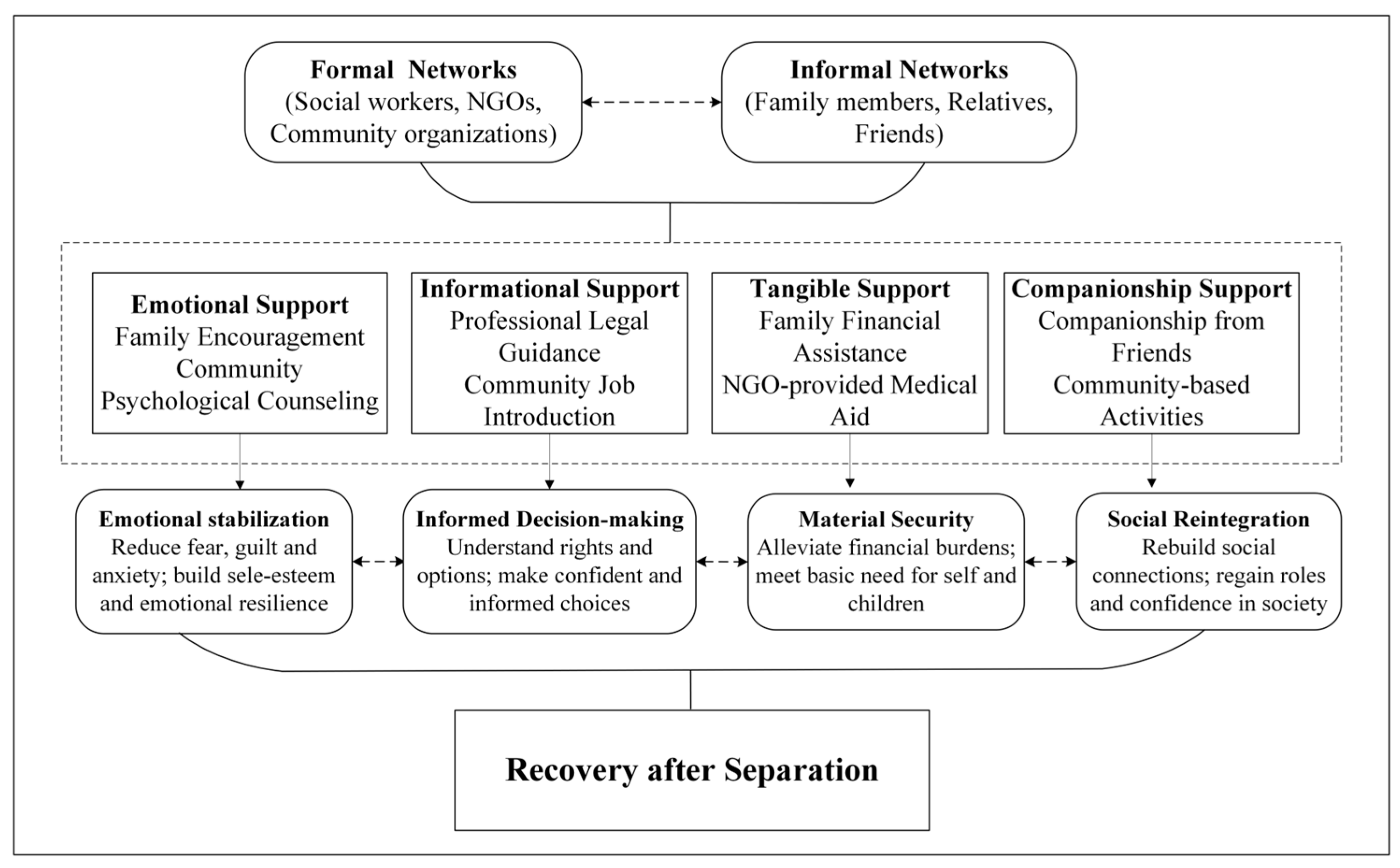
3.2.1. Emotional Support
After my ex-husband put me in the hospital, my parents, brother, and sister-in-law were by my side, taking care of me. They held my hand and cried, saying, “You have to stay strong, fight, and live on.(Source: Survivor 2)
The community provided me with psychological counseling to help me work through my mental and emotional struggles. When I first found out I was paralyzed, I couldn’t accept the reality…But after receiving counseling, I gradually calmed down. Thinking about my parents and my child, I knew I had to stay strong and fight for justice.(Source: Survivor 7)
3.2.2. Informational Support
I went to the community center and told them about my situation. The staff registered my information and helped me find a housekeeper job. I’m really very grateful to the community. The first day at work was a moment when I felt free again, earning money for myself, not under someone’s thumb’. This job has enabled me to achieve self-sufficiency.(Source: Survivor 5)
3.2.3. Tangible Support
My parents have to look after me in all aspects of daily life. They took out the savings they had worked hard for over half their lives to pay for my surgery. Relatives also extended a helping hand, lending me money so I could have the surgery as soon as possible.(Source: Survivor 8)
I shared my experience on social media, which drew widespread attention and support from netizens. I also received help from anti-domestic violence volunteers and related Non-Governmental Organizations. They assisted me in obtaining injury and disability assessments and helped me apply for medical assistance funds provided by the Yuanzhong Family and Community Development Service Center.(Source: Survivor 2)
3.2.4. Companionship Support
After the divorce, I stayed at a few friends’ houses. They helped me get phone numbers and rent apartments using their IDs. At that time, I was afraid to go out alone and worried that my ex-husband would find me. My friends always accompanied me and took me out shopping and relaxing. I really appreciated my friends’ company during that time.(Source: Survivor 2)
I was invited to participate in a cooking competition organized by the community. Since I’m pretty good at cooking, I even won a prize. Even though I’ve lost my family, I found a sense of home within the community.(Source: Survivor 5)
4. Discussion
5. Conclusions
6. Research Limitations
Author Contributions
Funding
Institutional Review Board Statement
Informed Consent Statement
Data Availability Statement
Acknowledgments
Conflicts of Interest
Abbreviations
| WHO | World Health Organization |
| NGO | Non-government organization |
| JADVS | Jinan Anti-Domestic Violence Shelter |
| IASC | Inter-Agency Standing Committee |
References
- Adams, A. E., Tolman, R. M., Bybee, D., Sullivan, C. M., & Kennedy, A. C. (2021). The impact of intimate partner violence on women’s economic well-being. Journal of Interpersonal Violence, 36(12), 5770–5792. [Google Scholar]
- Almış, B. H., Gümüştaş, F., & Kütük, E. K. (2020). Effects of domestic violence against women on mental health of women and children. Psikiyatride Guncel Yaklasimlar, 12(2), 232–242. [Google Scholar]
- Anderson, K. M., Renner, L. M., & Danis, F. S. (2012). Recovery: Resilience and growth in the aftermath of domestic violence. Violence Against Women, 18(11), 1279–1299. [Google Scholar] [CrossRef] [PubMed]
- Arendt, C. (2022). Unfulfilled needs of domestic violence survivors: A phenomenological study. Trevecca Nazarene University. [Google Scholar]
- Braun, V., & Clarke, V. (2013). Successful qualitative research: A practical guide for beginners. SAGE. [Google Scholar]
- Braun, V., & Clarke, V. (2021). Thematic analysis: A practical guide. Available online: https://uk.sagepub.com/en-gb/eur/thematic-analysis/book248481 (accessed on 8 January 2026).
- Brison, S. J. (2023). Aftermath: Violence and the remaking of a self. Available online: https://www.torrossa.com/gs/resourceProxy?an=5559739&publisher=FZO137 (accessed on 5 February 2026).
- Carman, M. J., & Kay-Lambkin, F. (2022). Long-term recovery from intimate partner violence: Recovery and hope. International Journal of Environmental Research and Public Health, 19(21), 13825. [Google Scholar] [CrossRef] [PubMed]
- Cattaneo, L. B., Stylianou, A. M., Hargrove, S., Goodman, L. A., Gebhard, K. T., & Curby, T. W. (2021). Survivor-centered practice and survivor empowerment: Evidence from a research–practitioner partnership. Violence Against Women, 27(9), 1252–1272. [Google Scholar] [CrossRef] [PubMed]
- Chen, J. (2024). The interplay of social norms and legal systems: Unraveling the complexity of domestic violence in China and paving the path for change. Challenger Research Journal, 5(1), 19–30. [Google Scholar] [CrossRef]
- Cheng, S.-Y., Lee, J., Schindeler, B., Kim, J. H., & Messing, J. T. (2025). Barriers and facilitators of help-seeking among Asian women survivors of intimate partner violence in the United States: A scoping review. Trauma, Violence, & Abuse. Online ahead of print. [Google Scholar] [CrossRef]
- Childress, S., Shrestha, N., Anekwe, K., Small, E., & McKay, M. (2022). Barriers to help-seeking for domestic violence in Kyrgyzstan: Perspectives of criminal justice, social, health, and educational professionals. Global Social Welfare, 9(3), 179–192. [Google Scholar] [CrossRef]
- Chua, S., Sabang, J. A., Chew, K. S., & Nohuddin, P. N. E. (2023). Textual analysis of tweets associated with domestic violence. Iranian Journal of Public Health, 52(11), 2402–2411. [Google Scholar] [CrossRef]
- Cordier, R., Chung, D., Wilkes-Gillan, S., & Speyer, R. (2021). The effectiveness of protection orders in reducing recidivism in domestic violence: A systematic review and meta-analysis. Trauma, Violence, & Abuse, 22(4), 804–828. [Google Scholar] [CrossRef]
- Creswell, J. W. (2014). Research design: Qualitative, quantitative, and mixed methods approaches (4th ed.). SAGE Publications. [Google Scholar]
- Davies, M., Satyen, L., & Toumbourou, J. W. (2026). Recovery after domestic, family and sexual violence: Impact of a holistic clinical support program on victim-survivors. Frontiers in Psychology, 17, 1742876. [Google Scholar] [CrossRef] [PubMed]
- Davies, R. L., Rice, K., & Rock, A. J. (2025). The potential burden of informal support: Exploring wellbeing and self-care of social network members of intimate partner violence survivors. Journal of Family Violence. [Google Scholar] [CrossRef]
- Denzin, N. K., & Lincoln, Y. S. (Eds.). (1994). Handbook of qualitative research. Sage Publications. [Google Scholar]
- Denzin, N. K., & Lincoln, Y. S. (2011). The Sage handbook of qualitative research. Sage. [Google Scholar]
- Ford-Gilboe, M., Varcoe, C., Noh, M., Wuest, J., Hammerton, J., Alhalal, E., & Burnett, C. (2015). Patterns and predictors of service use among women who have separated from an abusive partner. Journal of Family Violence, 30(4), 419–431. [Google Scholar] [CrossRef] [PubMed]
- Friesen, N., Henriksson, C., & Saevi, T. (Eds.). (2012). Hermeneutic phenomenology in education. SensePublishers. [Google Scholar] [CrossRef]
- García-Moreno, C., Hegarty, K., d’Oliveira, A. F. L., Koziol-McLain, J., Colombini, M., & Feder, G. (2015). The health-systems response to violence against women. The Lancet, 385(9977), 1567–1579. [Google Scholar] [CrossRef]
- Goodman, L. A., Fauci, J. E., Sullivan, C. M., DiGiovanni, C. D., & Wilson, J. M. (2016). Domestic violence survivors’ empowerment and mental health: Exploring the role of the alliance with advocates. American Journal of Orthopsychiatry, 86(3), 286–296. [Google Scholar] [CrossRef]
- Goodman-Williams, R., Simmons, C., Chiaramonte, D., Ayeni, O. O., Guerrero, M., Sprecher, M., & Sullivan, C. M. (2023). Domestic violence survivors’ housing stability, safety, and well-being over time: Examining the role of domestic violence housing first, social support, and material hardship. American Journal of Orthopsychiatry, 93(5), 402. [Google Scholar] [CrossRef]
- Goodson, A., & Hayes, B. E. (2021). Help-seeking behaviors of intimate partner violence victims: A cross-national analysis in developing nations. Journal of Interpersonal Violence, 36(9–10), NP4705–NP4727. [Google Scholar] [CrossRef]
- Green, J., Satyen, L., & Toumbourou, J. W. (2024). Influence of cultural norms on formal service engagement among survivors of intimate partner violence: A qualitative meta-synthesis. Trauma, Violence, & Abuse, 25(1), 738–751. [Google Scholar] [CrossRef]
- Gu, X., Li, H., & Peng, L. (2022). The anti-domestic violence law and women’s welfare: Evidence from a natural experiment in China. Journal of Economic Behavior & Organization, 202, 1–16. [Google Scholar] [CrossRef]
- Guest, G., Bunce, A., & Johnson, L. (2006). How many interviews are enough?: An experiment with data saturation and variability. Field Methods, 18(1), 59–82. [Google Scholar] [CrossRef]
- Hu, R., Xue, J., Lin, K., Sun, I. Y., Wu, Y., & Wang, X. (2021). The patterns and influencing factors of help-seeking decisions among women survivors of intimate partner violence in China. Journal of Family Violence, 36(6), 669–681. [Google Scholar] [CrossRef]
- Hu, R., Xue, J., & Wang, X. (2022). Migrant women’s help-seeking decisions and use of support resources for intimate partner violence in China. Violence Against Women, 28(1), 169–193. [Google Scholar] [CrossRef] [PubMed]
- Inter-Agency Standing Committee (IASC). (2007). IASC guidelines on mental health and psychosocial support in emergency settings. IASC. [Google Scholar]
- Johnson, L., Chen, Y., Stylianou, A., & Arnold, A. (2022). Examining the impact of economic abuse on survivors of intimate partner violence: A scoping review. BMC Public Health, 22(1), 1014. [Google Scholar] [CrossRef]
- Kavanagh, M., & Fassbender, C. (2024). Psychosocial needs of women in domestic violence services; perspectives of domestic violence staff in Ireland. Journal of Family Violence. [Google Scholar] [CrossRef]
- Khaironisak, H., Zaridah, S., Hasanain, F. G., & Zaleha, M. I. (2017). Prevalence, risk factors, and complications of violence against pregnant women in a hospital in Peninsular Malaysia. Women & Health, 57(8), 919–941. [Google Scholar] [CrossRef]
- Lakin, D. P., García-Moreno, C., & Roesch, E. (2022). Psychological interventions for survivors of intimate partner violence in humanitarian settings: An overview of the evidence and implementation considerations. International Journal of Environmental Research and Public Health, 19(5), 2916. [Google Scholar] [CrossRef] [PubMed]
- Li, H., Zakaria, N., & Zubir, A. (2024). Identification of recovery pathways for children and women victims of domestic violence among Malaysian. Journal of Human Security, 20(1), 61–71. [Google Scholar]
- Li, Y., Dong, F., & Xue, J. (2024). Help-seeking behaviors and associated factors among Chinese immigrant women experiencing intimate partner violence. Journal of Aggression, Maltreatment & Trauma, 33(11), 1399–1417. [Google Scholar] [CrossRef]
- Liamputtong, P. (2006). Researching the vulnerable: A guide to sensitive research methods. Available online: https://www.researchgate.net/publication/303015856_Researching_the_vulnerable_A_guide_to_sensitive_research_methods (accessed on 23 February 2026).
- Liang, D., Mays, V. M., & Hwang, W.-C. (2018). Integrated mental health services in China: Challenges and planning for the future. Health Policy and Planning, 33(1), 107–122. [Google Scholar] [CrossRef]
- Lincoln, Y. S. (1985). Naturalistic inquiry (Vol. 75). Sage. [Google Scholar]
- Liu, Y. K., Bradford, B., & Ristea, A. (2026). Sociocultural influences on attitudes and behaviors related to domestic and intimate partner violence: A qualitative study across British and Chinese contexts. Journal of Family Violence. [Google Scholar] [CrossRef]
- Lutgendorf, M. A. (2019). Intimate partner violence and women’s health. Obstetrics & Gynecology, 134(3), 470–480. [Google Scholar] [CrossRef]
- Machisa, M. T., Christofides, N., & Jewkes, R. (2018). Social support factors associated with psychological resilience among women survivors of intimate partner violence in Gauteng, South Africa. Global Health Action, 11(sup3), 1491114. [Google Scholar] [CrossRef]
- Masih, M., Wagstaff, C., & Kaur-Aujla, H. (2024). The global psychological and physical effects of domestic abuse and violence on South Asian women: A qualitative systematic review. Frontiers in Global Women’s Health, 5, 1365883. [Google Scholar] [CrossRef] [PubMed]
- Mellar, B. M., Fanslow, J. L., Gulliver, P. J., & McIntosh, T. K. D. (2024). Economic abuse by an intimate partner and its associations with women’s socioeconomic status and mental health. Journal of Interpersonal Violence, 39(21–22), 4415–4437. [Google Scholar] [CrossRef] [PubMed]
- Meyer, S. (2016). Still blaming the victim of intimate partner violence? Women’s narratives of victim desistance and redemption when seeking support. Theoretical Criminology, 20(1), 75–90. [Google Scholar] [CrossRef]
- Narayanan, S., Abd Rahman, F. N., Sutan, R., Kumarasuriar, G. K., & Leong, A. K. S. (2024). Prevalence and determinants of antenatal depression and its association with intimate partner violence: A cross-sectional study at hospital Melaka, Malaysia. Frontiers in Psychiatry, 15, 1466074. [Google Scholar] [CrossRef]
- Ogbe, E., Harmon, S., Van den Bergh, R., & Degomme, O. (2020). A systematic review of intimate partner violence interventions focused on improving social support and/mental health outcomes of survivors. PLoS ONE, 15(6), e0235177. [Google Scholar] [CrossRef] [PubMed]
- Papas, L., Hollingdrake, O., & Currie, J. (2023). Social determinant factors and access to health care for women experiencing domestic and family violence: Qualitative synthesis. Journal of Advanced Nursing, 79(5), 1633–1649. [Google Scholar] [CrossRef]
- Patton, M. Q. (2014). Qualitative research & evaluation methods: Integrating theory and practice. Sage Publications. [Google Scholar]
- Postmus, J. L., Hoge, G. L., Breckenridge, J., Sharp-Jeffs, N., & Chung, D. (2020). Economic abuse as an invisible form of domestic violence: A multicountry review. Trauma, Violence, & Abuse, 21(2), 261–283. [Google Scholar] [CrossRef]
- Qi, F., Wu, Y., & Wang, Q. (2020). Anti-domestic violence law: The fight for women’s legal rights in China. Asian Journal of Women’s Studies, 26(3), 383–396. [Google Scholar] [CrossRef]
- Robinson, S. R., Maxwell, D. R., & Rogers, K. R. (2020). Living in intimate partner violence shelters: A qualitative interpretive meta-synthesis of women’s experiences. The British Journal of Social Work, 50(1), 81–100. [Google Scholar] [CrossRef]
- Said, M. H. B. M., & Kaka, G. E. (2023). Domestic violence in cross-border marriages: A systematic review. Trauma Violence & Abuse, 24(3), 1483–1502. [Google Scholar] [CrossRef]
- Sapkota, D., Baird, K., Anderson, D., Saito, A., & Seib, C. (2022). Self-efficacy and social support as mediators of mental health among abused women. Nursing & Health Sciences, 24(2), 458–468. [Google Scholar] [CrossRef]
- Schmidt, M., Kedia, S. K., Dillon, P. J., & Howell, K. H. (2023). Challenges to help-seeking among women of color exposed to intimate partner violence. Journal of Interpersonal Violence, 38(13–14), 8088–8113. [Google Scholar] [CrossRef] [PubMed]
- Schucan Bird, K. L., Stokes, N., & Rivas, C. (2025). Interventions for improving informal social support for victim-survivors of domestic violence and abuse: An evidence and gap map. Campbell Systematic Reviews, 21(2), e70026. [Google Scholar] [CrossRef]
- Seff, I., Meinhart, M., Sarraf, D., Abu Zuhair, A., Sofia, J., Atuheire, R., Lee, J., Ahmed, N., Poulton, C., & Stark, L. (2024). Women’s collectives and social support: Exploring pathways and impacts among forcibly displaced women. Frontiers in Sociology, 9, 1409332. [Google Scholar] [CrossRef]
- Shenton, A. K. (2004). Strategies for ensuring trustworthiness in qualitative research projects. Education for Information, 22(2), 63–75. [Google Scholar] [CrossRef]
- Song, Y., Zhang, J., & Zhang, X. (2021). Cultural or institutional? Contextual effects on domestic violence against women in rural China. Journal of Family Violence, 36(6), 643–655. [Google Scholar] [CrossRef]
- Sontate, K. V., Rahim Kamaluddin, M., Naina Mohamed, I., Mohamed, R. M. P., Shaikh, M. F., Kamal, H., & Kumar, J. (2021). Alcohol, aggression, and violence: From public health to neuroscience. Frontiers in Psychology, 12, 699726. [Google Scholar] [CrossRef]
- Spearman, K. J., Vaughan-Eden, V., Hardesty, J. L., & Campbell, J. (2024). Post-separation abuse: A literature review connecting tactics to harm. Journal of Family Trauma Child Custody & Child Development, 21(2), 145–164. [Google Scholar] [CrossRef]
- Sripada, P. (2021). Help-seeking behavior of South Asian women in domestic violence: A scoping review. Journal of Human Behavior in the Social Environment, 31(6), 729–750. [Google Scholar] [CrossRef]
- Stylianou, A. M. (2018). Economic abuse within intimate partner violence: A review of the literature. Violence and Victims, 33(1), 3–22. [Google Scholar] [CrossRef] [PubMed]
- Su, Z., McDonnell, D., Cheshmehzangi, A., Ahmad, J., Chen, H., Šegalo, S., & Cai, Y. (2022). What “family affair?” Domestic violence awareness in China. Frontiers in Public Health, 10, 795841. [Google Scholar] [CrossRef]
- Sullivan, C. M. (2018). Understanding how domestic violence support services promote survivor well-being: A conceptual model. Journal of Family Violence, 33(2), 123–131. [Google Scholar] [CrossRef]
- Sun, I. Y., Wu, Y., Wang, X., & Xue, J. (2022). Officer and organizational correlates with police interventions in domestic violence in China. Journal of Interpersonal Violence, 37(11–12), NP8325–NP8349. [Google Scholar] [CrossRef] [PubMed]
- Sylaska, K. M., & Edwards, K. M. (2014). Disclosure of intimate partner violence to informal social support network members: A review of the literature. Trauma, Violence, & Abuse, 15(1), 3–21. [Google Scholar] [CrossRef]
- Tam, D. M., Schleicher, K., Wu, W., Kwok, S.-M., Thurston, W. E., & Dawson, M. (2016). Social work interventions on intimate partner violence against women in China. Journal of Social Work, 16(2), 228–249. [Google Scholar] [CrossRef]
- Thomson, G., Cull, J., Kuroski, J., Kuipers, Y., Leinweber, J., Karlsdottir, S. I., & Burns, L. (2026). Peer support for women who have experienced interpersonal trauma or abuse: An integrative review. Scandinavian Journal of Caring Sciences, 40(1), e70179. [Google Scholar] [CrossRef]
- Tisdell, E. J., Merriam, S. B., & Stuckey-Peyrot, H. L. (2025). Qualitative research: A guide to design and implementation. John Wiley & Sons. [Google Scholar]
- Trabold, N., McMahon, J., Alsobrooks, S., Whitney, S., & Mittal, M. (2020). A systematic review of intimate partner violence interventions: State of the field and implications for practitioners. Trauma, Violence, & Abuse, 21(2), 311–325. [Google Scholar] [CrossRef]
- Wang, X., Hayes, B. E., & Zhang, H. (2020). Correlates of Chinese police officer decision-making in cases of domestic violence. Crime & Delinquency, 66(11), 1556–1578. [Google Scholar] [CrossRef]
- Wang, Y., Chung, M. C., Wang, N., Yu, X., & Kenardy, J. (2021). Social support and posttraumatic stress disorder: A meta-analysis of longitudinal studies. Clinical Psychology Review, 85, 101998. [Google Scholar] [CrossRef]
- Wessells, M. G., & Kostelny, K. (2022). The psychosocial impacts of intimate partner violence against women in LMIC contexts: Toward a holistic approach. International Journal of Environmental Research and Public Health, 19(21), 14488. [Google Scholar] [CrossRef]
- White, S. J., Sin, J., Sweeney, A., Salisbury, T., Wahlich, C., Montesinos Guevara, C. M., Gillard, S., Brett, E., Allwright, L., Iqbal, N., Khan, A., Perot, C., Marks, J., & Mantovani, N. (2024). Global prevalence and mental health outcomes of intimate partner violence among women: A systematic review and meta-analysis. Trauma, Violence, & Abuse, 25(1), 494–511. [Google Scholar] [CrossRef]
- Williams, K., Harb, M., Satyen, L., & Davies, M. (2024). s-CAPE trauma recovery program: The need for a holistic, trauma-and violence-informed domestic violence framework. Frontiers in Global Women’s Health, 5, 1404599. [Google Scholar] [CrossRef]
- Winkler, K. P. (2005). The Cambridge companion to Berkeley. Cambridge University Press. [Google Scholar]
- World Health Organization (WHO). (2013). Building back better: Sustainable mental health care after emergencies. WHO. [Google Scholar]
- World Health Organization (WHO). (2021). Violence against women prevalence estimates, 2018: Global, regional and national prevalence estimates for intimate partner violence against women and global and regional prevalence estimates for non-partner sexual violence against women. WHO. [Google Scholar]
- Xue, J., Lin, K., Li, L., Wang, H. H., & Sun, I. (2024). Supportive interventions of Chinese police in domestic violence: Do officer knowledge and training matter? Journal of Interpersonal Violence, 39(15–16), 3508–3542. [Google Scholar] [CrossRef]
- Yuan, W., Kadetz, P. I., Shen, X., & Hesketh, T. (2024). Women’s experience of domestic violence: A qualitative study in Hangzhou, China. Journal of Family Violence. [Google Scholar] [CrossRef]
- Zhang, T., Ren, G., Ge, H., & Zhang, H. (2025). Factors influencing formal and informal help-seeking behavior among battered Chinese women in Beijing, Shanghai, Guangzhou, and Shenzhen. Behavioral Sciences, 15(7), 961. [Google Scholar] [CrossRef] [PubMed]


| Characteristics | M (SD) or N (%) |
|---|---|
| Age | |
| Mean (SD) | 39.6 (5.4) |
| Education level | |
| Junior high school | 2 (20) |
| Senior high school | 4 (40) |
| Junior college | 4 (40) |
| Occupation | |
| Employed | 7 (70) |
| Unemployed | 2 (20) |
| Self-employed | 1 (10) |
| Number of children | |
| One child | 9 (90) |
| Two children | 1 (10) |
| Duration of marriage | |
| 1–10 years | 4 (40) |
| 10 years and above | 6 (60) |
| Duration of divorce | |
| 1–2 years | 7 (70) |
| 3–5 years | 3 (30) |
| Type of abuse experienced | |
| Physical and emotional | 8 (80) |
| Physical, emotional and sexual | 2 (20) |
Disclaimer/Publisher’s Note: The statements, opinions and data contained in all publications are solely those of the individual author(s) and contributor(s) and not of MDPI and/or the editor(s). MDPI and/or the editor(s) disclaim responsibility for any injury to people or property resulting from any ideas, methods, instructions or products referred to in the content. |
© 2026 by the authors. Licensee MDPI, Basel, Switzerland. This article is an open access article distributed under the terms and conditions of the Creative Commons Attribution (CC BY) license.
Share and Cite
Cui, Y.; Aun, N.S.M.; Mohamad, M.S.; Rajaratnam, S. Psychosocial Support Promoting Recovery Among Women Survivors of Domestic Violence After Separation in China: A Qualitative Study. Behav. Sci. 2026, 16, 884. https://doi.org/10.3390/bs16060884
Cui Y, Aun NSM, Mohamad MS, Rajaratnam S. Psychosocial Support Promoting Recovery Among Women Survivors of Domestic Violence After Separation in China: A Qualitative Study. Behavioral Sciences. 2026; 16(6):884. https://doi.org/10.3390/bs16060884
Chicago/Turabian StyleCui, Yingying, Nur Saadah Mohamad Aun, Mohd Suhaimi Mohamad, and Surendran Rajaratnam. 2026. "Psychosocial Support Promoting Recovery Among Women Survivors of Domestic Violence After Separation in China: A Qualitative Study" Behavioral Sciences 16, no. 6: 884. https://doi.org/10.3390/bs16060884
APA StyleCui, Y., Aun, N. S. M., Mohamad, M. S., & Rajaratnam, S. (2026). Psychosocial Support Promoting Recovery Among Women Survivors of Domestic Violence After Separation in China: A Qualitative Study. Behavioral Sciences, 16(6), 884. https://doi.org/10.3390/bs16060884