Beyond the Individual: A Scoping Review of Group and Community Dimensions of Youth Empowerment
 , ,
, ,
Abstract
1. Introduction and Theoretical Framework
2. Method
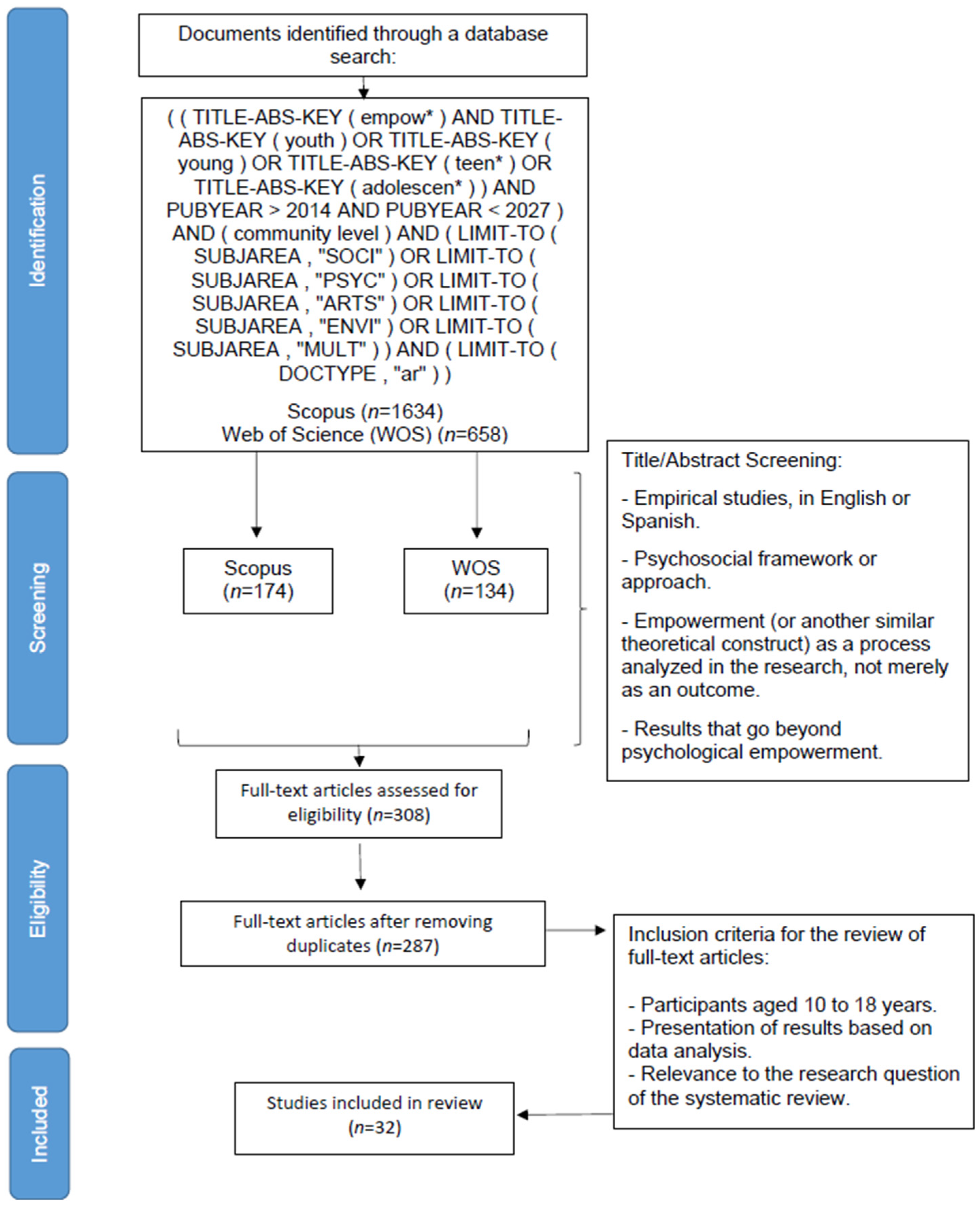
2.1. Identification of Primary Studies
2.2. Screening
2.3. Full-Text Review and Selection of the Final Sample
2.4. Data Analysis
3. Results
3.1. Characteristics of the Studies
3.2. Types of Psychosocial Interventions
3.2.1. Settings and Contexts of Implementation
3.2.2. Intervention Strategies
3.3. Study Designs
3.4. Group and Community Empowerment
3.4.1. Group-Level Empowerment
Building Social Support Ties and a Sense of Belonging
Collaborative Action and Participation in Decision-Making Within Projects
3.4.2. Community-Level Empowerment
Civic Participation, Co-Design, and Co-Governance
Transformation of Power Relations and Public Legitimacy
4. Discussion
5. Conclusions
5.1. Implications for Practice
5.2. Future Directions
Author Contributions
Funding
Institutional Review Board Statement
Informed Consent Statement
Data Availability Statement
Conflicts of Interest
References
- Abraczinskas, M., & Zarrett, N. (2020). Youth participatory action research for health equity: Increasing youth empowerment and decreasing physical activity access inequities in under-resourced programs and schools. American Journal of Community Psychology, 66(3–4), 232–243. [Google Scholar] [CrossRef] [Scilit] [PubMed]
- Adu, J., Oudshoorn, A., Van Berkum, A., Pervez, R., Norman, R., Canas, E., Virdee, M., Yosieph, L., & MacDougall, A. G. (2022). System transformation to enhance transitional age youth mental health: A scoping review. Child and Adolescent Mental Health, 27(4), 399–418. [Google Scholar] [CrossRef] [Scilit] [PubMed]
- Bastable, K., Cooke, P., Harvey, L., Olarte, V., Casteleijn, D., & Dada, S. (2023). Changing the story: The evaluation of a leadership development programme for vulnerable and deaf youth in South Africa. Social Sciences, 12(11), 631. [Google Scholar] [CrossRef] [Scilit]
- Brown, L. D., Redelfs, A. H., Taylor, T. J., & Messer, R. L. (2015). Comparing the functioning of youth and adult partnerships for health promotion. American Journal of Community Psychology, 56(1–2), 25–35. [Google Scholar] [CrossRef] [Scilit]
- Buelens, E., Theeboom, M., Vertonghen, J., & De Martelaer, K. (2017). Conditions for successfully increasing disadvantaged adolescents’ engagement in and development through volunteering in community sport. Social Inclusion, 5(2), 179–197. [Google Scholar] [CrossRef] [Scilit]
- Cardarelli, K. M., Ickes, M., Huntington-Moskos, L., Wilmhoff, C., Larck, A., Pinney, S. M., & Hahn, E. J. (2021). Authentic youth engagement in environmental health research and advocacy. International Journal of Environmental Research and Public Health, 18(4), 2154. [Google Scholar] [CrossRef] [Scilit]
- Cargo, M., Grams, G. D., Ottoson, J. M., Ward, P., & Green, L. W. (2003). Empowerment as fostering positive youth development and citizenship. American Journal of Health Behavior, 27(Suppl. S1), S66–S79. [Google Scholar] [CrossRef] [Scilit]
- Case, A. D. (2017). A critical-positive youth development model for intervening with minority youth at risk for delinquency. American Journal of Orthopsychiatry, 87(5), 510–519. [Google Scholar] [CrossRef] [Scilit]
- Chong, Y.-Y., Sherry, E., Harith, S., & Khoo, S. (2022). Sport for development programs contributing to sustainable development goal 5: A review. Sustainability, 14(11), 6828. [Google Scholar] [CrossRef] [Scilit]
- Christens, B. D. (2012). Toward relational empowerment. American Journal of Community Psychology, 50(1–2), 114–128. [Google Scholar] [CrossRef] [Scilit]
- Christens, B. D. (2023). Building community power: An introduction. In B. D. Christens (Ed.), The Cambridge handbook of community power (pp. 1–32). Cambridge University Press. [Google Scholar] [CrossRef] [Scilit]
- Cicognani, E., Mazzoni, D., Albanesi, C., & Zani, B. (2015). Sense of community and empowerment among young people: Understanding pathways from civic participation to social well-being. Voluntas: International Journal of Voluntary and Nonprofit Organizations, 26(1), 24–44. [Google Scholar] [CrossRef] [Scilit]
- Council of the European Union. (2018). Resolution of the Council of the European Union and the representatives of the governments of the member states meeting within the Council on a framework for European cooperation in the youth field: The European Union youth strategy 2019–2027. Official Journal of the European Union, C456, 1–22. [Google Scholar]
- Cyril, S., Smith, B. J., & Renzaho, A. M. (2016). Systematic review of empowerment measures in health promotion. Health Promotion International, 31(4), 809–826. [Google Scholar] [CrossRef] [Scilit]
- Diaz, A. L., & Paceley, M. S. (2024). Youth–adult partnerships for youth activism: A critique of the utility of empowerment theory. Critical and Radical Social Work, 12(4), 456–472. [Google Scholar] [CrossRef] [Scilit]
- Dill, L. J. (2015). Poetic justice: Engaging in participatory narrative analysis to find solace in the “killer corridor”. American Journal of Community Psychology, 55(1–2), 128–135. [Google Scholar] [CrossRef] [Scilit]
- Ellington, A., Hice-Fromille, T., London, R. A., Cariño, T. M., & Otero, L. (2023). Las voces de mujercitas empoderadas: Documenting support for youth with youth participatory action research. Social Sciences, 12(9), 483. [Google Scholar] [CrossRef] [Scilit]
- Elsevier. (2026). Scopus content policy and selection. Available online: https://www-elsevier-com.sire.ub.edu/products/scopus/content/content-policy-and-selection (accessed on 13 May 2026).
- Farahzadi, S., Maarefvand, M., & Hosselnzadeh, S. (2025). Addressing complex needs: Assertive community treatment with Afghan migrant adolescents in Iran. Child and Adolescent Social Work Journal. [Google Scholar] [CrossRef] [Scilit]
- Favre, C. A., Kassis, W., & Aksoy, D. (2025). Cocreating awareness and fostering action on violence resilience: Urban film-making. Video Journal of Education and Pedagogy, 10(1), 1–23. [Google Scholar] [CrossRef] [Scilit]
- Ferrer-Fons, M., Rovira-Martínez, M., & Soler-i-Martí, R. (2022). Youth empowerment through arts education: A case study of a non-formal education arts centre in Barcelona. Social Inclusion, 10(2), 85–94. [Google Scholar] [CrossRef] [Scilit]
- Forbes-Genade, K., & van Niekerk, D. (2018). GIRRL power! Participatory action research for building girl-led community resilience in South Africa. Action Research, 17(2), 237–257. [Google Scholar] [CrossRef] [Scilit]
- Godfrey, E. B., & Grayman, J. K. (2014). Teaching citizens: The role of open classroom climate in fostering critical consciousness among youth. Journal of Youth and Adolescence, 43, 1801–1817. [Google Scholar] [CrossRef] [Scilit]
- González, S. A., Rubio, M. A., Triana, C. A., King, A. C., Banchoff, A. W., & Sarmiento, O. L. (2022). Building healthy schools through technology-enabled citizen science: The case of the Our Voice participatory action model in schools from Bogotá, Colombia. Global Public Health, 17(3), 403–419. [Google Scholar] [CrossRef] [Scilit]
- Goodkind, S., Brinkman, B. G., & Elliott, K. (2020). Redefining resilience and reframing resistance: Empowerment programming with Black girls to address societal inequities. Behavioral Medicine, 46(3–4), 317–329. [Google Scholar] [CrossRef] [Scilit]
- Gough, D., Thomas, J., & Oliver, S. (2012). Clarifying differences between review designs and methods. Systematic Reviews, 1, 28. [Google Scholar] [CrossRef] [Scilit]
- Hillel Lavian, R. (2018). “Society judges us only by what is different, dreadlocks, piercings and tattoos”: Photovoice as a method for the empowerment of youth at risk. Journal of Special Education and Rehabilitation, 19(1–2), 101–118. [Google Scholar] [CrossRef] [Scilit]
- Horwitz, C., & Mares, T. M. (2025). Empowering teens through food justice: An exploration of youth development programs. Journal of Agriculture, Food Systems, and Community Development, 14(2), 325–338. [Google Scholar] [CrossRef] [Scilit]
- Jennings, L. B., Parra-Medina, D. M., Hilfinger-Messias, D. K., & McLoughlin, K. (2006). Toward a critical social theory of youth empowerment. Journal of Community Practice, 14(1–2), 31–55. [Google Scholar] [CrossRef] [Scilit]
- Kennedy, H., DeChants, J., Bender, K., & Anyon, Y. (2019). More than data collectors: A systematic review of the environmental outcomes of youth inquiry approaches in the United States. American Journal of Community Psychology, 63(1–2), 208–226. [Google Scholar] [CrossRef] [Scilit] [PubMed]
- Khan, R. (2022). Beyond empowerment and inspiration: Toward a critical program for multicultural youth leadership. Journal of Youth Studies, 25(9), 1284–1300. [Google Scholar] [CrossRef] [Scilit]
- Lardier, D. T., Jr., Powell, K. G., Verdezoto, C. S., Rivera, A. M., Peterson, N. A., & Reid, R. J. (2024). Empowerment and substance use prevention among youth of color: A scoping review. Current Addiction Reports, 11, 838–868. [Google Scholar] [CrossRef] [Scilit]
- Lasczik, T., Lasczik, A., & Cutter-Mackenzie-Knowles, A. (2025). Artivist childhoods. International Journal of Art & Design Education, 44(2), 462–478. [Google Scholar] [CrossRef] [Scilit]
- Lopez-Cortes, O. D., Betancourt-Núñez, A., Bernal Orozco, M. F., & Vizmanos, B. (2022). Scoping reviews: Una nueva forma de síntesis de la evidencia. Investigación en Educación Médica, 11(44), 98–104. [Google Scholar] [CrossRef] [Scilit]
- Massó Guijarro, B. (2018). Drama as a social and educational tool in a challenging context: Analysis of an experience. The International Journal of Pedagogy and Curriculum, 25(4), 17–31. [Google Scholar] [CrossRef] [Scilit]
- McKay, T. E., Kan, M. L., Landweh, R., & Miller, E. (2022). When disclosure isn’t the goal: Exploring responses to partner violence victimization screening and universal education among youth and adults. Journal of Family Violence, 37, 487–504. [Google Scholar] [CrossRef] [Scilit]
- Monteiro, E. M. L. M., Brandão Neto, W., Soares de Lima, L., de Aquino, J. M., Gontijo, D. T., & Pereira, B. O. (2015). Culture circles in adolescent empowerment for the prevention of violence. International Journal of Adolescence and Youth, 20(2), 167–184. [Google Scholar] [CrossRef] [Scilit] [PubMed]
- Montes, F., Guerra, A. M., Higuera-Mendieta, D., De La Vega-Taboada, E., King, A. C., Banchoff, A., Rodríguez Maturana, A. C., & Sarmiento, O. L. (2022). Our voice in a rural community: Empowering Colombian adolescents to advocate for school community well-being through citizen science. BMC Public Health, 22(1), 2411. [Google Scholar] [CrossRef] [Scilit]
- Moreno Álvarez, M. D. (2025). Urban and youth transformations in Envigado: Connection with oneself, others, and the environment. The Journal of Public Space, 10(1), 117–136. [Google Scholar] [CrossRef] [Scilit]
- Mouchrek, N., & Benson, M. (2023). The theory of integrated empowerment in the transition to adulthood: Concepts and measures. Frontiers in Sociology, 8, 893898. [Google Scholar] [CrossRef] [Scilit] [PubMed]
- Perkins, D. D., Mihaylov, N. L., & Bess, K. D. (2023). Organizational and coalition strategies for youth violence prevention: A longitudinal mixed-methods study. American Journal of Criminal Justice, 48, 1105–1131. [Google Scholar] [CrossRef] [Scilit]
- Rappaport, J. (1984). Studies in empowerment: Introduction to the issue. Prevention in Human Services, 3(2–3), 1–7. [Google Scholar] [CrossRef] [Scilit]
- Ruhr, L. R., & Fowler, L. J. (2022). Empowerment-focused positive youth development programming for underprivileged youth in the Southern U.S.: A qualitative evaluation. Children and Youth Services Review, 143, 106684. [Google Scholar] [CrossRef] [Scilit]
- Scholtes-Bos, W., van Lieshout, M., van Roost, M. H. I., & de Vries, S. I. (2025). Beyond healthy eating: The broader impact of the Food Boost Challenge’s participatory approach with young people. Social Sciences, 14(4), 246. [Google Scholar] [CrossRef] [Scilit]
- Small, S., & Memmo, M. (2004). Contemporary models of youth development and problem prevention: Toward an integration of terms, concepts, and models. Family Relations, 53(1), 3–11. [Google Scholar] [CrossRef] [Scilit]
- Soler-Masó, P., Úcar, X., Planas-Lladó, A., González-Martínez, J., & Llena-Berñe, M. A. (2025). Can communities facilitate youth empowerment? A systematic analysis. Community Development, 57(3), 344–362. [Google Scholar] [CrossRef] [Scilit]
- Thulin, E. J., Lee, D. B., Eisman, A. B., Reischl, T. M., Hutchison, P., Franzen, S., & Zimmerman, M. A. (2022). Longitudinal effects of Youth Empowerment Solutions: Preventing youth aggression and increasing prosocial behavior. American Journal of Community Psychology, 70(1–2), 75–88. [Google Scholar] [CrossRef] [Scilit]
- To, S., Chun-Sing Cheung, J., Liu, X., Lau, C. D., Zeng, H. J., & Chan, A. M. (2020). Youth empowerment in the community and young people’s creative self-efficacy: The moderating role of youth–adult partnerships in youth service. Youth & Society, 53(6), 1021–1043. [Google Scholar] [CrossRef] [Scilit]
- Tricco, A. C., Lillie, E., Zarin, W., O’Brien, K. K., Colquhoun, H., Levac, D., Moher, D., Peters, M. D. J., Horsley, T., Weeks, L., Hempel, S., Akl, E. A., Chang, C., McGowan, J., Stewart, L., Hartling, L., Aldcroft, A., Wilson, M. G., Garritty, C., … Straus, S. E. (2018). PRISMA extension for scoping reviews (PRISMA-ScR): Checklist and explanation. Annals of Internal Medicine, 169(7), 467–473. [Google Scholar] [CrossRef] [Scilit]
- Trott, C. D., Rockett, M. L., Gray, E. S., Lam, S., Even, T. L., & Frame, S. M. (2020). “Another Haiti starting from the youth”: Integrating the arts and sciences for empowering youth climate justice action in Jacmel, Haiti. Community Psychology in Global Perspective, 6(2), 48–70. [Google Scholar]
- Universidad de Córdoba. (2025). Biblioteca universitaria. Web of science (wos): Proceso de evaluación y criterios de selección de revistas. Available online: https://biblioguias.uco.es/c.php?g=665969&p=5128516 (accessed on 13 May 2026).
- Úcar Martínez, X., Jiménez-Morales, M., Soler Masó, P., & Trilla Bernet, J. (2017). Exploring the conceptualization and research of empowerment in the field of youth. International Journal of Adolescence and Youth, 22(4), 405–418. [Google Scholar] [CrossRef] [Scilit]
- Valdez, E. S., Skobic, I., Valdez, L., O Garcia, D., Korchmaros, J., Stevens, S., Sabo, S., & Carvajal, S. (2020). Youth participatory action research for youth substance use prevention: A systematic review. Substance Use & Misuse, 55(2), 314–328. [Google Scholar] [CrossRef] [Scilit]
- Wagaman, M. A., Howell, K., Teresa, B., Hefner, R., Woehrle, H., Haynes, T. S., & Lawrence, J. (2023). Youth participatory action research as an empowerment-based method for community change. Journal of Community Practice, 31(3–4), 297–314. [Google Scholar] [CrossRef] [Scilit]
- Wellman, R. L., Henderson, A., Coleman, R., Hill, C., & Davey, B. T. (2025). Assessment of a youth climate empowerment program: Climate READY. Geoscience Communication, 8, 1–46. [Google Scholar] [CrossRef] [Scilit]
- Wenitong-Schrieber, L., Tranby, S., Caelli, N., Nona, M., Jose, S., Rosendale, D., & Ketchell, S. (2024). Reclaiming our future: The establishment of a youth-led community-based Aboriginal and Torres Strait Islander empowerment organisation in Australia. Youth Voice Journal, 14(5), 1–33. [Google Scholar]
- Zimmerman, M. A. (2000). Empowerment theory: Psychological, organizational, and community levels of analysis. In J. Rappaport, & E. Seidman (Eds.), Handbook of community psychology (pp. 43–63). Springer. [Google Scholar] [CrossRef] [Scilit]
- Zuma, T., Seeley, J., Hlongwane, S., Chimbindi, N., Sherr, L., Floyd, S., Birdthistle, I., & Shahmanesh, M. (2022). A socio-ecological approach to understanding experiences and perceptions of a multilevel HIV prevention intervention: The determined, resilient, empowered, AIDS-free, mentored, and safe (DREAMS) partnership in uMkhanyakude, KwaZulu-Natal, South Africa. SSM—Qualitative Research in Health, 2, 100138. [Google Scholar] [CrossRef] [Scilit]


| Authors & Year | Objectives | Design | Participants (Characteristics of Participating Adolescents) | Data & Analysis | Key Findings on Empowerment at the Group and Community Levels |
|---|---|---|---|---|---|
| (Abraczinskas & Zarrett, 2020) | Feasibility of YPAR (Youth participatory action research) and YPAR + PA (Physical activity) | Mixed methods | 64 students (female = 41) aged 11–15. 94% non-Hispanic Black/African American, 75% free/reduced lunch in the southeastern United States. | Youth Empowerment Scale (Quan) + journals, surveys, photovoice, interviews (Qual). Triangulation. | Youth shared decision-making; systems-level change requires a stakeholder support at multiple levels. YPAR + PA increased influence. Youth are viewed as experts from within, whose perspectives can bring about changes that “top-down” approaches often overlook. |
| (Bastable et al., 2023) | Evaluate Changing the Story, Leadership Development Programme within the Youth Accountability and Deaf Inclusion in South Africa | Q-method, a participatory research methodology. | 38 youth (12–21 years of age) participated in the programme from a safe park (n = 23 vulnerable youth) and a special needs school (n = 15 Deaf youth). | Longitudinal Q-sort methodology to measure the youths’ changes in perceptions. | Youth gained insight into themselves not only as individuals, but as individuals who could guide others and contribute to their communities. |
| (Brown et al., 2015) | Compare youth partnerships (Paso del Norte Health Foundation and focused on tobacco control) with that of adults in health promotion. | Quantitative. Cross-sectional comparative study. | Youth participants (n = 44) were predominantly Hispanic, 45% female, and had an average age of 13 years. | Multidimensional battery of 10 partnership functioning constructs. | Youth–adult partnerships operate comparably to adult partnerships, offering young people substantive opportunities for agency, including skill development, relationship building, meaningful contribution, and engagement in change-oriented actions that foster civic identity. Young people face heightened participation barriers; however, these can be reduced through organizational adaptations that promote inclusion and strengthen advocacy capacity. |
| (Buelens et al., 2017) | Sufficient conditions necessary to foster human capital development among disadvantaged adolescents through volunteering in community sport. | Phenomenological Analysis (IPA) approach was used across eight community sport programmes within the “Street Action” initiative in Flanders. | Adolescents: 26 disadvantaged young people (M = 13.8; SD = 2.14), participating in four focus groups. | Semi-structured, in-depth interviews, Focus groups, Observations, Documentary analysis, Round-table discussion with sport partners. Inductive analysis. | These processes are associated with personal and interpersonal competencies. Their alignment with critical youth empowerment frameworks is only partial. Most programs do not reach the more transformative dimensions of critical empowerment. |
| (Cardarelli et al., 2021) | Critical components of authentic youth engagement in environmental health promotion, science communication, advocacy and research. | Comparative case study analysis of four initiatives on youth engagement to promote environmental education in rural (Central Appalachia) and urban (Cincinnati, Ohio) communities, using the Youth Empowerment Solutions (YES!) framework. | 1. Mountain Air Youth Photovoice Project (10 participants aged 13–18). 2. Citizen Science Program (over 100 high school students) 3. Medical Camp (24 participants per session, 5th-8th grade urban youth) 4. Youth Tobacco Advocacy Training Program (20 youth in development phase; 80 youth in implementation phase). Workshop: 60 participants. | Categorization of case study elements using the Youth Empowerment Solutions (YES!) | Youth empowerment as a multilevel construct. Youth demonstrated agency to influence environmental health issues through real-world engagement; however, action-oriented opportunities remained comparatively scarce. Authentic youth engagement is framed as essential, requiring meaningful leadership roles, transparent decision-making processes, and institutional recognition of youth voice. The proposed model positions empowerment as an intergenerational, collaborative process. Barriers operate across individual, organizational and community levels. |
| (Case, 2017) | Propose a model of intervening that integrates positive youth development (PYD) and critical theory to address the social-structural inequalities faced by minority youths from low-income urban communities (LUC). | Ethnographic study (9 months). | Youth participants: 9 African American youths (mean age 18) involved in Peer Ambassadors (PA) in Champaign, Illinois. | Observations, Semi-structured interviews, Fieldnotes documenting observations. Thematic analysis. | Youth empowerment at the interpersonal and community levels was reported through their enactment of highly visible, responsibility-laden roles which expanded their perceived agency and civic influence. These roles fostered recognition as legitimate social actors. The program functioned as a counterspace that replaced deficit-oriented labels with a collective identity grounded in public engagement, enabling the emergence of counternarratives affirming youths’ value and civic potential. Supportive peer relationships further operated as structured systems of care. Community engagement enabling youth to develop civic competencies, navigate community systems, and form identities. Empowerment described as relational, collective, civic, identity-based, and action-oriented aligning with critical perspectives. |
| (Cicognani et al., 2015) | Organizational membership effects in different types of community and youth organizations on young people’s Social well-being. | Cross-sectional quantitative study. | 835 adolescents and young adults. Age: 16–26 years. Adolescents (16–19): 38.1%. Gender: 50.4% female. From Emilia Romagna region (North Italy). | Structured questionnaire Included descriptive analyses, ANOVA, hierarchical regression, and bootstrapped mediation models. | Membership in organizations consistently strengthens young people’s empowerment (whether through occasional or ongoing participation). Empowerment functions as a central mediating mechanism between organizational participation and social well-being. Youth empowerment emerges within relational and participatory contexts that support youth voice, shared decision-making, opportunities to enact agency, and supportive organizational relationships. |
| (Dill, 2015) | Detail how youth engaged in participatory narrative analysis and asserted themselves as expert researchers and storytellers of their neighborhood. | Ethnographic study evolving into critical ethnography and youth participatory action research (YPAR), incorporating research poetry and interpretive poetry as methodological innovations. | 25 African American and Latino youth, aged 12–20, recruited from multiple programs in East Oakland. | Semi-structured interviews, Participant observation for 8 months, Poetry workshops. Analysis occurred collaboratively, culminating in a poetry anthology. | Youth empowerment is enacted through their positioning as co-researchers. Participatory narrative and poetic methods further strengthen youth narrative agencies, enabling them to contest deficit-based portrayals, articulate complex socio-emotional experiences, and reclaim representational power. Public dissemination of poetic work expands their civic agency. Collective empowerment emerges through research collective, which facilitates shared reflection, mutual support, and the co-construction of multi-layered identities. Spirituality serves as a framework for coping and seeking meaning that young people use to interpret violence, define their aspirations, and express their will to survive. Artistic creation operates as an empowerment practice that transforms lived disorder into expressive, communal, and political action. |
| (Ellington et al., 2023) | Document how a local community organization (Salud y Cariño) supported youth during and after the COVID-19 through two youth-led YPAR projects in Live Oak, in Santa Cruz County, California (U.S.). | A qualitative, community-engaged YPAR design. | Approximately 25 youth (students of color, the majority Latinx, including several identifying as non-binary or transgender). The documentary included 7th–12th graders; the photovoice project involved 8th graders. | Field notes, artifacts and youth outputs were compiled as data sources. Open coding; Extended case method; Deductive application of theories on YPAR, youth voice, and community engagement; and Inductive/grounded theory elements. | Salud y Cariño functioned as a stable, relational support system, described as a “second family”, that fostered continuity, mentoring, and social connection during periods of isolation. The program created a welcoming and safe interpersonal environment that validated diverse gender identities, facilitated emotional safety, and reduced stress. Everyday activities infused with care strengthened emotional resilience and reinforced youths’ sense of agency. At the interpersonal and community levels, empowerment emerged through youth-led decision-making, opportunities to construct and share their own narratives of inequity, and participation in public dissemination spaces. The program also promoted reciprocal empowerment, as adults acknowledged gaining purpose and insight from youth leadership. Cultural empowerment was central emphasized. Latinx histories, communal values, identity pride, and resistance while explicitly affirming gender diversity within Latinx cultural contexts. |
| (Farahzadi et al., 2025) | Investigate the feasibility and acceptability of an Assertive Community Treatment (ACT) intervention for Afghan migrant adolescents in Tehran. | Quantitative, semi-experimental pre-test/post-test design | 11 Afghan migrant adolescents, aged 13–15, residing in a low-income neighborhood. | Quant: Demographic questionnaireEcomaps; HITS tool (domestic violence screening); Illinois Bully Scale. Qual: Semi-structured interviews; Home visits, Observational reports; and Detailed case reports. Wilcoxon test for pre/post changes. | Although it does not explicitly frame its findings through empowerment, it documents outcomes aligned with interpersonal and community-level youth empowerment processes. The intervention strengthened adolescents’ social integration by expanding peer networks and reinforcing their sense of belonging in school and community settings. Participants increased their engagement in collective activities, suggesting greater agency in accessing communal spaces and improved confidence in social environments. The program also enhanced family linkages to support organizations and increased adolescents’ contact with trusted adults. |
| (Favre et al., 2025) | Strengthen the resilient development of youth who have experienced parental physical violence by involving them directly in the creation of educational video materials. | Qualitative, participatory, design-based approach. | 119 adolescents (ages 12–20) recruitment through schools and SEMO programs (socioeconomically disadvantaged or vulnerable youth) in German- and French-speaking regions of Switzerland. From these, 12 adolescents (ages 12–16) voluntarily formed expert groups | Six half-day workshops. Iterative co-creation cycles. | Youth empowerment is depicted as a relational and collective process rooted in participatory co-creation, where adolescents hold narrative and creative authority. Empowerment emerges through interdependence within family, school, and peer systems, highlighting co-learning and access to supportive conditions. Help-seeking is reframed as an expression of agency, while recovery from trauma is conceptualized as reclaiming identity and capacity for action. Narrative and metaphor-based problem-solving further illustrate empowerment as the activation of resources, negotiated access to support, and collaborative challenge-solving. Authentic representation, inclusion, and the production of tools for peers underscore empowerment as a collective, future-oriented practice. |
| (Ferrer-Fons et al., 2022) | Non-formal arts education attenuates socioeconomic and cultural barriers in a vulnerable context. | Extreme case study strategy. | 10 Young people aged 16–21 (migrants, second generation, mono-parental families, low-qualified or unemployed parents) from “Raval” neighborhood in Barcelona (Spain). | Non-participant observation, semi-structured qualitative interviews. Thematic and inductive coding. | Youth empowerment emerges through emotionally and creatively engaged arts-based participation, which enables access to personal and collective experiences. Empowering conditions are grounded in non-hierarchical, trust-based educator-youth relationships. At the interpersonal level, empowerment is associated with enhanced socio-emotional competencies. Collectively, empowerment is fostered through collaborative artistic practices emphasizing cooperation, shared decision-making, and mutual support. Community-level empowerment is further expressed through the development of critical environmental awareness and an understanding of culture as a tool for social transformation. Structural constraints limit empowerment. |
| (Forbes-Genade & van Niekerk, 2018) | Contributions of the Girls in Risk Reduction Leadership (GIRRL) Program in building resilient communities through Participatory Action Research (PAR) | PAR intervention and study. | 21 adolescent girls, ages 13–18, from Sonderwater, an informal settlement in South Africa, characterized by poverty, social exclusion, high disaster risk, and multiple social stressors. Girls were selected based on vulnerability criteria. | Focus group discussions. Participatory tools. Narratives of life. Journals. Iterative, reflective analysis embedded in PAR cycles | Youth empowerment at group and community levels is reported as multifaceted, encompassing agency, collective action, and sociopolitical influence. Emerges through adolescents’ participation in decision-making structures, where disadvantaged girls exercise agency within community governance and risk-reduction processes. It is further reflected in their assumption of leadership roles and increased public visibility. Programs also emphasize the development of social capital by fostering partnerships between girls and municipal actors, enabling intergenerational role shifts, and generating broader stakeholder recognition of girls’ contributions. Skill-building is framed as preparation for collective action. Empowerment additionally involves the cultivation of critical awareness. Collective identity, solidarity, and mutual support are highlighted as relational dimensions of empowerment. Youth influence is described as contributing to cultural and institutional change. |
| (Godfrey & Grayman, 2014) | Examine whether an open classroom climate predicts youth’s critical consciousness, exploring differences between young people from racial or ethnic minority and majority groups. | Quantitative, multilevel analysis. Data from the 1999 IEA Civic Education Study, a nationally representative cross-sectional survey of U.S. ninth-graders. | 2774 U.S. ninth-graders, average age 14. 50% female; 58% white; remainder represented multiple racial/ethnic minority groups. | Secondary analysis. Two-level regression models. Tests of moderation by racial/ethnic majority versus minority status | Open classroom climates function as empowering institutional contexts that enhance youths’ sociopolitical efficacy and support their engagement in community-oriented critical action. The empowering effects vary by racial and ethnic background in school settings; however, these inclusive environments appear to offer forms of structural empowerment that can mitigate marginalization. |
| (González et al., 2022) | To engage and empower students from schools in Bogotá, Colombia to use the Our Voice model to assess and seek to improve their local school environments | Mixed-methods design within the Our Voice “citizen science by the people” participatory action. | 97 student citizen scientists. Ages: 9–18 years (mean 13.4). From 5 public schools in Bogotá. Majority from low socioeconomic strata; over half female. | Surveys, Environmental Assessments with the Discovery Tool App. Thematic analysis. | Youth empowerment is reported through multiple interrelated processes that enhance agency. These include the development of youth as “agents of change” through active participation in institutional decision-making and civic advocacy. Empowerment also emerges from collective reflection and shared responsibility for the school environment. At the community level, strengthened and sustained civic engagement is framed as a long-term capacity aligned with broader youth empowerment models. Despite structural limitations, young people influenced institutional priorities, signaling partial but significant shifts in power dynamics. |
| (Goodkind et al., 2020) | Contrast traditional (individual) and alternative (collective) models of resilience within the context of an empowerment program for Black girls. | Mixed-methods evaluation of an empowerment program. | 33 Black high-school girls in Allegheny County, Pennsylvania (13–17 years old), attended a mix of public and charter schools; some were U.S.-born and others recently immigrated from African countries. | Quan: Online surveys. Descriptive statistics, correlations, t-tests. Qual: Participant observation. 16 Individual interviews and a focus group (n = 13). Deductive coding. | The program enhanced critical reflection by shifting girls’ interpretations of personal experiences toward structural analyses of racism, sexism, and adultification, alongside a rejection of neoliberal individualism. Participants developed a positive gendered racial identity. Interpersonally, empowerment manifested through mutual support and communal validation, reframing well-being as interdependent. At the community level, empowerment was articulated as the convergence of critical consciousness, collective identity, and collective action. |
| (Hillel Lavian, 2018) | Accompany a group of teenagers in risk situations through a photography workshop as part of a personal and social empowerment project. | Radical feminist qualitative research design applying Photovoice methodology. | 7 teenagers, ages 14–18, living in a shelter for youth at risk in central Israel. One boy and six girls. | Photographs taken by participants. Documented conversations and discussions about the photograph. Researcher’s diary. Interactions in a closed Facebook group. Holistic content analysis and Interpretive content analysis of photographs and narratives. Coding of themes emerging during discussions. | Youth empowerment is depicted as a relational and collective process in which visibility functions as a key mechanism. Participatory photography fosters critical awareness and open dialogue on complex social issues. Individually, empowerment appears through increased agency, self-recognition, and narrative reclamation. At the community level, shared reflection strengthens collective identity and mutual support. |
| (Horwitz & Mares, 2025) | Explore the developmental outcomes of five youth food justice (YFJ) programs in the Northeastern U.S. | Comparative qualitative case study of program Grounded in Positive Youth Development (PYD). | 17 participants: 11 youth, aged 15–20; self-identified as Hispanic, Black/African American, Black/Caribbean, White, Cape Verdean, African, and Puerto Rican. | Open-ended, semi-structured interviews. Initial coding, axial coding and condensation into broader themes. | Youth empowerment was described across interrelated interpersonal, group, and community dimensions. Critical consciousness developed as youth recognized systemic oppression. Supportive relationships with adult mentors and access to safe, inclusive program spaces enhanced emotional security and personal growth. Community engagement fostered collective agency, civic participation, and socially valued roles, strengthening community-rooted identities. |
| (Lasczik et al., 2025) | Explore how engaging in a/r/tography can empower artivist childhoods. | A child-framed participatory a/r/tographic inquiry, combining Arts-based research, walking/mapping practices, and collaborative data creation and analysis. | Young people (under 18) enrolled in a Special Assistance Secondary School in Southeast Queensland; youth identified as at risk of disengagement from schooling. | Walking-based exploration, visual mapping, and various individual and collaborative artmaking practices. Youth conducted an initial rhizoanalysis and. Analyses were both collective and individual and developed rhizomatically. | Arts-rich, socially just pedagogies fostered interpersonal and collective empowerment by enhancing political awareness, critical literacy, and public expressive skills. A/r/tographic practices supported identity transformation and new relational orientations. Youth also influenced institutional structures by co-designing curriculum, with their contributions adopted at the school level, evidence of structural, community-level empowerment. |
| (Massó Guijarro, 2018) | Explore the potential of performing arts, specifically theatre, as a socio-educational tool in challenging contexts. | Qualitative research within a hermeneutic paradigm using: ethnographic approach and participatory observation. | Young people participating in a theater workshop at a socio-educational center (Córdoba, Argentina). Mostly male, 12–21 years old, low socioeconomic status and a range of other experiences of vulnerability. | Participatory observation conducted throughout the theater workshop. Field notes. Grounded Theory principles. Hermeneutical interpretation | Youth empowerment as resistance to oppressive structures with theater. Horizontal and dialogic relations position them as active agents, while participatory artistic practices validate their capacities and recast diversity as a collective asset. Creative production challenges cultural hierarchies and fosters expressive agency, countering symbolic violence. Interventions that destabilize traditional educational hierarchies reinforce inclusion and collective empowerment. |
| (McKay et al., 2022) | Outcomes of Intimate Partner Violence/Teen Dating Violence (IPV/TDV) victimization screening and universal education other than disclosure | Mixed-methods randomized field test | Youth (n = 648). English-speaking, ages 13+; racially/ethnically diverse. Additional interviews with 8 youth participants | Quantitative surveys. Inductive qualitative analysis of interviews. Post-intervention surveys. Descriptive stats; OLS and logistic regression; Bonferroni correction. | Interventions promoted youth empowerment by triggering reflection on relationship norms, clarifying unhealthy dynamics, and increasing awareness of safety resources. Empowerment was further supported by staff interactions marked by authenticity and respect, which enhanced youths’ sense of help-seeking ability. Program environments fostering safety, trust, and belonging enabled youth to consider protective options. At a broader level, organizational improvements, indirectly reinforced empowerment by strengthening the surrounding care ecosystem. |
| (Monteiro et al., 2015) | Culture Circles (CC) as a health education intervention involving adolescents in the collective construction of knowledge about strategies to prevent violence. | Participatory action research with a qualitative approach, based on Paulo Freire’s pedagogy of CC. | 11 adolescents (6 girls, 5 boys), aged 15–19, enrolled in public secondary education in a highly vulnerable community in Recife (Brazil). | Participant observation; Field diary notes; Photographic records; Audio recordings; and Projective techniques. Qualitative triangulation of data. Critical-dialectical interpretation. | Youth empowerment is portrayed as a collective, relational process that strengthens critical consciousness, sociopolitical agency, and adolescents’ roles as community change agents. Through dialogical practices, creative expression, and intersectoral networking, adolescents co-developed strategies for community transformation while enhancing autonomy, belonging, and collective efficacy. |
| (Montes et al., 2022) | Valuate the impacts of the Our Voice citizen science method among adolescents in Santa Ana (Barú, Colombia). | Descriptive, first-generation formative pilot study using the Our Voice “by-the-people” citizen science methodology. | 11 adolescent citizen scientists, aged 13–17, members of the school’s science club (7 girls, 3 boys completed all activities). | Technology-enabled community walks using the Stanford Discovery Tool to collect geotagged photos, audio/text comments, and ratings of school environment features. Pre-walk survey. Participatory mapping workshops. Topics classified into themes. | The project demonstrated youth empowerment through increased agency, collective action, and civic engagement. Participatory methodologies enabled adolescents to assume leadership roles, influence institutional decisions, and shift local power dynamics. Youth-led advocacy secured concrete commitments from school authorities, while project activities expanded dialogue and coordination across the wider community. |
| (Moreno Álvarez, 2025) | Analyse the implementation and impact of the S2Cities programme in Envigado, Colombia. | A qualitative case study grounded in the methodological approach of the S2Cities Fellowship Programme. | More than 90 young people across three cohorts of the programme. Young participants designed and implemented 47 pilot initiatives. | Monitoring and evaluation data from the programme’s internal measurement systems Qual: Youth testimonies, Documentation of initiatives, and Records of alliances and advocacy processes. Analysis organized across individual, relational and structural levels. | Youth empowerment is reported as the collective strengthening of agency in local governance and public-space management. Empowerment emerges through high-trust, cross-sector networks that expand relational capacity and enable coordinated, system-level action. At the community level, empowerment is reflected in youths’ ability to mobilise resources, sustain initiatives beyond programme cycles, and shape formal policy mechanisms and territorial planning. It is also expressed through the collective reclaiming of public space, redefining cultural practices, and fostering social cohesion via intergenerational dialogue, community mobilisation, and violence-prevention efforts. |
| (Ruhr & Fowler, 2022) | Explore whether the experiences, perceptions, and perceived benefits voiced by underserved minority youth in a Southern U.S. school district. | A qualitative evaluation using focus groups. | 48 youth, ages 7–19, 46% female. 34 caregivers. Youth who had participated in one or more of three empowerment programs, came from economically disadvantaged backgrounds. | Separate in-person focus groups with youth and caregivers. Semi-structured interview. Note-taking. A theory-driven codebook based on the Five C’s and Big Three. Thematic analysis. | Youth empowerment as a multi-level process grounded in competence development, life-skill acquisition, and meaningful sociocommunity participation. Enhanced agency, communication, and self-expression strengthened youths’ effectiveness in interpersonal and group contexts. Independent decision-making, leadership practice, and adaptive problem-solving further supported functional autonomy. Opportunities to lead community initiatives enabled authentic youth voice and influence. Contributing to community improvement fostered collective efficacy and reinforced internal growth. Safe, inclusive program environments enhanced belonging, trust, and readiness for leadership. Reported gains included increased confidence, ethical agency, and adaptive functioning. Supportive, consistent adult–youth relationships provided essential scaffolding. |
| (Scholtes-Bos et al., 2025) | Explore the impact of the Food Boost Challenge (FBC) beyond changes in healthy eating in Netherlands. | A community-up participatory action research (PAR) design, implemented across two 9-month Food Boost Challenges. Mixed-methods design aligned with Community-Based Participatory Research (CBPR) indicators. | Young people aged 10–24. Stakeholders. | Semi-structured interviews with participants. Digital feedback surveys. Informal partner-management discussions. Peer-research data. Findings were grouped into descriptive theme. | Youth empowerment emerged through increased agency, emotional investment, and meaningful participation in food-system change. Reciprocal learning and reduced hierarchies strengthened youths’ confidence, skills, and legitimacy within multi-stakeholder settings. Capacity building and public recognition enhanced their perceived competence and visibility, while community-level collaboration expanded collective networks. Positioning young people as co-creators of feasible solutions also exposed gaps between policy ideals and lived realities, reinforcing empowerment through pragmatic engagement. |
| (To et al., 2020) | Association between youth empowerment in the community and young people’s creative self-efficacy (CSE) and between youth–adult partnerships (YAPs) and CSE. | Quantitative, cross-sectional survey. | 2653 young people aged 11–24, recruited from 16 Integrated Children and Youth Services Centres (ICYSCs) across Hong Kong. Nearly equal proportions of males and females and represented diverse education levels. | Self-administered questionnaire. Descriptive statistics of demographic variables. Pearson correlations. Hierarchical regression analyses. | Community-level youth empowerment, via voice, shared decision-making, and meaningful community roles. YAP defined by reciprocity and authentic collaboration, operates as empowering relational structures. Empowerment is framed as a structural and relational construct that disrupts power imbalances and position. Such contexts strengthen young people’s belief in their capacity to innovate and require ongoing attention to power dynamics and reflexive practice. |
| (Trott et al., 2020) | To explore processes of individual and collective empowerment among youth participating in an integrated art-science course (“Photo-Environment”) in Jacmel, Haiti. | Qualitative study within a participatory action research (PAR) framework. | 21 students (children, adolescents, and two adults) took part in the Photo-Environment course. Interview participants: 5 youth (female: 4; ages 8–17). | Semi-structured interviews with students and staff. Thematic analysis. | Youth engagement in arts-based initiatives enabled them to contest deficit-driven narratives about Haiti and to reframe how their communities are represented locally and globally. Through the Photo-Environment program, participants challenged cultural norms that position youth as unable to question authority. Collectively, they acted as environmental advocates who influenced community members, decision makers, and international audiences. Individually, fostered critical awareness promoted youth-led environmental action, and supported the envisioning of alternative socio-environmental futures for Haiti. |
| (Wagaman et al., 2023) | Identify components of youth empowerment rooted in the experiences of young people engaged in Youth Participatory Action Research (YPAR) in a mid-size Mid-Atlantic urban community (one of the cities with the highest eviction rates in the US.) | Interpretive qualitative design. | 15 youth and young adult researchers (ages 16–25) involved in three YPAR teams. 9 participated in the post-project focus groups. All focus-group participants identified as Black or African American. | Post-project focus groups. Observation tools Thematic analysis. Empowerment theory provided the initial coding structure. | Youth empowerment was depicted as an iterative, relational process encompassing confidence in one’s own expertise, its active mobilization in interpersonal and research contexts, the development of critical structural awareness, and the formation of collective ties grounded in shared experience. External recognition of youth as legitimate contributors to community change was also central. Empowerment depended on trust, accountability, shared expertise, personal relevance of the issue, and was strengthened through YPAR’s role in rebuilding collective capacity amid housing instability. |
| (Wellman et al., 2025) | In-depth assessment of a youth, climate empowerment program, called Climate READY—Climate Resilience Education and Action for Dedicated Youth. | Design and Development Research model. Mixed-methods evaluation. Implementation of curriculum. | Climate READY Ambassadors (CRAs): High school students ages 15–17. After-school youth: Elementary students ages 9–11. | Pre/post questionnaire. After-school pre/post surveys. Community post-event surveys. Quan: Matched-pair Student’s t-tests and Kolmogorov–Smirnov tests for non-normal distributions (CRAs). Independent t-tests for after-school learners. Significance threshold p < 0.05. Qual: Kernel analysis and thematic summarization. | Youth empowerment is portrayed as the development of civic capacity, community attachment, and socially recognized leadership. Through involvement in resilience planning, public engagement, and interaction with local authorities, young people gained legitimacy in climate governance. They assumed mentoring roles, received community validation as knowledgeable contributors, and developed the agency and skills needed to influence local change. |
| (Wenitong-Schrieber et al., 2024) | Provide a detailed case study of the establishment of a youth-led, community-based First Nations empowerment organisation, Deadly Inspiring Youth Doing Good (DIYDG), created by Aboriginal and Torres Strait Islander young people. | In-depth case study. | Young people: 5 participants aged 16–20. All participants hold tribal links to diverse Aboriginal and Torres Strait Islander groups in Queensland. | Group and individual interviews. Speeches, social media posts, promotional videos. Focus groups. Website and social media content. Meeting minutes, strategic documents, business planning canvasses. Observations. Analysed, and further articulated through iterative discussions among co-authors. | Youth empowerment is depicted as a collective, culturally grounded process of resistance and community self-determination. It is relational and rooted in First Nations knowledge, with group formation serving as a reclaiming of agency and narrative control. Decision-making is youth-led, while Elders provide non-authoritarian cultural guidance. Empowerment is enacted through a continuous, non-linear process integrating inspiration, capacity-building, and action. It is collective and intergenerational, oriented toward healing, cultural continuity, and future reclamation. Structural constraints position empowerment as inherently political, requiring sustained negotiation and resistance. |
| (Zuma et al., 2022) | Understand experiences and perceptions of the multilevel DREAMS (Determined, Resilient, Empowered, AIDS-free, Mentored and Safe) HIV prevention intervention for adolescent girls and young women (AGYW) in rural KwaZulu-Natal (South Africa). | Ethnographic qualitative study. | AGYW and ABYM (adolescent boys and young men) targeted by DREAMS (ages 10–24 for AGYW; 12–35 for ABYM). | Group discussions. Longitudinal in-depth interviews (IDI) with young people. IDIs with implementing partners and stakeholders. Community mapping and observations using structured checklists. Open coding followed by thematic refinement. Comparison of themes. | The study does not explicitly define empowerment, yet it illustrates interconnected individual, relational, community, and structural dynamics shaping AGYW’s agency. Individual gains in information and service access were weakened by restrictive gender norms and family-level disempowerment. Community-level empowerment emerged through safe spaces, mentoring, and mobilization in schools and dialogues, though uneven implementation and the exclusion of key groups limited broader collective impact. Structural efforts at multi-sectoral coordination showed partial promise. |
Disclaimer/Publisher’s Note: The statements, opinions and data contained in all publications are solely those of the individual author(s) and contributor(s) and not of MDPI and/or the editor(s). MDPI and/or the editor(s) disclaim responsibility for any injury to people or property resulting from any ideas, methods, instructions or products referred to in the content. |
© 2026 by the authors. Licensee MDPI, Basel, Switzerland. This article is an open access article distributed under the terms and conditions of the Creative Commons Attribution (CC BY) license.
Share and Cite
Fernández Carrasco, R.-D.; Carrillo Bestagno, G.; Martínez Salguero, D.; Carmona Monferrer, M. Beyond the Individual: A Scoping Review of Group and Community Dimensions of Youth Empowerment. Behav. Sci. 2026, 16, 866. https://doi.org/10.3390/bs16060866
Fernández Carrasco R-D, Carrillo Bestagno G, Martínez Salguero D, Carmona Monferrer M. Beyond the Individual: A Scoping Review of Group and Community Dimensions of Youth Empowerment. Behavioral Sciences. 2026; 16(6):866. https://doi.org/10.3390/bs16060866
Chicago/Turabian StyleFernández Carrasco, Ruben-David, Gisela Carrillo Bestagno, David Martínez Salguero, and Moisés Carmona Monferrer. 2026. "Beyond the Individual: A Scoping Review of Group and Community Dimensions of Youth Empowerment" Behavioral Sciences 16, no. 6: 866. https://doi.org/10.3390/bs16060866
APA StyleFernández Carrasco, R.-D., Carrillo Bestagno, G., Martínez Salguero, D., & Carmona Monferrer, M. (2026). Beyond the Individual: A Scoping Review of Group and Community Dimensions of Youth Empowerment. Behavioral Sciences, 16(6), 866. https://doi.org/10.3390/bs16060866