


Uncovering Motivational Profiles Among Academically Resilient Students: A Population-Level Latent Profile Analysis
 , ,
, ,  , , , , and
Abstract
1. Introduction
1.1. Academic Motivation of Resilient Students in the Light of Self-Determination Theory
1.2. The Present Study
2. Materials and Methods
2.1. Participants
2.2. Measures
2.2.1. Socioeconomic Status (SES)
2.2.2. Achievement
2.2.3. Academic Motivation
2.2.4. Intention to Drop Out
2.3. Analysis
3. Results
3.1. Model Comparison and Selection
3.2. Latent Motivational Profiles
4. Discussion
4.1. The Motivational Profile of Resilient Students
4.2. Theoretical Implications for Academic Resilience
4.3. Implications for Educational Research and Practice
4.4. Limitations
4.5. Future Directions
5. Conclusions
Author Contributions
Funding
Institutional Review Board Statement
Informed Consent Statement
Data Availability Statement
Conflicts of Interest
References
- Alivernini, F. (2013). An exploration of the gap between highest and lowest ability readers across 20 countries. Educational Studies, 39(4), 399–417. [Google Scholar] [CrossRef]
- Alivernini, F., & Lucidi, F. (2008). The Academic Motivation Scale (AMS): Factorial structure, invariance, and validity in the Italian context. Testing, Psychometrics, Methodology in Applied Psychology, 15(4), 211–220. [Google Scholar]
- Alivernini, F., & Lucidi, F. (2011). Relationship between social context, self-efficacy, motivation, academic achievement, and intention to drop out of high school: A longitudinal study. The Journal of Educational Research, 104(4), 241–252. [Google Scholar] [CrossRef]
- Alivernini, F., Manganelli, S., & Lucidi, F. (2016). The last shall be the first: Competencies, equity and the power of resilience in the Italian school system. Learning and Individual Differences, 51, 19–28. [Google Scholar] [CrossRef]
- Alivernini, F., Manganelli, S., Lucidi, F., & Cavicchiolo, E. (2023). Understanding and supporting the motivation of students from low-income families. Contemporary Educational Psychology, 73, 102177. [Google Scholar] [CrossRef]
- Asparouhov, T., & Muthén, B. (2014). Auxiliary variables in mixture modeling: Three-step approaches using Mplus. Structural Equation Modeling: A Multidisciplinary Journal, 21(3), 329–341. [Google Scholar] [CrossRef]
- Azevedo, R., Rosário, P., Magalhães, P., Núñez, J. C., Pereira, B., & Pereira, A. (2023). A tool-kit to help students from low socioeconomic status background: A school-based self-regulated learning intervention. European Journal of Psychology of Education, 38(2), 495–518. [Google Scholar] [CrossRef]
- Banerjee, R., & Halder, S. (2021). Amotivation and influence of teacher support dimensions: A self-determination theory approach. Heliyon, 7(7), e07410. [Google Scholar] [CrossRef]
- Bianchi, D., Cavicchiolo, E., Manganelli, S., Lucidi, F., Chirico, A., Girelli, L., Cozzolino, M., & Alivernini, F. (2022). School absenteeism and self-efficacy in very-low-income students in Italy: Cross-lagged relationships and differential effects of immigrant background. Children and Youth Services Review, 136, 106446. [Google Scholar] [CrossRef]
- Bianchi, D., Cavicchiolo, E., Manganelli, S., Lucidi, F., Girelli, L., Cozzolino, M., Galli, F., & Alivernini, F. (2021). Bullying and victimization in native and immigrant very low-income adolescents in Italy: Disentangling the roles of peer acceptance and friendship. Child & Youth Care Forum, 50, 1013–1036. [Google Scholar] [CrossRef]
- Bureau, J. S., Gilbert, W., & Guay, F. (2026). The potential of person-centered analyses to unlock a broader understanding of individual differences in learning. Learning and Individual Differences, 125, 102839. [Google Scholar] [CrossRef]
- Cavicchiolo, E., Manganelli, S., Lucidi, F., & Alivernini, F. (2026). Deciding to drop out of school during compulsory education: Testing developmental and contextual models in students from low-income families. Learning and Individual Differences, 127, 102887. [Google Scholar] [CrossRef]
- Cheon, S. H., & Reeve, J. (2015). A classroom-based intervention to help teachers decrease students’ amotivation. Contemporary Educational Psychology, 40, 99–111. [Google Scholar] [CrossRef]
- Cui, T., Kam, C. C. S., Cheng, E. H., & Liu, Q. (2023). Exploring the factors relating to academic resilience among students with socioeconomic disadvantages: Factors from individual, school, and family domains. Psychology in the Schools, 60(4), 1186–1201. [Google Scholar] [CrossRef]
- Dagani, J., Buizza, C., & Ghilardi, A. (2026). Exploring the role of sleep and physical activity in academic stress, motivation, self-efficacy, and dropout intention among Italian university students. European Journal of Investigation in Health, Psychology and Education, 16(1), 3. [Google Scholar] [CrossRef]
- Deci, E. L., & Ryan, R. M. (2000). The «what» and «why» of goal pursuits: Human needs and the self-determination of behavior. Psychological Inquiry, 11(4), 227–268. [Google Scholar] [CrossRef]
- Dietrichson, J., Bøg, M., Filges, T., & Klint Jørgensen, A.-M. (2017). Academic interventions for elementary and middle school students with low socioeconomic status: A systematic review and meta-analysis. Review of Educational Research, 87(2), 243–282. [Google Scholar] [CrossRef]
- Findeisen, S., Brodsky, A., Michaelis, C., Schimmelpenningh, B., & Seifried, J. (2024). Dropout intention: A valid predictor of actual dropout? Empirical Research in Vocational Education and Training, 16(1), 10. [Google Scholar] [CrossRef]
- Funder, D. C., & Ozer, D. J. (2019). Evaluating effect size in psychological research: Sense and nonsense. Advances in Methods and Practices in Psychological Science, 2(2), 156–168. [Google Scholar] [CrossRef]
- Gibson, W. A. (1959). Three multivariate models: Factor analysis, latent structure analysis, and latent profile analysis. Psychometrika, 24(3), 229–252. [Google Scholar] [CrossRef]
- Gignac, G. E., & Szodorai, E. T. (2016). Effect size guidelines for individual differences researchers. Personality and Individual Differences, 102, 74–78. [Google Scholar] [CrossRef]
- Gordon Rouse, K. A. (2001). Resilient students’ goals and motivation. Journal of Adolescence, 24(4), 461–472. [Google Scholar] [CrossRef]
- Hardre, P. L., & Reeve, J. (2003). A motivational model of rural students’ intentions to persist in, versus drop out of, high school. Journal of Educational Psychology, 95(2), 347–356. [Google Scholar] [CrossRef]
- Hedges, L. V. (2025). Interpretation of the standardized mean difference effect size when distributions are not normal or homoscedastic. Educational and Psychological Measurement, 85(2), 245–257. [Google Scholar] [CrossRef]
- Howard, J. L., Bureau, J., Guay, F., Chong, J. X. Y., & Ryan, R. M. (2021). Student motivation and associated outcomes: A meta-analysis from self-determination theory. Perspectives on Psychological Science, 16(6), 1300–1323. [Google Scholar] [CrossRef] [PubMed]
- Howard, J. L., Gagné, M., & Bureau, J. S. (2017). Testing a continuum structure of self-determined motivation: A meta-analysis. Psychological Bulletin, 143(12), 1346–1377. [Google Scholar] [CrossRef] [PubMed]
- Howard, J. L., Gagné, M., & Morin, A. J. S. (2020). Putting the pieces together: Reviewing the structural conceptualization of motivation within SDT. Motivation and Emotion, 44, 846–861. [Google Scholar] [CrossRef]
- Howard, M. C., & Hoffman, M. E. (2018). Variable-centered, person-centered, and person-specific approaches: Where theory meets the method. Organizational Research Methods, 21(4), 846–876. [Google Scholar] [CrossRef]
- IBM Corp. (2020). IBM SPSS statistics for windows (version 27.0) [Computer software]. IBM Corp. [Google Scholar]
- INVALSI. (2015). Rilevazioni nazionali degli apprendimenti 2014–2015 rapporto tecnico. INVALSI. [Google Scholar]
- Jeno, L. M., Danielsen, A. G., & Raaheim, A. (2018). A prospective investigation of students’ academic achievement and dropout in higher education: A self-determination theory approach. Educational Psychology, 38(9), 1163–1184. [Google Scholar] [CrossRef]
- Jeno, L. M., Nylehn, J., Hole, T. N., Raaheim, A., Velle, G., & Vandvik, V. (2023). Motivational determinants of students’ academic functioning: The role of autonomy-support, autonomous motivation, and perceived competence. Scandinavian Journal of Educational Research, 67(2), 194–211. [Google Scholar] [CrossRef]
- Jiang, T., Qian, H. F., Li, F. Q., & Wang, T. J. (2025). Typologies of secondary school student academic resilience in science with classroom and school context predictors. International Journal of Science Education, 47(3), 307–336. [Google Scholar] [CrossRef]
- Kim, S. W., Cho, H., & Kim, L. Y. (2019). Socioeconomic status and academic outcomes in developing countries: A meta-analysis. Review of Educational Research, 89(6), 875–916. [Google Scholar] [CrossRef]
- Lanza, S. T., Tan, X., & Bray, B. C. (2013). Latent class analysis with distal outcomes: A flexible model-based approach. Structural Equation Modeling: A Multidisciplinary Journal, 20(1), 1–26. [Google Scholar] [CrossRef] [PubMed]
- Lo, Y., Mendell, N. R., & Rubin, D. B. (2001). Testing the number of components in a normal mixture. Biometrika, 88(3), 767–778. [Google Scholar] [CrossRef]
- Manganelli, S., Cavicchiolo, E., Lucidi, F., Galli, F., Cozzolino, M., Chirico, A., & Alivernini, F. (2021). Differences and similarities in adolescents’ academic motivation across socioeconomic and immigrant backgrounds. Personality and Individual Differences, 182, 111077. [Google Scholar] [CrossRef]
- Morgan, G. B. (2015). Mixed mode latent class analysis: An examination of fit index performance for classification. Structural Equation Modeling: A Multidisciplinary Journal, 22(1), 76–86. [Google Scholar] [CrossRef]
- Muthén, B. O., & Muthén, L. K. (2000). Integrating person-centered and variablecentered analyses: Growth mixture modeling with latent trajectory classes. Alcoholism: Clinical & Experimental Research, 24(6), 882–891. [Google Scholar] [CrossRef]
- Muthén, L. K., & Muthén, B. O. (1998–2017). Mplus (Version 8) [Computer software]. Muthén & Muthén. [Google Scholar]
- National Institute for the Evaluation of the Education System. (2015). Rilevazioni nazionali sugli apprendimenti 2014–2015 [National evaluations on learning 20142015]. Available online: https://invalsi-areaprove.cineca.it/docs/attach/035_Rapporto_Prove_INVALSI_2015.pdf (accessed on 24 March 2026).
- Nylund-Gibson, K., & Choi, A. Y. (2018). Ten frequently asked questions about latent class analysis. Translational Issues in Psychological Science, 4(4), 440–461. [Google Scholar] [CrossRef]
- OECD. (2011). Against the odds: Disadvantaged students who succeed in school. OECD. [Google Scholar] [CrossRef]
- OECD. (2023). PISA 2022 results (volume I): The state of learning and equity in education. OECD. [Google Scholar] [CrossRef]
- Organisation for Economic Co-operation and Development (OECD). (2014). PISA 2012 technical report. Programme for International Student Assessment, OECD Publishing. [Google Scholar]
- Pekrun, R. (2020). Self-report is indispensable to assess students’ learning. Frontline Learning Research, 8(3), 185–193. [Google Scholar] [CrossRef]
- Ratelle, C. F., Guay, F., Vallerand, R. J., Larose, S., & Senécal, C. (2007). Autonomous, controlled, and amotivated types of academic motivation: A person-oriented analysis. Journal of Educational Psychology, 99(4), 734–746. [Google Scholar] [CrossRef]
- Rump, M., Esdar, W., & Wild, E. (2017). Individual differences in the effects of academic motivation on higher education students’ intention to drop out. European Journal of Higher Education, 7(4), 341–355. [Google Scholar] [CrossRef]
- Ryan, R. M., & Deci, E. L. (2000). Intrinsic and extrinsic motivations: Classic definitions and new directions. Contemporary Educational Psychology, 25(1), 54–67. [Google Scholar] [CrossRef] [PubMed]
- Ryan, R. M., & Deci, E. L. (2017). Self-determination theory: Basic psychological needs in motivation, development, and wellness. Guilford Press. [Google Scholar] [CrossRef]
- Ryan, R. M., & Deci, E. L. (2020). Intrinsic and extrinsic motivation from a self-determination theory perspective: Definitions, theory, practices, and future directions. Contemporary Educational Psychology, 61, 101860. [Google Scholar] [CrossRef]
- Ryan, R. M., Jang, H., Wang, J. C. K., Matos, L., Gordeeva, T., Kaplan, H., Behzadnia, B., Kantas, Ö., Ferber, K. A., Soenens, B., & Vansteenkiste, M. (2025). Variations in need supports in education as a function of cultural and economic factors: Perspectives from self-determination theory. Educational Psychology Review, 37, 118. [Google Scholar] [CrossRef]
- Sandoval-Hernández, A., & Białowolski, P. (2016). Factors and conditions promoting academic resilience: A TIMSS-based analysis of five Asian education systems. Asia Pacific Education Review, 17(3), 511–520. [Google Scholar] [CrossRef]
- Sirin, S. R. (2005). Socioeconomic status and academic achievement: A meta-analytic review of research. Review of Educational Research, 75(3), 417–453. [Google Scholar] [CrossRef]
- Sorgente, A., Caliciuri, R., Robba, M., Lanz, M., & Zumbo, B. D. (2025). A systematic review of latent class analysis in psychology: Examining the gap between guidelines and research practice. Behavior Research Methods, 57(11), 301. [Google Scholar] [CrossRef]
- Šakan, D., Tóth-Király, I., & Morin, A. J. S. (2024). Nature, implications and determinants of academic motivation profiles among upper elementary and secondary students. Current Psychology, 43(6), 4899–4917. [Google Scholar] [CrossRef]
- Tan, C. Y. (2024). Socioeconomic status and student learning: Insights from an umbrella review. Educational Psychology Review, 36(4), 100. [Google Scholar] [CrossRef]
- Thorsen, C., Yang Hansen, K., & Johansson, S. (2021). The mechanisms of interest and perseverance in predicting achievement among academically resilient and non-resilient students: Evidence from Swedish longitudinal data. British Journal of Educational Psychology, 91(4), 1481–1497. [Google Scholar] [CrossRef]
- Tóth-Király, I., Morin, A. J. S., Litalien, D., Valuch, M., Bőthe, B., Orosz, G., & Rigó, A. (2022). Self-determined profiles of academic motivation. Motivation and Emotion, 46(2), 152–170. [Google Scholar] [CrossRef]
- Vallerand, R. J., & Bissonnette, R. (1992). Intrinsic, extrinsic, and amotivational styles as predictors of behavior: A prospective study. Journal of Personality, 60, 599–620. [Google Scholar] [CrossRef]
- Vallerand, R. J., Pelletier, L. G., Blais, M. R., Briere, N. M., Senecal, C., & Vallieres, E. F. (1993). On the assessment of intrinsic, extrinsic, and amotivation in education: Evidence on the concurrent and construct validity of the academic motivation scale. Educational and Psychological Measurement, 53, 159–172. [Google Scholar] [CrossRef]
- Vansteenkiste, M., Sierens, E., Soenens, B., Luyckx, K., & Lens, W. (2009). Motivational profiles from a self-determination perspective: The quality of motivation matters. Journal of Educational Psychology, 101(3), 671–688. [Google Scholar] [CrossRef]
- Wang, C. K. J., Liu, W. C., Nie, Y., Chye, Y. L. S., Lim, B. S. C., Liem, G. A., Tay, E. G., Hong, Y.-Y., & Chiu, C.-Y. (2017). Latent profile analysis of students’ motivation and outcomes in mathematics: An organismic integration theory perspective. Heliyon, 3(5), e00308. [Google Scholar] [CrossRef]
- Weller, B. E., Bowen, N. K., & Faubert, S. J. (2020). Latent class analysis: A guide to best practice. Journal of Black Psychology, 46(4), 287–311. [Google Scholar] [CrossRef]
- Xie, K., Vongkulluksn, V. W., Lu, L., & Cheng, S.-L. (2020). A person-centered approach to examining high-school students’ motivation, engagement and academic performance. Contemporary Educational Psychology, 62, 101877. [Google Scholar] [CrossRef]
- Yan, Y., & Gai, X. (2022). High achievers from low family socioeconomic status families: Protective factors for academically resilient students. International Journal of Environmental Research and Public Health, 19(23), 15882. [Google Scholar] [CrossRef]
- Ye, W., Strietholt, R., & Blömeke, S. (2021). Academic resilience: Underlying norms and validity of definitions. Educational Assessment, Evaluation and Accountability, 33, 169–202. [Google Scholar] [CrossRef]

| Variables | Mean | SD | 1. | 2. | 3. | 4. | 5. | 6. |
|---|---|---|---|---|---|---|---|---|
| 1. Amotivation | 1.46 | 0.64 | 1 | |||||
| 2. External Regulation | 3.08 | 0.63 | −0.08 | 1 | ||||
| 3. Introjected Regulation | 2.50 | 0.70 | −0.14 | 0.33 | 1 | |||
| 4. Identified Regulation | 3.21 | 0.63 | −0.45 | 0.30 | 0.36 | 1 | ||
| 5. Intrinsic Regulation | 2.81 | 0.65 | −0.30 | 0.03 | 0.39 | 0.48 | 1 | |
| 6. Intention to drop out | 1.90 | 0.93 | 0.49 | −0.06 | −0.13 | −0.29 | −0.26 | 1 |
| No. of Profile Groups | No. of Free Parameters | Log Likelihood | AIC | BIC | aBIC | aLMR | Entropy | Sgf | ALCPP |
|---|---|---|---|---|---|---|---|---|---|
| 1 | 10 | −77,855.364 | 155,730.729 | 155,807.375 | 155,775.596 | 100% | 1 | ||
| 2 | 16 | −72,434.991 | 144,901.982 | 145,024.616 | 144,973.769 | 0.00 | 0.882 | 17.8% | 0.92 |
| 3 | 22 | −70,161.744 | 140,367.488 | 140,536.110 | 140,466.196 | 0.00 | 0.922 | 6.9% | 0.93 |
| 4 | 28 | −68,611.994 | 137,679.988 | 137,894.599 | 137,805.617 | 0.20 | 0.848 | 6.5% | 0.77 |
| Profile 1 | Profile 2 | Profile 3 | |
|---|---|---|---|
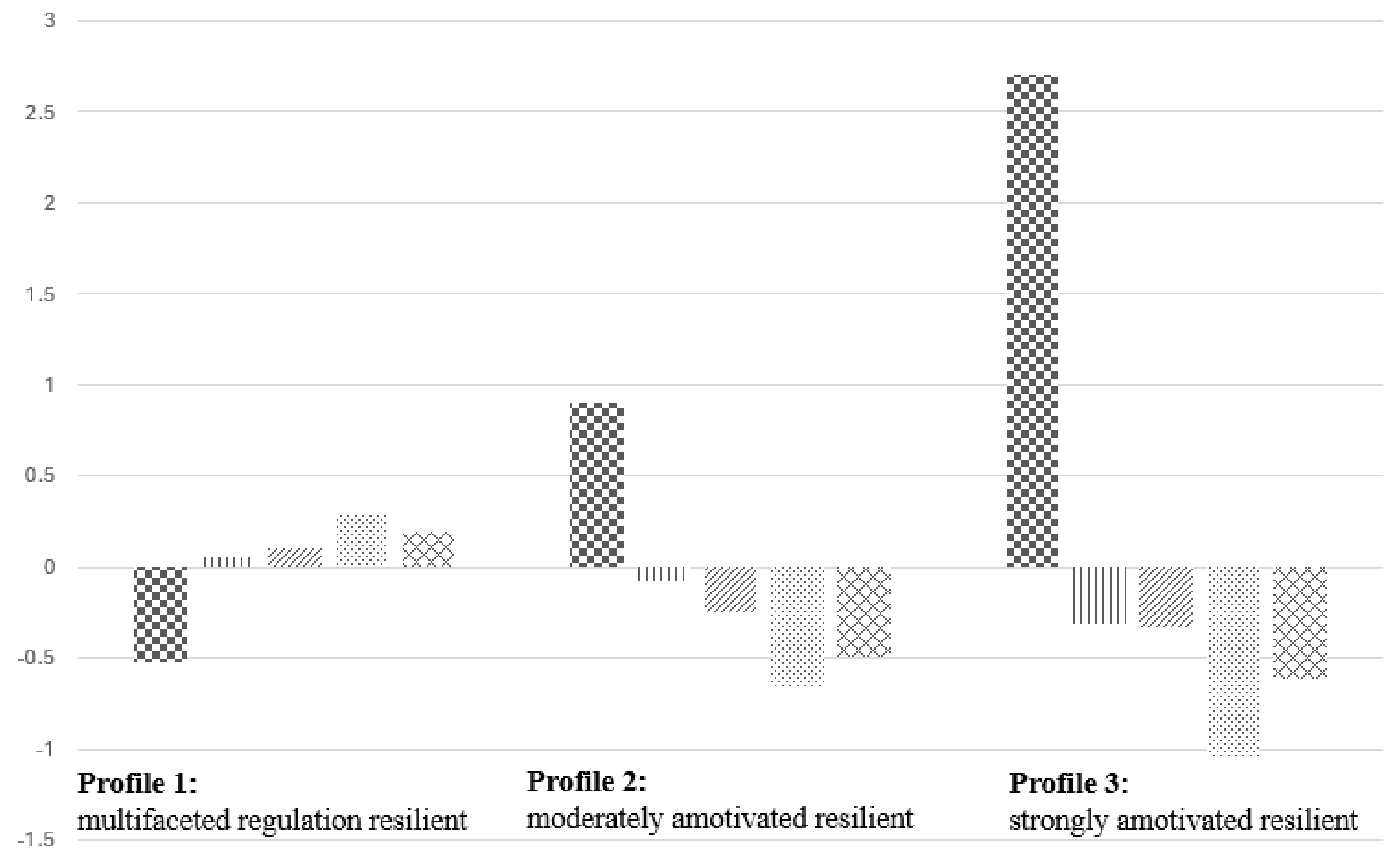
| Number of students per profile group | 11,393 | 3266 | 1092 |
| Percentage of all students per profile group | 72% | 21% | 7% |
| Amotivation | 1.13 (0.20) | 2.04 (0.27) | 3.19 (0.43) |
| External Regulation | 3.11 (0.61) | 3.03 (0.66) | 2.88 (0.74) |
| Introjected Regulation | 2.58 (0.68) | 2.33 (0.67) | 2.27 (0.85) |
| Identified Regulation | 3.39 (0.51) | 2.79 (0.62) | 2.55 (0.75) |
| Intrinsic Regulation | 2.94 (0.60) | 2.49 (0.61) | 2.41 (0.82) |
| Dimension | Profile Ordering | Note |
|---|---|---|
| Amotivation | P3 > P2 > P1 | All pairwise profile differences are statistically significant. |
| External regulation | P1 > P2 > P3 | All pairwise profile differences are statistically significant. |
| Introjected regulation | P1 > P2 and P1 > P3; P2 ≈ P3 | P2 vs. P3 difference is not statistically significant (p = 0.055). |
| Identified regulation | P1 > P2 > P3 | All pairwise profile differences are statistically significant. |
| Intrinsic regulation | P1 > P2 > P3 | All pairwise profile differences are statistically significant. |
Disclaimer/Publisher’s Note: The statements, opinions and data contained in all publications are solely those of the individual author(s) and contributor(s) and not of MDPI and/or the editor(s). MDPI and/or the editor(s) disclaim responsibility for any injury to people or property resulting from any ideas, methods, instructions or products referred to in the content. |
© 2026 by the authors. Licensee MDPI, Basel, Switzerland. This article is an open access article distributed under the terms and conditions of the Creative Commons Attribution (CC BY) license.
Share and Cite
Zacchilli, M.; Raimondi, G.; Manganelli, S.; Cavicchiolo, E.; Palombi, T.; Dawe, J.; Cazzolli, B.; Lucidi, F.; Alivernini, F. Uncovering Motivational Profiles Among Academically Resilient Students: A Population-Level Latent Profile Analysis. Behav. Sci. 2026, 16, 852. https://doi.org/10.3390/bs16060852
Zacchilli M, Raimondi G, Manganelli S, Cavicchiolo E, Palombi T, Dawe J, Cazzolli B, Lucidi F, Alivernini F. Uncovering Motivational Profiles Among Academically Resilient Students: A Population-Level Latent Profile Analysis. Behavioral Sciences. 2026; 16(6):852. https://doi.org/10.3390/bs16060852
Chicago/Turabian StyleZacchilli, Michele, Giulia Raimondi, Sara Manganelli, Elisa Cavicchiolo, Tommaso Palombi, James Dawe, Barbara Cazzolli, Fabio Lucidi, and Fabio Alivernini. 2026. "Uncovering Motivational Profiles Among Academically Resilient Students: A Population-Level Latent Profile Analysis" Behavioral Sciences 16, no. 6: 852. https://doi.org/10.3390/bs16060852
APA StyleZacchilli, M., Raimondi, G., Manganelli, S., Cavicchiolo, E., Palombi, T., Dawe, J., Cazzolli, B., Lucidi, F., & Alivernini, F. (2026). Uncovering Motivational Profiles Among Academically Resilient Students: A Population-Level Latent Profile Analysis. Behavioral Sciences, 16(6), 852. https://doi.org/10.3390/bs16060852

