Beyond Screen Time and Emotion Regulation: Social Trust as a Structural Pathway to Perceived Well-Being—A Competing-Models Analysis Among Chinese Youth


Abstract
1. Introduction
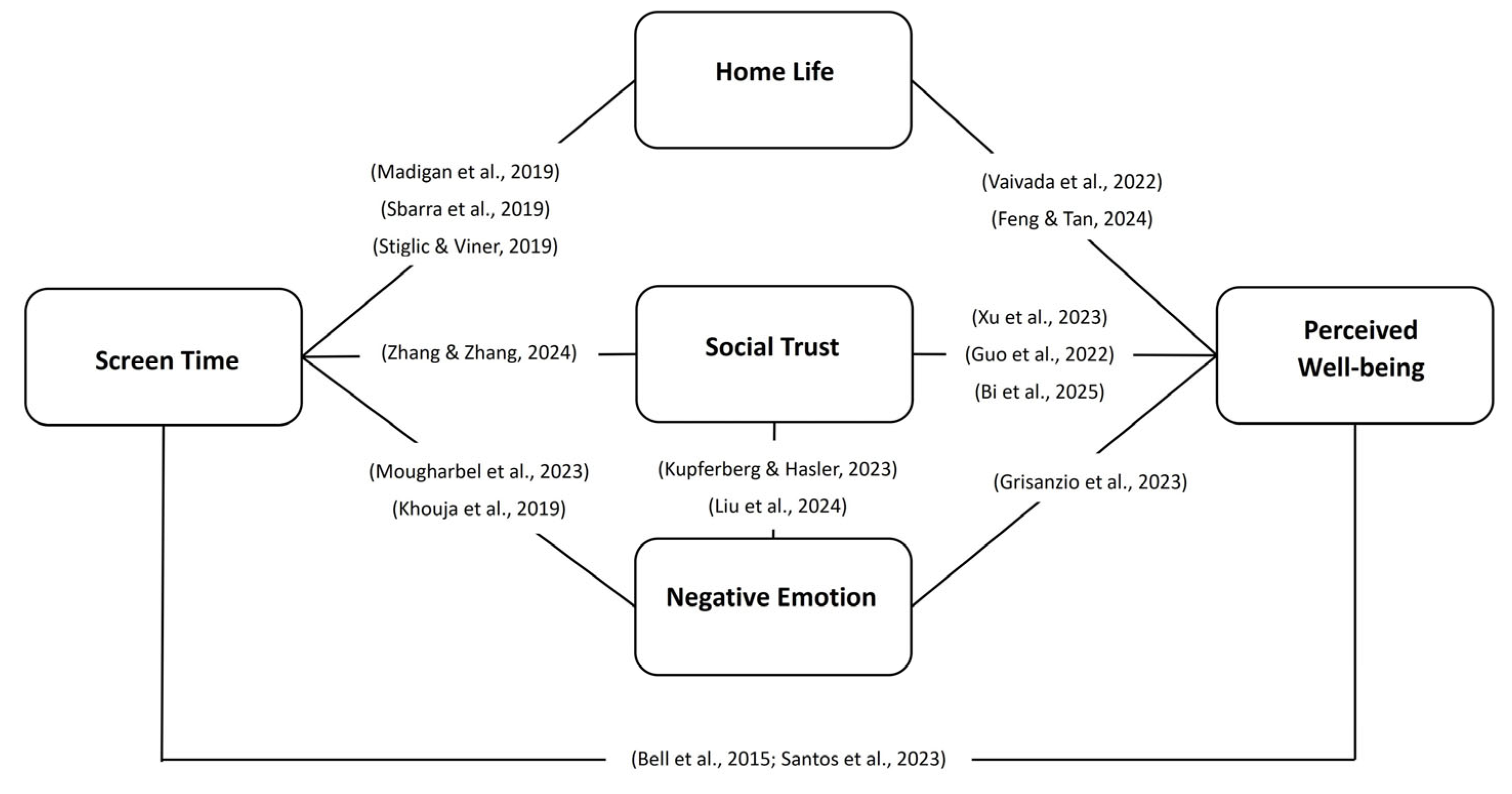
1.1. Competing Pathways Between Screen Time and Youth Well-Being
1.2. Why China, and Why 2022
1.3. Study Objectives
2. Materials and Methods
2.1. Study Design and Analytical Framework
2.2. Participants and Sampling
2.2.1. Inclusion and Exclusion Criteria
2.2.2. Missing Value Handling
2.3. Measures
2.3.1. Predictor Variable: Screen Time
+ β3(gender) + β4(residence) + ε
2.3.2. Outcome Variable: Perceived Well-Being
2.3.3. Intermediary Variables
2.3.4. Control Variable
2.4. Statistical Analysis
3. Results
3.1. Descriptive Statistics
3.2. Bivariate Correlations
3.3. Exploratory Factor Analysis (EFA)
3.4. Confirmatory Factor Analysis (CFA)
3.4.1. Measurement Model Fit
3.4.2. Convergent and Discriminant Validity
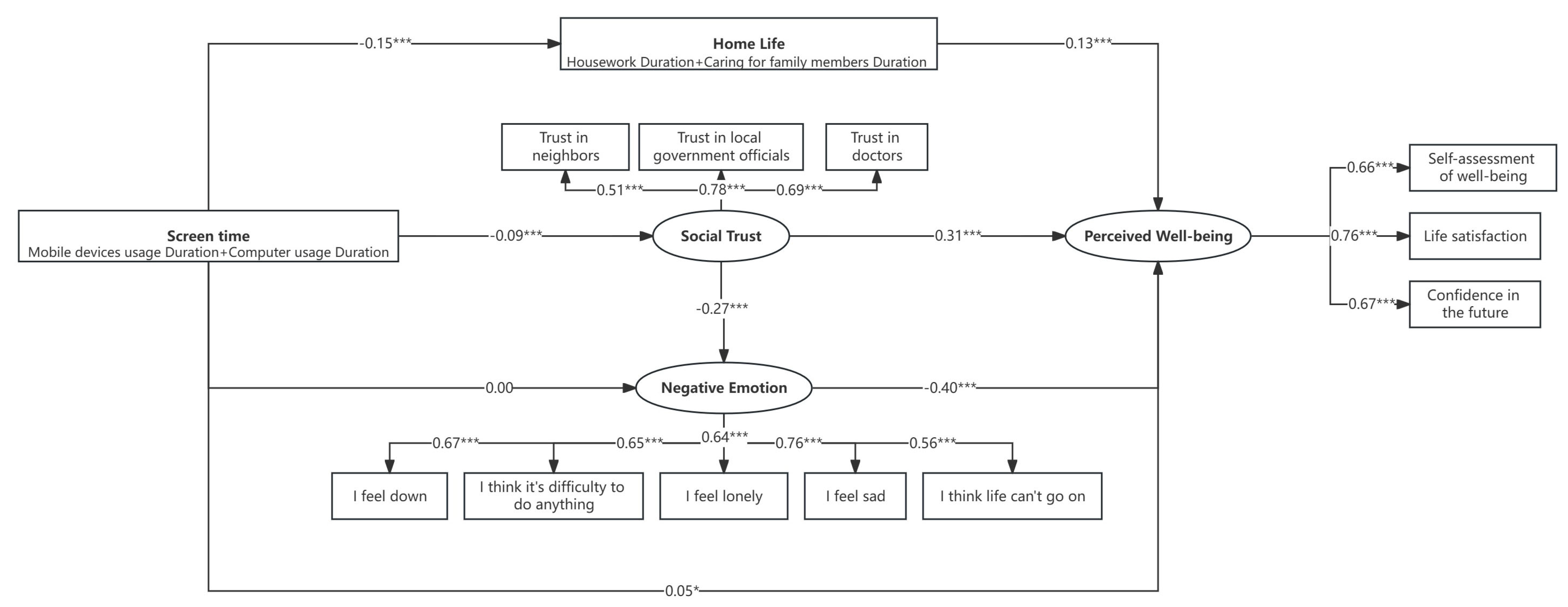
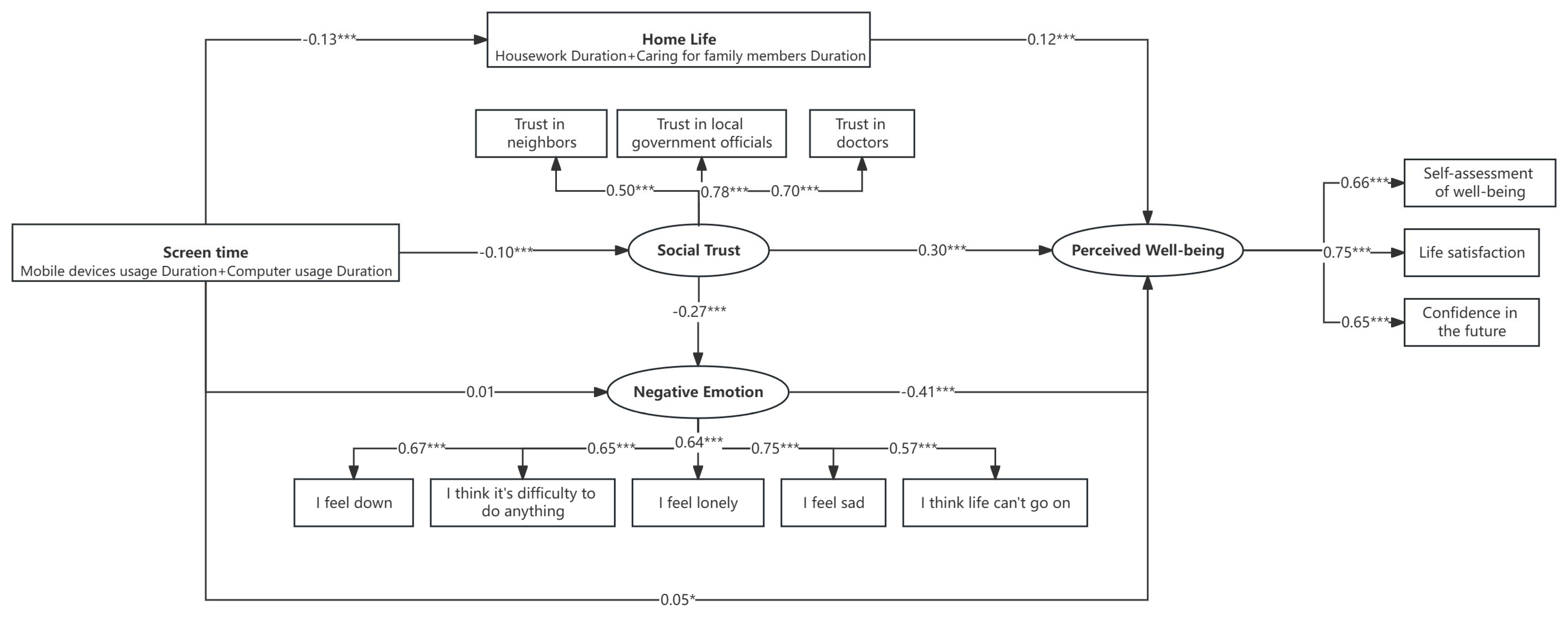
3.5. Structural Equation Model: Direct and Indirect Associations
3.5.1. Direct Associations on Well-Being
3.5.2. Competing-Pathways Analysis: Trust-First vs. Emotion-First
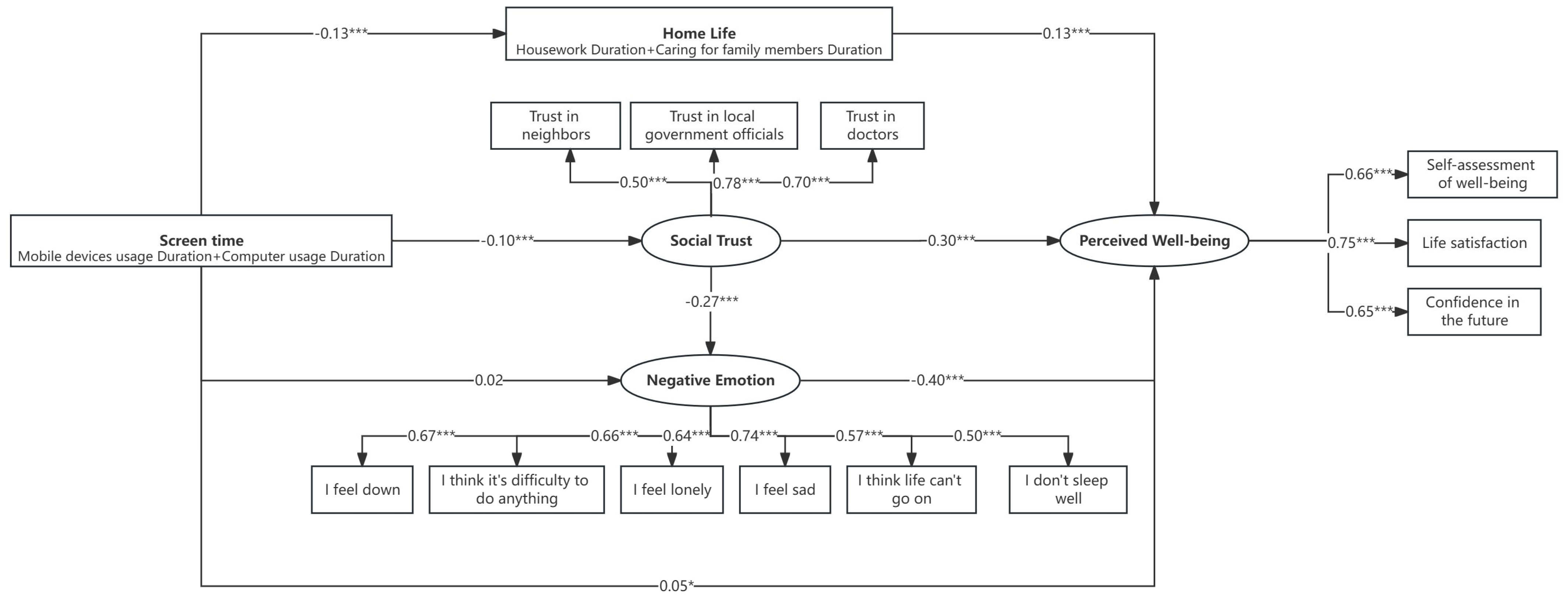
3.6. Sensitivity Analysis
3.6.1. Age Sensitivity Analysis
3.6.2. Measurement Sensitivity Analysis
4. Discussion
4.1. Principal Findings
4.2. Social Trust as Central to Well-Being in Digital Contexts
4.3. Screen Time as a Symptom
4.4. Implications for Intervention: Toward Trust-Centered Youth Well-Being in Digital Contexts
4.5. Strengths and Limitations
5. Conclusions
Supplementary Materials
Author Contributions
Funding
Institutional Review Board Statement
Informed Consent Statement
Data Availability Statement
Acknowledgments
Conflicts of Interest
Abbreviations
| CFPS | China Family Panel Studies |
| ST | Screen Time |
| WB | Well-being |
| NE | Negative Emotion |
References
- Abdel-Khalek, A. M. (2006). Measuring happiness with a single-item scale. Social Behavior and Personality: An International Journal, 34(2), 139–150. [Google Scholar] [CrossRef] [Scilit]
- Alavi, M., Visentin, D. C., Thapa, D. K., Hunt, G. E., Watson, R., & Cleary, M. (2020). Chi-square for model fit in confirmatory factor analysis. Journal of Advanced Nursing, 76(9), 2209–2211. [Google Scholar] [CrossRef] [Scilit] [PubMed]
- Anderson, J. C., & Gerbing, D. W. (1988). Structural equation modeling in practice: A review and recommended two-step approach. Psychological Bulletin, 103(3), 411–423. [Google Scholar] [CrossRef]
- Anderson, M., & Jiang, J. (2018). Teens, social media & technology 2018. Available online: https://www.pewresearch.org/internet/2024/12/12/teens-social-media-and-technology-2024/ (accessed on 15 August 2025).
- Andrews, F. M., & Withey, S. B. (1976). Social indicators of well-being. Social Indicators of Well-Being. [Google Scholar]
- Arslan, G. (2023). Psychological well-being and mental health in youth: Technical adequacy of the comprehensive inventory of thriving. Children, 10(7), 1269. [Google Scholar] [CrossRef] [Scilit] [PubMed]
- Bell, V., Bishop, D., & Przybylski, A. (2015). The debate over digital technology and young people. BMJ, 351, h3064. [Google Scholar] [CrossRef] [Scilit]
- Bi, S., Maes, M., Stevens, G. W. J. M., & Finkenauer, C. (2025). Life satisfaction differences across trust profiles among dutch adolescents. Journal of Happiness Studies, 26(6), 98. [Google Scholar] [CrossRef] [Scilit]
- Bond, B. J. (2016). Following your “friend”: Social media and the Strength of adolescents’ parasocial relationships with media personae. Cyberpsychology, Behavior, and Social Networking, 19(11), 656–660. [Google Scholar] [CrossRef] [Scilit]
- Botella, C., Molinari, G., Fernández-Álvarez, J., Guillén, V., García-Palacios, A., Baños, R. M., & Tomás, J. M. (2018). Development and validation of the openness to the future scale: A prospective protective factor. Health and Quality of Life Outcomes, 16(1), 72. [Google Scholar] [CrossRef] [Scilit]
- Brown, T. A. (2015). Confirmatory factor analysis for applied research (2nd ed.). Guilford Publications. Available online: https://books.google.com.tw/books?id=tTL2BQAAQBAJ (accessed on 19 August 2025).
- Cabezas-Klinger, H., Fernandez-Daza, F. F., & Mina-Paz, Y. (2025). Associations between social media use and mental disorders in adolescents and young adults: A systematic review and meta-analysis of recent evidence. Behavioral Sciences, 15(11), 1450. [Google Scholar] [CrossRef] [Scilit]
- Campbell, D. T., & Fiske, D. W. (1959). Convergent and discriminant validation by the multitrait-multimethod matrix. Psychological Bulletin, 56(2), 81–105. [Google Scholar] [CrossRef] [Scilit]
- Chang, G. (2025). Types of adolescent screen use and positive wellbeing: Gender and Parental education influences. Journal of Happiness Studies, 26(4), 62. [Google Scholar] [CrossRef] [Scilit]
- Cheng, Q., Panayiotou, M., Finserås, T. R., Andersen, A. I. O., & Humphrey, N. (2025). How do social media use, gaming frequency, and internalizing symptoms predict each other over time in early-to-middle adolescence? Journal of Public Health, 48(1), 59–69. [Google Scholar] [CrossRef] [Scilit]
- Cohen, J. C. P., West, S. G., & Aiken, L. S. (2003). Applied multiple regression/correlation analysis for the behavioral sciences (3rd ed.). Routledge. [Google Scholar] [CrossRef] [Scilit]
- Coleman, J. S. (1988). Social capital in the creation of human capital. American Journal of Sociology, 94, S95–S120. [Google Scholar] [CrossRef] [Scilit] [PubMed]
- CPC Central Committee. (2017). Medium- and long-term youth development plan (2016–2025). State Council. Available online: https://www.gov.cn/zhengce/2017-04/13/content_5185555.htm (accessed on 30 September 2025).
- Dai, Y., & Ouyang, N. (2026). Excessive screen time is associated with mental health problems in US children and adolescents: Physical activity and sleep as parallel mediators. Humanities and Social Sciences Communications, 13(1), 256. [Google Scholar] [CrossRef] [Scilit]
- Delhey, J., & Newton, K. (2005). Predicting cross-national levels of social trust: Global pattern or nordic exceptionalism? European Sociological Review, 21(4), 311–327. [Google Scholar] [CrossRef] [Scilit]
- Edelman Trust Institute. (2025). 2025 Edelman trust barometer: Trust and the crisis of grievance. Available online: https://www.edelman.com/trust/2025/trust-barometer (accessed on 18 March 2025).
- Edwards, M. C., Cheavens, J. S., Heiy, J. E., & Cukrowicz, K. C. (2010). A reexamination of the factor structure of the Center for Epidemiologic Studies Depression Scale: Is a one-factor model plausible? Psychol Assess, 22(3), 711–715. [Google Scholar] [CrossRef] [Scilit]
- Fang, G., Tang, T., Zhao, F., & Zhu, Y. (2023). The social scar of the pandemic: Impacts of COVID-19 exposure on interpersonal trust. Journal of Asian Economics, 86, 101609. [Google Scholar] [CrossRef] [Scilit]
- Feng, S., & Tan, C. Y. (2024). Toward conceptual clarity for digital cultural and social capital in student learning: Insights from a systematic literature review. Humanities and Social Sciences Communications, 11(1), 68. [Google Scholar] [CrossRef] [Scilit]
- Greenland, S., Pearl, J., & Robins, J. M. (1999). Causal diagrams for epidemiologic research. Epidemiology, 10(1), 37–48. [Google Scholar] [CrossRef] [Scilit]
- Grisanzio, K. A., Flournoy, J. C., Mair, P., & Somerville, L. H. (2023). Shifting qualities of negative affective experience through adolescence: Age-related change and associations with functional outcomes. Emotion, 23(1), 278–288. [Google Scholar] [CrossRef] [Scilit]
- Guo, Q., Zheng, W., Shen, J., Huang, T., & Ma, K. (2022). Social trust more strongly associated with well-being in individualistic societies. Personality and Individual Differences, 188, 111451. [Google Scholar] [CrossRef] [Scilit]
- Gutin, I. (2024). Diagnosing social ills: Theorising social determinants of health as a diagnostic category. Sociology of Health & Illness, 46(S1), 110–131. [Google Scholar] [CrossRef] [Scilit]
- Hair, J. F., Black, W. C., Babin, B. J., & Anderson, R. E. (2013). Multivariate data analysis: Pearson new international edition (pp. 128–134). Pearson Education. [Google Scholar]
- Hall, J. A., & Liu, D. (2022). Social media use, social displacement, and well-being. Current Opinion in Psychology, 46, 101339. [Google Scholar] [CrossRef] [Scilit]
- Hayes, A. F. (2013). Introduction to mediation, moderation, and conditional process analysis: A regression-based approach. The Guilford Press. [Google Scholar]
- Helliwell, J. F., Layard, R., Sachs, J. D., De Neve, J.-E., Aknin, L. B., & Wang, S. (Eds.). (2024). World happiness report 2024. Wellbeing Research Centre, University of Oxford. Available online: https://worldhappiness.report/ed/2024/ (accessed on 30 December 2025).
- Hoffner, C. A., & Bond, B. J. (2022). Parasocial relationships, social media, & well-being. Current Opinion in Psychology, 45, 101306. [Google Scholar] [CrossRef] [Scilit]
- Holt-Lunstad, J. (2024). Social connection as a critical factor for mental and physical health: Evidence, trends, challenges, and future implications. World Psychiatry, 23(3), 312–332. [Google Scholar] [CrossRef] [Scilit]
- Hughes, R. A., Heron, J., Sterne, J. A. C., & Tilling, K. (2019). Accounting for missing data in statistical analyses: Multiple imputation is not always the answer. International Journal of Epidemiology, 48(4), 1294–1304. [Google Scholar] [CrossRef] [Scilit]
- Judd, C. M., McClelland, G. H., & Ryan, C. S. (2017). Data analysis: A model comparison approach to regression, ANOVA, and beyond (3rd ed.). Routledge. [Google Scholar] [CrossRef] [Scilit]
- Kardefelt-Winther, D. (2014). A conceptual and methodological critique of internet addiction research: Towards a model of compensatory internet use. Computers in Human Behavior, 31, 351–354. [Google Scholar] [CrossRef] [Scilit]
- Keyes, C. L. (2002). The mental health continuum: From languishing to flourishing in life. Journal of Health and Social Behavior, 43(2), 207–222. [Google Scholar] [CrossRef] [Scilit]
- Khouja, J. N., Munafò, M. R., Tilling, K., Wiles, N. J., Joinson, C., Etchells, P. J., John, A., Hayes, F. M., Gage, S. H., & Cornish, R. P. (2019). Is screen time associated with anxiety or depression in young people? Results from a UK birth cohort. BMC Public Health, 19(1), 82. [Google Scholar] [CrossRef] [Scilit] [PubMed]
- Kupferberg, A., & Hasler, G. (2023). The social cost of depression: Investigating the impact of impaired social emotion regulation, social cognition, and interpersonal behavior on social functioning. Journal of Affective Disorders Reports, 14, 100631. [Google Scholar] [CrossRef] [Scilit]
- Lee, J. Y. (2025). The effects of social media criticism against public health institutions on trust, emotions, and social media engagement. Proceedings of the National Academy of Sciences of the United States of America, 122(26), e2422890122. [Google Scholar] [CrossRef] [Scilit]
- Li, R., & Hu, Y. (2026). Identifying key predictors of subjective well-being across 92 countries: A machine learning approach. Journal of Happiness Studies, 27(1), 16. [Google Scholar] [CrossRef] [Scilit]
- Li, R., Xu, W., Nie, H., & Zhang, W. (2025). The longitudinal relationship between close friendship and subjective well-being: The chain mediation model of interpersonal trust and perceived social support. Behavioral Sciences, 15(4), 480. [Google Scholar] [CrossRef] [Scilit]
- Li, X., & Bian, Y. (2024). Social networks in China: A thematic review of guanxi scholarship in the past decade. Chinese Journal of Sociology, 10(4), 531–562. [Google Scholar] [CrossRef] [Scilit]
- Li, Z., & Yang, M. (2021). Internet use and depressive symptoms among chinese older adults: The mediation and suppression effects of social capital. Frontiers in Psychology, 12, 729790. [Google Scholar] [CrossRef] [Scilit]
- Lin, C.-Y., Namdar, P., Griffiths, M. D., & Pakpour, A. H. (2021). Mediated roles of generalized trust and perceived social support in the effects of problematic social media use on mental health: A cross-sectional study. Health Expectations, 24(1), 165–173. [Google Scholar] [CrossRef] [Scilit] [PubMed]
- Liu, S., Hu, S. X., & Su, L. (2024). Parental democratic communication and adolescent well-being in an era of loneliness: The mediating role of societal trust. Frontiers in Psychiatry, 15, 1500937. [Google Scholar] [CrossRef] [Scilit] [PubMed]
- Lomas, T., Pawelski, J. O., & VanderWeele, T. J. (2023). A flexible map of flourishing: The dynamics and drivers of flourishing, well-being, health, and happiness. International Journal of Wellbeing, 13, 3665. [Google Scholar] [CrossRef] [Scilit]
- Lomas, T., Pawelski, J. O., & VanderWeele, T. J. (2025). Flourishing as ‘sustainable well-being’: Balance and harmony within and across people, ecosystems, and time. The Journal of Positive Psychology, 20(2), 203–218. [Google Scholar] [CrossRef] [Scilit]
- Lu, H., Tong, P., & Zhu, R. (2020). Longitudinal evidence on social trust and happiness in China: Causal effects and mechanisms. Journal of Happiness Studies, 21(5), 1841–1858. [Google Scholar] [CrossRef] [Scilit]
- Madigan, S., Browne, D., Racine, N., Mori, C., & Tough, S. (2019). Association between screen time and children’s performance on a developmental screening test. JAMA Pediatr, 173(3), 244–250. [Google Scholar] [CrossRef] [Scilit] [PubMed]
- Madley-Dowd, P., Hughes, R., Tilling, K., & Heron, J. (2019). The proportion of missing data should not be used to guide decisions on multiple imputation. Journal of Clinical Epidemiology, 110, 63–73. [Google Scholar] [CrossRef] [Scilit] [PubMed]
- Manwell, L. A., Tadros, M., Ciccarelli, T. M., & Eikelboom, R. (2022). Digital dementia in the internet generation: Excessive screen time during brain development will increase the risk of Alzheimer’s disease and related dementias in adulthood. Journal of Integrative Neuroscience, 21(1), 28. [Google Scholar] [CrossRef] [Scilit] [PubMed]
- Maples, B., Cerit, M., Vishwanath, A., & Pea, R. (2024). Loneliness and suicide mitigation for students using GPT3-enabled chatbots. npj Mental Health Research, 3(1), 4. [Google Scholar] [CrossRef] [Scilit]
- Marmot, M. (2005). Social determinants of health inequalities. Lancet, 365(9464), 1099–1104. [Google Scholar] [CrossRef]
- McRoberts, R. E., Næsset, E., Hou, Z., Ståhl, G., Saarela, S., Esteban, J., Travaglini, D., Mohammadi, J., & Chirici, G. (2023). How many bootstrap replications are necessary for estimating remote sensing-assisted, model-based standard errors? Remote Sensing of Environment, 288, 113455. [Google Scholar] [CrossRef] [Scilit]
- Menefee, D. S., Ledoux, T., & Johnston, C. A. (2022). The importance of emotional regulation in mental health. American Journal of Lifestyle Medicine, 16(1), 28–31. [Google Scholar] [CrossRef] [Scilit]
- Montag, C., Becker, B., & Gan, C. (2018). The multipurpose application WeChat: A review on recent research. Frontiers in Psychology, 9, 2247. [Google Scholar] [CrossRef] [Scilit]
- Moore, S., Salsberg, J., & Leroux, J. (2013). Advancing social capital interventions from a network and population health perspective. In I. Kawachi, S. Takao, & S. V. Subramanian (Eds.), Global perspectives on social capital and health (pp. 189–203). Springer. [Google Scholar] [CrossRef] [Scilit]
- Morgan, S. L., & Winship, C. (2014). Counterfactuals and causal inference: Methods and principles for social research (2nd ed.). Cambridge University Press. [Google Scholar] [CrossRef] [Scilit]
- Mougharbel, F., Chaput, J. P., Sampasa-Kanyinga, H., Colman, I., Leatherdale, S. T., Patte, K. A., & Goldfield, G. S. (2023). Longitudinal associations between different types of screen use and depression and anxiety symptoms in adolescents. Front Public Health, 11, 1101594. [Google Scholar] [CrossRef] [Scilit]
- National Academies of Sciences, Engineering, and Medicine. (2024). Social media and adolescent health (A. Wojtowicz, G. J. Buckley, & S. Galea, Eds.). National Academies Press (US). [Google Scholar] [CrossRef] [Scilit]
- Odgers, C. L., & Jensen, M. R. (2020). Annual research review: Adolescent mental health in the digital age: Facts, fears, and future directions. Journal of Child Psychology and Psychiatry, 61(3), 336–348. [Google Scholar] [CrossRef] [Scilit]
- Orben, A., Przybylski, A. K., Blakemore, S.-J., & Kievit, R. A. (2022). Windows of developmental sensitivity to social media. Nature Communications, 13(1), 1649. [Google Scholar] [CrossRef] [Scilit]
- Preacher, K. J., & Hayes, A. F. (2008). Asymptotic and resampling strategies for assessing and comparing indirect effects in multiple mediator models. Behavior Research Methods, 40(3), 879–891. [Google Scholar] [CrossRef] [Scilit]
- Pronk, N. P., Woodard, C., Zimmerman, F. J., & Arena, R. (2025). An ecological framework for population health and well-being. Progress in Cardiovascular Diseases, 90, 13–21. [Google Scholar] [CrossRef] [Scilit]
- Putnam, R. D. (2000). Bowling alone: The collapse and revival of American community. Touchstone Books/Simon & Schuster. [Google Scholar] [CrossRef] [Scilit]
- Radloff, L. S. (1977). The CES-D scale: A self-report depression scale for research in the general population. Applied Psychological Measurement, 1(3), 385–401. [Google Scholar] [CrossRef] [Scilit]
- Radtke, T., Apel, T., Schenkel, K., Keller, J., & von Lindern, E. (2022). Digital detox: An effective solution in the smartphone era? A systematic literature review. Mobile Media & Communication, 10(2), 190–215. [Google Scholar] [CrossRef] [Scilit]
- Rainie, L., Keeter, S., & Perrin, A. (2019). Trust and distrust in America. Pew Research Center. Available online: http://www.jstor.org/stable/resrep63059 (accessed on 30 October 2025).
- Robbins, B. G. (2023). Valid and reliable measures of generalized trust: Evidence from a nationally representative survey and behavioral experiment. Socius, 9, 23780231231192841. [Google Scholar] [CrossRef] [Scilit]
- Ryan, R. M., & Deci, E. L. (2000). Self-determination theory and the facilitation of intrinsic motivation, social development, and well-being. American Psychologist, 55(1), 68–78. [Google Scholar] [CrossRef] [PubMed]
- Santos, R. M. S., Mendes, C. G., Sen Bressani, G. Y., de Alcantara Ventura, S., de Almeida Nogueira, Y. J., de Miranda, D. M., & Romano-Silva, M. A. (2023). The associations between screen time and mental health in adolescents: A systematic review. BMC Psychology, 11(1), 127. [Google Scholar] [CrossRef] [Scilit]
- Sbarra, D. A., Briskin, J. L., & Slatcher, R. B. (2019). Smartphones and close relationships: The case for an evolutionary mismatch. Perspectives on Psychological Science, 14(4), 596–618. [Google Scholar] [CrossRef] [Scilit]
- Schramm, H., Liebers, N., Biniak, L., & Dettmar, F. (2024). Research trends on parasocial interactions and relationships with media characters. A review of 281 English and German-language studies from 2016 to 2020. Frontiers in Psychology, 15, 1418564. [Google Scholar] [CrossRef] [Scilit]
- Selnes, F. N. (2024). Fake news on social media: Understanding teens’ (Dis)engagement with news. Media, Culture & Society, 46(2), 376–392. [Google Scholar] [CrossRef] [Scilit]
- Stiglic, N., & Viner, R. M. (2019). Effects of screentime on the health and well-being of children and adolescents: A systematic review of reviews. BMJ Open, 9(1), e023191. [Google Scholar] [CrossRef] [Scilit]
- Twenge, J. M., Campbell, W. K., & Carter, N. T. (2014). Declines in trust in others and confidence in institutions among American adults and late adolescents, 1972–2012. Psychological Science, 25(10), 1914–1923. [Google Scholar] [CrossRef] [Scilit]
- Twenge, J. M., Haidt, J., Blake, A. B., McAllister, C., Lemon, H., & Le Roy, A. (2021). Worldwide increases in adolescent loneliness. Journal of Adolescence, 93, 257–269. [Google Scholar] [CrossRef] [Scilit] [PubMed]
- Twenge, J. M., Joiner, T. E., Rogers, M. L., & Martin, G. N. (2018). Increases in depressive symptoms, suicide-related outcomes, and suicide rates among U.S. adolescents after 2010 and links to increased new media screen time. Clinical Psychological Science, 6(1), 3–17. [Google Scholar] [CrossRef] [Scilit]
- Vaivada, T., Sharma, N., Das, J. K., Salam, R. A., Lassi, Z. S., & Bhutta, Z. A. (2022). Interventions for health and well-being in school-aged children and adolescents: A way forward. Pediatrics, 149(Suppl. 6), e2021053852M. [Google Scholar] [CrossRef] [Scilit] [PubMed]
- Vasconcellos, R. P., Sanders, T., Lonsdale, C., Parker, P., Conigrave, J., Tang, S., del Pozo Cruz, B., Biddle, S. J. H., Taylor, R., Innes-Hughes, C., Salmela-Aro, K., Vasconcellos, D., Wilhite, K., Tremaine, E., Booker, B., & Noetel, M. (2025). Electronic screen use and children’s socioemotional problems: A systematic review and meta-analysis of longitudinal studies. Psychological Bulletin, 151(5), 513–543. [Google Scholar] [CrossRef] [Scilit] [PubMed]
- Vidal, C., Lhaksampa, T., Miller, L., & Platt, R. (2020). Social media use and depression in adolescents: A scoping review. International Review of Psychiatry, 32(3), 235–253. [Google Scholar] [CrossRef] [Scilit]
- Wang, P., & Zhang, Y. (2025). Nesting of groups: Links among personal magnetism, community trust, inequality perception and depression. PLoS ONE, 20(3), e0320560. [Google Scholar] [CrossRef] [Scilit]
- Wang, Q., Zhi, K., Yu, B., & Cheng, J. (2023). Social trust and subjective well-being of first-generation college students in China: The multiple mediation effects of self-compassion and social empathy. Frontiers in Psychology, 14, 1091193. [Google Scholar] [CrossRef] [Scilit]
- West, T. N., Berman, C. J., Payne, B. K., Muscatell, K. A., & Fredrickson, B. L. (2025). Trust a stranger? Investigating community trust and economic inequality as barriers to positive interactions among strangers. Journal of Happiness Studies, 26(6), 107. [Google Scholar] [CrossRef] [Scilit]
- Williams, O., & Fullagar, S. (2019). Lifestyle drift and the phenomenon of ‘citizen shift’ in contemporary UK health policy. Sociology of Health & Illness, 41(1), 20–35. [Google Scholar] [CrossRef] [Scilit]
- World Health Organization. (2025). From loneliness to social connection: Charting a path to healthier societies: Report of the WHO commission on social connection. World Health Organization. Available online: https://www.who.int/publications/i/item/978240112360/ (accessed on 1 March 2025).
- Wu, C., & Kawachi, I. (2024). A triple trust penalty? The majority-minority gap in subjective wellbeing. Social Science & Medicine, 361, 117371. [Google Scholar] [CrossRef] [Scilit]
- Xu, H., Zhang, C., & Huang, Y. (2023). Social trust, social capital, and subjective well-being of rural residents: Micro-empirical evidence based on the Chinese General Social Survey (CGSS). Humanities and Social Sciences Communications, 10(1), 49. [Google Scholar] [CrossRef] [Scilit]
- Yang, F., Li, Y., Zhu, S., Luo, Y., Yan, S., & Jiang, Y. (2025). Social equity perception and subjective well-being: Evidence from China. Journal of Happiness Studies, 26(6), 90. [Google Scholar] [CrossRef] [Scilit]
- Zhang, Q., & Zhang, X. (2024). Media influence on public trust during crises: A comparative analysis of different media types and trust dimensions. Journal of Contingencies and Crisis Management, 32(3), e12624. [Google Scholar] [CrossRef] [Scilit]
- Zheng, J., Wang, T. Y., & Zhang, T. (2023). The extension of particularized trust to generalized trust: The moderating role of long-term versus short-term orientation. Social Indicators Research, 166(2), 269–298. [Google Scholar] [CrossRef] [Scilit]



| Category | Group | Frequency | Percentage |
|---|---|---|---|
| Age | Late adolescent (16~17) | 169 | 8.6% |
| Emerging adult (18–25) | 583 | 29.6% | |
| Established young adult (26–35) | 1215 | 61.8% | |
| Gender | Female | 1020 | 51.9% |
| Male | 947 | 48.1% | |
| Residence | Urban | 1064 | 54.1% |
| Rural | 903 | 45.9% | |
| Years of education | Illiteracy | 25 | 1.3% |
| Primary school | 133 | 6.8% | |
| Junior high school | 664 | 33.8% | |
| Senior high school | 509 | 25.9% | |
| Higher education | 636 | 32.2% |
| Latent Variables | Mean | SD | Skewness | Kurtosis | Minimum | Maximum |
|---|---|---|---|---|---|---|
| Screen time(actual) | 6.00 | 3.82 | 0.95 | 0.65 | 0.02 | 19.85 |
| Home life | 2.92 | 2.91 | 2.04 | 5.01 | 0.00 | 19.00 |
| Social trust | 19.20 | 5.00 | −0.39 | 0.52 | 0.00 | 30.00 |
| Negative emotion | 7.64 | 2.45 | 1.06 | 1.58 | 5.00 | 20.00 |
| Perceived well-being | 15.52 | 2.86 | −0.66 | 0.91 | 3.00 | 20.00 |
| Age | N | Mean (h/Day) | Std. Error | Minimum | Maximum | 95% Lower | 95% Upper |
|---|---|---|---|---|---|---|---|
| Late adolescent (16~17) | 169 | 4.99 | 3.36 | 0.03 | 13.43 | 4.48 | 5.50 |
| Emerging adult (18–25) | 583 | 6.96 | 3.94 | 0.02 | 19.85 | 6.64 | 7.28 |
| Established young adult (26–35) | 1215 | 6.00 | 3.72 | 0.02 | 19.79 | 5.47 | 5.88 |
| Screen Time (Actual) | Home Life | Social Trust | Negative Emotion | Perceived Well-Being | |
|---|---|---|---|---|---|
| Screen time (actual) | 1 | - | - | - | - |
| Home life | −0.17 *** | 1 | - | - | - |
| Social trust | −0.07 ** | −0.02 | 1 | - | - |
| Negative emotion | 0.04 | 0.18 *** | −0.23 | 1 | - |
| Perceived well-being | −0.002 | 0.03 | 0.36 *** | −0.37 *** | 1 |
| Item | Component | |
|---|---|---|
| 1 | 2 | |
| Trust in parents | 0.287 | 0.000 |
| Trust in neighbors | 0.568 | 0.277 |
| Trust in strangers | 0.188 | 0.774 |
| Trust in local government officials | 0.883 | 0.215 |
| Trust in doctors | 0.794 | 0.026 |
| Item | Component | |
|---|---|---|
| 1 | 2 | |
| I feel down | 0.811 | 0.114 |
| I think it’s difficult to do anything | 0.712 | 0.244 |
| I don’t sleep well | 0.231 | 0.971 |
| I feel lonely | 0.701 | 0.174 |
| I feel sad | 0.762 | 0.174 |
| I think life can’t go on | 0.529 | 0.169 |
| Latent Variable | Observed Variable | Std. Loading | UnStd. Loading | S.E. | C.R. (t-Value) | p | SMC | C.R | AVE |
|---|---|---|---|---|---|---|---|---|---|
| Perceived well-being | Self-assessment of happiness | 0.66 | 1.00 | *** | 0.44 | 0.73 | 0.48 | ||
| Confidence in the future | 0.65 | 0.44 | 0.02 | 20.47 | *** | 0.43 | |||
| Life satisfaction | 0.75 | 0.53 | 0.02 | 21.27 | *** | 0.57 | |||
| Social trust | Trust in doctors | 0.70 | 1.00 | *** | 0.49 | 0.70 | 0.45 | ||
| Trust in local government officials | 0.78 | 1.39 | 0.07 | 21.34 | *** | 0.61 | |||
| Trust in neighbor | 0.50 | 0.73 | 0.04 | 17.07 | *** | 0.25 | |||
| Negative emotion | I feel down | 0.67 | 1.00 | *** | 0.45 | 0.79 | 0.43 | ||
| I think it’s difficult to do anything | 0.65 | 0.89 | 0.04 | 23.96 | *** | 0.42 | |||
| I feel lonely | 0.64 | 0.87 | 0.04 | 22.91 | *** | 0.41 | |||
| I feel sad | 0.75 | 0.97 | 0.04 | 25.72 | *** | 0.57 | |||
| I think life can’t go on | 0.57 | 0.53 | 0.03 | 20.63 | *** | 0.32 |
| AVE | Screen Time | Social Trust | Negative Emotion | Home Life | Perceived Well-Being | |
|---|---|---|---|---|---|---|
| Screen time | / | / | - | - | - | - |
| Social trust | 0.45 | −0.10 | 0.67 | - | - | - |
| Negative emotion | 0.43 | 0.04 | −0.28 | 0.66 | - | - |
| Home life | / | −0.13 | 0.01 | −0.01 | / | - |
| Perceived well-being | 0.48 | −0.01 | 0.41 | −0.49 | 0.12 | 0.69 |
| Pathway | β | SE | p | 95% CI | |
|---|---|---|---|---|---|
| Lower | Upper | ||||
| Direct associations with Well-Being | |||||
| Screen Time → Well-being | 0.05 | 0.024 | 0.046 | 0.000 | 0.093 |
| Social Trust → Well-being | 0.30 | 0.038 | *** | 0.229 | 0.380 |
| Negative Emotions → Well-being | −0.41 | 0.032 | *** | −0.468 | −0.341 |
| Home Life → Well-being | 0.12 | 0.023 | *** | 0.075 | 0.167 |
| Indirect associations | |||||
| Screen Time → Negative emotion → Well-being | −0.004 | 0.003 | 0.563 | −0.008 | 0.005 |
| Screen Time → Social Trust → Well-being | −0.03 | 0.003 | *** | −0.016 | −0.005 |
| Screen Time → Home Life → Well-being | −0.016 | 0.001 | *** | −0.008 | −0.003 |
| Screen Time → Social Trust → Negative Emotion → Well-being | −0.011 | 0.001 | *** | −0.006 | −0.002 |
Disclaimer/Publisher’s Note: The statements, opinions and data contained in all publications are solely those of the individual author(s) and contributor(s) and not of MDPI and/or the editor(s). MDPI and/or the editor(s) disclaim responsibility for any injury to people or property resulting from any ideas, methods, instructions or products referred to in the content. |
© 2026 by the authors. Licensee MDPI, Basel, Switzerland. This article is an open access article distributed under the terms and conditions of the Creative Commons Attribution (CC BY) license.
Share and Cite
Zhang, J.; Su, L.; Xia, Q.; Hu, S.X. Beyond Screen Time and Emotion Regulation: Social Trust as a Structural Pathway to Perceived Well-Being—A Competing-Models Analysis Among Chinese Youth. Behav. Sci. 2026, 16, 847. https://doi.org/10.3390/bs16060847
Zhang J, Su L, Xia Q, Hu SX. Beyond Screen Time and Emotion Regulation: Social Trust as a Structural Pathway to Perceived Well-Being—A Competing-Models Analysis Among Chinese Youth. Behavioral Sciences. 2026; 16(6):847. https://doi.org/10.3390/bs16060847
Chicago/Turabian StyleZhang, Jingyuan, Lanxin Su, Qiqing Xia, and Sydney X. Hu. 2026. "Beyond Screen Time and Emotion Regulation: Social Trust as a Structural Pathway to Perceived Well-Being—A Competing-Models Analysis Among Chinese Youth" Behavioral Sciences 16, no. 6: 847. https://doi.org/10.3390/bs16060847
APA StyleZhang, J., Su, L., Xia, Q., & Hu, S. X. (2026). Beyond Screen Time and Emotion Regulation: Social Trust as a Structural Pathway to Perceived Well-Being—A Competing-Models Analysis Among Chinese Youth. Behavioral Sciences, 16(6), 847. https://doi.org/10.3390/bs16060847