Article

The Relationship Between Ostracism and Mental Health Issues Among College Students: The Chain Mediating Role of Rumination and Smartphone Addiction


1
School of Chinese Language and Literature, Harbin Normal University, Harbin 150080, China
2
School of Public Management, Guangzhou Nanfang College, Guangzhou 510970, China
3
School of Education Science, Nanjing Normal University, Nanjing 210097, China
4
Foreign Languages Studies, Faculty of Humanities and Social Sciences, Harbin Institute of Technology, Harbin 150001, China
5
School of Literature, Heilongjiang University, Harbin 150080, China
*
Author to whom correspondence should be addressed.
Behav. Sci. 2026, 16(5), 769; https://doi.org/10.3390/bs16050769
Submission received: 19 March 2026 / Revised: 8 May 2026 / Accepted: 12 May 2026 / Published: 14 May 2026
(This article belongs to the Special Issue Digital Technologies, Mental Health and Well-Being)

Abstract

Mental health issues, particularly symptoms of anxiety and depression, have become increasingly prominent among college students, with negative experiences such as ostracism identified as important correlates. However, the potential pathways linking ostracism to mental health issues remain to be further explored. By incorporating rumination and smartphone addiction, this study aimed to examine the associations among ostracism, rumination, smartphone addiction, and mental health issues in college students. A cross-sectional, self-reported questionnaire survey was conducted among 632 college students, measuring these four variables simultaneously. Correlation analyses and mediation analyses using a chain mediation model with bootstrap estimation were employed to examine the relationships among these variables. The results revealed significant positive associations among ostracism, rumination, smartphone addiction, and mental health issues. Further analyses indicated that rumination and smartphone addiction played a chain mediating role between ostracism and mental health issues. The bootstrap confidence intervals confirmed the significance of the indirect effects, which accounted for 32.62% of the total effect. These findings provide insight into the interrelationships among ostracism, rumination, smartphone addiction, and mental health issues in college students, contributing to a better understanding of factors related to mental health issues in this population and offering a reference for future research and potential intervention development in college settings.

1. Introduction

Mental health issues are relatively common among college students and adversely affect their future development (Cleary et al., 2011; Cook, 2007; Soet & Sevig, 2006). Among these issues, anxiety and depression are the most prevalent, and previous studies have found that they frequently co-occur (Choi et al., 2020; Huang & Liu, 2023). As a result, prior research has often used instruments that assess both anxiety and depression, such as the Patient Health Questionnaire-4 (PHQ-4), as indicators of overall mental health status (Hua, 2025; Yan et al., 2024). A recent meta-analysis conducted in China indicates that mental health issues among college students have shown a significant upward trend over the past decade, with a particularly notable increase in depression and anxiety (Chen et al., 2022). Therefore, exploring the factors influencing college students’ mental health is of great significance. Existing research indicates that the emergence of mental health issues is influenced by multiple factors (Byrd & McKinney, 2012; Samuolis et al., 2015). Among these, ostracism, as a crucial social contextual factor, has been confirmed to be closely related to mental health issues in college students (Tariq et al., 2024). Following experiences of ostracism, college students are often more prone to engage in repetitive thinking about negative events. Furthermore, when facing real-life pressures, college students may frequently use smartphones to alleviate stress or escape from real-world situations, thereby increasing the risk of smartphone addiction (Dou & Feng, 2025). However, excessive use of smartphones not only fails to effectively relieve psychological distress but may also further exacerbate mental health issues. Taken together, these findings suggest that ostracism may influence mental health not only directly but also indirectly through a series of cognitive and behavioral responses. However, how these processes are systematically interconnected remains insufficiently understood. To address this gap, it is necessary to examine cognitive and behavioral mechanisms within an integrated framework. Existing evidence points to a potential sequential pathway that may help clarify these relationships. Specifically, ostracism may be initially associated with cognitive processing (e.g., rumination), which in turn is related to an increased reliance on behavioral coping strategies (e.g., smartphone addiction), ultimately linking to poorer mental health outcomes. Based on this reasoning, the present study proposes a chain mediation model to examine the roles of rumination and smartphone addiction in the relationship between ostracism and mental health issues among college students. This study aims to deepen the understanding of the relationship between ostracism and mental health issues among college students by identifying the key mediating mechanisms involved, thereby providing a theoretical basis for mental health interventions in higher education settings.

1.1. The Relationship Between Ostracism and Mental Health Issues

Ostracism is defined as being overlooked and excluded by other individuals or groups (Williams, 2007, 2009). According to the Temporal Need-Threat Model, ostracism threatens individuals’ fundamental psychological needs, including belonging, control, meaningful existence, and self-esteem, thereby impairing psychological functioning and triggering negative emotional responses (Williams, 2007, 2009). Empirical studies have also found that ostracism is closely associated with negative psychological symptoms such as depression and anxiety (Rudert et al., 2021; Zadro et al., 2006). For college students, the adverse effects of ostracism may be particularly pronounced. The college stage represents a critical transitional period in which individuals shift from adolescence to adult roles, accompanied by changes in social relationship structures, academic demands, and lifestyles (Kroshus et al., 2021; Shi et al., 2023). During this phase, college students may be more sensitive to peer acceptance and social evaluation. Simultaneously, they must cope with multiple developmental tasks, including academic pressure, employment stress, and family expectations, which may render them psychologically vulnerable (Brougham et al., 2009; Buizza et al., 2022). Under such circumstances, sustained ostracism tends to be associated with increased frustration of fundamental psychological needs, which in turn is associated with a heightened risk of mental health issues. Based on this reasoning, the present study proposes Hypothesis 1: Ostracism is significantly and positively associated with mental health issues among college students.

1.2. The Mediating Role of Rumination

Rumination may serve as a mediator in the relationship between ostracism and mental health issues among college students. Rumination is a way of responding to distress involving repetitive and passive focus on distress symptoms and their potential causes and consequences (Nolen-Hoeksema et al., 2008). Research indicates that when individuals experience negative events that are threatening or closely related to the self, such experiences can generate dissatisfaction in interpersonal relationships, accompanied by negative emotions and psychological distress (Borders & Liang, 2011; Nezlek et al., 2012). In this context, ostracism, as a quintessential negative social experience, may lead college students to repeatedly recall situations in which they were ostracized and continuously contemplate the causes and potential consequences of these events, thereby directing sustained attention and cognitive resources toward these experiences. According to Response Styles Theory, rumination, as a maladaptive response style, reinforces individuals’ negative cognitive processing and impairs their ability to effectively cope with problems, thereby prolonging and intensifying negative emotional experiences (Nolen-Hoeksema & Morrow, 1991; Nolen-Hoeksema et al., 2008). Furthermore, rumination may diminish individuals’ tendency to seek social support, making it more difficult for them to recover from negative events (Xia et al., 2022). Empirical studies have also demonstrated that rumination is closely associated with mental health issues such as depression and anxiety, suggesting that it may constitute a significant factor contributing to psychological impairment (Liu et al., 2023; Long & Yu, 2025; McLaughlin & Nolen-Hoeksema, 2011). Therefore, this study proposes Hypothesis 2: Rumination mediates the relationship between ostracism and mental health issues among college students.

1.3. The Mediating Role of Smartphone Addiction

In addition to rumination, smartphone addiction may also serve as a mediator in the relationship between college students’ ostracism and mental health issues. Smartphone addiction refers to the uncontrollable and excessive use of smartphones that interferes with fundamental activities in daily life and leads to negative consequences (Park & Lee, 2012; Sunday et al., 2021). College students face multiple pressures while simultaneously coping with complex social relationships, rendering them particularly sensitive to ostracism (K.-p. Li et al., 2024; Sun et al., 2023). Therefore, when individuals experience ostracism, they are more susceptible to negative emotions such as loneliness and may increase smartphone usage as a means of seeking emotional connection and psychological compensation. However, prolonged reliance on such compensatory usage patterns may gradually solidify smartphone use into habitual behavior, potentially escalating into smartphone addiction. For college students, smartphone addiction may not only reduce face-to-face interactions in real life but also contribute to academic procrastination and impaired sleep quality (Zhang & Wu, 2020; Zhao et al., 2025). These factors have been empirically demonstrated to be closely associated with mental health issues such as depression and anxiety (Alwhaibi & Al Aloola, 2023; X. Li et al., 2024; Yang et al., 2023). Based on the aforementioned analysis, this study proposes Hypothesis 3: Smartphone addiction mediates the relationship between college students’ ostracism and mental health issues.

1.4. The Chain Mediating Role of Rumination and Smartphone Addiction

Furthermore, a close association exists between rumination and smartphone addiction (Çorak, 2026; Peng et al., 2022). According to Compensatory Internet Use Theory, when individuals experience stressful events or negative emotional experiences in real life, they may turn to internet use as a means of compensating for unmet psychological needs in offline contexts, thereby obtaining emotional relief or psychological compensation (Kardefelt-Winther, 2014). In this process, due to smartphones’ high accessibility and immediate feedback features, they are more likely to become important tools for individuals to cope with negative emotions, consequently increasing the risk of developing dependence on these devices. For college students who experience ostracism, repeatedly dwelling on exclusionary experiences may further amplify negative emotions and exacerbate levels of rumination, subsequently prompting individuals to use smartphones as a means of temporarily escaping real-life distress and satisfying thwarted belongingness needs. However, although such compensatory usage patterns may alleviate negative emotions in the short term, they are prone to developing into dependent use over time and may adversely affect mental health. Based on this reasoning, the present study further proposes Hypothesis 4: Rumination and smartphone addiction play a chain mediating role in the relationship between ostracism and mental health issues among college students.

1.5. The Present Study

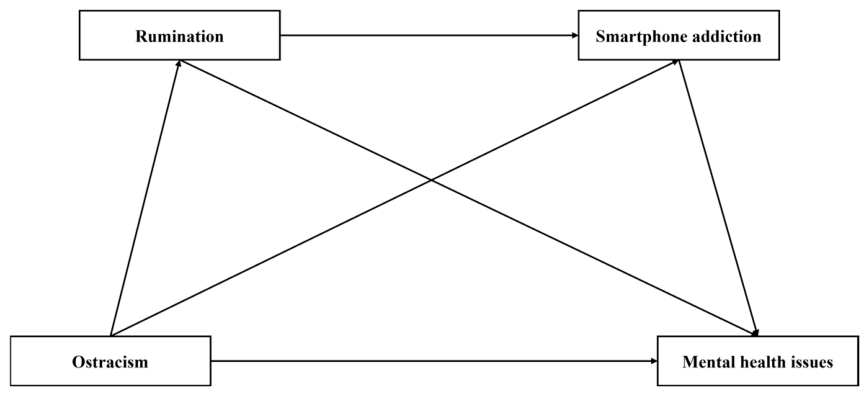
In summary, this study constructs a chain mediation model (see Figure 1) to investigate the associations among college students’ ostracism, rumination, smartphone addiction, and mental health issues. Specifically, we propose a sequential pathway in which ostracism is positively associated with rumination, which in turn is positively associated with smartphone addiction; this, ultimately, is positively associated with mental health issues. This model helps to elucidate the potential psychological mechanisms underlying the relationship between ostracism and mental health among college students, thereby providing theoretical guidance and practical implications for mental health promotion and intervention efforts targeting ostracized populations in higher education settings.

2. Methods

2.1. Participants

This study employed a cross-sectional design. Participants were undergraduate students recruited from two private colleges in Guangdong Province. A total of 710 questionnaires were distributed. The questionnaires were administered on-site by researchers during students’ class breaks and collected uniformly. Prior to completion, participants were informed of the research purpose and instructions, with emphasis placed on the academic nature of the study and the assurance of anonymity. All students participated voluntarily and completed the questionnaires independently. Following data collection, the questionnaires were reviewed and screened; those with missing critical information or identical responses across all items were considered invalid and subsequently excluded. A total of 78 invalid questionnaires were removed, yielding 632 valid responses, with an effective response rate of 89.01%. Among the valid sample, there were 278 male participants and 354 female participants. The age range of the participants was 18 to 21 years, with a mean age of 18.54 years.

2.2. Measures

2.2.1. Ostracism

Ostracism was measured using the Ostracism Experiences Scale (Carter-Sowell, 2010). This scale consists of 8 items rated on a 7-point Likert scale ranging from 1 (hardly ever) to 7 (almost always). Higher scores indicate more experiences of ostracism. The reliability of this scale has been established in Chinese samples (Yue et al., 2023). In the present study, Cronbach’s α coefficient for this scale was 0.963.

2.2.2. Rumination

Rumination was assessed using the Ruminative Responses Scale (RRS) (Treynor et al., 2003). This scale comprises 10 items rated on a 4-point Likert scale ranging from 1 (almost never) to 4 (almost always). Higher scores reflect more severe rumination. The reliability of this scale has been validated in Chinese samples (Wang et al., 2026). In the present study, Cronbach’s α coefficient for this scale was 0.903.

2.2.3. Smartphone Addiction

Smartphone addiction was measured using the scale developed by Roberts et al. (2014). This scale consists of 4 items rated on a 7-point Likert scale ranging from 1 (strongly disagree) to 7 (strongly agree). Higher scores indicate more severe smartphone addiction. The reliability of this scale has been established in Chinese samples (Dou & Feng, 2025). In the present study, Cronbach’s α coefficient for this scale was 0.855.

2.2.4. Mental Health Issues

Mental health issues were assessed using The Patient Health Questionnaire-4 (PHQ-4) (Löwe et al., 2010). This scale comprises 4 items rated on a 4-point Likert scale ranging from 0 (not at all) to 3 (nearly every day). Higher scores reflect more severe mental health issues. The reliability of this scale has been validated in Chinese samples (Gao et al., 2023). In the present study, Cronbach’s α coefficient for this scale was 0.900.

2.3. Data Analysis

Data analysis was conducted using SPSS 26.0 software. First, Harman’s single-factor test was employed to examine common method bias. Subsequently, descriptive statistics and Pearson correlation analyses were performed to examine the relationships among the study variables. Prior to hypothesis testing, the assumptions of regression analysis were assessed. The results indicated that the Durbin–Watson statistic values were close to 2 and fell within the acceptable range, suggesting no serious autocorrelation. Additionally, all variance inflation factor (VIF) values were well below the commonly accepted threshold of 5, indicating that multicollinearity was not a concern. Furthermore, the absolute values of skewness and kurtosis for all variables were below 2, supporting the assumption of normality. To test the proposed mediation effects, Model 6 of the PROCESS macro for SPSS was used, employing a bias-corrected non-parametric percentile bootstrap method (Hayes, 2013). Bootstrap resampling was conducted with 5000 resamples to generate 95% confidence intervals for the indirect effects. An indirect effect was considered statistically significant if its 95% confidence interval did not include zero.

3. Results

3.1. Common Method Bias Test

As all data in this study were collected using questionnaire methods, which may potentially introduce common method bias (Podsakoff et al., 2003), Harman’s single-factor test was conducted to examine this issue. The results of the unrotated factor analysis revealed that five factors had eigenvalues greater than 1. The total variance explained by the first factor was below the critical threshold of 40%, indicating that common method bias was not a serious concern in this study.

3.2. Descriptive Statistics and Correlation Analysis

As presented in Table 1, ostracism, rumination, smartphone addiction, and mental health issues were all positively correlated with each other.

3.3. Mediation Effect Test

Data analysis was conducted using the PROCESS macro for SPSS developed by Hayes. With the exception of gender, all variables in the model were standardized. With gender entered as a control variable, ostracism was specified as the independent variable, mental health issues as the dependent variable, and rumination and smartphone addiction as mediating variables. PROCESS Model 6 was selected to examine the chain mediating effects.
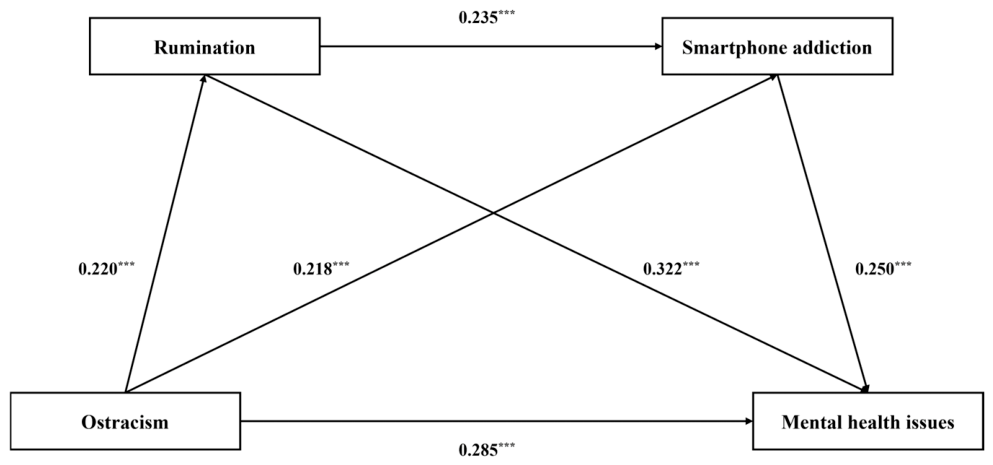
The results of the regression analysis are presented in Table 2 and Figure 2. Ostracism was significantly and positively associated with mental health issues (β = 0.423, p < 0.001, 95% CI [0.353, 0.494]) and rumination (β = 0.220, p < 0.001, 95% CI [0.145, 0.296]). Both ostracism (β = 0.218, p < 0.001, 95% CI [0.143, 0.293]) and rumination (β = 0.235, p < 0.001, 95% CI [0.159, 0.310]) were significantly and positively associated with smartphone addiction. Furthermore, when ostracism (β = 0.285, p < 0.001, 95% CI [0.220, 0.351]), rumination (β = 0.322, p < 0.001, 95% CI [0.255, 0.388]), and smartphone addiction (β = 0.250, p < 0.001, 95% CI [0.183, 0.317]) were simultaneously entered into the model, all three variables were positively associated with mental health issues.
The total indirect effect accounted for 32.62% of the total effect. The mediation effect analysis results are presented in Table 3. Specifically, the mediating effects consisted of three indirect pathways: Indirect Effect 1 (0.071) through “ostracism → rumination → mental health issues”; Indirect Effect 2 (0.055) through “ostracism → smartphone addiction → mental health issues”; and Indirect Effect 3 (0.013) through “ostracism → rumination → smartphone addiction → mental health issues.” The 95% confidence intervals for all three indirect effects did not include zero, indicating that all indirect effects were statistically significant.

4. Discussion

Given the increasing prominence of mental health issues among college students, the present study examined the association between ostracism and mental health issues in a sample of Chinese college students. Furthermore, this study investigated the chain mediating roles of rumination and smartphone addiction in the relationship between college students’ ostracism and mental health issues. The findings provide important empirical support for interventions targeting college students’ mental health issues within the context of a digital environment.
First, the results of this study revealed a positive association between ostracism and mental health issues among college students, thereby supporting Hypothesis 1. This finding suggests that ostracism, as a significant social stressor, is negatively associated with individuals’ psychological well-being. Specifically, when individuals encounter ostracism in social interactions, their need for belonging is readily threatened, which in turn is associated with negative emotions such as loneliness (Ren et al., 2021; Sakız et al., 2021). If the negative emotions elicited by ostracism experiences remain unrelieved over extended periods, individuals may tend to adopt avoidant or withdrawn interpersonal coping strategies, thereby reducing social engagement (Lei et al., 2024). Such diminished social interaction may be associated with their weakened capacity to cope with stress, ultimately linking to an increased risk of mental health issues, including depression and anxiety. Therefore, in college mental health education, attention should be directed toward social stressors such as ostracism. Practical efforts should focus on implementing targeted support strategies (e.g., peer support or counseling) for students who experience sustained ostracism, particularly when such experiences are identified through self-reports or routine screening in campus mental health services.
Second, our findings demonstrated that rumination mediated the relationship between ostracism and mental health issues among college students, supporting Hypothesis 2. This finding suggests that when college students experience ostracism, their mental health is associated not only with external events but also with their cognitive processing. Specifically, as a significant stressful context, ostracism is associated with a greater tendency to dwell repeatedly on the negative experience, which in turn is associated with elevated levels of rumination (Jiang & Poon, 2023). In this state, individuals’ attention tends to become excessively focused on negative emotions and their causes, while they are less likely to employ effective problem-solving strategies to cope with these stressors (Watkins & Roberts, 2020). Consequently, when college students experience elevated levels of rumination following ostracism, their mental health is associated with greater vulnerability to impairment. The findings of this study suggest that interventions targeting rumination may be beneficial in mitigating the negative correlates of ostracism among college students. Colleges could implement workshops aimed at helping students identify rumination, for example, through mindfulness-based practices. In addition, campus counseling services may incorporate specific strategies such as attention-shifting exercises when supporting students who report experiences of ostracism, thereby reducing the persistence of negative thought patterns associated with ostracism.
Third, the results of this study indicated that ostracism was positively correlated with smartphone addiction among college students, which in turn was positively correlated with mental health issues, thereby supporting Hypothesis 3. This finding aligns with existing research suggesting that ostracism is positively associated with problematic behaviors such as smartphone addiction (Yue et al., 2022). When individuals experience ostracism, they are prone to developing negative emotions and tendencies toward escapism, rendering them more inclined to seek emotional compensation and solace through virtual spaces (Poon, 2018). In this process, as smartphones serve as important mediums for accessing online social interaction and entertainment, both the frequency of use and degree of dependence may progressively increase, and this pattern is positively associated with a higher risk of smartphone addiction. Notably, smartphone addiction not only represents a behavioral dependence but may also be associated with disruptions to college students’ study and leisure time, which in turn is correlated with mental health issues such as depression and anxiety (Shang et al., 2024; Volungis et al., 2020). Therefore, this study further elucidates the potential mechanism through which ostracism is associated with college students’ mental health from the perspective of smartphone addiction. The findings also suggest that, when considering the correlates of ostracism in relation to college students’ mental health, targeted interventions might benefit from focusing on reducing problematic smartphone use as a key factor. Specifically, colleges and counseling services may enhance students’ awareness of maladaptive smartphone use and combine this with relevant strategies (e.g., screen time management and digital literacy programs).
Finally, our findings indicated that rumination and smartphone addiction jointly functioned as a chain mediating mechanism in the association between ostracism and mental health issues among college students, thereby supporting Hypothesis 4. This result highlights not only the close association between rumination and smartphone addiction but also how ostracism may be linked to mental health through interconnected cognitive and behavioral pathways within a specific cultural context. In China’s collectivist culture, which emphasizes a sense of belonging to a group, individuals often place greater importance on interpersonal relationships (He et al., 2024). In this context, experiences of ostracism are associated with stronger cognitive and emotional responses, which in turn are related to a higher tendency for repetitive negative thinking about the ostracism experience (Wesselmann et al., 2013). At the same time, academic and employment pressures, along with strong peer comparison norms, are further associated with increased ruminative tendencies. Under such circumstances, individuals may be more inclined to rely on smartphones as an accessible tool for immediate psychological compensation. Although this behavior may be associated with temporary relief from ostracism, it may also correlate with higher levels of problematic or addictive smartphone use (Sun et al., 2023). Over time, this pattern may be linked to disruptions in daily functioning and real-life social interactions, which in turn may be associated with a higher risk of mental health issues such as depression and anxiety among college students.

5. Limitations

Several limitations of this study should be noted. First, due to the cross-sectional design employed, the observed associations among variables cannot be interpreted as causal, and the directionality of these relationships remains tentative. It is also possible that reverse or bidirectional relationships exist; for example, individuals with more pronounced mental health issues may be more likely to perceive ostracism or to increase smartphone use as a coping strategy. Therefore, future research is encouraged to adopt longitudinal designs to further examine and validate the proposed chain mediation model. Second, the sample was primarily drawn from two private colleges in Guangdong Province, and only basic demographic information (i.e., gender and age) was collected, with no further disciplinary characteristics available. This may limit the contextual specificity and generalizability of the findings. Future studies could expand the sample size and enhance its representativeness. Third, the reliance on self-reported data may introduce social desirability bias or common method bias. To address this limitation, future research could adopt a multi-method approach. For example, ostracism could be assessed using experimental paradigms (e.g., the Cyberball paradigm), and smartphone addiction could be measured using objective smartphone usage data (e.g., screen time). Finally, other contextual and individual-level factors not included in the present model, such as personality traits, may also influence these associations, potentially limiting the comprehensiveness of the proposed model. Future research could incorporate these variables to develop a more comprehensive model.

6. Conclusions

In conclusion, by establishing a chain mediation model, this study provides a novel perspective for the existing literature and contributes to our understanding of the associations between ostracism and mental health issues among college students. The findings indicate that rumination and smartphone addiction play a chain mediating role in the association between ostracism and mental health issues. Specifically, ostracism is associated with increased levels of rumination, which in turn are associated with higher levels of smartphone addiction; such behaviors are further associated with mental health issues. This model not only elucidates the multiple psychological processes that may be involved in mental health difficulties among college students experiencing ostracism but also offers a theoretical foundation and practical reference for future mental health interventions in college settings.

Author Contributions

Conceptualization, C.Z. and D.L.; methodology, Z.W. and W.H.; formal analysis, Z.W. and J.L.; investigation, C.Z. and W.H.; resources, Z.W. and D.L.; data curation, Z.W.; writing—original draft preparation, C.Z. and Z.W.; writing—review and editing, C.Z. and D.L.; visualization, J.L.; supervision, C.Z.; project administration, D.L.; funding acquisition, D.L. All authors have read and agreed to the published version of the manuscript.

Funding

This research received no external funding.

Institutional Review Board Statement

The study was conducted in accordance with the Declaration of Helsinki, and approved by the Guangzhou Nanfang College (Ethics approval number:NF2026010602-1, approved on 16 January 2026).

Informed Consent Statement

Informed consent was obtained from all subjects involved in the study.

Data Availability Statement

The data are available from the corresponding author upon reasonable request.

Acknowledgments

We would like to thank all the participants who took part in this study.

Conflicts of Interest

The authors declare no conflicts of interest.

References

  1. Alwhaibi, M., & Al Aloola, N. A. (2023). Associations between stress, anxiety, depression and sleep quality among healthcare students. Journal of Clinical Medicine, 12(13), 4340. [Google Scholar] [CrossRef]
  2. Borders, A., & Liang, C. T. (2011). Rumination partially mediates the associations between perceived ethnic discrimination, emotional distress, and aggression. Cultural Diversity & Ethnic Minority Psychology, 17(2), 125. [Google Scholar] [CrossRef] [PubMed]
  3. Brougham, R. R., Zail, C. M., Mendoza, C. M., & Miller, J. R. (2009). Stress, sex differences, and coping strategies among college students. Current Psychology, 28(2), 85–97. [Google Scholar] [CrossRef]
  4. Buizza, C., Bazzoli, L., & Ghilardi, A. (2022). Changes in college students mental health and lifestyle during the COVID-19 pandemic: A systematic review of longitudinal studies. Adolescent Research Review, 7(4), 537–550. [Google Scholar] [CrossRef] [PubMed]
  5. Byrd, D. R., & McKinney, K. J. (2012). Individual, interpersonal, and institutional level factors associated with the mental health of college students. Journal of American College Health, 60(3), 185–193. [Google Scholar] [CrossRef] [PubMed]
  6. Carter-Sowell, A. R. (2010). Salting a wound, building a callous, or throwing in the towel? The measurement and effects of chronic ostracism experiences [Ph.D. Thesis, Purdue University]. [Google Scholar]
  7. Chen, Y., Zhang, Y., & Yu, G. (2022). Prevalence of mental health problems among college students in mainland China from 2010 to 2020: A meta-analysis. Advances in Psychological Science, 30(5), 991. [Google Scholar] [CrossRef]
  8. Choi, K. W., Kim, Y.-K., & Jeon, H. J. (2020). Comorbid anxiety and depression: Clinical and conceptual consideration and transdiagnostic treatment. In Y.-K. Kim (Ed.), Anxiety disorders: Rethinking and understanding recent discoveries (pp. 219–235). Springer. [Google Scholar] [CrossRef]
  9. Cleary, M., Walter, G., & Jackson, D. (2011). “Not always smooth sailing”: Mental health issues associated with the transition from high school to college. Issues in Mental Health Nursing, 32(4), 250–254. [Google Scholar] [CrossRef]
  10. Cook, L. J. (2007). Striving to help college students with mental health issues. Journal of Psychosocial Nursing and Mental Health Services, 45(4), 40–44. [Google Scholar] [CrossRef]
  11. Çorak, T. (2026). Intolerance of uncertainty and smartphone addiction: Mediating effects of reappraisal, suppression and rumination. Current Psychology, 45(5), 536. [Google Scholar] [CrossRef]
  12. Dou, G., & Feng, B. (2025). Social anxiety and smartphone addiction among college students: The mediating role of depressive symptoms. Current Psychology, 44(2), 882–893. [Google Scholar] [CrossRef]
  13. Gao, X., Zhong, J., Li, H., Pei, Y., Li, X., Zhang, S., Yue, Y., & Xiong, X. (2023). The relationship between perfectionism, self-perception of orofacial appearance, and mental health in college students. Frontiers in Public Health, 11, 1154413. [Google Scholar] [CrossRef] [PubMed]
  14. Hayes, A. (2013). Introduction to mediation, moderation, and conditional process analysis: A regression-based approach. Guilford Publications. [Google Scholar]
  15. He, Y., Chen, M., Guo, S., & Liang, J. (2024). An analysis of the latent profile and influencing factors of the sense of the meaning of life amongst medical students post-COVID-19 from the perspective of Chinese collectivist culture. Current Psychology, 43(20), 18790–18799. [Google Scholar] [CrossRef]
  16. Hua, Z. (2025). Religious attendance, psychological well-being, and mental health issues among older adults: A seven-year longitudinal study in the United States. International Journal of Geriatric Psychiatry, 40(11), e70171. [Google Scholar] [CrossRef] [PubMed]
  17. Huang, J., & Liu, X. (2023). Anxiety, depression, and their comorbidity among Chinese college students during the COVID-19 lockdown in the post-epidemic era: An online cross-sectional survey. BMC Psychiatry, 23(1), 923. [Google Scholar] [CrossRef]
  18. Jiang, Y., & Poon, K.-T. (2023). Stuck in companionless days, end up in sleepless nights: Relationships between ostracism, rumination, insomnia, and subjective well-being. Current Psychology, 42(1), 571–578. [Google Scholar] [CrossRef]
  19. Kardefelt-Winther, D. (2014). A conceptual and methodological critique of internet addiction research: Towards a model of compensatory internet use. Computers in Human Behavior, 31, 351–354. [Google Scholar] [CrossRef]
  20. Kroshus, E., Hawrilenko, M., & Browning, A. (2021). Stress, self-compassion, and well-being during the transition to college. Social Science & Medicine, 269, 113514. [Google Scholar] [CrossRef]
  21. Lei, Y., Li, M., Lin, C., Zhang, C., & Yu, Z. (2024). The effect of ostracism on social withdrawal behavior: The mediating role of self-esteem and the moderating role of rejection sensitivity. Frontiers in Psychology, 15, 1411697. [Google Scholar] [CrossRef]
  22. Li, K.-p., Niu, G.-f., Jin, S.-y., & Shi, X.-h. (2024). Social exclusion and video game addiction among college students: The mediating roles of depression and maladaptive cognition. Current Psychology, 43(40), 31639–31649. [Google Scholar] [CrossRef]
  23. Li, X., Xu, Y., Li, G., Ning, L., Xie, X., Shao, C., Liu, C., & Yang, X. (2024). The relationship between academic procrastination and anxiety symptoms among medical students during the COVID-19 pandemic: Exploring the moderated mediation effects of resilience and social support. BMC Psychiatry, 24(1), 850. [Google Scholar] [CrossRef]
  24. Liu, A., Yu, Y., & Sun, S. (2023). How is the Big Five related to college students’ anxiety: The role of rumination and resilience. Personality and Individual Differences, 200, 111901. [Google Scholar] [CrossRef]
  25. Long, Y., & Yu, M. (2025). The role of emotion-related impulsivity and inhibition in the associations between rumination and depressive symptoms in college students: The moderated mediation model. Current Psychology, 44(10), 9446–9457. [Google Scholar] [CrossRef]
  26. Löwe, B., Wahl, I., Rose, M., Spitzer, C., Glaesmer, H., Wingenfeld, K., Schneider, A., & Brähler, E. (2010). A 4-item measure of depression and anxiety: Validation and standardization of the Patient Health Questionnaire-4 (PHQ-4) in the general population. Journal of Affective Disorders, 122(1), 86–95. [Google Scholar] [CrossRef]
  27. McLaughlin, K. A., & Nolen-Hoeksema, S. (2011). Rumination as a transdiagnostic factor in depression and anxiety. Behaviour Research and Therapy, 49(3), 186–193. [Google Scholar] [CrossRef]
  28. Nezlek, J. B., Wesselmann, E. D., Wheeler, L., & Williams, K. D. (2012). Ostracism in everyday life. Group Dynamics: Theory, Research, and Practice, 16(2), 91. [Google Scholar] [CrossRef]
  29. Nolen-Hoeksema, S., & Morrow, J. (1991). A prospective study of depression and posttraumatic stress symptoms after a natural disaster: The 1989 Loma Prieta earthquake. Journal of Personality and Social Psychology, 61(1), 115–121. [Google Scholar] [CrossRef]
  30. Nolen-Hoeksema, S., Wisco, B. E., & Lyubomirsky, S. (2008). Rethinking rumination. Perspectives on Psychological Science, 3(5), 400–424. [Google Scholar] [CrossRef]
  31. Park, N., & Lee, H. (2012). Social implications of smartphone use: Korean college students’ smartphone use and psychological Well-being. Cyberpsychology, Behavior, and Social Networking, 15(9), 491–497. [Google Scholar] [CrossRef]
  32. Peng, Y., Zhou, H., Zhang, B., Mao, H., Hu, R., & Jiang, H. (2022). Perceived stress and mobile phone addiction among college students during the 2019 coronavirus disease: The mediating roles of rumination and the moderating role of self-control. Personality and Individual Differences, 185, 111222. [Google Scholar] [CrossRef] [PubMed]
  33. Podsakoff, P. M., MacKenzie, S. B., Lee, J.-Y., & Podsakoff, N. P. (2003). Common method biases in behavioral research: A critical review of the literature and recommended remedies. Journal of Applied Psychology, 88(5), 879. [Google Scholar] [CrossRef] [PubMed]
  34. Poon, K.-T. (2018). Unpacking the mechanisms underlying the relation between ostracism and Internet addiction. Psychiatry Research, 270, 724–730. [Google Scholar] [CrossRef]
  35. Ren, D., Wesselmann, E. D., & van Beest, I. (2021). Seeking solitude after being ostracized: A replication and beyond. Personality and Social Psychology Bulletin, 47(3), 426–440. [Google Scholar] [CrossRef]
  36. Roberts, J., Yaya, L., & Manolis, C. (2014). The invisible addiction: Cell-phone activities and addiction among male and female college students. Journal of Behavioral Addictions, 3(4), 254–265. [Google Scholar] [CrossRef]
  37. Rudert, S. C., Janke, S., & Greifeneder, R. (2021). Ostracism breeds depression: Longitudinal associations between ostracism and depression over a three-year-period. Journal of Affective Disorders Reports, 4, 100118. [Google Scholar] [CrossRef]
  38. Sakız, H., Mert, A., & Sarıçam, H. (2021). Self-esteem and perceived social competence protect adolescent students against ostracism and loneliness. Journal of Psychologists and Counsellors in Schools, 31(1), 94–109. [Google Scholar] [CrossRef]
  39. Samuolis, J., Barcellos, M., LaFlam, J., Belson, D., & Berard, J. (2015). Mental health issues and their relation to identity distress in college students. Identity, 15(1), 66–73. [Google Scholar] [CrossRef]
  40. Shang, Z. X., Wang, D. M., Liu, Z. K., & Zhang, X. Y. (2024). Exploring the impact of smartphone addiction on mental health among college students during the COVID-19 pandemic: The role of resilience and parental attachment. Journal of Affective Disorders, 367, 756–767. [Google Scholar] [CrossRef]
  41. Shi, Y., Ding, F., Qu, L., Liu, K., & Cheng, G. (2023). Developmental trajectory of ostracism during the transition to college: The role of the five-factor model traits. Personality and Individual Differences, 210, 112245. [Google Scholar] [CrossRef]
  42. Soet, J., & Sevig, T. (2006). Mental health issues facing a diverse sample of college students: Results from the college student mental health survey. NASPA Journal, 43(3), 410–431. [Google Scholar] [CrossRef]
  43. Sun, X., Zhang, Y., Niu, G., Tian, Y., Xu, L., & Duan, C. (2023). Ostracism and problematic smartphone use: The mediating effect of social self-efficacy and moderating effect of rejection sensitivity. International Journal of Mental Health and Addiction, 21(3), 1334–1347. [Google Scholar] [CrossRef]
  44. Sunday, O. J., Adesope, O. O., & Maarhuis, P. L. (2021). The effects of smartphone addiction on learning: A meta-analysis. Computers in Human Behavior Reports, 4, 100114. [Google Scholar] [CrossRef]
  45. Tariq, H., Iqbal, M. N., & Javed, F. (2024). Unveiling the nexus of personality traits, ostracism, and mental health issues in university students. Contemporary Journal of Social Science Review, 2(4), 382–389. [Google Scholar]
  46. Treynor, W., Gonzalez, R., & Nolen-Hoeksema, S. (2003). Rumination reconsidered: A psychometric analysis. Cognitive Therapy and Research, 27(3), 247–259. [Google Scholar] [CrossRef]
  47. Volungis, A. M., Kalpidou, M., Popores, C., & Joyce, M. (2020). Smartphone addiction and its relationship with indices of social-emotional distress and personality. International Journal of Mental Health and Addiction, 18(5), 1209–1225. [Google Scholar] [CrossRef]
  48. Wang, L., Guan, H., Fu, J., & Yu, W. (2026). Autonomous fitness behavior and social anxiety in college students: The chain mediating roles of rumination and emotional–social isolation. The Journal of Psychology, 1–18. [Google Scholar] [CrossRef] [PubMed]
  49. Watkins, E. R., & Roberts, H. (2020). Reflecting on rumination: Consequences, causes, mechanisms and treatment of rumination. Behaviour Research and Therapy, 127, 103573. [Google Scholar] [CrossRef]
  50. Wesselmann, E. D., Ren, D., Swim, E., & Williams, K. D. (2013). Rumination hinders recovery from ostracism. International Journal of Developmental Science, 7(1), 33–39. [Google Scholar] [CrossRef]
  51. Williams, K. D. (2007). Ostracism: The kiss of social death. Social and Personality Psychology Compass, 1(1), 236–247. [Google Scholar] [CrossRef]
  52. Williams, K. D. (2009). Chapter 6 ostracism: A temporal need-threat model. In Advances in experimental social psychology (Vol. 41, pp. 275–314). Academic Press. [Google Scholar] [CrossRef]
  53. Xia, H., Han, X., Cheng, J., Liu, D., Wu, Y., & Liu, Y. (2022). Effects of negative life events on depression in middle school students: The chain-mediating roles of rumination and perceived social support. Frontiers in Psychology, 13, 781274. [Google Scholar] [CrossRef]
  54. Yan, J., Lian, Y., & He, L. (2024). Perceived ambidextrous leadership and nurses’ mental health: A work-family perspective. BMC Nursing, 23(1), 504. [Google Scholar] [CrossRef] [PubMed]
  55. Yang, L., Liu, Z., Shi, S., Dong, Y., Cheng, H., & Li, T. (2023). The mediating role of perceived stress and academic procrastination between physical activity and depressive symptoms among Chinese college students during the COVID-19 pandemic. International Journal of Environmental Research and Public Health, 20(1), 773. [Google Scholar] [CrossRef] [PubMed]
  56. Yue, H., Yue, X., Zhang, X., Liu, B., & Bao, H. (2022). Exploring the relationship between social exclusion and smartphone addiction: The mediating roles of loneliness and self-control. Frontiers in Psychology, 13, 945631. [Google Scholar] [CrossRef]
  57. Yue, H., Yue, X., Zhang, X., Liu, B., & Bao, H. (2023). Exploring the relationship between social exclusion and social media addiction: The mediating roles of anger and impulsivity. Acta Psychologica, 238, 103980. [Google Scholar] [CrossRef]
  58. Zadro, L., Boland, C., & Richardson, R. (2006). How long does it last? The persistence of the effects of ostracism in the socially anxious. Journal of Experimental Social Psychology, 42(5), 692–697. [Google Scholar] [CrossRef]
  59. Zhang, M. X., & Wu, A. M. S. (2020). Effects of smartphone addiction on sleep quality among Chinese university students: The mediating role of self-regulation and bedtime procrastination. Addictive Behaviors, 111, 106552. [Google Scholar] [CrossRef] [PubMed]
  60. Zhao, X., Wang, H., Ma, Z., Zhang, L., & Chang, T. (2025). Smartphone addiction and academic procrastination among college students: A serial mediation model of self-control and academic self-efficacy [Original Research]. Frontiers in Psychiatry, 16, 1572963. [Google Scholar] [CrossRef] [PubMed]
Figure 1. The hypothesized model.
Behavsci 16 00769 g001
Figure 2. The final chain mediation model. *** p < 0.001.
Behavsci 16 00769 g002
Table 1. Descriptive statistics and correlation analysis of each variable.
VariableMSD1234
1. Ostracism18.6339.0131
2. Rumination24.6715.8030.224 **1
3. Smartphone addiction17.3425.1070.267 **0.271 **1
4. Mental health issues4.1192.2680.424 **0.454 **0.413 **1
Note: M is mean value; SD is standard deviation. ** p < 0.01.
Table 2. Regression analysis of the relationship between variables.
Dependent VariableIndependent VariableβtBootstrap 95% CIR2F
Mental health issuesGender−0.035−0.481[−0.178, 0.108]0.18069.104 ***
Ostracism0.42311.722 ***[0.353, 0.494]
RuminationGender−0.218−2.807 **[−0.371, −0.066]0.06220.810 ***
Ostracism0.2205.706 ***[0.145, 0.296]
Smartphone addictionGender0.2082.749 **[0.059, 0.356]0.12931.003 ***
Ostracism0.2185.710 ***[0.143, 0.293]
Rumination0.2356.099 ***[0.159, 0.310]
Mental health issuesGender−0.004−0.059[−0.131, 0.123]0.37092.081 ***
Ostracism0.2858.547 ***[0.220, 0.351]
Rumination0.3229.546 ***[0.255, 0.388]
Smartphone addiction0.2507.357 ***[0.183, 0.317]
Note: ** p < 0.01; *** p < 0.001.
Table 3. The mediation effect analysis.
Effect TypeEffect SizeSEBootstrap 95% CI
Total effect0.4230.036[0.353, 0.494]
Direct effect0.2850.033[0.220, 0.351]
Indirect effect 10.0710.017[0.040, 0.107]
Indirect effect 20.0550.014[0.030, 0.083]
Indirect effect 30.0130.004[0.006, 0.022]
Note: Indirect effects 1: Ostracism → Rumination → Mental Health Issues; Indirect effects 2: Ostracism → Smartphone addiction → Mental Health Issues; Indirect effects 3: Ostracism → Rumination → Smartphone addiction → Mental Health Issues.
Disclaimer/Publisher’s Note: The statements, opinions and data contained in all publications are solely those of the individual author(s) and contributor(s) and not of MDPI and/or the editor(s). MDPI and/or the editor(s) disclaim responsibility for any injury to people or property resulting from any ideas, methods, instructions or products referred to in the content.