Job Crafting Through the Lens of Paradoxical Leadership: The Role of Positive Psychological Capital and Promotive Voice


Abstract
1. Introduction
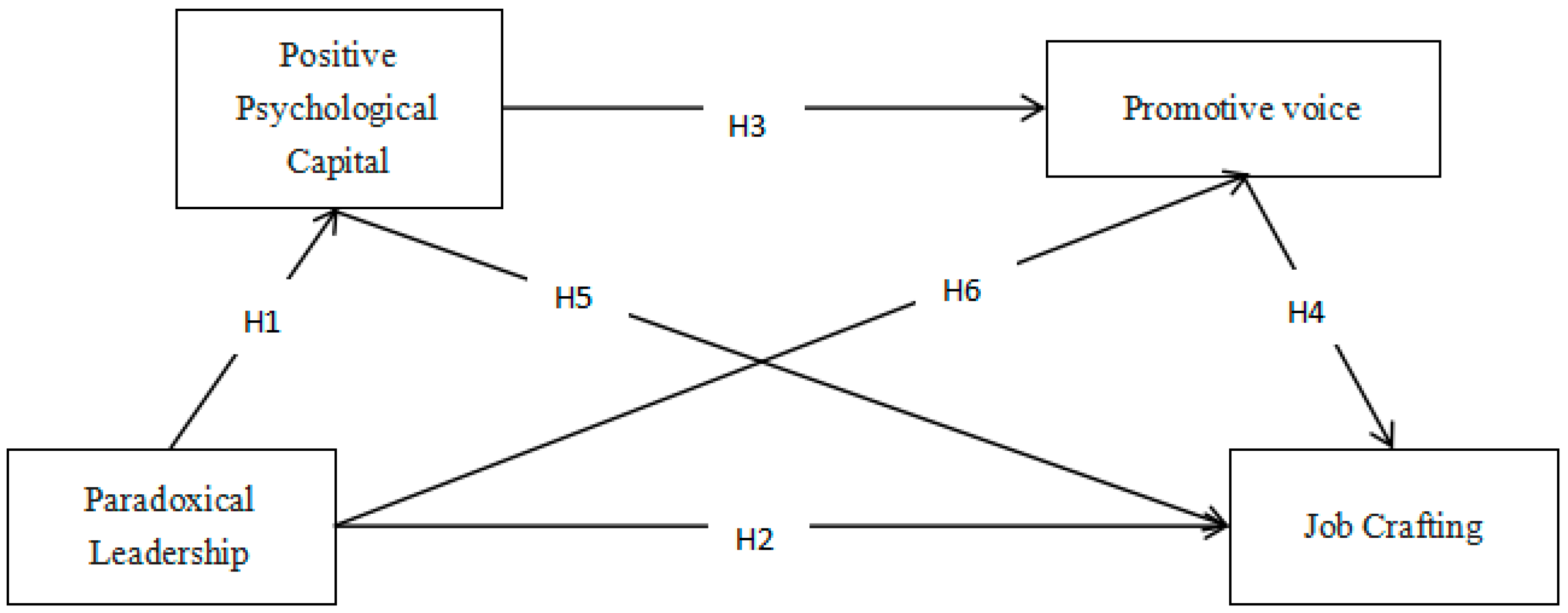
2. Theory and Hypotheses
2.1. Paradoxical Leadership and Positive Psychological Capital
2.2. Paradoxical Leadership and Job Crafting
2.3. Positive Psychological Capital and Promotive Voice
2.4. Promotive Voice and Job Crafting
2.5. Mediating Effect of Positive Psychological Capital
2.6. Mediating Effect of Promotive Voice
3. Methods
3.1. Sample and Data Collection
3.2. Measures
3.2.1. Paradoxical Leadership
3.2.2. Positive Psychological Capital
3.2.3. Promotive Voice
3.2.4. Job Crafting
4. Results
4.1. Common Method Bias
4.2. Measurement Reliability and Validity Assessment
4.3. Hypothesis Testing
5. Discussion
6. Conclusions
6.1. Theoretical Implications
6.2. Practical Implications
6.3. Limitations and Future Studies
Author Contributions
Funding
Institutional Review Board Statement
Informed Consent Statement
Data Availability Statement
Conflicts of Interest
References
- Adelman, K. (2012). Promoting employee voice and upward communication in healthcare: The CEO’s influence. Journal of Healthcare Management, 57(2), 133–148. [Google Scholar] [CrossRef] [PubMed]
- Agarwal, P., & Farndale, E. (2017). High-performance work systems and creativity implementation: The role of psychological capital and psychological safety. Human Resource Management Journal, 27(3), 440–458. [Google Scholar] [CrossRef]
- Ahmed, M., & Khan, M. I. (2024). Unpacking the paradoxical impact of ethical leadership on employees’ unethical pro-organizational behavior: The interplay of employees’ psychological capital and moral identity. Sage Open, 14(4), 21582440241300194. [Google Scholar] [CrossRef]
- Ajmal, M., Sareet, Z., & Islam, A. (2025). Unleashing innovation through employee voice behavior in the hotel industry: The impact of ambidextrous leadership on innovative work behavior. Journal of Hospitality and Tourism Insights, 8(2), 448–471. [Google Scholar] [CrossRef]
- Akhtar, N., & Riaz, A. (2024). The role of occupational self-efficacy as a mediator between paradoxical leadership and job crafting from the lens of proactive motivation theory. Journal of Innovative Research in Management Sciences, 5(2), 22–40. [Google Scholar] [CrossRef]
- Avey, J. B., Wernsing, T. S., & Luthans, F. (2008). Can positive employees help positive organizational change? Impact of psychological capital and emotions on relevant attitudes and behaviors. The Journal of Applied Behavioral Science, 44(1), 48–70. [Google Scholar] [CrossRef]
- Bakker, A. B. (2010). Engagement and “job crafting”: Engaged employees create their own great place to work. In Handbook of employee engagement. Edward Elgar Publishing. [Google Scholar]
- Bakker, A. B. (2017). Strategic and proactive approaches to work engagement. Organizational Dynamics, 46(2), 67–75. [Google Scholar] [CrossRef]
- Bakker, A. B., Tims, M., & Derks, D. (2012). Proactive personality and job performance: The role of job crafting and work engagement. Human Relations, 65(10), 1359–1378. [Google Scholar] [CrossRef]
- Bandura, A. (2023). Cultivate self-efficacy for personal and organizational effectiveness. In Principles of organizational behavior: The handbook of evidence-based management (3rd ed., pp. 113–135). John Wiley & Sons. [Google Scholar]
- Bindl, U. K., Unsworth, K. L., Gibson, C. B., & Stride, C. B. (2019). Job crafting revisited: Implications of an extended framework for active changes at work. Journal of Applied Psychology, 104(5), 605. [Google Scholar] [CrossRef]
- Brislin, R. W. (1980). Cross-cultural research methods: Strategies, problems, applications. In Environment and culture (pp. 47–82). Springer. [Google Scholar]
- Chen, H., & Li, Z. (2026). When digital power backfires: A systems perspective on technology-enacted abusive supervision, defensive silence, and counterproductive work behavior. Systems, 14(2), 145. [Google Scholar] [CrossRef]
- Curcuruto, M., & Griffin, M. A. (2023). Upward safety communication in the workplace: How team leaders stimulate employees’ voice through empowering and monitoring supervision. Safety Science, 157, 105947. [Google Scholar] [CrossRef]
- Devi, N. C. (2024). Paradoxical leadership and employee creativity: Knowledge sharing and hiding as mediators. Journal of Knowledge Management, 28(2), 312–340. [Google Scholar] [CrossRef]
- De Waal, J. J., & Pienaar, J. (2013). Towards understanding causality between work engagement and psychological capital. SA Journal of Industrial Psychology, 39(2), 1–10. [Google Scholar] [CrossRef]
- Farndale, E., Van Ruiten, J., Kelliher, C., & Hope-Hailey, V. (2011). The influence of perceived employee voice on organizational commitment: An exchange perspective. Human Resource Management, 50(1), 113–129. [Google Scholar] [CrossRef]
- Franken, E., Plimmer, G., & Malinen, S. (2020). Paradoxical leadership in public sector organisations: Its role in fostering employee resilience. Australian Journal of Public Administration, 79(1), 93–110. [Google Scholar] [CrossRef]
- Fürstenberg, N., Alfes, K., & Kearney, E. (2021). How and when paradoxical leadership benefits work engagement: The role of goal clarity and work autonomy. Journal of Occupational and Organizational Psychology, 94(3), 672–705. [Google Scholar] [CrossRef]
- Huang, D., Zhu, T., Wu, Y., & Sun, T. (2022). A study on paradoxical leadership and multiple path mechanisms of employees’ Bootleg innovation. Psychology Research and Behavior Management, 3391–3407. [Google Scholar] [CrossRef]
- Hussein, N., & Amiruddin, N. S. (2020). Job crafting, psychological capital and work engagement: An empirical evidence of a sustainable high-performance GLC. Journal of Emerging Economies & Islamic Research, 8(2), 1–13. [Google Scholar]
- Iqbal, J., Aukhoon, M. A., & Parray, Z. A. (2024). Thriving minds, thriving workplaces: Unleashing creativity through psychological wellbeing and psychological capital. Journal of Organizational Effectiveness: People and Performance, 12(4), 921–938. [Google Scholar] [CrossRef]
- Jerab, D., & Mabrouk, T. (2023, September 17). The role of leadership in changing organizational culture. Available online: https://ssrn.com/abstract=4574324 (accessed on 21 May 2026).
- Judge, T. A., Klinger, R., & Li, M. (2023). Promote job satisfaction through mental challenge. In Principles of organizational behavior: The handbook of evidence-based management (3rd ed., pp. 161–178). John Wiley & Sons. [Google Scholar]
- Jung, K. B., Kang, S. W., & Choi, S. B. (2022). Paradoxical leadership and involvement in creative task via creative self-efficacy: A moderated mediation role of task complexity. Behavioral Sciences, 12(10), 377. [Google Scholar] [CrossRef]
- Kamil, N. L. M., Stillwell, E., Nordin, W. N. A. W. M., & Zhao, K. (2024). The longitudinal effect of psychosocial safety climate and employee voice behaviour: Does job crafting and paradoxical leadership matter? In Opportunities and risks in AI for business development: Volume 1 (pp. 875–885). Springer Nature. [Google Scholar]
- Karimi, S., Ahmadi Malek, F., Yaghoubi Farani, A., & Liobikienė, G. (2023). The role of transformational leadership in developing innovative work behaviors: The mediating role of employees’ psychological capital. Sustainability, 15(2), 1267. [Google Scholar] [CrossRef]
- Kataria, P., & Varma, S. (2025). From voice to promotive voice: A positive organisational scholarship perspective. International Journal of Organizational Analysis, 34(6), 1978–2003. [Google Scholar] [CrossRef]
- Khan, M. T., & Ullah, S. (2025). Balancing innovation: The role of paradoxical leadership and ambidexterity in fostering team creativity. International Journal of Innovation Science. Advanced online publication. [Google Scholar] [CrossRef]
- Khan, M. T., Ullah, S., Sami, A., Kukreti, M., & Shaukat, M. R. (2025). Cultivating a paradoxical mindset: Enhancing transformative learning through paradoxical leadership. Leadership & Organization Development Journal, 46(2), 334–350. [Google Scholar] [CrossRef]
- Kim, J. E. (2021). Paradoxical leadership and proactive work behavior: The role of psychological safety in the hotel industry. The Journal of Asian Finance, Economics and Business, 8(5), 167–178. [Google Scholar]
- Lavine, M. (2014). Paradoxical leadership and the competing values framework. The Journal of Applied Behavioral Science, 50(2), 189–205. [Google Scholar] [CrossRef]
- Lewis, M. W., Andriopoulos, C., & Smith, W. K. (2014). Paradoxical leadership to enable strategic agility. California Management Review, 56(3), 58–77. [Google Scholar] [CrossRef]
- Li, Z., Choi, M. C., & Kim, H. E. (2025). AI awareness and employee innovation: A dual-pathway moderated mediation model within organizational systems. Systems, 13(7), 530. [Google Scholar] [CrossRef]
- Li, Z., & Jo, S. J. (2025). The hidden cost of empowerment: How differentiated empowering leadership influences knowledge hiding among generation MZ employees? Sage Open, 15(4), 21582440251395533. [Google Scholar] [CrossRef]
- Li, Z., & Song, L. (2024). Understanding the impact of abusive leadership on third-party observers’ turnover intentions: Insights from organizational identification and authority orientation. Acta Psychologica, 248, 104438. [Google Scholar] [CrossRef]
- Liang, J., Farh, C. I., & Farh, J. L. (2012). Psychological antecedents of promotive and prohibitive voice: A two-wave examination. Academy of Management Journal, 55(1), 71–92. [Google Scholar] [CrossRef]
- Liu, Y., Xu, S., & Zhang, B. (2020). Thriving at work: How a paradox mindset influences innovative work behavior. The Journal of Applied Behavioral Science, 56(3), 347–366. [Google Scholar] [CrossRef]
- Luc, P. T. (2023). Impact of psychological capital and social capital on social entrepreneurial intention through social entrepreneurial outcome expectations. Journal of Social Entrepreneurship, 16(3), 1332–1351. [Google Scholar] [CrossRef]
- Luthans, F., Avolio, B. J., Avey, J. B., & Norman, S. M. (2007). Positive psychological capital: Measurement and relationship with performance and satisfaction. Personnel Psychology, 60(3), 541–572. [Google Scholar] [CrossRef]
- Madaan, K., Jain, D., & Sharma, H. (2025). Does paradoxical leadership predict employee job performance in hospitality? A sequential mediation of harmonious work passion and innovative work behavior. Journal of Hospitality and Tourism Insights, 8(4), 1458–1477. [Google Scholar] [CrossRef]
- Mansaray, H. E. (2019). The role of leadership style in organisational change management: A literature review. Journal of Human Resource Management, 7(1), 18–31. [Google Scholar] [CrossRef]
- Mowbray, P. K., Gu, J., Chen, Z., Tse, H. H., & Wilkinson, A. (2024). How do tangible and intangible rewards encourage employee voice? The perspective of dual proactive motivational pathways. The International Journal of Human Resource Management, 35(15), 2569–2601. [Google Scholar] [CrossRef]
- Newman, A., Ucbasaran, D., Zhu, F. E. I., & Hirst, G. (2014). Psychological capital: A review and synthesis. Journal of Organizational Behavior, 35(S1), S120–S138. [Google Scholar] [CrossRef]
- Park, I. J., Shim, S. H., Hai, S., Kwon, S., & Kim, T. G. (2022). Cool down emotion, don’t be fickle! The role of paradoxical leadership in the relationship between emotional stability and creativity. The International Journal of Human Resource Management, 33(14), 2856–2886. [Google Scholar] [CrossRef]
- Pradies, C., Aust, I., Bednarek, R., Brandl, J., Carmine, S., Cheal, J., Pina e Cunha, M., Gaim, M., Keegan, A., Lê, J. K., Miron-Spektor, E., Nielsen, R. K., Pouthier, V., Sharma, G., Sparr, J. L., Vince, R., & Keller, J. (2021). The lived experience of paradox: How individuals navigate tensions during the pandemic crisis. Journal of Management Inquiry, 30(2), 154–167. [Google Scholar] [CrossRef]
- Qiu, A., Li, Z., Choi, M., & Kim, H. E. (2025). Abusive supervision and counterproductive work behaviors under generational differences: A chain mediation model between perception of organizational politics and defensive silence. Frontiers in Psychology, 16, 1657730. [Google Scholar] [CrossRef]
- Rabenu, E. (2017). Positive psychological capital: From strengths to power. In Redefining management: Smart power perspectives (pp. 81–105). Springer International Publishing. [Google Scholar]
- Rego, A., Sousa, F., Marques, C., & e Cunha, M. P. (2012). Authentic leadership promoting employees’ psychological capital and creativity. Journal of Business Research, 65(3), 429–437. [Google Scholar] [CrossRef]
- Ruck, K., Welch, M., & Menara, B. (2017). Employee voice: An antecedent to organisational engagement? Public Relations Review, 43(5), 904–914. [Google Scholar] [CrossRef]
- Schaufeli, W. (2021). Engaging leadership: How to promote work engagement? Frontiers in Psychology, 12, 754556. [Google Scholar] [CrossRef]
- Shah, T. A., Khattak, M. N., Zolin, R., & Shah, S. Z. A. (2019). Psychological empowerment and employee attitudinal outcomes: The pivotal role of psychological capital. Management Research Review, 42(7), 797–817. [Google Scholar] [CrossRef]
- Smith, W. K., & Lewis, M. W. (2011). Toward a theory of paradox: A dynamic equilibrium model of organizing. Academy of Management Review, 36(2), 381–403. [Google Scholar]
- Smith, W. K., & Lewis, M. W. (2012). Leadership skills for managing paradoxes. Industrial and Organizational Psychology, 5(2), 227–231. [Google Scholar] [CrossRef]
- Stynen, D., & Semeijn, J. (2023). Paradoxical leadership and well-being in turbulent times: A time-lagged study. Frontiers in Psychology, 14, 1148822. [Google Scholar] [CrossRef] [PubMed]
- Sun, W., Mei, J., Chen, K., & Li, Z. (2025). Biodiversity risk and value creation in emerging markets. Finance Research Letters, 85, 108069. [Google Scholar] [CrossRef]
- Sweetman, D., & Luthans, F. (2010). The power of positive psychology: Psychological capital and work engagement. In Work engagement: A handbook of essential theory and research (pp. 54–68). Psychology Press. [Google Scholar]
- Tan, L., Hao, P., Gao, H., & Wojtczuk-Turek, A. (2024). How does paradoxical leadership affect employee adaptive performance? A moderated mediation model. Journal of Organizational Change Management, 37(7), 1535–1558. [Google Scholar] [CrossRef]
- Tims, M., & Bakker, A. B. (2010). Job crafting: Towards a new model of individual job redesign. SA Journal of Industrial Psychology, 36(2), 1–9. [Google Scholar] [CrossRef]
- Tims, M., Bakker, A. B., & Derks, D. (2012). Development and validation of the job crafting scale. Journal of vocational Behavior, 80(1), 173–186. [Google Scholar] [CrossRef]
- Toor, S. U. R., & Ofori, G. (2010). Positive psychological capital as a source of sustainable competitive advantage for organizations. Journal of Construction Engineering and Management, 136(3), 341–352. [Google Scholar] [CrossRef]
- Wang, J. (2021). Research on the influence of dynamic work environment on employees’ innovative performance in the post-epidemic era–the role of job crafting and voice behavior. Frontiers in Psychology, 12, 795218. [Google Scholar] [CrossRef]
- Xia, B., Zhang, M., & Li, Z. (2026). Unpacking flexible work and employee thriving: Knowledge-motivation mediation and the boundary role of cognitive flexibility. Frontiers in Psychology, 17, 1701795. [Google Scholar] [CrossRef]
- Yin, J. (2022). Living with tensions in the workplace: A grounded theory of paradoxical leadership in cultivating subordinates’ paradox mindset. Leadership & Organization Development Journal, 43(6), 862–873. [Google Scholar] [CrossRef]
- Zhang, F., & Parker, S. K. (2019). Reorienting job crafting research: A hierarchical structure of job crafting concepts and integrative review. Journal of Organizational Behavior, 40(2), 126–146. [Google Scholar] [CrossRef]
- Zhang, K., Man, X., Jin, L., & Li, Z. (2025). The potential threat of ambidextrous leadership to employee innovation: The roles of cognitive ambivalence and paradox mindset. Acta Psychologica, 259, 105384. [Google Scholar] [CrossRef]
- Zhang, Y., Waldman, D. A., Han, Y. L., & Li, X. B. (2015). Paradoxical leader behaviors in people management: Antecedents and consequences. Academy of Management Journal, 58(2), 538–566. [Google Scholar] [CrossRef]



| Item | Estimate | S.E. | C.R. | AVE | CR | |
|---|---|---|---|---|---|---|
| β | B | |||||
| PL1 | 0.707 | 1 | 0.521 | 0.883 | ||
| PL2 | 0.699 | 0.988 | 0.080 | 12.425 | ||
| PL3 | 0.727 | 1.032 | 0.080 | 12.920 | ||
| PL4 | 0.673 | 0.954 | 0.080 | 11.938 | ||
| PL5 | 0.749 | 1.060 | 0.080 | 13.252 | ||
| PL6 | 0.729 | 1.030 | 0.080 | 12.932 | ||
| PL7 | 0.685 | 0.969 | 0.080 | 12.150 | ||
| PL8 | 0.755 | 1.075 | 0.079 | 13.537 | ||
| PL9 | 0.668 | 0.946 | 0.080 | 11.896 | ||
| PL10 | 0.725 | 1.025 | 0.079 | 12.904 | ||
| PL11 | 0.720 | 1.021 | 0.080 | 12.807 | ||
| PL12 | 0.699 | 0.989 | 0.079 | 12.445 | ||
| PL13 | 0.790 | 1.120 | 0.080 | 14.004 | ||
| PL14 | 0.764 | 1.080 | 0.080 | 13.506 | ||
| PPC1 | 0.694 | 1 | 0.527 | 0.816 | ||
| PPC2 | 0.684 | 0.977 | 0.085 | 11.545 | ||
| PPC3 | 0.788 | 1.135 | 0.085 | 13.314 | ||
| PPC4 | 0.695 | 0.999 | 0.085 | 11.755 | ||
| PPC5 | 0.723 | 1.043 | 0.085 | 12.216 | ||
| PPC6 | 0.718 | 1.037 | 0.085 | 12.196 | ||
| PPC7 | 0.749 | 1.088 | 0.085 | 12.812 | ||
| PPC8 | 0.748 | 1.078 | 0.085 | 12.694 | ||
| JC5 | 0.720 | 1 | 0.525 | 0.735 | ||
| JC4 | 0.755 | 1.067 | 0.082 | 13.012 | ||
| JC3 | 0.728 | 1.011 | 0.081 | 12.444 | ||
| JC2 | 0.719 | 0.997 | 0.081 | 12.277 | ||
| JC1 | 0.701 | 0.978 | 0.081 | 12.072 | ||
| PV8 | 0.809 | 1 | 0.626 | 0.870 | ||
| PV7 | 0.820 | 1.014 | 0.058 | 17.613 | ||
| PV6 | 0.788 | 0.975 | 0.059 | 16.482 | ||
| PV5 | 0.790 | 0.977 | 0.059 | 16.627 | ||
| PV4 | 0.775 | 0.958 | 0.059 | 16.187 | ||
| PV3 | 0.771 | 0.954 | 0.059 | 16.093 | ||
| PV2 | 0.779 | 0.965 | 0.059 | 16.329 | ||
| PV1 | 0.798 | 0.986 | 0.059 | 16.827 | ||
| Model fit | CMIN/DF = 1.131, p < 0.001, RMR = 0.066, GFI = 0.908, CFI = 0.990, TLI = 0.989, IFI = 0.990, RFI = 0.911, NFI = 0.918, RMSEA = 0.020. | |||||
| Model | Factor Structure | χ2 | df | χ2/df | NFI | IFI | TLI | RMSEA |
|---|---|---|---|---|---|---|---|---|
| 4-factor | PL, PPC, JC, PV | 301.126 | 264 | 1.131 | 0.918 | 0.99 | 0.989 | 0.02 |
| 3-factor | PL, PPC, (JC + PV) | 968.451 | 365 | 1.354 | 0.901 | 0.972 | 0.97 | 0.032 |
| 2-factor | PL, (PPC + JC + PV) | 1456.231 | 423 | 2.056 | 0.849 | 0.916 | 0.91 | 0.056 |
| 1-factor | (PL + PPC + JC + PV) | 1969.688 | 560 | 3.517 | 0.741 | 0.8 | 0.786 | 0.086 |
| Variables | Mean | S.D. | PL | PPC | JC | PV |
|---|---|---|---|---|---|---|
| PL | 3.120 | 1.054 | 1 | |||
| PPC | 3.215 | 1.083 | 0.586 ** | 1 | ||
| JC | 3.830 | 1.115 | 0.655 ** | 0.653 ** | 1 | |
| PV | 3.636 | 1.162 | 0.646 ** | 0.665 ** | 0.687 ** | 1 |
| Hypothesized Path | Estimate | SE | CR | P |
|---|---|---|---|---|
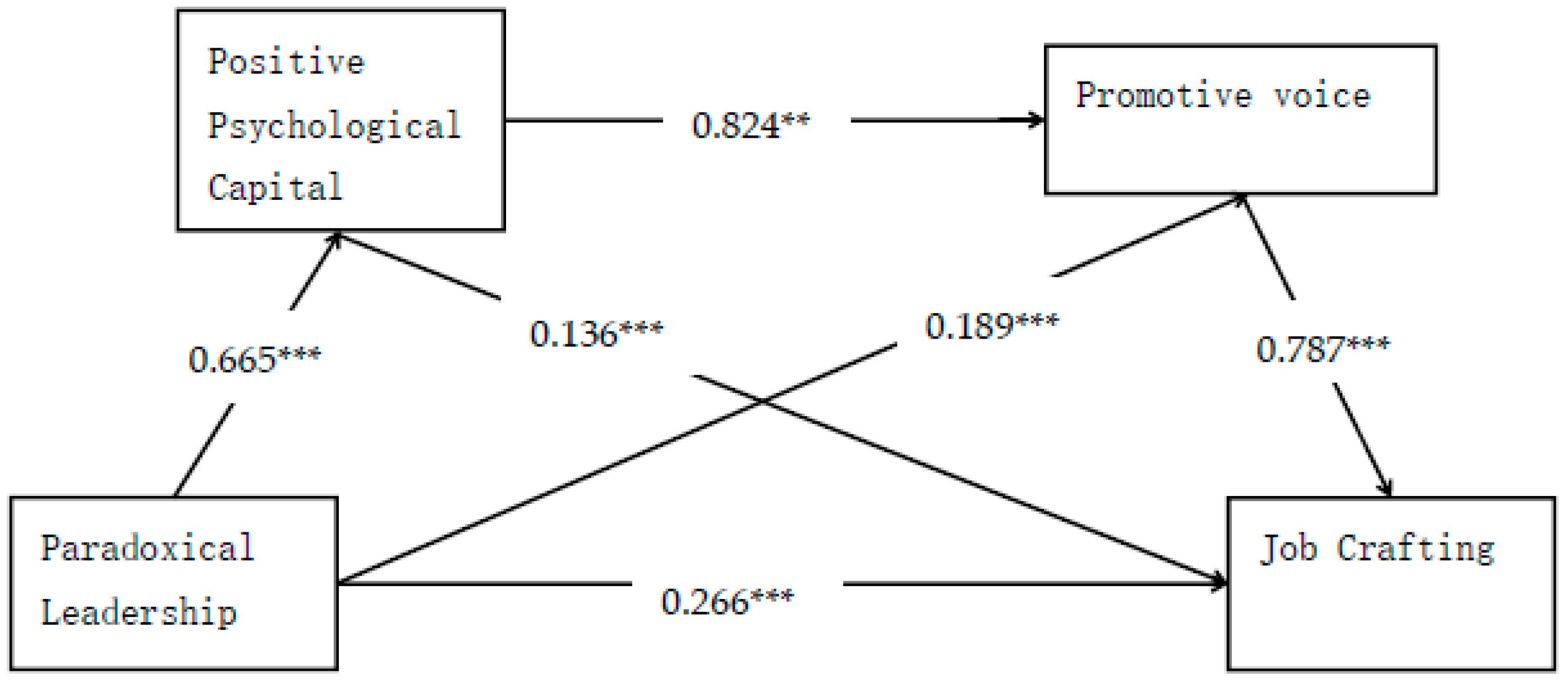
| H1. PL → PPC | 0.665 | 0.069 | 9.632 | *** |
| H2. PL → JC | 0.266 | 0.062 | 4.329 | *** |
| H3. PPC → PV | 0.824 | 0.079 | 10.469 | *** |
| H4. PV → JC | 0.787 | 0.081 | 9.754 | *** |
| Model fit | CMIN/DF = 1.225, p < 0.001, CFI = 0.982, TLI = 0.981, IFI = 0.982, RFI = 0.904, NFI = 0.910, RMSEA = 0.026. | |||
| Variables | H5 | H6 | ||
|---|---|---|---|---|
| Model 1 | Model 2 | Model 3 | Model 4 | |
| (PPC) | (PV) | (JC) | (JC) | |
| Gender | 0.299 | 0.251 | 0.044 | 0.131 |
| Age | 0.045 | 0.032 | 0.079 | 0.068 |
| Position | 0.214 * | 0.191 | 0.046 | 0.131 |
| PL | 0.690 *** | 0.801 *** | 0.341 *** | 0.780 *** |
| PPC | 0.319 *** | |||
| PV | 0.530 *** | |||
| R2 | 0.357 | 0.425 | 0.636 | 0.431 |
| ΔR2 | - | - | - | 0.205 |
| F value | 46.557 *** | 62.028 *** | 96.970 *** | 63.336 *** |
| Hypothesis | Effect | Boot SE | Boot LLCI | Boot ULCI |
|---|---|---|---|---|
| Total Effect | 0.712 | 0.051 | 0.612 | 0.808 |
| Total indirect effect | 0.446 | 0.042 | 0.368 | 0.530 |
| PL → PPC → JC | 0.136 | 0.032 | 0.076 | 0.200 |
| PL → PV → JC | 0.189 | 0.032 | 0.132 | 0.258 |
| PL → PPC → PV → JC | 0.121 | 0.020 | 0.086 | 0.161 |
Disclaimer/Publisher’s Note: The statements, opinions and data contained in all publications are solely those of the individual author(s) and contributor(s) and not of MDPI and/or the editor(s). MDPI and/or the editor(s) disclaim responsibility for any injury to people or property resulting from any ideas, methods, instructions or products referred to in the content. |
© 2026 by the authors. Licensee MDPI, Basel, Switzerland. This article is an open access article distributed under the terms and conditions of the Creative Commons Attribution (CC BY) license.
Share and Cite
Wang, Y.; Hu, J.; Choi, M.; Kim, H.E. Job Crafting Through the Lens of Paradoxical Leadership: The Role of Positive Psychological Capital and Promotive Voice. Behav. Sci. 2026, 16, 844. https://doi.org/10.3390/bs16060844
Wang Y, Hu J, Choi M, Kim HE. Job Crafting Through the Lens of Paradoxical Leadership: The Role of Positive Psychological Capital and Promotive Voice. Behavioral Sciences. 2026; 16(6):844. https://doi.org/10.3390/bs16060844
Chicago/Turabian StyleWang, Yueying, Jiaming Hu, MyeongCheol Choi, and Hann Earl Kim. 2026. "Job Crafting Through the Lens of Paradoxical Leadership: The Role of Positive Psychological Capital and Promotive Voice" Behavioral Sciences 16, no. 6: 844. https://doi.org/10.3390/bs16060844
APA StyleWang, Y., Hu, J., Choi, M., & Kim, H. E. (2026). Job Crafting Through the Lens of Paradoxical Leadership: The Role of Positive Psychological Capital and Promotive Voice. Behavioral Sciences, 16(6), 844. https://doi.org/10.3390/bs16060844