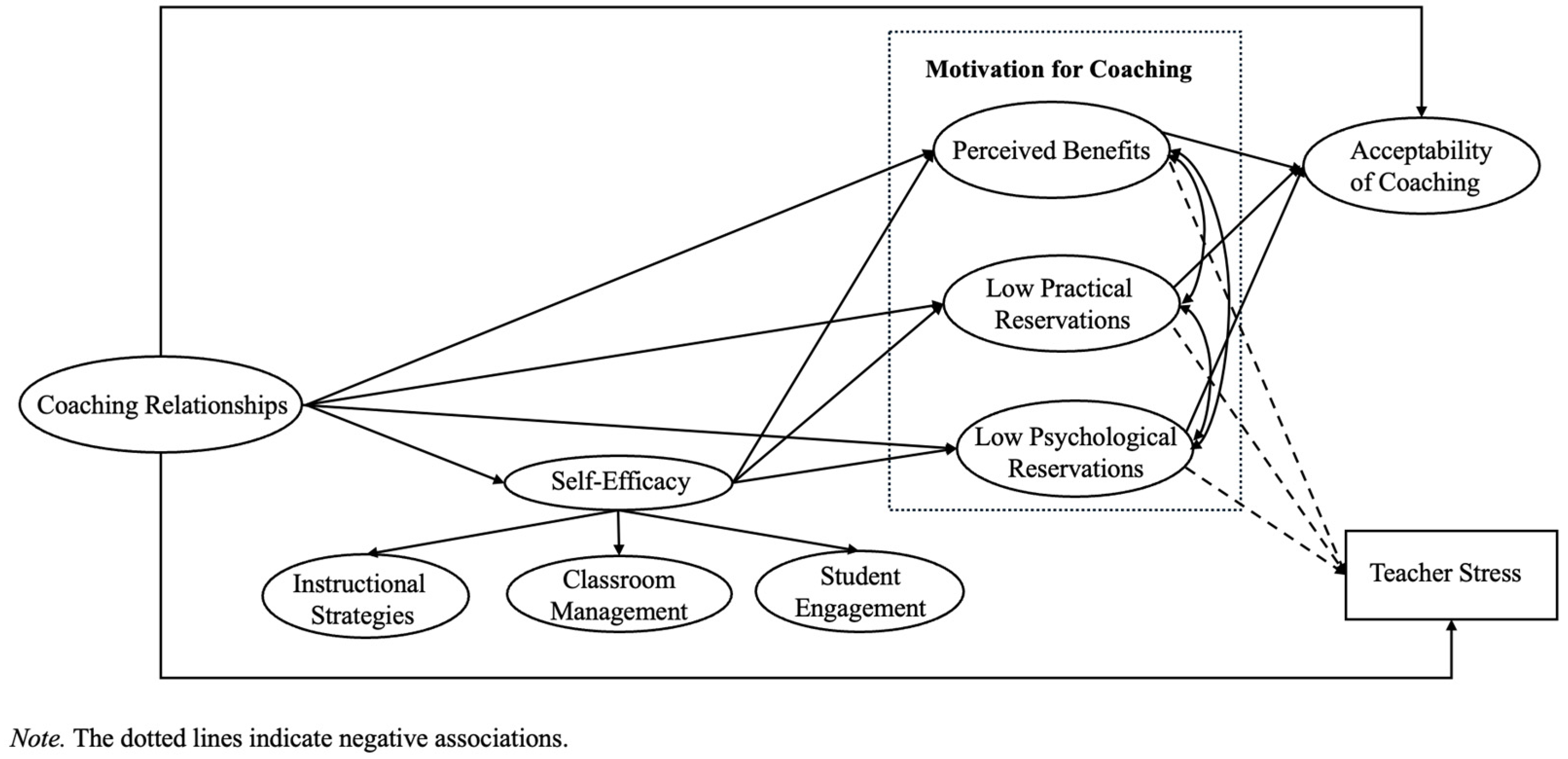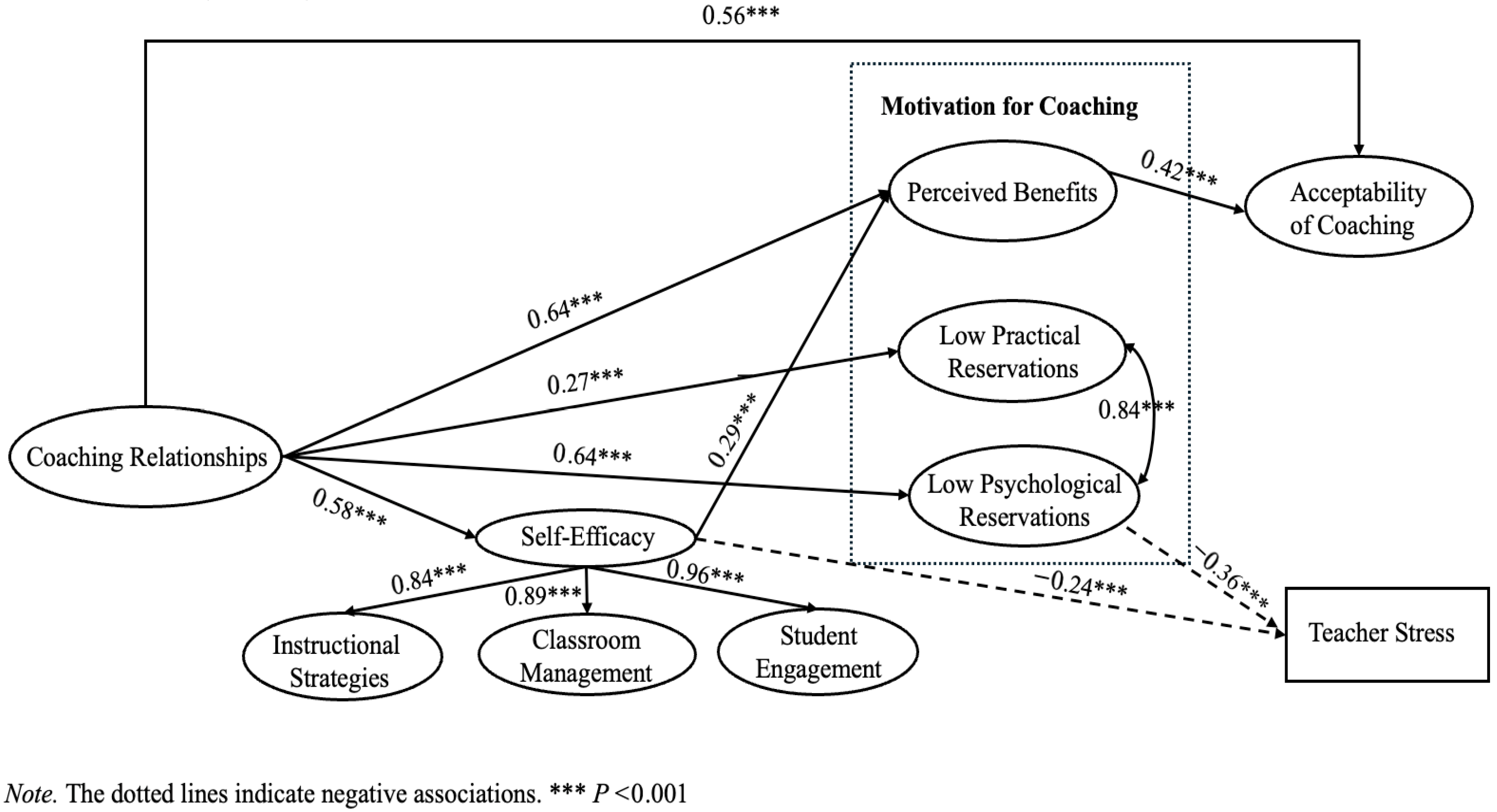
Exploring Coaching Relationships, Teacher Self-Efficacy, and Motivation: Psychological Associations with Teachers’ Acceptability of Coaching and Stress

Abstract
1. Introduction
1.1. A Conceptual Framework for Teachers’ Motivation for Coaching
1.2. Associations of Coaching Relationships with Acceptability and Stress
1.3. Associations of Motivation with Acceptability and Stress
1.4. Mediating Roles of Self-Efficacy and Motivation
1.5. Direct Associations Among Relationship, Self-Efficacy, and Motivation
2. Method
2.1. Procedures and Participants
2.2. Measures
2.3. Coach-Teacher Relationships
2.3.1. Teacher Self-Efficacy
2.3.2. Teacher’s Motivation Assessment for Coaching
2.3.3. Teachers’ Acceptability of Coaching
2.3.4. Teacher Stress
2.4. Data Analysis
3. Results
3.1. Descriptive Statistics and Measurement Model
3.2. Structural Equation Modeling and Hypothesis Testing
3.3. Mediation Analysis
4. Discussion
4.1. Coaching Relationships as the Socializing Factor
4.2. Distinct Roles of Motivational Dimensions
4.3. The Role of Self-Efficacy
4.4. Practical Implications
4.5. Limitations and Future Study Directions
5. Conclusions
Author Contributions
Funding
Institutional Review Board Statement
Informed Consent Statement
Data Availability Statement
Conflicts of Interest
References
- Alavi, M., Visentin, D. C., Thapa, D. K., Hunt, G. E., Watson, R., & Cleary, M. (2020). Chi-square for model fit in confirmatory factor analysis. Journal of Advanced Nursing, 76(9), 2209–2211. [Google Scholar] [CrossRef]
- Allen, M. S., Iliescu, D., & Greiff, S. (2022). Single item measures in psychological science. European Journal of Psychological Assessment, 38(1), 1–5. [Google Scholar] [CrossRef]
- Aytaç, A. (2021). A Study of teachers’ self-efficacy beliefs, motivation to teach, and curriculum fidelity: A path analysis model. International Journal of Contemporary Educational Research, 8(4), 130–143. [Google Scholar] [CrossRef]
- Bandura, A. (1999). Social cognitive theory: An agentic perspective. Asian Journal of Social Psychology, 2(1), 21–41. [Google Scholar] [CrossRef]
- Bandura, A. (2006). Toward a psychology of human agency. Perspectives on Psychological Science, 1(2), 164–180. [Google Scholar] [CrossRef] [PubMed]
- Blom-Hoffman, J., & Rose, G. S. (2007). Applying motivational interviewing to school-based consultation: A commentary on “has consultation achieved its primary prevention potential”? Journal of Educational and Psychological Consultation, 17(2), 151–156. [Google Scholar] [CrossRef]
- Bottiani, J. H., Duran, C. A., Pas, E. T., & Bradshaw, C. P. (2019). Teacher stress and burnout in urban middle schools: Associations with job demands, resources, and effective classroom practices. Journal of School Psychology, 77, 36–51. [Google Scholar] [CrossRef]
- Briesch, A. M., Chafouleas, S. M., Neugebauer, S. R., & Riley-Tillman, T. C. (2013). Assessing influences on intervention implementation: Revision of the Usage Rating Profile-Intervention. Journal of School Psychology, 51(1), 81–96. [Google Scholar] [CrossRef]
- Calkins, L., Wiens, P., Parker, J., & Tschinkel, R. (2024). Teacher motivation and self-efficacy: How do specific motivations for entering teaching relate to teacher self-efficacy? Journal of Education, 204(2), 427–438. [Google Scholar] [CrossRef]
- Carver, C. S., & Connor-Smith, J. (2010). Personality and coping. Annual Review of Psychology, 61, 679–704. [Google Scholar] [CrossRef]
- Cohen, S., & Wills, T. A. (1985). Stress, social support, and the buffering hypothesis. Psychological Bulletin, 98(2), 310–357. [Google Scholar] [CrossRef]
- Çoban, Ö., Özdemir, N., & Bellibaş, M. Ş. (2020). Trust in principals, leaders’ focus on instruction, teacher collaboration, and teacher self-efficacy: Testing a multilevel mediation model. Educational Management Administration & Leadership, 51(1), 95–115. [Google Scholar] [CrossRef]
- Dart, E. H., Cook, C. R., Collins, T. A., Gresham, F. M., & Chenier, J. S. (2012). Test driving interventions to increase treatment integrity and student outcomes. School Psychology Review, 41, 467–481. [Google Scholar] [CrossRef]
- Davis, A. E., Barrueco, S., & Perry, D. F. (2021). The role of consultative alliance in infant and early childhood mental health consultation: Child, teacher, and classroom outcomes. Infant Mental Health Journal, 42(2), 246–262. [Google Scholar] [CrossRef]
- Deci, E. L., & Ryan, R. M. (2000). The “what” and “why” of goal pursuits: Human needs and the self-determination of behavior. Psychological Inquiry, 11(4), 227–268. [Google Scholar] [CrossRef]
- Doménech-Betoret, F., Abellán-Roselló, L., & Gómez-Artiga, A. (2017). Self-efficacy, satisfaction, and academic achievement: The mediator role of students’ expectancy-value beliefs. Frontiers in Psychology, 8, 1193. [Google Scholar] [CrossRef] [PubMed]
- Eccles, J. S., & Wigfield, A. (2023). Expectancy-value theory to situated expectancy-value theory: Reflections on the legacy of 40+ years of working together. Motivation Science, 9(1), 1–12. [Google Scholar] [CrossRef]
- Eddy, C. L., Herman, K. C., & Reinke, W. M. (2019). Single-item teacher stress and coping measures: Concurrent and predictive validity and sensitivity to change. Journal of School Psychology, 76, 17–32. [Google Scholar] [CrossRef]
- Erchul, W. P. (2023). As we coach, so shall we consult: A perspective on coaching research in education. Journal of School Psychology, 96, 88–94. [Google Scholar] [CrossRef] [PubMed]
- Frank, J. L., & Kratochwill, T. R. (2014). School-based problem-solving consultation: Plotting a new course for evidence-based research and practice in consultation. In W. P. Erchul, & S. M. Sheridan (Eds.), Handbook of research in school consultation (2nd ed., pp. 13–30). Taylor and Francis. [Google Scholar]
- Fu, W., Wang, L., He, X., Chen, H., & He, J. (2022). Subjective well-being of special education teachers in China: The relation of social support and self-efficacy. Frontiers in Psychology, 13, 802811. [Google Scholar] [CrossRef]
- Gold, A. H., Malhotra, A., & Segars, A. H. (2001). Knowledge management: An organizational capabilities perspective. Journal of Management Information Systems, 18(1), 185–214. [Google Scholar] [CrossRef]
- Haydon, T., Leko, M. M., & Stevens, D. (2018). Teacher stress: Sources, effects, and protective factors. Journal of Special Education Leadership, 31(2), 99–107. [Google Scholar]
- Henseler, J., Ringle, C. M., & Sarstedt, M. (2015). A new criterion for assessing discriminant validity in variance-based structural equation modeling. Journal of the Academy of Marketing Science, 43(1), 115–135. [Google Scholar] [CrossRef]
- Herman, K. C., Sebastian, J., Reinke, W. M., & Huang, F. L. (2021). Individual and school predictors of teacher stress, coping, and wellness during the COVID-19 pandemic. School Psychology, 36(6), 483–493. [Google Scholar] [CrossRef]
- Hu, L., & Bentler, P. M. (1999). Cutoff criteria for fit indexes in covariance structure analysis: Conventional criteria versus new alternatives. Structural Equation Modeling, 6, 1–55. [Google Scholar] [CrossRef]
- Jentsch, A., Hoferichter, F., Blömeke, S., König, J., & Kaiser, G. (2023). Investigating teachers’ job satisfaction, stress and working environment: The roles of self-efficacy and school leadership. Psychology in the Schools, 60(3), 679–690. [Google Scholar] [CrossRef]
- Johnson, S., Pas, E., Bradshaw, C., Johnson, S. R., Pas, E. T., & Bradshaw, C. P. (2016). Understanding and measuring coach-teacher alliance: A glimpse inside the “black box”. Prevention Science, 17(4), 439–449. [Google Scholar] [CrossRef]
- Kazdin, A. E. (1980). Acceptability of alternative treatments for deviant child behavior. Journal of Applied Behavior Analysis, 13, 259–273. [Google Scholar] [CrossRef] [PubMed]
- Kenny, D. A. (2012, March 18). Identification. Available online: https://davidakenny.net/cm/identify_formal.htm (accessed on 1 May 2026).
- Kingsford-Smith, A. A., Collie, R. J., Loughland, T., & Nguyen, H. T. M. (2023). Teacher wellbeing in rural, regional, and metropolitan schools: Examining resources and demands across locations. Teaching and Teacher Education, 132, 104229. [Google Scholar] [CrossRef]
- Kline, R. B. (2016). Principles and practice of structural equation modeling (4th ed.). Guilford Press. [Google Scholar]
- Kochmanski, N. (2023). Identifying productive one-on-one coaching practices. Teacher and Teacher Education, 131, 104188. [Google Scholar] [CrossRef]
- Kraft, M. A., Blazar, D., & Hogan, D. (2018). The effect of teacher coaching on instruction and achievement: A meta-analysis of the causal evidence. Review of Educational Research, 88(4), 547–588. [Google Scholar] [CrossRef]
- Li, M. H., Eschenauer, R., & Persaud, V. (2018). Between avoidance and problem solving: Resilience, self-efficacy, and social support seeking. Journal of Counseling & Development, 96(2), 132–143. [Google Scholar] [CrossRef]
- Lyons, M. D., Jones, S. J., Smith, B. H., McQuillin, S. D., Richardson, G., Reid, E., & McClellan, A. (2017). Motivation coaching training for instructional coaches: A pilot study of motivational interviewing skills training. Mentoring & Tutoring: Partnership in Learning, 25(5), 548–565. [Google Scholar] [CrossRef]
- Marsh, H. W., Hau, K.-T., & Grayson, D. (2005). Goodness of fit evaluation. In A. Maydeu-Olivares, & J. McArdle (Eds.), Contemporary psychometrics (pp. 275–340). Erlbaum. [Google Scholar]
- Maslach, C., Jackson, S. E., & Schwab, R. L. (1996). Maslach burnout inventory—Educators survey (MBI-ES). In C. Maslach, S. E. Jackson, & M. P. Leiter (Eds.), MBI manual (3rd ed.). Consulting Psychologists Press. [Google Scholar]
- Merle, J. L., Cook, C. R., Pullmann, M. D., Larson, M. F., Hamlin, C. M., Hugh, M. L., Brewer, S. K., Duong, M. T., Bose, M., & Lyon, A. R. (2023). Longitudinal effects of a motivationally focused strategy to increase the yield of training and consultation on teachers’ adoption and fidelity of a universal program. School Mental Health, 15(1), 105–122. [Google Scholar] [CrossRef] [PubMed]
- Moshagen, M., & Bader, M. (2024). semPower: General power analysis for structural equation models. Behavior Research Methods, 56, 2901–2922. [Google Scholar] [CrossRef]
- Neff, K. D., Tóth-Király, I., Yarnell, L. M., Arimitsu, K., Castilho, P., Ghorbani, N., Guo, H. X., Hirsch, J. K., Hupfeld, J., Hutz, C. S., Kotsou, I., Lee, W. K., Montero-Marin, J., Sirois, F. M., de Souza, L. K., Svendsen, J. L., Wilkinson, R. B., & Mantzios, M. (2019). Examining the factor structure of the self-compassion scale in 20 diverse samples: Support for use of a total score and six subscale scores. Psychological Assessment, 31(1), 27–45. [Google Scholar] [CrossRef]
- Newman, D. S., Guiney, M. C., & Barrett, C. A. (2015). Language use in consultation: Can “we” help teachers and students? Consulting Psychology Journal, 67(1), 48–64. [Google Scholar] [CrossRef][Green Version]
- Newman, D. S., & Rosenfield, S. A. (2024). Building competence in school consultation: A developmental approach (2nd ed.). Routledge. [Google Scholar]
- Osman, D. J., & Warner, J. R. (2020). Measuring teacher motivation: The missing link between professional development and practice. Teaching and Teacher Education, 92, 103064. [Google Scholar] [CrossRef]
- Owens, J. S., Lee, M., Kassab, H., Evans, S. W., & Coles, E. C. (2021). Motivational ruler ratings among teachers receiving coaching in classroom management: Measurement and relationship to implementation integrity. Prevention Science, 22(6), 769–774. [Google Scholar] [CrossRef] [PubMed]
- Palermo, C., & Thomson, M. M. (2019). Large-scale assessment as professional development: Teachers’ motivations, ability beliefs, and values. Teacher Development, 23(2), 192–212. [Google Scholar] [CrossRef]
- Pas, E. T., Borden, L., Debnam, K. J., De Lucia, D., & Bradshaw, C. P. (2022). Exploring profiles of coaches’ fidelity to double check’s motivational interviewing-embedded coaching: Outcomes associated with fidelity. Journal of School Psychology, 92, 285–298. [Google Scholar] [CrossRef]
- Pollfish. (2025). Online sampling service service. Available online: https://www.pollfish.com/ (accessed on 1 May 2026).
- Reddy, L. A., Glover, T. A., Dudek, C. M., Alperin, A., Wiggs, N. B., & Bronstein, B. (2022). A randomized trial examining the effects of paraprofessional behavior support coaching for elementary students with disruptive behavior disorders: Paraprofessional and student outcomes. Journal of School Psychology, 92, 227–245. [Google Scholar] [CrossRef] [PubMed]
- Reddy, L. A., Glover, T. A., Elliott, S. N., & Kurz, A. (2019). Assessing the effectiveness and interactions of instructional coaches: Initial psychometric evidence for the instructional coaching assessments–teacher form. Assessment for Effective Intervention, 44(2), 104–119. [Google Scholar] [CrossRef]
- Reddy, L. A., Shernoff, E., & Lekwa, A. (2021). A randomized controlled trial of instructional coaching in high-poverty urban schools: Examining teacher practices and student outcomes. Journal of School Psychology, 86, 151–168. [Google Scholar] [CrossRef]
- Ruble, L., Ogle, L., & McGrew, J. (2023). Practice makes proficient: Evaluation of implementation fidelity following COMPASS consultation training. Psychology in the Schools, 60(3), 743–760. [Google Scholar] [CrossRef]
- Ryan, R. M., & Deci, E. L. (2000). Self-determination theory and the facilitation of intrinsic motivation, social development, and well-being. American Psychologist, 55(1), 68–78. [Google Scholar] [CrossRef]
- Shernoff, E. S., Lekwa, A. J., Reddy, L. A., & Coccaro, C. (2017). Examining teachers’ attitudes and experiences with coaching to inform research-based practice: An iterative developmental design study. Journal of Educational & Psychological Consultation, 27(4), 459–485. [Google Scholar] [CrossRef]
- Skaalvik, E. M., & Skaalvik, S. (2017). Motivated for teaching? Associations with school goal structure, teacher self-efficacy, job satisfaction and emotional exhaustion. Teaching and Teacher Education, 67, 152–160. [Google Scholar] [CrossRef]
- Steigleder, J., Buhr, L., Ehm, J.-H., Gawrilow, C., & von Suchodoletz, A. (2023). Changes in subjective stress experiences and self-efficacy beliefs of preschool teachers in Germany: A longitudinal study during 12 months of the COVID-19 pandemic. Teaching and Teacher Education, 124, 104015. [Google Scholar] [CrossRef] [PubMed]
- Sun, Y., & Yin, H. (2025). Profiles of teacher self-efficacy and their relations to teacher demographics and affective well-being: A social cognitive perspective. Teaching and Teacher Education, 154, 104855. [Google Scholar] [CrossRef]
- Taris, T. W., Kessler, S. R., & Kelloway, E. K. (2021). Strategies addressing the limitations of cross-sectional designs in occupational health psychology: What they are good for (and what not). Work & Stress, 35(1), 1–5. [Google Scholar] [CrossRef]
- Teng, M. F., Wang, C., & Wu, J. G. (2021). Metacognitive strategies, language learning motivation, self-efficacy belief, and English achievement during remote learning: A structural equation modelling approach. RELC Journal, 54(3), 648–666. [Google Scholar] [CrossRef]
- Toto, G. A., & Limone, P. (2021). Motivation, stress and impact of online teaching on Italian teachers during COVID-19. Computers, 10(6), 75. [Google Scholar] [CrossRef]
- Tschannen-Moran, M., & Hoy, A. W. (2001). Teacher efficacy: Capturing an elusive construct. Teaching and Teacher Education, 17, 783–805. [Google Scholar] [CrossRef]
- Urhahne, D., & Wijnia, L. (2023). Theories of motivation in education: An integrative framework. Educational Psychology Review, 35(2), 45. [Google Scholar] [CrossRef]
- Wang, J., Kalkbrenner, M. T., & Begeny, J. C. (2025a). Development and initial validation of scores on the teacher’s motivation assessment for coaching (T-MAC). Journal of Educational and Psychological Consultation, 36(2), 236–258. [Google Scholar] [CrossRef]
- Wang, J., Lee, B. H., & Zhao, Y. (2025b). Examining relationships of country, school context, and coping on teacher stress in the United States and the United Kingdom. International Journal of School & Educational Psychology, 13(3), 234–245. [Google Scholar] [CrossRef]
- Wehby, J. H., Maggin, D. M., Moore Partin, T. C., & Robertson, R. (2012). The impact of working alliance, social validity, and teacher burnout on implementation fidelity of the good behavior game. School Mental Health, 4(1), 22–33. [Google Scholar] [CrossRef]
- Wigfield, A., & Eccles, J. S. (2000). Expectancy–value theory of achievement motivation. Contemporary Educational Psychology, 25(1), 68–81. [Google Scholar] [CrossRef]
- Yin, H., Guo, Y., & Liu, Z. (2025). Teachers as thinkers, not feelers: Clarifying the definition and measurement of attitude in teachers’ acceptance of online teaching. Teaching and Teacher Education, 153, 104811. [Google Scholar] [CrossRef]
- Zhang, X., Admiraal, W., & Saab, N. (2021). Teachers’ motivation to participate in continuous professional development: Relationship with factors at the personal and school level. Journal of Education for Teaching, 47(5), 714–731. [Google Scholar] [CrossRef]



| Variable | Item | Factor Loading | M | SD | CR | AVE | ||
|---|---|---|---|---|---|---|---|---|
| Coaching Relationships | The coach and I agreed on what the most important goals for intervention were. | 0.81 | 4.24 | 0.70 | 0.87 | 0.88 | 0.56 | |
| The coach and I trusted one another. | 0.71 | |||||||
| The coach was approachable. | 0.71 | |||||||
| The coach and I worked together collaboratively. | 0.78 | |||||||
| Overall, the coach showed a sincere desire to understand and improve my classroom. | 0.79 | |||||||
| The coach incorporated my views into the services provided. | 0.69 | |||||||
| Self-Efficacy | Instructional Strategies | To what extent can you use a variety of assessment strategies? | 0.62 | 7.50 | 1.34 | 0.70 | 0.71 | 0.45 |
| To what extent can you craft good questions for your students? | 0.72 | |||||||
| How well can you implement alternative strategies in your classroom? | 0.68 | |||||||
| Classroom Management | How much can you do to control disruptive behavior in the classroom? | 0.76 | 7.42 | 1.32 | 0.75 | 0.76 | 0.51 | |
| How much can you do to get children to follow classroom rules? | 0.72 | |||||||
| How much can you do to calm a student who is disruptive or noisy? | 0.67 | |||||||
| Student Engagement | How much can you do to get students to believe they can do well in schoolwork? | 0.69 | 7.37 | 1.36 | 0.81 | 0.81 | 0.53 | |
| How much can you do to help your students value learning? | 0.72 | |||||||
| How much can you do to motivate students who show low interest in schoolwork? | 0.67 | |||||||
| How much can you assist families in helping their children do well in school? | 0.62 | |||||||
| Perceived Benefits | I appreciate the coach’s help in addressing my concerns about students | 0.61 | 4.27 | 0.67 | 0.92 | 0.92 | 0.53 | |
| The coach shares helpful materials and resources for teaching with me | 0.63 | |||||||
| Coaching helps me assist students with lower academic performance | 0.73 | |||||||
| Strategies I learn during coaching sessions help me become a better teacher | 0.73 | |||||||
| The coach helps me to identify my students’ needs | 0.78 | |||||||
| Coaching helps me manage student behaviors | 0.77 | |||||||
| The coach helps me review student progress throughout the coaching sessions | 0.68 | |||||||
| Coaching helps me improve my interactions with students | 0.79 | |||||||
| The coach helps me set up clear goals for our coaching sessions | 0.77 | |||||||
| I am motivated to achieve the goals that I identified with my coach | 0.68 | |||||||
| Practical Reservations | * Coaching does not make a difference to me in terms of my teaching practice | 0.68 | 3.34 | 1.12 | 0.83 | 0.84 | 0.57 | |
| * The goals that my coach and I set are unrealistic | 0.68 | |||||||
| * Explaining student concerns to my coach takes too much effort | 0.77 | |||||||
| * The effort that it takes to participate in coaching is not worth the benefits | 0.86 | |||||||
| Psychological Reservations | * I am worried about being evaluated negatively by a coach | 0.78 | 3.00 | 1.01 | 0.88 | 0.89 | 0.59 | |
| * I feel stressed when the coach asks me to use teaching strategies that I am not familiar with | 0.78 | |||||||
| * I feel nervous about being observed by the coach | 0.77 | |||||||
| * I am worried the coach will judge me | 0.83 | |||||||
| * It is stressful to follow the action plans set up for coaching | 0.75 | |||||||
| * I am too tired during the school day to receive coaching | 0.66 | |||||||
| Acceptability of Coaching | The coaching is an effective choice for addressing a variety of problems. | 0.82 | 4.87 | 0.99 | 0.92 | 0.93 | 0.59 | |
| The coaching is a fair way to handle the child’s behavior problem. | 0.78 | |||||||
| * I would not be interested in receiving coaching. | 0.85 | |||||||
| I would have positive attitudes about receiving coaching. | 0.82 | |||||||
| Coaching is a good way to handle the child’s behavior problem | 0.72 | |||||||
| I would receive coaching with a good deal of enthusiasm. | 0.83 | |||||||
| Coaching would not be disruptive to other students. | 0.52 | |||||||
| I would be committed to receiving coaching. | 0.79 | |||||||
| The coaching procedures easily fit in with my current practices. | 0.86 | |||||||
| Stress | How stressful is your job? | 1 | 6.65 | 2.60 | na | na | na | |
| 1 | 2 | 3 | 4 | 5 | 6 | 7 | |
|---|---|---|---|---|---|---|---|
| 1. Coaching Relationships | |||||||
| 2. Self-Efficacy | 0.61 *** | ||||||
| 3. Perceived Benefits | 0.81 *** | 0.67 *** | |||||
| 4.Low Practical Reservations | 0.22 *** | 0.04 | 0.22 *** | ||||
| 5. Low psychological Reservations | 0.21 *** | 0.04 | 0.18 *** | 0.85 *** | |||
| 6. Acceptability of Coaching | 0.90 *** | 0.64 *** | 0.88 *** | 0.19 *** | 0.18 *** | ||
| 7. Stress | −0.18 *** | −0.19 *** | −0.19 *** | −0.24 *** | −0.29 *** | −0.15 ** |
| Direct Associations | B | SE (β) | p | 95%CI (β) | |
|---|---|---|---|---|---|
| Self-Efficacy ON Coaching Relationships | 0.73 | 0.58 | 0.05 | <0.001 | [0.49, 0.68] |
| Perceived Benefits ON | |||||
| Coaching Relationships | 0.41 | 0.64 | 0.07 | <0.001 | [0.51, 0.77] |
| Self-Efficacy | 0.15 | 0.29 | 0.06 | <0.001 | [0.17, 0.41] |
| Low Practical Reservations ON Coaching Relationships | 0.38 | 0.27 | 0.05 | <0.001 | [0.18, 0.37] |
| Low Psychological Reservations ON Coaching Relationships | 0.35 | 0.23 | 0.05 | <0.001 | [0.13, 0.34] |
| Acceptability of Coaching ON | |||||
| Coaching Relationships | 0.74 | 0.56 | 0.08 | <0.001 | [0.39, 0.72] |
| Perceived Benefits | 0.88 | 0.42 | 0.09 | <0.001 | [0.25, 0.59] |
| Stress ON | |||||
| Self-Efficacy | −0.54 | −0.24 | 0.06 | <0.001 | [−0.36, −0.12] |
| Low Psychological Reservations | −0.67 | −0.36 | 0.06 | <0.001 | [−0.48, −0.23] |
| Indirect Associations | |||||
| |||||
| Total Effect | 1.19 | 0.89 | 0.02 | <0.001 | [0.85, 0.94] |
| Total Indirect | 0.45 | 0.34 | 0.10 | 0.001 | [0.15, 0.53] |
| Path 1: Coaching Relationships → Perceived Benefit → Acceptability | 0.36 | 0.27 | 0.09 | 0.003 | [0.09, 0.45] |
| Path 2: Coaching Relationships → Self-Efficacy → Perceived Benefit → Acceptability | 0.09 | 0.07 | 0.02 | 0.002 | [0.03, 0.11] |
| Direct | 0.74 | 0.56 | 0.08 | <0.001 | [0.35, 0.76] |
| |||||
| Total Effect | −0.63 | −0.23 | 0.05 | <0.001 | [−0.32, −0.12] |
| Total Indirect | −0.63 | −0.23 | 0.05 | <0.001 | [−0.32, −0.12] |
| Path 1: Coaching Relationship → Low Psychological Reservations → Stress | −0.23 | −0.08 | 0.03 | 0.003 | [−0.14, −0.03] |
| Path 2: Coaching Relationships → Self-Efficacy → Stress | −0.39 | −0.14 | 0.04 | 0.002 | [−0.23, −0.05] |
| Significant Covariates | |||||
| Coaching Relationships ON Gender | 0.22 | 0.15 | 0.05 | 0.003 | [0.05, 0.25] |
| Self-Efficacy ON Gender | 0.25 | 0.14 | 0.04 | 0.001 | [0.06, 0.22] |
| Low Practical Reservations ON | |||||
| Gender | −0.74 | −0.38 | 0.05 | <0.001 | [−0.47, −0.29] |
| Age | 0.04 | 0.30 | 0.05 | <0.001 | [0.19, 0.40] |
| Years of Teaching | −0.03 | −0.25 | 0.06 | <0.001 | [−0.36, −0.15] |
| Low Psychological Reservations ON | |||||
| Gender | −0.44 | −0.21 | 0.05 | <0.001 | [−0.30, −0.12] |
| Age | 0.03 | 0.23 | 0.06 | <0.001 | [0.10, 0.35] |
| Years of Teaching | −0.03 | −0.21 | 0.06 | 0.001 | [−0.33, −0.08] |
| Acceptability of Coaching ON Gender | 0.15 | 0.08 | 0.03 | 0.001 | [0.03, 0.13] |
| Stress ON Years of Teaching | 0.04 | 0.09 | 0.04 | 0.02 | [0.01, 0.17] |
Disclaimer/Publisher’s Note: The statements, opinions and data contained in all publications are solely those of the individual author(s) and contributor(s) and not of MDPI and/or the editor(s). MDPI and/or the editor(s) disclaim responsibility for any injury to people or property resulting from any ideas, methods, instructions or products referred to in the content. |
© 2026 by the authors. Licensee MDPI, Basel, Switzerland. This article is an open access article distributed under the terms and conditions of the Creative Commons Attribution (CC BY) license.
Share and Cite
Wang, J.; Shi, D. Exploring Coaching Relationships, Teacher Self-Efficacy, and Motivation: Psychological Associations with Teachers’ Acceptability of Coaching and Stress. Behav. Sci. 2026, 16, 838. https://doi.org/10.3390/bs16060838
Wang J, Shi D. Exploring Coaching Relationships, Teacher Self-Efficacy, and Motivation: Psychological Associations with Teachers’ Acceptability of Coaching and Stress. Behavioral Sciences. 2026; 16(6):838. https://doi.org/10.3390/bs16060838
Chicago/Turabian StyleWang, Jiayi, and Duli Shi. 2026. "Exploring Coaching Relationships, Teacher Self-Efficacy, and Motivation: Psychological Associations with Teachers’ Acceptability of Coaching and Stress" Behavioral Sciences 16, no. 6: 838. https://doi.org/10.3390/bs16060838
APA StyleWang, J., & Shi, D. (2026). Exploring Coaching Relationships, Teacher Self-Efficacy, and Motivation: Psychological Associations with Teachers’ Acceptability of Coaching and Stress. Behavioral Sciences, 16(6), 838. https://doi.org/10.3390/bs16060838