Relating Cognitive-Activating Instruction and Metacognitive Self-Regulation to Mathematics Performance and Self-Efficacy: A Process-Modelling Study


Abstract
1. Introduction
1.1. Theoretical Framework
1.1.1. Cognitive Activation as an Instructional Antecedent of Metacognition
1.1.2. Metacognitive Self-Regulation in Relation to Mathematics Performance
1.1.3. Mathematics Self-Efficacy as an Outcome of Mastery Experiences
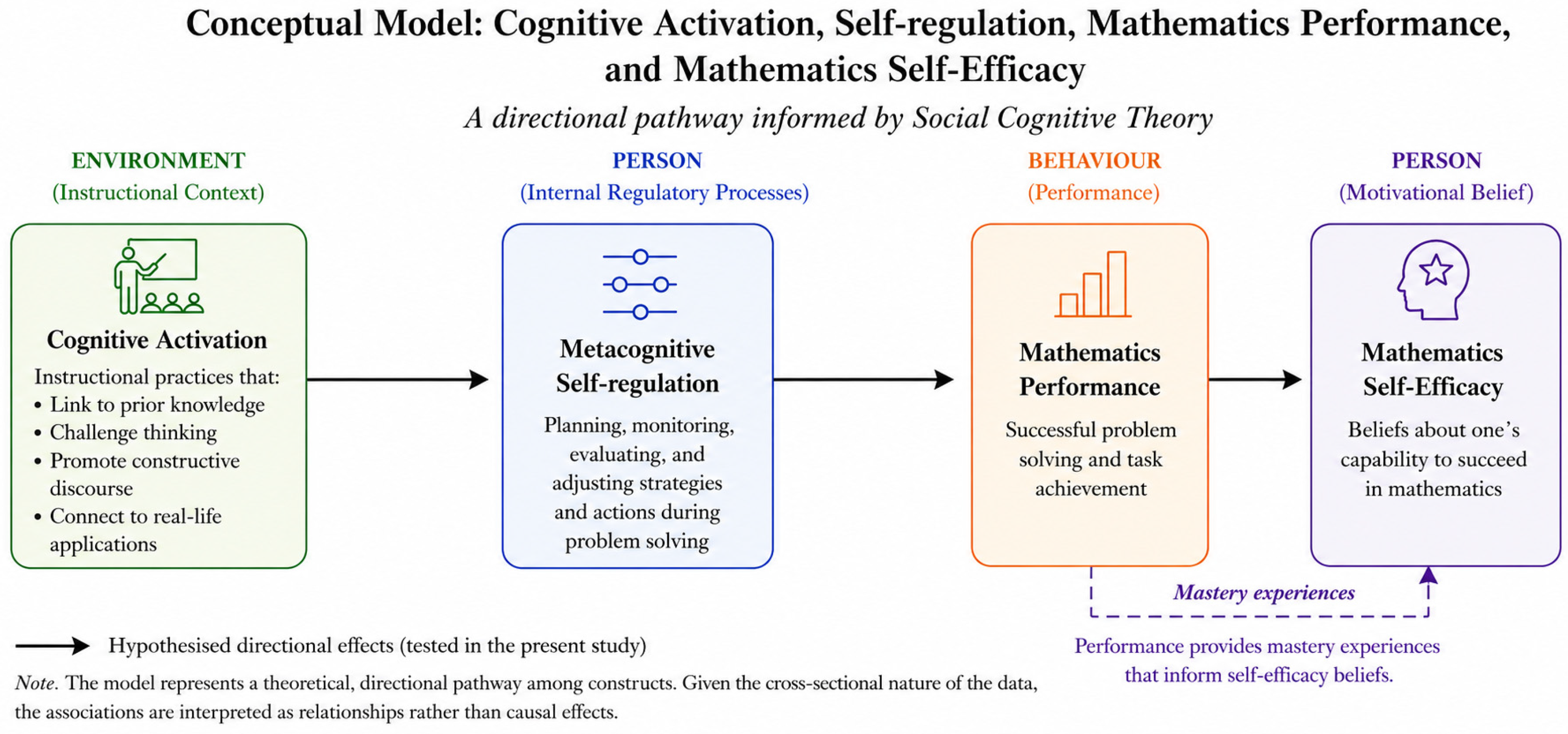
1.1.4. The Present Study: An Integrative Framework for Mathematics Self-Efficacy
2. Materials and Methods
2.1. Data and Sample
2.2. Measures
2.2.1. Mathematics Self-Efficacy
2.2.2. Cognitive Activation: Mathematics Argumentation
2.2.3. Metacognitive Regulation
2.2.4. Mathematics Performance
2.3. Statistical Analyses
3. Results
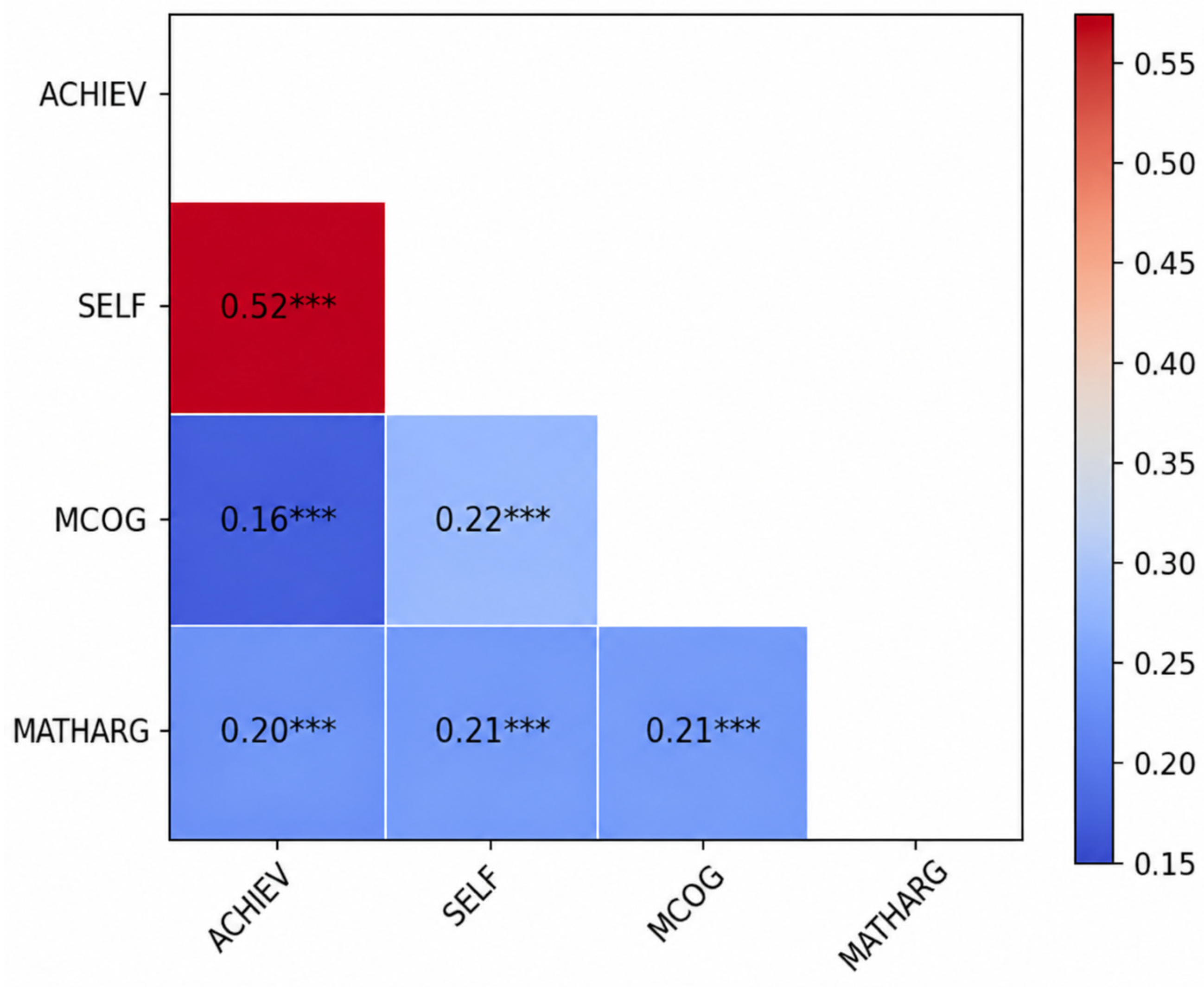
3.1. Descriptive Statistics and Correlations
3.2. Preliminary Psychometric Analyses
3.2.1. Assessing Potential Common Method Bias
3.2.2. Confirmatory Factor Analysis of the Measurement Model
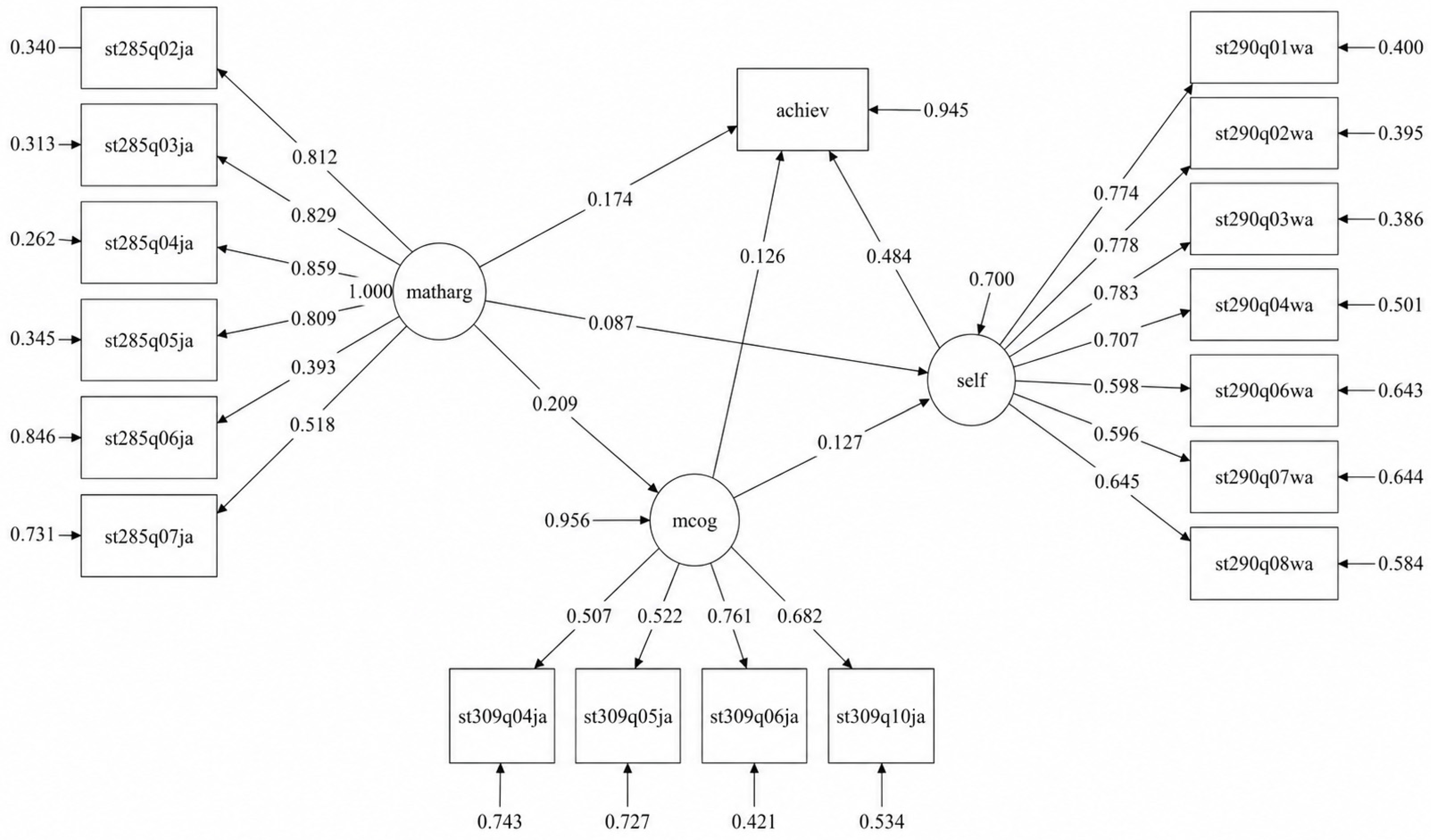
3.3. Structural Model of the Process Linking Cognitive Activation to Mathematics Self-Efficacy
4. Discussion
4.1. Cognitive-Activating Instruction as an Important Correlate of Metacognitive Regulation and Mathematics Performance
4.2. Metacognitive Self-Regulation and Mathematics Self-Efficacy
4.3. Performance as a Potential Source of Self-Efficacy
4.4. Limitations and Future Directions for Research
4.5. Implications for Practice
5. Conclusions
Supplementary Materials
Funding
Institutional Review Board Statement
Informed Consent Statement
Data Availability Statement
Conflicts of Interest
References
- Bandalos, D. L. (2014). Relative performance of categorical diagonally weighted least squares and robust maximum likelihood estimation. Structural Equation Modeling: A Multidisciplinary Journal, 21(1), 102–116. [Google Scholar] [CrossRef]
- Bandura, A. (1991). Social cognitive theory of self-regulation. Organizational Behavior and Human Decision Processes, Theories of Cognitive Self-Regulation, 50(2), 248–287. [Google Scholar] [CrossRef]
- Bandura, A. (1997). Self-efficacy: The exercise of control. W H Freeman. [Google Scholar]
- Baumert, J., Kunter, M., Blum, W., Brunner, M., Voss, T., Jordan, A., Klusmann, U., Krauss, S., Neubrand, M., & Tsai, Y.-M. (2010). Teachers’ mathematical knowledge, cognitive activation in the classroom, and student progress. American Educational Research Journal, 47(1), 133–180. [Google Scholar] [CrossRef]
- Brown, A. L. (1980). Metacognitive development and reading. In R. J. Spiro, B. B. Bruce, & F. W. Brewer (Eds.), Theoretical issues in reading comprehension (pp. 453–481). Lawrence Erlbaum. [Google Scholar]
- Dignath, C., & Veenman, M. V. J. (2021). The role of direct strategy instruction and indirect activation of self-regulated learning—Evidence from classroom observation studies. Educational Psychology Review, 33(2), 489–533. [Google Scholar] [CrossRef]
- dos Santos Kawata, K. H., Ueno, Y., Hashimoto, R., Yoshino, S., Ohta, K., Nishida, A., Ando, S., Nakatani, H., Kasai, K., & Koike, S. (2021). Development of metacognition in adolescence: The congruency-based metacognition scale. Frontiers in Psychology, 11, 565231. [Google Scholar] [CrossRef] [PubMed]
- Du, C., Qin, K., Wang, Y., & Xin, T. (2021). Mathematics interest, anxiety, self-efficacy and achievement: Examining reciprocal relations. Learning and Individual Differences, 91, 102060. [Google Scholar] [CrossRef]
- Dueber, D. (2021). BifactorIndicesCalculator: Bifactor indices calculator. R package (Version 0.2.2) [Computer software]. Available online: https://CRAN.R-project.org/package=BifactorIndicesCalculator (accessed on 12 May 2021).
- Dunlosky, J., & Metcalfe, J. (2009). Metacognition (pp. ix, 334). Sage Publications, Inc. [Google Scholar]
- Efklides, A. (2006). Metacognition and affect: What can metacognitive experiences tell us about the learning process? Educational Research Review, 1(1), 3–14. [Google Scholar] [CrossRef]
- Efklides, A. (2008). Metacognition: Defining its facets and levels of functioning in relation to self-regulation and co-regulation. European Psychologist, 13, 277–287. [Google Scholar] [CrossRef]
- Ekatushabe, M., Nsanganwimana, F., Muwonge, C. M., & Ssenyonga, J. (2021). The relationship between cognitive activation, self-efficacy, achievement emotions and (meta)cognitive learning strategies among ugandan biology learners. African Journal of Research in Mathematics, Science and Technology Education, 25(3), 247–258. [Google Scholar] [CrossRef]
- European Commission. (2022). Increasing achievement and motivation in mathematics and science learning in schools: Eurydice report. EACEA. [Google Scholar]
- Ferla, J., Valcke, M., & Cai, Y. (2009). Academic self-efficacy and academic self-concept: Reconsidering structural relationships. Learning and Individual Differences, 19(4), 499–505. [Google Scholar] [CrossRef]
- Förtsch, C., Werner, S., von Kotzebue, L., & Neuhaus, B. J. (2016). Effects of biology teachers’ professional knowledge and cognitive activation on students’ achievement. International Journal of Science Education, 38(17), 2642–2666. [Google Scholar] [CrossRef]
- Fu, Y., & Qi, C. (2025). The relationship between metacognitive skills and mathematics achievement of Chinese eighth-grade students. Current Psychology, 44(5), 3845–3856. [Google Scholar] [CrossRef]
- Geurten, M., Meulemans, T., & Lemaire, P. (2018). From domain-specific to domain-general? The developmental path of metacognition for strategy selection. Cognitive Development, 48, 62–81. [Google Scholar] [CrossRef]
- Granello, F., Cuder, A., Doz, E., Pellizzoni, S., & Passolunghi, M. C. (2025). Improving math self-efficacy and math self-concept in middle school: A narrative systematic review. European Journal of Psychology of Education, 40(1), 42. [Google Scholar] [CrossRef]
- Harman, D. (1967). A single factor test of common method variance. Journal of Psychology, 35, 359. [Google Scholar]
- Howard, M. C., & Henderson, J. (2023). A review of exploratory factor analysis in tourism and hospitality research: Identifying current practices and avenues for improvement. Journal of Business Research, 154, 113328. [Google Scholar] [CrossRef]
- Hu, L., & Bentler, P. M. (1999). Cutoff criteria for fit indexes in covariance structure analysis: Conventional criteria versus new alternatives. Structural Equation Modeling, 6(1), 1–55. [Google Scholar] [CrossRef]
- Jorgensen, T. D., Pornprasertmanit, S., Schoemann, A. M., & Rosseel, Y. (2026). semTools: Useful tools for structural equation modeling. R package (Version 0.5-8) [Computer software]. Available online: https://cran.r-project.org/package=semTools (accessed on 14 February 2026).
- Katsantonis, I. (2020). Self-regulated learning and reading comprehension: The effects of gender, motivation and metacognition. Hellenic Journal of Psychology, 17(3), 286–307. [Google Scholar] [CrossRef]
- Katsantonis, I. (2024). Exploring age-related differences in metacognitive self-regulation: The influence of motivational factors in secondary school students. Frontiers in Psychology, 15, 1383118. [Google Scholar] [CrossRef] [PubMed]
- Katsantonis, I., & McLellan, R. (2023). Person-centred study on higher-order interactions between students’ motivational beliefs and metacognitive self-regulation: Links with school language achievement. PLoS ONE, 18(10), e0289367. [Google Scholar] [CrossRef] [PubMed]
- Katsantonis, I., McLellan, R., & Torres, P. E. (2023). Unraveling the complexity of the associations between students’ science achievement, motivation, and teachers’ feedback. Frontiers in Psychology, 14, 1124189. [Google Scholar] [CrossRef] [PubMed]
- Katsantonis, I. G. (2025). Typologies of teaching strategies in classrooms and students’ metacognition and motivation: A latent profile analysis of the Greek PISA 2018 data. Metacognition and Learning, 20(1), 4. [Google Scholar] [CrossRef]
- Kyriakides, L., Anthimou, M., & Panayiotou, A. (2020). Searching for the impact of teacher behavior on promoting students’ cognitive and metacognitive skills. Studies in Educational Evaluation, 64, 100810. [Google Scholar] [CrossRef]
- Li, H., Liu, J., Zhang, D., & Liu, H. (2021). Examining the relationships between cognitive activation, self-efficacy, socioeconomic status, and achievement in mathematics: A multi-level analysis. British Journal of Educational Psychology, 91(1), 101–126. [Google Scholar] [CrossRef] [PubMed]
- Lingel, K., Lenhart, J., & Schneider, W. (2019). Metacognition in mathematics: Do different metacognitive monitoring measures make a difference? ZDM, 51(4), 587–600. [Google Scholar] [CrossRef]
- Liu, R., Jong, C., & Fan, M. (2024). Reciprocal relationship between self-efficacy and achievement in mathematics among high school students. Large-Scale Assessments in Education, 12(1), 14. [Google Scholar] [CrossRef]
- Liu, S., & Yin, H. (2024). Opening the black box: How professional learning communities, collective teacher efficacy, and cognitive activation affect students’ mathematics achievement in schools. Teaching and Teacher Education, 139, 104443. [Google Scholar] [CrossRef]
- Madrilejos, K. (2025). Structural equation model of students’ interest, motivation, self-efficacy, persistence, and perceived teaching quality in mathematics. Journal of Interdisciplinary Perspectives, 3(3), 260–272. [Google Scholar] [CrossRef]
- Metcalfe, J., & Shimamura, A. P. (Eds.). (1996). Metacognition: Knowing about knowing (1. MIT Press paperback ed.). MIT Press. [Google Scholar]
- Muncer, G., Higham, P. A., Gosling, C. J., Cortese, S., Wood-Downie, H., & Hadwin, J. A. (2022). A meta-analysis investigating the association between metacognition and math performance in adolescence. Educational Psychology Review, 34(1), 301–334. [Google Scholar] [CrossRef]
- Muthén, L. K., & Muthén, B. O. (2017). Mplus user’s guide (8th ed.). Muthén & Muthén. [Google Scholar]
- Nelson, L. J., & Fyfe, E. R. (2019). Metacognitive monitoring and help-seeking decisions on mathematical equivalence problems. Metacognition and Learning, 14(2), 167–187. [Google Scholar] [CrossRef]
- Niss, M., & Højgaard, T. (2019). Mathematical competencies revisited. Educational Studies in Mathematics, 102(1), 9–28. [Google Scholar] [CrossRef]
- OECD. (2023). PISA 2022 results (volume I): The state of learning and equity in education. OECD. [Google Scholar] [CrossRef]
- OECD. (2024a). PISA 2022 results (volume IV): How financially smart are students? OECD Publishing. [Google Scholar] [CrossRef]
- OECD. (2024b). PISA 2022 results (volume V): Learning strategies and attitudes for life. OECD Publishing. [Google Scholar] [CrossRef]
- OECD. (2024c). PISA 2022 technical report. OECD. [Google Scholar] [CrossRef]
- Oudman, S., van de Pol, J., & van Gog, T. (2022). Effects of self-scoring their math problem solutions on primary school students’ monitoring and regulation. Metacognition and Learning, 17(1), 213–239. [Google Scholar] [CrossRef]
- Özcan, B., & Kültür, Y. Z. (2021). The relationship between sources of mathematics self-efficacy and mathematics test and course achievement in high school seniors. Sage Open, 11(3), 21582440211040124. [Google Scholar] [CrossRef]
- Panadero, E. (2017). A review of self-regulated learning: Six models and four directions for research. Frontiers in Psychology, 8, 422. [Google Scholar] [CrossRef] [PubMed]
- Peura, P., Koponen, T., Aro, T., Viholainen, H., & Aro, M. (2026). Dynamics of change in math self-efficacy, sources of self-efficacy, and math skills. Journal of Educational Psychology, 118(2), 209–223. [Google Scholar] [CrossRef]
- Pintrich, P., Smith, D. A., Garcia, T., & McKeachie, W. (1991). Motivated strategies for learning questionnaire. Office of Educational Research and Improvement. [Google Scholar]
- R Core Team. (2023). R: A language and environment for statistical computing. R Foundation for Statistical Computing. Available online: https://www.R-project.org/ (accessed on 7 September 2022).
- Rhemtulla, M., Brosseau-Liard, P. É., & Savalei, V. (2012). When can categorical variables be treated as continuous? A comparison of robust continuous and categorical SEM estimation methods under suboptimal conditions. Psychological Methods, 17(3), 354–373. [Google Scholar] [CrossRef] [PubMed]
- Rivers, M. L. (2021). Metacognition about practice testing: A review of learners’ beliefs, monitoring, and control of test-enhanced learning. Educational Psychology Review, 33(3), 823–862. [Google Scholar] [CrossRef]
- Rodriguez, A., Reise, S. P., & Haviland, M. G. (2016). Evaluating bifactor models: Calculating and interpreting statistical indices. Psychological Methods, 21(2), 137–150. [Google Scholar] [CrossRef] [PubMed]
- Rosseel, Y. (2012). lavaan: An R package for structural equation modeling. Journal of Statistical Software, 48(2), 1–36. [Google Scholar] [CrossRef]
- Sawyer, S. M., Azzopardi, P. S., Wickremarathne, D., & Patton, G. C. (2018). The age of adolescence. The Lancet Child & Adolescent Health, 2(3), 223–228. [Google Scholar] [CrossRef] [PubMed]
- Schöber, C., Schütte, K., Köller, O., McElvany, N., & Gebauer, M. M. (2018). Reciprocal effects between self-efficacy and achievement in mathematics and reading. Learning and Individual Differences, 63, 1–11. [Google Scholar] [CrossRef]
- Schraw, G., & Dennison, R. S. (1994). Assessing metacognitive awareness. Contemporary Educational Psychology, 19(4), 460–475. [Google Scholar] [CrossRef]
- Schunk, D. H. (2005). Self-regulated learning: The educational legacy of Paul R. Pintrich. Educational Psychologist, 40(2), 85–94. [Google Scholar] [CrossRef] [PubMed]
- Schunk, D. H., & DiBenedetto, M. K. (2020). Motivation and social cognitive theory. Contemporary Educational Psychology, 60, 101832. [Google Scholar] [CrossRef]
- Sperling, R. A., Howard, B. C., Miller, L. A., & Murphy, C. (2002). Measures of children’s knowledge and regulation of cognition. Contemporary Educational Psychology, 27(1), 51–79. [Google Scholar] [CrossRef]
- Street, K. E. S., Malmberg, L.-E., & Schukajlow, S. (2024). Students’ mathematics self-efficacy: A scoping review. ZDM—Mathematics Education, 56(2), 265–280. [Google Scholar] [CrossRef]
- Tang, D., Fan, W., Zou, Y., George, R. A., Arbona, C., & Olvera, N. E. (2021). Self-efficacy and achievement emotions as mediators between learning climate and learning persistence in college calculus: A sequential mediation analysis. Learning and Individual Differences, 92, 102094. [Google Scholar] [CrossRef]
- Teig, N., Scherer, R., & Nilsen, T. (2019). I know I can, but do I have the time? The role of teachers’ self-efficacy and perceived time constraints in implementing cognitive-activation strategies in science. Frontiers in Psychology, 10, 1697. [Google Scholar] [CrossRef] [PubMed]
- Usher, E. L. (2009). Sources of middle school students’ self-efficacy in mathematics: A qualitative investigation. American Educational Research Journal, 46(1), 275–314. [Google Scholar] [CrossRef]
- Usher, E. L., & Pajares, F. (2009). Sources of self-efficacy in mathematics: A validation study. Contemporary Educational Psychology, 34(1), 89–101. [Google Scholar] [CrossRef]
- Veenman, M. V. J., Van Hout-Wolters, B. H. A. M., & Afflerbach, P. (2006). Metacognition and learning: Conceptual and methodological considerations. Metacognition and Learning, 1(1), 3–14. [Google Scholar] [CrossRef]
- Wang, M.-T., Binning, K. R., Del Toro, J., Qin, X., & Zepeda, C. D. (2021). Skill, thrill, and will: The role of metacognition, interest, and self-control in predicting student engagement in mathematics learning over time. Child Development, 92(4), 1369–1387. [Google Scholar] [CrossRef] [PubMed]
- Wolf, S., & McCoy, D. C. (2019). The role of executive function and social-emotional skills in the development of literacy and numeracy during preschool: A cross-lagged longitudinal study. Developmental Science, 22(4), e12800. [Google Scholar] [CrossRef] [PubMed]
- Xie, Y., Liu, Q., & Lei, T. (2026). The development of metacognition and its impact on mathematics academic achievement among junior high school students: A two-and-a-half-year longitudinal study. Metacognition and Learning, 21(1), 5. [Google Scholar] [CrossRef]
- Yang, Y., Maeda, Y., & Gentry, M. (2024). The relationship between mathematics self-efficacy and mathematics achievement: Multilevel analysis with NAEP 2019. Large-Scale Assessments in Education, 12(1), 16. [Google Scholar] [CrossRef]
- Zhao, N., Teng, X., Li, W., Li, Y., Wang, S., Wen, H., & Yi, M. (2019). A path model for metacognition and its relation to problem-solving strategies and achievement for different tasks. ZDM, 51(4), 641–653. [Google Scholar] [CrossRef]
- Zimmerman, B. J., Schunk, D. H., & DiBenedetto, M. K. (2017). The role of self-efficacy and related beliefs in self-regulation of learning and performance. In A. J. Elliot, C. S. Dweck, & D. S. Yeager (Eds.), Handbook of competence and motivation (2nd ed., pp. 313–333). Guilford Press. [Google Scholar]
- Zuo, S., Huang, Q., & Qi, C. (2024). The relationship between cognitive activation and mathematics achievement: Mediating roles of self-efficacy and mathematics anxiety. Current Psychology, 43(39), 30794–30805. [Google Scholar] [CrossRef]



| Variable | Mean | SD | Minimum | Maximum | Skewness | Reliability Coefficient |
|---|---|---|---|---|---|---|
| Mathematics Self-efficacy | 2.48 | 0.76 | 1 | 4 | 0.01 | 0.87 |
| Metacognitive Self-regulation | 3.65 | 0.86 | 1 | 5 | −0.62 | 0.72 |
| Cognitive Activation: Mathematics Argumentation | 3.16 | 1.07 | 1 | 5 | −0.19 | 0.85 |
| Mathematics Performance | 430.14 | 79.23 | 128.1 | 702.44 | 0.24 | 0.89 |
| Measure | Scaled Chi-Square (df) | CFI | TLI | RMSEA | SRMR |
|---|---|---|---|---|---|
| Cognitive activation: Mathematics argumentation | 124.685 (9) *** | 0.968 | 0.946 | 0.047 | 0.049 |
| Metacognitive self-regulation | 49.758 (2) *** | 0.925 | 0.774 | 0.063 | 0.053 |
| Mathematics self-efficacy | 150.415 (14) *** | 0.967 | 0.950 | 0.041 | 0.039 |
| Path | Coefficient (S.E.) | p-Value |
|---|---|---|
| Effects on Performance | ||
| Argumentation → Metacognitive Self-regulation → Performance | 0.026 (0.006) | 0.000 |
| Effects on Self-efficacy | ||
| Argumentation → Performance → Self-efficacy | 0.084 (0.011) | 0.000 |
| Argumentation → Metacognitive Self-regulation → Self-efficacy | 0.027 (0.006) | 0.000 |
| Argumentation → Metacognitive Self-regulation → Performance → Self-efficacy | 0.013 (0.003) | 0.000 |
| Direct Effect | ||
| Argumentation → Self-efficacy | 0.087 (0.018) | 0.000 |
Disclaimer/Publisher’s Note: The statements, opinions and data contained in all publications are solely those of the individual author(s) and contributor(s) and not of MDPI and/or the editor(s). MDPI and/or the editor(s) disclaim responsibility for any injury to people or property resulting from any ideas, methods, instructions or products referred to in the content. |
© 2026 by the author. Licensee MDPI, Basel, Switzerland. This article is an open access article distributed under the terms and conditions of the Creative Commons Attribution (CC BY) license.
Share and Cite
Katsantonis, I.G. Relating Cognitive-Activating Instruction and Metacognitive Self-Regulation to Mathematics Performance and Self-Efficacy: A Process-Modelling Study. Behav. Sci. 2026, 16, 1029. https://doi.org/10.3390/bs16061029
Katsantonis IG. Relating Cognitive-Activating Instruction and Metacognitive Self-Regulation to Mathematics Performance and Self-Efficacy: A Process-Modelling Study. Behavioral Sciences. 2026; 16(6):1029. https://doi.org/10.3390/bs16061029
Chicago/Turabian StyleKatsantonis, Ioannis G. 2026. "Relating Cognitive-Activating Instruction and Metacognitive Self-Regulation to Mathematics Performance and Self-Efficacy: A Process-Modelling Study" Behavioral Sciences 16, no. 6: 1029. https://doi.org/10.3390/bs16061029
APA StyleKatsantonis, I. G. (2026). Relating Cognitive-Activating Instruction and Metacognitive Self-Regulation to Mathematics Performance and Self-Efficacy: A Process-Modelling Study. Behavioral Sciences, 16(6), 1029. https://doi.org/10.3390/bs16061029