



Generalization and Maintenance of Prosocial Skills: A Literature Review of Strategies and Tactics


Abstract
1. Introduction
1.1. Behavior-Analytic Approach to Social and Prosocial Skills
1.2. Stokes and Baer (1977)
2. Methods
2.1. Literature Search
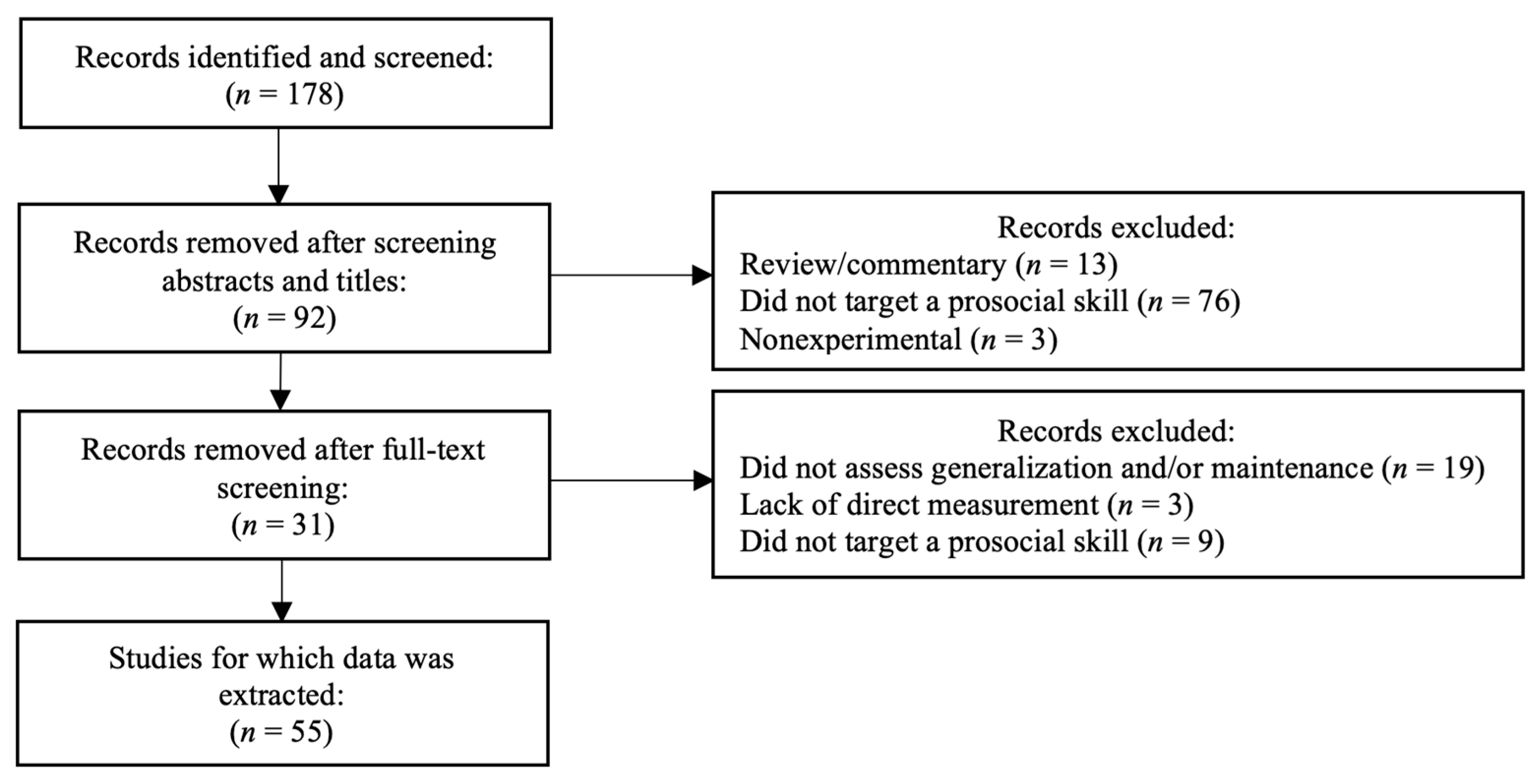
2.2. Article Screening
2.3. Data Extraction
2.4. Classification of Stokes and Baer (1977) Strategies
2.5. Interobserver Agreement
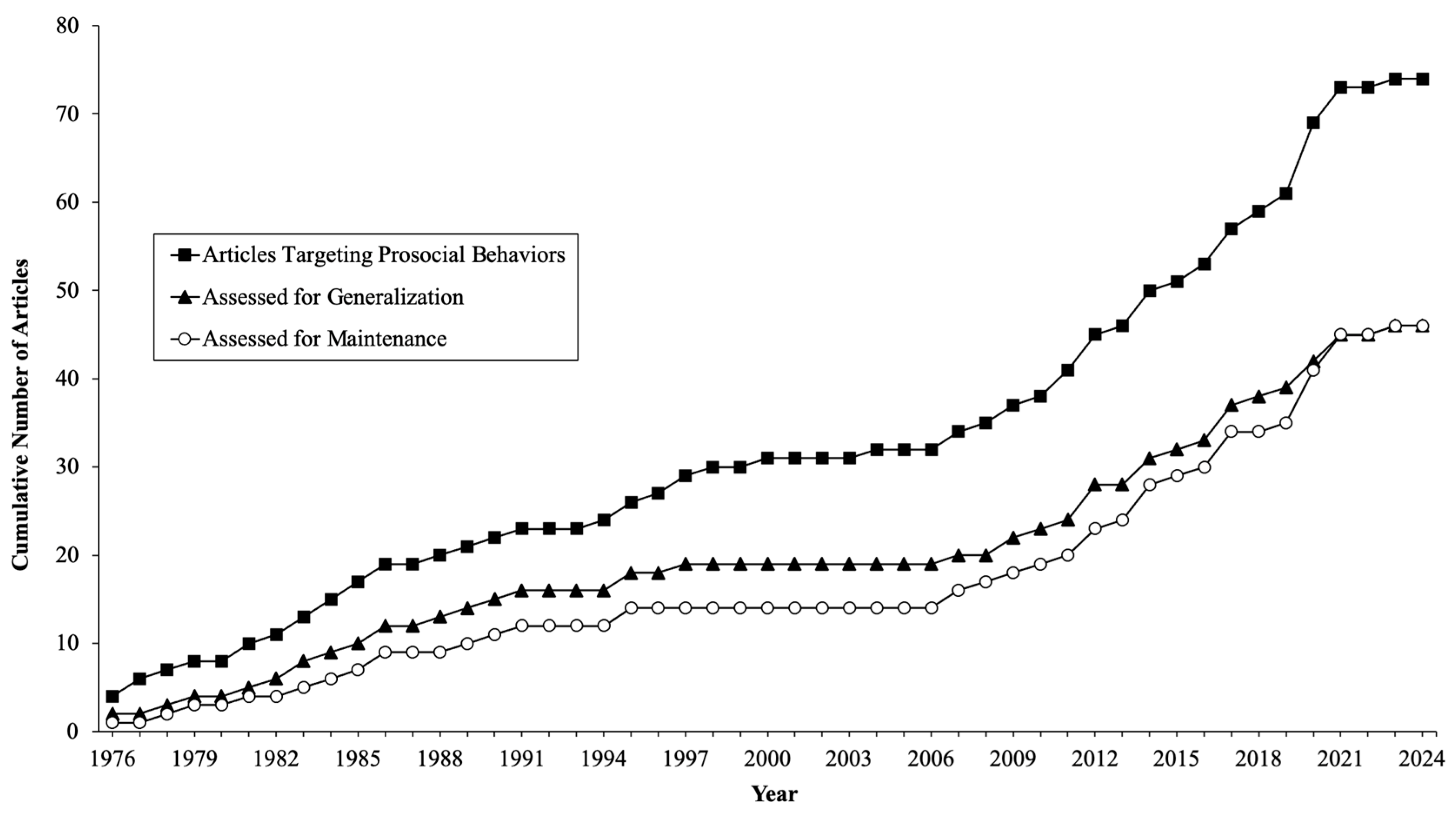
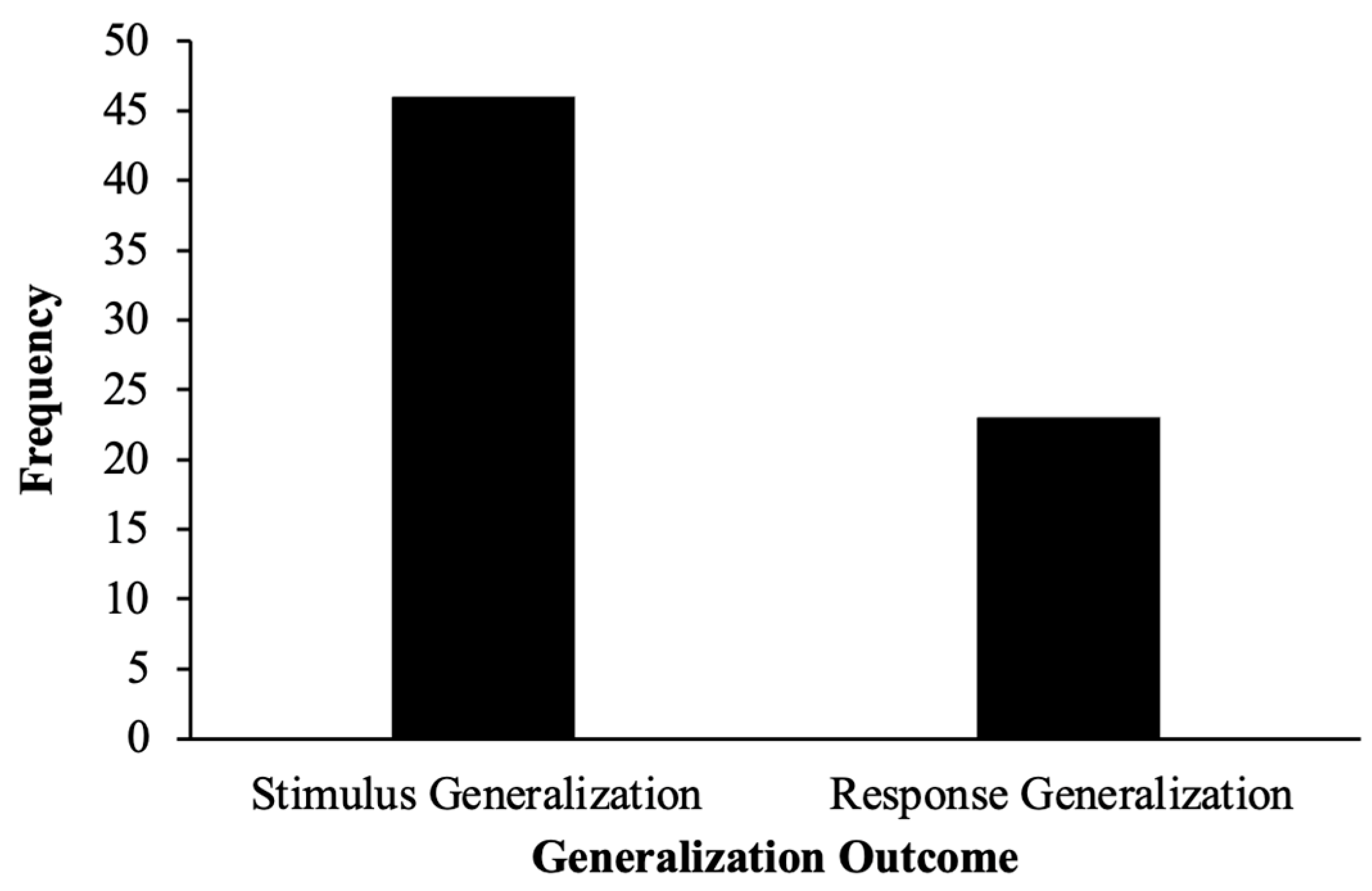
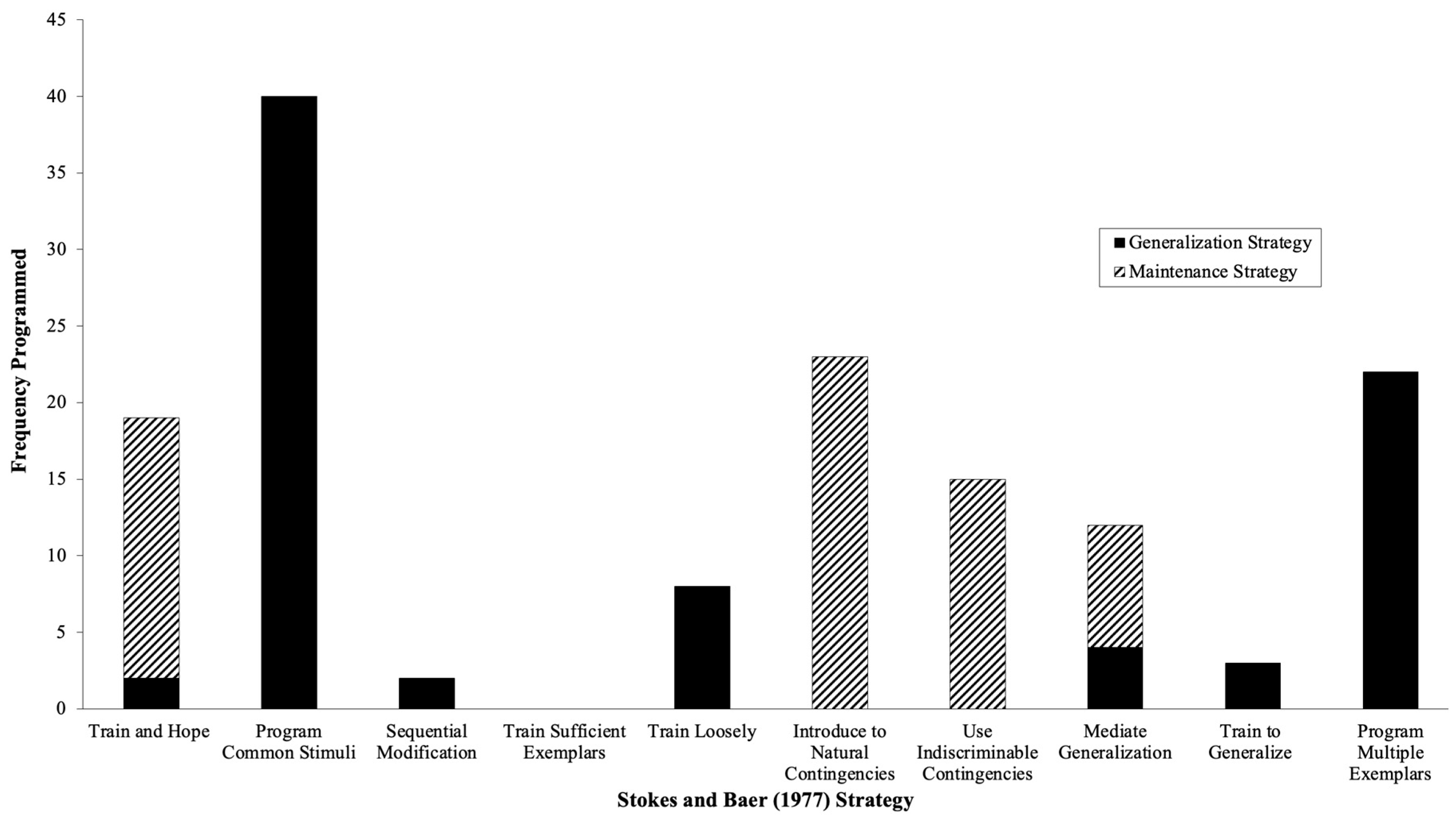
3. Results
4. Discussion
4.1. Implementing Stokes and Baer (1977)
4.2. General Recommendations
5. Conclusions
Supplementary Materials
Author Contributions
Funding
Institutional Review Board Statement
Informed Consent Statement
Data Availability Statement
Conflicts of Interest
| 1 | We acknowledge that the application of multiple exemplars is recognized as a form of Train Sufficient Exemplars (Cooper et al., 2020). However, given Train Sufficient Exemplars was originally outlined as a reactive strategy by Stokes and Baer (1977), Program Multiple Exemplars was introduced and coded as a separate strategy given its active application. |
References
- American Psychiatric Association. (2013). Diagnostic and statistical manual of mental disorders (5th ed.). APA Publishing. [Google Scholar] [CrossRef]
- American Psychological Association. (2018, April 19). Social skills. APA Dictionary of Psychology. Available online: https://dictionary.apa.org/social-skills (accessed on 21 October 2024).
- Argott, P. J., Townsend, D. B., & Poulson, C. L. (2017). Acquisition and generalization of complex empathetic responses among children with autism. Behavior Analysis in Practice, 10(2), 107–117. [Google Scholar] [CrossRef] [PubMed][Green Version]
- Arnold-Saritepe, A. M., Phillips, K. J., Taylor, S. A., Gomes-Ng, S., Lo, M., & Daly, S. (2023). Generalization and maintenance. In J. L. Matson (Ed.), Handbook of applied behavior analysis for children with autism: Clinical guide to assessment and treatment (pp. 415–433). Springer Nature Switzerland AG. [Google Scholar] [CrossRef]
- Baer, D. M., Wolf, M. M., & Risley, T. R. (1968). Some current dimensions of applied behavior analysis. Journal of Applied Behavior Analysis, 1(1), 91–97. [Google Scholar] [CrossRef] [PubMed]
- Bagwell, C. L., Newcomb, A. F., & Bukowski, W. M. (1998). Preadolescent friendship and peer rejection as predictors of adult adjustment. Child Development, 69(1), 140–153. [Google Scholar] [CrossRef]
- Bierman, K. L., & Erath, S. A. (2006). Promoting social competence in early childhood: Classroom curricula and social skills coaching programs. In K. McCartney, & D. Phillips (Eds.), Blackwell handbook of early childhood development (pp. 595–615). Blackwell Publishing Ltd. [Google Scholar] [CrossRef]
- Chandler, L. K., Lubeck, R. C., & Fowler, S. A. (1992). Generalization and maintenance of preschool children’s social skills: A critical review and analysis. Journal of Applied Behavior Analysis, 25(2), 415–428. [Google Scholar] [CrossRef] [PubMed]
- Chen, J. L., Leader, G., Sung, C., & Leahy, M. (2015). Trends in employment for individuals with autism spectrum disorder: A review of the research literature. Review Journal of Autism and Developmental Disorders, 2(2), 115–127. [Google Scholar] [CrossRef]
- Cihon, T. M. (2007). A review of training intraverbal repertoires: Can precision teaching help? The Analysis of Verbal Behavior, 23(1), 123–133. [Google Scholar] [CrossRef] [PubMed]
- Combs, M. L., & Lahey, B. B. (1981). A cognitive social skills training program: Evaluation with young children. Behavior Modification, 5(1), 39–60. [Google Scholar] [CrossRef]
- Constantino, J. N., & Gruber, C. P. (2012). Social responsiveness scale (2nd ed.). Western Psychological Services. [Google Scholar]
- Cooke, T. P., & Apolloni, T. (1976). Developing positive social-emotional behaviors: A study of training and generalization effects. Journal of Applied Behavior Analysis, 9(1), 65. [Google Scholar] [CrossRef] [PubMed]
- Cooper, J. O., Heron, T. E., & Heward, W. L. (2020). Applied behavior analysis (3rd ed.). Pearson. [Google Scholar]
- Covey, A., Li, T., & Alber-Morgan, S. R. (2021). Using behavioral skills training to teach peer models: Effects on interactive play for students with moderate to severe disabilities. Education & Treatment of Children, 44(1), 19–30. [Google Scholar] [CrossRef] [PubMed]
- Curl, R. M., Rowbury, T. G., & Baer, D. M. (1985). The facilitation of children’s social interaction by a picture-cue training program. Child and Family Behavior Therapy, 7(2), 11–39. [Google Scholar] [CrossRef]
- Daffner, M. S., DuPaul, G. J., Kern, L., Cole, C. L., & Cleminshaw, C. L. (2020). Enhancing social skills of young children with ADHD: Effects of a sibling-mediated intervention. Behavior Modification, 44(5), 698–726. [Google Scholar] [CrossRef] [PubMed]
- Day-Watkins, J., Murray, R., & Connell, J. E. (2014). Teaching helping to adolescents with autism. Journal of Applied Behavior Analysis, 47(4), 850–855. [Google Scholar] [CrossRef] [PubMed]
- degli Espinosa, F. (2025). A verbal behavior analysis of theory of mind: Conceptual and applied implications. Perspectives on Behavior Science, 49, 27–74. [Google Scholar] [CrossRef] [PubMed]
- Deming, D. J. (2017). The growing importance of social skills in the labor market. The Quarterly Journal of Economics, 132(4), 1593–1640. [Google Scholar] [CrossRef]
- Deschamps, P. K. H., Been, M., & Matthys, W. (2014). Empathy and empathy induced prosocial behavior in 6- and 7-year-olds with autism spectrum disorder. Journal of Autism and Developmental Disorders, 44(7), 1749–1758. [Google Scholar] [CrossRef] [PubMed]
- Dufour, M. M., & Lanovaz, M. J. (2017). Comparing two methods to promote generalization of receptive identification in children with autism spectrum disorders. Developmental Neurorehabilitation, 20(8), 463–474. [Google Scholar] [CrossRef] [PubMed]
- Eisenberg, N., Spinrad, T. L., & Knafo-Noam, A. (2015). Prosocial development. In M. E. Lamb, & R. M. Lerner (Eds.), Handbook of child psychology and developmental science: Vol. 3. Socioemotional processes (7th ed., pp. 610–656). Wiley. [Google Scholar] [CrossRef]
- Farley, M., Cottle, K. J., Bilder, D., Viskochil, J., Coon, H., & McMahon, W. (2018). Mid-life social outcomes for a population-based sample of adults with ASD. Autism Research, 11(1), 142–152. [Google Scholar] [CrossRef] [PubMed]
- Feldman, M. A., Towns, F., Rincover, A., Case, L., & Betel, J. (1989). Parent education project III: Increasing affection and responsivity in developmentally handicapped mothers: Component analysis, generalization, and effects on child language. Journal of Applied Behavior Analysis, 22(2), 211–222. [Google Scholar] [CrossRef] [PubMed]
- Goetz, E. M., & Baer, D. M. (1973). Social control of form diversity and the emergence of new forms in children’s blockbuilding. Journal of Applied Behavior Analysis, 6(2), 209–217. [Google Scholar] [CrossRef] [PubMed]
- Gresham, F. M., & Elliott, S. N. (2008). Social skills improvement system—Rating scales (SSIS-RS) [Database record]. APA PsycTests. [Google Scholar] [CrossRef]
- Grob, C. M., Lerman, D. C., Langlinais, C. A., & Villante, N. K. (2019). Assessing and teaching job-related social skills to adults with autism spectrum disorder. Journal of Applied Behavior Analysis, 52(1), 150–172. [Google Scholar] [CrossRef] [PubMed]
- Gunning, C., Holloway, J., & Grealish, L. (2020). An evaluation of parents as behavior change agents in the Preschool Life Skills program. Journal of Applied Behavior Analysis, 53(2), 889–917. [Google Scholar] [CrossRef] [PubMed]
- Hanley, G. P., Heal, N. A., Tiger, J. H., & Ingvarsson, E. T. (2007). Evaluation of a classwide teaching program for developing preschool life skills. Journal of Applied Behavior Analysis, 40(2), 277–300. [Google Scholar] [CrossRef] [PubMed]
- Harrison, P. L., & Oakland, T. (2015). Adaptive behavior assessment system (3rd ed.). Western Psychological Services. [Google Scholar]
- Hendricks, D. (2010). Employment and adults with autism spectrum disorders: Challenges and strategies for success. Journal of Vocational Rehabilitation, 32(2), 125–134. [Google Scholar] [CrossRef]
- Hendrickson, J. M., Tremblay, A., Strain, P. S., & Shores, R. E. (1981). Relationship between toy and material use and the occurrence of social interactive behaviors by normally developing preschool children. Psychology in the Schools, 18(4), 500–504. [Google Scholar] [CrossRef]
- Hood, S. A., Beauchesne, B. M., Fahmie, T. A., & Go, A. (2021). Descriptive assessment of conversational skills: Towards benchmarks for young adults with social deficits. Journal of Applied Behavior Analysis, 54(3), 1075–1094. [Google Scholar] [CrossRef] [PubMed]
- Hood, S. A., Olsen, A. E., Luczynski, K. C., & Randle, F. A. (2020). Improving accepting and giving compliments with individuals with developmental disabilities. Journal of Applied Behavior Analysis, 53(2), 1013–1028. [Google Scholar] [CrossRef] [PubMed]
- Howlin, P., Goode, S., Hutton, J., & Rutter, M. (2004). Adult outcome for children with autism. Journal of Child Psychology and Psychiatry, 45(2), 212–229. [Google Scholar] [CrossRef] [PubMed]
- Howlin, P., Moss, P., Savage, S., & Rutter, M. (2013). Social outcomes in mid- to later adulthood among individuals diagnosed with autism and average nonverbal IQ as children. Journal of the American Academy of Child and Adolescent Psychiatry, 52(6), 572–581. [Google Scholar] [CrossRef] [PubMed]
- Jones, S. H., St. Peter, C. C., & Ruckle, M. M. (2020). Reporting of demographic variables in the Journal of Applied Behavior Analysis. Journal of Applied Behavior Analysis, 53(3), 1304–1315. [Google Scholar] [CrossRef] [PubMed]
- King, S., Davidson, K., Chitiyo, A., & Apple, D. (2020). Evaluating article search and selection procedures in special education literature reviews. Remedial and Special Education, 41(1), 3–17. [Google Scholar] [CrossRef]
- Lattal, K. A., St. Peter, C., & Escobar, R. (2013). Operant extinction: Elimination and generation of behavior. In G. J. Madden, W. V. Dube, T. D. Hackenberg, G. P. Hanley, & K. A. Lattal (Eds.), APA handbook of behavior analysis: Vol. 2. Translating principles into practice (pp. 77–107). American Psychological Association. [Google Scholar] [CrossRef]
- Leaf, J. B., Cihon, J. H., Leaf, R., McEachin, J., Liu, N., Russell, N., Unumb, L., Shapiro, S., & Khosrowshahi, D. (2022). Concerns about ABA-based intervention: An evaluation and recommendations. Journal of Autism and Developmental Disorders, 52(6), 2838–2853. [Google Scholar] [CrossRef] [PubMed]
- Leaf, J. B., Taubman, M., Bloomfield, S., Palos-Rafuse, L., Leaf, R., McEachin, J., & Oppenheim, M. L. (2009). Increasing social skills and pro-social behavior for three children diagnosed with autism through the use of a teaching package. Research in Autism Spectrum Disorders, 3(1), 275–289. [Google Scholar] [CrossRef]
- Ledbetter-Cho, K., Lang, R., Davenport, K., Moore, M., Lee, A., Howell, A., Drew, C., Dawson, D., Charlop, M. H., Falcomata, T., & O’Reilly, M. (2015). Effects of script training on the peer-to-peer communication of children with autism spectrum disorder. Journal of Applied Behavior Analysis, 48(4), 785–799. [Google Scholar] [CrossRef] [PubMed]
- Lee, G. T., Hu, X., Liu, Y., Zou, C., Cheng, X., Zhao, Q., & Huang, J. (2020). Increasing response diversity to intraverbals in children with autism spectrum disorder. Journal of Autism and Developmental Disorders, 50(1), 292–307. [Google Scholar] [CrossRef] [PubMed]
- Lord, C., Rutter, M., DiLavore, P. C., Risi, S., Gotham, K., & Bishop, S. L. (2012). Autism diagnostic observation schedule (2nd ed.). Western Psychological Services. [Google Scholar]
- Luczynski, K. C., Hanley, G. P., & Rodriguez, N. M. (2014). An evaluation of the generalization and maintenance of functional communication and self-control skills with preschoolers. Journal of Applied Behavior Analysis, 47(2), 246–263. [Google Scholar] [CrossRef] [PubMed]
- Marzullo-Kerth, D., Reeve, S. A., Reeve, K. F., & Townsend, D. B. (2011). Using multiple-exemplar training to teach a generalized repertoire of sharing to children with autism. Journal of Applied Behavior Analysis, 44(2), 279–294. [Google Scholar] [CrossRef] [PubMed]
- McKeown, C. A., Luczynski, K. C., & Lehardy, R. K. (2021). Evaluating the generality and social acceptability of early friendship skills. Journal of Applied Behavior Analysis, 54(4), 1341–1368. [Google Scholar] [CrossRef] [PubMed]
- Miltenberger, R. G. (2016). Behavior modification: Principles and procedures (6th ed.). Cengage Learning. [Google Scholar]
- Mutchler, M. K., & Pence, S. T. (2025). Distribution of follow-up sessions influences determinations of skill maintenance. Journal of Applied Behavior Analysis, 58(3), 547–559. [Google Scholar] [CrossRef] [PubMed]
- Ng, A. H. S., Schulze, K., Rudrud, E., & Leaf, J. B. (2016). Using the teaching interactions procedure to teach social skills to children with autism and intellectual disability. American Journal on Intellectual and Developmental Disabilities, 121(6), 501–519. [Google Scholar] [CrossRef] [PubMed]
- Odom, S. L., Hoyson, M., Jamieson, B., & Strain, P. S. (1985). Increasing handicapped preschoolers’ peer social interactions: Cross-setting and component analysis. Journal of Applied Behavior Analysis, 18(1), 3–16. [Google Scholar] [CrossRef] [PubMed]
- Peterson, S. P., Rodriguez, N. M., & Pawich, T. L. (2019). Effects of modeling rote versus varied responses on response variability and skill acquisition during discrete-trial instruction. Journal of Applied Behavior Analysis, 52(2), 370–385. [Google Scholar] [CrossRef] [PubMed]
- Reeve, S. A., Reeve, K. F., Townsend, D. B., & Poulson, C. L. (2007). Establishing a generalized repertoire of helping behavior in children with autism. Journal of Applied Behavior Analysis, 40(1), 123–136. [Google Scholar] [CrossRef] [PubMed]
- Reynolds, C. R., & Kamphaus, R. W. (2015). Behavior assessment system for children (3rd ed.). Pearson. [Google Scholar]
- Schlinger, H. D. (1995). A behavior analytic view of child development. Plenum Press. [Google Scholar] [CrossRef]
- Schnell, L. K., Vladescu, J. C., Kodak, T., & Nottingham, C. L. (2018). Comparing procedures on the acquisition and generalization of tacts for children with autism spectrum disorder. Journal of Applied Behavior Analysis, 51(4), 769–783. [Google Scholar] [CrossRef] [PubMed]
- Schrandt, J. A., Buffington Townsend, D., & Poulson, C. L. (2009). Teaching empathy skills to children with autism. Journal of Applied Behavior Analysis, 42(1), 17–32. [Google Scholar] [CrossRef] [PubMed]
- Sivaraman, M. (2017). Using multiple exemplar training to teach empathy skills to children with autism. Behavior Analysis in Practice, 10(4), 337–346. [Google Scholar] [CrossRef] [PubMed]
- Sparrow, S. S., Cicchetti, D. V., & Saulnier, C. A. (2016). Vineland adaptive behavior scales (3rd ed.). Pearson. [Google Scholar]
- Stokes, T. F., & Baer, D. M. (1977). An implicit technology of generalization. Journal of Applied Behavior Analysis, 10(2), 349–367. [Google Scholar] [CrossRef] [PubMed]
- Strain, P. S., & Odom, S. L. (1986). Peer social initiations: Effective intervention for social skills development. Exceptional Children, 52(6), 543–551. [Google Scholar] [CrossRef] [PubMed]
- Taylor, J. L., Henninger, N. A., & Mailick, M. R. (2015). Longitudinal patterns of employment and postsecondary education for adults with autism and average-range IQ. Autism: The International Journal of Research and Practice, 19(7), 785–793. [Google Scholar] [CrossRef] [PubMed]
- Toner, I. J., & Smith, R. A. (1977). Age and overt verbalization in delay-maintenance behavior in children. Journal of Experimental Child Psychology, 24(1), 123–128. [Google Scholar] [CrossRef]
- Tremblay, A., Strain, P. S., Hendrickson, J. M., & Shores, R. E. (1981). Social interactions of normal preschool children: Using normative data for subject and target behavior selection. Behavior Modification, 5(2), 237–253. [Google Scholar] [CrossRef]
- Vollmer, T. R., Athens, E. A., & Fernand, J. K. (2021). Developing function-based extinction procedures for problem behavior. In W. Fisher, C. Piazza, & H. S. Roane (Eds.), Handbook of applied behavior analysis (2nd ed., pp. 321–336). Guilford Press. [Google Scholar]
- Wunderlich, K. L., & Vollmer, T. R. (2017). Effects of serial and concurrent training on receptive identification tasks: A systematic replication. Journal of Applied Behavior Analysis, 50(3), 641–652. [Google Scholar] [CrossRef] [PubMed]
- Wunderlich, K. L., Vollmer, T. R., Donaldson, J. M., & Phillips, C. L. (2014). Effects of serial and concurrent training on acquisition and generalization. Journal of Applied Behavior Analysis, 47(4), 723–737. [Google Scholar] [CrossRef] [PubMed]

| Strategy | Characteristics |
|---|---|
| Train and Hope | Behavior analysts do not explicitly program for generalization or maintenance strategies. Any generalization and/or maintenance observed are a byproduct of the original teaching. General application takes a passive approach. Can be used to promote stimulus generalization, response generalization, and maintenance outcomes. |
| Program Common Stimuli | Behavior analysts introduce into the teaching setting salient stimuli likely to be present in the generalization settings. General application can take a passive or active approach. Can be programmed for stimulus generalization outcomes. |
| Sequential Modification | Behavior analysts first assess for generalization and, if generalization is absent, teaching is extended across all relevant exemplars. General application takes a reactive approach. Can be programmed for stimulus and response generalization outcomes. |
| Train Sufficient Exemplars | An abbreviated version of Sequential Modification in that if generalization is absent during generalization assessments, teaching is extended across only enough exemplars to produce generalization. General application takes a reactive approach. Can be programmed for stimulus and response generalization outcomes. |
| Program Multiple Exemplars | Behavior analysts teach across many exemplars during teaching to increase the probability that generalization occurs. General applications take an active approach. Can be programmed for stimulus and response generalization outcomes. |
| Train Loosely | Behavior analysts vary the stimulus dimensions for occasioning responses or response dimensions that are reinforced. Overall, there is a lack of systematic stimulus and response requirements. General applications can take an active or reactive approach. Can be programmed for stimulus and response generalization outcomes. |
| Introduce to Natural Maintaining Contingencies | Behavior analysts (a) select target responses that will contact natural contingencies prior to the generalization/maintenance assessment, or (b) arrange the environment to be more responsive to the target behaviors. General applications take an active approach. Can be programmed for maintenance outcomes. |
| Use of Indiscriminable Contingencies | Behavior analysts program intermittent or delayed reinforcement, unpredictable settings, or responses. General applications take an active approach. Can be programmed for stimulus generalization, response generalization, and maintenance outcomes. |
| Mediate Generalization | Behavior analysts teach a mediating response likely to control other responses in other situations. General applications take an active approach. Can be programmed for stimulus generalization, response generalization, and maintenance outcomes. |
| Train to Generalize | Behavior analysts reinforce or instruct generalized responding as the operant class. General applications take an active approach. Can be programmed for stimulus generalization, response generalization, and maintenance outcomes. |
| Journal |
|---|
| American Journal on Intellectual and Developmental Disabilities |
| Analysis and Intervention in Developmental Disabilities |
| Behavior Analysis in Practice |
| Behavior Analysis: Research and Practices |
| Behavior Modification |
| Behavioral Disorders |
| Behavioral Interventions |
| Education and Treatment of Children |
| Exceptionality |
| Journal of Applied Behavior Analysis |
| Research in Autism Spectrum Disorders |
| Demographic | Frequency (N = 305) | Demographic | Frequency (N = 305) |
|---|---|---|---|
| Sex | Diagnosis b | ||
| Male | 179 | Neurodevelopmental | |
| Female | 108 | ASD | 99 |
| Unspecified | 18 | ADHD | 11 |
| Age | Other | 8 | |
| <10 | 236 | Physical Disability | 13 |
| 10–18 | 40 | Genetic Disorder | 5 |
| >18 | 29 | Other DSM-5 | 4 |
| Ethnicity a | Co-occurring Diagnoses | 13 | |
| Black | 15 | Unspecified c | 39 |
| White | 19 | None | 139 |
| Hispanic | 3 | ||
| Asian | 3 | ||
| Multiethnic | 3 | ||
| Unspecified | 271 |
Disclaimer/Publisher’s Note: The statements, opinions and data contained in all publications are solely those of the individual author(s) and contributor(s) and not of MDPI and/or the editor(s). MDPI and/or the editor(s) disclaim responsibility for any injury to people or property resulting from any ideas, methods, instructions or products referred to in the content. |
© 2026 by the authors. Licensee MDPI, Basel, Switzerland. This article is an open access article distributed under the terms and conditions of the Creative Commons Attribution (CC BY) license.
Share and Cite
Arredulfo, E.; McKeown, C.A.; Morrison, M.R. Generalization and Maintenance of Prosocial Skills: A Literature Review of Strategies and Tactics. Behav. Sci. 2026, 16, 1013. https://doi.org/10.3390/bs16061013
Arredulfo E, McKeown CA, Morrison MR. Generalization and Maintenance of Prosocial Skills: A Literature Review of Strategies and Tactics. Behavioral Sciences. 2026; 16(6):1013. https://doi.org/10.3390/bs16061013
Chicago/Turabian StyleArredulfo, Evelin, Ciobha A. McKeown, and Matthew R. Morrison. 2026. "Generalization and Maintenance of Prosocial Skills: A Literature Review of Strategies and Tactics" Behavioral Sciences 16, no. 6: 1013. https://doi.org/10.3390/bs16061013
APA StyleArredulfo, E., McKeown, C. A., & Morrison, M. R. (2026). Generalization and Maintenance of Prosocial Skills: A Literature Review of Strategies and Tactics. Behavioral Sciences, 16(6), 1013. https://doi.org/10.3390/bs16061013

