Trust in Context: A Three-Factor Experimental Study

Abstract
1. Introduction
2. Literature Review and Theoretical Framework
2.1. Literature Review
- (1)
- Methods for Measuring Trust
- (2)
- Conceptual Definition of Trust
2.2. Theoretical Framework
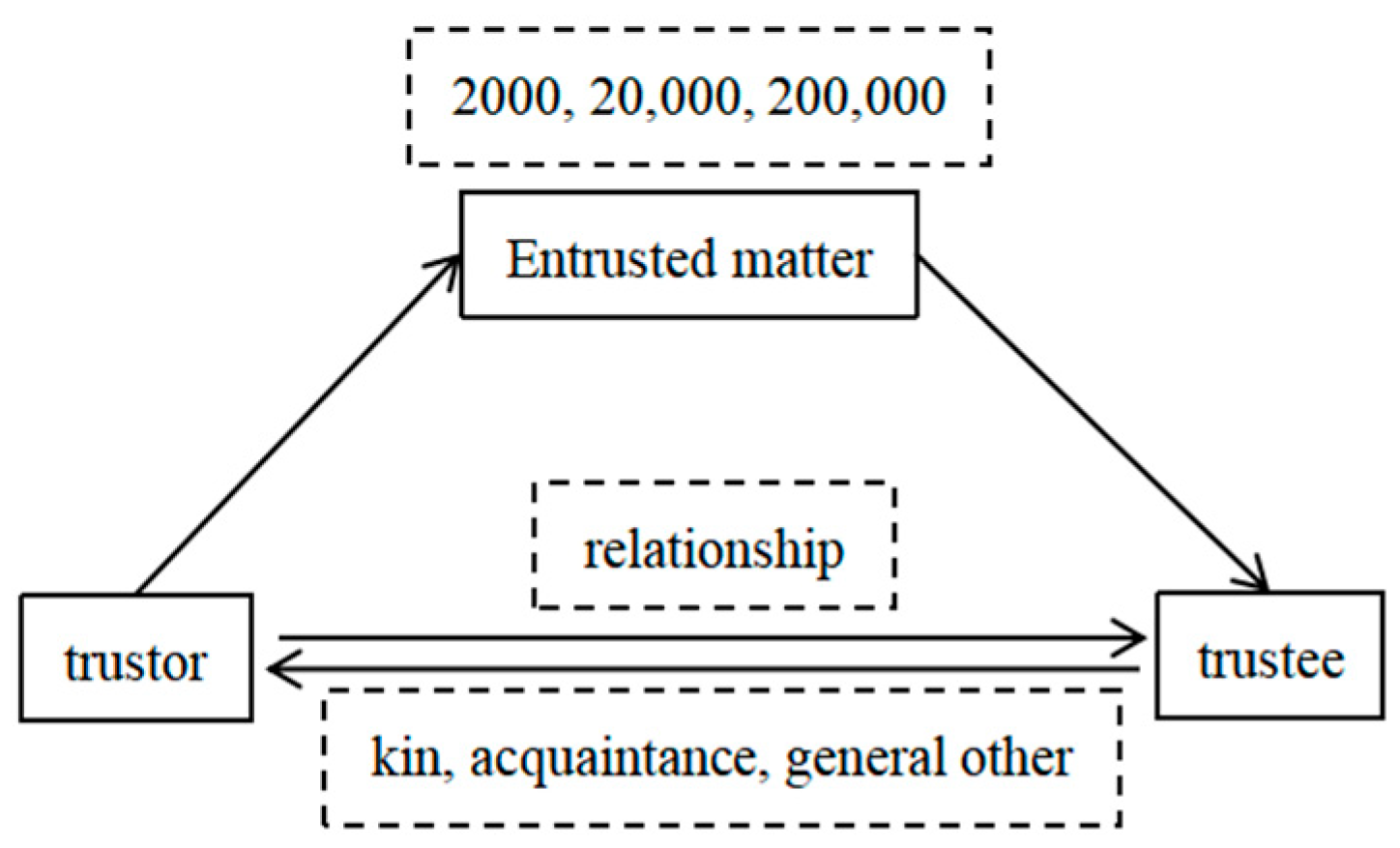
× b (ability, degree of integrity, etc.) × x (large or small loan amount)
× R(ab) (kin, friends, or business partners).
2.3. Research Hypotheses
3. Research Methods
3.1. Method Selection and Experimental Design
3.2. Variable Measurement and Data Collection
- (1)
- Relationship (R)
- (2)
- Entrusted Matters (x)
- (3)
- Trustee Attributes (b)
4. Empirical Results
4.1. Manipulation Check of Relationship Classification
4.2. Analysis of Main Effects and Interaction Effects
- (1)
- Main Effects Tests
- (2)
- Two-Way Interaction Effects
- (3)
- Three-Way Interaction Test
5. Results and Discussion
5.1. Ecological Validity
5.2. Cross-Cultural Generalizability
5.3. Behavioral Validity
5.4. Sample Representativeness
Supplementary Materials
Author Contributions
Funding
Institutional Review Board Statement
Informed Consent Statement
Data Availability Statement
Conflicts of Interest
| 1 | Abstract: Based on the analysis of the five waves survey from the 2002–2015 data at 40 villages in Jiangxi province, this paper indicates that interpersonal trust of peasants emerged as a U-shaped change and general increase. Meanwhile, the internal structure of peasants trust demonstrates a pattern of difference sequence. The sequence from inside to outside of interpersonal trust of the peasants is family relationship-embedded relationship-open relationship”. This paper also analyzes the influencing factors of interpersonal trust by its degree and range, and the results suggest that the institutional and cultural factors are more applicable for explaining this interpersonal trust than the rational factor. Therefore, the paper advises that to create and improve the interpersonal trust in the rural area, to improve the quality of government governance and to inherit the excellent traditional culture for creating a harmonious interpersonal environment is necessary. In addition, government trust, the impact of traditional culture on the different structures of interpersonal trust is also worthy of subsequent attention. |
| 2 | Abstract: Drawing on data from the 2005 and 2015 Chinese General Social Survey, we examine how interpersonal trust has evolved in transitional China as well as its socioeconomic determinants. Results show that the overall interpersonal trust declined slightly among Chinese residents between 2005 and 2015. Nonetheless, this decline was mainly driven by increasing distrust in specialized connections, while generalized trust increased during the same period, indicating a structural shift in interpersonal trust in contemporary China. We also find that socioeconomic factors have a complicated impact oninterpersonal trust within both periods and discuss potential trends and implications. |
| 3 | Abstract: Trust is often exercised with immediate or extended family members in China, which implies that relationship closeness could positively affect interpersonal trust. Renging, a set of Chinese social norms to get along well with others, also has a positive influence on trust. Moreover, an individual’s trustworthiness, including ability, benevolence and integrity, are important antecedents of interpersonal trust. Based on extant theories, we attempt to build a systematic mechanism by investigating the influence of relationship closeness, perceived trustworthiness and Renging orientation on interpersonal trust. |
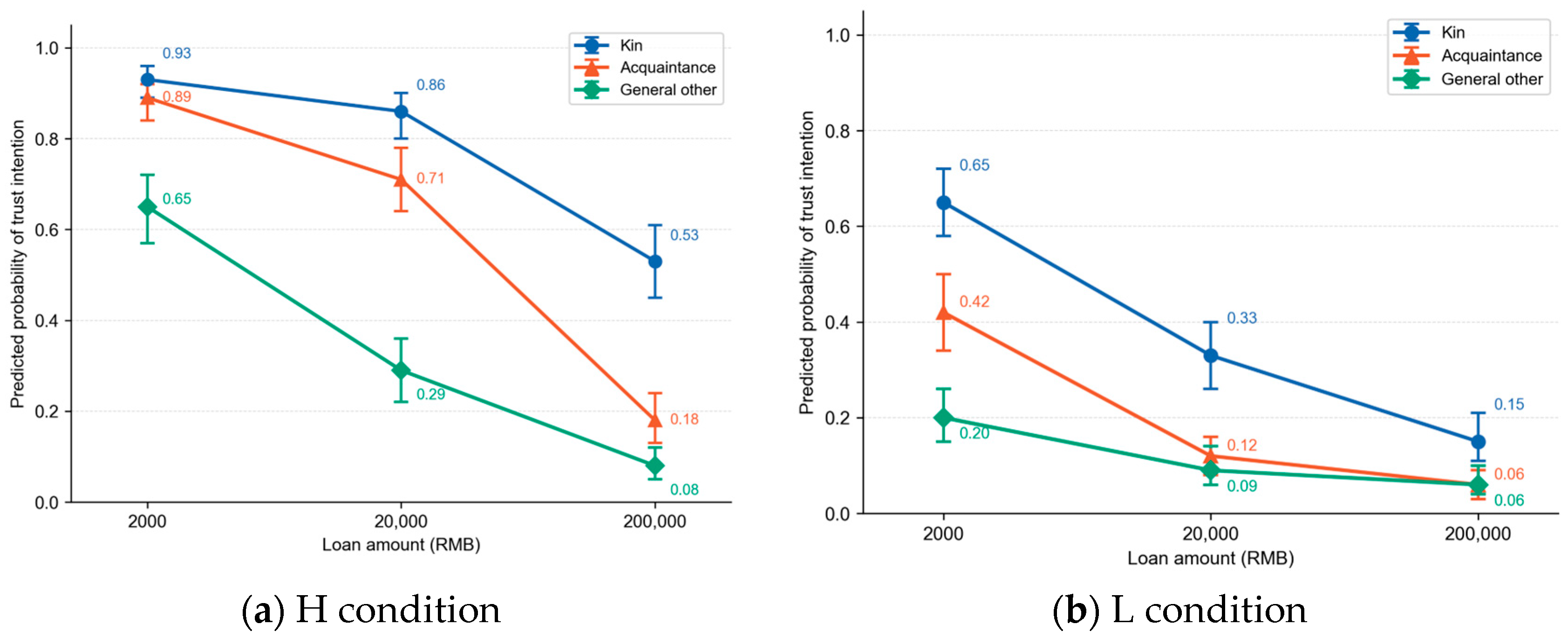
| 4 | In the following sections, “H” refer specifically to high ability and high integrity, whereas “L” denote low ability and low integrity. |
References
- Adobor, H. (2006). Optimal trust? Uncertainty as a determinant and limit to trust in inter-firm alliances. Leadership & Organization Development Journal, 27(7), 537–553. [Google Scholar] [CrossRef] [Scilit]
- Bai, C., Gong, Y., & Feng, C. (2019). Social trust, pattern of difference, and subjective well-being. Sage Open, 9(3), 2158244019865765. [Google Scholar] [CrossRef] [Scilit]
- Bauer, P. C., & Freitag, M. (2017). Measuring trust. In The Oxford handbook of social and political trust. Oxford University Press. Available online: https://academic.oup.com/edited-volume/34638/chapter/295110958 (accessed on 7 June 2026).
- Berg, J., Dickhaut, J., & McCabe, K. (1995). Trust, reciprocity, and social history. Games and Economic Behavior, 10(1), 122–142. [Google Scholar] [CrossRef] [Scilit]
- Butler, J. K. (1991). Toward understanding and measuring conditions of trust: Evolution of a conditions of trust inventory. Journal of Management, 17(3), 643–663. [Google Scholar] [CrossRef] [Scilit]
- Chen, C. C., Chen, X.-P., & Huang, S. (2013). Chinese Guanxi: An integrative review and new directions for future research. Management and Organization Review, 9(1), 167–207. [Google Scholar] [CrossRef] [Scilit]
- Clark, M. C., & Payne, R. L. (2006). Character-based determinants of trust in leaders. Risk Analysis, 26(5), 1161–1173. [Google Scholar] [CrossRef] [Scilit]
- Coleman, J. S. (1990). Foundations of social theory. Belknap Press of Harvard University Press. [Google Scholar]
- Cook, K. S., Hardin, R., & Levi, M. (2007). Cooperation without trust? Russell Sage Foundation. [Google Scholar]
- Durkheim, E., & Halls, W. D. (1984). The division of labor in society. Free Press. [Google Scholar]
- Fei, X. (1992). From the soil: The foundations of Chinese society (G. G. Hamilton, & W. Zheng, Trans.; 1st ed.). University of California Press. [Google Scholar]
- Glaeser, E. L., Laibson, D. I., Scheinkman, J. A., & Soutter, C. L. (2000). Measuring trust. The Quarterly Journal of Economics, 115(3), 811–846. [Google Scholar] [CrossRef] [Scilit]
- Gneezy, U., & Rustichini, A. (2000). Pay enough or don’t pay at all. The Quarterly Journal of Economics, 115(3), 791–810. [Google Scholar] [CrossRef] [Scilit]
- Guo, H. (2016). On trust. Southwest Normal University Press. [Google Scholar]
- Hardin, R. (2001). Conceptions and explanations of trust. In Trust in society (pp. 3–39). Russell Sage Foundation. [Google Scholar]
- Hardin, R. (2002). Trust and trustworthiness. Russell Sage Foundation. [Google Scholar]
- Hwang, K. (1987). Face and favor: The Chinese power game. American Journal of Sociology, 92(4), 944–974. [Google Scholar] [CrossRef] [Scilit] [PubMed]
- Lewicki, R. J., Tomlinson, E. C., & Gillespie, N. (2006). Models of interpersonal trust development: Theoretical approaches, empirical evidence, and future directions. Journal of Management, 32(6), 991–1022. [Google Scholar] [CrossRef] [Scilit]
- Liang, S. (2021). Fundamentals of Chinese culture (L. Ming, Trans.). Amsterdam University Press. [Google Scholar] [CrossRef] [Scilit]
- Liu, H., Wang, T. Y., Bernardo, A. B. I., & Shen, H. (2023). Cooperating with different types of strangers: The influence of guanxi perception, trust, and responsibility. Behavioral Sciences, 13(6), 473. [Google Scholar] [CrossRef] [Scilit]
- Liu, J., & Guo, J. (2024). The thirdness of “xinren” (trust)—Problems in its measurement. Social Research Methods Review, 5(1), 164–188. [Google Scholar]
- Liu, J., & Li, Y. (2025). On the “trust tetrahedron” in the Chinese context. Exploration and Free Views, (11), 78–93+174. [Google Scholar]
- Luhmann, N., King, M., Morgner, C., Davis, H., Raffan, J., & Rooney, K. (2017). Trust and power. Polity. [Google Scholar]
- Mayer, R. C., Davis, J. H., & Schoorman, F. D. (1995). An integrative model of organizational trust. The Academy of Management Review, 20(3), 709–734. [Google Scholar] [CrossRef] [Scilit]
- Nannestad, P. (2008). What have we learned about generalized trust, if anything? Annual Review of Political Science, 11, 413–436. [Google Scholar] [CrossRef] [Scilit]
- Newton, K., & Zmerli, S. (2011). Three forms of trust and their association. European Political Science Review, 3(2), 169–200. [Google Scholar] [CrossRef] [Scilit]
- Qi, Y., & Zhang, Z. (2022). Structural shift of interpersonal trust in transitional China. Sociological Review of China, 10(2), 124–144. [Google Scholar]
- Rotter, J. B. (1967). A new scale for the measurement of interpersonal trust. Journal of Personality, 35(4), 651–665. [Google Scholar] [CrossRef] [Scilit]
- Schoorman, F. D., Mayer, R. C., & Davis, J. H. (2007). An integrative model of organizational trust: Past, present, and future. The Academy of Management Review, 32(2), 344–354. [Google Scholar] [CrossRef] [Scilit]
- Simmel, G. (2011). The philosophy of money. Routledge. [Google Scholar] [CrossRef] [Scilit]
- Stryker, S. (1980). Symbolic interactionism: A social structural version. Benjamin/Cummings Pub. Co. [Google Scholar]
- Sturgis, P., & Smith, P. (2010). Assessing the validity of generalized trust questions: What kind of trust are we measuring? International Journal of Public Opinion Research, 22(1), 74–92. [Google Scholar] [CrossRef] [Scilit]
- Suneja, V., & Das, D. (2024). Impact of social preferences, trust and behavioural norms on cooperation: Experimental evidence from prisoner’s dilemma game. Studies in Microeconomics, 12(3), 326–344. [Google Scholar] [CrossRef] [Scilit]
- Tedeschi, J. T., Hiester, D. S., & Gahagan, J. P. (1969). Trust and the prisoner’s dilemma game. The Journal of Social Psychology, 79(1), 43–50. [Google Scholar] [CrossRef] [Scilit]
- Tönnies, F. (2001). Tönnies: Community and civil society (M. Hollis, Trans.; J. Harris, Ed.). Cambridge University Press. [Google Scholar] [CrossRef] [Scilit]
- Um, S. (2024). Honesty: Respect for the right not to be deceived. Journal of Moral Education, 53(2), 292–306. [Google Scholar] [CrossRef] [Scilit]
- Uslaner, E. M. (2002). The moral foundations of trust. Cambridge University Press. [Google Scholar] [CrossRef] [Scilit]
- Uzzi, B. (1997). Social structure and competition in interfirm networks: The paradox of embeddedness. Administrative Science Quarterly, 42(1), 35–67. [Google Scholar] [CrossRef] [Scilit]
- Xu, G. (2001). The opposition and unity between objective and subjective good faith. Social Sciences in China, (6), 97–113+206. [Google Scholar]
- Xu, H., Zhang, C., & Huang, Y. (2023). Social trust, social capital, and subjective well-being of rural residents: Micro-empirical evidence based on the Chinese General Social Survey (CGSS). Humanities and Social Sciences Communications, 10(1), 49. [Google Scholar] [CrossRef] [Scilit]
- Yamagishi, T., Cook, K. S., & Watabe, M. (1998). Uncertainty, trust, and commitment formation in the United States and Japan. American Journal of Sociology, 104(1), 165–194. [Google Scholar] [CrossRef] [Scilit]
- Yang, K.-S. (1995). Chinese social orientation: An integrative analysis. In T. Y. Lin, W. S. Tseng, & Y. K. Yeh (Eds.), Chinese societies and mental health (pp. 19–39). Oxford University Press. [Google Scholar]
- Yu, H. (2017). On the change of Chinese peasants interpersonal trust and its determinants: Analysis of the data from five waves survey (2002–2015) in 40 villages of Jiangxi province. Journal of Central China Normal University (Humanities and Social Sciences), 56(5), 1–10. [Google Scholar]
- Yuan, X., & Guo, S. (2017). Differential mode of association in Chinese interpersonal relationship affection: Evidence from Extrinsic Affective Simon Task (EAST). Journal of Psychological Science, 40(3), 651–656. [Google Scholar] [CrossRef]
- Zhang, Y. (2009). Interpersonal trust and social interaction between people of different regions sizes. Sociological Studies, 24(4), 112–132+244. [Google Scholar] [CrossRef]
- Zhu, Q., Zhang, F., & Zhong, N. (2021). Favoring relatives, favoring the sage: The influence of relationship and renqing on interpersonal trust. Journal of Psychological Science, 44(6), 1461–1468. [Google Scholar] [CrossRef]



| Variables | Category | Frequency | Percentage | Mean | SD |
|---|---|---|---|---|---|
| Gender | Female | 142 | 56.3% | 0.44 | 0.497 |
| Male | 110 | 43.7% | |||
| Age | Under 18 | 8 | 3.2% | 3.7579 | 1.41454 |
| 19–24 | 43 | 17.1% | |||
| 25–34 | 71 | 28.2% | |||
| 35–44 | 47 | 18.7% | |||
| 45–54 | 50 | 19.8% | |||
| 55–64 | 29 | 11.5% | |||
| 65+ | 4 | 1.6% | |||
| Education | High school or below | 103 | 41% | 2.21 | 1.147 |
| Junior college | 33 | 13% | |||
| Bachelor’s | 75 | 30% | |||
| Master’s or above | 41 | 16% | |||
| Major | No college | 104 | 41.3% | 1.21 | 1.299 |
| Humanities and social sciences | 61 | 24.2% | |||
| Economics and management | 34 | 13.5% | |||
| Natural sciences and engineering | 36 | 14.3% | |||
| Medicine and health | 17 | 6.7% | |||
| Occupation | Student | 55 | 21.8% | 3.51 | 1.771 |
| Government/institution staff | 32 | 12.7% | |||
| State-owned/collective enterprise staff | 23 | 9.1% | |||
| Private company or self-employed | 51 | 20.2% | |||
| Freelancer/flexible employment | 54 | 21.4% | |||
| Unemployed/job-seeking | 37 | 14.7% | |||
| Monthly | <1000 RMB | 45 | 17.9% | 2.82 | 1.465 |
| 1000–3000 RMB | 82 | 32.5% | |||
| 3000–5000 RMB | 54 | 21.4% | |||
| 5000–8000 RMB | 32 | 12.7% | |||
| 8000–12,000 RMB | 28 | 11.1% | |||
| 12,000–15,000 RMB | 5 | 2% | |||
| >15,000 RMB | 6 | 2.4% | |||
| Region | Central Region | 138 | 54.76% | — | — |
| Eastern Coast | 69 | 27.38% | |||
| Northeast Region | 27 | 10.71% | |||
| Western Region | 18 | 7.14% |
| Relationship | Mean Rank | Chi-Square | Kendall’s W | p |
|---|---|---|---|---|
| Kin | 1.36 | 224.553 | 0.446 | 0.001 |
| Acquaintance | 1.99 | |||
| General others | 2.65 |
| Variable | Wald χ2 | p |
|---|---|---|
| Intercept | 14.455 | <0.001 |
| Relationship (R) | 195.375 | <0.001 |
| Loan amount (x) | 262.163 | <0.001 |
| Trustee attributes (b) | 249.017 | <0.001 |
| R × x | 27.157 | <0.001 |
| R × b | 38.129 | <0.001 |
| x × b | 57.703 | <0.001 |
| R × x × b | 36.107 | <0.001 |
| Income | 5.308 | 0.505 |
| Gender | 0.023 | 0.880 |
| Age | 4.516 | 0.033 |
| Var | Level | Predicted Probability M [95% CI] | Marginal Effect Δp [95% CI] | Wald | p |
|---|---|---|---|---|---|
| R | Kin | 0.61 [0.54, 0.68] | — | 195.38 | <0.001 |
| Acq | 0.35 [0.29, 0.42] | — | |||
| Gen | 0.18 [0.14, 0.23] | — | |||
| Kin vs. Gen | — | +0.43 [0.37, 0.50] | |||
| Acq vs. Gen | — | +0.17 [0.13, 0.22] | |||
| Kin vs. Acq | — | +0.26 [0.21, 0.32] | |||
| x | 2000 | 0.67 [0.60, 0.73] | — | 262.16 | <0.001 |
| 20,000 | 0.37 [0.31, 0.44] | — | |||
| 200,000 | 0.13 [0.10, 0.18] | — | |||
| 2000 vs. 200,000 | — | +0.53 [0.46, 0.60] | |||
| 20,000 vs. 200,000 | — | +0.24 [0.18, 0.29] | |||
| 2000 vs. 20,000 | — | +0.3 [0.25, 0.35] | |||
| b | H | 0.59 [0.52, 0.65] | — | 249.02 | <0.001 |
| L | 0.18 [0.14, 0.23] | — | |||
| H vs. L | — | +0.41 [0.36, 0.45] |
| Entrusted Matter | Relationship | Predicted Probability M [95% CI] | Marginal Effect Δp [95% CI] | Wald | p |
|---|---|---|---|---|---|
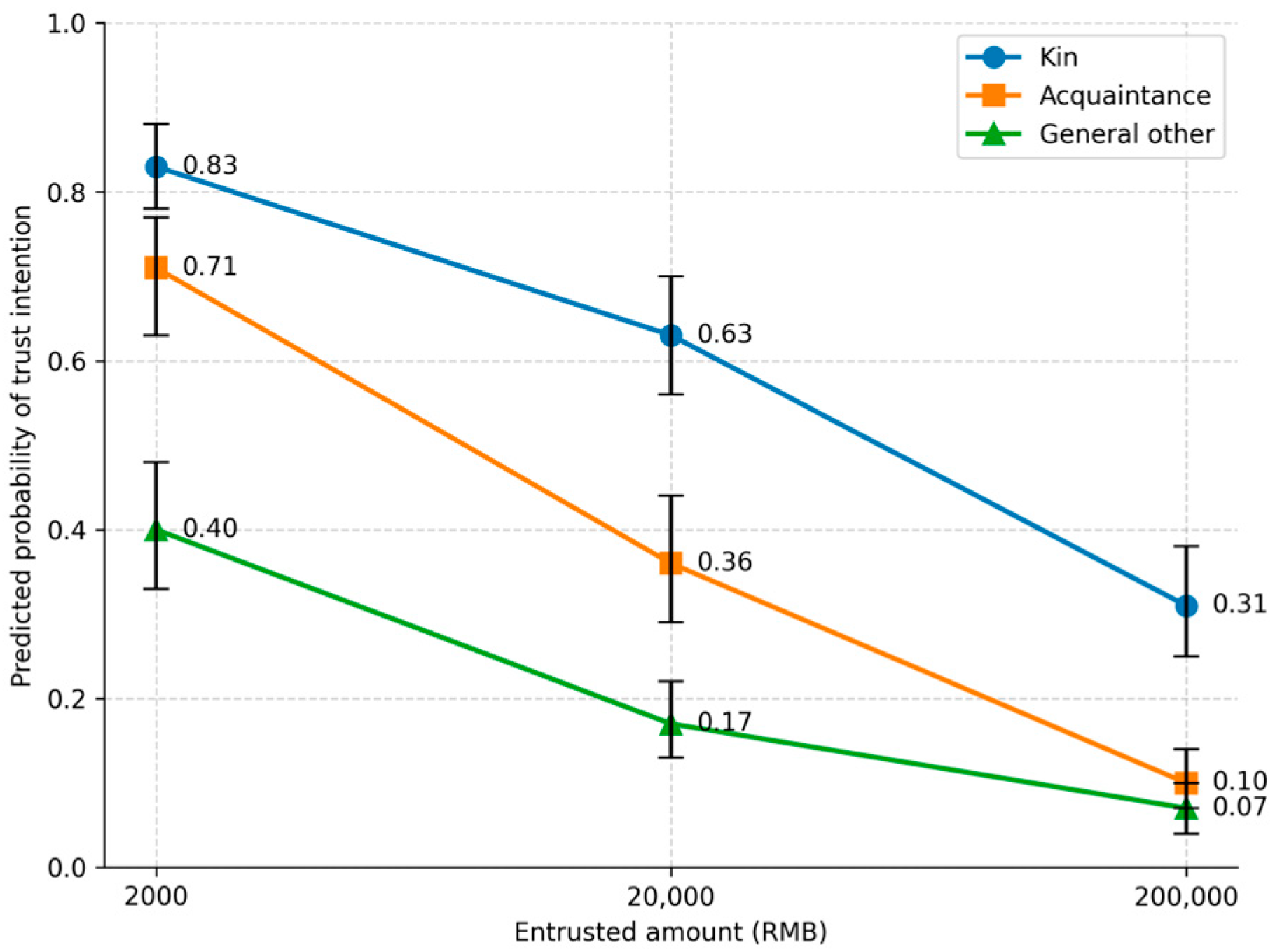
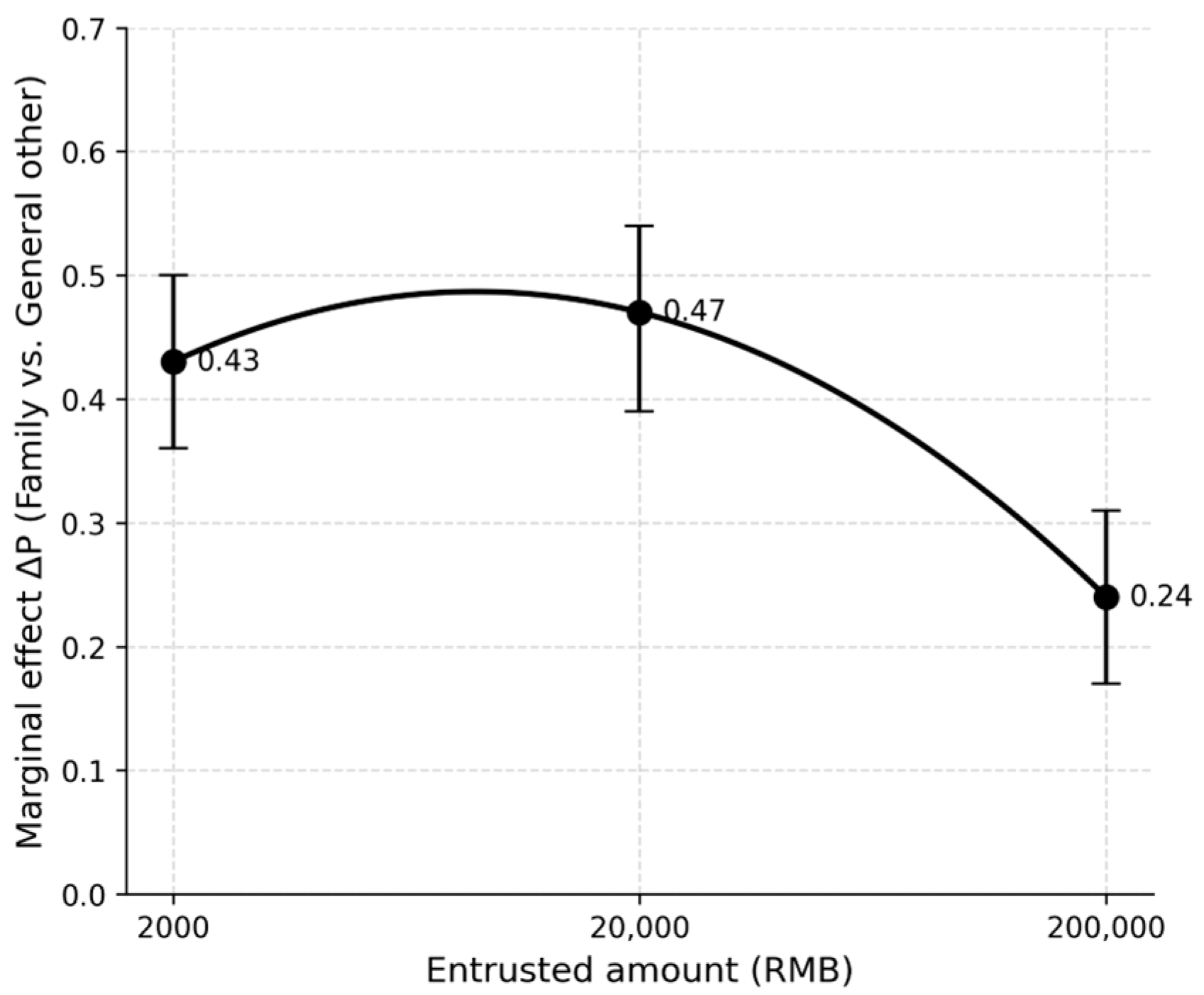
| 2000 | Kin | 0.83 [0.78, 0.88] | +0.43 [0.36, 0.50] 1 | 192.18 | <0.001 |
| Acquaintance | 0.71 [0.63, 0.77] | +0.30 [0.23, 0.37] 2 | |||
| General | 0.40 [0.33, 0.48] | — | |||
| 20,000 | Kin | 0.63 [0.56, 0.70] | +0.47 [0.39, 0.54] 1 | 225.17 | <0.001 |
| Acquaintance | 0.36 [0.29, 0.44] | +0.19 [0.14, 0.25] 2 | |||
| General | 0.17 [0.13, 0.22] | — | |||
| 200,000 | Kin | 0.31 [0.25, 0.38] | +0.24 [0.17, 0.31] 1 | 63.76 | <0.001 |
| Acquaintance | 0.10 [0.07, 0.14] | +0.04 [0.01, 0.06] 2 | |||
| General | 0.07 [0.04, 0.10] | — |
| Entrusted Matter | Trustee Attributes | Relationship | Predicted Probability M [95% CI] | Marginal Effect Δp [95% CI] | Wald | p |
|---|---|---|---|---|---|---|
| 2000 | H | Kin | 0.93 [0.89, 0.96] | +0.28 [0.20, 0.36] 1 | 71.50 | <0.001 |
| Acquaintance | 0.89 [0.84, 0.92] | +0.24 [0.16, 0.31] 2 | ||||
| General | 0.65 [0.57, 0.72] | — | ||||
| L | Kin | 0.65 [0.58, 0.72] | +0.45 [0.37, 0.54] 1 | 169.40 | <0.001 | |
| Acquaintance | 0.42 [0.34, 0.50] | +0.22 [0.14, 0.30] 2 | ||||
| General | 0.20 [0.15, 0.26] | — | ||||
| 20,000 | H | Kin | 0.86 [0.80, 0.90] | +0.57 [0.49, 0.65] 1 | 292.82 | <0.001 |
| Acquaintance | 0.71 [0.64, 0.78] | +0.43 [0.35, 0.50] 2 | ||||
| General | 0.29 [0.22, 0.36] | — | ||||
| L | Kin | 0.33 [0.26, 0.40] | +0.24 [0.16, 0.31] 1 | 57.36 | <0.001 | |
| Acquaintance | 0.12 [0.08, 0.16] | +0.02 [0.00, 0.05] 2 | ||||
| General | 0.09 [0.06, 0.14] | — | ||||
| 200,000 | H | Kin | 0.53 [0.45, 0.61] | +0.46 [0.36, 0.55] 1 | 131.64 | <0.001 |
| Acquaintance | 0.18 [0.13, 0.24] | +0.10 [0.05, 0.16] 2 | ||||
| General | 0.08 [0.05, 0.12] | — | ||||
| L | Kin | 0.15 [0.11, 0.21] | +0.09 [0.03, 0.15] 1 | 17.19 | <0.001 | |
| Acquaintance | 0.06 [0.03, 0.09] | +0.00 [−0.03, 0.02] 2 | ||||
| General | 0.06 [0.04, 0.10] | — |
Disclaimer/Publisher’s Note: The statements, opinions and data contained in all publications are solely those of the individual author(s) and contributor(s) and not of MDPI and/or the editor(s). MDPI and/or the editor(s) disclaim responsibility for any injury to people or property resulting from any ideas, methods, instructions or products referred to in the content. |
© 2026 by the authors. Licensee MDPI, Basel, Switzerland. This article is an open access article distributed under the terms and conditions of the Creative Commons Attribution (CC BY) license.
Share and Cite
Guo, J.; Liu, J. Trust in Context: A Three-Factor Experimental Study. Behav. Sci. 2026, 16, 1001. https://doi.org/10.3390/bs16061001
Guo J, Liu J. Trust in Context: A Three-Factor Experimental Study. Behavioral Sciences. 2026; 16(6):1001. https://doi.org/10.3390/bs16061001
Chicago/Turabian StyleGuo, Jiayin, and Jun Liu. 2026. "Trust in Context: A Three-Factor Experimental Study" Behavioral Sciences 16, no. 6: 1001. https://doi.org/10.3390/bs16061001
APA StyleGuo, J., & Liu, J. (2026). Trust in Context: A Three-Factor Experimental Study. Behavioral Sciences, 16(6), 1001. https://doi.org/10.3390/bs16061001