


The Prospective Indirect Effect of Mathematics Interest in the Relationship Between Mathematics Anxiety and Self-Concept: A Two-Wave Longitudinal Study

Abstract
1. Introduction
2. Literature Review
2.1. Math Anxiety
2.2. Academic Self-Concept in Mathematics
2.3. Math Interest
2.4. The Mediating Role of Math Interest
3. Method
3.1. Participants and Procedure
3.2. Measures
3.2.1. Mathematics Anxiety Scale
3.2.2. Mathematics Interest Scale
3.2.3. Academic Self-Concept Scale
3.3. Data Analysis
4. Results
4.1. Descriptive Statistics and Bivariate Correlations
4.2. Measurement Model Evaluation
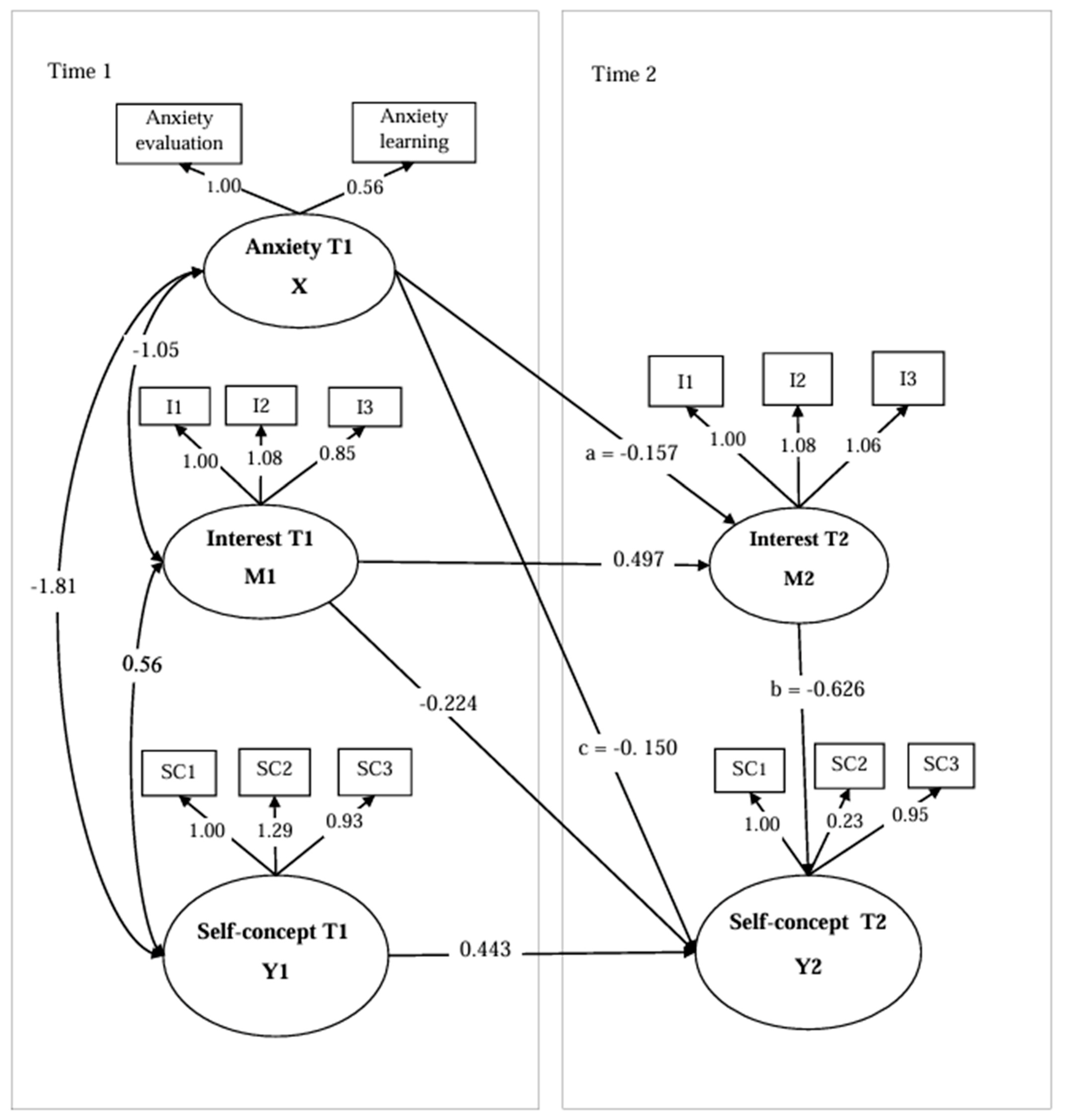
4.3. Two-Wave Cross-Lagged Panel Model
5. Discussion
5.1. Implications
5.2. Limitations and Future Research
6. Conclusions
Author Contributions
Funding
Institutional Review Board Statement
Informed Consent Statement
Data Availability Statement
Conflicts of Interest
References
- Ahmed, W. (2018). Developmental trajectories of math anxiety during adolescence: Associations with STEM career choice. Journal of Adolescence, 67(1), 158–166. [Google Scholar] [CrossRef]
- Ahmed, W., Minnaert, A., Kuyper, H., & van der Werf, G. (2012). Reciprocal relationships between math self-concept and math anxiety. Learning and Individual Differences, 22(3), 385–389. [Google Scholar] [CrossRef]
- Arens, A. K., Yeung, A. S., Craven, R. G., & Hasselhorn, M. (2011). The twofold multidimensionality of academic self-concept: Domain specificity and separation between competence and affect components. Journal of Educational Psychology, 103(4), 970–981. [Google Scholar] [CrossRef]
- Ashcraft, M. H. (2002). Math anxiety: Personal, educational, and cognitive consequences. Current Directions in Psychological Science, 11(5), 181–185. [Google Scholar] [CrossRef]
- Ashcraft, M. H., & Moore, A. M. (2009). Mathematics anxiety and the affective drop in performance. Journal of Psychoeducational Assessment, 27(3), 197–205. [Google Scholar] [CrossRef]
- Barroso, C., Ganley, C. M., McGraw, A. L., Geer, E. A., Hart, S. A., & Daucourt, M. C. (2021). A meta-analysis of the relation between math anxiety and math achievement. Psychological Bulletin, 147(2), 134–168. [Google Scholar] [CrossRef] [PubMed]
- Bong, M., & Skaalvik, E. M. (2003). Academic self-concept and self-efficacy: How different are they really? Educational Psychology Review, 15(1), 1–40. [Google Scholar] [CrossRef]
- Broda, M. D., Ross, E., Sorhagen, N., & Ekholm, E. (2023). Exploring control-value motivational profiles of mathematics anxiety, self-concept, and interest in adolescents. Frontiers in Psychology, 14, 1159588. [Google Scholar] [CrossRef]
- Brumariu, L. E., Waslin, S. M., Gastelle, M., Kochendorfer, L. B., & Kerns, K. A. (2023). Anxiety, academic achievement, and academic self-concept: Meta-analytic syntheses of their relations across developmental periods. Development and Psychopathology, 35(4), 1597–1613. [Google Scholar] [CrossRef] [PubMed]
- Carey, E., Hill, F., Devine, A., & Szűcs, D. (2017). The modified abbreviated math anxiety scale: A valid and reliable ınstrument for use with children. Frontiers in Psychology, 8, 11. [Google Scholar] [CrossRef]
- Caviola, S., Toffalini, E., Giofrè, D., Ruiz, J. M., Szűcs, D., & Mammarella, I. C. (2022). Math performance and academic anxiety forms, from sociodemographic to cognitive aspects: A meta-analysis on 906,311 participants. Educational Psychology Review, 34(1), 363–399. [Google Scholar] [CrossRef]
- Chang, H., & Beilock, S. L. (2016). The math anxiety-math performance link and its relation to individual and environmental factors: A review of current behavioral and psychophysiological research. Current Opinion in Behavioral Sciences, 10, 33–38. [Google Scholar] [CrossRef]
- Cole, D. A., & Maxwell, S. E. (2003). Testing mediational models with longitudinal data: Questions and tips in the use of structural equation modeling. Journal of Abnormal Psychology, 112(4), 558–577. [Google Scholar] [CrossRef]
- Cribbs, J., Huang, X., & Piatek-Jimenez, K. (2021). Relations of mathematics mindset, mathematics anxiety, mathematics identity, and mathematics self-efficacy to STEM career intentions: A structural equation modeling approach. School Science and Mathematics, 121(5), 275–287. [Google Scholar] [CrossRef]
- Cuder, A., Pellizzoni, S., Di Marco, M., Blason, C., Doz, E., Giofrè, D., & Passolunghi, M. C. (2024). The impact of math anxiety and self-efficacy in middle school STEM choices: A 3-year longitudinal study. British Journal of Educational Psychology, 94(4), 1091–1108. [Google Scholar] [CrossRef] [PubMed]
- Deci, E. L., & Ryan, R. M. (2000). The “what” and “why” of goal pursuits: Human needs and the self-determination of behavior. Psychological Inquiry, 11(4), 227–268. [Google Scholar] [CrossRef]
- Denissen, J. J. A., Zarrett, N. R., & Eccles, J. S. (2007). I like to do it, I’m able, and I know I am: Longitudinal couplings between domain-specific achievement, self-concept, and interest. Child Development, 78(2), 430–447. [Google Scholar] [CrossRef]
- Denner, J., Valdes, O., Dickson, D. J., & Laursen, B. (2019). Math interest and self-concept among Latino/a students: Reciprocal influences across the transition to middle school. Journal of Adolescence, 75, 22–36. [Google Scholar] [CrossRef]
- Dowker, A., Sarkar, A., & Looi, C. Y. (2016). Mathematics anxiety: What have we learned in 60 years? Frontiers in Psychology, 7, 508. [Google Scholar] [CrossRef] [PubMed]
- Eccles, J., Adler, T. F., Futterman, R., Goff, S. B., Kaczala, C. M., Meece, J. L., & Midgley, C. (1983). Expectancies, values, and academic behaviors. In J. T. Spence (Ed.), Achievement and achievement motivation (pp. 75–146). W. H. Freeman. [Google Scholar]
- Eccles, J., Wigfield, A., Harold, R. D., & Blumenfeld, P. (1993). Age and gender differences in children’s self- and task perceptions during elementary school. Child Development, 64(3), 830–847. [Google Scholar] [CrossRef]
- Forsblom, L., Pekrun, R., Loderer, K., & Peixoto, F. (2022). Cognitive appraisals, achievement emotions, and students’ math achievement: A longitudinal analysis. Journal of Educational Psychology, 114(2), 346–367. [Google Scholar] [CrossRef]
- Gogol, K., Brunner, M., Preckel, F., Goetz, T., & Martin, R. (2016). Developmental dynamics of general and school-subject-specific components of academic self-concept, academic interest, and academic anxiety. Frontiers in Psychology, 7, 356. [Google Scholar] [CrossRef]
- Gunderson, E. A., Park, D., Maloney, E. A., Beilock, S. L., & Levine, S. C. (2018). Reciprocal relations among motivational frameworks, math anxiety, and math achievement in early elementary school. Journal of Cognition and Development, 19(1), 21–46. [Google Scholar] [CrossRef]
- Hamaker, E. L., Kuiper, R. M., & Grasman, R. P. P. P. (2015). A critique of the cross-lagged panel model. Psychological Methods, 20(1), 102–116. [Google Scholar] [CrossRef]
- Hidi, S., & Renninger, K. A. (2006). The four-phase model of interest development. Educational Psychologist, 41(2), 111–127. [Google Scholar] [CrossRef]
- Hu, L.-T., & Bentler, P. M. (1999). Cutoff criteria for fit indexes in covariance structure analysis: Conventional criteria versus new alternatives. Structural Equation Modeling: A Multidisciplinary Journal, 6(1), 1–55. [Google Scholar] [CrossRef]
- Justicia-Galiano, M. J., Martín-Puga, M. E., Linares, R., & Pelegrina, S. (2017). Math anxiety and math performance in children: The mediating roles of working memory and math self-concept. The British Journal of Educational Psychology, 87(4), 573–589. [Google Scholar] [CrossRef]
- Krapp, A. (2002). Structural and dynamic aspects of interest development: Theoretical considerations from an ontogenetic perspective. Learning and Instruction, 12(4), 383–409. [Google Scholar] [CrossRef]
- Kul, Ü., Aksu, Z., & Satici, S. A. (2024). Adaptation of the modified abbreviated math anxiety scale: Its relationship with mathematics achievement and demographic variables. Current Psychology, 43, 21586–21595. [Google Scholar] [CrossRef]
- Lei, Q., Liu, D., Chen, X., Hirni, M., Wang, J., Abdelnaby, H., & Wei, S. (2025). Mathematics anxiety, trait emotional intelligence, and self-concept: Pathways to mathematics performance in students with and without mathematics learning difficulties. Journal of Research in Special Educational Needs, 25, 945–957. [Google Scholar] [CrossRef]
- Little, T. D., Cunningham, W. A., Shahar, G., & Widaman, K. F. (2002). To parcel or not to parcel: Exploring the question, weighing the merits. Structural Equation Modeling, 9(2), 151–173. [Google Scholar] [CrossRef]
- Marsh, H. W. (1986). Verbal and math self-concepts: An internal/external frame of reference model. American Educational Research Journal, 23(1), 129–149. [Google Scholar] [CrossRef]
- Marsh, H. W., & Martin, A. J. (2011). Academic self-concept and academic achievement: Relations and causal ordering. British Journal of Educational Psychology, 81(1), 59–77. [Google Scholar] [CrossRef]
- Marsh, H. W., Pekrun, R., Parker, P. D., Murayama, K., Guo, J., Dicke, T., & Arens, A. K. (2019). The murky distinction between self-concept and self-efficacy: Beware of lurking jingle-jangle fallacies. Journal of Educational Psychology, 111(2), 331–353. [Google Scholar] [CrossRef]
- Marsh, H. W., Trautwein, U., Lüdtke, O., Köller, O., & Baumert, J. (2005). Academic self-concept, interest, grades, and standardized test scores: Reciprocal effects models of causal ordering. Child Development, 76(2), 397–416. [Google Scholar] [CrossRef] [PubMed]
- Munoz, Z. A. A., Viveros, M., Barajas-Salazar, B., Tokman, M., Oka, L., Thompson, K., Rutter, E. M., Tran, K., Kim, C., de Sousa, C., Lei, Y., Almeida, M., & Menon, R. (2025). Roles of mathematics-related psychological factors in STEM sense of belonging and identity: A structural equation modeling analysis. International Journal of STEM Education, 12, 68. [Google Scholar] [CrossRef]
- Niepel, C., Marsh, H. W., Guo, J., Pekrun, R., & Möller, J. (2022). Revealing dynamic relations between mathematics self-concept and perceived achievement from lesson to lesson: An experience-sampling study. Journal of Educational Psychology, 114(6), 1380–1393. [Google Scholar] [CrossRef]
- OECD. (2003). The PISA 2003 assessment framework. OECD Publishing. [Google Scholar]
- OECD. (2013). PISA 2012 results: Ready to learn: Students’ engagement, drive and self-beliefs (Vol. III). OECD Publishing. [Google Scholar] [CrossRef]
- Paschke, P., Steinmayr, R., Mertens, A., Neubauer, A. B., & Spinath, B. (2025). Re-examination of the reciprocal relation between intrinsic motivation and competence beliefs in math using the random-intercept cross-lagged panel framework. Child Development, 96(6), 2201–2220. [Google Scholar] [CrossRef]
- Peixoto, F., Sanches, C., Mata, L., & Monteiro, V. (2017). “How do you feel about math?”: Relationships between competence and value appraisals, achievement emotions and academic achievement. European Journal of Psychology of Education, 32(3), 385–405. [Google Scholar] [CrossRef]
- Pekrun, R. (2006). The control-value theory of achievement emotions: Assumptions, corollaries, and implications for educational research and practice. Educational Psychology Review, 18(4), 315–341. [Google Scholar] [CrossRef]
- Pekrun, R. (2024). Control-value theory: From achievement emotion to a general theory of human emotions. Educational Psychology Review, 36(3), 83. [Google Scholar] [CrossRef]
- Pekrun, R., Lichtenfeld, S., Marsh, H. W., Murayama, K., & Goetz, T. (2017). Achievement emotions and academic performance: Longitudinal models of reciprocal effects. Child Development, 88(5), 1653–1670. [Google Scholar] [CrossRef] [PubMed]
- Pinxten, M., Marsh, H. W., De Fraine, B., Van Den Noortgate, W., & Van Damme, J. (2014). Enjoying mathematics or feeling competent in mathematics? Reciprocal effects on mathematics achievement and perceived math effort expenditure. The British Journal of Educational Psychology, 84(1), 152–174. [Google Scholar] [CrossRef]
- Richardson, F. C., & Suinn, R. M. (1972). The mathematics anxiety rating scale: Psychometric data. Journal of Counseling Psychology, 19(6), 551–554. [Google Scholar] [CrossRef]
- Sakaki, M., Murayama, K., Frenzel, A. C., Goetz, T., Marsh, H. W., Lichtenfeld, S., & Pekrun, R. (2024). Developmental trajectories of achievement emotions in mathematics during adolescence. Child Development, 95(1), 276–295. [Google Scholar] [CrossRef]
- Schoenherr, J., Schukajlow, S., & Pekrun, R. (2025). Emotions in mathematics learning: A systematic review and meta-analysis. ZDM–Mathematics Education, 57, 603–620. [Google Scholar] [CrossRef]
- Schukajlow, S., Rakoczy, K., & Pekrun, R. (2023). Emotions and motivation in mathematics education: Where we are today and where we need to go. ZDM: The International Journal on Mathematics Education, 55(2), 249–267. [Google Scholar] [CrossRef]
- Van der Beek, J. P. J., Van der Ven, S. H. G., Kroesbergen, E. H., & Leseman, P. P. M. (2017). Self-concept mediates the relation between achievement and emotions in mathematics. The British Journal of Educational Psychology, 87(3), 478–495. [Google Scholar] [CrossRef] [PubMed]
- Viljaranta, J., Tolvanen, A., Aunola, K., & Nurmi, J.-E. (2014). The developmental dynamics between interest, self-concept of ability, and academic performance. Scandinavian Journal of Educational Research, 58(6), 734–756. [Google Scholar] [CrossRef]
- Wang, Z., Lukowski, S. L., Hart, S. A., Lyons, I. M., Thompson, L. A., Kovas, Y., Mazzocco, M. M. M., Plomin, R., & Petrill, S. A. (2015). Is math anxiety always bad for math learning? The role of math motivation. Psychological Science, 26(12), 1863–1876. [Google Scholar] [CrossRef] [PubMed]
- Wang, Z., Rimfeld, K., Shakeshaft, N., Schofield, K., & Malanchini, M. (2020). The longitudinal role of mathematics anxiety in mathematics development: Issues of gender differences and domain-specificity. Journal of Adolescence, 80, 220–232. [Google Scholar] [CrossRef]
- Wigfield, A., & Eccles, J. S. (2000). Expectancy-value theory of achievement motivation. Contemporary Educational Psychology, 25(1), 68–81. [Google Scholar] [CrossRef] [PubMed]
- Wu, H., Guo, Y., Yang, Y., Zhao, L., & Guo, C. (2021). A meta-analysis of the longitudinal relationship between academic self-concept and academic achievement. Educational Psychology Review, 33(4), 1749–1778. [Google Scholar] [CrossRef]
- Zhang, D., & Wang, C. (2020). The relationship between mathematics interest and mathematics achievement: Mediating roles of self-efficacy and mathematics anxiety. International Journal of Educational Research, 104, 101648. [Google Scholar] [CrossRef]
- Zhang, J., Chiu, M. M., & Lei, H. (2023). Achievement, self-concept and anxiety in mathematics and English: A three-wave cross-lagged panel study. British Journal of Educational Psychology, 93(1), 56–72. [Google Scholar] [CrossRef] [PubMed]

| Variable | 1 | 2 | 3 | 4 | 5 | 6 |
|---|---|---|---|---|---|---|
| 1. Self-Concept T1 | – | |||||
| 2. Self-Concept T2 | 0.59 ** | – | ||||
| 3. Interest T1 | 0.58 ** | 0.39 ** | – | |||
| 4. Interest T2 | 0.40 ** | 0.64 ** | 0.45 ** | – | ||
| 5. Anxiety T1 | −0.42 ** | −0.39 ** | −0.25 ** | −0.23 ** | – | |
| 6. Anxiety T2 | −0.29 ** | −0.40 ** | −0.10 * | −0.30 ** | 0.41 ** | – |
| Mean | 10.00 | 10.10 | 10.45 | 9.81 | 22.18 | 21.38 |
| SD | 2.98 | 3.02 | 3.05 | 2.97 | 7.33 | 6.75 |
| Skewness | −0.205 | −0.386 | −0.462 | −0.416 | 0.363 | 0.402 |
| Kurtosis | −0.477 | −0.248 | −0.456 | 0.019 | −0.169 | 0.506 |
| McDonald ω | 0.90 | 0.90 | 0.81 | 0.83 | 0.86 | 0.87 |
| Cronbach α | 0.89 | 0.90 | 0.81 | 0.83 | 0.81 | 0.82 |
| Guttman λ6 | 0.85 | 0.86 | 0.74 | 0.77 | 0.83 | 0.84 |
Disclaimer/Publisher’s Note: The statements, opinions and data contained in all publications are solely those of the individual author(s) and contributor(s) and not of MDPI and/or the editor(s). MDPI and/or the editor(s) disclaim responsibility for any injury to people or property resulting from any ideas, methods, instructions or products referred to in the content. |
© 2026 by the authors. Licensee MDPI, Basel, Switzerland. This article is an open access article distributed under the terms and conditions of the Creative Commons Attribution (CC BY) license.
Share and Cite
Çelik Demirci, S.; Kul, Ü.; Korkmaz, S. The Prospective Indirect Effect of Mathematics Interest in the Relationship Between Mathematics Anxiety and Self-Concept: A Two-Wave Longitudinal Study. Behav. Sci. 2026, 16, 733. https://doi.org/10.3390/bs16050733
Çelik Demirci S, Kul Ü, Korkmaz S. The Prospective Indirect Effect of Mathematics Interest in the Relationship Between Mathematics Anxiety and Self-Concept: A Two-Wave Longitudinal Study. Behavioral Sciences. 2026; 16(5):733. https://doi.org/10.3390/bs16050733
Chicago/Turabian StyleÇelik Demirci, Sedef, Ümit Kul, and Samet Korkmaz. 2026. "The Prospective Indirect Effect of Mathematics Interest in the Relationship Between Mathematics Anxiety and Self-Concept: A Two-Wave Longitudinal Study" Behavioral Sciences 16, no. 5: 733. https://doi.org/10.3390/bs16050733
APA StyleÇelik Demirci, S., Kul, Ü., & Korkmaz, S. (2026). The Prospective Indirect Effect of Mathematics Interest in the Relationship Between Mathematics Anxiety and Self-Concept: A Two-Wave Longitudinal Study. Behavioral Sciences, 16(5), 733. https://doi.org/10.3390/bs16050733

