Psychometric Properties of the Italian Food Noise Questionnaire (FNQ) for the Assessment of Intrusive Food-Related Thoughts
 ,
,  ,
,  , and
, and
Abstract
1. Introduction
2. Materials and Methods
2.1. Study Design and Procedure
2.2. Participants
2.3. Measures
2.3.1. Socio-Demographic Variables
2.3.2. Italian Food Noise Questionnaire (FNQ)
2.3.3. Food Cravings Questionnaire—Trait (FCQ-T)
2.4. Psychological Distress
2.5. Data Analyses
3. Results
3.1. Item-Level Descriptive Statistics
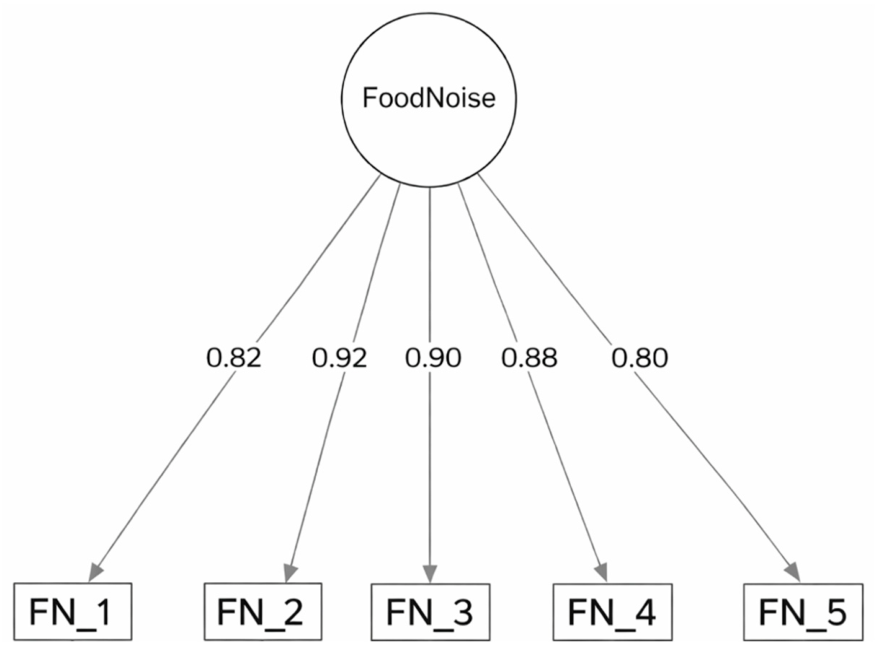
3.2. Factor Structure
3.3. Factorial Invariance Tests Across Gender
3.4. Reliability and Validity
4. Discussion
5. Conclusions
Author Contributions
Funding
Institutional Review Board Statement
Informed Consent Statement
Data Availability Statement
Conflicts of Interest
Abbreviations
| FNQ | Food Noise Questionnaire |
| BMI | Body Mass Index |
| CFA | Confirmatory Factor Analysis |
| MG-CFA | Multiple Group Confirmatory Factor Analysis |
| DWLS | Diagonally Weighted Least Squares |
| CFI | Comparative Fit Index |
| TLI | Tucker–Lewis Index |
| SRMR | Standardized Root Mean Square Residual |
| RMSEA | Root Mean Square Error of Approximation |
| FCQ-T | Food Cravings Questionnaire Trait |
| GAD-7 | Generalized Anxiety Disorder 7 |
| PHQ-9 | Patient Health Questionnaire 9 |
| PSS | Perceived Stress Scale |
| SD | Standard Deviation |
References
- Beaton, D. E., Bombardier, C., Guillemin, F., & Ferraz, M. B. (2000). Guidelines for the process of cross cultural adaptation of self report measures. Spine, 25(24), 3186–3191. [Google Scholar] [CrossRef] [Scilit]
- Boswell, R. G., & Kober, H. (2016). Food cue reactivity and craving predict eating and weight gain: A meta analytic review. Obesity Reviews, 17(2), 159–177. [Google Scholar] [CrossRef] [Scilit] [PubMed]
- Cepeda-Benito, A., Gleaves, D. H., Williams, T. L., & Erath, S. A. (2000). The development and validation of the state and trait food cravings questionnaires. Behaviour Therapy, 31(1), 151–173. [Google Scholar] [CrossRef] [Scilit]
- Chen, F. F. (2007). Sensitivity of goodness of fit indexes to lack of measurement invariance. Structural Equation Modeling, 14(3), 464–504. [Google Scholar] [CrossRef] [Scilit]
- Cheung, G. W., & Rensvold, R. B. (2002). Evaluating goodness of fit indexes for testing measurement invariance. Structural Equation Modeling, 9(2), 233–255. [Google Scholar] [CrossRef] [Scilit]
- De Vet, H. C. W., Terwee, C. B., Mokkink, L. B., & Knol, D. L. (2011). Measurement in medicine: A practical guide. Cambridge University Press. [Google Scholar]
- Dhurandhar, E. J., Maki, K. C., Dhurandhar, N. V., Kyle, T. K., Yurkow, S., Hawkins, M. A., Agley, J., Ho, E. H., Cheskin, L. J., Sørensen, T. I., Wang, X. R., & Allison, D. B. (2025). Food noise: Definition, measurement, and future research directions. Nutrition & Diabetes, 15, 30. [Google Scholar] [CrossRef] [Scilit]
- Diktas, H. E., Cardel, M. I., Foster, G. D., LeBlanc, M. M., Dickinson, S. L., Ables, E. M., Chen, X., Nathan, R., Shapiro, D., & Martin, C. K. (2025). Development and validation of the food noise questionnaire. Obesity, 33(2), 289–297. [Google Scholar] [CrossRef] [Scilit]
- Ferguson, C. J. (2009). An effect size primer: A guide for clinicians and researchers. Professional Psychology: Research and Practice, 40(5), 532–538. [Google Scholar] [CrossRef] [Scilit]
- Flora, D. B. (2020). Your coefficient alpha is probably wrong, but which coefficient omega is right? A tutorial on using R. Advances in Methods and Practices in Psychological Science, 3, 484–501. [Google Scholar] [CrossRef] [Scilit]
- Green, S. B., & Yang, Y. (2009). Reliability of summed item scores using structural equation modeling: An alternative to Cronbach’s alpha. Psychometrika, 74(1), 155–167. [Google Scholar] [CrossRef] [Scilit]
- Hair, J. F., Black, W. C., Babin, B. J., & Anderson, R. E. (2019). Multivariate data analysis (8th ed.). Cengage. [Google Scholar]
- Hayashi, D., Edwards, C., Emond, J. A., Gilbert-Diamond, D., Butt, M., Rigby, A., & Masterson, T. D. (2023). What is food noise? A conceptual model of food cue reactivity. Nutrients, 15(22), 4809. [Google Scholar] [CrossRef] [Scilit] [PubMed]
- Heymsfield, S. B., & Wadden, T. A. (2017). Mechanisms, pathophysiology, and management of obesity. New England Journal of Medicine, 376(3), 254–266. [Google Scholar] [CrossRef] [Scilit] [PubMed]
- Higgs, S. (2015). Manipulations of attention during eating and their effects on later snack intake. Appetite, 92, 287–294. [Google Scholar] [CrossRef] [Scilit] [PubMed]
- Hu, L. T., & Bentler, P. M. (1999). Cutoff criteria for fit indexes in covariance structure analysis: Conventional criteria versus new alternatives. Structural Equation Modeling, 6, 1–55. [Google Scholar] [CrossRef] [Scilit]
- Innamorati, M., Imperatori, C., Balsamo, M., Tamburello, S., Belvederi Murri, M., Contardi, A., Tamburello, A., & Fabbricatore, M. (2014). Food cravings questionnaire trait (FCQ T) discriminates between obese and overweight patients with and without binge eating tendencies: The Italian version of the FCQ T. Journal of Personality Assessment, 96(6), 632–639. [Google Scholar] [CrossRef] [Scilit]
- Kanoski, S. E., & Boutelle, K. N. (2022). Food cue reactivity: Neurobiological and behavioral underpinnings. Reviews in Endocrine and Metabolic Disorders, 23(4), 683–696. [Google Scholar] [CrossRef] [Scilit]
- Kenny, D. A., Kaniskan, B., & McCoach, D. B. (2015). The performance of RMSEA in models with small degrees of freedom. Sociological Methods & Research, 44(3), 486–507. [Google Scholar] [CrossRef] [Scilit]
- Kulis, D., Arnott, M., Greimel, E. R., Bottomley, A., & Koller, M. (2011). Trends in translation requests and arising issues regarding cultural adaptation. Expert Review of Pharmacoeconomics & Outcomes Research, 11(3), 307–314. [Google Scholar] [CrossRef] [Scilit]
- Li, C. H. (2016). The performance of ML, DWLS, and ULS estimation with robust corrections in structural equation models with ordinal variables. Psychological methods, 21(3), 369–387. [Google Scholar] [CrossRef] [Scilit]
- May, J., Andrade, J., Batey, H., Berry, L. M., & Kavanagh, D. J. (2010). Less food for thought: Impact of attentional instructions on intrusive thoughts about snack foods. Appetite, 55(2), 279–287. [Google Scholar] [CrossRef] [Scilit]
- Meredith, W. (1993). Measurement invariance, factor analysis and factorial invariance. Psychometrika, 58(4), 525–543. [Google Scholar] [CrossRef] [Scilit]
- Mondo, M., Sechi, C., & Cabras, C. (2021). Psychometric evaluation of three versions of the Italian perceived stress scale. Current Psychology, 40, 1884–1892. [Google Scholar] [CrossRef] [Scilit]
- Muthén, B., & Kaplan, D. (1985). A comparison of some methodologies for the factor analysis of non normal Likert variables. British Journal of Mathematical and Statistical Psychology, 38(2), 171–189. [Google Scholar] [CrossRef] [Scilit]
- Rosseel, Y. (2012). lavaan: An R package for structural equation modeling. Journal of Statistical Software, 48(2), 1–36. [Google Scholar] [CrossRef] [Scilit]
- Shevlin, M., Butter, S., McBride, O., Murphy, J., Gibson Miller, J., Hartman, T. K., Levita, L., Mason, L., Martinez, A. P., McKay, R., Stocks, T. V., Bennett, K. M., Hyland, P., Vallieres, F., Valiente, C., Vazquez, C., Contreras, A., Peinado, V., Trucharte, A., … Bentall, R. P. (2022). Measurement invariance of the Patient Health Questionnaire 9 (PHQ 9) and Generalized Anxiety Disorder scale (GAD 7) across four European countries during the COVID-19 pandemic. BMC Psychiatry, 22(1), 154. [Google Scholar] [CrossRef] [Scilit]
- Shi, D., DiStefano, C., Maydeu Olivares, A., & Lee, T. (2022). Evaluating SEM model fit with small degrees of freedom. Multivariate Behavioral Research, 57(2–3), 179–207. [Google Scholar] [CrossRef] [Scilit]
- Swinburn, B. A., Sacks, G., Hall, K. D., McPherson, K., Finegood, D. T., Moodie, M. L., & Gortmaker, S. L. (2011). The global obesity pandemic: Shaped by global drivers and local environments. The Lancet, 378(9793), 804–814. [Google Scholar] [CrossRef] [Scilit]
- Taasoobshirazi, G., & Wang, S. (2016). The performance of the SRMR, RMSEA, CFI, and TLI: An examination of sample size, path size, and degrees of freedom. Journal of Applied Quantitative Methods, 11(3), 31–39. [Google Scholar]
- Tapper, K., & Pothos, E. M. (2010). Development and validation of a food preoccupation questionnaire. Eating Behaviors, 11(1), 45–53. [Google Scholar] [CrossRef] [Scilit]
- Ten Kulve, J. S., Veltman, D. J., van Bloemendaal, L., Barkhof, F., Drent, M. L., Diamant, M., & IJzerman, R. G. (2016). Liraglutide reduces CNS activation in response to visual food cues only after short term treatment in patients with type 2 diabetes. Diabetes Care, 39(2), 214–221. [Google Scholar] [CrossRef] [Scilit]
- Wang, J., & Wang, X. (2019). Structural equation modeling: Applications using Mplus (2nd ed.). Wiley. [Google Scholar]
- Ward, A., & Mann, T. (2000). Don’t mind if I do: Disinhibited eating under cognitive load. Journal of Personality and Social Psychology, 78(4), 753–763. [Google Scholar] [CrossRef]
- Wild, D., Grove, A., Martin, M., Eremenco, S., McElroy, S., Verjee-Lorenz, A., & Erikson, P. (2005). Principles of good practice for the translation and cultural adaptation process for patient reported outcomes measures: Report of the ISPOR task force. Value in Health, 8(2), 94–104. [Google Scholar] [CrossRef] [Scilit]
- Zagaria, A., Cerolini, S., Mocini, E., & Lombardo, C. (2023). The relationship between internalized weight stigma and physical and mental health related quality of life in a large sample of women: A structural equation modeling analysis. Eating and Weight Disorders, 28, 52. [Google Scholar] [CrossRef] [Scilit]
- Zagaria, A., Mocini, E., Cerolini, S., Donini, L. M., Castelnuovo, G., Manzoni, G. M., Pietrabissa, G., & Lombardo, C. (2022). A validation study of the Italian version of the attitudes toward obese persons (I ATOP) questionnaire. Obesity Research & Clinical Practice, 16(3), 262–268. [Google Scholar] [CrossRef] [Scilit]


| Mean (SD) | Range | Skewness | Kurtosis | |
|---|---|---|---|---|
| 1. I find myself constantly thinking about food throughout the day | 1.779 (1.071) | 0–4 | 0.236 | −0.643 |
| 2. My thoughts about food feel uncontrollable | 1.268 (1.087) | 0–4 | 0.665 | −0.307 |
| 3. I spend too much time thinking about food | 1.579 (1.207) | 0–4 | 0.351 | −0.970 |
| 4. My thoughts about food have negative effects on me and/or my life | 1.477 (1.270) | 0–4 | 0.426 | −1.048 |
| 5. My thoughts about food distract me from what I need to do | 1.137 (1.069) | 0–4 | 0.772 | −0.201 |
| Model | χ2 (df) | CFI | TLI | SRMR | RMSEA | Model Comparison | ΔRMSEA | ΔCFI |
|---|---|---|---|---|---|---|---|---|
| 1. Configural invariance | 63.546 (10) | 0.998 | 0.996 | 0.038 | 0.099 | |||
| 2. Metric invariance | 81.583 (14) | 0.997 | 0.996 | 0.044 | 0.094 | 2 vs. 1 | 0.005 | −0.001 |
| 3. Scalar invariance | 85.064 (28) | 0.998 | 0.998 | 0.038 | 0.061 | 3 vs. 2 | −0.033 | 0.001 |
| Variable | Mean (SD) | Range | Skewness | Kurtosis |
|---|---|---|---|---|
| Food Noise (FNQ) | 7.24 (4.91) | 0–20 | 0.52 | −0.51 |
| Food-related preoccupation (FCQ-T) | 15.25 (7.52) | 7–42 | 1.15 | 0.81 |
| Depressive symptoms (PHQ-9) | 8.41 (5.23) | 0–27 | 0.93 | 0.64 |
| Anxiety symptoms (GAD-7) | 8.21 (4.88) | 0–21 | 0.74 | −0.22 |
| Perceived stress (PSS) | 19.01 (6.98) | 1–38 | 0.12 | −0.40 |
Disclaimer/Publisher’s Note: The statements, opinions and data contained in all publications are solely those of the individual author(s) and contributor(s) and not of MDPI and/or the editor(s). MDPI and/or the editor(s) disclaim responsibility for any injury to people or property resulting from any ideas, methods, instructions or products referred to in the content. |
© 2026 by the authors. Licensee MDPI, Basel, Switzerland. This article is an open access article distributed under the terms and conditions of the Creative Commons Attribution (CC BY) license.
Share and Cite
Mocini, E.; Di Vincenzo, O.; D’angelo, C.; Baldari, C.; Migliaccio, S.; Zagaria, A. Psychometric Properties of the Italian Food Noise Questionnaire (FNQ) for the Assessment of Intrusive Food-Related Thoughts. Behav. Sci. 2026, 16, 609. https://doi.org/10.3390/bs16040609
Mocini E, Di Vincenzo O, D’angelo C, Baldari C, Migliaccio S, Zagaria A. Psychometric Properties of the Italian Food Noise Questionnaire (FNQ) for the Assessment of Intrusive Food-Related Thoughts. Behavioral Sciences. 2026; 16(4):609. https://doi.org/10.3390/bs16040609
Chicago/Turabian StyleMocini, Edoardo, Olivia Di Vincenzo, Clarissa D’angelo, Carlo Baldari, Silvia Migliaccio, and Andrea Zagaria. 2026. "Psychometric Properties of the Italian Food Noise Questionnaire (FNQ) for the Assessment of Intrusive Food-Related Thoughts" Behavioral Sciences 16, no. 4: 609. https://doi.org/10.3390/bs16040609
APA StyleMocini, E., Di Vincenzo, O., D’angelo, C., Baldari, C., Migliaccio, S., & Zagaria, A. (2026). Psychometric Properties of the Italian Food Noise Questionnaire (FNQ) for the Assessment of Intrusive Food-Related Thoughts. Behavioral Sciences, 16(4), 609. https://doi.org/10.3390/bs16040609