Dual Pathways of Online Social Support on Sleep Quality in University Freshmen: The Suppression Effect of Psychological Resilience and the Moderating Role of Digital Literacy


Abstract
1. Introduction
1.1. Sleep Problems Among Adolescents
1.2. The Buffering Effect of Offline Social Support on Sleep
1.3. The Role of Online Social Support in Sleep Quality
1.4. The Mediating Role of Psychological Resilience
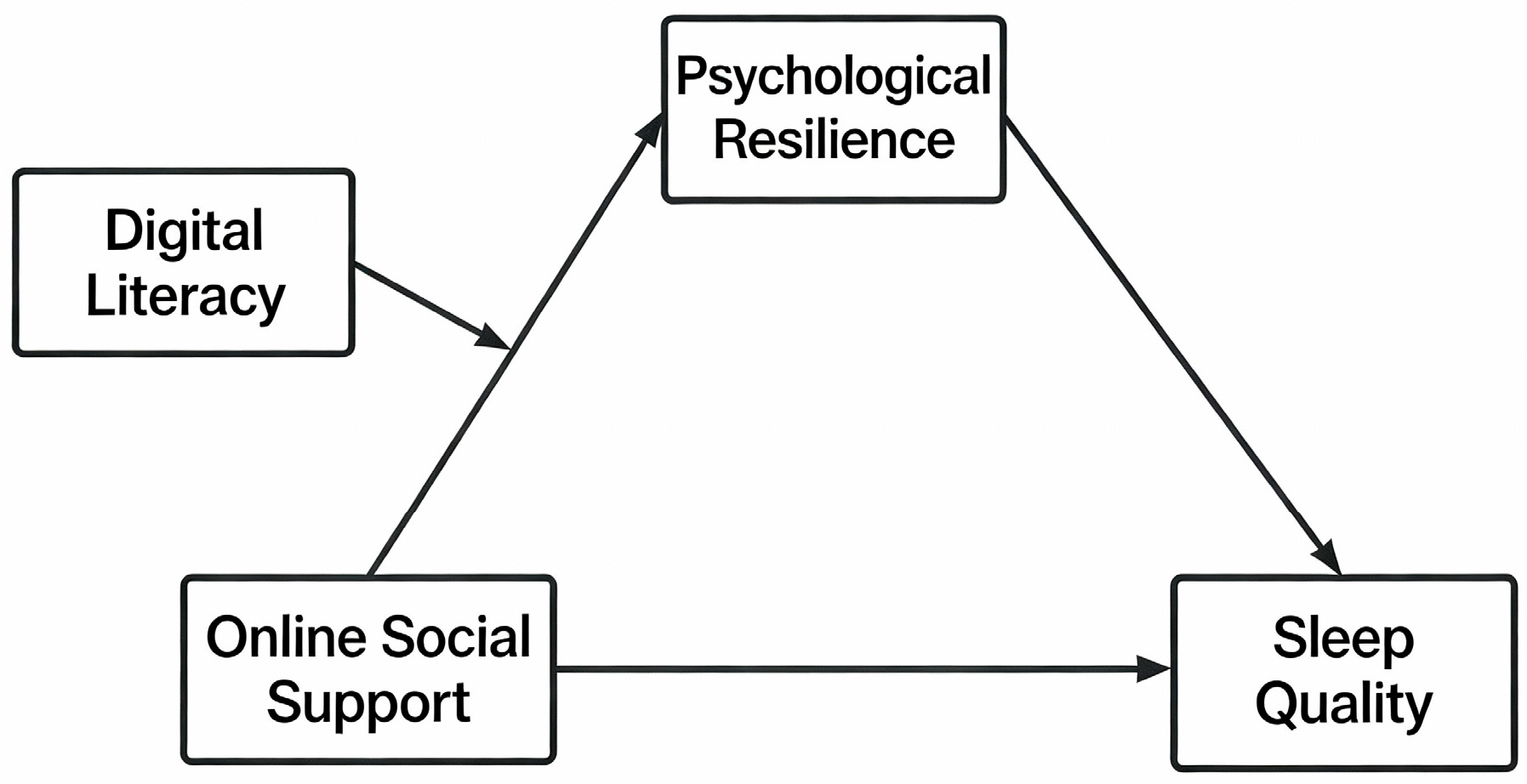
1.5. The Moderating Role of Digital Literacy
2. Materials and Methods
2.1. Research Participants
2.2. Measures
2.2.1. Online Social Support
2.2.2. Sleep Quality
2.2.3. Psychological Resilience
2.2.4. Digital Literacy
2.3. Statistical Analysis
3. Results
3.1. Common Method Bias Test
3.2. Descriptive Statistics and Correlation Analysis
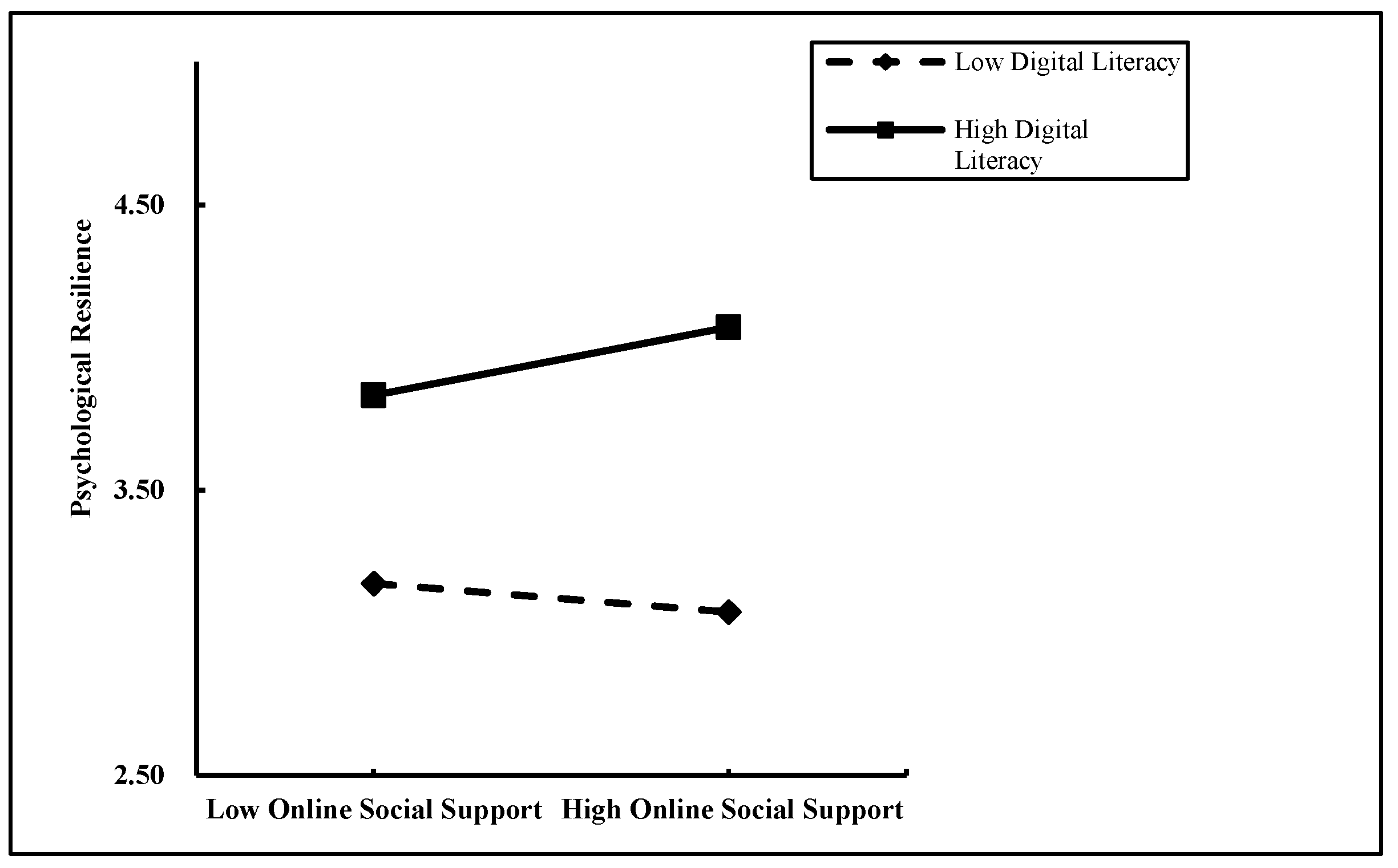
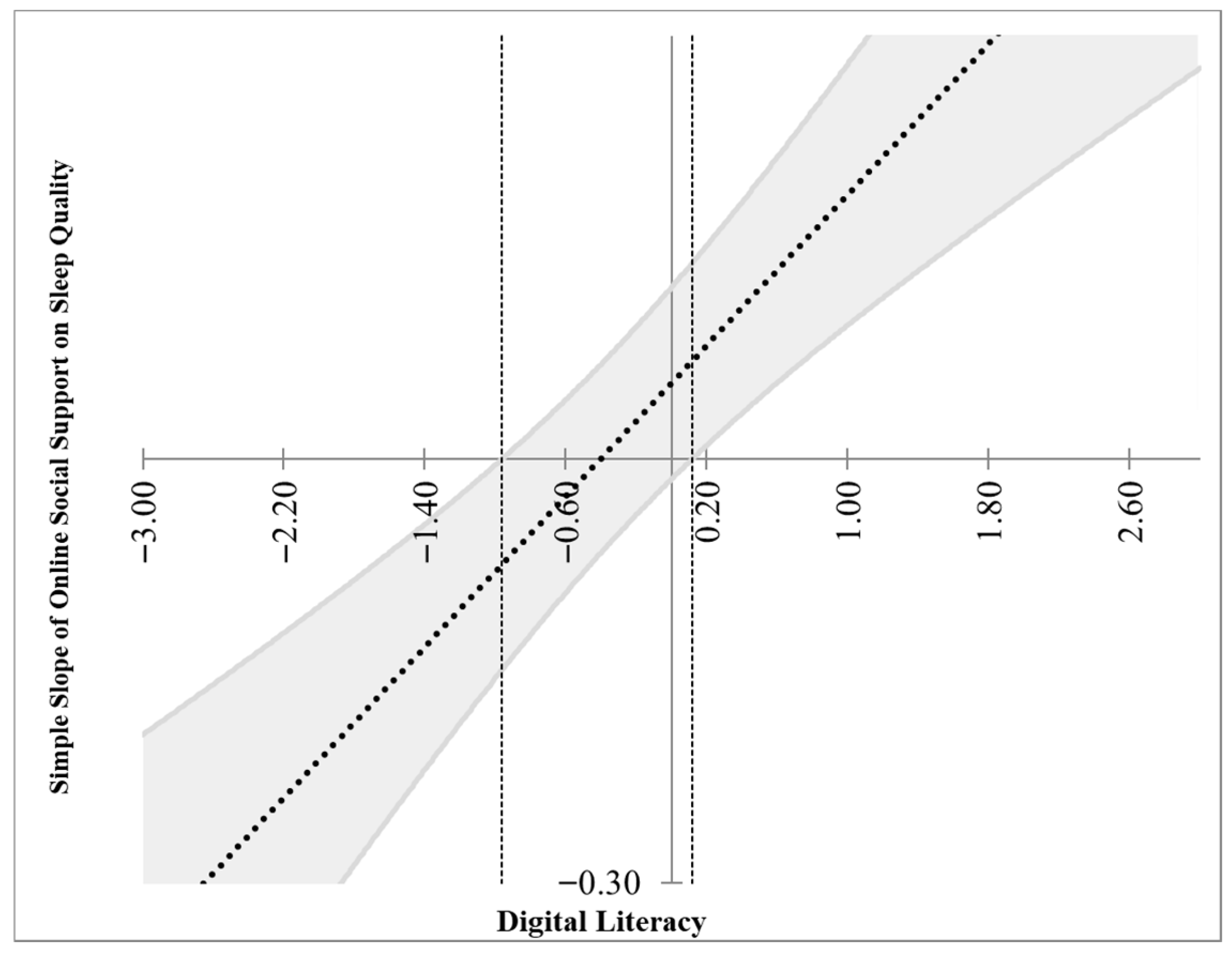
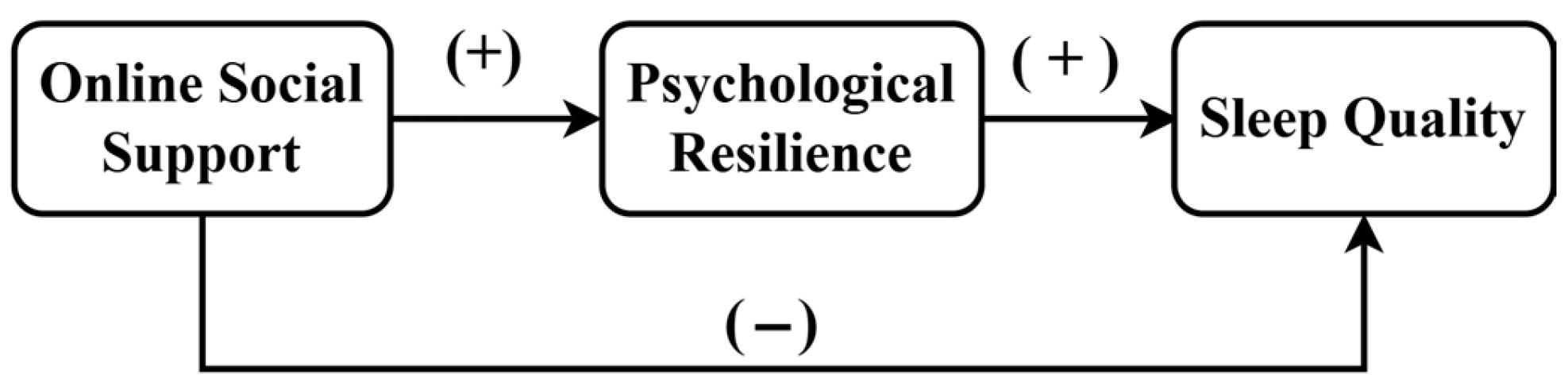
3.3. Test of the Moderated Mediation Effect
4. Discussion
4.1. The Positive Mediating Pathway of Psychological Resilience
4.2. The Direct Negative Association of Online Social Support
4.3. Theoretical Integration: The Competitive Dual-Path Model
4.4. The Protective Moderating Role of Digital Literacy
4.5. Limitations and Future Research
5. Conclusions
Author Contributions
Funding
Institutional Review Board Statement
Informed Consent Statement
Data Availability Statement
Conflicts of Interest
References
- Arora, T., Grey, I., Östlundh, L., Alamoodi, A., Omar, O. M., Hubert Lam, K. B., & Grandner, M. (2022). A systematic review and meta-analysis to assess the relationship between sleep duration/quality, mental toughness and resilience amongst healthy individuals. Sleep Medicine Reviews, 62, 101593. [Google Scholar] [CrossRef] [Scilit] [PubMed]
- Cemei, L., Sriram, S., Holý, O., & Rehman, S. (2024). A longitudinal investigation on the reciprocal relationship of problematic smartphone use with bedtime procrastination, sleep quality, and mental health among university students. Psychology Research and Behavior Management, 17, 3355–3367. [Google Scholar] [CrossRef] [Scilit] [PubMed]
- Cohen, S., & Wills, T. A. (1985). Stress, social support, and the buffering hypothesis. Psychological Bulletin, 98(2), 310–357. [Google Scholar] [CrossRef] [PubMed]
- Connor, K. M., & Davidson, J. R. (2003). Development of a new resilience scale: The Connor-Davidson Resilience Scale (CD-RISC). Depression and Anxiety, 18(2), 76–82. [Google Scholar] [CrossRef] [Scilit]
- Díaz González-Colmenero, F., Millan-Alanis, J. M., Barrera, F. J., & Saucedo-Uribe, E. (2021). Letter to the editor: “Prevalence of mental health problems among children and adolescents during the COVID-19 pandemic: A systematic review and meta-analysis”. Journal of Affective Disorders, 294, 479–480. [Google Scholar] [CrossRef] [Scilit]
- Domoff, S. E., Borgen, A. L., Rye, B., Barajas, G. R., & Avery, K. (2022). Problematic digital media use and addiction. In J. Nesi, E. H. Telzer, & M. J. Prinstein (Eds.), Handbook of adolescent digital media use and mental health (pp. 300–316). Cambridge University Press. [Google Scholar]
- European Commission: Directorate-General for Education, Youth, Sport and Culture. (2023). Digital education action plan (2021–2027). Publications Office of the European Union. [Google Scholar]
- Fang, C., & He, Y. (2022). A study on the construction of digital literacy framework for college students. Journal of Literature and Data Science, 4(2), 53–65. [Google Scholar]
- Fang, J., Zhang, M., & Qiu, H. (2012). Mediation analysis and effect size measurement: Retrospect and prospect. Psychological Development and Education, 28(1), 105–111. [Google Scholar]
- Geng, R. (2020). A study on the key influencing factors of college students’ digital literacy education in the information age. Information Science, 38(9), 42–48. [Google Scholar]
- Guo, S. R., Wu, S. W., & Feng, X. W. (2014). The influence of social support on sleep quality: Evidence from multiple mediation model. Psychological Science, 37(6), 1404–1408. [Google Scholar]
- Hayes, A. F. (2009). Beyond Baron and Kenny: Statistical mediation analysis in the new millennium. Communication Monographs, 76(4), 408–420. [Google Scholar] [CrossRef] [Scilit]
- Hobfoll, S. E. (1989). Conservation of resources. A new attempt at conceptualizing stress. The American Psychologist, 44(3), 513–524. [Google Scholar] [CrossRef] [PubMed]
- Hu, Y., & Qian, Y. (2025). Who is concerned about digitalization? The role of digital literacy and exposure across 30 countries. Information, Communication & Society, 1–19. [Google Scholar] [CrossRef] [Scilit]
- Izabel, S., Kiss, O., Krause, A., Hunt, E. T., Potter, A., Johnson, M., Dube, S. L., Allgaier, N., Garavan, H., & Goldstein-Piekarski, A. (2025). Objective sleep, internalizing symptoms, and emotion regulation in adolescents: Findings from the ABCD Study. Sleep, 48, A458. [Google Scholar] [CrossRef] [Scilit]
- Jahrami, H., BaHammam, A. S., Bragazzi, N. L., Saif, Z., Faris, M., & Vitiello, M. V. (2021). Sleep problems during the COVID-19 pandemic by population: A systematic review and meta-analysis. Journal of Clinical Sleep Medicine: JCSM: Official Publication of the American Academy of Sleep Medicine, 17(2), 299–313. [Google Scholar] [CrossRef] [Scilit]
- Kasturiratna, K. T. A. S., Hartanto, A., Chen, C. H. Y., Tong, E. M. W., & Majeed, N. M. (2025). Umbrella review of meta-analyses on the risk factors, protective factors, consequences and interventions of cyberbullying victimization. Nature Human Behaviour, 9(1), 101–132. [Google Scholar] [CrossRef] [Scilit]
- Knowles, E. A., & Danzi, B. A. (2025). The role of online social support in mental health: Comparing rural and urban youth. Children, 12(2), 113. [Google Scholar] [CrossRef] [Scilit]
- Lei, H., Huang, W., & Zhang, X. (2023). The influence of negative life events on sleep quality of junior high school students: The moderated mediating effect. Chinese Journal of Clinical Psychology, 31(4), 971–974. [Google Scholar]
- Liang, X., & Wei, L. (2008). A preliminary study of college students’ online social support testing. Psychological Science, 31(3), 689–691. [Google Scholar]
- Liu, X. C., & Tang, M. Q. (1996). Reliability and validity of the Pittsburgh sleep quality index. Chinese Journal of Psychiatry, 29(2), 29103–29107. [Google Scholar]
- MacKinnon, D. P., Krull, J. L., & Lockwood, C. M. (2000). Equivalence of the mediation, confounding and suppression effect. Prevention Science: The Official Journal of the Society for Prevention Research, 1(4), 173–181. [Google Scholar] [CrossRef] [Scilit]
- Mazza, S., Parola, S. R., Schröder, C., & Rey, A. (2024). Sommeil, cognition et apprentissage chez l’enfant et l’adolescent. Bulletin de l’Académie Nationale de Médecine, 208(7), 920–927. [Google Scholar] [CrossRef] [Scilit]
- McLean, L., Gaul, D., & Penco, R. (2023). Perceived social support and stress: A Study of 1st year students in Ireland. International Journal of Mental Health and Addiction, 21, 2101–2121. [Google Scholar] [CrossRef] [Scilit] [PubMed]
- Nor, N. F. M., Iqbal, N., & Shaari, A. H. (2025). The role of false self-presentation and social comparison in excessive social media use. Behavioral Sciences, 15(5), 675. [Google Scholar] [CrossRef] [Scilit] [PubMed]
- Podsakoff, P. M., MacKenzie, S. B., & Podsakoff, N. P. (2012). Sources of method bias in social science research and recommendations on how to control it. Annual Review of Psychology, 63, 539–569. [Google Scholar] [CrossRef] [Scilit]
- Rabiei, M., Masoumi, S. J., Haghani, M., Nematolahi, S., Rabiei, R., & Mortazavi, S. M. J. (2024). Do blue light filter applications improve sleep outcomes? A study of smartphone users’ sleep quality in an observational setting. Electromagnetic Biology and Medicine, 43(1–2), 107–116. [Google Scholar] [CrossRef] [Scilit]
- Santiago, F. L., da Silva, A. O., de Souza Silva, R. I., de Castro Melo, W. V., de Albuquerque Rodrigues Filho, E., Pirauá, A. L. T., Farah, B. Q., & Machado-Oliveira, L. (2022). Association between screen time exposure, anxiety, and sleep quality in adolescents. Salud Mental, 45(3), 125–133. [Google Scholar] [CrossRef] [Scilit]
- Sanusi, S. Y., Al-Batayneh, O. B., Khader, Y. S., & Saddki, N. (2022). The association of smartphone addiction, sleep quality and perceived stress amongst Jordanian dental students. European Journal of Dental Education: Official Journal of the Association for Dental Education in Europe, 26(1), 76–84. [Google Scholar] [CrossRef] [Scilit]
- Sechi, C., Rossi, M., & Bianchi, L. (2025). Adolescent mental health in the digital era: Social media, screen time, and digital literacy. Journal of Clinical and Developmental Psychology, 7(1), 92–115. [Google Scholar]
- Singh, R. K., Bekena, S., Zhu, Y., Trani, J. F., Briggs, A., Bubu, O. M., Lucey, B. P., Ances, B. M., Babulal, G. M., & Aging Adult Brain Connectome (AABC) Study Team. (2025). Neighborhood support as a protective factor for cognition: Associations with sleep, depression, and stress. Alzheimer’s & Dementia: The Journal of the Alzheimer’s Association, 21(11), e70940. [Google Scholar]
- Song, D., Liu, Y., Chang, L., Zhang, Q., & Li, Y. (2023). Relationship between fear of missing out and social media fatigue among 306 college students: The chain mediating role of sleep quality and negative emotions. Journal of Shandong University (Health Sciences), 61(1), 80–85. [Google Scholar]
- Sun, X., Dai, X., Yang, T., Song, H., Yang, J., Bai, J., & Zhang, L. (2014). Effects of mental resilience on neuroendocrine hormones level changes induced by sleep deprivation in servicemen. Endocrine, 47(3), 884–888. [Google Scholar] [CrossRef] [Scilit]
- Vissenberg, J., d’Haenens, L., & Livingstone, S. (2022). Digital literacy and online resilience as facilitators of young people’s well-being? A systematic review. European Psychologist, 27(2), 76–85. [Google Scholar] [CrossRef] [Scilit]
- Wang, M., Chen, Z., Han, N., & Yao, H. (2025). Sleep duration and subject-specific academic performance among adolescents in China. npj Science of Learning, 10(1), 71. [Google Scholar] [CrossRef] [Scilit]
- Wang, S., Wang, X., Yan, F., Sun, H., & Wei, S. (2025). The influence of self-presentation on social networking sites on college students’ ego identity: The longitudinal mediating role of online social support and basic psychological need satisfaction. Chinese Journal of Clinical Psychology, 33(6), 1258–1264+1283. [Google Scholar]
- Wen, Z., & Ye, B. (2014). Analyses of mediating effects: The development of methods and models. Advances in Psychological Science, 22(5), 731–745. [Google Scholar] [CrossRef] [Scilit]
- Yaghmour, K. A., Alhmyri, S. M., Alhmyri, B. M., Sharaf, R., Alasmari, M. A., & Almilabi, M. M. (2023). The effect of sleep quality and mental health on academic performance among the medical students of King Abdulaziz University. Cureus, 15(9), e44951. [Google Scholar] [CrossRef] [Scilit] [PubMed]
- Yang, Z., Zhao, X., Guo, K., Luo, J., Du, T., Zhang, Y., Hu, Y., & Yang, J. (2025). Variability in cortisol awakening response related to sleep efficiency and its relationship with trait anxiety and psychological resilience. Acta Psychologica Sinica, 57(1), 84–99. [Google Scholar] [CrossRef] [Scilit]
- Yu, X., & Zhang, J. (2005). Resilience: The psychological mechanism of recovery and growth under pressure. Advances in Psychological Science, 13(5), 658–665. [Google Scholar]
- Yu, X., & Zhang, J. (2007). A comparison between the Chinese version of ego-resiliency scale and Connor-Davidson resilience scale. Psychological Science, 30(5), 1169–1171. [Google Scholar]
- Zhang, D., Hu, X.-Q., & Liu, Q. (2021). Stress and sleep quality among undergraduate students: Chain mediating effects of rumination and resilience. Psychological Science, 44(1), 90–96. [Google Scholar]
- Zhang, S., & Liu, Z. (2022). The effect of upward social comparison on social networks on college students’ sleep quality: The roles of online social anxiety and optimistic personality. China Journal of Health Psychology, 30(11), 1728–1733. [Google Scholar]
- Zhang, Y., Huang, H., Tang, D., Lu, X., Fan, F., & Pan, J. (2023). Mechanism of online emotional support accompany group for stress: The role of social support. Frontiers in Psychology, 13, 1047364. [Google Scholar] [CrossRef] [Scilit]
- Zhao, C., & Zhang, Y. (2024). Moderated serial mediation effects of adaptation problems, academic stress, and interpersonal relationships on the sleep quality of early-year university students. Frontiers in Public Health, 12, 1476020. [Google Scholar] [CrossRef] [Scilit]
- Zhou, H., & Long, L. (2004). Statistical remedies for common method biases. Advances in Psychological Science, 12(6), 942–950. [Google Scholar]
- Zhou, M., & Zhi, H. (2023). An experimental study on the impact of perceived information overload on social media users’ willingness to disclose privacy. Journalism Bimonthly, (5), 12–28+118–119. [Google Scholar] [CrossRef]
- Zhou, Z., & Cheng, Q. (2022). Relationship between online social support and adolescents’ mental health: A systematic review and meta-analysis. Journal of Adolescence, 94(3), 281–292. [Google Scholar] [CrossRef] [Scilit]
- Zhou, Z., Cheng, Q., & Ma, Y. (2025). Adolescents’ offline and online social support: A study on latent groups and their relationship with mental health. Journal of Adolescence, 97(2), 369–382. [Google Scholar] [CrossRef] [Scilit] [PubMed]



| Variables | M ± SD | 1 | 2 | 3 | 4 |
|---|---|---|---|---|---|
| Online Social Support | 3.25 ± 0.72 | 1 | |||
| Psychological Resilience | 3.56 ± 0.63 | 0.378 ** | 1 | ||
| Digital Literacy | 3.76 ± 0.65 | 0.464 ** | 0.679 ** | 1 | |
| Sleep Quality | 4.15 ± 2.27 | 0.012 | 0.289 ** | 0.197 ** | 1 |
| Variables | Equation (1) (Dependent Variable: Sleep Quality) | Equation (2) (Dependent Variable: Psychological Resilience) | Equation (3) (Dependent Variable: Sleep Quality) | |||||||||
|---|---|---|---|---|---|---|---|---|---|---|---|---|
| β | SE | t | 95% CI | β | SE | t | 95% CI | β | SE | t | 95% CI | |
| Gender | −0.063 | 0.17 | −1.55 | [−0.58, 0.069] | −0.089 | 0.048 | −2.36 | [−0.21, −0.02] | −0.034 | 0.16 | −0.87 | [−0.45, 0.17] |
| Online Social Support | 0.008 | 0.11 | 0.2 | [−0.20, 0.24] | 0.37 | 0.032 | 9.92 *** | [0.25, 0.38] | −0.11 | 0.11 | −2.73 ** | [−0.54, −0.087] |
| Psychological Resilience | 0.33 | 0.14 | 7.81 *** | [0.79, 1.132] | ||||||||
| R2 | 0.004 | 0.15 | 0.096 | |||||||||
| F | 1.24 | 53.40 *** | 21.23 *** | |||||||||
| Effect Type | Effect Size | Boot 95% CI | BootSE | t | Conclusion | |
|---|---|---|---|---|---|---|
| LLCI | ULCI | |||||
| Indirect Effect | 0.334 | 0.082 | 0.163 | 0.021 | 15.901 | Suppression Effect |
| Direct Effect | −0.312 | −0.536 | −0.087 | 0.114 | −2.728 | |
| Total Effect | 0.022 | −0.196 | 0.241 | 0.111 | 0.202 | |
| Variables | Sleep Quality | Psychological Resilience | ||||||
|---|---|---|---|---|---|---|---|---|
| β | SE | t | 95% CI | β | SE | t | 95% CI | |
| Gender | −0.14 | 0.16 | −0.87 | [−0.45, 0.17] | −0.08 | 0.04 | −2.13 * | [−0.15, −0.01] |
| Online Social Support | −0.31 | 0.11 | −2.73 ** | [−0.54, −0.09] | −0.62 | 0.11 | −5.45 *** | [−0.84, −0.40] |
| Digital Literacy | 0.08 | 0.1 | 0.81 | [−0.11, 0.26] | ||||
| Online Social Support × Digital Literacy | 0.18 | 0.03 | 6.21 *** | [0.12, 0.23] | ||||
| Psychological Resilience | 1.05 | 0.14 | 7.81 *** | [0.79, 1.32] | ||||
| R2 | 0.1 | 0.5 | ||||||
| F | 21.23 *** | 152.07 *** | ||||||
| Digital Literacy | Effect | BootSE | BootLLCI | BootULCI |
|---|---|---|---|---|
| Low (−1 SD) | −0.071 | 0.036 | −0.148 | −0.003 |
| Medium (Mean) | 0.047 | 0.03 | −0.013 | 0.104 |
| High (+1 SD) | 0.165 | 0.043 | 0.079 | 0.247 |
Disclaimer/Publisher’s Note: The statements, opinions and data contained in all publications are solely those of the individual author(s) and contributor(s) and not of MDPI and/or the editor(s). MDPI and/or the editor(s) disclaim responsibility for any injury to people or property resulting from any ideas, methods, instructions or products referred to in the content. |
© 2026 by the authors. Licensee MDPI, Basel, Switzerland. This article is an open access article distributed under the terms and conditions of the Creative Commons Attribution (CC BY) license.
Share and Cite
Meng, X.; Feng, S. Dual Pathways of Online Social Support on Sleep Quality in University Freshmen: The Suppression Effect of Psychological Resilience and the Moderating Role of Digital Literacy. Behav. Sci. 2026, 16, 603. https://doi.org/10.3390/bs16040603
Meng X, Feng S. Dual Pathways of Online Social Support on Sleep Quality in University Freshmen: The Suppression Effect of Psychological Resilience and the Moderating Role of Digital Literacy. Behavioral Sciences. 2026; 16(4):603. https://doi.org/10.3390/bs16040603
Chicago/Turabian StyleMeng, Xiangying, and Shuidong Feng. 2026. "Dual Pathways of Online Social Support on Sleep Quality in University Freshmen: The Suppression Effect of Psychological Resilience and the Moderating Role of Digital Literacy" Behavioral Sciences 16, no. 4: 603. https://doi.org/10.3390/bs16040603
APA StyleMeng, X., & Feng, S. (2026). Dual Pathways of Online Social Support on Sleep Quality in University Freshmen: The Suppression Effect of Psychological Resilience and the Moderating Role of Digital Literacy. Behavioral Sciences, 16(4), 603. https://doi.org/10.3390/bs16040603