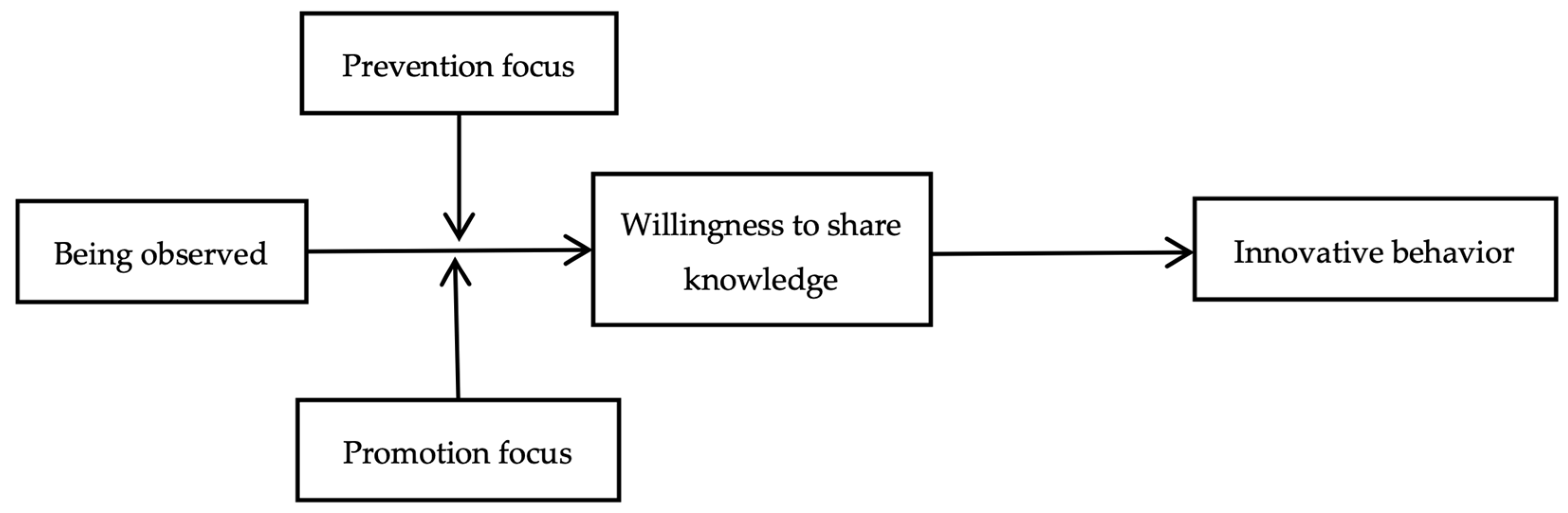
Under the Gaze: How and When Being Observed Facilitates Innovative Behavior

Abstract
1. Introduction
2. Theoretical Background and Hypotheses
2.1. Social Facilitation Theory
2.2. Being Observed and Willingness to Share Knowledge
2.3. The Mediating Role of Willingness to Share Knowledge
2.4. The Moderation Effect of Regulatory Focus

3. Study 1
3.1. Method
3.1.1. Participants and Procedure
3.1.2. Measurements
3.2. Results
3.2.1. Descriptive Statistics
3.2.2. Confirmatory Factor Analysis
3.2.3. Hypotheses Testing
3.3. Discussion
4. Study 2
4.1. Method
4.1.1. Participants and Procedure
4.1.2. Measurements
4.2. Results
4.2.1. Confirmatory Factor Analysis
4.2.2. Confirmatory Factor Analysis
4.3. Hypothesis Testing
5. Discussion
5.1. Theoretical Implications
5.2. Practical Implications
5.3. Limitations and Future Research Directions
Author Contributions
Funding
Institutional Review Board Statement
Informed Consent Statement
Data Availability Statement
Conflicts of Interest
References
- Afsar, B. (2016). The impact of person-organization fit on innovative work behavior: The mediating effect of knowledge sharing behavior. International Journal of Health Care Quality Assurance, 29(2), 104–122. [Google Scholar] [CrossRef]
- Amabile, T. M. (2018). Creativity in context: Update to the social psychology of creativity. Routledge. [Google Scholar]
- American Management Association. (2019). Electronic monitoring and surveillance survey. AMA. [Google Scholar]
- Anderson, N., Potočnik, K., & Zhou, J. (2014). Innovation and creativity in organizations: A state-of-the-science review, prospective commentary, and guiding framework. Journal of Management, 40(5), 1297–1333. [Google Scholar] [CrossRef]
- Axtell, C. M., Holman, D. J., Unsworth, K. L., Wall, T. D., Waterson, P. E., & Harrington, E. (2000). Shopfloor innovation: Facilitating the suggestion and implementation of ideas. Journal of Occupational and Organizational Psychology, 73(3), 265–285. [Google Scholar] [CrossRef]
- Babcock, P. (2004). Shedding light on knowledge management. HR Magazine, 49(5), 46–50. [Google Scholar]
- Baron, R. S. (1986). Distraction-conflict theory: Progress and problems. Advances in Experimental Social Psychology, 19, 1–40. [Google Scholar] [CrossRef]
- Bateson, M., Nettle, D., & Roberts, G. (2006). Cues of being watched enhance cooperation in a real-world setting. Biology Letters, 2(3), 412–414. [Google Scholar] [CrossRef]
- Bavik, Y. L., Tang, P. M., Shao, R., & Lam, L. W. (2018). Ethical leadership and employee knowledge sharing: Exploring dual-mediation paths. The Leadership Quarterly, 29(2), 322–332. [Google Scholar] [CrossRef]
- Bernstein, E. S. (2012). The transparency paradox: A role for privacy in organizational learning and operational control. Administrative Science Quarterly, 57(2), 181–216. [Google Scholar] [CrossRef]
- Bernstein, E. S., Blunden, H., Brodsky, A., Sohn, W., & Waber, B. (2020). The implications of working without an office. Harvard Business Review, 98(4), 58–67. [Google Scholar]
- Bhave, D. P. (2014). The invisible eye? Electronic performance monitoring and employee job performance. Personnel Psychology, 67(3), 605–635. [Google Scholar] [CrossRef]
- Bond, C. F. (1982). Social facilitation: A self-presentational view. Journal of Personality and Social Psychology, 42(6), 1042–1050. [Google Scholar] [CrossRef]
- Bond, C. F., & Titus, L. J. (1983). Social facilitation: A meta-analysis of 241 studies. Psychological Bulletin, 94(2), 265–292. [Google Scholar] [CrossRef]
- Boothby, E. J., Clark, M. S., & Bargh, J. A. (2014). Shared experiences are amplified. Psychological Science, 25(12), 2209–2216. [Google Scholar] [CrossRef]
- Brislin, R. W. (1986). The wording and translation of research instruments. In W. J. Lonner, & J. W. Berry (Eds.), Field methods in cross-cultural research (pp. 137–164). Sage. [Google Scholar]
- Brockner, J., & Higgins, E. T. (2001). Regulatory focus theory: Implications for the study of emotions at work. Organizational Behavior and Human Decision Processes, 86(1), 35–66. [Google Scholar] [CrossRef]
- Browne, M. W., & Cudeck, R. (1993). Alternative ways of assessing model fit. In K. A. Bollen, & J. S. Long (Eds.), Testing structural equation models (pp. 136–162). Sage. [Google Scholar]
- Bui, T. T., Le, C. T., Le, T. T., Phan, Q. T., & Nguyen, T. Y. N. (2025). The relationship between online knowledge sharing and employee innovation: The role of task crafting and departmental support for innovation. European Journal of Management and Business Economics. Advance online publication. [Google Scholar] [CrossRef]
- Carter, C., & Scarbrough, H. (2001). Regimes of knowledge, stories of power. Creativity and Innovation Management, 10(3), 210–220. [Google Scholar] [CrossRef]
- Carver, C. S., & Scheier, M. F. (1981). Self-consciousness and reactance. Journal of Research in Personality, 15(1), 16–29. [Google Scholar] [CrossRef]
- Chen, T., Li, F., & Leung, K. (2016). When does supervisor support encourage innovative behavior? Personnel Psychology, 69(1), 123–158. [Google Scholar] [CrossRef]
- Chib, V. S., Adachi, R., & O’Doherty, J. P. (2018). Neural substrates of social facilitation effects on incentive-based performance. Social Cognitive and Affective Neuroscience, 13(4), 391–403. [Google Scholar] [CrossRef] [PubMed]
- Claypoole, V. L., & Szalma, J. L. (2019). Electronic performance monitoring and sustained attention: Social facilitation for modern applications. Computers in Human Behavior, 94, 25–34. [Google Scholar] [CrossRef]
- Connelly, C. E., & Kelloway, E. K. (2003). Predictors of employees’ perceptions of knowledge sharing cultures. Leadership & Organization Development Journal, 24(5), 294–301. [Google Scholar] [CrossRef]
- Cottrell, N. B. (1972). Social facilitation. In C. G. McClintock (Ed.), Experimental social psychology (pp. 185–236). Holt, Rinehart & Winston. [Google Scholar]
- Davenport, T. H., & Prusak, L. (1998). Working knowledge: How organizations manage what they know. Harvard Business Press. [Google Scholar]
- Dong, Y., Bartol, K. M., Zhang, Z. X., & Li, C. (2017). Enhancing employee creativity via individual skill development and team knowledge sharing. Journal of Organizational Behavior, 38(3), 439–458. [Google Scholar] [CrossRef]
- Erez, M., & Nouri, R. (2010). Creativity: The influence of cultural, social, and work contexts. Management and Organization Review, 6(3), 351–370. [Google Scholar] [CrossRef]
- Ernest-Jones, M., Nettle, D., & Bateson, M. (2011). Effects of eye images on everyday cooperative behavior: A field experiment. Evolution and Human Behavior, 32(3), 172–178. [Google Scholar] [CrossRef]
- Haak-Saheem, W. (2016). The notion of expatriation in the United Arab Emirates. International Journal of Cross Cultural Management, 16(3), 301–320. [Google Scholar] [CrossRef]
- Haley, K. J., & Fessler, D. M. (2005). Nobody’s watching?: Subtle cues affect generosity in an anonymous economic game. Evolution and Human Behavior, 26(3), 245–256. [Google Scholar] [CrossRef]
- Harari, M. B., Reaves, A. C., & Viswesvaran, C. (2016). Creative and innovative performance: A meta-analysis. European Journal of Work and Organizational Psychology, 25(4), 495–511. [Google Scholar] [CrossRef]
- Hayes, A. F. (2017). Introduction to mediation, moderation, and conditional process analysis (2nd ed.). Guilford Publications. [Google Scholar]
- Henchy, T., & Glass, D. C. (1968). Evaluation apprehension and the social facilitation of dominant and subordinate responses. Journal of Personality and Social Psychology, 10(4), 446–454. [Google Scholar] [CrossRef]
- Higgins, E. T. (1997). Beyond pleasure and pain. American Psychologist, 52(12), 1280–1300. [Google Scholar] [CrossRef]
- Higgins, E. T. (1998). Promotion and prevention: Regulatory focus as a motivational principle. Advances in Experimental Social Psychology, 30, 1–46. [Google Scholar]
- Higgins, E. T., Friedman, R. S., Harlow, R. E., Idson, L. C., Ayduk, O. N., & Taylor, A. (2001). Achievement orientations from subjective histories of success. European Journal of Social Psychology, 31(1), 3–23. [Google Scholar] [CrossRef]
- Higgs, W. J., & Joseph, K. B. (1971). Effects of real and anticipated audiences on verbal learning. The Journal of Social Psychology, 85(1), 41–49. [Google Scholar] [CrossRef]
- Hills, P. J., Dickinson, D., Daniels, L. M., Boobyer, C. A., & Burton, R. (2019). Being observed caused physiological stress. Acta Psychologica, 196, 118–128. [Google Scholar] [CrossRef] [PubMed]
- Holland, P. J., Cooper, B., & Hecker, R. (2015). Electronic monitoring and surveillance in the workplace. International Journal of Human Resource Management, 26(18), 2335–2351. [Google Scholar] [CrossRef]
- Hu, L., & Bentler, P. M. (1999). Cutoff criteria for fit indexes in covariance structure analysis. Structural Equation Modeling, 6(1), 1–55. [Google Scholar] [CrossRef]
- Huang, J. L., Curran, P. G., Keeney, J., Poposki, E. M., & DeShon, R. P. (2012). Detecting and deterring insufficient effort responding. Journal of Business and Psychology, 27(1), 99–114. [Google Scholar] [CrossRef]
- Hughes, D. J., Lee, A., Tian, A. W., Newman, A., & Legood, A. (2018). Leadership, creativity, and innovation: A critical review. The Leadership Quarterly, 29(5), 549–569. [Google Scholar] [CrossRef]
- Ipe, M. (2003). Knowledge sharing in organizations: A conceptual framework. Human Resource Development Review, 2(4), 337–359. [Google Scholar] [CrossRef]
- Janssen, O. (2000). Job demands, perceptions of effort–reward fairness and innovative work behaviour. Journal of Occupational and Organizational Psychology, 73(3), 287–302. [Google Scholar] [CrossRef]
- Janssen, O., & Van Yperen, N. W. (2004). Employees’ goal orientations. Academy of Management Journal, 47(3), 368–384. [Google Scholar] [CrossRef]
- Keller, J., & Pfattheicher, S. (2011). Vigilant self-regulation, cues of being watched and cooperativeness. European Journal of Personality, 25(5), 363–372. [Google Scholar] [CrossRef]
- Kessler, L., Hewig, J., Weichold, K., Silbereisen, R. K., & Miltner, W. H. (2017). Feedback negativity and decision-making behavior. Psychophysiology, 54(2), 260–269. [Google Scholar] [CrossRef]
- Khan, A. N., Soomro, M. A., & Pitafi, A. H. (2025). AI in the workplace: Driving employee performance through enhanced knowledge sharing and work engagement. International Journal of Human-Computer Interaction, 41(17). [Google Scholar] [CrossRef]
- Kim, W., & Lee, J. (2013). The effect of knowledge sharing on innovative behavior. Journal of Knowledge Management, 17(6), 902–917. [Google Scholar]
- Lanaj, K., Chang, C. H., & Johnson, R. E. (2012). Regulatory focus and work-related outcomes. Psychological Bulletin, 138(5), 998–1034. [Google Scholar] [CrossRef]
- Lim, V. K. G. (2002). The IT way of loafing on the job. Journal of Organizational Behavior, 23(5), 675–694. [Google Scholar] [CrossRef]
- Lockwood, P., Jordan, C. H., & Kunda, Z. (2002). Motivation by positive or negative role models. Journal of Personality and Social Psychology, 83(4), 854–864. [Google Scholar] [CrossRef]
- Lu, L., Lin, X., & Leung, K. (2012). Goal orientation and innovative performance. Journal of Applied Social Psychology, 42, E180–E197. [Google Scholar] [CrossRef]
- Markus, H. R. (1978). The effect of mere presence on social facilitation. Journal of Experimental Social Psychology, 14(4), 389–397. [Google Scholar] [CrossRef]
- Markus, H. R., & Kitayama, S. (1991). Culture and the self. Psychological Review, 98(2), 224–253. [Google Scholar] [CrossRef]
- McNall, L. A., & Roch, S. G. (2009). A social exchange model of employee reactions to electronic performance monitoring. Human Performance, 22(3), 204–224. [Google Scholar] [CrossRef]
- Meade, A. W., & Craig, S. B. (2012). Identifying careless responses in survey data. Psychological Methods, 17(3), 437–455. [Google Scholar] [CrossRef] [PubMed]
- Mullen, B., Bryant, B., & Driskell, J. E. (1997). Presence of others and arousal. Group Dynamics, 1(1), 52–64. [Google Scholar] [CrossRef]
- Mumford, M. D., Scott, G. M., Gaddis, B., & Strange, J. M. (2002). Leading creative people. The Leadership Quarterly, 13(6), 705–750. [Google Scholar] [CrossRef]
- Mumm, J., & Mutlu, B. (2011). Designing motivational agents. Computers in Human Behavior, 27(5), 1643–1650. [Google Scholar] [CrossRef]
- Ng, T. W., Feldman, D. C., & Lam, S. S. (2010). Psychological contract breaches and innovation-related behaviors. Journal of Applied Psychology, 95(4), 744–751. [Google Scholar] [CrossRef]
- Pfattheicher, S. (2015). A regulatory focus perspective on reputational concerns. Motivation and Emotion, 39(6), 932–942. [Google Scholar] [CrossRef]
- Pfattheicher, S., & Keller, J. (2015). The watching eyes phenomenon. European Journal of Social Psychology, 45(5), 560–566. [Google Scholar] [CrossRef]
- Ravid, D. M., Tomczak, D. L., White, J. C., & Behrend, T. S. (2020). EPM 20/20: A review, framework, and research agenda for electronic performance monitoring. Journal of Management, 46(1), 100–126. [Google Scholar] [CrossRef]
- Ravid, D. M., White, J. C., Tomczak, D. L., Miles, A. F., & Behrend, T. S. (2023). A meta-analysis of the effects of electronic performance monitoring on work outcomes. Personnel Psychology, 76(1), 5–40. [Google Scholar] [CrossRef]
- Rigdon, M., Ishii, K., Watabe, M., & Kitayama, S. (2009). Minimal social cues in the dictator game. Journal of Economic Psychology, 30(3), 358–367. [Google Scholar] [CrossRef]
- Schnuerch, R., & Gibbons, H. (2021). Social attention and social facilitation. Social Cognition, 39(3), 340–358. [Google Scholar]
- Schnuerch, R., & Pfattheicher, S. (2018). Motivated malleability. Social Neuroscience, 13(4), 480–494. [Google Scholar] [CrossRef]
- Schuh, S. C., Zhang, X. A., Morgeson, F. P., Tian, P., & van Dick, R. (2018). Are you really doing good things in your boss’s eyes? Human Resource Management, 57(1), 397–409. [Google Scholar] [CrossRef]
- Scott, S. G., & Bruce, R. A. (1994). Determinants of innovative behavior. Academy of Management Journal, 37(3), 580–607. [Google Scholar] [CrossRef]
- Shalley, C. E., & Perry-Smith, J. E. (2001). Effects of social-psychological factors on creative performance. Organizational Behavior and Human Decision Processes, 84(1), 1–22. [Google Scholar] [CrossRef]
- Shalley, C. E., Zhou, J., & Oldham, G. R. (2004). The effects of personal and contextual characteristics on creativity. Journal of Management, 30(6), 933–958. [Google Scholar] [CrossRef]
- Shteynberg, G., Bramlett, J. M., Fles, E. H., & Cameron, J. (2016). The broadcast of shared attention. Journal of Personality and Social Psychology, 111(5), 665–673. [Google Scholar] [CrossRef]
- Silvia, P. J., & Phillips, A. G. (2004). Self-awareness, self-evaluation, and creativity. Personality and Social Psychology Bulletin, 30(8), 1009–1017. [Google Scholar] [CrossRef] [PubMed]
- Stanton, J. M. (2000). Reactions to employee performance monitoring. Human Performance, 13(1), 85–113. [Google Scholar] [CrossRef]
- Steinmetz, J., & Pfattheicher, S. (2017). Beyond social facilitation: A review of the far-reaching effects of social attention. Social Cognition, 35(5), 585–599. [Google Scholar] [CrossRef]
- Steinmetz, J., Xu, Q., Fishbach, A., & Zhang, Y. (2016). Being observed magnifies action. Journal of Personality and Social Psychology, 111(6), 852–865. [Google Scholar] [CrossRef]
- Triplett, N. (1898). The dynamogenic factors in pacemaking and competition. American Journal of Psychology, 9(4), 507–533. [Google Scholar] [CrossRef]
- Tursunbayeva, A., Pagliari, C., Di Lauro, S., & Antonelli, G. (2022). The ethics of people analytics. Personnel Review, 51(3), 900–921. [Google Scholar] [CrossRef]
- Uziel, L. (2007). Individual differences in the social facilitation effect. Journal of Research in Personality, 41(3), 579–601. [Google Scholar] [CrossRef]
- Voelpel, S. C., Dous, M., & Davenport, T. H. (2005). Five steps to creating a global knowledge-sharing system. Academy of Management Perspectives, 19(2), 9–23. [Google Scholar] [CrossRef]
- Wang, J., Yang, J., & Xue, Y. (2017). Subjective well-being, knowledge sharing and individual innovation behavior. Leadership & Organization Development Journal, 38(8), 1110–1127. [Google Scholar] [CrossRef]
- Wang, S., & Noe, R. A. (2010). Knowledge sharing: A review and directions for future research. Human Resource Management Review, 20(2), 115–131. [Google Scholar] [CrossRef]
- Wicklund, R. A., & Duval, S. (1971). Opinion change and performance facilitation. Journal of Experimental Social Psychology, 7(3), 319–342. [Google Scholar] [CrossRef]
- Yam, K. C., Bigman, Y. E., Tang, P. M., Ilies, R., De Cremer, D., Soh, H., & Gray, K. (2023). Robots at work: People prefer—And forgive—Service robots with perceived feelings. Journal of Applied Psychology, 108(2), 213–228. [Google Scholar] [CrossRef]
- Youssef, M., Haak-Saheem, W., & Youssef, E. M. (2017). A structural equation model for knowledge sharing behavior. Journal of Knowledge Management, 21(4), 925–945. [Google Scholar] [CrossRef]
- Yu, C., Yu, T. F., & Yu, C. C. (2013). Knowledge sharing, organizational climate, and innovative behavior. Social Behavior and Personality, 41(1), 143–156. [Google Scholar] [CrossRef]
- Yuan, F., & Woodman, R. W. (2010). Innovative behavior in the workplace. Academy of Management Journal, 53(2), 323–342. [Google Scholar] [CrossRef]
- Zajonc, R. B. (1965). Social facilitation. Science, 149(3681), 269–274. [Google Scholar] [CrossRef] [PubMed]
- Zajonc, R. B., Heingartner, A., & Herman, E. M. (1969). Social enhancement and impairment of performance in the cockroach. Journal of Personality and Social Psychology, 13(2), 83–92. [Google Scholar] [CrossRef]
- Zhou, J., & Hoever, I. J. (2014). Research on workplace creativity: A review and redirection. Annual Review of Organizational Psychology and Organizational Behavior, 1(1), 333–359. [Google Scholar] [CrossRef]

| Mean | SD | 1 | 2 | 3 | 4 | 5 | 6 | |
|---|---|---|---|---|---|---|---|---|
| 1. Gender | 0.87 | 0.70 | ||||||
| 2. Age | 2.15 | 0.62 | −0.07 | |||||
| 3. Education | 2.54 | 0.69 | 0.16 * | −0.32 ** | ||||
| 4. Work tenure | 3.43 | 1.10 | 0.30 ** | 0.35 ** | −0.10 | |||
| 5. Being observed | 0.48 | 0.50 | −0.01 | −0.11 | 0.02 | −0.59 ** | ||
| 6. Knowledge sharing | 3.83 | 0.72 | −0.23 ** | −0.03 | −0.02 | −0.14 * | 0.18 ** | |
| 7. Innovative behavior | 3.62 | 0.66 | −0.36 ** | 0.07 | −0.06 | −0.12 | 0.30 ** | 0.45 ** |
| Models | χ2 | df | χ2/df | CFI | TLI | RMSEA |
|---|---|---|---|---|---|---|
| Five-factor model a | 69.04 | 51 | 1.35 | 0.95 | 0.92 | 0.06 |
| Four-factor model b | 83.58 | 55 | 1.55 | 0.92 | 0.88 | 0.07 |
| Three-factor model c | 121.42 | 58 | 2.09 | 0.82 | 0.76 | 0.11 |
| Two-factor model d | 126.89 | 60 | 2.11 | 0.81 | 0.75 | 0.11 |
| Single-factor model e | 231.73 | 61 | 3.79 | 0.51 | 0.38 | 0.17 |
| Variable | Mean | SD | 1 | 2 | 3 | 4 | 5 | 6 | 7 | 8 |
|---|---|---|---|---|---|---|---|---|---|---|
| 1. Gender | 0.46 | 0.50 | ||||||||
| 2. Age | 2.03 | 0.75 | −0.027 ** | |||||||
| 3. Education | 2.52 | 0.70 | 0.24 * | −0.42 ** | ||||||
| 4. Tenure | 2.83 | 1.09 | −0.36 ** | 0.51 ** | −0.31 ** | |||||
| 5. Being Observed | 3.86 | 0.44 | −0.14 | 0.15 | −0.13 | 0.08 | ||||
| 6. Willingness to share knowledge | 4.11 | 0.28 | −0.07 | −0.04 | −0.04 | −0.04 | 0.27 ** | |||
| 7. Innovative behavior | 3.78 | 0.44 | −0.11 | 0.21 * | −0.08 | 0.05 | 0.29 ** | 0.32 ** | ||
| 8. Prevention focus | 4.66 | 0.80 | −0.10 | 0.10 | −0.08 | −0.08 | 0.02 | 0.06 | 0.04 | |
| 9. Promotion focus | 5.18 | 0.77 | −0.10 | −0.01 | 0.12 | −0.13 | −0.06 | −0.06 | 0.10 | 0.40 ** |
| Variables | Willingness to Share Knowledge | Innovative Behavior | |||||||
|---|---|---|---|---|---|---|---|---|---|
| M1 | M2 | M3 | M4 | M5 | M6 | M7 | M8 | M9 | |
| Gender | −0.09 | −0.06 | −0.05 | −0.07 | −0.08 | −0.05 | −0.04 | −0.03 | −0.01 |
| Age | −0.06 | −0.09 | −0.14 | −0.04 | 0.24 | 0.22 | 0.24 | 0.17 | 0.26 |
| Education | −0.06 | −0.04 | −0.09 | −0.02 | 0.01 | 0.03 | 0.04 | −0.03 | 0.03 |
| Tenure | −0.06 | −0.05 | −0.02 | −0.10 | −0.10 | −0.09 | −0.08 | −0.07 | −0.09 |
| Being observed | 0.27 ** | 0.20 * | 0.21 * | 0.26 ** | 0.19 + | 0.13 | 0.14 | ||
| Willingness to share knowledge | 0.28 ** | 0.15 | 0.24 * | ||||||
| Prevention focus | 0.01 | −0.06 | |||||||
| Promotion focus | 0.03 | 0.20 * | |||||||
| Being observed × Prevention focus | 0.32 ** | 0.39 ** | |||||||
| Being observed × Promotion focus | −0.24 * | −0.24 * | |||||||
| R2 | 0.01 | 0.08 | 0.18 | 0.13 | 0.05 | 0.12 | 0.19 | 0.32 | 0.25 |
| △R2 | 0.01 | 0.07 ** | 0.10 ** | 0.05 + | 0.05 | 0.07 ** | 0.07 ** | 0.13 ** | 0.06 * |
| Moderator | Level | Effect | SE | 95% CI |
|---|---|---|---|---|
| Prevention focus | Low | −0.01 | 0.03 | [−0.09, 0.04] |
| High | 0.14 | 0.07 | [0.02, 0.27] | |
| Index of moderated mediation | 0.10 | 0.05 | [0.01, 0.22] | |
| Promotion focus | Low | 0.12 | 0.06 | [−0.01, 0.24] |
| High | −0.01 | 0.06 | [−0.12, 0.10] | |
| Index of moderated mediation | −0.10 | 0.08 | [−0.55, 0.05] |
Disclaimer/Publisher’s Note: The statements, opinions and data contained in all publications are solely those of the individual author(s) and contributor(s) and not of MDPI and/or the editor(s). MDPI and/or the editor(s) disclaim responsibility for any injury to people or property resulting from any ideas, methods, instructions or products referred to in the content. |
© 2026 by the authors. Licensee MDPI, Basel, Switzerland. This article is an open access article distributed under the terms and conditions of the Creative Commons Attribution (CC BY) license.
Share and Cite
Zhang, X.; Tian, G.; Liang, L.; Tian, Y.; Li, Z. Under the Gaze: How and When Being Observed Facilitates Innovative Behavior. Behav. Sci. 2026, 16, 532. https://doi.org/10.3390/bs16040532
Zhang X, Tian G, Liang L, Tian Y, Li Z. Under the Gaze: How and When Being Observed Facilitates Innovative Behavior. Behavioral Sciences. 2026; 16(4):532. https://doi.org/10.3390/bs16040532
Chicago/Turabian StyleZhang, Xue, Guyang Tian, Liang Liang, Yezhuang Tian, and Zhongqiu Li. 2026. "Under the Gaze: How and When Being Observed Facilitates Innovative Behavior" Behavioral Sciences 16, no. 4: 532. https://doi.org/10.3390/bs16040532
APA StyleZhang, X., Tian, G., Liang, L., Tian, Y., & Li, Z. (2026). Under the Gaze: How and When Being Observed Facilitates Innovative Behavior. Behavioral Sciences, 16(4), 532. https://doi.org/10.3390/bs16040532