Authentic Emotional Displays and Job Burnout Among Preschool Teachers: A Chain Mediation Model of Psychological Capital and Family–Work Conflict

Abstract
1. Introduction
1.1. The Relationship Between Authentic Emotional Displays and Job Burnout
1.2. The Mediating Role of Psychological Capital Between Authentic Emotional Displays and Job Burnout
1.3. The Mediating Role of Family–Work Conflict Between Authentic Expressional Displays and Job Burnout
1.4. The Chain-Mediated Relationship Between Psychological Capital and Family–Work Conflict
1.5. Summary
2. Methods
2.1. Participants
2.2. Procedures
2.3. Measures
2.3.1. Authentic Emotional Displays
2.3.2. Psychological Capital
2.3.3. Work-Family Conflict
2.3.4. Teacher Burnout
2.3.5. Covariates
2.4. Analytic Strategy
3. Results
3.1. Test of Common Method Biases
3.2. Preliminary Analyses
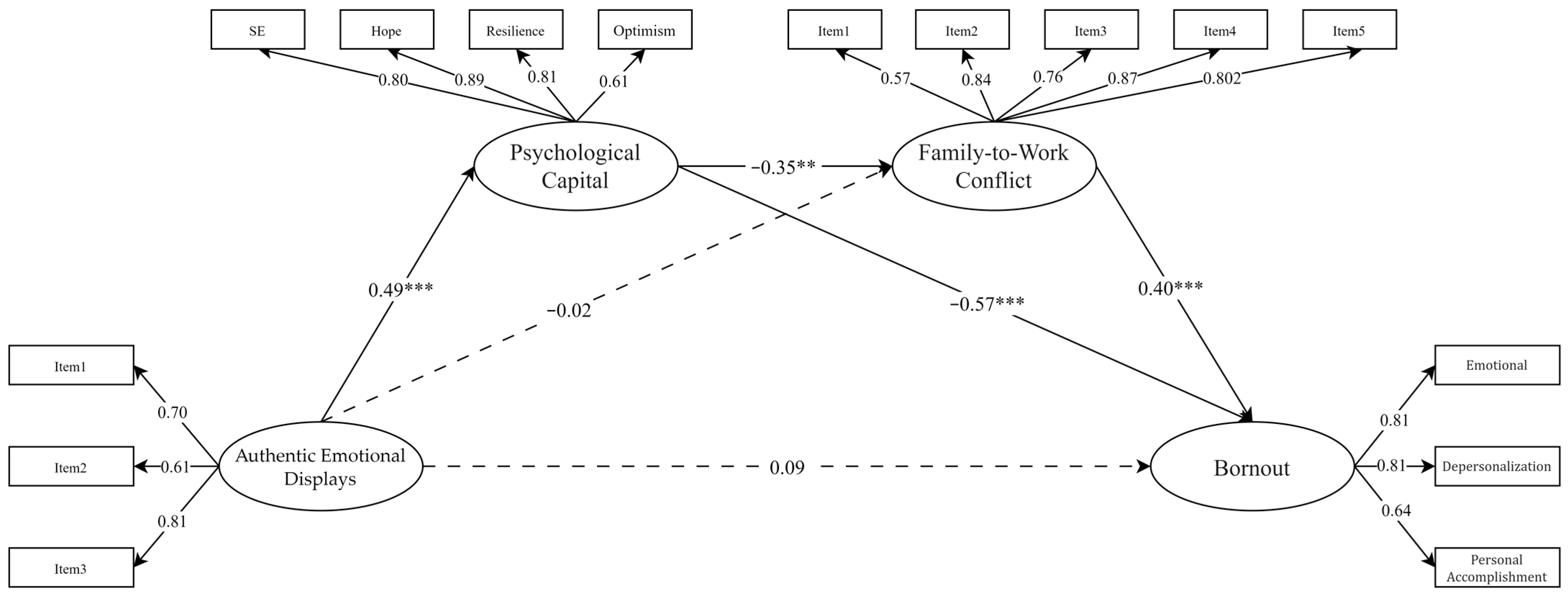
3.3. The Mediating Effect of Psychological Capital and Work-Family Conflict
4. Discussion
5. Practical Implications
6. Limitations and Future Research
7. Conclusions
Author Contributions
Funding
Institutional Review Board Statement
Informed Consent Statement
Data Availability Statement
Conflicts of Interest
References
- Aboagye, M. O., Qin, J., Qayyum, A., Antwi, C. O., Jababu, Y., & Affum-Osei, E. (2018). Teacher burnout in pre-schools: A cross-cultural factorial validity, measurement invariance and latent mean comparison of the Maslach Burnout Inventory, Educators Survey (MBI-ES). Children and Youth Services Review, 94, 186–197. [Google Scholar] [CrossRef]
- Allen, T. D., Herst, D. E., Bruck, C. S., & Sutton, M. (2000). Consequences associated with work-to-family conflict: A review and agenda for future research. Journal of Occupational Health Psychology, 5(2), 278–308. [Google Scholar] [CrossRef]
- Allen, T. D., Johnson, R. C., Saboe, K. N., Cho, E., Dumani, S., & Evans, S. (2012). Dispositional variables and work–family conflict: A meta-analysis. Journal of Vocational Behavior, 80(1), 17–26. [Google Scholar] [CrossRef]
- Aloe, A. M., Amo, L. C., & Shanahan, M. E. (2014). Classroom management self efficacy and burnout: A multivariate meta analysis. Educational Psychology Review, 26(1), 101–126. [Google Scholar] [CrossRef]
- Ashforth, B. E., & Humphrey, R. H. (1993). Emotional labor in service roles: The influence of identity. Academy of Management Review, 18(1), 88–115. [Google Scholar] [CrossRef]
- Avey, J. B., Luthans, F., Smith, R. M., & Palmer, N. F. (2010). Impact of positive psychological capital on employee well-being over time. Journal of Occupational Health Psychology, 15(1), 17–28. [Google Scholar] [CrossRef] [PubMed]
- Aw, S. S. Y., Ilies, R., & De Pater, I. E. (2020). Dispositional empathy, emotional display authenticity, and employee outcomes. Journal of Applied Psychology, 105(9), 1036–1046. [Google Scholar] [CrossRef]
- Bai, B., Ma, R., & Rehima, J. (2025). Exploring the impact of psychological capital and work family conflict on stress regulation and success in competitive athletes. Frontiers in Psychology, 16, 1566508. [Google Scholar] [CrossRef]
- Bandura, A., & Wessels, S. (1997). Self-efficacy: The exercise of control (Vol. 10). Cambridge University Press. [Google Scholar]
- Bao, X., Dong, J., & Guo, J. (2025). Family-to-work conflict and innovative work behavior among university teachers: The mediating effect of work stress and the moderating effect of gender. Behavioral Sciences, 15(10), 1309. [Google Scholar] [CrossRef] [PubMed]
- Barrick, M. R., & Mount, M. K. (1991). The big five personality dimensions and job performance: A meta-analysis. Personnel Psychology, 44(1), 1–26. [Google Scholar] [CrossRef]
- Brotheridge, C. M., & Grandey, A. A. (2002). Emotional labor and burnout: Comparing two perspectives of “people work”. Journal of Vocational Behavior, 60(1), 17–39. [Google Scholar] [CrossRef]
- Burić, I., Kim, L. E., & Hodis, F. (2021). Emotional labor profiles among teachers: Associations with positive affective, motivational, and well-being factors. Journal of Educational Psychology, 113(6), 1227–1243. [Google Scholar] [CrossRef]
- Byron, K. (2005). A meta-analytic review of work–family conflict and its antecedents. Journal of Vocational Behavior, 67(2), 169–198. [Google Scholar] [CrossRef]
- Carey, S., & Sutton, A. (2024). Early childhood teachers’ emotional labour: The role of job and personal resources in protecting well-being. Teaching and Teacher Education, 148, 104699. [Google Scholar] [CrossRef]
- Chang, M. L. (2009). An appraisal perspective of teacher burnout: Examining the emotional work of teachers. Educational Psychology Review, 21(3), 193–218. [Google Scholar] [CrossRef]
- Choi, S., & Choi, S. (2025). Authentic emotional displays and teacher well-being in early childhood education: The mediating role of affect states. Teaching and Teacher Education, 162, 105044. [Google Scholar] [CrossRef]
- Clark, S. C. (2000). Work/family border theory: A new theory of work/family balance. Human Relations, 53(6), 747–770. [Google Scholar] [CrossRef]
- Cohen, S., & Wills, T. A. (1985). Stress, social support, and the buffering hypothesis. Psychological Bulletin, 98(2), 310–357. [Google Scholar] [CrossRef]
- Cole, D. A., & Maxwell, S. E. (2003). Testing mediational models with longitudinal data: Questions and tips in the use of structural equation modeling. Journal of Abnormal Psychology, 112(4), 558–577. [Google Scholar] [CrossRef]
- Collie, R. J., Shapka, J. D., & Perry, N. E. (2012). School climate and social–emotional learning: Predicting teacher stress, job satisfaction, and teaching efficacy. Journal of Educational Psychology, 104(4), 1189–1204. [Google Scholar] [CrossRef]
- Côté, S. (2005). A social interaction model of the effects of emotion regulation on work strain. Academy of Management Review, 30(3), 509–530. [Google Scholar] [CrossRef]
- Cumming, T. (2017). Early childhood educators’ well-being: An updated review of the literature. Early Childhood Education Journal, 45(5), 583–593. [Google Scholar] [CrossRef]
- Demerouti, E., Bakker, A. B., Nachreiner, F., & Schaufeli, W. B. (2001). The job demands-resources model of burnout. The Journal of Applied Psychology, 86(3), 499–512. [Google Scholar] [CrossRef]
- Deng, H., Walter, F., Lam, C. K., & Zhao, H. H. (2017). Spillover effects of emotional labor in customer service encounters toward coworker harming: A resource depletion perspective. Personnel Psychology, 70(2), 469–502. [Google Scholar] [CrossRef]
- Diefendorff, J. M., Croyle, M. H., & Gosserand, R. H. (2005). The dimensionality and antecedents of emotional labor strategies. Journal of Vocational Behavior, 66(2), 339–357. [Google Scholar] [CrossRef]
- Edelwich, J., & Brodsky, A. (1980). Burn-out: Stages of disillusionment in the helping professions (Vol. 1). Human Sciences Press. [Google Scholar]
- Fredrickson, B. L. (2001). The role of positive emotions in positive psychology. American Psychologist, 56(3), 218–226. [Google Scholar] [CrossRef] [PubMed]
- Frone, M. R., Russell, M., & Cooper, M. L. (1992). Antecedents and outcomes of work-family conflict: Testing a model of the work-family interface. Journal of Applied Psychology, 77(1), 65–78. [Google Scholar] [CrossRef]
- Fu, C., & Li, F. (2025). The impact of work–family conflict on job and life satisfaction among construction workers: The mediating role of self-control ability. Sustainability, 17(24), 10923. [Google Scholar] [CrossRef]
- Glavin, P., & Schieman, S. (2012). Work–family role blurring and work-family conflict: The moderating influence of job resources and job demands. Work and Occupations, 39(1), 71–98. [Google Scholar] [CrossRef]
- Grandey, A., Foo, S. C., Groth, M., & Goodwin, R. E. (2012). Free to be you and me: A climate of authenticity alleviates burnout from emotional labor. Journal of Occupational Health Psychology, 17(1), 1–14. [Google Scholar] [CrossRef]
- Grandey, A. A. (2000). Emotional regulation in the workplace: A new way to conceptualize emotional labor. Journal of Occupational Health Psychology, 5(1), 95–110. [Google Scholar] [CrossRef]
- Grandey, A. A., & Gabriel, A. S. (2015). Emotional labor at a crossroads: Where do we go from here? Annual Review of Organizational Psychology and Organizational Behavior, 2(1), 323–349. [Google Scholar] [CrossRef]
- Grandey, A. A., & Melloy, R. C. (2017). The state of the heart: Emotional labor as emotion regulation reviewed and revised. Journal of Occupational Health Psychology, 22(3), 407–422. [Google Scholar] [CrossRef]
- Greenhaus, J. H., & Beutell, N. J. (1985). Sources of conflict between work and family roles. Academy of Management Review, 10(1), 76–88. [Google Scholar] [CrossRef]
- Gross, J. J. (1998). The emerging field of emotion regulation: An integrative review. Review of General Psychology, 2(3), 271–299. [Google Scholar] [CrossRef]
- Grzywacz, J. G., & Marks, N. F. (2000). Reconceptualizing the work-family interface: An ecological perspective on the correlates of positive and negative spillover between work and family. Journal of Occupational Health Psychology, 5(1), 111–126. [Google Scholar] [CrossRef]
- Hao, D. (2024). An empirical study on the relationship between emotional labor and work performance among university teachers. Frontiers in Psychology, 15, 1470436. [Google Scholar] [CrossRef] [PubMed]
- Hobfoll, S. E. (1989). Conservation of resources: A new attempt at conceptualizing stress. American Psychologist, 44(3), 513–524. [Google Scholar] [CrossRef]
- Hobfoll, S. E. (2002). Social and psychological resources and adaptation. Review of General Psychology, 6(4), 307–324. [Google Scholar] [CrossRef]
- Hochschild, A. R. (2012). The managed heart: Commercialization of human feeling. University of California Press. Available online: https://www.jstor.org/stable/10.1525/j.ctt1pn9bk (accessed on 10 March 2026).
- Hu, L. T., & Bentler, P. M. (1999). Cutoff criteria for fit indexes in covariance structure analysis: Conventional criteria versus new alternatives. Structural Equation Modeling: A Multidisciplinary Journal, 6(1), 1–55. [Google Scholar] [CrossRef]
- Jeon, L., Buettner, C. K., & Grant, A. A. (2018). Early childhood teachers’ psychological well being: Exploring potential predictors of depression, stress, and emotional exhaustion. Early Education and Development, 29(1), 53–69. [Google Scholar] [CrossRef]
- Jeung, D.-Y., Kim, C., & Chang, S.-J. (2018). Emotional labor and burnout: A review of the literature. Yonsei Medical Journal, 59(2), 187–194. [Google Scholar] [CrossRef] [PubMed]
- Johnson, T., Kulesa, P., Cho, Y. I., & Shavitt, S. (2005). The relation between culture and response styles: Evidence from 19 countries. Journal of Cross-Cultural Psychology, 36(2), 264–277. [Google Scholar] [CrossRef]
- Karatepe, O. M., & Karadas, G. (2014). The effect of psychological capital on conflicts in the work–family interface, turnover and absence intentions. International Journal of Hospitality Management, 43, 132–143. [Google Scholar] [CrossRef]
- Keller, M. M., & Becker, E. S. (2021). Teachers’ emotions and emotional authenticity: Do they matter to students’ emotional responses in the classroom? Teachers and Teaching, 27(5), 404–422. [Google Scholar] [CrossRef]
- Kernis, M. H. (2003). TARGET ARTICLE: Toward a conceptualization of optimal self-esteem. Psychological Inquiry, 14(1), 1–26. [Google Scholar] [CrossRef]
- Kernis, M. H., & Goldman, B. M. (2006). A multicomponent conceptualization of authenticity: Theory and research. Advances in Experimental Social Psychology, 38, 283–357. [Google Scholar] [CrossRef]
- Kuvaas, B., Buch, R., Weibel, A., Dysvik, A., & Nerstad, C. G. L. (2017). Do intrinsic and extrinsic motivation relate differently to employee outcomes? Journal of Economic Psychology, 61, 244–258. [Google Scholar] [CrossRef]
- Kwon, K. A., Ford, T. G., Salvatore, A. L., Randall, K., Jeon, L., Malek-Lasater, A., Ellis, N., Kile, M. S., Horm, D. M., Kim, S. G., & Han, M. (2022). Neglected elements of a high-quality early childhood workforce: Whole teacher well-being and working conditions. Early Childhood Education Journal, 50(1), 157–168. [Google Scholar] [CrossRef]
- Landa, I., & English, T. (2022). Variability in state authenticity predicts daily affect and emotion regulation. Emotion, 22(8), 1995–1999. [Google Scholar] [CrossRef]
- Lee, M., Pekrun, R., Taxer, J. L., Schutz, P. A., Vogl, E., & Xie, X. (2016). Teachers’ emotions and emotion management: Integrating emotion regulation theory with emotional labor research. Social Psychology of Education, 19(4), 843–863. [Google Scholar] [CrossRef]
- Lenton, A. P., Bruder, M., Slabu, L., & Sedikides, C. (2013). How does “being real” feel? The experience of state authenticity. Journal of Personality, 81(3), 276–289. [Google Scholar] [CrossRef] [PubMed]
- Li, H., & Liu, J. (2025). The impact of work-family support and occupational stress on burnout among university teachers: The mediating role of psychological capital. Sage Open, 15(4), 21582440251386175. [Google Scholar] [CrossRef]
- Luo, Y., Zhang, Y., Chen, J., Lu, G., Liu, J., & Chen, C. (2025). The effect of emotional labor on young nurses’ job burnout: The mediating role of social support and emotional regulation. Nursing Open, 12(12), e70388. [Google Scholar] [CrossRef]
- Luthans, F., Luthans, K. W., & Luthans, B. C. (2004). Positive psychological capital: Beyond human and social capital. Business Horizons, 47(1), 45–50. [Google Scholar] [CrossRef]
- Luthans, F., Youssef, C. M., & Avolio, B. J. (2006). Psychological capital: Developing the human competitive edge. Oxford University Press. [Google Scholar] [CrossRef]
- Marsh, H. W., Hau, K. T., & Wen, Z. (2004). In search of golden rules: Comment on hypothesis-testing approaches to setting cutoff values for fit indexes and dangers in overgeneralizing Hu and Bentler’s (1999) findings. Structural Equation Modeling, 11(3), 320–341. [Google Scholar] [CrossRef]
- Maslach, C., & Jackson, S. E. (1981). The measurement of experienced burnout. Journal of Organizational Behavior, 2(2), 99–113. [Google Scholar] [CrossRef]
- Maslach, C., & Leiter, M. P. (2016). Understanding the burnout experience: Recent research and its implications for psychiatry. World Psychiatry, 15(2), 103–111. [Google Scholar] [CrossRef]
- Maslach, C., Schaufeli, W. B., & Leiter, M. P. (2001). Job burnout. Annual Review of Psychology, 52(2001), 397–422. [Google Scholar] [CrossRef] [PubMed]
- Mellors, J., & Gaspar, T. (2025). Keeping it real? Authenticity and well-being at work. Annals of Tourism Research, 114, 104012. [Google Scholar] [CrossRef]
- Michel, J. S., Kotrba, L. M., Mitchelson, J. K., Clark, M. A., & Baltes, B. B. (2011). Antecedents of work–family conflict: A meta-analytic review. Journal of Organizational Behavior, 32(5), 689–725. [Google Scholar] [CrossRef]
- Modan, N. (2022, October 10). 45% of early childhood educators report high burnout, stress. K-12 Dive. Available online: https://www.k12dive.com/news/early-childhood-educators-experiencing-high-burnout-stress/633709/ (accessed on 10 March 2026).
- Moran, C., & Çoruk, A. (2021). The relationship between emotional labor behavior and life satisfaction levels of primary school teachers. Trakya Eğitim Dergisi, 11(1), 267–284. [Google Scholar] [CrossRef]
- Muraven, M., Shmueli, D., & Burkley, E. (2006). Conserving self-control strength. Journal of Personality and Social Psychology, 91(3), 524–537. [Google Scholar] [CrossRef]
- Muthén, L. K., & Muthén, B. (2017). Mplus user’s guide: Statistical analysis with latent variables, user’s guide. Muthén & Muthén. [Google Scholar]
- Netemeyer, R. G., Boles, J. S., & McMurrian, R. (1996). Development and validation of work-family conflict and family–work conflict scales. Journal of Applied Psychology, 81(4), 400–410. [Google Scholar] [CrossRef]
- Rosco, R. C., Yuayan, A. P., & Pilongo, L. W. E. (2021). Public school teachers’ psychological capital, emotional labor, and stress index. ACADEME University of Bohol, Graduate School and Professional Studies Journal, 18(1), 1–21. [Google Scholar] [CrossRef]
- Ryan, R. M., & Deci, E. L. (2000). Self-determination theory and the facilitation of intrinsic motivation, social development, and well-being. American Psychologist, 55(1), 68–78. [Google Scholar] [CrossRef]
- Schaack, D. D., Le, V.-N., & Stedron, J. (2020). When fulfillment is not enough: Early childhood teacher occupational burnout and turnover intentions from a job demands and resources perspective. Early Education and Development, 31(7), 1011–1030. [Google Scholar] [CrossRef]
- Schaufeli, W. B., & Bakker, A. B. (2004). Job demands, job resources, and their relationship with burnout and engagement: A multi-sample study. Journal of Organizational Behavior: The International Journal of Industrial, Occupational and Organizational Psychology and Behavior, 25(3), 293–315. [Google Scholar] [CrossRef]
- Scott, B. A., Lennard, A. C., Mitchell, R. L., & Johnson, R. E. (2020). Emotions naturally and laboriously expressed: Antecedents, consequences, and the role of valence. Personnel Psychology, 73(4), 587–613. [Google Scholar] [CrossRef]
- Sheldon, K. M., & Elliot, A. J. (1998). Not all personal goals are personal: Comparing autonomous and controlled reasons for goals as predictors of effort and attainment. Personality and Social Psychology Bulletin, 24(5), 546–557. [Google Scholar] [CrossRef]
- Sheldon, K. M., Goffredi, R., & Schlegel, R. J. (2023). Self-concordant goal-striving as internalized motivation: Benefits beyond person-goal fit. Motivation Science, 9(1), 53–61. [Google Scholar] [CrossRef]
- Siu, O. L., Bakker, A. B., & Jiang, X. (2014). Psychological capital among university students: Relationships with study engagement and intrinsic motivation. Journal of Happiness Studies, 15(4), 979–994. [Google Scholar] [CrossRef]
- Skaalvik, E. M., & Skaalvik, S. (2010). Teacher self-efficacy and teacher burnout: A study of relations. Teaching and Teacher Education, 26(4), 1059–1069. [Google Scholar] [CrossRef]
- Taxer, J. L., & Frenzel, A. C. (2015). Facets of teachers’ emotional lives: A quantitative investigation of teachers’ genuine, faked, and hidden emotions. Teaching and Teacher Education, 49, 78–88. [Google Scholar] [CrossRef]
- Taxer, J. L., & Gross, J. J. (2018). Emotion regulation in teachers: The “why” and “how”. Teaching and Teacher Education, 74, 180–189. [Google Scholar] [CrossRef]
- Ten Brummelhuis, L. L., & Bakker, A. B. (2012). A resource perspective on the work-home interface: The work-home resources model. American Psychologist, 67(7), 545–556. [Google Scholar] [CrossRef]
- Toprak, M., Tösten, R., & Elçiçek, Z. (2024). Teacher stress and work-family conflict: Examining a moderation model of psychological capital. Irish Educational Studies, 43(4), 627–643. [Google Scholar] [CrossRef]
- Van den Bosch, R., & Taris, T. W. (2014). The authentic worker’s well-being and performance: The relationship between authenticity at work, well-being, and work outcomes. The Journal of Psychology, 148(6), 659–681. [Google Scholar] [CrossRef]
- Wahid, A.-S. A., Mohd, I. H., & Omar, M. K. (2023). Psychological Capital (PSYCAP), emotional labour, and burnout in Malaysia: An overview. International Journal of Academic Research in Business and Social Sciences, 13(5), 1128–1143. [Google Scholar] [CrossRef] [PubMed]
- Wang, H., Hall, N. C., & Taxer, J. L. (2019). Antecedents and consequences of teachers’ emotional labor: A systematic review and meta-analytic investigation. Educational Psychology Review, 31(3), 663–698. [Google Scholar] [CrossRef]
- Wayne, J. H., Matthews, R. A., Odle-Dusseau, H., & Casper, W. J. (2019). Fit of role involvement with values: Theoretical, conceptual, and psychometric development of work and family authenticity. Journal of Vocational Behavior, 115, 103317. [Google Scholar] [CrossRef]
- White, M. L., Wayne, J. H., Casper, W. J., Matthews, R. A., Odle-Dusseau, H., & Jean, E. L. (2024). The authentic self in work and family roles and well-being: A test of self-determination theory. Journal of Occupational and Organizational Psychology, 97(1), 321–341. [Google Scholar] [CrossRef]
- Wood, A. M., Linley, P. A., Maltby, J., Baliousis, M., & Joseph, S. (2008). The authentic personality: A theoretical and empirical conceptualization and the development of the Authenticity Scale. Journal of Counseling Psychology, 55(3), 385–399. [Google Scholar] [CrossRef]
- Xie, D., & Yang, Y. (2025). When does authenticity benefit employee well-being: A relational framework of authenticity at work. Administrative Sciences, 15(11), 449. [Google Scholar] [CrossRef]
- Yan, Z., Wang, X., & Li, Y. (2022). Effects of psychological capital and person job fit on hospitality employees’ work family conflict, family work conflict and job performance: The moderating role of marital status. Frontiers in Psychology, 13, 868971. [Google Scholar] [CrossRef]
- Yan, Z., Zhang, Z., & Choo, W. C. (2024). A meta analysis of antecedents and outcomes of psychological capital in hospitality and tourism. Journal of Hospitality Marketing & Management, 33(7), 993–1021. [Google Scholar] [CrossRef]
- Yin, H., Huang, S., & Chen, G. (2019). The relationships between teachers’ emotional labor and their burnout and satisfaction: A meta-analytic review. Educational Research Review, 28, 100283. [Google Scholar] [CrossRef]
- Yin, H., Huang, S., & Lee, J. C. K. (2017). Choose your strategy wisely: Examining the relationships between emotional labor in teaching and teacher efficacy in Hong Kong primary schools. Teaching and Teacher Education, 66, 127–136. [Google Scholar] [CrossRef]
- Yin, H. B., & Lee, J. C. K. (2012). Be passionate, but be rational as well: Emotional rules for Chinese teachers’ work. Teaching and Teacher Education, 28(1), 56–65. [Google Scholar] [CrossRef]
- Zhang, L., Yu, S., & Jiang, L. (2020). Chinese preschool teachers’ emotional labor and regulation strategies. Teaching and Teacher Education, 92, 103024. [Google Scholar] [CrossRef]
- Zhang, Q., Yin, J., Chen, H., Zhang, Q., & Wu, W. (2020). Emotional labor among early childhood teachers: Frequency, antecedents, and consequences. Journal of Research in Childhood Education, 34(2), 288–305. [Google Scholar] [CrossRef]
- Zheng, J., Geng, Y., Gao, J., & Xiang, Q. (2024). Authenticity: Effective emotional labor strategies on teaching efficacy of university teachers in China. PLoS ONE, 19(1), e0297760. [Google Scholar] [CrossRef] [PubMed]
- Zhou, Y. F., & Nanakida, A. (2023). Job satisfaction and self efficacy of in service early childhood teachers in the post COVID-19 pandemic era. Humanities and Social Sciences Communications, 10(1), 721. [Google Scholar] [CrossRef]
- Žiedelis, A., Urbanavičiūtė, I., & Lazauskaitė-Zabielskė, J. (2023). Family boundary permeability, difficulties detaching from work, and work-home conflict: What comes first during the lockdown? Current Psychology, 42(28), 24163–24174. [Google Scholar] [CrossRef] [PubMed]


| Variable | M | SD | 1 | 2 | 3 | 4 | 5 | 6 | 7 |
|---|---|---|---|---|---|---|---|---|---|
| 1. Teaching Years | 7.69 | 8.12 | – | ||||||
| 2. Educational Background a | 2.22 | 0.57 | 0.22 *** | – | |||||
| 3. Tenure Status b | 1.43 | 0.50 | −0.09 | −0.43 *** | – | ||||
| 4. Authentic Emotional Displays | 3.92 | 0.68 | 0.11 | 0.06 | 0.08 | – | |||
| 5. Psychological Capital | 3.69 | 0.46 | 0.40 *** | −0.02 | 0.11 | 0.46 *** | – | ||
| 6. Family-to-Work conflict | 1.84 | 0.77 | 0.08 | 0.15 * | −0.06 | −0.16 * | −0.24 *** | – | |
| 7. Burnout | 2.39 | 0.59 | −0.24 *** | 0.00 | −0.14 | −0.38 *** | −0.63 *** | 0.48 *** | – |
| Models | χ2(df) | CFI | TLI | RMSEA | SRMR | Δχ2 | p |
|---|---|---|---|---|---|---|---|
| Baseline model | 244.39 (117) | 0.92 | 0.90 | 0.07 | 0.06 | — | — |
| Parallel model | 255.17 (118) | 0.92 | 0.90 | 0.07 | 0.08 | 10.78 (1) | 0.001 |
| Pure-chain model | 282.63 (119) | 0.90 | 0.88 | 0.08 | 0.09 | 38.24 (2) | <0.001 |
| Reversed model | 244.39 (117) | 0.92 | 0.90 | 0.07 | 0.06 | 0.00 (0) | — |
| Effect | Path | Effect | SE | 95% CI | Ratio |
|---|---|---|---|---|---|
| Total | AED → BO | −0.27 | 0.12 | [−0.49, −0.04] | — |
| Total Indirect | −0.36 | 0.08 | [−0.51, −0.21] | — | |
| Specific Indirect | AED → PC → BO | −0.28 | 0.07 | [−0.43, −0.15] | 77.8% |
| AED → WFC → BO | −0.01 | 0.04 | [−0.08, 0.06] | 2.8% | |
| AED → WFC → PC → BO | −0.07 | 0.02 | [−0.13, −0.03] | 19.4% | |
| Direct | AED → BO | 0.09 | 0.1 | [−0.12, 0.29] | — |
Disclaimer/Publisher’s Note: The statements, opinions and data contained in all publications are solely those of the individual author(s) and contributor(s) and not of MDPI and/or the editor(s). MDPI and/or the editor(s) disclaim responsibility for any injury to people or property resulting from any ideas, methods, instructions or products referred to in the content. |
© 2026 by the authors. Licensee MDPI, Basel, Switzerland. This article is an open access article distributed under the terms and conditions of the Creative Commons Attribution (CC BY) license.
Share and Cite
Wang, X.; Duan, X.; Li, J.; Lin, C. Authentic Emotional Displays and Job Burnout Among Preschool Teachers: A Chain Mediation Model of Psychological Capital and Family–Work Conflict. Behav. Sci. 2026, 16, 483. https://doi.org/10.3390/bs16040483
Wang X, Duan X, Li J, Lin C. Authentic Emotional Displays and Job Burnout Among Preschool Teachers: A Chain Mediation Model of Psychological Capital and Family–Work Conflict. Behavioral Sciences. 2026; 16(4):483. https://doi.org/10.3390/bs16040483
Chicago/Turabian StyleWang, Xi, Xingyu Duan, Jiajia Li, and Chaopai Lin. 2026. "Authentic Emotional Displays and Job Burnout Among Preschool Teachers: A Chain Mediation Model of Psychological Capital and Family–Work Conflict" Behavioral Sciences 16, no. 4: 483. https://doi.org/10.3390/bs16040483
APA StyleWang, X., Duan, X., Li, J., & Lin, C. (2026). Authentic Emotional Displays and Job Burnout Among Preschool Teachers: A Chain Mediation Model of Psychological Capital and Family–Work Conflict. Behavioral Sciences, 16(4), 483. https://doi.org/10.3390/bs16040483