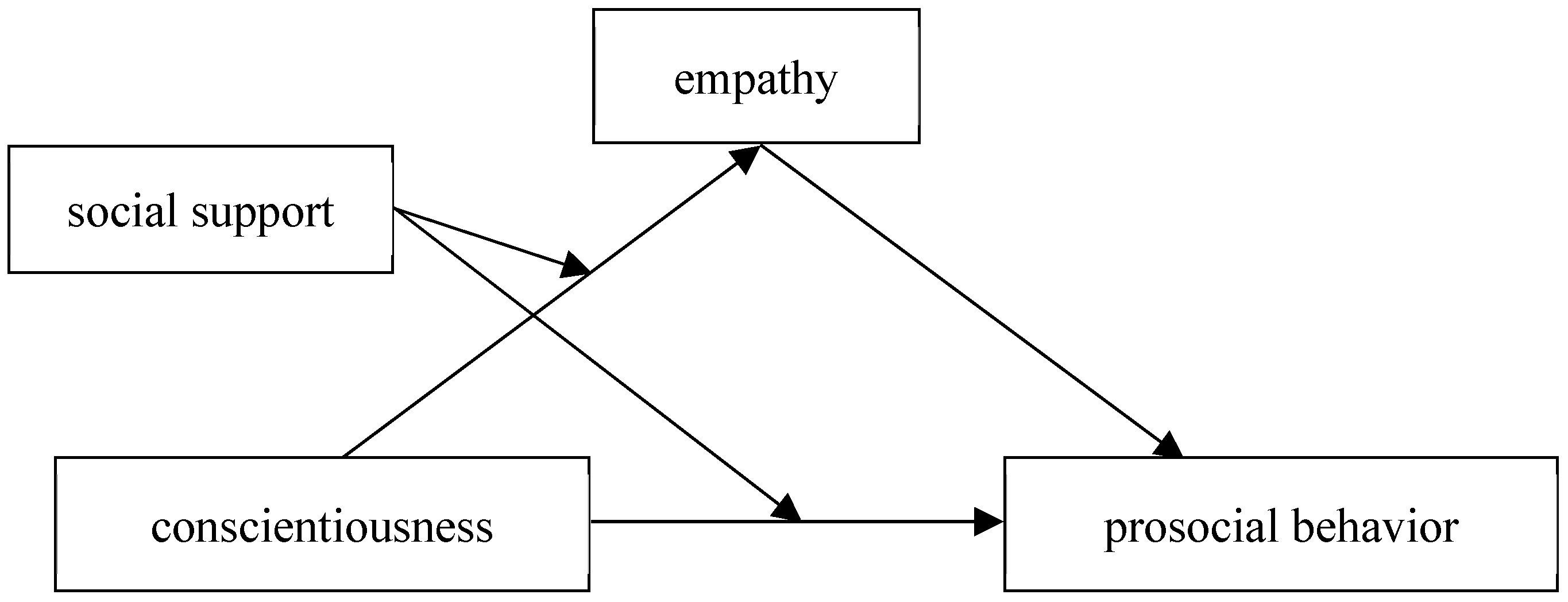
How Conscientiousness Influences Prosocial Behavior Among Adolescents: The Role of Empathy and Social Support

Abstract
1. Introduction
1.1. Conscientiousness and Prosocial Behavior
1.2. Indirect Effect of Empathy
1.3. Moderating Effect of Social Support
1.4. The Present Study
2. Methods
2.1. Participants
2.2. Measures
2.2.1. Conscientiousness
2.2.2. Empathy
2.2.3. Social Support
2.2.4. Prosocial Behavior
2.3. Procedure
2.4. Data Analysis
3. Results
3.1. Correlation Analyses
3.2. Mediating Analysis
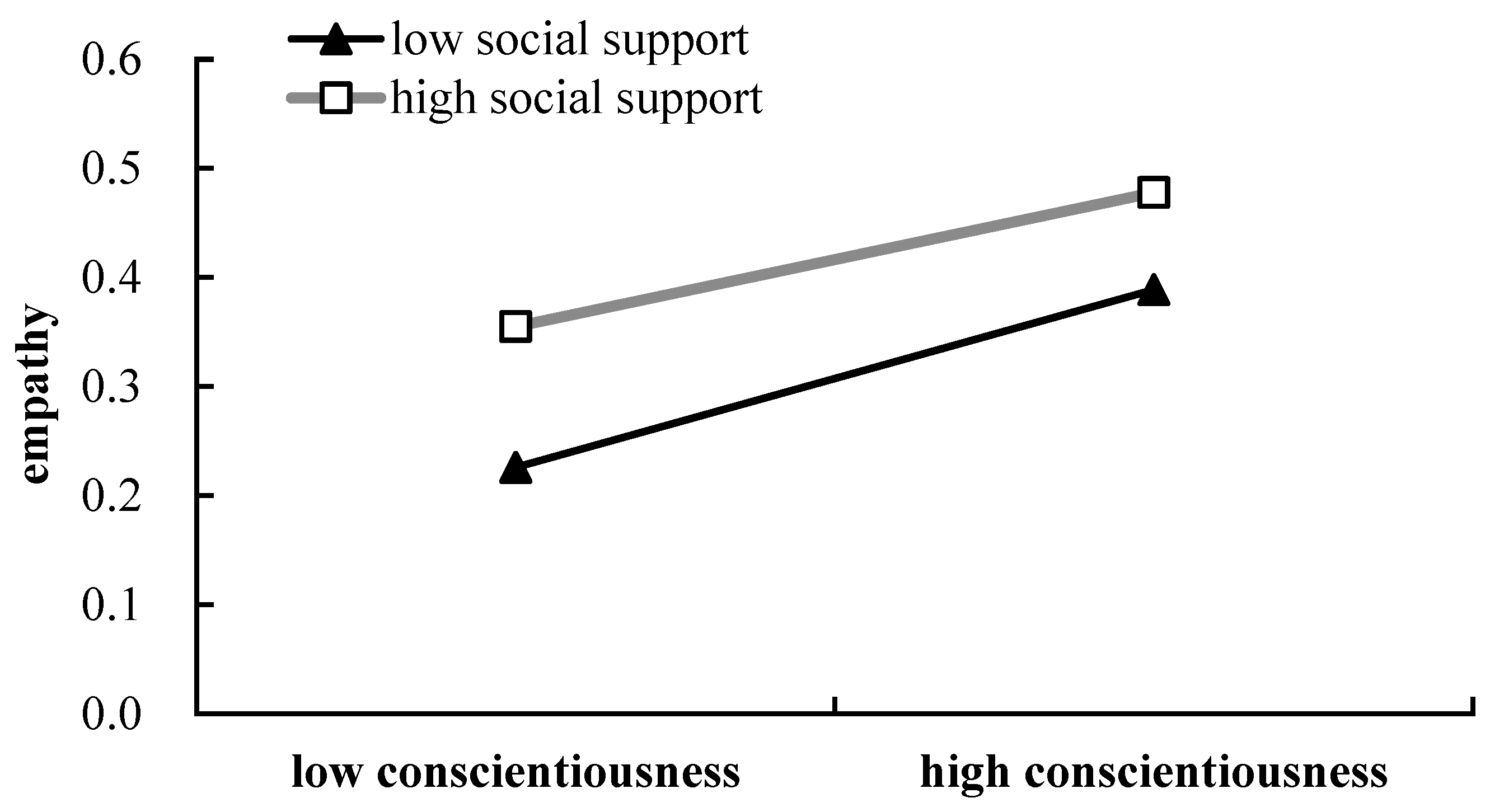
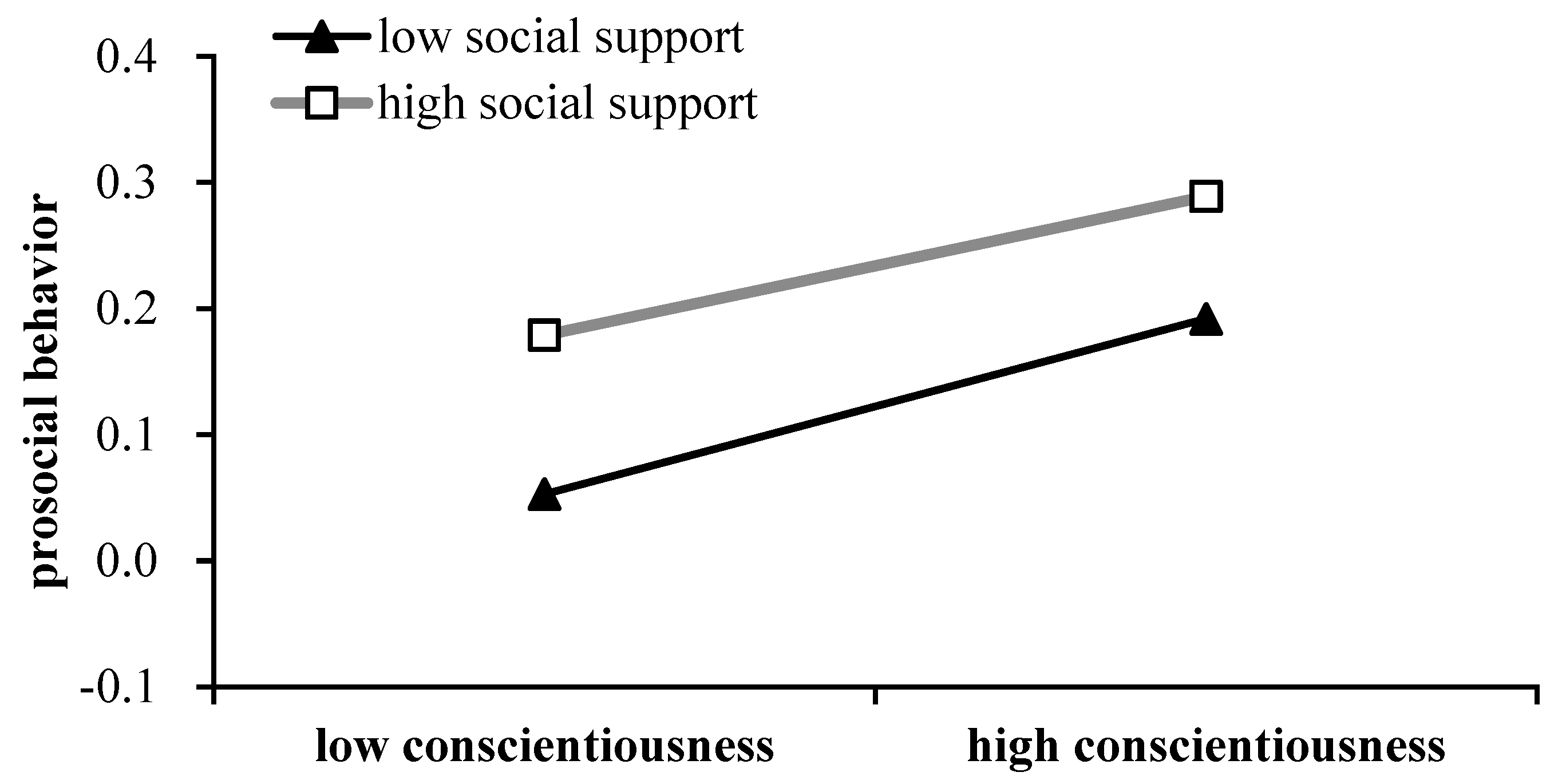
3.3. Moderated Mediation Analysis
4. Discussion
5. Limitations and Implications
6. Conclusions
Author Contributions
Funding
Institutional Review Board Statement
Informed Consent Statement
Data Availability Statement
Acknowledgments
Conflicts of Interest
References
- Abdullah, A. A., Hamsan, H. H., & Ma’rof, A. A. (2020). How do personality factors associate with prosocial behavior? The mediating role of empathy. International Journal of Academic Research in Business and Social Sciences, 10(16), 206–219. [Google Scholar] [CrossRef] [PubMed]
- Afolabi, O. A. (2013). Roles of personality types, emotional intelligence and gender differences on prosocial behavior. Psychological Thought, 6(1), 124–139. [Google Scholar] [CrossRef]
- Alfirević, N., Arslanagić-Kalajdžić, M., & Lep, Ž. (2023). The role of higher education and civic involvement in converting young adults’ social responsibility to prosocial behavior. Scientific Reports, 13(1), 2559. [Google Scholar] [CrossRef]
- Andreoni, J., Nikiforakis, N., & Stoop, J. (2021). Higher socioeconomic status does not predict decreased prosocial behavior in a field experiment. Nature Communications, 12(1), 4266. [Google Scholar] [CrossRef]
- Bakker, A. B., Demerouti, E., & Ten Brummelhuis, L. L. (2012). Work engagement, performance, and active learning: The role of conscientiousness. Journal of Vocational Behavior, 80(2), 555–564. [Google Scholar] [CrossRef]
- Barańczuk, U. (2019). The Five Factor Model of personality and social support: A meta-analysis. Journal of Research in Personality, 81, 38–46. [Google Scholar] [CrossRef]
- Barrio, V. D., Aluja, A., & García, L. F. (2004). Relationship between empathy and the Big Five personality traits in a sample of Spanish adolescents. Social Behavior and Personality: An International Journal, 32(7), 677–681. [Google Scholar] [CrossRef]
- Bartlett, M. Y., & DeSteno, D. (2006). Gratitude and prosocial behavior: Helping when it costs you. Psychological Science, 17(4), 319–325. [Google Scholar]
- Batson, C. D., Batson, J. G., Slingsby, J. K., Harrell, K. L., Peekna, H. M., & Todd, R. M. (1991). Empathic joy and the empathy-altruism hypothesis. Journal of Personality and Social Psychology, 61(3), 413. [Google Scholar] [CrossRef]
- Batson, C. D., Lishner, D. A., & Stocks, E. L. (2015). The empathy-altruism hypothesis. In The Oxford handbook of prosocial behavior (pp. 259–281). Oxford University Press. [Google Scholar]
- Bogg, T., & Roberts, B. W. (2004). Conscientiousness and health-related behaviors: A meta-analysis of the leading behavioral contributors to mortality. Psychological Bulletin, 130(6), 887. [Google Scholar] [CrossRef] [PubMed]
- Bronfenbrenner, U. (1979). The ecology of human development: Experiments by nature and design. Harvard University Press. [Google Scholar]
- Buckley, L., Atkins, T., Perera, W., & Waller, M. (2024). Trajectories of parental warmth and the role they play in explaining adolescent prosocial behavior. Journal of Youth and Adolescence, 53(3), 526–536. [Google Scholar] [CrossRef]
- Byrne, Z. S., Stoner, J., Thompson, K. R., & Hochwarter, W. (2005). The interactive effects of conscientiousness, work effort, and psychological climate on job performance. Journal of Vocational Behavior, 66(2), 326–338. [Google Scholar] [CrossRef]
- Calandri, E., Graziano, F., Testa, S., Cattelino, E., & Begotti, T. (2019). Empathy and depression among early adolescents: The moderating role of parental support. Frontiers in Psychology, 10, 1447. [Google Scholar] [CrossRef]
- Carlo, G., & Padilla-Walker, L. (2020). Adolescents’ prosocial behaviors through a multidimensional and multicultural lens. Child Development Perspectives, 14(4), 265–272. [Google Scholar] [CrossRef]
- Carlo, G., & Randall, B. A. (2002). The development of a measure of prosocial behaviors for late adolescents. Journal of Youth and Adolescence, 31, 31–44. [Google Scholar] [CrossRef]
- Carrizales, A., Branje, S., & Lannegrand, L. (2021). Disentangling between-and within-person associations between empathy and prosocial behaviors during early adolescence. Journal of Adolescence, 93, 114–125. [Google Scholar] [CrossRef] [PubMed]
- Carrizales, A., Carlo, G., & Lannegrand, L. (2025). A parallel-process analysis of the longitudinal associations between adolescents’ empathy and prosocial behaviors. Developmental Psychology, 61(9), 1669–1683. [Google Scholar] [CrossRef]
- Chen, Y., & Xu, Y. (2021). Exploring the effect of social support and empathy on user engagement in online mental health communities. International Journal of Environmental Research and Public Health, 18(13), 6855. [Google Scholar] [CrossRef]
- Chia, K. H., & Tan, D. M. K. (2024). Neural correlates of the big five personality traits: Understanding the brain basis of openness, conscientiousness, extroversion, agreeableness, and neuroticism. The Asian Educational Therapist, 2(2), 43–59. [Google Scholar] [CrossRef]
- Cohen, S., & McKay, G. (2020). Social support, stress and the buffering hypothesis: A theoretical analysis. In Handbook of psychology and health (Vol. IV, pp. 253–267). Routledge. [Google Scholar]
- Cohen, S., & Wills, T. A. (1985). Stress, social support, and the buffering hypothesis. Psychological Bulletin, 98(2), 310. [Google Scholar] [CrossRef]
- Conrad, N., & Patry, M. W. (2012). Conscientiousness and academic performance: A mediational analysis. International Journal for the Scholarship of Teaching and Learning, 6(1), n1. [Google Scholar] [CrossRef]
- Cuff, B. M., Brown, S. J., Taylor, L., & Howat, D. J. (2016). Empathy: A review of the concept. Emotion Review, 8(2), 144–153. [Google Scholar] [CrossRef]
- De Groot, J. I., & Steg, L. (2009). Morality and prosocial behavior: The role of awareness, responsibility, and norms in the norm activation model. The Journal of Social Psychology, 149(4), 425–449. [Google Scholar] [CrossRef]
- Doğan, S. E., Aslan, H., & Akçin, A. (2025). The mediating role of empathy in relationships between conscientious intelligence and perceptions of spiritual care among Turkish nurses; a structural equation modelling. BMC Nursing, 24(1), 827. [Google Scholar] [CrossRef] [PubMed]
- Eisenberg, N. (2006). Prosocial behavior. National Association of School Psychologists. [Google Scholar]
- Eisenberg, N., Eggum, N. D., & Di Giunta, L. (2010). Empathy-related responding: Associations with prosocial behavior, aggression, and intergroup relations. Social Issues and Policy Review, 4(1), 143–180. [Google Scholar] [CrossRef]
- Eisenberg, N., & Fabes, R. A. (1990). Empathy: Conceptualization, measurement, and relation to prosocial behavior. Motivation and Emotion, 14(2), 131–149. [Google Scholar] [CrossRef]
- Eisenberg, N., Fabes, R. A., Shepard, S. A., Guthrie, I. K., Murphy, B. C., & Reiser, M. (1999). Parental reactions to children’s negative emotions: Longitudinal relations to quality of children’s social functioning. Child Development, 70(2), 513–534. [Google Scholar] [CrossRef] [PubMed]
- Eisenberg, N., & Miller, P. A. (1987). The relation of empathy to prosocial and related behaviors. Psychological Bulletin, 101(1), 91. [Google Scholar] [CrossRef]
- Esparza-Reig, J., Martí-Vilar, M., González-Sala, F., Merino-Soto, C., & Toledano-Toledano, F. (2022). Social support and resilience as predictors of prosocial behaviors before and during COVID-19. Healthcare, 10(9), 1669. [Google Scholar] [CrossRef]
- Fu, W., Wang, C., Chai, H., & Xue, R. (2022). Examining the relationship of empathy, social support, and prosocial behavior of adolescents in China: A structural equation modeling approach. Humanities and Social Sciences Communications, 9(1), 1–8. [Google Scholar]
- Fu, X., Li, S., Shen, C., Zhu, K., Zhang, M., Liu, Y., & Zhang, M. (2023). Effect of prosocial behavior on school bullying victimization among children and adolescents: Peer and student–teacher relationships as mediators. Journal of Adolescence, 95(2), 322–335. [Google Scholar] [CrossRef]
- Gerbino, M., Zuffianò, A., Eisenberg, N., Castellani, V., Luengo Kanacri, B. P., Pastorelli, C., & Caprara, G. V. (2018). Adolescents’ prosocial behavior predicts good grades beyond intelligence and personality traits. Journal of Personality, 86(2), 247–260. [Google Scholar] [CrossRef]
- Giacomo, A., Ilaria, B., & Caterina, F. (2026). Parental interference in adolescents’ choices and depressive symptoms: The role of self-efficacy, school anxiety, engagement, and burnout in a structural equation model: G. Angelini et al. European Journal of Psychology of Education, 41(1), 19. [Google Scholar]
- Goldberg, L. R. (1993). The structure of phenotypic personality traits. American Psychologist, 48(1), 26. [Google Scholar] [CrossRef]
- Gregori, F., López-Pérez, B., Manfredi, L., Eisenberg, N., Lundie, D., Lee, S., Gerbino, M., Pastorelli, C., & Zuffianò, A. (2025). The relations among prosocial behavior, hedonic, and eudaimonic well-being in everyday life. Journal of Personality, 93(2), 412–424. [Google Scholar] [CrossRef]
- Guariglia, P., Palmiero, M., Giannini, A. M., & Piccardi, L. (2023). The key role of empathy in the relationship between age and social support. Healthcare, 11(17), 2464. [Google Scholar] [CrossRef] [PubMed]
- Guilera, T., Batalla, I., Forné, C., & Soler-González, J. (2019). Empathy and big five personality model in medical students and its relationship to gender and specialty preference: A cross-sectional study. BMC Medical Education, 19(1), 57. [Google Scholar] [CrossRef] [PubMed]
- Guinote, A., Cotzia, I., Sandhu, S., & Siwa, P. (2015). Social status modulates prosocial behavior and egalitarianism in preschool children and adults. Proceedings of the National Academy of Sciences USA, 112(3), 731–736. [Google Scholar] [CrossRef]
- Gungordu, N. (2023). Foundations and predictors of prosocial behavior development across preschool years: Empathy, personality, and creativity. The University of Alabama. [Google Scholar]
- Guo, Q., Zhou, J., & Feng, L. (2018). Pro-social behavior is predictive of academic success via peer acceptance: A study of Chinese primary school children. Learning and Individual Differences, 65, 187–194. [Google Scholar] [CrossRef]
- Habashi, M. M., Graziano, W. G., & Hoover, A. E. (2016). Searching for the prosocial personality: A big five approach to linking personality and prosocial behavior. Personality and Social Psychology Bulletin, 42(9), 1177–1192. [Google Scholar] [CrossRef]
- Hayes, A. F. (2017). Introduction to mediation, moderation, and conditional process analysis: A regression-based approach. Guilford Publications. [Google Scholar]
- Hill, P. L., Payne, B. R., Jackson, J. J., Stine-Morrow, E. A., & Roberts, B. W. (2014). Perceived social support predicts increased conscientiousness during older adulthood. Journals of Gerontology Series B: Psychological Sciences and Social Sciences, 69(4), 543–547. [Google Scholar] [CrossRef]
- Hu, H., You, Y., Ling, Y., Yuan, H., & Huebner, E. S. (2021). The development of prosocial behavior among adolescents: A positive psychology perspective. Current Psychology, 42(12), 9734–9742. [Google Scholar] [CrossRef]
- Igartua, J. J., & Hayes, A. F. (2021). Mediation, moderation, and conditional process analysis: Concepts, computations, and some common confusions. The Spanish Journal of Psychology, 24, e49. [Google Scholar] [CrossRef]
- Javed, F., Bibi, M., Dost, H., & Zia, K. (2025). Examining the interplay between empathy, social support, and prosocial behavior among early adults. International Journal of Social Sciences Bulletin, 3(1), 208–215. [Google Scholar]
- Jiang, Q. (1999). Perceived Social Support Scale (PSSS). In Handbook of mental health rating scales (pp. 131–133). Chinese Mental Health Journal Publisher. [Google Scholar]
- Jolliffe, D., & Farrington, D. P. (2006). Development and validation of the basic empathy scale. Journal of Adolescence, 29(4), 589–611. [Google Scholar] [CrossRef]
- Kamas, L., & Preston, A. (2021). Empathy, gender, and prosocial behavior. Journal of Behavioral and Experimental Economics, 92, 101654. [Google Scholar] [CrossRef]
- Kidron, Y., & Fleischman, S. (2006). Promoting adolescents’ prosocial behavior. Educational Leadership, 63(7), 90–91. [Google Scholar]
- Kline, R., Bankert, A., Levitan, L., & Kraft, P. (2019). Personality and prosocial behavior: A multilevel meta-analysis. Political Science Research and Methods, 7(1), 125–142. [Google Scholar] [CrossRef]
- Kou, Y., Hong, H., Tan, C., & Li, L. (2007). Revisioning prosocial tendencies measure for adolescent. Psychological Development and Education, 23(1), 112–117. [Google Scholar]
- Lakey, B., & Cohen, S. (2000). Social support theory and measurement. In Social support measurement and intervention: A guide for health and social scientists (p. 2952). Oxford University Press. [Google Scholar]
- Lee, L., & Madera, J. M. (2021). A within-level analysis of the effect of customer-focused perspective-taking on deep acting and customer helping behaviors: The mediating roles of negative affect and empathy. International Journal of Hospitality Management, 95, 102907. [Google Scholar] [CrossRef]
- Leng, J., Guo, Q., Ma, B., Zhang, S., & Sun, P. (2020). Bridging personality and online prosocial behavior: The roles of empathy, moral identity, and social self-efficacy. Frontiers in Psychology, 11, 575053. [Google Scholar] [CrossRef]
- Li, C., Lü, R., Liu, J., & Zhong, J. (2011). The adaptation of basic empathy scale among chinese adolescents. Chinese Journal of Clinical Psychology, 19(2), 163–166+183. [Google Scholar]
- Li, J., Yao, M., & Liu, H. (2021). From social support to adolescents’ subjective well-being: The mediating role of emotion regulation and prosocial behavior and gender difference. Child Indicators Research, 14(1), 77–93. [Google Scholar] [CrossRef]
- Li, Q., Chen, H., & Yang, Z. (2024). Social responsibility and youths’ prosocial behavior: The mediating effect of positive affect and the moderating effect of social class. Chinese Journal of Clinical Psychology, 32(2), 431–435. [Google Scholar]
- Lindahl, J. (2023). Conscientiousness predicts doctoral students’ research productivity. Journal of Informetrics, 17(1), 101353. [Google Scholar] [CrossRef]
- Liu, A., Wang, W., & Wu, X. (2021). Self-compassion and posttraumatic growth mediate the relations between social support, prosocial behavior, and antisocial behavior among adolescents after the Ya’an earthquake. European Journal of Psychotraumatology, 12(1), 1864949. [Google Scholar] [CrossRef]
- Luengo Kanacri, B. P., Eisenberg, N., Thartori, E., Pastorelli, C., Uribe Tirado, L. M., Gerbino, M., & Caprara, G. V. (2017). Longitudinal relations among positivity, perceived positive school climate, and prosocial behavior in Colombian adolescents. Child Development, 88(4), 1100–1114. [Google Scholar] [CrossRef] [PubMed]
- Ma, L. K., Tunney, R. J., & Ferguson, E. (2017). Does gratitude enhance prosociality? A meta-analytic review. Psychological Bulletin, 143(6), 601. [Google Scholar] [CrossRef]
- Ma, Y., Hu, Z., Sun, Y., Qin, B., Yang, X., & He, Y. (2022). Study on the gratitude and prosocial behavior of medical students based on moderated mediation model. Chinese Health Service Management, 39(11), 868–873. [Google Scholar]
- Malti, T., Chaparro, M. P., Zuffianò, A., & Colasante, T. (2016). School-based interventions to promote empathy-related responding in children and adolescents: A developmental analysis. Journal of Clinical Child & Adolescent Psychology, 45(6), 718–731. [Google Scholar]
- Marshall, S. L., Ciarrochi, J., Parker, P. D., & Sahdra, B. K. (2020). Is self-compassion selfish? The development of self-compassion, empathy, and prosocial behavior in adolescence. Journal of Research on Adolescence, 30, 472–484. [Google Scholar] [CrossRef] [PubMed]
- Melchers, M. C., Li, M., Haas, B. W., Reuter, M., Bischoff, L., & Montag, C. (2016). Similar personality patterns are associated with empathy in four different countries. Frontiers in Psychology, 7, 290. [Google Scholar] [CrossRef] [PubMed]
- Meyer, J., Lüdtke, O., Schmidt, F. T., Fleckenstein, J., Trautwein, U., & Köller, O. (2024). Conscientiousness and cognitive ability as predictors of academic achievement: Evidence of synergistic effects from integrative data analysis. European Journal of Personality, 38(1), 36–52. [Google Scholar] [CrossRef]
- Oguni, R., & Ishii, C. (2024). Gratitude promotes prosocial behavior even in uncertain situation. Scientific Reports, 14(1), 14379. [Google Scholar] [CrossRef]
- Park, H. J., & Lee, J. H. (2020). Looking into the personality traits to enhance empathy ability: A review of literature. In International conference on human-computer interaction (pp. 173–180). Springer International Publishing. [Google Scholar]
- Pastor, Y., Pérez-Torres, V., Thomas-Currás, H., Lobato-Rincón, L. L., López-Sáez, M. Á., & García, A. (2024). A study of the influence of altruism, social responsibility, reciprocity, and the subjective norm on online prosocial behavior in adolescence. Computers in Human Behavior, 154, 108156. [Google Scholar] [CrossRef]
- Patitsa, C. D., Sotiropoulou, K., Giannakouli, V., Sahinidis, A. G., & Tsaknis, P. A. (2022). The influence of personality on compliance with COVID-19 public health protection measures: The role of prosocial behavior. Journal of Governance and Regulation/Volume, 11(4), 136. [Google Scholar] [CrossRef]
- Peng, S., Peng, R., Lei, H., & Liu, W. (2023). Family functioning and problematic behavior among secondary vocational school students: The mediating role of hope and the moderating role of perceived social support. Personality and Individual Differences, 207, 112156. [Google Scholar] [CrossRef]
- Roberts, B. W., Lejuez, C., Krueger, R. F., Richards, J. M., & Hill, P. L. (2014). What is conscientiousness and how can it be assessed? Developmental Psychology, 50(5), 1315. [Google Scholar] [CrossRef]
- Saman, A., & Wirawan, H. (2021). Examining the impact of psychological capital on academic achievement and work performance: The roles of procrastination and conscientiousness. Cogent Psychology, 8(1), 1938853. [Google Scholar] [CrossRef]
- Sari, Y. (2020). Predictors of job performance: Moderating role of conscientiousness. International Journal of Innovation, Creativity and Change, 11, 135–152. [Google Scholar]
- Scaffidi Abbate, C., Misuraca, R., Roccella, M., Parisi, L., Vetri, L., & Miceli, S. (2022). The role of guilt and empathy on prosocial behavior. Behavioral Sciences, 12(3), 64. [Google Scholar] [CrossRef]
- Scaffidi Abbate, C., & Ruggieri, S. (2008). A beggar, self-awareness and willingness to help. Current Psychology Letters, 24, 98–107. [Google Scholar]
- Schwartz, S. H. (1973). Normative explanations of helping behavior: A critique, proposal, and empirical test. Journal of Experimental Social Psychology, 9(4), 349–364. [Google Scholar] [CrossRef]
- Schwartz, S. H. (1977). Normative influences on altruism. In L. Berkowitz (Ed.), Advances in experimental social psychology (Vol. 10). Academic Press. [Google Scholar]
- Schwartz, S. H., & David, A. B. (1976). Responsibility and helping in an emergency: Effects of blame, ability and denial of responsibility. Sociometry, 39, 406–415. [Google Scholar] [CrossRef]
- Scourfield, J., John, B., Martin, N., & McGuffin, P. (2004). The development of prosocial behaviour in children and adolescents: A twin study. Journal of Child Psychology and Psychiatry, 45(5), 927–935. [Google Scholar] [CrossRef] [PubMed]
- Shah, A. M., & Rizvi, T. (2016). Prosocial behavior and big five-factor model of personality: A theoretical review. The International Journal of Indian Psychology, 4(1), 161–170. [Google Scholar] [CrossRef]
- Song, Y., & Shi, M. (2017). Associations between empathy and big five personality traits among Chinese undergraduate medical students. PLoS ONE, 12(2), e0171665. [Google Scholar] [CrossRef]
- Spinrad, T. L., & Eisenberg, N. (2014). Empathy, prosocial behavior, and positive development in schools. In Handbook of positive psychology in schools (pp. 82–98). Routledge. [Google Scholar]
- Staub, E. (2013). Positive social behavior and morality: Social and personal influences. Elsevier. [Google Scholar]
- Suazo, I., Pérez-Fuentes, M. D. C., Molero Jurado, M. D. M., Martos Martínez, Á., Simón Márquez, M. D. M., Barragán Martín, A. B., Sisto, M., & Gázquez Linares, J. J. (2020). Moral sensitivity, empathy and prosocial behavior: Implications for humanization of nursing care. International Journal of Environmental Research and Public Health, 17(23), 8914. [Google Scholar] [CrossRef] [PubMed]
- Swickert, R., Abushanab, B., Bise, H., & Szer, R. (2014). Conscientiousness moderates the influence of a help-eliciting prime on prosocial behavior. Psychology, 5(17), 1954. [Google Scholar] [CrossRef][Green Version]
- Sze, J. A., Gyurak, A., Goodkind, M. S., & Levenson, R. W. (2012). Greater emotional empathy and prosocial behavior in late life. Emotion, 12(5), 1129. [Google Scholar] [CrossRef]
- Tariq, F. T., & Naqvi, I. (2020). Relationship between personality traits and prosocial behavior among adolescents. Foundation University Journal of Psychology, 4(2), 54–63. [Google Scholar] [CrossRef]
- Telle, N. T., & Pfister, H. R. (2016). Positive empathy and prosocial behavior: A neglected link. Emotion Review, 8(2), 154–163. [Google Scholar] [CrossRef]
- Tett, R. P., & Burnett, D. D. (2003). A personality trait-based interactionist model of job performance. Journal of Applied Psychology, 88(3), 500. [Google Scholar] [CrossRef]
- Thielmann, I., Spadaro, G., & Balliet, D. (2020). Personality and prosocial behavior: A theoretical framework and meta-analysis. Psychological Bulletin, 146(1), 30. [Google Scholar] [CrossRef]
- Trishala, M. (2021). Big Five Personality traits as determinants of pro-social behaviour. Indian Journal of Positive Psychology, 12(2), 200–203. [Google Scholar]
- Trombini, C., Jiang, W., & Kinias, Z. (2025). Receiving social support motivates long-term prosocial behavior. Journal of Business Ethics, 197(4), 689–711. [Google Scholar] [CrossRef]
- Van der Graaff, J., Carlo, G., Crocetti, E., Koot, H. M., & Branje, S. (2018). Prosocial behavior in adolescence: Gender differences in development and links with empathy. Journal of Youth and Adolescence, 47(5), 1086–1099. [Google Scholar] [CrossRef]
- Verbree, A. R., Hornstra, L., Maas, L., & Wijngaards-de Meij, L. (2023). Conscientiousness as a predictor of the gender gap in academic achievement. Research in Higher Education, 64(3), 451–472. [Google Scholar] [CrossRef] [PubMed]
- Vianello, M., Robusto, E., & Anselmi, P. (2010). Implicit conscientiousness predicts academic performance. Personality and Individual Differences, 48(4), 452–457. [Google Scholar] [CrossRef]
- Wan, Q., Jiang, L., Zeng, Y., & Wu, X. (2019). A big-five personality model-based study of empathy behaviors in clinical nurses. Nurse Education in Practice, 38, 66–71. [Google Scholar] [CrossRef] [PubMed]
- Wang, M. T., & Eccles, J. S. (2012). Social support matters: Longitudinal effects of social support on three dimensions of school engagement from middle to high school. Child Development, 83(3), 877–895. [Google Scholar] [CrossRef]
- Wang, W., & Wu, X. (2020). Mediating roles of gratitude, social support and posttraumatic growth in the relation between empathy and prosocial behavior among adolescents after the Ya’an earthquake. Acta Psychologica Sinica, 52(3), 307. [Google Scholar] [CrossRef]
- Wang, Y., Ran, G., Zhang, Q., & Zhang, Q. (2024). The association between social support and prosocial behavior: A three-level meta-analysis. PsyCh Journal, 13(6), 1026–1043. [Google Scholar] [CrossRef]
- Wentzel, K. R. (2014). Prosocial behavior and peer relations in adolescence. Prosocial Development: A Multidimensional Approach, 178, 200. [Google Scholar]
- Xia, Z., & Yang, F. (2020). Ethical leadership and knowledge sharing: The impacts of prosocial motivation and two facets of conscientiousness. Frontiers in Psychology, 11, 581236. [Google Scholar] [CrossRef]
- Xiao, S. X., Hashi, E. C., Korous, K. M., & Eisenberg, N. (2019). Gender differences across multiple types of prosocial behavior in adolescence: A meta-analysis of the prosocial tendency measure-revised (PTM-R). Journal of Adolescence, 77, 41–58. [Google Scholar] [CrossRef]
- Xie, X., Chen, W., Lei, L., Xing, C., & Zhang, Y. (2016). The relationship between personality types and prosocial behavior and aggression in Chinese adolescents. Personality and Individual Differences, 95, 56–61. [Google Scholar] [CrossRef]
- Yao, Z., & Li, Y. (2023). The influence of social support on low-income adolescents’ prosocial behavior: The mediating role of social goals. Children and Youth Services Review, 155, 107201. [Google Scholar] [CrossRef]
- Yin, Y., & Wang, Y. (2023). Is empathy associated with more prosocial behaviour? A meta-analysis. Asian Journal of Social Psychology, 26(1), 3–22. [Google Scholar] [CrossRef]
- Yoo, H., Feng, X., & Day, R. D. (2013). Adolescents’ empathy and prosocial behavior in the family context: A longitudinal study. Journal of Youth and Adolescence, 42, 1858–1872. [Google Scholar] [CrossRef] [PubMed]
- You, S., Lee, J., & Lee, Y. (2022). Relationships between gratitude, social support, and prosocial and problem behaviors. Current Psychology, 41(5), 2646–2653. [Google Scholar] [CrossRef]
- Younis, A., Xiaobao, P., Nadeem, M. A., Kanwal, S., Pitafi, A. H., Qiong, G., & Yuzhen, D. (2021). Impact of positivity and empathy on social entrepreneurial intention: The moderating role of perceived social support. Journal of Public Affairs, 21(1), e2124. [Google Scholar] [CrossRef]
- Yu, Y., Zhao, Y., Li, D., Zhang, J., & Li, J. (2021). The relationship between big five personality and social well-being of Chinese residents: The mediating effect of social support. Frontiers in Psychology, 11, 613659. [Google Scholar] [CrossRef] [PubMed]
- Zahn-Waxler, C., & Robinson, J. (1995). Empathy and guilt: Early origins of feelings of responsibility. Guilford Press. [Google Scholar]
- Zhang, B., Li, Y. M., Li, J., Luo, J., Ye, Y., Yin, L., Chen, Z., Soto, C. J., & John, O. P. (2022). The big five inventory–2 in China: A comprehensive psychometric evaluation in four diverse samples. Assessment, 29(6), 1262–1284. [Google Scholar] [CrossRef]
- Zhu, N., Li, C., Ye, Y., Zhang, L., & Kong, F. (2024). Longitudinal effect of gratitude on prosocial behavior among young adults: Evidence from the bi-factor model of gratitude. Journal of Happiness Studies, 25(1), 3. [Google Scholar] [CrossRef]
- Zhu, Q., Cheong, Y., Wang, C., & Tong, J. (2023). The impact of maternal and paternal parenting styles and parental involvement on Chinese adolescents’ academic engagement and burnout. Current Psychology, 42(4), 2827–2840. [Google Scholar] [CrossRef]
- Zimet, G. D., Powell, S. S., Farley, G. K., Werkman, S., & Berkoff, K. A. (1990). Psychometric characteristics of the multidimensional scale of perceived social support. Journal of Personality Assessment, 55(3–4), 610–617. [Google Scholar]


| Variables | M ± SD | 1 | 2 | 3 | 4 | 5 | 6 |
|---|---|---|---|---|---|---|---|
| 1. Gender | 1.51 ± 0.50 | - | |||||
| 2. Grade | 3.54 ± 1.55 | −0.026 | - | ||||
| 3. Conscientiousness | 38.04 ± 5.12 | −0.083 ** | 0.174 ** | - | |||
| 4. Empathy | 62.44 ± 8.91 | 0.016 | 0.125 ** | 0.407 ** | - | ||
| 5. Social support | 61.24 ± 13.39 | 0.047 | −0.096 ** | 0.211 ** | 0.196 ** | - | |
| 6. Prosocial behavior | 94.04 ± 17.08 | −0.050 | 0.016 | 0.348 ** | 0.271 ** | 0.614 ** | - |
| Predictors | Model 1 (Prosocial Behavior) | Model 2 (Empathy) | Model 3 (Prosocial Behavior) | |||
|---|---|---|---|---|---|---|
| β(SE) | t | β(SE) | t | β(SE) | t | |
| Conscientiousness | 0.35(0.03) | 12.11 *** | 0.41(0.03) | 14.55 *** | 0.29(0.03) | 9.16 *** |
| Empathy | 0.15(0.03) | 4.97 *** | ||||
| R2 | 0.12 | 0.17 | 0.14 | |||
| F | 146.64 *** | 211.65 *** | 87.31 *** | |||
| Indirect effect | B | Boot SE | LLCI | ULCI | ||
| Empathy | 0.063 | 0.020 | 0.027 | 0.102 | ||
| Predictors | Model 1 (Empathy) | Model 2 (Prosocial Behavior) | ||||
|---|---|---|---|---|---|---|
| β(SE) | t | 95% CI | β(SE) | t | 95% CI | |
| Conscientiousness | 0.362(0.029) | 12.213 *** | 0.304, 0.419 | 0.178(0.026) | 6.778 *** | 0.127, 0.230 |
| Social support | 0.114(0.028) | 3.998 *** | 0.058, 0.169 | 0.555(0.024) | 23.353 *** | 0.508, 0.602 |
| Conscientiousness × Social support | 0.055(0.022) | 2.514 * | 0.012, 0.097 | 0.056(0.018) | 3.066 ** | 0.020, 0.091 |
| Empathy | 0.076(0.026) | 2.958 ** | 0.025, 0.126 | |||
| R2 | 0.184 | 0.437 | ||||
| F | 79.523 *** | 205.664 *** | ||||
| Condition | Social Support | Effect | BootSE | BootLLCI | BootULCI |
|---|---|---|---|---|---|
| Conscientiousness → Empathy → Prosocial behavior | M − 1SD | 0.307 | 0.042 | 0.226 | 0.389 |
| M | 0.362 | 0.030 | 0.304 | 0.420 | |
| M + 1SD | 0.416 | 0.031 | 0.355 | 0.478 | |
| Conscientiousness → Prosocial behavior | M − 1SD | 0.122 | 0.035 | 0.053 | 0.192 |
| M | 0.178 | 0.026 | 0.127 | 0.230 | |
| M + 1SD | 0.233 | 0.028 | 0.179 | 0.289 |
Disclaimer/Publisher’s Note: The statements, opinions and data contained in all publications are solely those of the individual author(s) and contributor(s) and not of MDPI and/or the editor(s). MDPI and/or the editor(s) disclaim responsibility for any injury to people or property resulting from any ideas, methods, instructions or products referred to in the content. |
© 2026 by the authors. Licensee MDPI, Basel, Switzerland. This article is an open access article distributed under the terms and conditions of the Creative Commons Attribution (CC BY) license.
Share and Cite
Lei, W.; Xia, X.; Dai, D.Y.; Wang, G. How Conscientiousness Influences Prosocial Behavior Among Adolescents: The Role of Empathy and Social Support. Behav. Sci. 2026, 16, 468. https://doi.org/10.3390/bs16030468
Lei W, Xia X, Dai DY, Wang G. How Conscientiousness Influences Prosocial Behavior Among Adolescents: The Role of Empathy and Social Support. Behavioral Sciences. 2026; 16(3):468. https://doi.org/10.3390/bs16030468
Chicago/Turabian StyleLei, Weina, Xiaogang Xia, David Yun Dai, and Guihua Wang. 2026. "How Conscientiousness Influences Prosocial Behavior Among Adolescents: The Role of Empathy and Social Support" Behavioral Sciences 16, no. 3: 468. https://doi.org/10.3390/bs16030468
APA StyleLei, W., Xia, X., Dai, D. Y., & Wang, G. (2026). How Conscientiousness Influences Prosocial Behavior Among Adolescents: The Role of Empathy and Social Support. Behavioral Sciences, 16(3), 468. https://doi.org/10.3390/bs16030468