Profiling Personality to Predict Athletes’ Academic Achievement: Cross-Cultural Analysis




Abstract
1. Introduction
1.1. Personality Traits Among Athletic Students
1.2. A Person-Centered Approach to Examining Personality Among Athletes
1.3. Objectives of the Study
- High scores in conscientiousness, intellect (openness), agreeableness, and emotional stability (low neuroticism) are associated with high academic achievement among athletes.
- Personality profiles can predict academic achievement among athletes.
2. Materials and Methods
2.1. Study Design and Procedure
2.2. Participants’ Characteristics
2.3. Measures
2.3.1. Personality
2.3.2. Academic Achievements
2.4. Statistical Analysis
3. Results
3.1. Descriptive Statistics
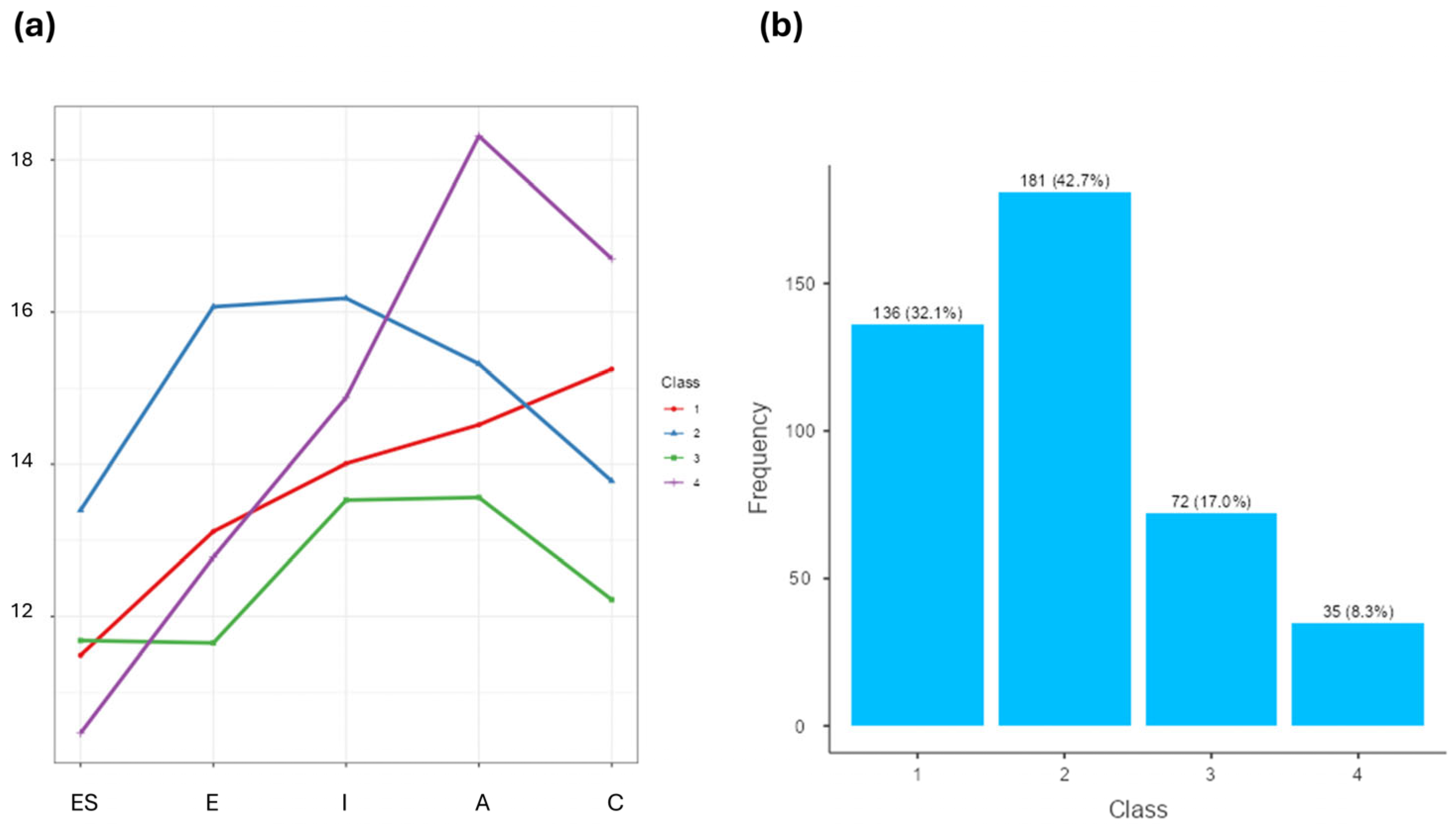
3.2. Latent Profile Analysis
3.3. Predictors of Academic Achievement Among Athletes
4. Discussion
4.1. Associations Between Academic Achievement and Personality Traits
4.2. Personality Profiles Among Athletes
4.3. Associations Between Personality Profiles and Academic Achievement in Student Athletes
4.4. Practical Implications of LPA Profiling
4.5. Limitations of the Study and Future Research Directions
5. Conclusions
Author Contributions
Funding
Institutional Review Board Statement
Informed Consent Statement
Data Availability Statement
Acknowledgments
Conflicts of Interest
Abbreviations
| AHP | Analytic Hierarchy Process |
| AIC | Akaike’s Information Criterion |
| ANOVA | analysis of variance |
| AWE | Approximate Weight of Evidence |
| BIC | Bayesian Information Criterion |
| CLC | Classification Likelihood Criterion |
| GPA | grade point average |
| IPIP | International Personality Item Pool |
| KIC | Kullback Information Criterion |
| LPA | Latent Profile Analysis |
| SABIC | Sample-Size Adjusted BIC |
References
- Akogul, S., & Erisoglu, M. (2017). An approach for determining the number of clusters in a model-based cluster analysis. Entropy, 19(9), 452. [Google Scholar] [CrossRef]
- Allik, J., & McCrae, R. R. (2004). Toward a geography of personality traits: Patterns of profiles across 36 cultures. Journal of Cross-Cultural Psychology, 35(1), 13–28. [Google Scholar] [CrossRef]
- Aykora, A. F., & Dinçer, U. (2022). Investigation of sports commitment levels and academic achievements of undergraduate students studying in sports sciences. International Journal of Mountaineering and Climbing, 1, 1–8. [Google Scholar] [CrossRef]
- Ayrancı, M., & Aydin, M. K. (2025). The complex interplay between psychological factors and sports performance: A systematic review and meta-analysis. PLoS ONE, 20, e0330862. [Google Scholar] [CrossRef]
- Bhattacharjee, R. R., & RamKumar, A. (2025). Effect of Big Five personality dimensions on the academic performance of college students. Frontiers in Psychology, 16, 1490427. [Google Scholar] [CrossRef]
- Boonyapison, K., Sittironnarit, G., & Rattanaumpawan, P. (2025). Association between the big five personalities and academic performance among grade 12 students at international high school in Thailand. Scientific Reports, 15, 16484. [Google Scholar] [CrossRef]
- Chen, H., Chen, H., Lu, T., Liu, C., Hu, C., Wang, C., & Yan, J. (2024). Personality profiles and physical activity across adolescent: Based on latent profile analysis. Acta Psychologica, 249, 104455. [Google Scholar] [CrossRef]
- Christensen, A. P., Kenett, Y. N., Cotter, K. N., Beaty, R. E., & Silvia, P. J. (2018). Remotely close associations: Openness to experience and semantic memory structure. European Journal of Personality, 32(4), 480–492. [Google Scholar] [CrossRef]
- Credé, M., Harms, P., Niehorster, S., & Gaye-Valentine, A. (2012). An evaluation of the consequences of using short measures of the Big Five personality traits. Journal of Personality and Social Psychology, 102(4), 874–888. [Google Scholar] [CrossRef]
- DeYoung, C. G. (2014). Openness/intellect: A dimension of personality reflecting cognitive exploration. In APA handbook of personality and social psychology: Vol. 4. Personality processes and individual differences (pp. 369–399). American Psychological Association. [Google Scholar] [CrossRef]
- DeYoung, C. G., Grazioplene, R. G., & Peterson, J. B. (2012). From madness to genius: The Openness/Intellect trait domain as a paradoxical simplex. Journal of Research in Personality, 46(1), 63–78. [Google Scholar] [CrossRef]
- Donnellan, M. B., Oswald, F. L., Baird, B. M., & Lucas, R. E. (2006). The Mini-IPIP scales: Tiny-yet-effective measures of the Big Five factors of personality. Psychological Assessment, 18(2), 192–203. [Google Scholar] [CrossRef] [PubMed]
- Edelsbrunner, P. A., Flaig, M., & Schneider, M. (2023). A Simulation study on latent transition analysis for examining profiles and trajectories in education: Recommendations for fit statistics. Journal of Research on Educational Effectiveness, 16(2), 350–375. [Google Scholar] [CrossRef]
- George, D., & Mallery, P. (2020). IBM SPSS statistics 26 step by step: A simple guide and reference (17th ed.). Routledge. [Google Scholar]
- Gorry, D. (2016). Heterogenous effects of sports participation on education and labor market outcomes. Education Economics, 24(6), 622–638. [Google Scholar] [CrossRef][Green Version]
- Greenlees, I. (2020). Five-factor model (big 5) and its relation to sporting performance. In The routledge international encyclopedia of sport and exercise psychology. Routledge. [Google Scholar] [CrossRef]
- Guo, X., Meyerhoefer, C. D., & Peng, L. (2019). Participation in school-sponsored sports and academic spillovers: New evidence from the early childhood longitudinal survey. Applied Economics, 51(15), 1602–1620. [Google Scholar] [CrossRef]
- He, Y., Chen, D., & Cui, X. (2024). The effects of psychological stress and anxiety on academic achievement in athletes: Strategies for effective coping. International Journal of Medicine & Science of Physical Activity & Sport, 24(97), 16. [Google Scholar] [CrossRef]
- Hernández-Peña, K., Gea-García, G., García-Fuentes, J. P., Martínez-Aranda, L., & Antúnez, R. M. (2022). Personality trait changes in athletic training students during their university career: Effects of academic stress or COVID-19 pandemic? Sustainability, 15, 486. [Google Scholar] [CrossRef]
- Ishihara, T., Nakajima, T., Yamatsu, K., Okita, K., Sagawa, M., & Morita, N. (2020). Relationship of participation in specific sports to academic performance in adolescents: A 2-year longitudinal study. Scandinavian Journal of Medicine and Science in Sports, 30(8), 1471–1482. [Google Scholar] [CrossRef]
- Judge, T., & Ilies, R. (2002). Relationship of personality to performance motivation: A meta-analytic review. The Journal of Applied Psychology, 87(4), 797–807. [Google Scholar] [CrossRef]
- Juhász, I., Berki, T., Tóth, R., Nagy, S., Tóth, L., & Bognár, J. (2025). A comparative study of personality and cognitive functions in elite and sub-elite Hungarian junior handball players. BMC Psychology, 13, 1020. [Google Scholar] [CrossRef]
- Kemarat, S., Theanthong, A., Yeemin, W., & Suwankan, S. (2022). Personality characteristics and competitive anxiety in individual and team athletes. PLoS ONE, 17, e0262486. [Google Scholar] [CrossRef]
- Komarraju, M., Karau, S., & Schmeck, R. (2009). Role of the Big Five personality traits in predicting college students’ academic motivation and achievement. Learning and Individual Differences, 19, 47–52. [Google Scholar] [CrossRef]
- Komarraju, M., Karau, S., Schmeck, R., & Avdić, A. (2011). The Big Five personality traits, learning styles, and academic achievement. Personality and Individual Differences, 51, 472–477. [Google Scholar] [CrossRef]
- Kuśnierz, C., Rogowska, A. M., & Pavlova, I. (2020). Examining gender differences, personality traits, academic performance, and motivation in ukrainian and polish students of physical education: A cross-cultural study. International Journal of Environmental Research and Public Health, 17(16), 5729. [Google Scholar] [CrossRef] [PubMed]
- Li, Q., Xiao, D., & Zeng, Q. (2024). Exploring performance of athletic individuals: Tying athletic behaviors and big-five personality traits with sports performance. PLoS ONE, 19, e0312850. [Google Scholar] [CrossRef]
- Mammadov, S. (2022). Big Five personality traits and academic performance: A meta-analysis. Journal of Personality, 90(2), 222–255. [Google Scholar] [CrossRef]
- Mammadov, S., Wang, S., & Lu, Z. (2024). Personality types and their associations with psychological resilience, coping with stress, and life satisfaction among undergraduate students: A latent profile analysis approach. Personality and Individual Differences, 222, 112599. [Google Scholar] [CrossRef]
- Mathew, A., & Doorenbos, A. Z. (2022). Latent profile analysis—An emerging advanced statistical approach to subgroup identification. Indian Journal of Continuing Nursing Education, 23(2), 127–133. [Google Scholar] [CrossRef]
- Nédélec, M., Lienhart, N., Martinent, G., & Doron, J. (2020). Personality traits, stress appraisals and sleep in young elite athletes: A profile approach. European Journal of Sport Science, 21, 1299–1305. [Google Scholar] [CrossRef]
- Nusbaum, E. C., & Silvia, P. J. (2011). Are Openness and Intellect distinct aspects of Openness to Experience? A test of the O/I model. Personality and Individual Differences, 51(5), 571–574. [Google Scholar] [CrossRef]
- Nylund-Gibson, K., & Choi, A. Y. (2018). Ten frequently asked questions about latent class analysis. Translational Issues in Psychological Science, 4(4), 440–461. [Google Scholar] [CrossRef]
- Obmiński, Z., Mroczkowska, H., Jagiello, M., & Litwiniuk, A. (2020). Sex-and sport related differences in the personality traits students in volleyball, basketball and judo athletes. Physical Education of Students, 24(6), 304–311. [Google Scholar] [CrossRef]
- O’Connor, M., & Paunonen, S. (2007). Big Five personality predictors of post-secondary academic performance. Personality and Individual Differences, 43, 971–990. [Google Scholar] [CrossRef]
- Piepiora, P. (2021). Assessment of personality traits influencing the performance of men in team sports in terms of the big five. Frontiers in Psychology, 12, 679724. [Google Scholar] [CrossRef]
- Piepiora, P. (2024). Personality traits and sporting level of athletes. Physical Education of Students, 28(3), 144–151. [Google Scholar] [CrossRef]
- Piepiora, P., & Piepiora, Z. (2021). Personality determinants of success in men’s sports in the light of the big five. International Journal of Environmental Research and Public Health, 18, 6297. [Google Scholar] [CrossRef] [PubMed]
- Pinto-Escalona, T., Valenzuela, P. L., Esteban-Cornejo, I., & Martínez-de-Quel, Ó. (2022). Sport participation and academic performance in young elite athletes. International Journal of Environmental Research and Public Health, 19(23), 15651. [Google Scholar] [CrossRef] [PubMed]
- Ponterotto, J. G., & Ruckdeschel, D. E. (2007). An overview of coefficient alpha and a reliability matrix for estimating adequacy of internal consistency coefficients with psychological research measures. Perceptual and Motor Skills, 105(3), 997–1014. [Google Scholar] [CrossRef]
- Rehman, A. U., Ahmed, F., Ali, A., Haider, A., & Azam, M. (2025). Assessing the association and gender-based differences in big five personality traits and emotional intelligence among varsity squash players. Physical Education of Students, 29(2), 135–140. [Google Scholar] [CrossRef]
- Rolland, J.-P. (2002). The cross-cultural generalizability of the five-factor model of personality. In R. McCrae, & J. Allik (Eds.), The five-factor model of personality across cultures (pp. 7–28). Kluwer Academic/Plenum Publishers. [Google Scholar] [CrossRef]
- Rumbold, J., Madigan, D., Murtagh-Cox, A., & Jones, L. (2021). Examining profiles of the big five and sensation seeking among competitive climbers. Psychology of Sport and Exercise, 55, 101951. [Google Scholar] [CrossRef]
- Schmitt, D., Allik, J., McCrae, R., & Benet-Martínez, V. (2007). The geographic distribution of Big Five personality traits. Journal of Cross-Cultural Psychology, 38, 173–212. [Google Scholar] [CrossRef]
- Shuai, Y., Wang, S., Liu, X., Kueh, Y., & Kuan, G. (2023). The influence of the five-factor model of personality on performance in competitive sports: A review. Frontiers in Psychology, 14, 1284378. [Google Scholar] [CrossRef]
- Solmaz, S., Şimşek, B., Özbek, S., Özcan, B., & Yarayan, Y. E. (2024). The effect of gender on personality and psychological well-being in fitness practitioners. Turkish Journal of Sport and Exercise, 26(3), 488–497. [Google Scholar] [CrossRef]
- Stajkovic, A., Bandura, A., Locke, E., Lee, D., & Sergent, K. (2018). Test of three conceptual models of influence of the Big Five personality traits and self-efficacy on academic performance: A meta-analytic path-analysis. Personality and Individual Differences, 120, 238–245. [Google Scholar] [CrossRef]
- Steca, P., Baretta, D., Greco, A., D’addario, M., & Monzani, D. (2018). Associations between personality, sports participation and athletic success. A comparison of Big Five in sporting and non-sporting adults. Personality and Individual Differences, 121, 176–183. [Google Scholar] [CrossRef]
- Şirin, T., Şirin, Y. E., & Aydin, Ö. (2023). Investigation effects of self-efficacy levels of athletes students on academic achievement by logistic regression. Akdeniz Spor Bilimleri Dergisi, 6(1), 64–77. [Google Scholar] [CrossRef]
- Topolewska, E., Skimina, E., Strus, W., Cieciuch, J., & Rowiski, T. (2014). The short IPIP-BFM-20 questionnaire for measuring the Big Five. Annals of Psychology, 17(2), 385–402. [Google Scholar]
- Waleriańczyk, W., & Stolarski, M. (2021). Personality and sport performance: The role of perfectionism, Big Five traits, and anticipated performance in predicting the results of distance running competitions. Personality and Individual Differences, 169, 109993. [Google Scholar] [CrossRef]
- Wang, J., Shao, Y.-R., Guo, L., & Mao, Z. (2024). Personality profiles and exercise behaviour across adulthood. Social and Personality Psychology Compass, 18(7), e12989. [Google Scholar] [CrossRef]
- Weller, B. E., Bowen, N. K., & Faubert, S. J. (2020). Latent class analysis: A guide to best practice. Journal of Black Psychology, 46(4), 287–311. [Google Scholar] [CrossRef]
- Wild, D., Eremenco, S., Mear, I., Martin, M., Houchin, C., Gawlicki, M., Hareendran, A., Wiklund, I., Chong, L. Y., Von Maltzahn, R., Cohen, L., & Molsen, E. (2009). Multinational trials—Recommendations on the translations required, approaches to using the same language in different countries, and the approaches to support pooling the data: The ISPOR patient-reported outcomes translation and linguistic validation good research practices task force report. Value in Health, 12(4), 430–440. [Google Scholar] [CrossRef]
- Wild, D., Grove, A., Martin, M., Eremenco, S., McElroy, S., Verjee-Lorenz, A., & Erikson, P. (2005). Principles of good practice for the translation and cultural adaptation process for patient-reported outcomes (PRO) measures: Report of the ISPOR task force for translation and cultural adaptation. Value in Health, 8(2), 94–104. [Google Scholar] [CrossRef]
- Wurpts, I. C., & Geiser, C. (2014). Is adding more indicators to a latent class analysis beneficial or detrimental? Results of a Monte-Carlo study. Frontiers in Psychology, 5, 920. [Google Scholar] [CrossRef]
- Xu, J., & Hao, F. (2025). The role of personality traits in athlete selection: A systematic review. Acta Psychologica, 260, 105478. [Google Scholar] [CrossRef]
- Yang, J.-H., Yang, H., Choi, C., & Bum, C.-H. (2024). Relationship between athletes’ big five model of personality and athletic performance: Meta-analysis. Behavioral Sciences, 14, 71. [Google Scholar] [CrossRef]
- Yang, Q., Song, M., Li, M., & Chen, X. (2025). The influence of personality traits on college students’ exercise behavior: A chain mediation model of exercise self-efficacy and exercise motivation. BMC Psychology, 13, 864. [Google Scholar] [CrossRef] [PubMed]
- Zell, E., & Lesick, T. (2022). Big Five personality traits and performance: A quantitative synthesis of 50+ meta-analyses. Journal of Personality, 90(4), 559–573. [Google Scholar] [CrossRef] [PubMed]
- Zhang, Y. (2025). The impact of Big Five personality traits on exercise motivation and mental health in college students: The mediating role of emotional intelligence. Acta Psychologica, 260, 105522. [Google Scholar] [CrossRef] [PubMed]
- Zimprich, D., Allemand, M., & Dellenbach, M. (2009). Openness to Experience, fluid intelligence, and crystallized intelligence in middle-aged and old adults. Journal of Research in Personality, 43(3), 444–454. [Google Scholar] [CrossRef]


| Variable | Range | M | SD | Skew. | Kurt. | Pearson’s r | ||||
|---|---|---|---|---|---|---|---|---|---|---|
| 1 | 2 | 3 | 4 | 5 | ||||||
| 1. Academic achievements | 3–5 | 4.00 | 0.46 | 0.10 | −0.07 | |||||
| 2. Emotional stability | 4–19 | 12.25 | 2.88 | 0.14 | 0.02 | −0.04 | ||||
| 3. Extraversion | 4–20 | 14.01 | 3.19 | −0.30 | −0.18 | 0.10 * | 0.18 *** | |||
| 4. Intellect | 8–20 | 14.88 | 2.50 | −0.11 | −0.29 | 0.22 *** | 0.16 *** | 0.26 *** | ||
| 5. Agreeableness | 8–20 | 14.93 | 2.43 | 0.01 | −0.26 | 0.05 | −0.13 ** | 0.12 * | 0.20 *** | |
| 6. Conscientiousness | 4–20 | 14.08 | 3.10 | −0.48 | −0.01 | 0.19 *** | −0.04 | −0.04 | 0.09 | 0.11 * |
| Model | Class | AIC | AWE | BIC | SABIC | CLC | KIC | Entr. |
|---|---|---|---|---|---|---|---|---|
| 1 | 2 | 10,353.54 | 10,562.29 | 10,418.34 | 10,367.56 | 10,322.38 | 10,372.54 | 0.42 |
| 1 | 3 | 10,330.33 | 10,617.51 | 10,419.42 | 10,349.61 | 10,287.34 | 10,355.33 | 0.50 |
| 1 | 4 | 10,311.72 | 10,677.17 | 10,425.11 | 10,336.26 | 10,257.05 | 10,342.72 | 0.67 |
| 1 | 5 | 10,306.59 | 10,750.65 | 10,444.28 | 10,336.39 | 10,239.92 | 10,343.59 | 0.66 |
| Model | Predictor | B | SE | 95% CI | t | p | β | ΔR2 | R2 | F | df1, df2 | p | |
|---|---|---|---|---|---|---|---|---|---|---|---|---|---|
| LL | UL | ||||||||||||
| 1 | Intercept | 3.16 | 0.30 | 2.57 | 3.74 | 10.63 | <0.001 | 0.075 | 0.075 | 11.41 | 3, 420 | <0.001 | |
| Sex | −0.18 | 0.05 | −0.27 | −0.09 | −3.97 | <0.001 | −0.39 | ||||||
| Study major | 0.01 | 0.04 | −0.08 | 0.09 | 0.20 | 0.841 | 0.02 | ||||||
| Country | 0.22 | 0.04 | 0.13 | 0.30 | 4.92 | <0.001 | 0.46 | ||||||
| 2 | Emotional stability | −0.02 | 0.01 | −0.03 | 0.00 | −2.15 | 0.032 | −0.11 | 0.090 | 0.165 | 10.25 | 8, 415 | <0.001 |
| Extraversion | 0.00 | 0.01 | −0.02 | 0.02 | 0.03 | 0.974 | 0.00 | ||||||
| Intellect | 0.03 | 0.01 | 0.01 | 0.05 | 2.84 | 0.005 | 0.15 | ||||||
| Agreeableness | 0.00 | 0.01 | −0.02 | 0.02 | −0.06 | 0.953 | 0.00 | ||||||
| Conscientiousness | 0.04 | 0.01 | 0.03 | 0.06 | 5.05 | <0.001 | 0.27 | ||||||
| 3 | LPA Membership | 0.018 | 0.183 | 8.38 | 11, 412 | <0.001 | |||||||
| Profile 2 vs. 1 | 0.14 | 0.07 | 0.01 | 0.28 | 2.08 | 0.038 | 0.31 | ||||||
| Profile 3 vs. 1 | 0.10 | 0.07 | −0.04 | 0.25 | 1.39 | 0.166 | 0.22 | ||||||
| Profile 4 vs. 1 | −0.12 | 0.09 | −0.30 | 0.06 | −1.32 | 0.189 | −0.26 | ||||||
Disclaimer/Publisher’s Note: The statements, opinions and data contained in all publications are solely those of the individual author(s) and contributor(s) and not of MDPI and/or the editor(s). MDPI and/or the editor(s) disclaim responsibility for any injury to people or property resulting from any ideas, methods, instructions or products referred to in the content. |
© 2026 by the authors. Licensee MDPI, Basel, Switzerland. This article is an open access article distributed under the terms and conditions of the Creative Commons Attribution (CC BY) license.
Share and Cite
Rogowska, A.M.; Kuśnierz, C.; Pavlova, I. Profiling Personality to Predict Athletes’ Academic Achievement: Cross-Cultural Analysis. Behav. Sci. 2026, 16, 461. https://doi.org/10.3390/bs16030461
Rogowska AM, Kuśnierz C, Pavlova I. Profiling Personality to Predict Athletes’ Academic Achievement: Cross-Cultural Analysis. Behavioral Sciences. 2026; 16(3):461. https://doi.org/10.3390/bs16030461
Chicago/Turabian StyleRogowska, Aleksandra M., Cezary Kuśnierz, and Iuliia Pavlova. 2026. "Profiling Personality to Predict Athletes’ Academic Achievement: Cross-Cultural Analysis" Behavioral Sciences 16, no. 3: 461. https://doi.org/10.3390/bs16030461
APA StyleRogowska, A. M., Kuśnierz, C., & Pavlova, I. (2026). Profiling Personality to Predict Athletes’ Academic Achievement: Cross-Cultural Analysis. Behavioral Sciences, 16(3), 461. https://doi.org/10.3390/bs16030461