


Behavioral Predictors of Adolescent Anxiety During Therapy Dog Interactions Within an Experimental Setting

Simple Summary
Abstract
1. Introduction
1.1. Adolescent Social Stress and Animal-Assisted Interventions
1.2. Mechanistic Drivers of Effective Treatment in AAI
1.3. The Present Study
2. Methods
2.1. Participants
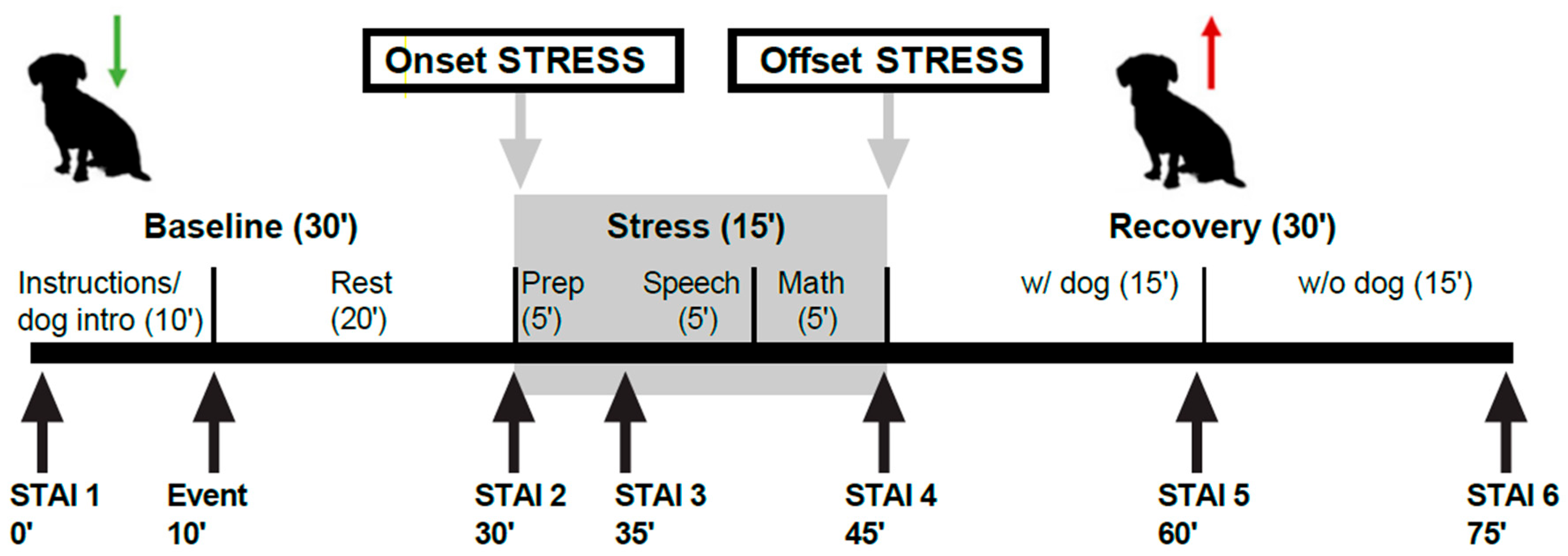
2.2. Procedures
2.3. Measures
2.3.1. Behavioral Observations
2.3.2. Self-Reported Anxiety
2.3.3. Physiological Arousal
2.4. Data Analysis
3. Results
4. Discussion
Limitations and Future Research
5. Conclusions
Author Contributions
Funding
Institutional Review Board Statement
Informed Consent Statement
Data Availability Statement
Acknowledgments
Conflicts of Interest
Abbreviations
| AAIs | Animal-Assisted Interventions |
| HAI | Human–Animal Interactions |
| EDA | Electrodermal Activity |
| STAI | State-Trait Anxiety Inventory |
References
- American Psychiatric Association. (2013). Anxiety disorders. In Diagnostic and statistical manual of mental disorders (5th ed.). American Psychiatric Association. Available online: https://psychiatryonline.org/doi/book/10.1176/appi.books.9780890425596 (accessed on 2 March 2026).
- Barcelos, A. M., Kargas, N., Maltby, J., & Mills, D. S. (2023). Potential psychosocial explanations for the impact of pet ownership on human well-being: Evaluating and expanding current hypotheses. Human-Animal Interactions, 2023, 8. [Google Scholar] [CrossRef]
- Barker, L. E., & Shaw, K. M. (2015). Best (but oft-forgotten) practices: Checking assumptions concerning regression residuals. American Journal of Clinical Nutrition, 102(3), 533–539. [Google Scholar] [CrossRef]
- Beerda, B., Schilder, M. B. H., van Hooff, J. A. R. A. M., de Vries, H. W., & Mol, J. A. (2000). Behavioural and hormonal indicators of enduring environmental stress in dogs. Animal Welfare, 9(1), 49–62. [Google Scholar] [CrossRef]
- Binfet, J.-T., Green, F. L. L., & Draper, Z. A. (2021). The importance of client–canine contact in canine-assisted interventions: A randomized controlled trial. Anthrozoös, 35(1), 1–22. [Google Scholar] [CrossRef]
- Brandão, C., Sampaio, M., Sousa-Gomes, V., Fávero, M., & Moreira, D. (2025). Effects of animal-assisted therapy for anxiety reduction in children and adolescents: A systematic review. Journal of Clinical Medicine, 14(1), 287. [Google Scholar] [CrossRef] [PubMed]
- Bryce, A., Nurkin, P., & Horowitz, A. (2024). Shake it off: Investigating the function of a domestic dog behavior in social contexts. Animals, 14(22), 3248. [Google Scholar] [CrossRef] [PubMed]
- Burstein, M., He, J. P., Kattan, G., Albano, A. M., Avenevoli, S., & Merikangas, K. R. (2011). Social phobia and subtypes in the national comorbidity survey-adolescent supplement: Prevalence, correlates, and comorbidity. Journal of the American Academy of Child & Adolescent Psychiatry, 50(9), 870–880. [Google Scholar] [CrossRef]
- Buske-Kirschbaum, A., Jobst, S., Wustmans, A., Kirschbaum, C., Rauh, W., & Hellhammer, D. (1997). Attenuated free cortisol response to psychosocial stress in children with atopic dermatitis. Biopsychosocial Science and Medicine, 59(4), 419–426. [Google Scholar] [CrossRef]
- Buttner, A. P., & Strasser, R. (2014). Contagious yawning, social cognition, and arousal: An investigation of the processes underlying shelter dogs’ responses to human yawns. Animal Cognition, 17(1), 95–104. [Google Scholar] [CrossRef]
- Chiu, K., Clark, D. M., & Leigh, E. (2021). Prospective associations between peer functioning and social anxiety in adolescents: A systematic review and meta-analysis. Journal of Affective Disorders, 279, 650–661. [Google Scholar] [CrossRef]
- Dowling-Guyer, S., Dabney, K., Robertson, E. A. R., & Mueller, M. K. (2024). Behavior coding of adolescent and therapy dog interactions during a social stress task. Veterinary Sciences, 11(12), 644. [Google Scholar] [CrossRef]
- Duranton, C. (2020). Local synchrony as a tool to estimate affiliation in dogs. Journal of Veterinary Behavior, 36, 48–53. [Google Scholar] [CrossRef]
- Duranton, C., & Gaunet, F. (2015). Canis sensitivus: Affiliation and dogs’ sensitivity to others’ behavior as the basis for synchronization with humans? Journal of Veterinary Behavior, 10(6), 513–524. [Google Scholar] [CrossRef]
- Ellis, P. D. (2010). The essential guide to effect sizes: Statistical power, meta-analysis, and the interpretation of research results. Cambridge University Press. [Google Scholar] [CrossRef]
- Empatica Inc. (n.d.). E4 wristband. Available online: https://www.empatica.com/research/e4/ (accessed on 16 October 2024).
- Epstein, J., Dowling-Guyer, S., McCobb, E., Glotzer, C., & Dodman, N. H. (2021). Addressing stress in dogs in shelters through a novel visual and auditory enrichment device. Applied Animal Behaviour Science, 236, 105215. [Google Scholar] [CrossRef]
- Erichsmeier, R., Arney, D., & Soonberg, M. (2025). Behavioral observations of dogs during animal-assisted interventions and their handlers’ perceptions of their experienced level of stress. Journal of Applied Animal Welfare Science, 1–12. [Google Scholar] [CrossRef]
- Etheridge, H. (2019). A beginner’s guide to animal-assisted intervention terminology. Pet Partners. Available online: https://petpartners.org/a-beginners-guide-to-animal-assisted-intervention-terminology/ (accessed on 29 November 2025).
- Faul, F., Erdfelder, E., Buchner, A., & Lang, A.-G. (2009). Statistical power analyses using G*Power 3.1: Tests for correlation and regression analyses. Behavior Research Methods, 41, 1149–1160. [Google Scholar] [CrossRef]
- Flynn, E., Valdovinos, M. G., Mueller, M. K., & Morris, K. N. (2025). A relational developmental theory of human-animal interaction: A meta-synthesis and grounded theory. Developmental Review, 75, 101181. [Google Scholar] [CrossRef]
- Flynn, E., Zoller, A. G., Gandenberger, J., & Morris, K. N. (2022). Improving engagement in behavioral and mental health services through animal-assisted interventions: A scoping review. Psychiatric Services, 73(2), 188–195. [Google Scholar] [CrossRef] [PubMed]
- Gandenberger, J., Flynn, E., Moratto, E., Wendt, A., & Morris, K. N. (2022). Molecular biomarkers of adult human and dog stress during canine-assisted interventions: A systematic scoping review. Animals, 12(5), 651. [Google Scholar] [CrossRef] [PubMed]
- Gandenberger, J., Ledreux, A., Taeckens, A., Murphy, K., Forkin, J., Gilmore, A., & Morris, K. N. (2024). The presence of a pet dog is associated with a more balanced response to a social stressor. Stresses, 4(3), 598–613. [Google Scholar] [CrossRef]
- Glenk, L. M. (2017). Current perspectives on therapy dog welfare in animal-assisted interventions. Animals, 7(2), 7. [Google Scholar] [CrossRef]
- Glenk, L. M., & Foltin, S. (2021). Therapy dog welfare revisited: A review of the literature. Veterinary Sciences, 8(10), 226. [Google Scholar] [CrossRef] [PubMed]
- Glenk, L. M., Kothgassner, O. D., Stetina, B. U., Palme, R., Kepplinger, B., & Baran, H. (2014). Salivary cortisol and behavior in therapy dogs during animal-assisted interventions: A pilot study. Journal of Veterinary Behavior, 9(3), 98–106. [Google Scholar] [CrossRef]
- Green, F. L., Dahlman, M. L., Lomness, A., & Binfet, J.-T. (2024). For the love of acronyms: An analysis of terminology and acronyms used in AAI research 2013–2023. Human-Animal Interactions, 12, 1–10. [Google Scholar] [CrossRef]
- Haller, S. P., Cohen Kadosh, K., Scerif, G., & Lau, J. Y. (2015). Social anxiety disorder in adolescence: How developmental cognitive neuroscience findings may shape understanding and interventions for psychopathology. Developmental Cognitive Neuroscience, 13, 11–20. [Google Scholar] [CrossRef]
- Heit, D. R., Ortiz-Calo, W., Poisson, M. K. P., Butler, A. R., & Moll, R. J. (2024). Generalized nonlinearity in animal ecology: Research, review, and recommendations. Ecology and Evolution, 14(7), e11387. [Google Scholar] [CrossRef] [PubMed]
- Hoagwood, K. E., Acri, M., Morrissey, M., & Peth-Pierce, R. (2017). Animal-assisted therapies for youth with or at risk for mental health problems: A systematic review. Applied Developmental Science, 21(1), 1–13. [Google Scholar] [CrossRef] [PubMed]
- Hoy-Gerlach, J., & Townsend, L. (2023). Reimagining healthcare: Human–animal bond support as a primary, secondary, and tertiary public health intervention. International Journal of Environmental Research and Public Health, 20, 5272. [Google Scholar] [CrossRef]
- IBM Corporation. (n.d.). IBM SPSS software. Available online: https://www.ibm.com/products/spss (accessed on 2 March 2026).
- International Association of Human-Animal Interaction Organizations. (2018). IAHAIO white paper: The IAHAIO definitions for animal assisted intervention and guidelines for wellness of animals involved. Available online: https://iahaio.org/wp/wp-content/uploads/2021/01/iahaio-white-paper-2018-english.pdf (accessed on 2 March 2026).
- Kertes, D. A., Liu, J., Hall, N. J., Hadad, N. A., Wynne, C. D. L., & Bhatt, S. S. (2017). Effect of pet dogs on children’s perceived stress and cortisol stress response. Social Development, 26(2), 382–401. [Google Scholar] [CrossRef]
- Kilmer, M., Hong, M., Akakpo, V., Hawley, T., Randolph, D., Huetter, S., Reichel, A., & Bowden, M. (2025). The effect of animal-assisted therapy on prosocial behavior and emotional regulation in autistic children with varying verbal abilities: A pilot study. PLoS ONE, 20(7), e0326085. [Google Scholar] [CrossRef]
- Kretzler, B., Konig, H. H., & Hajek, A. (2022). Pet ownership, loneliness, and social isolation: A systematic review. Social Psychiatry and Psychiatric Epidemiology, 57(10), 1935–1957. [Google Scholar] [CrossRef]
- Kuhne, F., Hößler, J. C., & Struwe, R. (2012). Effects of human–dog familiarity on dogs’ behavioural responses to petting. Applied Animal Behaviour Science, 142(3–4), 176–181. [Google Scholar] [CrossRef]
- Kuhne, F., Hößler, J. C., & Struwe, R. (2014). Emotions in dogs being petted by a familiar or unfamiliar person: Validating behavioural indicators of emotional states using heart rate variability. Applied Animal Behaviour Science, 161, 113–120. [Google Scholar] [CrossRef]
- La Greca, A. M., & Lopez, N. (1998). Social anxiety among adolescents: Linkages with peer relations and friendships. Journal of Abnormal Child Psychology, 26(2), 83–94. [Google Scholar] [CrossRef]
- Leconstant, C., & Spitz, E. (2022). Integrative model of human-animal interactions: A one health–one welfare systemic approach to studying HAI. Frontiers in Veterinary Science, 9, 656833. [Google Scholar] [CrossRef] [PubMed]
- Lee, C. Y., Ngai, J. T. K., Chau, K. K. Y., Yu, R. W. M., & Wong, P. W. C. (2022). Development of a pilot human-canine ethogram for an animal-assisted education programme in primary schools—A case study. Applied Animal Behaviour Science, 255, 105725. [Google Scholar] [CrossRef]
- Mariti, C., Gazzano, A., Moore, J. L., Baragli, P., Chelli, L., & Sighieri, C. (2012). Perception of dogs’ stress by their owners. Journal of Veterinary Behavior, 7(4), 213–219. [Google Scholar] [CrossRef]
- Mariti, C., Raspanti, E., Zilocchi, M., Carlone, B., & Gazzano, A. (2015). The assessment of dog welfare in the waiting room of a veterinary clinic. Animal Welfare, 24(3), 299–305. [Google Scholar] [CrossRef]
- Marteau, T. M., & Bekker, H. (1992). The development of a six-item short-form of the state scale of the Spielberger State-Trait Anxiety Inventory (STAI). British Journal of Clinical Psychology, 31(3), 301–306. [Google Scholar] [CrossRef]
- Martin, M. J., Davies, P. T., & Cummings, E. M. (2017). Distinguishing attachment and affiliation in early adolescents’ narrative descriptions of their best friendship. Journal of Research on Adolescence, 27(3), 644–660. [Google Scholar] [CrossRef]
- Martins, C. F., Soares, J. P., Cortinhas, A., Silva, L., Cardoso, L., Pires, M. A., & Mota, M. P. (2023). Pet’s influence on humans’ daily physical activity and mental health: A meta-analysis. Frontiers in Public Health, 11, 1196199. [Google Scholar] [CrossRef]
- Mellor, D. J. (2016). Updating animal welfare thinking: Moving beyond the “Five Freedoms” towards “A Life Worth Living”. Animals, 6(3), 21. [Google Scholar] [CrossRef]
- Mellor, D. J., Beausoleil, N. J., Littlewood, K. E., McLean, A. N., McGreevy, P. D., Jones, B., & Wilkins, C. (2020). The 2020 five domains model: Including human–animal interactions in assessments of animal welfare. Animals, 10(10), 1870. [Google Scholar] [CrossRef]
- Mignot, A., de Luca, K., Servais, V., & Leboucher, G. (2022). Handlers’ representations on therapy dogs’ welfare. Animals, 12(5), 580. [Google Scholar] [CrossRef]
- Mueller, M. K., Anderson, E. C., King, E. K., & Urry, H. L. (2021). Null effects of therapy dog interaction on adolescent anxiety during a laboratory-based social evaluative stressor. Anxiety Stress Coping, 34(4), 365–380. [Google Scholar] [CrossRef]
- Nieforth, L. O., Guerin, N. A., Stehli, A., Schuck, S. E. B., Yi, K., & O’Haire, M. E. (2024). Observation of human-animal interaction for research (OHAIRE) behavior coding in a randomized control trial of children with attention-deficit hyperactivity disorder (ADHD) and a canine-assisted intervention. Frontiers in Psychiatry, 15, 1327380. [Google Scholar] [CrossRef] [PubMed]
- Nilsson, A., Lidfors, L., Wichman, A., Handlin, L., Petersson, M., & Uvnäs-Moberg, K. (2024). Influence of interactive behaviors induced by a therapy dog and her handler on the physiology of residents in nursing homes: An exploratory study. Anthrozoös, 37(2), 323–342. [Google Scholar] [CrossRef]
- O’Haire, M. E., McKenzie, S. J., Beck, A. M., & Slaughter, V. (2015). Animals may act as social buffers: Skin conductance arousal in children with autism spectrum disorder in a social context. Developmental Psychobiology, 57(5), 584–595. [Google Scholar] [CrossRef]
- Payne, E., Bennett, P. C., & McGreevy, P. D. (2015). Current perspectives on attachment and bonding in the dog-human dyad. Psychology Research and Behavior Management, 8, 71–79. [Google Scholar] [CrossRef]
- Pedretti, G., Canori, C., Marshall-Pescini, S., Pavan, G., & Valsecchi, P. (2023). Behavioural analysis of dogs’ response to threatening and neutral conspecific video stimuli. Applied Sciences, 13(16), 9254. [Google Scholar] [CrossRef]
- Pet Partners. (n.d.). Volunteer program requirements. Available online: https://petpartners.org/volunteer/requirements/ (accessed on 13 October 2025).
- Pet Partners. (2018). Pet partners therapy animal program handler guide. Available online: https://petpartners.org/publications/ (accessed on 2 March 2026).
- Pérez-Manrique, A., & Gomila, A. (2022). Emotional contagion in nonhuman animals: A review. WIREs Cognitive Science, 13(1). [Google Scholar] [CrossRef]
- Rial, L. A., Damián, J. P., & Bentosela, M. (2025). Affiliative and stress behaviors of domestic dogs when they witness a human conflict between their caregivers. Applied Animal Behaviour Science, 289, 106680. [Google Scholar] [CrossRef]
- Salari, N., Heidarian, P., Hassanabadi, M., Babajani, F., Abdoli, N., Aminian, M., & Mohammadi, M. (2024). Global prevalence of social anxiety disorder in children, adolescents and youth: A systematic review and meta-analysis. Journal of Prevention, 45(5), 795–813. [Google Scholar] [CrossRef]
- Santaniello, A., Garzillo, S., Cristiano, S., Fioretti, A., & Menna, L. F. (2021). The research of standardized protocols for dog involvement in animal-assisted therapy: A systematic review. Animals, 11(9), 2576. [Google Scholar] [CrossRef]
- Seligman, L. D., Ollendick, T. H., Langley, A. K., & Baldacci, H. B. (2004). The utility of measures of child and adolescent anxiety: A meta-analytic review of the revised children’s manifest anxiety scale, the state–trait anxiety inventory for children, and the child behavior checklist. Journal of Clinical Child & Adolescent Psychology, 33(3), 557–565. [Google Scholar] [CrossRef]
- Selya, A. S., Rose, J. S., Dierker, L. C., Hedeker, D., & Mermelstein, R. J. (2012). A practical guide to calculating cohen’s f(2), a measure of local effect size, from PROC MIXED. Frontiers in Psychology, 3, 111. [Google Scholar] [CrossRef] [PubMed]
- Sidel, S. B., Gandenberger, J., Murphy, K., & Morris, K. N. (2025). Recognizing and mitigating canine stress in human–canine interaction research: Proposed guidelines. Animals, 15(11), 1665. [Google Scholar] [CrossRef] [PubMed]
- Sim, S. Q., Liu, Z., Wu, Z., Wang, S., & Nisa, C. (2025). Canine-assisted therapy in reducing stress and anxiety levels of university students: Systematic review and meta-analysis of randomized controlled trials. BMC Complementary Medicine and Therapies, 25(1), 303. [Google Scholar] [CrossRef] [PubMed]
- Stoesz, B. M., Hare, J. F., & Snow, W. M. (2013). Neurophysiological mechanisms underlying affiliative social behavior: Insights from comparative research. Neuroscience & Biobehavioral Reviews, 37(2), 123–132. [Google Scholar] [CrossRef]
- Stroud, L. R., Foster, E., Papandonatos, G. D., Handwerger, K., Granger, D. A., Kivlighan, K. T., & Niaura, R. (2009). Stress response and the adolescent transition: Performance versus peer rejection stressors. Development and Psychopathology, 21(1), 47–68. [Google Scholar] [CrossRef]
- Sundman, A.-S., Van Poucke, E., Svensson Holm, A.-C., Faresjö, Å., Theodorsson, E., Jensen, P., & Roth, L. S. V. (2019). Long-term stress levels are synchronized in dogs and their owners. Scientific Reports, 9(1), 7391. [Google Scholar] [CrossRef] [PubMed]
- Townsend, L., & Gee, N. R. (2021). Recognizing and mitigating canine stress during animal assisted interventions. Veterinary Sciences, 8(11), 254. [Google Scholar] [CrossRef] [PubMed]
- Wood, W., Alm, K., Benjamin, J., Thomas, L., Anderson, D., Pohl, L., & Kane, M. (2021). Optimal terminology for services in the United States that incorporate horses to benefit people: A consensus document. The Journal of Alternative and Complementary Medicine, 27(1), 88–95. [Google Scholar] [CrossRef] [PubMed]

| Individual Behaviors | n | % | |
|---|---|---|---|
| Adolescent Stress Behaviors | Bites Nails (Duration) | 27 | 54.0% |
| Adolescent Affiliative Behaviors | Participant Talks to Handler (Duration) | 47 | 94.0% |
| Laughing (Count) | 45 | 90.0% | |
| Participant Talks to Dog (Duration) | 32 | 64.0% | |
| Dog Stress-Linked Behaviors | Panting (Duration) | 7 | 14.0% |
| Shake Off (Duration) | 22 | 44.0% | |
| Dog Affiliative Behaviors | Pawing at Participant (Count) | 12 | 24.0% |
| Sniff Participant (Duration) | 35 | 70.0% | |
| Wagging tail (Duration) | 26 | 52.0% | |
| Individual Behaviors | Mean | SD | Min | Max | |
|---|---|---|---|---|---|
| Adolescent Stress Behaviors | General Fidget (Duration, Seconds) | 824.44 | 493.84 | 0.00 | 2555.44 |
| Reposition (Count) | 96.54 | 49.07 | 0.00 | 214.00 | |
| Touch Face (Count) | 29.22 | 20.93 | 0.00 | 93.00 | |
| Yawn (Count) | 3.44 | 3.66 | 0.00 | 16.00 | |
| Adolescent Affiliative Behaviors | Smiling (Count) | 25.84 | 14.33 | 0.00 | 69.00 |
| Dog Stress-Linked Behaviors | Shift Within Position (Count) | 54.18 | 39.36 | 1.00 | 212.00 |
| Yawning (Count) | 1.92 | 2.35 | 0.00 | 11.00 | |
| Dog Affiliative Behaviors | Turn Head Towards Participant (Duration, Seconds) | 37.21 | 41.16 | 0.00 | 210.10 |
| Stress Reactivity | n | Mean | SD | Min | Max |
|---|---|---|---|---|---|
| EDA Peak | 50 | 3.23 | 2.36 | −0.92 | 8.61 |
| EDA Recovery | 50 | 1.35 | 1.89 | −4.29 | 6.93 |
| STAI Peak Anxiety | 47 | 5.34 | 2.15 | 2.00 | 11.00 |
| STAI Anxiety Recovery | 49 | 4.39 | 2.29 | −1.00 | 12.00 |
| Outcome | Adolescent Stress Behaviors | Estimate (B) | SE | β | R2 | f2 | 95% CI | p | |
|---|---|---|---|---|---|---|---|---|---|
| LL | UL | ||||||||
| EDA Peak | Bites Nails (Duration, Binary) | −0.327 | 0.674 | −0.070 | 0.005 | 0.00 | −1.682 | 1.028 | 0.630 |
| General Fidget (Duration, Continuous) | −0.055 | 0.340 | −0.024 | 0.001 | 0.00 | −0.739 | 0.628 | 0.871 | |
| Reposition (Count, Continuous) | −0.270 | 0.338 | −0.115 | 0.013 | 0.01 | −0.949 | 0.410 | 0.428 | |
| Touch Face (Count, Continuous) | −0.341 | 0.337 | −0.145 | 0.021 | 0.02 | −1.018 | 0.336 | 0.316 | |
| Yawn (Count, Continuous) | 0.148 | 0.340 | 0.063 | 0.004 | 0.00 | −0.535 | 0.830 | 0.666 | |
| EDA Recovery | Bites Nails (Duration, Binary) | −0.231 | 0.543 | −0.061 | 0.004 | 0.00 | −1.323 | 0.861 | 0.673 |
| General Fidget (Duration, Continuous) | 0.022 | 0.274 | 0.011 | 0.000 | 0.00 | −0.529 | 0.572 | 0.938 | |
| Reposition (Count, Continuous) | 0.508 | 0.264 | 0.267 | 0.072 | 0.08 | −0.023 | 1.038 | 0.060 | |
| Touch Face (Count, Continuous) | 0.329 | 0.270 | 0.173 | 0.030 | 0.03 | −0.213 | 0.872 | 0.229 | |
| Yawn (Count, Continuous) | 0.182 | 0.273 | 0.096 | 0.009 | 0.01 | −0.367 | 0.730 | 0.009 | |
| STAI Peak | Bites Nails (Duration, Binary) | 0.127 | 0.635 | 0.030 | 0.001 | 0.00 | −1.152 | 1.406 | 0.842 |
| General Fidget (Duration, Continuous) | −0.315 | 0.311 | −0.149 | 0.022 | 0.02 | −0.942 | 0.312 | 0.317 | |
| Reposition (Count, Continuous) | −0.183 | 0.318 | −0.085 | 0.007 | 0.01 | −0.823 | 0.458 | 0.568 | |
| Touch Face (Count, Continuous) | 0.080 | 0.319 | 0.037 | 0.001 | 0.00 | −0.562 | 0.723 | 0.802 | |
| Yawn (Count, Continuous) | 0.533 | 0.318 | 0.243 | 0.059 | 0.06 | −0.107 | 1.173 | 0.101 | |
| STAI Recovery | Bites Nails (Duration, Binary) | 0.485 | 0.659 | 0.107 | 0.011 | 0.01 | −0.840 | 1.810 | 0.465 |
| General Fidget (Duration, Continuous) | −0.319 | 0.327 | −0.141 | 0.020 | 0.02 | −0.978 | 0.339 | 0.335 | |
| Reposition (Count, Continuous) | −0.186 | 0.336 | −0.081 | 0.006 | 0.01 | −0.861 | 0.489 | 0.582 | |
| Touch Face (Count, Continuous) | −0.046 | 0.333 | −0.020 | 0.000 | 0.00 | −0.716 | 0.624 | 0.891 | |
| Yawn (Count, Continuous) | 0.371 | 0.329 | 0.162 | 0.026 | 0.03 | −0.291 | 1.033 | 0.266 | |
| Outcome | Adolescent Affiliative Behaviors | Estimate (B) | SE | β | R2 | f2 | 95% CI | p | |
|---|---|---|---|---|---|---|---|---|---|
| LL | UL | ||||||||
| EDA Peak | Participant Talks to Handler (Duration, Binary) | 0.257 | 1.418 | 0.026 | 0.001 | 0.00 | −2.593 | 3.108 | 0.857 |
| Laughing (Count, Binary) | −0.090 | 1.123 | −0.012 | 0.000 | 0.00 | −2.347 | 2.167 | 0.937 | |
| Smiling (Count, Continuous) | −0.132 | 0.340 | −0.056 | 0.003 | 0.00 | −0.815 | 0.551 | 0.699 | |
| Participant Talks to Dog (Duration, Binary) | 0.075 | 0.702 | 0.016 | 0.000 | 0.00 | −1.335 | 1.486 | 0.915 | |
| EDA Recovery | Participant Talks to Handler (Duration, Binary) | 0.767 | 1.137 | 0.097 | 0.009 | 0.01 | −1.518 | 3.052 | 0.503 |
| Laughing (Count, Binary) | 0.160 | 0.904 | 0.026 | 0.001 | 0.00 | −1.657 | 1.977 | 0.860 | |
| Smiling (Count, Continuous) | 0.320 | 0.270 | 0.169 | 0.029 | 0.03 | −0.222 | 0.863 | 0.241 | |
| Participant Talks to Dog (Duration, Binary) | 0.737 | 0.555 | 0.188 | 0.035 | 0.04 | −0.379 | 1.853 | 0.191 | |
| STAI Peak | Participant Talks to Handler (Duration, Binary) | 0.356 | 1.570 | 0.034 | 0.001 | 0.00 | −2.806 | 3.517 | 0.822 |
| Laughing (Count, Binary) | 0.605 | 1.024 | 0.088 | 0.008 | 0.01 | −1.458 | 2.668 | 0.558 | |
| Smiling (Count, Continuous) | 0.095 | 0.313 | 0.045 | 0.002 | 0.00 | −0.535 | 0.725 | 0.763 | |
| Participant Talks to Dog (Duration, Binary) | 0.349 | 0.658 | 0.079 | 0.006 | 0.01 | −0.976 | 1.674 | 0.598 | |
| STAI Recovery | Participant Talks to Handler (Duration, Binary) | 0.404 | 1.670 | 0.035 | 0.001 | 0.00 | −2.954 | 3.763 | 0.810 |
| Laughing (Count, Binary) | 0.209 | 1.092 | 0.028 | 0.001 | 0.00 | −1.987 | 2.405 | 0.849 | |
| Smiling (Count, Continuous) | 0.126 | 0.331 | 0.056 | 0.003 | 0.00 | −0.539 | 0.792 | 0.704 | |
| Participant Talks to Dog (Duration, Binary) | −0.090 | 0.686 | −0.019 | 0.000 | 0.00 | −1.469 | 1.290 | 0.897 | |
| Outcome | Dog Stress-Linked Behaviors | Estimate (B) | SE | β | R2 | f2 | 95% CI | p | |
|---|---|---|---|---|---|---|---|---|---|
| LL | UL | ||||||||
| EDA Peak | Panting (Duration, Binary) | 0.591 | 0.967 | 0.088 | 0.008 | 0.01 | −1.353 | 2.535 | 0.544 |
| Shake Off (Duration, Binary) | −1.089 | 0.660 | −0.232 | 0.054 | 0.06 | −2.416 | 0.238 | 0.105 | |
| Shift Within Position (Count, Continuous) | −0.132 | 0.340 | −0.056 | 0.003 | 0.00 | −0.815 | 0.550 | 0.698 | |
| Yawning (Count, Continuous) | −0.023 | 0.340 | −0.010 | 0.000 | 0.00 | −0.707 | 0.661 | 0.947 | |
| EDA Recovery | Panting (Duration, Binary) | −0.738 | 0.774 | −0.136 | 0.019 | 0.02 | −2.294 | 0.819 | 0.346 |
| Shake Off (Duration, Binary) | −0.214 | 0.545 | −0.056 | 0.003 | 0.00 | −1.311 | 0.883 | 0.697 | |
| Shift Within Position (Count, Continuous) | −0.449 | 0.266 | −0.236 | 0.056 | 0.06 | −0.984 | 0.086 | 0.098 | |
| Yawning (Count, Continuous) | −0.540 | 0.263 | −0.284 | 0.081 | 0.09 | −1.068 | −0.012 | 0.045 | |
| STAI Peak | Panting (Duration, Binary) | −0.199 | 0.950 | −0.031 | 0.001 | 0.00 | −2.112 | 1.713 | 0.835 |
| Shake Off (Duration, Binary) | −1.550 | 0.598 | −0.360 | 0.130 | 0.15 | −2.755 | −0.345 | 0.013 | |
| Shift Within Position (Count, Continuous) | 0.025 | 0.312 | 0.012 | 0.000 | 0.00 | −0.604 | 0.654 | 0.937 | |
| Yawning (Count, Continuous) | −0.030 | 0.316 | −0.014 | 0.000 | 0.00 | −0.666 | 0.606 | 0.925 | |
| STAI Recovery | Panting (Duration, Binary) | 0.508 | 1.006 | 0.073 | 0.005 | 0.01 | −1.515 | 2.531 | 0.616 |
| Shake Off (Duration, Binary) | 0.071 | 0.668 | 0.016 | 0.000 | 0.00 | −1.272 | 1.415 | 0.915 | |
| Shift Within Position (Count, Continuous) | 0.398 | 0.326 | 0.176 | 0.031 | 0.03 | −0.257 | 1.053 | 0.228 | |
| Yawning (Count, Continuous) | 0.139 | 0.332 | 0.061 | 0.004 | 0.00 | −0.529 | 0.808 | 0.667 | |
| Outcome | Dog Affiliative Behaviors | Estimate (B) | SE | β | R2 | f2 | 95% CI | p | |
|---|---|---|---|---|---|---|---|---|---|
| LL | UL | ||||||||
| EDA Peak | Turn Head Towards Participant (Duration, Continuous) | −0.356 | 0.336 | −0.151 | 0.023 | 0.02 | −1.032 | 0.321 | 0.296 |
| Pawing at Participant (Count, Binary) | 0.618 | 0.784 | 0.113 | 0.013 | 0.01 | −0.958 | 2.193 | 0.434 | |
| Sniffing Participant (Duration, Binary) | 0.205 | 0.734 | 0.040 | 0.002 | 0.00 | −1.271 | 1.682 | 0.781 | |
| Wagging Tail (Duration, Binary) | −0.215 | 0.673 | −0.046 | 0.002 | 0.00 | −1.569 | 1.139 | 0.751 | |
| EDA Recovery | Turn Head Towards Participant (Duration, Continuous) | −0.041 | 0.274 | −0.022 | 0.000 | 0.00 | −0.592 | 0.509 | 0.880 |
| Pawing at Participant (Count, Binary) | −0.162 | 0.635 | −0.037 | 0.001 | 0.00 | −1.438 | 1.114 | 0.800 | |
| Sniffing Participant (Duration, Binary) | −0.462 | 0.588 | −0.113 | 0.013 | 0.01 | −1.645 | 0.720 | 0.436 | |
| Wagging Tail (Duration, Binary) | −0.627 | 0.535 | −0.167 | 0.028 | 0.03 | −1.703 | 0.449 | 0.247 | |
| STAI Peak | Turn Head Towards Participant (Duration, Continuous) | −0.233 | 0.315 | −0.110 | 0.012 | 0.01 | −0.867 | 0.401 | 0.436 |
| Pawing at Participant (Count, Binary) | −0.682 | 0.742 | −0.136 | 0.018 | 0.02 | −2.176 | 0.812 | 0.363 | |
| Sniffing Participant (Duration, Binary) | −0.185 | 0.680 | −0.041 | 0.002 | 0.00 | −1.554 | 1.183 | 0.786 | |
| Wagging Tail (Duration, Binary) | −0.471 | 0.631 | −0.110 | 0.012 | 0.01 | −1.743 | 0.801 | 0.460 | |
| STAI Recovery | Turn Head Towards Participant (Duration, Continuous) | 0.071 | 0.332 | 0.031 | 0.001 | 0.00 | −0.596 | 0.739 | 0.830 |
| Pawing at Participant (Count, Binary) | 0.555 | 0.788 | 0.102 | 0.010 | 0.01 | −1.030 | 2.140 | 0.485 | |
| Sniffing Participant (Duration, Binary) | −0.594 | 0.712 | −0.121 | 0.015 | 0.02 | −2.060 | 0.838 | 0.408 | |
| Wagging Tail (Duration, Binary) | −0.908 | 0.649 | −0.200 | 0.040 | 0.04 | −2.214 | 0.398 | 0.168 | |
Disclaimer/Publisher’s Note: The statements, opinions and data contained in all publications are solely those of the individual author(s) and contributor(s) and not of MDPI and/or the editor(s). MDPI and/or the editor(s) disclaim responsibility for any injury to people or property resulting from any ideas, methods, instructions or products referred to in the content. |
© 2026 by the authors. Licensee MDPI, Basel, Switzerland. This article is an open access article distributed under the terms and conditions of the Creative Commons Attribution (CC BY) license.
Share and Cite
Mason, N.; Dowling-Guyer, S.; Anderson, E.C.; Mueller, M.K. Behavioral Predictors of Adolescent Anxiety During Therapy Dog Interactions Within an Experimental Setting. Behav. Sci. 2026, 16, 391. https://doi.org/10.3390/bs16030391
Mason N, Dowling-Guyer S, Anderson EC, Mueller MK. Behavioral Predictors of Adolescent Anxiety During Therapy Dog Interactions Within an Experimental Setting. Behavioral Sciences. 2026; 16(3):391. https://doi.org/10.3390/bs16030391
Chicago/Turabian StyleMason, Nicole, Seana Dowling-Guyer, Eric C. Anderson, and Megan K. Mueller. 2026. "Behavioral Predictors of Adolescent Anxiety During Therapy Dog Interactions Within an Experimental Setting" Behavioral Sciences 16, no. 3: 391. https://doi.org/10.3390/bs16030391
APA StyleMason, N., Dowling-Guyer, S., Anderson, E. C., & Mueller, M. K. (2026). Behavioral Predictors of Adolescent Anxiety During Therapy Dog Interactions Within an Experimental Setting. Behavioral Sciences, 16(3), 391. https://doi.org/10.3390/bs16030391

