The Effect of Solution-Focused Brief Group Counseling on Adolescents’ Self-Confidence Levels
Abstract
1. Introduction
1.1. Self-Confidence in Adolescence
1.2. Solution-Focused Brief Therapy (SFBT) and Its Mechanisms
1.3. The Present Study
- Solution-Focused Brief Counseling will significantly increase the level of self-confidence of adolescents.
- There will be a significant difference between the self-confidence levels of the experimental groups (who received the intervention) and the control groups for both low and moderate self-confidence levels, and these improvements will be maintained during the follow-up period.
2. Materials and Methods
2.1. Study Design
2.2. Data Collection Tools
Self-Confidence Scale
2.3. Participants and Group Formation
- Low self-confidence experimental group.
- Low self-confidence control group.
- Moderate self-confidence experimental group.
- Moderate self-confidence control group.
2.4. Development Process of the Intervention
- Session 1 (Welcome/Orienting): Creating group rules, introducing the concept of self-confidence, helping members determine individual goals, and drawing attention to positive change using the “Miracle Question” technique.
- Session 2 (Awareness and Solutions): Exploring pre-session changes, reframing negative self-perceptions, and using “Scaling Questions” to help clients visualize their progress and set manageable steps.
- Session 3 (Strengths and Boundaries): Highlighting the importance of saying “No.” Using “Exception Questions” to identify times when self-confidence was not an issue, and reinforcing positive steps with the “Compliment” technique.
- Session 4 (Assertiveness Training): Differentiating among avoidant, aggressive, and assertive behaviors. Practicing assertiveness to directly build self-confidence.
- Session 5 (Problem-Solving Skills): Equipping clients with problem-solving tools, encouraging the “Search for Solution” mindset, and rehearsing coping strategies for difficult situations.
- Session 6 (Termination): Assessing the achievement of initial goals using “Scaling Questions”, providing mutual positive feedback (“Love Bombing” activity), and finalizing the termination process.
2.5. Data Analysis
3. Results
3.1. Results Related to Adolescents with Low Self-Confidence
3.2. Results Related to Adolescents with Moderate Self-Confidence
4. Discussion and Conclusions
4.1. Discussion of the Findings
4.2. Mechanisms of Change, Group Dynamics, and Developmental Factors
4.3. Limitations and Future Directions
- Sample Size and Sampling: The study utilized a relatively small sample size (n = 48 total; n = 12 per subgroup). Additionally, the use of single-site sampling (one high school in a specific province) and its cultural specificity to the Turkish educational context limit the generalizability of the findings to broader or more diverse populations.
- Lack of an Active Control Group: The control groups in this study received no intervention. Without an active control group (e.g., a group receiving an alternative psycho-educational activity or general counseling), it is difficult to completely rule out whether the improvements were due to the specific SFBT techniques or simply the result of receiving attention and being part of a group (the Hawthorne effect).
- Researcher Effects: The intervention was administered by the researcher, which introduces the potential for researcher expectancy effects. The researcher’s enthusiasm and belief in the therapy might have influenced the participants’ responses.
4.4. Conclusions
Author Contributions
Funding
Institutional Review Board Statement
Informed Consent Statement
Data Availability Statement
Acknowledgments
Conflicts of Interest
References
- Akın, A. (2007). Özgüven ölçeğinin geliştirilmesi ve psikometrik özellikleri [Development of the self-confidence scale and its psychometric properties]. Abant İzzet Baysal Üniversitesi Eğitim Fakültesi Dergisi, 7(2), 165–175. [Google Scholar]
- Akkuş, Z. (2015). Ergenlerde psikolojik dayanıklılığın özgüven ve anne baba tutumları ile ilişkisi [The relationship between psychological resilience, self-confidence, and parental attitudes in adolescents] [Unpublished Master’s Thesis]. Dokuz Eylül University.
- Alşan, Ç. Z. (2005). Anormal yeme tutum ve davranışlarının aile ortamı, özgüven ve mükemmeliyetçilikle ilişkisi [The relationship of abnormal eating attitudes and behaviors with family environment, self-confidence, and perfectionism] [Unpublished Master’s Thesis]. İstanbul University.
- Altıntaş, E. (2015). Kuramdan uygulamaya özgüven [Self-confidence from theory to practice]. Nobel Akademik Yayıncılık. [Google Scholar]
- Berg, I. K., & Miller, S. (1992). Working with problem drinkers. Norton. [Google Scholar]
- Bilgin, O. (2011). Ergenlerde özgüven düzeyinin bazı değişkenler açısından incelenmesi [Investigation of self-confidence levels in adolescents in terms of some variables] [Unpublished Master’s Thesis]. Sakarya University.
- Bingöl, T. Y. (2015). Çözüm odaklı kısa süreli yaklaşıma dayalı grup rehberliği programının öz-yeterlik inancına etkisi [The effect of a group guidance program based on a solution-focused brief approach on self-efficacy belief] [Unpublished Doctoral Dissertation]. Sakarya University.
- Çitemel, N. (2014). Çözüm odaklı kısa süreli grupla psikolojik danışmanın lise öğrencilerinin akran zorbalığına etkisi [The effect of solution-focused brief group counseling on peer bullying among high school students] [Unpublished Doctoral Dissertation]. Sakarya University.
- De Shazer, S., Berg, I. K., Lipchik, E., Nunnally, E., Molnar, A., Gingerich, W., & Weiner-Davis, M. (1986). Brief therapy: Focused solution development. Family Process, 25(2), 207–221. [Google Scholar] [CrossRef] [Scilit] [PubMed]
- Eisengart, S., & Gingerich, W. J. (2000). Solution-focused brief therapy: A review of the outcome research. Family Process, 39(4), 477–498. [Google Scholar]
- Eldeleklioğlu, J. (2004). Çocuklarda özgüven gelişimi [Development of self-confidence in children]. Gazi Üniversitesi Eğitim Fakültesi Dergisi, 24(2), 111–121. [Google Scholar]
- Gingerich, W. J., & Wabeke, T. (2001). A solution-focused approach to mental health intervention in school settings. Children & Schools, 23(1), 33–47. [Google Scholar] [CrossRef] [Scilit]
- Gladding, S. T. (2013). Counseling: A comprehensive profession [Psikolojik danışma] (N. V. Acar, Trans.; 6th ed.). Nobel Akademik Yayıncılık. [Google Scholar]
- Göknar, Ö. (2010). Özgüven kazanmak [Gaining self-confidence] (2nd ed.). Arkadaş Yayınevi. [Google Scholar]
- Hildingh, C., Russell, L., Amir, B., & Evy, L. (2006). Stress, health complaints and self-confidence: A comparison between young adult women in Sweden and USA. Scandinavian Journal of Caring Sciences, 20(2), 202–208. [Google Scholar] [CrossRef] [Scilit] [PubMed]
- İlbay, A. B. (2014). Çözüm odaklı kısa süreli grupla psikolojik danışmanın üniversite öğrencilerinin tükenmişlik düzeyleri üzerindeki etkisi [The effect of solution-focused brief group counseling on burnout levels of university students] [Unpublished Doctoral Dissertation]. Sakarya University.
- Kurtuldu, P. S. (2007). İlköğretim okulu yöneticilerinin özgüven düzeyleri ile liderlik düzeyleri arasındaki ilişkinin incelenmesi [Investigation of the relationship between self-confidence levels and leadership levels of primary school administrators] [Unpublished Master’s Thesis]. Yeditepe University.
- Kvarme, L. G., Helseth, S., Sorum, R., Luth-Hansen, V., Haugland, S., & Natvig, G. K. (2010). The effect of a solution-focused approach to improve self-efficacy in socially withdrawn school children: A non-randomized controlled trial. International Journal of Nursing Studies, 47(11), 1389–1396. [Google Scholar] [CrossRef] [Scilit] [PubMed]
- Leggett, M. E. S. (2004). The effects of a solution-focused classroom guidance intervention with elementary students [Unpublished Doctoral Dissertation]. Texas A&M University–Corpus Christi.
- Lines, D. (2006). Brief counselling in schools: Working with young people from 11 to 18 (2nd ed.). Sage Publications. [Google Scholar]
- Macdonald, A. (2007). Solution-focused therapy: Theory, research and practice. Sage Publications. [Google Scholar]
- Mckay, M., & Fanning, P. (2009). Self-esteem [Özgüven] (F. G. Atay, Trans.; 4th ed.). Arkadaş Yayınevi. [Google Scholar]
- Merey, B. (2010). Yetişkinlerde özgüven duygusu ile anksiyete düzeyi arasındaki ilişkinin karşılaştırılması ve kültürlerarası bir yaklaşım [Comparison of the relationship between the feeling of self-confidence and anxiety levels in adults and a cross-cultural approach] [Unpublished Master’s Thesis]. Maltepe University.
- Meydan, B. (2013). Çözüm odaklı kısa süreli psikolojik danışma: Okullardaki etkililiği üzerine bir inceleme [Solution-focused brief counseling: A review of its effectiveness in schools]. Türk Psikolojik Danışma ve Rehberlik Dergisi, 4(39), 120–129. [Google Scholar]
- Murphy, J. J. (2008). Solution-focused counseling in schools. American Counseling Association. [Google Scholar]
- Newsome, W. S. (2005). The impact of solution-focused brief therapy with at-risk junior high school students. Children & Schools, 27, 83–90. [Google Scholar]
- Okyay, B. (2012). Yönetici ve çalışanların özgüven düzeyleri ve kişisel gelişim inisiyatifi alma becerilerinin karşılaştırılması [Comparison of self-confidence levels and personal development initiative-taking skills of managers and employees] [Unpublished Master’s Thesis]. Maltepe University.
- Özcan, H. (1996). İlkokul öğrencilerinin öz güvenleri, akademik başarıları ve anne baba tutumları arasındaki ilişkiler [The relationships among self-confidence, academic achievement, and parental attitudes of primary school students] [Unpublished Doctoral Dissertation]. Marmara University.
- Sarıcı-Bulut, S. (2008). İlköğretim ikinci kademe öğrencilerinin sınav kaygıları, saldırganlık eğilimleri ve problem çözme becerilerindeki yetersizliklerin sağaltımında grupla çözüm odaklı kısa terapinin etkileri [The effects of solution-focused brief group therapy in the treatment of test anxiety, aggressive tendencies, and deficiencies in problem-solving skills of middle school students] [Unpublished Doctoral Dissertation]. Atatürk University.
- Sklare, B. G. (2010). Brief counseling that works: A solution-focused approach for school counselors [Okul danışmanları için çözüm odaklı kısa süreli psikolojik danışma] (Ç. M. Siyez, & A. Kaya, Trans.). PegemA Yayıncılık. [Google Scholar]
- Soner, O. (1995). Aile uyumu, öğrenci özgüveni ve akademik başarı arasındaki ilişkiler [The relationships among family cohesion, student self-confidence, and academic achievement] [Unpublished Doctoral Dissertation]. Marmara University.
- Springer, D. W., Lynch, C., & Rubin, A. (2000). Effects of a solution-focused mutual aid group for Hispanic children of incarcerated parents. Child and Adolescent Social Work Journal, 17(6), 431–432. [Google Scholar] [CrossRef] [Scilit]
- Suner, E. (2000). Farklı liselerdeki ergenlerin benlik saygısı, akademik başarı ve sürekli kaygı düzeyi arasındaki ilişki [The relationship between self-esteem, academic achievement, and trait anxiety levels of adolescents in different high schools] [Unpublished Master’s Thesis]. Dokuz Eylül University.
- Umutlu, Ç. (2010). Çocuk dostu okul projesi kapsamında olan ve olmayan ilköğretim okulu öğrencilerinin özgüvenleri ile zorbalık eğilimlerinin incelenmesi [Investigation of self-confidence and bullying tendencies of primary school students within and outside the scope of the child-friendly school project] [Unpublished Master’s Thesis]. Yeditepe University.
- Uysal, R. (2014). Çözüm odaklı kısa süreli yaklaşıma dayalı bir müdahale programının ergenlerde risk alma davranışına etkisi [The effect of an intervention program based on a solution-focused brief approach on risk-taking behavior in adolescents] [Unpublished Doctoral Dissertation]. Sakarya University.


| Groups | Pre-Test | Procedure | Post-Test | Follow-Up |
|---|---|---|---|---|
| Experimental groups | SS * | Solution-Focused Brief Counseling Application (6 sessions) | SS | SS |
| Control groups | SS | No procedure | SS | SS |
| Low Self-Confidence | Moderate Self-Confidence | ||||
|---|---|---|---|---|---|
| Experimental | Control | Experimental | Control | ||
| Gender | Female | 5 | 4 | 6 | 6 |
| Male | 7 | 8 | 6 | 6 | |
| Grade | 9 | 3 | 4 | 2 | 7 |
| 10 | 4 | 4 | 7 | 2 | |
| 11 | 5 | 4 | 3 | 3 | |
| Group | Pre-Test | Post-Test | Follow-Up Test | ||||||
|---|---|---|---|---|---|---|---|---|---|
| N | S | N | S | N | S | ||||
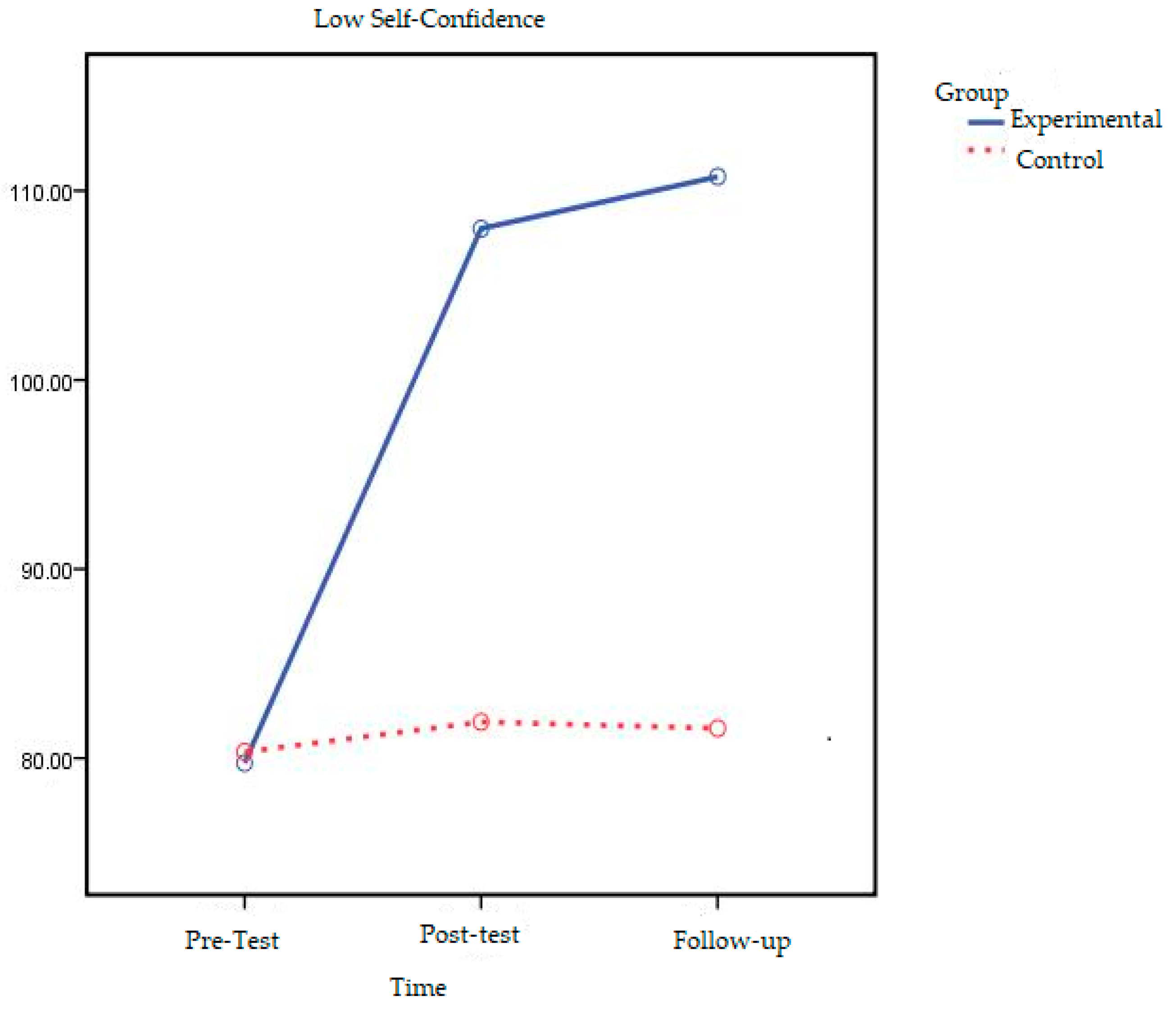
| Experimental | 12 | 79.75 | 2.34 | 12 | 108 | 11.92 | 12 | 110.75 | 9.09 |
| Control | 12 | 80.33 | 1.66 | 12 | 81.91 | 5.99 | 12 | 81.58 | 6.17 |
| Source of the Variance | Sum of Squares | Sd | Average of Squares | F | p | η2 |
|---|---|---|---|---|---|---|
| Between groups | 8173.111 | 23 | ||||
| Intervention (Experimental/Control) | 5976.889 | 1 | 5976.889 | 59.872 | 0.000 | 0.731 |
| Error | 2196.222 | 22 | 99.828 | |||
| Intragroup | 8266 | 48 | ||||
| Time (pre-test, post-test, follow-up test) | 3871.861 | 2 | 1935.931 | 72.018 | 0.000 | 0.766 |
| Intervention × Time | 3211.361 | 2 | 1605.681 | 59.732 | 0.000 | 0.731 |
| Error | 1182.778 | 44 | 26.881 |
| Experimental Group | Control Group | ||||||
|---|---|---|---|---|---|---|---|
| Pre-Test | Post-Test | Follow-Up | Pre-Test | Post-Test | Follow-Up | ||
| Experimental | Pre-Test | - | −28.25 ** | −31.00 ** | |||
| Post-Test | - | −2.75 | 26.09 ** | ||||
| Follow-up | - | 29.17 ** | |||||
| Control | Pre-Test | - | −1.58 | −1.25 | |||
| Post-Test | - | 0.33 | |||||
| Follow-up | - | ||||||
| Group | Pre-Test | Post-Test | Follow-Up Test | ||||||
|---|---|---|---|---|---|---|---|---|---|
| N | S | N | S | N | S | ||||
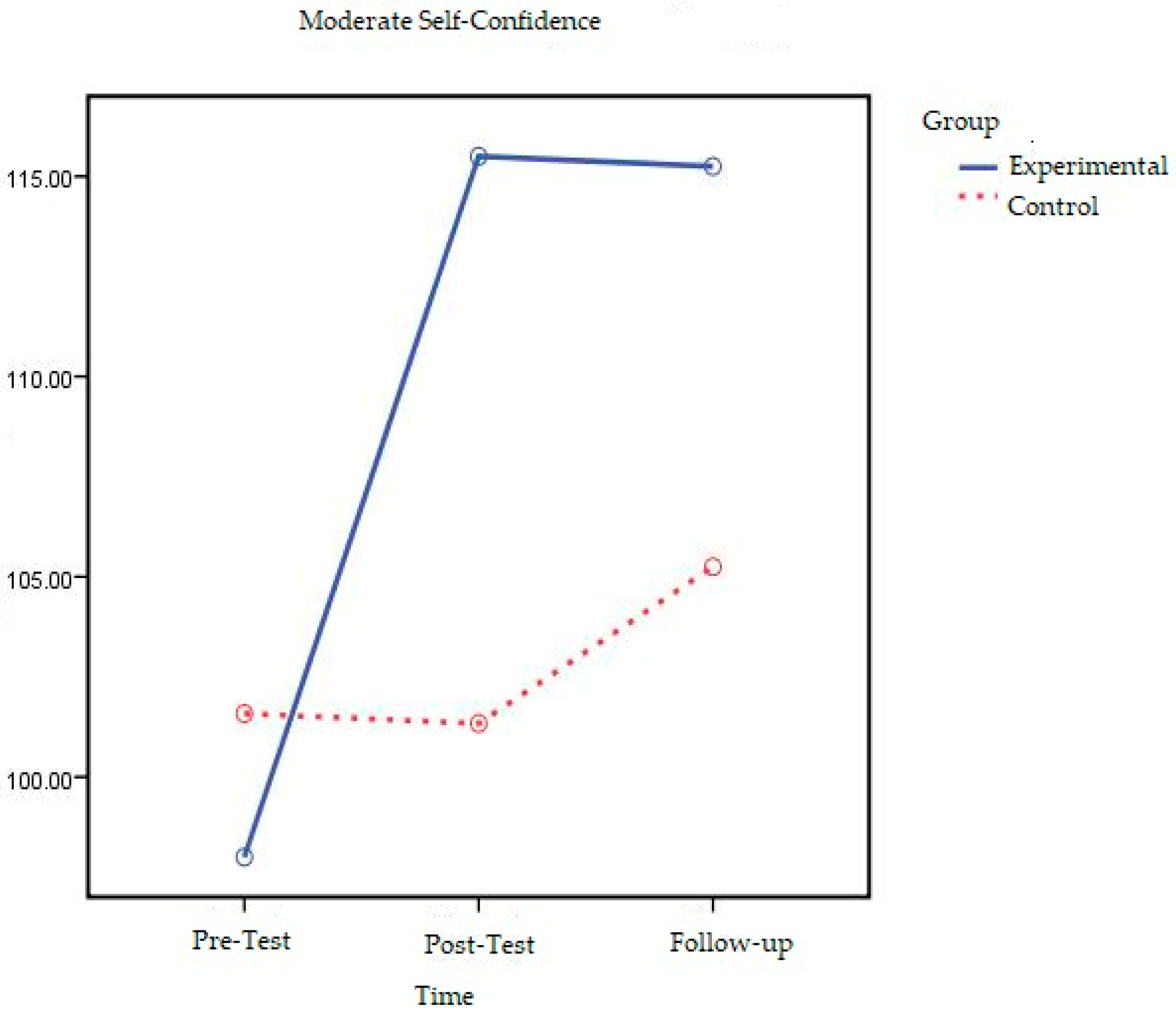
| Experimental | 12 | 98 | 7.45 | 12 | 115.50 | 11.40 | 12 | 115.25 | 10.50 |
| Control | 12 | 101.58 | 5.93 | 12 | 101.33 | 7.02 | 12 | 105.25 | 7.16 |
| Source of the Variance | Sum of Squares | Sd | Average of Squares | F | p | η2 |
|---|---|---|---|---|---|---|
| Between groups | 4665.986 | 23 | ||||
| Intervention (Experimental/Control) | 847.347 | 1 | 847.347 | 4.882 | 0.038 | 0.182 |
| Error | 3818.639 | 22 | 173.574 | |||
| Intragroup | 3463.333 | 48 | ||||
| Time (pre-test, post-test, follow-up test) | 1497.028 | 2 | 748.514 | 35.321 | 0.000 | 0.616 |
| Intervention × Time | 1033.861 | 2 | 516.931 | 24.393 | 0.000 | 0.526 |
| Error | 932.444 | 44 | 21.192 |
| Experimental Group | Control Group | ||||||
|---|---|---|---|---|---|---|---|
| Pre-Test | Post-Test | Follow-Up | Pre-Test | Post-Test | Follow Up | ||
| Experimental | Pre-Test | - | −17.50 ** | −17.25 ** | |||
| Post-Test | - | 0.25 | 14.17 ** | ||||
| Follow up | - | 10.00 | |||||
| Control | Pre-Test | - | 0.25 | −3.67 | |||
| Post-Test | - | −3.92 | |||||
| Follow up | - | ||||||
Disclaimer/Publisher’s Note: The statements, opinions and data contained in all publications are solely those of the individual author(s) and contributor(s) and not of MDPI and/or the editor(s). MDPI and/or the editor(s) disclaim responsibility for any injury to people or property resulting from any ideas, methods, instructions or products referred to in the content. |
© 2026 by the authors. Licensee MDPI, Basel, Switzerland. This article is an open access article distributed under the terms and conditions of the Creative Commons Attribution (CC BY) license.
Share and Cite
Bilgin, O.; Koç, M. The Effect of Solution-Focused Brief Group Counseling on Adolescents’ Self-Confidence Levels. Behav. Sci. 2026, 16, 378. https://doi.org/10.3390/bs16030378
Bilgin O, Koç M. The Effect of Solution-Focused Brief Group Counseling on Adolescents’ Self-Confidence Levels. Behavioral Sciences. 2026; 16(3):378. https://doi.org/10.3390/bs16030378
Chicago/Turabian StyleBilgin, Okan, and Mustafa Koç. 2026. "The Effect of Solution-Focused Brief Group Counseling on Adolescents’ Self-Confidence Levels" Behavioral Sciences 16, no. 3: 378. https://doi.org/10.3390/bs16030378
APA StyleBilgin, O., & Koç, M. (2026). The Effect of Solution-Focused Brief Group Counseling on Adolescents’ Self-Confidence Levels. Behavioral Sciences, 16(3), 378. https://doi.org/10.3390/bs16030378