
Psychological Flexibility Moderates the Association Between Multidimensional Stress and Psychological Distress in Medical Postgraduates: A Multi-Center Cross-Sectional Study



Abstract
1. Introduction
1.1. Graduate Stress and Mental Health: The Unique Situation of Medical Postgraduates
1.2. Psychological Flexibility and Mental Health: Direct and Indirect Pathways
1.3. The Present Study
2. Materials and Methods
2.1. Participants
2.2. Measures
2.2.1. Symptom Checklist-90 (SCL-90)
2.2.2. Sources of Postgraduate Stress
2.2.3. Psychological Flexibility
2.3. Procedure
2.4. Data Analysis
2.4.1. Factor Analysis
2.4.2. Moderation Analysis
3. Results
3.1. Relationships Among Sources of Postgraduate Stress, Psychological Health, and Psychological Flexibility
3.2. The Moderating Role of Psychological Flexibility in the Relationship Between Postgraduate Life Variables and Mental Health
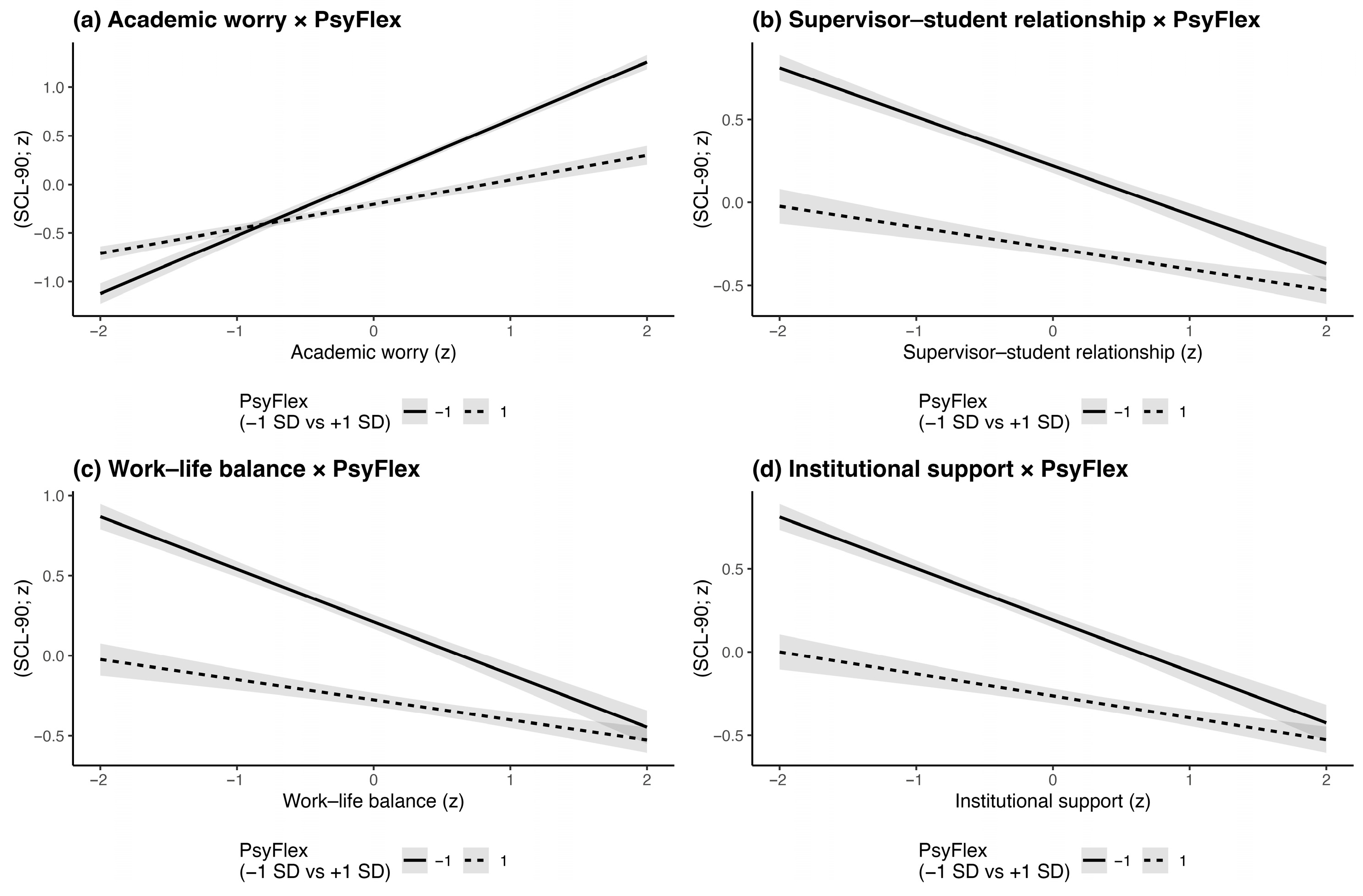
3.2.1. Psychological Flexibility as a Moderator of the Relationship Between Academic Worry and Psychological Health
3.2.2. Psychological Flexibility as a Moderator of the Relationship Between Supervisor–Student Relationship and Psychological Health
3.2.3. Psychological Flexibility as a Moderator of the Relationship Between Work–Life Balance and Psychological Health
3.2.4. Psychological Flexibility as a Moderator of the Relationship Between Institutional Supports and Psychological Health
4. Discussion
4.1. Theoretical Contributions
4.2. Practical Implications
4.3. Limitations and Future Directions
Supplementary Materials
Author Contributions
Funding
Institutional Review Board Statement
Informed Consent Statement
Data Availability Statement
Conflicts of Interest
Abbreviations
| ACT | Acceptance and Commitment Therapy |
| SCL-90 | Symptom Checklist-90 |
| Comp ACT | Comprehensive Assessment of ACT progress |
| EFA | Exploratory Factor Analysis |
| KMO | The Kaiser–Meyer–Olkin Measure |
| CFA | Confirmatory Factor Analysis |
Appendix A

| Item | Factor 1 | Factor 2 | Factor 3 | Factor 4 | Communality |
|---|---|---|---|---|---|
| 1. I have concerns about future job opportunities | 0.87 | 0.72 | |||
| 2. I have anxiety over personal competence and achievements | 0.84 | 0.66 | |||
| 3. I have financial security concerns | 0.83 | 0.62 | |||
| 4. I have worries about devaluation of graduate degrees | 0.79 | 0.63 | |||
| 5. I have fear of delayed graduation | 0.75 | 0.55 | |||
| 6. I have mental health apprehensions | 0.57 | 0.49 | |||
| 7. I have concerns about negative work–life integration | 0.54 | 0.60 | |||
| 8. I have anxiety regarding delayed stipend payments | 0.52 | 0.33 | |||
| 9. I have a good advisor-advisee relationship | 0.97 | 0.83 | |||
| 10. I can feel my supervisor’s support | 0.96 | 0.81 | |||
| 11. I can feel recognition from supervisor | 0.87 | 0.73 | |||
| 12. I have good research group welfare | 0.71 | 0.64 | |||
| 13. I can feel helpful instruction in my research group | 0.44 | 0.55 | |||
| 14. I have conference participation opportunities | 0.42 | 0.49 | |||
| 15. I have work autonomy | 0.94 | 0.74 | |||
| 16. I have workload manageability | 0.93 | 0.74 | |||
| 17. I have leave flexibility | 0.90 | 0.74 | |||
| 18. I have good work–life balance | 0.77 | 0.75 | |||
| 19. I have good social environment | 0.51 | 0.50 | |||
| 20. My university provides individual psychological counseling | 0.98 | 0.84 | |||
| 21. My university provides mental health activities | 0.95 | 0.85 | |||
| 22. My university provides mental health services | 0.85 | 0.72 | |||
| 23. My university supports student work–life balance | 0.74 | 0.76 | |||
| Proportion of variance explained | 42.90 | 9.24 | 7.42 | 6.16 | |
| Cumulative proportion of variance explained | 42.90 | 52.14 | 59.55 | 65.71 |
References
- Al Saadi, T., Zaher Addeen, S., Turk, T., Abbas, F., & Alkhatib, M. (2017). Psychological distress among medical students in conflicts: A cross-sectional study from Syria. BMC Medical Education, 17, 173. [Google Scholar] [CrossRef] [Scilit]
- Althubaiti, A., & Althubaiti, S. M. (2022). Medical research: What to expect in a student–supervisor relationship. BMC Medical Education, 22, 774. [Google Scholar] [CrossRef] [Scilit]
- Cohen, J. S., & Patten, S. (2005). Well-being in residency training: A survey examining resident physician satisfaction both within and outside of residency training and mental health in Alberta. BMC Medical Education, 5, 21. [Google Scholar] [CrossRef] [Scilit]
- Davis, A. K., Barrett, F. S., & Griffiths, R. R. (2020). Psychological flexibility mediates the relations between acute psychedelic effects and subjective decreases in depression and anxiety. Journal of Contextual Behavioral Science, 15, 39–45. [Google Scholar] [CrossRef] [Scilit] [PubMed]
- Denckla, C. A., Consedine, N. S., Chung, W. J., Stein, M., Roche, M., & Blais, M. (2018). A double-edged sword? Sub-types of psychological flexibility are associated with distinct psychiatric disorders. Journal of Research in Personality, 77, 119–125. [Google Scholar] [CrossRef] [Scilit] [PubMed]
- Derogatis, L. R., & Unger, R. (2010). Symptom checklist-90-revised. In I. B. Weiner, & W. E. Craighead (Eds.), The corsini encyclopedia of psychology (4th ed., pp. 1–2). John Wiley & Sons. [Google Scholar] [CrossRef] [Scilit]
- Dyrbye, L. N., & Shanafelt, T. D. (2011). Commentary: Medical student distress: A call to action. Academic Medicine, 86(7), 801–803. [Google Scholar] [CrossRef] [Scilit] [PubMed]
- Feather, G., & Williams, M. (2022). The moderating effects of psychological flexibility and psychological inflexibility on the relationship between climate concern and climate-related distress. Journal of Contextual Behavioral Science, 23, 137–143. [Google Scholar] [CrossRef] [Scilit]
- Gaston-Hawkins, L. A., Solorio, F. A., Chao, G. F., & Green, C. R. (2020). The silent epidemic: Causes and consequences of medical learner burnout. Current Psychiatry Reports, 22, 86. [Google Scholar] [CrossRef] [Scilit]
- Grégoire, S., Chénier, C., Doucerain, M., Lachance, L., & Shankland, R. (2020). Ecological momentary assessment of stress, well-being, and psychological flexibility among college and university students during acceptance and commitment therapy. Canadian Journal of Behavioral Science/Revue Canadienne des Sciences du Comportment, 52(3), 231–243. [Google Scholar] [CrossRef] [Scilit]
- Grégoire, S., Lachance, L., Bouffard, T., & Dionne, F. (2018). The use of acceptance and commitment therapy to promote mental health and school engagement in university students: A multisite randomized controlled trial. Behavior Therapy, 49(3), 360–372. [Google Scholar] [CrossRef] [Scilit]
- Guo, J., Huang, X., Zheng, A., Chen, W., Lei, Z., Tang, C., Chen, H., Ma, H., & Li, X. (2022). The influence of self-esteem and psychological flexibility on medical college students’ mental health: A cross-sectional study. Frontiers in Psychiatry, 13, 836956. [Google Scholar] [CrossRef] [Scilit]
- Hayes, A. F. (2022). Introduction to mediation, moderation, and conditional process analysis—A regression-based approach (3rd. ed.). Guilford Press. [Google Scholar]
- Hayes, S. C. (2004). Acceptance and commitment therapy, relational frame theory, and the third wave of behavioral and cognitive therapies. Behavior Therapy, 35(4), 639–665. [Google Scholar] [CrossRef] [Scilit]
- Holmberg, J., Kemani, M. K., Holmström, L., Öst, L.-G., & Wicksell, R. K. (2020). Psychological flexibility and its relationship to distress and work engagement among intensive care medical staff. Frontiers in Psychology, 11, 603986. [Google Scholar] [CrossRef] [Scilit]
- Hsu, T., Adamowicz, J. L., & Thomas, E. B. K. (2023). The effect of acceptance and commitment therapy on the psychological flexibility and inflexibility of undergraduate students: A systematic review and three-level meta-analysis. Journal of Contextual Behavioral Science, 30, 169–180. [Google Scholar] [CrossRef] [Scilit] [PubMed]
- Kelly, M., Soles, R., Garcia, E., & Kundu, I. (2020). Job stress, burnout, work-life balance, well-being, and job satisfaction among pathology residents and fellows. American Journal of Clinical Pathology, 153(4), 449–469. [Google Scholar] [CrossRef] [Scilit]
- Lucas, J. J., & Moore, K. A. (2020). Psychological flexibility: Positive implications for mental health and life satisfaction. Health Promotion International, 35(2), 312–320. [Google Scholar] [CrossRef] [Scilit]
- Mao, Y., Zhang, N., Liu, J., Zhu, B., He, R., & Wang, X. (2019). A systematic review of depression and anxiety in medical students in China. BMC Medical Education, 19, 327. [Google Scholar] [CrossRef] [Scilit]
- Marshall, E.-J., & Brockman, R. N. (2016). The relationships between psychological flexibility, self-compassion, and emotional well-being. Journal of Cognitive Psychotherapy, 30(1), 60–72. [Google Scholar] [CrossRef] [Scilit] [PubMed]
- Rotenstein, L. S., Ramos, M. A., Torre, M., Segal, J. B., Peluso, M. J., Guille, C., Sen, S., & Mata, D. A. (2016). Prevalence of depression, depressive symptoms, and suicidal ideation among medical students: A systematic review and meta-analysis. JAMA, 316(21), 2214–2236. [Google Scholar] [CrossRef] [Scilit] [PubMed]
- Stockton, D., Kellett, S., Berrios, R., Sirois, F., Wilkinson, N., & Miles, G. (2019). Identifying the underlying mechanisms of change during Acceptance and Commitment Therapy (ACT): A systematic review of contemporary mediation studies. Behavioural and Cognitive Psychotherapy, 47(3), 332–362. [Google Scholar] [CrossRef] [Scilit]
- Trindade, I. A., Ferreira, N. B., Mendes, A. L., Ferreira, C., Dawson, D., & Golijani-Moghaddam, N. (2021). Comprehensive assessment of Acceptance and Commitment Therapy processes (CompACT): Measure refinement and study of measurement invariance across Portuguese and UK samples. Journal of Contextual Behavioral Science, 21, 30–36. [Google Scholar] [CrossRef] [Scilit]
- Westhoff, M., Heshmati, S., Siepe, B., Vogelbacher, C., Ciarrochi, J., Hayes, S. C., & Hofmann, S. G. (2024). Psychological flexibility and cognitive-affective processes in young adults’ daily lives. Scientific Reports, 14(1), 8182. [Google Scholar] [CrossRef] [Scilit] [PubMed]
- Woolston, C. (2022). Stress and uncertainty drag down graduate students’ satisfaction. Nature, 610, 805–808. [Google Scholar] [CrossRef] [Scilit]
- Wu, Y., Qu, Z., Tang, W., Zheng, Y., Xiong, X., Ye, Z., & Li, Z. (2024). Reducing the risk of suicidal behaviors in medical graduate students: Exploration of student-supervisor relationship and subjective family socioeconomic status. Frontiers in Psychiatry, 15, 1381291. [Google Scholar] [CrossRef] [Scilit] [PubMed]
- Ye, W. Q. W., Rietze, B. A., McQueen, S., Zhang, K., Quilty, L. C., & Wickens, C. M. (2023). Barriers to accessing mental health support services in undergraduate medical training: A multicenter, qualitative study. Academic Medicine, 98(4), 491–496. [Google Scholar] [CrossRef] [Scilit]
- Zhang, L., Huang, S., Liu, S., Huang, Y., Chen, S., Hu, J., & Xu, M. (2024). Effectiveness of an internet-based acceptance and commitment therapy intervention for reducing psychological distress in health care professionals: Randomized controlled trial. Journal of Medical Internet Research, 26, e59093. [Google Scholar] [CrossRef] [Scilit]

| Measure | M | SD | 1 | 2 | 3 | 4 | 5 | 6 |
|---|---|---|---|---|---|---|---|---|
| 1 Psychological flexibility | 5.0 | 0.6 | - | - | - | - | - | - |
| 2 Academic worry | 2.8 | 0.9 | −0.40 *** | - | - | - | - | - |
| 3 Supervisor-student relationship | 4.0 | 0.6 | −0.33 *** | −0.55 *** | - | - | - | - |
| 4 Work–life balance | 3.5 | 0.7 | /0.32 *** | −0.56 *** | /0.60 *** | - | - | - |
| 5 Institutional supports | 3.8 | 0.7 | /0.40 *** | −0.54 *** | /0.55 *** | /0.58 *** | - | - |
| 6 Psychological distress | 1.2 | 0.3 | −0.32 *** | /0.47 *** | −0.30 *** | −0.30 *** | −0.31 | - |
Disclaimer/Publisher’s Note: The statements, opinions and data contained in all publications are solely those of the individual author(s) and contributor(s) and not of MDPI and/or the editor(s). MDPI and/or the editor(s) disclaim responsibility for any injury to people or property resulting from any ideas, methods, instructions or products referred to in the content. |
© 2026 by the authors. Licensee MDPI, Basel, Switzerland. This article is an open access article distributed under the terms and conditions of the Creative Commons Attribution (CC BY) license.
Share and Cite
Lai, Y.; Gu, Y.; Chen, Y.; Hu, Z.; Zheng, W. Psychological Flexibility Moderates the Association Between Multidimensional Stress and Psychological Distress in Medical Postgraduates: A Multi-Center Cross-Sectional Study. Behav. Sci. 2026, 16, 374. https://doi.org/10.3390/bs16030374
Lai Y, Gu Y, Chen Y, Hu Z, Zheng W. Psychological Flexibility Moderates the Association Between Multidimensional Stress and Psychological Distress in Medical Postgraduates: A Multi-Center Cross-Sectional Study. Behavioral Sciences. 2026; 16(3):374. https://doi.org/10.3390/bs16030374
Chicago/Turabian StyleLai, Yuan, Yu Gu, Yanqi Chen, Zhengjuan Hu, and Wen Zheng. 2026. "Psychological Flexibility Moderates the Association Between Multidimensional Stress and Psychological Distress in Medical Postgraduates: A Multi-Center Cross-Sectional Study" Behavioral Sciences 16, no. 3: 374. https://doi.org/10.3390/bs16030374
APA StyleLai, Y., Gu, Y., Chen, Y., Hu, Z., & Zheng, W. (2026). Psychological Flexibility Moderates the Association Between Multidimensional Stress and Psychological Distress in Medical Postgraduates: A Multi-Center Cross-Sectional Study. Behavioral Sciences, 16(3), 374. https://doi.org/10.3390/bs16030374