AI and the Future of Work: Assessing Occupational Social Status Perceptions Among University Students


Abstract
1. Introduction
1.1. Theoretical Foundation and Measurement of Occupational Social Status
1.2. The Dual Impacts of AI on Employment and Occupational Cognition
1.3. Research Gaps and Core Research Questions
2. Experiment 1: Exploring University Students’ Perception of AI as a Threat to Social Status
2.1. Method
2.1.1. Participants
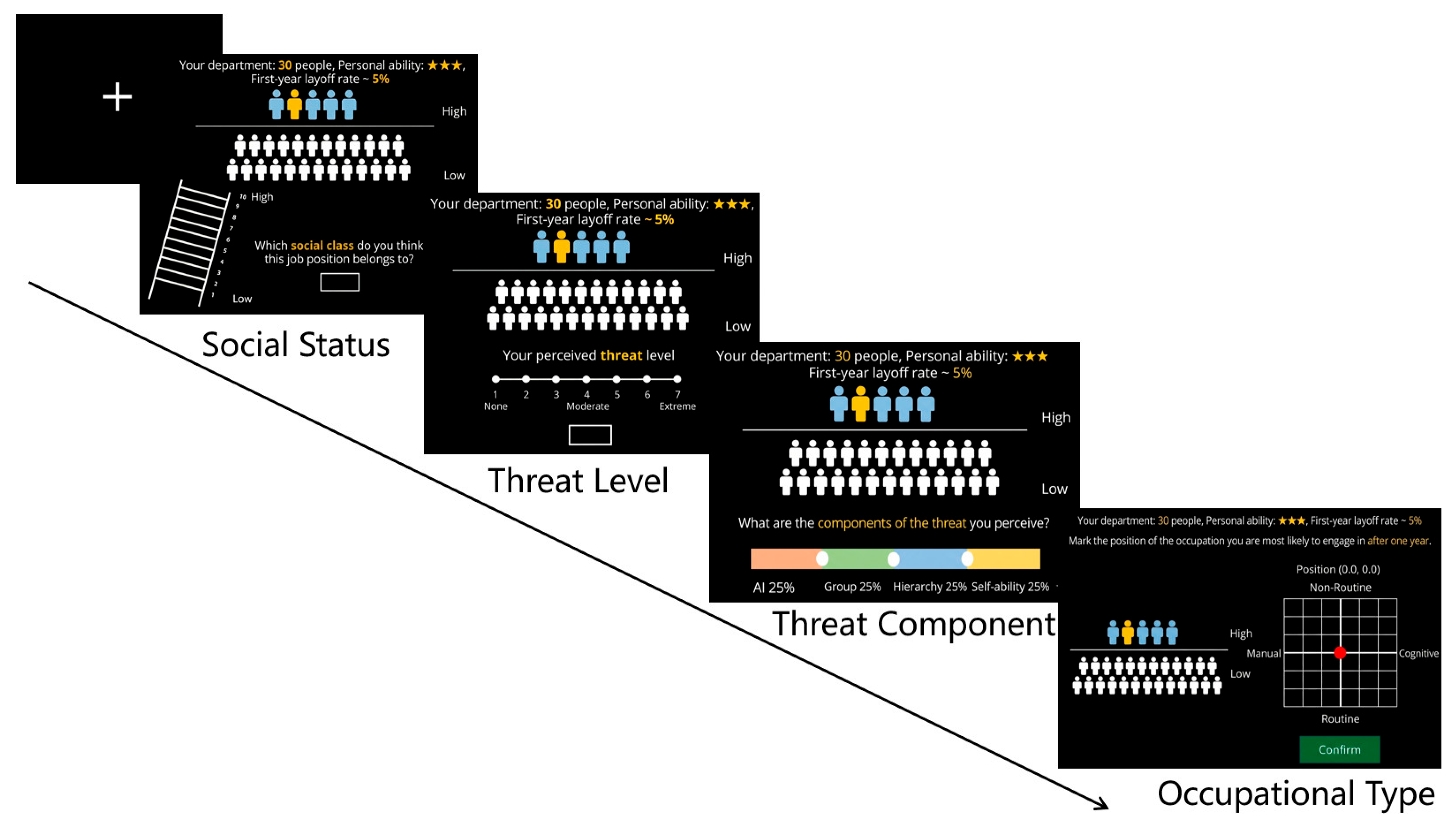
2.1.2. Experimental Design and Procedure
2.2. Statistical Analyses
2.3. Results
2.3.1. Occupational Social Status and Perception of Status Threat
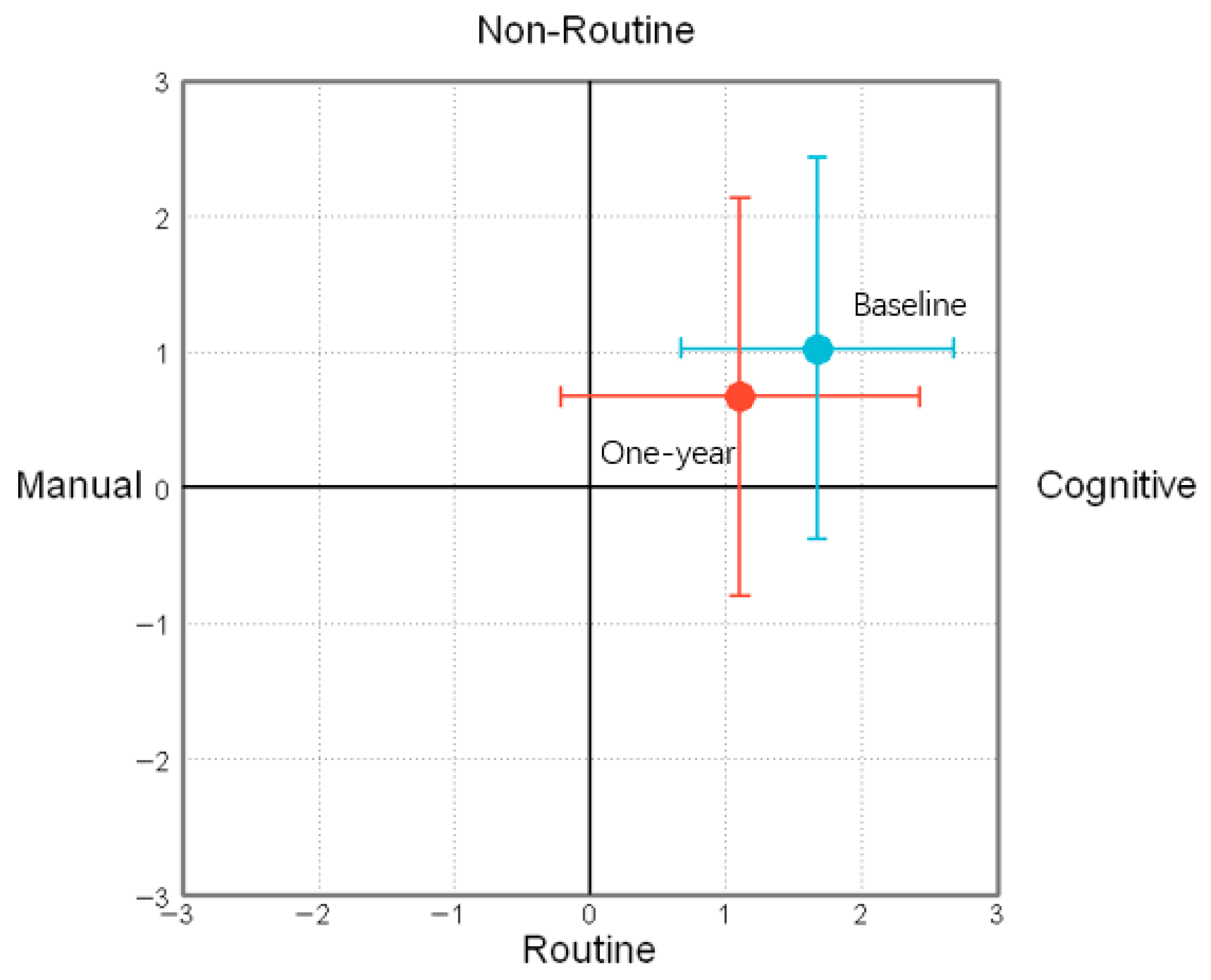
2.3.2. Occupational Type Adjustment After One Year
2.4. Discussion
3. Experiment 2: AI Involvement’s Impact on Cognitive-Type Occupation
3.1. Method
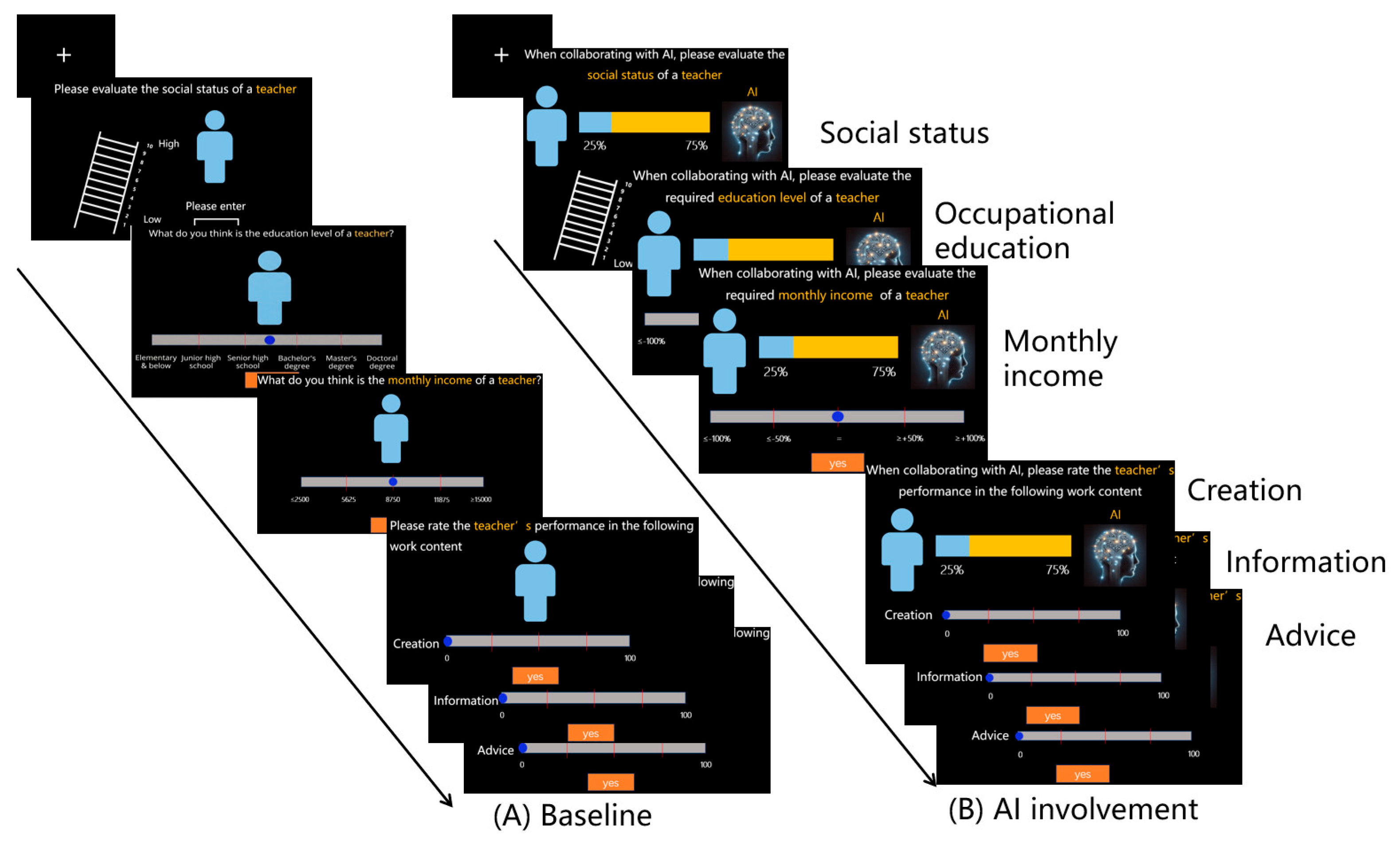
Experimental Design and Procedure
3.2. Statistical Analyses
3.3. Results
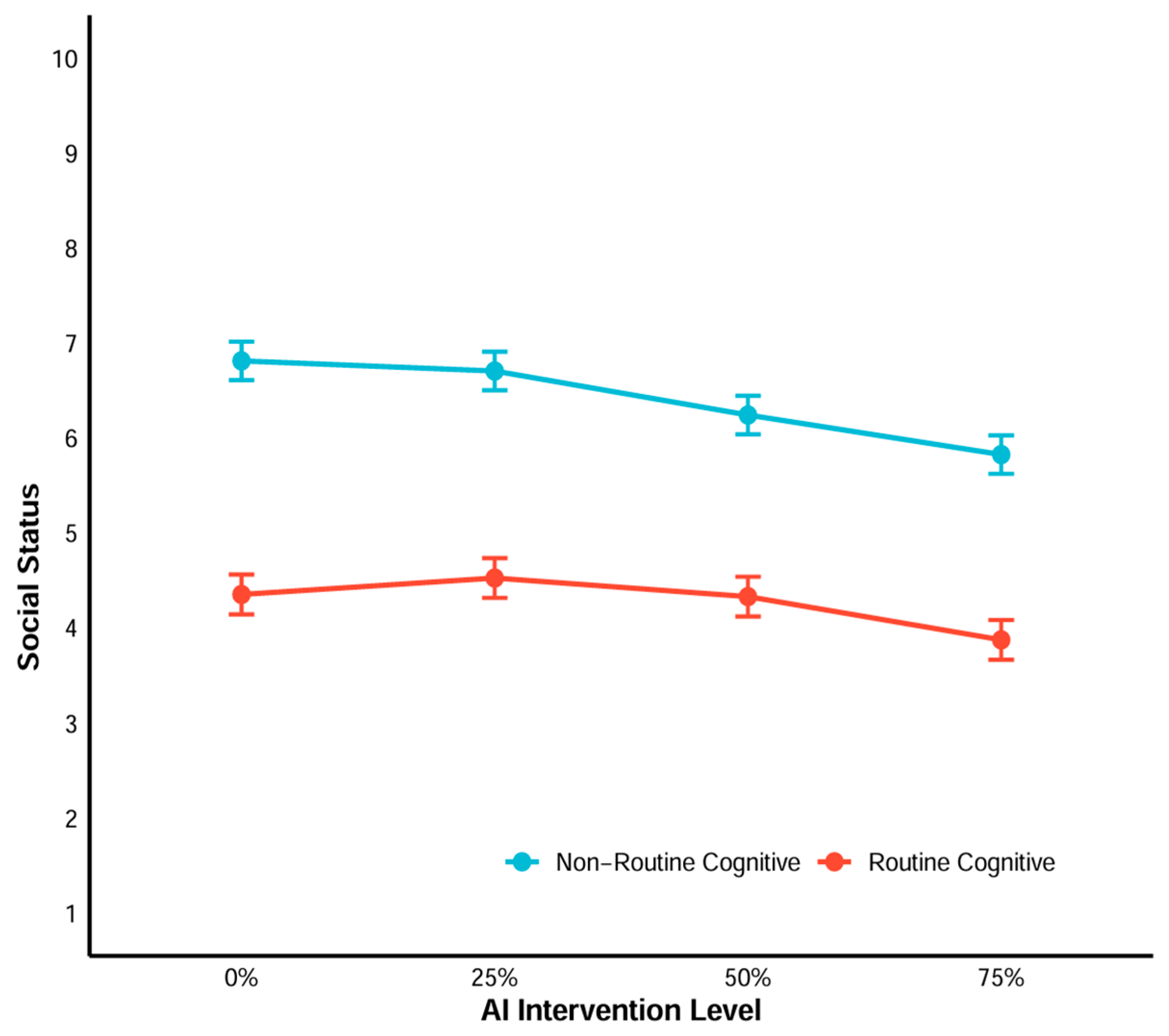
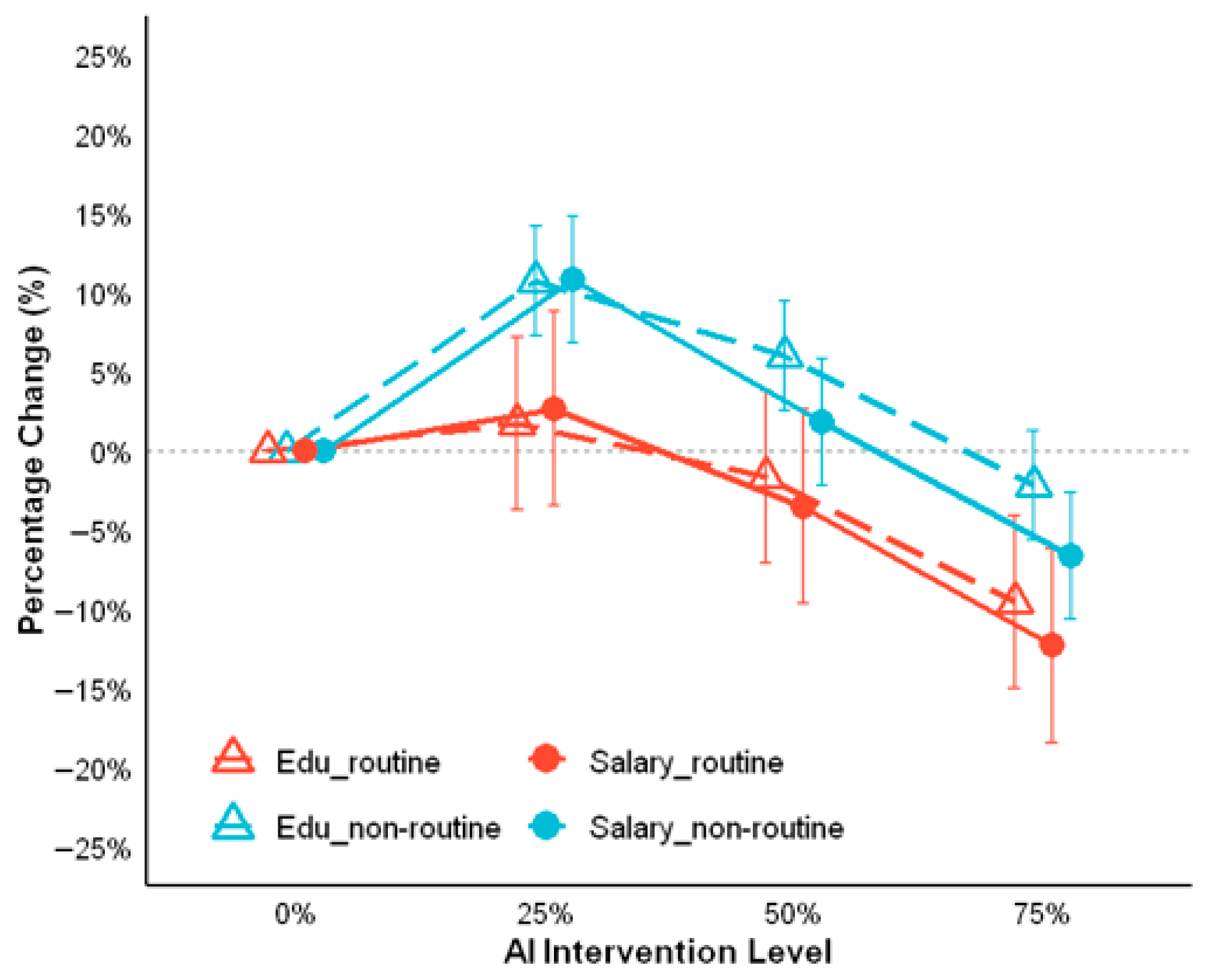
3.3.1. AI Influences Occupational Social Status
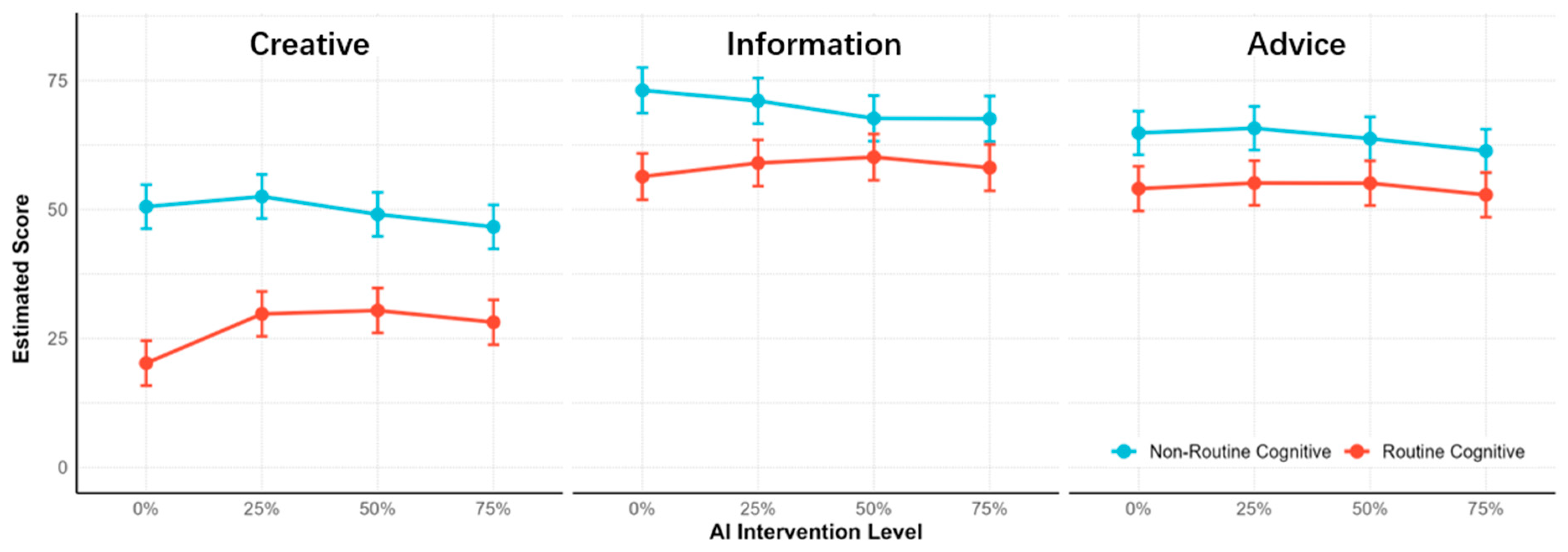
3.3.2. AI Affects the Task Type of Occupations
3.3.3. Attitudes Towards AI and Occupational Evaluations
3.4. Discussion
4. General Discussion
5. Limitations and Future Directions
Supplementary Materials
Author Contributions
Funding
Institutional Review Board Statement
Informed Consent Statement
Data Availability Statement
Conflicts of Interest
References
- Abraham, K. G., Haltiwanger, J., Sandusky, L. K., & Spletzer, J. (2018). Measuring the gig economy: Current knowledge and open issues. Available online: https://ssrn.com/abstract=3244232 (accessed on 20 September 2025).
- Acemoglu, D., & Restrepo, P. (2018). The race between man and machine: Implications of technology for growth, factor shares, and employment. American Economic Review, 108(6), 1488–1542. [Google Scholar] [CrossRef] [Scilit]
- Adler, N. E., Epel, E. S., Castellazzo, G., & Ickovics, J. R. (2000). Relationship of subjective and objective social status with psychological and physiological functioning: Preliminary data in healthy white women. Health Psychology, 19(6), 586–592. [Google Scholar] [CrossRef] [PubMed]
- Aitchison, J. (1982). The statistical analysis of compositional data. Journal of the Royal Statistical Society: Series B (Methodological), 44(2), 139–160. [Google Scholar] [CrossRef] [Scilit]
- Andersson, A. B., & Lindh, A. (2023). Occupational skills and subjective social status. In A research agenda for skills and inequality (pp. 103–120). Edward Elgar Publishing. [Google Scholar] [CrossRef] [Scilit]
- Benítez-Rueda, M., & Parrado, E. (2024). “Mirror, mirror on the wall: Which jobs will AI replace after all?”: A new index of occupational exposure. Available online: http://www.iadb.org (accessed on 14 October 2025).
- Bowles, D. (2013). Toward an integrated theory of social stratification. American Journal of Economics and Sociology, 72(1), 32–58. [Google Scholar] [CrossRef] [Scilit]
- Chen, P., Schmidtke, C., & Jin, X. (2024). Chinese technical and vocational education and training, skill formation, and national development: A systematic review of educational policies. Vocation, Technology & Education, 1(3), 1–13. [Google Scholar] [CrossRef] [Scilit]
- Ciechanowski, L., Przegalinska, A., Magnuski, M., & Gloor, P. (2019). In the shades of the uncanny valley: An experimental study of human–chatbot interaction. Future Generation Computer Systems, 92, 539–548. [Google Scholar] [CrossRef] [Scilit]
- Cortés, P., Pan, J., Pilossoph, L., Reuben, E., & Zafar, B. (2023). Gender differences in job search and the earnings gap: Evidence from the field and lab. The Quarterly Journal of Economics, 138(4), 2069–2126. [Google Scholar] [CrossRef] [Scilit]
- Dahlin, E. (2024). Who says artificial intelligence is stealing our jobs? Socius, 10, 23780231241259672. [Google Scholar] [CrossRef] [Scilit]
- Egozcue, J. J., Pawlowsky-Glahn, V., Mateu-Figueras, G., & Barceló-Vidal, C. (2003). Isometric logratio transformations for compositional data analysis. Mathematical Geology, 35(3), 279–300. [Google Scholar] [CrossRef] [Scilit]
- Eloundou, T., Manning, S., Mishkin, P., & Rock, D. (2024). GPTs are GPTs: Labor market impact potential of LLMs. Research is needed to estimate how jobs may be affected. Science, 384(6702), 1306–1308. [Google Scholar] [CrossRef] [Scilit]
- Fast, N. J., & Schroeder, J. (2020). Power and decision making: New directions for research in the age of artificial intelligence. Current Opinion in Psychology, 33, 172–176. [Google Scholar] [CrossRef] [Scilit]
- Faul, F., Buchner, A., Erdfelder, E., & Mayr, S. (2007). A short tutorial of GPower. Tutorials in Quantitative Methods for Psychology, 3(2), 51–59. [Google Scholar]
- Ferrer-Rosell, B., & Coenders, G. (2017). Airline type and tourist expenditure: Are full service and low cost carriers converging or diverging? Journal of Air Transport Management, 63, 119–125. [Google Scholar] [CrossRef] [Scilit]
- Gentile, M., Città, G., Perna, S., & Allegra, M. (2023). Do we still need teachers? Navigating the paradigm shift of the teacher’s role in the AI era. Frontiers in Education, 8, 1161777. [Google Scholar] [CrossRef] [Scilit]
- Georgieff, A., & Hyee, R. (2022). Artificial intelligence and employment: New cross-country evidence. Frontiers in Artificial Intelligence, 5, 832736. [Google Scholar] [CrossRef] [Scilit]
- Gmyrek, P., Berg, J., & Bescond, D. (2023). Generative AI and jobs: A global analysis of potential effects on job quantity and quality (ILO Working Paper 96). ILO. Available online: https://ssrn.com/abstract=4584219 (accessed on 14 October 2025).
- Guangdong Provincial Department of Human Resources and Social Security. (2024). Guangdong provincial human resources market wage levels and industry labor cost information in 2024. Available online: https://hrss.gd.gov.cn/gkmlpt/content/4/4522/post_4522123.html (accessed on 14 October 2025).
- Hong, J. W. (2022). I was born to love AI: The influence of social status on AI self-efficacy and intentions to use AI. International Journal of Communication, 16, 172–191. [Google Scholar]
- Huang, Y., Jiang, S., & Gong, Z. (2025). Validity and reliability of the Chinese version of general attitudes towards artificial intelligence scale. International Journal of Human-Computer Interaction, 41(20), 12884–12894. [Google Scholar] [CrossRef] [Scilit]
- Huseynov, S. (2025). ChatGPT and the labor market: Unraveling the effect of AI discussions on students’ earning expectations. Journal of Economic Psychology, 108, 102803. [Google Scholar] [CrossRef] [Scilit]
- Ivandić, R., & Lassen, A. S. (2023). Gender gaps from labor market shocks. Labour Economics, 83, 102394. [Google Scholar] [CrossRef] [Scilit]
- Ivanov, S., Kuyumdzhiev, M., & Webster, C. (2020). Automation fears: Drivers and solutions. Technology in Society, 63, 101431. [Google Scholar] [CrossRef] [Scilit]
- Jago, A. S., Raveendhran, R., Fast, N., & Gratch, J. (2024). Algorithmic management diminishes status: An unintended consequence of using machines to perform social roles. Journal of Experimental Social Psychology, 110, 104553. [Google Scholar] [CrossRef] [Scilit]
- Katsantonis, A., & Katsantonis, I. G. (2024). University students’ attitudes toward artificial intelligence: An exploratory study of the cognitive, emotional, and behavioural dimensions of AI attitudes. Education Sciences, 14(9), 988. [Google Scholar] [CrossRef] [Scilit]
- Khalifa, M., & Albadawy, M. (2024). AI in diagnostic imaging: Revolutionising accuracy and efficiency. Computer Methods and Programs in Biomedicine Update, 5, 100146. [Google Scholar] [CrossRef] [Scilit]
- Kish-Gephart, J. J., Moergen, K. J. N., Tilton, J. D., & Gray, B. (2023). Social class and work: A review and organizing framework. Journal of Management, 49(1), 509–565. [Google Scholar] [CrossRef] [Scilit]
- Kraus, M. W., Tan, J. J. X., & Tannenbaum, M. B. (2013). The social ladder: A rank-based perspective on social class. Psychological Inquiry, 24(2), 81–96. [Google Scholar] [CrossRef] [Scilit]
- Lee, H. P., Sarkar, A., Tankelevitch, L., Drosos, I., Rintel, S., Banks, R., & Wilson, N. (2025). The impact of generative AI on critical thinking: Self-reported reductions in cognitive effort and confidence effects from a survey of knowledge workers. In Conference on human factors in computing systems—Proceedings. Association for Computing Machinery. [Google Scholar] [CrossRef] [Scilit]
- Lichtinger, G., & Hosseini Maasoum, S. M. (2025). Generative AI as seniority-biased technological change: Evidence from us resume and job posting data. Available online: https://www.researchgate.net/publication/395371355_Generative_AI_as_Seniority-Biased_Technological_Change_Evidence_from_US_Resume_and_Job_Posting_Data (accessed on 1 March 2026).
- McGinn, K. L., & Oh, E. (2017). Gender, social class, and women’s employment. Current Opinion in Psychology, 18, 84–88. [Google Scholar] [CrossRef] [Scilit]
- Mirbabaie, M., Brünker, F., Möllmann Frick, N. R. J., & Stieglitz, S. (2022). The rise of artificial intelligence—Understanding the AI identity threat at the workplace. Electronic Markets, 32(1), 73–99. [Google Scholar] [CrossRef] [Scilit]
- MyCOS Institute. (2025). Chinese 4-year college graduates’ employment annual report (2025) (pp. 1–9). Social Sciences Academic Press (China). [Google Scholar]
- O’Donovan, C., Gurakan, S., Wu, X., Stilgoe, J., Bert, N., Dmitrichenko, E., Gorba, E., Liu, S., Zamborsky, T., & Zhao, T. (2025). Visions, values, voices: A survey of artificial intelligence researchers. Zenodo. [Google Scholar]
- Oppenlaender, J., Linder, R., & Silvennoinen, J. (2025). Prompting AI art: An investigation into the creative skill of prompt engineering. International Journal of Human-Computer Interaction, 41(16), 10207–10229. [Google Scholar] [CrossRef] [Scilit]
- Pawlowsky-Glahn, V., Egozcue, J. J., & Lovell, D. (2015). Tools for compositional data with a total. Statistical Modelling, 15(2), 175–190. [Google Scholar] [CrossRef] [Scilit]
- Peirce, J., Gray, J. R., Simpson, S., MacAskill, M., Höchenberger, R., Sogo, H., Kastman, E., & Lindeløv, J. K. (2019). PsychoPy2: Experiments in behavior made easy. Behavior Research Methods, 51(1), 195–203. [Google Scholar] [CrossRef] [Scilit]
- Qi, J., Liu, J., Xu, Y., Qi, J., Liu, J., & Xu, Y. (2025). The role of individual capabilities in maximizing the benefits for students using GenAI tools in higher education. Behavioral Sciences, 15(3), 328. [Google Scholar] [CrossRef] [Scilit]
- Qu, C., Ligneul, R., Van der Henst, J.-B., & Dreher, J.-C. (2017). An integrative interdisciplinary perspective on social dominance hierarchies. Trends in Cognitive Sciences, 21(11), 893–908. [Google Scholar] [CrossRef] [Scilit]
- Roys, N., Taber, C. R., Roys, N., & Taber, C. R. (2019). Skill prices, occupations, and changes in the wage structure for low skilled men. Available online: https://econpapers.repec.org/RePEc:nbr:nberwo:26453 (accessed on 19 October 2025).
- Schepman, A., & Rodway, P. (2023). The general attitudes towards artificial intelligence scale (GAAIS): Confirmatory validation and associations with personality, corporate distrust, and general trust. International Journal of Human-Computer Interaction, 39(13), 2724–2741. [Google Scholar] [CrossRef] [Scilit]
- Tang, P. M., Koopman, J., Mai, K. M., De Cremer, D., Zhang, J. H., Reynders, P., Ng, C. T. S., & Chen, I. H. (2023). No person is an island: Unpacking the work and after-work consequences of interacting with artificial intelligence. Journal of Applied Psychology, 108(11), 1766–1789. [Google Scholar] [CrossRef] [Scilit] [PubMed]
- Tinguely, P. N., Lee, J., & He, V. F. (2023). Designing human resource management systems in the age of AI. Journal of Organization Design, 12(4), 263–269. [Google Scholar] [CrossRef] [Scilit]
- Tschang, F. T., & Almirall, E. (2021). Artificial intelligence as augmenting automation: Implications for employment. Academy of Management Perspectives, 35(4), 642–659. [Google Scholar] [CrossRef] [Scilit]
- Venkataramani, V., Derfler-Rozin, R., Liu, X., & Mao, J. Y. (2024). Keep off my turf! Low-status managers’ territoriality as a response to employees’ novel ideas. Organization Science, 35(4), 1224–1250. [Google Scholar] [CrossRef] [Scilit]
- Wang, P., Liao, W., Zhao, Z., & Miu, F. (2022). Prediction of factors influencing the starting salary of college graduates based on machine learning. Wireless Communications and Mobile Computing, 2022(1), 7845545. [Google Scholar] [CrossRef] [Scilit]
- Wester, C. T., Brusaca, L. A., Palarea-Albaladejo, J., Kyriakidis, S., Frost, A. D., Holtermann, A., & Rasmussen, C. D. N. (2025). What determines childcare workers physical behaviours at work? An investigation of determinants at the institution, team, and worker levels in Danish day nurseries. Annals of Work Exposures and Health, 69(5), 520–530. [Google Scholar] [CrossRef] [Scilit]
- Xing, F., Du, K., Mengaldo, G., Cambria, E., & Welsch, R. (2025). AI reshaping financial modeling. npj Artificial Intelligence, 1(1), 29. [Google Scholar] [CrossRef] [Scilit]
- Yao, Q., Wu, Z., & Zhou, W. (2022). The impact of social class and service type on preference for AI service robots. International Journal of Emerging Markets, 17(4), 1049–1066. [Google Scholar] [CrossRef] [Scilit]
- Zhang, H., Lee, I., Ali, S., DiPaola, D., Cheng, Y., & Breazeal, C. (2023). Integrating ethics and career futures with technical learning to promote AI literacy for middle school students: An exploratory study. International Journal of Artificial Intelligence in Education, 33(2), 290–324. [Google Scholar] [CrossRef] [Scilit] [PubMed]
- Zhou, E., & Lee, D. (2024). Generative artificial intelligence, human creativity, and art. PNAS Nexus, 3(3), pgae052. [Google Scholar] [CrossRef] [Scilit] [PubMed]


Disclaimer/Publisher’s Note: The statements, opinions and data contained in all publications are solely those of the individual author(s) and contributor(s) and not of MDPI and/or the editor(s). MDPI and/or the editor(s) disclaim responsibility for any injury to people or property resulting from any ideas, methods, instructions or products referred to in the content. |
© 2026 by the authors. Licensee MDPI, Basel, Switzerland. This article is an open access article distributed under the terms and conditions of the Creative Commons Attribution (CC BY) license.
Share and Cite
Liu, J.; Zhuang, Y.; Yang, H.; Li, S.; Qu, C. AI and the Future of Work: Assessing Occupational Social Status Perceptions Among University Students. Behav. Sci. 2026, 16, 362. https://doi.org/10.3390/bs16030362
Liu J, Zhuang Y, Yang H, Li S, Qu C. AI and the Future of Work: Assessing Occupational Social Status Perceptions Among University Students. Behavioral Sciences. 2026; 16(3):362. https://doi.org/10.3390/bs16030362
Chicago/Turabian StyleLiu, Jiawei, Yifan Zhuang, Huaqi Yang, Siying Li, and Chen Qu. 2026. "AI and the Future of Work: Assessing Occupational Social Status Perceptions Among University Students" Behavioral Sciences 16, no. 3: 362. https://doi.org/10.3390/bs16030362
APA StyleLiu, J., Zhuang, Y., Yang, H., Li, S., & Qu, C. (2026). AI and the Future of Work: Assessing Occupational Social Status Perceptions Among University Students. Behavioral Sciences, 16(3), 362. https://doi.org/10.3390/bs16030362