A Latent Profile Analysis of Emotions in AI-Mediated IDLE: Associations with Emotion Regulation Strategies and Perceived AI Affordances
Abstract
1. Introduction
2. Literature Review
2.1. Theoretical Framework
2.2. Emotions and Emotion Profiles
2.3. Emotion Profiles and Perceived AI Affordances
2.4. Emotion Regulation Strategies and Emotion Profiles
2.5. Research Questions
3. Methodology
3.1. Participants
3.2. Instruments
3.2.1. Emotion Regulation
3.2.2. Achievement Emotions
3.2.3. Perceived AI Affordances
3.3. Data Collection and Analysis
4. Results
4.1. Preliminary Analyses
4.2. Latent Profile Models of Emotions in AI-Mediated IDLE
4.2.1. Identification of the Suitable Profile Model
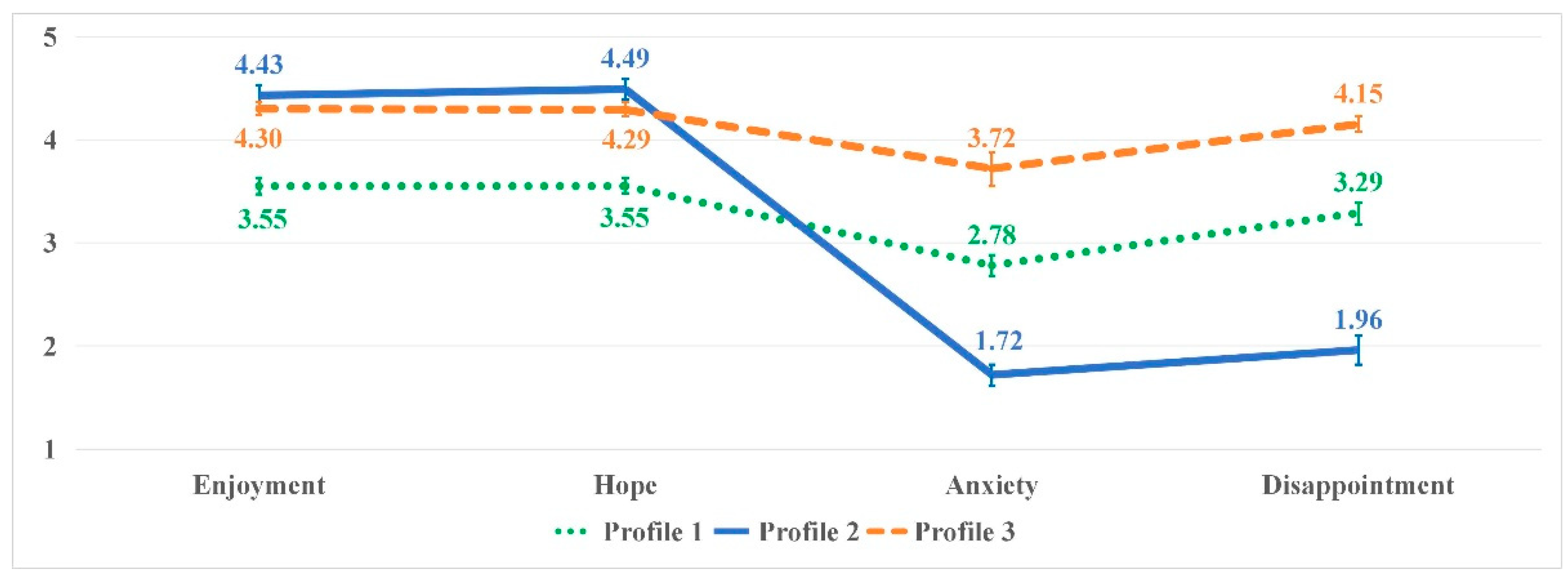
4.2.2. Description of the Selected Profile Model
4.3. Differences in Perceived AI Affordances Across Emotion Profiles
4.4. The Effects of ERSs on Emotion Profiles
5. Discussion
5.1. Emotion Profiles in AI-Mediated IDLE
5.2. Perceived AI Affordances Across Different Emotion Profiles
5.3. The Predictive Effects of ERSs on Emotion Profiles
6. Conclusions, Implications and Limitations
Supplementary Materials
Author Contributions
Funding
Institutional Review Board Statement
Informed Consent Statement
Data Availability Statement
Acknowledgments
Conflicts of Interest
| 1 | Double First-Class universities refer to the universities that are recognized as world-class universities or universities that possess first-class disciplines in China. |
References
- Alqarni, N. A. (2024). Predictors of foreign language proficiency: Emotion regulation, foreign language enjoyment, or academic stress? System, 126, 103462. [Google Scholar] [CrossRef] [Scilit]
- Asparouhov, T., & Muthén, B. (2014). Auxiliary variables in mixture modeling: Three-step approaches using Mplus. Structural Equation Modeling: A Multidisciplinary Journal, 21(3), 329–341. [Google Scholar] [CrossRef] [Scilit]
- Asparouhov, T., & Muthén, B. (2021). Auxiliary variables in mixture modeling: Using the BCH method in Mplus to estimate a distal outcome model and an arbitrary secondary model. Mplus Web Notes, 21(2), 1–22. [Google Scholar]
- Buhle, J. T., Silvers, J. A., Wager, T. D., Lopez, R., Onyemekwu, C., Kober, H., Weber, J., & Ochsner, K. N. (2014). Cognitive reappraisal of emotion: A meta-analysis of human neuroimaging studies. Cerebral Cortex, 24(11), 2981–2990. [Google Scholar] [CrossRef] [Scilit]
- Butler, E. A., Lee, T. L., & Gross, J. J. (2007). Emotion regulation and culture: Are the social consequences of emotion suppression culture-specific? Emotion, 7(1), 30–48. [Google Scholar] [CrossRef] [Scilit]
- Cohen, E. L., & Myrick, J. G. (2023). Emotions and technological affordances. In R. L. Nabi, & J. G. Myrick (Eds.), Emotions in the digital world: Exploring affective experience and expression in online interactions (pp. 32–52). Oxford University Press. [Google Scholar] [CrossRef] [Scilit]
- Cohen, J. (1988). Statistical power analysis for the behavioral sciences (2nd ed.). Erlbaum. [Google Scholar]
- Cui, Y., Meng, Y., Zhang, X., & Tang, L. (2025). Exploring the impact of affordance theory on motivated learning behavior in ChatGPT-assisted IDLE contexts. Available online: https://journals.sagepub.com/doi/10.1177/00336882251347978 (accessed on 10 December 2025).
- Davis, F. D. (1989). Perceived usefulness, perceived ease of use, and user acceptance of information technology. Management Information System Quarterly, 13(3), 319–340. [Google Scholar] [CrossRef] [Scilit]
- Dewaele, J.-M., & Li, C. (2022). Foreign language enjoyment and anxiety: Associations with general and domain-specific English achievement. Chinese Journal of Applied Linguistics, 45(1), 32–48. [Google Scholar] [CrossRef] [Scilit]
- Dewaele, J.-M., & MacIntyre, P. D. (2014). The two faces of Janus? Anxiety and enjoyment in the foreign language classroom. Studies in Second Language Learning and Teaching, 4(2), 237–274. [Google Scholar] [CrossRef] [Scilit]
- Dou, K., Halim, H. A., & Saad, M. R. M. (2025). Factors determining the continuance intention to use mobile English learning applications: An application and extension of expectation confirmation model in the mobile-assisted language learning context. European Journal of Education, 60(2), e70082. [Google Scholar] [CrossRef] [Scilit]
- Dörnyei, Z., & Csizér, K. (2012). How to design and analyze surveys in second language acquisition research. In A. Mackey, & S. M. Gass (Eds.), Research methods in second language acquisition: A practical guide (pp. 74–94). Blackwell. [Google Scholar] [CrossRef] [Scilit]
- Fang, F., Meng, Y., Tang, L., & Cui, Y. (2025). The impact of informal digital learning of English (IDLE) on EFL learners’ engagement: Mediating roles of flow, online self-efficacy, and behavioral intention. Behavioral Sciences, 15(7), 851. [Google Scholar] [CrossRef] [Scilit] [PubMed]
- Feng, D., & Yang, C. (2025). Exploring the associations between informal digital English learning (IDLE), personality traits, and critical thinking among Chinese EFL learners. Available online: https://onlinelibrary.wiley.com/doi/10.1111/ijal.12835 (accessed on 10 December 2025).
- Ferguson, S. L., Moore, E. W. G., & Hull, D. M. (2019). Finding latent groups in observed data: A primer on latent profile analysis in Mplus for applied researchers. International Journal of Behavioral Development, 44(5), 458–468. [Google Scholar] [CrossRef] [Scilit]
- Fernandes, M. A., & Tone, E. B. (2021). A systematic review and meta-analysis of the association between expressive suppression and positive affect. Clinical Psychology Review, 88, 102068. [Google Scholar] [CrossRef] [Scilit]
- Ford, B. Q., Gross, J. J., & Gruber, J. (2019). Broadening our field of view: The role of emotion polyregulation. Emotion Review, 11(3), 197–208. [Google Scholar] [CrossRef] [Scilit]
- Gibson, J. J. (1986). The ecological approach to visual perception. Psychology Press. [Google Scholar]
- Gross, J. J. (2015). Emotion regulation: Current status and future prospects. Psychological Inquiry, 26(1), 1–26. [Google Scholar] [CrossRef] [Scilit]
- Gross, J. J., & John, O. P. (2003). Individual differences in two emotion regulation processes: Implications for affect, relationships, and well-being. Journal of Personality and Social Psychology, 85(2), 348–362. [Google Scholar] [CrossRef] [Scilit]
- Guan, L., Zhang, E. Y., & Gu, M. M. (2025). Examining generative AI-mediated informal digital learning of English practices with social cognitive theory: A mixed-methods study. ReCALL, 37(3), 315–331. [Google Scholar] [CrossRef] [Scilit]
- Guo, F., Zhang, L., Shi, T., & Coates, H. (2025). Whether and when could generative AI improve college student learning engagement? Behavioral Sciences, 15(8), 1011. [Google Scholar] [CrossRef] [Scilit]
- Guo, S., Yao, H., & Lee, J. S. (2025). A latent profile analysis of informal digital learning of English: Emotion regulation strategies as predictors and willingness to communicate as outcomes. System, 132, 103686. [Google Scholar] [CrossRef] [Scilit]
- Hair, J. F., Jr., Black, W. C., Babin, B. J., & Anderson, R. E. (2014). Multivariate data analysis (7th ed.). Pearson. [Google Scholar]
- Harley, J., Pekrun, R., Taxer, J., & Gross, J. (2019). Emotion regulation in achievement situations: An integrated model. Educational Psychologist, 54(2), 106–126. [Google Scholar] [CrossRef] [Scilit]
- He, T., & Li, S. (2019). A comparative study of digital informal learning: The effects of digital competence and technology expectancy. British Journal of Educational Technology, 50(4), 1744–1758. [Google Scholar] [CrossRef] [Scilit]
- Huang, F., Peng, D., & Teo, T. (2025). AI affordances and EFL learners’ speaking engagement: The moderating roles of gender and learner type. European Journal of Education, 60(1), e70041. [Google Scholar] [CrossRef] [Scilit]
- Huang, F., & Zou, B. (2024). English speaking with artificial intelligence (AI): The roles of enjoyment, willingness to communicate with AI, and innovativeness. Computers in Human Behavior, 159, 108355. [Google Scholar] [CrossRef] [Scilit]
- Jeon, J. (2022). Exploring AI chatbot affordances in the EFL classroom: Young learners’ experiences and perspectives. Computer Assisted Language Learning, 37(1–2), 1–26. [Google Scholar] [CrossRef] [Scilit]
- Jiang, A. L., Sun, K., Liang, J., Jin, Y., & Zhang, S. (2025). Unpacking the relationship among task engagement, achievement emotions and emotion regulation among EFL learners: A network analysis. Perceptual and Motor Skills, 132(5), 944–968. [Google Scholar] [CrossRef] [Scilit]
- Kashdan, T. B., & Breen, W. E. (2008). Social anxiety and positive emotions: A prospective examination of a self-regulatory model with tendencies to suppress or express emotions as a moderating variable. Behavior Therapy, 39(1), 1–12. [Google Scholar] [CrossRef] [Scilit]
- Kunnan, A. J. (1998). An introduction to structural equation modelling for language assessment research. Language Testing, 15(3), 295–332. [Google Scholar] [CrossRef] [Scilit]
- Lee, J. S. (2019). Quantity and diversity of informal digital learning of English. Language Learning & Technology, 23(1), 114–126. [Google Scholar] [CrossRef] [Scilit]
- Lee, J. S. (2022). Informal digital learning of English: Research to practice. Routledge. [Google Scholar] [CrossRef] [Scilit]
- Lee, J. S., & Chiu, M. M. (2023). Modeling EFL learners’ willingness to communicate: The roles of face-to-face and digital L2 communication anxiety. Annual Review of Applied Linguistics, 43, 64–87. [Google Scholar] [CrossRef] [Scilit]
- Lee, J. S., Xie, Q., & Lee, K. (2024). Informal digital learning of English and L2 willingness to communicate: Roles of emotions, gender, and educational stage. Journal of Multilingual and Multicultural Development, 45(2), 596–612. [Google Scholar] [CrossRef] [Scilit]
- Li, C., Dewaele, J.-M., & Jiang, G. (2020). The complex relationship between classroom emotions and EFL achievement in China. Applied Linguistics Review, 11(3), 485–510. [Google Scholar] [CrossRef] [Scilit]
- Li, C., Jiang, G., & Dewaele, J.-M. (2018). Understanding Chinese high school students’ foreign language enjoyment: Validation of the Chinese version of the foreign language enjoyment scale. System, 76, 183–196. [Google Scholar] [CrossRef] [Scilit]
- Liu, G., Darvin, R., & Ma, C. (2025a). Exploring AI-mediated informal digital learning of English (AI-IDLE): A mixed-method investigation of Chinese EFL learners’ AI adoption and experiences. Computer Assisted Language Learning, 38(7), 1632–1660. [Google Scholar] [CrossRef] [Scilit]
- Liu, G., Soyoof, A., Lee, J. S., & Zhang, L. J. (2025b). Informal digital learning of English in Asian English as a foreign language contexts: A thematic review. Available online: https://journals.sagepub.com/doi/full/10.1177/00336882251332309 (accessed on 10 December 2025).
- Liu, G., Zhang, Y., & Zhang, R. (2024). Examining the relationships among motivation, informal digital learning of English, and foreign language enjoyment: An explanatory mixed-method study. ReCALL, 36(1), 72–88. [Google Scholar] [CrossRef] [Scilit]
- Liu, G., Zou, M., Soyoof, A., & Chiu, M. M. (2025c). Untangling the relationship between AI-mediated informal digital learning of English (AI-IDLE), foreign Language enjoyment and the ideal L2 self: Evidence from Chinese university EFL students. European Journal of Education, 60(1), e12846. [Google Scholar] [CrossRef] [Scilit]
- Liu, H., & Fan, J. (2025). AI-mediated communication in EFL classrooms: The role of technical and pedagogical stimuli and the mediating effects of AI literacy and enjoyment. European Journal of Education, 60(1), e12813. [Google Scholar] [CrossRef] [Scilit]
- Liu, H., Fan, J., & Xia, M. (2025a). Exploring individual’s emotional and autonomous learning profiles in AI-enhanced data-driven language learning: An expanded SOR perspective. Learning and Individual Differences, 122, 102753. [Google Scholar] [CrossRef] [Scilit]
- Liu, H., Jiang, Y., Nie, H., & Zhou, X. (2025b). Unveiling the effects of enjoyment and hope on students’ English learning effort. Scientific Reports, 15, 26630. [Google Scholar] [CrossRef] [Scilit]
- Ma, D., Akram, H., & Chen, H. (2024). Artificial intelligence in higher education: A cross-cultural examination of students’ behavioral intentions and attitudes. The International Review of Research in Open and Distributed Learning, 25(3), 134–157. [Google Scholar] [CrossRef] [Scilit]
- Magidson, J., Vermunt, J. K., & Madura, J. P. (2020). Latent class analysis. Sage. [Google Scholar] [CrossRef] [Scilit]
- Mahfoodh, O. H. A. (2017). “I feel disappointed”: EFL university students’ emotional responses towards teacher written feedback. Assessing Writing, 31, 53–72. [Google Scholar] [CrossRef] [Scilit]
- Mather, M., & Sutherland, M. R. (2011). Arousal-biased competition in perception and memory. Perspectives on Psychological Science, 6(2), 114–133. [Google Scholar] [CrossRef] [Scilit]
- McInerney, D. M., & King, R. B. (2017). Culture and self-regulation in educational contexts. In D. H. Schunk, & J. A. Greene (Eds.), Handbook of self-regulation of learning and performance (pp. 485–502). Routledge. [Google Scholar] [CrossRef] [Scilit]
- Miyamoto, Y., & Ryff, C. D. (2011). Cultural differences in the dialectical and non-dialectical emotional styles and their implications for health. Cognition and Emotion, 25(1), 22–39. [Google Scholar] [CrossRef] [Scilit]
- Murata, A., Moser, J. S., & Kitayama, S. (2013). Culture shapes electrocortical responses during emotion suppression. Social Cognitive and Affective Neuroscience, 8(5), 595–601. [Google Scholar] [CrossRef] [Scilit]
- Nakamura, S. (2018). How I see it: An exploratory study on attributions and emotions in L2 learning. Studies in Second Language Learning and Teaching, 8(3), 553–574. [Google Scholar] [CrossRef] [Scilit]
- Nakamura, S., Darasawang, P., & Reinders, H. (2024). A practitioner study on the implementation of strategy instruction for boredom regulation. Language Teaching Research, 28(2), 786–808. [Google Scholar] [CrossRef] [Scilit]
- Namaziandost, E., & Rezai, A. (2024). Interplay of academic emotion regulation, academic mindfulness, L2 learning experience, academic motivation, and learner autonomy in intelligent computer-assisted language learning: A study of EFL learners. System, 125, 103419. [Google Scholar] [CrossRef] [Scilit]
- Nylund, K. L., Asparouhov, T., & Muthén, B. O. (2007). Deciding on the number of classes in latent class analysis and growth mixture modeling: A monte carlo simulation study. Structural Equation Modeling: A Multidisciplinary Journal, 14(4), 535–569. [Google Scholar] [CrossRef] [Scilit]
- Pekrun, R. (2006). The control-value theory of achievement emotions: Assumptions, corollaries, and implications for educational research and practice. Educational Psychology Review, 18(4), 315–341. [Google Scholar] [CrossRef] [Scilit]
- Pekrun, R., Goetz, T., Frenzel, A. C., Barchfeld, P., & Perry, R. P. (2011). Measuring emotions in students’ learning and performance: The achievement emotions questionnaire (AEQ). Contemporary Educational Psychology, 36(1), 36–48. [Google Scholar] [CrossRef] [Scilit]
- Pekrun, R., Marsh, H. W., Elliot, A. J., Stockinger, K., Perry, R. P., Vogl, E., Goetz, T., van Tilburg, W. A. P., Lüdtke, O., & Vispoel, W. P. (2023). A three-dimensional taxonomy of achievement emotions. Journal of Personality and Social Psychology, 124(1), 145–178. [Google Scholar] [CrossRef] [Scilit]
- Prior, M. T. (2019). Elephants in the room: An “affective turn,” or just feeling our way? The Modern Language Journal, 103(2), 516–527. [Google Scholar] [CrossRef] [Scilit]
- Rezai, A., Goodarzi, A., & Liu, G. (2025). A comparative study of the effects of informal digital learning of English in extracurricular and extramural settings on reading comprehension: A multi-analysis study on Iranian university students. Available online: https://www.tandfonline.com/doi/abs/10.1080/09588221.2025.2491708 (accessed on 10 December 2025).
- Shao, K., Pekrun, R., Marsh, H. W., & Loderer, K. (2020). Control-value appraisals, achievement emotions, and foreign language performance: A latent interaction analysis. Learning and Instruction, 69, 101356. [Google Scholar] [CrossRef] [Scilit]
- Sheppes, G., Scheibe, S., Suri, G., & Gross, J. J. (2011). Emotion-regulation choice. Psychological Science, 22(11), 1391–1396. [Google Scholar] [CrossRef] [Scilit]
- Shi, H., & Wang, Y. (2025). High school EFL students’ pre-exam academic emotions and their associations with academic achievement: A latent profile analysis. European Journal of Education, 60(3), e70185. [Google Scholar] [CrossRef] [Scilit]
- Snyder, C. R. (2002). Hope theory: Rainbows in the mind. Psychological Inquiry, 13(4), 249–275. [Google Scholar] [CrossRef] [Scilit]
- Soyoof, A., Reynolds, B. L., Vazquez-Calvo, B., & McLay, K. (2023). Informal digital learning of English (IDLE): A scoping review of what has been done and a look towards what is to come. Computer Assisted Language Learning, 36(4), 608–640. [Google Scholar] [CrossRef] [Scilit]
- Storbeck, J., & Clore, G. L. (2008). Affective arousal as information: How affective arousal influences judgments, learning, and memory. Social and Personality Psychology Compass, 2(5), 1824–1843. [Google Scholar] [CrossRef] [Scilit] [PubMed]
- Tang, Y., & Hu, J. (2022). The impact of teacher attitude and teaching approaches on student demotivation: Disappointment as a mediator. Frontiers in Psychology, 13, 985859. [Google Scholar] [CrossRef] [Scilit]
- Tein, J.-Y., Coxe, S., & Cham, H. (2013). Statistical power to detect the correct number of classes in latent profile analysis. Structural Equation Modeling: A Multidisciplinary Journal, 20(4), 640–657. [Google Scholar] [CrossRef] [Scilit]
- Teng, L. S., & Pan, J. (2024). Achievement emotions in online language learning: Domain-specific components and interactions with self-regulation strategies and language performance. Available online: https://academic.oup.com/applij/advance-article-abstract/doi/10.1093/applin/amae080/7915951 (accessed on 10 December 2025).
- Tram, N. H. M., Nguyen, T. T., & Tran, C. D. (2024). ChatGPT as a tool for self-learning English among EFL learners: A multi-methods study. System, 127, 103528. [Google Scholar] [CrossRef] [Scilit]
- Tsang, A., & Yeung, S. S.-s. (2024). A hierarchical clustering analysis of classroom emotional profiles of Grade-4-to-5 EFL learners: Classroom emotions, motivation, family backgrounds, and proficiency development. Available online: https://journals.sagepub.com/doi/abs/10.1177/13621688241275733 (accessed on 10 December 2025).
- Van Dijk, W. W., & Zeelenberg, M. (2002). What do we talk about when we talk about disappointment? Distinguishing outcome-related disappointment from person-related disappointment. Cognition and Emotion, 16(6), 787–807. [Google Scholar] [CrossRef] [Scilit]
- Wang, C., Du, Y., & Zou, B. (2025). Learners’ acceptance and use of multimodal artificial intelligence (AI)-generated content in AI-mediated informal digital learning of English. Available online: https://onlinelibrary.wiley.com/doi/abs/10.1111/ijal.12827 (accessed on 10 December 2025).
- Wang, Q., Gao, Y., & Wang, X. (2025). Exploring engagement, self-efficacy, and anxiety in large language model EFL learning: A latent profile analysis of Chinese university students. International Journal of Human-Computer Interaction, 41(12), 7815–7824. [Google Scholar] [CrossRef] [Scilit]
- Wang, Y., & Xu, J. (2024). A latent profile analysis of L2 writing emotions and their relations to writing buoyancy, motivation and proficiency. Applied Linguistics Review, 15(5), 2277–2302. [Google Scholar] [CrossRef] [Scilit]
- Xin, Z., & Derakhshan, A. (2024). From excitement to anxiety: Exploring English as a foreign language learners’ emotional experiences in the artificial intelligence-powered classrooms. European Journal of Education, 60(1), e12845. [Google Scholar] [CrossRef] [Scilit]
- Xu, J., & Li, J. (2024). Effects of AI affordances on student engagement in EFL classrooms: A structural equation modelling and latent profile analysis. European Journal of Education, 59(4), e12808. [Google Scholar] [CrossRef] [Scilit]
- Yang, L., & Zhao, S. (2024). AI-induced emotions in L2 education: Exploring EFL students’ perceived emotions and regulation strategies. Computers in Human Behavior, 159, 108337. [Google Scholar] [CrossRef] [Scilit]
- Yüksel, H. G., Solhi, M., Özcan, E., & Giritlioğlu, N. B. (2025). The associations between EFL learners’ L2 class belongingness, emotion regulation strategies, and perceived L2 proficiency in an online learning context. Language Learning Journal, 53(3), 306–322. [Google Scholar] [CrossRef] [Scilit]
- Zare, J., Zhang, L. J., & Madiseh, F. R. (2025). Emotion regulation strategies and task engagement in L2 development: A structural equation modeling analysis. Available online: https://www.tandfonline.com/doi/full/10.1080/17501229.2025.2501605 (accessed on 10 December 2025).
- Zhang, J., Liu, Z., Lv, H., & Jiang, M. (2024). AI in e-learning: The affordance perspective. Behaviour & Information Technology, 43(15), 3863–3892. [Google Scholar] [CrossRef] [Scilit]
- Zhang, Q., Nie, H., Fan, J., & Liu, H. (2025). Exploring the dynamics of artificial intelligence literacy on English as a foreign language learners’ willingness to communicate: The critical mediating roles of artificial intelligence learning self-efficacy and classroom anxiety. Behavioral Sciences, 15(4), 523. [Google Scholar] [CrossRef] [Scilit]
- Zhang, R., Zou, D., & Cheng, G. (2025). ChatGPT affordance for logic learning strategies and its usefulness for developing knowledge and quality of logic in English argumentative writing. System, 128, 103561. [Google Scholar] [CrossRef] [Scilit]
- Zhu, X., Zhan, J., & Yao, Y. (2024). A latent profile analysis of Chinese EFL learners’ enjoyment and anxiety in reading and writing: Associations with imaginative capacity and story continuation writing performance. IRAL-International Review of Applied Linguistics in Language Teaching, 62(2), 807–841. [Google Scholar] [CrossRef] [Scilit]
- Zou, M., Liu, G., Li, D., & Chen, H. (2025a). Beyond motivation: Modeling the predictive role of L2 pride in informal digital learning of English. International Journal of Applied Linguistics, 35(4), 1938–1952. [Google Scholar] [CrossRef] [Scilit]
- Zou, M., Reinders, H., & Amjad, F. (2026). Understanding the potential role of GenAI-mediated informal digital learning of English (GenAI-IDLE) in the Global South: AI literacy, emotions, and willingness to communicate as outcomes. ReCALL, 38(1), 131–149. [Google Scholar] [CrossRef] [Scilit]
- Zou, M., Soyoof, A., Teng, M. F., & Chen, H. (2025b). A skill-specific perspective on AI-mediated informal digital learning of English (AI-IDLE): Examining the contributing roles of L2 writing motivation and enjoyment. Available online: https://journals.sagepub.com/doi/abs/10.1177/13621688251375547 (accessed on 10 December 2025).


| Study | Context | Emotion Profile Types | Key Results |
|---|---|---|---|
| Y. Wang and Xu (2024) | In-class EFL writing | Negative profile (P1, 43.0%) Positive profile (P2, 11.8%) Moderate profile (P3, 45.2%) | Students in P2 possessed the highest level of writing buoyancy, motivation and proficiency, followed by those in P3 and P1. |
| Zhu et al. (2024) | In-class EFL writing | Moderate-enjoyment/moderate-anxiety profile (P1, 24.3%) Moderate-enjoyment/low-anxiety profile (P2, 48.6%) High-enjoyment/moderate-anxiety profile (P3, 8.8%) Low-enjoyment/high-anxiety profile (P4, 18.3%) | An increase in imaginative capacity predicted students’ membership in P3 to a greater extent than in P4. Students in P2 scored the highest writing score, while those in P4 showed the worst writing performance. |
| Tsang and Yeung (2024) | In-class EFL learning | Negative emotion profile (P1, 21.43%) High enjoyment profile (P2, 46.93%) High enjoyment and anxiety profile (P3, 31.63%) | Students in P2 and P3 showed higher scores in various aspects of English proficiency and motivation than those in P1. |
| Shi and Wang (2025) | Pre-exam EFL learning | Positive-emotion-driven profile (P1, 31%) Bimodal-emotion-driven profile (P2, 56%) Negative-emotion-driven profile (P3, 13%) | Students in P1 and P2 achieved higher English scores than those in P3. |
| Demographic Information | Description | Number of Participants (Percentage) |
|---|---|---|
| Institutional tier | Double First-Class university | 366 (60%) |
| Non-Double First-Class university | 247 (40%) | |
| Geographic region | North China | 286 (47%) |
| Northwest China | 50 (8%) | |
| Central China | 118 (19%) | |
| South China | 68 (11%) | |
| East China | 91 (15%) | |
| Gender | Male | 372 (61%) |
| Female | 241 (39%) | |
| Grade | Year 1 | 272 (44%) |
| Year 2 | 181 (30%) | |
| Year 3 | 107 (17%) | |
| Year 4 | 53 (9%) | |
| Major | Linguistics | 139 (23%) |
| Humanities other than linguistics | 99 (16%) | |
| Science and engineering | 351 (57%) | |
| Medicine | 24 (4%) | |
| Self-rated English proficiency | 1–5 | 164 (27%) |
| 6–10 | 449 (73%) |
| Variables | Mean | SD | Min | Max | Skewness | Kurtosis |
|---|---|---|---|---|---|---|
| Enjoyment | 4.00 | 0.58 | 2.00 | 5.00 | −0.45 | 0.40 |
| Hope | 4.02 | 0.58 | 2.00 | 5.00 | −0.42 | 0.42 |
| Anxiety | 2.89 | 1.06 | 1.00 | 5.00 | 0.00 | −0.99 |
| Disappointment | 3.32 | 1.00 | 1.00 | 5.00 | −0.49 | −0.61 |
| Cognitive reappraisal | 3.98 | 0.54 | 1.50 | 5.00 | −0.52 | 1.23 |
| Expressive suppression | 3.25 | 0.98 | 1.00 | 5.00 | −0.42 | −0.56 |
| Perceived AI affordances | 4.00 | 0.53 | 1.77 | 5.00 | −0.28 | 0.39 |
| Profile | AIC | BIC | ΔBIC | aBIC | LMRp | BLRTp | Entropy | Smallest Profile Percentage |
|---|---|---|---|---|---|---|---|---|
| 1 | 5704.02 | 5739.37 | - | 5713.97 | - | - | - | - |
| 2 | 5336.94 | 5394.38 | −344.99 | 5353.11 | <0.001 | <0.001 | 0.84 | 152 (25%) |
| 3 | 4921.10 | 5000.63 | −393.75 | 4943.48 | <0.001 | <0.001 | 0.81 | 128 (21%) |
| 4 | 4793.48 | 4895.10 | −105.53 | 4822.08 | 0.088 | <0.001 | 0.83 | 45 (7%) |
| 5 | 4687.76 | 4811.47 | −83.63 | 4722.58 | 0.241 | <0.001 | 0.82 | 58 (9%) |
| Outcome | Profile 1 Mean (SE) | Profile 2 Mean (SE) | Profile 3 Mean (SE) | Wald Chi-Square Test Results | ||||||||||||||
|---|---|---|---|---|---|---|---|---|---|---|---|---|---|---|---|---|---|---|
| Profile 1 vs. 2 | Profile 1 vs. 3 | Profile 2 vs. 3 | ||||||||||||||||
| x2 | df | p | 95% CI | d | x2 | df | p | 95% CI | d | x2 | df | p | 95% CI | d | ||||
| Interactivity | 3.76 (0.04) | 4.44 (0.05) | 4.21 (0.04) | 112.20 | 1 | <0.001 | [−0.81, −0.55] | −1.09 | 57.73 | 1 | <0.001 | [−0.57, −0.34] | −0.83 | 14.94 | 1 | <0.001 | [0.11, 0.34] | 0.42 |
| Personalization | 3.50 (0.05) | 4.35 (0.06) | 4.26 (0.04) | 109.70 | 1 | <0.001 | [−1.01, −0.69] | −1.31 | 138.64 | 1 | <0.001 | [−0.88, −0.63] | −1.37 | 1.48 | 1 | 0.223 | [−0.06, 0.24] | 0.13 |
| Convenience | 3.72 (0.04) | 4.45 (0.05) | 4.27 (0.04) | 140.22 | 1 | <0.001 | [−0.85, −0.61] | −1.24 | 100.86 | 1 | <0.001 | [−0.66, −0.44] | −1.09 | 9.56 | 1 | 0.002 | [0.07, 0.29] | 0.33 |
| Social presence | 3.44 (0.05) | 4.24 (0.07) | 4.21 (0.04) | 84.41 | 1 | <0.001 | [−0.98, −0.64] | −1.15 | 141.35 | 1 | <0.001 | [−0.90, −0.65] | −1.35 | 0.17 | 1 | 0.677 | [−0.13, 0.20] | 0.05 |
| Predictors | Profile 1 vs. Profile 2 (Profile 2: Reference Group) | Profile 3 vs. Profile 2 (Profile 2: Reference Group) | Profile 1 vs. Profile 3 Profile 3 (Reference Group) | |||||||||
|---|---|---|---|---|---|---|---|---|---|---|---|---|
| Est. | SE | p | OR [95% CI] | Est. | SE | p | OR [95% CI] | Est. | SE | p | OR [95% CI] | |
| Cognitive reappraisal | −3.70 | 0.77 | <0.001 | 0.03 [0.01, 0.09] | −0.47 | 0.42 | 0.146 | 0.62 [0.32, 1.23] | −3.23 | 0.65 | <0.001 | 0.04 [0.01, 0.12] |
| Expressive suppression | 0.54 | 0.18 | 0.018 | 1.71 [1.28, 2.28] | 1.10 | 0.16 | <0.001 | 3.02 [2.30, 3.95] | −0.57 | 0.18 | <0.001 | 0.57 [0.43, 0.76] |
| Gender | 0.57 | 0.35 | 0.217 | 1.76 [0.99, 3.13] | 0.26 | 0.33 | 0.488 | 1.29 [0.76, 2.21] | 0.31 | 0.29 | 0.362 | 1.36 [0.84, 2.20] |
| Age | −0.04 | 0.10 | 0.647 | 0.96 [0.82, 1.12] | 0.15 | 0.09 | 0.106 | 1.17 [1.01, 1.35] | −0.20 | 0.08 | 0.006 | 0.82 [0.72, 0.94] |
| Proficiency | −0.24 | 0.13 | 0.035 | 0.79 [0.64, 0.97] | −0.02 | 0.12 | 0.860 | 0.98 [0.81, 1.18] | −0.22 | 0.11 | 0.020 | 0.80 [0.68, 0.96] |
Disclaimer/Publisher’s Note: The statements, opinions and data contained in all publications are solely those of the individual author(s) and contributor(s) and not of MDPI and/or the editor(s). MDPI and/or the editor(s) disclaim responsibility for any injury to people or property resulting from any ideas, methods, instructions or products referred to in the content. |
© 2026 by the authors. Licensee MDPI, Basel, Switzerland. This article is an open access article distributed under the terms and conditions of the Creative Commons Attribution (CC BY) license.
Share and Cite
Gao, Z.; Du, C. A Latent Profile Analysis of Emotions in AI-Mediated IDLE: Associations with Emotion Regulation Strategies and Perceived AI Affordances. Behav. Sci. 2026, 16, 283. https://doi.org/10.3390/bs16020283
Gao Z, Du C. A Latent Profile Analysis of Emotions in AI-Mediated IDLE: Associations with Emotion Regulation Strategies and Perceived AI Affordances. Behavioral Sciences. 2026; 16(2):283. https://doi.org/10.3390/bs16020283
Chicago/Turabian StyleGao, Zihan, and Chenxi Du. 2026. "A Latent Profile Analysis of Emotions in AI-Mediated IDLE: Associations with Emotion Regulation Strategies and Perceived AI Affordances" Behavioral Sciences 16, no. 2: 283. https://doi.org/10.3390/bs16020283
APA StyleGao, Z., & Du, C. (2026). A Latent Profile Analysis of Emotions in AI-Mediated IDLE: Associations with Emotion Regulation Strategies and Perceived AI Affordances. Behavioral Sciences, 16(2), 283. https://doi.org/10.3390/bs16020283