How Consistent Friendlike Conversation with AI Companions Influences Our Attitudes and Perceptions Toward AI: An Exploratory Experiment


Abstract
1. Introduction
1.1. AI Companionship and Attitudes Towards AI Chatbots
1.2. How Positive Attitudes Towards AI Chatbots Form
1.3. How Negative Attitudes Towards AI Chatbots Form
1.4. The Present Study
2. Methods
2.1. Participants
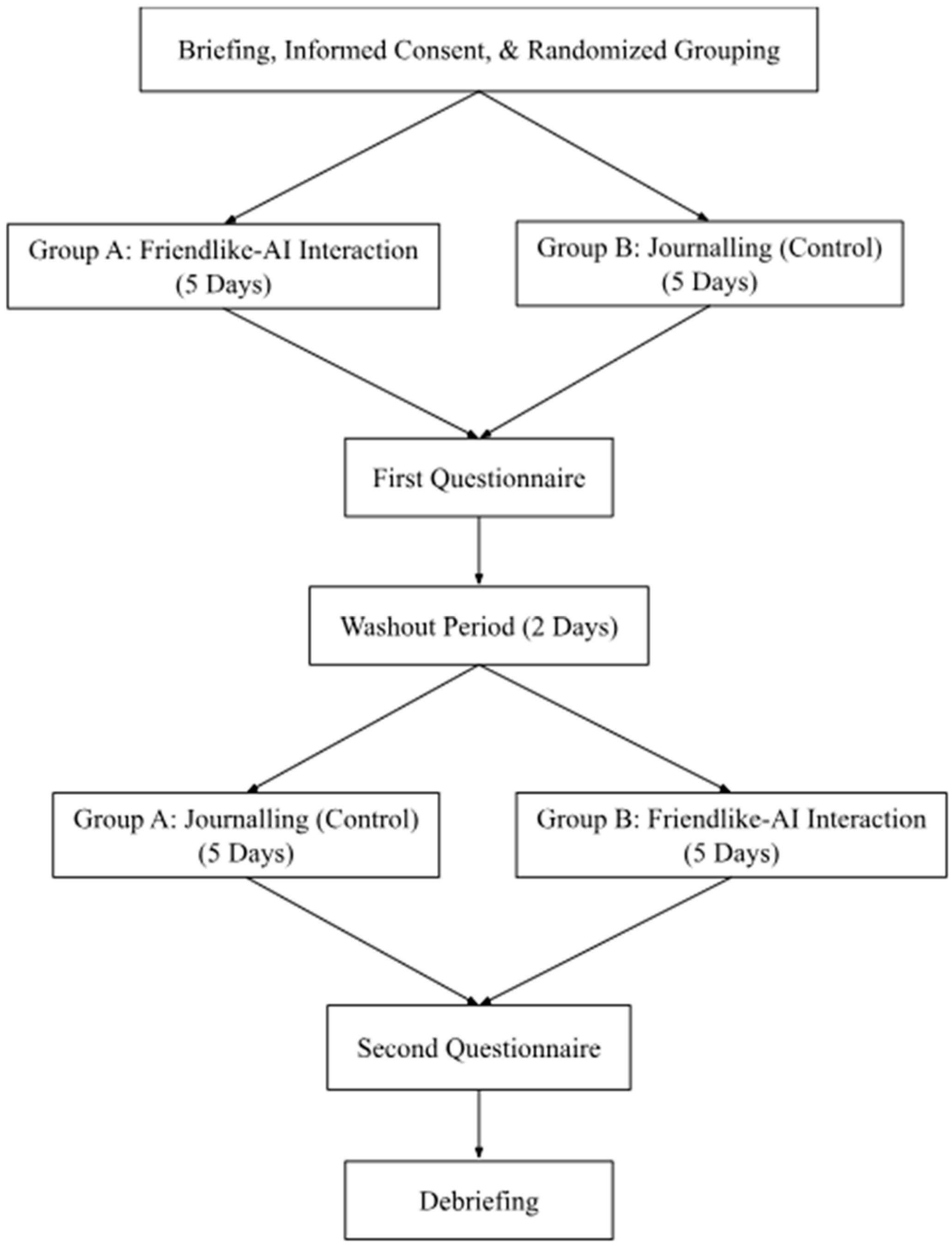
2.2. Procedure
2.3. Measures
2.3.1. Key Outcomes
2.3.2. Exploratory Outcomes
3. Results
3.1. Main Analysis
3.1.1. Attitudes Towards AI
3.1.2. Trust Towards AI
3.1.3. Perceived Empathy of Technology
3.1.4. Godspeed Questionnaire
3.1.5. Generative AI Dependency
3.2. Exploratory Analysis
Self-Esteem
4. Discussion
4.1. The Impact of Friendlike-AI Interactions on Attitudinal Outcomes
4.2. Friendlike-AI Interactions and Self-Esteem
4.3. Implications
4.4. Limitations and Future Directions
5. Conclusions
Author Contributions
Funding
Institutional Review Board Statement
Informed Consent Statement
Data Availability Statement
Conflicts of Interest
Abbreviation
| AI | Artificial Intelligence |
References
- Abd-alrazaq, A. A., Alajlani, M., Alalwan, A. A., Bewick, B. M., Gardner, P., & Househ, M. (2019). An overview of the features of chatbots in mental health: A scoping review. International Journal of Medical Informatics, 132, 103978. [Google Scholar] [CrossRef] [PubMed]
- Adler, N. E., Epel, E. S., Castellazzo, G., & Ickovics, J. R. (2000). Relationship of subjective and objective social status with psychological and physiological functioning: Preliminary data in healthy, white women. Health Psychology, 19(6), 586–592. [Google Scholar] [CrossRef]
- Airenti, G. (2015). The cognitive bases of anthropomorphism: From relatedness to empathy. International Journal of Social Robotics, 7(1), 117–127. [Google Scholar] [CrossRef]
- Aranha, A. M. (2019). The role of personal growth initiative in the relationship between self-compassion and self esteem among college students. The International Journal of Indian Psychology, 7(1), 196–203. [Google Scholar]
- Bai, S., He, H., Han, C., Yang, M., Li, Z., & Fan, W. (2025a). Light trumps Shadow? How generative AI agent’s language arousal influences users’ interactive willingness: Evidence from multi-modal analysis. IEEE Transactions on Engineering Management, 72, 3921–3936. [Google Scholar] [CrossRef]
- Bai, S., Li, Z., He, H., & Fan, W. (2025b). Engaging tourists from city aesthetics: Evidence from multi-modal analysis of computer vision and text mining. Asia Pacific Journal of Marketing and Logistics. [Google Scholar] [CrossRef]
- Baidoo-Anu, D., & Ansah, L. O. (2023). Education in the era of generative artificial intelligence (AI): Understanding the potential benefits of ChatGPT in promoting teaching and learning. Journal of AI, 7(1), 52–62. [Google Scholar] [CrossRef]
- Bartneck, C. (2023). Godspeed questionnaire series: Translations and usage. In C. U. Krägeloh, M. Alyami, & O. N. Medvedev (Eds.), International handbook of behavioral health assessment (pp. 1–35). Springer International Publishing. [Google Scholar] [CrossRef]
- Bartneck, C., Kulić, D., Croft, E., & Zoghbi, S. (2009). Measurement instruments for the anthropomorphism, animacy, likeability, perceived intelligence, and perceived safety of robots. International Journal of Social Robotics, 1(1), 71–81. [Google Scholar] [CrossRef]
- Bassili, J. N. (1996). Meta-judgmental versus operative indexes of psychological attributes: The case of measures of attitude strength. Journal of Personality and Social Psychology, 71(4), 637–653. [Google Scholar] [CrossRef]
- Bellaiche, L., Shahi, R., Tupin, M. H., Ragnhildstveit, A., Sprockett, S., Barr, N., Christensen, A., & Seli, P. (2023). Humans versus AI: Whether and why we prefer human-created compared to AI-created artwork. Cognitive Research: Principles and Implications, 8, 42. [Google Scholar] [CrossRef]
- Brandtzaeg, P. B., Skjuve, M., & Følstad, A. (2022). My AI friend: How users of a social chatbot understand their human–AI friendship. Human Communication Research, 48(3), 404–429. [Google Scholar] [CrossRef]
- Buchanan, J., & Hickman, W. (2024). Do people trust humans more than ChatGPT? Journal of Behavioral and Experimental Economics, 112, 102239. [Google Scholar] [CrossRef]
- Cave, S., Coughlan, K., & Dihal, K. (2019, January 27–28). “Scary robots”: Examining public responses to AI. 2019 AAAI/ACM Conference on AI, Ethics, and Society (pp. 331–337), Honolulu, HI, USA. [Google Scholar] [CrossRef]
- Chandra, M., Naik, S., Ford, D., Okoli, E., De Choudhury, M., Ershadi, M., Ramos, G., Hernandez, J., Bhattacharjee, A., Warreth, S., & Suh, J. (2025, June 23–26). From lived experience to insight: Unpacking the psychological risks of using AI conversational agents. 2025 ACM Conference on Fairness, Accountability, and Transparency (pp. 975–1004), Athens, Greece. [Google Scholar] [CrossRef]
- Chaturvedi, R., Verma, S., Das, R., & Dwivedi, Y. K. (2023). Social companionship with artificial intelligence: Recent trends and future avenues. Technological Forecasting and Social Change, 193, 122634. [Google Scholar] [CrossRef]
- Chaudhry, B. M., & Debi, H. R. (2024). User perceptions and experiences of an AI-driven conversational agent for mental health support. mHealth, 10, 22. [Google Scholar] [CrossRef]
- Cleophas, T. J. (1999). Carryover effects in clinical research. In Human experimentation: Methodologic issues fundamental to clinical trials (pp. 25–36). Springer. [Google Scholar] [CrossRef]
- Cunningham, W. A., Zelazo, P. D., Packer, D. J., & Van Bavel, J. J. (2007). The iterative reprocessing model: A multilevel framework for attitudes and evaluation. Social Cognition, 25(5), 736–760. [Google Scholar] [CrossRef]
- Dewitte, P. (2024). Better alone than in bad company: Addressing the risks of companion chatbots through data protection by design. Computer Law & Security Review, 54, 106019. [Google Scholar] [CrossRef]
- Diener, E., Inglehart, R. F., & Tay, L. (2013). Theory and validity of life satisfaction scales. Social Science Research Network. SSRN Scholarly Paper No. 2199211. Available online: https://papers.ssrn.com/abstract=2199211 (accessed on 28 September 2025).
- Epley, N., Waytz, A., & Cacioppo, J. T. (2007). On seeing human: A three-factor theory of anthropomorphism. Psychological Review, 114(4), 864–886. [Google Scholar] [CrossRef]
- Farzan, M., Ebrahimi, H., Pourali, M., & Sabeti, F. (2025). Artificial intelligence-powered cognitive behavioral therapy chatbots, a systematic review. Iranian Journal of Psychiatry, 20(1), 102–110. [Google Scholar] [CrossRef]
- Faul, F., Erdfelder, E., Lang, A. G., & Buchner, A. (2007). G*Power 3: A flexible statistical power analysis program for the social, behavioral, and biomedical sciences. Behavior Research Methods, 39(2), 175–191. [Google Scholar] [CrossRef] [PubMed]
- Fenigstein, A., Scheier, M. F., & Buss, A. H. (1975). Public and private self-consciousness: Assessment and theory. Journal of Consulting and Clinical Psychology, 43(4), 522–527. [Google Scholar] [CrossRef]
- Fogarty, R., & McTighe, J. (1993). Educating teachers for higher order thinking: The three-story intellect. Theory into Practice, 32(3), 161–169. [Google Scholar]
- Furman, J., & Seamans, R. (2019). AI and the economy. Innovation Policy and the Economy, 19, 161–191. [Google Scholar] [CrossRef]
- Gerlich, M. (2024). The use of artificial intelligence in modern business education: The impact on students’ cognitive and communication skills in the United Kingdom. IEEE Engineering Management Review, 53, 154–167. [Google Scholar] [CrossRef]
- Gillespie, N., Lockey, S., Ward, T., Macdade, A., & Hassed, G. (2025). Trust, attitudes and use of artificial intelligence: A global study 2025. The University of Melbourne and KPMG. [Google Scholar] [CrossRef]
- Goh, A. Y. H., Hartanto, A., & Majeed, N. M. (2025). Generative artificial intelligence dependency: Scale development, validation, and its motivational, behavioral, and psychological correlates. Computers in Human Behavior Reports, 20, 100845. [Google Scholar] [CrossRef]
- Gray, H. M., Gray, K., & Wegner, D. M. (2007). Dimensions of mind perception. Science, 315(5812), 619. [Google Scholar] [CrossRef]
- Gray, K., Young, L., & Waytz, A. (2012). Mind perception is the essence of morality. Psychological Inquiry, 23(2), 101–124. [Google Scholar] [CrossRef]
- Haque, M. D. R., & Rubya, S. (2023). An overview of chatbot-based mobile mental health apps: Insights from app description and user reviews. JMIR mHealth and uHealth, 11, e44838. [Google Scholar] [CrossRef]
- Harrington, R., & Loffredo, D. A. (2010). Insight, rumination, and self-reflection as predictors of well-being. The Journal of Psychology, 145(1), 39–57. [Google Scholar] [CrossRef]
- He, H., Bai, S., Han, C., Yang, M., Fan, W., & Gupta, B. B. (2025). Beyond simple interaction: Uncovering the perception-interaction intrinsic mechanism of generative AI agents—A multi-modal big data analysis with PLS-SEM and fsQCA. Technology in Society, 83, 103020. [Google Scholar] [CrossRef]
- Ho, J. Q. H., Hartanto, A., Koh, A., & Majeed, N. M. (2025a). Gender biases within artificial intelligence and ChatGPT: Evidence, sources of biases and solutions. Computers in Human Behavior: Artificial Humans, 4, 100145. [Google Scholar] [CrossRef]
- Ho, J. Q. H., Hu, M., Chen, T. X., & Hartanto, A. (2025b). Potential and pitfalls of romantic artificial intelligence (AI) companions: A systematic review. Computers in Human Behavior Reports, 19, 100715. [Google Scholar] [CrossRef]
- Hodgins, H. S., Brown, A. B., & Carver, B. (2007). Autonomy and control motivation and self-esteem. Self and Identity, 6(2–3), 189–208. [Google Scholar] [CrossRef]
- Hoffman, R. R., Mueller, S. T., Klein, G., & Litman, J. (2023). Measures for explainable AI: Explanation goodness, user satisfaction, mental models, curiosity, trust, and human-AI performance. Frontiers in Computer Science, 5, 1096257. [Google Scholar] [CrossRef]
- Hu, M., Chua, X. C. W., Diong, S. F., Kasturiratna, K. T. A. S., Majeed, N. M., & Hartanto, A. (2025a). AI as your ally: The effects of AI-assisted venting on negative affect and perceived social support. Applied Psychology: Health and Well-Being, 17(1), e12621. [Google Scholar] [CrossRef]
- Hu, M., Ho, J., Ng, C., Wong, S., & Hartanto, A. (2025b). Emotional support through AI: Venting to artificial intelligence or a human may offer comparable emotional well-being benefits. OSF. [Google Scholar] [CrossRef]
- Imran, M., & Almusharraf, N. (2024). Google Gemini as a next generation AI educational tool: A review of emerging educational technology. Smart Learning Environments, 11(1), 22. [Google Scholar] [CrossRef]
- Johnson, C. S., & Stapel, D. A. (2011). Reflection versus self-reflection: Sources of self-esteem boost determine behavioral outcomes. Social Psychology, 42(2), 144–151. [Google Scholar] [CrossRef]
- Kasturiratna, K. S., & Hartanto, A. (2025). Attachment to artificial intelligence: Development of the AI attachment scale, construct validation, and the psychological mechanisms of human–AI attachment. Computers in Human Behavior Reports, 21, 100912. [Google Scholar] [CrossRef]
- Kuczynski, A. M., Halvorson, M. A., Slater, L. R., & Kanter, J. W. (2021). The effect of social interaction quantity and quality on depressed mood and loneliness: A daily diary study. Journal of Social and Personal Relationships, 39(3), 734–756. [Google Scholar] [CrossRef]
- Lee, M. D., & Wagenmakers, E. J. (2014). Bayesian cognitive modeling: A practical course. Cambridge University Press. [Google Scholar]
- Lee, R. M., & Robbins, S. B. (1995). Measuring belongingness: The Social Connectedness and the Social Assurance scales. Journal of Counseling Psychology, 42(2), 232–241. [Google Scholar] [CrossRef]
- Limpanopparat, S., Gibson, E., & Harris, D. A. (2024). User engagement, attitudes, and the effectiveness of chatbots as a mental health intervention: A systematic review. Computers in Human Behavior: Artificial Humans, 2(2), 100081. [Google Scholar] [CrossRef]
- Liu, T., Giorgi, S., Aich, A., Lahnala, A., Curtis, B., Ungar, L., & Sedoc, J. (2025, February 27–March 4). The illusion of empathy: How AI chatbots shape conversation perception. AAAI Conference on Artificial Intelligence (Vol. 39, pp. 14327–14335), Philadelphia, PA, USA. [Google Scholar] [CrossRef]
- Longoni, C., Bonezzi, A., & Morewedge, C. K. (2019). Resistance to medical artificial intelligence. Journal of Consumer Research, 46(4), 629–650. [Google Scholar] [CrossRef]
- Lopes, P. N., Salovey, P., & Straus, R. (2003). Emotional intelligence, personality, and the perceived quality of social relationships. Personality and Individual Differences, 35(3), 641–658. [Google Scholar] [CrossRef]
- Łukasik, A., & Gut, A. (2025). From robots to chatbots: Unveiling the dynamics of human-AI interaction. Frontiers in Psychology, 16, 1569277. [Google Scholar] [CrossRef]
- Marteau, T. M., & Bekker, H. (1992). The development of a six-item short-form of the state scale of the Spielberger State—Trait Anxiety Inventory (STAI). British Journal of Clinical Psychology, 31(3), 301–306. [Google Scholar] [CrossRef] [PubMed]
- Mazi, C. C., Anichebe, G., Anya, O. I., & Nwanakwaugwu, A. C. (2024). Exploring a pragmatic and exponential advancement in the use of machine learning and artificial intelligence systems. Asian Journal of Research in Computer Science, 17(5), 201–211. [Google Scholar] [CrossRef]
- Meera, S., & Geerthik, S. (2022). Natural language processing. In Artificial intelligent techniques for wireless communication and networking (pp. 139–153). John Wiley & Sons, Ltd. [Google Scholar] [CrossRef]
- Mori, M. (1970). Bukimi no tani [the uncanny valley]. Energy, 7, 33–35. [Google Scholar]
- Murphy, K., & Myors, B. (2023). Statistical power analysis: A simple and general model for traditional and modern hypothesis tests (5th ed.). Routledge. Available online: https://learning.oreilly.com/library/view/statistical-power-analysis/9781000843255/xhtml/cover.xhtml (accessed on 29 July 2025).
- Pai, R. Y., Shetty, A., Dinesh, T. K., Shetty, A. D., & Pillai, N. (2024). Effectiveness of social robots as a tutoring and learning companion: A bibliometric analysis. Cogent Business & Management, 11(1), 2299075. [Google Scholar] [CrossRef]
- Parsakia, K. (2023). The effect of chatbots and AI on the self-efficacy, self-esteem, problem-solving and critical thinking of students. Health Nexus, 1(1), 71–76. [Google Scholar]
- Pentina, I., Hancock, T., & Xie, T. (2023). Exploring relationship development with social chatbots: A mixed-method study of Replika. Computers in Human Behavior, 140, 107600. [Google Scholar] [CrossRef]
- Placani, A. (2024). Anthropomorphism in AI: Hype and fallacy. AI and Ethics, 4(3), 691–698. [Google Scholar] [CrossRef]
- Quintana, D. S., & Williams, D. R. (2018). Bayesian alternatives for common null-hypothesis significance tests in psychiatry: A non-technical guide using JASP. BMC Psychiatry, 18(1), 178. [Google Scholar] [CrossRef]
- Racine, E., Boehlen, W., & Sample, M. (2019). Healthcare uses of artificial intelligence: Challenges and opportunities for growth. Healthcare Management Forum, 32(5), 272–275. [Google Scholar] [CrossRef] [PubMed]
- Reeves, B., & Nass, C. (1996). The media equation: How people treat computers, television, and new media like real people and places. Bibliovault OAI Repository, The University of Chicago Press. [Google Scholar]
- Roberts, R. C. (2009). Emotional consciousness and personal relationships. Emotion Review, 1(3), 281–288. [Google Scholar] [CrossRef]
- Rosenberg, M. (1979). Conceiving the self. Basic Books. [Google Scholar]
- Roser, M. (2022). The brief history of artificial intelligence: The world has changed fast—What might be next? Our World in Data. Available online: https://ourworldindata.org/brief-history-of-ai (accessed on 29 July 2025).
- Russell, D., Peplau, L. A., & Cutrona, C. E. (1980). The revised UCLA loneliness scale: Concurrent and discriminant validity evidence. Journal of Personality and Social Psychology, 39(3), 472–480. [Google Scholar] [CrossRef]
- Russell, J. A. (1980). A circumplex model of affect. Journal of Personality and Social Psychology, 39(6), 1161–1178. [Google Scholar] [CrossRef]
- Ryan, M. (2020). In AI we trust: Ethics, artificial intelligence, and reliability. Science and Engineering Ethics, 26, 2749–2767. [Google Scholar] [CrossRef]
- Schmidmaier, M., Rupp, J., Cvetanova, D., & Mayer, S. (2024, May 11–16). Perceived Empathy of Technology Scale (PETS): Measuring empathy of systems toward the user. CHI Conference on Human Factors in Computing Systems (pp. 1–18), Oahu, HI, USA. [Google Scholar] [CrossRef]
- Schwesig, R., Brich, I., Buder, J., Huff, M., & Said, N. (2023). Using artificial intelligence (AI)? Risk and opportunity perception of AI predict people’s willingness to use AI. Journal of Risk Research, 26(10), 1053–1084. [Google Scholar] [CrossRef]
- Skjuve, M., Følstad, A., Fostervold, K. I., & Brandtzaeg, P. B. (2021). My chatbot companion—A study of human-chatbot relationships. International Journal of Human-Computer Studies, 149, 102601. [Google Scholar] [CrossRef]
- Skjuve, M., Følstad, A., Fostervold, K. I., & Brandtzaeg, P. B. (2022). A longitudinal study of human–chatbot relationships. International Journal of Human-Computer Studies, 168, 102903. [Google Scholar] [CrossRef]
- Snyder, E., Cai, B., DeMuro, C., Morrison, M. F., & Ball, W. (2018). A new single-item sleep quality scale: Results of psychometric evaluation in patients with chronic primary insomnia and depression. Journal of Clinical Sleep Medicine, 14(11), 1849–1857. [Google Scholar] [CrossRef]
- Sova, R., Tudor, C., Tartavulea, C. V., & Dieaconescu, R. I. (2024). Artificial intelligence tool adoption in higher education: A structural equation modeling approach to understanding impact factors among economics students. Electronics, 13(18), 3632. [Google Scholar] [CrossRef]
- Stein, J.-P., Messingschlager, T., Gnambs, T., Hutmacher, F., & Appel, M. (2024). Attitudes towards AI: Measurement and associations with personality. Scientific Reports, 14(1), 2909. [Google Scholar] [CrossRef]
- Strack, F. (1992). “Order effects” in survey research: Activation and information functions of preceding questions. In N. Schwarz, & S. Sudman (Eds.), Context effects in social and psychological research (pp. 23–34). Springer. [Google Scholar] [CrossRef]
- Symons, J., & Abumusab, S. (2024). Social agency for artifacts: Chatbots and the ethics of artificial intelligence. Digital Society, 3(1), 2. [Google Scholar] [CrossRef]
- Ta, V., Griffith, C., Boatfield, C., Wang, X., Civitello, M., Bader, H., DeCero, E., & Loggarakis, A. (2020). User experiences of social support from companion chatbots in everyday contexts: Thematic analysis. Journal of Medical Internet Research, 22(3), e16235. [Google Scholar] [CrossRef] [PubMed]
- Taherdoost, H., & Madanchian, M. (2023). Artificial intelligence and sentiment analysis: A review in competitive research. Computers, 12(2), 37. [Google Scholar] [CrossRef]
- Vaidyam, A. N., Wisniewski, H., Halamka, J. D., Kashavan, M. S., & Torous, J. B. (2019). Chatbots and conversational agents in mental health: A review of the psychiatric landscape. The Canadian Journal of Psychiatry, 64(7), 456–464. [Google Scholar] [CrossRef] [PubMed]
- van Doorn, J., van den Bergh, D., Böhm, U., Dablander, F., Derks, K., Draws, T., Etz, A., Evans, N. J., Gronau, Q. F., Haaf, J. M., Hinne, M., Kucharský, Š., Ly, A., Marsman, M., Matzke, D., Gupta, A. R. K. N., Sarafoglou, A., Stefan, A., Voelkel, J. G., & Wagenmakers, E. J. (2021). The JASP guidelines for conducting and reporting a Bayesian analysis. Psychonomic Bulletin & Review, 28(3), 813–826. [Google Scholar] [CrossRef]
- Vasilescu, C., & Gheorghe, M. (2024). Improving the performance of corporate employees through the use of artificial intelligence: The case of Copilot application. Proceedings of the International Conference on Business Excellence, 18(1), 1819–1830. [Google Scholar] [CrossRef]
- Wang, G., Obrenovic, B., Gu, X., & Godinic, D. (2025). Fear of the new technology: Investigating the factors that influence individual attitudes toward generative artificial intelligence (AI). Current Psychology, 44(9), 8050–8067. [Google Scholar] [CrossRef]
- Wang, Q., Saha, K., Gregori, E., Joyner, D., & Goel, A. (2021, May 8–13). Towards mutual theory of mind in human-AI interaction: How language reflects what students perceive about a virtual teaching assistant. 2021 CHI Conference on Human Factors in Computing Systems (pp. 1–14), Yokohama, Japan. [Google Scholar] [CrossRef]
- Weijers, D., & Munn, N. (2025). Human–AI friendship is possible and can be good. In Oxford intersections: AI in society. Oxford University Press. [Google Scholar] [CrossRef]
- Wienrich, C., Carolus, A., Markus, A., Augustin, Y., Pfister, J., & Hotho, A. (2023). Long-term effects of perceived friendship with intelligent voice assistants on usage behavior, user experience, and social perceptions. Computers, 12(4), 77. [Google Scholar] [CrossRef]
- Wolf, V., & Maier, C. (2024). ChatGPT usage in everyday life: A motivation-theoretic mixed-methods study. International Journal of Information Management, 79, 102821. [Google Scholar] [CrossRef]
- Xie, T., & Pentina, I. (2022, January 4–7). Attachment theory as a framework to understand relationships with social chatbots: A case study of Replika. 55th Hawaii International Conference on System Sciences, Maui, HI, USA. [Google Scholar] [CrossRef]
- Xie, T., Pentina, I., & Hancock, T. (2023). Friend, mentor, lover: Does chatbot engagement lead to psychological dependence? Journal of Service Management, 34(4), 806–828. [Google Scholar] [CrossRef]
- Yarovenko, H., Kuzior, A., Norek, T., & Lopatka, A. (2024). The future of artificial intelligence: Fear, hope or indifference? Human Technology, 20(3), 611–639. [Google Scholar] [CrossRef]
- Yoganathan, V., Osburg, V.-S., Kunz, W. H., & Toporowski, W. (2021). Check-in at the Robo-desk: Effects of automated social presence on social cognition and service implications. Tourism Management, 85, 104309. [Google Scholar] [CrossRef]
- Yuan, A., Garcia Colato, E., Pescosolido, B., Song, H., & Samtani, S. (2025). Improving workplace well-being in modern organizations: A review of large language model-based mental health chatbots. ACM Transactions on Management Information Systems, 16(1), 1–26. [Google Scholar] [CrossRef]



| Characteristic | M (SD) or % | Observed Range | Theoretical Range | Skewness | Kurtosis |
|---|---|---|---|---|---|
| Age (years) | 21.4 (1.78) | 18–26 | >18 | 0.68 | 0.47 |
| Subjective Socioeconomic Status | 6.52 (1.18) | 3–10 | 1–10 | −0.09 | 1.79 |
| Objective Socioeconomic Status (Monthly Household Income in SGD) | 3.52 (1.34) | 1–6 | 1–6 | 0.03 | −0.65 |
| Education Level (Father) | 8.62 (2.96) | 1–12 | 1–14 | −1.35 | 0.61 |
| Education Level (Mother) | 8.04 (3.01) | 1–12 | 1–14 | −0.90 | −0.58 |
| Gender (% Female) | 82.7% | ||||
| Ethnicity (% Chinese) | 75% | ||||
| Nationality (% Singaporean) | 75% |
| Attitudes | Friendlike-AI Interaction M (SD) | Journaling Control M (SD) | d | 95% CI | p | BF10 |
|---|---|---|---|---|---|---|
| Attitudes towards AI | 3.37 (0.60) | 3.40 (0.67) | −0.05 | [−0.15, 0.10] | 0.720 | 0.16 |
| Trust towards AI | 3.30 (0.66) | 3.25 (0.69) | 0.08 | [−0.11, 0.21] | 0.554 | 0.18 |
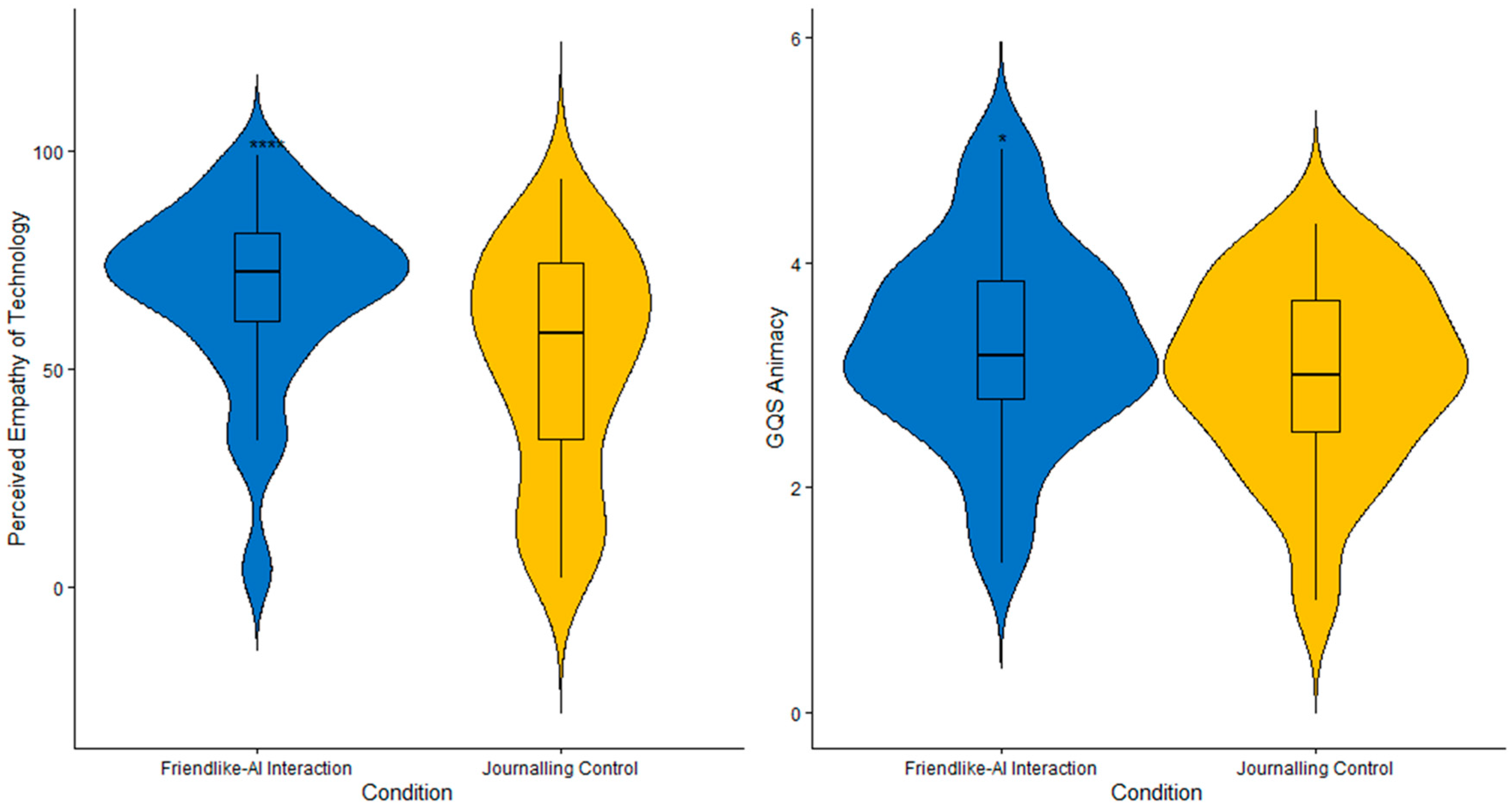
| Perceived Empathy of Technology | 67.80 (20.85) | 51.62 (25.68) | 0.74 | [10.12, 22.24] | <0.001 * | >100 |
| Anthropomorphism | 3.20 (0.74) | 2.98 (0.94) | 0.25 | [−0.02, 0.45] | 0.078 | 0.67 |
| Animacy | 3.28 (0.88) | 3.00 (0.83) | 0.33 | [0.05, 0.50] | 0.019 * | 2.13 |
| Likeability | 3.73 (0.92) | 3.77 (0.73) | −0.04 | [−0.29, 0.22] | 0.764 | 0.16 |
| Perceived Intelligence | 3.70 (0.86) | 3.70 (0.64) | 0.01 | [−0.20, 0.21] | 0.970 | 0.15 |
| Perceived Safety | 3.49 (0.79) | 3.51 (0.75) | −0.02 | [−0.27, 0.23] | 0.879 | 0.15 |
| Generative AI Dependency | 2.66 (0.90) | 2.61 (0.97) | 0.11 | [−0.08, 0.18] | 0.420 | 0.21 |
| Outcome | Friendlike-AI Interaction M (SD) | Journaling Control M (SD) | d | 95% CI | p |
|---|---|---|---|---|---|
| Positive Affect | 2.95 (0.88) | 2.92 (0.80) | 0.04 | [−0.17, 0.24] | 0.755 |
| Negative Affect | 2.13 (0.91) | 2.26 (0.99) | −0.13 | [−0.38, 0.14] | 0.355 |
| Loneliness | 2.05 (1.12) | 2.04 (1.04) | 0.01 | [−0.27, 0.29] | 0.944 |
| Social Interaction Quantity and Quality | 6.33 (2.04) | 6.56 (2.19) | −0.12 | [−0.77, 0.30] | 0.376 |
| State Anxiety | 2.48 (0.65) | 2.42 (0.72) | 0.10 | [−0.12, 0.25] | 0.485 |
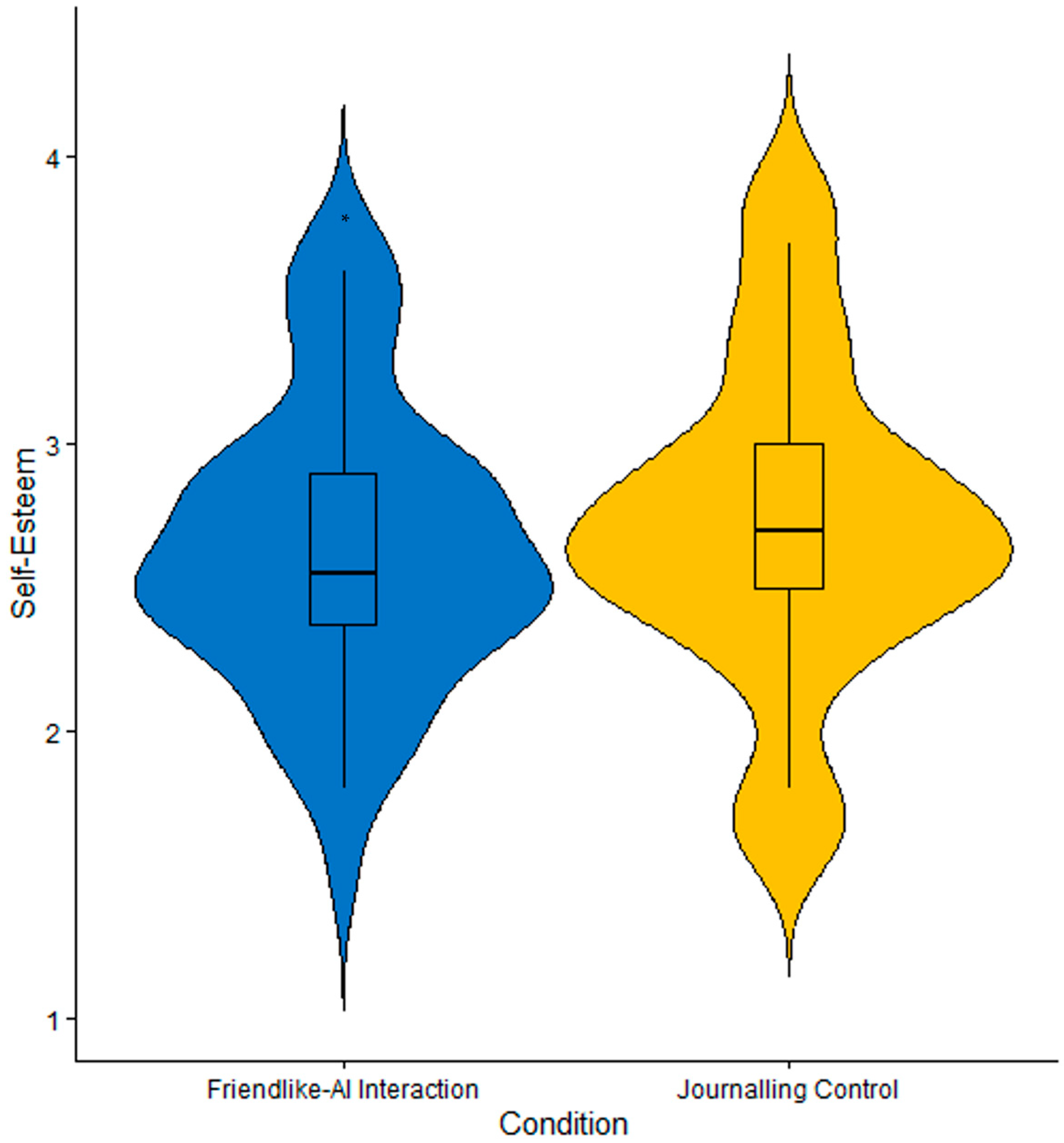
| Self-Esteem | 2.63 (0.50) | 2.72 (0.56) | −0.29 | [−0.17, −0.002] | 0.045 * |
| Perceived Stress | 5.00 (2.71) | 5.15 (2.33) | −0.05 | [−0.94, 0.63] | 0.696 |
| Weekly Life Satisfaction | 3.71 (0.85) | 3.58 (0.87) | 0.15 | [−0.11, 0.38] | 0.279 |
| Sleep Quality | 5.31 (2.69) | 5.37 (2.99) | −0.02 | [−0.77, 0.65] | 0.871 |
| Social Connectedness | 4.27 (1.17) | 4.38 (1.25) | −0.09 | [−0.45, 0.23] | 0.515 |
Disclaimer/Publisher’s Note: The statements, opinions and data contained in all publications are solely those of the individual author(s) and contributor(s) and not of MDPI and/or the editor(s). MDPI and/or the editor(s) disclaim responsibility for any injury to people or property resulting from any ideas, methods, instructions or products referred to in the content. |
© 2026 by the authors. Licensee MDPI, Basel, Switzerland. This article is an open access article distributed under the terms and conditions of the Creative Commons Attribution (CC BY) license.
Share and Cite
Ho, J.Q.H.; Hu, M.; Goh, A.Y.H.; Pragasam, E.J.; Hartanto, A. How Consistent Friendlike Conversation with AI Companions Influences Our Attitudes and Perceptions Toward AI: An Exploratory Experiment. Behav. Sci. 2026, 16, 278. https://doi.org/10.3390/bs16020278
Ho JQH, Hu M, Goh AYH, Pragasam EJ, Hartanto A. How Consistent Friendlike Conversation with AI Companions Influences Our Attitudes and Perceptions Toward AI: An Exploratory Experiment. Behavioral Sciences. 2026; 16(2):278. https://doi.org/10.3390/bs16020278
Chicago/Turabian StyleHo, Jerlyn Q. H., Meilan Hu, Adalia Y. H. Goh, Emma Jane Pragasam, and Andree Hartanto. 2026. "How Consistent Friendlike Conversation with AI Companions Influences Our Attitudes and Perceptions Toward AI: An Exploratory Experiment" Behavioral Sciences 16, no. 2: 278. https://doi.org/10.3390/bs16020278
APA StyleHo, J. Q. H., Hu, M., Goh, A. Y. H., Pragasam, E. J., & Hartanto, A. (2026). How Consistent Friendlike Conversation with AI Companions Influences Our Attitudes and Perceptions Toward AI: An Exploratory Experiment. Behavioral Sciences, 16(2), 278. https://doi.org/10.3390/bs16020278