Frontal EEG Asymmetry and Attachment Style During Sequential Decision-Making in the Secretary Problem

Abstract
1. Introduction
2. Materials and Methods
2.1. Participants
2.2. Task Procedure
2.3. EEG Recording and Preprocessing
2.4. Data Analysis
2.4.1. Phase-Based Asymmetry Analysis
2.4.2. Trajectory-Length Analysis
3. Results
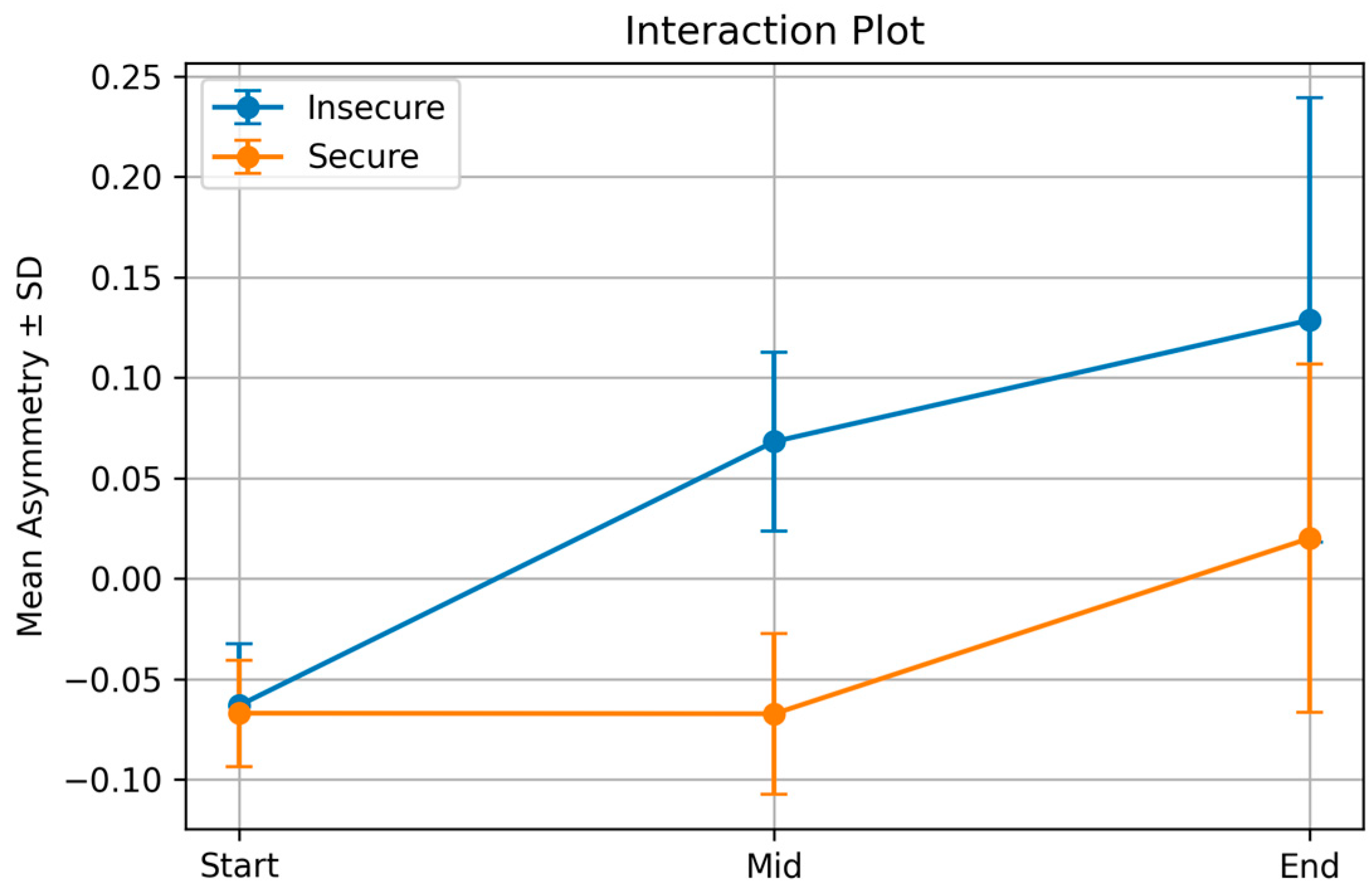
3.1. Phase-Based Asymmetry Analysis
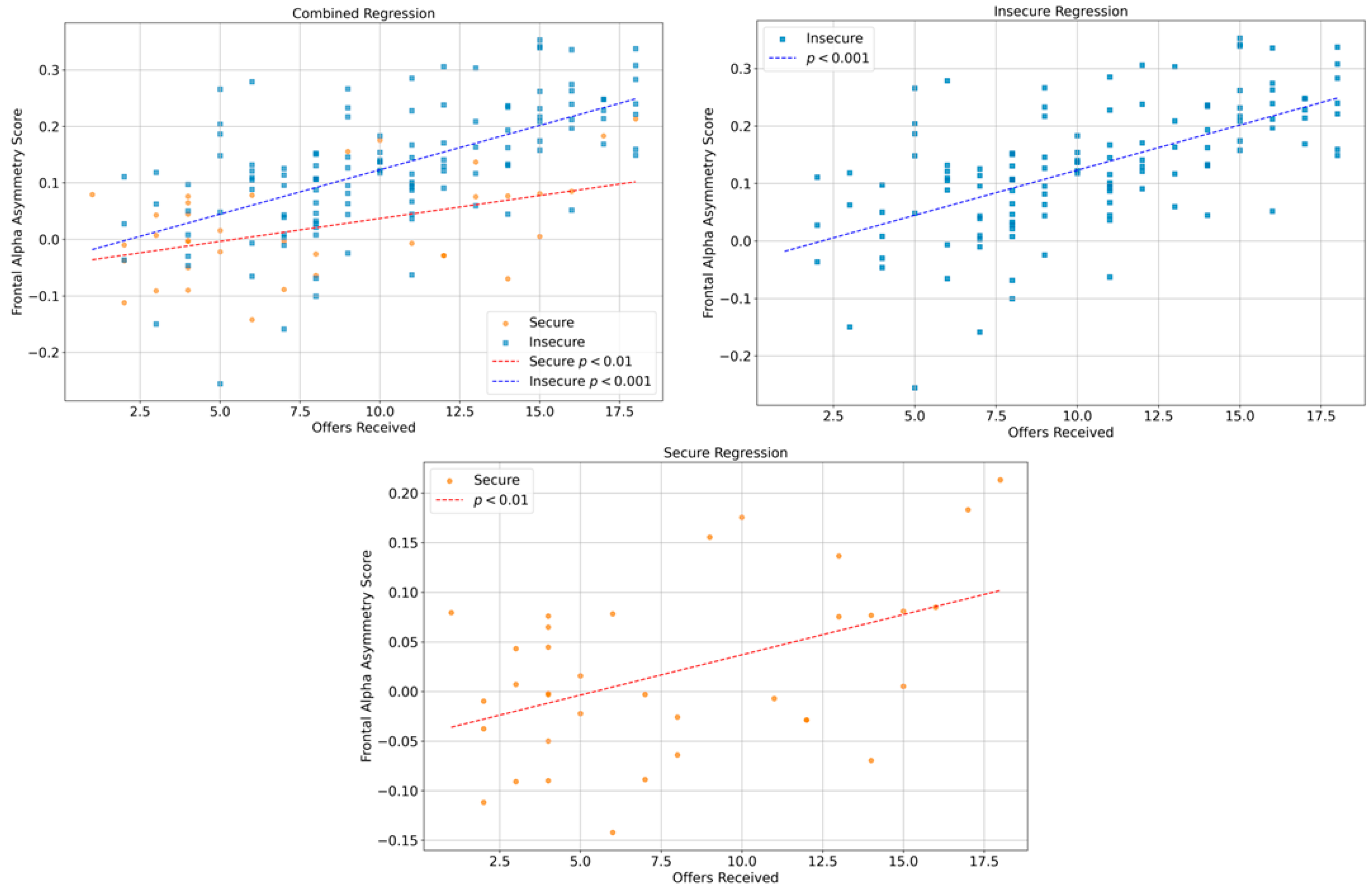
3.2. Trajectory-Length Analysis
4. Discussion
4.1. Hypothesis 1: Asymmetry Across Decision Phases
4.2. Hypothesis 2: Decision Length and Final Asymmetry
4.3. Interpretation of Asymmetry Patterns
4.4. Theoretical Implications
4.5. Limitations
4.6. Future Directions
4.7. Conclusions
Funding
Institutional Review Board Statement
Informed Consent Statement
Data Availability Statement
Conflicts of Interest
References
- Ambrosini, E., & Vallesi, A. (2017). Domain-general Stroop performance and hemispheric asymmetries: A resting-state EEG study. Journal of Cognitive Neuroscience, 29(5), 769–779. [Google Scholar] [CrossRef] [Scilit] [PubMed]
- Bearden, J. N., Murphy, R. O., & Rapoport, A. (2005). A multi-attribute extension of the secretary problem: Theory and experiments. Journal of Mathematical Psychology, 49(5), 410–422. [Google Scholar] [CrossRef] [Scilit]
- Becske, M., Lázár, I., & Bódizs, R. (2023). A questionnaire measure of adult attachment anxiety correlates with frontal hemispheric asymmetry in sleep spindle activity. Sleep and Biological Rhythms, 21(2), 155–163. [Google Scholar] [CrossRef] [Scilit] [PubMed]
- Bergquist, M., & Ekelund, M. (2025). The role of emotion regulation in normative influence under uncertainty. BMC Psychology, 13(1), 731. [Google Scholar] [CrossRef] [Scilit]
- Berretz, G., Packheiser, J., Wolf, O. T., & Ocklenburg, S. (2022). Acute stress increases left hemispheric activity measured via changes in frontal alpha asymmetries. Iscience, 25(2), 103841. [Google Scholar] [CrossRef] [Scilit]
- Biro, S., Peltola, M. J., Huffmeijer, R., Alink, L. R., Bakermans-Kranenburg, M. J., & van IJzendoorn, M. H. (2021). Frontal EEG asymmetry in infants observing separation and comforting events: The role of infants’ attachment relationship. Developmental Cognitive Neuroscience, 48, 100941. [Google Scholar] [CrossRef] [Scilit]
- Brera, R., & Fu, F. (2023). The satisficing secretary problem: When closed-form solutions meet simulated annealing. arXiv, arXiv:2302.03220. [Google Scholar] [CrossRef] [Scilit]
- Buchheim, A., George, C., Gündel, H., & Viviani, R. (2017). Neuroscience of human attachment. Frontiers in Human Neuroscience, 11, 136. [Google Scholar] [CrossRef] [Scilit]
- Chen, Z. (2025). The differences between secure and insecure attachment styles in decision making under social contexts. Lecture Notes in Education Psychology and Public Media, 92, 64–71. [Google Scholar] [CrossRef] [Scilit]
- Clear, S. J., Gardner, A. A., Webb, H. J., & Zimmer-Gembeck, M. J. (2019). Common and distinct correlates of depression, anxiety, and aggression: Attachment and emotion regulation of sadness and anger. Journal of Adult Development, 27, 181–191. [Google Scholar] [CrossRef] [Scilit]
- Deng, M., Zhang, X., Bi, X., & Gao, C. (2021). Neural basis underlying the trait of attachment anxiety and avoidance revealed by the amplitude of low-frequency fluctuations and resting-state functional connectivity. BMC Neuroscience, 22(1), 11. [Google Scholar] [CrossRef] [Scilit]
- Domic-Siede, M., Guzmán-González, M., Ortiz, R., Hernández, S., & Carvallo, C. (2025). Phase-synchronized brain connectivity during emotion regulation: Attachment as a moderator. Social Cognitive and Affective Neuroscience, 20(1), nsaf069. [Google Scholar] [CrossRef] [Scilit] [PubMed]
- Eilert, D. W., & Buchheim, A. (2023). Attachment-related differences in emotion regulation in adults: A systematic review on attachment representations. Brain Sciences, 13(6), 884. [Google Scholar] [CrossRef] [Scilit]
- Ellis, A. J., Kinzel, C., Salgari, G. C., & Loo, S. K. (2017). Frontal alpha asymmetry predicts inhibitory processing in youth with attention deficit/hyperactivity disorder. Neuropsychologia, 102, 45–51. [Google Scholar] [CrossRef] [Scilit] [PubMed]
- Enriquez-Geppert, S., Huster, R. J., Figge, C., & Herrmann, C. S. (2014). Self-regulation of frontal-midline theta facilitates memory updating and mental set shifting. Frontiers in Behavioral Neuroscience, 8, 420. [Google Scholar] [CrossRef] [Scilit] [PubMed]
- Epishin, V., & Bogacheva, N. (2020). Tolerance for uncertainty and patterns of decision-making in complex problem-solving strategies. Multimodal Technologies and Interaction, 4(3), 58. [Google Scholar] [CrossRef] [Scilit]
- Ferguson, T. S. (1989). Who solved the secretary problem? Statistical Science, 4(3), 282–289. [Google Scholar] [CrossRef] [Scilit]
- Gander, M., & Buchheim, A. (2015). Attachment classification, psychophysiology and frontal EEG asymmetry across the lifespan: A review. Frontiers in Human Neuroscience, 9, 79. [Google Scholar] [CrossRef] [Scilit]
- Gander, M., Karabatsiakis, A., Nuderscher, K., Bernheim, D., Doyen-Waldecker, C., & Buchheim, A. (2022). Secure attachment representation in adolescence buffers heart-rate reactivity in response to attachment-related stressors. Frontiers in Human Neuroscience, 16, 806987. [Google Scholar] [CrossRef] [Scilit]
- Gardner, A. A., Zimmer-Gembeck, M. J., & Campbell, S. M. (2020). Attachment and emotion regulation: A person-centred examination and relations with coping with rejection, friendship closeness, and emotional adjustment. British Journal of Developmental Psychology, 38(1), 125–143. [Google Scholar] [CrossRef] [Scilit]
- Goodman, R. N., Rietschel, J. C., Lo, L. C., Costanzo, M. E., & Hatfield, B. D. (2013). Stress, emotion regulation and cognitive performance: The predictive contributions of trait and state relative frontal EEG alpha asymmetry. International Journal of Psychophysiology, 87(2), 115–123. [Google Scholar] [CrossRef] [Scilit]
- Gómez-Ariza, C. J., Martín, M. C., & Morales, J. (2017). Tempering proactive cognitive control by transcranial direct current stimulation of the right (but not the left) lateral prefrontal cortex. Frontiers in Neuroscience, 11, 282. [Google Scholar] [CrossRef] [Scilit] [PubMed]
- Grassini, S., Sikka, P., Revonsuo, A., & Koivisto, M. (2020). Subjective ratings of fear are associated with frontal late positive potential asymmetry, but not with early brain activity over the occipital and centro-parietal cortices. Psychophysiology, 57(12), e13665. [Google Scholar] [CrossRef] [Scilit] [PubMed]
- Grimshaw, G. M., & Carmel, D. (2014). An asymmetric inhibition model of hemispheric differences in emotional processing. Frontiers in Psychology, 5, 489. [Google Scholar] [CrossRef] [Scilit] [PubMed]
- Harmon-Jones, E., & Gable, P. A. (2018). On the role of asymmetric frontal cortical activity in approach and withdrawal motivation: An updated review of the evidence. Psychophysiology, 55(1), e12879. [Google Scholar] [CrossRef] [Scilit]
- Hazarika, N., Chen, J. Z., Tsoi, A. C., & Sergejew, A. (1997). Classification of EEG signals using the wavelet transform. Signal Processing, 59(1), 61–72. [Google Scholar] [CrossRef] [Scilit]
- Hiebler-Ragger, M., Perchtold-Stefan, C. M., Unterrainer, H. F., Fuchshuber, J., Koschutnig, K., Nausner, L., Kapfhammer, H. P., Papousek, I., Weiss, E. M., & Fink, A. (2021). Lower cognitive reappraisal capacity is related to impairments in attachment and personality structure in poly-drug use: An fMRI study. Brain Imaging and Behavior, 15(4), 2187–2198. [Google Scholar] [CrossRef] [Scilit]
- Howarth, G. Z., Fettig, N. B., Curby, T. W., & Bell, M. A. (2016). Frontal EEG asymmetry and temperament across infancy and early childhood: An exploration of stability and bidirectional relations. Child Development, 87, 465–476. [Google Scholar] [CrossRef] [Scilit]
- Hyvärinen, A., & Oja, E. (2000). Independent component analysis: Algorithms and applications. Neural Networks, 13(4–5), 411–430. [Google Scholar] [CrossRef] [Scilit]
- Jollans, L., Whelan, R., Venables, L., Turnbull, O. H., Cella, M., & Dymond, S. (2017). Computational EEG modelling of decision making under ambiguity reveals spatio-temporal dynamics of outcome evaluation. Behavioural Brain Research, 321, 28–35. [Google Scholar] [CrossRef] [Scilit]
- Kaack, I., Chae, J., Shadli, S. M., & Hillman, K. (2020). Exploring approach motivation: Correlating self-report, frontal asymmetry, and performance in the Effort Expenditure for Rewards Task. Cognitive, Affective, & Behavioral Neuroscience, 20(6), 1234–1247. [Google Scholar] [CrossRef] [Scilit]
- Kelley, N. J., & Hughes, M. L. (2019). Resting frontal EEG asymmetry and emotion regulation in older adults: The midlife in the United States (MIDUS) study. Psychology and Aging, 34(3), 341. [Google Scholar] [CrossRef] [Scilit] [PubMed]
- Kungl, M. T., Leyh, R., & Spangler, G. (2016). Attachment representations and brain asymmetry during the processing of autobiographical emotional memories in late adolescence. Frontiers in Human Neuroscience, 10, 644. [Google Scholar] [CrossRef] [Scilit] [PubMed]
- Laufer, I., Mizrahi, D., & Zuckerman, I. (2024). Enhancing EEG-Based attachment style prediction: Unveiling the impact of feature domains. Frontiers in Psychology, 15, 1326791. [Google Scholar] [CrossRef] [Scilit] [PubMed]
- Lavín, C., García, R., & Fuentes, M. (2024). Navigating uncertainty: The role of mood and confidence in decision-making flexibility and performance. Behavioral Sciences, 14(12), 1144. [Google Scholar] [CrossRef] [Scilit]
- Leyh, R., Heinisch, C., Kungl, M. T., & Spangler, G. (2016). Attachment representation moderates the influence of emotional context on information processing. Frontiers in Human Neuroscience, 10, 278. [Google Scholar] [CrossRef] [Scilit]
- Li, X., Leng, Y., Xiong, Z., & Liu, J. (2024). The effect of long-term learning of baduanjin on emotion regulation: Evidence from resting-state frontal EEG asymmetry. Psychology Research and Behavior Management, 17, 2391–2401. [Google Scholar] [CrossRef] [Scilit]
- Liu, X., Milenkovic, O., & Moustakides, G. V. (2023). A combinatorial proof for the secretary problem with multiple choices. arXiv, arXiv:2303.02361. [Google Scholar] [CrossRef] [Scilit]
- Lorenzini, N., & Fonagy, P. (2013). Attachment and personality disorders: A short review. Focus, 11(2), 155–166. [Google Scholar] [CrossRef] [Scilit]
- Lyons-Ruth, K., Pechtel, P., Yoon, S. A., Anderson, C. M., & Teicher, M. H. (2016). Disorganized attachment in infancy predicts greater amygdala volume in adulthood. Behavioural Brain Research, 308, 83–93. [Google Scholar] [CrossRef] [Scilit]
- McConnell, M., & Moss, E. (2011). Attachment across the life span: Factors that contribute to stability and change. Australian Journal of Educational & Developmental Psychology, 11, 60–77. [Google Scholar]
- Mizrahi, D., Laufer, I., & Zuckerman, I. (2024). Neurophysiological insights into sequential decision-making: Exploring the secretary problem through ERPs and TBR dynamics. BMC Psychology, 12(1), 245. [Google Scholar] [CrossRef] [Scilit] [PubMed]
- Mizrahi, D., Zuckerman, I., & Laufer, I. (2022, July). Analysis of alpha band decomposition in different level-k scenarios with semantic processing. In International conference on brain informatics (pp. 65–73). Springer International Publishing. [Google Scholar]
- Moran, J. K., Crombach, A., Elbert, T., Nandi, C., Bambonyé, M., Wienbruch, C., Lommen, U., & Weierstall, R. (2017). The individual contribution of DSM 5 symptom clusters of PTSD, life events, and childhood adversity to frontal oscillatory brain asymmetry in a large sample of active combatants. Biological Psychology, 129, 305–313. [Google Scholar] [CrossRef] [Scilit] [PubMed]
- Moutsiana, C., Fearon, P., Murray, L., Cooper, P., Goodyer, I., Johnstone, T., & Halligan, S. (2014). Making an effort to feel positive: Insecure attachment in infancy predicts the neural underpinnings of emotion regulation in adulthood. Journal of Child Psychology and Psychiatry, 55(9), 999–1008. [Google Scholar] [CrossRef] [Scilit]
- Müller, B. C., Marx, A. K., Paulus, M., & Meinhardt, J. (2018). Frontal electroencephalogram alpha asymmetry relates to implicit achievement motives: A pilot study. Mind, Brain, and Education, 12(2), 82–89. [Google Scholar] [CrossRef] [Scilit]
- Nakuci, J., Samaha, J., & Rahnev, D. (2023). Brain signatures indexing variation in internal processing during perceptual decision-making. iScience, 26(10), 107750. [Google Scholar] [CrossRef] [Scilit]
- Nelson, B. D., Shankman, S. A., & Proudfit, G. H. (2014). Intolerance of uncertainty mediates reduced reward anticipation in major depressive disorder. Journal of Affective Disorders, 158, 108–113. [Google Scholar] [CrossRef] [Scilit]
- Palmiero, M., & Piccardi, L. (2017). Frontal EEG asymmetry of mood: A mini-review. Frontiers in Behavioral Neuroscience, 11, 224. [Google Scholar] [CrossRef] [Scilit]
- Pavlov, Y. G., & Kotchoubey, B. (2022). Oscillatory brain activity and maintenance of verbal and visual working memory: A systematic review. Psychophysiology, 59(5), e13735. [Google Scholar] [CrossRef] [Scilit]
- Pedroni, A., Gianotti, L. R., Koenig, T., Lehmann, D., Faber, P., & Knoch, D. (2017). Temporal characteristics of EEG microstates mediate trial-by-trial risk taking. Brain Topography, 30(1), 149–159. [Google Scholar] [CrossRef] [Scilit]
- Pester, B., & Ligges, C. (2018, July). Does independent component analysis influence EEG connectivity analyses? In 2018 40th annual international conference of the IEEE engineering in medicine and biology society (EMBC) (pp. 1007–1010). IEEE. [Google Scholar]
- Petrowski, K., Beetz, A., Schurig, S., Wintermann, G. B., & Buchheim, A. (2017). Association of attachment disorganization, attachment-related emotion regulation, and cortisol response after standardized psychosocial stress procedure: A pilot study. Psihologija, 50(2), 103–116. [Google Scholar] [CrossRef] [Scilit]
- Puhlmann, L. M., Derome, M., Morosan, L., Kilicel, D., Vrtička, P., & Debbané, M. (2023). Longitudinal associations between self-reported attachment dimensions and neurostructural development from adolescence to early adulthood. Attachment & Human Development, 25(1), 162–180. [Google Scholar]
- Ramos-Henderson, M., Guzmán-González, M., Bahamondes, J., & Domic-Siede, M. (2024). The moderating role of the late positive potential in the link between attachment anxiety and emotion regulation difficulties. Frontiers in Psychology, 15, 1360. [Google Scholar] [CrossRef] [Scilit] [PubMed]
- Ravaja, N., Korhonen, P., Köksalan, M., Lipsanen, J., Salminen, M., Somervuori, O., & Wallenius, J. (2016). Emotional–motivational responses predicting choices: The role of asymmetrical frontal cortical activity. Journal of Economic Psychology, 52, 56–70. [Google Scholar] [CrossRef] [Scilit]
- Revilla, R., Nelson, C. M., Friedman, N. R., Braun, S. S., & Hudac, C. M. (2024). Frontal alpha asymmetry predicts subsequent social decision-making: A dynamic multilevel, neural, and developmental perspective. Developmental Cognitive Neuroscience, 69, 101434. [Google Scholar] [CrossRef] [Scilit]
- Robble, M. A., Schroder, H. S., Kangas, B. D., Nickels, S., Breiger, M., Iturra-Mena, A. M., Perlo, S., Cardenas, E., Der-Avakian, A., Barnes, S. A., Leutgeb, S., Risbrough, V. B., Vitaliano, G., Bergman, J., Carlezon, W. A., Jr., & Pizzagalli, D. A. (2021). Concordant neurophysiological signatures of cognitive control in humans and rats. Neuropsychopharmacology, 46(7), 1252–1262. [Google Scholar] [CrossRef] [Scilit]
- Rognoni, E., Galati, D., Costa, T., & Crini, M. (2008). Relationship between adult attachment patterns, emotional experience and EEG frontal asymmetry. Personality and Individual Differences, 44(4), 909–920. [Google Scholar] [CrossRef] [Scilit]
- Shensa, M. J. (2002). The discrete wavelet transform: Wedding the a trous and Mallat algorithms. IEEE Transactions on Signal Processing, 40(10), 2464–2482. [Google Scholar] [CrossRef] [Scilit]
- Singh, M. I., & Singh, M. (2021). Emotion recognition: An evaluation of ERP features acquired from frontal EEG electrodes. Applied Sciences, 11(9), 4131. [Google Scholar] [CrossRef] [Scilit]
- Skarupski, M. (2020). Secretary Problem with possible errors in Observation. Mathematics, 8(10), 1639. [Google Scholar] [CrossRef] [Scilit]
- Smith, E. E., Cavanagh, J. F., & Allen, J. J. (2018). Intracranial source activity (eLORETA) related to scalp-level asymmetry scores and depression status. Psychophysiology, 55(1), e13019. [Google Scholar] [CrossRef] [Scilit] [PubMed]
- Smith, E. E., Reznik, S. J., Stewart, J. L., & Allen, J. J. (2017). Assessing and conceptualizing frontal EEG asymmetry: An updated primer on recording, processing, analyzing, and interpreting frontal alpha asymmetry. International Journal of Psychophysiology, 111, 98–114. [Google Scholar] [CrossRef] [Scilit] [PubMed]
- Spironelli, C., & Borella, E. (2021). Working memory training and cortical arousal in healthy older adults: A resting-state EEG pilot study. Frontiers in Aging Neuroscience, 13, 718965. [Google Scholar] [CrossRef] [Scilit] [PubMed]
- Stewart, J. L., Coan, J. A., Towers, D. N., & Allen, J. J. (2011). Frontal EEG asymmetry during emotional challenge differentiates individuals with and without lifetime major depressive disorder. Journal of Affective Disorders, 129(1–3), 167–174. [Google Scholar] [CrossRef] [Scilit]
- Tickle, H., Tsetsos, K., Speekenbrink, M., & Summerfield, C. (2023). Human optional stopping in a heteroscedastic world. Psychological Review, 130(1), 1–22. [Google Scholar] [CrossRef] [Scilit]
- Tironi, M., Charpentier Mora, S., Cavanna, D., Borelli, J. L., & Bizzi, F. (2021). Physiological factors linking insecure attachment to psychopathology: A systematic review. Brain Sciences, 11(11), 1477. [Google Scholar] [CrossRef] [Scilit]
- Van Leeuwen, W., Van der Straten, A., Bögemann, S., Luyten, P., Denys, D., Van Wingen, G., & Van Marle, H. (2025). Attachment insecurity modulates neural responses to psychological distress in OCD and healthy individuals. Journal of Affective Disorders, 377, 157–167. [Google Scholar] [CrossRef] [Scilit]
- Verbeke, W. J., Pozharliev, R., Van Strien, J. W., Belschak, F., & Bagozzi, R. P. (2014). “I am resting but rest less well with you.” The moderating effect of anxious attachment style on alpha power during EEG resting state in a social context. Frontiers in Human Neuroscience, 8, 486. [Google Scholar] [CrossRef] [Scilit]
- Vigário, R., Sarela, J., Jousmiki, V., Hamalainen, M., & Oja, E. (2002). Independent component approach to the analysis of EEG and MEG recordings. IEEE Transactions on Biomedical Engineering, 47(5), 589–593. [Google Scholar] [CrossRef] [Scilit]
- Vrtička, P., & Vuilleumier, P. (2012). Neuroscience of human social interactions and adult attachment style. Frontiers in Human Neuroscience, 6, 212. [Google Scholar] [CrossRef] [Scilit]
- Xue, G., Xue, F., Droutman, V., Lu, Z. L., Bechara, A., & Read, S. (2013). Common neural mechanisms underlying reversal learning by reward and punishment. PLoS ONE, 8, e82169. [Google Scholar] [CrossRef] [Scilit]
- Yang, M., Deng, X., & An, S. (2021). The relationship between habitual use and real-time emotion regulation strategies in adolescents: Evidence from frontal EEG asymmetry. Neuropsychologia, 162, 108056. [Google Scholar] [CrossRef] [Scilit]
- Zhang, B., & Shou, Y. (2022). Immediate emotions and subjective stakes in risky decision-making under uncertainty. Anxiety, Stress, & Coping, 35(6), 649–661. [Google Scholar]
- Zhang, J., & Chen, P. (2020). Selection of optimal EEG electrodes for human emotion recognition. IFAC-PapersOnLine, 53(2), 10229–10235. [Google Scholar] [CrossRef] [Scilit]
- Zhang, X., Ran, G., Xu, W., Ma, Y., & Chen, X. (2018). Adult attachment affects neural response to preference-inferring in ambiguous scenarios: Evidence from an fMRI study. Frontiers in Psychology, 9, 139. [Google Scholar] [CrossRef] [Scilit]
- Zhang, Y., Wang, C., Wu, F., Huang, K., Yang, L., & Ji, L. (2020). Prediction of working memory ability based on EEG by functional data analysis. Journal of Neuroscience Methods, 333, 108552. [Google Scholar] [CrossRef] [Scilit]
- Zhao, G., Zhang, Y., Ge, Y., Zheng, Y., Sun, X., & Zhang, K. (2018). Asymmetric hemisphere activation in tenderness: Evidence from EEG signals. Scientific Reports, 8(1), 8029. [Google Scholar] [CrossRef] [Scilit]


Disclaimer/Publisher’s Note: The statements, opinions and data contained in all publications are solely those of the individual author(s) and contributor(s) and not of MDPI and/or the editor(s). MDPI and/or the editor(s) disclaim responsibility for any injury to people or property resulting from any ideas, methods, instructions or products referred to in the content. |
© 2026 by the author. Licensee MDPI, Basel, Switzerland. This article is an open access article distributed under the terms and conditions of the Creative Commons Attribution (CC BY) license.
Share and Cite
Laufer, I. Frontal EEG Asymmetry and Attachment Style During Sequential Decision-Making in the Secretary Problem. Behav. Sci. 2026, 16, 275. https://doi.org/10.3390/bs16020275
Laufer I. Frontal EEG Asymmetry and Attachment Style During Sequential Decision-Making in the Secretary Problem. Behavioral Sciences. 2026; 16(2):275. https://doi.org/10.3390/bs16020275
Chicago/Turabian StyleLaufer, Ilan. 2026. "Frontal EEG Asymmetry and Attachment Style During Sequential Decision-Making in the Secretary Problem" Behavioral Sciences 16, no. 2: 275. https://doi.org/10.3390/bs16020275
APA StyleLaufer, I. (2026). Frontal EEG Asymmetry and Attachment Style During Sequential Decision-Making in the Secretary Problem. Behavioral Sciences, 16(2), 275. https://doi.org/10.3390/bs16020275