2.2. Participants
A total of 739 individuals participated, ranging in age from 10 to 72 years (M = 30.48; SD = 15.6). Of the sample, 62.9% identified as women, 36.1% as men, and 0.9% did not report their gender. Regarding ethnic identification, 62.7% self-identified as Mapuche and 37.3% as non-Mapuche. Participants were distributed across three school roles: 36% teachers, 38.8% students, and 25.2% parents/caregivers from primary and secondary schools in the regions of Biobío (2.2%), La Araucanía (83.4%), and Los Lagos (14.5%).
Teacher ages ranged from 23 to 72 years (M = 41.83; SD = 10.39); parents/caregivers ranged from 19 to 60 years (M = 40.54; SD = 9.16); and students ranged from 10 to 18 years (M = 13.55; SD = 1.98). Gender and ethnic ancestry distributions for each group are presented in
Table 1.
This sample size met recommended criteria for factor analyses, including at least five to ten cases per item (
Nunnally & Bernstein, 1995;
Lloret-Segura et al., 2014), ensuring parameter stability and reliability in model estimation. School selection was based on intercultural relevance, requiring that at least 10% of enrolled students self-identify as Mapuche, according to records from the Ministry of Education (Mineduc) and the 2017 National Census (
INE, 2018). For the teacher group, inclusion criteria required being employed in schools with a significant enrollment of Mapuche students. For the student group, inclusion criteria were (a) self-identification as Mapuche and (b) being enrolled between 8th grade and 12th grade.
2.3. Instruments
The Socio-Educational and Cultural Ambivalence Scale (EASC) is grounded in a theoretical framework that integrates two conceptual traditions: (a) the model of double educational rationality (
Quilaqueo et al., 2016;
Quilaqueo et al., 2022), which conceives the coexistence of two epistemic systems in tension—the modern school rationality and the Mapuche community rationality—and (b) the theoretical approach to educational ambivalence as cognitive and affective tension in response to conflicting values and knowledge systems (
Gasché, 2013;
Tabboni, 2007).
Socio-educational and cultural ambivalence is expected to manifest differently depending on the actor’s role within the school institution. While Mapuche students experience this ambivalence as an identity- and emotion-based tension in relation to school, parents/caregivers encounter it as a dissonance between family educational values and the norms of the formal school system. Consequently, two complementary and conceptually equivalent instruments were developed, designed to capture the perceptions and experiences of both groups from their respective positions within the educational community.
Thus, the design of the scales followed a parallel logic: maintaining conceptual equivalence across instruments while adapting language, level of abstraction, and item complexity to the characteristics of each target group. Both questionnaires were originally developed in Spanish and underwent linguistic review in Mapuzugun to ensure cultural and semantic adequacy. Given the importance of elderly relatives and extended family (e.g., grandparents) in Mapuche culture, we use parents/caregivers interchangeably to reflect diverse family configurations. The same scale was administered to all parent/caregiver respondents. Parent/caregiver and teacher scales are identical in structure and items, with minimal wording adjustments only where role-specific language was necessary.
- a.
Conceptual Exploration and Item Construction
Instrument development was grounded in the framework of double educational rationality and was additionally informed by prior qualitative evidence developed by the authors. Specifically, an independent qualitative study (currently under review) explored ambivalence as expressed in both the family sphere and the educational/school sphere within intercultural schooling settings, using semi-structured interviews and participatory activities with educational actors and families. The categorical analysis conducted in that study identified recurring thematic clusters and semantic cores that conceptually align with the six dimensions proposed in the present manuscript and guided the initial conceptual specification of the model and item allocation. Importantly, this qualitative study did not constitute a qualitative phase of the current psychometric validation; rather, it represents a separate line of inquiry that provided contextual and semantic grounding for the a priori structure subsequently tested here. All three versions share the same factorial structure, although item wording was adapted to respondents’ roles and contexts (see
Appendix A). The teacher (EASC-D) and parent/caregiver (EASC-P) versions each contain 36 items, while the student (EASC-E) version contains 25 items, rated on a five-point Likert scale (1 = strongly disagree to 5 = strongly agree).
The scale is organized into six dimensions that explore the relationship between educational practices, local knowledge, and cultural recognition.
1. Integration of Contextual and Cultural Knowledge: Evaluates the incorporation of Mapuche cultural and contextual knowledge into the school curriculum. High scores indicate meaningful integration between local and academic knowledge; low scores reflect the dominance of Western knowledge.
Examples:
EASC-E: “E_10 I like when we use examples from the Mapuche community to understand school subjects.”
EASC-P: “P_10 We consider it important for the school to incorporate knowledge from the territory and Mapuche culture.”
EASC-D: “D_10 I strive to include local Mapuche knowledge when teaching school content.”
2. School–Community Linkages and Knowledge Mobilization: Assesses collaboration between school, family, and community in transmitting traditional knowledge.
High scores indicate active, reciprocal links; low scores suggest disconnection or symbolic participation.
Examples:
EASC-E: “E_13 I enjoy when school activities involve the Mapuche community.”
EASC-P: “P_13 We gladly participate when the school organizes activities with the community.”
EASC-D: “D_13 I value collaboration with Mapuche families in educational and cultural projects.”
3. Equal Treatment and Recognition of Cultural Diversity: Examines equitable treatment and recognition of cultural diversity within the school. High scores indicate inclusion and respect; low scores reflect invisibilization or disregard of differences.
Examples:
EASC-E: “E_15 Teachers value the different cultures of students.”
EASC-P: “P_15 The school recognizes and respects the culture of every family.”
EASC-D: “D_15 I strive for all my students’ cultures to be equally valued in the classroom.”
4. Cultural Identity and Resistance to Homogenization: Assesses the preservation of Mapuche identity in the face of homogenizing pressures within the school system. High scores indicate pride and continuity; low scores reflect cultural loss or displacement.
Examples:
EASC-E: “E_17 I am proud of my culture and I enjoy learning about it.”
EASC-P: “P_17 We are concerned that the school may weaken our children’s cultural identity.”
EASC-D: “D_17 Teaching should strengthen Mapuche students’ cultural identity.”
5. Intercultural Education and Deepening of Traditional Knowledge: Evaluates the depth with which Mapuche knowledge is taught, avoiding folklorization. High scores indicate substantive teaching; low scores reflect superficial or symbolic practices.
Examples:
EASC-E: “E_20 It is important to learn what Mapuche people know about plants and animals.”
EASC-P: “P_20 We value when the school teaches traditional knowledge beyond celebrations.”
EASC-D: “D_20 I seek to meaningfully incorporate traditional Mapuche knowledge into the curriculum.”
6. Participation in Cultural Ceremonies and Hybrid Spaces: Assesses participation in Mapuche ceremonies as spaces for cultural encounter and hybridization. High scores indicate meaningful and respectful participation; low scores reflect absence or trivialization.
Examples:
EASC-E: “E_23 I enjoy participating in cultural ceremonies at school.”
EASC-P: “P_23 We consider it important for schools to include Mapuche ceremonies as part of learning.”
EASC-D: “D_23 Participation in cultural ceremonies strengthens intercultural respect among students.”
Validation
The adaptation process followed international guidelines for test construction and validation in multicultural contexts (
Muñiz et al., 2013), encompassing the following stages: (a) Conceptual review: The research team examined theoretical and empirical literature on ambivalence, interculturality, and educational rationalities to refine the scale dimensions. (b) Linguistic–cultural review: Semantic appropriateness of items for teacher and student populations was assessed, adapting expressions to the cultural and linguistic register of the Mapuche context. (c) Expert judgment: Experts in intercultural education, psychometrics, and sociology of education evaluated item clarity, relevance, and representativeness.
2.5. Data Analysis
Although exploratory factor analysis (EFA) is commonly used in the early phases of scale development, we did not conduct a traditional EFA in the present study because the EASC was not designed to derive its dimensionality from a purely inductive statistical procedure. Instead, the scale was conceived as a theoretically grounded instrument with an a priori six-factor structure, consistent with the framework of double educational rationality and intercultural schooling. Moreover, this a priori specification was strengthened by prior qualitative categorical evidence produced by the authors in an independent study currently under review, which explored ambivalence in both family and educational spheres and identified thematic clusters that conceptually align with the six dimensions tested here. Importantly, this qualitative work should not be interpreted as a preliminary qualitative phase of the current psychometric study; rather, it represents a separate line of inquiry that contributed additional contextual and semantic grounding for the proposed structure.
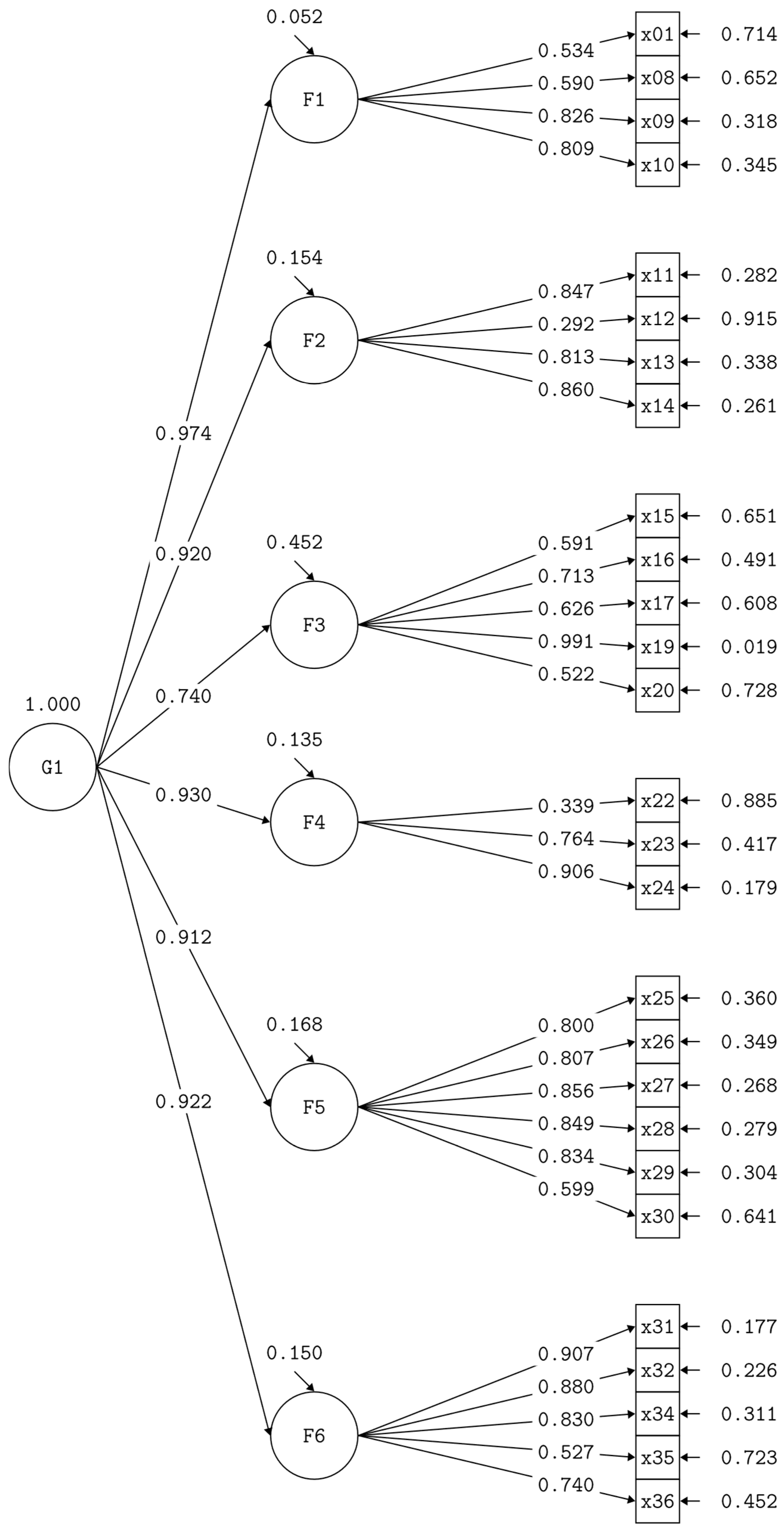
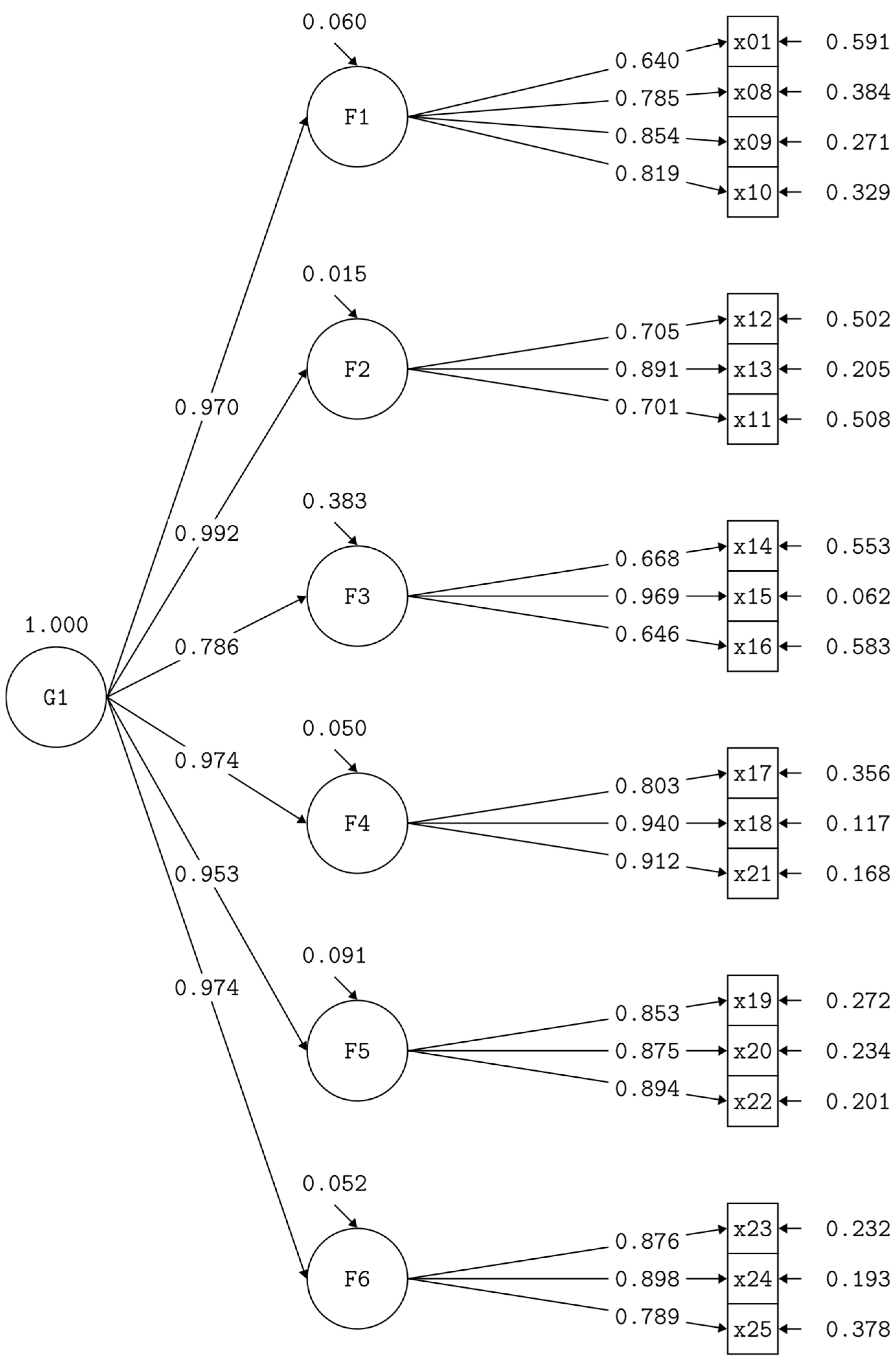
Accordingly, we adopted confirmatory factor analysis (CFA) as the primary approach to evaluate the hypothesized factorial structure, test dimensionality, and examine item allocation across the six factors. In terms of item allocation, the adult versions retained 36 items distributed across the six dimensions, whereas the student version retained 25 items across the same dimensions but with fewer indicators. Given these differences in the number of indicators and the linguistic adaptation required for younger participants, analyses were conducted separately for (1) students and (2) adults. Additionally, measurement invariance analyses were used to examine whether the adult model functioned equivalently across teacher and parent/caregiver groups.
Because the student scale does not contain the same number of items as the teacher and parent/caregiver versions, the analyses were conducted independently for (1) students and (2) teachers and parents/caregivers.
Normality was examined for all items to select the appropriate estimators for subsequent analyses. Confirmatory factor analysis (CFA) was conducted using the robust weighted least squares estimator (ULSMV) (
Brown, 2015;
Muthén & Muthén, 2017). To evaluate model fit, the following indices were examined: chi-square and chi-square/df ratio; root mean square error of approximation (RMSEA); standardized root mean square residual (SRMR); Comparative Fit Index (CFI); Tucker–Lewis Index (TLI). In general, a model is considered to have adequate fit when χ
2/df ≤ 3, RMSEA < 0.08 (ideally < 0.05), SRMR < 0.08, and CFI/TLI ≥ 0.90 (preferably ≥ 0.95) (
Hu & Bentler, 1999;
Kline, 2016;
Byrne, 2016).
Regarding internal parameters, standardized factor loadings (λ) ≥ 0.40 were considered acceptable, although loadings ≥ 0.60 are desirable as they indicate an adequate representation of the item within its factor (
Hair et al., 2019). Composite reliability (CR) should exceed 0.70, and average variance extracted (AVE) should reach at least 0.50, indicating convergent validity and internal consistency (
Fornell & Larcker, 1981).
Discriminant validity was examined using the Fornell–Larcker criterion, comparing shared variance across constructs with variance extracted. Since discriminant validity was not achieved, a second-order factor model was tested, provided it met theoretical and statistical criteria (
Varela et al., 2006). High standardized loadings (>0.90) between first- and second-order factors are not considered problematic when the model is well-identified and theoretically coherent (
Hair et al., 2019;
Kline, 2016).
A second phase examined measurement invariance between teachers and parents/caregivers. Invariance analysis assesses whether the factorial structure is equivalent across groups. Three hierarchical levels were tested: (a) configural invariance, verifying the same factor structure; (b) metric invariance, testing equality of factor loadings; and (c) scalar invariance, testing equality of intercepts or thresholds.



 ,
,