


Does Eyewitness Confidence Calibration Vary by Target Race?

Abstract
1. Does Eyewitness Confidence Calibration Vary by Target Race?
2. Current Study
3. Method
3.1. Participants
3.1.1. Sample Size Determination
3.1.2. Data Inclusion and Exclusion
3.1.3. Demographics
3.2. Design
3.3. Materials
3.3.1. Mock-Crime Videos
3.3.2. Intervening Task
3.3.3. Lineups
3.4. Measures
3.4.1. Lineup Responses and Eyewitness Confidence
3.4.2. Eyewitness Confidence
3.4.3. Demographics and Data Quality Checks
3.5. Procedure
4. Results
4.1. Lineup Decisions
4.2. Confidence-Accuracy Relationship
5. Discussion
Theoretical Perspectives
6. Conclusions
Supplementary Materials
Author Contributions
Funding
Institutional Review Board Statement
Informed Consent Statement
Data Availability Statement
Conflicts of Interest
| 1 | Other Asian countries reported by participants to be as country of origin are: n = 11 India, n = 9 China, n = 9 Korea, n = 5 Vietnam, n = 5 the Philippines, n = 4 Hong Kong, n = 3 Indonesia, n = 3 Pakistan, n = 2 Taiwan, n = 2 Malaysia, n = 1 Bangladesh, n = 1 Kazakhstan, n = 1 Liberia, n = 1 Nepal, n = 1 Singapore, n = 1 Thailand, n = 1 Laos, and n = 1 Trinidad. |
| 2 | n = 11 India, n = 9 China, n = 2 Hong Kong, n = 2 Malaysia, n = 2 Pakistan, n = 1 Kazakhstan, n = 1 Korea, n = 1 Singapore, n = 1 Taiwan, n = 1 Thailand, n = 1 Vietnam, n = 1 Pakistan. |
| 3 | n = 6 Poland, n = 4 Italy, n = 2 Hungary, n = 2 Ireland, n = 1 Egypt, n = 1 Finland, n = 1 Greece, n = 1 Latvia, n = 1 Lithuania, n = 1 Norway, n = 1 Romania, n = 1 South Africa |
| 4 | n = 2 Hungary, n = 2 Ireland, n = 2 Italy, n = 1 Egypt, n = 1 Finland, n = 1 France, n = 1 Greece, n = 1 Norway, n = 1 Poland, n = 1 Romania, n = 1 South Africa, n = 1 Netherlands, n = 1 United Arab Emirates |
| 5 | TM and © 2008 Entertainment Rights Distribution Limited. All rights reserved. |
References
- Akan, M., Starns, J. J., Cohen, A. L., & Reid, A. E. (2025). The role of race in lineup construction. Journal of Experimental Psychology: General, 154(12), 3251–3283. [Google Scholar] [CrossRef] [Scilit] [PubMed]
- Bache, S. M., & Wickham, H. (2020). magrittr: A forward-pipe operator for R: 2.0.1. Available online: https://CRAN.R-project.org/package=magrittr (accessed on 20 February 2021).
- Bates, D., Mächler, M., Bolker, B., & Walker, S. (2015). Fitting linear mixed-effects models using lme4. Journal of Statistical Software, 67(1), 1–48. [Google Scholar] [CrossRef] [Scilit]
- Beaudry, J. L., Lindsay, R. C. L., Leach, A.-M., Mansour, J. K., Bertrand, M. I., & Kalmet, N. (2015). The effect of evidence type, identification accuracy, line-up presentation, and line-up administration on observers’ perceptions of eyewitnesses. Legal and Criminological Psychology, 20(2), 343–364. [Google Scholar] [CrossRef] [Scilit]
- Brewer, N., & Wells, G. L. (2006). The confidence-accuracy relationship in eyewitness identification: Effects of lineup instructions, foil similarity, and target-absent base rates. Journal of Experimental Psychology: Applied, 12(1), 11–30. [Google Scholar] [CrossRef] [Scilit]
- Brigham, J. C., Maass, A., Snyder, L. D., & Spaulding, K. (1982). Accuracy of eyewitness identifications in a field study. Journal of Personality and Social Psychology, 42(4), 673–681. [Google Scholar] [CrossRef]
- Brigham, J. C., & Ready, D. J. (1985). Own-race bias in lineup construction. Law and Human Behavior, 9(4), 415–424. [Google Scholar] [CrossRef] [Scilit]
- Canty, A., & Ripley, B. (2022). boot:Bootrap R (S-Plus) Functions: 1.30. Available online: https://CRAN.R-project.org/package=boot (accessed on 20 May 2023).
- Carlson, C. A., Gronlund, S. D., & Clark, S. E. (2008). Lineup composition, suspect position, and the sequential lineup advantage. Journal of Experimental Psychology: Applied, 14(2), 118–128. [Google Scholar] [CrossRef] [Scilit]
- Carlson, C. A., Lockamyeir, R. F., Carlson, M. A., Goodsell, C. A., Jones, A. R., Wooten, A. R., & Brand, Z. T. (2025). Comparing the strength of the confidence-accuracy versus response time-accuracy relationship for eyewitness identification. Scientific Reports, 15(1), 11064. [Google Scholar] [CrossRef] [Scilit]
- Carlson, C. A., Lockamyeir, R. F., Wooten, A. R., Jones, A. R., Carlson, M. A., & Hemby, J. A. (2023). A stronger memory for the perpetrator may attenuate effects of the identification procedure on eyewitness accuracy. Applied Cognitive Psychology, 37(2), 419–432. [Google Scholar] [CrossRef] [Scilit]
- Chiroro, P., & Valentine, T. (1995). An investigation of the contact hypothesis of the own-race bias in face recognition. The Quarterly Journal of Experimental Psychology, 48(4), 879–894. [Google Scholar] [CrossRef] [Scilit]
- Cutler, B. L., Penrod, S. D., & Stuve, T. E. (1988). Juror decision making in eyewitness identification cases. Law and Human Behavior, 12(1), 41–55. [Google Scholar] [CrossRef] [Scilit]
- DeCarlo, L. T. (1998). Signal detection theory and generalized linear models. Psychological Methods, 3(2), 186–205. [Google Scholar] [CrossRef]
- Deffenbacher, K. A. (1980). Eyewitness accuracy and confidence: Can we infer anything about their relationship? Law and Human Behavior, 4(4), 243–260. [Google Scholar] [CrossRef] [Scilit]
- Deffenbacher, K. A., & Loftus, E. F. (1982). Do jurors share a common understanding concerning eyewitness behavior? Law and Human Behavior, 6(1), 15–30. [Google Scholar] [CrossRef] [Scilit]
- Dodson, C. S., & Dobolyi, D. G. (2016). Confidence and eyewitness identifications: The cross-race effect, decision time and accuracy. Applied Cognitive Psychology, 30(1), 113–125. [Google Scholar] [CrossRef] [Scilit]
- Dowle, M., & Srinivasan, A. (2023, February 17). Extension of “data.frame” [R package data.table version 1.14.8]. The Comprehensive R Archive Network. Available online: https://cran.r-project.org/web/packages/data.table/ (accessed on 10 June 2023).
- Firke, S. (2023). Janitor: Simple tools for examining and cleaning dirty data: 2.20. Available online: https://CRAN.R-project.org/package=janitor (accessed on 10 June 2023).
- Fitzgerald, R. J., Rubínová, E., & Juncu, S. (2021). Eyewitness identification around the world. In Methods, measures, and theories in eyewitness identification tasks (pp. 294–322). Routledge. [Google Scholar]
- Fitzgerald, R. J., Tredoux, C. G., & Juncu, S. (2023). Estimation of eyewitness error rates in fair and biased lineups. Law and Human Behavior, 47(4), 463–483. [Google Scholar] [CrossRef] [Scilit] [PubMed]
- Flowe, H. D., Colloff, M. F., Karoğlu, N., Zelek, K., Ryder, H., Humphries, J. E., & Takarangi, M. K. (2017). The effects of alcohol intoxication on accuracy and the confidence–accuracy relationship in photographic simultaneous line-ups. Applied Cognitive Psychology, 31(4), 379–391. [Google Scholar] [CrossRef] [Scilit]
- Garrett, B. L., Crozier, W. E., Modjadidi, K., Liu, A. J., Kafadar, K., Yaffe, J., & Dodson, C. S. (2023). Sensitizing jurors to eyewitness confidence using “reason-based” judicial instructions. Journal of Applied Research in Memory and Cognition, 12(1), 141–157. [Google Scholar] [CrossRef] [Scilit]
- Garrett, B. L., Liu, A., Kafadar, K., Yaffe, J., & Dodson, C. S. (2020). Factoring the role of eyewitness evidence in the courtroom. Journal of Empirical Legal Studies, 17(3), 556–579. [Google Scholar] [CrossRef] [Scilit]
- Giacona, A. M., Lampinen, J. M., & Anastasi, J. S. (2021). Estimator variables can matter even for high-confidence lineup identifications made under pristine conditions. Law and Human Behavior, 45(3), 256–270. [Google Scholar] [CrossRef] [Scilit] [PubMed]
- Grabman, J. H., Dobolyi, D. G., Berelovich, N. L., & Dodson, C. S. (2019). Predicting high confidence errors in eyewitness memory: The role of face recognition ability, decision-time, and justifications. Journal of Applied Research in Memory and Cognition, 8(2), 233–243. [Google Scholar] [CrossRef] [Scilit]
- Harvey, A. J., Shrimpton, B., Azzopardi, Z., O’Grady, K., Hicks, E., Hirst, E., & Atkinson-Cox, K. (2020). The influence of alcohol and weapon presence on eyewitness memory and confidence. Applied Cognitive Psychology, 34(2), 489–503. [Google Scholar] [CrossRef] [Scilit]
- Havard, C., Breese, E., Thirkettle, M., Kask, K., Leol, K. L., & Mädamürk, K. (2025). A background of bias: Subtle changes in lineup backgrounds increase the own race bias. Journal of Police and Criminal Psychology, 40, 292–303. [Google Scholar] [CrossRef] [Scilit]
- Havard, C., Memon, A., & Humphries, J. E. (2017). The own-race bias in child and adolescent witnesses: Evidence from video line-ups. International Journal of Police Science & Management, 19(4), 261–272. [Google Scholar] [CrossRef] [Scilit]
- Helm, R. K., & Spearing, E. R. (2025). The impact of race on assessor’s ability to differentiate accurate and inaccurate witness identifications: Areas of vulnerability, bias, and discriminatory outcomes. Psychology, Public Policy, and Law, 31(4), 359–374. [Google Scholar] [CrossRef] [Scilit]
- Horry, R., & Wright, D. B. (2008). I know your face but not where I saw you: Context memory is impaired for other-race faces. Psychonomic Bulletin & Review, 15(3), 610–614. [Google Scholar] [CrossRef] [Scilit] [PubMed]
- Josephson, S., & Holmes, M. E. (2011). Selecting the suspect: An eye-tracking comparison of viewing of same-race vs. cross-race photographs in eyewitness identification. Visual Communication Quarterly, 18(4), 236–249. [Google Scholar] [CrossRef] [Scilit]
- Koehnken, G., Malpass, R. S., & Wogalter, M. S. (1996). Logical foundations for the identification of individuals. In Psychological issues in eyewitness identification (Vol. 205). Lawrence Erlbaum Associates. [Google Scholar]
- Lee, J., Mansour, J. K., & Penrod, S. D. (2024). How to measure lineup fairness: Concurrent and predictive validity of lineup-fairness measures. Psychology, Crime & Law, 31(6), 666–690. [Google Scholar] [CrossRef] [Scilit]
- Lee, J., & Penrod, S. D. (2022). Three-level meta-analysis of the other-race bias in facial identification. Applied Cognitive Psychology, 36(5), 1106–1130. [Google Scholar] [CrossRef] [Scilit]
- Lindsay, R. C., Ross, D. F., Read, J. D., & Toglia, M. P. (Eds.). (2013). The handbook of eyewitness psychology: Volume ii: Memory for people (Vol. 2). Psychology Press. [Google Scholar]
- Lockamyeir, R. F., Carlson, C. A., Jones, A. R., Carlson, M. A., & Weatherford, D. R. (2020). The effect of viewing distance on empirical discriminability and the confidence–accuracy relationship for eyewitness identification. Applied Cognitive Psychology, 34(5), 1047–1060. [Google Scholar] [CrossRef] [Scilit]
- Luus, C. E., & Wells, G. L. (1991). Eyewitness identification and the selection of distracters for lineups. Law and Human Behavior, 15(1), 43–57. [Google Scholar] [CrossRef] [Scilit]
- Lüdecke, D., Patil, I., Ben-Shachar, M. S., Wiernik, B. M., Waggoner, P., & Makowski, D. (2021). See: An R package for visualizing statistical models. Journal of Open-Source Software, 6(64), 3393. [Google Scholar] [CrossRef] [Scilit]
- Mansour, J. K., Lindsay, R. S., Brewer, N., & Munhall, K. G. (2009). Characterizing visual behaviour in a lineup task. Applied Cognitive Psychology, 23(7), 1012–1026. [Google Scholar] [CrossRef] [Scilit]
- Meissner, C. A., & Brigham, J. C. (2001). Thirty years of investigating the own-race bias in memory for faces: A meta-analytic review. Psychology, Public Policy and Law, 7(1), 3–35. [Google Scholar] [CrossRef]
- Mickes, L. (2015). Receiver operating characteristic analysis and confidence–accuracy characteristic analysis in investigations of system variables and estimator variables that affect eyewitness memory. Journal of Applied Research in Memory and Cognition, 4(2), 93. [Google Scholar] [CrossRef] [Scilit]
- National Registry of Exonerations. (2024). Exonerations—States [Interactive map]. Available online: https://exonerationregistry.org/Exonerations-in-the-United-States-Map (accessed on 10 December 2024).
- Navon, D. (1992). Selection of lineup foils by similarity to the suspect is likely to misfire. Law and Human Behavior, 16(5), 575–593. [Google Scholar] [CrossRef] [Scilit]
- Neil v. Biggers, 409 U.S. 188. (1972). Available online: https://supreme.justia.com/cases/federal/us/409/188/ (accessed on 1 January 2022).
- Nguyen, T. B., Pezdek, K., & Wixted, J. T. (2017). Evidence for a confidence–accuracy relationship in memory for same-and cross-race faces. Quarterly Journal of Experimental Psychology, 70(12), 2518–2534. [Google Scholar] [CrossRef] [Scilit]
- Noon, E., & Hollin, C. R. (1987). Lay knowledge of eyewitness behaviour: A British survey. Applied Cognitive Psychology, 1(2), 143–153. [Google Scholar] [CrossRef] [Scilit]
- Nyman, T. J., Antfolk, J., Lampinen, J. M., Tuomisto, M., Kaakinen, J. K., Korkman, J., & Santtila, P. (2019). A stab in the dark: The distance threshold of target identification in low light. Cogent Psychology, 6(1), 1632047. [Google Scholar] [CrossRef] [Scilit]
- Olsson, N., & Juslin, P. (2002). Calibration of confidence among eyewitnesses and earwitnesses. In Metacognition: Process, function and use (pp. 203–218). Springer. [Google Scholar]
- Potter, R., & Brewer, N. (1999). Perceptions of witness behaviour-accuracy relationships held by police, lawyers and mock-jurors. Psychiatry, Psychology and Law, 6(1), 97–103. [Google Scholar] [CrossRef] [Scilit]
- Quigley-McBride, A., & Wells, G. L. (2021). Methodological considerations in eyewitness identification experiments. In A. M. Smith, M. P. Toglia, & J. M. Lampinen (Eds.), Methods, measures, and theories in eyewitness identification tasks (pp. 85–112). Routledge. [Google Scholar] [CrossRef] [Scilit]
- R Core Team. (2022). R: A language and environment for statistical computing. R Foundation for Statistical Computing. Available online: https://www.R-project.org/ (accessed on 1 January 2022).
- Rhodes, G. (2013). Looking at faces: First-order and second-order features as determinants of facial appearance. Perception, 42(11), 1179–1199. [Google Scholar] [CrossRef] [Scilit]
- Sauer, J. D., Palmer, M. A., & Brewer, N. (2019). Pitfalls in using eyewitness confidence to diagnose the accuracy of an individual identification decision. Psychology, Public Policy, and Law, 25(3), 147–165. [Google Scholar] [CrossRef] [Scilit]
- Semmler, C., Dunn, J., Mickes, L., & Wixted, J. T. (2018). The role of estimator variables in eyewitness identification. Journal of Experimental Psychology: Applied, 24(3), 400. [Google Scholar] [CrossRef] [Scilit]
- Slane, C. R., & Dodson, C. S. (2022). Eyewitness confidence and mock juror decisions of guilt: A meta-analytic review. Law and Human Behavior, 46(1), 45–66. [Google Scholar] [CrossRef] [Scilit] [PubMed]
- Smith, A. M., Smalarz, L., Ditchfield, R., & Ayala, N. T. (2021). Evaluating the claim that high confidence implies high accuracy in eyewitness identification. Psychology, Public Policy, and Law, 27(4), 479–491. [Google Scholar] [CrossRef] [Scilit]
- Smith, A. M., Yang, Y., & Wells, G. L. (2020). Distinguishing between investigator discriminability and eyewitness discriminability: A method for creating full receiver operating characteristic curves of lineup identification performance. Perspectives on Psychological Science, 15(3), 589–607. [Google Scholar] [CrossRef] [Scilit]
- Smith, S. M., Lindsay, R. S., Pryke, S., & Dysart, J. E. (2001). Postdictors of eyewitness errors: Can false identifications be diagnosed in the cross-race situation? Psychology, Public Policy and Law, 7(1), 153–169. [Google Scholar] [CrossRef]
- Stelter, M., Simon, D., Calanchini, J., Christ, O., & Degner, J. (2023). Real-life outgroup exposure, self-reported outgroup contact and the other-race effect. British Journal of Psychology, 114(Suppl. 1), 150–171. [Google Scholar] [CrossRef] [Scilit] [PubMed]
- Töredi, D. (2024). Reducing and measuring the cross-race effect [Doctoral dissertation, Queen Margaret University]. [Google Scholar]
- Töredi, D., Mansour, J. K., Jones, S. E., Skelton, F., & McIntyre, A. (2024). The impact of minority-race status on the cross-race effect: A critical review. Perspectives on Psychological Science: A Journal of the Association for Psychological Science, 20(6), 1033–1048. [Google Scholar] [CrossRef] [Scilit] [PubMed]
- Töredi, D., Mansour, J. K., Jones, S. E., Skelton, F., & McIntyre, A. (2025). Creating a Cross-race Effect Inventory to postdict eyewitness accuracy (2025). Law and Human Behaviour, 49(4), 353–375. [Google Scholar] [CrossRef] [Scilit] [PubMed]
- Tredoux, C. G. (1998). Statistical inference on measures of lineup fairness. Law and human Behavior, 22(2), 217–237. [Google Scholar] [CrossRef] [Scilit]
- Tryon, W. W. (2001). Evaluating statistical difference, equivalence, and indeterminacy using inferential confidence intervals: An integrated alternative method of conducting null hypothesis statistical tests. Psychological Methods, 6(4), 371. [Google Scholar] [CrossRef] [Scilit]
- Vallano, J. P., Pettalia, J., Pica, E., & Pozzulo, J. (2019). An examination of mock jurors’ judgments in familiar identification cases. Journal of Police and Criminal Psychology, 34(2), 121–133. [Google Scholar] [CrossRef] [Scilit]
- Weber, N., & Brewer, N. (2004). Confidence-accuracy calibration in absolute and relative face recognition judgments. Journal of Experimental Psychology: Applied, 10(3), 156–172. [Google Scholar] [CrossRef] [Scilit]
- Wells, G. L. (2020). Psychological science on eyewitness identification and its impact on police practices and policies. American Psychologist, 75(9), 1316–1329. [Google Scholar] [CrossRef] [Scilit]
- Wells, G. L., & Windschitl, P. D. (1999). Stimulus sampling and social psychological experimentation. Personality and Social Psychology Bulletin, 25(9), 1115–1125. [Google Scholar] [CrossRef] [Scilit]
- Wickham, H., Averick, M., Bryan, J., Chang, W., McGowan, L. D. A., François, R., Grolemund, G., Hayes, A., Henry, L., Hester, J., Kuhn, M., Lin Pedersen, T., Miller, E., Milton Bache, S., Müller, K., Ooms, J., Robinson, D., Seidel, D. P., Spinu, V., … Yutani, H. (2019). Welcome to the Tidyverse. Journal of Open Source Software, 4(43), 1686. [Google Scholar] [CrossRef] [Scilit]
- Wixted, J. T., & Wells, G. L. (2017). The relationship between eyewitness confidence and identification accuracy: A new synthesis. Psychological Science in the Public Interest, 18(1), 10–65. [Google Scholar] [CrossRef] [Scilit] [PubMed]
- Wright, D. B., & London, K. (2009). Multilevel modelling: Beyond the basic applications. British Journal of Mathematical and Statistical Psychology, 62(2), 439–456. [Google Scholar] [CrossRef] [Scilit] [PubMed]
- Wylie, L. E., Bergt, S., Haby, J., Brank, E. M., & Bornstein, B. H. (2015). Age and lineup type differences in the own-race bias. Psychology, Crime & Law, 21(5), 490–506. [Google Scholar] [CrossRef] [Scilit]
- Yaniv, I., Yates, J. F., & Smith, J. E. K. (1991). Measures of discrimination skill in probabilistic judgment. Psychological Bulletin, 110(3), 611–617. [Google Scholar] [CrossRef]
- Zhou, X., Elshiekh, A., & Moulson, M. C. (2019). Lifetime perceptual experience shapes face memory for own- and other-race faces. Visual Cognition, 27(9–10), 687–700. [Google Scholar] [CrossRef] [Scilit]
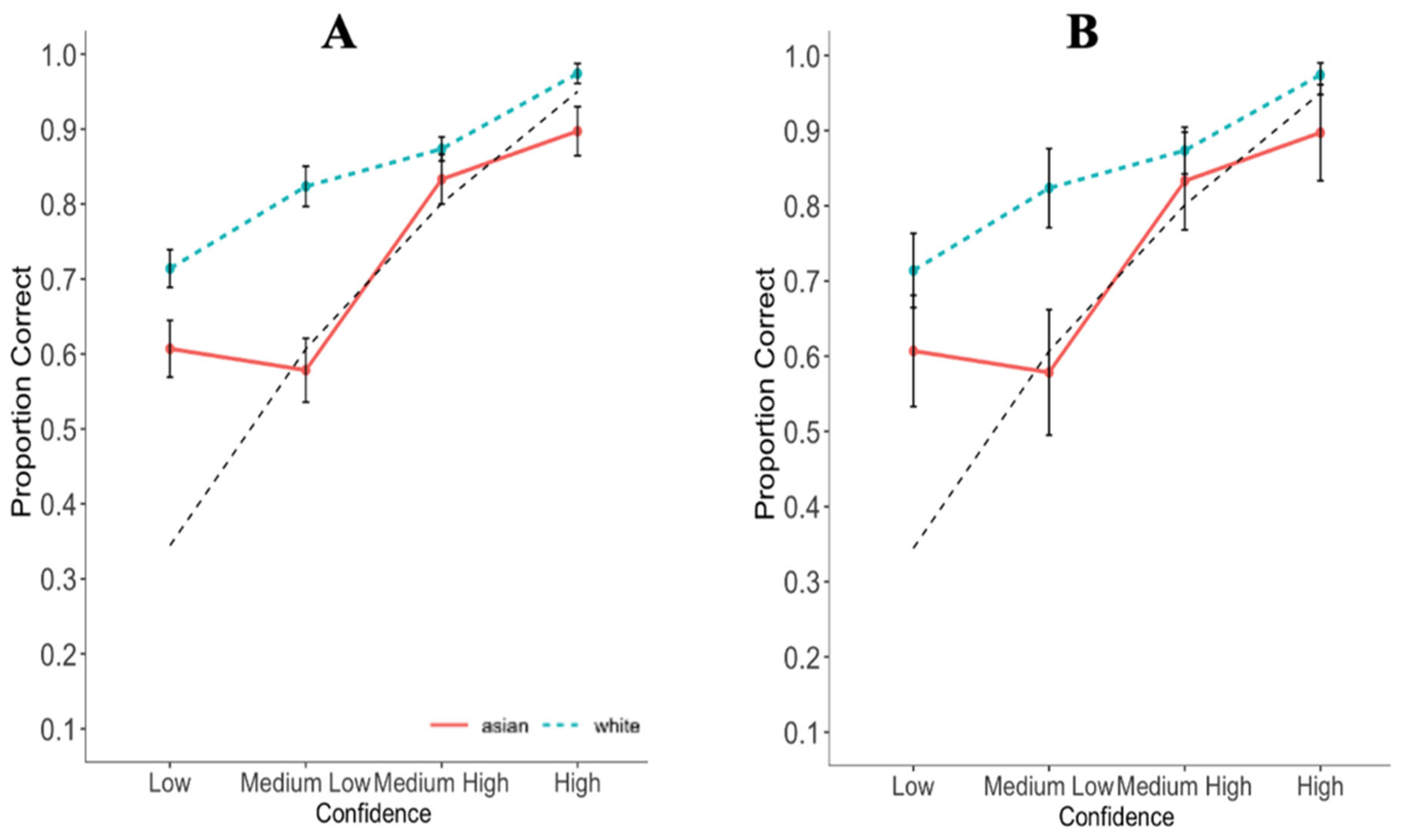

| Target Race | ||
|---|---|---|
| Confidence Bin | White | Asian |
| Low | [0.76, 0.83] | [0.58, 0.69] |
| Medium-low | [0.80, 0.89] | [0.55, 0.68] |
| Medium-high | [0.88, 0.93] | [0.80, 0.90] |
| High | [0.95, 0.99] | [0.82, 0.93] |
| Target Race | ||
|---|---|---|
| Calibration Indices | White | Asian |
| c-index | 0.03 [−0.009, 0.07] | 0.01 [−0.005, 0.04] |
| O/U | −0.11 [−0.21, −0.01] | −0.04 [−0.13, 0.04] |
| ANDI | 0.07 [0.01, 0.13] | 0.07 [0.02, 0.13] |
Disclaimer/Publisher’s Note: The statements, opinions and data contained in all publications are solely those of the individual author(s) and contributor(s) and not of MDPI and/or the editor(s). MDPI and/or the editor(s) disclaim responsibility for any injury to people or property resulting from any ideas, methods, instructions or products referred to in the content. |
© 2026 by the authors. Licensee MDPI, Basel, Switzerland. This article is an open access article distributed under the terms and conditions of the Creative Commons Attribution (CC BY) license.
Share and Cite
Töredi, D.; Mansour, J.K.; Jones, S.E.; Skelton, F.; McIntyre, A. Does Eyewitness Confidence Calibration Vary by Target Race? Behav. Sci. 2026, 16, 257. https://doi.org/10.3390/bs16020257
Töredi D, Mansour JK, Jones SE, Skelton F, McIntyre A. Does Eyewitness Confidence Calibration Vary by Target Race? Behavioral Sciences. 2026; 16(2):257. https://doi.org/10.3390/bs16020257
Chicago/Turabian StyleTöredi, Dilhan, Jamal K. Mansour, Sian E. Jones, Faye Skelton, and Alex McIntyre. 2026. "Does Eyewitness Confidence Calibration Vary by Target Race?" Behavioral Sciences 16, no. 2: 257. https://doi.org/10.3390/bs16020257
APA StyleTöredi, D., Mansour, J. K., Jones, S. E., Skelton, F., & McIntyre, A. (2026). Does Eyewitness Confidence Calibration Vary by Target Race? Behavioral Sciences, 16(2), 257. https://doi.org/10.3390/bs16020257

