Individual Differences in the Affective Experience of Writing a Gratitude Letter: Who Benefits Most?
Abstract
1. Introduction
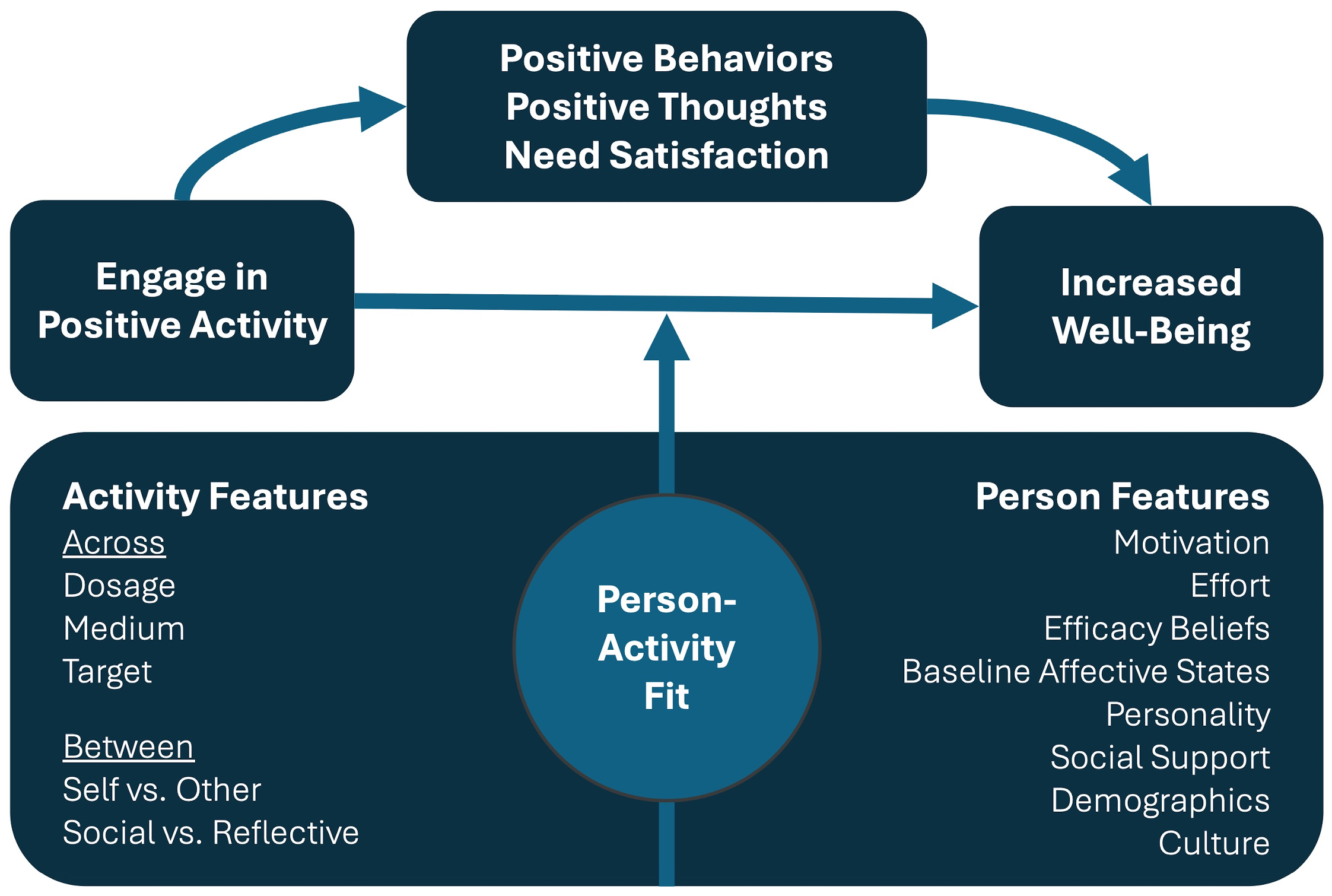
1.1. Writing Gratitude Letters: The Role of Person–Activity Fit
1.2. Past Research on the Effects of Gratitude PAIs Based on Person Features
1.2.1. Demographics
1.2.2. Personality
1.2.3. Activity Effort
1.2.4. Trait Gratitude
1.2.5. Baseline Affective States
1.3. The Present Study
- RQ1 Activity Fit: Do distinct clusters emerge based on changes in affect after writing a gratitude letter?
- RQ2 Person Features: Are there individual differences (e.g., demographics, personality, pre-intervention affect) across these clusters?
1.3.1. Activity Fit Predictions: Do Distinct Affect Clusters Emerge?
1.3.2. Person Feature Predictions: Who Benefits Most from Gratitude Interventions?
2. Materials and Methods
- Regan, Walsh, and Lyubomirsky (Regan et al., 2022; n = 157), henceforth the Ways of Expressing Gratitude study (https://doi.org/10.1007/s42761-022-00160-3).
- Walsh, Regan, Twenge, and Lyubomirsky (Walsh et al., 2022c; n = 231), henceforth the Optimal Way to Give Thanks study (https://doi.org/10.1007/s42761-022-00150-5).
- Walsh, Regan, and Lyubomirsky (Walsh et al., 2022b; n = 99), henceforth the Thanking Parents study (https://doi.org/10.1080/17439760.2021.1991449).
2.1. Data Preparation
2.2. Participants
2.3. Activity Fit Measures
2.4. Person Features Measures
2.5. Coding the Gratitude Letters
2.6. Data Exclusion Criteria
2.7. Analytic Approach
3. Results
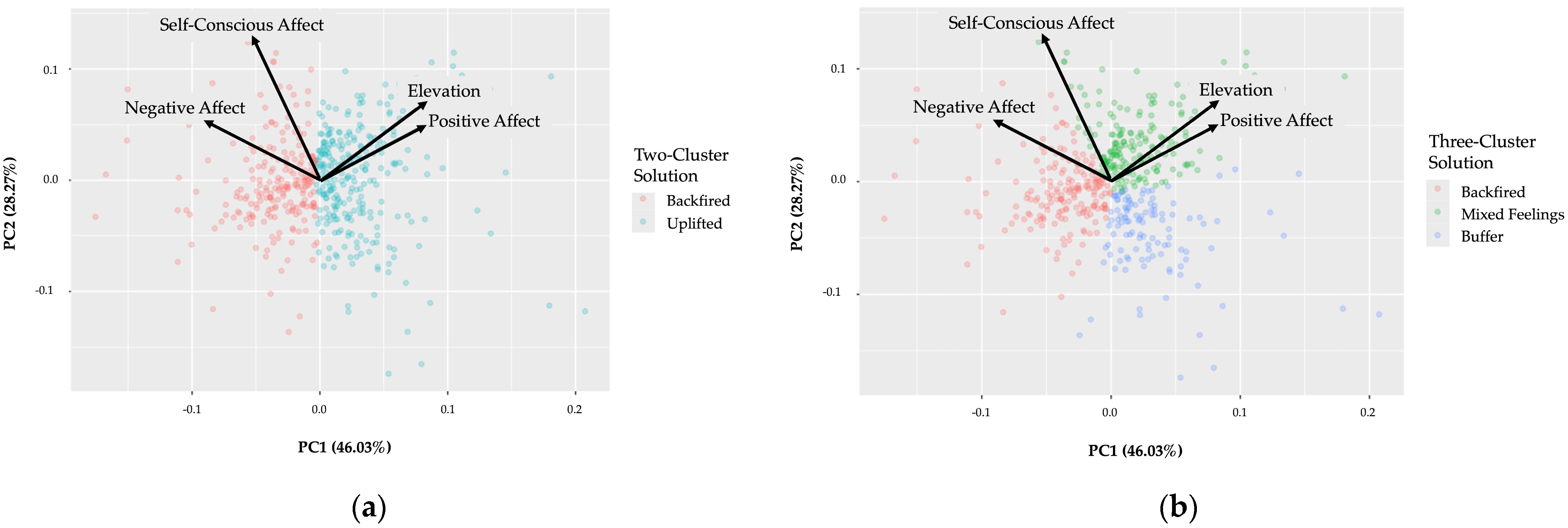
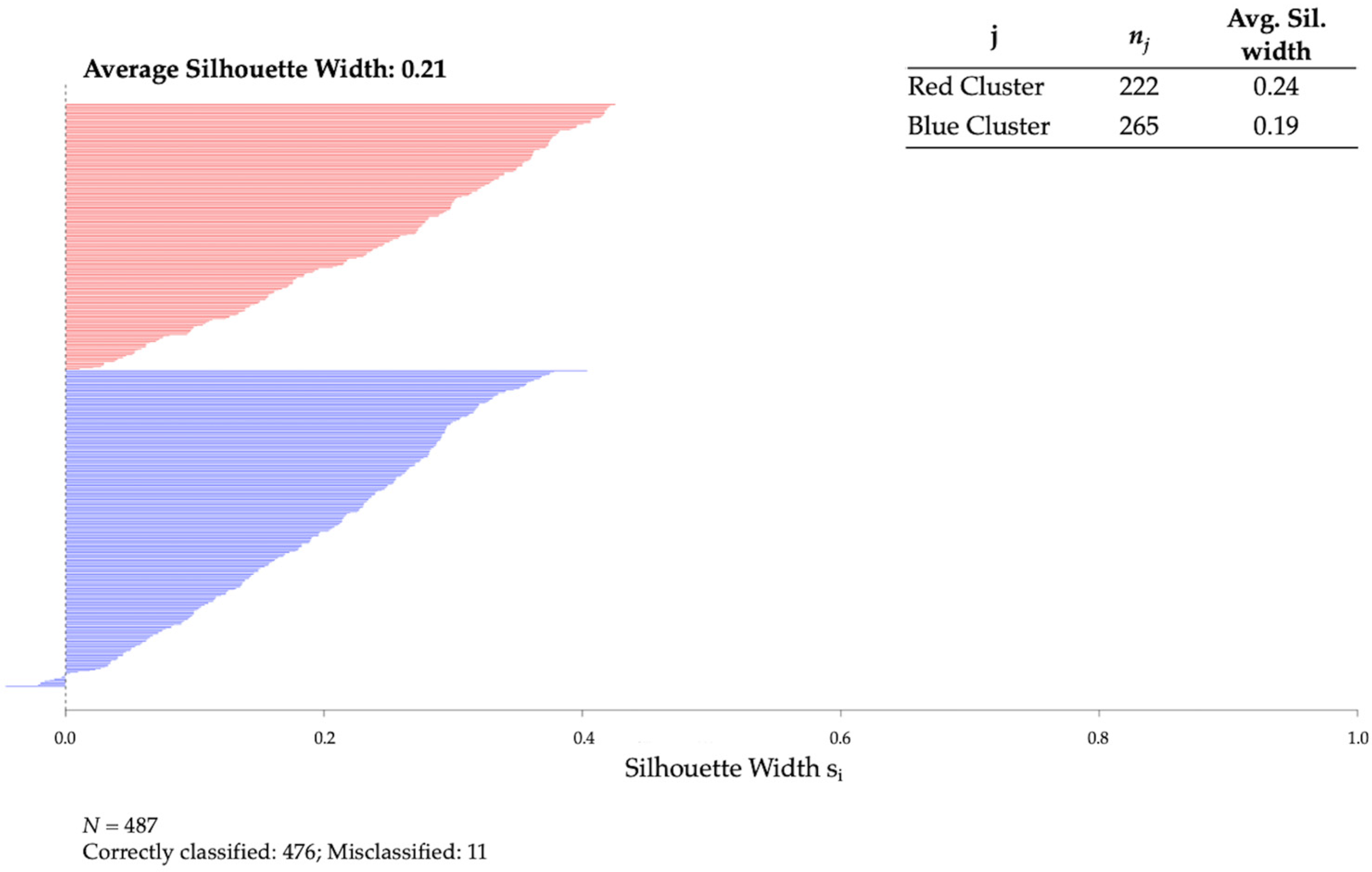
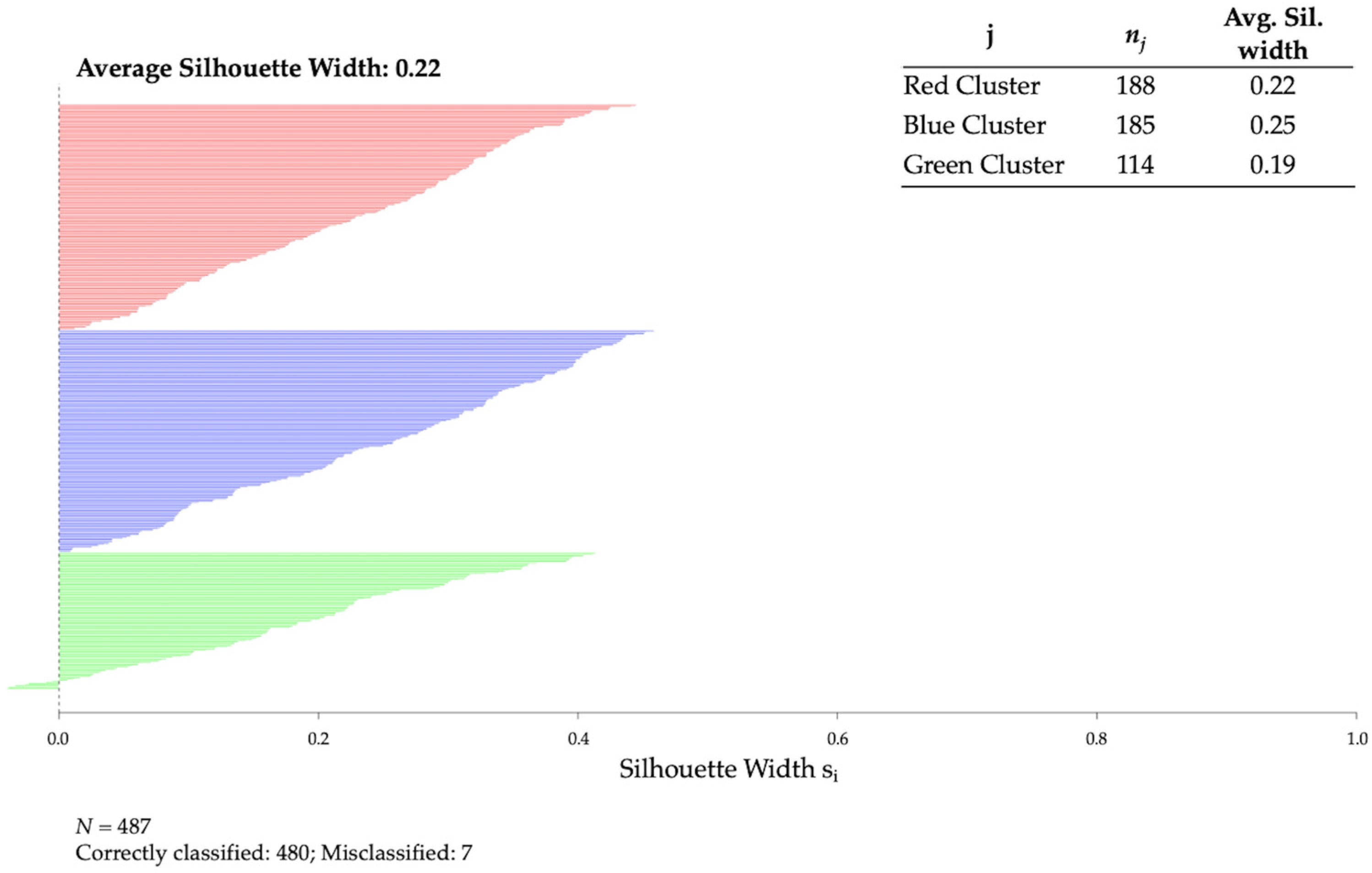
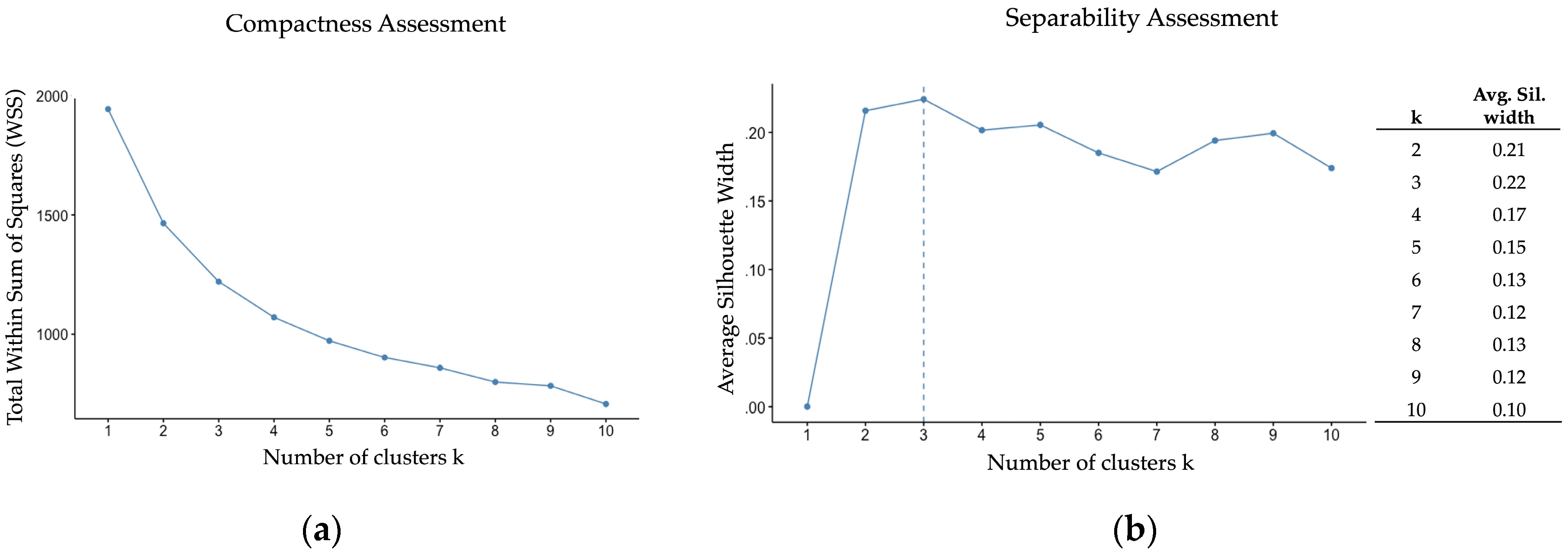
3.1. Do Distinct Affect Clusters Emerge After Writing a Gratitude Letter?
3.2. Who Benefits Most—And Least—From Writing a Gratitude Letter?
3.2.1. Demographics
3.2.2. Personality
3.2.3. Baseline Affect and Trait Gratitude
3.2.4. Activity Effort
3.2.5. Coded Gratitude Letters
4. Discussion
4.1. Do Distinct Affect Clusters Emerge After Writing a Gratitude Letter?
4.2. Who Benefits Most—And Least—From Writing a Gratitude Letter?
4.3. Limitations
5. Conclusions
- Who might benefit?
- Who might not benefit as much?
Supplementary Materials
Author Contributions
Funding
Institutional Review Board Statement
Informed Consent Statement
Data Availability Statement
Acknowledgments
Conflicts of Interest
Appendix A. Tables

| Baseline Characteristic | Present Study | Ways of Expressing Gratitude Study | Optimal Way to Give Thanks Study | Thanking Parents Study |
|---|---|---|---|---|
| Age (M ± SD in years) | 28 (15.7) | 47 (15.6) | 19 (1.85) | 19 (1.5) |
| Generation | ||||
| Gen Z | 67% | 5% | 99% | 91% |
| Millennial | 12% | 30% | 1% | 9% |
| Gen X | 9% | 28% | 0% | 0% |
| Boomer | 10% | 32% | 0% | 0% |
| Silent | 2% | 5% | 0% | 0% |
| Sex | ||||
| Female | 62% | 50% | 66% | 73% |
| Male | 38% | 50% | 33% | 27% |
| Other | 0% | 0% | 1% | NA |
| Ethnicity | ||||
| White | 34% | 85% | 8% | 14% |
| Black | 6% | 10% | 3% | 9% |
| Hispanic | 24% | 0% | 35% | 35% |
| Asian | 26% | 0% | 44% | 24% |
| Other | 10% | 5% | 10% | 17% |
| Relationship Status | ||||
| Single, not in a relationship | 38% | 17% | 69% | NA |
| Relationship | 19% | 15% | 29% | NA |
| Cohabiting | 3% | 8% | 0% | NA |
| Single (not defined) | 20% | NA | NA | 100% |
| Married | 15% | 44% | 1% | 0% |
| Divorced/Separated | 5% | 14% | 0% | 0% |
| Widowed | 1% | 3% | 0% | 0% |
| Total | 487 | 157 | 231 | 99 |
| PA | Elev | NA | SCA | |
|---|---|---|---|---|
| Positive Affect (PA) | 1 | |||
| Elevation (Elev) | 0.48 *** | 1 | ||
| Negative Affect (NA) | −0.37 *** | −0.27 *** | 1 | |
| Self-Conscious Affect (SCA) | −0.06 | −0.02 | 0.39 *** | 1 |
| Ways of Expressing Gratitude Study | Optimal Way to Give Thanks Study | Thanking Parents Study | ||||||||||
|---|---|---|---|---|---|---|---|---|---|---|---|---|
| PA | Elev | NA | SCA | PA | Elev | NA | SCA | PA | Elev | NA | SCA | |
| Positive Affect (PA) | 1 | 1 | 1 | |||||||||
| Elevation (Elev) | 0.46 *** | 1 | 0.56 *** | 1 | 0.38 *** | 1 | ||||||
| Negative Affect (NA) | −0.34 *** | −0.10 | 1 | −0.51 *** | −0.48 *** | 1 | −0.32 *** | 0.01 | 1 | |||
| Self-Conscious Affect (SCA) | −0.01 | −0.01 | 0.41 *** | 1 | −0.07 | −0.13 | 0.39 *** | 1 | −0.15 | 0.15 | 0.38 *** | 1 |
| PC1 | PC2 | |
|---|---|---|
| Positive Affect | 0.57 | 0.34 |
| Elevation | 0.52 | 0.44 |
| Negative Affect | −0.56 | 0.33 |
| Self-Conscious Affect | −0.31 | 0.76 |
| Standard Deviation | 1.36 | 1.06 |
| Proportion of Variance | 0.46 | 0.28 |
| Cumulative Proportion | 0.46 | 0.74 |
| Present Study | Ways of Expressing Gratitude Study | Optimal Way to Give Thanks Study | Thanking Parents Study | |
|---|---|---|---|---|
| (A) | (B) | (C) | ||
| Backfired | 38% | 33% | 42% | 35% |
| Mixed Feelings | 39% | 34% | 40% | 43% |
| Buffered | 23% | 33% B | 18% | 21% |
| Total | 487 | 157 | 231 | 99 |
| Composite Score | Items | Backfired | Mixed Feelings | Buffered |
|---|---|---|---|---|
| Positive Affect | Happy | −0.63 | 0.47 | 0.25 |
| Pleased | −0.58 | 0.51 | 0.10 | |
| Joyful | −0.58 | 0.54 | 0.05 | |
| Enjoyment/Fun | −0.45 | 0.52 | −0.13 | |
| Elevation | Moved | −0.51 | 0.52 | −0.04 |
| Uplifted | −0.63 | 0.55 | 0.11 | |
| Optimistic about humanity | −0.46 | 0.46 | −0.01 | |
| A warm feeling in your chest | −0.57 | 0.50 | 0.11 | |
| A desire to help others | −0.44 | 0.39 | 0.06 | |
| A desire to become a better person | −0.38 | 0.39 | −0.01 | |
| Negative Affect | Unhappy | 0.54 | −0.02 | −0.83 |
| Worried/Anxious | 0.40 | −0.10 | −0.49 | |
| Angry/Hostile | 0.42 | 0.11 | −0.88 | |
| Frustrated | 0.53 | −0.06 | −0.76 | |
| Depressed/Blue | 0.48 | −0.03 | −0.74 | |
| Self-Conscious Affect | Indebted | −0.16 | 0.46 | −0.51 |
| Guilty | 0.18 | 0.22 | −0.66 | |
| Embarrassed | 0.20 | 0.25 | −0.73 | |
| Uncomfortable | 0.29 | 0.18 | −0.76 | |
| Ashamed | 0.21 | 0.27 | −0.78 | |
| Total (n) | 185 | 188 | 114 |
| Baseline Characteristic | Backfired | Mixed Feelings | Buffered |
|---|---|---|---|
| (A) | (B) | (C) | |
| Age (M ± SD in years) | 27 (15.0) | 28 (17.2) | 29 (14.2) |
| Generation | |||
| Gen Z | 69% C | 70% C | 58% |
| Millennial | 12% | 9% | 18% |
| Gen X | 9% | 6% | 14% |
| Boomer | 9% | 12% | 11% |
| Silent | 2% | 3% | 0% |
| Sex | |||
| Female | 60% | 62% | 66% |
| Male | 40% | 38% | 33% |
| Other | 1% | 0% | 1% |
| Ethnicity | |||
| White | 32% | 32% | 41% |
| Black | 7% | 5% | 9% |
| Hispanic | 25% | 23% | 24% |
| Asian | 27% | 30% | 18% |
| Other | 10% | 10% | 9% |
| Relationship Status | |||
| Single, no relationship | 41% | 36% | 37% |
| Relationship | 20% | 19% | 17% |
| Cohabiting | 3% | 3% | 2% |
| Single (not defined) | 19% | 23% | 18% |
| Married | 14% | 13% | 18% |
| Divorced/Separated | 4% | 4% | 8% |
| Widowed | 1% | 2% | 0% |
| Total (n) | 185 | 188 | 114 |
| Backfired | Mixed Feelings | Buffered | ||||
|---|---|---|---|---|---|---|
| (A) | (B) | (C) | ||||
| Personality | Mean | SD | Mean | SD | Mean | SD |
| Neuroticism | 3.06 | 1.11 | 2.96 | 1.07 | 3.67 AB | 1.00 |
| Agreeableness | 3.73 | 0.73 | 3.88 C | 0.78 | 3.57 | 0.77 |
| Conscientiousness | 3.51 C | 0.87 | 3.45 | 0.89 | 3.23 | 0.85 |
| Openness | 3.59 C | 0.73 | 3.47 | 0.78 | 3.34 | 0.85 |
| Extraversion | 3.02 | 0.95 | 2.82 | 0.93 | 2.81 | 0.93 |
| Personality Type | Contrast | Diff | p Adj | Cohen’s d |
|---|---|---|---|---|
| Neuroticism | Mixed Feelings-Backfired | −0.10 | 0.718 | −0.09 |
| Neuroticism | Buffered-Backfired | 0.61 | <0.000 *** | 0.57 |
| Neuroticism | Buffered-Mixed Feelings | 0.71 | <0.000 *** | 0.66 |
| Agreeableness | Mixed Feelings-Backfired | 0.14 | 0.241 | 0.19 |
| Agreeableness | Buffered-Backfired | −0.16 | 0.233 | −0.22 |
| Agreeableness | Buffered-Mixed Feelings | −0.31 | 0.007 * | −0.40 |
| Conscientiousness | Mixed Feelings-Backfired | −0.07 | 0.797 | −0.07 |
| Conscientiousness | Buffered-Backfired | −0.28 | 0.037 * | −0.33 |
| Conscientiousness | Buffered-Mixed Feelings | −0.22 | 0.142 | −0.25 |
| Openness | Mixed Feelings-Backfired | −0.12 | 0.386 | −0.15 |
| Openness | Buffered-Backfired | −0.24 | 0.047 | −0.31 |
| Openness | Buffered-Mixed Feelings | −0.12 | 0.452 | −0.16 |
| Extraversion | Mixed Feelings-Backfired | −0.19 | 0.177 | −0.21 |
| Extraversion | Buffered-Backfired | −0.21 | 0.204 | −0.23 |
| Extraversion | Buffered-Mixed Feelings | −0.02 | 0.990 | −0.02 |
| Backfired | Mixed Feelings | Buffered | ||||
|---|---|---|---|---|---|---|
| (A) | (B) | (C) | ||||
| Personality | Mean | SD | Mean | SD | Mean | SD |
| Positive Affect | 4.47 BC | 1.31 | 3.95 | 1.29 | 3.70 | 1.37 |
| Elevation | 4.18 BC | 1.24 | 3.77 | 1.20 | 3.73 | 1.34 |
| Negative Affect | 2.29 | 1.04 | 2.35 | 1.07 | 3.85 AB | 1.30 |
| Self-Conscious Affect | 1.71 | 0.82 | 1.61 | 0.85 | 2.80 AB | 1.10 |
| Trait Gratitude | 5.89 C | 1.01 | 5.73 C | 1.12 | 5.39 | 1.31 |
| Activity Effort | 5.40 | 1.21 | 5.71 | 1.09 | 5.65 | 1.24 |
| Measure | Contrast | Diff | p Adj | Cohen’s d |
|---|---|---|---|---|
| Positive Affect T0 | Mixed Feelings-Backfired | −0.52 | <0.000 *** | −0.40 |
| Positive Affect T0 | Buffered-Backfired | −0.78 | <0.000 *** | −0.59 |
| Positive Affect T0 | Buffered-Mixed Feelings | −0.25 | 0.243 | −0.19 |
| Elevation T0 | Mixed Feelings-Backfired | −0.42 | 0.004 ** | −0.33 |
| Elevation T0 | Buffered-Backfired | −0.45 | 0.007 ** | −0.36 |
| Elevation T0 | Buffered-Mixed Feelings | −0.04 | 0.967 | −0.03 |
| Negative Affect T0 | Mixed Feelings-Backfired | 0.06 | 0.857 | 0.05 |
| Negative Affect T0 | Buffered-Backfired | 1.55 | <0.000 *** | 1.39 |
| Negative Affect T0 | Buffered-Mixed Feelings | 1.49 | <0.000 *** | 1.34 |
| Self-Conscious Affect T0 | Mixed Feelings-Backfired | −0.10 | 0.535 | −0.11 |
| Self-Conscious Affect T1 | Buffered-Backfired | 1.09 | <0.000 *** | 1.21 |
| Self-Conscious Affect T2 | Buffered-Mixed Feelings | 1.19 | <0.000 *** | 1.32 |
| Trait Gratitude | Mixed Feelings-Backfired | −0.17 | 0.331 | −0.15 |
| Trait Gratitude | Buffered-Backfired | −0.50 | 0.001 ** | −0.45 |
| Trait Gratitude | Buffered-Mixed Feelings | −0.34 | 0.032 | −0.30 |
| Effort | Mixed Feelings-Backfired | 0.30 | 0.050 | 0.26 |
| Effort | Buffered-Backfired | 0.25 | 0.230 | 0.21 |
| Effort | Buffered-Mixed Feelings | −0.06 | 0.922 | −0.05 |
| Coding Theme | Contrast | Diff | p Adj | Cohen’s d |
|---|---|---|---|---|
| Writer effort | Buffered-Backfired | −0.04 | 0.977 | −0.03 |
| Writer effort | Mixed Feelings-Backfired | 0.44 | 0.037 * | 0.38 |
| Writer effort | Mixed Feelings-Buffered | 0.48 | 0.029 * | 0.42 |
| Level of detail | Buffered-Backfired | 0.00 | 1 | 0.00 |
| Level of detail | Mixed Feelings-Backfired | 0.51 | 0.007 ** | 0.47 |
| Level of detail | Mixed Feelings-Buffered | 0.51 | 0.011 * | 0.47 |
| Heartfelt sincerity | Buffered-Backfired | 0.03 | 0.978 | 0.03 |
| Heartfelt sincerity | Mixed Feelings-Backfired | 0.38 | 0.039 * | 0.38 |
| Heartfelt sincerity | Mixed Feelings-Buffered | 0.35 | 0.087 | 0.34 |
| Reflection depth | Buffered-Backfired | −0.02 | 0.997 | −0.01 |
| Reflection depth | Mixed Feelings-Backfired | 0.48 | 0.017 * | 0.42 |
| Reflection depth | Mixed Feelings-Buffered | 0.50 | 0.020 * | 0.44 |
| Genuineness | Buffered-Backfired | −0.03 | 0.989 | −0.02 |
| Genuineness | Mixed Feelings-Backfired | 0.44 | 0.021 * | 0.41 |
| Genuineness | Mixed Feelings-Buffered | 0.47 | 0.020 * | 0.44 |
| Superficiality | Buffered-Backfired | −0.18 | 0.547 | −0.18 |
| Superficiality | Mixed Feelings-Backfired | −0.50 | 0.003 ** | −0.50 |
| Superficiality | Mixed Feelings-Buffered | −0.32 | 0.109 | −0.33 |
| Benefactor effort | Buffered-Backfired | −0.19 | 0.515 | −0.19 |
| Benefactor effort | Mixed Feelings-Backfired | 0.30 | 0.147 | 0.29 |
| Benefactor effort | Mixed Feelings-Buffered | 0.49 | 0.010 * | 0.48 |
| Number of Words in Letter | Buffered-Backfired | −7.56 | 0.834 | −0.10 |
| Number of Words in Letter | Mixed Feelings-Backfired | 20.96 | 0.185 | 0.27 |
| Number of Words in Letter | Mixed Feelings-Buffered | 28.52 | 0.061 | 0.37 |
Appendix B. Figures


References
- Algoe, S. B., Gable, S. L., & Maisel, N. C. (2010). It’s the little things: Everyday gratitude as a booster shot for romantic relationships. Personal Relationships, 17(2), 217–233. [Google Scholar] [CrossRef]
- Antonovsky, A. (1993). The structure and properties of the sense of coherence scale. Social Science & Medicine, 36(6), 725–733. [Google Scholar] [CrossRef]
- Armenta, C. N., Fritz, M. M., Walsh, L. C., & Lyubomirsky, S. (2022). Satisfied yet striving: Gratitude fosters life satisfaction and improvement motivation in youth. Emotion, 22(5), 1004–1016. [Google Scholar] [CrossRef]
- Benjamini, Y., & Hochberg, Y. (1995). Controlling the false discovery rate: A practical and powerful approach to multiple testing. Journal of the Royal Statistical Society: Series B (Methodological), 57, 289–300. [Google Scholar] [CrossRef]
- Bono, G., & Sender, J. T. (2018). How gratitude connects humans to the best in themselves and in others. Research in Human Development, 15(3–4), 224–237. [Google Scholar] [CrossRef]
- Breen, W. E., Kashdan, T. B., Lenser, M. L., & Fincham, F. D. (2010). Gratitude and forgiveness: Convergence and divergence on self-report and informant ratings. Personality and Individual Differences, 49(8), 932–937. [Google Scholar] [CrossRef]
- Chaplin, L. N., John, D. R., Rindfleisch, A., & Froh, J. J. (2018). The impact of gratitude on adolescent materialism and generosity. The Journal of Positive Psychology, 14(4), 502–511. [Google Scholar] [CrossRef]
- Chopik, W. J., Newton, N. J., Ryan, L. H., Kashdan, T. B., & Jarden, A. J. (2019). Gratitude across the life span: Age differences and links to subjective well-being. The Journal of Positive Psychology, 14(3), 292–302. [Google Scholar] [CrossRef] [PubMed]
- Cohen, J. (1988). Statistical power analysis for the behavioral sciences (2nd ed.). Lawrence Erlbaum Associates. [Google Scholar]
- Corona, K., Senft, N., Campos, B., Chen, C., Shiota, M., & Chentsova-Dutton, Y. E. (2020). Ethnic variation in gratitude and well-being. Emotion, 20(3), 518–524. [Google Scholar] [CrossRef] [PubMed]
- Dickens, L. R. (2017). Using gratitude to promote positive change: A series of meta-analyses investigating the effectiveness of gratitude interventions. Basic and Applied Social Psychology, 39(4), 193–208. [Google Scholar] [CrossRef]
- Diener, E., & Emmons, R. A. (1985). The independence of positive and negative affect. Journal of Personality and Social Psychology, 47, 1105–1117. [Google Scholar] [CrossRef] [PubMed]
- Dolnicar, S., Grün, B., Leisch, F., & Schmidt, K. (2014). Required sample sizes for data-driven market segmentation analyses in tourism. Journal of Travel Research, 53(3), 296–306. [Google Scholar] [CrossRef]
- Dunn, J. R., & Schweitzer, M. E. (2005). Feeling and believing: The influence of emotion on trust. Journal of Personality and Social Psychology, 88(5), 736–748. [Google Scholar] [CrossRef]
- Emmons, R. A., & McCullough, M. E. (2003). Counting blessings versus burdens: An experimental investigation of gratitude and subjective well-being in daily life. Journal of Personality and Social Psychology, 84(2), 377–389. [Google Scholar] [CrossRef] [PubMed]
- Emmons, R. A., & Mishra, A. (2011). Why gratitude enhances well-being: What we know, what we need to know. In K. M. Sheldon, T. B. Kashdan, & M. F. Steger (Eds.), Designing positive psychology: Taking stock and moving forward (1st ed., pp. 248–262). Oxford University Press. [Google Scholar] [CrossRef]
- Faul, F., Erdfelder, E., Lang, A. G., & Buchner, A. (2007). G Power 3: A flexible statistical power analysis program for the social, behavioral, and biomedical sciences. Behavior Research Methods, 39(2), 175–191. [Google Scholar] [CrossRef]
- Folk, D., & Dunn, E. (2023). A systematic review of the strength of evidence for the most commonly recommended happiness strategies in mainstream media. Nature Human Behaviour, 7(10), 1697–1707. [Google Scholar] [CrossRef]
- Fredrickson, B. L. (1998). What good are positive emotions? Review of General Psychology, 2(3), 300–319. [Google Scholar] [CrossRef]
- Fredrickson, B. L. (2004). The broaden-and-build theory of positive emotions. Philosophical Transactions of the Royal Society of London. Series B, Biological Sciences, 359(1449), 1367–1378. [Google Scholar] [CrossRef]
- Froh, J. J., & Bono, G. (2008). The gratitude of youth. In S. J. Lopez (Ed.), Positive psychology: Exploring the best in people, vol. 2. Capitalizing on emotional experiences (pp. 55–78). Praeger Publishers; Greenwood Publishing Group. [Google Scholar]
- Froh, J. J., Bono, G., & Emmons, R. (2010). Being grateful is beyond good manners: Gratitude and motivation to contribute to society among early adolescents. Motivation and Emotion, 34(2), 144–157. [Google Scholar] [CrossRef]
- Froh, J. J., Emmons, R. A., Card, N. A., Bono, G., & Wilson, J. A. (2011). Gratitude and the reduced costs of materialism in adolescents. Journal of Happiness Studies, 12(2), 289–302. [Google Scholar] [CrossRef]
- Froh, J. J., Kashdan, T. B., Ozimkowski, K. M., & Miller, N. (2009a). Who benefits the most from a gratitude intervention in children and adolescents? Examining positive affect as a moderator. The Journal of Positive Psychology, 4(5), 408–422. [Google Scholar] [CrossRef]
- Froh, J. J., Sefick, W. J., & Emmons, R. A. (2008). Counting blessings in early adolescents: An experimental study of gratitude and subjective well-being. Journal of School Psychology, 46(2), 213–233. [Google Scholar] [CrossRef]
- Froh, J. J., Yurkewicz, C., & Kashdan, T. B. (2009b). Gratitude and subjective well-being in early adolescence: Examining gender differences. Journal of Adolescence, 32(3), 633–650. [Google Scholar] [CrossRef] [PubMed]
- Funder, D. C., & Ozer, D. J. (2019). Evaluating effect size in psychological research: Sense and nonsense. Advances in Methods and Practices in Psychological Science, 2, 156–168. [Google Scholar] [CrossRef]
- Götz, F. M., Gosling, S. D., & Rentfrow, J. (2021). Small effects: The indispensable foundation for a cumulative psychological science. Perspectives on Psychological Science, 17(1), 205–215. [Google Scholar] [CrossRef]
- Grant, A. M., & Gino, F. (2010). A little thanks goes a long way: Explaining why gratitude expressions motivate prosocial behavior. Journal of Personality and Social Psychology, 98(6), 946–955. [Google Scholar] [CrossRef]
- Harbaugh, C. N., & Vasey, M. W. (2014). When do people benefit from gratitude practice? The Journal of Positive Psychology, 9(6), 535–546. [Google Scholar] [CrossRef]
- Hareli, S., & Parkinson, B. (2008). What’s social about social emotions? Journal for the Theory of Social Behaviour, 38(2), 131–156. [Google Scholar] [CrossRef]
- Hodge, A. S., Ellis, H. M., Zuniga, S., Zhang, H., Davis, C. W., McLaughlin, A. T., Hook, J. N., Davis, D. E., & Van Tongeren, D. R. (2023). Linguistic and thematic differences in written letters of gratitude to god and gratitude toward others. The Journal of Positive Psychology, 19(1), 83–94. [Google Scholar] [CrossRef]
- Howell, D. C. (2013). Statistical methods for psychology (8th ed.). Wadsworth Cengage Learning. [Google Scholar]
- Jain, A. K. (2010). Data clustering: 50 years beyond K-means. Pattern Recognition Letters, 31(8), 651–666. [Google Scholar] [CrossRef]
- Kashdan, T. B., Mishra, A., Breen, W. E., & Froh, J. J. (2009). Gender differences in gratitude: Examining appraisals, narratives, the willingness to express emotions, and changes in psychological needs. Journal of Personality, 77(3), 691–730. [Google Scholar] [CrossRef] [PubMed]
- Kern, M. L., Eichstaedt, J. C., Schwartz, H. A., Park, G., Ungar, L. H., Stillwell, D. J., Kosinski, M., Dziurzynski, L., & Seligman, M. E. (2014). From “Sooo excited!!!” to “so proud”: Using language to study development. Developmental Psychology, 50(1), 178–188. [Google Scholar] [CrossRef] [PubMed]
- Koo, T. K., & Li, M. Y. (2016). A guideline of selecting and reporting intraclass correlation coefficients for reliability research. Journal of Chiropractic Medicine, 15(2), 155–163. [Google Scholar] [CrossRef] [PubMed]
- Kubacka, K. E., Finkenauer, C., Rusbult, C. E., & Keijsers, L. (2011). Maintaining close relationships. Personality and Social Psychology Bulletin, 37(10), 1362–1375. [Google Scholar] [CrossRef]
- Kumar, A., & Epley, N. (2018). Undervaluing gratitude: Expressers misunderstand the consequences of showing appreciation. Psychological Science, 29(9), 1423–1435. [Google Scholar] [CrossRef]
- Lambert, N. M., Graham, S. M., Fincham, F. D., & Stillman, T. F. (2009). A changed perspective: How gratitude can affect sense of coherence through positive reframing. The Journal of Positive Psychology, 4(6), 461–470. [Google Scholar] [CrossRef]
- Layous, K., Lee, H., Choi, I., & Lyubomirsky, S. (2013). Culture matters when designing a successful hapainess-increasing activity: A comparison of the United States and South Korea. Journal of Cross-Cultural Psychology, 44(8), 1294–1303. [Google Scholar] [CrossRef]
- Layous, K., Sweeny, K., Armenta, C., Na, S., Choi, I., & Lyubomirsky, S. (2017). The proximal experience of gratitude. PLoS ONE, 12(7), e0179123. [Google Scholar] [CrossRef]
- Lindström, B., & Eriksson, M. (2005). Salutogenesis. Journal of Epidemiology & Community Health, 59(6), 440–442. [Google Scholar] [CrossRef]
- Liu, I., Liu, F., Xiao, Y., Huang, Y., Wu, S., & Ni, S. (2024). Investigating the key success factors of chatbot-based positive psychology intervention with retrieval and generative pre-trained transformer (GPT)-based chatbots. International Journal of Human-Computer Interaction, 41(1), 341–352. [Google Scholar] [CrossRef]
- Lyubomirsky, S., Dickerhoof, R., Boehm, J. K., & Sheldon, K. M. (2011). Becoming happier takes both a will and a proper way: An experimental longitudinal intervention to boost well-being. Emotion, 11(2), 391–402. [Google Scholar] [CrossRef]
- Lyubomirsky, S., & Layous, K. (2013). How do simple positive activities increase well-being? Current Directions in Psychological Science, 22(1), 57–62. [Google Scholar] [CrossRef]
- Lyubomirsky, S., Sheldon, K. M., & Schkade, D. (2005). Pursuing happiness: The architecture of sustainable change. Review of General Psychology, 9(2), 111–131. [Google Scholar] [CrossRef]
- McCullough, M. E., Emmons, R. A., & Tsang, J.-A. (2002). The grateful disposition: A conceptual and empirical topography. Journal of Personality and Social Psychology, 82(1), 112–127. [Google Scholar] [CrossRef]
- McCullough, M. E., Tsang, J.-A., & Emmons, R. A. (2004). Gratitude in intermediate affective terrain: Links of grateful moods to individual differences and daily emotional experience. Journal of Personality and Social Psychology, 86(2), 295–309. [Google Scholar] [CrossRef]
- Nelson, J. M., Hardy, S. A., Tice, D., & Schnitker, S. A. (2023). Returning thanks to god and others: Prosocial consequences of transcendent indebtedness. The Journal of Positive Psychology, 19(1), 121–135. [Google Scholar] [CrossRef]
- Nelson, J. M., Tsang, J.-A., & Schnitker, S. A. (2024). Gratitude: From relational emotion to contextualized virtue inclusive of indebtedness. In R. M. Lerner, & M. D. Matthews (Eds.), The Routledge international handbook of multidisciplinary perspectives on character development, volume I (1st ed., Vol. 1, pp. 459–487). Routledge. [Google Scholar] [CrossRef]
- Oltean, L.-E., Miu, A. C., Șoflău, R., & Szentágotai-Tătar, A. (2022). Tailoring gratitude interventions. how and for whom do they work? the potential mediating role of reward processing and the moderating role of childhood adversity and trait gratitude. Journal of Happiness Studies, 23(6), 3007–3030. [Google Scholar] [CrossRef]
- Oriol, X., Unanue, J., Miranda, R., Amutio, A., & Bazán, C. (2020). Self-transcendent aspirations and life satisfaction: The moderated mediation role of gratitude considering conditional effects of affective and cognitive empathy. Frontiers in Psychology, 11, 2105. [Google Scholar] [CrossRef]
- Pison, G., Struyf, A., & Rousseeuw, P. J. (1999). Displaying a clustering with CLUSPLOT. Computational Statistics & Data Analysis, 30(4), 381–392. [Google Scholar] [CrossRef]
- Rash, J. A., Matsuba, M. K., & Prkachin, K. M. (2011). Gratitude and well-being: Who benefits the most from a gratitude intervention? Applied Psychology: Health and Well-Being, 3(3), 350–369. [Google Scholar] [CrossRef]
- Reckart, H., Huebner, E. S., Hills, K. J., & Valois, R. F. (2017). A preliminary study of the origins of early adolescents’ gratitude differences. Personality and Individual Differences, 116, 44–50. [Google Scholar] [CrossRef]
- Regan, A., Walsh, L. C., & Lyubomirsky, S. (2022). Are some ways of expressing gratitude more beneficial than others? Results from a randomized controlled experiment. Affective Science, 4(1), 72–81. [Google Scholar] [CrossRef]
- Rousseeuw, P. J. (1987). Silhouettes: A graphical aid to the interpretation and validation of cluster analysis. Journal of Computational and Applied Mathematics, 20, 53–65. [Google Scholar] [CrossRef]
- Schnall, S., Roper, J., & Fessler, D. M. T. (2010). Elevation leads to altruistic behavior. Psychological Science, 21(3), 315–320. [Google Scholar] [CrossRef] [PubMed]
- Seligman, M. E., Steen, T. A., Park, N., & Peterson, C. (2005). Positive psychology progress: Empirical validation of interventions. American Psychologist, 60(5), 410–421. [Google Scholar] [CrossRef] [PubMed]
- Shin, L. J., Armenta, C. N., Kamble, S. V., Chang, S.-L., Wu, H.-Y., & Lyubomirsky, S. (2020). Gratitude in collectivist and individualist cultures. The Journal of Positive Psychology, 15(5), 598–604. [Google Scholar] [CrossRef]
- Shin, L. J., & Lyubomirsky, S. (2017). Increasing well-being in independent and interdependent cultures. In M. Warren, & S. Donaldson (Eds.), Scientific advances in positive psychology (1st ed., pp. 11–36). Praeger. [Google Scholar] [CrossRef]
- Soto, C. J., & John, O. P. (2017). Short and extra-short forms of the Big Five Inventory-2: The BFI-2-S and BFI-2-XS. Journal of Research in Personality, 68, 69–81. [Google Scholar] [CrossRef]
- Szcześniak, M., Rodzeń, W., Malinowska, A., & Kroplewski, Z. (2020). Big five personality traits and gratitude: The role of emotional intelligence. Psychology Research and Behavior Management, 13, 977–988. [Google Scholar] [CrossRef]
- Tangney, J. P. (2012). Self-conscious emotions. In M. R. Leary, & J. P. Tangney (Eds.), Handbook of self and identity (2nd ed., pp. 446–478). The Guilford Press. Available online: https://psycnet.apa.org/record/2012-10435-021 (accessed on 25 January 2026).
- Toepfer, S. M., Cichy, K., & Peters, P. (2012). Letters of gratitude: Further evidence for author benefits. Journal of Happiness Studies, 13(1), 187–201. [Google Scholar] [CrossRef]
- Tsang, J.-A. (2006). The effects of helper intention on gratitude and indebtedness. Motivation and Emotion, 30(3), 198–204. [Google Scholar] [CrossRef]
- Tsang, J.-A. (2007). Gratitude for small and large favors: A behavioral test. The Journal of Positive Psychology, 2(3), 157–167. [Google Scholar] [CrossRef]
- Vargha, A., Bergman, L. R., & Takács, S. (2016). Performing cluster analysis within a person-oriented context: Some methods for evaluating the quality of Cluster Solutions. Journal for Person-Oriented Research, 2(1–2), 78–86. [Google Scholar] [CrossRef]
- Walsh, L. C., Armenta, C. N., Itzchakov, G., Fritz, M. M., & Lyubomirsky, S. (2022a). More than merely positive: The immediate affective and motivational consequences of gratitude. Sustainability, 14(14), 8679. [Google Scholar] [CrossRef]
- Walsh, L. C., Regan, A., & Lyubomirsky, S. (2022b). The role of actors, targets, and witnesses: Examining gratitude exchanges in a social context. The Journal of Positive Psychology, 17(2), 233–249. [Google Scholar] [CrossRef]
- Walsh, L. C., Regan, A., Twenge, J. M., & Lyubomirsky, S. (2022c). What is the optimal way to give thanks? Comparing the effects of gratitude expressed privately, one-to-one via text, or publicly on social media. Affective Science, 4(1), 82–91. [Google Scholar] [CrossRef]
- Wang, R. A., Nelson-Coffey, S. K., Layous, K., Jacobs Bao, K., Davis, O. S., & Haworth, C. M. (2017). Moderators of wellbeing interventions: Why do some people respond more positively than others? PLoS ONE, 12(11), e0187601. [Google Scholar] [CrossRef]
- Watkins, P., Scheer, J., Ovnicek, M., & Kolts, R. (2006). The debt of gratitude: Dissociating gratitude and indebtedness. Cognition & Emotion, 20(2), 217–241. [Google Scholar] [CrossRef]
- Wood, A. M., Maltby, J., Gillett, R., Linley, P. A., & Joseph, S. (2008a). The role of gratitude in the development of social support, stress, and depression: Two longitudinal studies. Journal of Research in Personality, 42(4), 854–871. [Google Scholar] [CrossRef]
- Wood, A. M., Maltby, J., Stewart, N., & Joseph, S. (2008b). Conceptualizing gratitude and appreciation as a unitary personality trait. Personality and Individual Differences, 44(3), 621–632. [Google Scholar] [CrossRef]
- Zakharov, K. (2016). Application of K-means clustering in psychological studies. The Quantitative Methods for Psychology, 12(2), 87–100. [Google Scholar] [CrossRef]


| Two-Cluster Solution | Three-Cluster Solution | ||||
|---|---|---|---|---|---|
| Composite Score | Backfired | Uplifted | Backfired | Mixed Feelings | Buffered |
| Positive Affect | −0.60 | 0.51 | −0.69 | 0.64 | 0.07 |
| Elevation | −0.58 | 0.48 | −0.72 | 0.68 | 0.06 |
| Negative Affect | 0.61 | −0.51 | 0.66 | −0.03 | −1.02 |
| Self-Conscious Affect | 0.32 | −0.27 | 0.20 | 0.45 | −1.06 |
| Total (n) | 222 | 265 | 185 | 188 | 114 |
| r Indebtedness | |||
|---|---|---|---|
| Composite Score | Items | T0 | T1 |
| Positive Affect | Happy | −0.01 | 0.05 |
| Pleased | 0.06 | 0.14 *** | |
| Joyful | 0.09 | 0.07 | |
| Enjoyment/Fun | 0.09 * | 0.06 | |
| Elevation | Moved | 0.20 *** | 0.29 *** |
| Uplifted | 0.09 | 0.24 *** | |
| Optimistic about humanity | 0.13 *** | 0.21 *** | |
| A warm feeling in your chest | 0.14 *** | 0.27 *** | |
| A desire to help others | 0.12 * | 0.19 *** | |
| A desire to become a better person | 0.06 | 0.12 * | |
| Negative Affect | Unhappy | 0.23 *** | 0.07 |
| Worried/Anxious | 0.14 *** | −0.06 | |
| Angry/Hostile | 0.25 *** | 0.08 | |
| Frustrated | 0.26 *** | 0.01 | |
| Depressed/Blue | 0.13 *** | 0.05 | |
| Self-Conscious Affect | Indebted | 1 | 1 |
| Guilty | 0.27 *** | 0.28 *** | |
| Embarrassed | 0.32 *** | 0.28 *** | |
| Uncomfortable | 0.21 *** | 0.15 *** | |
| Ashamed | 0.38 *** | 0.29 *** | |
| Backfired | Mixed Feelings | Buffered | ||||
|---|---|---|---|---|---|---|
| (A) | (B) | (C) | ||||
| Coding Theme | Mean | SD | Mean | SD | Mean | SD |
| Writer effort | 2.99 | 1.31 | 3.43 AC | 1.06 | 2.95 | 1.10 |
| Level of detail | 2.63 | 1.18 | 3.13 AC | 1.00 | 2.62 | 1.06 |
| Heartfelt sincerity | 3.14 | 1.20 | 3.53 A | 0.88 | 3.18 | 0.97 |
| Reflection depth | 2.69 | 1.22 | 3.17 AC | 1.07 | 2.68 | 1.12 |
| Genuineness | 3.10 | 1.25 | 3.54 AC | 0.94 | 3.07 | 1.02 |
| Superficiality | 2.34 B | 1.17 | 1.84 | 0.80 | 2.16 | 0.99 |
| Benefactor Effort | 2.68 | 1.15 | 2.98 C | 0.98 | 2.48 | 0.97 |
| Word Count | 114.61 | 86.94 | 135.56 | 75.04 | 107.05 | 68.67 |
Disclaimer/Publisher’s Note: The statements, opinions and data contained in all publications are solely those of the individual author(s) and contributor(s) and not of MDPI and/or the editor(s). MDPI and/or the editor(s) disclaim responsibility for any injury to people or property resulting from any ideas, methods, instructions or products referred to in the content. |
© 2026 by the authors. Licensee MDPI, Basel, Switzerland. This article is an open access article distributed under the terms and conditions of the Creative Commons Attribution (CC BY) license.
Share and Cite
Vannoy, T.K.; Walsh, L.C.; Liao, L.; Lyubomirsky, S. Individual Differences in the Affective Experience of Writing a Gratitude Letter: Who Benefits Most? Behav. Sci. 2026, 16, 232. https://doi.org/10.3390/bs16020232
Vannoy TK, Walsh LC, Liao L, Lyubomirsky S. Individual Differences in the Affective Experience of Writing a Gratitude Letter: Who Benefits Most? Behavioral Sciences. 2026; 16(2):232. https://doi.org/10.3390/bs16020232
Chicago/Turabian StyleVannoy, Tanya K., Lisa C. Walsh, Luke Liao, and Sonja Lyubomirsky. 2026. "Individual Differences in the Affective Experience of Writing a Gratitude Letter: Who Benefits Most?" Behavioral Sciences 16, no. 2: 232. https://doi.org/10.3390/bs16020232
APA StyleVannoy, T. K., Walsh, L. C., Liao, L., & Lyubomirsky, S. (2026). Individual Differences in the Affective Experience of Writing a Gratitude Letter: Who Benefits Most? Behavioral Sciences, 16(2), 232. https://doi.org/10.3390/bs16020232