The Longitudinal Relationship Between Perceived Discrimination and Prosocial Behaviors: The Roles of Self-Esteem and Coping Styles

Abstract
1. Introduction
1.1. Perceived Discrimination and Prosocial Behaviors
1.2. Perceived Discrimination and Self-Esteem
1.3. Self-Esteem and Prosocial Behaviors
1.4. Possible Moderating Effects of Coping Styles
1.5. The Present Study
2. Materials and Methods
2.1. Participants and Procedure
2.2. Measures
2.2.1. Perceived Discrimination
2.2.2. Self-Esteem
2.2.3. Prosocial Behaviors
2.2.4. Coping Styles
2.3. Analytical Strategy
3. Results
3.1. Common Method Bias Test
3.2. Descriptive Statistics and Correlation Analyses
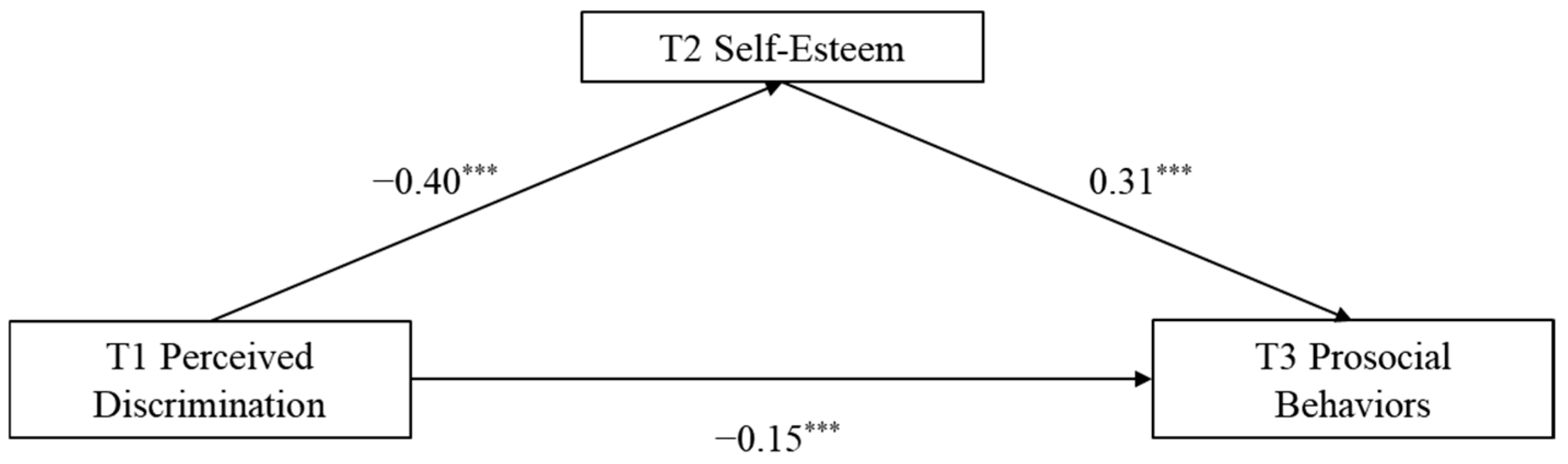
3.3. Mediation Model Test
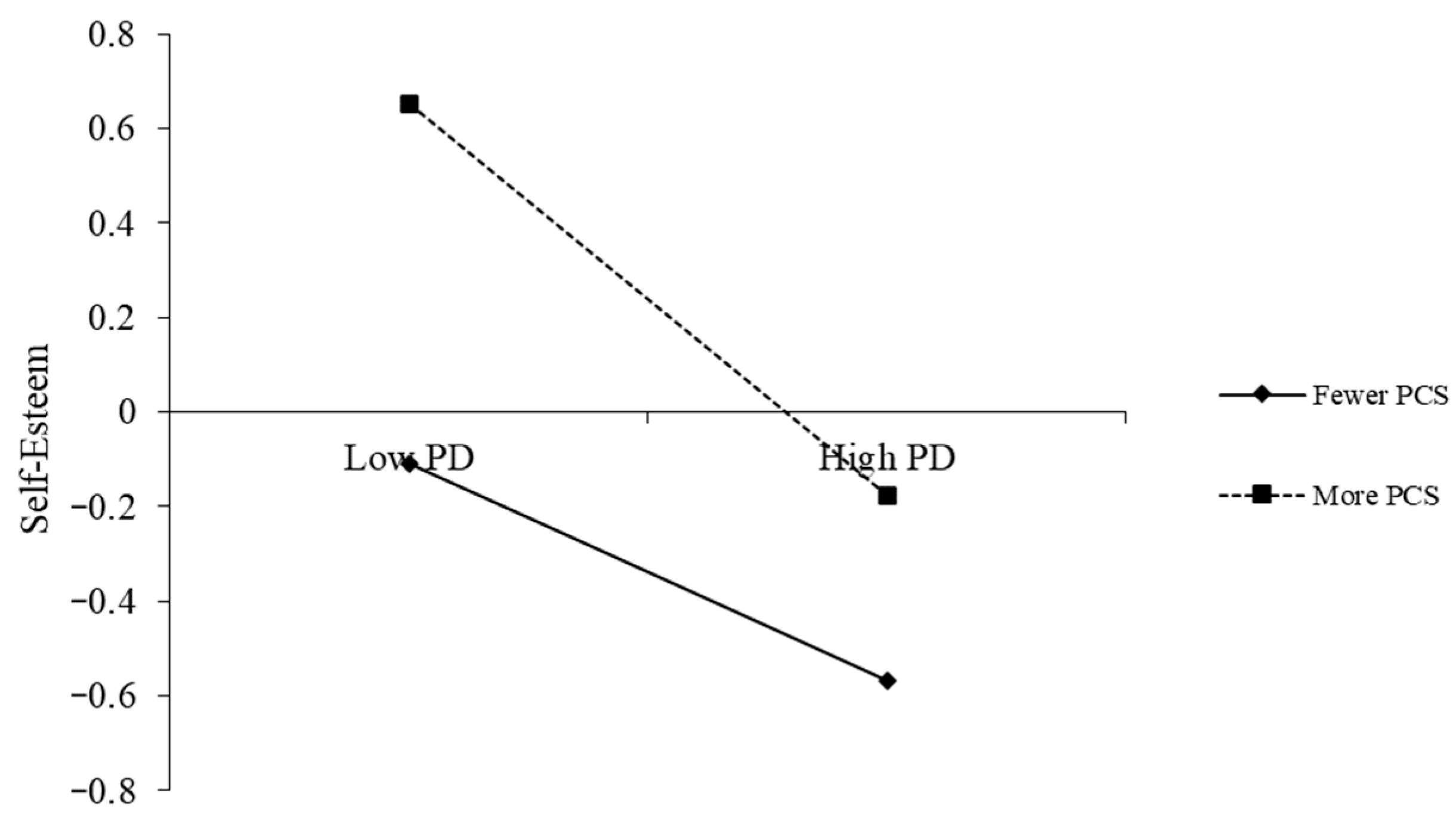
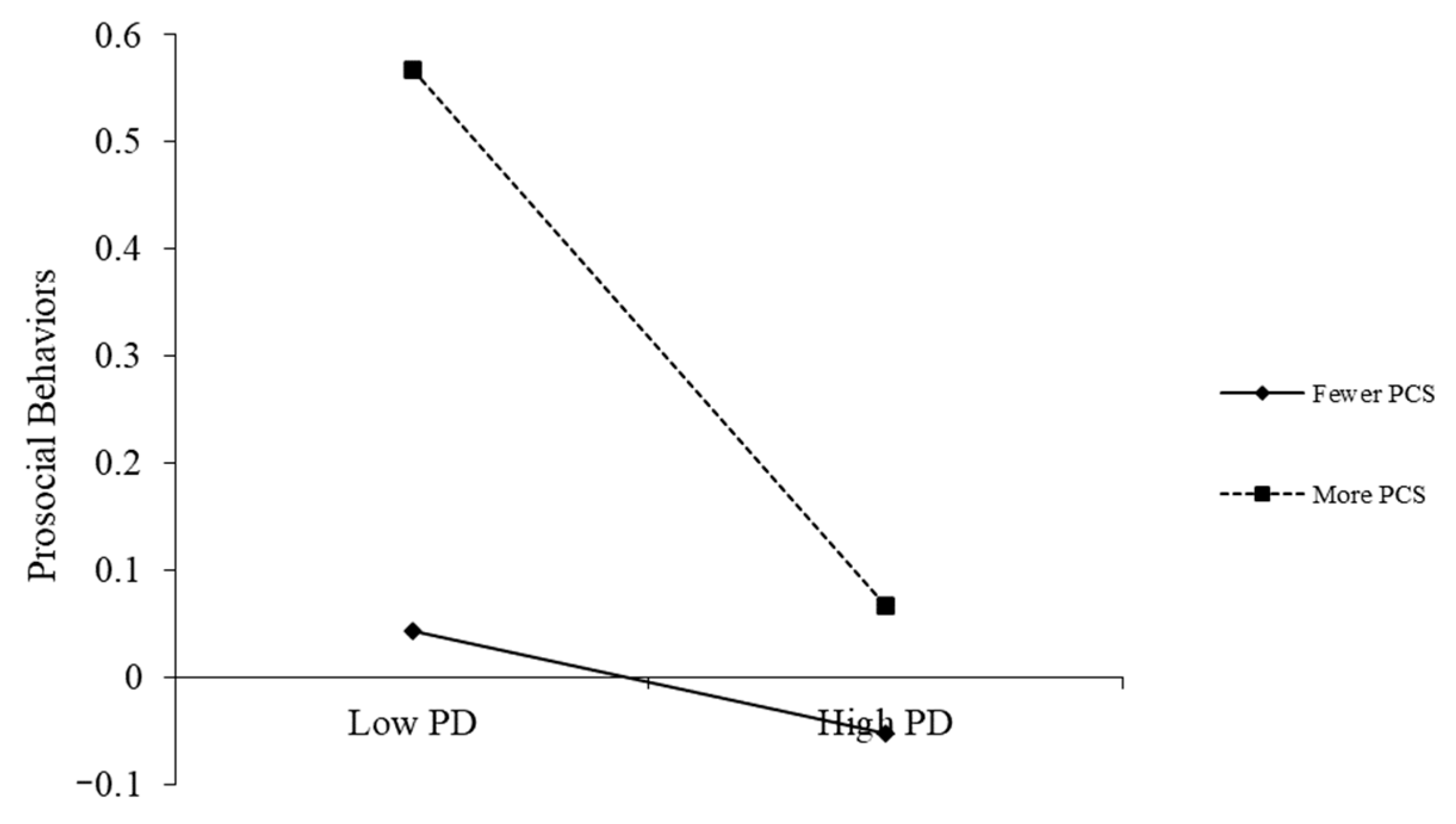
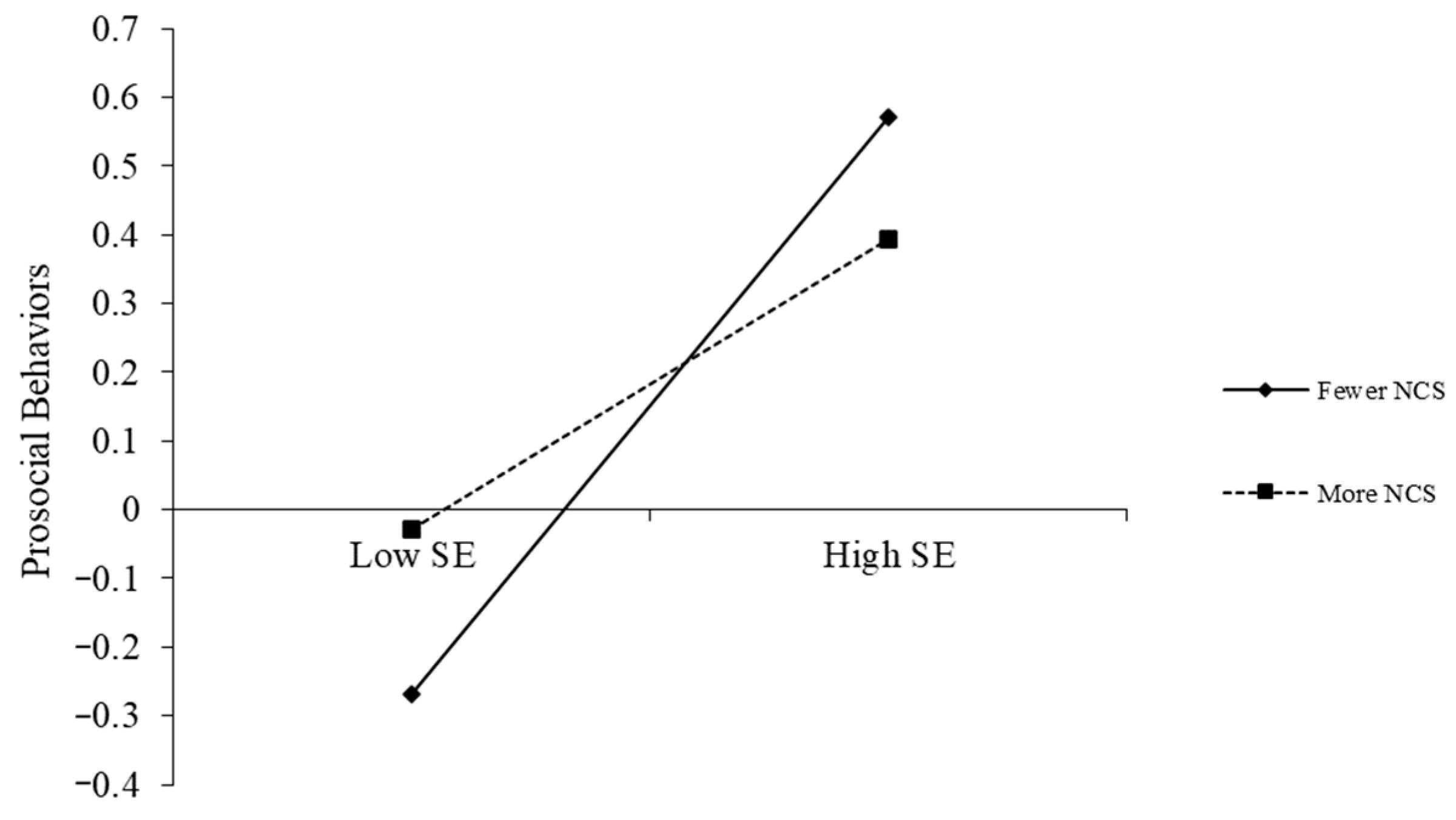
3.4. Moderated Mediation Model Test
4. Discussion
4.1. The Mediating Role of Self-Esteem
4.2. The Moderating Effects of Positive and Negative Coping Styles
4.3. Limitations and Future Directions
5. Conclusions
Author Contributions
Funding
Institutional Review Board Statement
Informed Consent Statement
Data Availability Statement
Acknowledgments
Conflicts of Interest
References
- Aydinli-Karakulak, A., Tepe, B., Nurcan, E., & Dimitrova, R. (2021). How prosocial behavior turns bad into good: An examination among Turkish-Bulgarian adolescents. Current Psychology, 40(8), 3986–3996. [Google Scholar] [CrossRef]
- Bao, Z., Zhang, W., Lai, X., & Wang, Y. (2016). Family income and adolescents’ sleep quality: The chain mediating effect of perceived discrimination and self-esteem. Journal of Psychological Science, 39(2), 350–356. [Google Scholar] [CrossRef]
- Baumeister, R. F., Campbell, J. D., Krueger, J. I., & Vohs, K. D. (2003). Does high self-esteem cause better performance, interpersonal success, happiness, or healthier lifestyles? Psychological Science, 4, 1–44. [Google Scholar] [CrossRef]
- Bonanno, G. A., & Burton, C. L. (2013). Regulatory flexibility. Perspectives on Psychological Science, 8(6), 591–612. [Google Scholar] [CrossRef]
- Chen, F., Yang, J., Zhu, Z., Zhou, Q., & Wang, Y. (2010). Relationship between stressors and problem behaviors in higher elementary school students: Moderation effect of coping strategies. Psychological Exploration, 30(4), 64–69. [Google Scholar]
- Chen, H., Zhao, L., & Liu, L. (2010). A regulatory effect of the coping strategies by urban management enforcement officials on the relationship between their sense of pressure and their mental health. Chinese Journal of Special Education, 18(3), 73–76. [Google Scholar]
- Chen, L., & Guan, J. (2025). The actor-partner interdependence model analysis of parental and offspring’ national identity and prosocial behavior: The mediating role of self-esteem. Chinese Journal of Clinical Psychology, 33(5), 949–954+961. [Google Scholar] [CrossRef]
- Compas, B. E., Jaser, S. S., Dunbar, J. P., Watson, K. H., Bettis, A. H., Gruhn, M. A., & Williams, E. K. (2014). Coping and emotion regulation from childhood to early adulthood: Points of convergence and divergence. Australian Journal of Psychology, 66(2), 71–81. [Google Scholar] [CrossRef]
- Corning, A. F. (2002). Self-esteem as a moderator between perceived discrimination and psychological distress among women. Journal of Counseling Psychology, 49(1), 117–126. [Google Scholar] [CrossRef]
- Crocker, J., & Major, B. (1989). Social stigma and self-esteem: The self-protective properties of stigma. Psychological Review, 96(4), 608–630. [Google Scholar] [CrossRef]
- Davis, A. N., Carlo, G., McGinley, M., & Schwartz, S. J. (2022). The enhancing and buffering role of ethnic socialization on the links between discrimination and prosocial behaviors among U.S. Latinx young adults. Hispanic Journal of Behavioral Sciences, 44(4), 247–266. [Google Scholar] [CrossRef]
- Du, Y., Kou, J., Wang, X., Xia, L., & Zou, R. (2006). A study on the strengths and difficulties questionnaire (SDQ). Psychological Science, 29(6), 1419–1421. [Google Scholar] [CrossRef]
- Eisenberg, N. (1986). Altruistic emotion, cognition, and behavior. Erlbaum. [Google Scholar]
- Eisenberg, N., & Mussen, P. H. (1989). The roots of prosocial behavior in children. Cambridge University Press. [Google Scholar]
- Fan, X., Fang, X., Liu, Y., Lin, X., & Yuan, X. (2013). The effect of social support and social identity on the relationship between perceived discrimination and socio-cultural adjustment among Chinese migrant children. Acta Psychologica Sinica, 44(5), 647–663. [Google Scholar] [CrossRef]
- Fischer, A. R., & Shaw, C. M. (1999). African Americans’ mental health and perceptions of racist discrimination: The moderating effects of racial socialization experiences and self-esteem. Journal of Counseling Psychology, 46(3), 395–407. [Google Scholar] [CrossRef]
- Folkman, S., & Moskowitz, J. T. (2004). Coping: Pitfalls and promise. Annual Review of Psychology, 55(1), 745–774. [Google Scholar] [CrossRef]
- Forsythe, C. J., & Compas, B. E. (1987). Interaction of cognitive appraisals of stressful events and coping: Testing the goodness of fit hypothesis. Cognitive Therapy and Research, 11(4), 473–485. [Google Scholar] [CrossRef]
- Fu, X., Padilla-Walker, L. M., & Brown, M. N. (2017). Longitudinal relations between adolescents’ self-esteem and prosocial behavior toward strangers, friends and family. Journal of Adolescence, 57(1), 90–98. [Google Scholar] [CrossRef]
- Goodman, R. (2001). Psychometric properties of the strengths and difficulties questionnaire. Journal of the American Academy of Child & Adolescent Psychiatry, 40(11), 1337–1345. [Google Scholar] [CrossRef]
- Gregory, A., Hafen, C. A., Ruzek, E., Mikami, A. Y., Allen, J. P., & Pianta, R. C. (2016). Closing the racial discipline gap in classrooms by changing teacher practice. School Psychology Review, 45(2), 171–191. [Google Scholar] [CrossRef]
- Grossman, J. M., & Liang, B. (2008). Discrimination distress among Chinese American adolescents. Journal of Youth and Adolescence, 37(1), 1–11. [Google Scholar] [CrossRef]
- Hatzenbuehler, M. L. (2016). Structural stigma: Research evidence and implications for psychological science. American Psychologist, 71(8), 742–751. [Google Scholar] [CrossRef]
- Hayes, A. F. (2018). Introduction to mediation, moderation, and conditional process analysis: A regression-based approach (2nd ed., pp. 6–7). Guilford Press. [Google Scholar]
- Hooberman, J., Rosenfeld, B., Rasmussen, A., & Keller, A. (2010). Resilience in trauma-exposed refugees: The moderating effect of coping style on resilience variables. American Journal of Orthopsychiatry, 80(4), 557–563. [Google Scholar] [CrossRef]
- Huang, C., Li, G., Zhang, Y., Aphichaithawon, N., Deng, Z., Zhang, Z., Zhang, Y., & Ding, J. (2023). The influence of physical education courses integrated with civic education on prosocial behavior among college students: The chain mediating effect of cultural confidence and self-esteem. Frontiers in Psychology, 14, 1217290. [Google Scholar] [CrossRef]
- Ji, Y., & Yu, X. (1999). Self-esteem scale. Chinese Mental Health Journal, 12, 318–320. [Google Scholar]
- Joormann, J., & Stanton, C. H. (2016). Examining emotion regulation in depression: A review and future directions. Behaviour Research and Therapy, 86, 35–49. [Google Scholar] [CrossRef] [PubMed]
- Kartalova-O’Doherty, Y., & Doherty, D. T. (2007). Coping strategies and styles of family carers of persons with enduring mental illness: A mixed methods analysis. Scandinavian Journal of Caring Sciences, 22(1), 19–28. [Google Scholar] [CrossRef] [PubMed][Green Version]
- Labroo, A. A., & Goldsmith, K. (2021). The dirty underbelly of prosocial behavior: Reconceptualizing Greater good as an ecosystem with unintended consequences. Journal of Consumer Psychology, 31(3), 417–428. [Google Scholar] [CrossRef]
- Lazar, L., & Eisenberger, N. I. (2022). The benefits of giving: Effects of prosocial behavior on recovery from stress. Psychophysiology, 59(2), e13954. [Google Scholar] [CrossRef]
- Lazarus, R. S., & Folkman, S. (1984). Stress, appraisal, and coping. Springer. [Google Scholar]
- Li, H., & Mei, J. (2002). Assessing psychological well-being of college student: Psychometric properties of GHQ-20. Psychological Development and Education, 1, 75–79. [Google Scholar] [CrossRef]
- Li, H., Shen, J., Wang, X., & Zhang, L. (2011). Discriminatory perception is more noteworthy than poverty—Their effect on poor and non-poor children’s behavior. Chinese Journal of Special Education, 2, 83–89. [Google Scholar] [CrossRef]
- Li, Q., Shang, S., Du, J., Wu, J., & Xiao, S. (2024). Perceived discrimination as a predictor of cyberbullying: The mediating role of self-esteem and moderating role of self-compassion. Frontiers in Psychology, 15, 1499759. [Google Scholar] [CrossRef]
- Liang, J., Chen, Z., & Lei, J. (2016). Inspire me to donate: The use of strength emotion in donation appeals. Journal of Consumer Psychology, 26(2), 283–288. [Google Scholar] [CrossRef]
- Liu, Q., Zhao, F., & Zhang, S. (2020). Considering the reciprocal relationship between meaning in life and prosocial behavior: A cross-lagged analysis. Journal of Psychological Science, 43(6), 1438–1445. [Google Scholar] [CrossRef]
- Liu, X., & Shen, J. (2010). Chinese migrant children’s perceived discrimination and its relation to self-esteem. Psychological Science, 33(3), 695–697. [Google Scholar] [CrossRef]
- Liu, X., Zhao, J., & Shen, J. (2013). Perceived discrimination and subjective well-being among urban migrant children: The effect of mediator and moderator. Acta Psychologica Sinica, 45(5), 568–584. [Google Scholar] [CrossRef]
- Luo, H., Zhu, H., & Qiu, X. (2025). The relationship between family socioeconomic status and prosocial behavior of adolescents: The chain mediating effect and differences of only-child status. Studies of Psychology and Behavior, 23(1), 130–137. [Google Scholar] [CrossRef]
- Miller, C. T., & Kaiser, C. R. (2001). A theoretical perspective on coping with stigma. Journal of Social Issues, 57(1), 73–92. [Google Scholar] [CrossRef]
- Padilla-Walker, L. M., Memmott-Elison, M. K., & Nielson, M. G. (2018). Longitudinal change in high-cost prosocial behaviors of defending and including during the transition to adulthood. Journal of Youth and Adolescence, 47(9), 1853–1865. [Google Scholar] [CrossRef]
- Partovi, R., Carlo, G., White, R. M. B., Roche, K. M., & Little, T. D. (2025). Longitudinal within- and between-person effects of school discrimination on U.S. Latino/a adolescents’ prosocial behaviors. Developmental Psychology. Advance online publication. [Google Scholar] [CrossRef]
- Peacock, J. (2022). Relationships between prosocial factors and college student health. Journal of American College Health, 70(2), 347–354. [Google Scholar] [CrossRef]
- Penner, L. A., Dovidio, J. F., Piliavin, J. A., & Schroeder, D. A. (2005). Prosocial behavior: Multilevel perspectives. Annual Review of Psychology, 56(1), 365–392. [Google Scholar] [CrossRef]
- Podsakoff, P. M., MacKenzie, S. B., Lee, J.-Y., & Podsakoff, N. P. (2003). Common method biases in behavioral research: A critical review of the literature and recommended remedies. Journal of Applied Psychology, 88(5), 879–903. [Google Scholar] [CrossRef]
- Prelow, H. M., Mosher, C. E., & Bowman, M. A. (2006). Perceived racial discrimination, social support, and psychological adjustment among African American college students. Journal of Black Psychology, 32(4), 442–454. [Google Scholar] [CrossRef]
- Quan, X., Yang, J., Chai, J., Qiu, T., & Sun, J. (2024). Role of class relationship in the influence of perceived discrimination on pro-social behavior of left-behind junior middle school students. Chinese Journal of School Health, 45(11), 1625–1628. [Google Scholar] [CrossRef]
- Rosenberg, M. (1965). Society and the adolescent self-image. Princeton University Press. [Google Scholar]
- Roux, C., Goldsmith, K., & Bonezzi, A. (2015). On the psychology of scarcity: When reminders of resource scarcity promote selfish (and generous) behavior. Journal of Consumer Research, 42(4), 615−631. [Google Scholar] [CrossRef]
- Ruck, M. D., Mistry, R. S., & Flanagan, C. A. (2019). Children’s and adolescents’ understanding and experiences of economic inequality: An introduction to the special section. Developmental Psychology, 55(3), 449–456. [Google Scholar] [CrossRef]
- Shen, J., Hu, X., & Liu, X. (2009). Left-over children’s perceived discrimination: Its characteristics and relationship with personal well being. Journal of Henan University (Social Science), 49(6), 116–121. [Google Scholar]
- Spencer, M. B., Fegley, S. G., & Harpalani, V. (2003). A theoretical and empirical examination of identity as coping: Linking coping resources to the self processes of african american youth. Applied Developmental Science, 7(3), 181–188. [Google Scholar] [CrossRef]
- Staub, E., & Vollhardt, J. (2008). Altruism born of suffering: The roots of caring and helping after victimization and other trauma. American Journal of Orthopsychiatry, 78(3), 267–280. [Google Scholar] [CrossRef] [PubMed]
- Sun, W., & Fu, W. (2024). Perceived discrimination and self-esteem of left-behind children: The mediating effect of grit. Analyses of Social Issues and Public Policy, 24(2), 469–508. [Google Scholar] [CrossRef]
- Taylor, S. E., & Brown, J. D. (1988). Illusion and well-being: A social psychological perspective on mental health. Psychological Bulletin, 103(2), 193–210. [Google Scholar] [CrossRef]
- Taylor, S. E., & Stanton, A. L. (2007). Coping resources, coping processes, and mental health. Annual Review of Clinical Psychology, 3(1), 377–401. [Google Scholar] [CrossRef]
- Tom, D. M. (2006). Effects of perceived discrimination: Rejection and identification as two distinct pathways and their associated effects [Ph.D. thesis, The Ohio State University]. [Google Scholar]
- Wang, X., Wang, X., & Ma, H. (1999). Mental health assessment scale (revised ed., pp. 318–320). Chinese Mental Health Magazine Press. [Google Scholar]
- Xie, Q., Zhang, R., & Lan, W. (2023). The influence of perceived discrimination on the anxiety in college students with left-behind experience: The longitudinal mediating effect of self-esteem and rumination. Chinese Journal of Clinical Psychology, 31(5), 1117–1121. [Google Scholar] [CrossRef]
- Xie, Y. (1998). Preliminary study on the reliability and validity of the simplified coping style scale. Chinese Journal of Clinical Psychology, 6(2), 114–115. [Google Scholar] [CrossRef]
- Yang, J., Li, K., Zheng, W., & Guo, S. (2025). How people “love others”? The promotion mechanism of confucian ethical spirituality to prosocial behavior of college students. Chinese Journal of Clinical Psychology, 33(1), 66–71. [Google Scholar] [CrossRef]
- Zeiders, K. H., Umaña-Taylor, A. J., & Derlan, C. L. (2013). Trajectories of depressive symptoms and self-esteem in Latino youths: Examining the role of gender and perceived discrimination. Developmental Psychology, 49(5), 951–963. [Google Scholar] [CrossRef]
- Zhang, J., Ren, Y., Deng, Y., & Huang, S. (2025). Perceived discrimination and poor children’s executive function: The different roles of self-esteem and perceived social support. Applied Developmental Science, 29(1), 34–44. [Google Scholar] [CrossRef]
- Zhang, W., Chen, Y., & Zhu, L. (2023). “Attraction of the like”: The influence of peer’s donation choice on prosocial behavior of adolescents and the role of the belief in a just world. Acta Psychologica Sinica, 55(9), 1453–1464. [Google Scholar] [CrossRef]
- Zhang, X., Yan, F., & Meng, L. (2025). The influence mechanism of relative deprivation on prosocial behavior of migrant children: Based on the mediating effect of self-esteem and the moderating effect of social support. Frontiers in Psychology, 16, 1610985. [Google Scholar] [CrossRef] [PubMed]
- Zhang, X., Zu, J., & Zhao, Y. (2015). Self-esteem development in children and adolescents: Theory construction and empirical studies. Psychological Development and Education, 31(1), 15–20. [Google Scholar] [CrossRef]
- Zhao, H., Xu, F., Guo, Y., & Shu, S. (2018). Difference of prosocial behavior between social classes: Dual perspective of giving and receiving. Chinese Journal of Clinical Psychology, 26(5), 841–846. [Google Scholar] [CrossRef]
- Zhao, M., Jia, Q., & Li, C. (2025a). Examining the interaction between perceived neighborhood disorder, positive peers, and self-esteem on adolescent prosocial behavior: A study of Chinese adolescents. Behavioral Sciences, 15(9), 1146. [Google Scholar] [CrossRef]
- Zhao, M., Rutland, A., & Psychogiou, L. (2025b). Self-esteem mediates the association of leisure activities with adolescents’ mental health difficulties and prosocial behavior: Evidence from a UK-representative cohort. Journal of Leisure Research, 1–20. [Google Scholar] [CrossRef]
- Zhou, H., & Long, L. (2004). Statistical remedies for common method biases. Advances in Psychological Science, 12(6), 942–950. [Google Scholar] [CrossRef]
- Zhu, C., Li, Y., Li, Z., Ding, W., Wang, X., Li, W., & Xie, R. (2023). The longitudinal relationship between filial piety and prosocial behavior of children: The chain mediating effect of self-esteem and peer attachment. Current Psychology, 42(28), 24078–24087. [Google Scholar] [CrossRef]



| Variables | M | SD | 1 | 2 | 3 | 4 | 5 |
|---|---|---|---|---|---|---|---|
| 1. T1 Perceived discrimination | 1.43 | 0.56 | 1 | ||||
| 2. T2 Self-esteem | 3.14 | 0.51 | −0.40 *** | 1 | |||
| 3. T3 Prosocial behaviors | 1.50 | 0.52 | −0.27 *** | 0.36 *** | 1 | ||
| 4. T1 Positive coping styles | 1.74 | 0.56 | −0.38 *** | 0.42 *** | 0.32 *** | 1 | |
| 5. T1 Negative coping styles | 1.01 | 0.57 | 0.19 *** | −0.15 *** | −0.08 | 0.12 ** | 1 |
| Dependent Variable: T2 SE | Dependent Variable: T3 PB | |||||
|---|---|---|---|---|---|---|
| β | SE | 95% CI | β | SE | 95% CI | |
| Class | 0.01 | 0.01 | [−0.01, 0.03] | −0.01 | 0.01 | [−0.03, 0.01] |
| Gender | −0.09 | 0.08 | [−0.24, 0.06] | −0.21 ** | 0.08 | [−0.36, −0.05] |
| Age | 0.05 | 0.04 | [−0.02, 0.13] | −0.04 | 0.04 | [−0.11, 0.04] |
| T1 PD | −0.32 *** | 0.04 | [−0.41, −0.23] | −0.15 ** | 0.05 | [−0.24, −0.05] |
| T1 PCS | 0.29 *** | 0.04 | [0.21, 0.37] | 0.16 *** | 0.05 | [0.07, 0.25] |
| T1 PD × T1 PCS | −0.09 * | 0.04 | [−0.18, −0.01] | −0.10 * | 0.05 | [−0.20, −0.003] |
| T2 SE | 0.24 *** | 0.05 | [0.15, 0.33] | |||
| T2 SE × T1 PCS | −0.04 | 0.04 | [−0.12, 0.04] | |||
| R2 | 0.25 | 0.20 | ||||
| F | 29.77 *** | 15.86 *** | ||||
| Dependent Variable: T2 SE | Dependent Variable: T3 PB | |||||
|---|---|---|---|---|---|---|
| β | SE | 95% CI | β | SE | 95% CI | |
| Class | −0.01 | 0.01 | [−0.02, 0.03] | −0.01 | 0.01 | [−0.03, 0.01] |
| Gender | −0.06 | 0.08 | [−0.22, 0.09] | −0.19 * | 0.08 | [−0.35, −0.03] |
| Age | 0.06 | 0.04 | [−0.02, 0.13] | −0.05 | 0.04 | [−0.12, 0.03] |
| T1 PD | −0.39 *** | 0.04 | [−0.48, −0.31] | −0.15 ** | 0.05 | [−0.24, −0.06] |
| T1 NCS | −0.08 | 0.04 | [−0.16, 0.004] | 0.01 | 0.04 | [−0.07, 0.10] |
| T1 PD × T1 NCS | 0.02 | 0.04 | [−0.05, 0.10] | −0.02 | 0.04 | [−0.11, 0.06] |
| T2 SE | 0.32 *** | 0.04 | [0.23, 0.40] | |||
| T2 SE × T1 NCS | −0.10 ** | 0.04 | [−0.18, −0.03] | |||
| R2 | 0.17 | 0.18 | ||||
| F | 17.91 *** | 13.96 *** | ||||
Disclaimer/Publisher’s Note: The statements, opinions and data contained in all publications are solely those of the individual author(s) and contributor(s) and not of MDPI and/or the editor(s). MDPI and/or the editor(s) disclaim responsibility for any injury to people or property resulting from any ideas, methods, instructions or products referred to in the content. |
© 2026 by the authors. Licensee MDPI, Basel, Switzerland. This article is an open access article distributed under the terms and conditions of the Creative Commons Attribution (CC BY) license.
Share and Cite
Gu, T.; Gai, X.; Wang, T. The Longitudinal Relationship Between Perceived Discrimination and Prosocial Behaviors: The Roles of Self-Esteem and Coping Styles. Behav. Sci. 2026, 16, 172. https://doi.org/10.3390/bs16020172
Gu T, Gai X, Wang T. The Longitudinal Relationship Between Perceived Discrimination and Prosocial Behaviors: The Roles of Self-Esteem and Coping Styles. Behavioral Sciences. 2026; 16(2):172. https://doi.org/10.3390/bs16020172
Chicago/Turabian StyleGu, Tingyu, Xiaosong Gai, and Tianyue Wang. 2026. "The Longitudinal Relationship Between Perceived Discrimination and Prosocial Behaviors: The Roles of Self-Esteem and Coping Styles" Behavioral Sciences 16, no. 2: 172. https://doi.org/10.3390/bs16020172
APA StyleGu, T., Gai, X., & Wang, T. (2026). The Longitudinal Relationship Between Perceived Discrimination and Prosocial Behaviors: The Roles of Self-Esteem and Coping Styles. Behavioral Sciences, 16(2), 172. https://doi.org/10.3390/bs16020172