Reflecting the Self: The Mirror Effect of Narcissistic Self-Regulation in Older Adults’ Evaluations of Empathic vs. Cold Socially Assistive Robots


Abstract
1. Introduction
1.1. Literature Review
1.1.1. Empathy and Social Cues in Human–Robot Interaction
1.1.2. Personality and Individual Differences in HRI
1.1.3. Narcissism and Interpersonal Dynamics
1.1.4. Integrating Narcissism with Empathic vs. Cold Robot Behavior
1.2. The Present Study
Hypotheses
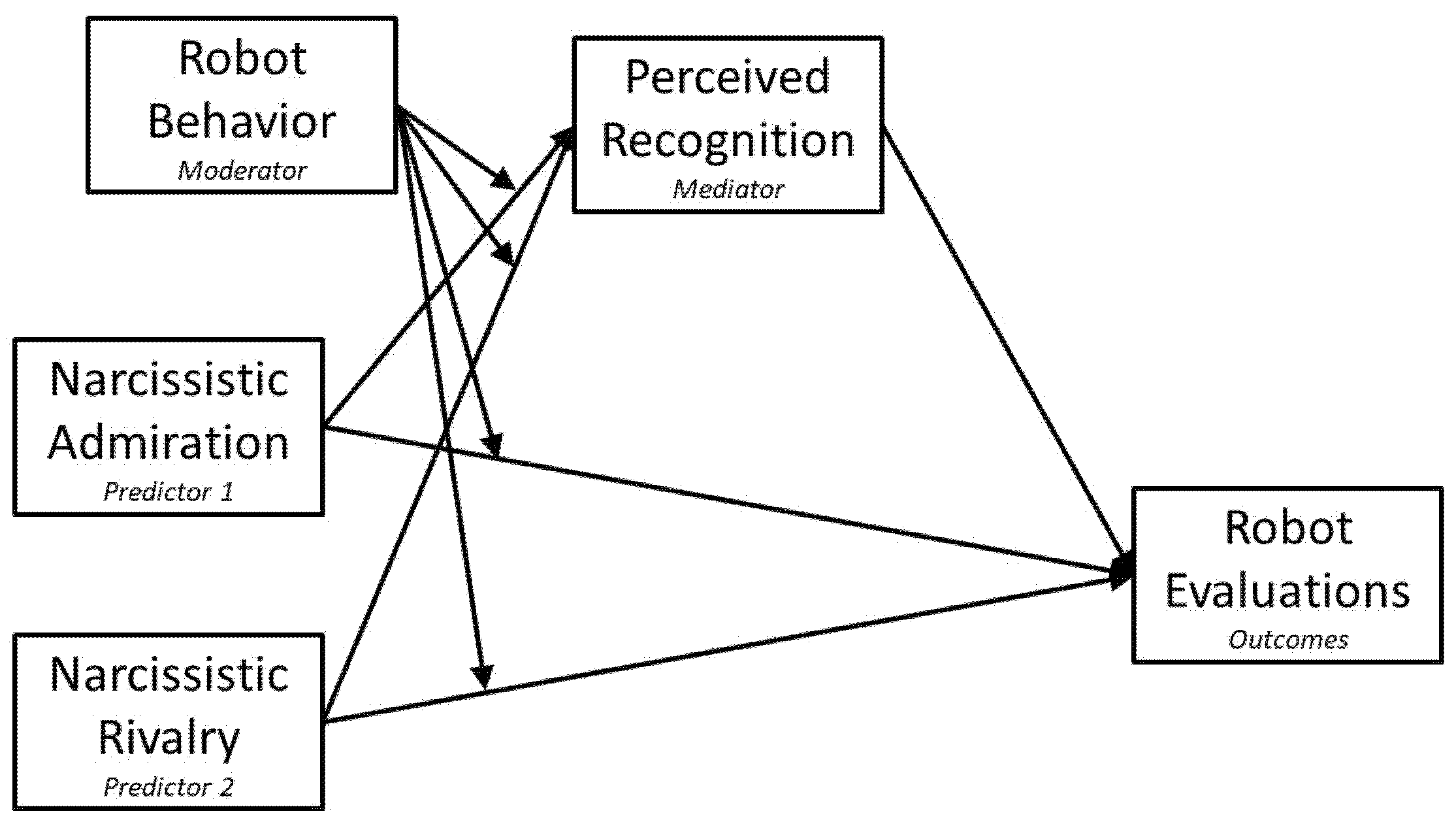
1.3. Theoretical Model: The Mirror Effect
2. Materials and Methods
2.1. Participants
2.2. Materials
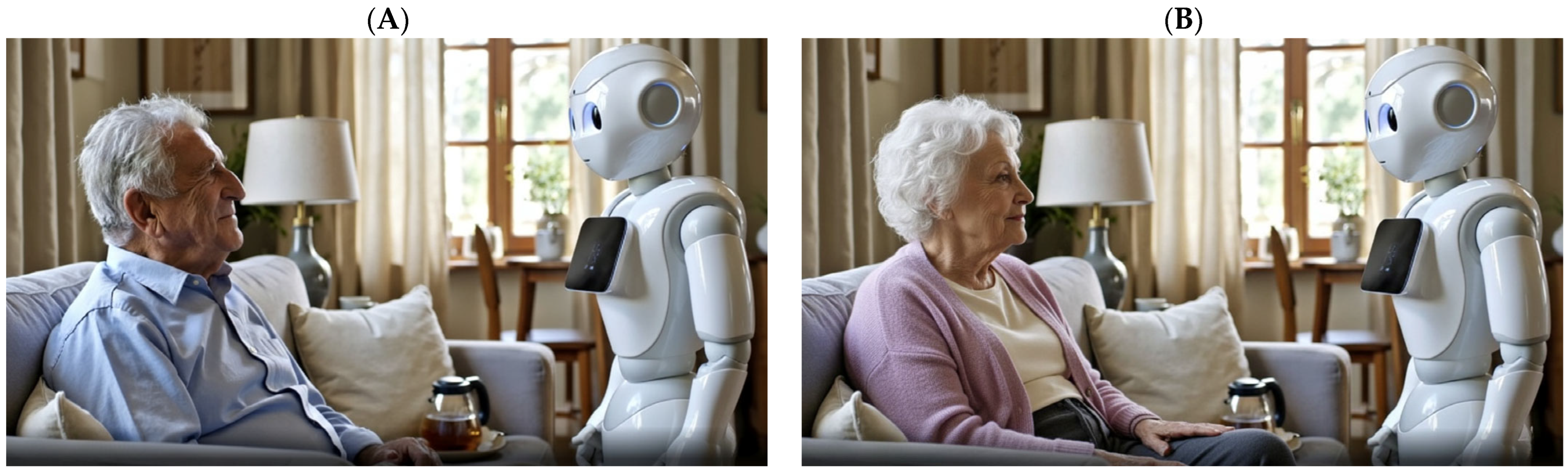
2.2.1. Video Stimuli
- Empathic Condition (n = 270; 140 men and 130 women). In this version, Novi spoke in a warm and gentle tone, maintained eye contact, used natural prosodic modulation, and offered supportive verbal cues (e.g., “I can see your hands are trembling a little, take your time, I’m right here with you.”).
- Cold Condition (n = 257; 131 men and 126 women). In this version, Novi spoke in a flat, mechanical tone, avoided eye contact, minimized verbal cues, and omitted any empathic references (e.g., “Acknowledged. Preparing tea. Please specify type.”).
2.2.2. Final Stimulus Set and Standardization
2.2.3. AI Video-Generation Tools and Production Pipeline
Manipulation Validation (Expert Ratings)
2.2.4. Pre-Manipulation Questionnaires
Demographic Questionnaire
Narcissistic Admiration and Rivalry
2.2.5. Post-Manipulation Questionnaires
Perceived Recognition Scale
Robot Interaction Evaluation
2.3. Measurement Validity for an Older Adult Population
2.4. Procedure
“Please watch the following interaction carefully and imagine that you are in Mr. Cohen’s [Ms. Cohen’s] place. Afterward, you will answer several questions about how you felt during the interaction.”
2.5. Design
2.6. Ethical Considerations
2.7. Statistical Analyses
2.8. Data Availability
3. Results
3.1. Background and Sociodemographic Variables
3.2. Univariate Analyses
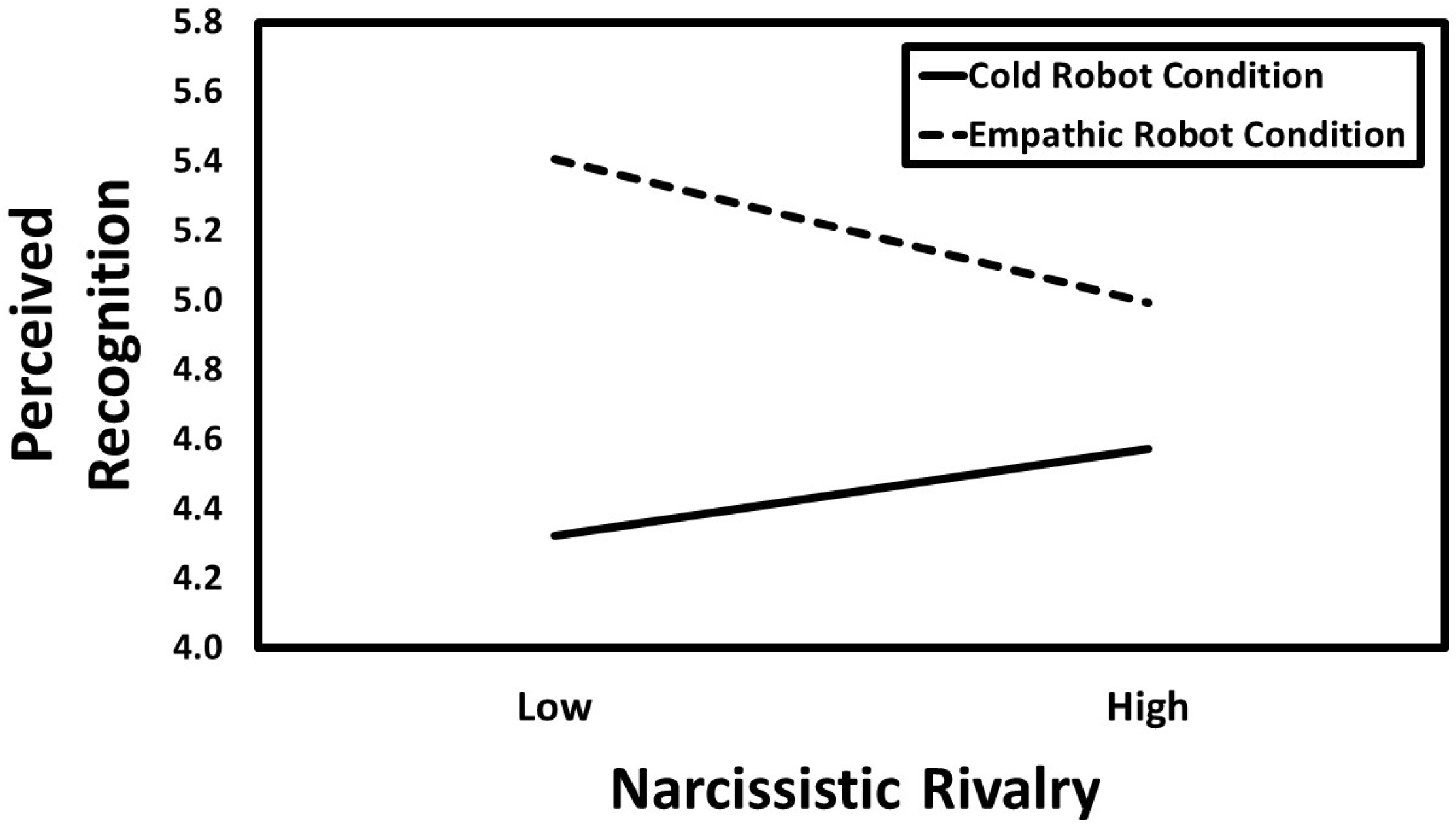
3.3. Perceived Recognition
3.4. Anthropomorphism

| Outcome | ||||||||
|---|---|---|---|---|---|---|---|---|
| M: Perceived Recognition | Y: Anthropomorphism | |||||||
| Predictor | Coeff. | SE | p | Coeff. | SE | p | ||
| X1: Narcissistic Admiration (ADM) | 0.20 | 0.04 | <0.001 | 0.04 | 0.04 | 0.343 | ||
| X2: Narcissistic Rivalry (RIV) | −0.04 | 0.04 | 0.380 | 0.00 | 0.04 | 0.900 | ||
| M: Perceived Recognition | – | – | – | 0.52 | 0.04 | <0.001 | ||
| W: Condition | 0.34 | 0.04 | <0.001 | 0.04 | 0.04 | 0.270 | ||
| X1 × W: ADM × Condition | 0.03 | 0.04 | 0.504 | 0.04 | 0.04 | 0.243 | ||
| X2 × W: RIV × Condition | −0.15 | 0.04 | <0.001 | 0.05 | 0.04 | 0.217 | ||
| Constant | −0.10 | 0.04 | 0.813 | 0.00 | 0.04 | 0.989 | ||
| R2 = 0.17 | R2 = 0.29 | |||||||
| F = 22.03, p < 0.001 | F = 36.84, p < 0.001 | |||||||
| Conditional Indirect Association of ADM with Anthropomorphism through Perceived Recognition | ||||||||
| Condition | Coeff. | Boot SE | Boot LCI | Boot UCI | ||||
| Cold (−1) | 0.09 | 0.04 | 0.01 | 0.17 | ||||
| Empathic (+1) | 0.12 | 0.03 | 0.07 | 0.18 | ||||
| Conditional Indirect Association of RIV with Anthropomorphism through Perceived Recognition | ||||||||
| Condition | Coeff. | Boot SE | Boot LCI | Boot UCI | ||||
| Cold (−1) | 0.06 | 0.03 | 0.00 | 0.12 | ||||
| Empathic (+1) | −0.10 | 0.02 | −0.15 | −0.05 | ||||
3.5. Likability
| Outcome | ||||||||
|---|---|---|---|---|---|---|---|---|
| M: Perceived Recognition | Y: Likability | |||||||
| Predictor | Coeff. | SE | p | Coeff. | SE | p | ||
| X1: Narcissistic Admiration (ADM) | 0.20 | 0.04 | <0.001 | 0.05 | 0.04 | 0.207 | ||
| X2: Narcissistic Rivalry (RIV) | −0.04 | 0.04 | 0.380 | −0.00 | 0.04 | 0.270 | ||
| M: Perceived Recognition | – | – | – | 0.60 | 0.04 | <0.001 | ||
| W: Condition | 0.34 | 0.04 | <0.001 | 0.03 | 0.04 | 0.496 | ||
| X1 × W: ADM × Condition | 0.03 | 0.04 | 0.504 | −0.03 | 0.04 | 0.432 | ||
| X2 × W: RIV × Condition | −0.15 | 0.04 | <0.001 | 0.02 | 0.04 | 0.563 | ||
| Constant | −0.10 | 0.04 | 0.813 | 0.00 | 0.03 | 0.987 | ||
| R2 = 0.17 | R2 = 0.38 | |||||||
| F = 22.03, p < 0.001 | F = 53.67, p < 0.001 | |||||||
| Conditional Indirect Association of ADM with Likability through Perceived Recognition | ||||||||
| Condition | Coeff. | Boot SE | Boot LCI | Boot UCI | ||||
| Cold (−1) | 0.10 | 0.05 | 0.01 | 0.20 | ||||
| Empathic (+1) | 0.14 | 0.03 | 0.08 | 0.20 | ||||
| Conditional Indirect Association of RIV with Likability through Perceived Recognition | ||||||||
| Condition | Coeff. | Boot SE | Boot LCI | Boot UCI | ||||
| Cold (−1) | 0.07 | 0.04 | 0.00 | 0.14 | ||||
| Empathic (+1) | −0.11 | 0.03 | −0.17 | −0.06 | ||||
3.6. Perceived Intelligence
| Outcome | ||||||||
|---|---|---|---|---|---|---|---|---|
| M: Perceived Recognition | Y: Perceived Intelligence | |||||||
| Predictor | Coeff. | SE | p | Coeff. | SE | p | ||
| X1: Narcissistic Admiration (ADM) | 0.20 | 0.04 | <0.001 | 0.03 | 0.04 | 0.477 | ||
| X2: Narcissistic Rivalry (RIV) | −0.04 | 0.04 | 0.380 | −0.09 | 0.04 | 0.037 | ||
| M: Perceived Recognition | – | – | – | 0.43 | 0.04 | <0.001 | ||
| W: Condition | 0.34 | 0.04 | <0.001 | −0.17 | 0.04 | <0.001 | ||
| X1 × W: ADM × Condition | 0.03 | 0.04 | 0.504 | 0.05 | 0.04 | 0.191 | ||
| X2 × W: RIV × Condition | −0.15 | 0.04 | <0.001 | −0.03 | 0.04 | 0.444 | ||
| Constant | −0.10 | 0.04 | 0.813 | 0.00 | 0.04 | 0.918 | ||
| R2 = 0.17 | R2 = 0.18 | |||||||
| F = 22.03, p < 0.001 | F = 19.19, p < 0.001 | |||||||
| Conditional Indirect Association of ADM with Perceived Intelligence through Perceived Recognition | ||||||||
| Condition | Coeff. | Boot SE | Boot LCI | Boot UCI | ||||
| Cold (−1) | 0.07 | 0.03 | 0.01 | 0.14 | ||||
| Empathic (+1) | 0.10 | 0.02 | 0.05 | 0.15 | ||||
| Conditional Indirect Association of RIV with Perceived Intelligence through Perceived Recognition | ||||||||
| Condition | Coeff. | Boot SE | Boot LCI | Boot UCI | ||||
| Cold (−1) | 0.05 | 0.03 | 0.00 | 0.10 | ||||
| Empathic (+1) | −0.08 | 0.02 | −0.12 | −0.04 | ||||
3.7. Safety
| Outcome | ||||||||
|---|---|---|---|---|---|---|---|---|
| M: Perceived Recognition | Y: Safety | |||||||
| Predictor | Coeff. | SE | p | Coeff. | SE | p | ||
| X1: Narcissistic Admiration (ADM) | 0.20 | 0.04 | <0.001 | 0.05 | 0.04 | 0.224 | ||
| X2: Narcissistic Rivalry (RIV) | −0.04 | 0.04 | 0.380 | 0.02 | 0.04 | 0.600 | ||
| M: Perceived Recognition | – | – | – | 0.37 | 0.05 | <0.001 | ||
| W: Condition | 0.34 | 0.04 | <0.001 | −0.11 | 0.04 | 0.012 | ||
| X1 × W: ADM × Condition | 0.03 | 0.04 | 0.504 | −0.02 | 0.04 | 0.664 | ||
| X2 × W: RIV × Condition | −0.15 | 0.04 | <0.001 | 0.04 | 0.04 | 0.318 | ||
| Constant | −0.10 | 0.04 | 0.813 | 0.00 | 0.04 | 0.942 | ||
| R2 = 0.17 | R2 = 0.13 | |||||||
| F = 22.03, p < 0.001 | F = 13.03 p < 0.001 | |||||||
| Conditional Indirect Association of ADM with Safety through Perceived Recognition | ||||||||
| Condition | Coeff. | Boot SE | Boot LCI | Boot UCI | ||||
| Cold (−1) | 0.06 | 0.03 | 0.01 | 0.13 | ||||
| Empathic (+1) | 0.08 | 0.02 | 0.05 | 0.13 | ||||
| Conditional Indirect Association of RIV with Safety through Perceived Recognition | ||||||||
| Condition | Coeff. | Boot SE | Boot LCI | Boot UCI | ||||
| Cold (−1) | 0.04 | 0.02 | 0.00 | 0.09 | ||||
| Empathic (+1) | −0.07 | 0.02 | −0.11 | −0.03 | ||||
3.8. Intention to Use
| Outcome | ||||||||
|---|---|---|---|---|---|---|---|---|
| M: Perceived Recognition | Y: Intention to Use | |||||||
| Predictor | Coeff. | SE | p | Coeff. | SE | p | ||
| X1: Narcissistic Admiration (ADM) | 0.20 | 0.04 | <0.001 | 0.06 | 0.04 | 0.149 | ||
| X2: Narcissistic Rivalry (RIV) | −0.04 | 0.04 | 0.380 | 0.14 | 0.04 | <0.001 | ||
| M: Perceived Recognition | – | – | – | 0.34 | 0.04 | <0.001 | ||
| W: Condition | 0.34 | 0.04 | <0.001 | −0.14 | 0.04 | 0.002 | ||
| X1 × W: ADM × Condition | 0.03 | 0.04 | 0.504 | 0.02 | 0.04 | 0.585 | ||
| X2 × W: RIV × Condition | −0.15 | 0.04 | <0.001 | 0.07 | 0.04 | 0.078 | ||
| Constant | −0.10 | 0.04 | 0.813 | 0.00 | 0.04 | 0.920 | ||
| R2 = 0.17 | R2 = 0.14 | |||||||
| F = 22.03, p < 0.001 | F = 13.86, p < 0.001 | |||||||
| Conditional Indirect Association of ADM with Intention to Use through Perceived Recognition | ||||||||
| Condition | Coeff. | Boot SE | Boot LCI | Boot UCI | ||||
| Cold (−1) | 0.06 | 0.03 | 0.01 | 0.12 | ||||
| Empathic (+1) | 0.08 | 0.02 | 0.04 | 0.12 | ||||
| Conditional Indirect Association of RIV with Intention to Use through Perceived Recognition | ||||||||
| Condition | Coeff. | Boot SE | Boot LCI | Boot UCI | ||||
| Cold (−1) | 0.04 | 0.02 | 0.00 | 0.08 | ||||
| Empathic (+1) | −0.06 | 0.02 | −0.10 | −0.03 | ||||
4. Discussion
4.1. Summary of the Main Findings
Hypotheses and Overall Pattern of Support
4.2. Theoretical Contributions: Recognition as a Central Mechanism in HRI
4.3. Personality Dynamics: Why Admiration Benefits and Rivalry Can Backfire
4.4. Reconciling Mean Differences with Model-Based Condition Effects
4.5. Practical Implications for Social-Robot Design in Older Adult Care
4.6. Ethical and Psychological Considerations of Recognition-Based AI
4.7. Limitations
4.8. Directions for Future Research
5. Conclusions
Author Contributions
Funding
Institutional Review Board Statement
Informed Consent Statement
Data Availability Statement
Acknowledgments
Conflicts of Interest
Appendix A
Perceived Recognition Scale (PRS): Items and Factor Loadings
| Item Wording | Loading |
|---|---|
| 1. The robot seemed to notice my emotional state. | 0.78 |
| 2. The robot acknowledged my presence during the interaction. | 0.66 |
| 3. The robot made me feel personally seen or recognized. | 0.85 |
| 4. The robot seemed to value me as an individual. | 0.91 |
| 5. I felt that the robot was attentive specifically to me. | 0.86 |
| 6. The robot’s behavior made me feel appreciated. | 0.82 |
Appendix B
Appendix B.1. Post Hoc Assessment of Common Method Variance and Discriminant Validity (CFA; AMOS)
Appendix B.2. Baseline Two-Factor Model
Appendix B.3. Single-Factor Model (CFA Analog of Harman’s Test)
Appendix B.4. Discriminant Validity: Free vs. Constrained Correlation
Appendix B.5. Common Latent Factor (CLF) Model
References
- Arbuckle, J. L. (2024). IBM SPSS Amos 29 user’s guide. IBM Corporation. [Google Scholar]
- Armbruster, D., Mandl, S., Zeiler, A., & Strobel, A. (2025). Artificial morality: Differences in responses to moral choices by human and artificial agents. International Journal of Social Robotics, 17(7), 1363–1379. [Google Scholar] [CrossRef]
- Back, M. D., Kufner, A. C., Dufner, M., Gerlach, T. M., Rauthmann, J. F., & Denissen, J. J. (2013). Narcissistic admiration and rivalry: Disentangling the bright and dark sides of narcissism. Journal of Personality and Social Psychology, 105(6), 1013–1037. [Google Scholar] [CrossRef]
- Bartneck, C., Kulić, D., Croft, E., & Zoghbi, S. (2008). Measurement instruments for the anthropomorphism, animacy, likeability, perceived intelligence, and perceived safety of robots. International Journal of Social Robotics, 1(1), 71–81. [Google Scholar] [CrossRef]
- Baumeister, R. F., & Leary, M. R. (1995). The need to belong: Desire for interpersonal attachments as a fundamental human motivation. Psychological Bulletin, 117(3), 497–529. [Google Scholar] [CrossRef]
- Berrezueta-Guzman, S., Dolón-Poza, M., & Wagner, S. (2025, June 23–26). Supporting preschool emotional development with AI-powered robot. 24th Annual ACM Interaction Design and Children Conference (IDC ’25) (pp. 1134–1139), Reykjavik, Iceland. [Google Scholar] [CrossRef]
- Bevilacqua, R., Felici, E., Cavallo, F., Amabili, G., & Maranesi, E. (2021). Designing acceptable robots for assisting older adults: A pilot study on the willingness to interact. International Journal of Environmental Research and Public Health, 18(20), 10686. [Google Scholar] [CrossRef]
- Breazeal, C. (2003). Toward sociable robots. Robotics and Autonomous Systems, 42(3–4), 167–175. [Google Scholar] [CrossRef]
- Broadbent, E. (2017). Interactions with robots: The truths we reveal about ourselves. Annual Review of Psychology, 68, 627–652. [Google Scholar] [CrossRef] [PubMed]
- Cascio, C. N., Konrath, S. H., & Falk, E. B. (2015). Narcissists’ social pain seen only in the brain. Social Cognitive and Affective Neuroscience, 10(3), 335–341. [Google Scholar] [CrossRef] [PubMed]
- D’Angelo, I., Morocutti, L., Giunchiglia, E., Recchiuto, C., & Sgorbissa, A. (2023, August 28–31). Nice and nasty theory of mind for social and antisocial robots. 2023 32nd IEEE International Conference on Robot and Human Interactive Communication (RO-MAN) (pp. 1675–1682), Busan, Republic of Korea. [Google Scholar] [CrossRef]
- de Graaf, M. M. A., & Ben Allouch, S. (2013). Exploring influencing variables for the acceptance of social robots. Robotics and Autonomous Systems, 61(12), 1476–1486. [Google Scholar] [CrossRef]
- Donnellan, M. B., Oswald, F. L., Baird, B. M., & Lucas, R. E. (2006). The mini-IPIP scales: Tiny-yet-effective measures of the Big Five factors of personality. Psychological Assessment, 18(2), 192–203. [Google Scholar] [CrossRef]
- Esterwood, C., Essenmacher, K., Yang, H., Zeng, F., & Robert, L. P. (2021, May 8–13). A meta-analysis of human personality and robot acceptance in human-robot interaction. CHI ’21: Proceedings of the 2021 CHI Conference on Human Factors in Computing System (pp. 1–18), Yokohama, Japan. [Google Scholar] [CrossRef]
- Fong, T., Nourbakhsh, I., & Dautenhahn, K. (2003). Socially interactive robots: A survey of social interaction paradigms. Robotics and Autonomous Systems, 42(3–4), 143–166. [Google Scholar] [CrossRef]
- Fraser, N. (2000). Rethinking recognition. New Left Review, 3, 107–120. [Google Scholar] [CrossRef]
- Fuchs, T. (2024). Narcissistic depressive technoscience. The New Atlantis, 76, 79–95. [Google Scholar]
- Gnambs, T., & Appel, M. (2018). Narcissism and social networking behavior: A meta-analysis. Journal of Personality, 86(2), 200–212. [Google Scholar] [CrossRef] [PubMed]
- Hayes, A. F. (2022). Introduction to mediation, moderation, and conditional process analysis: A regression-based approach (3rd ed.). The Guilford Press. [Google Scholar]
- Henschel, A., Laban, G., & Cross, E. S. (2021). What makes a robot social? A review of social robots from science fiction to a home or hospital near you. Current Robotics Reports, 2(1), 9–19. [Google Scholar] [CrossRef]
- Honneth, A. (1996). The struggle for recognition: The moral grammar of social conflicts. MIT Press. [Google Scholar]
- Hsieh, T.-Y., & Cross, E. S. (2022, March 7–10). The role of empathic traits in emotion recognition and emotion contagion of cozmo robots. 2022 ACM/IEEE International Conference on Human-Robot Interaction (HRI ’22) (pp. 802–806), Sapporo, Japan. [Google Scholar] [CrossRef]
- Isabet, B., Pino, M., Lewis, M., Benveniste, S., & Rigaud, A. S. (2021). Social telepresence robots: A narrative review of experiments involving older adults before and during the COVID-19 Pandemic. International Journal of Environmental Research and Public Health, 18(7), 3597. [Google Scholar] [CrossRef]
- Jauk, E., Benedek, M., Koschutnig, K., Kedia, G., & Neubauer, A. C. (2017). Self-viewing is associated with negative affect rather than reward in highly narcissistic men: An fMRI study. Scientific Reports, 7(1), 5804. [Google Scholar] [CrossRef]
- Jones, R. A. (2021). Projective anthropomorphism as a dialogue with ourselves. International Journal of Social Robotics, 13(4), 763–771. [Google Scholar] [CrossRef]
- Joshi, A., Das, S., & Sekar, S. (2023). How big five personality traits affect information and communication technology use: A meta-analysis. Australasian Journal of Information Systems, 27, 1–39. [Google Scholar] [CrossRef]
- Kabacińska, K., Dosso, J. A., Vu, K., Prescott, T. J., Robillard, J. M., & Adler, J. (2025). Influence of user personality traits and attitudes on interactions with social robots: Systematic review. Collabra: Psychology, 11(1), 129175. [Google Scholar] [CrossRef]
- Łukasik, S., Tobis, S., Suwalska, J., Łojko, D., Napierała, M., Proch, M., Neumann-Podczaska, A., & Suwalska, A. (2021). The role of socially assistive robots in the care of older people: To assist in cognitive training, to remind or to accompany? Sustainability, 13(18), 10394. [Google Scholar] [CrossRef]
- Mazuz, K., & Yamazaki, R. (2024). Adaptive learning in human–android interactions: An anthropological analysis of play and ritual. AI & Society, 39, 1–11. [Google Scholar] [CrossRef]
- Morf, C. C., & Rhodewalt, F. (2001). Unraveling the paradoxes of narcissism: A dynamic self-regulatory processing model. Psychological Inquiry, 12(4), 177–196. [Google Scholar] [CrossRef]
- Papadopoulos, I., Koulouglioti, C., Lazzarino, R., & Ali, S. (2020). Enablers and barriers to the implementation of socially assistive humanoid robots in health and social care: A systematic review. BMJ Open, 10(1), e033096. [Google Scholar] [CrossRef]
- Park, S., & Whang, M. (2022). Empathy in human-robot interaction: Designing for social robots. International Journal of Environmental Research and Public Health, 19(3), 1889. [Google Scholar] [CrossRef] [PubMed]
- Perugia, G., Paetzel, M., & Castellano, G. (2020). On the role of personality and empathy in human-human, human-agent, and human-robot mimicry. In G. Castellano (Ed.), Social robotics (pp. 120–131). Springer. [Google Scholar] [CrossRef]
- Poushneh, A., Vasquez-Parraga, A., & Gearhart, R. S. (2024). The effect of empathetic response and consumers’ narcissism in voice-based artificial intelligence. Journal of Retailing and Consumer Services, 79, 103871. [Google Scholar] [CrossRef]
- Reeves, B., & Nass, C. (1996). The media equation: How people treat computers, television, and new media like real people and places. Cambridge University Press. Available online: https://psycnet.apa.org/record/1996-98923-000 (accessed on 1 December 2025).
- Rossi, S., Conti, D., Garramone, F., Santangelo, G., Staffa, M., Varrasi, S., & Di Nuovo, A. (2020). The role of personality factors and empathy in the acceptance and performance of a social robot for psychometric evaluations. Robotics, 9(2), 39. [Google Scholar] [CrossRef]
- Sgorbissa, A., Morocutti, L., D’Angelo, I., & Recchiuto, C. T. (2024). Machiavellian robots and their theory of mind. IEEE Transactions on Affective Computing, Advance, Early Access. [Google Scholar] [CrossRef]
- Short, J., Williams, E., & Christie, B. (1976). The social psychology of telecommunications. Wiley. [Google Scholar]
- Stock-Homburg, R. (2021). Survey of emotions in human–robot interactions: Perspectives from robotic psychology on 20 years of research. International Journal of Social Robotics, 14(2), 389–411. [Google Scholar] [CrossRef]
- UN. (2022). World population prospects 2022: Summary of results. United Nations Department of Economic and Social Affairs, Population Division. Available online: https://www.un.org/development/desa/pd/sites/www.un.org.development.desa.pd/files/wpp2022_summary_of_results.pdf (accessed on 1 December 2025).
- UN. (2023). Ageing. United Nations Department of Economic and Social Affairs. Available online: https://www.un.org/en/global-issues/ageing (accessed on 1 December 2025).
- Weidmann, R., Chopik, W. J., Ackerman, R. A., Allroggen, M., Bianchi, E. C., Brecheen, C., Campbell, W. K., Gerlach, T. M., Geukes, K., Grijalva, E., Grossmann, I., Hopwood, C. J., Hutteman, R., Konrath, S., Küfner, A. C. P., Leckelt, M., Miller, J. D., Penke, L., Pincus, A. L., … Back, M. D. (2023). Age and gender differences in narcissism: A comprehensive study across eight measures and over 250,000 participants. Journal of Personality and Social Psychology, 124(6), 1277–1298. [Google Scholar] [CrossRef]
- WHO. (2025a). Ageing and health. World Health Organization. Available online: https://www.who.int/news-room/fact-sheets/detail/ageing-and-health (accessed on 1 December 2025).
- WHO. (2025b). Ageing: Global population. World Health Organization. Available online: https://www.who.int/news-room/questions-and-answers/item/population-ageing (accessed on 1 December 2025).
- Xiao, W., Wang, X.-L., & Hu, W.-A. (2025). More narcissistic, more charming: Investigating human-agent collaborative innovation from an internal compatibility perspective. Basic and Applied Social Psychology, 47(5), 276–289. [Google Scholar] [CrossRef]
- Zguda, P., Radosz-Knawa, Z., Kukier, T., Radosz, M., Kamińska, A., & Indurkhya, B. (2025). How do older adults perceive technology and robots? A participatory study in a care center in poland. Electronics, 14(6), 1106. [Google Scholar] [CrossRef]
- Zhang, Q., You, S., Kim, S., Esterwood, C., Alahmad, R., & Robert, L. P., Jr. (2020). A review of personality in human–robot interactions. Foundations and Trends® in Information Systems, 4(2), 107–212. [Google Scholar] [CrossRef]


| Men (n = 271) | Women (n = 256) | |||||
|---|---|---|---|---|---|---|
| Experimental Condition | ||||||
| Total Sample (N = 527) | Cold Robot (n = 131) | Empathic Robot (n = 140) | Cold Robot (n = 126) | Empathic Robot (n = 130) | Cold ≠ Empathic Statistics | |
| Age | 72.73 | 73.21 | 74.03 | 71.84 | 71.71 | t = −0.92 |
| Number of children | 2.90 | 2.96 | 2.98 | 2.76 | 2.88 | t = −0.55 |
| Sense of loneliness | 22.58 | 23.98 | 19.30 | 25.11 | 22.25 | t = 1.66 |
| Perceived social support | 73.41 | 71.40 | 74.46 | 74.69 | 73.06 | t = −0.36 |
| Previous experience with robots | χ2 = 0.15 | |||||
| Yes | 41.2% | 41.2% | 45.0% | 42.9% | 35.4% | |
| No | 58.8% | 58.8% | 55.0% | 57.1% | 64.6% | |
| Education | χ2 = 2.50 | |||||
| No high school degree | 11.0% | 9.2% | 9.3% | 15.9% | 10.0% | |
| High school degree | 27.7% | 22.1% | 27.9% | 29.4% | 31.5% | |
| Bachelor’s degree | 36.4% | 41.2% | 32.9% | 31.0% | 40.8% | |
| Master’s degree | 21.6% | 24.4% | 25.7% | 21.4% | 14.6% | |
| Ph.D. or equivalent | 3.2% | 3.1% | 4.3% | 2.4% | 3.1% | |
| Employment | χ2 = 4.78 | |||||
| Full time | 17.8% | 21.4% | 18.6% | 18.3% | 13.1% | |
| Part time | 14.0% | 11.5% | 9.3% | 16.7% | 19.2% | |
| Unemployed | 1.6% | 1.6% | 1.4% | 0.8% | 2.3% | |
| Going to school | 0.6% | 0.0% | 0.0% | 1.6% | 0.8% | |
| Home maker | 64.1% | 62.6% | 70.0% | 60.3% | 63.1% | |
| Retired | 1.9% | 3.1% | 0.7% | 2.4% | 1.5% | |
| Marital Status | χ2 = 7.38 | |||||
| Single | 2.8% | 2.3% | 0.7% | 5.6% | 3.1% | |
| Dating | 0.8% | 0.0% | 0.0% | 1.6% | 1.6% | |
| Cohabiting | 2.5% | 3.8% | 0.7% | 3.2% | 2.3% | |
| Married | 71.7% | 82.4% | 85.0% | 53.2% | 64.6% | |
| Separated | 0.6% | 0.8% | 0.0% | 0.8% | 0.8% | |
| Divorced | 13.9% | 8.4% | 5.7% | 22.2% | 20.0% | |
| Widowed | 7.8% | 2.3% | 7.9% | 13.5% | 7.7% | |
| Household income | χ2 = 3.19 | |||||
| Very high | 12.9% | 15.3% | 20.0% | 6.3% | 9.2% | |
| Somewhat high | 25.0% | 32.1% | 27.9% | 19.0% | 20.8% | |
| Moderate | 32.3% | 35.1% | 30.7% | 29.4% | 33.8% | |
| Somewhat low | 18.0% | 6.9% | 12.9% | 28.6% | 24.6% | |
| Very low | 11.8% | 10.7% | 8.6% | 16.7% | 11.5% | |
| Religiosity | χ2 = 3.05 | |||||
| Secular | 68.1% | 72.5% | 66.4% | 69.0% | 64.6% | |
| Traditional | 20.1% | 13.0% | 26.4% | 17.5% | 23.1% | |
| Religious | 8.2% | 9.9% | 5.7% | 8.7% | 8.5% | |
| Ultra-Orthodox | 3.6% | 4.6% | 1.4% | 4.8% | 3.8% | |
| 1 | 2 | 3 | 4 | 5 | 6 | 7 | 8 | |
|---|---|---|---|---|---|---|---|---|
| 1. Narcissistic Admiration | – | 0.17 ** | 0.25 *** | 0.19 ** | 0.15 * | 0.15 * | 0.11 | 0.18 ** |
| 2. Narcissistic Rivalry | 0.24 *** | – | −0.18 ** | −0.02 | −0.11 | −0.16 * | 0.02 | 0.17 ** |
| 3. Perceived Recognition | 0.19 ** | 0.15 * | – | 0.44 *** | 0.50 *** | 0.45 *** | 0.28 *** | 0.30 *** |
| 4. Anthropomorphism | 0.09 | 0.03 | 0.57 *** | – | 0.49 *** | 0.48 *** | 0.52 *** | 0.52 *** |
| 5. Likability | 0.17 ** | 0.05 | 0.64 *** | 0.64 *** | – | 0.65 *** | 0.59 *** | 0.44 *** |
| 6. Perceived Intelligence | 0.05 | 0.01 | 0.40 *** | 0.39 *** | 0.61 *** | – | 0.57 *** | 0.43 *** |
| 7. Safety | 0.15 * | 0.06 | 0.43 *** | 0.40 *** | 0.57 *** | 0.60 *** | – | 0.64 *** |
| 8. Intention to Use | 0.13 * | 0.14 * | 0.36 *** | 0.50 *** | 0.55 *** | 0.53 *** | 0.65 *** | – |
| MeanCold Robot | 3.39 | 1.98 | 4.45 | 3.69 | 5.50 | 5.83 | 5.76 | 5.04 |
| Standard DeviationCold Robot | 0.83 | 0.77 | 1.22 | 1.45 | 1.32 | 1.08 | 1.16 | 1.70 |
| SkewnessCold Robot | −0.03 | 0.88 | −0.72 | 0.20 | −0.63 | −1.03 | −1.04 | −0.84 |
| KurtosisCold Robot | −0.43 | 0.32 | −0.50 | −0.70 | −0.37 | 0.72 | 0.48 | −0.27 |
| MeanEmpathic Robot | 3.39 | 1.97 | 5.20 | 4.33 | 6.07 | 5.78 | 5.79 | 4.95 |
| Standard DeviationEmpathic Robot | 0.80 | 0.69 | 0.86 | 1.40 | 1.12 | 1.06 | 1.25 | 1.85 |
| SkewnessEmpathic Robot | 0.05 | 0.83 | −1.45 | −0.29 | −1.30 | −0.77 | −1.13 | −0.74 |
| KurtosisEmpathic Robot | −0.49 | 0.52 | 2.35 | −0.67 | 1.09 | 0.12 | 0.51 | −0.61 |
| Cold Robot Condition (n = 257) | Empathic Robot Condition (n = 270) | ||||
|---|---|---|---|---|---|
| M | SD | M | SD | t | |
| Narcissistic Admiration | 3.39 | 0.83 | 3.39 | 0.80 | 0.10 |
| Narcissistic Rivalry | 1.98 | 0.77 | 1.97 | 0.69 | 0.18 |
| Perceived Recognition | 4.45 | 1.22 | 5.20 | 0.86 | 8.21 *** |
| Anthropomorphism | 3.69 | 1.45 | 4.33 | 1.40 | 5.17 *** |
| Likability | 5.50 | 1.32 | 6.07 | 1.12 | 5.37 *** |
| Perceived Intelligence | 5.83 | 1.08 | 5.78 | 1.06 | −0.47 |
| Safety | 5.76 | 1.16 | 5.79 | 1.25 | 0.34 |
| Intention to Use | 5.04 | 1.70 | 4.95 | 1.85 | 0.55 |
Disclaimer/Publisher’s Note: The statements, opinions and data contained in all publications are solely those of the individual author(s) and contributor(s) and not of MDPI and/or the editor(s). MDPI and/or the editor(s) disclaim responsibility for any injury to people or property resulting from any ideas, methods, instructions or products referred to in the content. |
© 2026 by the authors. Licensee MDPI, Basel, Switzerland. This article is an open access article distributed under the terms and conditions of the Creative Commons Attribution (CC BY) license.
Share and Cite
Besser, A.; Zeigler-Hill, V.; Mazuz, K. Reflecting the Self: The Mirror Effect of Narcissistic Self-Regulation in Older Adults’ Evaluations of Empathic vs. Cold Socially Assistive Robots. Behav. Sci. 2026, 16, 164. https://doi.org/10.3390/bs16020164
Besser A, Zeigler-Hill V, Mazuz K. Reflecting the Self: The Mirror Effect of Narcissistic Self-Regulation in Older Adults’ Evaluations of Empathic vs. Cold Socially Assistive Robots. Behavioral Sciences. 2026; 16(2):164. https://doi.org/10.3390/bs16020164
Chicago/Turabian StyleBesser, Avi, Virgil Zeigler-Hill, and Keren Mazuz. 2026. "Reflecting the Self: The Mirror Effect of Narcissistic Self-Regulation in Older Adults’ Evaluations of Empathic vs. Cold Socially Assistive Robots" Behavioral Sciences 16, no. 2: 164. https://doi.org/10.3390/bs16020164
APA StyleBesser, A., Zeigler-Hill, V., & Mazuz, K. (2026). Reflecting the Self: The Mirror Effect of Narcissistic Self-Regulation in Older Adults’ Evaluations of Empathic vs. Cold Socially Assistive Robots. Behavioral Sciences, 16(2), 164. https://doi.org/10.3390/bs16020164