An In-Depth Investigation of Eye Movement Profile of Dyslexic Readers Using a Standardized Text-Reading Aloud Task in French

 , ,
, ,
Abstract
1. Introduction
1.1. Eye Tracking and Dyslexia: Psycholinguistic Factors
1.2. Oral Reading and the Eye-Voice Span
1.3. Eye Tracking in Oral Reading Assessment Tasks
1.4. The Present Study
2. Materials and Methods
2.1. Participants
2.2. Apparatus
2.3. Reading Material
2.4. Procedure
2.5. Data Preprocessing and Coding
2.6. Analyses
3. Results
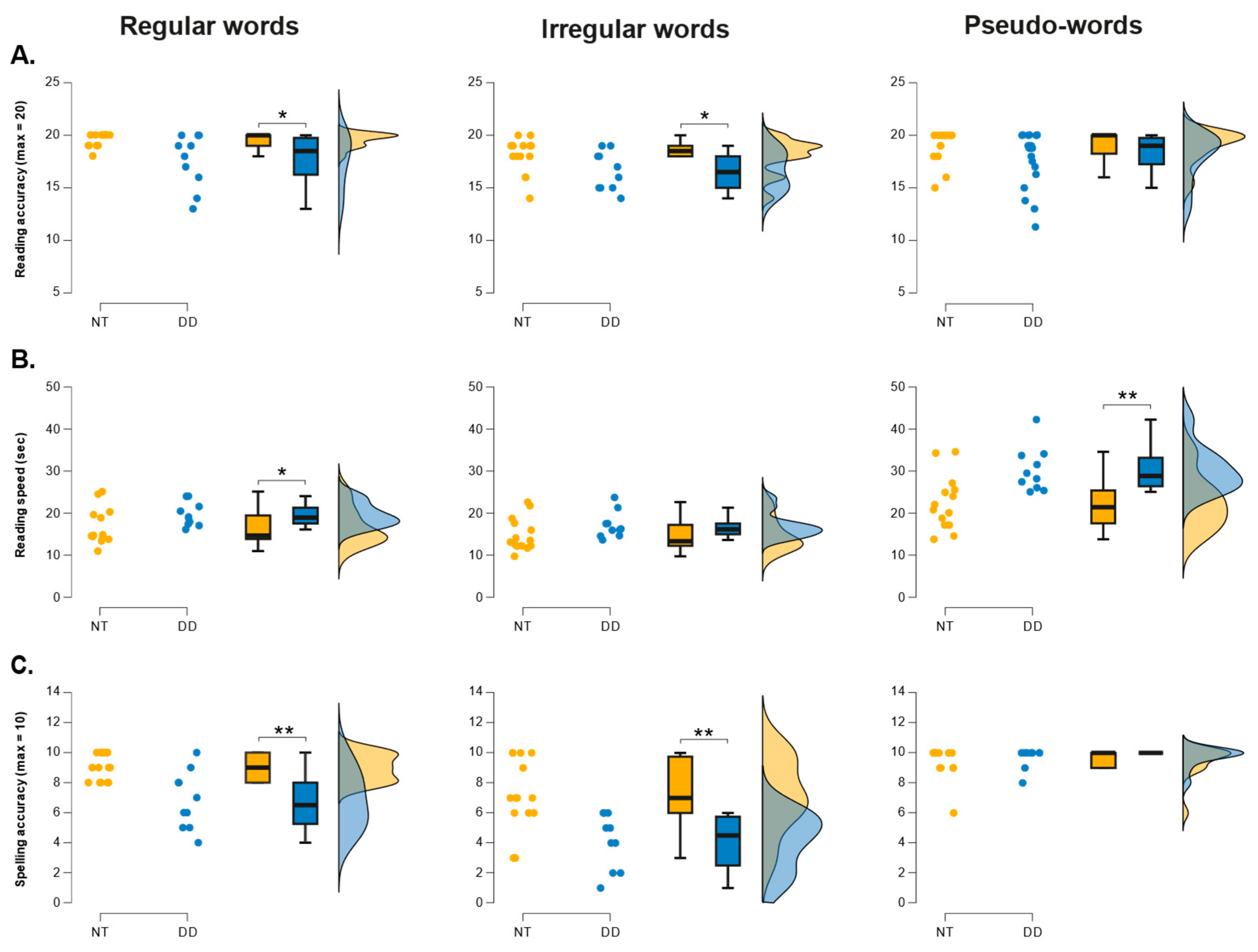
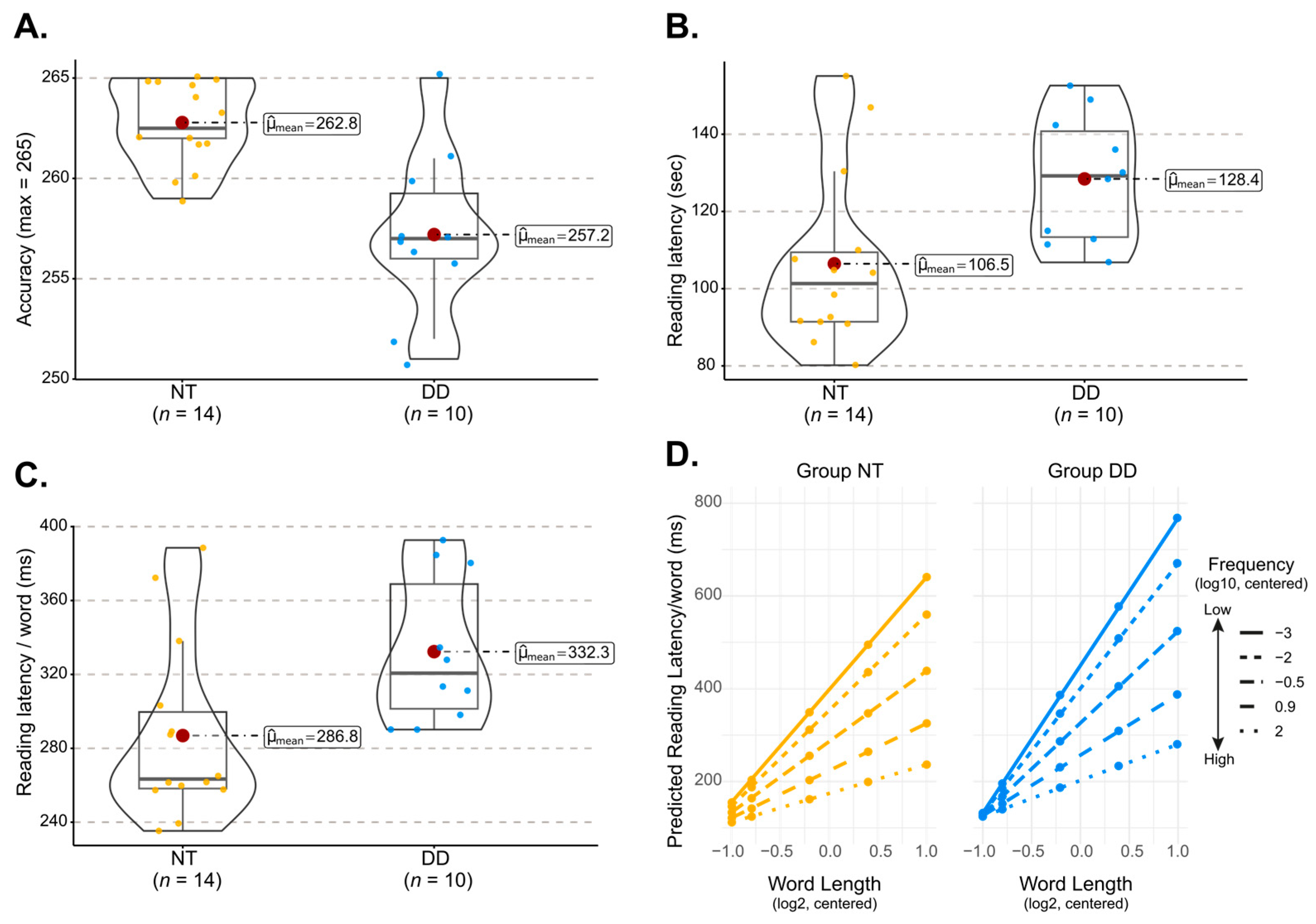
3.1. Reading Performance Measures
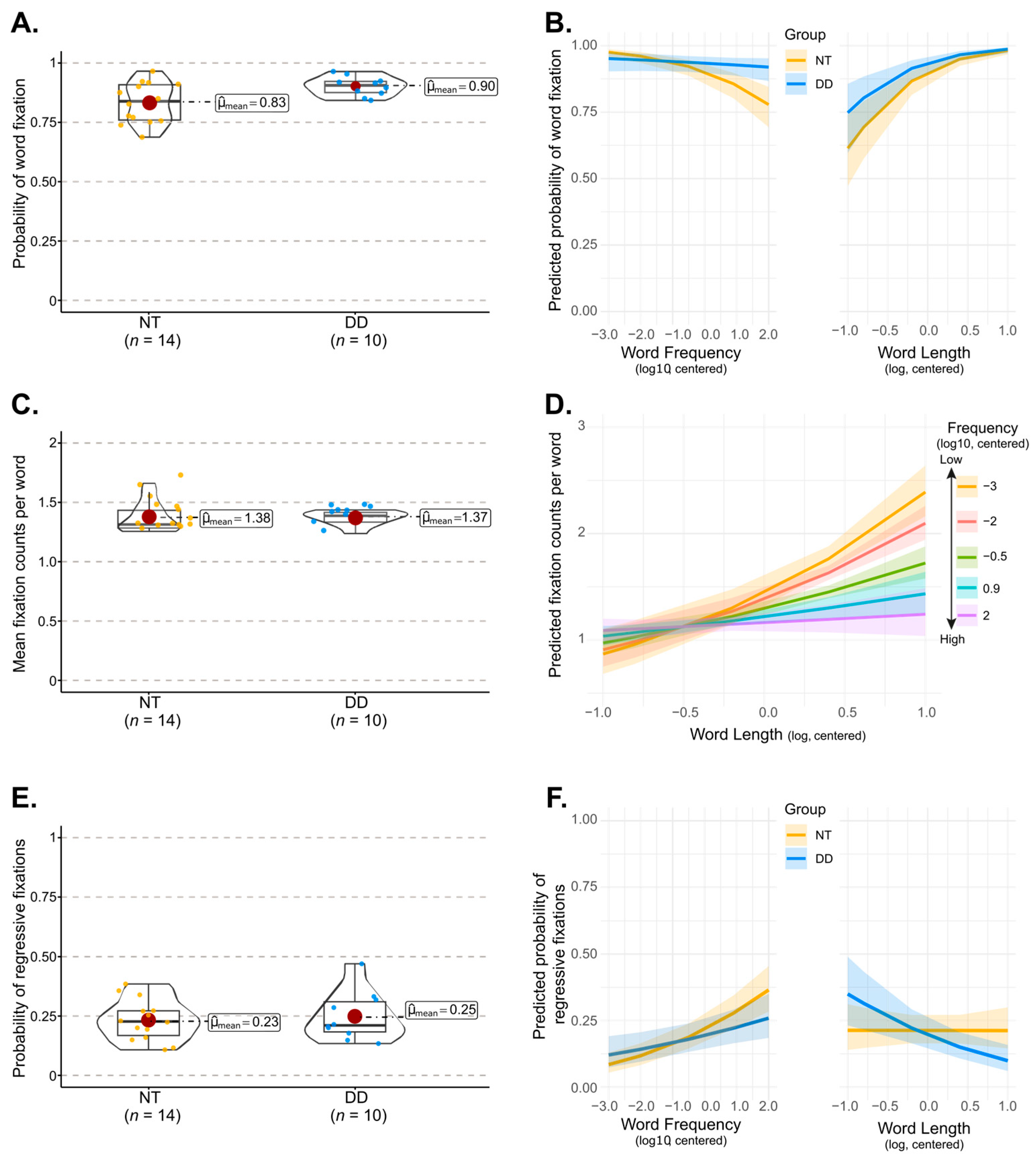
3.2. Fixation Probability Measures
3.2.1. Word Fixation Probability
3.2.2. Fixation Counts per Word
3.2.3. Probability of Regressive Fixations
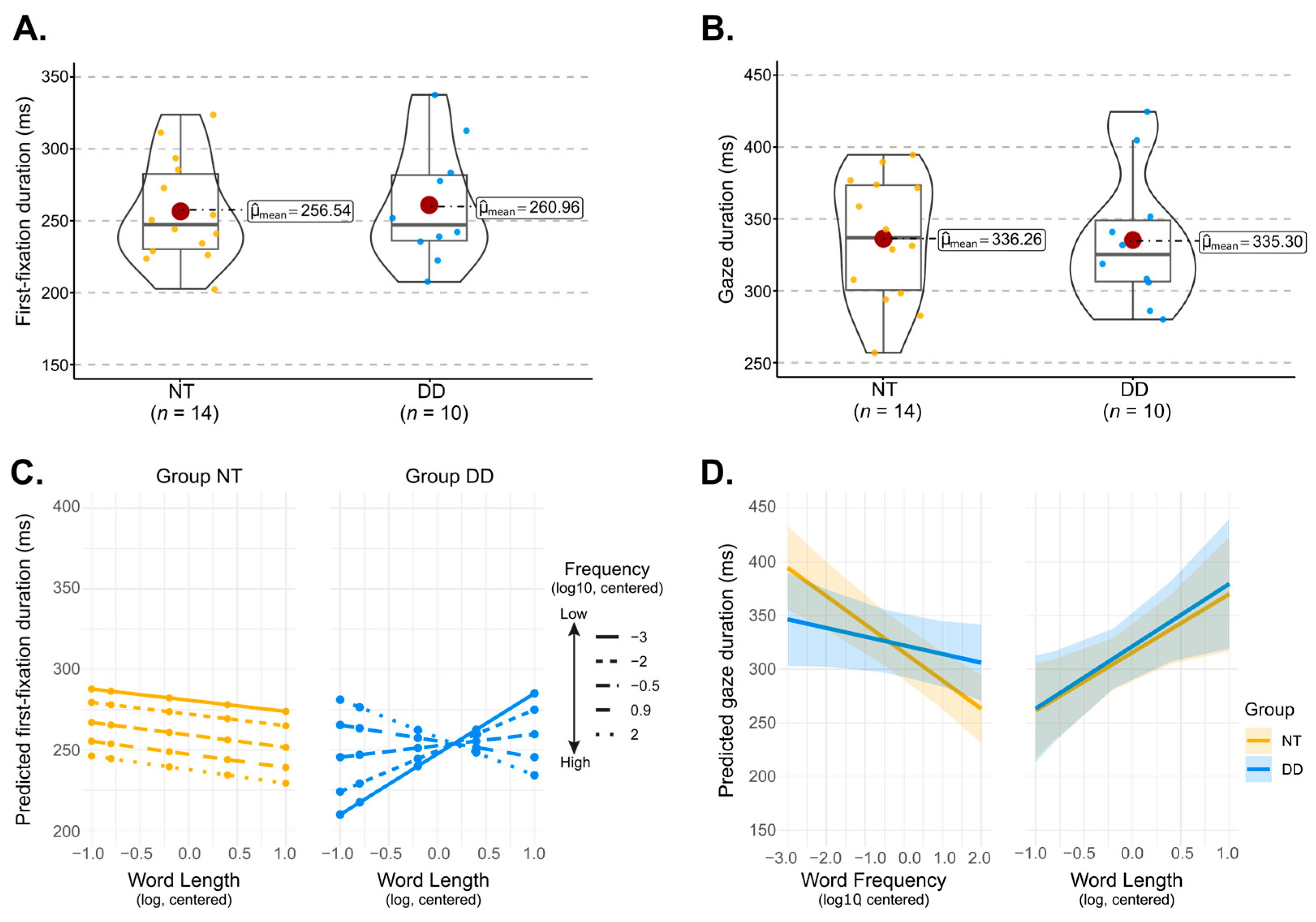
3.3. Fixation Time Measures
3.3.1. First Fixation Duration
3.3.2. Gaze Duration
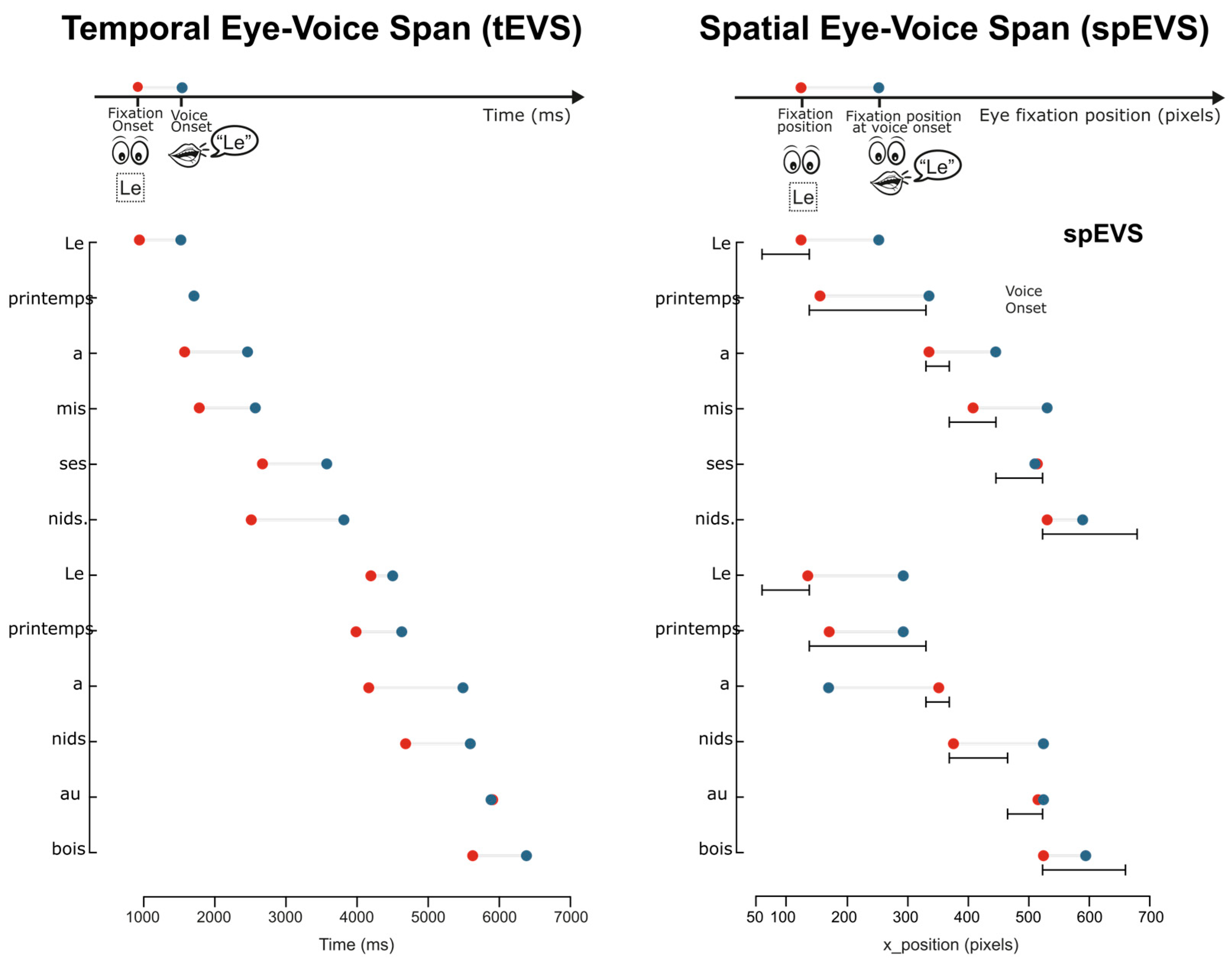
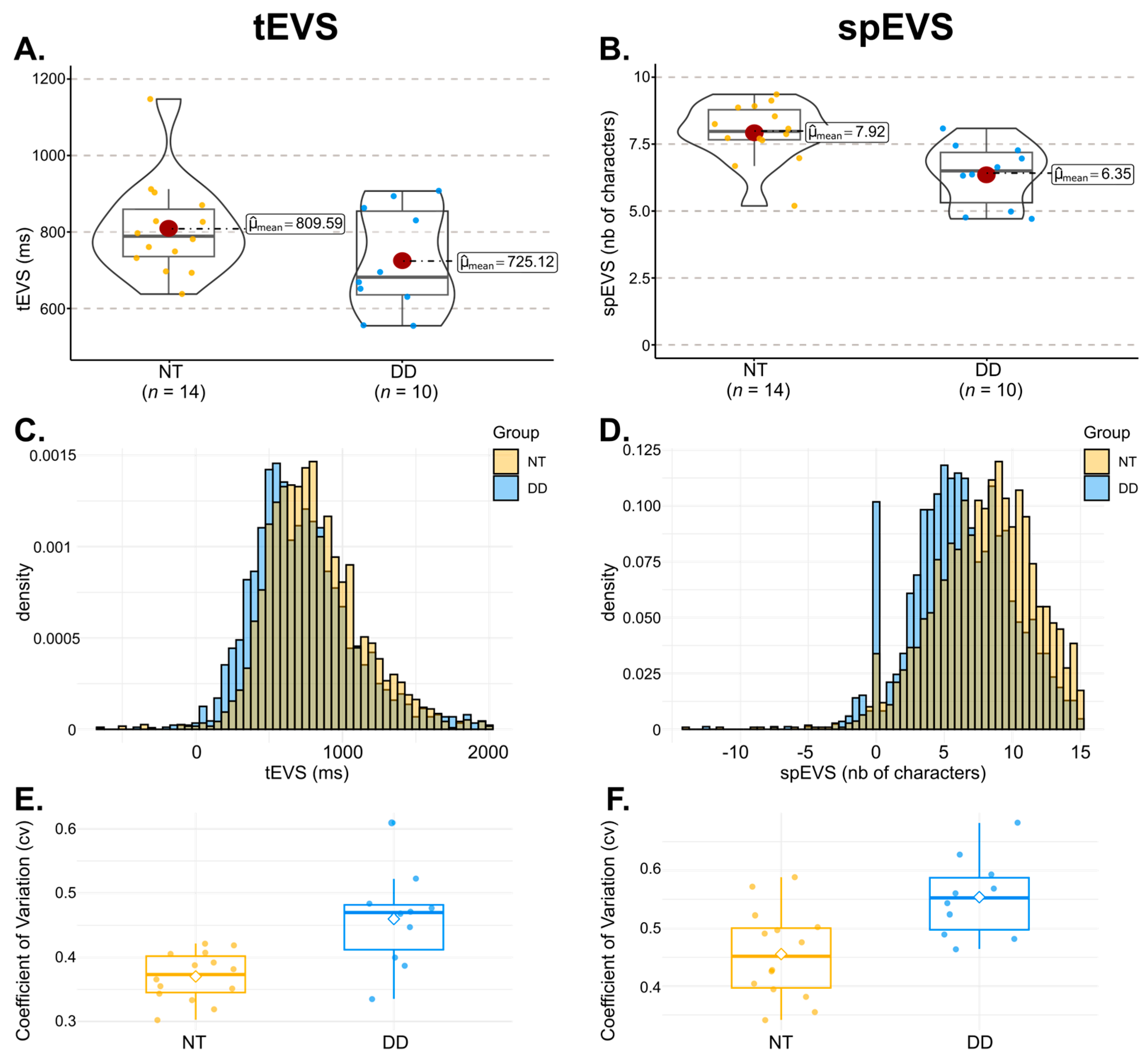
3.4. Measures of Eye and Voice Coordination
4. Discussion
4.1. Reading Performance Measures
4.2. Fixation Counts and Word Fixation Probabilities
4.3. First Fixation and Gaze Durations
4.4. Eye-Voice Span
4.5. Limits and Future Studies
5. Conclusions
Author Contributions
Funding
Institutional Review Board Statement
Informed Consent Statement
Data Availability Statement
Conflicts of Interest
Abbreviations
| GD | Gaze Duration |
| FFD | First Fixation Duration |
| tEVS | temporal Eye-Voice Span |
| spEVS | spatial Eye-Voice Span |
| LMM | Linear Mixed Model |
| GLMM | Generalized Linear Mixed Model |
| DD | Developmental Dyslexia |
| NT | Neurotypical |
Appendix A

| Predictors | Std. β Coefficient | CI (95%) | p |
|---|---|---|---|
| (Intercept) | −0.23 | −0.37–−0.09 | <0.001 |
| Group (DD) | 0.21 | 0.02–0.40 | 0.034 |
| Word Length (WL) | 0.73 | 0.53–0.93 | <0.001 |
| Word Frequency (WF) | −0.24 | −0.30–−0.19 | <0.001 |
| G × WL | 0.21 | 0.03–0.40 | 0.021 |
| G × WF | −0.03 | −0.05–−0.00 | 0.022 |
| WL × WF | 0.20 | −0.27–−0.12 | <0.001 |
| G × WL × WF | −0.06 | −0.10–−0.03 | <0.001 |
| Random Effects | |||
| σ2 | 5139.27 | ||
| τ00 (Item) | 4757.02 | ||
| τ00 (Subj) | 1820.42 | ||
| τ11 (WL|Subj) | 1451.37 | ||
| ρ01 (Subj) | 0.98 | ||
| ICC | 0.57 | ||
| Nsubj | 24 | ||
| NItem | 265 | ||
| Observations Marginal R2/Conditional R2 | 6354 0.645/0.849 |
| Predictors | Odds Ratios | CI (95%) | p |
|---|---|---|---|
| (Intercept) | 9.75 | 6.62–14.35 | <0.001 |
| Group (DD) | 1.52 | 0.83–2.80 | 0.174 |
| Word Length (WL) | 6.02 | 3.80–9.55 | <0.001 |
| Word Frequency (WF) | 0.61 | 0.53–0.70 | <0.001 |
| G × WL | 0.82 | 0.40–−1.69 | 0.595 |
| G × WF | 1.47 | 1.17–1.84 | 0.001 |
| WL × WF | 0.72 | 0.55–0.95 | 0.020 |
| G × WL × WF | 1.40 | 0.93–2.10 | 0.110 |
| Random Effects | |||
| σ2 | 3.29 | ||
| τ00 (Subj) | 0.11 | ||
| ICC | 0.42 | ||
| Nsubj | 24 | ||
| Observations Marginal R2/Conditional R2 | 4829 0.327/0.403 |
| Predictors | Incidence Rate Ratios | CI | p |
|---|---|---|---|
| (Intercept) | 1.27 | 1.21–1.33 | <0.001 |
| Group (DD) | 1.00 | 0.93–1.08 | 0.971 |
| Word Length (WL) | 1.26 | 1.10–1.43 | 0.001 |
| Word Frequency (WF) | 0.95 | 0.91–0.99 | 0.014 |
| G × WL | 1.03 | 0.85–1.25 | 0.772 |
| G × WF | 1.02 | 0.96–1.08 | 0.582 |
| WL × WF | 0.93 | 0.88–0.98 | 0.005 |
| G × WL × WF | 0.97 | 0.90–1.06 | 0.515 |
| Random Effects | |||
| σ2 | 0.55 | ||
| τ00 (Subj) | 0.00 | ||
| ICC | 0.00 | ||
| Nsubj | 24 | ||
| Observations Marginal R2/Conditional R2 | 4157 0.059/0.060 |
| Predictors | Odds Ratios | CI | p |
|---|---|---|---|
| (Intercept) | 0.28 | 0.21–0.37 | <0.001 |
| Group (DD) | 0.89 | 0.56–1.41 | 0.619 |
| Word Length (WL) | 1.00 | 0.68–1.46 | 0.984 |
| Word Frequency (WF) | 1.44 | 1.28–1.63 | <0.001 |
| G × WL | 0.45 | 0.25–0.80 | 0.006 |
| G × WF | 0.84 | 0.70–0.10 | 0.059 |
| WL × WF | 0.98 | 0.83–1.16 | 0.826 |
| G × WL × WF | 0.82 | 0.63–1.06 | 0.121 |
| Random Effects | |||
| σ2 | 3.29 | ||
| τ00 (Subj) | 0.25 | ||
| ICC | 0.07 | ||
| Nsubj | 24 | ||
| NItem | 205 | ||
| Observations Marginal R2/Conditional R2 | 4159 0.093/0.158 |
| Predictors | Std. β Coefficient | CI | p |
|---|---|---|---|
| (Intercept) | −0.02 | −0.20–0.15 | <0.001 |
| Group (DD) | −0.02 | −0.28–0.25 | 0.91 |
| Word Length (WL) | −0.03 | −0.12–0.06 | 0.47 |
| Word Frequency (WF) | −0.2 | −0.20–−0.04 | 0.005 |
| G × WL | 0.04 | −0.07–0.15 | 0.48 |
| G × WF | 0.14 | 0.04–0.24 | 0.005 |
| WL × WF | −0.002 | −0.06–0.05 | 0.94 |
| G × WL × WF | −0.08 | −0.14–−0.01 | 0.022 |
| Random Effects | |||
| σ2 | 10,601.75 | ||
| τ00 (Item) | 530.36 | ||
| τ00 (Subj) | 1236.55 | ||
| τ11 (WL|Subj) | 275.21 | ||
| ρ01 (Subj) | 0.37 | ||
| ICC | 0.15 | ||
| Nsubj | 24 | ||
| NItem | 205 | ||
| Observations Marginal R2/Conditional R2 | 4142 0.008/0.154 |
| Predictors | Std. β Coefficient | CI | p |
|---|---|---|---|
| (Intercept) | −0.10 | −0.24–0.04 | 0.16 |
| Group (DD) | 0.03 | −0.17–0.24 | 0.75 |
| Word Length (WL) | 0.14 | 0.03–0.25 | 0.014 |
| Word Frequency (WF) | −0.23 | −0.31–−0.14 | <0.001 |
| G × WL | 0.01 | −0.14–0.16 | 0.892 |
| G × WF | 0.16 | 0.06–0.25 | 0.001 |
| WL × WF | −0.09 | −0.15–−0.04 | <0.001 |
| G × WL × WF | −0.01 | −0.08–0.051 | 0.71 |
| Random Effects | |||
| σ2 | 24,702.86 | ||
| τ00 (Item) | 1861.63 | ||
| τ00 (Subj) | 1665.64 | ||
| τ11 (WL|Subj) | 2700.19 | ||
| ρ01 (Subj) | 0.43 | ||
| ICC | 0.14 | ||
| Nsubj | 24 | ||
| NItem | 205 | ||
| Observations Marginal R2/Conditional R2 | 4108 0.097/0.227 |
References
- American Psychiatric Association. (2013). Diagnostic and statistical manual of mental disorders (5th ed.). American Psychiatric Publishing. [Google Scholar]
- Barr, D. J., Levy, R., Scheepers, C., & Tily, H. J. (2013). Random effects structure for confirmatory hypothesis testing: Keep it maximal. Journal of Memory and Language, 68(3), 255–278. [Google Scholar] [CrossRef] [PubMed]
- Barrouillet, P., Billard, C., De Agostini, M., Démonet, J.-F., Fayol, M., Gombert, J.-E., Habib, M., Le Normand, M.-T., Ramus, F., & Sprenger-Charolles, L. (2007). Dyslexie, dysorthographie, dyscalculie: Bilan des données scientifiques (Institut National de la Santé et de la Recherche Médicale (INSERM), Issue Rapport de recherche). [Rapport de recherche]. Institut National de la Santé et de la Recherche Médicale (INSERM). [Google Scholar]
- Barton, J. J., Hanif, H. M., Eklinder Bjornstrom, L., & Hills, C. (2014). The word-length effect in reading: A review. Cognitive Neuropsychology, 31(5–6), 378–412. [Google Scholar] [CrossRef]
- Bates, D., Maechler, M., Bolker, B., Walker, S., Christensen, R. H. B., Singmann, H., Dai, B., Grothendieck, G., Green, P., & Bolker, M. B. (2015). Package ‘lme4’ (Version 1.1-35.4) [Computer software]. Comprehensive R Archive Network (CRAN).
- Bell, A., Brenier, J. M., Gregory, M., Girand, C., & Jurafsky, D. (2009). Predictability effects on durations of content and function words in conversational English. Journal of Memory and Language, 60(1), 92–111. [Google Scholar] [CrossRef]
- Bertoni, S., Franceschini, S., Ronconi, L., Gori, S., & Facoetti, A. (2019). Is excessive visual crowding causally linked to developmental dyslexia? Neuropsychologia, 130, 107–117. [Google Scholar] [CrossRef]
- Bosse, M. L., Tainturier, M. J., & Valdois, S. (2007). Developmental dyslexia: The visual attention span deficit hypothesis. Cognition, 104(2), 198–230. [Google Scholar] [CrossRef]
- Bouma, H., & de Voogd, A. H. (1974). On the control of eye saccades in reading. Vision Research, 14, 273–284. [Google Scholar] [CrossRef]
- Brooks, M. E., Kristensen, K., van Benthem, K. J., Magnusson, A., Berg, C. W., Nielsen, A., Skaug, H. J., Mächler, M., & Bolker, B. M. (2017). glmmTMB balances speed and flexibility among packages for zero-inflated generalized linear mixed modeling. The R Journal, 9(2), 378–400. [Google Scholar] [CrossRef]
- Bruck, M. (1990). Word-recognition skills of adults with childhood diagnoses of dyslexia. Developmental Psychology, 26(3), 439–454. [Google Scholar] [CrossRef]
- Brysbaert, M., Drieghe, D., & Vitu, F. (2005). Word skipping: Implications for theories of eye movement control in reading. In G. Underwood (Ed.), Cognitive processes in eye guidance (pp. 53–77). Oxford University Press. [Google Scholar]
- Buswell, G. T. (1922). Fundamental reading habits: A study of their development. University of Chicago. [Google Scholar]
- Carroll, J. M., Holden, C., Kirby, P., Thompson, P. A., Snowling, M. J., & Dyslexia Delphi, P. (2025). Toward a consensus on dyslexia: Findings from a Delphi study. Journal of Child Psychology and Psychiatry, 66(7), 1065–1076. [Google Scholar] [CrossRef] [PubMed]
- Cavalli, E., Casalis, S., El Ahmadi, A., Zira, M., Poracchia-George, F., & Cole, P. (2016). Vocabulary skills are well developed in university students with dyslexia: Evidence from multiple case studies. Research in Developmental Disabilities, 51–52, 89–102. [Google Scholar] [CrossRef] [PubMed]
- Cavalli, E., Cole, P., Leloup, G., Poracchia-George, F., Sprenger-Charolles, L., & El Ahmadi, A. (2018). Screening for dyslexia in french-speaking university students: An evaluation of the detection accuracy of the alouette test. Journal of Learning Disabilities, 51(3), 268–282. [Google Scholar] [CrossRef] [PubMed]
- Cavalli, E., Duncan, L. G., Elbro, C., El Ahmadi, A., & Cole, P. (2017). Phonemic-morphemic dissociation in university students with dyslexia: An index of reading compensation? Annals of Dyslexia, 67(1), 63–84. [Google Scholar] [CrossRef]
- Champagne, L., Safi, D., & Gauthier, B. (2024). Alouette-R normative data for French-speaking school-aged children living in Quebec. International Journal of Language and Communication Disorders, 59(5), 2071–2086. [Google Scholar] [CrossRef]
- Collette, E., & Schelstraete, M. A. (2016). Les étudiants dyslexiques à l’université: Profils, évaluation et prise en charge. In B. Stanké (Ed.), Les dyslexies-dysorthographies (1st ed., pp. 175–196). Presses de l’Université du Québec. [Google Scholar]
- Coltheart, M., Rastle, K., Perry, C., Langdon, R., & Ziegler, J. (2001). DRC: A dual route cascaded model of visual word recognition and reading aloud. Psychological Review, 108(1), 204–256. [Google Scholar] [CrossRef] [PubMed]
- Daniel, S. S., Walsh, A. K., Goldston, D. B., Arnold, E. M., Reboussin, B. A., & Wood, F. B. (2006). Suicidality, school dropout, and reading problems among adolescents. Journal of Learning Disabilities, 39(6), 507–514. [Google Scholar] [CrossRef]
- De Luca, M., Borrelli, M., Judica, A., Spinelli, D., & Zoccolotti, P. (2002). Reading words and pseudowords: An eye movement study of developmental dyslexia. Brain and Language, 80(3), 617–626. [Google Scholar] [CrossRef] [PubMed]
- De Luca, M., Di Pace, E., Judica, A., Spinelli, D., & Zoccolotti, P. (1999). Eye movement patterns in linguistic and non-linguistic tasks in developmental surface dyslexia. Neuropsychologia, 37(12), 1407–1420. [Google Scholar] [CrossRef]
- De Luca, M., Pontillo, M., Primativo, S., Spinelli, D., & Zoccolotti, P. (2013). The eye-voice lead during oral reading in developmental dyslexia. Frontiers in Human Neuroscience, 7, 696. [Google Scholar] [CrossRef]
- Drieghe, D., Brysbaert, M., Desmet, T., & De Baecke, C. (2004). Word skipping in reading: On the interplay of linguistic and visual factors. European Journal of Cognitive Psychology, 16(1–2), 79–103. [Google Scholar] [CrossRef]
- Drieghe, D., Desmet, T., & Brysbaert, M. (2007). How important are linguistic factors in word skipping during reading? British Journal of Psychology, 98, 157–171. [Google Scholar] [CrossRef][Green Version]
- Egan, C., Oppenheim, G. M., Saville, C., Moll, K., & Jones, M. W. (2019). Bilinguals apply language-specific grain sizes during sentence reading. Cognition, 193, 104018. [Google Scholar] [CrossRef]
- Fairbanks, G. (1937). The relation between eye-movements and voice in the oral reading of good and poor silent readers. Psychological Monographs, 48(3), 78–107. [Google Scholar] [CrossRef]
- Franzen, L., Stark, Z., & Johnson, A. P. (2021). Individuals with dyslexia use a different visual sampling strategy to read text. Scientific Reports, 11(1), 6449. [Google Scholar] [CrossRef] [PubMed]
- Gerth, S., & Festman, J. (2021). Reading development, word length and frequency effects: An eye-tracking study with slow and fast readers. Frontiers in Communication, 6, 743113. [Google Scholar] [CrossRef]
- Gilger, J. W., Pennington, B. F., & DeFries, J. C. (1992). A twin study of the etiology of comorbidity: Attention-deficit hyperactivity disorder and dyslexia. Journal of the American Academy of Child and Adolescent Psychiatry, 31(2), 343–348. [Google Scholar] [CrossRef]
- Giraud, A. L., & Ramus, F. (2013). Neurogenetics and auditory processing in developmental dyslexia. Current Opinion in Neurobiology, 23(1), 37–42. [Google Scholar] [CrossRef] [PubMed]
- Godde, E., Bosse, M., & Bailly, G. (2020). A review of reading prosody acquisition and development. Reading and Writing, 33, 399–426. [Google Scholar] [CrossRef]
- Gola-Asmussen, C., Lequette, C., Pouget, G., Rouyer, C., & Zorman, M. (2011). Alouette-R: Test d’analyse de la lecture et de la dyslexie. CogniSciences. [Google Scholar]
- Gordon, P. C., & Hoedemaker, R. S. (2016). Effective scheduling of looking and talking during rapid automatized naming. Journal of Experimental Psychology: Human Perception and Performance, 42(5), 742–760. [Google Scholar] [CrossRef]
- Goswami, U. (2002). Phonology, reading development, and dyslexia: A cross-linguistic perspective. Annals of Dyslexia, 52, 141–163. [Google Scholar] [CrossRef]
- Goswami, U. (2011). A temporal sampling framework for developmental dyslexia. Trends in Cognitive Sciences, 15(1), 3–10. [Google Scholar] [CrossRef]
- Hancock, R., Pugh, K. R., & Hoeft, F. (2017). Neural noise hypothesis of developmental dyslexia. Trends in Cognitive Sciences, 21(6), 434–448. [Google Scholar] [CrossRef]
- Hatzidaki, A., Gianneli, M., Petrakis, E., Makaronas, N., & Aslanides, I. M. (2011). Reading and visual processing in greek dyslexic children: An eye-movement study. Dyslexia, 17(1), 85–104. [Google Scholar] [CrossRef]
- Hautala, J., Hyönä, J., & Aro, M. (2011). Dissociating spatial and letter-based word length effects observed in readers’ eye movement patterns. Vision Research, 51(15), 1719–1727. [Google Scholar] [CrossRef][Green Version]
- Hawelka, S., Gagl, B., & Wimmer, H. (2010). A dual-route perspective on eye movements of dyslexic readers. Cognition, 115(3), 367–379. [Google Scholar] [CrossRef]
- Hawelka, S., & Wimmer, H. (2005). Impaired visual processing of multi-element arrays is associated with increased number of eye movements in dyslexic reading. Vision Research, 45(7), 855–863. [Google Scholar] [CrossRef] [PubMed]
- Hedges, L. V., & Olkin, I. (1985). Statistical methods for meta-analysis. Academic Press. [Google Scholar]
- Hendriks, A. W., & Kolk, H. H. J. (1997). Strategic control in developmental dyslexia. Cognitive Neuropsychology, 14(3), 321–366. [Google Scholar] [CrossRef]
- Horn, L., Berktold, J., & Statistics, N. C. f. E. (1999). Students with disabilities in postsecondary education: A profile of preparation, participation, and outcomes. U.S. Dept. of Education, Office of Educational Research and Improvement. [Google Scholar]
- Hulme, C., & Snowling, M. J. (1994). Reading development and dyslexia. Whurr Publishers. [Google Scholar]
- Humphrey, N., & Mullins, P. M. (2002). Self-concept and self-esteem in developmental dyslexia. Journal of Research in Special Educational Needs, 2(2), 1–13. [Google Scholar] [CrossRef]
- Hutzler, F., & Wimmer, H. (2004). Eye movements of dyslexic children when reading in a regular orthography. Brain and Language, 89(1), 235–242. [Google Scholar] [CrossRef] [PubMed]
- Hyönä, J., & Olson, R. K. (1995). Eye fixation patterns among dyslexic and normal readers—Effects of word-length and word-frequency. Journal of Experimental Psychology: Learning Memory and Cognition, 21(6), 1430–1440. [Google Scholar] [CrossRef]
- Inhoff, A. W., & Rayner, K. (1986). Parafoveal word-processing during eye fixations in reading—Effects of word-frequency. Perception and Psychophysics, 40(6), 431–439. [Google Scholar] [CrossRef] [PubMed]
- Inhoff, A. W., Solomon, M., Radach, R., & Seymour, B. A. (2011). Temporal dynamics of the eye-voice span and eye movement control during oral reading. Journal of Cognitive Psychology, 23(5), 543–558. [Google Scholar] [CrossRef]
- Jensen, O., Pan, Y., Frisson, S., & Wang, L. (2021). An oscillatory pipelining mechanism supporting previewing during visual exploration and reading. Trends in Cognitive Sciences, 25(12), 1033–1044. [Google Scholar] [CrossRef]
- Jobard, G., Crivello, F., & Tzourio-Mazoyer, N. (2003). Evaluation of the dual route theory of reading: A metanalysis of 35 neuroimaging studies. Neuroimage, 20(2), 693–712. [Google Scholar] [CrossRef] [PubMed]
- Juhasz, B. J., & Rayner, K. (2003). Investigating the effects of a set of intercorrelated variables on eye fixation durations in reading. Journal of Experimental Psychology: Learning Memory and Cognition, 29(6), 1312–1318. [Google Scholar] [CrossRef]
- Kemper, S., Crow, A., & Kemtes, K. (2004). Eye-fixation patterns of high- and low-span young and older adults: Down the garden path and back again. Psychology and Aging, 19(1), 157–170. [Google Scholar] [CrossRef] [PubMed]
- Kennedy, A. (2000). Parafoveal processing in word recognition. Quarterly Journal of Experimental Psychology Section A: Human Experimental Psychology, 53(2), 429–455. [Google Scholar] [CrossRef]
- Kim, Y. S., Wagner, R. K., & Foster, E. (2011). Relations among oral reading fluency, silent reading fluency, and reading comprehension: A latent variable study of first-grade readers. Scientific Studies of Reading, 15(4), 338–362. [Google Scholar] [CrossRef] [PubMed]
- Kliegl, R., Nuthmann, A., & Engbert, R. (2006). Tracking the mind during reading: The influence of past, present, and future words on fixation durations. Journal of Experimental Psychology: General, 135(1), 12–35. [Google Scholar] [CrossRef]
- Krieber, M., Bartl-Pokorny, K. D., Pokorny, F. B., Zhang, D., Landerl, K., Körner, C., Pernkopf, F., Pock, T., Einspieler, C., & Marschik, P. B. (2017). Eye movements during silent and oral reading in a regular orthography: Basic characteristics and correlations with childhood cognitive abilities and adolescent reading skills. PLoS ONE, 12(2), e0170986. [Google Scholar] [CrossRef]
- Kuhn, M. R., Schwanenflugel, P. J., Morris, R. D., Morrow, L. M., Woo, D. G., Meisinger, E. B., Sevcik, R. A., Bradley, B. A., & Stahl, S. A. (2006). Teaching children to become fluent and automatic readers. Journal of Literacy Research, 38(4), 357–387. [Google Scholar] [CrossRef]
- Kuperman, V., & Bresnan, J. (2012). The effects of construction probability on word durations during spontaneous incremental sentence production. Journal of Memory and Language, 66(4), 588–611. [Google Scholar] [CrossRef]
- Laubrock, J., & Kliegl, R. (2015). The eye-voice span during reading aloud. Frontiers in Psychology, 6, 1432. [Google Scholar] [CrossRef]
- Law, J. M., Wouters, J., & Ghesquière, P. (2015). Morphological awareness and its role in compensation in adults with dyslexia. Dyslexia, 21(3), 254–272. [Google Scholar] [CrossRef]
- Lefavrais, P. (2005). Alouette-R: Test d’analyse de la lecture et de la dyslexie. Les Éditions du Centre de Psychologie Appliquée. [Google Scholar]
- Lefebvre, P., & Stanké, B. (2016). Les dyslexies-dysorthographies développementales. In B. Stanké (Ed.), Les dyslexies-dysorthographies (1st ed., pp. 47–68). Presses de l’Université du Québec. [Google Scholar]
- Lefèvre, E., Law, J. M., Quémart, P., Anders, R., & Cavalli, E. (2023). What’s morphology got to do with it: Oral reading fluency in adolescents with dyslexia. Journal of Experimental Psychology-Learning Memory and Cognition, 49(8), 1345–1360. [Google Scholar] [CrossRef]
- Lenth, R. V., Buerkner, P., Herve, M., Love, J., Riebl, H., & Singmann, H. (2021). emmeans: Estimated marginal means, aka least-squares means (version 1.7.0) [Computer Software]. Available online: https://CRAN.R-project.org/package=emmeans (accessed on 2 December 2025).
- Levin, H., & Kaplan, E. L. (1970). Grammatical structure and reading. In H. Levin, & J. P. William (Eds.), Basic studies on reading (pp. 119–133). Basic Books. [Google Scholar]
- Luke, S. G., Tolley, C., Gutierrez, A., Smith, C., Brown, T., Woodruff, K., & Ford, O. (2024). The perceptual span in dyslexic reading and visual search. Dyslexia, 30(4), e1783. [Google Scholar] [CrossRef] [PubMed]
- Lüdecke, D. (2021). sjPlot: Data visualization for statistics in social science. R Package Version, 2(7), 1–106. [Google Scholar]
- Lüdecke, D., Aust, F., Crawley, S., & Ben-Shachar, M. S. (2018). ggeffects: Create tidy data frames of marginal effects for ‘ggplot’from model outputs. R Package Version 0.3, 3(11), 10-21105. [Google Scholar]
- Lyon, G. R., Shaywitz, S. E., & Shaywitz, B. A. (2003). A definition of dyslexia. Annals of Dyslexia, 53, 1–14. [Google Scholar] [CrossRef]
- Maughan, B., Rutter, M., & Yule, W. (2020). The Isle of wight studies: The scope and scale of reading difficulties. Oxford Review of Education, 46(4), 429–438. [Google Scholar] [CrossRef]
- McAuliffe, M., Socolof, M., Mihuc, S., Wagner, M., & Sonderegger, M. (2017, August 20–24). Montreal forced aligner: Trainable text-speech alignment using Kaldi. 18th Annual Conference of the International Speech Communication Association (Interspeech 2017) (Vols. 1–6, pp. 498–502), Stockholm, Sweden. [Google Scholar] [CrossRef]
- Meixner, J. M., Nixon, J. S., & Laubrock, J. (2022). The perceptual span is dynamically adjusted in response to foveal load by beginning readers. Journal of Experimental Psychology: General, 151(6), 1219–1232. [Google Scholar] [CrossRef]
- Meteyard, L., & Davies, R. A. (2020). Best practice guidance for linear mixed-effects models in psychological science. Journal of Memory and Language, 112, 104092. [Google Scholar] [CrossRef]
- Miles, W. R. (1930). Ocular dominance in human adults. The Journal of General Psychology, 3(3), 412–430. [Google Scholar] [CrossRef]
- Nerusil, B., Polec, J., Skunda, J., & Kacur, J. (2021). Eye tracking based dyslexia detection using a holistic approach. Scientific Reports, 11(1), 15687. [Google Scholar] [CrossRef]
- New, B., Pallier, C., Brysbaert, M., & Ferrand, L. (2004). Lexique 2: A new french lexical database. Behavior Research Methods, 36(3), 516–524. [Google Scholar]
- Olson, R. K., Conners, F. A., & Rack, J. P. (1991). Eye movements in dyslexic and normal readers. In J. F. Stein (Ed.), Vision and visual dyslexia (pp. 243–250). Macmillan. [Google Scholar]
- Pech-Georgel, C., & George, F. (2011). Evalad. Solal. [Google Scholar]
- Peterson, R. L., & Pennington, B. F. (2015). Developmental dyslexia. Annual Review of Clinical Psychology, 11, 283–307. [Google Scholar] [CrossRef]
- Plaza, M., Robert-Jahier, A.-M., Gatignol, P., & Oudry, M. (2008). Phonolec adolescents adultes. Adéprio. [Google Scholar]
- Posit Team. (2024). RStudio: Integrated Development Environment for R. (Version 2024.4.2.764) [Computer Software]. Posit Software.
- Premeti, A., Isel, F., & Bucci, M. P. (2025). Eye movements of french dyslexic adults while reading texts: Evidence of word length, lexical frequency, consistency and grammatical category. Brain Sciences, 15(7), 693. [Google Scholar] [CrossRef]
- Price, C. J. (2012). A review and synthesis of the first 20 years of PET and fMRI studies of heard speech, spoken language and reading. Neuroimage, 62(2), 816–847. [Google Scholar] [CrossRef]
- Ramus, F. (2004). Neurobiology of dyslexia: A reinterpretation of the data. Trends in Neurosciences, 27(12), 720–726. [Google Scholar] [CrossRef] [PubMed]
- Rau, A. K., Moeller, K., & Landerl, K. (2014). The transition from sublexical to lexical processing in a consistent orthography: An eye-tracking study. Scientific Studies of Reading, 18(3), 224–233. [Google Scholar] [CrossRef]
- Rayner, K. (1998). Eye movements in reading and information processing: 20 years of research. Psychological Bulletin, 124(3), 372–422. [Google Scholar] [CrossRef] [PubMed]
- Rayner, K. (2009). Eye movements in reading: Models and data. Journal of Eye Movement Research, 2(5), 1. [Google Scholar] [CrossRef]
- Rayner, K., & McConkie, G. W. (1976). What guides a reader’s eye movements? Vision Research, 16(8), 829–837. [Google Scholar] [CrossRef]
- Rayner, K., Murphy, L. A., Henderson, J. M., & Pollatsek, A. (1989). Selective attentional dyslexia. Cognitive Neuropsychology, 6(4), 357–378. [Google Scholar] [CrossRef]
- Rayner, K., Pollatsek, A., Ashby, J., & Clifton, C. (2012). The psychology of reading. Psychology Press. [Google Scholar]
- Rayner, K., Reichle, E. D., Stroud, M. J., Williams, C. C., & Pollatsek, A. (2006). The effect of word frequency, word predictability, and font difficulty on the eye movements of young and older readers. Psychology and Aging, 21(3), 448–465. [Google Scholar] [CrossRef]
- Rayner, K., Sereno, S. C., & Raney, G. E. (1996). Eye movement control in reading: A comparison of two types of models. Journal of Experimental Psychology: Human Perception and Performance, 22(5), 1188–1200. [Google Scholar] [CrossRef]
- Razuk, M., Barela, J. A., Peyre, H., Gerard, C. L., & Bucci, M. P. (2018). Eye movements and postural control in dyslexic children performing different visual tasks. PLoS ONE, 13(5), e0198001. [Google Scholar] [CrossRef] [PubMed]
- R Core Team. (2024). R: A language and environment for statistical computing. R Foundation for Statistical Computing. Available online: https://www.R-project.org (accessed on 2 December 2025).
- Reis, A., Araújo, S., Morais, I. S., & Faísca, L. (2020). Reading and reading-related skills in adults with dyslexia from different orthographic systems: A review and meta-analysis. Annals of Dyslexia, 70(3), 339–368. [Google Scholar] [CrossRef] [PubMed]
- Schimmel, N., & Ness, M. (2017). The effects of oral and silent reading on reading comprehension. Reading Psychology, 38(4), 390–416. [Google Scholar] [CrossRef]
- Seymour, P. H. K., Aro, M., Erskine, J. M., & Collaboration with COST Action A8 Network. (2003). Foundation literacy acquisition in European orthographies. British Journal of Psychology, 94, 143–174. [Google Scholar] [CrossRef]
- Share, D. L. (2008). On the anglocentricities of current reading research and practice: The perils of overreliance on an “Outlier” orthography. Psychological Bulletin, 134(4), 584–615. [Google Scholar] [CrossRef]
- Snowling, M. J., & Melby-Lervag, M. (2016). Oral language deficits in familial dyslexia: A meta-analysis and review. Psychological Bulletin, 142(5), 498–545. [Google Scholar] [CrossRef]
- Stanovich, K. E. (1988). Children’s reading and the development of phonological awareness. Wayne State University Press. [Google Scholar]
- Stein, J., & Walsh, V. (1997). To see but not to read; the magnocellular theory of dyslexia. Trends in Neurosciences, 20(4), 147–152. [Google Scholar] [CrossRef]
- Svaricek, R., Dostalova, N., Sedmidubsky, J., & Cernek, A. (2025). INSIGHT: Combining fixation visualisations and residual neural networks for dyslexia classification from eye-tracking data. Dyslexia, 31(1), e1801. [Google Scholar] [CrossRef]
- Trenta, M., Benassi, M., Di Filippo, G., Pontillo, M., & Zoccolotti, P. (2013). Developmental dyslexia in a regular orthography: Can the reading profile be reduced to strategic control? Cognitive Neuropsychology, 30(3), 147–171. [Google Scholar] [CrossRef] [PubMed]
- Vellutino, F. R., Fletcher, J. M., Snowling, M. J., & Scanlon, D. M. (2004). Specific reading disability (dyslexia): What have we learned in the past four decades? Journal of Child Psychology and Psychiatry, 45(1), 2–40. [Google Scholar] [CrossRef]
- Vergilino-Perez, D., Collins, T., & Doré-Mazars, K. (2004). Decision and metrics of refixations in reading isolated words. Vision Research, 44(17), 2009–2017. [Google Scholar] [CrossRef]
- Vitu, F., Oregan, J. K., & Mittau, M. (1990). Optimal landing position in reading isolated words and continuous text. Perception and Psychophysics, 47(6), 583–600. [Google Scholar] [CrossRef] [PubMed]
- Vorstius, C., Radach, R., & Lonigan, C. J. (2014). Eye movements in developing readers: A comparison of silent and oral sentence reading. Visual Cognition, 22(3–4), 458–485. [Google Scholar] [CrossRef]
- Wagner, R. K., Zirps, F. A., Edwards, A. A., Wood, S. G., Joyner, R. E., Becker, B. J., Liu, G., & Beal, B. (2020). The prevalence of dyslexia: A new approach to its estimation. Journal of Learning Disabilities, 53(5), 354–365. [Google Scholar] [CrossRef]
- Ward, L. M., & Kapoula, Z. (2021). Dyslexics’ fragile oculomotor control is further destabilized by increased text difficulty. Brain Sciences, 11(8), 990. [Google Scholar] [CrossRef] [PubMed]
- Yan, M., Zhou, W., Shu, H., Yusupu, R., Miao, D. X., Krügel, A., & Kliegl, R. (2014). Eye movements guided by morphological structure: Evidence from the Uighur language. Cognition, 132(2), 181–215. [Google Scholar] [CrossRef] [PubMed]
- Yap, M. J., Balota, D. A., Sibley, D. E., & Ratcliff, R. (2012). Individual differences in visual word recognition: Insights from the english lexicon project. Journal of Experimental Psychology: Human Perception and Performance, 38(1), 53–79. [Google Scholar] [CrossRef]
- Ziaka, L., & Protopapas, A. (2025). Dynamic adjustment of the eye-voice span and articulation duration in the course of multi-item naming tasks: Evidence for lockout scheduling. Journal of Experimental Psychology: Learning Memory and Cognition. Advance online publication. [Google Scholar] [CrossRef]
- Ziegler, J. C., & Goswami, U. (2005). Reading acquisition, developmental dyslexia, and skilled reading across languages: A psycholinguistic grain size theory. Psychological Bulletin, 131(1), 3–29. [Google Scholar] [CrossRef] [PubMed]
- Zoccolotti, P., De Luca, M., Di Filippo, G., Judica, A., & Martelli, M. (2009). Reading development in an orthographically regular language: Effects of length, frequency, lexicality and global processing ability. Reading and Writing, 22(9), 1053–1079. [Google Scholar] [CrossRef]
- Zoccolotti, P., De Luca, M., Di Pace, E., Gasperini, F., Judica, A., & Spinelli, D. (2005). Word length effect in early reading and in developmental dyslexia. Brain and Language, 93(3), 369–373. [Google Scholar] [CrossRef]
- Zoccolotti, P., De Luca, M., Di Pace, E., Judica, A., & Orlandi, M. (1999). Markers of developmental surface dyslexia in a language (Italian) with high grapheme-phoneme correspondence. Applied Psycholinguistics, 20(2), 191–216. [Google Scholar] [CrossRef]
- Zorzi, M. (2010). The connectionist dual process (CDP) approach to modelling reading aloud. European Journal of Cognitive Psychology, 22(5), 836–860. [Google Scholar] [CrossRef]


Disclaimer/Publisher’s Note: The statements, opinions and data contained in all publications are solely those of the individual author(s) and contributor(s) and not of MDPI and/or the editor(s). MDPI and/or the editor(s) disclaim responsibility for any injury to people or property resulting from any ideas, methods, instructions or products referred to in the content. |
© 2025 by the authors. Licensee MDPI, Basel, Switzerland. This article is an open access article distributed under the terms and conditions of the Creative Commons Attribution (CC BY) license.
Share and Cite
Rossier-Bisaillon, A.; Robidoux, J.; Stanké, B.; Jemel, B. An In-Depth Investigation of Eye Movement Profile of Dyslexic Readers Using a Standardized Text-Reading Aloud Task in French. Behav. Sci. 2026, 16, 18. https://doi.org/10.3390/bs16010018
Rossier-Bisaillon A, Robidoux J, Stanké B, Jemel B. An In-Depth Investigation of Eye Movement Profile of Dyslexic Readers Using a Standardized Text-Reading Aloud Task in French. Behavioral Sciences. 2026; 16(1):18. https://doi.org/10.3390/bs16010018
Chicago/Turabian StyleRossier-Bisaillon, Antonin, Julie Robidoux, Brigitte Stanké, and Boutheina Jemel. 2026. "An In-Depth Investigation of Eye Movement Profile of Dyslexic Readers Using a Standardized Text-Reading Aloud Task in French" Behavioral Sciences 16, no. 1: 18. https://doi.org/10.3390/bs16010018
APA StyleRossier-Bisaillon, A., Robidoux, J., Stanké, B., & Jemel, B. (2026). An In-Depth Investigation of Eye Movement Profile of Dyslexic Readers Using a Standardized Text-Reading Aloud Task in French. Behavioral Sciences, 16(1), 18. https://doi.org/10.3390/bs16010018