


The Influence of Dark Triad Traits on Non-Suicidal Self-Injury Among Left-Behind Adolescents: A Moderated Mediation Model

Abstract
1. Introduction
2. Materials and Methods
2.1. Participants
2.2. Materials
2.2.1. The Dirty Dozen Dark Triad Measure
2.2.2. The Adolescent Self—Rating Life Events Checklist
2.2.3. Center for Epidemiologic Studies Depression Scale
2.2.4. Adolescent Self-Injury Scale
2.3. Research Procedures and Data Analysis
3. Results
3.1. Common Method Bias Test
3.2. Descriptive Statistics and Correlation Analysis
3.3. Comparison of Scale Scores Between Male and Female Adolescents with Left-Behind Experience
3.4. The Relationship Between the Dark Triad Traits and Non-Suicidal Self-Injury: Testing the Mediating Role of Negative Life Events
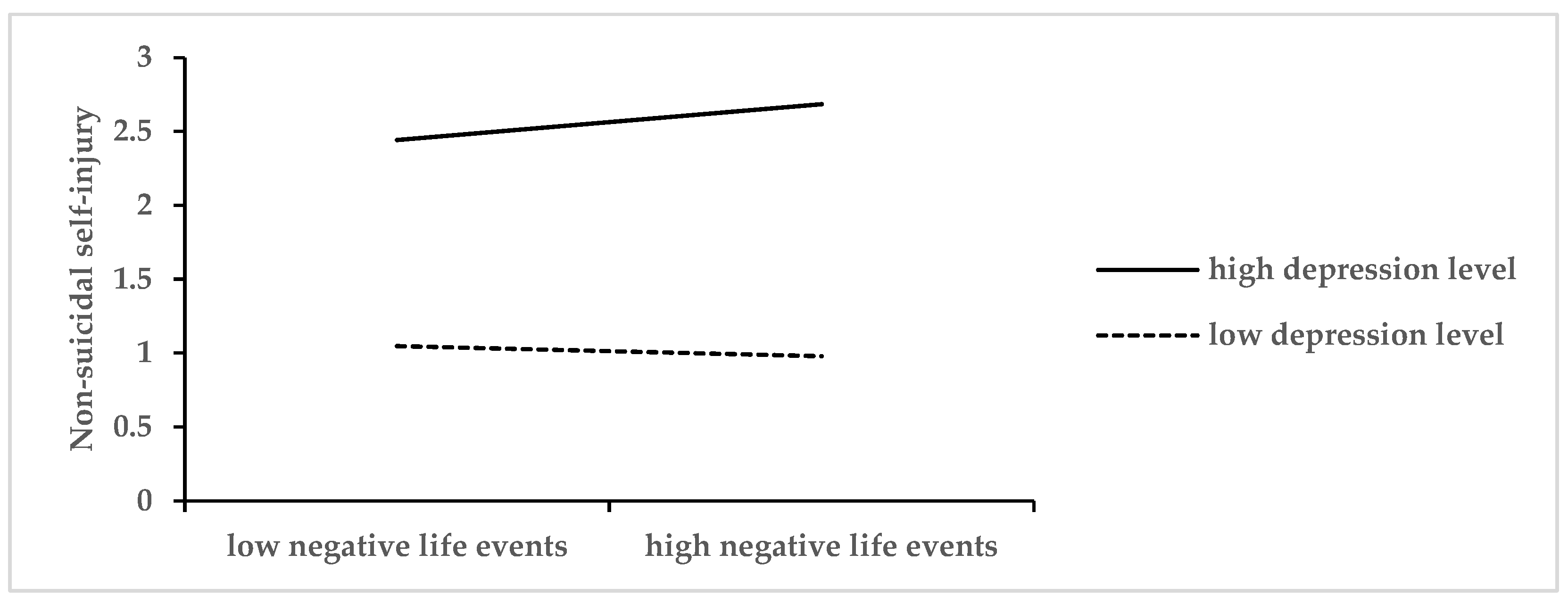
3.5. The Relationship Between the Dark Triad Traits and Non-Suicidal Self-Injury: A Moderated Mediation Model
4. Discussion
5. Conclusions
Author Contributions
Funding
Institutional Review Board Statement
Informed Consent Statement
Data Availability Statement
Acknowledgments
Conflicts of Interest
References
- Beck, A. T. (1979). Cognitive therapy and the emotional disorders. Penguin. [Google Scholar]
- Bertl, B., Pietschnig, J., Tran, U. S., Stieger, S., & Voracek, M. (2017). More or less than the sum of its parts? Mapping the dark triad of personality onto a single dark core. Personality and Individual Differences, 114, 140–144. [Google Scholar] [CrossRef] [Scilit]
- Bonfá-Araujo, B., Lima-Costa, A. R., Baptista, M. N., & Hauck-Filho, N. (2023). Depressed or satisfied? The relationship between the dark triad traits, depression, and life satisfaction. Current Psychology, 42(5), 3520–3527. [Google Scholar] [CrossRef] [Scilit]
- Brown, R. C., & Plener, P. L. (2017). Non-suicidal self-injury in adolescence. Current Psychiatry Reports, 19(3), 20. [Google Scholar] [CrossRef] [Scilit]
- Fan, X. H., Fang, X. Y., & Huang, Y. S. (2018). The influence mechanism of parental care on depression among left-behind rural children in China: A longitudinal study. Acta Psychologica Sinica, 50(9), 1029–1040. [Google Scholar] [CrossRef] [Scilit]
- Fan, X. H., Fang, X. Y., Zhao, X., & Chen, F. J. (2023). Cumulative risk of negative family circumstances and social adjustment in left-behind children: The mediating role of stress and the moderating role of psychosocial resources. Acta Psychologica Sinica, 55(8), 1270–1284. [Google Scholar] [CrossRef] [Scilit]
- Feng, Y. (2008). The relationship between adolescent self-harm behaviors and individual emotional factors/family environmental factors [Master’s thesis, Central China Normal University]. [Google Scholar]
- Fischer, A. H., Kret, M. E., & Broekens, J. (2018). Gender differences in emotion perception and self-reported emotional intelligence: A test of the emotion sensitivity hypothesis. PLoS ONE, 13(1), e0190712. [Google Scholar] [CrossRef] [Scilit]
- Gao, Y. Y., Wang, R., Ren, R. J., Wang, L., Li, N., Zhao, T. Y., Lu, W. T., Huang, F. F., Liu, B. F., Jiao, Y. M., Zhang, C. M., Zhao, X. C., Wang, J. C., & Wang, X. Y. (2024). Impact of negative life events and psychological resilience on suicide behavior in adolescents with depressive disorder. Journal of Neuroscience and Mental Health, 24(9), 629–634. [Google Scholar]
- Geng, Y. G., Sun, Q. B., & Huang, J. Y. (2015). Dirty dozen and short dark triad: A Chinese validation of two brief measures of the dark triad. Chinese Journal of Clinical Psychology, 23(2), 246–250. [Google Scholar]
- Han, L., Yuan, J. W., & Long, Y. (2021). Will moss bloom like peonies? The relationship between negative life events and mental health of left-behind children. Psychological Development and Education, 37(2), 266–274. [Google Scholar]
- He, J., Chen, Z., Shen, Y., Tian, Y., Li, Y., & Ou, J. (2025). The mediating roles of stressful life events and negative affect in the relationship between childhood maltreatment and non-suicidal self-injury among clinical adolescents. European Journal of Psychotraumatology, 16(1), 2542045. [Google Scholar] [CrossRef] [Scilit]
- Huang, Q., Hou, J. Q., & Chen, Z. Y. (2024). A study on exploring factors related to peer victimization from a home-school cooperation perspective: A moderated mediation model. Psychological Development and Education, 40(6), 845–852. [Google Scholar]
- Jiang, Z. L., Wang, Z. Y., & Zhao, M. (2022). The relationship between prevalence, severity of non-suicidal self-injury and family environment in junior high school students. Journal of Psychiatry, 35(3), 288–292. [Google Scholar]
- Li, P. P. (2020). A study on the influence between dark triad and non-suicidal self-injury: Mediating effect of resilience [Master’s thesis, Zhengzhou University]. [Google Scholar]
- Li, Y., Shen, X., & Wang, J. L. (2025). Association between negative life events and suicidal behavior in adolescents: Roles of core self-evaluation, depression and gender. Social Psychiatry and Psychiatric Epidemiology, 60(3), 673–684. [Google Scholar] [CrossRef] [Scilit] [PubMed]
- Liu, W., Wu, Y., Yang, F., Xu, L., & Yang, J. (2024). Advances in ERP research on reward processing abnormalities in adolescents with psychotic depression. Journal of International Psychiatry, 51(6), 1694–1698. [Google Scholar]
- Liu, X., Liu, L., Yang, J., Chai, F., Wang, A., Sun, L., Zhao, G., & Ma, D. (1997). The adolescent self-rating life events checklist and its reliability and validity. Chinese Journal of Clinical Psychology, 5(1), 39–41. [Google Scholar]
- Liu, X. C., Tang, M. Q., Chen, K., Hu, L., & Wang, A. Z. (1995). Comparison of SDS and CES-D assessment results of depressive symptoms in college students. Chinese Mental Health Journal, 1, 19–20. [Google Scholar]
- Mann, J. J., Waternaux, C., Haas, G. L., & Malone, K. M. (1999). Toward a clinical model of suicidal behavior in psychiatric patients. American Journal of Psychiatry, 156(2), 181–189. [Google Scholar] [CrossRef] [Scilit]
- Mansouri, M., Tarimoradi, A., Mansouri, A., Zam, F., & Bolghan-Abadi, M. (2023). The mediating role of negative spiritual coping in the relationship between dark triad personality and nonsuicidal self-injury in adolescents. Rooyesh Ravanshenasi Journal, 12(4), 75–84. [Google Scholar]
- Ovsyanik, O. A., Nesterova, A. A., & Sidyacheva, N. V. (2022). Gender features of coping strategies in men and women. Journal of Psychology and Pedagogics, 19(4), 765–780. [Google Scholar] [CrossRef] [Scilit]
- Paulhus, D. L., & Williams, K. M. (2002). The dark triad of personality: Narcissism, Machiavellianism, and psychopathy. Journal of Research in Personality, 36(6), 556–563. [Google Scholar] [CrossRef] [Scilit]
- Pozuelo, J. R., Desborough, L., Stein, A., & Cipriani, A. (2022). Systematic review and meta-analysis: Depressive symptoms and risky behaviors among adolescents in low-and middle-income countries. Journal of the American Academy of Child & Adolescent Psychiatry, 61(2), 255–276. [Google Scholar]
- Qian, C., Lin, Y., & Li, Y. L. (2024). Analysis on influencing factors for non-suicidal self-injury behavior in 223 adolescents. Zhejiang Medical Journal, 46(13), 1410–1414. [Google Scholar]
- Qu, Z. X., Tong, Y. L., Lu, H. H., & Lu, Y. M. (2012). The influence of peer relationships and academic performance on aggressive behavior in children and adolescents: A study based on the frustration-aggression theory. Juvenile Delinquency Issues, (4), 13–21. [Google Scholar] [CrossRef]
- Sai, X. Y., Gu, J. J., Zhu, X. L., Chen, Q. L., & Wang, W. (2020). Early adversity and the dark triad: A moderated mediation model. Chinese Journal of Clinical Psychology, 28(2), 369–373, 427. [Google Scholar]
- Schoemann, A. M., Boulton, A. J., & Short, S. D. (2017). Determining power and sample size for simple and complex mediation models. Social Psychological and Personality Science, 8(4), 379–386. [Google Scholar] [CrossRef] [Scilit]
- Shafti, M., Taylor, P. J., Forrester, A., & Pratt, D. (2021). The co-occurrence of self-harm and aggression: A cognitive-emotional model of dual-harm. Frontiers in Psychology, 12, 586135. [Google Scholar] [CrossRef] [Scilit]
- Shang, J., Jin, W. J., Geng, Y. G., Zhang, Y. W., Zhan, T. T., Shi, L. P., & Yu, J. J. (2022). Dark triad and depression of middle school students: Chain mediator of social ostracism and self-esteem. Chinese Journal of Clinical Psychology, 30(6), 1282–1286. [Google Scholar]
- Tang, J., Xu, G. Y., & Zheng, Y. (2023). Relationship between non-suicidal self-injury behavior and negative life events in adolescents. Chinese Mental Health Journal, 37(1), 35–40. [Google Scholar]
- Wu, B., Zhang, H., Chen, J., Chen, J., Liu, Z., Cheng, Y., Yuan, T., & Peng, D. (2023). Potential mechanisms of non-suicidal self-injury (NSSI) in major depressive disorder: A systematic review. General Psychiatry, 36(4), e100946. [Google Scholar] [CrossRef] [Scilit]
- Xian, L. L. (2023). The relationship between individual dark personality and non-suicidal self-injurious behavior—Moderated mediators and intervention [Master’s thesis, Northwest Normal University]. [Google Scholar]
- Xiao, J. L., Liang, K. X., Huang, L. Y., Wang, E. N., Huang, Q. M., He, Y. H., Lu, B. L., & Chi, X. L. (2024). The cumulative effects, relationship model, and the effects of specific positive development assets in reducing adolescent depression. Psychological Development and Education, 40(2), 257–269. [Google Scholar]
- Xu, H., Jiang, Z., Li, S., Zhang, X., Xu, S., Wan, Y., & Tao, F. (2022). Differences in influencing factors between non-suicidal self-injury and suicide attempts in Chinese adolescents: The role of gender. Frontiers in Psychiatry, 13, 870864. [Google Scholar] [CrossRef] [Scilit]
- Yu, N. Q. (2022). The effect of negative life events on NSSI among middle school students: The role of rumination and perceived social support [Master’s thesis, Shanxi University]. [Google Scholar]
- Zhang, F., Cheng, W. H., & Xiao, Z. P. (2014). Research status of non-suicidal self-injury behavior in adolescents. Chinese Journal of Psychiatry, 47(5), 308–311. [Google Scholar]
- Zhao, Y., & Liu, Y. L. (2025). Influencing factors of adolescent suicidal ideation and educational recommendations from the stress-vulnerability model perspective. Mental Health Education in Primary and Secondary Schools, (5), 4–9. [Google Scholar] [CrossRef]
- Zheng, Q., Chen, X. C., Deng, Y. J., Ji, Y. J., Liu, Q., Zhang, C. Y., Zhang, T. T., & Li, L. J. (2025). Non-suicidal self-injury risk among left-behind children and adolescents in China: A systematic review and meta-analysis. World Journal of Psychiatry, 15(2), 101595. [Google Scholar] [CrossRef] [Scilit] [PubMed]
- Zhou, H., & Long, L. R. (2004). Statistical remedies for common method biases. Advances in Psychological Science, 12(6), 942–950. [Google Scholar]

| Category | Subgroup | Count | Percentage |
|---|---|---|---|
| Gender | Male | 130 | 58.04% |
| Female | 91 | 40.63% | |
| Missing data | 3 | 1.33% | |
| Grade level | 7th grade | 127 | 56.70% |
| 8th grade | 37 | 16.52% | |
| 9th grade | 34 | 15.18% | |
| Missing data | 26 | 11.61% |
| χ2/df | TLI | CFI | RMSEA | SRMR | |
|---|---|---|---|---|---|
| DTT | 2.70 | 0.96 | 0.98 | 0.04 | 0.04 |
| NLE | 4.25 | 0.95 | 0.97 | 0.06 | 0.03 |
| DS | 4.27 | 0.90 | 0.91 | 0.06 | 0.05 |
| NSSI | 4.85 | 0.93 | 0.94 | 0.06 | 0.04 |
| M ± SD | DTT | NLE | DS | NSSI | |
|---|---|---|---|---|---|
| AGE | 14.30 ± 1.15 | ||||
| DTT | 2.27 ± 0.86 | 1 | |||
| NLE | 2.31 ± 0.78 | 0.22 ** | 1 | ||
| DS | 2.12 ± 0.55 | 0.28 ** | 0.27 ** | 1 | |
| NSSI | 1.31 ± 0.61 | 0.31 ** | 0.28 ** | 0.54 ** | 1 |
| Variable | Male (n = 130) | Female (n = 91) | t | p |
|---|---|---|---|---|
| DTT | 26.60 ± 10.41 | 28.20 ± 9.83 | −1.16 | 0.249 |
| NLE | 18.65 ± 6.46 | 18.44 ± 5.96 | 0.24 | 0.808 |
| DS | 36.06 ± 10.30 | 39.10 ± 11.61 | −2.00 * | 0.047 |
| NSSI | 22.26 ± 9.83 | 25.43 ± 12.11 | −2.04 * | 0.042 |
| NLE | NSSI | |||||||
|---|---|---|---|---|---|---|---|---|
| β | t | LLCI | ULCI | β | t | LLCI | ULCI | |
| DTT | 0.22 | 3.14 ** | 0.08 | 0.35 | 0.28 | 4.16 ** | 0.15 | 0.41 |
| NLE | 0.22 | 3.32 *** | 0.09 | 0.35 | ||||
| R2 | 0.08 | 0.17 | ||||||
| F | 5.71 *** | 10.67 *** | ||||||
| NLE | NSSI | |||||||
|---|---|---|---|---|---|---|---|---|
| β | t | LLCI | ULCI | β | t | LLCI | ULCI | |
| DTP (X) | 0.15 | 2.08 | 0.01 | 0.29 | 0.15 | 2.53 ** | 0.03 | 0.27 |
| D (U) | 0.22 | 3.05 ** | 0.08 | 0.36 | 0.41 | 6.64 *** | 0.29 | 0.54 |
| X × U | 0.06 | 1.10 | −0.05 | 0.18 | 0.10 | 1.91 | −0.01 | 0.19 |
| NLE (M) | 0.09 | 1.55 *** | −0.03 | 0.21 | ||||
| M × U | 0.14 | 2.65 ** | 0.03 | 0.24 | ||||
| R2 | 0.13 | 0.39 | ||||||
| F | 6.10 *** | 18.25 *** | ||||||
Disclaimer/Publisher’s Note: The statements, opinions and data contained in all publications are solely those of the individual author(s) and contributor(s) and not of MDPI and/or the editor(s). MDPI and/or the editor(s) disclaim responsibility for any injury to people or property resulting from any ideas, methods, instructions or products referred to in the content. |
© 2026 by the authors. Licensee MDPI, Basel, Switzerland. This article is an open access article distributed under the terms and conditions of the Creative Commons Attribution (CC BY) license.
Share and Cite
Wang, J.; Jin, T. The Influence of Dark Triad Traits on Non-Suicidal Self-Injury Among Left-Behind Adolescents: A Moderated Mediation Model. Behav. Sci. 2026, 16, 137. https://doi.org/10.3390/bs16010137
Wang J, Jin T. The Influence of Dark Triad Traits on Non-Suicidal Self-Injury Among Left-Behind Adolescents: A Moderated Mediation Model. Behavioral Sciences. 2026; 16(1):137. https://doi.org/10.3390/bs16010137
Chicago/Turabian StyleWang, Jiale, and Tonglin Jin. 2026. "The Influence of Dark Triad Traits on Non-Suicidal Self-Injury Among Left-Behind Adolescents: A Moderated Mediation Model" Behavioral Sciences 16, no. 1: 137. https://doi.org/10.3390/bs16010137
APA StyleWang, J., & Jin, T. (2026). The Influence of Dark Triad Traits on Non-Suicidal Self-Injury Among Left-Behind Adolescents: A Moderated Mediation Model. Behavioral Sciences, 16(1), 137. https://doi.org/10.3390/bs16010137

