Accounting the Role of Prosociality in the Disjunction Effect with a Drift Diffusion Model

Abstract
1. Introduction
2. Methods
2.1. Participants
2.2. Prosocial Trait Measurement
2.3. Payoff Structure
2.4. Experimental Procedure
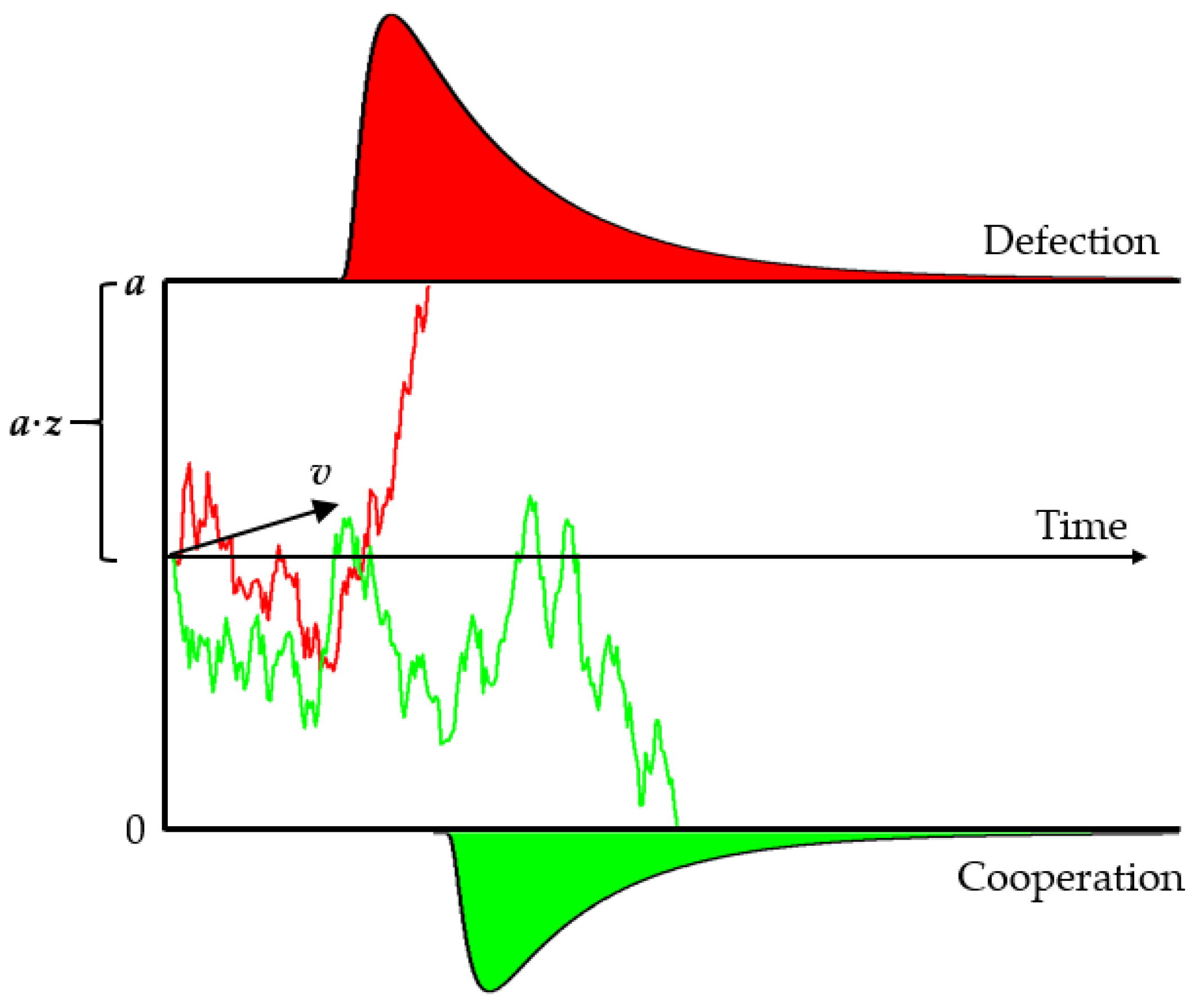
2.5. Drift Diffusion Model
2.6. Statistical Analysis
3. Results
3.1. Test of the Disjunction Effect
3.2. DDM Analysis
3.2.1. Threshold
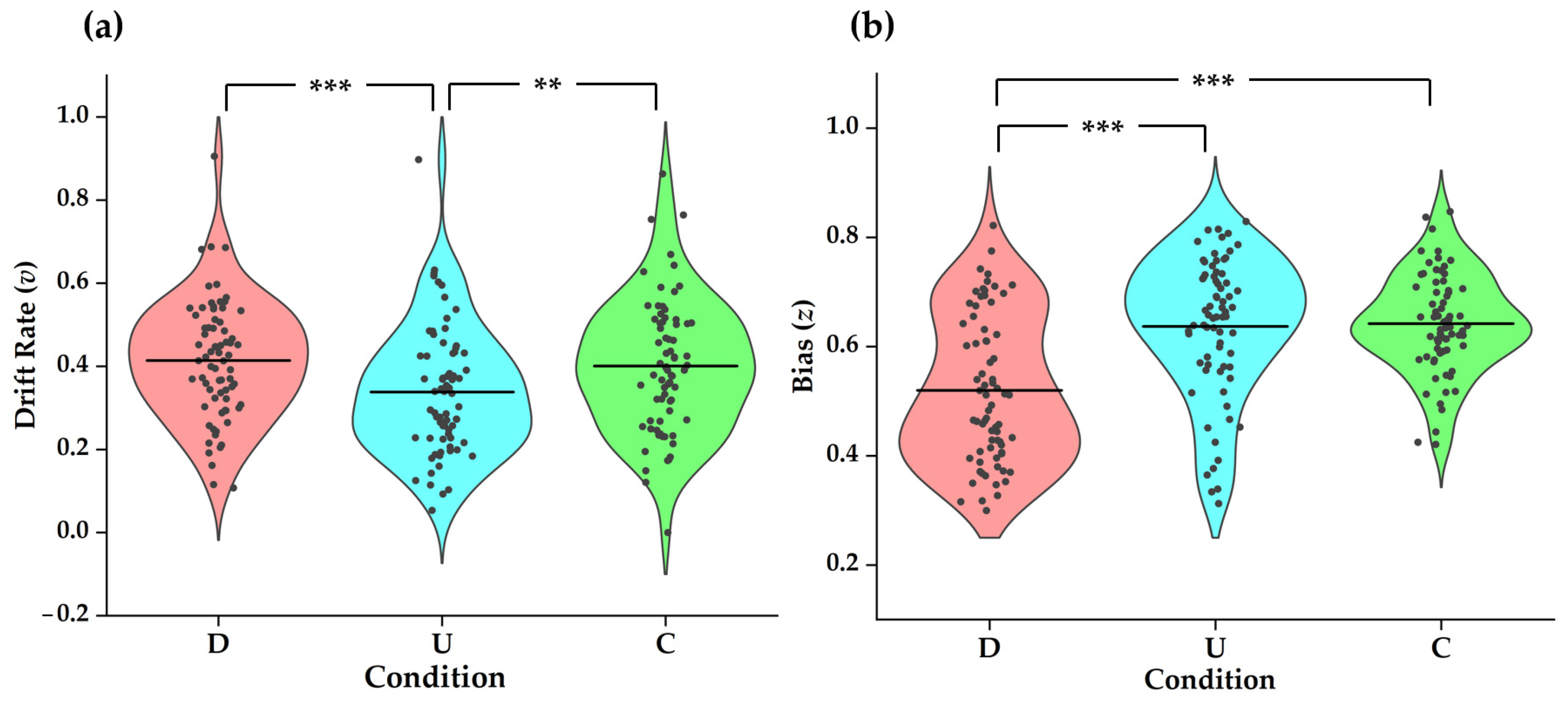
3.2.2. Drift Rate
3.2.3. Bias
3.3. The Contribution of Each DDM Parameter Variation to EOD
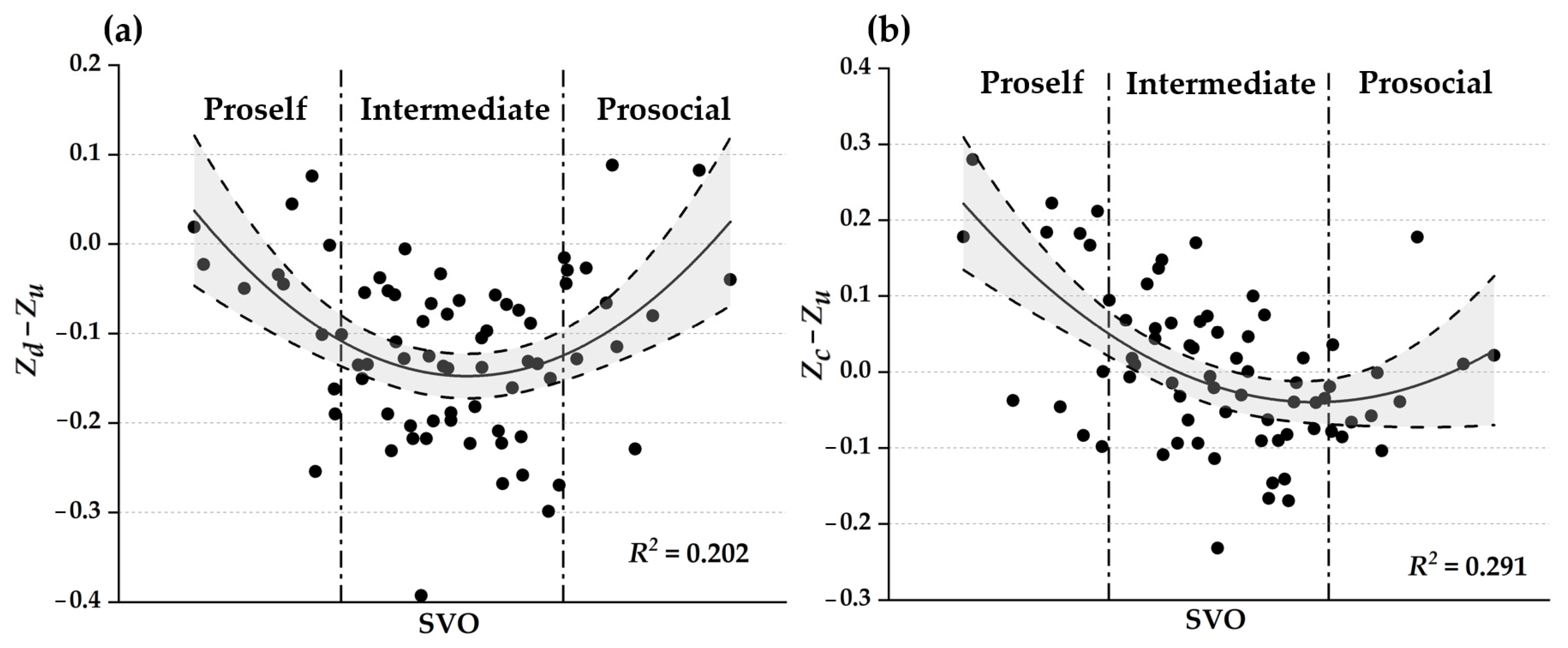
3.4. The Relationship Between SVO and (a) DDM Parameters and (b) Defection Rates
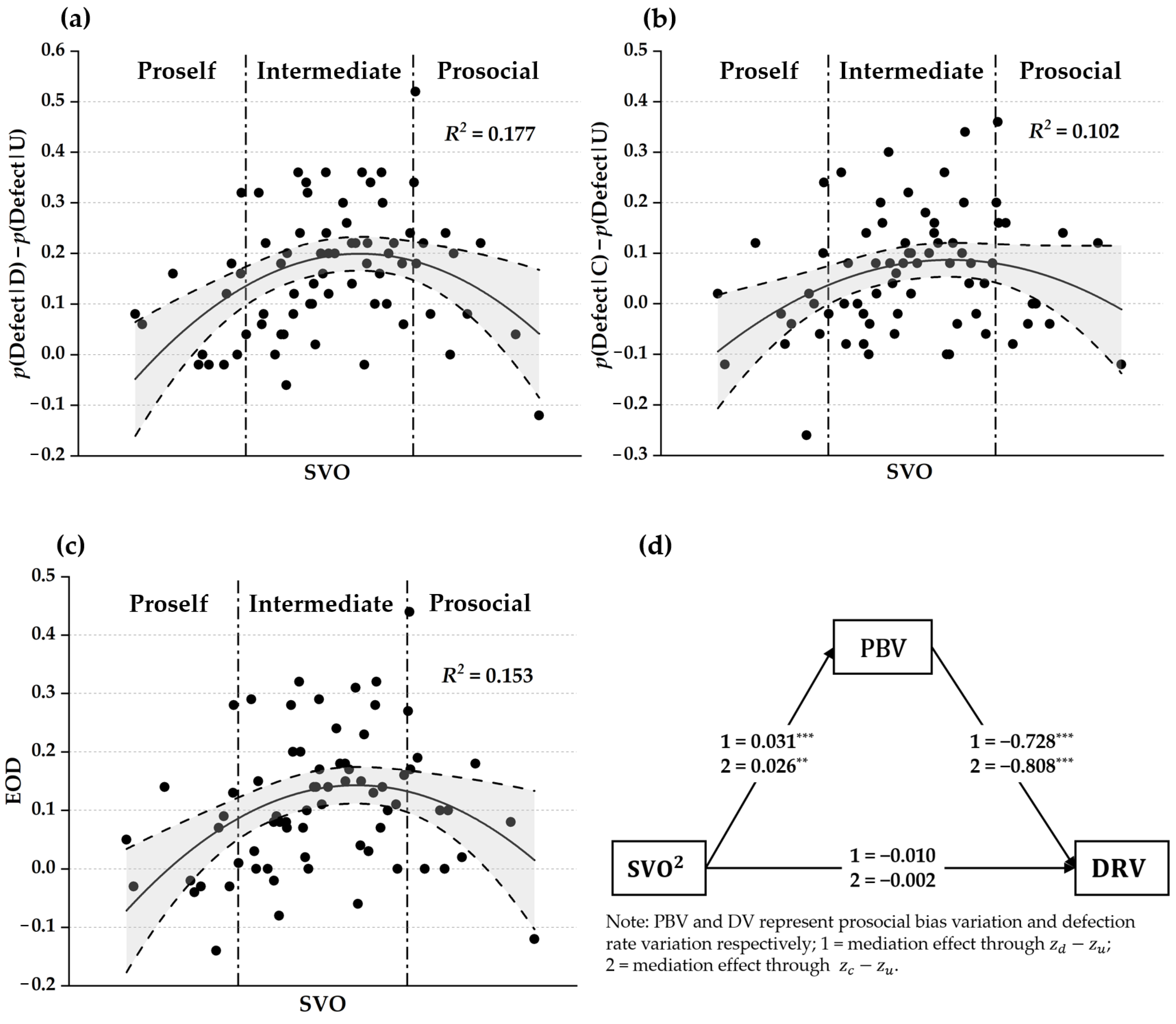
3.5. The Relationship Between SVO and Prosocial-Bias Variations
3.6. The Relationship Between SVO and EOD Through Prosocial-Bias Variations
4. Discussion
Supplementary Materials
Author Contributions
Funding
Institutional Review Board Statement
Informed Consent Statement
Data Availability Statement
Conflicts of Interest
| 1 | The Greenhouse–Geisser (GG) correction is adopted if the assumption of sphericity is violated. |
References
- Balliet, D., Parks, C., & Joireman, J. (2009). Social value orientation and cooperation in social dilemmas: A meta-analysis. Group Processes & Intergroup Relations, 12(4), 533–547. [Google Scholar] [CrossRef] [Scilit]
- Bear, A., & Rand, D. G. (2016). Intuition, deliberation, and the evolution of cooperation. Proceedings of the National Academy of Sciences, 113(4), 936–941. [Google Scholar] [CrossRef] [Scilit]
- Boone, C., Declerck, C., & Kiyonari, T. (2010). Inducing cooperative behavior among proselfs versus prosocials: The moderating role of incentives and trust. Journal of Conflict Resolution, 54(5), 799–824. [Google Scholar] [CrossRef] [Scilit]
- Capraro, V. (2013). A model of human cooperation in social dilemmas. PLoS ONE, 8(8), e72427. [Google Scholar] [CrossRef] [Scilit] [PubMed]
- Capraro, V. (2015). The emergence of hyper-altruistic behaviour in conflictual situations. Scientific Reports, 5(1), 9916. [Google Scholar] [CrossRef] [Scilit] [PubMed]
- Chen, F., & Krajbich, I. (2018). Biased sequential sampling underlies the effects of time pressure and delay in social decision making. Nature Communications, 9(1), 3557. [Google Scholar] [CrossRef] [Scilit]
- Croson, R. T. (1999). The disjunction effect and reason-based choice in games. Organizational Behavior and Human Decision Processes, 80(2), 118–133. [Google Scholar] [CrossRef] [Scilit]
- Declerck, C. H., & Bogaert, S. (2008). Social value orientation: Related to empathy and the ability to read the mind in the eyes. The Journal of Social Psychology, 148(6), 711–726. [Google Scholar] [CrossRef] [Scilit]
- Declerck, C. H., Boone, C., & Emonds, G. (2013). When do people cooperate? The neuroeconomics of prosocial decision making. Brain and Cognition, 81(1), 95–117. [Google Scholar] [CrossRef] [Scilit] [PubMed]
- Emonds, G., Declerck, C. H., Boone, C., Vandervliet, E. J., & Parizel, P. M. (2011). Comparing the neural basis of decision making in social dilemmas of people with different social value orientations, a fMRI study. Journal of Neuroscience, Psychology, and Economics, 4(1), 11. [Google Scholar] [CrossRef] [Scilit]
- Evans, J. S. B. (2008). Dual-processing accounts of reasoning, judgment, and social cognition. Annural Review of Psychology, 59, 255–278. [Google Scholar] [CrossRef] [Scilit] [PubMed]
- Festinger, L. (1957). A theory of cognitive dissonance. Stanford University Press. [Google Scholar]
- Fiedler, S., Glöckner, A., Nicklisch, A., & Dickert, S. (2013). Social value orientation and information search in social dilemmas: An eye-tracking analysis. Organizational Behavior and Human Decision Processes, 120(2), 272–284. [Google Scholar] [CrossRef] [Scilit]
- Fischbacher, U. (2007). z-Tree: Zurich toolbox for ready-made economic experiments. Experimental Economics, 10(2), 171–178. [Google Scholar] [CrossRef] [Scilit]
- Forstmann, B. U., Ratcliff, R., & Wagenmakers, E. J. (2016). Sequential sampling models in cognitive neuroscience: Advantages, applications, and extensions. Annual Review of Psychology, 67, 641–666. [Google Scholar] [CrossRef] [Scilit]
- Gallotti, R., & Grujić, J. (2019). A quantitative description of the transition between intuitive altruism and rational deliberation in iterated Prisoner’s Dilemma experiments. Scientific Reports, 9(1), 17046. [Google Scholar] [CrossRef] [Scilit]
- Grömping, U. (2007). Relative importance for linear regression in R: The package relaimpo. Journal of Statistical Software, 17, 1–27. [Google Scholar]
- Henrich, J., Boyd, R., Bowles, S., Camerer, C., Fehr, E., Gintis, H., McElreath, R., Alvard, M., Barr, A., Ensminger, J., Henrich, N. S., Hill, K., Gil-White, F., Gurven, M., Marlowe, F. W., Patton, J. Q., & Tracer, D. (2005). “Economic man” in cross-cultural perspective: Behavioral experiments in 15 small-scale societies. Behavioral and Brain Sciences, 28(6), 795–815. [Google Scholar] [CrossRef] [Scilit] [PubMed]
- Hristova, E., & Grinberg, M. (2008, July 23–27). Disjunction effect in prisoner’s dilemma: Evidences from an eye-tracking study. 30th Annual Conference of the Cognitive Science Society, Washington, DC, USA. [Google Scholar]
- Hristova, E., & Grinberg, M. (2010, August 11–14). Testing two explanations for the disjunction effect in Prisoner’s Dilemma games: Complexity and quasi-magical thinking. Annual Meeting of the Cognitive Science Society, Portland, OR, USA. [Google Scholar]
- Jin, Z., Stern, Y., & Lee, S. (2025). Bayesian Regression Analysis with the Drift-Diffusion Model. arXiv, arXiv:2507.01177. [Google Scholar] [CrossRef] [Scilit]
- Kelley, H. H., & Stahelski, A. J. (1970). Social interaction basis of cooperators’ and competitors’ beliefs about others. Journal of Personality and Social Psychology, 16(1), 66. [Google Scholar] [CrossRef] [Scilit]
- Krajbich, I., Bartling, B., Hare, T., & Fehr, E. (2015). Rethinking fast and slow based on a critique of reaction-time reverse inference. Nature Communications, 6(1), 7455. [Google Scholar] [CrossRef] [Scilit]
- Lau, L. Y., & Ranyard, R. (2005). Chinese and English probabilistic thinking and risk taking in gambling. Journal of Cross-Cultural Psychology, 36(5), 621–627. [Google Scholar] [CrossRef] [Scilit]
- Li, S., & Taplin, J. E. (2002). Examining whether there is a disjunction effect in Prisoner’s Dilemma games. Chinese Journal of Psychology, 44(1), 25–46. [Google Scholar]
- Li, S., Taplin, J. E., & Zhang, Y. (2007). The equate-to-differentiate’s way of seeing the prisoner’s dilemma. Information Sciences, 177(6), 1395–1412. [Google Scholar] [CrossRef] [Scilit]
- Lohse, J., Goeschl, T., & Diederich, J. H. (2017). Giving is a question of time: Response times and contributions to an environmental public good. Environmental and Resource Economics, 67(3), 455–477. [Google Scholar] [CrossRef] [Scilit]
- Mischkowski, D., & Glöckner, A. (2016). Spontaneous cooperation for prosocials, but not for proselfs: Social value orientation moderates spontaneous cooperation behavior. Scientific Reports, 6(1), 21555. [Google Scholar] [CrossRef] [Scilit]
- Murphy, R. O., & Ackermann, K. A. (2014). Social value orientation: Theoretical and measurement issues in the study of social preferences. Personality and Social Psychology Review, 18(1), 13–41. [Google Scholar] [CrossRef] [Scilit] [PubMed]
- Murphy, R. O., Ackermann, K. A., & Handgraaf, M. (2011). Measuring social value orientation. Judgment and Decision Making, 6(8), 771–781. [Google Scholar] [CrossRef] [Scilit]
- Piovesan, M., & Wengström, E. (2009). Fast or fair? A study of response times. Economics Letters, 105(2), 193–196. [Google Scholar] [CrossRef] [Scilit]
- Pothos, E. M., & Busemeyer, J. R. (2009). A quantum probability explanation for violations of ‘rational’ decision theory. Proceedings of the Royal Society B: Biological Sciences, 276(1665), 2171–2178. [Google Scholar] [CrossRef] [Scilit]
- Pothos, E. M., Perry, G., Corr, P. J., Matthew, M. R., & Busemeyer, J. R. (2011). Understanding cooperation in the Prisoner’s Dilemma game. Personality and Individual Differences, 51(3), 210–215. [Google Scholar] [CrossRef] [Scilit]
- Qi, Y., Wu, H., & Liu, X. (2017). The influences of social value orientation on prosocial behaviors: The evidences from behavioral and neuroimaging studies. Chinese Science Bulletin, 62(11), 1136–1144. [Google Scholar] [CrossRef] [Scilit]
- Rand, D. G. (2016). Cooperation, fast and slow: Meta-analytic evidence for a theory of social heuristics and self-interested deliberation. Psychological Science, 27(9), 1192–1206. [Google Scholar] [CrossRef] [Scilit]
- Rand, D. G., Greene, J. D., & Nowak, M. A. (2012). Spontaneous giving and calculated greed. Nature, 489(7416), 427–430. [Google Scholar] [CrossRef] [Scilit]
- Rand, D. G., Peysakhovich, A., Kraft-Todd, G. T., Newman, G. E., Wurzbacher, O., Nowak, M. A., & Greene, J. D. (2014). Social heuristics shape intuitive cooperation. Nature Communications, 5(1), 3677. [Google Scholar] [CrossRef] [Scilit] [PubMed]
- Ratcliff, R., Smith, P. L., Brown, S. D., & McKoon, G. (2016). Diffusion decision model: Current issues and history. Trends in Cognitive Sciences, 20(4), 260–281. [Google Scholar] [CrossRef] [Scilit] [PubMed]
- Salahshour, M. (2025). Perceptual rationality: An evolutionary game theory of perceptually rational decision-making. Royal Society Open Science, 12(10), 251125. [Google Scholar] [CrossRef] [Scilit] [PubMed]
- Salahshour, M., & Couzin, I. D. (2025). Evolution of altruistic rationality provides a solution to social dilemmas via rational reciprocity. Physical Review Research, 7(3), 033211. [Google Scholar] [CrossRef] [Scilit]
- Savage, L. J. (1954). The foundations of statistics. John Wiley & Sons. [Google Scholar]
- Shafir, E., & Tversky, A. (1992). Thinking through uncertainty: Nonconsequential reasoning and choice. Cognitive Psychology, 24(4), 449–474. [Google Scholar] [CrossRef] [Scilit]
- Thielmann, I., Spadaro, G., & Balliet, D. (2020). Personality and prosocial behavior: A theoretical framework and meta-analysis. Psychological Bulletin, 146(1), 30. [Google Scholar] [CrossRef] [Scilit]
- Van den Bergh, D., Tuerlinckx, F., & Verdonck, S. (2020). DstarM: An R package for analyzing two-choice reaction time data with the D∗M method. Behavior Research Methods, 52(2), 521–543. [Google Scholar] [CrossRef] [Scilit]
- Van Lange, P. A. (2000). Beyond self-interest: A set of propositions relevant to interpersonal orientations. European Review of Social Psychology, 11(1), 297–331. [Google Scholar] [CrossRef] [Scilit]
- Verdonck, S., & Tuerlinckx, F. (2016). Factoring out non-decision time in choice RT data: Theory and implications. Psychological Review, 123, 208–218. [Google Scholar] [CrossRef] [Scilit]
- Weber, E., & Hsee, C. (2000). Culture and individual judgment and decision making. Applied Psychology, 49(1), 32–61. [Google Scholar] [CrossRef] [Scilit]
- Wiecki, T. V., Sofer, I., & Frank, M. J. (2013). HDDM: Hierarchical Bayesian estimation of the drift-diffusion model in Python. Frontiers in Neuroinformatics, 7, 14. [Google Scholar] [CrossRef] [Scilit] [PubMed]
- Xin, X., Sun, M., Liu, B., Li, Y., & Gao, X. (2022). A more realistic markov process model for explaining the disjunction effect in one-shot prisoner’s dilemma game. Mathematics, 10(5), 834. [Google Scholar] [CrossRef] [Scilit]
- Yamagishi, T., Matsumoto, Y., Kiyonari, T., Takagishi, H., Li, Y., Kanai, R., & Sakagami, M. (2017). Response time in economic games reflects different types of decision conflict for prosocial and proself individuals. Proceedings of the National Academy of Sciences, 114(24), 6394–6399. [Google Scholar] [CrossRef] [Scilit]
- Zaki, J., & Mitchell, J. P. (2013). Intuitive prosociality. Current Directions in Psychological Science, 22(6), 466–470. [Google Scholar] [CrossRef] [Scilit]



| Outcome | Outcome | ||||
|---|---|---|---|---|---|
| Predictor | PMVD | Predictor | PMVD | ||
| 0.018 | 1.6% | 0.039 | 5.9% | ||
| 0.634 *** | 65.3% | 0.622 *** | 60.2% | ||
| −0.809 *** | 33.1% | −0.797 *** | 33.9% | ||
| R2 | 0.809 | R2 | 0.903 | ||
| F statistic | 92.556 *** | F statistic | 213.257 *** | ||
| Predictors | Linear Model | Quadratic Model | ||
| 95% CI | 95% CI | |||
| Intercept | −0.117 *** | −0.139, −0.095 | −0.147 *** | −0.172, −0.122 |
| SVO | −0.007 | −0.029, 0.015 | −0.008 | −0.028, 0.012, |
| SVO2 | 0.031 *** | 0.016, 0.046, | ||
| Adjusted R2 | −0.009 | 0.179 | ||
| F statistic | 0.383 | 8.732 *** | ||
| The Relationship Between SVO and | ||||
| Predictors | Linear Model | Quadratic Model | ||
| 95% CI | 95% CI | |||
| Intercept | 0.005 | −0.017, 0.027, | −0.020 | −0.046, 0.005 |
| SVO | −0.043 *** | −0.066, −0.021 | −0.043 *** | −0.066, −0.023 |
| SVO2 | 0.026 ** | 0.010, 0.041 | ||
| Adjusted R2 | 0.167 | 0.270 | ||
| F statistic | 14.13 *** | 15.17 *** | ||
| Predictors | Linear Model | Quadratic Model | ||
| 95% CI | 95% CI | |||
| Intercept | 0.161 *** | 0.132, 0.190 | 0.195 *** | 0.162, 0.227 |
| SVO | 0.023 | −0.006, 0.052 | 0.023 | −0.002, 0.052 |
| SVO2 | −0.034 *** | −0.053, −0.015 | ||
| Adjusted R2 | 0.022 | 0.153 | ||
| F statistic | 2.592 | 7.441 ** | ||
| The Relationship Between SVO and | ||||
| Predictors | Linear Model | Quadratic Model | ||
| 95% CI | 95% CI | |||
| Intercept | 0.059 *** | 0.031, 0.086 | 0.082 *** | −0.006, 0.005 |
| SVO | 0.021 | −0.007, 0.047 | 0.021 | −0.005, 0.047 |
| SVO2 | 0.023 * | −0.043, −0.004 | ||
| Adjusted R2 | 0.016 | 0.076 | ||
| F statistic | 2.18 | 3.935 * | ||
| The Relationship Between SVO and EOD | ||||
| Predictors | Linear Model | Quadratic Model | ||
| 95% CI | 95% CI | |||
| Intercept | 0.110 *** | 0.083, 0.136 | 0.138 *** | 0.107, 0.169 |
| SVO | 0.022 | −0.005, 0.047 | 0.023 | −0.002, 0.047 |
| SVO2 | −0.029 ** | −0.047, −0.010 | ||
| Adjusted R2 | 0.023 | 0.130 | ||
| F statistic | 2.673 | 6.298 ** | ||
| Outcome Variable | ||||
|---|---|---|---|---|
| 95% CI | 95% CI | |||
| Direct effect | −0.010 | −0.019, 0.000 | −0.002 | −0.007, 0.007 |
| Indirect effect | −0.022 *** | −0.039, −0.013 | −0.021 ** | −0.036, −0.007 |
| Total effect | −0.033 *** | −0.047, −0.020 | −0.023 ** | −0.035, −0.008 |
| Proportion of indirect effect | 68.2% | 89.9% | ||
Disclaimer/Publisher’s Note: The statements, opinions and data contained in all publications are solely those of the individual author(s) and contributor(s) and not of MDPI and/or the editor(s). MDPI and/or the editor(s) disclaim responsibility for any injury to people or property resulting from any ideas, methods, instructions or products referred to in the content. |
© 2026 by the authors. Licensee MDPI, Basel, Switzerland. This article is an open access article distributed under the terms and conditions of the Creative Commons Attribution (CC BY) license.
Share and Cite
Xin, X.; Liu, B.; Yan, B.; Li, Y. Accounting the Role of Prosociality in the Disjunction Effect with a Drift Diffusion Model. Behav. Sci. 2026, 16, 132. https://doi.org/10.3390/bs16010132
Xin X, Liu B, Yan B, Li Y. Accounting the Role of Prosociality in the Disjunction Effect with a Drift Diffusion Model. Behavioral Sciences. 2026; 16(1):132. https://doi.org/10.3390/bs16010132
Chicago/Turabian StyleXin, Xiaoyang, Bo Liu, Bihua Yan, and Ying Li. 2026. "Accounting the Role of Prosociality in the Disjunction Effect with a Drift Diffusion Model" Behavioral Sciences 16, no. 1: 132. https://doi.org/10.3390/bs16010132
APA StyleXin, X., Liu, B., Yan, B., & Li, Y. (2026). Accounting the Role of Prosociality in the Disjunction Effect with a Drift Diffusion Model. Behavioral Sciences, 16(1), 132. https://doi.org/10.3390/bs16010132