Analogue Play in the Age of AI: A Scoping Review of Non-Digital Games as Active Learning Strategies in Higher Education

Abstract
1. Introduction
1.1. Active Learning and the Pedagogical Value of Play
1.2. The Case for Analogue Game-Based Learning and Active Learning
1.3. GenAI and the Changing Context of Learning
1.4. Rationale for a Scoping Review
1.5. Aims and Research Questions
- In what disciplinary contexts are non-digital games being used as active learning tools in tertiary education?
- What learning outcomes, cognitive, affective, behavioural, or social, are reported?
- What types of analogue games and pedagogical designs are most commonly employed?
- Has the emergence of GenAI since 2022 acted as a driver or brake on these analogue pedagogies?
1.6. Structure of the Paper
2. Methodology
2.1. Review Design
2.2. Research Questions
- -
- How are traditional, non-digital games used as active learning strategies in tertiary or higher-education contexts, what learning outcomes are reported, across which disciplines, and in what ways, if any, is GenAI influencing these pedagogical practices?
- -
- In what disciplinary domains are non-digital games applied?
- -
- What learning outcomes (knowledge, skills, attitudes, engagement) are reported?
- -
- What types of games and active-learning designs are used?
- -
- Has the emergence of GenAI (2022–2025) been identified as a contextual driver or barrier?
2.3. Search Strategy
2.4. Eligibility Criteria
- -
- Described the design, implementation, or evaluation of a non-digital game (e.g., board, card) used for educational purposes;
- -
- Were conducted within a tertiary or higher-education context (undergraduate, postgraduate, or faculty development);
- -
- Explicitly situated the activity within an active learning, experiential, or gamified pedagogy;
- -
- Were published in English between 2010 and 2025;
- -
- Provided sufficient empirical or descriptive detail to extract pedagogical outcomes.
- -
- Digital, computer, or video-game interventions;
- -
- Non-higher education, community, or informal education settings;
- -
- Papers lacking educational or pedagogical analysis;
- -
- Non-English texts;
- -
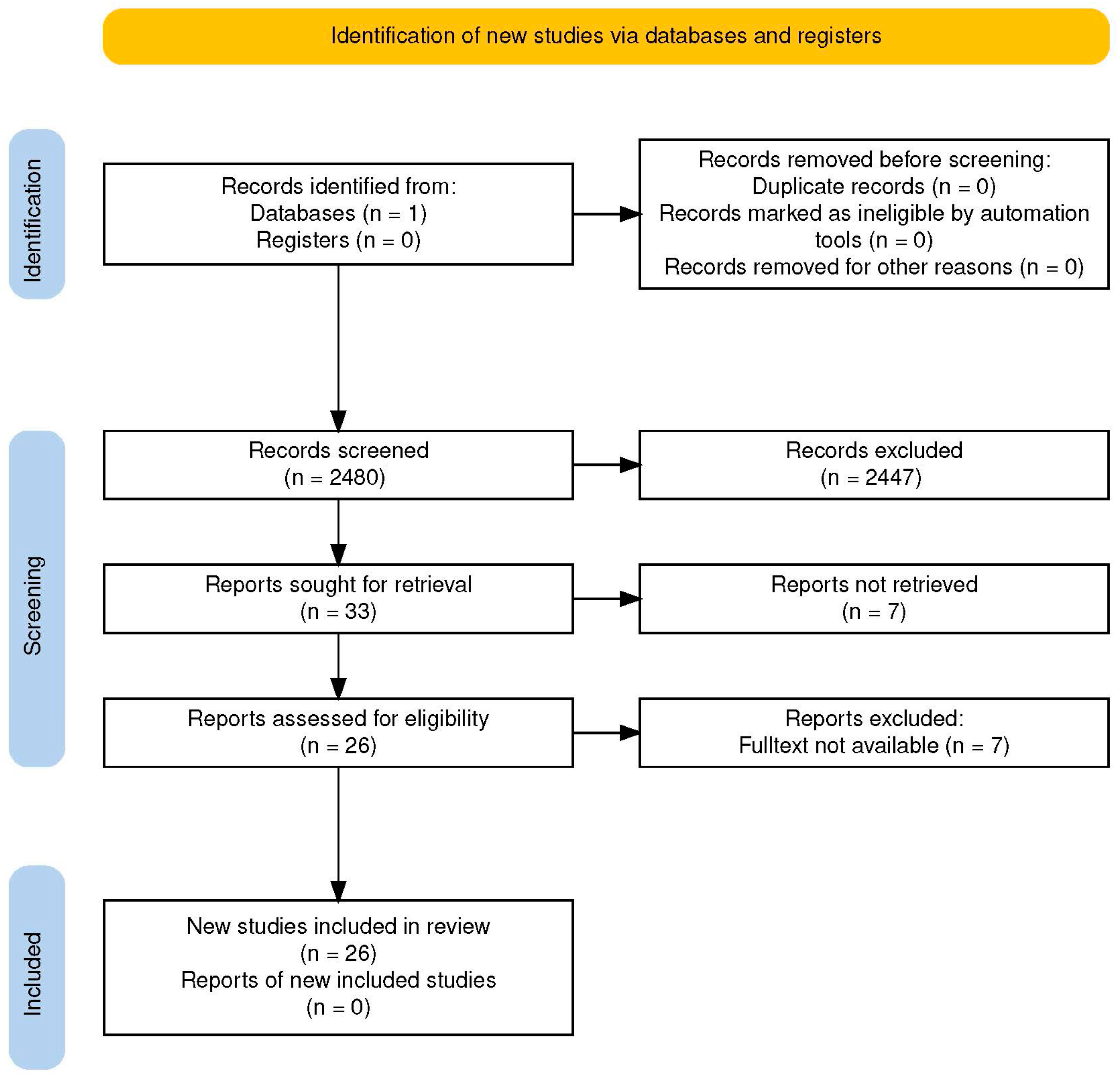
- Records where full-text access was unavailable.
2.5. Screening and Selection Process
2.6. Data Charting and Extraction
- -
- Author(s), year, and DOI
- -
- Country and disciplinary context
- -
- Game type (board, card, hybrid)
- -
- Educational level (undergraduate, postgraduate, faculty)
- -
- Study design or evaluation method
- -
- Reported learning outcomes (knowledge, skills, engagement, attitudes)
- -
- Pedagogical framing (active learning, experiential, problem-based, gamified)
- -
- Reference to GenAI or post-2022 contextual discussion
2.7. Data Analysis and Synthesis
2.8. Limitations
2.9. Ethical Considerations
3. Results
3.1. Overview of Included Studies
3.2. Disciplinary Distribution
3.3. Game Types and Pedagogical Designs
3.4. Reported Learning Outcomes
3.5. Temporal Trends: Pre- and Post-GenAI
3.6. Synthesis of Emerging Themes
- Embodied Engagement: Analogue games foster physical and social participation, enabling learners to externalise reasoning and negotiate meaning collaboratively. This embodiment contrasts with the increasingly disembodied modes of digital and AI-mediated learning.
- Authenticity and Agency: Post-2023 studies emphasise authenticity, trust, and ethical decision-making, framing analogue games as contexts where human judgement and unpredictability are valued.
- Pedagogical Resilience in the GenAI Era: Rather than being supplanted by technology, analogue game-based learning appears to have gained renewed pedagogical legitimacy as educators seek resilient, human-centred methods that complement AI tools without replicating them.
4. Discussion
4.1. Overview
4.2. Analogue Games as Embodied and Social Pedagogies
4.3. Learning Outcomes and Pedagogical Value
4.4. The Influence of GenAI: Catalyst, Not Competitor
4.5. Disciplinary Breadth and Transferability
- -
- In STEM, to model systems and encourage experimentation;
- -
- In business and economics, to develop strategic thinking and risk management;
- -
- In health, to facilitate communication and empathy;
- -
- In arts and civics, to provoke dialogue and ethical reflection.
4.6. Gaps and Opportunities
4.7. Reframing Active Learning in the GenAI Era
5. Conclusions
Author Contributions
Funding
Institutional Review Board Statement
Informed Consent Statement
Data Availability Statement
Conflicts of Interest
Abbreviations
| AI | Artificial Intelligence |
| GBL | Game-based Learning |
| Gen-AI | Generative Artificial Intelligence |
| PRISMA-ScR | Preferred Reporting Items for Systematic Reviews and Meta-Analyses extension for Scoping Reviews |
Appendix A. Included Studies (n = 26)
| Babl, R.M., Cole, K.D., Parish, R.L., Wartman, C., Howington, D., MacSorley, R., Adcock, K.G. (2025). Promoting values and ethics in collaborative health-care training. Journal of the American College of Clinical Pharmacy, 8, 732–740. https://doi.org/10.1002/jac5.70072. |
| Conway, E., & Smith, R. (2026). Playing with purpose: A game-based approach to teaching business metrics. International Journal of Management Education, 24(1), 101310. https://doi.org/10.1016/j.ijme.2025.101310. |
| Cruza, I. A., (2025). Educational Impact of Infinity Masters: A Digital Board Game on Arithmetic, Strategy, and Interactive Learning. International Journal of Computer Games Technology, (1), 2470446. https://doi.org/10.1155/ijcg/2470446. |
| Ferreira Dias, M., Alves, C., Amorim, M. (2024). Board games and entrepreneurial skills acquisition. In T. Connolly (Ed.), Proceedings of the European conference on game-based learning (ECGBL) (pp. 135–144). https://doi.org/10.34190/ecgbl.18.1.2666. |
| Gómez Buitrago, P. Tobar-Muñoz, H., Arteaga, D. (2024). Amino-Structure: A card game for amino-acid learning in biochemistry classes. Journal of Chemical Education, 101(5), 2141–2148. https://doi.org/10.1021/acs.jchemed.3c01209. |
| Huang, A., & Levinson, D. (2012). To game or not to game: Teaching transportation planning with board games. Transportation Research Board, 2307(1), 141–149. https://doi.org/10.3141/2307-15. |
| Jaroenkhasemmeesuk, C. Lima, R. M., Horgan, K. Mesquita, D. Supeekit, T. (2023). Active learning in engineering education: Case study in mechanics. In Pisut Koomsap, Adam Cooper, Josip Stjepandić (Eds.), Leveraging Transdisciplinary Engineering in a Changing and Connected World, 41, 633–642. https://doi.org/10.3233/ATDE230659. |
| Kurisu, K., Okabe, H., Nakatani, J., Moriguchi, Y. (2021). Development of board game to encourage life-cycle thinking. Cleaner and Responsible Consumption, 3, 100033. https://doi.org/10.1016/j.clrc.2021.100033. |
| Makri, E. G. (2022). Does the cards against calamity learning game facilitate attitudes toward negotiation, civics, and sustainability? empirical findings from greek graduates. Education Sciences, 12(11), 738. https://doi.org/10.3390/educsci12110738. |
| Marcos, S., & López-García, B. (2024). Boardcraft: Learning the art of strategic decision-making card by card. Proceedings of the European conference on game-based learning (ECGBL), 18, 1 1047–1051. https://doi.org/10.34190/ecgbl.18.1.2646. |
| Martindale, R. C., & Weiss, A. M. (2020). ”Taphonomy: Dead and fossilized”: A new board game designed to teach college undergraduate students about the process of fossilization. Journal of Geoscience Education, 68(3), 265–285. https://doi.org/10.1080/10899995.2019.1693217. |
| Rafiq, R., Matthews, H., Abedalreza, D., Yahya, F., Jones, M.A. (2025). Card games as effective tools to enhance foundation-year health and safety inductions. FEBS Open Bio, 15(12), 2080–2095. https://doi.org/10.1002/2211-5463.70140. |
| Ruiz-Arroyo, M., Castillo, A., & Gutierrez, L. (2025). Active Learning and Authentic Assessment Through Gamification: A Board Game Experience in Eliseo Vilalta-Perdomo, Alessandra Scroccaro, David Ernesto Salinas-Navarro, Rosario Michel-Villarreal (Eds.) The Emerald Handbook of Active Learning For Authentic Assessment, 125–146. https://doi.org/10.1108/978-1-83797-857-120251007. |
| Sarinho, V.T. (2019). Masters of the Process: A Board Game Proposal for Teaching Software Management and Software Development Process. Proceedings of the XXXIII Brazilian Symposium on Software Engineering, 532–536. https://doi.org/10.1145/3350768.3352459. |
| Selamat, A.I., & Ngalim, S.M. (2022). Putra Salamanis board game: the game of bookkeeping for fundamental financial accounting learning. Accounting Education, 31(5), 596–614. https://doi.org/10.1080/09639284.2021.2015408. |
| Shemran, R.P., Clark, R.M., Bilec, M.M., Landis, A.E., Parrish, K. (2017). Developing a framework to better engage students in STEM via game design: Findings from year 1. American Society for Engineering Education Annual Conference and Exposition, Conference Proceedings. Jun 24 2017, 20435. https://peer.asee.org/27702. |
| Sierra, J., & Suárez-Collado, A. (2021). The transforming generation: Economic decisions and sustainability. International Journal of Sustainability in Higher Education, 22(5), 1087–1107. https://doi.org/10.1108/IJSHE-06-2020-0221. |
| Sotoca-Orgaz, P., Arevalo-Baeza, M., Perez-Lopez, I.J. (2025). Impact of a serious board game on future physical education teachers. International Journal of Serious Games, 12(3), 149–169. https://doi.org/10.17083/mt8e7w68. |
| Szilagyi, S., Korei, A., Vaiciulyte, I. (2025). The Role of Non-Digital and Digital UNO-Type Card Games as Learning Media in Different Levels of Mathematics Education: A Systematic Review. Education Sciences, 15(8), 1030. https://doi.org/10.3390/educsci15081030. |
| Taillandier, F., Micolier, A., Sauce, G., Chaplain, M. (2021). DOMEGO: A board game for learning how to manage a construction project. International Journal of Game-Based Learning, 11(2), 20–37. https://doi.org/10.4018/IJGBL.2021040102. |
| Thammaboosadee, R. (2025). Stardust Odyssey: City’s Last Stand—Utilising Process Drama and Design-Based Research in Tabletop Game Workshops to Reimagine Active Citizenship in Thailand’s Neoliberal Education Context. Designs for Learning, 16(1), 22–35. https://doi.org/10.16993/dfl.235. |
| Thammavongsy, Z., Morris, M.A., & Link, R.D. (2020). 1H NMR Spectrum: A Team-Based Tabletop Game for Molecular Structure Elucidation. Journal of Chemical Education, 97(12), 4385–4390. https://doi.org/10.1021/acs.jchemed.0c01267. |
| Tzioutzios, D., Song, S., Bean, H., Chabay, I., Cruz, A.M. (2024). Serious gaming for Natech risk awareness: Introducing EGNARIA. International Journal of Disaster Risk Reduction, 115, 105080. https://doi.org/10.1016/j.ijdrr.2024.105080. |
| Watsjold, B., & Zhong, D. (2020). Clinical coaching cards: A game of active learning theory and teaching techniques. MedEdPORTAL, 16(1), 11042. https://doi.org/10.15766/mep_2374-8265.11042. |
| Wu, J. H., Su, P. H., Wu, H. Y., Hsin, Y. M., Lin, C. H., & Lee, C. Y. (2025). Educational board game for training dental and dental hygiene students in patient safety issues. BMC Medical Education, 25, 518. https://doi.org/10.1186/s12909-025-07284-7. |
| Yeo, D. (2021). nCoV-BusterBot: Mission Simulation Lab Modules for Supporting a Lab-based Autonomous Systems Class in a Remote Learning Environment. AIAA SciTech Forum, January 2021. https://doi.org/10.2514/6.2021-0040. |
References
- Arksey, H., & O’Malley, L. (2005). Scoping studies: Towards a methodological framework. International Journal of Social Research Methodology, 8(1), 19–32. [Google Scholar] [CrossRef]
- Ashford-Rowe, K., Herrington, J., & Brown, C. (2014). Establishing the critical elements that determine authentic assessment. Assessment & Evaluation in Higher Education, 39(2), 205–222. [Google Scholar] [CrossRef]
- Boud, D., & Falchikov, N. (2006). Aligning assessment with long-term learning. Assessment & Evaluation in Higher Education, 31(4), 399–413. [Google Scholar] [CrossRef]
- Deterding, S., Dixon, D., Khaled, R., & Nacke, L. (2011). From game design elements to gamefulness: Defining “gamification”. In Proceedings of the 15th international academic MindTrek conference: Envisioning future media environments (mindtrek ’11). Association for Computing Machinery. [Google Scholar] [CrossRef]
- Dicheva, D., Dichev, C., Agre, G., & Angelova, G. (2015). Gamification in education: A systematic mapping study. Educational Technology & Society, 18(3), 75–88. [Google Scholar]
- Eaton, S. E. (2023). Postplagiarism: Transdisciplinary ethics and integrity in the age of artificial intelligence. International Journal for Educational Integrity, 19, 5. [Google Scholar] [CrossRef]
- Freeman, S., Eddy, S. L., McDonough, M., Smith, M. K., Okoroafor, N., Jordt, H., & Wenderoth, M. P. (2014). Active learning increases student performance in science, engineering, and mathematics. Proceedings of the National Academy of Sciences USA, 111(23), 8410–8415. [Google Scholar] [CrossRef] [PubMed]
- Gee, J. P. (2008). Learning and games. In K. Salen (Ed.), The ecology of games: Connecting youth, games, and learning (pp. 21–40). The MIT Press. [Google Scholar] [CrossRef]
- Gentry, S. V., Gauthier, A., L’Estrade Ehrstrom, B., Wortley, D., Lilienthal, A., Tudor Car, L., Dauwels-Okutsu, S., Nikolaou, C. K., Zary, N., Campbell, J., & Car, J. (2019). Serious gaming and gamification education in health professions: Systematic review. Journal of Medical Internet Research, 21(3), e12994. [Google Scholar] [CrossRef] [PubMed]
- Hamari, J., Koivisto, J., & Sarsa, H. (2014, January 6–9). Does gamification work?—A literature review of empirical studies on gamification. 47th Hawaii International Conference on System Sciences (pp. 3025–3034), Waikoloa, HI, USA. [Google Scholar] [CrossRef]
- Herrington, J., Reeves, T. C., & Oliver, R. (2010). Authentic learning environments. In Learning, design, and technology. Routledge. [Google Scholar]
- Holmes, W., Bialik, M., & Fadel, C. (2019). Artificial intelligence in education: Promises and implications for teaching and learning. Center for Curriculum Redesign. [Google Scholar]
- Hutchins, E. (1995). Cognition in the wild. MIT Press. [Google Scholar]
- Jandrić, P., Knox, J., Besley, T., Ryberg, T., Suoranta, J., & Hayes, S. (2018). Postdigital dialogue. Postdigital Science and Education, 1(1), 163–189. [Google Scholar] [CrossRef]
- Kasneci, E., Sessler, K., Straube, S., Dörr, M., Kühn, S., & Kasneci, G. (2023). ChatGPT for good? On opportunities and challenges of large language models for education. Learning and Individual Differences, 103, 102274. [Google Scholar] [CrossRef]
- Knox, J. (2023). AI and education in the postdigital age. Learning, Media and Technology, 48(2), 145–160. [Google Scholar] [CrossRef]
- Kolb, D. A. (2015). Experiential learning: Experience as the source of learning and development (2nd ed.). Pearson. [Google Scholar]
- Lave, J., & Wenger, E. (1991). Situated learning: Legitimate peripheral participation. Cambridge University Press. [Google Scholar]
- Lean, J., Moizer, J., Towler, M., & Abbey, C. (2006). Simulations and games: Use and barriers in higher education. Active Learning in Higher Education, 7(3), 227–242. [Google Scholar] [CrossRef]
- Levac, D., Colquhoun, H., & O’Brien, K. K. (2010). Scoping studies: Advancing the methodology. Implementation Science, 5, 69. [Google Scholar] [CrossRef] [PubMed]
- Luckin, R., Holmes, W., Griffiths, M., & Forcier, L. B. (2016). Intelligence unleashed: An argument for AI in education. Pearson. [Google Scholar]
- Munn, Z., Peters, M. D. J., Stern, C., Tufanaru, C., McArthur, A., & Aromataris, E. (2018). Systematic review or scoping review? Guidance for authors when choosing between a systematic or scoping review approach. BMC Medical Research Methodology, 18, 143. [Google Scholar] [CrossRef] [PubMed]
- Nicholson, S. (2015). Peeking behind the locked door: A survey of escape room facilities. White Paper. Available online: https://scottnicholson.com/pubs/erfacwhite.pdf (accessed on 13 October 2025).
- Prince, M. (2004). Does active learning work? A review of the research. Journal of Engineering Education, 93(3), 223–231. [Google Scholar] [CrossRef]
- Selwyn, N., Hillman, T., Bergviken-Rensfeldt, A., & Perrotta, C. (2023). Making sense of the digital automation of education. Postdigital Science and Education, 5(1), 1–14. [Google Scholar] [CrossRef]
- Star, S. L., & Griesemer, J. R. (1989). Institutional ecology, “translations” and boundary objects: Amateurs and professionals in Berkeley’s Museum of Vertebrate Zoology, 1907–1939. Social Studies of Science, 19(3), 387–420. [Google Scholar] [CrossRef]
- Subhash, S., & Cudney, E. A. (2018). Gamified learning in higher education: A systematic review of the literature. Computers in Human Behavior, 87, 192–206. [Google Scholar] [CrossRef]
- Topali, P., Haelermans, C., Molenaar, I., & Segers, E. (2025). Pedagogical considerations in the automation era: A systematic literature review of AIEd in K-12 authentic settings. British Educational Research Journal, 51, 2777–2809. [Google Scholar] [CrossRef]
- Tricco, A. C., Lillie, E., Zarin, W., O’Brien, K., Colquhoun, H., Levac, D., Moher, D., Peters, M. D. J., Horsley, T., Weeks, L., Hempel, S., Akl, E. A., Chang, C., McGowan, J., Stewart, L., Hartling, L., Aldcroft, A., Wilson, M. G., Garritty, C., … Straus, S. E. (2018). PRISMA extension for scoping reviews (PRISMA-ScR): Checklist and explanation. Annals of Internal Medicine, 169(7), 467–473. [Google Scholar] [CrossRef] [PubMed]
- Vygotsky, L. S. (1978). Mind in society: The development of higher psychological processes. Harvard University Press. [Google Scholar]
- Zawacki-Richter, O., Marín, V. I., Bond, M., & Gouverneur, F. (2019). Systematic review of research on artificial intelligence applications in higher education—Where are the educators? International Journal of Educational Technology in Higher Education, 16, 39. [Google Scholar] [CrossRef]


| Discipline | Number of Studies | Typical Game Type | Example Studies |
|---|---|---|---|
| STEM (chemistry, engineering, environmental science) | 11 | Board/card | (Babl et al., 2025; Taillandier et al., 2021; Kurisu et al., 2021) |
| Business/Economics | 5 | Card/strategic board | (Conway & Smith, 2026; Marcos & López-García, 2024) |
| Health/Medical | 4 | Card/board | (Watsjold & Zhong, 2020; Rafiq et al., 2025) |
| Education/Social Sciences | 4 | Board/mixed | (Ferreira Dias et al., 2024; Sierra & Suárez-Collado, 2021) |
| Arts/Humanities/Civic | 2 | Mixed | (Thammaboosadee, 2025) |
| Learning Outcome Category | Frequency | Illustrative Examples |
|---|---|---|
| Engagement and motivation | 22 | “Students expressed higher enthusiasm and persistence” (Ferreira Dias et al., 2024) |
| Conceptual or procedural understanding | 17 | Very effective as an introduction to taphomony” (Martindale & Weiss, 2020) |
| Collaboration and communication | 15 | “Enhanced peer-to-peer explanation and teamwork” (Rafiq et al., 2025) |
| Critical thinking/ethical reasoning | 8 | “Prompted discussion of professional dilemmas” (Babl et al., 2025) |
| Reflection and metacognition | 6 | “Facilitated self-assessment and confidence” (Watsjold & Zhong, 2020) |
| Creativity/problem-solving | 5 | “Encouraged innovative solutions under constraint” (Thammaboosadee, 2025) |
Disclaimer/Publisher’s Note: The statements, opinions and data contained in all publications are solely those of the individual author(s) and contributor(s) and not of MDPI and/or the editor(s). MDPI and/or the editor(s) disclaim responsibility for any injury to people or property resulting from any ideas, methods, instructions or products referred to in the content. |
© 2026 by the authors. Licensee MDPI, Basel, Switzerland. This article is an open access article distributed under the terms and conditions of the Creative Commons Attribution (CC BY) license.
Share and Cite
Conway, E.; Smith, R. Analogue Play in the Age of AI: A Scoping Review of Non-Digital Games as Active Learning Strategies in Higher Education. Behav. Sci. 2026, 16, 133. https://doi.org/10.3390/bs16010133
Conway E, Smith R. Analogue Play in the Age of AI: A Scoping Review of Non-Digital Games as Active Learning Strategies in Higher Education. Behavioral Sciences. 2026; 16(1):133. https://doi.org/10.3390/bs16010133
Chicago/Turabian StyleConway, Elaine, and Ruth Smith. 2026. "Analogue Play in the Age of AI: A Scoping Review of Non-Digital Games as Active Learning Strategies in Higher Education" Behavioral Sciences 16, no. 1: 133. https://doi.org/10.3390/bs16010133
APA StyleConway, E., & Smith, R. (2026). Analogue Play in the Age of AI: A Scoping Review of Non-Digital Games as Active Learning Strategies in Higher Education. Behavioral Sciences, 16(1), 133. https://doi.org/10.3390/bs16010133