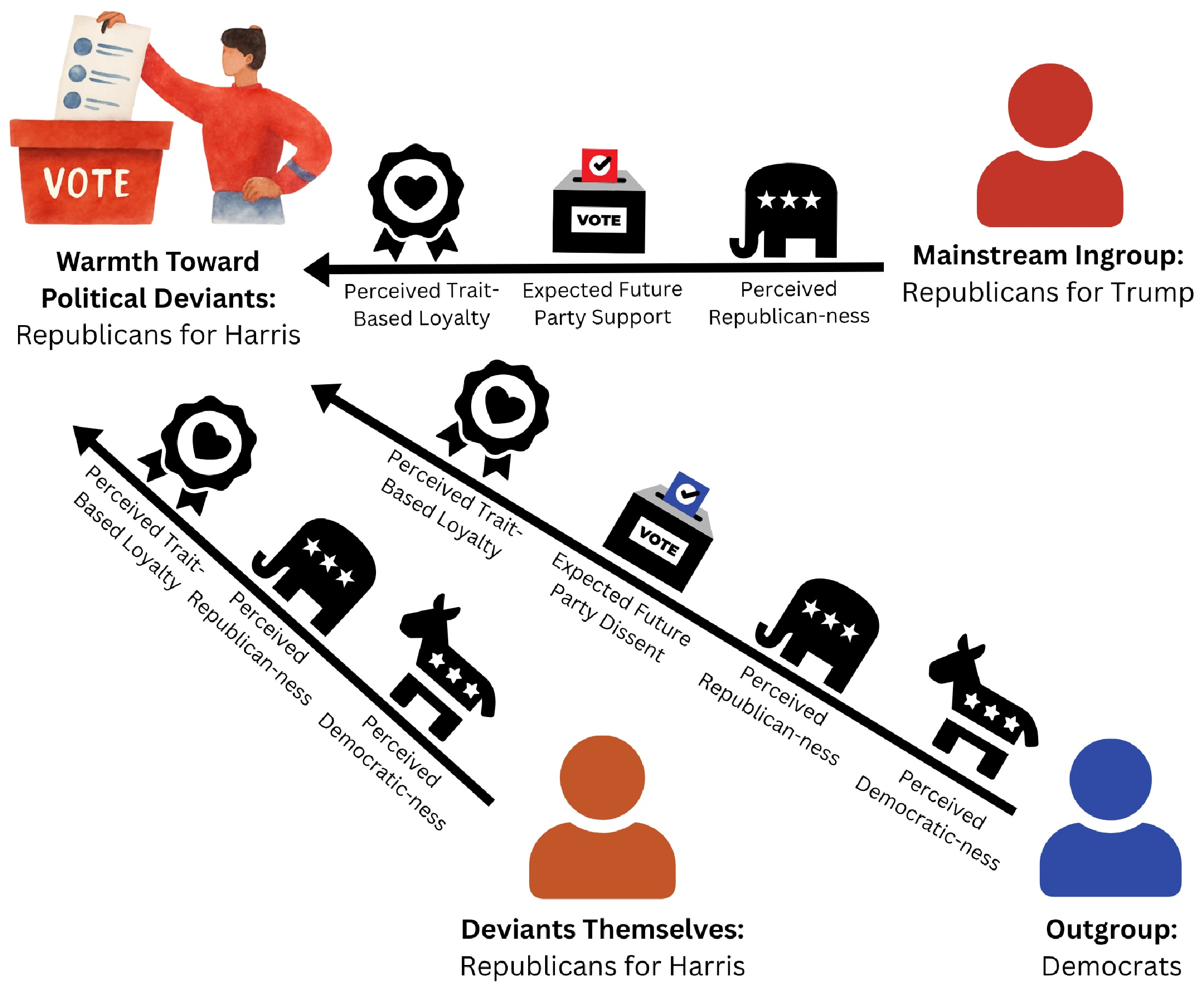
Redefining Loyalty: How Political Deviants Maintain Positive Self-Views Amid Ingroup Rejection

Abstract
1. Introduction
1.1. Evaluations of Deviance
1.2. The Present Case: Republicans for Harris
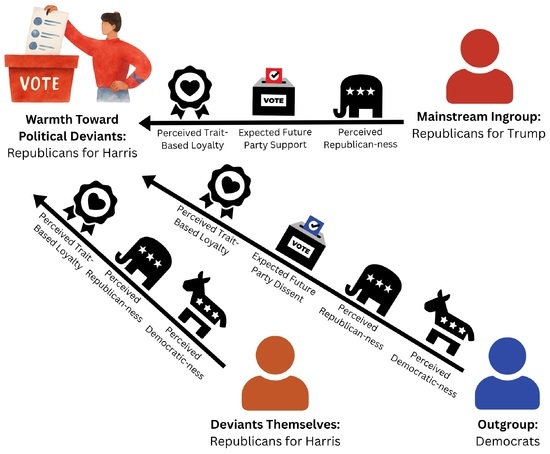
1.3. Current Study
2. Methods
2.1. Participants
Attrition
2.2. Measures
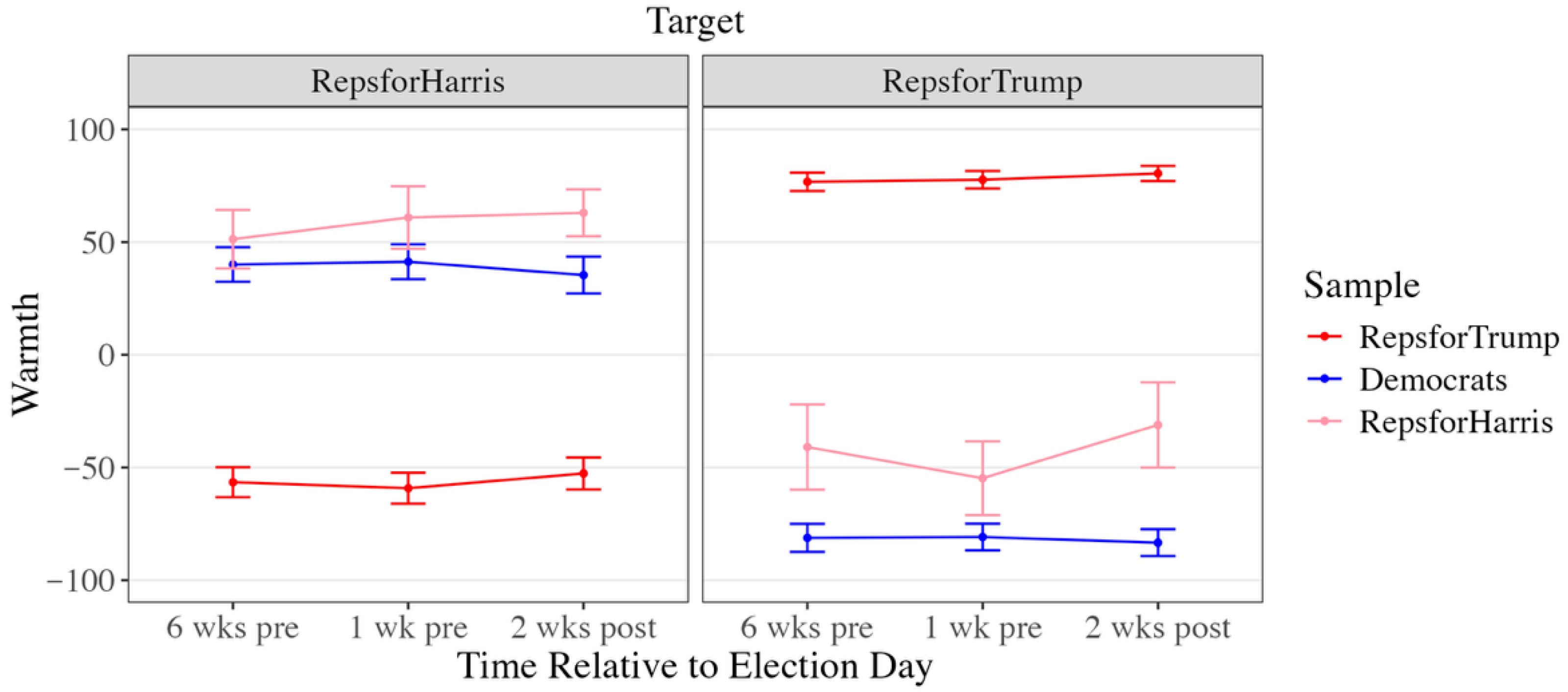
2.2.1. Warmth
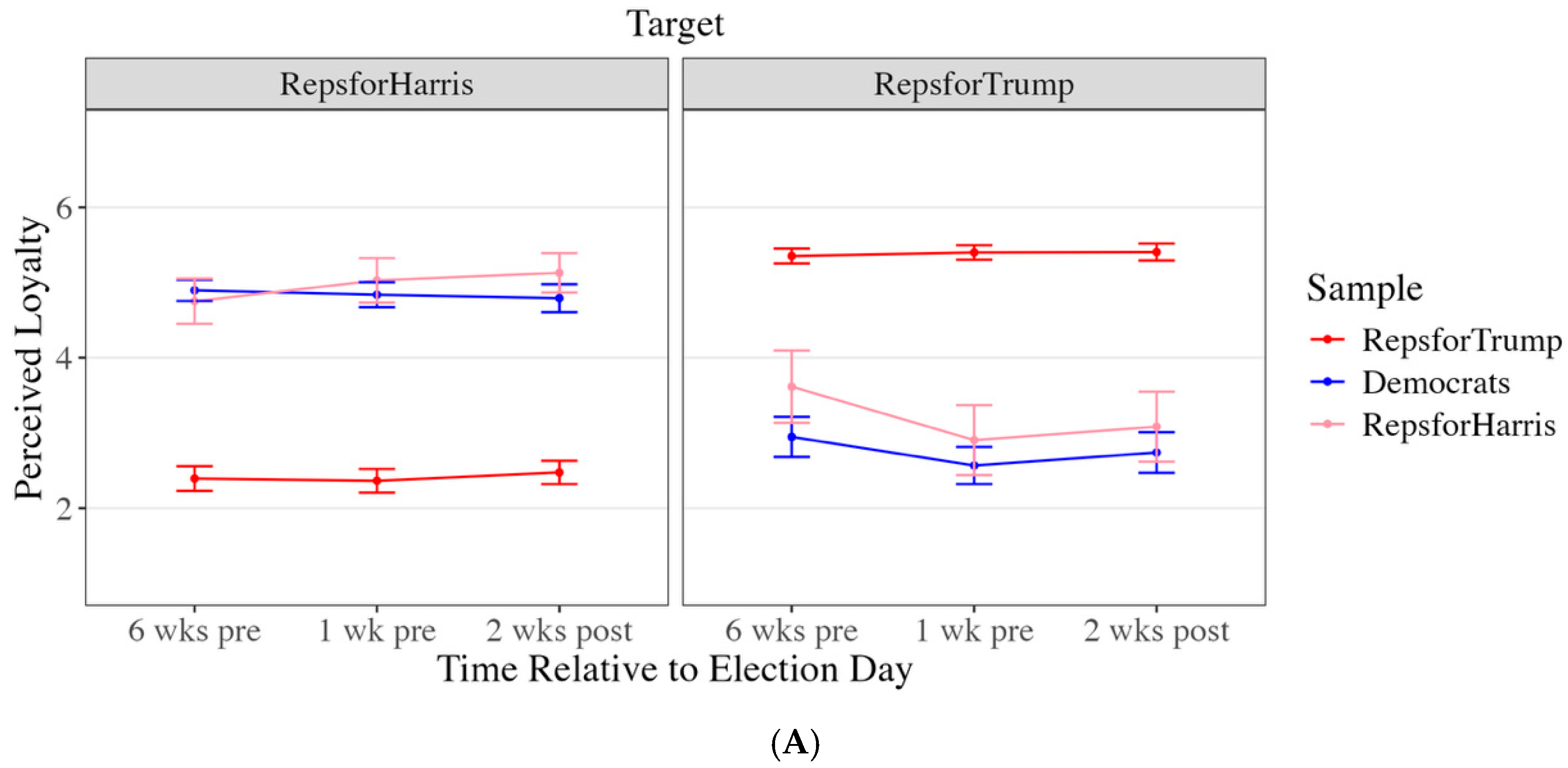
2.2.2. Republican Loyalty
2.2.3. Perceived Norm Priority (Country over Party)
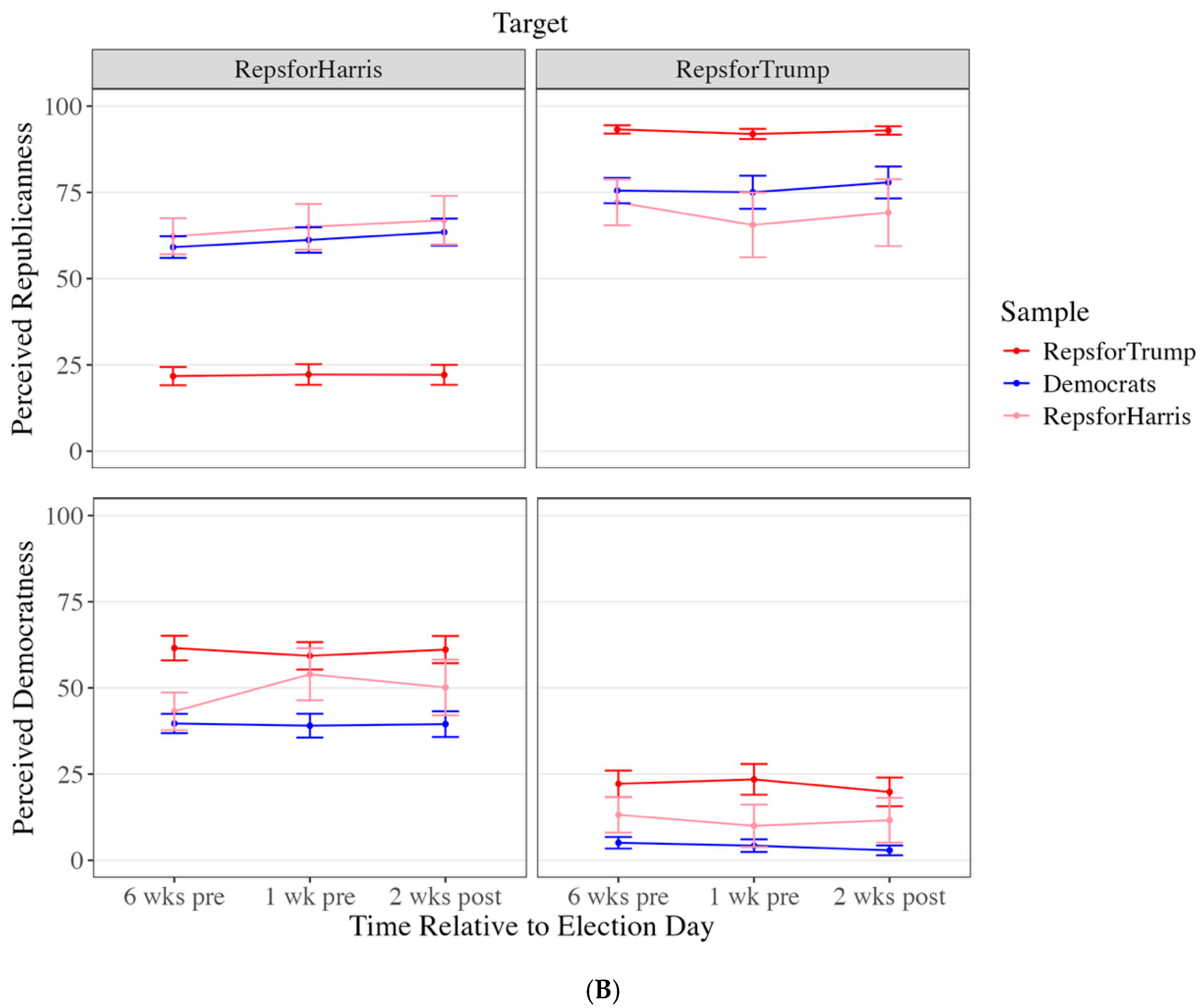
2.2.4. Prototypicality
2.2.5. Partisan Identification
2.2.6. Candidate Support
2.3. Analysis Approach
2.4. Post Hoc Sensitivity Analyses
3. Results
3.1. Warmth Toward Deviants

3.2. Perceived Loyalty of Deviants


3.3. How Perceived Loyalty Shapes Warmth
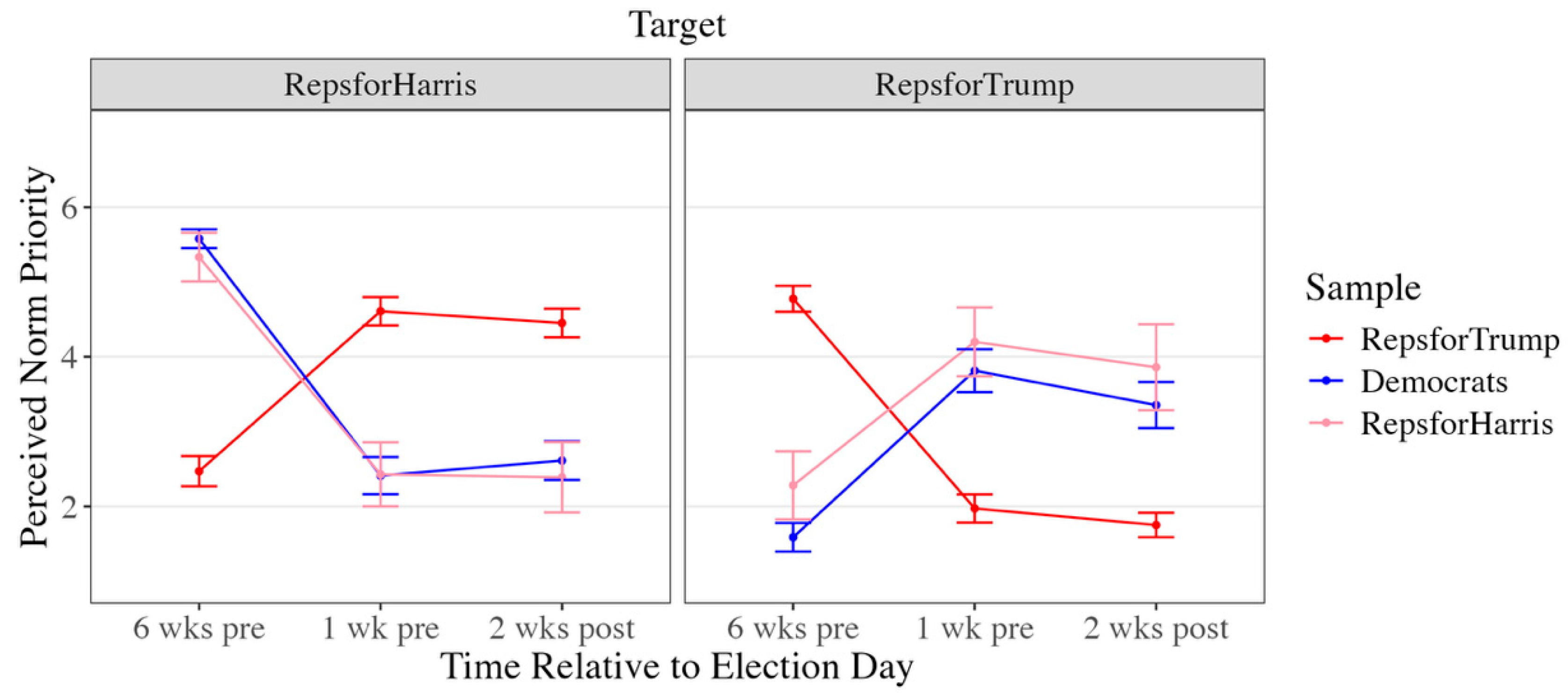
Context-Dependent Norm Prioritization

4. Discussion
4.1. How Loyalty Shapes Attitudes Toward Deviance
4.2. Context-Dependent Construals of Loyalty
4.3. Limitations
5. Conclusions
Supplementary Materials
Author Contributions
Funding
Institutional Review Board Statement
Informed Consent Statement
Data Availability Statement
Conflicts of Interest
| 1 | After the election, 96.31% of RTs, 86.05% of RHs, and 91.41% of Democrats indicated that they voted for their supported candidate. |
References
- Abrams, D., Marques, J., Bown, N., & Dougill, M. (2002). Anti-norm and pro-norm deviance in the bank and on the campus: Two experiments on subjective group dynamics. Group Processes & Intergroup Relations, 5(2), 163–182. [Google Scholar] [CrossRef]
- Abrams, D., Marques, J. M., Bown, N., & Henson, M. (2000). Pro-norm and anti-norm deviance within and between groups. Journal of Personality and Social Psychology, 78(5), 906–912. [Google Scholar] [CrossRef]
- Ahler, D. J. (2018). The group theory of parties: Identity politics, party stereotypes, and polarization in the 21st century. The Forum, 16(1), 3–22. [Google Scholar] [CrossRef]
- American National Election Studies [ANES]. (2020). The anes guide to public opinion and electoral behavior. Available online: https://electionstudies.org/data-tools/anes-guide/anes-guide.html?chart=affective_polarization_parties (accessed on 7 January 2026).
- American National Election Studies [ANES]. (2025). ANES 2024 time series study full release [dataset and documentation]. Available online: www.electionstudies.org (accessed on 8 August 2025).
- Amira, K., Wright, J. C., & Goya-Tocchetto, D. (2021). In-group love versus out-group hate: Which is more important to partisans and when? Political Behavior, 43(2), 473–494. [Google Scholar] [CrossRef]
- Berry, Z., Lewis, N. A., Jr., & Sowden, W. J. (2021). The double-edged sword of loyalty. Current Directions in Psychological Science, 30(4), 321–326. [Google Scholar] [CrossRef]
- Cramwinckel, F. M., van den Bos, K., & van Dijk, E. (2015). Reactions to morally motivated deviance. Current Opinion in Psychology, 6, 150–156. [Google Scholar] [CrossRef]
- Dungan, J. A., Young, L., & Waytz, A. (2019). The power of moral concerns in predicting whistleblowing decisions. Journal of Experimental Social Psychology, 85, 103848. [Google Scholar] [CrossRef]
- Dupuis, D. R., Wohl, M. J., Packer, D. J., & Tabri, N. (2016). To dissent and protect: Stronger collective identification increases willingness to dissent when group norms evoke collective angst. Group Processes & Intergroup Relations, 19(5), 694–710. [Google Scholar] [CrossRef]
- Fernbach, P. M., & Van Boven, L. (2022). False polarization: Cognitive mechanisms and potential solutions. Current Opinion in Psychology, 43, 1–6. [Google Scholar] [CrossRef] [PubMed]
- Finifter, A. W. (1974). The friendship group as a protective environment for political deviants. American Political Science Review, 68(2), 607–625. [Google Scholar] [CrossRef]
- Frimer, J. A., Gaucher, D., & Schaefer, N. K. (2014). Political conservatives’ affinity for obedience to authority is loyal, not blind. Personality & Social Psychology Bulletin, 40(9), 1205–1214. [Google Scholar] [CrossRef]
- Frimer, J. A., & Skitka, L. J. (2018). The Montagu Principle: Incivility decreases politicians’ public approval, even with their political base. Journal of Personality and Social Psychology, 115(5), 845. [Google Scholar] [CrossRef] [PubMed]
- Garrett, K. N., & Bankert, A. (2020). The moral roots of partisan division: How moral conviction heightens affective polarization. British Journal of Political Science, 50(2), 621–640. [Google Scholar] [CrossRef]
- Graham, J., Haidt, J., Koleva, S., Motyl, M., Iyer, R., Wojcik, S. P., & Ditto, P. H. (2013). Moral foundations theory: The pragmatic validity of moral pluralism. In Advances in experimental social psychology (Vol. 47, pp. 55–130). Academic Press. [Google Scholar]
- Graham, J., Haidt, J., & Nosek, B. A. (2009). Liberals and conservatives rely on different sets of moral foundations. Journal of Personality and Social Psychology, 96(5), 1029–1046. [Google Scholar] [CrossRef]
- Graham, J., Nosek, B. A., Haidt, J., Iyer, R., Koleva, S., & Ditto, P. H. (2011). Mapping the moral domain. Journal of Personality and Social Psychology, 101(2), 366. [Google Scholar] [CrossRef]
- Groves, S. (2023, July 18). House republicans propose planting a trillion trees as they move away from climate change denial. Associated Press News. Available online: https://apnews.com/article/climate-change-republicans-trillion-trees-01e455acce4397c0376e82bfa18b72c2?utm_source=chatgpt.com (accessed on 7 January 2026).
- Hornsey, M. J. (2016). Dissent and deviance in intergroup contexts. Current Opinion in Psychology, 11, 1–5. [Google Scholar] [CrossRef]
- Hornsey, M. J., Majkut, L., Terry, D. J., & McKimmie, B. M. (2003). On being loud and proud: Non-conformity and counter-conformity to group norms. The British Journal of Social Psychology, 42(Pt 3), 319–335. [Google Scholar] [CrossRef]
- Jetten, J., Branscombe, N. R., Spears, R., & McKimmie, B. M. (2003). Predicting the paths of peripherals: The interaction of identification and future possibilities. Personality and Social Psychology Bulletin, 29(1), 130–140. [Google Scholar] [CrossRef] [PubMed]
- Jetten, J., & Hornsey, M. J. (2014). Deviance and dissent in groups. Annual Review of Psychology, 65, 461–485. [Google Scholar] [CrossRef]
- Jost, J. T., Van Der Linden, S., Panagopoulos, C., & Hardin, C. D. (2018). Ideological asymmetries in conformity, desire for shared reality, and the spread of misinformation. Current Opinion in Psychology, 23, 77–83. [Google Scholar] [CrossRef]
- Kulibert, D., Moss, A. J., Appleby, J., & O’Brien, L. T. (2025). Perceptions of political deviants in the US democrat and republican parties. Journal of Applied Social Psychology, 55(2), 87–102. [Google Scholar] [CrossRef]
- Lee, C. (2024, November 11). Why abortion rights won in three states that voted for trump. Time. Available online: https://time.com/7174962/abortion-rights-won-states-voted-trump/?utm_source=chatgpt.com (accessed on 7 January 2026).
- Lee, M. J. (2017). Considering political identity: Conservatives, republicans, and donald trump. Rhetoric and Public Affairs, 20(4), 719–730. [Google Scholar] [CrossRef]
- Lelkes, Y. (2018). Affective polarization and ideological sorting: A reciprocal, albeit weak, relationship. The Forum, 16(1), 67–79. [Google Scholar] [CrossRef]
- Levine, J. M., & Moreland, R. L. (2002). Group reactions to loyalty and disloyalty. In Advances in group processes (Vol. 19, pp. 203–228). Emerald (MCB UP). [Google Scholar] [CrossRef]
- Loustau, T., Fong, H. P., & Young, L. (2025). Social identity complexity mitigates outgroup derogation in moral judgment. Journal of Experimental Social Psychology, 121, 104810. [Google Scholar] [CrossRef]
- Loustau, T., Glassman, J., Martin, J. W., Young, L., & McAuliffe, K. (2024). The impact of group membership on punishment versus partner rejection. Scientific Reports, 14, 22238. [Google Scholar] [CrossRef]
- Luttig, M. D. (2016). The rise of partisan rigidity: The nature and origins of partisan extremism in American politics [Doctoral dissertation, University of Minnesota]. [Google Scholar]
- Marques, J., Abrams, D., & Serôdio, R. G. (2001). Being better by being right: Subjective group dynamics and derogation of in-group deviants when generic norms are undermined. Journal of Personality and Social Psychology, 81(3), 436–447. [Google Scholar] [CrossRef]
- Marques, J. M., Yzerbyt, V. Y., & Leyens, J. (1988). The “black sheep effect”: Extremity of judgments towards ingroup members as a function of group identification. European Journal of Social Psychology, 18(1), 1–16. [Google Scholar] [CrossRef]
- Mason, L., & Wronski, J. (2018). One tribe to bind them all: How our social group attachments strengthen partisanship. Political Psychology, 39, 257–277. [Google Scholar] [CrossRef]
- McCammon, S. (2024, August 20). Former trump white house press secretary and other republicans to speak at DNC Tuesday. NPR. Available online: https://www.npr.org/2024/08/19/g-s1-17582/republicans-for-harris-dnc-chicago-election (accessed on 7 January 2026).
- Molski, M. (2024, November 6). How voting demographics changed between 2020 and 2024 presidential elections. NBC Los Angeles. Available online: https://www.nbclosangeles.com/decision-2024/2024-voter-turnout-election-demographics-trump-harris/3554587/?os=vbkn4ztqhoorjmxr5bHHCS0XiZ&ref=app (accessed on 7 January 2026).
- NPR. (2024, August 20). ‘Republicans for Harris’ coalitions have launched in several swing states. Morning Edition. Available online: https://www.npr.org/2024/08/20/nx-s1-5081167/republicans-for-harris-coalitions-have-launched-in-several-swing-states (accessed on 7 January 2026).
- Packer, D. J. (2008). On being both with us and against us: A normative conflict model of dissent in social groups. Personality and Social Psychology Review, 12(1), 50–72. [Google Scholar] [CrossRef]
- Packer, D. J., & Miners, C. T. (2014). Tough love: The normative conflict model and a goal system approach to dissent decisions. Social and Personality Psychology Compass, 8(7), 354–373. [Google Scholar] [CrossRef]
- Packer, D. J., Ungson, N. D., & Marsh, J. K. (2021). Conformity and reactions to deviance in the time of COVID-19. Group Processes & Intergroup Relations, 24(2), 311–317. [Google Scholar] [CrossRef]
- Reiman, A. K., & Killoran, T. C. (2023). When group members dissent: A direct comparison of the black sheep and intergroup sensitivity effects. Journal of Experimental Social Psychology, 104, 104408. [Google Scholar] [CrossRef]
- Schnell, M. (2022, December 8). Here are the 39 house republicans who backed the same-sex marriage bill. The Hill. Available online: https://thehill.com/homenews/house/3767461-here-are-the-39-house-republicans-who-backed-the-same-sex-marriage-bill/?utm_source=chatgpt.com (accessed on 7 January 2026).
- Stephan, W. G., Ybarra, O., & Rios, K. (2015). Intergroup threat theory. In Handbook of prejudice, stereotyping, and discrimination (pp. 255–278). Psychology Press. [Google Scholar]
- Turner, J. C. (1991). Social influence. Thomson Brooks/Cole Publishing Co. [Google Scholar]
- Turner, J. C., Hogg, M. A., Oakes, P. J., Reicher, S. D., & Wetherell, M. S. (1987). Rediscovering the social group: A self-categorization theory. Basil Blackwell. [Google Scholar]
- Van Assche, J., Politi, E., Van Dessel, P., & Phalet, K. (2020). To punish or to assist? Divergent reactions to ingroup and outgroup members disobeying social distancing. British Journal of Social Psychology, 59(3), 594–606. [Google Scholar] [CrossRef] [PubMed]

| Time 1—6 Wks Pre | ||||||
| NTotal | Attrition | Age | Gender | |||
| M (SD) | NFemale | NMale | NNonbinary/Other | |||
| Reps. for Harris | 89 | NA | 44.55 (14.78) | 45 | 44 | 0 |
| Reps. for Trump | 340 | NA | 44.96 (14.05) | 174 | 166 | 0 |
| Democrats | 294 | NA | 38.67 (11.81) | 145 | 144 | 5 |
| Time 2—1 wk pre | ||||||
| NTotal | Attrition | Age | Gender | |||
| M (SD) | NFemale | NMale | NNonbinary/Other | |||
| Reps. for Harris | 51 | 42.70% | 45.61 (12.32) | 25 | 26 | 0 |
| Reps. for Trump | 257 | 24.41% | 45.77 (14.39) | 125 | 132 | 0 |
| Democrats | 181 | 38.44% | 38.79 (11.50) | 94 | 83 | 4 |
| Time 3—2 wks post | ||||||
| NTotal | Attrition | Age | Gender | |||
| M (SD) | NFemale | NMale | NNonbinary/Other | |||
| Reps. for Harris | 43 | 15.69% | 47.67 (14.57) | 19 | 24 | 0 |
| Reps. for Trump | 244 | 5.06% | 46.32 (14.66) | 117 | 123 | 0 |
| Democrats | 163 | 9.94% | 32.29 (11.15) | 84 | 73 | 3 |
| Predictor | Warmth Toward RHs | Warmth Toward RTs | ||||
|---|---|---|---|---|---|---|
| RTs | RHs | Dems | RTs | RHs | Dems | |
| Across Time Points | ||||||
| Intercept | −52.28 *** | 61.96 *** | 40.30 *** | 78.01 *** | −46.75 *** | −80.90 *** |
| Perceived Loyalty to Rep. Party | 10.61 *** | 8.53 ** | 9.95 *** | 6.37 *** | 19.86 *** | 8.04 *** |
| Perceived Norm Priority (Country Over Party) | −0.32 | −0.49 | 2.88 * | −0.16 | 2.90 | 0.98 |
| Perceived Likelihood of Supporting Rep. Party | 6.29 *** | 1.31 | −2.36 | 0.65 | 5.10 | −1.29 |
| Perceived Likelihood of Dissenting from Rep. Party | −0.89 | 3.15 | 7.05 *** | 2.14 * | 7.73 | 6.14 *** |
| Perceived Republican-ness | 18.39 *** | 5.06 * | 3.68 * | 2.92 *** | 9.07* | 0.87 |
| Perceived Democratic-ness | 1.74 | 5.22 * | 5.04 ** | 2.36 ** | 6.67 | 6.69 *** |
| Identification with Republicans | 0.64 | 1.03 | 2.78 | 11.05 *** | 8.50* | 6.31 *** |
| Identification with Democrats | 12.10 *** | 7.03 * | 0.05 *** | −2.11 * | −2.34 | −3.13 ** |
| 6 Weeks Before the 2024 Presidential Election | ||||||
| Intercept | −43.38 *** | 49.42 *** | 23.24 *** | 73.31 *** | −48.38 *** | −80.61 *** |
| Perceived Loyalty to Rep. Party | 7.11 * | 6.30 | 12.33 *** | 8.30 *** | 20.17 ** | 9.85 *** |
| Perceived Norm Priority (Country Over Party) | 13.18 *** | 16.15 ** | 21.70 *** | 5.09 * | 5.44 | 1.34 |
| Perceived Likelihood of Supporting Rep. Party | 3.88 | −6.78 | −1.87 | −0.61 | 7.22 | −2.32 |
| Perceived Likelihood of Dissenting from Rep. Party | −1.26 | 2.46 | 5.70 * | 4.37 * | 14.66 * | 5.92 * |
| Perceived Republican-ness | 20.09 *** | 6.03 | 3.33 | 4.63 *** | 8.39 | 0.21 |
| Perceived Democratic-ness | 5.21 * | 5.14 | 8.68 *** | 2.72 * | 4.38 | 9.02 *** |
| Identification with Republicans | 3.21 | 7.22 | 5.89 * | 12.81 *** | 6.18 | 5.10 * |
| Identification with Democrats | 9.89 *** | 10.91 * | 9.34 *** | −3.08 * | −9.88 | −4.72 ** |
| 1 Week Before the 2024 Presidential Election | ||||||
| Intercept | −49.6 *** | 46.46 *** | 38.96 *** | 73.58 *** | −44.76 *** | −82.02 *** |
| Perceived Loyalty to Rep. Party | 8.00 * | 0.65 | 9.78 * | 9.33 *** | 25.41 ** | 7.56 ** |
| Perceived Norm Priority (Country Over Party) | −9.81 * | −20.72 * | −2.05 | −7.70** | −4.54 | 3.83 |
| Perceived Likelihood of Supporting Rep. Party | 7.36 * | 10.73 | −1.57 | −3.36 | −2.04 | −1.50 |
| Perceived Likelihood of Dissenting from Rep. Party | 7.39 | 7.50 | 9.68 ** | 3.49 | −6.89 | 6.95 *** |
| Perceived Republican-ness | 15.70 *** | 10.95 | 3.33 | 4.45 ** | 4.59 | 2.13 |
| Perceived Democratic-ness | −3.52 | 4.12 | 7.42 * | 3.37 * | 18.96 * | 10.02 *** |
| Identification with Republicans | 3.46 | −0.77 | 4.65 | 11.91 *** | 12.78 * | 9.32 *** |
| Identification with Democrats | 22.04 *** | 5.91 | 11.57 *** | −1.12 | 11.47 | −3.06 |
| 2 Weeks After the 2024 Presidential Election | ||||||
| Intercept | −52.24 *** | 61.99*** | 40.37 *** | 76.21 *** | −24.94 ** | −79.13 *** |
| Perceived Loyalty to Rep. Party | 11.52 ** | 13.46 | 15.82 ** | 4.51 * | 23.76 | 8.46 ** |
| Perceived Norm Priority (Country Over Party) | −2.40 | 3.41 | 5.31 | −4.34 | −7.97 | −2.47 |
| Perceived Likelihood of Supporting Rep. Party | 1.70 | −5.90 | −7.90 | 0.53 | 6.49 | −2.43 |
| Perceived Likelihood of Dissenting from Rep. Party | −2.47 | −5.88 | 3.03 | 4.03* | 3.90 | 5.23 |
| Perceived Republican-ness | 22.69 *** | 9.55 | 5.79 | 7.81 *** | 8.52 | 0.87 |
| Perceived Democratic-ness | 1.29 | 5.12 | 4.28 | 2.14 | 5.06 | 9.76 ** |
| Identification with Republicans | −0.13 | −3.14 | 12.87 *** | 11.93 *** | 11.89 | 10.27 *** |
| Identification with Democrats | 12.01 *** | 6.23 | 16.38 *** | −0.38 | −0.45 | −4.71 * |
Disclaimer/Publisher’s Note: The statements, opinions and data contained in all publications are solely those of the individual author(s) and contributor(s) and not of MDPI and/or the editor(s). MDPI and/or the editor(s) disclaim responsibility for any injury to people or property resulting from any ideas, methods, instructions or products referred to in the content. |
© 2026 by the authors. Licensee MDPI, Basel, Switzerland. This article is an open access article distributed under the terms and conditions of the Creative Commons Attribution (CC BY) license.
Share and Cite
Loustau, T.; Young, L. Redefining Loyalty: How Political Deviants Maintain Positive Self-Views Amid Ingroup Rejection. Behav. Sci. 2026, 16, 126. https://doi.org/10.3390/bs16010126
Loustau T, Young L. Redefining Loyalty: How Political Deviants Maintain Positive Self-Views Amid Ingroup Rejection. Behavioral Sciences. 2026; 16(1):126. https://doi.org/10.3390/bs16010126
Chicago/Turabian StyleLoustau, Trystan, and Liane Young. 2026. "Redefining Loyalty: How Political Deviants Maintain Positive Self-Views Amid Ingroup Rejection" Behavioral Sciences 16, no. 1: 126. https://doi.org/10.3390/bs16010126
APA StyleLoustau, T., & Young, L. (2026). Redefining Loyalty: How Political Deviants Maintain Positive Self-Views Amid Ingroup Rejection. Behavioral Sciences, 16(1), 126. https://doi.org/10.3390/bs16010126