


Perfectionism Mediates the Relationship Between Parental Expectations and Adolescent Depressive Symptoms

Abstract
1. Introduction
1.1. Perfectionism and Parental Expectations
1.2. Social Expectations Model
1.3. Perfectionism and Mental Health Outcomes
1.4. Current Study
2. Materials and Methods
2.1. Participants
2.2. Measures
2.2.1. Living up to Parent Expectations Inventory
2.2.2. Frost’s Multi-Dimensional Perfectionism Scale
2.2.3. Beck Depression Inventory
2.3. Data Analysis
3. Results
4. Discussion
Limitations
5. Conclusions
Author Contributions
Funding
Institutional Review Board Statement
Informed Consent Statement
Data Availability Statement
Conflicts of Interest
References
- Almroth, M., László, K., Kosidou, K., & Galanti, M. (2020). Individual and familial factors predict formation and improvement of adolescents’ academic expectations: A longitudinal study in Sweden. PLoS ONE, 15, e0229505. [Google Scholar] [CrossRef]
- Beck, A. T., Steer, R. A., & Carbin, M. G. (1988). Psychometric properties of the Beck Depression Inventory: Twenty-five years of evaluation. Clinical Psychology Review, 8(1), 77–100. [Google Scholar] [CrossRef]
- Choe, D. (2020). Parents’ and adolescents’ perceptions of parental support as predictors of adolescents’ academic achievement and self-regulated learning. Children and Youth Services Review, 116, 105172. [Google Scholar] [CrossRef]
- Cross, F. L., Marchand, A. D., Medina, M., Villafuerte, A., & Rivas-Drake, D. (2019). Academic socialization, parental educational expectations, and academic self-efficacy among Latino adolescents. Psychology in the Schools, 56(4), 483–496. [Google Scholar] [CrossRef]
- Curran, T., & Hill, A. P. (2022). Young people’s perceptions of their parents’ expectations and criticism are increasing over time: Implications for perfectionism. Psychological Bulletin, 148(1–2), 107–128. [Google Scholar] [CrossRef]
- Damian, L. E., Negru-Subtirica, O., Pop, E. I., & Stoeber, J. (2021). Becoming a perfectionistic adolescent: Perceived parental behaviors involved in developmental trajectories of perfectionism. European Journal of Personality, 36(1), 24–46. [Google Scholar] [CrossRef]
- Damian, L. E., Stoeber, J., Negru, O., & Băban, A. (2013). On the development of perfectionism in adolescence: Perceived parental expectations predict longitudinal increases in socially prescribed perfectionism. Personality and Individual Differences, 55(6), 688–693. [Google Scholar] [CrossRef]
- De Los Reyes, A., Ohannessian, C. M., & Racz, S. J. (2019). Discrepancies between adolescent and parent reports about family relationships. Child Development Perspectives, 13(1), 53–58. [Google Scholar] [CrossRef]
- Díez, M., Jiménez-Iglesias, A., Paniagua, C., & García-Moya, I. (2024). The role of perfectionism and parental expectations in the school stress and health complaints of secondary school students. Youth & Society, 56(5), 885–906. [Google Scholar] [CrossRef]
- Domocus, I. M., & Damian, L. E. (2018). The role of parents and teachers in changing adolescents’ perfectionism: A short-term longitudinal study. Personality and Individual Differences, 131, 244–248. [Google Scholar] [CrossRef]
- Doyle, S., & Catling, J. (2022). The influence of perfectionism, self-esteem, and resilience on young people’s mental health. Journal of Psychologists and Counsellors in Schools, 32(2), 276–291. [Google Scholar] [CrossRef] [PubMed]
- Flett, G. L., & Hewitt, P. L. (2022). Perfectionism in childhood and adolescence: A developmental approach. American Psychological Association. [Google Scholar] [CrossRef]
- Flett, G. L., Hewitt, P. L., Besser, A., Su, C., Vaillancourt, T., Boucher, D., & Gale, O. (2016). The Child–Adolescent Perfectionism Scale: Development, psychometric properties, and associations with stress, distress, and psychiatric symptoms. Journal of Psychoeducational Assessment, 34(7), 634–652. [Google Scholar] [CrossRef]
- Flett, G. L., Hewitt, P. L., Oliver, J. M., & Macdonald, S. (2002). Perfectionism in children and their parents: A developmental analysis. In G. L. Flett, & P. L. Hewitt (Eds.), Perfectionism: Theory, research, and treatment (pp. 89–132). American Psychological Association. [Google Scholar] [CrossRef]
- Frost, R. O., Marten, P., Lahart, C., & Rosenblate, R. (1990). The dimensions of perfectionism. Cognitive Therapy and Research, 14, 449–468. [Google Scholar] [CrossRef]
- Gäde, J., Schermelleh-Engel, K., & Klein, A. (2017). Disentangling the common variance of perfectionistic strivings and perfectionistic concerns: A bifactor model of perfectionism. Frontiers in Psychology, 8, 160. [Google Scholar] [CrossRef]
- Gyori, D., Farkas, B. F., Komaromy, D., Horvath, L. O., Kollarovics, N., Garas, P., & Balazs, J. (2023). The association between nonsuicidal self-injury and perfectionism in adolescence: The role of mental disorders. European Journal of Investigation in Health, Psychology and Education, 13(11), 2299–2327. [Google Scholar] [CrossRef]
- Haspolat, N. K., & Yalçın, İ. (2023). Psychological symptoms in high-achieving students: The multiple mediating effects of parental achievement pressure, perfectionism, and academic expectation stress. Psychology in the Schools, 60(11), 4721–4739. [Google Scholar] [CrossRef]
- Hewitt, P. L., & Flett, G. L. (1991). Perfectionism in self and social contexts: Conceptualizations, assessment, and association with psychopathology. Journal of Personality and Social Psychology, 60, 456–470. [Google Scholar] [CrossRef]
- Kuusi, A., Hirvonen, R., Niemivirta, M., & Tuominen, H. (2025). Perfectionistic profiles and well-being in general upper secondary education: The moderating role of perceived support. International Journal of Educational Research, 134, 102769. [Google Scholar] [CrossRef]
- Lavrijsen, J., Soenens, B., Vansteenkiste, M., & Verschueren, K. (2021). Is intelligence related to perfectionism? Multidimensional perfectionism and parental antecedents among adolescents across varying levels of cognitive ability. Journal of Personality, 89(4), 652–671. [Google Scholar] [CrossRef]
- Lee, A., & Park, J. (2022). Diagnostic test accuracy of the beck depression inventory for detecting major depression in adolescents: A systematic review and meta-analysis. Clinical Nursing Research, 31(8), 1481–1490. [Google Scholar] [CrossRef]
- Levine, S. L., Green-Demers, I., Werner, K. M., & Milyavskaya, M. (2019). Perfectionism in adolescents: Self-critical perfectionism as a predictor of depressive symptoms across the school year. Journal of Social and Clinical Psychology, 38(1), 70–86. [Google Scholar] [CrossRef]
- Limburg, K., Watson, H. J., Hagger, M. S., & Egan, S. J. (2017). The relationship between perfectionism and psychopathology: A meta-analysis. Journal of Clinical Psychology, 73(10), 1301–1326. [Google Scholar] [CrossRef] [PubMed]
- Liu, M., Zhang, T., Tang, N., Zhou, F., & Tian, Y. (2022). The effect of educational expectations on children’s cognition and depression. International Journal of Environmental Research and Public Health, 19(21), 14070. [Google Scholar] [CrossRef] [PubMed]
- Lu, H., Nie, P., & Sousa-Poza, A. (2020). The effect of parental educational expectations on adolescent subjective well-being and the moderating role of perceived academic pressure: Longitudinal evidence for China. Child Indicators Research, 14, 117–137. [Google Scholar] [CrossRef]
- Lunn, J., Greene, D., Callaghan, T., & Egan, S. (2023). Associations between perfectionism and symptoms of anxiety, obsessive–compulsive disorder and depression in young people: A meta-analysis. Cognitive Behaviour Therapy, 52, 460–487. [Google Scholar] [CrossRef]
- Ma, Y., Siu, A., & Tse, W. (2018). The role of high parental expectations in adolescents’ academic performance and depression in Hong Kong. Journal of Family Issues, 39, 2505–2522. [Google Scholar] [CrossRef]
- Madjar, N., Voltsis, M., & Weinstock, M. P. (2015). The roles of perceived parental expectation and criticism in adolescents’ multidimensional perfectionism and achievement goals. Educational Psychology, 35(6), 765–778. [Google Scholar] [CrossRef]
- Mallinson, S., & Hill, A. (2011). The relationship between multidimensional perfectionism and psychological need thwarting in junior sports participants. Psychology of Sport and Exercise, 12, 676–684. [Google Scholar] [CrossRef]
- Menon, S., Aiswarya, V. R., & Rajan, S. K. (2025). Parental expectations and fear of negative evaluation among Indian emerging adults: The mediating role of maladaptive perfectionism. Indian Journal of Psychological Medicine, 47(5), 479–487. [Google Scholar] [CrossRef]
- Molnar, D. S., Thai, S., Blackburn, M., Zinga, D., Flett, G. L., & Hewitt, P. L. (2022). Dynamic changes in perfectionism dimensions and psychological distress among adolescents assessed before and during the COVID-19 pandemic. Child Development, 94(1), 254–271. [Google Scholar] [CrossRef]
- Nafiah, R. K., & Izzaty, R. E. (2024). Parental support in nurturing self-efficacy: Understanding youth expectations during early adolescence. Journal Penelitian Pendidikan Indonesia, 10(2), 161–169. [Google Scholar] [CrossRef]
- Okereke, A. E., & Ebenuwa-Okoh, E. E. (2021). Relationship between financial stress, parental expectations and depression among students in tertiary institutions in Delta Central Senatorial District. Journal of Educational Research and Development, 21(1), 133–145. [Google Scholar]
- Patterson, H., Firebaugh, C., Zolnikov, T., Wardlow, R., Morgan, S., & Gordon, B. (2021). A systematic review on the psychological effects of perfectionism and accompanying treatment. Psychology, 12, 1–24. [Google Scholar] [CrossRef]
- Sawitri, D. R., Creed, P. A., & Zimmer-Gembeck, M. J. (2015). Longitudinal relations of parental influences and adolescent career aspirations and actions in a collectivist society. Journal of Research on Adolescence, 25(3), 551–563. [Google Scholar] [CrossRef]
- Sironic, A., & Reeve, R. A. (2015). A combined analysis of the Frost Multidimensional Perfectionism Scale (FMPS), Child and Adolescent Perfectionism Scale (CAPS), and Almost Perfect Scale—Revised (APS-R): Different perfectionist profiles in adolescent high school students. Psychological Assessment, 27(4), 1471. [Google Scholar] [CrossRef]
- Slaney, R. B., Rice, K. G., Mobley, M., Trippi, J., & Ashby, J. S. (2001). The revised almost perfect scale. Measurement and Evaluation in Counseling and Development, 34(3), 130–145. [Google Scholar] [CrossRef]
- Smith, M. M., Sherry, S. B., Ge, S. Y., Hewitt, P. L., Flett, G. L., & Baggley, D. L. (2022). Multidimensional perfectionism turns 30: A review of known knowns and known unknowns. Canadian Psychology, 63(1), 16. [Google Scholar] [CrossRef]
- Smith, M. M., Sherry, S. B., Ray, C., Hewitt, P. L., Flett, G. L., & Mushquash, C. (2021). Is perfectionism a vulnerability factor for depressive symptoms, a complication of depressive symptoms, or both? A meta-analytic test of 67 longitudinal studies. Clinical Psychology Review, 84, 101982. [Google Scholar] [CrossRef]
- Smith, M. M., Sherry, S. B., Vidovic, V., Saklofske, D. H., Stoeber, J., & Benoit, A. (2019). Perfectionism and the Five-Factor Model of personality: A meta-analytic review. Personality and Social Psychology Review, 23, 367–390. [Google Scholar] [CrossRef]
- Stiles, K., Lee, S. S., & Luthar, S. S. (2020). When parents seek perfection: Implications for psychological functioning among teens at high-achieving schools. Journal of Child and Family Studies, 29(11), 3117–3128. [Google Scholar] [CrossRef]
- Stoeber, J., & Otto, K. (2006). Positive conceptions of perfectionism: Approaches, evidence, challenges. Personality and Social Psychology Review, 10(4), 295–319. [Google Scholar] [CrossRef]
- Stoeber, J., & Rambow, A. (2007). Perfectionism in adolescent school students: Relations with motivation, achievement, and well-being. Personality and Individual Differences, 42, 1379–1389. [Google Scholar] [CrossRef]
- Wang, L. F., & Heppner, P. P. (2002). Assessing the impact of parental expectations and psychological distress on Taiwanese college students. The Counseling Psychologist, 30(4), 582–608. [Google Scholar] [CrossRef]
- Wigfield, A., & Eccles, J. S. (2000). Expectancy–value theory of achievement motivation. Contemporary Educational Psychology, 25(1), 68–81. [Google Scholar] [CrossRef]
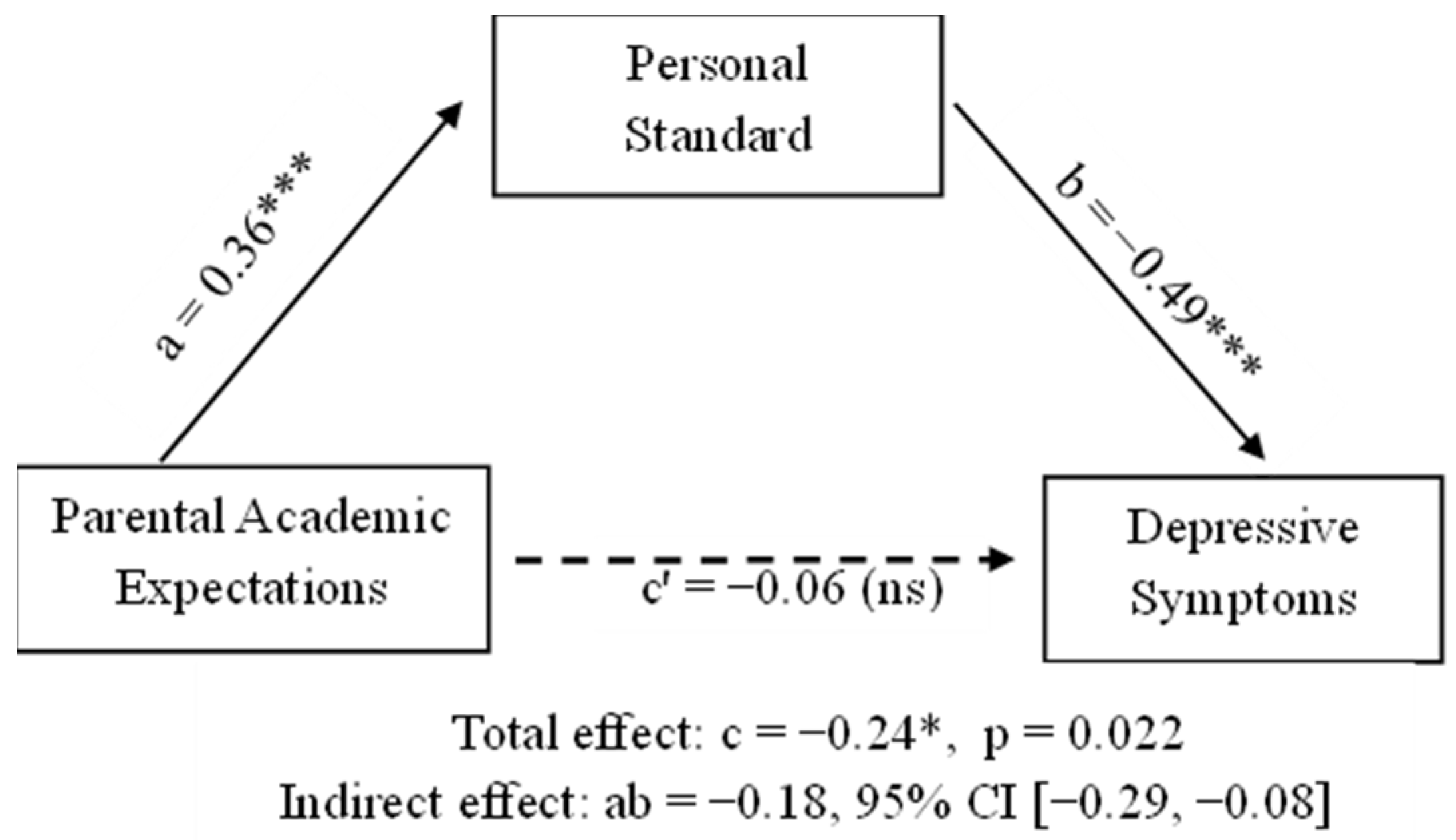
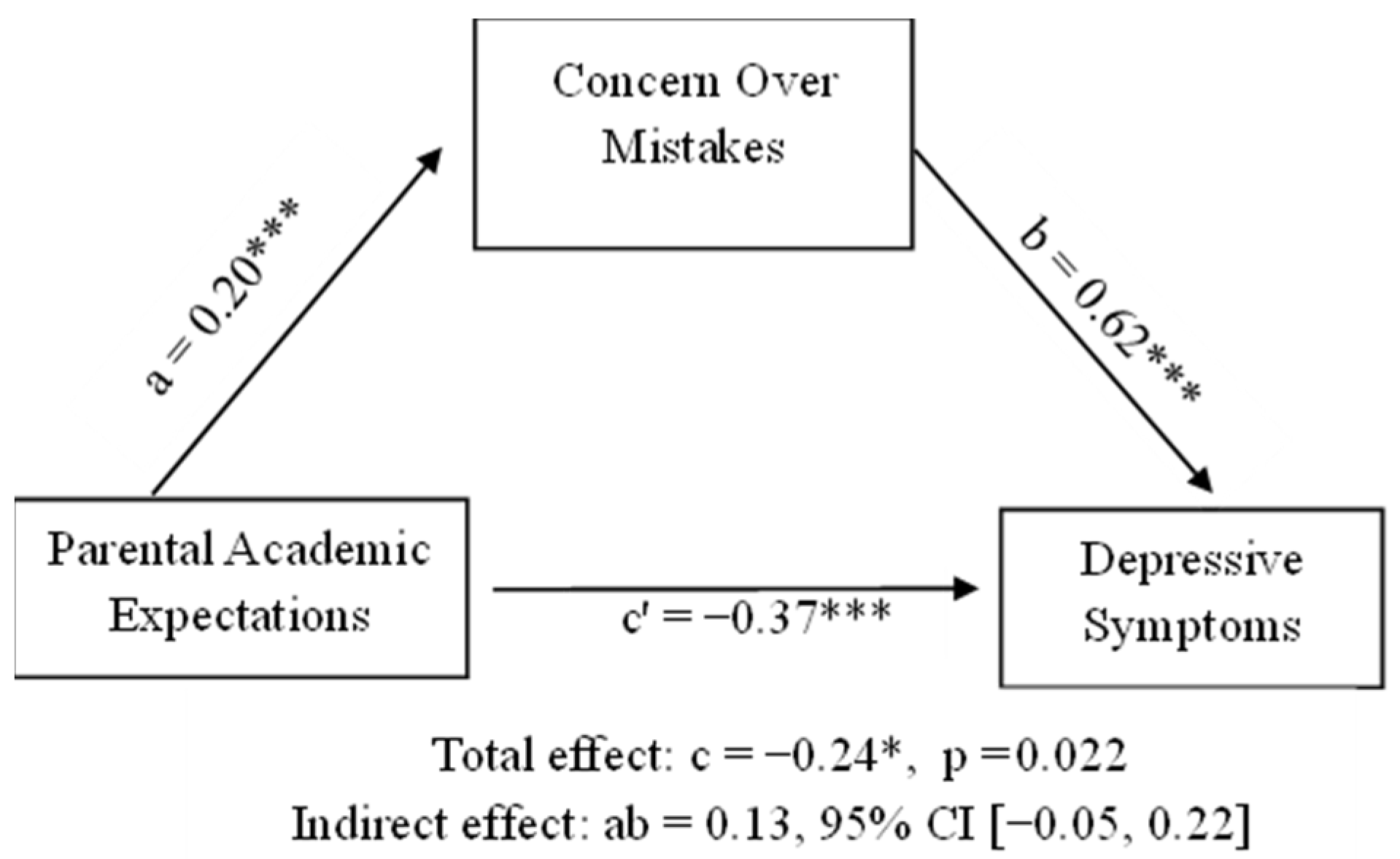

| 1 | 2 | 3 | 4 | |
|---|---|---|---|---|
| Depressive Symptoms | 1 | |||
| Personal Standard | −0.24 ** | 1 | ||
| Concern over Mistakes | 0.25 ** | 0.13 * | 1 | |
| Parental Academic Expectation | −0.14 * | 0.44 ** | 0.23 ** | 1 |
| Mean | 2.57 | 3.81 | 2.96 | 3.50 |
| Standard Deviation | 1.46 | 0.67 | 0.71 | 0.82 |
| Alphas (α) | 0.83 | 0.71 | 0.70 | 0.78 |
| Unstandardized Coefficients | Standardized Coefficients | 95% Confidence Interval for B | ||||||
|---|---|---|---|---|---|---|---|---|
| Model | Predictor | B | SE | β | t | p | Lower Bound | Upper Bound |
| 1 | (Constant) | 2.54 | 0.16 | — | 16.02 | <0.001 | 2.23 | 2.85 |
| PE → PS | 0.36 | 0.04 | 0.44 | 8.26 | <0.001 | 0.28 | 0.45 | |
| 2 | (Constant) | 4.67 | 0.51 | — | 9.10 | <0.001 | 3.66 | 5.68 |
| PE → Dep | −0.06 | 0.11 | −0.04 | −0.55 | 0.58 | −0.29 | 0.16 | |
| PS → Dep | −0.49 | 0.14 | −0.23 | −3.53 | <0.001 | −0.77 | −0.22 | |
| Unstandardized Coefficients | Standardized Coefficients | 95% Confidence Interval for B | ||||||
|---|---|---|---|---|---|---|---|---|
| Model | Predictor | B | SE | β | t | p | Lower Bound | Upper Bound |
| 1 | (Constant) | 2.25 | 0.18 | — | 12.37 | <0.001 | 1.89 | 2.60 |
| PE → CM | 0.20 | 0.05 | 0.23 | 4.04 | <0.001 | 0.10 | 0.30 | |
| 2 | (Constant) | 2.03 | 0.45 | — | 4.52 | <0.001 | 1.15 | 2.29 |
| PE → Dep | −0.37 | 0.10 | −0.21 | −3.56 | <0.001 | −0.57 | −0.16 | |
| CM → Dep | 0.62 | 0.12 | 0.30 | 5.21 | <0.001 | 0.38 | 0.85 | |
Disclaimer/Publisher’s Note: The statements, opinions and data contained in all publications are solely those of the individual author(s) and contributor(s) and not of MDPI and/or the editor(s). MDPI and/or the editor(s) disclaim responsibility for any injury to people or property resulting from any ideas, methods, instructions or products referred to in the content. |
© 2026 by the authors. Licensee MDPI, Basel, Switzerland. This article is an open access article distributed under the terms and conditions of the Creative Commons Attribution (CC BY) license.
Share and Cite
Aworefa, T.S.; Fletcher, K.L. Perfectionism Mediates the Relationship Between Parental Expectations and Adolescent Depressive Symptoms. Behav. Sci. 2026, 16, 125. https://doi.org/10.3390/bs16010125
Aworefa TS, Fletcher KL. Perfectionism Mediates the Relationship Between Parental Expectations and Adolescent Depressive Symptoms. Behavioral Sciences. 2026; 16(1):125. https://doi.org/10.3390/bs16010125
Chicago/Turabian StyleAworefa, Tolulope S., and Kathryn L. Fletcher. 2026. "Perfectionism Mediates the Relationship Between Parental Expectations and Adolescent Depressive Symptoms" Behavioral Sciences 16, no. 1: 125. https://doi.org/10.3390/bs16010125
APA StyleAworefa, T. S., & Fletcher, K. L. (2026). Perfectionism Mediates the Relationship Between Parental Expectations and Adolescent Depressive Symptoms. Behavioral Sciences, 16(1), 125. https://doi.org/10.3390/bs16010125

