Instagram Addiction in Italian Young Adults: The Role of Social Influence Processes, Meaningful Relationships and Fear of Missing Out

 ,
,  ,
,  ,
,
Abstract
1. Introduction
1.1. Social Media Usage, Psychological Effects, and Instagram Addiction
1.2. Instagram Addiction: Risk Factors, Correlates, and Moderators
1.3. Social Influence and Interpersonal Relationships in Problematic Social Media Use
1.4. Anxious Attachment, Fear of Missing Out, and Problematic Social Media Use
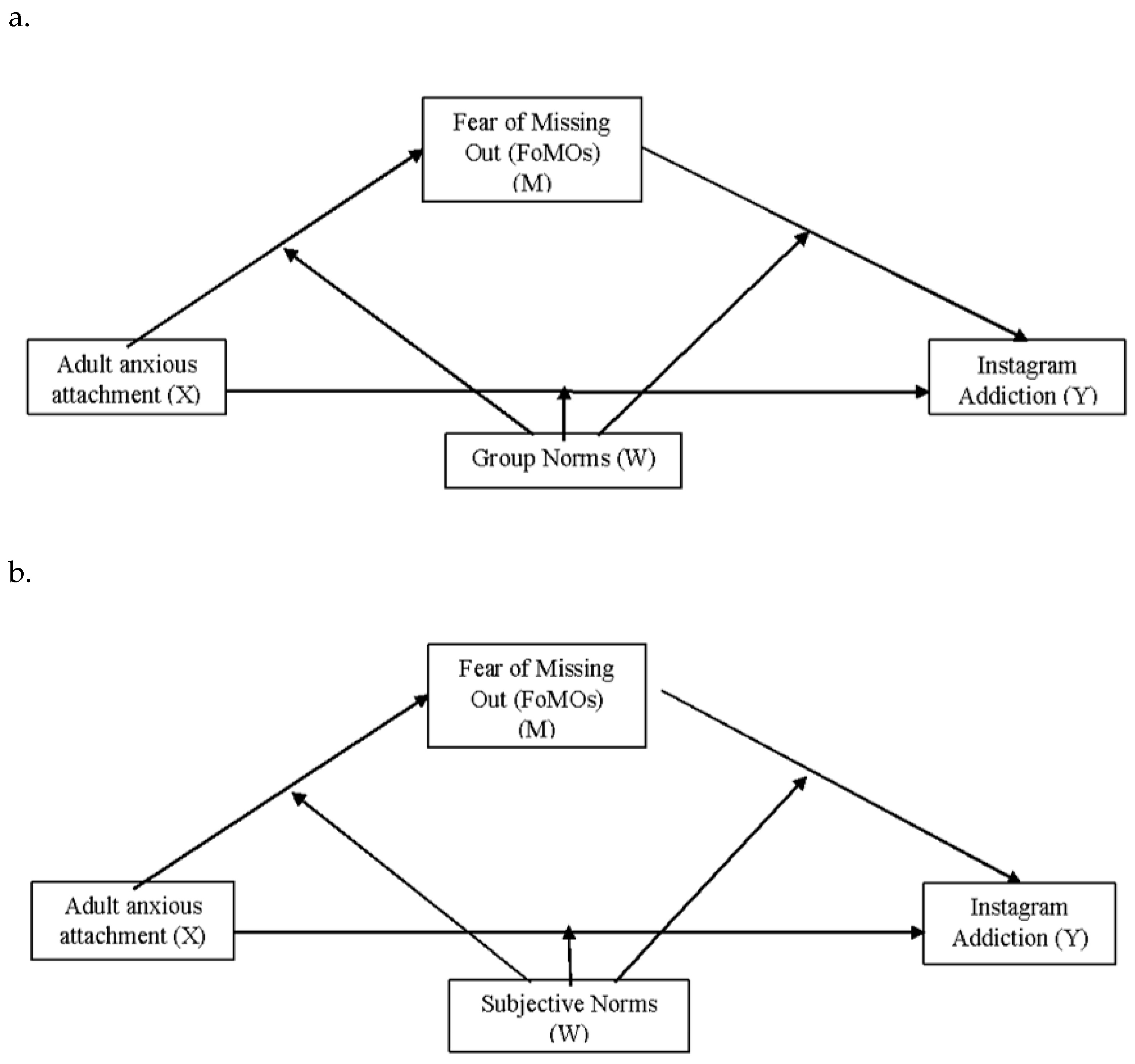
1.5. Study Aims and Hypothesis
2. Materials and Methods
2.1. Study Design and Data Collection
2.2. Ethical Aspects
2.3. Measures
2.4. Data Analysis
3. Results
3.1. The Use of Instagram Among Young Adults
3.1.1. Benefits of Using Social Network
3.1.2. Costs of Using Social Networks
3.2. Interactions and Moderations Among SIP, Meaningful Relationships, and FoMO on IA
4. Discussion
5. Conclusions
Author Contributions
Funding
Institutional Review Board Statement
Informed Consent Statement
Data Availability Statement
Acknowledgments
Conflicts of Interest
References
- Abbasi, I. S. (2019). Social media and committed relationships: What factors make our romantic relationship vulnerable? Social Science Computer Review, 37(3), 425–434. [Google Scholar] [CrossRef]
- Abbasi, I. S., Drouin, M., McDaniel, B. T., & Dibble, J. L. (2019). The protective influence of relationship commitment on the effects of Facebook addiction on marital disaffection. The American Journal of Family Therapy, 47(2), 120–136. [Google Scholar] [CrossRef]
- Ainsworth, M. D. (1985). Patterns of infant-mother attachments: Antecedents and effects on development. Bulletin of the New York Academy of Medicine, 61(9), 771. [Google Scholar] [PubMed]
- Angelini, F., Marino, C., & Gini, G. (2023). Friendship quality in adolescence: The role of social media features, online social support and e-motions. Current Psychology, 42(30), 26016–26032. [Google Scholar] [CrossRef]
- APA American Psychiatric Association, DSM-5 Task Force. (2013). Diagnostic and statistical manual of mental disorders: DSM-5™ (5th ed.). American Psychiatric Publishing, Inc. [Google Scholar] [CrossRef]
- Baek, Y. M., Cho, Y., & Kim, H. (2014). Attachment style and its influence on the activities, motives, and consequences of SNS use. Journal of Broadcasting & Electronic Media, 58(4), 522–541. [Google Scholar] [CrossRef]
- Ballarotto, G., Volpi, B., & Tambelli, R. (2021). Adolescent attachment to parents and peers and the use of Instagram: The mediation role of psychopathological risk. International Journal of Environmental Research and Public Health, 18(8), 3965. [Google Scholar] [CrossRef] [PubMed]
- Benzi, I. M. A., Fontana, A., Lingiardi, V., Parolin, L., & Carone, N. (2024). “Don’t leave me behind!” problematic internet use and fear of missing out through the lens of epistemic trust in emerging adulthood. Current Psychology, 43(15), 13775–13784. [Google Scholar] [CrossRef]
- Blackwell, D., Leaman, C., Tramposch, R., Osborne, C., & Liss, M. (2017). Extraversion, neuroticism, attachment style and fear of missing out as predictors of social media use and addiction. Personality and Individual Differences, 116, 69–72. [Google Scholar] [CrossRef]
- Błachnio, A., & Przepiórka, A. (2018). Facebook intrusion, fear of missing out, narcissism, and life satisfaction: A cross-sectional study. Psychiatry Research, 259, 514–519. [Google Scholar] [CrossRef]
- Boustead, R., & Flack, M. (2021). Moderated-mediation analysis of problematic social networking use: The role of anxious attachment orientation, fear of missing out and satisfaction with life. Addictive Behaviors, 119, 106938. [Google Scholar] [CrossRef]
- Bowlby, J. (1969). Attachment and loss. Vol. 1: Attachment. Basic Books. [Google Scholar]
- Bowlby, J. (1988). A secure base: Parent-child attachment and healthy human development. Basic Books. [Google Scholar]
- Braun, V., & Clarke, V. (2006). Using thematic analysis in psychology. Qualitative Research in Psychology, 3(2), 77–101. [Google Scholar] [CrossRef]
- Bukowski, W. M., Hoza, B., & Boivin, M. (1994). Measuring friendship quality during pre-and early adolescence: The development and psychometric properties of the friendship qualities scale. Journal of Social and Personal Relationships, 11(3), 471–484. [Google Scholar] [CrossRef]
- Carvalho, C. B., Cabral, J. M., Teixeira, M., Cordeiro, F., Costa, R., & Arroz, A. M. (2023). “Belonging without being”: Relationships between problematic gaming, internet use, and social group attachment in adolescence. Computers in Human Behavior, 149, 107932. [Google Scholar] [CrossRef]
- Casale, S., & Fioravanti, G. (2020). Factor structure and psychometric properties of the Italian version of the fear of missing out scale in emerging adults and adolescents. Addictive Behaviors, 102, 106179. [Google Scholar] [CrossRef]
- Chai, H. Y., Niu, G. F., Chu, X. W., Wei, Q., Song, Y. H., & Sun, X. J. (2018). Fear of missing out: What have I missed again? Advances in Psychological Science, 26(3), 527. [Google Scholar] [CrossRef]
- Chen, C. Y. (2018). Smartphone addiction: Psychological and social factors predict the use and abuse of a social mobile application. Information, Communication & Society, 23(3), 454–467. [Google Scholar] [CrossRef]
- Collins, N. L. (1996). Revised Adult Attachment Scale (RAAS) [Database record]. APA PsycTests. [Google Scholar] [CrossRef]
- D’Arienzo, M. C., Boursier, V., & Griffiths, M. D. (2019). Addiction to social media and attachment styles: A systematic literature review. International Journal of Mental Health and Addiction, 17, 1094–1118. [Google Scholar] [CrossRef]
- Deci, E. L., & Ryan, R. M. (1985). The general causality orientations scale: Self-determination in personality. Journal of Research in Personality, 19(2), 109–134. [Google Scholar] [CrossRef]
- Della Vedova, A. M., Covolo, L., Muscatelli, M., Loscalzo, Y., Giannini, M., & Gelatti, U. (2022). Psychological distress and problematic smartphone use: Two faces of the same coin? Findings from a survey on young Italian adults. Computers in Human Behavior, 132, 107243. [Google Scholar] [CrossRef]
- Demircioğlu, Z. I., & Köse, A. G. (2021). Effects of attachment styles, dark triad, rejection sensitivity, and relationship satisfaction on social media addiction: A mediated model. Current Psychology, 40, 414–428. [Google Scholar] [CrossRef]
- de Oliveira, M. J., Huertas, M. K. Z., & Lin, Z. (2016). Factors driving young users’ engagement with Facebook: Evidence from Brazil. Computers in Human Behavior, 54, 54–61. [Google Scholar] [CrossRef]
- Dhir, A., Yossatorn, Y., Kaur, P., & Chen, S. (2018). Online social media fatigue and psychological wellbeing—A study of compulsive use, fear of missing out, fatigue, anxiety and depression. International Journal of Information Management, 40, 141–152. [Google Scholar] [CrossRef]
- Dholakia, U. M., Bagozzi, R. P., & Pearo, L. K. (2004). A social influence model of consumer participation in network-and small-group-based virtual communities. International Journal of Research in Marketing, 21(3), 241–263. [Google Scholar] [CrossRef]
- Digital Global Overview Report. (2024). Available online: https://datareportal.com/reports/digital-2024-global-overview-report (accessed on 18 January 2024).
- D’Souza, L., & Hemamalini, M. J. (2018). Instagram addiction and depression among college students. International Journal of Indian Psychology, 6(4), 96–102. [Google Scholar] [CrossRef]
- Elhai, J. D., Yang, H., Fang, J., Bai, X., & Hall, B. J. (2019). Depression andanxiety symptoms are related to problematic smartphone use severity in Chinese young adults: Fear of missing out as a mediator. Addictive Behaviors, 101, 105962. [Google Scholar] [CrossRef] [PubMed]
- Ellemers, N., Kortekaas, P., & Ouwerkerk, J. W. (1999). Self-categorization, commitment to the group and group self-esteem as related but distinct aspects of social identity. European Journal of Social Psychology, 29(2/3), 371–389. [Google Scholar] [CrossRef]
- Fabio, R. A., & Iaconis, S. M. (2024). The role of critical thinking in mitigating social network addiction: A study of TikTok and Instagram users. International Journal of Environmental Research and Public Health, 21(10), 1305. [Google Scholar] [CrossRef]
- Fard, S. A. S., Griffiths, M. D., Nabizadeh, S., Taheri, M., & Refaei, M. (2025). The relationship between five personality traits and happiness: The mediating role of problematic Instagram use. Addiction & Health, 17, 1–8. [Google Scholar] [CrossRef]
- Fioravanti, G., Casale, S., Benucci, S. B., Prostamo, A., Falone, A., Ricca, V., & Rotella, F. (2021). Fear of missing out and social networking sites use and abuse: A meta-analysis. Computers in Human Behavior, 122, 10683. [Google Scholar] [CrossRef]
- Gentili, P., Contreras, L., Cassaniti, M., & D’arista, F. (2002). La dyadic adjustment scale: Una misura dell’adattamento di coppia. Minerva Psichiatrica, 43(2), 107–116. [Google Scholar]
- Goodman-Deane, J., Mieczakowski, A., Johnson, D., Goldhaber, T., & Clarkson, P. J. (2016). The impact of communication technologies on life and relationship satisfaction. Computers in Human Behavior, 57, 219–229. [Google Scholar] [CrossRef]
- Griffiths, M. D. (2005). A ‘components’ model of addiction within a biopsychosocial framework. Journal of Substance Use, 10(4), 191–197. [Google Scholar] [CrossRef]
- Guetterman, T. C., Fetters, M. D., & Creswell, J. W. (2015). Integrating quantitative and qualitative results in health science mixed methods research through joint displays. The Annals of Family Medicine, 13(6), 554–561. [Google Scholar] [CrossRef]
- Guizzo, F., Canale, N., & Fasoli, F. (2021). Instagram sexualization: When posts make you feel dissatisfied and wanting to change your body. Body Image, 39, 62–67. [Google Scholar] [CrossRef]
- Hamad, A. O. B., & Jaradat, A. K. M. (2024). Friendship quality as a predictor of addiction to social networking sites among university students. Jordanian Educational Journal, 9(1), 142–167. [Google Scholar] [CrossRef]
- Hayes, A. F. (2012). PROCESS: A versatile computational tool for observed variable mediation, moderation, and conditional process modeling. Available online: https://imaging.mrc-cbu.cam.ac.uk/statswiki/FAQ/SobelTest?action=AttachFile&do=get&target=process.pdf (accessed on 20 October 2024).
- Hayes, A. F. (2017). Introduction to mediation, moderation, and conditional process analysis: A regression-based approach. Guilford publications. [Google Scholar]
- Herrero-Báguena, B., Sanz-Blas, S., & Buzova, D. (2025). When interaction becomes addiction: The psychological consequences of Instagram dependency. Journal of Theoretical and Applied Electronic Commerce Research, 20(3), 195. [Google Scholar] [CrossRef]
- Jimeno, M. V., Ricarte, J. J., Toledano, A., Mangialavori, S., Cacioppo, M., & Ros, L. (2022). Role of attachment and family functioning in problematic smartphone use in young adults. Journal of Family Issues, 43(2), 375–391. [Google Scholar] [CrossRef]
- Kelman, H. C. (1958). Compliance, identification, and internalization: Three processes of attitude change. The Journal of Conflict Resolution, 2(1), 51–60. [Google Scholar] [CrossRef]
- Kelman, H. C. (1974). Further thoughts on the processes of compliance, identification, and internalization. In J. T. Tedeschi (Ed.), Perspectives on social power (pp. 126–171). Aldine Press. [Google Scholar]
- Khalaf, A. M., Alubied, A. A., Khalaf, A. M., Rifaey, A. A., Alubied, A., & Rifaey, A. (2023). The impact of social media on the mental health of adolescents and young adults: A systematic review. Cureus, 15(8), e42990. [Google Scholar] [CrossRef]
- Kircaburun, K., & Griffiths, M. D. (2018). Instagram addiction and the big five of personality: The mediating role of self-liking. Journal of Behavioral Addictions, 7(1), 158–170. [Google Scholar] [CrossRef]
- Kırcaburun, K., & Griffiths, M. D. (2019). Problematic Instagram use: The role of perceived feeling of presence and escapism. International Journal of Mental Health and Addiction, 17, 909–921. [Google Scholar] [CrossRef]
- Koh, G. K., Ow Yong, J. Q. Y., Lee, A. R. Y. B., Ong, B. S. Y., Yau, C. E., Ho, C. S. H., & Goh, Y. S. (2024). Social media use and its impact on adults’ mental health and well-being: A scoping review. Worldviews on Evidence-Based Nursing, 21(4), 345–394. [Google Scholar] [CrossRef]
- Li, J., Xue, W., Zhao, J., & Tan, L. (2023). Cognitive bias and fear of missing out (FOMO) among Chinese college students: The mediating effects of attentional control, need to belong and self-construal. Current Psychology, 42(27), 23123–23132. [Google Scholar] [CrossRef]
- Liu, C., & Ma, J. L. (2019). Adult attachment style, emotion regulation, and social networking sites addiction. Frontiers in Psychology, 10, 468836. [Google Scholar] [CrossRef]
- Longobardi, C., Settanni, M., Fabris, M. A., & Marengo, D. (2020). Follow or be followed: Exploring the links between Instagram popularity, social media addiction, cyber victimization, and subjective happiness in Italian adolescents. Children and Youth Services Review, 113, 104955. [Google Scholar] [CrossRef]
- Lopez, R. B., & Polletta, I. (2021). Regulating self-image on Instagram: Links between social anxiety, Instagram contingent self-worth, and content control behaviors. Frontiers in Psychology, 12, 711447. [Google Scholar] [CrossRef] [PubMed]
- Marino, C., Vieno, A., Pastore, M., Albery, I. P., Frings, D., & Spada, M. M. (2016). Modeling the contribution of personality, social identity and social norms to problematic Facebook use in adolescents. Addictive Behaviors, 63, 51–56. [Google Scholar] [CrossRef]
- Pekpazar, A., Aydın, G. K., Aydın, U., Beyhan, H., & Arı, E. (2021). Role of Instagram addiction on academic performance among Turkish university students: Mediating effect of procrastination. Computers and Education Open, 2, 100049. [Google Scholar] [CrossRef]
- Perazzini, M., Bontempo, D., Giancola, M., D’Amico, S., & Perilli, E. (2023). Adult attachment and fear of missing out: Does the mindful attitude matter? Healthcare, 11(23), 3093. [Google Scholar] [CrossRef]
- Ponti, L., Guarnieri, S., Smorti, A., & Tani, F. (2010). A measure for the study of friendship and romantic relationship quality from adolescence to early-adulthood. The Open Psychology Journal, 3(1), 76–87. [Google Scholar] [CrossRef]
- Pouwels, J. L., Valkenburg, P. M., Beyens, I., van Driel, I. I., & Keijsers, L. (2021). Social media use and friendship closeness in adolescents’ daily lives: An experience sampling study. Developmental Psychology, 57(2), 309. [Google Scholar] [CrossRef]
- Przybylski, A. K., Murayama, K., DeHaan, C. R., & Gladwell, V. (2013). Fear of missing out scale. In Computers in human behavior. Routledge. [Google Scholar] [CrossRef]
- Reer, F., Tang, W. J., & Quandt, T. (2019). Psychosocial well-being and social media engagement: The mediating roles of social comparison orientation and fear of missing out. New Media & Society, 21, 1486–1505. [Google Scholar] [CrossRef]
- Riordan, B. C., Flett, J. A. M., Hunter, J. A., Scarf, D., & Conner, T. S. (2015). Fear of missing out (FoMO): The relationship between FoMO, alcohol use, and alcoholrelated consequences in college students. Annals of Neuroscience and Psychology, 2, 1–7. [Google Scholar] [CrossRef]
- Rogowska, A. M., & Libera, P. (2022). Life satisfaction and Instagram addiction among university students during the COVID-19 pandemic: The bidirectional mediating role of loneliness. International Journal of Environmental Research and Public Health, 19(14), 8414. [Google Scholar] [CrossRef]
- Rozgonjuk, D., Sindermann, C., Elhai, J. D., & Montag, C. (2020). Fear of missing out (FoMO) and social media’s impact on daily-life and productivity at work: Do WhatsApp, Facebook, Instagram, and Snapchat use disorders mediate that association? Addictive Behaviors, 110, 106487. [Google Scholar] [CrossRef]
- Sanz-Blas, S., Buzova, D., & Miquel-Romero, M. J. (2019). From Instagram overuse to instastress and emotional fatigue: The mediation of addiction. Spanish Journal of Marketing-ESIC, 23(2), 143–161. [Google Scholar] [CrossRef]
- Satici, B., Kayis, A. R., & Griffiths, M. D. (2023). Exploring the association between social media addiction and relationship satisfaction: Psychological distress as a mediator. International Journal of Mental Health and Addiction, 21(4), 2037–2051. [Google Scholar] [CrossRef]
- Scott, H., & Woods, H. C. (2018). Fear of missing out and sleep: Cognitive behavioural factors in adolescents’ night-time social media use. Journal of Adolescence, 68, 61–65. [Google Scholar] [CrossRef] [PubMed]
- Sharifi Fard, S. A., Griffiths, M. D., Babaei, G. A., Zadeh, S. N., & Majidi, A. H. (2021). Validation of the Persian version of the Instagram Addiction Scale among Iranian students. Journal of Concurrent Disorders, 4(3), 53–70. [Google Scholar] [CrossRef]
- Shen, A. X., Cheung, C. M., Lee, M. K., & Chen, H. (2011). How social influence affects we-intention to use instant messaging: The moderating effect of usage experience. Information Systems Frontiers, 13, 157–169. [Google Scholar] [CrossRef]
- Soraci, P., Lo Destro, C., Pisanti, R., Melchiori, F. M., Scali, L., Ferrari, A., Cimaglia, R., Spagna, S., Guaitoli, E., Bernardo, C. D., & Grieco, F. (2022). Italian validation of the Instagram addiction scale and association with psychological distress, social media addiction, smartphone addiction, and internet use disorder. Journal of Concurrent Disorders, 5(1), 20–51. [Google Scholar] [CrossRef]
- Spanier, G. B. (1976). Measuring dyadic adjustment: New scales for assessing the quality of marriage and similar dyads. Journal of Marriage and the Family, 38, 15–38. [Google Scholar] [CrossRef]
- Statista. (2024). Instagram: Number of global users 2020–2025. Available online: https://www.statista.com/topics/1882/instagram/#topicOverview (accessed on 18 January 2024).
- Sun, Y., Liu, Y., & Zhang, J. (2020). Excessive enterprise social media use behavior at work: Role of communication visibility and perspective of uses and gratifications theory. IEEE Access, 8, 190989–191004. [Google Scholar] [CrossRef]
- Sun, Y., & Zhang, Y. (2021). A review of theories and models applied in studies of social media addiction and implications for future research. Addictive Behaviors, 114, 106699. [Google Scholar] [CrossRef] [PubMed]
- Tajfel, H. (1979). Individuals and groups in social psychology. British Journal of Social and Clinical Psychology, 18(2), 183–190. [Google Scholar] [CrossRef]
- Troisi, G., Parola, A., & Margherita, G. (2022). Italian validation of AAS-R: Assessing psychometric properties of adult attachment scale—Revised in the Italian context. Psychological Studies, 67(4), 605–613. [Google Scholar] [CrossRef]
- Valenzuela, S., Halpern, D., & Katz, J. E. (2014). Social network sites, marriage well-being and divorce: Survey and state-level evidence from the United States. Computers in Human Behavior, 36, 94–101. [Google Scholar] [CrossRef]
- Wacks, Y., & Weinstein, A. M. (2021). Excessive smartphone use is associated with health problems in adolescents and young adults. Frontiers in Psychiatry, 12, 669042. [Google Scholar] [CrossRef] [PubMed]
- WHO World Health Organization. (2019). International statistical classification of diseases and related health problems (11th ed.). Available online: https://icd.who.int/ (accessed on 3 April 2024).
- Worsley, J. D., Mansfield, R., & Corcoran, R. (2018). Attachment anxiety and problematic social media use: The mediating role of well-being. Cyberpsychology, Behavior, and Social Networking, 21(9), 563–568. [Google Scholar] [CrossRef]
- Yesilyurt, F., & Solpuk Turhan, N. (2020). Prediction of the time spent on Instagram by social media addiction and life satisfaction. Cypriot Journal of Educational Science, 15(2), 208–219. [Google Scholar] [CrossRef]
- Yurdagül, C., Kircaburun, K., Emirtekin, E., Wang, P., & Griffiths, M. D. (2021). Psychopathological consequences related to problematic Instagram use among adolescents: The mediating role of body image dissatisfaction and moderating role of gender. International Journal of Mental Health and Addiction, 19(5), 1385–1397. [Google Scholar] [CrossRef]
- Zhang, X. (2023). The impact of online socialization on adolescent mental health: The mediating role of friendship quality and family relationships. New Directions for Child and Adolescent Development, 2023, 7007025. [Google Scholar] [CrossRef]
- Zhou, T. (2011). Understanding online community user participation: A social influence perspective. Internet Research, 21(1), 67–81. [Google Scholar] [CrossRef]


| Total Sample (N = 180) | N (%) |
|---|---|
| Age in years, mean ± SD | M = 24.7 (SD = 3.25) |
| Sex at birth/current gender (same results) * | |
| Male | 41 (22.8) |
| Female | 136 (75.6) |
| Other | 1 (0.6) |
| Not answer | 2 (1.1) |
| Education | |
| Secondary school certificate | 2 (1.1) |
| High school diploma | 105 (58.3) |
| Bachelor’s degree | 38 (21.1) |
| Master’s degree | 31 (17.2) |
| Other | 4 (2.2) |
| Marital status | |
| Married/Cohabitant | 43 (23.9) |
| Separated/Divorced/Widowed | 3 (1.7) |
| Single | 134 (74.4) |
| Region of residence | |
| North | 111 (61.6) |
| Centre | 21 (11.7) |
| South & The Islands | 48 (26.7) |
| Average annual income | |
| Up to 10 thousand euros | 44 (24.4) |
| From 10 to 17 thousand euros | 37 (20.6) |
| From 17 to 25 thousand euros | 33 (18.3) |
| From 25 to 35 thousand euros | 29 (16.1) |
| From 35 to 55 thousand euros | 20 (11.1) |
| Over 55 thousand euros | 17 (9.4) |
| Actual occupation | |
| Employed, self-employed | 50 (27.8) |
| Worker, home worker, cooperative member | 4 (2.2) |
| In the armed forces and law enforcement sector | 1 (0.6) |
| Unemployed | 8 (4.4) |
| University student | 52 (28.9) |
| Student worker | 51 (28.3) |
| Other | 14 (7.8) |
| Who they live with | |
| Family of origin | 108 (60.0) |
| Partner/Husband-wife | 46 (25.6) |
| Housemate | 9 (5.0) |
| Alone | 15 (8.3) |
| Other | 2 (1.1) |
| Questions | N (%) |
|---|---|
| Which Social Network are you registered on (besides Instagram)? (Multiple choice) | |
| 176 (97.8) | |
| 156 (86.7) | |
| YouTube | 120 (66.7) |
| TikTok | 102 (56.7) |
| 75 (41.7) | |
| 72 (40.0) | |
| 53 (29.4) | |
| BeReal | 44 (24.4) |
| Snapchat | 29 (16.1) |
| Other (Telegram) | 4 (2.2) |
| Which Social Network do you use most often? | |
| 110 (61.6) | |
| 39 (21.7) | |
| TikTok | 21(11.7) |
| 7 (3.9) | |
| 2 (1.1) | |
| YouTube | 1 (0.6) |
| Do you ever lose hours of sleep because you stay up late on social media? | |
| Sometimes | 65 (36.1) |
| Rarely | 47 (26.1) |
| Never | 37 (20.6) |
| Often | 25 (13.9) |
| Always | 6 (3.3) |
| When do you typically use Instagram during the day? | |
| Evening | 71 (39.4) |
| Always | 51 (28.3) |
| Afternoon | 32 (17.8) |
| Something else | 12 (6.7) |
| Morning | 9 (5.0) |
| Night | 5 (2.8) |
| Theme | Subtheme | Examples of Participants’ Quotations | (N%) * |
|---|---|---|---|
| BENEFITS | |||
| 1. Relationship | 1. Meeting new people and making new connections | “A social changed my life because I met my husband, and let’s say my relationship with social is more of a way to spend some time or meet new people” | |
| 2. Keeping in touch with friends and family | “I find it a good way to maintain long-distance relationships with those you cannot see and hear from all the time and social media is a good way to shorten distances with both friends and relatives” | 15 (25.0) | |
| 2. Utility | 3. Searching for information (current affairs, travel, recipes, music, products and brands, videos) | “I can stay up-to-date on what is happening in the world and around me in terms of news and current affairs’ and ‘I mainly use them to organize trips, find places to visit, and particular restaurants.” | 26 (43.3) |
| 4. Work | “I live on social, I am a content-creator, and I am a very active guy on social, I manage a page on Instagram and it goes very well” | ||
| 3. Filler for empty | 5. During work breaks | “I use them mainly out of boredom and to occupy my time” | |
| 6. Morning or evening | “In the evening before falling asleep” and “I use social networks in the morning or during breaks at work” | 10 (16.7) | |
| COSTS | |||
| 1. Addiction | 7. Spending a lot of time on social networks to the detriment of our passions and human relationships | “Social media takes up a lot of time that I could be spending on my studies and my passions. I think I’m addicted to them.” | 5 (8.3) |
| 2. Privacy & Control | 9. Checking what family, friends, contacts are doing | “I realise I have tics. Now and then I open Instagram, check one/two stories to see what others are doing and close it” | 4 (6.6)) |
| 1 | 2 | 3 | 4 | 5 | 6 | 7 | 8 | 9 | 10 | 11 | |
|---|---|---|---|---|---|---|---|---|---|---|---|
| 1. Instagram Addiction (IAS) | 1 | ||||||||||
| 2. Social Identity (Cognitive) | 0.172 * | 1 | |||||||||
| 3. Social Identity (Affective) | 0.064 | 0.546 ** | 1 | ||||||||
| 4. Social Identity (Evaluative) | −0.084 | 0.492 ** | 0.723 ** | 1 | |||||||
| 5. Subjective Norms | 0.231 ** | 0.138 | 0.063 | 0.018 | 1 | ||||||
| 6. Group Norms | 0.433 ** | 0.102 | 0.011 | −0.089 | 0.670 ** | 1 | |||||
| 7. Fear of Missing Out (FoMOs) | 0.623 ** | 0.209 ** | 0.224 ** | 0.017 | 0.225 ** | 0.397 ** | 1 | ||||
| 8. Adult Anxiety Attachment (AAS-R) | 0.350 ** | 0.050 | 0.047 | −0.222 ** | 0.070 | 0.176 * | 0.502 ** | 1 | |||
| 9. Dyadic Satisfaction (DAS) | −0.185 * | 0.267 ** | 0.247 ** | 0.378 ** | 0.050 | −0.177 * | −0.148 | −0.223 * | 1 | ||
| 10. Friendship Quality Scale—Security (FQS) | −0.267 ** | 0.235 ** | 0.223 ** | 0.311 ** | −0.168 * | −0.222 ** | −0.159 | −0.055 | 0.345 ** | 1 | |
| 11. Friendship Quality Scale—Closeness (FQS) | −0.097 | 0.153 | 0.335 ** | 0.253 ** | −0.014 | −0.034 | −0.002 | 0.105 | 0.359 ** | 0.543 ** | 1 |
Disclaimer/Publisher’s Note: The statements, opinions and data contained in all publications are solely those of the individual author(s) and contributor(s) and not of MDPI and/or the editor(s). MDPI and/or the editor(s) disclaim responsibility for any injury to people or property resulting from any ideas, methods, instructions or products referred to in the content. |
© 2025 by the authors. Licensee MDPI, Basel, Switzerland. This article is an open access article distributed under the terms and conditions of the Creative Commons Attribution (CC BY) license (https://creativecommons.org/licenses/by/4.0/).
Share and Cite
Covelli, V.; Marelli, A.; Visco, M.A.; Crescenzo, P.; Bavagnoli, A. Instagram Addiction in Italian Young Adults: The Role of Social Influence Processes, Meaningful Relationships and Fear of Missing Out. Behav. Sci. 2025, 15, 1711. https://doi.org/10.3390/bs15121711
Covelli V, Marelli A, Visco MA, Crescenzo P, Bavagnoli A. Instagram Addiction in Italian Young Adults: The Role of Social Influence Processes, Meaningful Relationships and Fear of Missing Out. Behavioral Sciences. 2025; 15(12):1711. https://doi.org/10.3390/bs15121711
Chicago/Turabian StyleCovelli, Venusia, Alessandra Marelli, Marina Angela Visco, Pietro Crescenzo, and Alessandra Bavagnoli. 2025. "Instagram Addiction in Italian Young Adults: The Role of Social Influence Processes, Meaningful Relationships and Fear of Missing Out" Behavioral Sciences 15, no. 12: 1711. https://doi.org/10.3390/bs15121711
APA StyleCovelli, V., Marelli, A., Visco, M. A., Crescenzo, P., & Bavagnoli, A. (2025). Instagram Addiction in Italian Young Adults: The Role of Social Influence Processes, Meaningful Relationships and Fear of Missing Out. Behavioral Sciences, 15(12), 1711. https://doi.org/10.3390/bs15121711