Cumulative Family Risk and Migrant Children’s School Adjustment: A Moderated Mediation Model of Relative Deprivation and Beliefs About Adversity

Abstract
1. Introduction
2. Materials and Methods
2.1. Participants
2.2. Measures
2.2.1. Cumulative Family Risk
- (1)
- Family structure: Coded “0” when both biological parents are present, and “1” for any other family arrangements.
- (2)
- Educational attainment of parents: Coded “1” if neither parent had finished high school.
- (3)
- Parent–child separation: Designated “1” if one or both parents were away due to work or other migration within the previous six months; the presence of both parents was coded as “0”.
- (4)
- Family economic strain: Evaluated by a 4-item questionnaire adapted from Wadsworth and Compas (2002), concentrating on difficulties with covering expenses related to clothing, food, housing, and transportation. Participants responded on a scale from 1 (never) to 5 (always), and the reliability of the scale was strong, as indicated by a Cronbach’s α of 0.91. CFA demonstrated that the one-factor model exhibited a good fit to the data: χ2/df = 4.224, CFI = 0.91, TLI = 0.90, SRMR = 0.07, RMSEA = 0.08, and RMSEA 90% CI = [0.06, 0.09].
- (5)
- Family cohesion: Assessed by the cohesion subscale of the Family Adaptability and Cohesion Evaluation Scale (FACES II) (Olson et al., 1983). In this study, to ensure consistency, the scoring was reversed, with higher scores indicating lower levels of cohesion, subsequently categorized as ‘low family cohesion.’ This 10-item instrument was rated on a 5-point scale ranging from 1 (not at all) to 5 (always). The Cronbach’s α for this study was 0.88. CFA demonstrated that the one-factor model exhibited a good fit to the data: χ2/df = 4.04, CFI = 0.94, TLI = 0.94, SRMR = 0.07, RMSEA = 0.07, and RMSEA 90% CI = [0.05, 0.08].
- (6)
- Parent–child cohesion: The evaluation was conducted using a 20-item questionnaire adapted from W. Zhang et al. (2006). The questionnaire comprises two subscales: paternal cohesion and maternal cohesion. A low score on a single subscale is scored as 1 point, indicating the presence of one family risk factor, while a low score on both subscales is scored as 2 points, indicating two risk factors. Responses were rated on a 5-point scale ranging from 1 (not at all) to 5 (always). The Cronbach’s α for this study was 0.92. CFA showed that the two-factor model demonstrated an acceptable fit to the data. While the χ2/df ratio was elevated, other key indices supported the model’s adequacy (CFI = 0.93, TLI = 0.92, SRMR = 0.08, RMSEA = 0.08, and RMSEA 90% CI = [0.07, 0.09]).
2.2.2. Relative Deprivation
2.2.3. School Adjustment
2.2.4. Beliefs About Adversity
2.3. Procedure
2.4. Data Analysis
3. Results
3.1. Common Method Bias
3.2. Assessment of Clustering Effects
3.3. Preliminary Analyses
3.4. Testing for the Mediating Role of Relative Deprivation
3.5. Testing for Moderated Mediation
4. Discussion
5. Conclusions
Author Contributions
Funding
Institutional Review Board Statement
Informed Consent Statement
Data Availability Statement
Conflicts of Interest
References
- Appleyard, K., Egeland, B., van Dulmen, M. H., & Alan Sroufe, L. (2005). When more is not better: The role of cumulative risk in child behavior outcomes. Journal of Child Psychology and Psychiatry, 46(3), 235–245. [Google Scholar] [CrossRef] [PubMed]
- Arslan, G., & Allen, K.-A. (2022). Complete mental health in elementary school children: Understanding youth school functioning and adjustment. Current Psychology, 41(3), 1174–1183. [Google Scholar] [CrossRef]
- Ashworth, E., & Humphrey, N. (2020). More than the sum of its parts: Cumulative risk effects on school functioning in middle childhood. British Journal of Educational Psychology, 90, 43–61. [Google Scholar] [CrossRef] [PubMed]
- Boele, S., Denissen, J., Moopen, N., & Keijsers, L. (2020). Over-time fluctuations in parenting and adolescent adaptation within families: A systematic review. Adolescent Research Review, 5(3), 317–339. [Google Scholar] [CrossRef]
- Callan, M. J., Kim, H., Gheorghiu, A. I., & Matthews, W. J. (2017). The interrelations between social class, personal relative deprivation, and prosociality. Social Psychological and Personality Science, 8(6), 660–669. [Google Scholar] [CrossRef]
- Callan, M. J., Kim, H., & Matthews, W. J. (2015). Age differences in social comparison tendency and personal relative deprivation. Personality and Individual Differences, 87, 196–199. [Google Scholar] [CrossRef]
- Chen, Y., Yu, X., Ma’rof, A. A., Zaremohzzabieh, Z., Abdullah, H., Halimatusaadiah Hamsan, H., & Zhang, L. (2022). Social identity, core self-evaluation, school adaptation, and mental health problems in migrant children in China: A chain mediation model. International Journal of Environmental Research and Public Health, 19(24), 16645. [Google Scholar] [CrossRef]
- Cui, N. (2008). A study on the relationship of school adjustment and self-conception among junior school students. Southwest University. (In Chinese) [Google Scholar]
- Diler, R. S., Avci, A., & Seydaoglu, G. (2003). Emotional and behavioral problems in migrant childern. Swiss Medical Weekly, 133(0102), 16–21. [Google Scholar] [CrossRef]
- Evans, G. W., Li, D., & Whipple, S. S. (2013). Cumulative risk and child development. Psychological Bulletin, 139(6), 1342–1396. [Google Scholar] [CrossRef]
- Gannon, J., Budgeon, C. A., & Li, I. W. (2023). Relationships between student mobility and academic and behavioural outcomes in Western Australian public primary schools. Australian Journal of Education, 67(3), 270–289. [Google Scholar] [CrossRef]
- Gatt, J. M., Alexander, R., Emond, A., Foster, K., Hadfield, K., Mason-Jones, A., Reid, S., Theron, L., Ungar, M., & Wouldes, T. A. (2020). Trauma, resilience, and mental health in migrant and non-migrant youth: An international cross-sectional study across six countries. Frontiers in Psychiatry, 10, 344024. [Google Scholar] [CrossRef] [PubMed]
- Han, J.-L., Zhang, Y.-N., & Liu, Y. (2020). Changes and new characteristics of the definition of migrant children and left-behind children. Journal of Research on Education for Ethnic Minorities, 31(6), 81–88. [Google Scholar]
- He, H., & Yu, X.-Y. (2022). The effect of family socioeconomic status on preschool migrant children’s problem behaviors: The chain mediating role of family resilience and child-parent relationship. Journal of Psychological Science, 45(2), 315–322. [Google Scholar]
- Jiang, Y., Granja, M. R., & Koball, H. (2017). Basic facts about low-income children: Children 6 through 11 years, 2015. National Center for Children in Poverty, Columbia University. [Google Scholar]
- Keshavarz, S., Coventry, K. R., & Fleming, P. (2021). Relative deprivation and hope: Predictors of risk behavior. Journal of Gambling Studies, 37(3), 817–835. [Google Scholar] [CrossRef]
- Kliewer, W., Pillay, B. J., Swain, K., Rawatlal, N., Borre, A., Naidu, T., Pillay, L., Govender, T., Geils, C., & Jäggi, L. (2017). Cumulative risk, emotion dysregulation, and adjustment in South African youth. Journal of Child and Family Studies, 26(7), 1768–1779. [Google Scholar] [CrossRef]
- Ladd, G. W., Kochenderfer, B. J., & Coleman, C. C. (1997). Classroom peer acceptance, friendship, and victimization: Distinct relational systems that contribute uniquely to children’s school adjustment? Child Development, 68, 1181–1197. [Google Scholar] [CrossRef]
- Li, X., Zhang, X., & Lyu, H. (2024). Low socioeconomic status and academic achievement: A moderated mediation model of future time perspective and Chinese cultural beliefs about adversity. Current Psychology, 43(4), 3669–3681. [Google Scholar] [CrossRef]
- Liu, J., & Wang, Q. (2018). Stressful life events and the development of integrity of rural-to-urban migrant children: The moderating role of social support and beliefs about adversity. Psychological Development and Education, 34(5), 548–557. [Google Scholar]
- Luo, R., Chen, F., Ke, L., Wang, Y., Zhao, Y., & Luo, Y. (2023). Interparental conflict and depressive symptoms among Chinese adolescents: A longitudinal moderated mediation model. Development and Psychopathology, 35(2), 972–981. [Google Scholar] [CrossRef]
- Lynn, B. A. (2022). A nationally representative study of family resilience factors and socioemotional functioning in children of migrant farmworkers. The Catholic University of America. [Google Scholar]
- Ma, A. (2012). Relative deprivation and social adaption: The role of mediator and moderator. Acta Psychologica Sinica, 44, 377–387. [Google Scholar] [CrossRef]
- Martinez-Escudero, J. A., Garcia, O. F., Alcaide, M., Bochons, I., & Garcia, F. (2023). Parental socialization and adjustment components in adolescents and middle-aged adults: How are they related? Psychology Research and Behavior Management, 16, 1127–1139. [Google Scholar] [CrossRef] [PubMed]
- Mishra, S., & Carleton, R. N. (2015). Subjective relative deprivation is associated with poorer physical and mental health. Social Science & Medicine, 147, 144–149. [Google Scholar] [CrossRef]
- Mou, J., Griffiths, S. M., Fong, H., & Dawes, M. G. (2013). Health of China’s rural–urban migrants and their families: A review of literature from 2000 to 2012. British Medical Bulletin, 106(1), 19–43. [Google Scholar] [CrossRef]
- Ohno, H., Lee, K.-T., & Maeno, T. (2023). Feelings of personal relative deprivation and subjective well-being in Japan. Behavioral Sciences, 13(2), 158. [Google Scholar] [CrossRef]
- Olson, D. H., Russell, C. S., & Sprenkle, D. H. (1983). Circumplex model of marital and family systems: Vl. Theoretical update. Family Process, 22(1), 69–83. [Google Scholar] [CrossRef] [PubMed]
- Pettigrew, T. F. (2016). In pursuit of three theories: Authoritarianism, relative deprivation, and intergroup contact. Annual Review of Psychology, 67(1), 1–21. [Google Scholar] [CrossRef] [PubMed]
- Pinchak, N. P., & Swisher, R. R. (2022). Neighborhoods, schools, and adolescent violence: Ecological relative deprivation, disadvantage saturation, or cumulative disadvantage? Journal of Youth and Adolescence, 51(2), 261–277. [Google Scholar] [CrossRef]
- Pu, J., Gan, X., Pu, Z., Jin, X., Zhu, X., & Wei, C. (2024). The healthy context paradox between bullying and emotional adaptation: A moderated mediating effect. Psychology Research and Behavior Management, 17, 1661–1675. [Google Scholar] [CrossRef]
- Shek, D. T. (2004). Chinese cultural beliefs about adversity: Its relationship to psychological well-being, school adjustment and problem behaviour in Hong Kong adolescents with and without economic disadvantage. Childhood, 11(1), 63–80. [Google Scholar] [CrossRef]
- Shek, D. T. (2005). A longitudinal study of Chinese cultural beliefs about adversity, psychological well-being, delinquency and substance abuse in Chinese adolescents with economic disadvantage. Social Indicators Research, 71(1), 385–409. [Google Scholar] [CrossRef]
- Shek, D. T., Tang, V., Lam, C., Lam, M., Tsoi, K., & Tsang, K. (2003). The relationship between Chinese cultural beliefs about adversity and psychological adjustment in Chinese families with economic disadvantage. The American Journal of Family Therapy, 31(5), 427–443. [Google Scholar] [CrossRef]
- Smith, H. J., Pettigrew, T. F., Pippin, G. M., & Bialosiewicz, S. (2012). Relative deprivation: A theoretical and meta-analytic review. Personality and Social Psychology Review, 16(3), 203–232. [Google Scholar] [CrossRef]
- Sun, X., Chui, E. W., Chen, J., & Fu, Y. (2020). School adaptation of migrant children in Shanghai: Accessing educational resources and developing relations. Journal of Child and Family Studies, 29(6), 1745–1756. [Google Scholar] [CrossRef]
- Tang, D., & Wen, Z. (2020). Statistical approaches for testing common method bias: Problems and suggestions. Journal of Psychological Science, 43(1), 215–223. [Google Scholar]
- Tang, T., Luo, H., Yuan, Z., Peng, X., & Pan, Y. (2024). Longitudinal relationship between social avoidance and distress, learning burnout, school adaptation and depression among high school students. Chinese Journal of School Health [中国学校卫生], 45(4), 544–548. [Google Scholar]
- Taylor, S. E. (1983). Adjustment to threatening events: A theory of cognitive adaptation. American Psychologist, 38(11), 1161. [Google Scholar] [CrossRef]
- Tetzner, J., & Becker, M. (2015). How being an optimist makes a difference: The protective role of optimism in adolescents’ adjustment to parental separation. Social Psychological and Personality Science, 6(3), 325–333. [Google Scholar] [CrossRef]
- Wadsworth, M. E., & Compas, B. E. (2002). Coping with family conflict and economic strain: The adolescent perspective. Journal of Research on Adolescence, 12(2), 243–274. [Google Scholar] [CrossRef]
- Wang, J., Liu, K., Zheng, J., Liu, J., & You, L. (2017). Prevalence of mental health problems and associated risk factors among rural-to-urban migrant children in Guangzhou, China. International Journal of Environmental Research and Public Health, 14(11), 1385. [Google Scholar] [CrossRef] [PubMed]
- Wang, Q., & Liu, X. (2023). Child abuse and non-suicidal self-injury among Chinese migrant adolescents: The moderating roles of beliefs about adversity and family socioeconomic status. Journal of Interpersonal Violence, 38(3–4), 3165–3190. [Google Scholar] [CrossRef]
- Wang, Y., & Meng, W. (2024). Adverse childhood experiences and deviant peer affiliation among Chinese delinquent adolescents: The role of relative deprivation and age. Frontiers in Psychology, 15, 1374932. [Google Scholar] [CrossRef]
- Wertsch, J. V. (2005). Making human beings human: Bioecological perspectives on human development. The British Journal of Developmental Psychology, 23, 143–151. [Google Scholar] [CrossRef]
- Wickham, S., Shevlin, M., & Bentall, R. P. (2013). Development and validation of a measure of perceived relative deprivation in childhood. Personality and Individual Differences, 55(4), 399–405. [Google Scholar] [CrossRef]
- Winsper, C., Wolke, D., Bryson, A., Thompson, A., & Singh, S. P. (2016). School mobility during childhood predicts psychotic symptoms in late adolescence. Journal of Child Psychology and Psychiatry, 57(8), 957–966. [Google Scholar] [CrossRef] [PubMed]
- Xie, Y., Gao, B., Hu, T., & He, W. (2025). The vicious cycle of peer stress and self-directed violence among chinese left-behind adolescents: The mediating role of relative deprivation. Aggressive Behavior, 51(3), e70035. [Google Scholar] [CrossRef]
- Xiong, J., Xie, W., & Zhang, T. (2023). Cumulative risk and mental health of left-behind children in China: A moderated mediation model. International Journal of Environmental Research and Public Health, 20(2), 1105. [Google Scholar] [CrossRef] [PubMed]
- Xiong, M., & Ye, Y. (2016). The concept, measurement, influencing factors and effects of relative deprivation. Advances in Psychological Science, 24(3), 438–453. [Google Scholar] [CrossRef]
- Yang, B., Xiong, C., & Huang, J. (2021). Parental emotional neglect and left-behind children’s externalizing problem behaviors: The mediating role of deviant peer affiliation and the moderating role of beliefs about adversity. Children and Youth Services Review, 120, 105710. [Google Scholar] [CrossRef]
- Yang, G., Chen, Y., Ye, M., Cheng, J., & Liu, B. (2023). Relationship between family risk factors and adolescent mental health. Zhong nan da xue xue bao. Yi xue ban = Journal of Central South University. Medical Sciences, 48(7), 1076–1085. [Google Scholar]
- Ye, Y., & Xiong, M. (2017). The effect of environmental factors on migrant children’s relative deprivation: The moderating effect of migrant duration. Chinese Journal of Special Education, 7, 41–46. [Google Scholar]
- Yu, L., Wu, X., Zhang, Q., & Sun, B. (2024). Social support and social adjustment among Chinese secondary school students: The Mediating roles of subjective well-being and psychological resilience. Psychology Research and Behavior Management, 17, 3455–3471. [Google Scholar] [CrossRef] [PubMed]
- Zhai, Z., & Liu, W. (2021). Data quality of the 7th population census and new developments of China’s population. Population Research, 45(3), 46–56. [Google Scholar]
- Zhang, J., Dong, C., Jiang, Y., Zhang, Q., Li, H., & Li, Y. (2023). Parental phubbing and child social-emotional adjustment: A meta-analysis of studies conducted in China. Psychology Research and Behavior Management, 16, 4267–4285. [Google Scholar] [CrossRef] [PubMed]
- Zhang, J., Gu, J., & Wang, W. (2022). The relationship between bullying victimization and cyber aggression among college students: The mediating effects of relative deprivation and depression. Psychology Research and Behavior Management, 15, 3003–3012. [Google Scholar] [CrossRef]
- Zhang, J., & Tao, M. (2013). Relative deprivation and psychopathology of Chinese college students. Journal of Affective Disorders, 150(3), 903–907. [Google Scholar] [CrossRef]
- Zhang, L., Zhang, Y., Zhou, J., Zhang, X., & Gao, L. (2024). The mediating role of school adaptation in the impact of adolescent victimization from bullying on mental health: A gender differences perspective. Psychology Research and Behavior Management, 17, 3515–3531. [Google Scholar] [CrossRef]
- Zhang, W., Wang, M., & Fuligni, A. (2006). Expectations for autonomy, beliefs about parental authority, and parent-adolescent conflict and cohesion. Acta Psychologica Sinica, 38, 868–876. [Google Scholar]
- Zhao, J., Liu, X., & Zhang, W. (2013). Peer rejection, peer acceptance and psychological adjustment of left-behind children: The roles of parental cohesion and children’s cultural beliefs about adversity. Acta Psychologica Sinica, 45, 797–810. [Google Scholar] [CrossRef]
- Zhao, J., Luan, F., Sun, P., Xu, T., & Liu, X. (2017). Parental cohesion, beliefs about adversity and left-behind children’s positive/negative emotion in rural China. Psychological Development and Education, 33(4), 441–448. [Google Scholar]
- Zhou, M., Fan, L., Tian, Y., Wu, D., Zhang, F., & Du, W. (2022). Does mental health mediate the effect of deviant peer affiliation on school adaptation in migrant children: Evidence from a nationally representative survey in China. Public Health, 213, 78–84. [Google Scholar] [CrossRef]



| CFR Factor | Migrant Children | |||||||
|---|---|---|---|---|---|---|---|---|
| N | % | |||||||
| Family structure | 333 | 29.52 | ||||||
| Educational attainment of parents | 998 | 88.48 | ||||||
| Parent–child separation | 743 | 65.87 | ||||||
| Family economic strain | 282 | 25.00 | ||||||
| Family cohesion | 282 | 25.00 | ||||||
| Paternal cohesion | 282 | 25.00 | ||||||
| Maternal cohesion | 282 | 25.00 | ||||||
| CFR range | 0 | 1 | 2 | 3 | 4 | 5 | 6 | 7 |
| Distribution (n) | 245 | 360 | 194 | 135 | 126 | 61 | 6 | 1 |
| Proportion (%) | 21.72 | 31.91 | 17.20 | 11.97 | 11.17 | 5.41 | 0.53 | 0.09 |
| Variables | M ± SD | 1 | 2 | 3 | 4 | 5 | 6 |
|---|---|---|---|---|---|---|---|
| 1. Gender | _ | 1 | |||||
| 2. Age | 12.83 ± 1.21 | 0.02 | 1 | ||||
| 3. Cumulative family risk | 1.78 ± 1.52 | 0.01 | 0.03 | 1 | |||
| 4. Relative deprivation | 2.32 ± 1.19 | −0.04 | −0.03 | 0.36 ** | 1 | ||
| 5. Beliefs about adversity | 4.40 ± 0.80 | −0.10 * | −0.04 | −0.37 ** | −0.23 ** | 1 | |
| 6. School adjustment | 4.14 ± 0.64 | 0.00 | −0.07 * | −0.52 ** | −0.43 ** | 0.44 ** | 1 |
| Variables | Relative Deprivation | School Adjustment | ||
|---|---|---|---|---|
| β | SE | β | SE | |
| Gender | −0.03 | 0.06 | −0.03 | 0.01 |
| Age | −0.07 | 0.03 | −0.05 | 0.03 |
| CFR | 0.28 | 0.04 | −0.13 | 0.02 |
| RD | −0.15 | 0.02 | ||
| Effect | SE | 95% CI | Proportion (%) | |
|---|---|---|---|---|
| Total effect | −0.17 | 0.01 | [−0.19, −0.08] | 100% |
| Direct effect | −0.13 | 0.01 | [−0.16, −0.10] | 76.47% |
| Indirect effect | −0.04 | 0.01 | [−0.07, −0.01] | 23.53% |
| Variables | Relative Deprivation | School Adjustment | ||||
|---|---|---|---|---|---|---|
| β | SE | 95% CI | β | SE | 95% CI | |
| Gender | −0.02 | 0.05 | [−0.12, 0.08] | 0.03 | 0.03 | [−0.03, 0.08] |
| Age | −0.06 | 0.06 | [−0.18, 0.07] | 0.02 | 0.03 | [−0.05, 0.06] |
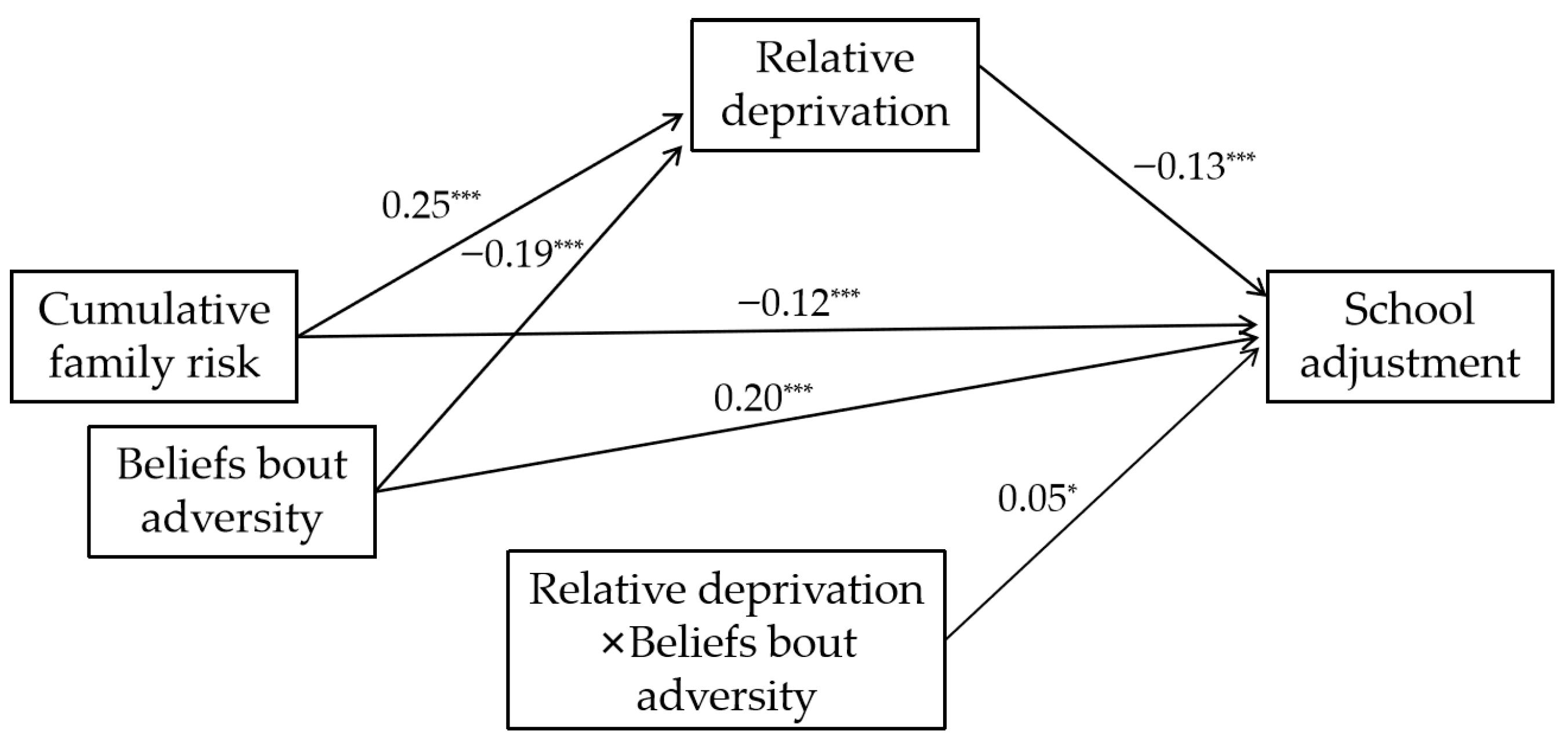
| CFR | 0.25 | 0.05 | [0.12, 0.28] | −0.12 | 0.02 | [−0.15, −0.08] |
| BA | −0.19 | 0.04 | [−0.27, −0.11] | 0.20 | 0.02 | [0.11, 0.27] |
| RD | −0.13 | 0.01 | [−0.15, −0.06] | |||
| RD × BA | 0.05 | 0.01 | [0.01, 0.08] | |||
Disclaimer/Publisher’s Note: The statements, opinions and data contained in all publications are solely those of the individual author(s) and contributor(s) and not of MDPI and/or the editor(s). MDPI and/or the editor(s) disclaim responsibility for any injury to people or property resulting from any ideas, methods, instructions or products referred to in the content. |
© 2025 by the authors. Licensee MDPI, Basel, Switzerland. This article is an open access article distributed under the terms and conditions of the Creative Commons Attribution (CC BY) license (https://creativecommons.org/licenses/by/4.0/).
Share and Cite
Fu, S.; Zhang, Z.; Gao, Q. Cumulative Family Risk and Migrant Children’s School Adjustment: A Moderated Mediation Model of Relative Deprivation and Beliefs About Adversity. Behav. Sci. 2025, 15, 1690. https://doi.org/10.3390/bs15121690
Fu S, Zhang Z, Gao Q. Cumulative Family Risk and Migrant Children’s School Adjustment: A Moderated Mediation Model of Relative Deprivation and Beliefs About Adversity. Behavioral Sciences. 2025; 15(12):1690. https://doi.org/10.3390/bs15121690
Chicago/Turabian StyleFu, Shuying, Zhicao Zhang, and Qinqiu Gao. 2025. "Cumulative Family Risk and Migrant Children’s School Adjustment: A Moderated Mediation Model of Relative Deprivation and Beliefs About Adversity" Behavioral Sciences 15, no. 12: 1690. https://doi.org/10.3390/bs15121690
APA StyleFu, S., Zhang, Z., & Gao, Q. (2025). Cumulative Family Risk and Migrant Children’s School Adjustment: A Moderated Mediation Model of Relative Deprivation and Beliefs About Adversity. Behavioral Sciences, 15(12), 1690. https://doi.org/10.3390/bs15121690