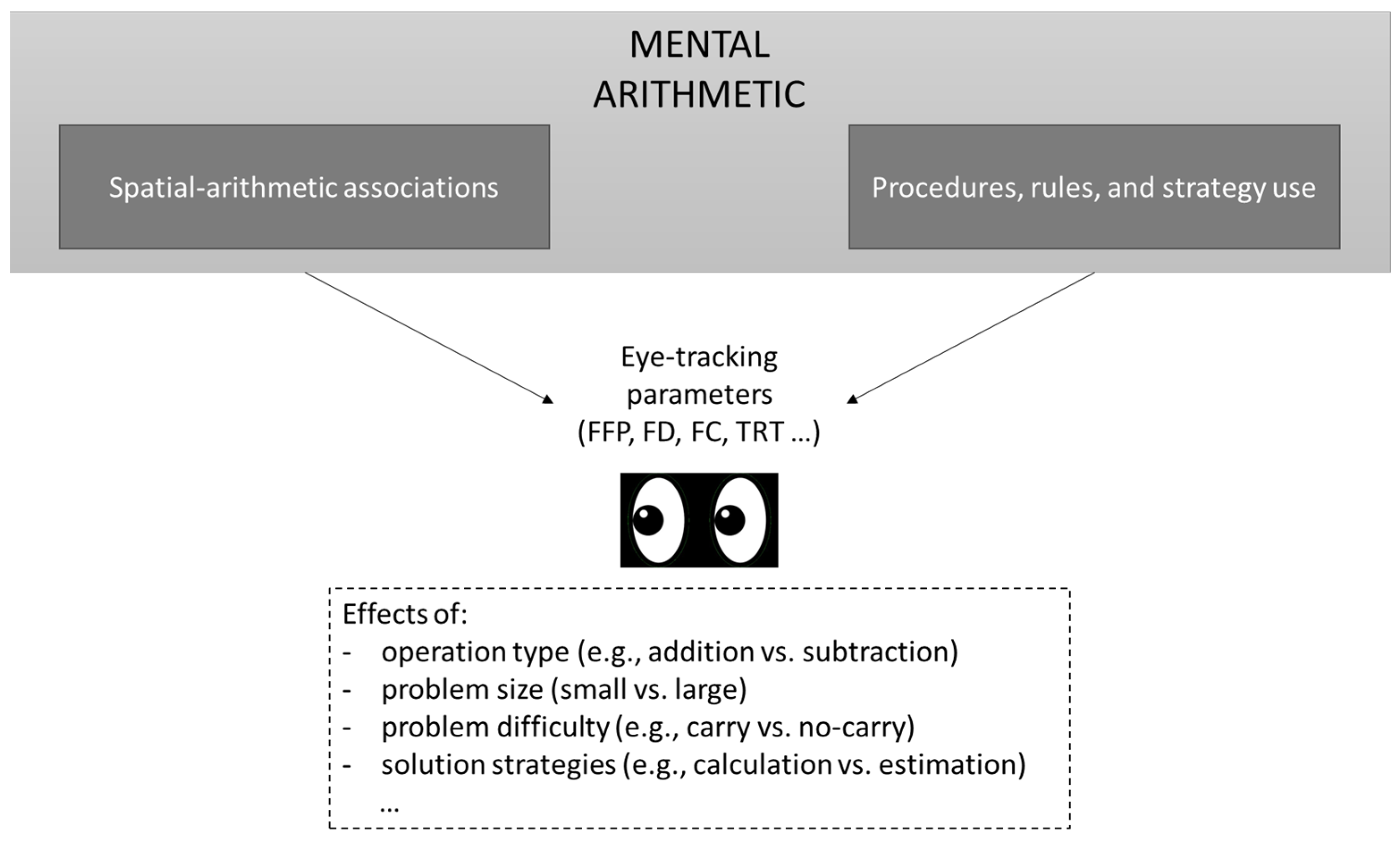
Looking into the Calculating Mind: Evidence About Arithmetic from Eye-Tracking Studies



Abstract
1. Introduction
2. Methods
3. Results
3.1. Spatial-Numerical Associations in Arithmetic
3.1.1. Operational Momentum in Mental Arithmetic
3.1.2. From Horizontal to Vertical Spatial-Arithmetic Associations
3.1.3. Temporal Dynamics of Attention Shifts
3.2. Procedures, Rules, and Strategies in Arithmetic Problem Solving
3.2.1. Simple Arithmetic
3.2.2. Complex Arithmetic
3.2.3. Multi-Term Arithmetic Expressions
4. Discussion and Perspectives
Author Contributions
Funding
Institutional Review Board Statement
Informed Consent Statement
Data Availability Statement
Conflicts of Interest
References
- Altmann, G. T. M. (2004). Language-mediated eye movements in the absence of a visual world: The ‘blank screen paradigm’. Cognition, 93(2), B79–B87. [Google Scholar] [CrossRef]
- Altmann, G. T. M., & Kamide, Y. (2007). The real-time mediation of visual attention by language and world knowledge: Linking anticipatory (and other) eye movements to linguistic processing. Journal of Memory and Language, 57(4), 502–518. [Google Scholar] [CrossRef]
- Blini, E., Pitteri, M., & Zorzi, M. (2019). Spatial grounding of symbolic arithmetic: An investigation with optokinetic stimulation. Psychological Research, 83(1), 64–83. [Google Scholar] [CrossRef] [PubMed]
- Bonato, M., Priftis, K., Marenzi, R., & Zorzi, M. (2009). Normal and impaired reflexive orienting of attention after central nonpredictive cues. Journal of Cognitive Neuroscience, 21(4), 745–759. [Google Scholar] [CrossRef] [PubMed]
- Bull, R., & Lee, K. (2014). Executive functioning and mathematics achievement. Child Development Perspectives, 8(1), 36–41. [Google Scholar] [CrossRef]
- Butterworth, B., Varma, S., & Laurillard, D. (2011). Dyscalculia: From brain to education. Science, 332(6033), 1049–1053. [Google Scholar] [CrossRef] [PubMed]
- Campbell, J. I. D., & Xue, Q. (2001). Cognitive arithmetic across cultures. Journal of Experimental Psychology: General, 130(2), 299–315. [Google Scholar] [CrossRef]
- Carter, B. T., & Luke, S. G. (2020). Best practices in eye-tracking research. International Journal of Psychophysiology, 155, 49–62. [Google Scholar] [CrossRef]
- Chesney, D. L., McNeil, N. M., Brockmole, J. R., & Kelley, K. (2013). An eye for relations: Eye-tracking indicates long-term negative effects of operational thinking on understanding of math equivalence. Memory & Cognition, 41(7), 1079–1095. [Google Scholar] [CrossRef][Green Version]
- Chow, J. C., & Ekholm, E. (2019). Language domains differentially predict mathematics performance in young children. Early Childhood Research Quarterly, 46, 179–186. [Google Scholar] [CrossRef]
- Cooper, R. M. (1974). The control of eye fixation by the meaning of spoken language. Cognitive Psychology, 6(1), 84–107. [Google Scholar] [CrossRef]
- Corbetta, M., Akbudak, E., Conturo, T. E., Snyder, A. Z., Ollinger, J. M., Drury, H. A., Linenweber, M. R., Petersen, S. E., Raichle, M. E., Van Essen, D. C., & Shulman, G. L. (1998). A common network of functional areas for attention and eye movements. Neuron, 21(4), 761–773. [Google Scholar] [CrossRef]
- Cragg, L., Keeble, S., Richardson, S., Roome, H. E., & Gilmore, C. (2017). Direct and indirect influences of executive functions on mathematics achievement. Cognition, 162, 12–26. [Google Scholar] [CrossRef]
- Curtis, E. T., Huebner, M. G., & LeFevre, J.-A. (2016). The relationship between problem size and fixation patterns during addition, subtraction, multiplication, and division. Journal of Numerical Cognition, 2(2), 91–115. [Google Scholar] [CrossRef]
- Dehaene, S., Bossini, S., & Giraux, P. (1993). The mental representation of parity and number magnitude. Journal of Experimental Psychology: General, 122(3), 371–396. [Google Scholar] [CrossRef]
- Delazer, M. (2003). Neuropsychological findings on conceptual knowledge of arithmetic. In A. J. Baroody, & A. Dowker (Eds.), The development of arithmetic concepts and skills: Constructing adaptive expertise (pp. 385–407). Lawrence Erlbaum Associates. [Google Scholar]
- Domahs, F., & Delazer, M. (2005). Some assumptions and facts about arithmetic facts. Psychology Science, 47(1), 96–111. [Google Scholar]
- Faulkenberry, T. J., Witte, M., & Hartmann, M. (2018). Tracking the continuous dynamics of numerical processing: A brief review and editorial. Journal of Numerical Cognition, 4(2), 271–285. [Google Scholar] [CrossRef]
- Fischer, M. H. (2012). A hierarchical view of grounded, embodied, and situated numerical cognition. Cognitive Processing, 13(S1), 161–164. [Google Scholar] [CrossRef] [PubMed]
- Fischer, M. H., & Brugger, P. (2011). When digits help digits: Spatial? Numerical associations point to finger counting as prime example of embodied cognition. Frontiers in Psychology, 2, 260. [Google Scholar] [CrossRef] [PubMed]
- Fischer, M. H., Castel, A. D., Dodd, M. D., & Pratt, J. (2003). Perceiving numbers causes spatial shifts of attention. Nature Neuroscience, 6(6), 555–556. [Google Scholar] [CrossRef] [PubMed]
- Fischer, M. H., & Shaki, S. (2014a). Spatial associations in numerical cognition—From single digits to arithmetic. Quarterly Journal of Experimental Psychology, 67(8), 1461–1483. [Google Scholar] [CrossRef]
- Fischer, M. H., & Shaki, S. (2014b). Spatial biases in mental arithmetic. Quarterly Journal of Experimental Psychology, 67(8), 1457–1460. [Google Scholar] [CrossRef] [PubMed]
- Ganor-Stern, D. (2015). When you don’t have to be exact: Investigating computational estimation skills with a comparison task. Acta Psychologica, 154, 1–9. [Google Scholar] [CrossRef] [PubMed]
- Ganor-Stern, D. (2016). Solving math problems approximately: A developmental perspective. PLoS ONE, 11(5), e0155515. [Google Scholar] [CrossRef] [PubMed]
- Ganor-Stern, D., & Weiss, N. (2016). Tracking practice effects in computation estimation. Psychological Research, 80(3), 434–448. [Google Scholar] [CrossRef]
- Geary, D. C., & Widaman, K. F. (1987). Individual differences in cognitive arithmetic. Journal of Experimental Psychology: General, 116(2), 154–171. [Google Scholar] [CrossRef]
- Green, H. J., Lemaire, P., & Dufau, S. (2007). Eye movement correlates of younger and older adults’ strategies for complex addition. Acta Psychologica, 125(3), 257–278. [Google Scholar] [CrossRef][Green Version]
- Harrison, A., Smith, H., Hulse, T., & Ottmar, E. R. (2020). Spacing out! Manipulating spatial features in mathematical expressions affects performance. Journal of Numerical Cognition, 6(2), 186–203. [Google Scholar] [CrossRef]
- Hartmann, M. (2022). Summing up: A functional role of eye movements along the mental number line for arithmetic. Acta Psychologica, 230, 103770. [Google Scholar] [CrossRef]
- Hartmann, M., & Fischer, M. H. (2016). Exploring the numerical mind by eye-tracking: A special issue. Psychological Research, 80(3), 325–333. [Google Scholar] [CrossRef]
- Hartmann, M., Grabherr, L., & Mast, F. W. (2012). Moving along the mental number line: Interactions between whole-body motion and numerical cognition. Journal of Experimental Psychology: Human Perception and Performance, 38(6), 1416–1427. [Google Scholar] [CrossRef]
- Hartmann, M., Laubrock, J., & Fischer, M. H. (2018). The visual number world: A dynamic approach to study the mathematical mind. Quarterly Journal of Experimental Psychology, 71(1), 28–36. [Google Scholar] [CrossRef] [PubMed]
- Hartmann, M., Mast, F. W., & Fischer, M. H. (2015). Spatial biases during mental arithmetic: Evidence from eye movements on a blank screen. Frontiers in Psychology, 6, 12. [Google Scholar] [CrossRef]
- Hawes, Z. C. K., Gilligan-Lee, K. A., & Mix, K. S. (2022). Effects of spatial training on mathematics performance: A meta-analysis. Developmental Psychology, 58(1), 112–137. [Google Scholar] [CrossRef] [PubMed]
- Hinault, T., & Lemaire, P. (2016). Age-related changes in strategic variations during arithmetic problem solving. In Progress in brain research (Vol. 227, pp. 257–276). Elsevier. [Google Scholar] [CrossRef]
- Hintz, F., & Meyer, A. S. (2015). Prediction and production of simple mathematical equations: Evidence from visual world eye-tracking. PLoS ONE, 10(7), e0130766. [Google Scholar] [CrossRef]
- Holmqvist, K., & Andersson, R. (2017). Eye-tracking: A comprehensive guide to methods, paradigms and measures. Lund Eye-Tracking Research Institute. [Google Scholar]
- Holmqvist, K., Nyström, M., Andersson, R., Dewhurst, R., Jarodzka, H., & van de Weijer, J. (2011). Eye-tracking: A comprehensive guide to methods and measures. Oxford University Press. [Google Scholar]
- Hubbard, E. M., Piazza, M., Pinel, P., & Dehaene, S. (2005). Interactions between number and space in parietal cortex. Nature Reviews Neuroscience, 6(6), 435–448. [Google Scholar] [CrossRef]
- Huebner, M. G., & LeFevre, J.-A. (2018). Selection of procedures in mental subtraction: Use of eye movements as a window on arithmetic processing. Canadian Journal of Experimental Psychology/Revue Canadienne de Psychologie Expérimentale, 72(3), 171–182. [Google Scholar] [CrossRef]
- Hunt, T. E., Clark-Carter, D., & Sheffield, D. (2015). Exploring the relationship between mathematics anxiety and performance: An eye-tracking approach. Applied Cognitive Psychology, 29(2), 226–231. [Google Scholar] [CrossRef]
- Imbo, I., Vandierendonck, A., & Rosseel, Y. (2007). The influence of problem features and individual differences on strategic performance in simple arithmetic. Memory & Cognition, 35(3), 454–463. [Google Scholar] [CrossRef][Green Version]
- Kasprowski, P. (2022). Eye-tracking hardware: Past to present, and beyond. In S. Stuart (Ed.), Eye-tracking (Vol. 183, pp. 31–48). Springer. [Google Scholar] [CrossRef]
- Klein, E., Huber, S., Nuerk, H.-C., & Moeller, K. (2014). Operational momentum affects eye fixation behaviour. Quarterly Journal of Experimental Psychology, 67(8), 1614–1625. [Google Scholar] [CrossRef] [PubMed]
- Knops, A., Dehaene, S., Berteletti, I., & Zorzi, M. (2014). Can approximate mental calculation account for operational momentum in addition and subtraction? Quarterly Journal of Experimental Psychology, 67(8), 1541–1556. [Google Scholar] [CrossRef] [PubMed]
- Knops, A., Thirion, B., Hubbard, E. M., Michel, V., & Dehaene, S. (2009a). Recruitment of an area involved in eye movements during mental arithmetic. Science, 324(5934), 1583–1585. [Google Scholar] [CrossRef] [PubMed]
- Knops, A., Viarouge, A., & Dehaene, S. (2009b). Dynamic representations underlying symbolic and nonsymbolic calculation: Evidence from the operational momentum effect. Attention, Perception, & Psychophysics, 71(4), 803–821. [Google Scholar] [CrossRef]
- Knops, A., Zitzmann, S., & McCrink, K. (2013). Examining the presence and determinants of operational momentum in childhood. Frontiers in Psychology, 4, 325. [Google Scholar] [CrossRef]
- Kong, J., Wang, C., Kwong, K., Vangel, M., Chua, E., & Gollub, R. (2005). The neural substrate of arithmetic operations and procedure complexity. Cognitive Brain Research, 22(3), 397–405. [Google Scholar] [CrossRef]
- Kramer, P., Stoianov, I., Umiltà, C., & Zorzi, M. (2011). Interactions between perceptual and numerical space. Psychonomic Bulletin & Review, 18(4), 722–728. [Google Scholar] [CrossRef]
- Landy, D. (2007). Formal notations as diagrams of abstract structure [Doctoral dissertation, Indiana University Bloomington]. [Google Scholar]
- Landy, D., Jones, M. N., & Goldstone, R. L. (2008, July 23–26). How the appearance of an operator affects its formal precedence. Thirtieth Annual Conference of the Cognitive Science Society (pp. 2109–2114), Washington, DC, USA. [Google Scholar]
- LeFevre, J., Fast, L., Skwarchuk, S., Smith-Chant, B. L., Bisanz, J., Kamawar, D., & Penner-Wilger, M. (2010). Pathways to mathematics: Longitudinal predictors of performance. Child Development, 81(6), 1753–1767. [Google Scholar] [CrossRef]
- Lemaire, P. (2010). Executive functions and strategic aspects of arithmetic performance: The case of adults’ and children’s arithmetic. Psychologica Belgica, 50(3–4), 335–352. [Google Scholar] [CrossRef][Green Version]
- Lemaire, P., & Arnaud, L. (2008). Young and older adults’ strategies in complex arithmetic. The American Journal of Psychology, 121(1), 1–16. [Google Scholar] [CrossRef]
- Li, M., Liu, D., Li, M., Dong, W., Huang, Y., & Chen, Q. (2018). Addition and subtraction but not multiplication and division cause shifts of spatial attention. Frontiers in Human Neuroscience, 12, 183. [Google Scholar] [CrossRef] [PubMed]
- Liu, D., Cai, D., Verguts, T., & Chen, Q. (2017). The time course of spatial attention shifts in elementary arithmetic. Scientific Reports, 7(1), 921. [Google Scholar] [CrossRef]
- Loetscher, T., Bockisch, C. J., Nicholls, M. E. R., & Brugger, P. (2010). Eye position predicts what number you have in mind. Current Biology, 20(6), R264–R265. [Google Scholar] [CrossRef]
- Lugli, L., Baroni, G., Anelli, F., Borghi, A. M., & Nicoletti, R. (2013). Counting is easier while experiencing a congruent motion. PLoS ONE, 8(5), e64500. [Google Scholar] [CrossRef] [PubMed]
- Masson, N., Andres, M., Alsamour, M., Bollen, Z., & Pesenti, M. (2020). Spatial biases in mental arithmetic are independent of reading/writing habits: Evidence from French and Arabic speakers. Cognition, 200, 104262. [Google Scholar] [CrossRef]
- Masson, N., Letesson, C., & Pesenti, M. (2018). Time course of overt attention shifts in mental arithmetic: Evidence from gaze metrics. Quarterly Journal of Experimental Psychology, 71(4), 1009–1019. [Google Scholar] [CrossRef]
- Masson, N., & Pesenti, M. (2014). Attentional bias induced by solving simple and complex addition and subtraction problems. Quarterly Journal of Experimental Psychology, 67(8), 1514–1526. [Google Scholar] [CrossRef]
- Masson, N., & Pesenti, M. (2016). Interference of lateralized distractors on arithmetic problem solving: A functional role for attention shifts in mental calculation. Psychological Research, 80(4), 640–651. [Google Scholar] [CrossRef]
- Masson, N., Pesenti, M., Coyette, F., Andres, M., & Dormal, V. (2017). Shifts of spatial attention underlie numerical comparison and mental arithmetic: Evidence from a patient with right unilateral neglect. Neuropsychology, 31(7), 822–833. [Google Scholar] [CrossRef]
- Mathieu, R., Epinat-Duclos, J., Sigovan, M., Breton, A., Cheylus, A., Fayol, M., Thevenot, C., & Prado, J. (2018). What’s behind a “+” sign? Perceiving an arithmetic operator recruits brain circuits for spatial orienting. Cerebral Cortex, 28(5), 1673–1684. [Google Scholar] [CrossRef] [PubMed]
- McCarthy, R. A., & Warrington, E. K. (1990). Calculation. In R. A. McCarthy, & E. K. Warrington (Eds.), Cognitive neuropsychology: A clinical introduction (pp. 262–274). Academic Press. [Google Scholar]
- McCrink, K., Dehaene, S., & Dehaene-Lambertz, G. (2007). Moving along the number line: Operational momentum in nonsymbolic arithmetic. Perception & Psychophysics, 69(8), 1324–1333. [Google Scholar] [CrossRef] [PubMed]
- Mock, J., Huber, S., Klein, E., & Moeller, K. (2016). Insights into numerical cognition: Considering eye-fixations in number processing and arithmetic. Psychological Research, 80(3), 334–359. [Google Scholar] [CrossRef]
- Moeller, K., Klein, E., & Nuerk, H.-C. (2011a). (No) Small adults: Children’s processing of carry addition problems. Developmental Neuropsychology, 36(6), 702–720. [Google Scholar] [CrossRef] [PubMed]
- Moeller, K., Klein, E., & Nuerk, H.-C. (2011b). Three processes underlying the carry effect in addition—Evidence from eye-tracking: Three processes underlying the carry effect. British Journal of Psychology, 102(3), 623–645. [Google Scholar] [CrossRef] [PubMed]
- Pinhas, M., & Fischer, M. H. (2008). Mental movements without magnitude? A study of spatial biases in symbolic arithmetic. Cognition, 109(3), 408–415. [Google Scholar] [CrossRef]
- Pinhas, M., Shaki, S., & Fischer, M. H. (2014). Heed the signs: Operation signs have spatial associations. Quarterly Journal of Experimental Psychology, 67(8), 1527–1540. [Google Scholar] [CrossRef] [PubMed]
- Porras, M. M., Campen, C. A. N. K., González-Rosa, J. J., Sánchez-Fernández, F. L., & Guzmán, J. I. N. (2024). Eye tracking study in children to assess mental calculation and eye movements. Scientific Reports, 14(1), 18901. [Google Scholar] [CrossRef]
- Prado, J., & Knops, A. (2024). Spatial attention in mental arithmetic: A literature review and meta-analysis. Psychonomic Bulletin & Review, 31(5), 2036–2057. [Google Scholar] [CrossRef]
- Rayner, K. (2009). The 35th sir frederick bartlett lecture: Eye movements and attention in reading, scene perception, and visual search. Quarterly Journal of Experimental Psychology, 62(8), 1457–1506. [Google Scholar] [CrossRef]
- Rivera, J., & Garrigan, P. (2016). Persistent perceptual grouping effects in the evaluation of simple arithmetic expressions. Memory & Cognition, 44(5), 750–761. [Google Scholar] [CrossRef]
- Salvaggio, S., Masson, N., Zénon, A., & Andres, M. (2022). The predictive role of eye movements in mental arithmetic. Experimental Brain Research, 240(5), 1331–1340. [Google Scholar] [CrossRef]
- Schneider, E., Maruyama, M., Dehaene, S., & Sigman, M. (2012). Eye gaze reveals a fast, parallel extraction of the syntax of arithmetic formulas. Cognition, 125(3), 475–490. [Google Scholar] [CrossRef]
- Smith-Chant, B. L., & LeFevre, J.-A. (2003). Doing as they are told and telling it like it is: Self-reports in mental arithmetic. Memory & Cognition, 31(4), 516–528. [Google Scholar] [CrossRef][Green Version]
- Stoianov, I., Kramer, P., Umiltà, C., & Zorzi, M. (2008). Visuospatial priming of the mental number line. Cognition, 106(2), 770–779. [Google Scholar] [CrossRef]
- Suppes, P., Cohen, M., Laddaga, R., Anliker, J., & Floyd, R. (1983). A procedural theory of eye movements in doing arithmetic. Journal of Mathematical Psychology, 27(4), 341–369. [Google Scholar] [CrossRef]
- Susac, A., Bubic, A., Kaponja, J., Planinic, M., & Palmovic, M. (2014). Eye movements reveal students’ strategies in simple equation solving. International Journal of Science and Mathematics Education, 12(3), 555–577. [Google Scholar] [CrossRef]
- Taillan, J., Ardiale, E., & Lemaire, P. (2015). Relationships between strategy switching and strategy switch costs in young and older adults: A study in arithmetic problem solving. Experimental Aging Research, 41(2), 136–156. [Google Scholar] [CrossRef] [PubMed]
- Tanenhaus, M. K., Spivey-Knowlton, M. J., Eberhard, K. M., & Sedivy, J. C. (1995). Integration of visual and linguistic information in spoken language comprehension. Science, 268(5217), 1632–1634. [Google Scholar] [CrossRef] [PubMed]
- van Harskamp, N. J., & Cipolotti, L. (2001). Selective impairments for addition, subtraction and multiplication. Implications for the organisation of arithmetical facts. Cortex, 37(3), 363–388. [Google Scholar] [CrossRef]
- Van Viersen, S., Slot, E. M., Kroesbergen, E. H., Van’T Noordende, J. E., & Leseman, P. P. M. (2013). The added value of eye-tracking in diagnosing dyscalculia: A case study. Frontiers in Psychology, 4, 679. [Google Scholar] [CrossRef]
- Walsh, V. (2003). A theory of magnitude: Common cortical metrics of time, space and quantity. Trends in Cognitive Sciences, 7(11), 483–488. [Google Scholar] [CrossRef] [PubMed]
- Widaman, K. F., Geary, D. C., Cormier, P., & Little, T. D. (1989). A componential model for mental addition. Journal of Experimental Psychology: Learning, Memory, and Cognition, 15(5), 898–919. [Google Scholar] [CrossRef][Green Version]
- Wiemers, M., Bekkering, H., & Lindemann, O. (2014). Spatial interferences in mental arithmetic: Evidence from the motion–arithmetic compatibility effect. Quarterly Journal of Experimental Psychology, 67(8), 1557–1570. [Google Scholar] [CrossRef]
- Winter, B., Matlock, T., Shaki, S., & Fischer, M. H. (2015). Mental number space in three dimensions. Neuroscience & Biobehavioral Reviews, 57, 209–219. [Google Scholar] [CrossRef]
- Wood, G., Willmes, K., Nuerk, H.-C., & Fischer, M. H. (2008). On the cognitive link between space and number: A meta-analysis of the SNARC effect. Psychology Science Quarterly, 50(4), 489–525. [Google Scholar]
- Zbrodoff, N. J., & Logan, G. D. (2005). What everyone finds: The problem-size effect. In J. I. D. Campbell (Ed.), Handbook of mathematical cognition (pp. 331–345). Psychology Press. [Google Scholar]
- Zhou, F., Zhao, Q., Chen, C., & Zhou, X. (2012). Mental representations of arithmetic facts: Evidence from eye movement recordings supports the preferred operand-order-specific representation hypothesis. Quarterly Journal of Experimental Psychology, 65(4), 661–674. [Google Scholar] [CrossRef] [PubMed]
- Zhu, R., Luo, Y., You, X., & Wang, Z. (2018). Spatial Bias Induced by Simple Addition and Subtraction: From Eye Movement Evidence. Perception, 47(2), 143–157. [Google Scholar] [CrossRef] [PubMed]
- Zhu, R., You, X., Gan, S., & Wang, J. (2019). Spatial attention shifts in addition and subtraction arithmetic: Evidence of eye movement. Perception, 48(9), 835–849. [Google Scholar] [CrossRef]

Disclaimer/Publisher’s Note: The statements, opinions and data contained in all publications are solely those of the individual author(s) and contributor(s) and not of MDPI and/or the editor(s). MDPI and/or the editor(s) disclaim responsibility for any injury to people or property resulting from any ideas, methods, instructions or products referred to in the content. |
© 2025 by the authors. Licensee MDPI, Basel, Switzerland. This article is an open access article distributed under the terms and conditions of the Creative Commons Attribution (CC BY) license (https://creativecommons.org/licenses/by/4.0/).
Share and Cite
Goettfried, E.; Zamarian, L. Looking into the Calculating Mind: Evidence About Arithmetic from Eye-Tracking Studies. Behav. Sci. 2025, 15, 1685. https://doi.org/10.3390/bs15121685
Goettfried E, Zamarian L. Looking into the Calculating Mind: Evidence About Arithmetic from Eye-Tracking Studies. Behavioral Sciences. 2025; 15(12):1685. https://doi.org/10.3390/bs15121685
Chicago/Turabian StyleGoettfried, Elisabeth, and Laura Zamarian. 2025. "Looking into the Calculating Mind: Evidence About Arithmetic from Eye-Tracking Studies" Behavioral Sciences 15, no. 12: 1685. https://doi.org/10.3390/bs15121685
APA StyleGoettfried, E., & Zamarian, L. (2025). Looking into the Calculating Mind: Evidence About Arithmetic from Eye-Tracking Studies. Behavioral Sciences, 15(12), 1685. https://doi.org/10.3390/bs15121685