Article

How Do Two Types of Exercise Habits Predict Physical Activity with Intention?


1
Division of Sports Science, Sun Moon University, Asan 31460, Republic of Korea
2
Department of Sport Science, Sungkyunkwan University, Suwon 16419, Republic of Korea
*
Author to whom correspondence should be addressed.
Behav. Sci. 2023, 13(11), 933; https://doi.org/10.3390/bs13110933
Submission received: 6 October 2023 / Revised: 2 November 2023 / Accepted: 14 November 2023 / Published: 15 November 2023
(This article belongs to the Section Health Psychology)

Abstract

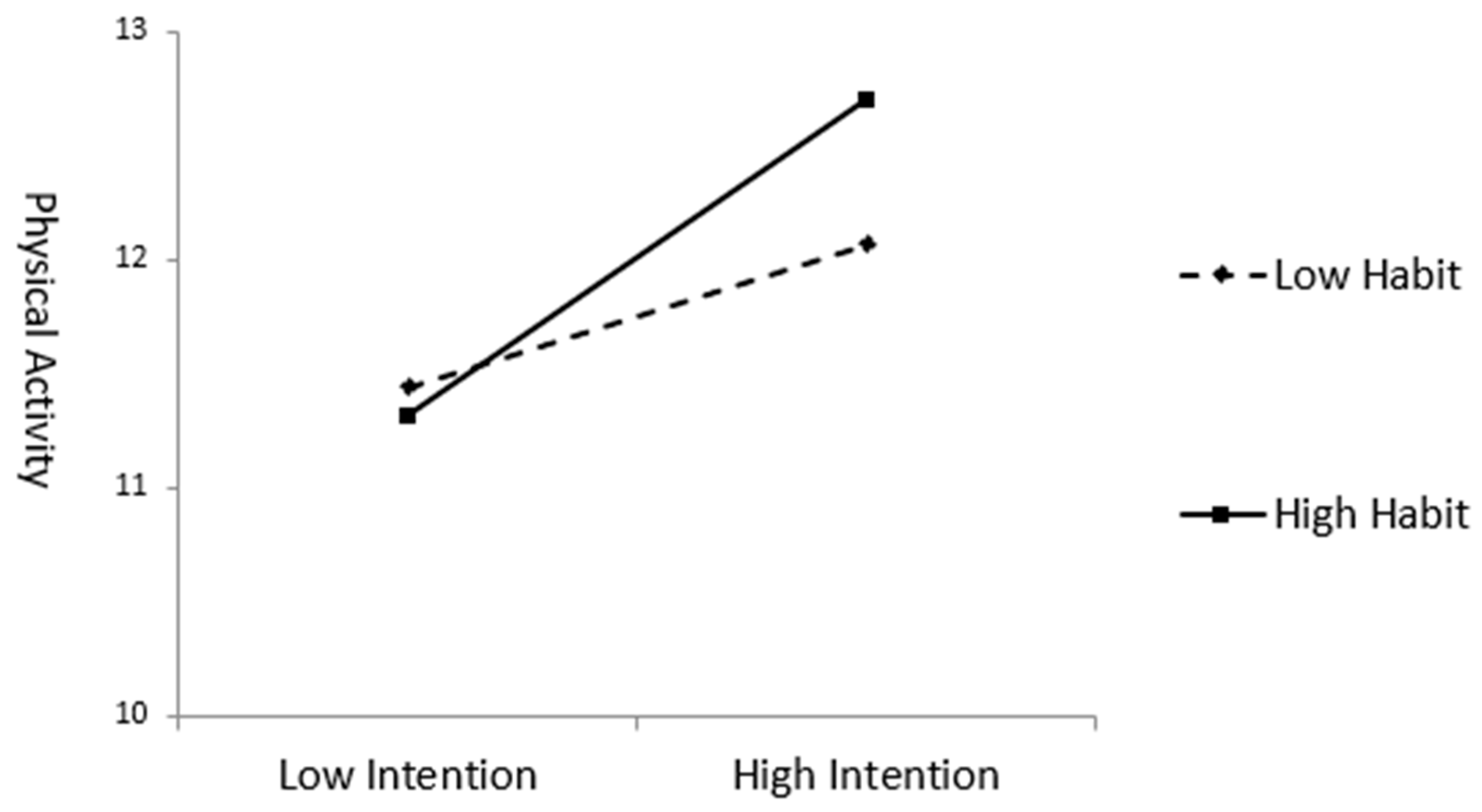
This manuscript investigates how conscious intention and unconscious exercise habits influence physical activity behavior. While prior research has predominantly focused on conscious decision-making, this study applied a dual-process model to explore the impact of intention and habit on physical activity engagement. Out of the 300 questionnaires distributed to students from one university, 282 questionnaires were utilized for data analysis after excluding insincere responses. Intention was measured using a 7-point scale, while exercise habits were assessed using the Self-Report Behavioral Automaticity Index. In addition, physical activity was measured using the Weekly Leisure-Time Exercise Questionnaire. The validity and reliability of measurement tools were confirmed. Data were analyzed using SPSS and AMOS, including correlation analysis, multiple regression, and moderation analysis. Intention, exercise preparation habit, and exercise performance habit were all found to influence physical activity levels significantly. Intention demonstrated the strongest impact, followed by exercise preparation habit and exercise performance habit. This suggests that the research efforts regarding intention conducted before the emergence of the dual process model, which proposes the importance of unconscious thinking patterns, were not in vain. The analysis revealed a statistically significant moderating effect of exercise preparation habit, but not exercise performance habit, in the relationship between intention and physical activity. Exercise preparation habit was identified as a significant moderator, enhancing the relationship between intention and physical activity. This study underscores the importance of considering both conscious intention and unconscious exercise habits in promoting physical activity. The findings challenge the prevailing emphasis on conscious decision-making and highlight the need for a more comprehensive understanding of unconscious behavior in health behavior interventions. This study is expected to arouse academic interest in the often-neglected area of unconscious behavior.
Keywords: physical activity; exercise preparation habit; exercise performance habit; intention; dual-process model physical activity; exercise preparation habit; exercise performance habit; intention; dual-process model