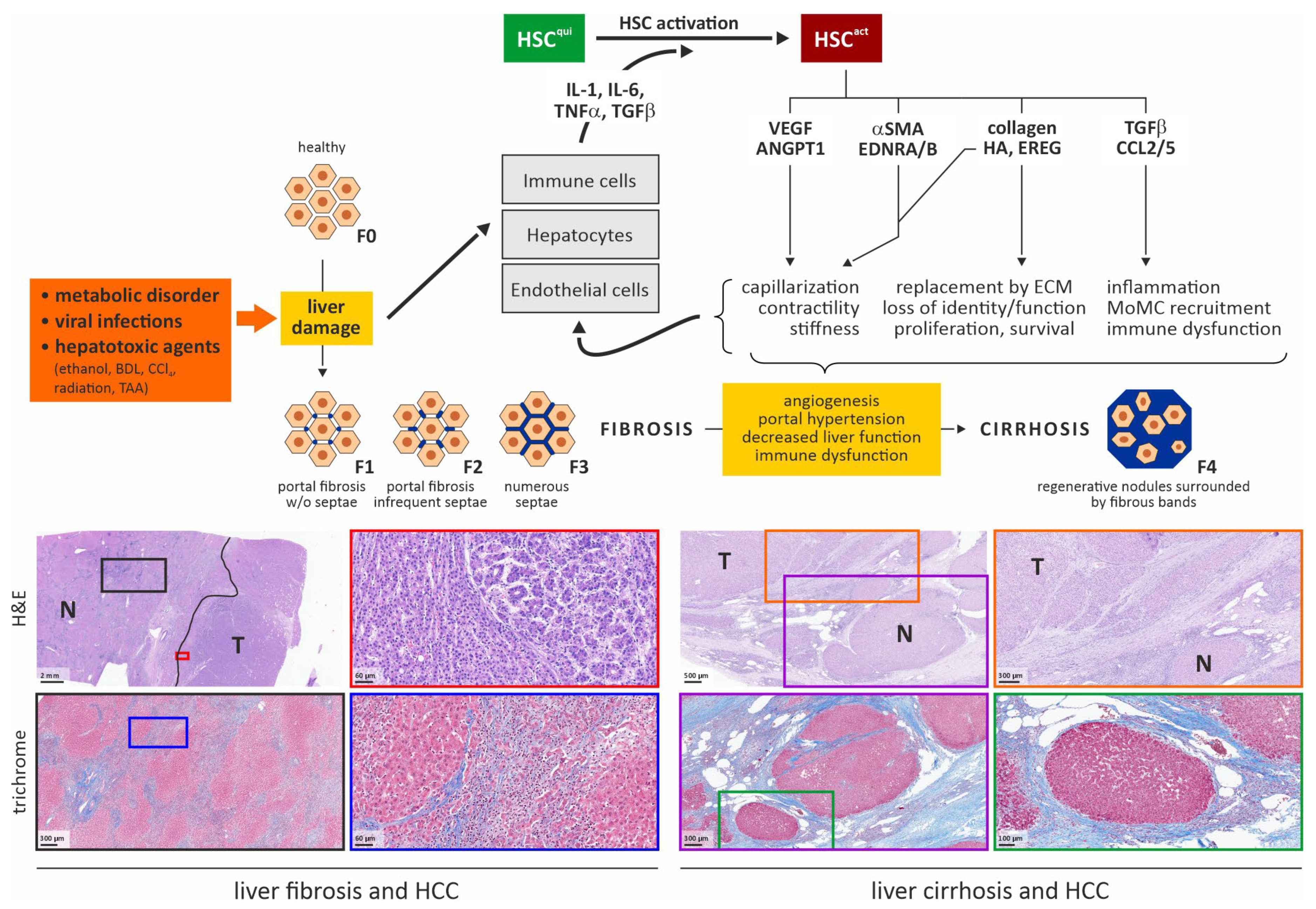

Translating Fibrosis to Malignancy: Biomarkers and Therapeutic Opportunities in Liver Fibrosis and Hepatocellular Carcinoma



Abstract
1. Introduction

2. Common Pathways in Liver Fibrosis and Tumorigenesis
3. Fibrosis Biomarkers
4. HCC Biomarkers
5. Therapeutic Opportunities to Target Liver Fibrosis and HCC—Focus on Shared Pathways

| Drug Name | Mechanism of Action | Highest Clinical Phase | Key Outcomes | Comments | Year | References |
|---|---|---|---|---|---|---|
| Fibrosis-focused studies | ||||||
| Pirfenidone | Inhibitor of p38 MAPK, and of TGFβ and TNFα synthesis | 2 (liver fibrosis) | Improved liver stiffness measurement, liver function tests, QoL and MELD score in compensated cirrhosis | Approved for idiopathic pulmonary fibrosis | 2025 | [144] |
| Hydronidone | Derivative of pirfenidone | 3 (HBV-related fibrosis) | Histologic improvement in fibrosis in combination with entecavir | Phase 3 ongoing | 2023/2025 | [145,146] |
| Pamrevlumab | α-CTGF mAb (IgG1) | 2 (liver fibrosis) | No liver-related data published | Discontinued | 2015 * | NCT01217632 |
| Bexotegrast | Dual inhibitor of αvβ6 and αvβ1 integrins (TGFβ pathway inhibitor) | 2 (liver fibrosis) | Reduced fibrosis markers (ELF, PRO-C3, MRI) relative to placebo at 12 weeks | FastTrack designation for PSC | 2025 | [147] NCT04480840 |
| PLN-1474 | Inhibitor of αvβ1 integrin | 1 (liver fibrosis, MASH) | Reduced liver fibrosis, steatosis and inflammation in mouse models; positive safety and PK profile in human healthy volunteers | Currently no development due to strategic decision and change in ownership | 2025 | [148] |
| Lixudebart | Claudin-1 mAb | 1 (liver fibrosis) | Safety, PK and target engagement achieved in Ph 1 healthy volunteer study, ready for Ph 2 | Preclinical data in PDX models confirmed antifibrotic effects | 2022 | [149] NCT05939947 |
| Foscenvivint | Inhibitor of CBP/b-catenin complex formation (WNT inhibitor) | 2 (cirrhosis) | Improvement in FibroScan, ELF score and hepatic collagen content | Preclinical antitumor effect in HCC models | 2022/2020 | [150,151] |
| HCC-focused studies | ||||||
| Sorafenib | Multikinase inhibitor | Approved (HCC) | Inhibition of HSC activation, collagen synthesis and EMT in preclinical models | No dedicated antifibrotic trials | 2014/2008 | [131,133,136,152,153,154] |
| Regorafenib | Multikinase inhibitor | Approved (HCC) | ||||
| Vactosertib | TGFβ type I receptor kinase inhibitor | 1 (HCC) | Preclinical data hint at potential use in liver fibrosis | Development prioritizes oncology development | 2016 | [155] |
| Galunisertib | TGFβ type I receptor inhibitor (ALK5) | 2 (HCC) | mOS 17.9 months in combination with sorafenib | No further development due to cardiac safety related to Smad inhibition | 2019 | [156] |
| Focus on other indications, but with relevant read-outs | ||||||
| Vismodegib | Smo antagonist | Approved (basal cell carcinoma) | Strong antifibrotic effects in preclinical models | Limited efficacy in oncology | 2011/2020 | [157,158] |
| Sotatercept | Activin type II receptor antagonist; bone morphogenetic protein 11 ligand inhibitor | Approved for Pulmonary Arterial Hypertension | No specific data on liver fibrosis, but mechanism of action is linked to HSC activation | 2024 | [159] | |
| Cudetaxestat | Autotaxin inhibitor | 2 (IPF) | Preclinical data hint at potential use in liver fibrosis | 2022 * | NCT05373914 | |
| Montelukast | Leukotriene D4 antagonist | Approved for asthma | Preclinical data hint at potential use in liver fibrosis | 2025 | [160] | |
6. Conclusions
Author Contributions
Funding
Institutional Review Board Statement
Informed Consent Statement
Data Availability Statement
Acknowledgments
Conflicts of Interest
Abbreviations
| AASLD | American Association for the Study of Liver Diseases |
| AFB1 | Aflatoxin B1 |
| AFP | α-fetoprotein |
| ALT | alanine aminotransferase |
| ANGPT1 | angiopoietin |
| αSMA | α-smooth muscle actin |
| AST | aspartate aminotransferase |
| AUROC | under the receiver operating characteristic curve |
| BDL | bile duct ligation |
| BMI | body mass index |
| CCL | CC-chemokine ligand |
| CCl4 | carbon tetrachloride |
| CTGF | connective tissue growth factor |
| cfDNA | cell-free DNA |
| DCP | des-γ-carboxy prothrombin |
| ECM | extracellular matrix |
| EDNRA/B | endothelin receptor A/B |
| ELF | Enhanced Liver Fibrosis |
| EMT | epithelial to mesenchymal transition |
| EREG | proepiregulin |
| GLUL | glutamine synthetase |
| GPNMB | glycoprotein non-metastatic melanoma protein B |
| GPC3 | glypican-3 |
| HA | hyaluronic acid |
| HBV | hepatitis B virus |
| HCC | hepatocellular carcinoma |
| HCV | hepatitis C virus |
| Hh | Hedgehog |
| HSC | hepatic stellate cells |
| HSCqui/act | quiescent/activated hepatic stellate cell |
| IL-1/6 | interleukin1-6 |
| IPF | idiopathic pulmonary fibrosis |
| LAM | lipid-associated macrophage |
| MASH | metabolic dysfunction-associated steatohepatitis |
| MASLD | metabolic dysfunction-associated steatotic liver disease |
| MΦ | macrophage |
| MELD | model for end-stage liver disease |
| MoMC | monocyte-derived macrophage |
| mOS | median overall survival |
| MRI | magnetic resonance imaging |
| MUP-uPA | major urinary protein-urokinase plasminogen activator transgenic |
| N | normal tissue |
| PIIINP | procollagen III N-terminal peptide |
| PDX | patient-derived xenograft |
| Ph | phase |
| PK | pharmacokinetics |
| PRO-C3 | pro-peptide of type III collagen |
| PSC | primary sclerosing cholangitis |
| QoL | quality of life |
| sTREM2 | soluble triggering receptor expressed on myeloid cells 2 |
| T | tumor |
| TAA | thioacetamide |
| TGFβ | transforming growth factor β |
| TNFα | tumor necrosis factor α |
| VEGF | vascular endothelial growth factor |
| WD | Western diet |
References
- Bray, F.; Laversanne, M.; Sung, H.; Ferlay, J.; Siegel, R.L.; Soerjomataram, I.; Jemal, A. Global Cancer Statistics 2022: GLOBOCAN Estimates of Incidence and Mortality Worldwide for 36 Cancers in 185 Countries. CA A Cancer J. Clin. 2024, 74, 229–263. [Google Scholar] [CrossRef]
- Miller, D.M.; McCauley, K.F.; Dunham-Snary, K.J. Metabolic Dysfunction-Associated Steatotic Liver Disease (MASLD): Mechanisms, Clinical Implications and Therapeutic Advances. Endocrinol. Diabetes Metab. 2025, 8, e70132. [Google Scholar] [CrossRef]
- Mayorca-Guiliani, A.E.; Leeming, D.J.; Henriksen, K.; Mortensen, J.H.; Nielsen, S.H.; Anstee, Q.M.; Sanyal, A.J.; Karsdal, M.A.; Schuppan, D. ECM Formation and Degradation during Fibrosis, Repair, and Regeneration. NPJ Metab. Health Dis. 2025, 3, 25. [Google Scholar] [CrossRef]
- Friedman, S.L. Hepatic Fibrosis and Cancer: The Silent Threats of Metabolic Syndrome. Diabetes Metab. J. 2024, 48, 161–169. [Google Scholar] [CrossRef] [PubMed]
- McGlynn, K.A.; Petrick, J.L.; El-Serag, H.B. Epidemiology of Hepatocellular Carcinoma. Hepatology 2021, 73, 4–13. [Google Scholar] [CrossRef] [PubMed]
- Kuchay, M.S.; Choudhary, N.S.; Ramos-Molina, B. Pathophysiological Underpinnings of Metabolic Dysfunction-Associated Steatotic Liver Disease. Am. J. Physiol. Cell Physiol. 2025, 328, C1637–C1666. [Google Scholar] [CrossRef]
- Hori, T. Impact of Alcohol-Associated and Metabolic Dysfunction-Associated Steatotic Liver Diseases upon Hepatic Disorder and Carcinogenesis in the Current Era. World J. Hepatol. 2025, 17, 112359. [Google Scholar] [CrossRef]
- Israelsen, M.; Francque, S.; Tsochatzis, E.A.; Krag, A. Steatotic Liver Disease. Lancet 2024, 404, 1761–1778. [Google Scholar] [CrossRef]
- Tian, Z.; Xu, C.; Yang, P.; Lin, Z.; Wu, W.; Zhang, W.; Ding, J.; Ding, R.; Zhang, X.; Dou, K. Molecular Pathogenesis: Connections between Viral Hepatitis-Induced and Non-Alcoholic Steatohepatitis-Induced Hepatocellular Carcinoma. Front. Immunol. 2022, 13, 984728. [Google Scholar] [CrossRef]
- Hasanoglu, I.; Rivero-Juárez, A.; Özkaya Şahin, G.; ESCMID Study Group For Viral Hepatitis (ESGVH). When Metabolic Dysfunction-Associated Steatotic Liver Disease Meets Viral Hepatitis. J. Clin. Med. 2025, 14, 3422. [Google Scholar] [CrossRef]
- Singal, A.K.; Mathurin, P. Diagnosis and Treatment of Alcohol-Associated Liver Disease: A Review. JAMA 2021, 326, 165–176. [Google Scholar] [CrossRef]
- Mol, B.; Werner, E.; Culver, E.L.; van der Meer, A.J.; Bogaards, J.A.; Ponsioen, C.Y. Epidemiological and Economical Burden of Cholestatic Liver Disease. Hepatology 2025, 82, 813–833. [Google Scholar] [CrossRef]
- Zhang, H.; Wang, X.; Zhang, X.; Ma, Y.; Bao, P.; Yu, Y.; Wang, Y.; Gong, P.; Zhang, N.; Lee, S.-O.; et al. Hepatic Ferroptosis Induced by Clonorchis Sinensis Exacerbates Liver Fibrosis. PLoS Neglected Trop. Dis. 2025, 19, e0013164. [Google Scholar] [CrossRef]
- Yang, L.; Gao, Y.-L.; Jiang, S.; Qian, B.; Che, L.; Wu, J.-S.; Du, Z.-B.; Wang, M.-Z.; Yang, Y.; Lin, Y.-C.; et al. Aflatoxin B1-Exposed Hepatocyte-Derived Extracellular Vesicles: Initiating Hepatic Stellate Cell-Mediated Liver Fibrosis through a P53-Parkin-Dependent Mitophagy Pathway. Ecotoxicol. Environ. Saf. 2024, 277, 116363. [Google Scholar] [CrossRef]
- Zhou, R.; Liu, M.; Liang, X.; Su, M.; Li, R. Clinical Features of Aflatoxin B1-Exposed Patients with Liver Cancer and the Molecular Mechanism of Aflatoxin B1 on Liver Cancer Cells. Environ. Toxicol. Pharmacol. 2019, 71, 103225. [Google Scholar] [CrossRef]
- Kogiso, T.; Sagawa, T.; Taniai, M.; Shimada, E.; Inai, K.; Shinohara, T.; Tokushige, K. Risk Factors for Fontan-Associated Hepatocellular Carcinoma. PLoS ONE 2022, 17, e0270230. [Google Scholar] [CrossRef] [PubMed]
- D’Amato, J.; Bianco, E.Z.; Camilleri, J.; Debattista, E.; Ellul, P. Hepatocellular Carcinoma in Fontan-Associated Liver Disease. Ann. Gastroenterol. 2025, 38, 133–142. [Google Scholar] [CrossRef]
- Lin, Q.; Tang, Z.; Qin, Y.; Deng, X.; Wei, C.; Liu, F.; Pan, X.; Liu, D.; Zhan, T.; Fang, M. Clonorchis Sinensis Infection Amplifies Hepatocellular Carcinoma Stemness, Predicting Unfavorable Prognosis. PLoS Neglected Trop. Dis. 2024, 18, e0011906. [Google Scholar] [CrossRef] [PubMed]
- Ocker, M.; Mayr, C.; Kiesslich, T.; Stintzing, S.; Neureiter, D. Immunmodulatory Treatment Strategies of Hepatocellular Carcinoma: From Checkpoint Inhibitors Now to an Integrated Approach in the Future. Cancers 2021, 13, 1558. [Google Scholar] [CrossRef]
- European Association for the Study of the Liver. EASL Clinical Practice Guidelines on the Management of Hepatocellular Carcinoma. J. Hepatol. 2025, 82, 315–374. [Google Scholar] [CrossRef] [PubMed]
- Elahi, R.; Alami Idrissi, Y.; Saeed, A. CAR-T Cell Therapy in Hepatocellular Carcinoma: From Mechanistic Insights to Clinical Translation. Cancer Treat. Rev. 2025, 141, 103046. [Google Scholar] [CrossRef]
- Jaeckel, E.; Friedman, S.L.; Hudecek, M.; Protzer, U. Chimeric Antigen Receptor (CAR) T-Cell Therapy: Engineering Immune Cells to Treat Liver Diseases. J. Hepatol. 2025, 83, 1156–1171. [Google Scholar] [CrossRef] [PubMed]
- Xue, X.; Li, Y.; Yao, Y.; Zhang, S.; Peng, C.; Li, Y. A Comprehensive Review of miR-21 in Liver Disease: Big Impact of Little Things. Int. Immunopharmacol. 2024, 134, 112116. [Google Scholar] [CrossRef]
- Elsaid, M.I.; Manne, A. Novel Therapeutics for Hepatocellular Carcinoma. Clin. Liver Dis. 2025, 29, 673–696. [Google Scholar] [CrossRef]
- Zamani, M.; Alizadeh-Tabari, S.; Ajmera, V.; Singh, S.; Murad, M.H.; Loomba, R. Global Prevalence of Advanced Liver Fibrosis and Cirrhosis in the General Population: A Systematic Review and Meta-Analysis. Clin. Gastroenterol. Hepatol. 2025, 23, 1123–1134. [Google Scholar] [CrossRef] [PubMed]
- Singal, A.G.; Zhang, E.; Narasimman, M.; Rich, N.E.; Waljee, A.K.; Hoshida, Y.; Yang, J.D.; Reig, M.; Cabibbo, G.; Nahon, P.; et al. HCC Surveillance Improves Early Detection, Curative Treatment Receipt, and Survival in Patients with Cirrhosis: A Systematic Review and Meta-Analysis. J. Hepatol. 2022, 77, 128–139. [Google Scholar] [CrossRef]
- Singal, A.G.; Pillai, A.; Tiro, J. Early Detection, Curative Treatment, and Survival Rates for Hepatocellular Carcinoma Surveillance in Patients with Cirrhosis: A Meta-Analysis. PLoS Med. 2014, 11, e1001624. [Google Scholar] [CrossRef]
- Kanda, T.; Goto, T.; Hirotsu, Y.; Moriyama, M.; Omata, M. Molecular Mechanisms Driving Progression of Liver Cirrhosis towards Hepatocellular Carcinoma in Chronic Hepatitis B and C Infections: A Review. Int. J. Mol. Sci. 2019, 20, 1358. [Google Scholar] [CrossRef] [PubMed]
- Alarcón-Sánchez, B.R.; Pérez-Carreón, J.I.; Villa-Treviño, S.; Arellanes-Robledo, J. Molecular Alterations That Precede the Establishment of the Hallmarks of Cancer: An Approach on the Prevention of Hepatocarcinogenesis. Biochem. Pharmacol. 2021, 194, 114818. [Google Scholar] [CrossRef]
- Zhang, D.Y.; Friedman, S.L. Fibrosis-Dependent Mechanisms of Hepatocarcinogenesis. Hepatology 2012, 56, 769–775. [Google Scholar] [CrossRef]
- Shan, L.; Wang, F.; Xue, W.; Zhai, D.; Liu, J.; Lv, X. New Insights into Fibrotic Signaling in Hepatocellular Carcinoma. Front. Oncol. 2023, 13, 1196298. [Google Scholar] [CrossRef]
- Ajith, A.; Evraerts, J.; Bouzin, C.; Brusa, D.; Merimi, M.; Najar, M.; Smets, F.; Sokal, E.; Najimi, M. Progression to Fibrosis and Hepatocellular Carcinoma in DEN CCl4 Liver Mice, Is Associated with Macrophage and Striking Regulatory T Cells Infiltration. Front. Immunol. 2025, 16, 1601215. [Google Scholar] [CrossRef]
- Dhar, D.; Baglieri, J.; Kisseleva, T.; Brenner, D.A. Mechanisms of Liver Fibrosis and Its Role in Liver Cancer. Exp. Biol. Med. 2020, 245, 96–108. [Google Scholar] [CrossRef]
- Lin, H.-Y.; Jeon, A.-J.; Chen, K.; Lee, C.J.M.; Wu, L.; Chong, S.-L.; Anene-Nzelu, C.G.; Foo, R.S.-Y.; Chow, P.K.-H. The Epigenetic Basis of Hepatocellular Carcinoma—Mechanisms and Potential Directions for Biomarkers and Therapeutics. Br. J. Cancer 2025, 132, 869–887. [Google Scholar] [CrossRef]
- Singal, A.G.; Llovet, J.M.; Yarchoan, M.; Mehta, N.; Heimbach, J.K.; Dawson, L.A.; Jou, J.H.; Kulik, L.M.; Agopian, V.G.; Marrero, J.A.; et al. AASLD Practice Guidance on Prevention, Diagnosis, and Treatment of Hepatocellular Carcinoma. Hepatology 2023, 78, 1922–1965. [Google Scholar] [CrossRef] [PubMed]
- Zhao, J.; Hu, Z.; Zheng, X.; Lin, Y.; Liu, X.; Zhang, J.; Peng, J.; Gao, H. Blood Biomarkers of Hepatocellular Carcinoma: A Critical Review. Front. Cell Dev. Biol. 2024, 12, 1489836. [Google Scholar] [CrossRef] [PubMed]
- Ismaiel, A.; Almonajjed, M.B.; Catana, C.S.; Popa, S.-L.; Dumitrascu, D.L. Metabolic Dysfunction-Associated Steatohepatitis in Focus: Pathogenesis, Non-Invasive Diagnostics, and Future Approaches. Arch. Med. Res. 2025, 56, 103350. [Google Scholar] [CrossRef] [PubMed]
- Goodman, Z.D. Grading and Staging Systems for Inflammation and Fibrosis in Chronic Liver Diseases. J. Hepatol. 2007, 47, 598–607. [Google Scholar] [CrossRef]
- Schwabe, R.F.; Brenner, D.A. Hepatic Stellate Cells: Balancing Homeostasis, Hepatoprotection and Fibrogenesis in Health and Disease. Nat. Rev. Gastroenterol. Hepatol. 2025, 22, 481–499. [Google Scholar] [CrossRef]
- Sultana, M.; Islam, M.A.; Khairnar, R.; Kumar, S. A Guide to Pathophysiology, Signaling Pathways, and Preclinical Models of Liver Fibrosis. Mol. Cell. Endocrinol. 2025, 598, 112448. [Google Scholar] [CrossRef]
- Bansal, R.; Nagórniewicz, B.; Prakash, J. Clinical Advancements in the Targeted Therapies against Liver Fibrosis. Mediat. Inflamm. 2016, 2016, 7629724. [Google Scholar] [CrossRef]
- O’Rourke, J.M.; Sagar, V.M.; Shah, T.; Shetty, S. Carcinogenesis on the Background of Liver Fibrosis: Implications for the Management of Hepatocellular Cancer. World J. Gastroenterol. 2018, 24, 4436–4447. [Google Scholar] [CrossRef]
- Zheng, J.; Wang, S.; Xia, L.; Sun, Z.; Chan, K.M.; Bernards, R.; Qin, W.; Chen, J.; Xia, Q.; Jin, H. Hepatocellular Carcinoma: Signaling Pathways and Therapeutic Advances. Signal Transduct. Target. Ther. 2025, 10, 35. [Google Scholar] [CrossRef]
- Chen, F.; Lyu, L.; Xing, C.; Chen, Y.; Hu, S.; Wang, M.; Ai, Z. The Pivotal Role of TGF-β/Smad Pathway in Fibrosis Pathogenesis and Treatment. Front. Oncol. 2025, 15, 1649179. [Google Scholar] [CrossRef]
- Chaudhary, R.; Weiskirchen, R.; Ehrlich, M.; Henis, Y.I. Dual Signaling Pathways of TGF-β Superfamily Cytokines in Hepatocytes: Balancing Liver Homeostasis and Disease Progression. Front. Pharmacol. 2025, 16, 1580500. [Google Scholar] [CrossRef] [PubMed]
- Dewidar, B.; Meyer, C.; Dooley, S.; Meindl-Beinker, A.N. TGF-β in Hepatic Stellate Cell Activation and Liver Fibrogenesis-Updated 2019. Cells 2019, 8, 1419. [Google Scholar] [CrossRef]
- Fabregat, I.; Caballero-Díaz, D. Transforming Growth Factor-β-Induced Cell Plasticity in Liver Fibrosis and Hepatocarcinogenesis. Front. Oncol. 2018, 8, 357. [Google Scholar] [CrossRef] [PubMed]
- Dooley, S.; Delvoux, B.; Lahme, B.; Mangasser-Stephan, K.; Gressner, A.M. Modulation of Transforming Growth Factor Beta Response and Signaling during Transdifferentiation of Rat Hepatic Stellate Cells to Myofibroblasts. Hepatology 2000, 31, 1094–1106. [Google Scholar] [CrossRef]
- Son, G.; Hines, I.N.; Lindquist, J.; Schrum, L.W.; Rippe, R.A. Inhibition of Phosphatidylinositol 3-Kinase Signaling in Hepatic Stellate Cells Blocks the Progression of Hepatic Fibrosis. Hepatology 2009, 50, 1512–1523. [Google Scholar] [CrossRef]
- Gäbele, E.; Reif, S.; Tsukada, S.; Bataller, R.; Yata, Y.; Morris, T.; Schrum, L.W.; Brenner, D.A.; Rippe, R.A. The Role of p70S6K in Hepatic Stellate Cell Collagen Gene Expression and Cell Proliferation. J. Biol. Chem. 2005, 280, 13374–13382. [Google Scholar] [CrossRef]
- Furukawa, F.; Matsuzaki, K.; Mori, S.; Tahashi, Y.; Yoshida, K.; Sugano, Y.; Yamagata, H.; Matsushita, M.; Seki, T.; Inagaki, Y.; et al. P38 MAPK Mediates Fibrogenic Signal through Smad3 Phosphorylation in Rat Myofibroblasts. Hepatology 2003, 38, 879–889. [Google Scholar] [CrossRef] [PubMed]
- Tsukada, S.; Westwick, J.K.; Ikejima, K.; Sato, N.; Rippe, R.A. SMAD and P38 MAPK Signaling Pathways Independently Regulate Alpha1(I) Collagen Gene Expression in Unstimulated and Transforming Growth Factor-Beta-Stimulated Hepatic Stellate Cells. J. Biol. Chem. 2005, 280, 10055–10064. [Google Scholar] [CrossRef]
- Swanton, C.; Bernard, E.; Abbosh, C.; André, F.; Auwerx, J.; Balmain, A.; Bar-Sagi, D.; Bernards, R.; Bullman, S.; DeGregori, J.; et al. Embracing Cancer Complexity: Hallmarks of Systemic Disease. Cell 2024, 187, 1589–1616. [Google Scholar] [CrossRef]
- Liao, J.; Zhu, T.; Wu, J.; Huang, M.; Luo, X. The Dual Role of Transforming Growth Factor-Beta (TGF-β) Signaling: Balancing Cellular Senescence and Tumor Progression for Precision Therapeutics. Iran. J. Immunol. 2025, 22, 174–191. [Google Scholar] [CrossRef]
- Gungor, M.Z.; Uysal, M.; Senturk, S. The Bright and the Dark Side of TGF-β Signaling in Hepatocellular Carcinoma: Mechanisms, Dysregulation, and Therapeutic Implications. Cancers 2022, 14, 940. [Google Scholar] [CrossRef]
- Zhang, K.; Zhang, M.; Luo, Z.; Wen, Z.; Yan, X. The Dichotomous Role of TGF-β in Controlling Liver Cancer Cell Survival and Proliferation. J. Genet. Genom. 2020, 47, 497–512. [Google Scholar] [CrossRef]
- Dimri, M.; Satyanarayana, A. Molecular Signaling Pathways and Therapeutic Targets in Hepatocellular Carcinoma. Cancers 2020, 12, 491. [Google Scholar] [CrossRef]
- Shamsan, E.; Almezgagi, M.; Gamah, M.; Khan, N.; Qasem, A.; Chuanchuan, L.; Haining, F. The Role of PI3k/AKT Signaling Pathway in Attenuating Liver Fibrosis: A Comprehensive Review. Front. Med. 2024, 11, 1389329. [Google Scholar] [CrossRef] [PubMed]
- Gadaleta, R.M.; Moschetta, A. Dark and Bright Side of Targeting Fibroblast Growth Factor Receptor 4 in the Liver. J. Hepatol. 2021, 75, 1440–1451. [Google Scholar] [CrossRef]
- Li, Y.; Zhang, W.; Doughtie, A.; Cui, G.; Li, X.; Pandit, H.; Yang, Y.; Li, S.; Martin, R. Up-Regulation of Fibroblast Growth Factor 19 and Its Receptor Associates with Progression from Fatty Liver to Hepatocellular Carcinoma. Oncotarget 2016, 7, 52329–52339. [Google Scholar] [CrossRef]
- Okano, J.; Shiota, G.; Kawasaki, H. Expression of Hepatocyte Growth Factor (HGF) and HGF Receptor (c-Met) Proteins in Liver Diseases: An Immunohistochemical Study. Liver 1999, 19, 151–159. [Google Scholar] [CrossRef]
- Chen, Z.; Jiang, L.; Liang, L.; Koral, K.; Zhang, Q.; Zhao, L.; Lu, S.; Tao, J. The Role of Fibroblast Growth Factor 19 in Hepatocellular Carcinoma. Am. J. Pathol. 2021, 191, 1180–1192. [Google Scholar] [CrossRef]
- Kim, H.-J.; Kim, H.; Lee, J.-H.; Hwangbo, C. Toll-like Receptor 4 (TLR4): New Insight Immune and Aging. Immun. Ageing 2023, 20, 67. [Google Scholar] [CrossRef] [PubMed]
- Tang, Y.-L.; Zhu, L.; Tao, Y.; Lu, W.; Cheng, H. Role of Targeting TLR4 Signaling Axis in Liver-Related Diseases. Pathol. Res. Pract. 2023, 244, 154410. [Google Scholar] [CrossRef]
- Perugorria, M.J.; Olaizola, P.; Labiano, I.; Esparza-Baquer, A.; Marzioni, M.; Marin, J.J.G.; Bujanda, L.; Banales, J.M. Wnt-β-Catenin Signalling in Liver Development, Health and Disease. Nat. Rev. Gastroenterol. Hepatol. 2019, 16, 121–136. [Google Scholar] [CrossRef] [PubMed]
- Monga, S.P. β-Catenin Signaling and Roles in Liver Homeostasis, Injury, and Tumorigenesis. Gastroenterology 2015, 148, 1294–1310. [Google Scholar] [CrossRef]
- Xu, C.; Xu, Z.; Zhang, Y.; Evert, M.; Calvisi, D.F.; Chen, X. β-Catenin Signaling in Hepatocellular Carcinoma. J. Clin. Investig. 2022, 132, e154515. [Google Scholar] [CrossRef]
- Dantzer, C.; Dif, L.; Vaché, J.; Basbous, S.; Billottet, C.; Moreau, V. Specific Features of SS-Catenin-Mutated Hepatocellular Carcinomas. Br. J. Cancer 2024, 131, 1871–1880. [Google Scholar] [CrossRef]
- Lehrich, B.M.; Delgado, E.R.; Yasaka, T.M.; Liu, S.; Cao, C.; Liu, Y.; Taheri, M.N.; Guan, X.; Koeppen, H.; Singh, S.; et al. Precision Targeting of β-Catenin Induces Tumor Reprogramming and Immunity in Hepatocellular Cancers. Nat. Commun. 2025, 16, 5009. [Google Scholar] [CrossRef] [PubMed]
- Carson, M.D.; Nejak-Bowen, K. Wnt/β-Catenin Signaling in Liver Pathobiology. Annu. Rev. Pathol. 2025, 20, 59–86. [Google Scholar] [CrossRef]
- Gajos-Michniewicz, A.; Czyz, M. WNT/β-Catenin Signaling in Hepatocellular Carcinoma: The Aberrant Activation, Pathogenic Roles, and Therapeutic Opportunities. Genes Dis. 2024, 11, 727–746. [Google Scholar] [CrossRef]
- Chung, S.I.; Moon, H.; Ju, H.-L.; Cho, K.J.; Kim, D.Y.; Han, K.-H.; Eun, J.W.; Nam, S.W.; Ribback, S.; Dombrowski, F.; et al. Hepatic Expression of Sonic Hedgehog Induces Liver Fibrosis and Promotes Hepatocarcinogenesis in a Transgenic Mouse Model. J. Hepatol. 2016, 64, 618–627. [Google Scholar] [CrossRef]
- Dugum, M.; Hanouneh, I.; McIntyre, T.; Pai, R.; Aucejo, F.; Eghtesad, B.; Zein, N. Sonic Hedgehog Signaling in Hepatocellular Carcinoma: A Pilot Study. Mol. Clin. Oncol. 2016, 4, 369–374. [Google Scholar] [CrossRef] [PubMed]
- Xu, H.; Wang, L. The Role of Notch Signaling Pathway in Non-Alcoholic Fatty Liver Disease. Front. Mol. Biosci. 2021, 8, 792667. [Google Scholar] [CrossRef] [PubMed]
- Gramantieri, L.; Giovannini, C.; Lanzi, A.; Chieco, P.; Ravaioli, M.; Venturi, A.; Grazi, G.L.; Bolondi, L. Aberrant Notch3 and Notch4 Expression in Human Hepatocellular Carcinoma. Liver Int. 2007, 27, 997–1007. [Google Scholar] [CrossRef] [PubMed]
- Valizadeh, A.; Sayadmanesh, A.; Asemi, Z.; Alemi, F.; Mahmoodpoor, A.; Yousefi, B. Regulatory Roles of the Notch Signaling Pathway in Liver Repair and Regeneration: A Novel Therapeutic Target. Curr. Med. Chem. 2021, 28, 8608–8626. [Google Scholar] [CrossRef]
- Moon, H.; Cho, K.; Shin, S.; Kim, D.Y.; Han, K.-H.; Ro, S.W. High Risk of Hepatocellular Carcinoma Development in Fibrotic Liver: Role of the Hippo-YAP/TAZ Signaling Pathway. Int. J. Mol. Sci. 2019, 20, 581. [Google Scholar] [CrossRef]
- Manmadhan, S.; Ehmer, U. Hippo Signaling in the Liver—A Long and Ever-Expanding Story. Front. Cell Dev. Biol. 2019, 7, 33. [Google Scholar] [CrossRef]
- Wu, H.; Liu, Y.; Jiang, X.-W.; Li, W.-F.; Guo, G.; Gong, J.-P.; Ding, X. Clinicopathological and Prognostic Significance of Yes-Associated Protein Expression in Hepatocellular Carcinoma and Hepatic Cholangiocarcinoma. Tumor Biol. 2016, 37, 13499–13508. [Google Scholar] [CrossRef]
- Russell, J.O.; Camargo, F.D. Hippo Signalling in the Liver: Role in Development, Regeneration and Disease. Nat. Rev. Gastroenterol. Hepatol. 2022, 19, 297–312. [Google Scholar] [CrossRef]
- Shi, H.; Zou, Y.; Zhong, W.; Li, Z.; Wang, X.; Yin, Y.; Li, D.; Liu, Y.; Li, M. Complex Roles of Hippo-YAP/TAZ Signaling in Hepatocellular Carcinoma. J. Cancer Res. Clin. Oncol. 2023, 149, 15311–15322. [Google Scholar] [CrossRef]
- Kumar, S.; Duan, Q.; Wu, R.; Harris, E.N.; Su, Q. Pathophysiological Communication between Hepatocytes and Non-Parenchymal Cells in Liver Injury from NAFLD to Liver Fibrosis. Adv. Drug Deliv. Rev. 2021, 176, 113869. [Google Scholar] [CrossRef]
- Hammerich, L.; Tacke, F. Hepatic Inflammatory Responses in Liver Fibrosis. Nat. Rev. Gastroenterol. Hepatol. 2023, 20, 633–646. [Google Scholar] [CrossRef]
- Akkız, H.; Gieseler, R.K.; Canbay, A. Liver Fibrosis: From Basic Science towards Clinical Progress, Focusing on the Central Role of Hepatic Stellate Cells. Int. J. Mol. Sci. 2024, 25, 7873. [Google Scholar] [CrossRef] [PubMed]
- Wang, W.; Gao, Y.; Chen, Y.; Cheng, M.; Sang, Y.; Wei, L.; Dai, R.; Wang, Y.; Zhang, L. TGF-β Inhibitors: The Future for Prevention and Treatment of Liver Fibrosis? Front. Immunol. 2025, 16, 1583616. [Google Scholar] [CrossRef] [PubMed]
- Wu, K.; Ding, J.; Chen, C.; Sun, W.; Ning, B.-F.; Wen, W.; Huang, L.; Han, T.; Yang, W.; Wang, C.; et al. Hepatic Transforming Growth Factor Beta Gives Rise to Tumor-Initiating Cells and Promotes Liver Cancer Development. Hepatology 2012, 56, 2255–2267. [Google Scholar] [CrossRef] [PubMed]
- Motola, D.L.; Caravan, P.; Chung, R.T.; Fuchs, B.C. Noninvasive Biomarkers of Liver Fibrosis: Clinical Applications and Future Directions. Curr. Pathobiol. Rep. 2014, 2, 245–256. [Google Scholar] [CrossRef]
- Llovet, J.M.; Kelley, R.K.; Villanueva, A.; Singal, A.G.; Pikarsky, E.; Roayaie, S.; Lencioni, R.; Koike, K.; Zucman-Rossi, J.; Finn, R.S. Hepatocellular Carcinoma. Nat. Rev. Dis. Primers 2021, 7, 6. [Google Scholar] [CrossRef]
- Liang, J.; Kim, N.; Yang, J.D. Hepatocellular Carcinoma Risk Prediction and Early Detection in Patients with Metabolic Dysfunction Associated Steatotic Liver Disease. Transl. Gastroenterol. Hepatol. 2024, 9, 67. [Google Scholar] [CrossRef]
- Patel, K.; Sebastiani, G. Limitations of Non-Invasive Tests for Assessment of Liver Fibrosis. JHEP Rep. 2020, 2, 100067. [Google Scholar] [CrossRef]
- Tanwar, S.; Trembling, P.M.; Hogan, B.J.; Parkes, J.; Harris, S.; Grant, P.; Nastouli, E.; Ocker, M.; Wehr, K.; Herold, C.; et al. Biomarkers of Hepatic Fibrosis in Chronic Hepatitis C: A Comparison of 10 Biomarkers Using 2 Different Assays for Hyaluronic Acid. J. Clin. Gastroenterol. 2017, 51, 268–277. [Google Scholar] [CrossRef]
- Tanwar, S.; Trembling, P.M.; Hogan, B.J.; Srivastava, A.; Parkes, J.; Harris, S.; Grant, P.; Nastouli, E.; Ocker, M.; Wehr, K.; et al. Noninvasive Markers of Liver Fibrosis: On-Treatment Changes of Serum Markers Predict the Outcome of Antifibrotic Therapy. Eur. J. Gastroenterol. Hepatol. 2017, 29, 289–296. [Google Scholar] [CrossRef]
- Baranova, A.; Lal, P.; Birerdinc, A.; Younossi, Z.M. Non-Invasive Markers for Hepatic Fibrosis. BMC Gastroenterol. 2011, 11, 91. [Google Scholar] [CrossRef]
- Kaur, N.; Goyal, G.; Garg, R.; Tapasvi, C.; Chawla, S.; Kaur, R. Potential Role of Noninvasive Biomarkers during Liver Fibrosis. World J. Hepatol. 2021, 13, 1919–1935. [Google Scholar] [CrossRef] [PubMed]
- Verschuren, L.; Mak, A.L.; van Koppen, A.; Özsezen, S.; Difrancesco, S.; Caspers, M.P.M.; Snabel, J.; van der Meer, D.; van Dijk, A.-M.; Rashu, E.B.; et al. Development of a Novel Non-Invasive Biomarker Panel for Hepatic Fibrosis in MASLD. Nat. Commun. 2024, 15, 4564. [Google Scholar] [CrossRef] [PubMed]
- Sterling, R.K.; Patel, K.; Duarte-Rojo, A.; Asrani, S.K.; Alsawas, M.; Dranoff, J.A.; Fiel, M.I.; Murad, M.H.; Leung, D.H.; Levine, D.; et al. AASLD Practice Guideline on Blood-Based Noninvasive Liver Disease Assessment of Hepatic Fibrosis and Steatosis. Hepatology 2025, 81, 321–357. [Google Scholar] [CrossRef] [PubMed]
- Tamaki, N.; Kurosaki, M.; Matsuda, S.; Muraoka, M.; Yasui, Y.; Suzuki, S.; Hosokawa, T.; Ueda, K.; Tsuchiya, K.; Nakanishi, H.; et al. Non-Invasive Prediction of Hepatocellular Carcinoma Development Using Serum Fibrosis Marker in Chronic Hepatitis C Patients. J. Gastroenterol. 2014, 49, 1495–1503. [Google Scholar] [CrossRef]
- Suh, B.; Park, S.; Shin, D.W.; Yun, J.M.; Yang, H.-K.; Yu, S.J.; Shin, C.-I.; Kim, J.-S.; Ahn, E.; Lee, H.; et al. High Liver Fibrosis Index FIB-4 Is Highly Predictive of Hepatocellular Carcinoma in Chronic Hepatitis B Carriers. Hepatology 2015, 61, 1261–1268. [Google Scholar] [CrossRef]
- Kim, M.N.; Lee, J.H.; Chon, Y.E.; Ha, Y.; Hwang, S.G. Fibrosis-4, Aspartate Transaminase-to-Platelet Ratio Index, and Gamma-Glutamyl Transpeptidase-to-Platelet Ratio for Risk Assessment of Hepatocellular Carcinoma in Chronic Hepatitis B Patients: Comparison with Liver Biopsy. Eur. J. Gastroenterol. Hepatol. 2020, 32, 433–439. [Google Scholar] [CrossRef]
- Castera, L.; Rinella, M.E.; Tsochatzis, E.A. Noninvasive Assessment of Liver Fibrosis. N. Engl. J. Med. 2025, 393, 1715–1729. [Google Scholar] [CrossRef]
- Decraecker, M.; Dutartre, D.; Hiriart, J.-B.; Irles-Depé, M.; Chermak, F.; Foucher, J.; de Lédinghen, V. Long-Term Prognosis of Patients with Metabolic (Dysfunction)-Associated Fatty Liver Disease by Non-Invasive Methods. Aliment. Pharmacol. Ther. 2022, 55, 580–592. [Google Scholar] [CrossRef]
- Calès, P.; Canivet, C.M.; Costentin, C.; Lannes, A.; Oberti, F.; Fouchard, I.; Hunault, G.; de Lédinghen, V.; Boursier, J. A New Generation of Non-Invasive Tests of Liver Fibrosis with Improved Accuracy in MASLD. J. Hepatol. 2025, 82, 794–804. [Google Scholar] [CrossRef]
- Arvaniti, P.; Giannoulis, G.; Lygoura, V.; Gatselis, N.K.; Gabeta, S.; Rigopoulou, E.; Koukoulis, G.K.; Zachou, K.; Dalekos, G.N. FibroMeter Scores Are Predictive Noninvasive Markers of Advanced and Significant Liver Fibrosis in Patients with Chronic Viral Hepatitis or Metabolic Dysfunction-Associated Steatotic Liver Disease. Ann. Gastroenterol. 2023, 36, 661–669. [Google Scholar] [CrossRef]
- Zachou, K.; Lygoura, V.; Arvaniti, P.; Giannoulis, G.; Gatselis, N.K.; Koukoulis, G.K.; Dalekos, G.N. FibroMeter Scores for the Assessment of Liver Fibrosis in Patients with Autoimmune Liver Diseases. Ann. Hepatol. 2021, 22, 100285. [Google Scholar] [CrossRef] [PubMed]
- Santol, J.; Rajcic, D.; Ortmayr, G.; Hoebinger, C.; Baranovskyi, T.P.; Rumpf, B.; Schuler, P.; Probst, J.; Aiad, M.; Kern, A.E.; et al. Soluble TREM2 Reflects Liver Fibrosis Status and Predicts Postoperative Liver Dysfunction after Liver Surgery. JHEP Rep. 2025, 7, 101226. [Google Scholar] [CrossRef] [PubMed]
- Ganguly, S.; Rosenthal, S.B.; Ishizuka, K.; Troutman, T.D.; Rohm, T.V.; Khader, N.; Aleman-Muench, G.; Sano, Y.; Archilei, S.; Soroosh, P.; et al. Lipid-Associated Macrophages’ Promotion of Fibrosis Resolution during MASH Regression Requires TREM2. Proc. Natl. Acad. Sci. USA 2024, 121, e2405746121. [Google Scholar] [CrossRef]
- Wernberg, C.W.; Indira Chandran, V.; Lauridsen, M.M.; Skytthe, M.K.; Hansen, C.D.; Hansen, J.K.; Grønkjær, L.L.; Jacobsen, B.G.; Di Caterino, T.; Detlefsen, S.; et al. Ability of Soluble TREM2 and PRO-C3 as Biomarkers to Predict Changes in MASLD Activity. JHEP Rep. 2025, 7, 101432. [Google Scholar] [CrossRef] [PubMed]
- European Association for the Study of the Liver. EASL Clinical Practice Guidelines on Non-Invasive Tests for Evaluation of Liver Disease Severity and Prognosis—2021 Update. J. Hepatol. 2021, 75, 659–689. [Google Scholar] [CrossRef]
- Sterling, R.K.; Duarte-Rojo, A.; Patel, K.; Asrani, S.K.; Alsawas, M.; Dranoff, J.A.; Fiel, M.I.; Murad, M.H.; Leung, D.H.; Levine, D.; et al. AASLD Practice Guideline on Imaging-Based Noninvasive Liver Disease Assessment of Hepatic Fibrosis and Steatosis. Hepatology 2025, 81, 672–724. [Google Scholar] [CrossRef]
- Liguori, A.; Zoncapè, M.; Casazza, G.; Easterbrook, P.; Tsochatzis, E.A. Staging Liver Fibrosis and Cirrhosis Using Non-Invasive Tests in People with Chronic Hepatitis B to Inform WHO 2024 Guidelines: A Systematic Review and Meta-Analysis. Lancet Gastroenterol. Hepatol. 2025, 10, 332–349. [Google Scholar] [CrossRef]
- Ocker, M. Challenges and Opportunities in Drug Development for Nonalcoholic Steatohepatitis. Eur. J. Pharmacol. 2020, 870, 172913. [Google Scholar] [CrossRef]
- Boslem, E.; Reibe, S.; Carlessi, R.; Smeuninx, B.; Tegegne, S.; Egan, C.L.; McLennan, E.; Terry, L.V.; Nobis, M.; Mu, A.; et al. Therapeutic Blockade of ER Stress and Inflammation Prevents NASH and Progression to HCC. Sci. Adv. 2023, 9, eadh0831. [Google Scholar] [CrossRef]
- Ganguly, S.; Muench, G.A.; Shang, L.; Rosenthal, S.B.; Rahman, G.; Wang, R.; Wang, Y.; Kwon, H.C.; Diomino, A.M.; Kisseleva, T.; et al. Nonalcoholic Steatohepatitis and HCC in a Hyperphagic Mouse Accelerated by Western Diet. Cell Mol. Gastroenterol. Hepatol. 2021, 12, 891–920. [Google Scholar] [CrossRef]
- Parikh, N.D.; Tayob, N.; Singal, A.G. Blood-Based Biomarkers for Hepatocellular Carcinoma Screening: Approaching the End of the Ultrasound Era? J. Hepatol. 2023, 78, 207–216. [Google Scholar] [CrossRef]
- Sanchez, J.I.; Fontillas, A.C.; Kwan, S.-Y.; Sanchez, C.I.; Calderone, T.L.; Lee, J.L.; Elsaiey, A.; Cleere, D.W.; Wei, P.; Vierling, J.M.; et al. Metabolomics Biomarkers of Hepatocellular Carcinoma in a Prospective Cohort of Patients with Cirrhosis. JHEP Rep. 2024, 6, 101119. [Google Scholar] [CrossRef]
- El-Serag, H.; Kanwal, F.; Ning, J.; Powell, H.; Khaderi, S.; Singal, A.G.; Asrani, S.; Marrero, J.A.; Amos, C.I.; Thrift, A.P.; et al. Serum Biomarker Signature Is Predictive of the Risk of Hepatocellular Cancer in Patients with Cirrhosis. Gut 2024, 73, 1000–1007. [Google Scholar] [CrossRef]
- Siguencia, F.; Matsuda, M.; Pandyarajan, V.; Tanaka, S.; Smith, S.M.; Bresee, C.; Seki, E.; Rosser, C.J.; Furuya, H. Diagnostic Performance of Liver FibraChek Dx©, a Blood-Based Test for the Non-Invasive Detection of Liver Cirrhosis and Cancer. World J. Hepatol. 2025, 17, 106481. [Google Scholar] [CrossRef]
- Yan, L.; Chen, Y.; Zhou, J.; Zhao, H.; Zhang, H.; Wang, G. Diagnostic Value of Circulating Cell-Free DNA Levels for Hepatocellular Carcinoma. Int. J. Infect. Dis. 2018, 67, 92–97. [Google Scholar] [CrossRef]
- Alunni-Fabbroni, M.; Rönsch, K.; Huber, T.; Cyran, C.C.; Seidensticker, M.; Mayerle, J.; Pech, M.; Basu, B.; Verslype, C.; Benckert, J.; et al. Circulating DNA as Prognostic Biomarker in Patients with Advanced Hepatocellular Carcinoma: A Translational Exploratory Study from the SORAMIC Trial. J. Transl. Med. 2019, 17, 328. [Google Scholar] [CrossRef]
- Xu, R.-H.; Wei, W.; Krawczyk, M.; Wang, W.; Luo, H.; Flagg, K.; Yi, S.; Shi, W.; Quan, Q.; Li, K.; et al. Circulating Tumour DNA Methylation Markers for Diagnosis and Prognosis of Hepatocellular Carcinoma. Nat. Mater. 2017, 16, 1155–1161. [Google Scholar] [CrossRef]
- Chen, Y.-J.; Zhu, J.-M.; Wu, H.; Fan, J.; Zhou, J.; Hu, J.; Yu, Q.; Liu, T.-T.; Yang, L.; Wu, C.-L.; et al. Circulating microRNAs as a Fingerprint for Liver Cirrhosis. PLoS ONE 2013, 8, e66577. [Google Scholar] [CrossRef]
- Guo, Y.; Shen, B.; Xue, Y.; Li, Y. Development and Validation of a Non-Invasive Model for Predicting Significant Fibrosis Based on Patients with Nonalcoholic Fatty Liver Disease in the United States. Front. Endocrinol. 2023, 14, 1207365. [Google Scholar] [CrossRef]
- Liu, Z.; Yuan, H.; Suo, C.; Zhao, R.; Jin, L.; Zhang, X.; Zhang, T.; Chen, X. Point-Based Risk Score for the Risk Stratification and Prediction of Hepatocellular Carcinoma: A Population-Based Random Survival Forest Modeling Study. EClinicalMedicine 2024, 75, 102796. [Google Scholar] [CrossRef]
- Cheung, C.Y.-Y.; Wan, P.; Wan, H.; Xu, C.; Jia, X.; Fong, C.H.-Y.; Lui, D.T.-W.; Song, E.; Chen, X.; Chow, W.-S.; et al. Development and Clinical Validation of a Novel Protein Biomarkers-Based Algorithm for Risk Prediction and Diagnosis of Advanced Liver Fibrosis: A Multi-Centre Study. J. Adv. Res. 2025; in press. [Google Scholar] [CrossRef]
- Duarte-Rojo, A.; Altamirano, J.T.; Feld, J.J. Noninvasive Markers of Fibrosis: Key Concepts for Improving Accuracy in Daily Clinical Practice. Ann. Hepatol. 2012, 11, 426–439. [Google Scholar] [CrossRef]
- Mehal, W. NASH and HCC Are Driven by Different Signaling Pathways with a Common Regulator. Cell Metab. 2019, 29, 3–4. [Google Scholar] [CrossRef]
- Sinclair, S.; Shearen, S.; Ghobrial, Y.; Trad, G.; Abdul Basit, S.; Shih, D.; Ryan, J.K. Review of the Effects of Antiviral Therapy on Hepatitis B/C-Related Mortality and the Regression of Fibrosis. Viruses 2024, 16, 1531. [Google Scholar] [CrossRef]
- Fassio, E.; Colombato, L.; Gualano, G.; Perez, S.; Puga-Tejada, M.; Landeira, G. Hepatocellular Carcinoma After HCV Eradication with Direct-Acting Antivirals: A Reappraisal Based on New Parameters to Assess the Persistence of Risk. Cancers 2025, 17, 1018. [Google Scholar] [CrossRef]
- Calvaruso, V.; Cabibbo, G.; Cacciola, I.; Petta, S.; Madonia, S.; Bellia, A.; Tinè, F.; Distefano, M.; Licata, A.; Giannitrapani, L.; et al. Incidence of Hepatocellular Carcinoma in Patients with HCV-Associated Cirrhosis Treated with Direct-Acting Antiviral Agents. Gastroenterology 2018, 155, 411–421.e4. [Google Scholar] [CrossRef]
- Oh, J.H.; Park, Y.; Goh, M.J.; Sinn, D.H.; Ahn, S.B.; Kang, W.; Gwak, G.-Y.; Paik, Y.-H.; Choi, M.S.; Lee, J.H.; et al. Improved On-Treatment Fibrosis-4 during Antiviral Therapy and Lower Hepatocellular Carcinoma Risk in Cirrhotic Patients with Hepatitis B. Sci. Rep. 2023, 13, 9443. [Google Scholar] [CrossRef]
- Hung, C.-F.; Liu, D.; Wu, T.-H.; Lee, C.-W.; Pan, K.-T.; Wang, C.-T.; Chai, H.-Y.; Yu, M.-C.; Chen, Y.-C. Attenuation of Liver Stiffness in Sorafenib-Treated Patients with Advanced Hepatocellular Carcinoma. Hepatoma Res. 2017, 3, 52–57. [Google Scholar] [CrossRef][Green Version]
- Yuan, S.; Wei, C.; Liu, G.; Zhang, L.; Li, J.; Li, L.; Cai, S.; Fang, L. Sorafenib Attenuates Liver Fibrosis by Triggering Hepatic Stellate Cell Ferroptosis via HIF-1α/SLC7A11 Pathway. Cell Prolif. 2021, 55, e13158. [Google Scholar] [CrossRef]
- Hong, F.; Chou, H.; Fiel, I.; Friedman, S.L. Antifibrotic Activity of Sorafenib in Experimental Hepatic Fibrosis—Refinement of Inhibitory Targets, Dosing and Window of Efficacy In Vivo. Dig. Dis. Sci. 2013, 58, 257–264. [Google Scholar] [CrossRef]
- Uschner, F.E.; Schueller, F.; Nikolova, I.; Klein, S.; Schierwagen, R.; Magdaleno, F.; Gröschl, S.; Loosen, S.; Ritz, T.; Roderburg, C.; et al. The Multikinase Inhibitor Regorafenib Decreases Angiogenesis and Improves Portal Hypertension. Oncotarget 2018, 9, 36220–36237. [Google Scholar] [CrossRef]
- Kim, Y.J.; Merle, P.; Finn, R.S.; Kudo, M.; Klümpen, H.-J.; Lim, H.Y.; Ikeda, M.; Granito, A.; Masi, G.; Gerolami, R.; et al. Regorafenib for Hepatocellular Carcinoma in Real-World Practice (REFINE): A Prospective, Observational Study. Liver Cancer 2025, 14, 391–407. [Google Scholar] [CrossRef]
- Lacin, S.; Abdel-Wahab, R.; Elbanan, M.; Abdelbaki, S.; Shalaby, A.S.; Hassan, M.; Wei, W.; Sun, J.; Elsayes, K.M.; Kaseb, A.O. Impact of Sorafenib Treatment on Portal Hypertension in Hepatocellular Carcinoma Patients. J. Clin. Oncol. 2016, 34, e15637. [Google Scholar] [CrossRef]
- Javelaud, D.; Pierrat, M.-J.; Mauviel, A. Crosstalk between TGF-β and Hedgehog Signaling in Cancer. FEBS Lett. 2012, 586, 2016–2025. [Google Scholar] [CrossRef]
- Ortega-Carballo, K.J.; Vargas-Pozada, E.E.; Muriel, P. Involvement of the Hedgehog Signaling Pathway in Liver Diseases. Ann. Hepatol. 2025, 30, 102148. [Google Scholar] [CrossRef]
- Steinway, S.N.; Zañudo, J.G.T.; Ding, W.; Rountree, C.B.; Feith, D.J.; Loughran, T.P.; Albert, R. Network Modeling of TGFβ Signaling in Hepatocellular Carcinoma Epithelial-to-Mesenchymal Transition Reveals Joint Sonic Hedgehog and Wnt Pathway Activation. Cancer Res. 2014, 74, 5963–5977. [Google Scholar] [CrossRef]
- Suo, Y.; Thimme, R.; Bengsch, B. Spatial Single-Cell Omics: New Insights into Liver Diseases. Gut, 2025; Epub ahead of printing. [Google Scholar] [CrossRef]
- He, J.; Zhang, X.; Chen, X.; Xu, Z.; Chen, X.; Xu, J. Shared Genes and Molecular Mechanisms between Nonalcoholic Fatty Liver Disease and Hepatocellular Carcinoma Established by WGCNA Analysis. Glob. Med. Genet. 2023, 10, 144–158. [Google Scholar] [CrossRef]
- Hatakeyama, D.; Itaba, N.; Shimizu, H.; Morimoto, M.; Shiota, G. The Wnt/β-Catenin Inhibitor HC-1 Suppresses Liver Fibrosis by Inhibiting Activated Hepatic Stellate Cells and Inducing Matrix Metalloproteinase-1. Yonago Acta Medica 2025, 68, 131–143. [Google Scholar] [CrossRef]
- Tokunaga, Y.; Osawa, Y.; Ohtsuki, T.; Hayashi, Y.; Yamaji, K.; Yamane, D.; Hara, M.; Munekata, K.; Tsukiyama-Kohara, K.; Hishima, T.; et al. Selective Inhibitor of Wnt/β-Catenin/CBP Signaling Ameliorates Hepatitis C Virus-Induced Liver Fibrosis in Mouse Model. Sci. Rep. 2017, 7, 325. [Google Scholar] [CrossRef]
- Muñoz-Espinosa, L.E.; Torre, A.; Cisneros, L.; Montalvo, I.; Malé, R.; Mejía, S.; Aguilar, J.R.; Lizardi, J.; Zuñiga-Noriega, J.; Eugenia Icaza, M.; et al. Noninvasive Evaluation of Prolonged-Release Pirfenidone in Compensated Liver Cirrhosis. ODISEA Study, a Randomised Trial. Liver Int. 2025, 45, e70131. [Google Scholar] [CrossRef]
- Cai, X.; Liu, X.; Xie, W.; Ma, A.; Tan, Y.; Shang, J.; Zhang, J.; Chen, C.; Yu, Y.; Qu, Y.; et al. Hydronidone for the Treatment of Liver Fibrosis Related to Chronic Hepatitis B: A Phase 2 Randomized Controlled Trial. Clin. Gastroenterol. Hepatol. 2023, 21, 1893–1901.e7. [Google Scholar] [CrossRef]
- Cai, X.; Qu, Y.; Xie, W.; Wang, Y.; Zhao, M.; Zhang, L.; Luo, Y.; Yin, P.; Cheng, J.; Lu, L. Hydronidone for the Treatment of Liver Fibrosis Associated with Chronic Hepatitis B: Protocol for a Phase 3 Randomized Trial. J. Clin. Transl. Hepatol. 2025, 13, 361–366. [Google Scholar] [CrossRef]
- Hirschfield, G.M.; Kowdley, K.V.; Trivedi, P.J.; Eksteen, B.; Hameed, B.; Vincent, C.; Chen, T.; Goel, A.; Reddy, K.G.; Orman, E.; et al. Phase II INTEGRIS-PSC Trial of Bexotegrast, an Avβ6/Avβ1 Integrin Inhibitor, in Primary Sclerosing Cholangitis. J. Hepatol. 2025, 84, 86–98. [Google Scholar] [CrossRef]
- Sharip, A.; Kunz, J. Mechanosignaling via Integrins: Pivotal Players in Liver Fibrosis Progression and Therapy. Cells 2025, 14, 266. [Google Scholar] [CrossRef]
- Roehlen, N.; Saviano, A.; El Saghire, H.; Crouchet, E.; Nehme, Z.; Del Zompo, F.; Jühling, F.; Oudot, M.A.; Durand, S.C.; Duong, F.H.T.; et al. A Monoclonal Antibody Targeting Nonjunctional Claudin-1 Inhibits Fibrosis in Patient-Derived Models by Modulating Cell Plasticity. Sci. Transl. Med. 2022, 14, eabj4221. [Google Scholar] [CrossRef]
- Kimura, K.; Kanto, T.; Shimoda, S.; Harada, K.; Kimura, M.; Nishikawa, K.; Imamura, J.; Ogawa, E.; Saio, M.; Ikura, Y.; et al. Safety, Tolerability, and Anti-Fibrotic Efficacy of the CBP/β-Catenin Inhibitor PRI-724 in Patients with Hepatitis C and B Virus-Induced Liver Cirrhosis: An Investigator-Initiated, Open-Label, Non-Randomised, Multicentre, Phase 1/2a Study. EBioMedicine 2022, 80, 104069. [Google Scholar] [CrossRef]
- Gabata, R.; Harada, K.; Mizutani, Y.; Ouchi, H.; Yoshimura, K.; Sato, Y.; Kitao, A.; Kimura, K.; Kouji, H.; Miyashita, T.; et al. Anti-Tumor Activity of the Small Molecule Inhibitor PRI-724 Against β-Catenin-Activated Hepatocellular Carcinoma. Anticancer Res. 2020, 40, 5211–5219. [Google Scholar] [CrossRef]
- Llovet, J.M.; Ricci, S.; Mazzaferro, V.; Hilgard, P.; Gane, E.; Blanc, J.-F.; de Oliveira, A.C.; Santoro, A.; Raoul, J.-L.; Forner, A.; et al. Sorafenib in Advanced Hepatocellular Carcinoma. N. Engl. J. Med. 2008, 359, 378–390. [Google Scholar] [CrossRef]
- Wang, Y.; Gao, J.; Zhang, D.; Zhang, J.; Ma, J.; Jiang, H. New Insights into the Antifibrotic Effects of Sorafenib on Hepatic Stellate Cells and Liver Fibrosis. J. Hepatol. 2010, 53, 132–144. [Google Scholar] [CrossRef]
- Pinter, M.; Sieghart, W.; Reiberger, T.; Rohr-Udilova, N.; Ferlitsch, A.; Peck-Radosavljevic, M. The Effects of Sorafenib on the Portal Hypertensive Syndrome in Patients with Liver Cirrhosis and Hepatocellular Carcinoma--a Pilot Study. Aliment. Pharmacol. Ther. 2012, 35, 83–91. [Google Scholar] [CrossRef]
- Kim, M.-J.; Park, S.-A.; Kim, C.H.; Park, S.-Y.; Kim, J.-S.; Kim, D.-K.; Nam, J.-S.; Sheen, Y.Y. TGF-β Type I Receptor Kinase Inhibitor EW-7197 Suppresses Cholestatic Liver Fibrosis by Inhibiting HIF1α-Induced Epithelial Mesenchymal Transition. Cell. Physiol. Biochem. 2016, 38, 571–588. [Google Scholar] [CrossRef]
- Kelley, R.K.; Gane, E.; Assenat, E.; Siebler, J.; Galle, P.R.; Merle, P.; Hourmand, I.O.; Cleverly, A.; Zhao, Y.; Gueorguieva, I.; et al. A Phase 2 Study of Galunisertib (TGF-Β1 Receptor Type I Inhibitor) and Sorafenib in Patients With Advanced Hepatocellular Carcinoma. Clin. Transl. Gastroenterol. 2019, 10, e00056. [Google Scholar] [CrossRef]
- Philips, G.M.; Chan, I.S.; Swiderska, M.; Schroder, V.T.; Guy, C.; Karaca, G.F.; Moylan, C.; Venkatraman, T.; Feuerlein, S.; Syn, W.-K.; et al. Hedgehog Signaling Antagonist Promotes Regression of Both Liver Fibrosis and Hepatocellular Carcinoma in a Murine Model of Primary Liver Cancer. PLoS ONE 2011, 6, e23943. [Google Scholar] [CrossRef]
- De Jesus-Acosta, A.; Sugar, E.A.; O’Dwyer, P.J.; Ramanathan, R.K.; Von Hoff, D.D.; Rasheed, Z.; Zheng, L.; Begum, A.; Anders, R.; Maitra, A.; et al. Phase 2 Study of Vismodegib, a Hedgehog Inhibitor, Combined with Gemcitabine and Nab-Paclitaxel in Patients with Untreated Metastatic Pancreatic Adenocarcinoma. Br. J. Cancer 2020, 122, 498–505. [Google Scholar] [CrossRef]
- Zhang, W.; Zhu, L.; Fang, F.; Zhang, F.; Wang, R.; Yang, K.; Liu, Y.; Cui, X. Activin A Plays an Essential Role in Migration and Proliferation of Hepatic Stellate Cells via Smad3 and Calcium Signaling. Sci. Rep. 2024, 14, 20419. [Google Scholar] [CrossRef]
- Abdelrahman, R.S.; Elnfarawy, A.A.; Nashy, A.E.; Abdelsalam, R.A.; Zaghloul, M.S. Targeting Angiogenic and Proliferative Mediators by Montelukast & Trimetazidine Ameliorates Thioacetamide-Induced Liver Fibrosis in Rats. Toxicol. Appl. Pharmacol. 2025, 495, 117208. [Google Scholar] [CrossRef]
Disclaimer/Publisher’s Note: The statements, opinions and data contained in all publications are solely those of the individual author(s) and contributor(s) and not of MDPI and/or the editor(s). MDPI and/or the editor(s) disclaim responsibility for any injury to people or property resulting from any ideas, methods, instructions or products referred to in the content. |
© 2026 by the authors. Licensee MDPI, Basel, Switzerland. This article is an open access article distributed under the terms and conditions of the Creative Commons Attribution (CC BY) license.
Share and Cite
Neureiter, D.; Kiesslich, T.; Ocker, M. Translating Fibrosis to Malignancy: Biomarkers and Therapeutic Opportunities in Liver Fibrosis and Hepatocellular Carcinoma. Med. Sci. 2026, 14, 110. https://doi.org/10.3390/medsci14010110
Neureiter D, Kiesslich T, Ocker M. Translating Fibrosis to Malignancy: Biomarkers and Therapeutic Opportunities in Liver Fibrosis and Hepatocellular Carcinoma. Medical Sciences. 2026; 14(1):110. https://doi.org/10.3390/medsci14010110
Chicago/Turabian StyleNeureiter, Daniel, Tobias Kiesslich, and Matthias Ocker. 2026. "Translating Fibrosis to Malignancy: Biomarkers and Therapeutic Opportunities in Liver Fibrosis and Hepatocellular Carcinoma" Medical Sciences 14, no. 1: 110. https://doi.org/10.3390/medsci14010110
APA StyleNeureiter, D., Kiesslich, T., & Ocker, M. (2026). Translating Fibrosis to Malignancy: Biomarkers and Therapeutic Opportunities in Liver Fibrosis and Hepatocellular Carcinoma. Medical Sciences, 14(1), 110. https://doi.org/10.3390/medsci14010110