
Short-Term Outcomes of a Structured Self-Rehabilitation Program After Mini-Open Latarjet Procedure in Military Personnel: A Prospective Observational Study

 , ,
, ,
Abstract
1. Introduction
2. Materials and Methods
2.1. Study Design and Ethical Approval
2.2. Patient Selection
2.3. Surgical Technique
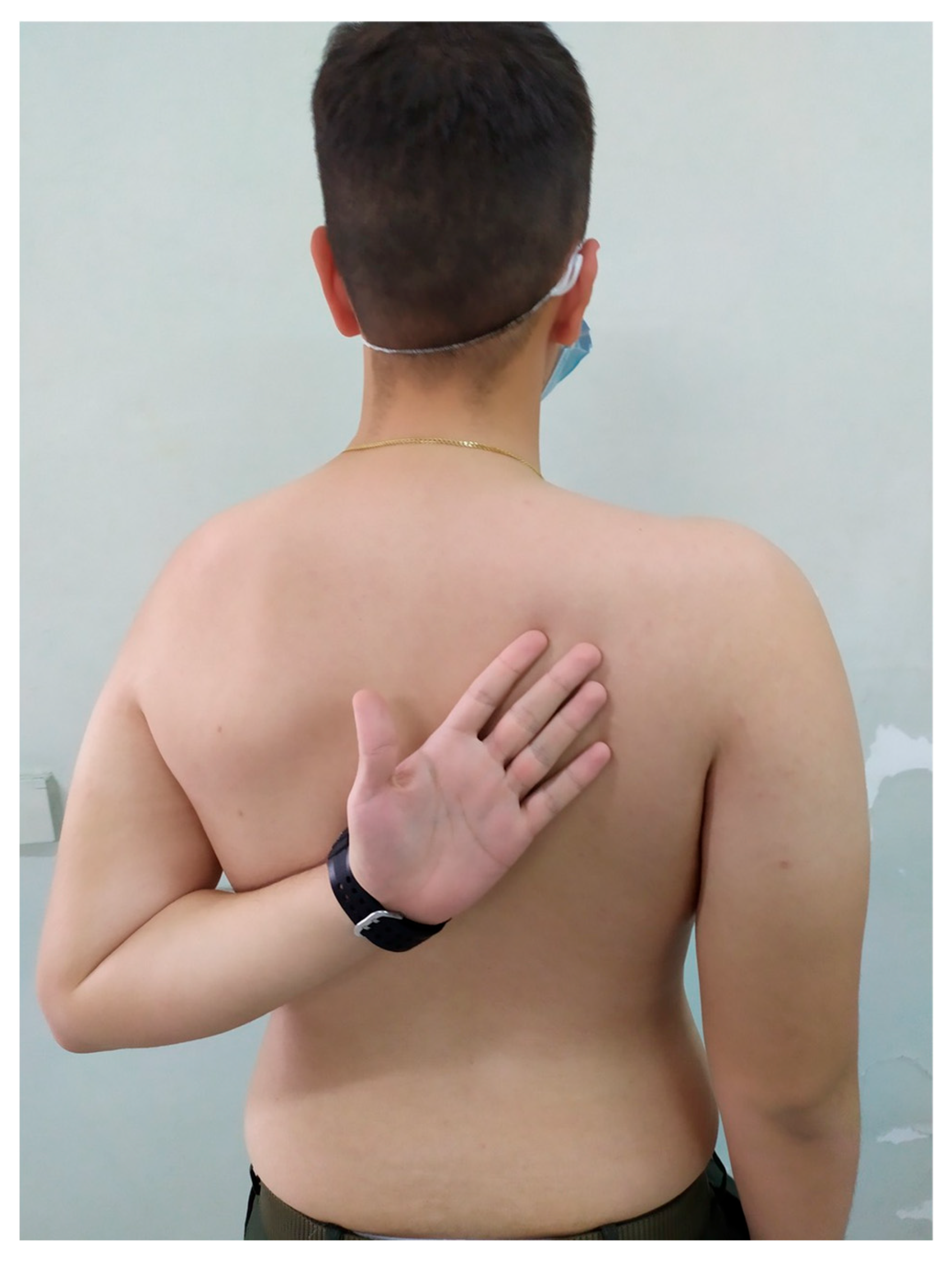
2.4. Self-Rehabilitation Protocol
2.5. Clinical Evaluation
2.6. Statistical Analysis
3. Results
3.1. Pain and Analgesic Use
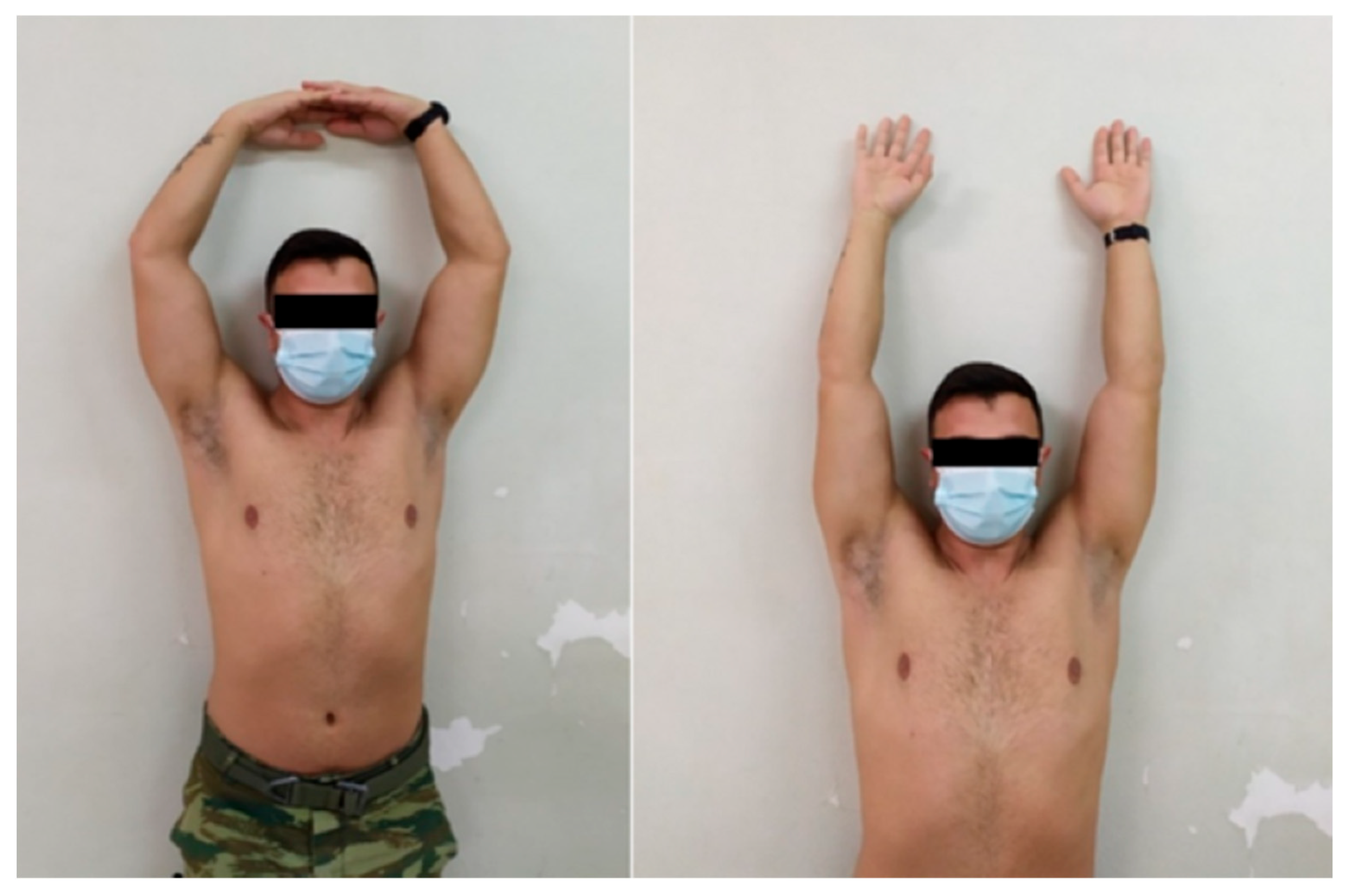
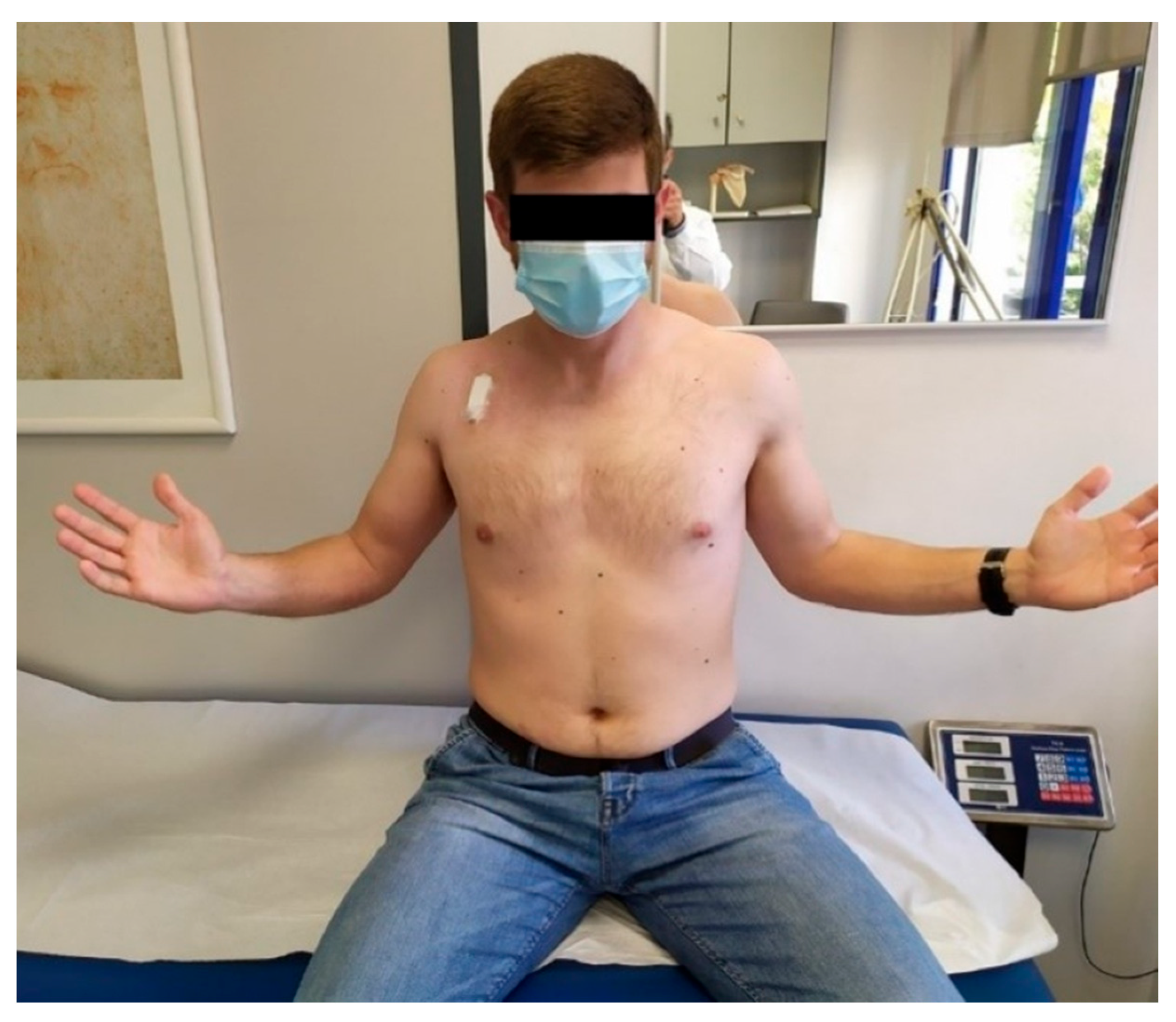
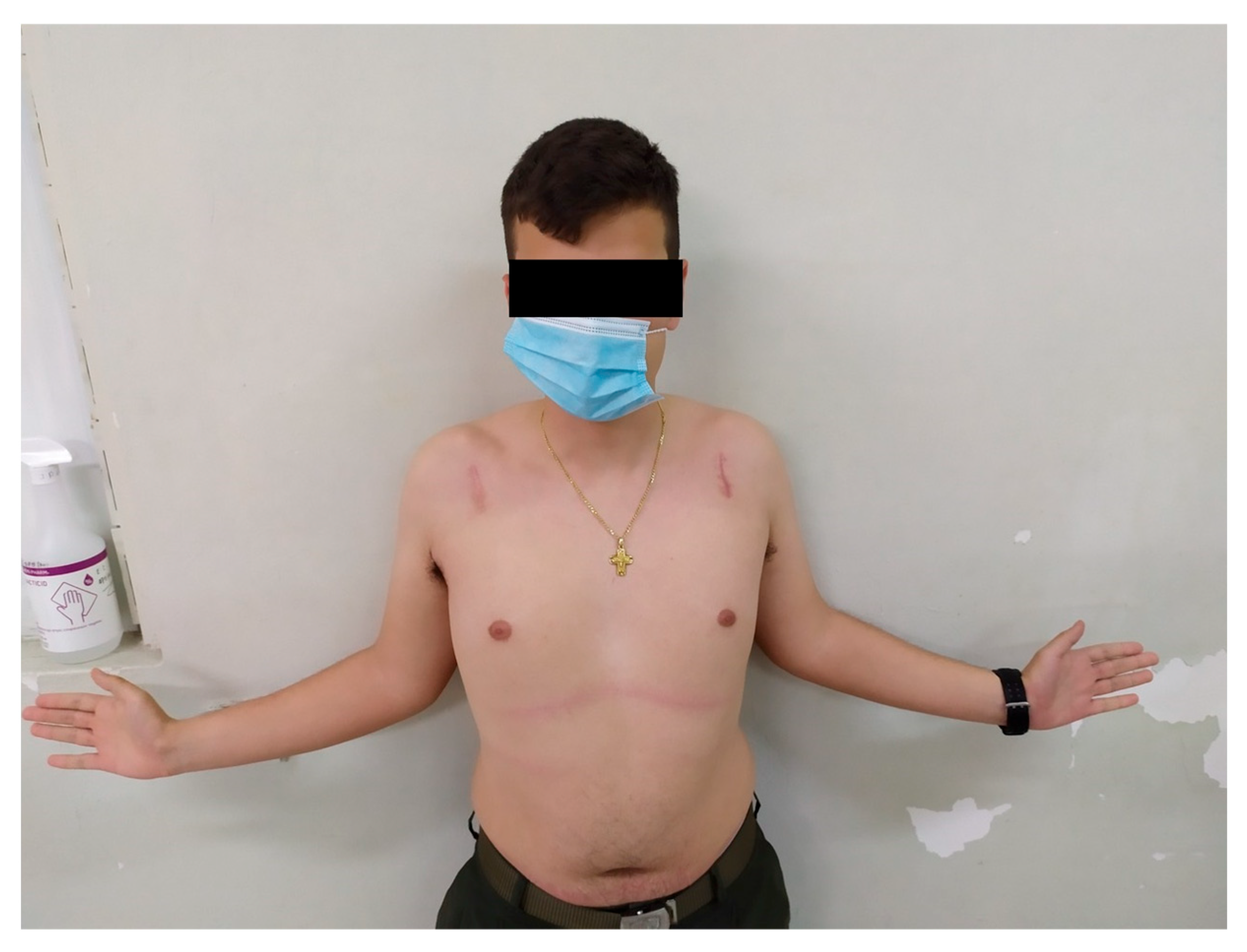
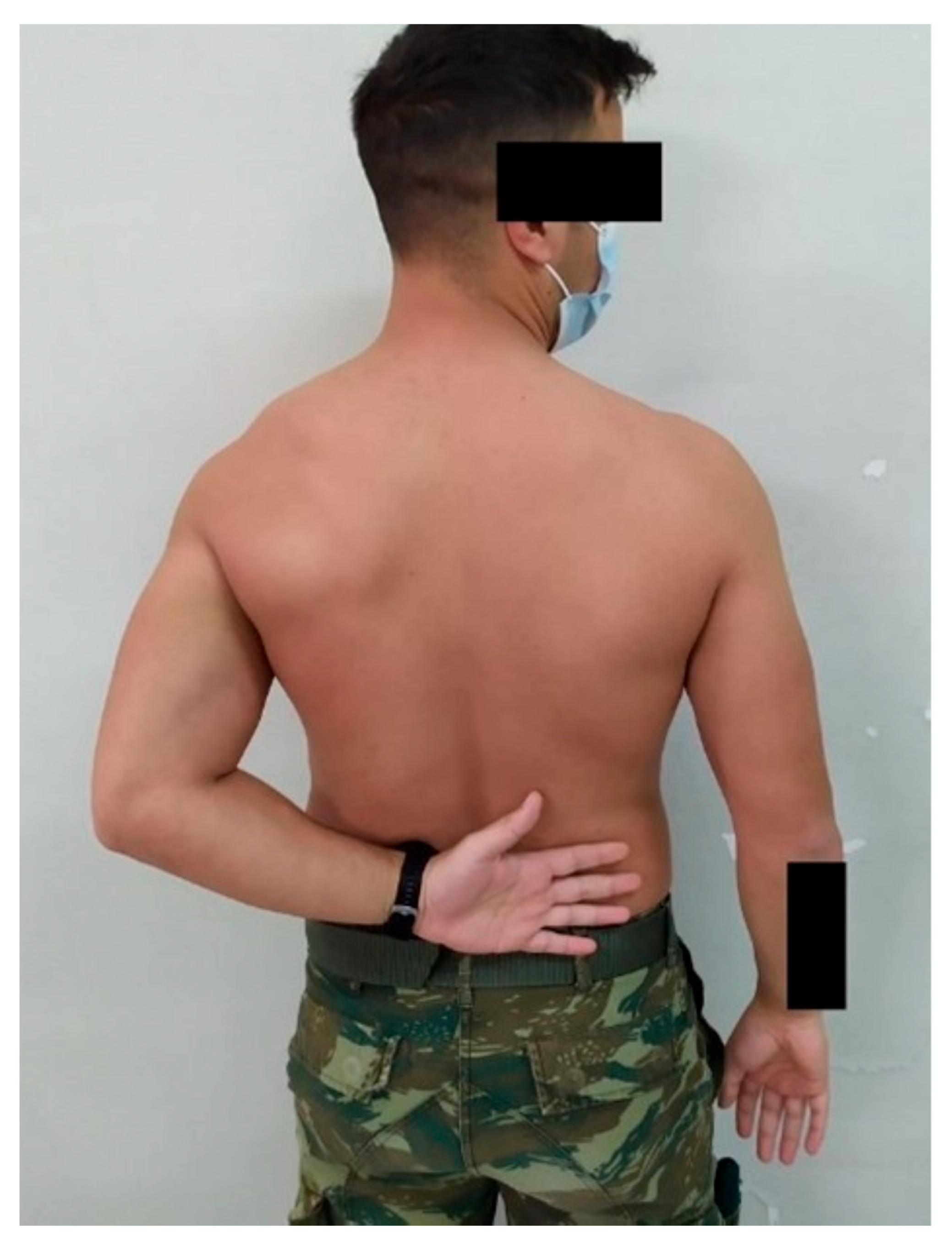
3.2. Range of Motion (ROM)
3.3. Complications and Satisfaction
4. Discussion
5. Conclusions
Author Contributions
Funding
Institutional Review Board Statement
Informed Consent Statement
Data Availability Statement
Conflicts of Interest
References
- Owens, B.D.; Dawson, L.; Burks, R.; Cameron, K.L. Incidence of Shoulder Dislocation in the United States Military: Demographic Considerations from a High-Risk Population. J. Bone Jt. Surg. Am. 2009, 91, 791–796. [Google Scholar] [CrossRef] [Scilit]
- Mattern, O.; Young, A.; Walch, G. Open Latarjet: Tried, Tested and True. Ann. Jt. 2017, 2, 65. [Google Scholar] [CrossRef] [Scilit]
- Roulet, S.; Borel, F.; Franger, G.; Liotard, J.-P.; Michelet, A.; Godenèche, A. Immediate Self-Rehabilitation after Open Latarjet Procedures Enables Recovery of Preoperative Shoulder Mobility at 3 Months. Knee Surg. Sports Traumatol. Arthrosc. 2019, 27, 3979–3988. [Google Scholar] [CrossRef] [Scilit]
- An, V.V.G.; Sivakumar, B.S.; Phan, K.; Trantalis, J. A Systematic Review and Meta-Analysis of Clinical and Patient-Reported Outcomes Following Two Procedures for Recurrent Traumatic Anterior Instability of the Shoulder: Latarjet Procedure vs. Bankart Repair. J. Shoulder Elb. Surg. 2016, 25, 853–863. [Google Scholar] [CrossRef] [Scilit]
- Tashjian, R.Z.; Deloach, J.; Porucznik, C.A.; Powell, A.P. Minimal Clinically Important Differences (MCID) and Patient Acceptable Symptomatic State (PASS) for Visual Analog Scales (VAS) Measuring Pain in Patients Treated for Rotator Cuff Disease. J. Shoulder Elb. Surg. 2009, 18, 927–932. [Google Scholar] [CrossRef] [Scilit]
- Cerciello, S.; Corona, K.; Morris, B.J.; Santagada, D.A.; Maccauro, G. Early Outcomes and Perioperative Complications of the Arthroscopic Latarjet Procedure: Systematic Review and Meta-Analysis. Am. J. Sports Med. 2019, 47, 2232–2241. [Google Scholar] [CrossRef] [Scilit]
- Frank, R.M.; Gregory, B.; O’Brien, M.; Bernardoni, E.; Verma, N.N.; Cole, B.J.; Nicholson, G.P.; Romeo, A.A. Ninety-Day Complications Following the Latarjet Procedure. J. Shoulder Elb. Surg. 2019, 28. [Google Scholar] [CrossRef] [Scilit]
- Hurley, E.T.; Jamal, M.S.; Ali, Z.S.; Montgomery, C.; Pauzenberger, L.; Mullett, H. Long-Term Outcomes of the Latarjet Procedure for Anterior Shoulder Instability: A Systematic Review of Studies at 10-Year Follow-Up. J. Shoulder Elb. Surg. 2019, 28, e33–e39. [Google Scholar] [CrossRef] [Scilit]
- Meyer, A.M.; Lorentz, S.G.; Klifto, C.S.; Bradley, K.E.; Lau, B.C.; Dickens, J.F.; Hurley, E.T. Open Latarjet Results in Lower Recurrent Instability and Revision Rates Than Arthroscopic Bankart Repair at a 10-Year Follow-Up: A Systematic Review. Arthrosc. J. Arthrosc. Relat. Surg. 2025, 41, 3693–3705. [Google Scholar] [CrossRef] [Scilit]
- Abdul-Rassoul, H.; Galvin, J.W.; Curry, E.J.; Simon, J.; Li, X. Return to Sport After Surgical Treatment for Anterior Shoulder Instability: A Systematic Review. Am. J. Sports Med. 2019, 47, 1507–1515. [Google Scholar] [CrossRef] [Scilit]
- Beletsky, A.; Cancienne, J.M.; Manderle, B.J.; Mehta, N.; Wilk, K.E.; Verma, N.N. A Comparison of Physical Therapy Protocols Between Open Latarjet Coracoid Transfer and Arthroscopic Bankart Repair. Sports Health 2020, 12, 124–131. [Google Scholar] [CrossRef] [Scilit]
- Mazzocca, A.D.; Arciero, R.A.; Shea, K.P.; Apostolakos, J.M.; Solovyova, O.; Gomlinski, G.; Wojcik, K.E.; Tafuto, V.; Stock, H.; Cote, M.P. The Effect of Early Range of Motion on Quality of Life, Clinical Outcome, and Repair Integrity After Arthroscopic Rotator Cuff Repair. Arthrosc. J. Arthrosc. Relat. Surg. 2017, 33, 1138–1148. [Google Scholar] [CrossRef] [Scilit]
- Mazuquin, B.F.; Wright, A.C.; Russell, S.; Monga, P.; Selfe, J.; Richards, J. Effectiveness of Early Compared with Conservative Rehabilitation for Patients Having Rotator Cuff Repair Surgery: An Overview of Systematic Reviews. Br. J. Sports Med. 2018, 52, 111–121. [Google Scholar] [CrossRef] [Scilit]
- Sonoda, Y.; Nishioka, T.; Nakajima, R.; Imai, S.; Vigers, P.; Kawasaki, T. Use of a Shoulder Abduction Brace after Arthroscopic Rotator Cuff Repair: A Study on Gait Performance and Falls. Prosthet. Orthot. Int. 2018, 42, 136–143. [Google Scholar] [CrossRef] [Scilit]
- Andersen, N.H.; Søjbjerg, J.O.; Johannsen, H.V.; Sneppen, O. Self-Training versus Physiotherapist-Supervised Rehabilitation of the Shoulder in Patients Treated with Arthroscopic Subacromial Decompression: A Clinical Randomized Study. J. Shoulder Elb. Surg. 1999, 8, 99–101. [Google Scholar] [CrossRef] [Scilit]
- Elsabbagh, L.; AlQahtani, H.; Alsultan, A.A.; AlDossary, H.J.; Alresheidi, H.; Abdelhamid, A.; Buraik, D.W. Effect of Telerehabilitation Assessment for Adults with Musculoskeletal Conditions on Access to Care beyond the COVID-19 Pandemic: A Retrospective Case-Control Analysis. Digit. Health 2024, 10, 20552076241288734. [Google Scholar] [CrossRef] [Scilit]
- Cottrell, M.A.; O’Leary, S.P.; Raymer, M.; Hill, A.J.; Comans, T.; Russell, T.G. Does Telerehabilitation Result in Inferior Clinical Outcomes Compared with In-Person Care for the Management of Chronic Musculoskeletal Spinal Conditions in the Tertiary Hospital Setting? A Non-Randomised Pilot Clinical Trial. J. Telemed. Telecare 2021, 27, 444–452. [Google Scholar] [CrossRef] [Scilit]
- Krzyzaniak, N.; Cardona, M.; Peiris, R.; Michaleff, Z.A.; Greenwood, H.; Clark, J.; Scott, A.M.; Glasziou, P. Telerehabilitation versus Face-to-Face Rehabilitation in the Management of Musculoskeletal Conditions: A Systematic Review and Meta-Analysis. Phys. Ther. Rev. 2023, 28, 71–87. [Google Scholar] [CrossRef] [Scilit]
- Shaheen, H.M.; Shameh, R.A.; Abufara, A. Effectiveness and Challenges of Tele-Physiotherapy Compared to In-Person Care in Musculoskeletal Rehabilitation. Ahliya J. Allied Med. Technol. Sci. 2025, 2, 5–9. [Google Scholar] [CrossRef] [Scilit]
- Barth, J.; Boutsiadis, A.; Neyton, L.; Lafosse, L.; Walch, G. Can a Drill Guide Improve the Coracoid Graft Placement During the Latarjet Procedure? A Prospective Comparative Study With the Freehand Technique. Orthop. J. Sports Med. 2017, 5, 2325967117734218. [Google Scholar] [CrossRef] [Scilit]
- Boutsiadis, A.; Bampis, I.; Swan, J.; Barth, J. Best Implant Choice for Coracoid Graft Fixation during the Latarjet Procedure Depends on Patients’ Morphometric Considerations. J. Exp. Orthop. 2020, 7, 15. [Google Scholar] [CrossRef] [Scilit]
- Griesser, M.J.; Harris, J.D.; McCoy, B.W.; Hussain, W.M.; Jones, M.H.; Bishop, J.Y.; Miniaci, A. Complications and Re-Operations after Bristow-Latarjet Shoulder Stabilization: A Systematic Review. J. Shoulder Elb. Surg. 2013, 22, 286–292. [Google Scholar] [CrossRef] [Scilit] [PubMed]
- Rollick, N.C.; Ono, Y.; Kurji, H.M.; Nelson, A.A.; Boorman, R.S.; Thornton, G.M.; Lo, I.K. Long-Term Outcomes of the Bankart and Latarjet Repairs: A Systematic Review. Open Access J. Sports Med. 2017, 8, 97–105. [Google Scholar] [CrossRef] [Scilit]
- McHale, K.J.; Sanchez, G.; Lavery, K.P.; Rossy, W.H.; Sanchez, A.; Ferrari, M.B.; Provencher, M.T. Latarjet Technique for Treatment of Anterior Shoulder Instability With Glenoid Bone Loss. Arthrosc. Tech. 2017, 6, e791–e799. [Google Scholar] [CrossRef] [Scilit]



| Outcome | Week 1 | Week 2 | Week 4 | Week 8 | Week 12 |
|---|---|---|---|---|---|
| VAS (0–10) | 1.2 ± 0.6 | 0.8 ± 0.5 | 0 | 0 | 0 |
| Active Forward Flexion (°) | 155 ± 10 | 170 ± 5 | 180 | 180 | 180 |
| External Rotation (°) | - | - | 60 ± 5 | 75 ± 4 | 80 ± 3 |
| Internal Rotation Level | - | - | L3 | T7 | T7 |
| Complications | None | None | None | None | None |
| Satisfaction (0–10) | - | - | - | - | 9.5 ± 0.4 |
Disclaimer/Publisher’s Note: The statements, opinions and data contained in all publications are solely those of the individual author(s) and contributor(s) and not of MDPI and/or the editor(s). MDPI and/or the editor(s) disclaim responsibility for any injury to people or property resulting from any ideas, methods, instructions or products referred to in the content. |
© 2025 by the authors. Licensee MDPI, Basel, Switzerland. This article is an open access article distributed under the terms and conditions of the Creative Commons Attribution (CC BY) license (https://creativecommons.org/licenses/by/4.0/).
Share and Cite
Bekas, K.; Bampis, I.; Stamatopoulos, A.; Papadimitriou, A.-A.; Vamvakeros, K.; Kechagias, I.; Boutsiadis, A. Short-Term Outcomes of a Structured Self-Rehabilitation Program After Mini-Open Latarjet Procedure in Military Personnel: A Prospective Observational Study. Med. Sci. 2025, 13, 307. https://doi.org/10.3390/medsci13040307
Bekas K, Bampis I, Stamatopoulos A, Papadimitriou A-A, Vamvakeros K, Kechagias I, Boutsiadis A. Short-Term Outcomes of a Structured Self-Rehabilitation Program After Mini-Open Latarjet Procedure in Military Personnel: A Prospective Observational Study. Medical Sciences. 2025; 13(4):307. https://doi.org/10.3390/medsci13040307
Chicago/Turabian StyleBekas, Kyriakos, Ioannis Bampis, Alexandros Stamatopoulos, Apostolos-Apollon Papadimitriou, Konstantinos Vamvakeros, Ioannis Kechagias, and Achilleas Boutsiadis. 2025. "Short-Term Outcomes of a Structured Self-Rehabilitation Program After Mini-Open Latarjet Procedure in Military Personnel: A Prospective Observational Study" Medical Sciences 13, no. 4: 307. https://doi.org/10.3390/medsci13040307
APA StyleBekas, K., Bampis, I., Stamatopoulos, A., Papadimitriou, A.-A., Vamvakeros, K., Kechagias, I., & Boutsiadis, A. (2025). Short-Term Outcomes of a Structured Self-Rehabilitation Program After Mini-Open Latarjet Procedure in Military Personnel: A Prospective Observational Study. Medical Sciences, 13(4), 307. https://doi.org/10.3390/medsci13040307