
Nature-Based Learning and Inclusive Education for Deaf Students: Theoretical Foundations and an Illustrative Geology Activity in Portuguese Sign Language



Abstract
1. Introduction
2. Fundamental Principles of Nature-Based Learning (NBL)
3. Who Are Deaf Individuals and How Do They Learn?
4. Nature-Based Learning and the Inclusion of Deaf Students: Opportunities and Challenges
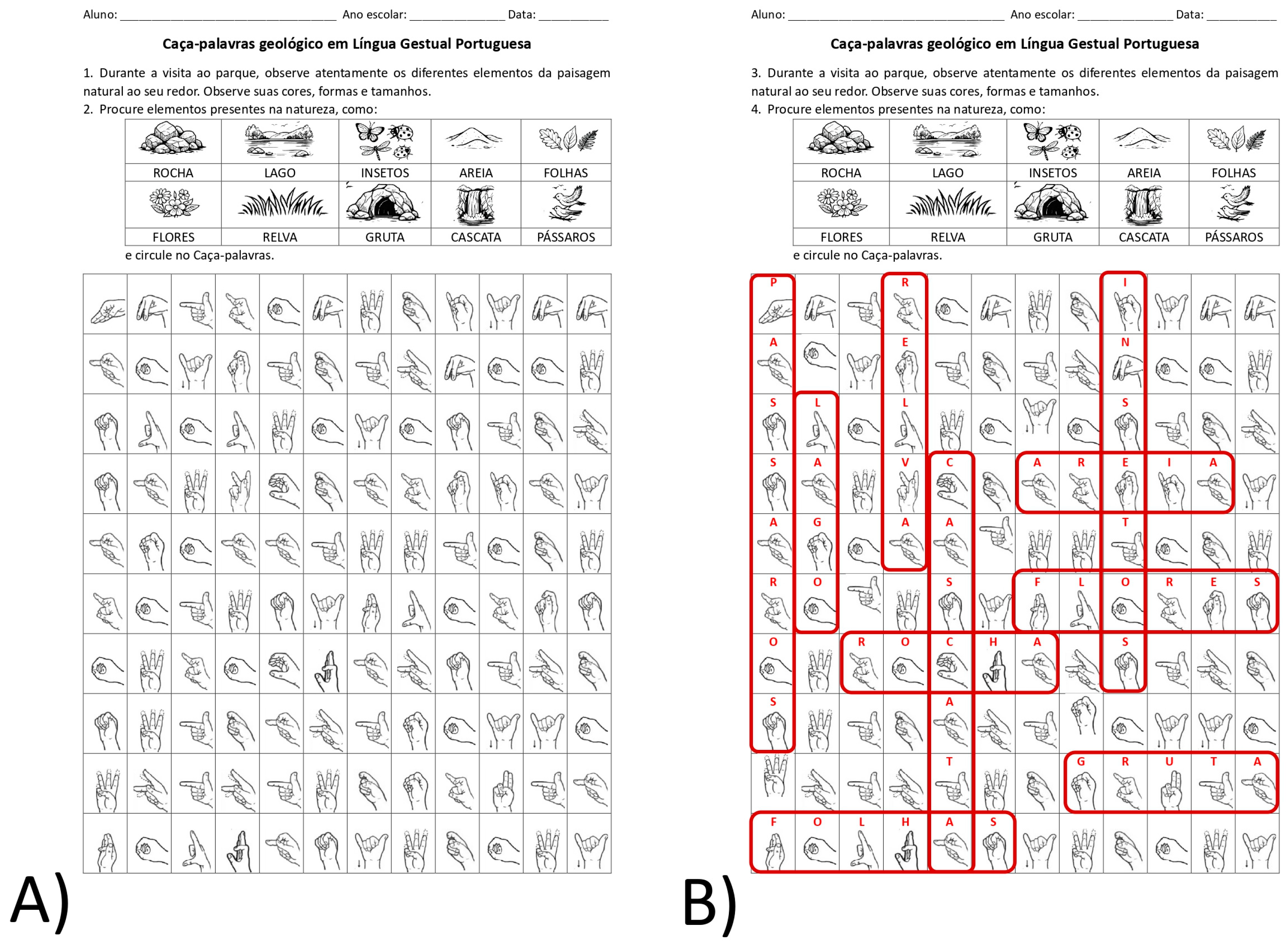
An Illustrative Inclusive Geology Activity in Portuguese Sign Language
5. Conclusions and Future Perspectives
Author Contributions
Funding
Data Availability Statement
Conflicts of Interest
References
- Amor, A.M.; Hagiwara, M.; Shogren, K.A.; Thompson, J.R.; Verdugo, M.Á.; Burke, K.M.; Aguayo, V. International perspectives and trends in research on inclusive education: A systematic review. Int. J. Incl. Educ. 2019, 23, 1277–1295. [Google Scholar] [CrossRef] [Scilit]
- Slee, R. Defining the Scope of Inclusive Education; Paper Commissioned for the 2020 Global Education Monitoring Report, Inclusion and Education; UNESCO: Paris, France, 2018; Available online: https://unesdoc.unesco.org/ark:/48223/pf0000265773 (accessed on 20 May 2026).
- Booth, T.; Ainscow, M. Index for Inclusion: Developing Learning and Participation in Schools; Centre for Studies on Inclusive Education: Bristol, UK, 2002. [Google Scholar]
- Florian, L.; Beaton, M.C. Inclusive pedagogy in action: Getting it right for every child. Int. J. Incl. Educ. 2018, 22, 870–884. [Google Scholar] [CrossRef] [Scilit]
- Ainscow, M. Promoting inclusion and equity in education: Lessons from international experiences. Nord. J. Stud. Educ. Policy 2020, 6, 7–16. [Google Scholar] [CrossRef] [Scilit]
- Neto, A.D.O.S.; Ávila, É.G.; Sale, T.R.R.; Amorim, S.S.; Nunes, A.K.; Santos, V.M. Educação inclusiva: Uma escola para todos. Rev. Educ. Espec. 2018, 31, 81–92. [Google Scholar] [CrossRef] [Scilit]
- Maia, V.; Freire, S. Understanding teachers’ mindset regarding differentiated instruction: Issues related to curriculum planning. Int. J. Incl. Educ. 2023, 29, 919–934. [Google Scholar] [CrossRef] [Scilit]
- Nilholm, C. Research about inclusive education in 2020–How can we improve our theories in order to change practice? Eur. J. Spec. Needs Educ. 2021, 36, 358–370. [Google Scholar] [CrossRef] [Scilit]
- Fernandes, J.M.; Reis, I.F. Estratégia Didática Inclusiva a Alunos Surdos para o Ensino dos Conceitos de Balanceamento de Equações Químicas e de Estequiometria para o Ensino Médio. Quím. Nova Esc. 2017, 39, 186–194. [Google Scholar] [CrossRef] [Scilit]
- Grützmann, T.P.; da Silveira Alves, R.; Lebedeff, T.B. A Pedagogia Visual na Educação de Surdos: Uma experiência com o ensino da matemática no MathLibras. Práxis Educ. 2020, 16, 51–74. [Google Scholar] [CrossRef] [Scilit]
- da Silva, A.R.S.; da Silva Miranda, S.M.B.; da Silva Lopes, L.C.; Miranda, A.L.A.; da Silva Ferreira, H.H.; de Sousa, D.L.; da Silva de Carvalho, D. A libras como primeira língua para a aprendizagem de crianças surdas. Rev. Geopolítica 2026, 17, e2205. [Google Scholar] [CrossRef] [Scilit]
- Gomes, E.M.L.d.S.; Bentes, T.; da Silveira Calixto, H.R. A pedagogia visual como fundamental na educação de surdos: Significações do corpo e as experiências visuais dos alunos surdos. Rev. Interinst. Artes Educ. 2021, 7, 1713–1731. [Google Scholar] [CrossRef] [Scilit]
- Ogunwale, O.R. Outdoor Classroom and Pictorial Illustration Instructional Strategies as Determinants of Learning Outcomes in Basic Science Among Students with Hearing Impairment in Ibadan. Ph.D. Thesis, University of Ibadan, Ibadan, Nigeria, 2021. [Google Scholar]
- Daza Gonzalez, M.T.; Phillips-Silver, J.; Maurno, N.G.; García, L.F.; Ruiz-Castañeda, P. Improving phonological skills and reading comprehension in deaf children: A new multisensory approach. Sci. Stud. Read. 2023, 27, 119–135. [Google Scholar] [CrossRef] [Scilit]
- Hettiarachchi, S.; Ranaweera, M.; Disanayake, H.M.L.N. The effectiveness of using multi-sensory children’s stories on vocabulary development in young deaf and hard-of-hearing children. Deaf. Educ. Int. 2021, 23, 145–168. [Google Scholar] [CrossRef] [Scilit]
- Anderson, S.K. Bringing School to Life: Place-Based Education Across the Curriculum; Rowman Littlefield Publishers: London, UK, 2017. [Google Scholar]
- Faber Taylor, A.; Butts-Wilmsmeyer, C.; Jordan, C. Nature-based instruction for science learning—A good fit for all: A controlled comparison of classroom versus nature. Environ. Educ. Res. 2022, 28, 1527–1546. [Google Scholar] [CrossRef] [Scilit]
- Chawla, L. Benefits of Nature Contact for Children. J. Plan. Lit. 2015, 30, 433–452. [Google Scholar] [CrossRef] [Scilit]
- Kuo, M.; Browning, M.H.E.M.; Penner, M.L. Do Lessons in Nature Boost Subsequent Classroom Engagement? Refueling Students in Flight. Front. Psychol. 2018, 8, 2253. [Google Scholar] [CrossRef] [Scilit] [PubMed]
- Mann, J.; Gray, T.; Truong, S.; Brymer, E.; Passy, R.; Ho, S.; Sahlsberg, P.; Ward, K.; Bentsen, P.; Curry, C.; et al. Getting out of the classroom and into nature: A systematic review of nature-specific outdoor learning on school Children’s learning and development. Front. Public Health 2022, 10, 877058. [Google Scholar] [CrossRef] [Scilit] [PubMed]
- Fernandes, J.V.; Steinke, V.A.; de la Vega, A.G. Geografia, paisagem e fotogeografia: Uma experiência no ensino de alunos surdos. ENTRE-LUGAR 2021, 12, 126–145. [Google Scholar] [CrossRef] [Scilit]
- Höher, P.B.; Peres, P.E.C. Percepções de alunos surdos em trilha ecológica com o uso dos diferentes sentidos: Uma abordagem da educação ambiental. Rev. Monogr. Ambient. 2012, 6, 1341–1353. [Google Scholar] [CrossRef] [Scilit]
- Kaya, C.; Kuzugudenli, E. Nature-Themed Teaching Methods for Deaf Students. J. Multidiscip. Eng. Sci. Technol. 2016, 3, 5475–5478. [Google Scholar]
- De Oliveira Vons, P.C.; Scopel, J.M.; Scur, L. The Sensory Garden as an Environmental Educational Activity for Social Inclusion in the Natural Sciences Museum of University of Caxias do Sul. Sci. Cum Ind. 2014, 2, 43–46. [Google Scholar]
- Shabrina, S.; Muna, Z.F.L. Analysis of Nature-Based-Learning for Children with Autism Spectrum Disorder in Elementary School Age: A Systematic Review. Spec. Incl. Educ. J. 2023, 4, 50–55. [Google Scholar] [CrossRef] [Scilit]
- Yigit-Gencten, V.; Gultekin, M. Nature-based reading and writing instructions in early childhood education: The Giving Tree example. Environ. Educ. Res. 2022, 28, 95–108. [Google Scholar] [CrossRef] [Scilit]
- Kiviranta, L.; Lindfors, E.; Rönkkö, M.-L.; Luukka, E. Outdoor learning in early childhood education: Exploring benefits and challenges. Educ. Res. 2024, 66, 102–119. [Google Scholar] [CrossRef] [Scilit]
- Wolken, B.K. Assessing Accessibility in Environmental Education with an Emphasis on the d/Deaf and Hard of Hearing Community. Doctoral Dissertation, Kansas State University, Manhattan, KS, USA, 2025. [Google Scholar]
- Michaelson, V.; King, N.; Janssen, I.; Lawal, S.; Pickett, W. Electronic Screen Technology Use and Connection to Nature in Canadian Adolescents: A Mixed Methods Study. Can. J. Public Health 2020, 111, 502–514. [Google Scholar] [CrossRef] [Scilit] [PubMed]
- Stavrianos, A. Green inclusion: Biophilia as a necessity. Br. J. Spec. Educ. 2016, 43, 416–429. [Google Scholar] [CrossRef] [Scilit]
- Louv, R. A Brief History of the Children Nature Movement. J. Sci. Educ. Technol. 2008, 17, 217–218. [Google Scholar] [CrossRef] [Scilit]
- Malone, K. Reconsidering Children’s Encounters with Nature and Place Using Posthumanism. Aust. J. Environ. Educ. 2016, 32, 42–56. [Google Scholar] [CrossRef] [Scilit]
- Chawla, L.; Gould, R. Childhood nature connection and constructive hope: A review of research on connecting with nature and coping with environmental loss. People Nat. 2020, 2, 619–642. [Google Scholar] [CrossRef] [Scilit]
- Latane, C. Schools That Heal: Design with Mental Health in Mind; Island Press: Washington, DC, USA, 2021. [Google Scholar]
- Falzon, D. Designing Spaces for Nature-Based Learning in Small, Urban Primary Schools. Doctoral Dissertation, University of Malta, Msida, Malta, 2025. Available online: https://www.um.edu.mt/library/oar/handle/123456789/144595 (accessed on 21 August 2026).
- Friedman, S.; James, M.; Brocklebank, J.; Cox, S.; Morrison, S. Facilitating Nature-Based Learning with Autistic Students. Child. Educ. 2023, 99, 14–23. [Google Scholar] [CrossRef] [Scilit]
- Wulansari, B.Y.; Sugito, S. Development of Nature-Based Learning Models to Improve the Quality of Early Childhood Learning Process. J. Pendidik. Pemberdaya. Masy. 2016, 3, 16–27. [Google Scholar]
- Miller, N.C.; Kumar, S.; Pearce, K.L.; Baldock, K.L. The outcomes of nature-based learning for primary school aged children: A systematic review of quantitative research. Environ. Educ. Res. 2021, 27, 1115–1140. [Google Scholar] [CrossRef] [Scilit]
- Vasconcelos, C.; Ribeiro, T.; Ramos, A. Potential and Limitations of Virtual Field Trips in promoting Nature-Based Learning and Inclusion. In Practical Work in Science Education in the Digital Era; Leite, L., Dourado, L., Afonso, A.S., Morgado, S., Carvalho, L., Eds.; Advances in Technology-Rich Science Education; Springer: Cham, Switzerland, 2026; Volume 2. [Google Scholar] [CrossRef] [Scilit]
- Jordan, C.; Chawla, L. A coordinated research agenda for nature-based learning. Front. Psychol. 2019, 10, 766. [Google Scholar] [CrossRef] [Scilit] [PubMed]
- Hasbi Sjamsir, Y. Nature-based Learning Analysis in the Nature School of Early Childhood Education-Barokallah Samarinda. Int. J. Early Child. Spec. Educ. 2021, 13, 49–52. [Google Scholar] [CrossRef] [Scilit]
- Jucker, R.; von Au, J. High-Quality Outdoor Learning: Evidence-Based Education Outside the Classroom for Children, Teachers and Society; Springer: Cham, Switzerland, 2022; p. 386. [Google Scholar]
- Harper, A.; Hespos, S.; Gray, T. Nature Play in Primary School: Supporting Holistic Development Through Outdoor Learning. Educ. Sci. 2025, 15, 1487. [Google Scholar] [CrossRef] [Scilit]
- Lubis, M.; Yustika, S. Dynamics of Nature-Based Learning in Developing Children’s Motoricic Skills: Teacher and Parent Perspectives. HUMANISMA J. Gend. Stud. 2025, 9, 64–79. [Google Scholar] [CrossRef] [Scilit]
- Carrier, S.J.; Thomson, M.M.; Tugurian, L.P.; Stevenson, K.T. Elementary Science Education in Classrooms and Outdoors: Stakeholder Views, Gender, Ethnicity, and Testing. Int. J. Sci. Educ. 2014, 36, 2195–2220. [Google Scholar] [CrossRef] [Scilit]
- Gupta, R.; LaMarca, N.; Rank, S.J.; Flinner, K. The environment as a pathway to science learning for K–12 learners—A case study of the E-STEM movement. Ecopsychology 2018, 10, 228–242. [Google Scholar] [CrossRef] [Scilit]
- Ernst, J.; Juckett, H.; Sobel, D. Comparing the Impact of Nature, Blended, and Traditional Preschools on Children’s Resilience: Some Nature May Be Better Than None. Front. Psychol. 2021, 12, 724340. [Google Scholar] [CrossRef] [Scilit] [PubMed]
- Kuo, M.; Dettweiler, U.; Faber Taylor, A.; Jordan, C.; Wells, N.M. Editorial: Nature-based learning and development: Maximizing the returns on investment, volume II. Front. Psychol. 2023, 14, 1304644. [Google Scholar] [CrossRef] [Scilit] [PubMed]
- Otto, S.; Pensini, P. Nature-based environmental education of children: Environmental knowledge and connectedness to nature, together, are related to ecological behaviour. Glob. Environ. Change 2017, 47, 88–94. [Google Scholar] [CrossRef] [Scilit]
- Kuo, M. How might contact with nature promote human health? Promising mechanisms and a possible central pathway. Front. Psychol. 2015, 6, 1093. [Google Scholar] [CrossRef] [Scilit] [PubMed]
- Li, D.; Sullivan, W.C. Impact of views to school landscapes on recovery from stress and mental fatigue. Landsc. Urban Plan. 2016, 148, 149–158. [Google Scholar] [CrossRef] [Scilit]
- Gray, C.; Gibbons, R.; Larouche, R.; Sandseter, E.B.H.; Bienenstock, A.; Brussoni, M.; Chabot, G.; Herrington, S.; Janssen, I.; Pickett, W.; et al. What is the Relationship between Outdoor Time and Physical Activity, Sedentary Behaviour, and Physical Fitness in Children? A Systematic Review. Int. J. Environ. Res. Public Health 2015, 12, 6455–6474. [Google Scholar] [CrossRef] [Scilit] [PubMed]
- Kushalnagar, R. Deafness and hearing loss. In Web Accessibility; Yesilada, Y., Harper, S., Eds.; Springer: London, UK, 2019. [Google Scholar] [CrossRef] [Scilit]
- Kuzugudenli, E.; Goktas, H.; Kaya, C.; Kilic, A. Nature education teaching techniques for hearing impaired people. Int. J. Res.-Granthaalayah 2017, 5, 298–301. [Google Scholar] [CrossRef] [Scilit]
- Agapova, T.V. Specifics of teaching a foreign language to students with hearing impairment (hard of hearing students). Pedagog. Z. 2020, 10, 635–644. [Google Scholar]
- Krasavina, Y.V.; Serebryakova, Y.V.; Ponomarenko, E.P.; Zhuykova, O.V. Research-Based Teaching of Hearing-Impaired Students. ARPHA Proc. 2019, 1, 1789–1801. [Google Scholar] [CrossRef] [Scilit]
- Kodirova, F.U.; Matupaeva, S.Z.; Teshaboeva, F.R. Methodical cluster-an innovative mechanism to increase the efficiency of general secondary and inclusive education. Eur. J. Res. Reflect. Educ. Sci. 2020, 8, 115–122. [Google Scholar]
- Pimentel, G.S.R. O brasil e os desafios da educação e dos educadores na agenda 2030 da onu. Rev. Nova Paid.—Rev. Interdiscip. Educ. Pesqui. 2019, 1, 22–33. [Google Scholar] [CrossRef] [Scilit]
- Sanches, I.R.; da Silva, P.B. A inclusão de estudantes surdos no ensino superior brasileiro: O caso de um curso de Pedagogia: The inclusion of deaf students in higher education in Brazil: The case of a Pedagogy course. Rev. Port. Educ. 2019, 32, 155–172. [Google Scholar] [CrossRef] [Scilit]
- UNESCO. A Guide for Ensuring Inclusion and Equity in Education; UNESCO: Paris, France, 2017. [Google Scholar] [CrossRef] [Scilit]
- Nery, C.A.; Batista, C.G. Imagens visuais como recursos pedagógicos na educação de uma adolescente surda: Um estudo de caso. Paideia 2004, 14, 287–299. [Google Scholar] [CrossRef] [Scilit]
- Campos, M.d.L.I.L. Educação Inclusiva para surdos e as políticas vigentes. In Língua Brasileira de Sinais-Libras: Uma Introdução; Góes, A.M., Lodi, A.C.B., Lacerda, C.B.F.D., Eds.; UAB-UFSCar: São Carlos, Brazil, 2011; pp. 27–50. Available online: http://livresaber.sead.ufscar.br:8080/jspui/bitstream/123456789/690/1/PE_LinguabrasileiradesinaisLibrasumaintroducao.pdf (accessed on 25 August 2026).
- Mantoan, M.T.E. Diferenciar para incluir ou para excluir? Por uma pedagogia da diferença. Diversa, 29 October 2013. Available online: https://diversa.org.br/artigos/diferenciar-para-incluir-ou-para-excluir-por-uma-pedagogia-da-diferenca/ (accessed on 25 August 2026).
- Pozas, M.; Letzel, V.; Schneider, C. Teachers and Differentiated Instruction: Exploring Differentiation Practices to Address Student Diversity. J. Res. Spec. Educ. Needs 2020, 20, 217–230. [Google Scholar] [CrossRef] [Scilit]
- Godwin, E.; Jarvis, L.; Parkin, N.; Poortinga, W.; Hobson, K.; Stead, M.; Reeves, J.; Marshall, M.; Gattis, M. Making outdoor learning accessible and inclusive for children with special educational needs and disabilities (SEND): A case study. J. Adventure Educ. Outdoor Learn. 2025, 1–20. [Google Scholar] [CrossRef] [Scilit]
- Creati, P.; Pela, P.; Cuccaro, A.; Gentilozzi, C. Nature-based education as a pathway to sustainable and transformative learning: A theoretical perspective. Ital. J. Health Educ. Sports Incl. Didact. 2025, 9, 20–29. [Google Scholar] [CrossRef]
- O‘G‘Li, H.I.H. Environmental Education of Hearing-impaired Preschool Children by Shaping Their Knowledge of Nature. Galaxy Int. Interdiscip. Res. J. 2023, 11, 510–513. [Google Scholar]
- Tarbuck, E.J.; Lutgens, F.K.; Tasa, D. Ciencias de la Tierra, 8th ed.; Pearson Educación S.A.: Madrid, Spain, 2005. [Google Scholar]
- Moreira, F.D.; de Melo Santos, J.M. A abordagem tectônica no ensino de projeto: Uma análise a partir de experiências acadêmicas na inglaterra e no Brasil. Rev. Proj.—Proj. Percepção Ambiente 2019, 4, 20–35. [Google Scholar] [CrossRef] [Scilit]
- Carmo, H.; Freire, M.J.; de Carvalho, P.V. Porquê o termo língua gestual portuguesa? Diffractions 2023, 7, 108–130. [Google Scholar] [CrossRef]


| Component | Proposed Characteristics |
|---|---|
| Educational level | Primary education is adaptable according to students’ age and curricular level. |
| Participants | Inclusive groups of Deaf and hearing students. |
| Duration | Approximately 2–3 sessions: preparation, outdoor exploration, and post-activity discussion. |
| Learning objectives | Identify selected geological elements; observe and describe physical properties; distinguish geological from other natural elements; relate observations to introductory geological concepts. |
| Geological content | Rocks, minerals, soils, sand, and landscape features available in the local environment. |
| Environment | Accessible natural or naturalized areas close to the school, such as parks, gardens, trails, beaches, or green areas. |
| Materials | LGP-adapted word search, images, visual cards, concrete samples where appropriate, and writing/drawing materials. |
| Pre-activity | Introduction of relevant geological vocabulary, concepts, and corresponding LGP signs. |
| Outdoor activity | Observation, identification, comparison, and multisensory exploration of geological and other natural elements. |
| Organization | Small collaborative groups including Deaf and hearing students. |
| Teacher’s role | Facilitate observation and inquiry, provide visual instructions, support comparison, and connect observations to geological concepts. |
| LGP accessibility | Key instructions and concepts provided visually and/or in LGP; involvement of an LGP interpreter or Deaf educator when available and appropriate. |
| Post-activity | Collective discussion, distinction between geological and other natural elements, and comparison of observed characteristics. |
| Assessment possibilities | Identification/classification task, visual record, drawing, short presentation in LGP and/or written language, or group discussion. |
| Adaptation | Procedures and resources adjusted to individual linguistic, sensory, communication, and educational needs. |
Disclaimer/Publisher’s Note: The statements, opinions and data contained in all publications are solely those of the individual author(s) and contributor(s) and not of MDPI and/or the editor(s). MDPI and/or the editor(s) disclaim responsibility for any injury to people or property resulting from any ideas, methods, instructions or products referred to in the content. |
© 2026 by the authors. Licensee MDPI, Basel, Switzerland. This article is an open access article distributed under the terms and conditions of the Creative Commons Attribution (CC BY) license.
Share and Cite
Fernandes, N.; Vasconcelos, C. Nature-Based Learning and Inclusive Education for Deaf Students: Theoretical Foundations and an Illustrative Geology Activity in Portuguese Sign Language. Geosciences 2026, 16, 350. https://doi.org/10.3390/geosciences16090350
Fernandes N, Vasconcelos C. Nature-Based Learning and Inclusive Education for Deaf Students: Theoretical Foundations and an Illustrative Geology Activity in Portuguese Sign Language. Geosciences. 2026; 16(9):350. https://doi.org/10.3390/geosciences16090350
Chicago/Turabian StyleFernandes, Natalia, and Clara Vasconcelos. 2026. "Nature-Based Learning and Inclusive Education for Deaf Students: Theoretical Foundations and an Illustrative Geology Activity in Portuguese Sign Language" Geosciences 16, no. 9: 350. https://doi.org/10.3390/geosciences16090350
APA StyleFernandes, N., & Vasconcelos, C. (2026). Nature-Based Learning and Inclusive Education for Deaf Students: Theoretical Foundations and an Illustrative Geology Activity in Portuguese Sign Language. Geosciences, 16(9), 350. https://doi.org/10.3390/geosciences16090350