Perspective

Why Can Laminated Carbonate-Rich Shales Produce Low-Volatility Black Oil at Low to Moderate Thermal Maturity?


1
State Key Laboratory of Shale Oil and Gas Enrichment Mechanisms and Efficient Development, SINOPEC, Beijing 102206, China
2
Key Laboratory of Shale Oil/Gas Exploration and Production Technology, SINOPEC, Beijing 102206, China
3
Petroleum Exploration and Production Research Institute, SINOPEC, Beijing 102206, China
4
Sinopec Shengli Oilfield Company, Dongying 257001, China
5
State Key Laboratory of Deep Oil and Gas, China University of Petroleum (East China), Qingdao 266580, China
*
Author to whom correspondence should be addressed.
Geosciences 2026, 16(8), 302; https://doi.org/10.3390/geosciences16080302
Submission received: 6 July 2026 / Revised: 23 July 2026 / Accepted: 24 July 2026 / Published: 1 August 2026

Abstract

Understanding how liquid hydrocarbons flow through nanoporous shale matrices is essential for predicting shale oil productivity and evaluating unconventional resources. Despite substantial advances in geological and geochemical characterization, the physical and chemical mechanisms governing oil mobility in tight shale media remain incompletely constrained. This knowledge gap has become particularly evident through an anomalous phenomenon: the prolific production of low-volatile black oil from low- to medium-maturity, extremely tight shale reservoirs, where such viscous oils were previously expected to exhibit limited mobility. This unexpected behavior challenges existing physical models of oil flow. In this Perspective, we revisit the key controls on oil mobility by integrating available geological, geochemical, and reservoir evidence, including the influence of lithofacies on pore systems, the effects of thermal maturity and organic matter on fluid properties, the mechanisms of overpressure generation, and the interactions between hydrocarbons and shale matrices. We particularly emphasize the physical–chemical interaction processes between hydrocarbons and shale matrices, which have been largely overlooked in previous models. Based on these analyses, we propose a conceptual cross-scale migration–accumulation framework for shale oil and discuss its implications using representative shale systems from North America and China. The available evidence indicates that oil mobility is jointly controlled by mineral composition, pore structure, pressure coefficients, hydrocarbon physical–chemical properties, and hydrocarbon–matrix coupling. Thermal maturity emerges as a key parameter because it modulates several of these controls and therefore affects effective oil flow. Despite regional differences, broadly comparable controls may operate across different shale systems. Laminated carbonate-rich shales deposited under saline conditions exhibit high oil mobility even at low maturity, whereas clay-rich freshwater lacustrine shales require higher maturity to achieve comparable flow. The proposed framework links pore-scale processes with reservoir- and basin-scale accumulation and may provide a conceptual basis for evaluating movable oil resource potential in different shale systems.

1. Introduction

The sustainable development of modern society hinges on reliable energy supply amid the accelerating global energy transition [1]. As conventional hydrocarbon reserves continue to decline, unconventional resources, particularly shale oil, have become essential for meeting future energy demand. The remarkable success of shale oil production in North America has transformed global energy landscapes, revealing the enormous potential of organic-rich fine-grained sedimentary rocks as self-contained hydrocarbon systems. However, the stark contrast between highly productive shale plays in North America and the more variable outcomes in other regions underscores a fundamental challenge: our limited understanding of the mechanisms governing liquid oil mobility in tight shale media.
In North America, large-scale commercial production typically occurs in thermally mature to overmature marine shales [2,3], yielding predominantly light oil and condensate [4,5]. In contrast, many lacustrine shale systems produce liquid hydrocarbons at variable thermal maturity levels [6,7]. Consequently, exploration outcomes differ markedly. For instance, production of black oil has been achieved from the Paleogene laminated carbonate-rich shales within the oil window in the Bohai Bay Basin, where single-well daily production is typically in the range of 60–150 t/d, with some wells producing over 30 t/d from shales at vitrinite reflectance (Ro) as low as 0.7% [8]. By contrast, single-well productivity from the mature organic-rich shales in the Yanchang Formation, Ordos Basin, seldom exceeds 10 t/d [9].
This anomalous phenomenon, the prolific flow of low-maturity black oil from “tight” shale, poses a direct challenge to current understanding of liquid hydrocarbon flow, according to which such viscous oils would be expected to exhibit very limited mobility within nanoporous matrices. Previous studies have attributed productivity differences to variations in organic richness, mineral composition, and thermal maturity [7,10,11], but these explanations remain largely descriptive within geological or geochemical frameworks. A fundamental physical–chemical understanding of oil mobility is still lacking. In particular, prior models of shale matrix-hydrocarbon interaction in nano-sized pores have emphasized physical adsorption (e.g., van der Waals attraction), while giving comparatively less attention to physicochemical interactions that may significantly modify flow behavior. This omission may underlie the inability of current physical frameworks to explain high-rate black-oil production at low maturity. Addressing this problem requires bridging geoscience, porous-media physics, and interfacial chemistry.
Herein, we synthesize existing studies to examine the coupled effects of lithofacies, pore structure, fluid properties, and explicitly incorporate both physical and chemical interaction processes between hydrocarbons and shale matrices. We then discuss how thermal maturity, overpressure, and mineral composition jointly influence effective oil mobility under geological conditions. On this basis, we construct a conceptual migration–accumulation framework that links pore-scale flow mechanisms with reservoir and basin-scale hydrocarbon distribution. The applicability of this framework is illustrated using representative case studies from North America and China. By integrating geological characterization with physical–chemical modelling, this Perspective provides a unified conceptual basis for understanding oil mobility in shale systems. It may improve our understanding of oil-flow mechanisms in tight shale media and provide a conceptual basis for evaluating movable oil resource potential across diverse shale systems.

2. Main Controlling Factors for Oil Flow in Shale

In conventional reservoirs, fluids flow within a relatively unconfined pore system, and Darcy’s law provides an adequate description of this process. According to Darcy’s law, the flow velocity of a fluid in porous media is jointly governed by the pressure gradient, fluid properties, and permeability [12]. However, shale and tight reservoirs exist within a strongly confined pore system, where pore throats are typically on the nanometer scale. In this context, capillary pressure, threshold-pressure effects, and interactions between fluids and pore surfaces become increasingly important. Fluid flow may therefore deviate from the classical Darcy behavior and exhibit pre-Darcy characteristics [13]. Under these confined conditions, elucidating the mechanisms of oil flow requires careful consideration of the interactions between the shale matrix and the fluid [14]. The following sections systematically discuss the principal factors controlling oil mobility in shale reservoirs and their governing mechanisms.

2.1. Lithofacies Controlled Pore Systems

As described by Darcy’s law, the pressure gradient, fluid viscosity, and permeability of porous media are the fundamental factors influencing fluid flow capacity. Under similar conditions of thermal maturity and organic matter type, permeability is one of the key parameters controlling shale oil mobility, and the variations in permeability largely depend on the characteristics of the pore system. In lacustrine basins, fine-grained sedimentation is often governed by tectonic and depositional settings, leading to strong heterogeneity in organic-rich shale intervals. The pore system, in turn, is primarily controlled by lithofacies and diagenetic processes [6].
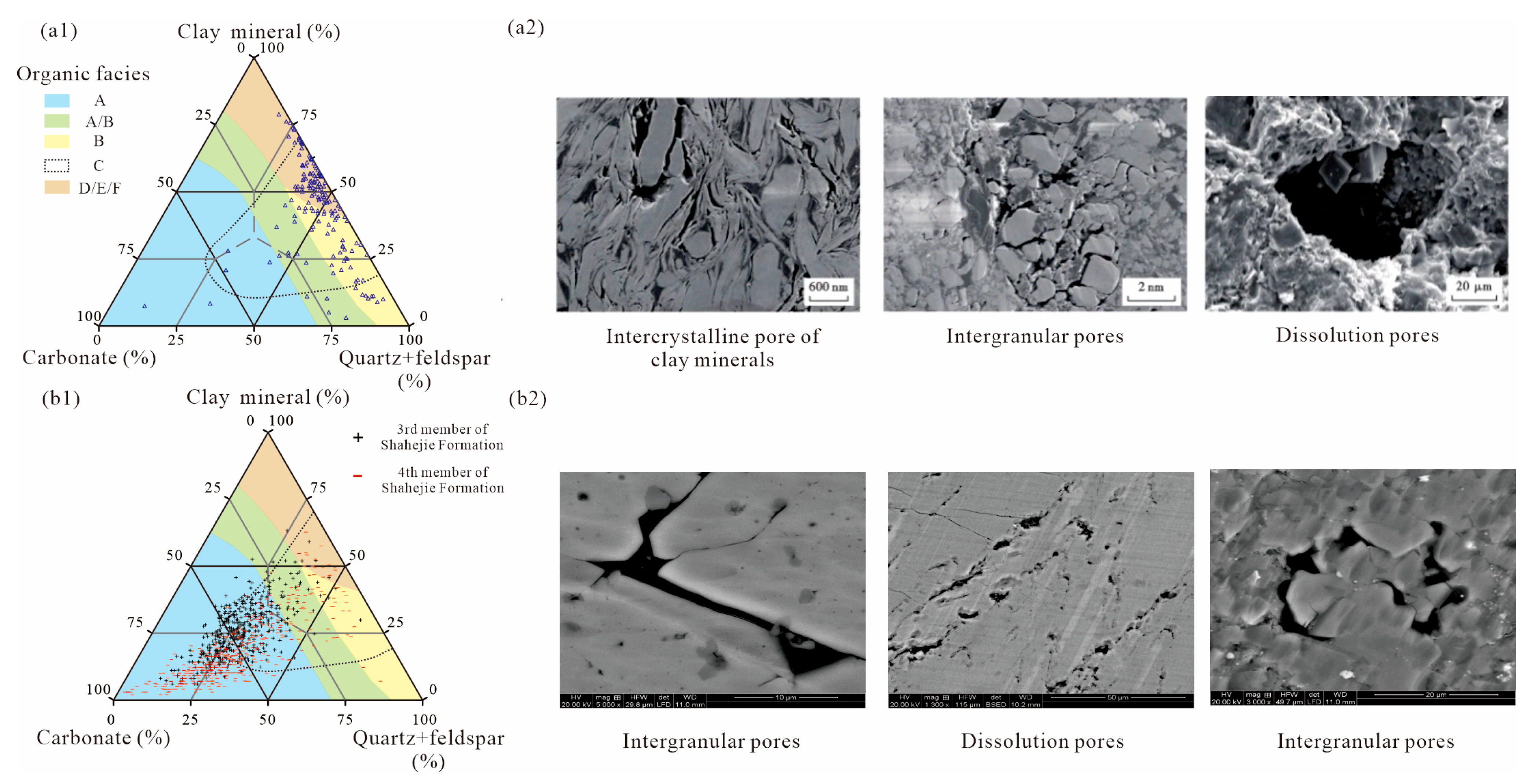
It should be noted that, unlike shale gas systems, shale oil reservoirs with low to moderate thermal maturity generally lack extensive development of organic pores, making inorganic pores the dominant storage spaces [7,11]. For instance, in the Triassic Yanchang Formation of the Ordos Basin and the Paleogene Shahejie Formation of the Jiyang Depression, distinct differences in pore systems have been observed. In the Yanchang Formation, shales contain higher clay mineral contents, and the organic-rich lithofacies are mainly composed of laminated argillaceous and mixed shales (Figure 1(a1)). The pore types are dominated by intercrystalline pores within clay minerals, with minor interparticle pores, dissolution pores, and hydrocarbon-generation-related microfractures (Figure 1(a2)). Due to the high proportion of organic-clay complexes and the low abundance of rigid framework grains and brittle minerals, the reservoir exhibits poor resistance to compaction, resulting in severe pore destruction during diagenesis. Although partial dissolution of unstable minerals such as feldspars can generate secondary pores, their overall contribution remains limited. Studies have shown that in the shale reservoirs of the 7th Member of the Yanchang Formation, the pore diameter of intercrystalline clay pores is generally less than 50 nm [7,11], whereas in interbedded reservoirs, pore reduction during compaction ranges from approximately 26% to 33%, with current porosity values typically exceeding 5% [15]. By contrast, the Shahejie Formation shales contain higher proportions of carbonate minerals (calcite and dolomite), and the lithofacies are mainly composed of laminated carbonate and mixed shales (Figure 1(b1)). The pore system is dominated by intercrystalline and dissolution pores within calcite and dolomite, as well as intergranular pores, with minor clay intercrystalline pores (Figure 1(b2)). Owing to the higher abundance of rigid framework grains, these shales retain a portion of intergranular and dissolution pores even under strong compaction. For example, in the Shahejie Formation of the Jiyang Depression, Bohai Bay Basin, the pore diameter of intercrystalline dissolution pores commonly ranges from 200 to 400 nm [16], which is significantly larger than that of intercrystalline clay pores in the Yanchang Formation.
In summary, lithofacies exert a primary control on the initial framework and composition of the pore system, while the coupled evolution of diagenesis and hydrocarbon-generation dynamics further shapes pore characteristics. Together, these factors control the permeability of shale reservoirs and ultimately govern the oil mobility within shale.

2.2. Controls of Thermal Maturity and Organic Facies on Fluid Properties

In shale systems, oil properties are primarily governed by the type of organic facies, the molecular structure of kerogen, and its thermal maturity [6,17,18]. The essence of hydrocarbon generation in organic-rich shales lies in the breaking of chemical bonds within kerogen, leading to the formation of hydrocarbon compounds [19], while thermal maturity reflects the extent of kerogen conversion into hydrocarbons [20]. Exploration practices and laboratory simulations have shown that with increasing thermal maturity, the chemical bonds within kerogen and its hydrocarbon products are progressively cleaved [21]. This process results in distinct physicochemical properties of hydrocarbons generated at different maturities. Under geological conditions, kerogen cracking and hydrocarbon generation generally follow a reaction pathway from heavy oil to black oil, light oil, condensate, and finally natural gas [22]. Shale oils with low to moderate maturity typically exhibit high wax content, elevated viscosity, and poor mobility. As thermal maturity increases, oil density and viscosity decrease, while the gas–oil ratio rises, leading to improved mobility [23]. The generated hydrocarbons in shale systems typically accumulate in situ or after short-distance migration within layers [24,25]. Therefore, under comparable organic facies conditions, maturity serves as the principal factor controlling fluid properties in shale reservoirs. However, it is also essential to consider exceptional cases where hydrocarbons migrate from adjacent shale successions into the target reservoir through fractures or other pathways; for instance, the Lucaogou Formation shale in the Junggar Basin represents a typical example of such a process [25].
The organic facies of shale reflect the depositional environment and the hydrocarbon-generating potential of the original organic matter, which directly determine the properties of the generated hydrocarbons. Owing to significant differences in the maceral composition among various kerogen types, their hydrocarbon-generation patterns and resulting oil and gas characteristics also differ markedly [26,27,28,29]. Consequently, even under similar thermal maturity conditions, the physicochemical properties of generated hydrocarbons from different kerogen types exhibit notable variations. For example, marine shale successions commonly contain type II-S kerogen [6], which forms when sulfur is incorporated into algal- and bacterial-derived organic matter under reducing conditions. Compared with typical type II kerogen, type II-S kerogen tends to generate hydrocarbons at an earlier stage. This phenomenon can be attributed to two key factors: (1) sulfur-bearing chemical bonds, such as thioethers, within type II-S kerogen possess lower bond energies, enabling preferential cracking and hydrocarbon formation at lower thermal maturities; and (2) the decomposition of sulfur-containing functional groups produces sulfur radicals, which further attack kerogen bridge bonds, thereby accelerating hydrocarbon generation. The coupling of these two mechanisms promotes earlier hydrocarbon generation in type II-S kerogen relative to typical type II kerogen [30]. Consequently, hydrocarbons derived from type II-S kerogen under comparable maturity conditions generally exhibit lower density and viscosity.

2.3. Formation Pressure and Driving Forces for Oil Flow

In the development processes, the pressure differential between the wellbore and the formation serves as the primary driving force for oil flow. In formations exhibiting abnormally high pressures, industrial oil flow is more readily achieved. Previous studies have categorized the mechanisms responsible for abnormal formation pore pressures into four main types: undercompaction, fluid expansion, fluid transfer, and tectonic compression [31,32]. These types can elaborate as follows: stress-related overpressure arises from differential compaction and tectonic stress; fluid volume-related overpressure is generated by processes such as thermal expansion, hydrocarbon generation from kerogen, and thermal cracking of hydrocarbons; and fluid flow- and buoyancy-related overpressure results from pressure transmission, fluid potential differences, density contrasts among oil, gas, and water, and variations in fluid mobility [33].
In lacustrine oil-rich basins in China, high-quality organic-rich mudstone intervals exhibit typical source–storage integration or source–storage coexistence configurations, regardless of whether the basins were formed during the rift phase, such as the Permian Lucaogou Formation in the Jimusaer Sag of the Junggar Basin and the Paleogene Shahejie Formation in the Jiyang Depression of the Bohai Bay Basin, or during the depression stage, such as the Triassic Yanchang Formation in the Ordos Basin and the Cretaceous Qingshankou Formation in the Songliao Basin. These high-quality source rocks may develop abnormally high formation pressures due to several factors: differential compaction during shallow burial, clay mineral transformation at low-to-moderate maturity, and the in situ generation and short-distance migration of hydrocarbons [34,35]. Laterally, these overpressured intervals display clear strata-controlled characteristics, with pressures decreasing toward basin margins, providing lateral driving forces for hydrocarbon migration. Vertically, pressure differentials between layers, arising from variations in organic content and hydrocarbon-generation potential, constitute an important driving force for vertical migration. Additionally, the strong heterogeneity of lacustrine shale systems favors large-scale, continuous hydrocarbon retention within shales, supporting high-yield reservoirs. For example, in the 4th Sub-Member of the Shahejie Formation in the Jiyang Depression, pressure coefficients commonly exceed 1.2, with single wells achieving peak daily oil production of up to 263 t/d.

2.4. Interactions Between Shale Matrix and Oil

2.4.1. Interaction Between Organic Matter and Oil

Shale is a complex porous medium composed of both mineral and organic constituents. The adsorption capacity of the shale matrix is a critical control on oil mobility. Experimental and molecular simulation studies demonstrate that organic matter exhibits a much stronger affinity for hydrocarbons than minerals [36,37,38]. This affinity varies with hydrocarbon polarity, molecular size, and structural complexity. Kerogen is largely hydrophobic, showing weak interactions with small, non-polar molecules such as saturates, but it strongly binds aromatic and heavy components through π–π stacking between aromatic rings in kerogen and those in hydrocarbons. Molecules in resins and asphaltenes, enriched in heteroatoms and polar functional groups, can form strong chemical interactions with kerogen surfaces [18,39,40]. These polarity-driven interactions extend beyond conventional van der Waals adsorption and represent an additional mechanism for hydrocarbon retention within organic nanopores. Moreover, nanoconfinement and the formation of adsorbed hydrocarbon layers may further restrict the mobility of small hydrocarbon molecules within kerogen nanopores [41].
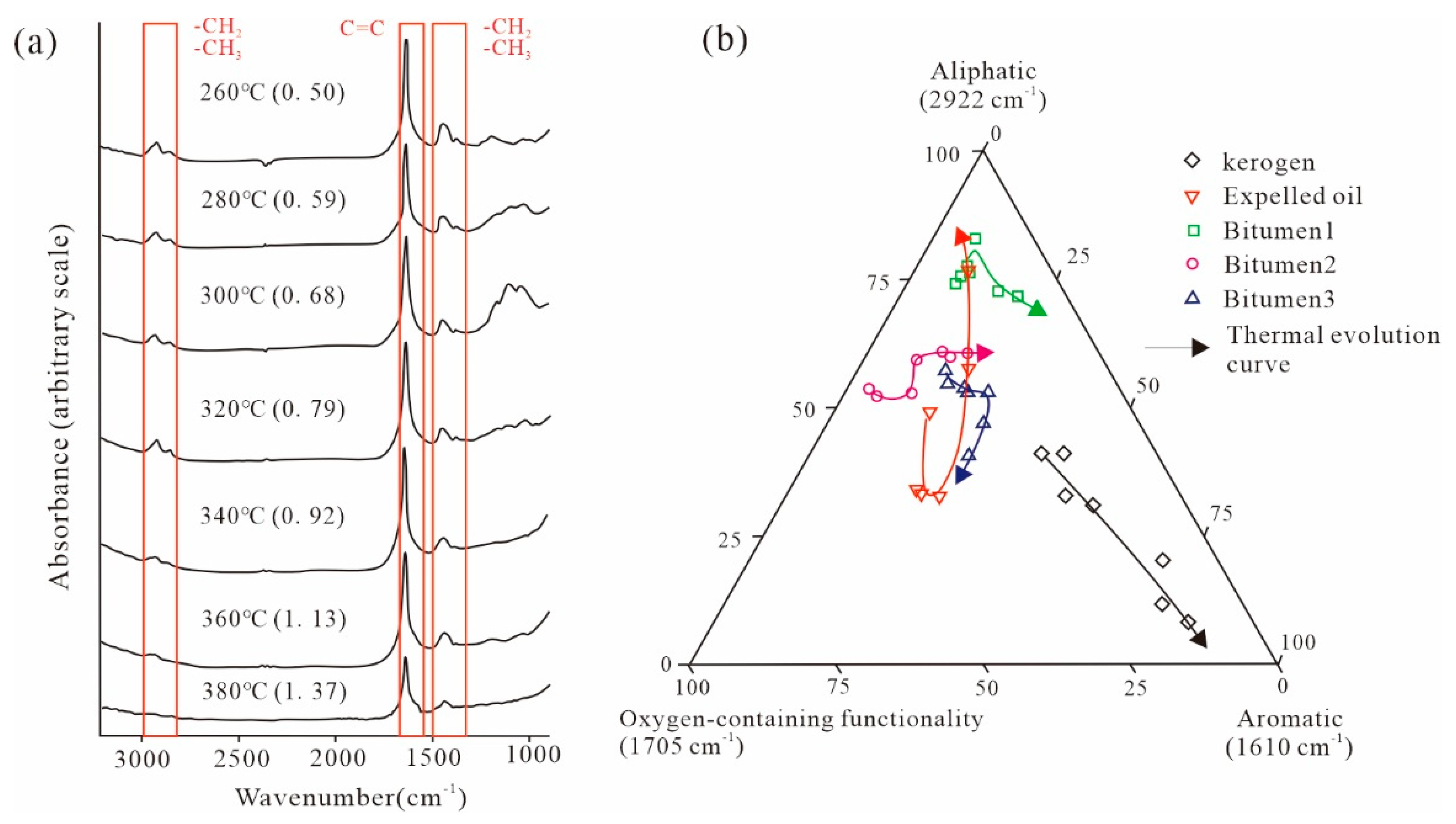
It is important to note that adsorption capacity and strength also depend on kerogen type and maturity [40]. Generally, kerogen with higher aromatic carbon content exhibits stronger adsorption. As thermal maturity increases, continuous kerogen degradation leads to enhanced aromatization, which amplifies the differences between the molecular structures of kerogen and the generated hydrocarbons. This results in a higher proportion of aromatic structures in adsorbed asphaltenes and a higher proportion of aliphatic structures in expelled oil (Figure 2). Additionally, type I kerogen, having lower aromatic carbon content than type III kerogen, exhibits a correspondingly weaker oil adsorption capacity [37,41].

2.4.2. Interaction Between Minerals and Oil

Mineral composition exerts additional control on oil retention and release. Compared with siliceous and carbonate minerals, clay minerals generally exhibit stronger adsorption of hydrocarbons [37]. Two distinct mechanisms operate. First, polar compounds such as asphaltenes can form chemical bonds with clay surfaces via ligand exchange, cation exchange, or cation bridging [42,43,44,45,46]. These reactions arise from isomorphous substitution and lattice defects that impart permanent negative charges to clay minerals [47]. Second, non-polar hydrocarbons, particularly saturates, are adsorbed primarily through weaker physical interactions, such as van der Waals forces, whereas hydrogen bonding is more relevant to polar compounds containing heteroatoms or to interactions involving surface hydroxyl groups and interfacial water [48]. Because clays possess specific surface areas one to two orders of magnitude larger than those of siliceous or carbonate minerals [49], they provide abundant active sites for such interactions [48]. Nevertheless, the binding strength of physical adsorption is much lower than that of chemical bonding.

2.4.3. A Conceptual Model of Oil Retention and Migration in the Shale Matrix

Laboratory and molecular studies consistently indicate that organic matter exhibits stronger oil adsorption than minerals. However, under geological conditions, the ubiquitous presence of formation water complicates this behavior, giving mineral surfaces, particularly clay minerals, an important role in controlling oil mobility.
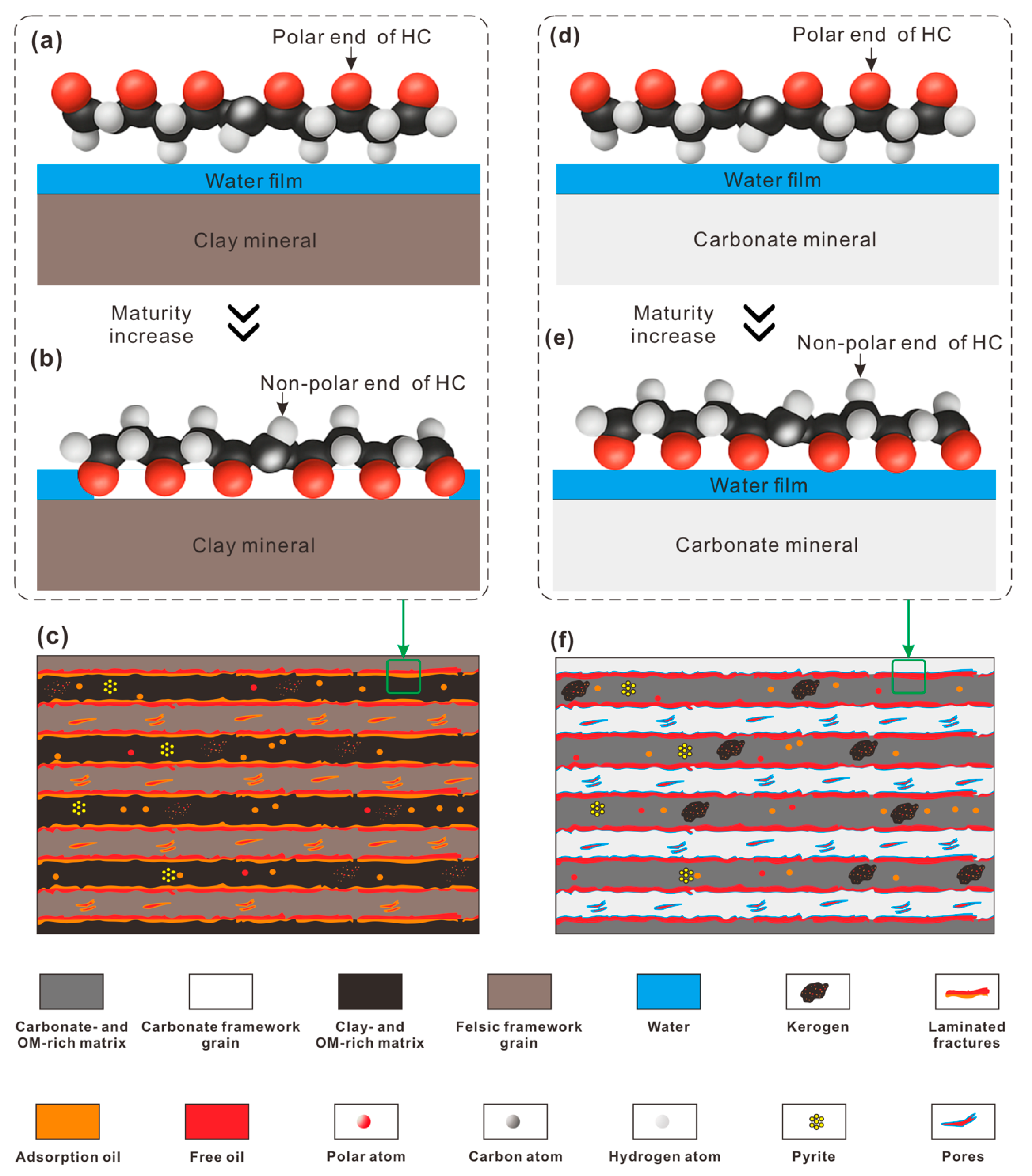
Prior to kerogen hydrocarbon generation, the pores in shale reservoirs are occupied by water, and the mineral surfaces are water-wet, covered by a thin water film (Figure 3a,d). During kerogen cracking, numerous polar non-hydrocarbon compounds are generated and migrate from organic-rich laminae toward laminae composed of framework grains. In clay-rich shales, these polar molecules readily interact with surface hydroxyls on clays through hydrogen bonding. Because clay minerals exhibit high cation-exchange capacity arising from lattice defects and substitution [47], the polar ends of organic molecules may attach to clay surfaces via cation bridging and partially displace or destabilize the interfacial water film. This process produces a polar organic coating that may shift surface wettability from strongly water-wet toward mixed-wet or oil-wet conditions (Figure 3a–c). Consequently, a substantial portion of crude oil within clay-dominated pore systems remains adsorbed on mineral surfaces, greatly reducing oil mobility.
In contrast, the lower specific surface area and different surface chemistry of carbonate minerals may result in weaker overall hydrocarbon retention than in clay-dominated matrices. Where interfacial water films remain stable and connected intercrystalline or dissolution pores are preserved, a larger proportion of hydrocarbons may occur in a relatively free or weakly confined state (Figure 3d,e). This weak chemical affinity enhances oil mobility and helps explain why laminated, carbonate-rich shales can produce low-maturity black oil at unexpectedly high rates. In addition, the greater mechanical strength of carbonate matrices aids pore preservation and fracture development during compaction and hydraulic stimulation, further improving fluid connectivity.
In summary, the physical–chemical interactions within the shale matrix fundamentally dictate oil retention and migration. While organic matter dominates hydrocarbon adsorption, mineral-controlled interactions, particularly polarity-driven adsorption on clay surfaces, govern the transition from water-wet to oil-wet states and thus the overall mobility of liquid hydrocarbons. The contrast between organic matter adsorption and mineral–water–hydrocarbon interactions therefore provides a possible mechanistic explanation for the unexpectedly high mobility of low-volatility black oil in some low- to moderate-maturity, carbonate-rich shale reservoirs. It should be emphasized, however, that the proposed model represents generalized, mineral-specific tendencies rather than a classification of reservoir wettability. Wettability evolution under geological conditions is considerably more complex because it is jointly controlled by mineral surface properties, organic matter characteristics, hydrocarbon composition, formation-water chemistry, and thermal maturity. Accordingly, shale reservoirs under geological conditions may exhibit spatially heterogeneous or mixed-wet behavior rather than being uniformly water-wet or oil-wet. Future studies should therefore experimentally characterize wettability evolution throughout thermal maturation at the mineral and pore scales across a broader range of shale compositions and representative reservoir conditions.

3. Representative Shale Systems and Implications for Oil Mobility

Herein, building on the fundamental principles discussed in Section 2, we illustrate the mechanisms of oil flow in shale systems under actual geological conditions across different geological settings. It should be noted that the geological characteristics of each shale system vary, and multiple types of shale plays coexist. The following discussion highlights the most representative features of different shale systems.

3.1. Key Examples from North America

In North America, most shale oil and gas plays that have been commercially developed are located in hydrocarbon-generation depressions with moderate to high thermal maturity [50,51,52]. For instance, parts of the main producing area of the Eagle Ford Shale in the western Gulf of Mexico exhibit a thermal maturity of Ro 1.1–1.3%, predominantly producing wet gas-associated light oil and condensate [3,50,51]. High maturity brings two main advantages for efficient shale oil exploration and development. First, as thermal maturity increases, the intermolecular interactions between kerogen and generated hydrocarbons may weaken, leading to a significant reduction in the adsorption capacity of organic matter for oil. Meanwhile, secondary cracking of generated hydrocarbons further decreases the density and viscosity of liquid oil. These physical and chemical effects collectively enhance oil mobility within shale reservoirs. The Eagle Ford represents a typical organic-rich calcareous shale [52]. As mentioned earlier, compared with clay-rich shale systems, the mineral matrix of carbonate-rich shales exhibits much weaker adsorption capacity for liquid hydrocarbons. These favorable geological conditions make the Eagle Ford one of the world-class unconventional plays [53].
Similarly, the Wolfcamp Shale in the Permian Basin represents another carbonate-dominated organic-rich shale system, where high TOC values and multiple source–reservoir assemblages jointly contribute to large-scale oil enrichment. Being in the peak oil generation window (Ro up to 1.3%), the Wolfcamp Shale exhibits excellent source–reservoir configuration and widespread overpressure, which greatly facilitate hydrocarbon expulsion and short-distance migration within the formation. This combination of multi-cycle deposition, high maturity, and strong fracability, due to abundant carbonates, makes the Wolfcamp one of the most productive shale oil systems in North America. In contrast, the Marcellus Shale in the Appalachian Basin was deposited in a shallow marine shelf setting and contains a higher proportion of clay minerals. Such a mineralogical composition leads to lower fracability and stronger adsorption capacity for liquid hydrocarbons, hindering large-scale oil accumulation. Consequently, the Marcellus mainly produces shale gas under high thermal maturity [3].
However, not all shale oil systems in North America that achieve commercial production are characterized by high thermal maturity. Some can produce economically even at moderate maturity, such as the Bakken Shale in the Williston Basin [4]. In certain regions, the Bakken Shale achieves commercial productivity at Ro values of 0.6–0.9%. This can be attributed to two primary factors. First, the Bakken Shale was deposited in a sulfur-rich environment containing special hydrocarbon precursors, such as photosynthetic green sulfur bacteria. Such sulfur-enriched systems tend to generate hydrocarbons earlier [54], and the resulting oils are generally lighter. Second, oil production in the Bakken primarily occurs from the Middle Bakken Member, which contains a high proportion of carbonate minerals and exhibits favorable physical properties. The oils generated from the lower and Upper Bakken Members subsequently migrate and accumulate within this middle interval. During migration, chromatographic effects within the formation can enhance the mobility of the migrated oil [19,24,25]. In addition, the weak adsorption capacity of the carbonate-dominated pore system further promotes oil mobility. Under these combined conditions, the Middle Bakken Member can achieve commercial production even at relatively low to moderate maturities.

3.2. Key Examples from China

The Shahejie Formation in the Jiyang Depression of the Bohai Bay Basin, China, represents one of the most typical lacustrine shales deposited under saline conditions. It has developed commercial oil reservoirs even under low to moderate thermal maturity. Based on the source–reservoir configuration, these shale oil reservoirs are primarily characterized by source–storage coexistence on a centimeter- to millimeter-scale. On the microscale, hydrocarbons generated from organic-rich argillaceous laminae migrate into carbonate-rich laminae, where they accumulate and are preserved [11]. Moreover, although the Shahejie Formation was deposited in a lacustrine environment, marine transgressions introduced sulfate into the water column, resulting in the formation of a substantial proportion of sulfur-enriched kerogen. Similar to the Bakken Shale in North America, these sulfur-rich organic matters exhibit early hydrocarbon generation, and subsequent micro-migration enhances the physical properties of the oil stored in carbonate laminae. This combination helps explain why the Shahejie Formation in the Jiyang Depression can achieve commercial production even at low to moderate maturity.
In contrast, the Triassic Yanchang Formation in the Ordos Basin contains a set of moderate-maturity, organic-rich shales deposited under freshwater conditions. Owing to its large resource scale and favorable source rock conditions for lacustrine shale oil exploration and development in China [55]. The main producing intervals are sandstone reservoirs interbedded with organic-rich argillaceous shales [56]. However, large-scale industrial breakthroughs remain limited in these fine-grained clay-rich sediments. It is generally believed that to achieve commercial productivity in the organic-rich fine-grained sediments of the Yanchang Formation, one must either target locally more mature intervals [9] or employ in situ conversion technologies [57]. This indicates that, under geological conditions, the oil within fine sediments of the Yanchang Formation exhibits poor mobility. Three main factors contribute to this limitation. First, the Yanchang Formation in the Ordos Basin is generally within the oil window stage, with most Ro values ranging from 0.7% to 1.0%, except for a few local areas [57]. Consequently, the generated oil is mainly black oil with high density and viscosity. Moreover, within the oil window, strong interactions occur between organic matter and hydrocarbons [18,40,58], further reducing oil mobility in shale reservoirs. Second, the Yanchang Formation contains abundant clay minerals, and organic matter is typically associated with these clays to form organic-clay complexes. During hydrocarbon generation, the produced non-hydrocarbons may disrupt the water film on clay surfaces and alter surface wettability, thereby enhancing the adsorption capacity for hydrocarbons [11]. Consequently, mineral-composition-induced organic–inorganic interactions hinder the development of commercial oil flow under low to moderate maturity. Finally, high clay content not only strengthens interactions between minerals and generated hydrocarbons but also weakens the compaction resistance of shales. During diagenesis, numerous primary pores are destroyed, leading to further deterioration of reservoir properties. These three factors collectively explain why shale reservoirs in the Yanchang Formation struggle to achieve high productivity at low to moderate maturity. Similarly, the Cretaceous Qingshankou Formation in the Songliao Basin, which was also deposited under freshwater conditions, exhibits geological characteristics comparable to those of the Yanchang Formation [59]. Consistently, commercial production in the Qingshankou Shale has been primarily achieved in regions with higher thermal maturity (Ro > 1.2%) [60,61].
An integrated comparison of key examples from North America and China suggests that laminated carbonate-rich shales deposited under saline conditions are more likely to form oil with higher mobility under low to moderate maturity, whereas clay-rich lacustrine shales deposited under freshwater conditions generally require higher thermal maturity to achieve commercial production.

4. Outlook

Laminated carbonate-rich shale systems may preserve a relatively large movable-oil fraction even at low to moderate thermal maturity, making them important targets for future shale oil evaluation. Such shale systems are widely distributed across multiple petroliferous basins, including the Eagle Ford Shale in South Texas, the Wolfcamp Formations in the Permian Basin of North America, the Duvernay Shale in the Western Canadian Sedimentary Basin, the Shahejie Formation in the Jiyang Depression of the Bohai Bay Basin, and the Permian Lucaogou Formation in the Junggar Basin, China [62,63,64]. Despite ongoing exploration and development in these laminated carbonate-rich shale systems, their potential has not yet been fully recognized. The primary constraint limiting their large-scale development remains economic feasibility.
For petroleum companies, profitability is the core driver of exploration decisions. Consequently, enterprises tend to prioritize regions offering the lowest costs and the highest returns under current conditions, an approach that is entirely understandable from a business perspective. However, from a broader societal viewpoint, while the world is undergoing an energy transition, fossil fuels will continue to play a crucial role in the global energy mix for the foreseeable future [1]. The sustainable development of modern economies still depends on a stable and sufficient supply of fossil energy. Therefore, a strategic divergence often exists between resource-holding countries and petroleum companies: the former emphasizes long-term energy security, whereas the latter focuses on short-term economic gains.
As exploration advances, the quality of conventional oil and gas is inevitably declining. To achieve sustainable exploration, two main pathways can be pursued: (1) expanding into new exploration regions, and (2) conducting more refined exploration within existing blocks to tap into residual resource potential. It is well known that new region exploration entails high risk and substantial investment. In contrast, fine-scale exploration within mature areas is more feasible and cost-effective. These regions typically possess well-established infrastructure, such as pipeline networks and production facilities, allowing for the development of unconventional resources with relatively modest incremental investment, which is far more economical than investing in entirely new blocks.
Therefore, in future exploration and development, petroleum explorers should adopt a forward-looking and inclusive approach. While continuing to focus on currently profitable “sweet spot” areas, equal attention should be given to unconventional resources with lower present-day economic returns but substantial long-term potential, such as laminated carbonate-rich shale systems. These systems represent a vital frontier for ensuring the sustainability of global oil and gas exploration and development.

5. Conclusions

This Perspective is based on existing evidence to elucidate the fundamental controls on oil mobility in tight shale systems, focusing on the influences of lithofacies on pore structure, effects of thermal maturity and organic matter on fluid properties, mechanisms of overpressure generation, and shale matrix–hydrocarbon interactions. Based on these controls, we propose a migration–accumulation model that bridges pore-scale mechanisms and reservoir-scale accumulation and illustrate its geological implications through representative shale oil systems from North America and China. Our main conclusions are as follows:
(1)
Multiple factors, including mineral composition, pore structure, pressure coefficients, hydrocarbon physical–chemical properties, and the strength of fluid–organic matter interactions, jointly determine whether oil can flow effectively under geological conditions. Thermal maturity emerges as an important integrative factor, exerting broad influence over many of these controls and thus governing effective oil mobility.
(2)
In addition to previously recognized physical adsorption and capillary effects, physical–chemical interactions, such as adsorption between hydrocarbons and mineral surfaces, may significantly influence flow behavior. Insufficient consideration of these chemical effects in traditional physical models may partly explain why low-maturity, low-volatile black-oil production from extremely tight shale has remained difficult to explain in earlier understanding.
(3)
Comparative analysis between shale oil systems in North America and China suggests that broadly similar controls on oil mobility may operate across basins, although their relative importance varies among shale systems. Shale systems that are laminated, carbonate-rich, and formed in saline depositional environments tend to exhibit elevated oil mobility even at low to moderate maturity. In contrast, clay-rich freshwater lacustrine shales require significantly higher thermal maturity to achieve comparable fluid flow. Thus, exploration strategies must be tailored to the geological character of each shale system.
(4)
Laminated carbonate-rich shale systems, widely distributed across the globe, constitute favorable targets for future shale oil exploration. Even amid the global energy transition, understanding the universal physical–chemical mechanisms of liquid hydrocarbon flow is vital for accurately evaluating unconventional resources and ensuring the sustainable development of petroleum systems. Explorers should therefore look beyond currently profitable “sweet-spot” plays to identify unconventional domains with lower short-term returns but significant long-term potential.

Author Contributions

Conceptualization, M.L.; Methodology, X.M.; Investigation, X.M. and E.W.; Resources, M.Q., T.C., H.L., Z.L. and Y.H.; Data curation, M.Q. and T.C.; Writing—original draft, C.L. and E.W.; Writing—review and editing, X.M., M.L., Y.H. and M.W.; Visualization, C.L.; Supervision, H.L. All authors have read and agreed to the published version of the manuscript.

Funding

This study is supported by the National Natural Science Foundation of China (Projects U24B6002 and 42502151) and Sinopec S & T Program (Contract No. P25196).

Data Availability Statement

The original contributions presented in this study are included in the article. Further inquiries can be directed to the corresponding author.

Conflicts of Interest

Authors Huimin Liu and Zheng Li was employed by the company Sinopec Shengli Oilfield Company. The remaining authors declare that the research was conducted in the absence of any commercial or financial relationships that could be construed as a potential conflict of interest.

References

  1. Energy Outlook. 2025. Available online: https://www.bp.com/content/dam/bp/business-sites/en/global/corporate/pdfs/energy-economics/energy-outlook/bp-energy-outlook-2025 (accessed on 12 January 2026).
  2. Xiao, X.; Song, Z.; Zhu, Y.; Tian, H.; Yin, H. Summary of shale gas research in North American and revelations to shale gas exploration of Lower Paleozoic strata in China south area. J. China Coal Soc. 2013, 38, 721–727. [Google Scholar]
  3. Li, M.; Ma, X.; Jiang, Q.; Li, Z.; Pang, X.; Zhang, C. Enlightenment from formation conditions and enrichment characteristics of marine shale oil in North America. Pet. Geol. Recovery Effic. 2019, 26, 13–28. [Google Scholar]
  4. Jarvie, D.M. Shale resource systems for oil and gas: Part 2—Shale-oil resource systems. In Shale Reservoirs—Giant Resources for the 21st Century; Breyer, J.A., Ed.; AAPG: Tulsa, OK, USA, 2012; pp. 89–119. [Google Scholar] [CrossRef] [Scilit]
  5. Donovan, D.; Staerker, S.; Gardner, R.; Pope, C.; Wehner, M. Findings from the Eagle Ford Outcrops of West Texas and Implications to the Subsurface of South Texas; AAPG: Tulsa, OK, USA, 2016; Volume 110, pp. 301–336. [Google Scholar]
  6. Li, M.; Ma, X.; Jin, Z.; Li, Z.; Jiang, Q.; Wu, S.; Li, Z.; Xu, Z. Diversity in the lithofacies assemblages of marine and lacustrine shale strata and significance for unconventional petroleum exploration in China. Oil Gas. Geol. 2022, 43, 1–25. [Google Scholar]
  7. Guo, X.; Ma, X.; Li, M.; Qian, M.; Hu, Z. Mechanisms for lacustrine shale oil enrichment in Chinese sedimentary basins. Oil Gas. Geol. 2023, 44, 1333–1349. [Google Scholar]
  8. Zhang, S.; Liu, H.; Zhang, P.; Li, J.; Liu, J.; Song, X.; Wei, X.; Wang, Y.; Wang, W. Geological characteristics of shale oil enrichenment in Niuzhuang sag, Dongying depression. J. China Univ. Min. Technol. 2022, 51, 1138–1151. [Google Scholar]
  9. Wang, E.; Li, M.; Ma, X.; Qian, M.; Cao, T.; Li, Z.; Li, S.; Jin, Z. Can clay-rich reservoirs in predominantly-freshwater lacustrine shale systems serve as primary exploration targets in low-medium maturity? A case study of the Triassic Yanchang Formation of the Ordos Basin. Pet. Sci. 2025, 22, 3925–3938. [Google Scholar] [CrossRef] [Scilit]
  10. Cao, J.; Zhang, R.; Zhi, D.; Tang, Y.; Xia, L.; He, W. Unique bimodal oil generation of alkaline-saline lacustrine source rock: Evidences, model and mechanism of organic-inorganic interactions. Sci. China Earth Sci. 2025, 68, 1559–1582. [Google Scholar] [CrossRef] [Scilit]
  11. Guo, X.; Wang, E.; Ma, X.; Li, M.; Qian, M.; Cao, T.; Li, Z.; Chu, J. Lacustrine shale oil systems in China: Advances in characterization methods and resource accumulation models. Earth-Sci. Rev. 2025, 270, 105256. [Google Scholar] [CrossRef] [Scilit]
  12. Darcy, H. Les Fontaines Publiques de La Ville de Dijon; Victor Dalmont: Paris, France, 1856. [Google Scholar]
  13. Longmuir, G. Pre-Darcy Flow: A Missing Piece of the Improved Oil Recovery Puzzle? In Proceedings of the SPE/DOE Symposium on Improved Oil Recovery, Tulsa, OK, USA, 11–17 April 2004; p. SPE-89433-MS. [Google Scholar]
  14. Lin, Z.; Li, J.; Wang, M.; Zhang, P.; Lu, S.; Zhi, Q.; Wang, J.; Huang, H. Organic fluid migration in low permeability reservoirs restricted by pore structure parameters. J. Petrol. Sci. Eng. 2022, 218, 111028. [Google Scholar] [CrossRef] [Scilit]
  15. Qi, R.; Zhu, F.; He, F.; Jiang, L.; Yin, C.; Shao, K. Characteristics and controlling factors of shale oil reservoirs in the seventh member of Triassic Yanchang Formation, wetern Mahuangshan area, Ordos Basin. Peroleum Geol. Exp. 2025, 47, 791–804. [Google Scholar]
  16. Liu, H. Geological particularity and exploration practice of Paleogene shale oil in Jiyang depression: A case study of the upper submember of Member 4 to the lower submember of Member 3 of Shahejie Formation. Acta Pet. Sin. 2022, 43, 581–594. [Google Scholar]
  17. Tissot, B.; Durand, B.; Espitalie, J.; Combaz, A. Influence of the nature and diagenesis of organic matter in the formation of petroleum. AAPG Bull. 1974, 58, 499–506. [Google Scholar] [CrossRef] [Scilit]
  18. Wang, E.; Feng, Y.; Guo, T.; Li, M. Oil content and resource quality evaluation methods for lacustrine shale: A review and a novel three-dimensional quality evaluation model. Earth-Sci. Rev. 2022, 232, 104134. [Google Scholar] [CrossRef] [Scilit]
  19. Tissot, B.P.; Welte, D.H. Petroleum Formation and Occurrence, 2nd ed.; Springer: Berlin/Heidelberg, Germany, 1984. [Google Scholar]
  20. Peters, K.E.; Cassa, M.R. Applied source rock geochemistry. In The Petroleum System—From Source to Trap; Magoon, L.B., Dow, W.G., Eds.; American Association of Petroleum Geologists: Tulsa, OK, USA, 1994; pp. 93–120. [Google Scholar]
  21. Spigolon, A.L.D.; Lewan, M.; Penteado, H.; Coutinho, L.; Filho, J. Evaluation of the petroleum composition and quality with increasing thermal maturity as simulated by hydrous pyrolysis: A case study using a Brazilian source rock with Type I kerogen. Org. Geochem. 2015, 83–84, 27–53. [Google Scholar] [CrossRef] [Scilit]
  22. Doan, T.V.L.; Bostrom, N.; Burnham, A.; Kleinberg, R.; Pomerantz, A.; Allix, P. Green river oil shale pyrolysis: Semi-open conditions. Energy Fuels 2013, 27, 6447–6459. [Google Scholar] [CrossRef] [Scilit]
  23. Zhao, W.; Hu, S.; Hou, L.; Yang, T.; Guo, B.; Yang, Z. Types and resource potential of continental shale oil in China and its boundary with tight oil. Petrol. Explor. Dev. 2020, 47, 1–10. [Google Scholar] [CrossRef] [Scilit]
  24. Gao, Z.; Bai, L.; Hu, Q.; Yang, Z.; Jiang, Z.; Wang, Z.; Xin, H.; Zhang, L.; Yang, A.; Jia, L.; et al. Shale oil migration across multiple scales: A review of characterization methods and different patterns. Earth Sci. Rev. 2024, 254, 104819. [Google Scholar] [CrossRef] [Scilit]
  25. Wang, E.; Li, M.; Ma, X.; Qian, M.; Cao, T.; Li, Z.; Jin, Z. Inter-strata oil migration and its implications of hydrocarbon accumulation in the lacustrine shale system of the Lucaogou Formation, Jimusaer Sag, Junggar Basin. Mar. Petrol. Geol. 2025, 181, 107533. [Google Scholar] [CrossRef] [Scilit]
  26. Chen, Z.; Jiang, C. A data driven model for studying kerogen kinetics with application examples from Canadian sedimentary basins. Mar. Pet. Geol. 2015, 67, 795–803. [Google Scholar] [CrossRef] [Scilit]
  27. Ungerer, P.; Collell, J.; Yiannourakou, M. Molecular modeling of the volumetric and thermodynamic properties of kerogen: Influence of organic type and maturity. Energy Fuels 2015, 29, 91–105. [Google Scholar]
  28. Li, C.; Jin, Z.; Zhang, L.; Liang, X. Thermodynamic and microstructural properties of the lacustrine Chang-7 shale kerogen: Implications for in-situ conversion of shale. Int. J. Coal Geol. 2024, 283, 104447. [Google Scholar] [CrossRef] [Scilit]
  29. Mani, D.; Patil, D.J.; Dayal, A.M.; Prasad, B.N. Thermal maturity, source rock potential and kinetics of hydrocarbon generation in Permian shales from the Damodar Valley basin, Eastern India. Mar. Pet. Geol. 2015, 66, 1056–1072. [Google Scholar] [CrossRef] [Scilit]
  30. Lewan, M.D. Sulphur-radical control on petroleum formation rates. Nature 1998, 391, 164–166. [Google Scholar] [CrossRef] [Scilit]
  31. Ward, C.D.; Coghill, K.; Broussard, M.D. The application of petrophysical data to improve pore and fracture pressure determination in North Sea Central Graben HPHT wells. J. Geophys. Res. Atmos. 1994, 99, 13023–13037. [Google Scholar]
  32. Bowers, G.L. Detecting high overpressure. Lead. Edge 2012, 21, 174–177. [Google Scholar]
  33. Ma, X.; Li, M.; Hu, K.; Tao, G.; Qian, M.; Cao, T.; Liu, P.; Li, Z.; Jiang, Q.; Li, Z. Abnormal pressure genesis and its relationship with continental shale oil accumulation in Paleogene, Jiyang Depression, Bohai Bay Basin. Peroleum Geol. Exp. 2023, 45, 145–156. [Google Scholar]
  34. Zheng, H.; Huang, Y.; Feng, Y. Anomalous overpressure system of early Tertiary in Dongying Depression and its petroleum geology significance. Petrol. Explor. Dev. 2000, 27, 67–70. [Google Scholar]
  35. Yang, H.; Liang, X.; Niu, X.; Feng, S.; You, Y. Geological conditions for continental tight oil formation and the main controlling factors for the enrichment: A case of Chang 7 member, Triassic Yanchang Formation, Ordos Basin, NW China. Pet. Explor. Dev. 2017, 44, 12–20. [Google Scholar] [CrossRef] [Scilit]
  36. Sandvik, E.I.; Young, W.A.; Curry, D.J. Expulsion from hydrocarbon sources: The role of organic absorption. Org. Geochem. 1992, 19, 77–87. [Google Scholar] [CrossRef] [Scilit]
  37. Li, Z.; Zou, Y.; Xu, X.; Sun, J.; Li, M.; Peng, P. Adsorption of mudstone source rock for shale oil—Experiments, model and a case study. Org. Geochem. 2016, 92, 55–62. [Google Scholar] [CrossRef] [Scilit]
  38. Li, J.; Wang, M.; Jiang, C.; Lu, S.; Li, Z. Sorption model of lacustrine shale oil: Insights from the contribution of organic matter and clay minerals. Energy 2022, 260, 125011. [Google Scholar] [CrossRef] [Scilit]
  39. Pepper, A.S.; Perry, S.E.; Heister, L.E.; Sondergeld, C.H. Saturation isn’t what it used to be: Towards more realistic petroleum fluid saturations and produced fluid compositions in organic-rich unconventional reservoirs. In Proceedings of the Unconventional Resources Technology Conference (URTeC), San Antonio, TX, USA, 22–24 July 2019. [Google Scholar] [CrossRef] [Scilit]
  40. Pan, Y.; Li, M.; Sun, Y.; Li, Z.; Liao, L.; Liao, Y. Characterization of free and bound bitumen fractions in a thermal maturation shale sequence. Part 2: Structural evolution of kerogen and bitumen during shale oil generation, expulsion and retention. Org. Geochem. 2023, 182, 104640. [Google Scholar] [CrossRef] [Scilit]
  41. Huang, L.; Ning, Z.; Wang, Q.; Qi, R.; Li, J.; Zeng, Y.; Ye, H.; Qin, H. Thermodynamic and structural characterization of bulk organic matter in Chinese Silurian shale: Experimental and molecular modeling studies. Energy Fuels 2017, 31, 4851–4865. [Google Scholar] [CrossRef] [Scilit]
  42. Kothawala, D.N.; Roehm, C.; Boldau, C.; Moore, T. Selective adsorption of dissolved organic matter to mineral soils. Geoderma 2012, 189, 334–342. [Google Scholar] [CrossRef] [Scilit]
  43. Ahmat, A.M.; Boussafir, M.; Milbeau, C.; Guégan, R.; Oliveira, T.; Forestier, L. Organic matter and clay interaction in a meromictic lake: Implications for source rock OM preservation (Lac Pavin, Puy-de-Dôme, France). Org. Geochem. 2017, 109, 47–57. [Google Scholar] [CrossRef] [Scilit]
  44. Hong, H.; Chen, S.; Fang, Q.; Algeo, T.; Zhao, L. Adsorption of organic matter on clay minerals in the Dajiuhu peat soil chronosequence, South China. Appl. Clay Sci. 2019, 178, 105125. [Google Scholar] [CrossRef] [Scilit]
  45. He, J.; Cai, J.; Lei, T.; Song, M.; Liu, H.; Wang, X. Characteristics comparison and occurrence mode of different types of soluble organic matter in lacustrine shale in the Dongying Sag, eastern China. Int. J. Coal Geol. 2022, 254, 103971. [Google Scholar] [CrossRef] [Scilit]
  46. Cai, C.; Cai, J.; Liu, H.; Wang, X.; Zeng, X.; Wang, Y. Occurrence of organic matter in argillaceous sediments and rocks and its geological significance: A review. Chem. Geol. 2023, 639, 121737. [Google Scholar] [CrossRef] [Scilit]
  47. Murray, H.H. Chapter 2: Structure and composition of the clay minerals and their physical and chemical properties. In Applied Clay Mineralogy: Occurrences, Processing and Application of Kaolins, Bentonites, Palygorskite-Sepiolite, and Common Clays; Murray, H.H., Ed.; Elsevier: Amsterdam, The Netherlands, 2006; pp. 7–31. [Google Scholar]
  48. Schoonheydt, R.; Johnston, C. Surface and interface chemistry of clay minerals. In Handbook of Clay Science; Bergaya, F., Theng, B.K.G., Lagaly, G., Eds.; Elsevier: Amsterdam, The Netherlands, 2006; pp. 87–113. [Google Scholar]
  49. Kennedy, M.J.; Wagner, T. Clay mineral continental amplifier for marine carbon sequestration in a greenhouse ocean. Proc. Natl. Acad. Sci. USA 2011, 108, 9776–9781. [Google Scholar] [CrossRef] [Scilit] [PubMed]
  50. Clarke, P.R.; Portis, D.; Barzola, G.; Bello, H.; Basu, N. Assessing well performance in a prolific liquids-rich shale play: An Eagle Ford case study. In The Eagle Ford Shale: A Renaissance in U.S. Oil Production;AAPG Memoir 110; Breyer, J.A., Ed.; American Association of Petroleum Geologists: Tulsa, OK, USA, 2016; pp. 213–240. [Google Scholar]
  51. Miceli Romero, A.A.; Nguyen, T.; Philp, R.P. Organic geochemistry of the Eagle Ford Group in Texas. AAPG Bull. 2018, 102, 1379–1412. [Google Scholar] [CrossRef] [Scilit]
  52. Kuske, S.; Horsfield, B.; Jweda, J.; Michail, G.E.; Song, Y.S. Geochemical factors controlling the phase behavior of Eagle Ford Shale petroleum fluids. AAPG Bull. 2019, 103, 835–870. [Google Scholar] [CrossRef] [Scilit]
  53. Sun, X.; Zhang, T.W.; Walters, C.C. Geochemistry of oils and condensates from the lower Eagle Ford Formation, south Texas. Part 2: Molecular characterization. Mar. Pet. Geol. 2022, 141, 105710. [Google Scholar] [CrossRef] [Scilit]
  54. Eills, G.; Zhang, T.; Kralert, P.; Tang, Y. Kinetics of elemental sulfur reduction by petroleum hydrocarbons and the implications for hydrocarbon thermal chemical alteration. Geochim. Cosmochi. Ac. 2019, 251, 192–216. [Google Scholar] [CrossRef] [Scilit]
  55. Wang, E.; Li, M.; Ma, X.; Qian, M.; Cao, T.; Li, Z.; Yang, W.; Jin, Z. Diahopane and diasterane as proxies for paleoenvironment, hydrocarbon generation condition, and shale oil accumulation. Chem. Geol. 2024, 670, 122447. [Google Scholar] [CrossRef] [Scilit]
  56. Wang, L.; Lyu, Q.; Li, L.; Liu, J.; Luo, S.; Sun, X.; Zhang, L.; Xu, X. Sedimentary characteristics of mixed-source fine-grained gravity flow and significance for shale oil exploration in lacustrine depression basins: A case study from the Chang 73 sub-member, Ordos Basin. Sediment. Geol. 2024, 464, 106629. [Google Scholar] [CrossRef] [Scilit]
  57. Zhao, W.; Bian, C.; Li, Y.; Liu, W.; Dong, J.; Wang, K.; Zeng, X. Organic matter transformation ratio, hydrocarbon expulsion efficiency and shale oil enrichment type in Chang 73 shale of Upper Triassic Yanchang Formation, Ordos Basin, NW China. Petrol. Explor. Dev. 2023, 50, 12–23. [Google Scholar] [CrossRef] [Scilit]
  58. Wang, E.; Li, C.; Feng, Y.; Song, Y.; Guo, T.; Li, M.; Chen, Z. Novel method for determining the oil moveable threshold and an innovative model for evaluating the oil content in shales. Energy 2022, 239, 121848. [Google Scholar] [CrossRef] [Scilit]
  59. Feng, Y.; Xiao, X.; Wang, E.; Lu, C.; Li, G.; Tan, Y. Oil mobility evaluation and light hydrocarbon restoration in shale reservoirs: A review. Gondwana Res. 2026, 154, 122–154. [Google Scholar] [CrossRef] [Scilit]
  60. Sun, L.D.; He, W.; Li, G.; Zhang, S.; Zhu, R.; Jin, X.; Meng, S.; Jiang, H. An analysis of major scientific problems and research paths of Gulong shale oil in Daqing Oilfield, NE China. Petrol. Explor. Dev. 2021, 48, 527–540. [Google Scholar] [CrossRef] [Scilit]
  61. Jin, Z.J.; Liang, X.P.; Bai, Z.R. Exploration breakthrough and its significance of Gulong lacustrine shale oil in the Songliao Basin, Northeastern China. Energy Geosci. 2022, 3, 120–125. [Google Scholar] [CrossRef] [Scilit]
  62. Jin, Z.J. Hydrocarbon accumulation and resources evaluation: Recent advances and current challenges. Adv. Geo-Energy Res. 2023, 8, 1–4. [Google Scholar] [CrossRef] [Scilit]
  63. Zhao, W.Z.; Guan, M.; Liu, W.; Li, Y.; Wang, X.; Xu, R. Low-to-medium maturity lacustrine shale oil resource and in-situ conversion process technology: Recent advances and challenges. Adv. Geo-Energy Res. 2024, 12, 81–88. [Google Scholar] [CrossRef] [Scilit]
  64. Li, J.J.; You, H.; Zhang, X.; Zhao, S.; Jiang, F.; Feng, G.; Su, Y.; Zhang, Y.; Xue, J. Influence of shale reservoir properties on shale oil mobility and its mechanism. Energy Geosci. 2024, 5, 100329. [Google Scholar] [CrossRef] [Scilit]
Figure 1. Lithofacies and pore type of the shale reservoirs in the Yanchang Formation and the Shahejie Formation. (a1) Mineral composition of the Triassic Yanchang Formation in the Ordos Basin. (a2) Pore systems of the Triassic Yanchang Formation in the Ordos Basin; (b1) Mineral composition of the Paleogene Shahejie Formation of the Jiyang Depression, Bohai Bay Basin; (b2) Pore systems of the Paleogene Shahejie Formation of the Jiyang Depression, Bohai Bay Basin (modified from references [7,11]).
Geosciences 16 00302 g001
Figure 2. (a) FTIR spectra showing the structural features of kerogen in thermally matured shale samples subjected to different pyrolysis temperatures; (b) ternary diagram illustrating the relative distributions of aliphatic, oxygen-containing, and aromatic functional groups in kerogen and generated hydrocarbons. (Easy%Ro values, modified from reference [40]).
Geosciences 16 00302 g002
Figure 3. Conceptual models of shale oil occurrences in different lithofacies. During the early diagenetic stage, shale pores are filled with water, and thin water films are adsorbed onto the lamination surfaces of clay and carbonate minerals (a,d). As thermal maturity increases, kerogen degradation generates a large amount of hydrocarbons. Due to the higher hydroxyl content and stronger electronegativity on the surfaces of clay minerals, interactions with polar compounds in the oil are stronger, disrupting the water films on clay surfaces (b), thereby promoting the accumulation of adsorbed oil within the clay laminae (c). In contrast, the lower surface polarity of carbonate minerals results in weaker interactions with the polar compounds in the oil, allowing the water films to remain intact (e), thus promoting substantial free oil accumulation on the carbonate laminae surfaces. This differential behavior leads to lower oil mobility in shale facies rich in clays, whereas shale facies rich in carbonates exhibit higher oil mobility (f), thereby influencing shale oil yield.
Geosciences 16 00302 g003
Disclaimer/Publisher’s Note: The statements, opinions and data contained in all publications are solely those of the individual author(s) and contributor(s) and not of MDPI and/or the editor(s). MDPI and/or the editor(s) disclaim responsibility for any injury to people or property resulting from any ideas, methods, instructions or products referred to in the content.