
Decoding the Geomechanical Memory of Deep Shales: Decoupling Extreme 3D Stress and Overpressure for Unconventional Engineering

Abstract
1. Introduction
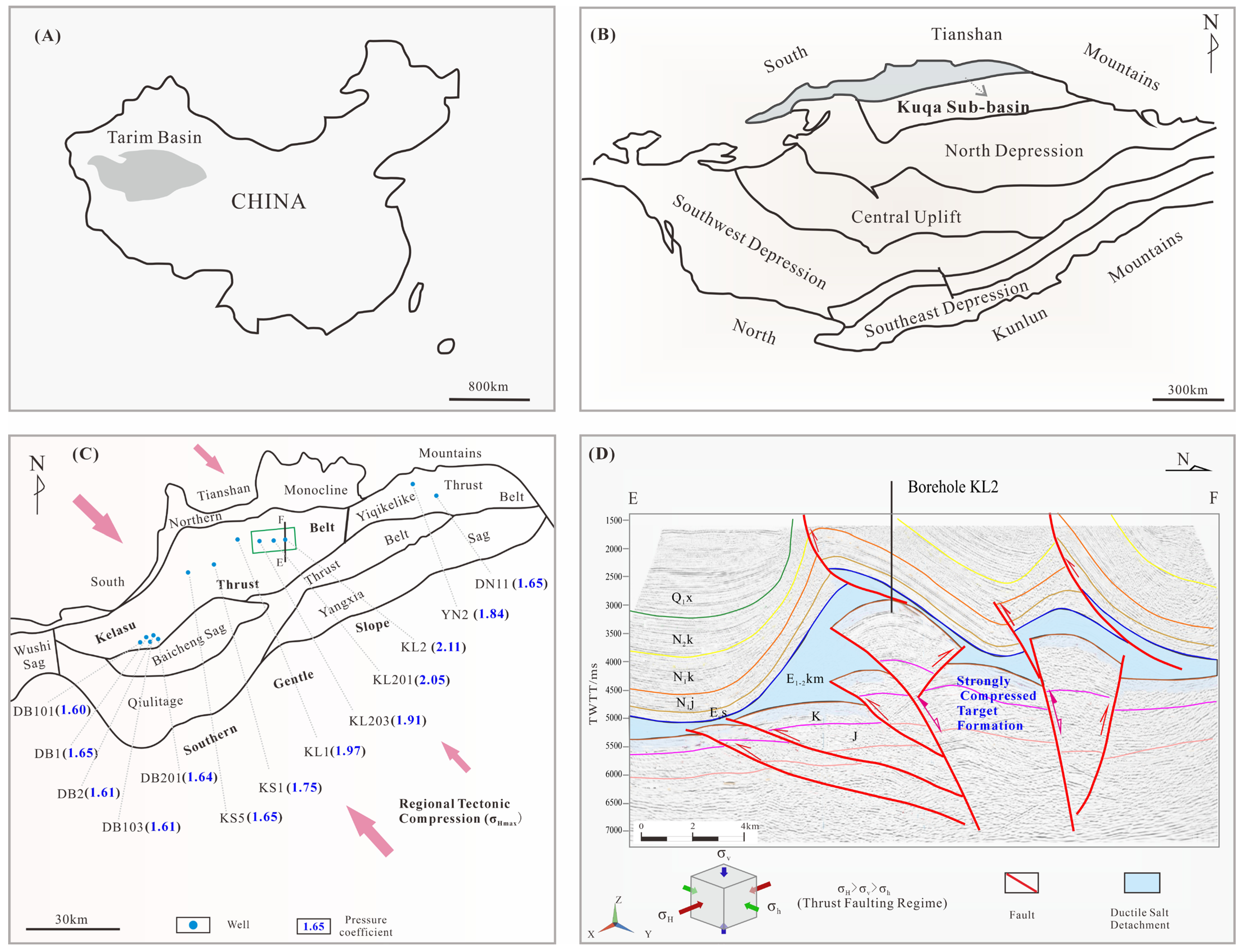
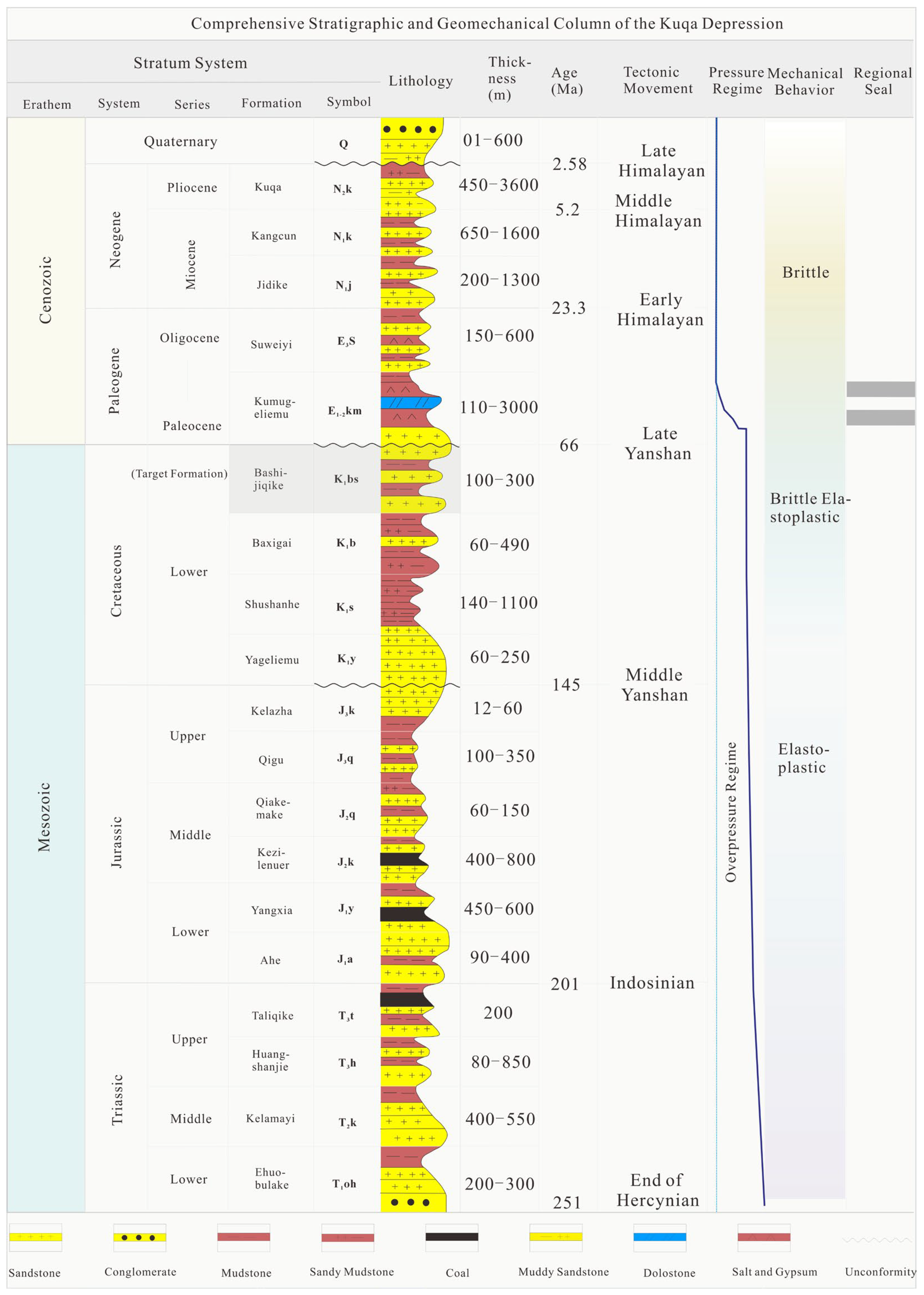
2. Geomechanical Setting
3. Poro-Elastoplastic Constitutive Framework and Mathematical Formulation
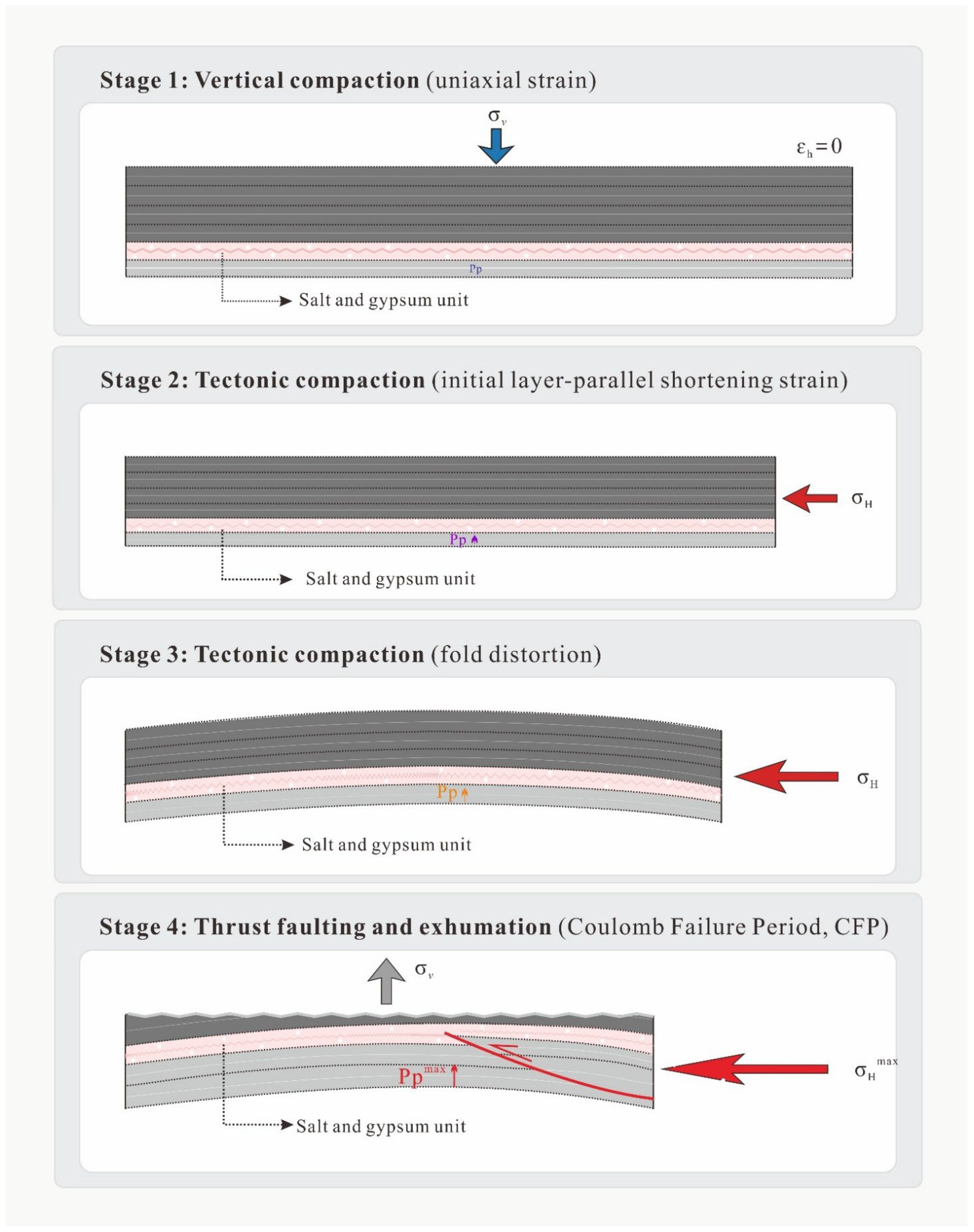
3.1. Stress Paths and Poro-Mechanical Boundary Conditions
3.2. Mathematical Formulation
4. Results
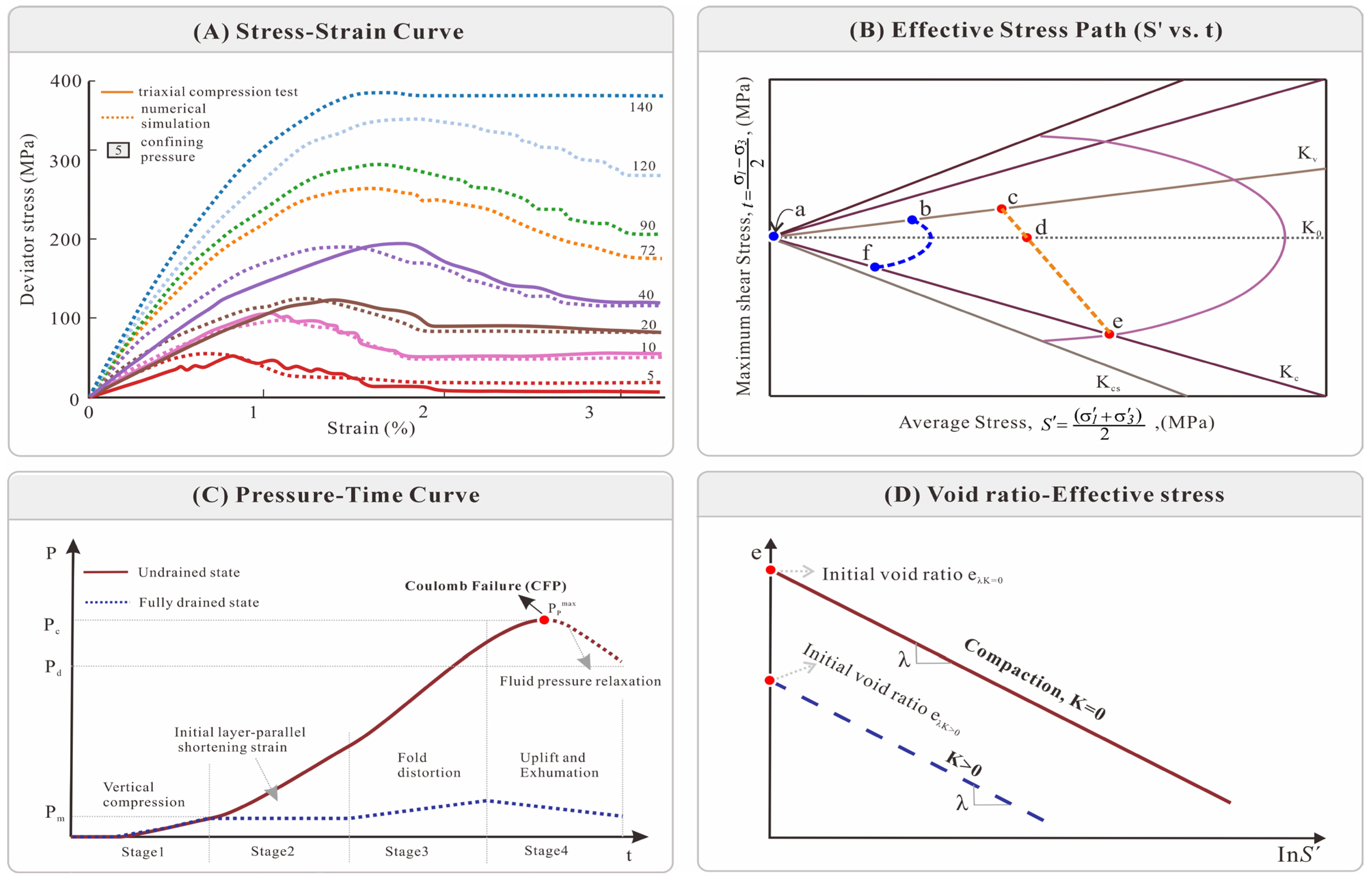
4.1. Determination of Poro-Elastoplastic Material Parameters
4.2. Quantitative Prediction of Pore Pressure and Overpressure Partitions
4.3. Reconstructed 3D Stress Tensor and Effective Stress State at Failure
5. Discussion
5.1. Quantitative Comparison with Alternative Stress and Pressure Evaluation Models
- (1)
- Comparison with Eaton-type Empirical Formulations
- (2)
- Alignment with Basin Modeling in Convergent Margins
- (3)
- In situ Verification via Drilling-induced Failures and LOT Measurements
5.2. Poro-Mechanical Evolution Path During Uplift and Exhumation
5.3. Quantitative Decoupling of Overpressure: Vertical Compaction vs. Tectonic Compression
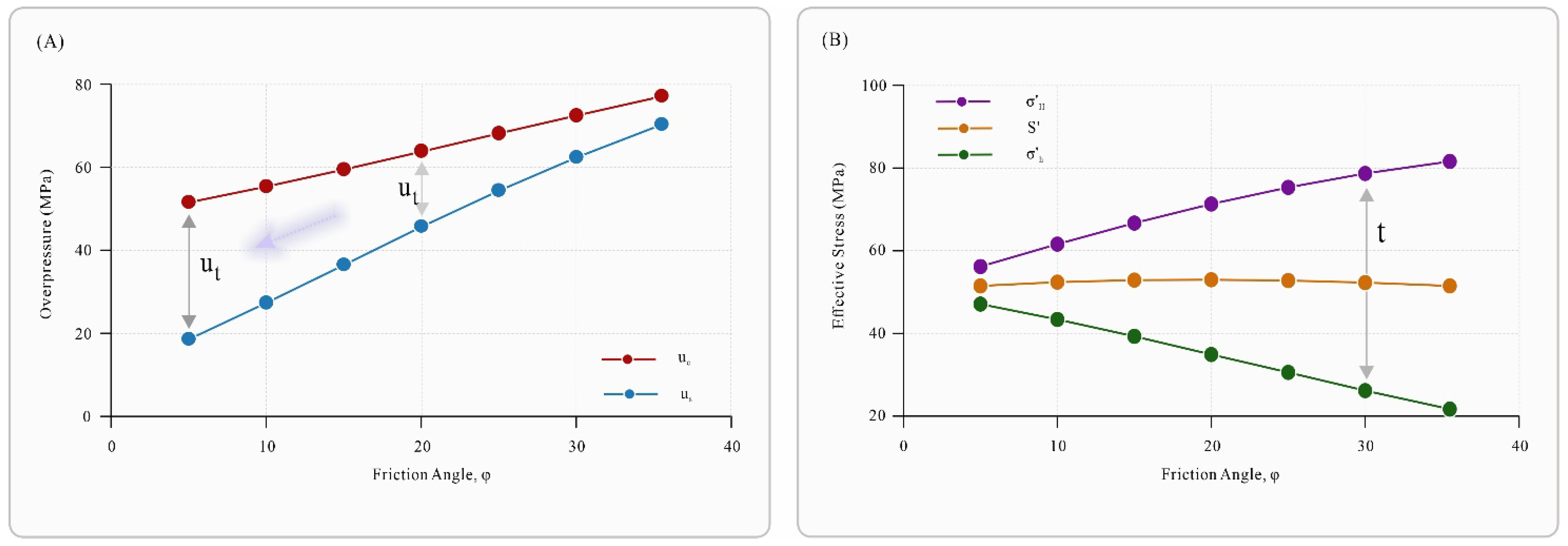
5.4. The Rheological Influence of Internal Friction Angle (Φ)
5.5. Limitations, Boundary Conditions, and Future Directions
- (1)
- Thermodynamic and Stress Thresholds: The analogy between lithified mudstones and critical-state soils requires specific high-stress boundary conditions. Our triaxial experiments confirm that diagenetic cementation dictates brittle behavior at shallow depths. The continuous plastic flow and volumetric yielding essential for the MCC framework are exclusively activated when the confining pressure exceeds 140 MPa. Thus, the model is strictly applicable to ultra-deep regimes (>6000 m), where extreme lithostatic stresses and elevated temperatures (>140 °C) overcome shallow-level brittleness, forcing the matrix into a ductile, strain-hardening state. Future extensions should couple this framework with thermo-hydro-mechanical (THM) formulations to explicitly model temperature-dependent evolution of MCC parameters under extreme geothermal gradients (>140 °C), as conceptualized by Casey et al. (2016) [20].
- (2)
- Constant Elastoplastic Parameters: The current formulation assumes a constant compression index (λ) and friction angle (ϕ). Contemporary geomechanics recognizes stress-dependent degradation of these parameters under extreme confinement [39,40]. While adopting constant values represents a first-order mechanical simplification, future improvements will incorporate non-linear degradation laws (e.g., Fjaer et al., 2008 [39]; Casey, 2014 [40]) to capture continuous rock matrix damage. Nevertheless, current sensitivity analyses confirm that the constant-parameter assumption successfully captures fundamental macro-yielding trends without obscuring the dominant tectonic mechanism.
- (3)
- Negligible Elastic Rebound (κ ≪ λ): Treating the mudstone matrix as undergoing irreversible plastic compaction during exhumation implies neglecting the poro-elastic swelling index (κ). For deeply buried, highly overconsolidated mudstones,κ is typically an order of magnitude smaller than λ. Hence, the porosity expansion driven by elastic relaxation during uplift is mathematically insignificant compared to the primary tectonic plastic contraction. To rigorously validate the calculated stresses (especially σh), integrating core-based Anelastic Strain Recovery (ASR) measurements and image log breakout widths will be an essential validation protocol in future field applications.
- (4)
- Static Peak Pressure vs. Transient Dynamics: Finally, the model analytically resolves the peak fluid pressure (Pc) immediately preceding macroscopic Coulomb failure. It does not account for transient, post-failure hydro-mechanical behavior, such as rapid pressure bleed-off induced by fault-rupture permeability surges (fault-valve mechanisms) [41]. Future research extending this framework to incorporate fault-valve dynamic models (e.g., Wang et al., 2024 [41]) and time-dependent creep will further refine the temporal prediction of geopressure evolution.
5.6. Engineering Implications and Present-Day Applications
- (1)
- Optimization of Ultra-deep Drilling Safety and Wellbore Stability
- (2)
- Hydraulic Fracturing and Deep Reservoir Stimulation
- (3)
- Long-term Integrity of Caprocks for Geo-Energy Storage
6. Conclusions
Author Contributions
Funding
Data Availability Statement
Acknowledgments
Conflicts of Interest
Nomenclature
| CFP | Coulomb failure period |
| MBP | maximum burial period |
| MCC | Modified Cam-Clay model |
| KTB | Kelasu Thrust Belt |
| Pd | current pore fluid pressure |
| Pc | pore fluid pressure of Coulomb failure period |
| Pm | pore fluid pressure of maximum burial period |
| Ps | pore fluid overpressure induced by average stress of Coulomb failure period |
| Pt | pore fluid overpressure induced by shear stress of Coulomb failure period |
| ud | current pore fluid overpressure |
| uc | pore fluid overpressure of Coulomb failure period |
| us | pore fluid overpressure induced by average stress of Coulomb failure period |
| ut | pore fluid overpressure induced by shear stress of Coulomb failure period |
| S | average stress |
| S′ | average effective stress |
| t | maximum shear stress |
| σ′v | vertical effective stress of Coulomb failure period |
| σ′H | maximum horizontal effective stress of Coulomb failure period |
| σ′h | minimum horizontal effective stress of Coulomb failure period |
| σv-present | current vertical stress |
| σ′v-present | current vertical effective stress |
| σ′1 | the maximum effective stress |
| σ′3 | the minimum effective stress |
| ψ | sediment porosity |
| e | void ratio |
| e0 | sediment initial void ratio |
| eλiso | the initial void ratio of isotropic compaction path |
| M | the slope of the critical shape of yield surface |
| λ | the slope represented by compaction line |
| φ | angle of internal friction of mudstone |
| K | the slope of an arbitrary line in s’-t space |
| Kv | stress ratio in vertical compaction |
| KC | the stress ratio when soil element reaches the Coulomb failure |
Appendix A
References
- Guo, X.S.; Hu, Z.Q.; Li, S.J.; Zheng, L.J.; Zhu, D.Y.; Liu, J.L.; Shen, B.J.; Du, W. Progress and prospect of natural gas exploration and research in deep and ultra-deep strata. Pet. Sci. Bull. 2023, 04, 461–474. [Google Scholar] [CrossRef]
- He, X.P.; Zhang, P.X.; Gao, Y.Q.; Wang, K.M.; He, G.S.; Ren, J.H.; Gao, Q.F.; Zang, S.H. Challenges and countermeasures for beneficial development of unconventional oil and gas resources in China. China Pet. Explor. 2025, 30, 28–43. [Google Scholar] [CrossRef]
- Cao, W.; Zhang, R.; Nie, X.; Ren, L. Laboratory Fracture Slip and Seismicity Subjected to Fluid Injection-Related Stress and Pressure Paths. Rock Mech. Rock Eng. 2024, 57, 1245–1261. [Google Scholar] [CrossRef]
- Sun, B.S.; Ding, Y.C.; Shao, Z.G. Application of acoustic emission technique in determination of fossil and present-day stresses in oil fields. J. Geo-Mech. 1996, 2, 11–17. (In Chinese) [Google Scholar]
- Ding, Y.C.; Shao, Z.G. An experimental research into determination of the highest paleotectonic stress state experienced by rock through geological ages. Earth Sci. J. China Univ. Geosci. 2001, 26, 99–104. (In Chinese) [Google Scholar]
- Vergara Sassarini, N.A.; Gasparrini, M.; Bernasconi, S.M.; Corrado, S. Joint application of fluid inclusion and clumped isotope (Δ47) thermometry unravels the complexity of thermal and fluid-flow history reconstruction in sedimentary basins—Upper Triassic Chaunoy Formation reservoirs (Paris Basin). Basin Res. 2024, 36, e12814. [Google Scholar] [CrossRef]
- Gonçalvès, J.; Pagel, M.; Violette, S.; Guillocheau, F.; Robin, C. Fluid inclusions as constraints in a three-dimensional hydro-thermo-mechanical model of the Paris Basin, France. Basin Res. 2010, 22, 699–716. [Google Scholar] [CrossRef]
- Marín-Moreno, H.; Minshull, T.A.; Edwards, R.A. Inverse modelling and seismic data constraints on overpressure generation by disequilibrium compaction and aquathermal pressuring: Application to the Eastern Black Sea Basin. Basin Res. 2013, 25, 331–347. [Google Scholar]
- Burgreen-Chan, B.; Scheirer, A.H.; Graham, S.A.; Muñoz-Sáez, C. Basin and petroleum system modelling of the East Coast Basin, New Zealand: A test of overpressure scenarios in a convergent margin. Basin Res. 2016, 28, 536–567. [Google Scholar] [CrossRef]
- Eaton, B.A. The equation for geopressure prediction from well logs. Soc. Pet. Eng. 1975, 5544, SPE-5544-MS. [Google Scholar] [CrossRef]
- Zhang, J.C. Pore pressure prediction from well logs: Methods, modifications, and new approaches. Earth Sci. Rev. 2011, 108, 50–63. [Google Scholar] [CrossRef]
- Couzens-Schultz, B.A.; Chan, A.W. Stress determination in active thrust belts: An alternative leak-off pressure interpretation. J. Struct. Geol. 2010, 32, 1061–1069. [Google Scholar] [CrossRef]
- Chang, C.; McNeill, L.C.; Moore, J.C.; Lin, W.; Conin, M.; Yamada, Y. In situ stress state in the Nankai accretionary wedge estimated from borehole wall failures. Geochem. Geophys. Geosystems 2010, 11, Q0AD04. [Google Scholar] [CrossRef]
- Nifuku, K.; Kobayashi, Y.; Araki, Y.; Ashida, T.; Taniwaki, T. Overpressure evolution controlled by spatial and temporal changes in the sedimentation rate: Insights from a basin modelling study in offshore Suriname. Basin Res. 2021, 33, 1294–1314. [Google Scholar] [CrossRef]
- Hubbert, M.K.; Rubey, W.W. Role of fluid pressure in mechanics of overthrust faulting. Geol. Soc. Am. Bull. 1959, 70, 115–166. [Google Scholar] [CrossRef]
- Zhang, J. Effective stress, porosity, velocity and abnormal pore pressure prediction accounting for compaction disequilibrium and unloading. Mar. Pet. Geol. 2013, 45, 2–11. [Google Scholar] [CrossRef]
- Li, Q.; Li, Q.; Cao, H.; Wu, J.; Wang, F.; Wang, Y. The crack propagation behaviour of CO2 fracturing fluid in unconventional low permeability reservoirs: Factor analysis and mechanism revelation. Processes 2025, 13, 159. [Google Scholar] [CrossRef]
- Li, Q.; Li, Q.; Wang, F.; Wu, J.; Wang, Y.; Jin, J. Effects of geological and fluid characteristics on the injection filtration of hydraulic fracturing fluid in the wellbores of shale reservoirs: Numerical analysis and mechanism determination. Processes 2025, 13, 1747. [Google Scholar] [CrossRef]
- Li, Q.; Li, Q.; Wang, F.; Xu, N.; Wang, Y.; Bai, B. Settling behavior and mechanism analysis of kaolinite as a fracture proppant of hydrocarbon reservoirs in CO2 fracturing fluid. Colloids Surf. A Physicochem. Eng. Asp. 2025, 724, 137463. [Google Scholar] [CrossRef]
- Casey, B.; Germaine, J.T.; Flemings, P.B.; Fahy, B.P. In situ stress state and strength in mudrocks. J. Geophys. Res. Solid Earth 2016, 121, 5611–5623. [Google Scholar] [CrossRef]
- Carey, J.W.; Frash, L.P. Brittle-ductile behavior and caprock integrity. Energy Procedia 2017, 114, 3132–3139. [Google Scholar] [CrossRef]
- Flemings, P.B.; Saffer, D.M. Pressure and stress prediction in the Nankai accretionary prism: A critical state soil mechanics porosity-based approach. J. Geophys. Res. Solid Earth 2018, 123, 1089–1115. [Google Scholar] [CrossRef]
- Ghimire, S.; Panthi, K.K. In-Situ Stress Evaluation in an Unlined Pressure Tunnel of a Hydropower in South-Western Part of Norway. Rock Mech. Rock Eng. 2026, 59, 1–26. [Google Scholar] [CrossRef]
- Chen, S.P.; Tang, L.J.; Jin, Z.J.; Jia, C.Z.; Pi, X.J. Thrust and fold tectonics and the role of evaporites in deformation in the Western Kuqa Foreland of Tarim Basin, Northwest China. Mar. Pet. Geol. 2004, 21, 1027–1042. [Google Scholar] [CrossRef]
- Wang, Q.H.; Yang, H.J.; Yang, W. New progress and future exploration targets in petroleum geological research of ultra-deep castic rocks in Kuqa Depression, Tarim Basin, NW China. Pet. Explor. Dev. 2025, 52, 70–83. [Google Scholar] [CrossRef]
- Roscoe, K.H.; Burland, J.B. On the generalized stress-strain behaviour of “wet” clay. In Engineering Plasticity; Heyman, J., Ed.; Cambridge University: Cambridge, UK, 1968; pp. 535–609. [Google Scholar] [CrossRef]
- Jia, C.Z. Characteristics of Mesozoic and Cenozoic Structures and Petroleum Occurrence in the Tarim Basin; Petroleum Industry Press: Beijing, China, 2004. (In Chinese) [Google Scholar]
- Song, Y.; Liu, S.B.; Zhao, M.; Hong, J.F.; Fang, S.H. The Oil and Gas Distribution Law and the Main Controlling Factors in Foreland Basins, Central and Western China; Petroleum Industry Press: Beijing, China, 2008; pp. 107–108. [Google Scholar]
- Zou, Y.R.; Zhao, C.Y.; Wang, Y.P.; Zhao, W.Z.; Peng, P.A.; Shuai, Y.H. Characteristics and origin of natural gases in the Kuqa Depression of Tarim Basin, NW China. Org. Geochem. 2006, 37, 280–290. [Google Scholar] [CrossRef]
- Graham, S.A.; Hendrix, M.S.; Wang, L.B.; Homewood, P. Collision successor basins of western China, impact of tectonic inheritance on sand composition. Geol. Soc. Am. Bull. 1993, 105, 323–344. Available online: https://pubs.geoscienceworld.org/gsa/gsabulletin/article-abstract/105/3/323/182780/Collisional-successor-basins-of-western-China?redirectedFrom=fulltext (accessed on 1 July 2026).
- Tang, L.J.; Jia, C.Z.; Jin, Z.J.; Chen, S.P.; Pi, X.J.; Xie, H.W. Salt tectonic evolution and hydrocarbon accumulation of Kuqa foreland fold belt, Tarim Basin, NW China. J. Pet. Sci. Eng. 2004, 41, 97–108. [Google Scholar] [CrossRef]
- Mei, Y.X.; Zhang, J.N.; Neng, Y.; Wang, W.J.; Xu, K.; Xiang, H.; Wu, Y.; Liu, P. Tectonic control on ultra-deep sub-salt trap architecture: Insights from multi-detachment modeling and physical simulations in the Kuqa Foreland Thrust Belt. Geosciences 2026, 16, 197. [Google Scholar] [CrossRef]
- Fan, C.Y.; Wang, G.; Wang, Z.L.; Han, X.J.; Chen, J.; Zhang, K.L.; Zhang, B.S. Prediction of multiple origin overpressure in deep fold-thrust belt: A case study of Kuqa subbasin, Tarim Basin, northwestern China. AAPG Bull. 2021, 105, 1511–1533. [Google Scholar] [CrossRef]
- Xie, H.W.; Li, Y.; Zhong, D.K.; Lei, G.L.; Li, X.; Yang, X.Z.; Rao, H.W.; Yang, Q.X. Sedimentary evolution of the Neogene—Quaternary deposits in the Kuqa depression, Xinjiang. Sediment. Geol. Tethyan Geol. 2013, 33, 10–15. Available online: https://cjyttsdz.com.cn/article/id/20130302 (accessed on 1 July 2026).
- Gao, B.; Flemings, P.B.; Nikolinakou, M.A.; Saffer, D.M.; Heidari, M. Mechanics of Fold and Thrust Belts Based on Geomechanical Modeling. J. Geophys. Res. Solid Earth 2018, 123, 4454–4474. [Google Scholar] [CrossRef]
- Chen, M.Y.; Chen, S.T.; Ji, Q.S.; Lu, M.X. Numerical simulation of the brittle-ductile fracture characteristics of the mudstone caprock in Kuche Depression. Pet. Geol. Oilfied Dev. Daqing 2020, 39, 28–35. [Google Scholar] [CrossRef]
- Jiang, R.T. Fracture Development and Distribution in Interbeded Sandstone and Mudstone of Keshen 2 Gas Reservoir. Master’s Thesis, China University of Petroleum (East China), Qingdao, China, 2021. [Google Scholar]
- Marcussen, Ø.; Faleide, J.I.; Jahren, J.; Bjørlykke, K. Mudstone compaction curves in basin modelling: A study of Mesozoic and Cenozoic Sediments in the northern North Sea. Basin Res. 2010, 22, 325–341. [Google Scholar] [CrossRef]
- Fjaer, E.; Holt, R.M.; Raaen, A.M.; Risnes, R.; Horsrud, P. Petroleum Related Rock Mechanics, 2nd ed.; Elsevier: Amsterdam, The Netherlands, 2008. [Google Scholar]
- Casey, B. The Consolidation and Strength Behavior of Mechanically Compressed Fine-Grained Sediments. Ph.D. Thesis, Department of Civil and Environmental Engineering, Massachusetts Institute of Technology, Cambridge, MA, USA, 2014; 259p. [Google Scholar]
- Wang, Q.; Sun, Q.; You, K.; Foschi, M. Overpressure-driven hydrofracture growth in the northern South China Sea. Basin Res. 2024, 36, e12894. [Google Scholar] [CrossRef]
- Lu, Y.; Li, W.; Jin, Y.; Chen, M.; Pang, H.; Zhou, W. Short- and Long-term Wellbore Stability Analysis for a Horizontal Well in a Transversely Isotropic Poroelastic Formation. Rock Mech. Rock Eng. 2025, 58, 767–786. [Google Scholar] [CrossRef]
- Ibemesi, P.; Benson, P. Effect of Pressure and Stress Cycles on Fluid Flow in Hydraulically Fractured, Low-Porosity, Anisotropic Sandstone. Rock Mech. Rock Eng. 2023, 56, 19–34. [Google Scholar] [CrossRef]
- Yang, Y.; Li, X.; Ju, Y.; Gao, Y.; Liu, X.; Liu, J.; Guo, J. Analysis of Wellbore Wall Stress for SC-CO2 Horizontal Well Fracturing in Bedded Rocks and the Influence Mechanism of Bedding Structure: Development of a Fracture Initiation Criterion and a Theoretical Prediction Model for Initiation Pressure in SC-CO2 Fracturing. Rock Mech. Rock Eng. 2026, 59, 1–16. [Google Scholar] [CrossRef]


Disclaimer/Publisher’s Note: The statements, opinions and data contained in all publications are solely those of the individual author(s) and contributor(s) and not of MDPI and/or the editor(s). MDPI and/or the editor(s) disclaim responsibility for any injury to people or property resulting from any ideas, methods, instructions or products referred to in the content. |
© 2026 by the authors. Licensee MDPI, Basel, Switzerland. This article is an open access article distributed under the terms and conditions of the Creative Commons Attribution (CC BY) license.
Share and Cite
Wang, G.; Fan, C.; Wang, Z.; Yang, H. Decoding the Geomechanical Memory of Deep Shales: Decoupling Extreme 3D Stress and Overpressure for Unconventional Engineering. Geosciences 2026, 16, 276. https://doi.org/10.3390/geosciences16070276
Wang G, Fan C, Wang Z, Yang H. Decoding the Geomechanical Memory of Deep Shales: Decoupling Extreme 3D Stress and Overpressure for Unconventional Engineering. Geosciences. 2026; 16(7):276. https://doi.org/10.3390/geosciences16070276
Chicago/Turabian StyleWang, Gang, Changyu Fan, Zhenliang Wang, and Haijun Yang. 2026. "Decoding the Geomechanical Memory of Deep Shales: Decoupling Extreme 3D Stress and Overpressure for Unconventional Engineering" Geosciences 16, no. 7: 276. https://doi.org/10.3390/geosciences16070276
APA StyleWang, G., Fan, C., Wang, Z., & Yang, H. (2026). Decoding the Geomechanical Memory of Deep Shales: Decoupling Extreme 3D Stress and Overpressure for Unconventional Engineering. Geosciences, 16(7), 276. https://doi.org/10.3390/geosciences16070276