Article

Deep-Seated Processes Controlling Mesozoic Differential Metallogeny in the Southern Region of South China: Insights from Hf-Nd Isotope Mapping

1
National Mineral, Rock and Fossil Resource Center, and Deep Space Exploration Laboratory, China University of Geosciences, Beijing 100083, China
2
State Key Laboratory of Geological Processes and Mineral Resources, School of Gemology, China University of Geosciences, Beijing 100083, China
3
School of Gemmology, China University of Geosciences, Beijing 100083, China
4
Department of Geology and Mountain Hazards, Karakoram International University, Gilgit 15100, Pakistan
*
Author to whom correspondence should be addressed.
Geosciences 2026, 16(6), 230; https://doi.org/10.3390/geosciences16060230
Submission received: 30 March 2026 / Revised: 23 May 2026 / Accepted: 5 June 2026 / Published: 8 June 2026
(This article belongs to the Special Issue Isotope Geochemistry: New Techniques and Applications)

Abstract

The southern region of the South China Block hosts a super-large metallogenic province. However, the Mesozoic differential metallogeny between the southern Cathaysia Block (W-Sn) and the southern Yangtze Block (Au-Sb) remains enigmatic. To characterize the crustal architecture beneath different metallogeny belts, we integrate 3239 published εHf(t) values of synmagmatic zircons from Mesozoic igneous rocks and corresponding whole-rock εNd(t) datasets to generate coupled Hf–Nd isotopic mappings. The results show that εHf(t) values range from −19.3 to +11.6 (TDM2: 464–2419 Ma) and εNd(t) values are from −12.2 to +5.0 (TDM2: 580–2008 Ma) in the southern part of South China Block. High εHf(t) (−4~+11.6) and εNd(t) (−4~+5.0) zones are concentrated along the Honghe Fault and Chenzhou–Linwu Fault systems, while low-value Hf–Nd isotopic (εHf(t) = −10.6 to −4; εNd (t) = −12.2 to −4) zones are mainly distributed in the interior of the southern Yangtze Block. The W-Sn deposits in the southern Cathaysia Block are genetically linked to the heterogeneous εHf(t)-εNd(t) isotopic domains. The ore-forming materials of these high-temperature W-Sn polymetallic deposits may primarily derive from crust hybrid magmas that have undergone multistage crustal reworking. In contrast, low-temperature Au-Sb deposits in the northern Youjiang basin are distributed in areas characterized by elevated εHf(t)-εNd(t) isotopic signatures, which are primarily derived from reworked crust with significant mantle contributions. Most magmatic rock-associated Au deposits tend to cluster at the boundaries of Hf-Nd isotopic anomalies, which indicates the contribution of crust-mantle interaction to Au mineralization. Our Hf-Nd isotopic mappings reveal that mantle-crust deep-seated process controls the Mesozoic differential metallogeny between the southern Cathaysia Block (W-Sn) and the southern Yangtze Block (Au-Sb).

1. Introduction

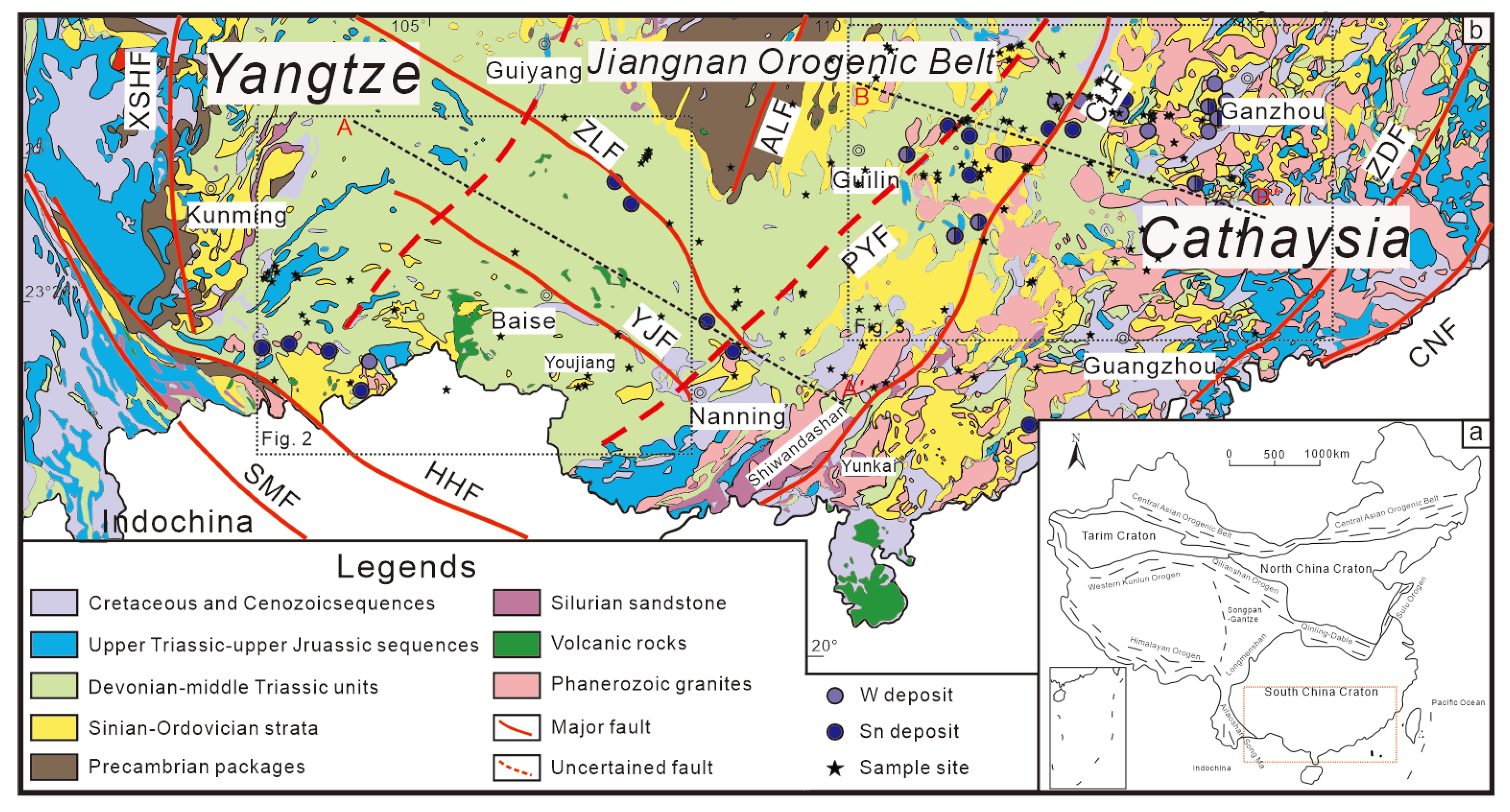
The South China Block was formed in the Neoproterozoic through the collision and amalgamation of the Yangtze Craton and the Cathaysia Block along the Jiangnan Orogenic Belt (Figure 1) [1]. Subsequently, it experienced multiple episodes of magmatic–tectonic activities, including intracontinental orogeny and oceanic crust subduction [2,3]. Corresponding to these major geological events, extensive Mesozoic metallogenic processes occurred in the southern part of the South China Block. This led to the formation of a Au-Sb low-temperature metallogenic province in Youjiang basin, (southern Yangtze Block) [4], while a W-Sn polymetallic high-temperature metallogenic province, associated with granitic magmatism [5], developed in Nanling region of the southern Cathaysia Block (Figure 1). The southern part of the South China Block hosts many large to super-large metal deposits [6], making it an area of significant interest in geological research. For a long time, due to their spatial distribution, the low-temperature metallogenic province in the west and the high-temperature metallogenic province in the east of part of the southern South China Block have been regarded as independent metallogenic systems. However, with recent advancements in analytical techniques and the rapid accumulation of research data, a growing number of scholars have recognized that these two metallogenic provinces may be closely genetically linked [4,7,8]. Studies of geochemical fingerprints, such as sulfur isotopes, noble gas isotopes, mercury isotopes, and fluid inclusions, indicate a genetic relationship between the low-temperature and high-temperature ore deposits. Based on this, some researchers have proposed that the southern part of the South China Block should exhibit a binary metallogenic structure from east to west: the eastern high-temperature metallogenic province hosts numerous S-type or highly fractionated granites derived from crustal anatexis. The magmatic fluids differentiated from these deep crustal granitic magmas formed high-temperature W-Sn polymetallic deposits at deeper levels, while the heat from the granites and the residual magmatic fluids after the formation of the high-temperature W-Sn deposits drove the circulation of meteoric groundwater, which leached ore-forming elements from the Precambrian basement strata to form overlying low-temperature deposits such as Au and Sb [4]. However, this model has not yet been validated. Therefore, it is essential to investigate the deep structure across various ore clusters in the southern part of the South China Block, in order to clarify the tectonic evolution and the deep-seated processes responsible for the large-scale differential metallogeny in the terrane.
This study selected Hf–Nd isotopic datasets of Mesozoic intrusive and volcanic rocks in southern region of the South China Block to conduct isotopic mapping. The results reveal that the high-temperature W-Sn polymetallic metallogenic belt in the southern Cathaysia Block is distributed in heterogeneous εHf(t)-εNd(t) isotopic domains, suggesting it likely originated from crust-derived magma that underwent multistage crustal reworking; however, the low-temperature Au-Sb metallogenic belt in the Youjiang basin lies within elevated εHf(t)-εNd(t) isotopic zones, indicating its ore-forming materials were derived from reworked crust with substantial mantle material contributions. More importantly, most large-scale Mesozoic magmatic rock-associated deposits in the southern South China Block are concentrated at the boundaries of Hf–Nd isotopic anomalous zones, which are closely related to the reworked crust. The deep-seated process controls the Mesozoic differential metallogeny between the southern Cathaysia Block (W-Sn) and the southern Yangtze Block (Au-Sb).

2. Geological Background

2.1. South China Block

The South China Block is bounded to the north by the Qinling–Dabie–Sulu collisional orogen, which juxtaposes it against the North China Craton. To the southwest the block is linked to the Indochina Block via the Red River and related strike-slip fault systems, and to the east, it is fringed by the Pacific Plate, whose subduction has exerted first-order control on its tectonic evolution since the Mesozoic [1,3]. The South China Block is a composite continental block formed through the amalgamation and modification of diverse terranes via multiple tectonic events [9]. It records a complex geological evolutionary history and hosts highly active tectono-magmatic-metallogenic processes [10]. The block was established upon the Neoproterozoic collision and amalgamation of the Yangtze Block and the Cathaysia Block [11], which formed a unified primordial basement (Figure 1). The tectonic evolution of South China Block has been progressively governed by both the Tethyan and Pacific tectonic domains [9]. During the Paleozoic, the main body of South China was situated in a relatively stable shallow marine environment, with continuous deposition of thick carbonate and clastic sedimentary sequences [12]. In the Mesozoic, the subduction of the Paleo-Pacific Plate became the dominant dynamic mechanism, triggering extensive intracontinental orogeny in southeastern China [13]. This orogenic event formed an intracontinental orogenic belt approximately 1300 km wide, characterized not by traditional plate-margin collision but by intense lithospheric extension and thinning, large-scale magmatic intrusions and volcanic eruptions, and the widespread development of fault systems and fault-bound basins [14,15,16].
The Mesozoic era, particularly the Jurassic-Cretaceous period, represents the climax of the South China Block’s geological evolution [17]. The heat and fluids derived from the subduction of the Paleo-Pacific Plate triggered large-scale partial melting of ancient crustal materials, forming the world-renowned Mesozoic granitic province of South China Block [18]. These crust-derived or crust-mantle mixed granitoids are intimately associated with prolific metallogenesis of metals such as W, Sn, Bi, Cu, Pb, Zn, U and Au [19]. This process gave rise to world-class metallogenic belts including the Nanling W-Sn Polymetallic Belt, Qin-Hang Metallogenic Belt, and Youjiang basin Carlin-type Au Belt, collectively constituting one of the most distinctive geological features of the South China Block [20,21,22,23]. Some researchers have pointed out that the Yangtze Craton developed the Guangxi Promontory along its irregular continental margin. Within this tectonic framework, the Youjiang basin belongs to the Yangtze Craton, whereas the Nanling region is part of the Cathaysia Block. This study adopts this tectonic division scheme as the fundamental framework for discussing the geological evolution of the two regions [24,25].

2.2. Youjiang Basin and Nanling Region

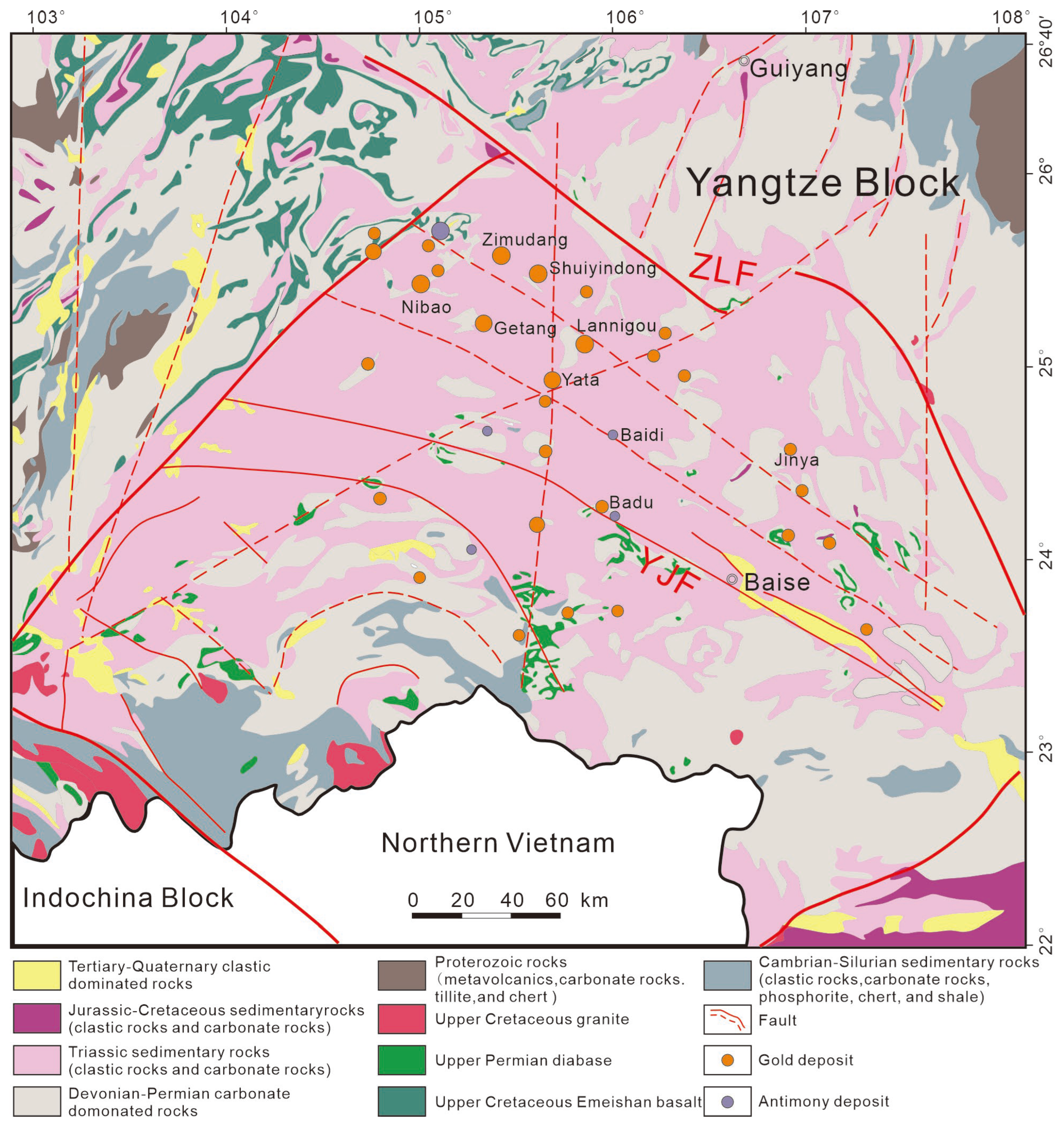
The southern Yangtze Block (including the Youjiang basin) is situated at the junction of Yunnan, Guizhou, and Guangxi provinces, along the southwestern margin of the main Yangtze Block (Figure 2) [26]. This region exhibits an overall diamond-shaped structure, bounded to the south by the Viet Bac Block and connected to the Indochina Block via the Ailaoshan–Song Ma Suture Zone, with these boundaries controlled by multiple NE- and NW-trending deep faults [27]. It is bounded to the northwest by the Mile–Shizong Fault, to the northeast by the Ziyun–Du’an–Hechi Fault, to the southeast by the Pingxiang–Nanning Fault, and to the southwest by the Ailaoshan–Red River Fault Zone [28,29]. The basement of this region consists of Precambrian to Ordovician strata, overlain by Devonian to Triassic formations [30]. During the Devonian to the Triassic periods, the Youjiang basin deposited an alternating succession of shallow-water platform-facies carbonates (such as limestone, dolomite, marl, and bioclastic limestone) and deep-water slope-to-basin-facies clastic rocks (including argillaceous rocks, siliceous rocks, and siltstone) [31,32]. This characteristic depositional pattern is closely linked to the opening of the Paleo-Tethys Ocean during the Late Devonian to Early Carboniferous [33]. During the Mesozoic, the southern Yangtze Block underwent a complex geological process transitioning from oceanic subduction and closure, through plate collision and orogeny, to intracontinental deformation and magmatic mineralization [34]. In the Triassic, associated with the Indosinian Orogeny that led to the collision between the Indochina Block and the South China Block as well as the closure of the Paleo-Tethys Ocean, the Youjiang basin evolved from a rift basin into a foreland basin and accumulated thick flysch deposits [30]. During the Late Triassic, the region was uplifted and emerged above sea level, terminating marine sedimentation [35]. After the Early–Middle Jurassic, influenced by the Yanshanian movement, the basin experienced intense compression, leading to folding and faulting of the strata [36]. By the Late Cretaceous, the late stage of the Yanshanian movement induced an extensional regime, resulting in the emplacement of numerous ultra-mafic alkaline dykes and the development of a structural system dominated by NE- and NW-trending faults [37], alongside subordinate near-EW, near-SN, and arcuate structures. Many of the earlier basement structures were buried beneath Paleozoic to Mesozoic cover, yet they exerted a significant influence on subsequent tectonic evolution and mineralization [35]. Furthermore, between 120 and 70 Ma, triggered by the steep subduction of the Pacific Plate, the foreland basin entered an extensional phase [38,39], facilitating widespread magmatic activity and the formation of associated Sn-polymetallic deposits. The southern Yangtze Block and its surrounding areas exhibit a complex metallogenic system characterized by the spatial coupling of typical low-temperature hydrothermal and magmatic-hydrothermal metallogenic domains [40]. The interior of this region, particularly the Youjiang basin, is pervasively characterized by low-temperature mineralization dominated by Au, Sb, Hg and As. These elements display a unique geochemical distribution pattern across the region, exhibiting both paragenesis and separation [22,41]. The formation of Carlin-type Au deposits in the basin exhibits typical multistage overprinting characteristics, with their main mineralization periods corresponding to compressional settings of collisional orogeny [42,43]. The early stage (235–193 Ma) was jointly controlled by the collision between the Yangtze and Indochina blocks and the subduction of the Paleo-Pacific Plate, which triggered magmatic activity [44]. The resulting Au-enriched magmatic fluids mixed with basinal brines or metamorphic hydrothermal fluids, resulting in preliminary Au enrichment and mineralization in the central-southern basin [37]. The late stage (148–103 Ma) occurred under a NW-SE compressional stress field, where large-scale magmatic-hydrothermal activity overprinted and modified pre-existing structures [45]. This not only facilitated large-scale Au mineralization in the central-northern part of the basin but also significantly upgraded and enriched the early-stage ore bodies in the central-southern regions through superimposed mineralization [26]. Meanwhile, during the late Yanshanian period, the margins of this system were characterized by high-temperature mineralization assemblages closely associated with felsic magmatic activity [46]. On the eastern side, the Dachang Sn-polymetallic ore field and the Damingshan W-polymetallic ore field developed, while on the western side, the Gejiu Sn-polymetallic ore field and the Bainiuchang Ag-polymetallic ore field are located. Together, they constitute an integrated metallogenic series driven by deep magmatic processes and controlled by multi-stage tectonic activities [47].
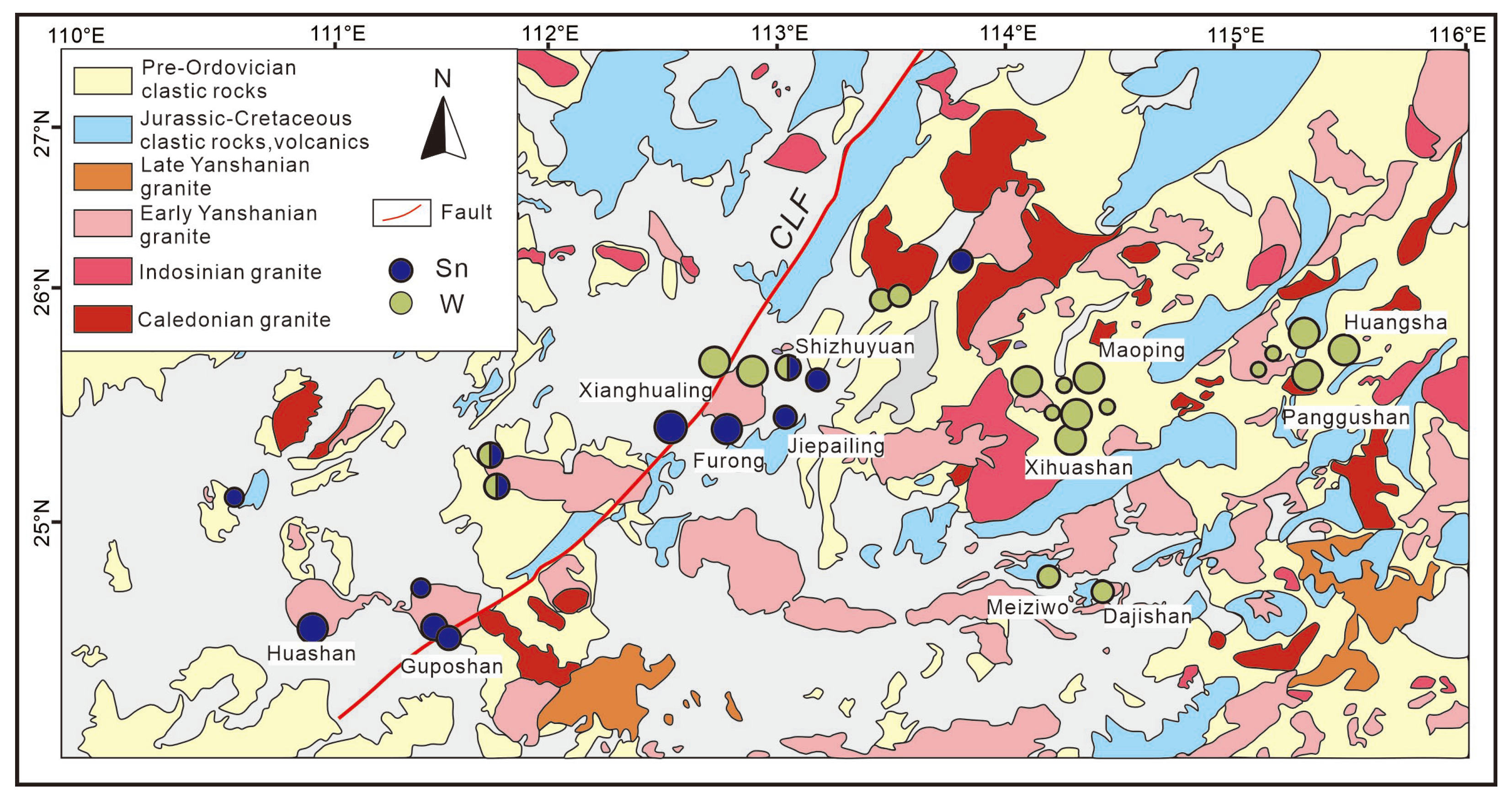
The eastern part of the study area is mainly located in the southern segment of the Cathaysia Block, with its primary geological setting belonging to the Nanling region. The Nanling region traverses the Yangtze Block, the Jiangnan Orogenic Belt, and the Cathaysia Block of the South China Block [49]. Its southern and northern boundaries are controlled by the Wuzhou–Sihui Buried Fault and the Chaling–Guangchang Buried Fault, respectively (Figure 3) [50,51]. As the world’s largest W-Sn-polymetallic metallogenic belt, the southern Cathaysia Block hosts famous W-Sn deposits such as the Shizhuyuan, Xihuashan, and Dachang deposits, serving as a typical representative of intracontinental mineralization associated with continental granites [52,53]. This region has experienced multi-stage magmatic activities including the Jinningian, Caledonian, Indosinian, and Yanshanian periods [54]. Under the alternating influence of north–south tectonic regimes, three granitic belts were formed, constituting a prominent feature of the Nanling region [55]. Since the Late Paleozoic, nearshore to shallow marine strata have undergone extensive folding and deformation, with intense reworking of the pre-Devonian structural layers developing nearly east–west trending folds accompanied by crustal thickening [56,57,58,59]. Early structural features were partially obscured by the superimposition of NNE-trending folds during the Yanshanian period, while the nearly east–west trending structures continued to control the emplacement of early Indosinian granitic bodies [60]. During the Middle to Late Triassic, the Indosinian collisional orogeny concluded. Late Triassic continental to paralic clastic rocks were deposited with an angular unconformity over the Middle Triassic peraluminous granites. This Middle–Late Triassic stratigraphic unconformity marks the regional transition from a compressional to an extensional tectonic regime [57]. Yang pointed out that the Triassic collision between the North China and Yangtze cratons reactivated crustal fissures, intensifying hydrothermal activity and middle crustal anatexis, which led to the formation of the Xuefengshan–Mufushan–Southern Anhui Huangshan granitic belt during the Yanshanian period [61]. Under the post-Indosinian post-orogenic extensional setting, the southern Cathaysia Block developed a series of post-collisional granites and associated high-temperature W-Sn polymetallic mineralization [62], indicating that this intracontinental orogeny provided the key dynamic conditions for metallogenesis [4]. It is noteworthy that the southern Cathaysia Block experienced a magmatic quiescent period between 205 and 180 Ma [63]. In the southwestern segment of Nanling region, which was structurally influenced by the superimposition of NW–WNW- and NE-trending folds, the fault system is predominantly NE/NEE-trending, cutting through Mesozoic strata [59]. Magmatic activity is frequent, with widespread outcrops of Caledonian, Indosinian, and Yanshanian intrusions. The Late Mesozoic (205–80 Ma) igneous rocks exhibit a complete range of types. Granitic rocks are distributed in three approximately east–west trending belts (the Qitianling–Jiufeng, Dadongshan–Guidong, and Fogang–Xinfengjiang belts), while mafic rocks, syenites, and bimodal volcanic rocks are sporadically developed [64,65,66,67]. During the Early Yanshanian period, magmatic activity was distributed along a SW–NE trend in inland regions, while in the Late Yanshanian period, it shifted to an NNE orientation and became concentrated in coastal areas [14,15]. Furthermore, the emergence of volcanic belts with low model ages during this period reflects the incorporation of juvenile mantle-derived materials into the magmatic sources [68], revealing the complexity of deep-seated material processes beneath the southern Cathaysia Block. The western part of this region exhibits distinctive regional metallogenic characteristics, dominated by W-Sn-REE deposits closely associated with multi-stage granitic intrusions [69]. This area primarily develops granite-hosted Nb-Ta deposits and greisen-type lithium mica deposits, whose spatial distribution is controlled by the NNE-trending Pingxiang–Jiangshan–Shaoxing Fault and shows close temporal and spatial association with W-Sn deposits [70]. Regarding metallogenic epochs, major mineralization events were concentrated during the Late Triassic (220–200 Ma), as exemplified by the niobium–tantalum–tin–tungsten deposits (~217 Ma) in the Limu ore field of Guangxi and the Gaoling tungsten–niobium–tantalum deposit (204 Ma) [71]. During the Yanshanian period (158–150 Ma), REE deposits such as the Zhengchong deposit in Daoxian County, Hunan province formed, accompanied by the widespread development of quartz-vein and skarn-type W deposits around 156 Ma, including the Anqiantan W deposit. From the perspective of regional metallogenic zoning, the western part of the southern Cathaysia Block is distinguished by large-scale Sn and REE mineralization, contrasting with its central part where both W and Sn are equally prominent, and the eastern part characterized by concentrated tungsten mineralization [72].

3. Methodology

3.1. Data Collection

The compiled dataset in this study primarily focuses on Mesozoic magmatic rocks from the southern part of the South China Block, encompassing the Cretaceous, Jurassic, and Triassic periods. The collected lithologies are dominantly intermediate to acidic granitic rocks. The ore-productive or barren rocks are defined, following previous workers, as the country rocks that host the mineralization (Supplementary Materials Tables S1 and S2). A total of 3239 isotopic data points from the South China Block were compiled, encompassing lithologies such as rhyolite, porphyritic granite, biotite granite, granodiorite porphyry, granodiorite, diorite, hornblende diorite, syenite, and dacite. To standardize spatial analysis, geographical coordinates as data points, the average age for each location was calculated to determine the corresponding εHf(t), εNd(t), and age distribution. The final validated datasets for mapping consisted of 130 data points for Hf isotopes and secondary model ages, and 76 data points for Nd isotopes and secondary model ages. Average-value maps of εHf(t), εNd(t), and secondary model ages were generated to elucidate the composition of magmatic sources and their correlation with different metallogenic districts. Contour mapping of εHf(t) and εNd(t) values, along with secondary model age distributions, were constructed to reveal the spatiotemporal evolution of magmatic material sources and their formation ages during the Mesozoic in southern South China. However, as the compiled dataset includes both ore-related and barren magmatic rocks; therefore, the isotopic maps primarily reflect first-order crustal architecture and lithospheric heterogeneity, rather than the compositions of ore-forming magmas sensu stricto.

3.2. Hf Isotopes

The Lu-Hf isotope system has rapidly developed as an important technique for geochronology and geochemical tracing [74]. In this system, zircon typically contains 1–2% Hf and exhibits very low Lu/Hf ratios (generally <0.002). As a result, the radiogenic 176Hf produced by the decay of 176Lu is negligible, meaning that the measured 176Hf/177Hf ratio effectively represents the Hf isotopic composition of the source region at the time of zircon crystallization [75,76]. Even if the U-Pb system of zircon has been disturbed by later events, its Hf isotopic system generally remains closed [77], thereby reliably preserving the characteristics of the primary crust from which the original rock was derived [78]. Leveraging this advantage, zircon Hf isotopes are widely used to trace the nature of magmatic sources and to calculate model ages. By analyzing the Hf isotopic composition of zircon in intermediate-acidic magmatic rocks, it is possible to effectively determine whether the magma originated from the remelting of ancient, mature crust or from the partial melting of juvenile crustal material [75]. Furthermore, the utilization of the two-stage Hf model age not only reveals the timing of crust-mantle differentiation but also, through comparison with the rock’s formation age, provides further constraints on the nature of its source region. This offers critical evidence for understanding crustal evolution and petrogenesis [79]. The calculation formula is as follows [75,80]:
εHf(t) = {[(176Hf/177Hf)s − (176Lu/177Hf)s(eλt − 1)]/(176Hf/177Hf)CHUR,0 − (176Lu/177Hf)CHUR(eλt − 1)] − 1} × 10,000
TDM1 = 1/λln{1 + [(176Hf/177Hf)s − (176Hf/177Hf)DM]/(176Lu/177Hf)s − (176Lu/177Hf)DM}
TDM2 = TDM1 − (TDM1 − t)(fCCfS)/(fCCfDM)
fLu/Hf = (176Lu/177Hf)s/(176Lu/177Hf)CHUR − 1
t = crystallization age of zircon, λ = 1.867 × 10⁻¹¹/year [81], (176Hf/177Hf)s and (176Lu/177Hf)s represents the normalized sample data; (176Lu/177Hf)CHUR = 0.0332; (176Hf/177Hf)CHUR,0 = 0.282772 [82]; (176Lu/177Hf)DM = 0.0384; (176Hf/177Hf)DM = 0.28325 [83]; fCC = [(176Lu/177Hf)Crust/(176Lu/177Hf)CHUR)] − 1, (176Lu/177Hf)Crust = 0.015; fS = fLu/Hf; fDM = [(176Lu/177Hf)DM/(176Lu/177Hf)CHUR] − 1.

3.3. Nd Isotopes

The values of εNd(t) and Nd two-stage depleted mantle model age are tools for distinguishing the possible sources of magma and the formation age of crustal source rocks separately [84]. Previously published Nd isotopic data were used to evaluate the crustal evolution in this region over time based on existing zircon U-Pb ages or other isotopic ages [85]. To produce a data set, a consistent method was used to recalculate the data [86]. The specific calculation methods and parameters are as follows [87,88]:
εNd(t) = [(143Nd/144Nd)i/(143Nd/144Nd)CHUR − 1] × 10,000
(143Nd/144Nd)i = (143Nd/144Nd) − (147Sm/144Nd)(eλt − 1)
fSm/Nd = (147Sm/144Nd)/(147Sm/144Nd)CHUR − 1
TDM1 = 1/λln{1 + [(143Nd/144Nd) − 0.51315]/(147Sm/144Nd) − 0.2137}
TDM2 = TDM1 − (TDM1 − t)(fCCfS)/(fCCfDM)
where λ = 6.54 × 10⁻¹², (143Nd/144Nd)CHUR = 0.512638, (147Sm/144Nd)CHUR = 0.1967, fCC = − 0.4 and fDM = 0.08592.

3.4. Mapping Methodology

The integration of Hf and Nd isotopic mapping overcomes the limitations and uncertainties associated with studies relying on single elements [89]. Their combined application provides a more robust approach for identifying lithospheric tectonic domains, prospective metallogenic geological units, or favorable metallogenic settings. These include continental margins—particularly those in accretionary tectonic regimes—as well as crustal-scale faults or suture zones that constrain mineralization location [90]. Furthermore, this methodology can be applied to the study of metallogenic systems, helping to delineate potential orogenic belts and associated orogen-related mineralization [91].
Hf-Nd isotopic mapping was conducted using Surfer 15 software with the Kriging interpolation method. Since a single magmatic rock sample may contain multiple zircon Hf isotope analytical points, significant variations in Hf isotopes could arise from human factors or the presence of inherited zircon data [92]. Therefore, during actual data processing, it is necessary to exclude outliers to accurately invert magmatic evolution and source attributes, thereby avoiding significant deviations from geological facts. All the zircons we selected are synmagmatic zircons of the same period from the published literature. At the same time, clearly anomalous data points were carefully removed (e.g., the 1544 Ma zircon age reported by Jiang from the Dabaoshan intrusion, which is likely an inherited zircon; its εHf(t) value was not included in the averaging) to avoid bias in the overall interpretation [93]. Subsequently, the average zircon Hf isotope value was calculated for each location. These averaged values fall within the normal range of zircon Hf parameters, demonstrating representativeness and authenticity, and effectively reflect the data characteristics of the samples. In the data processing stage, anomalously high or low values (e.g., inherited zircon data) were removed, thus only coeval magmatic zircons were kept for further analysis. During the Surfer mapping process, if a region contains extremely high or low zircon εHf(t) values, it would severely affect adjacent areas without data control, consequently impacting final interpretations. It should be noted that in the southwestern part of the Youjiang basin, due to the limited number of sample points, the contours show a smooth outward spread, which results from interpolation by the software based on the available data and reflects the current constraints in this region. Finally, the maps generated by Surfer 15 were refined and enhanced using CorelDRAW 2024, with relevant geological content added [94]. This approach macroscopically reveals the spatial distribution characteristics of crustal properties in the southern part of the South China Block.

4. Results

4.1. Age Distribution

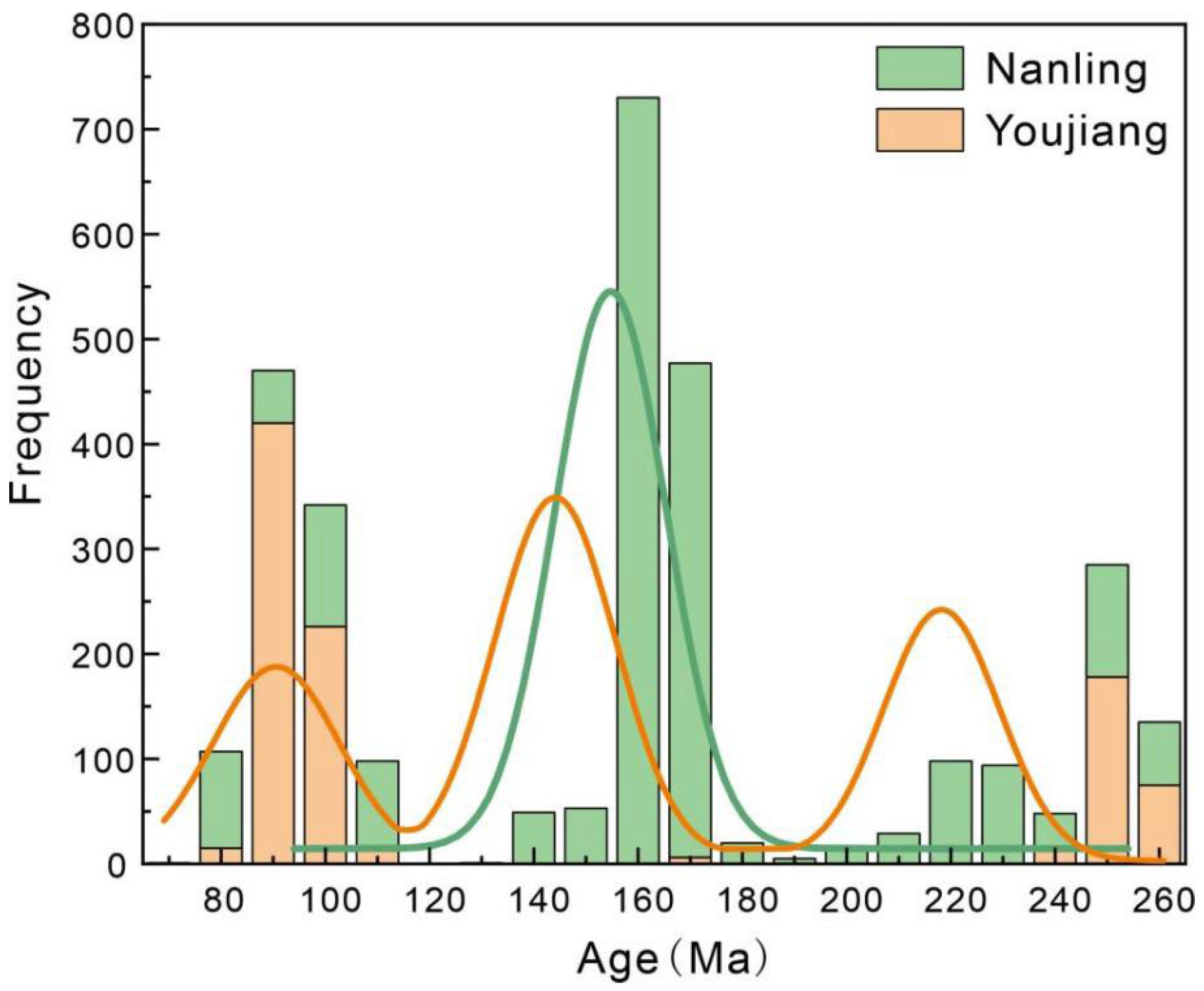
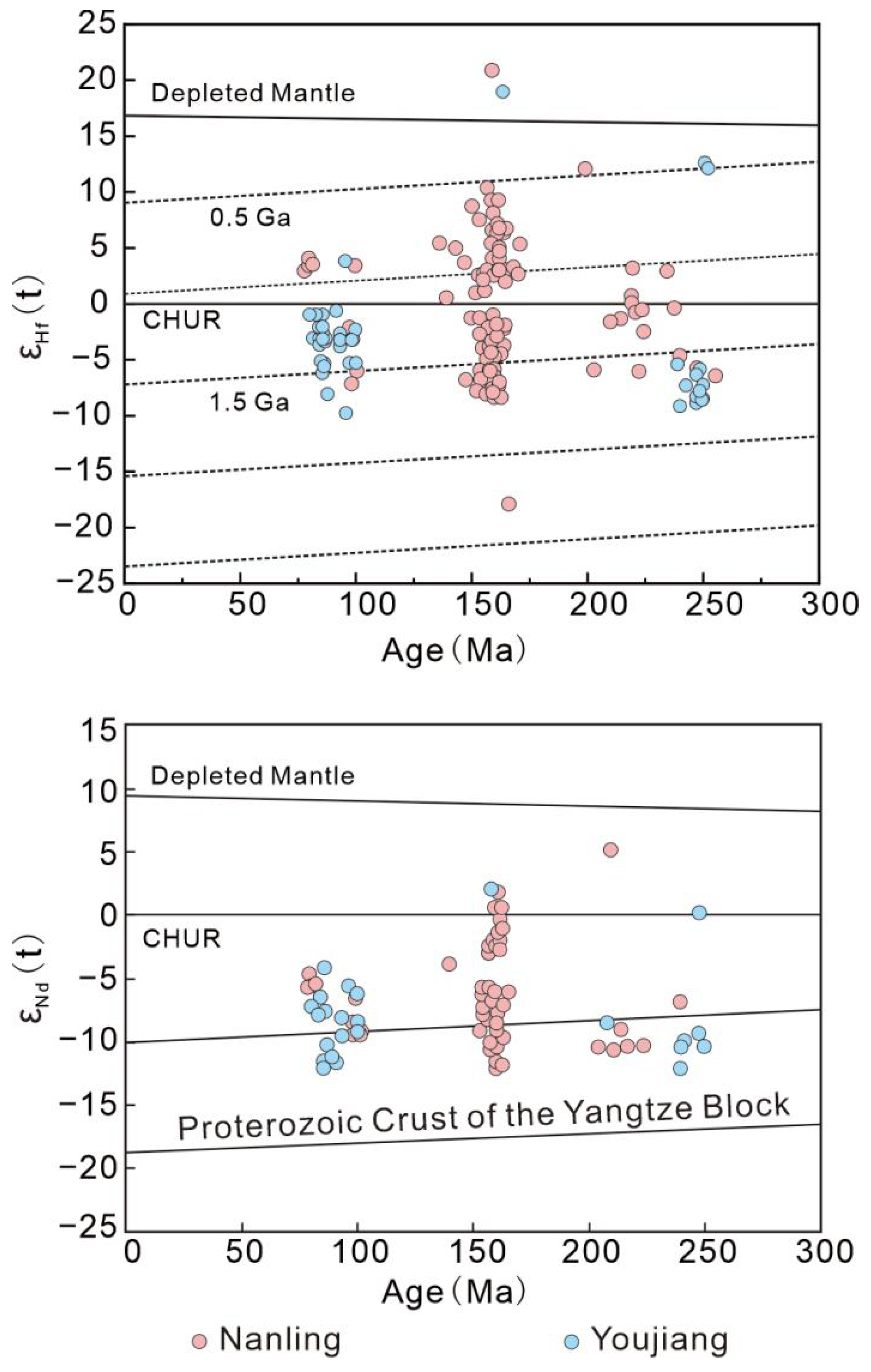
The age data of magmatic rocks collected in this study are concentrated from 69 to 252 Ma, covering the complete Triassic, Jurassic, and Cretaceous periods (Figure 4; Table S1 in Supplementary Materials). This demonstrates the continuity and completeness of the sample age distribution. A total of 3239 zircon U-Pb ages were obtained. These ages are primarily distributed across three geological periods: 755 samples yield Triassic ages, 1294 samples correspond to the Jurassic, and 1190 samples are attributed to the Cretaceous. Notably, the Jurassic represents the largest population, followed by the Cretaceous and then the Triassic. In terms of age concentration characteristics, the whole South China Block was characterized by intense magmatic activity during the Mesozoic. The southern Cathaysia Block was mainly concentrated in the Jurassic, while the Youjiang (southern Yangtze Block) was mainly concentrated in the Cretaceous and Triassic. Previous studies have demonstrated that the mineralization ages of W-Sn deposits in the Youjiang basin are predominantly concentrated in the Cretaceous [95], while Au mineralization ages date back to the Triassic [8,96]. The peak mineralization age in the southern Cathaysia Block occurred during the Jurassic [73]. The mineralization ages in both regions correspond respectively to their magmatic formation ages. The age distribution in the southern region of the South China Block suggests that this period may represent a key concentration phase for magmatic activity, tectonic movements, or mineral crystallization in the region. This provides important age constraints for further elucidating the timing and intensity of geological events in the southern part of the South China Block during the Mesozoic.

4.2. Hf Isotopic Data Base

The Hf isotopic composition in the southern region of the South China Block is heterogeneous, reflecting variations in the properties of deep crustal materials. The εHf(t) values in the study transect range from −19.3 to +11.6, with corresponding TDM2 (Ma) results of 464–2419 Ma (Table S1 in Supplementary Materials). The southeastern part within the Youjiang basin, near the Youjiang Fault, exhibits εHf values ranging from −10.6 to −4.0, with secondary model ages (TDM2) between 1600 and 1933 Ma. In the southwestern section, the Honghe Fault (εHf (t) = −4 to +5.8) and northeast of the area of the Ziyun–Luodian Fault (εHf(t) = −4 to +10.6) show TDM2 ranging from 536 to 1430 Ma. In contrast to the southern Yangtze Block, the southern of Cathaysia Block displays relatively higher εHf(t) values, ranging from −19.3 to +11.6, with corresponding TDM2 generally between 464 and 2419 Ma. In the southern of Cathaysia Block, along the Chenzhou–Linwu Fault (εHf (t) = −4 to +4.7), TDM2 range from 938 to 1409 Ma. The western part of Nanling region exhibits εHf values from −11.8 to −7.5, with TDM2 between 1630 and 2015 Ma.

4.3. Nd Isotopic Data Base

The εNd(t) values range from −12.2 to +5.0, with corresponding two-stage depleted mantle model age of 580–2008 Ma (Table S2 in Supplementary Materials). Nd isotopic data and two-stage depleted mantle model age (TDM2) indicate that the southern part of southern Yangtze Block exhibits lower εNd values, ranging from −12.2 to +0.2, and correspondingly older TDM2 of 930–2008 Ma. In the southwestern part of the Honghe Fault (εNd(t) = −4 to +0.1) and the northeastern part of the Ziyun–Luodian Fault, the εNd(t) value are from −4 to +2.0 and TDM2 range from 786 to 1444 Ma. Within the interior of the southern Yangtze Block the εNd(t) are from −12.2 to −4 and secondary model ages are between 1476 and 2008 Ma in the southern of the Youjiang Fault. However, the southern Cathaysia Block shows εNd values ranging from −12.1 to +5.0, with corresponding and relatively TDM2 of 580–1930 Ma. Along the Chenzhou–Lindian Fault, the εNd(t) are from −4 to +1.9 and TDM2 vary from 793 to 1465 Ma in the central part. However, in the western part, εNd values range from −6.6 to +0.3, with corresponding TDM2 of 929–1438 Ma.

5. Discussion

5.1. Characteristics of Mesozoic Magmatic Activity

The southern Cathaysia Block is dominated by strongly peraluminous S-type granites at the Triassic–Jurassic transition (240–205 Ma), formed in a post-Indosinian collisional extensional setting [97]. During the Early–Middle Jurassic (185–150 Ma), the magmatic suite shifted to bimodal volcanic rocks and A-type granites, recording intense lithospheric thinning and asthenospheric upwelling triggered by the westward subduction of the Paleo-Pacific Plate [98]. Large-scale emplacement of high-K calc-alkaline granites and mafic dykes during the Cretaceous (140–65 Ma) marked the peak of back-arc extension driven by progressive slab rollback. Throughout the Cretaceous, extensional basins and dome structures were extensively developed across the South China Block, accompanied by large-scale magmatic intrusion and eruption, consistent with an extensional tectonic regime induced by Paleo-Pacific subduction [99,100]. The inland-to-coastal migration of A-type granites and volcanic rocks between 137 and 136 Ma and 96 Ma brackets two pulses of peak extension that align precisely with two-stage slab rollback of the Paleo-Pacific Plate [101]. Correspondingly, several episodes of highly fractionated granites supplied sustained heat and ore-forming materials for W-Sn-Nb-Ta and U mineralization, with ore-forming ages clustering at 160–150 Ma and 130–90 Ma [102].
The southern Yangtze Block underwent a compression-to-extension transition during the Triassic–Jurassic. Magmatism during this period was generally weak, limited to local mafic dyke swarms (~200 Ma) and alkaline basaltic volcanics (~175 Ma) [103]. Cretaceous (130–80 Ma) lithospheric delamination triggered asthenospheric upwelling, producing voluminous felsic dykes (rhyolite porphyry, granite porphyry) and minor mafic dykes (lamprophyre, diabase) in a bimodal assemblage [104]. Zircon Hf isotopic compositions of most magmatic rocks in the southern Yangtze Block predominantly plot along the 1.0–2.0 Ga evolutionary lines (Figure 5), indicating that their deep crustal sources were dominated by Proterozoic basement. During the late Mesozoic, especially from the Jurassic to Cretaceous, southern South China Block experienced notable extensional tectonics and extensive magmatism [105]. This tectonic-magmatic episode was closely linked to the subduction of the Paleo-Pacific Plate. In response to this dynamic setting, the southern Yangtze Block exhibited characteristics of crustal thinning and intensive magmatic emplacement [35]. Metallogenesis in the basin is characterized by orogenic Au and low-temperature Sb-Hg-As assemblages, with ore fluids sourced mainly from basinal formation waters and metamorphic dehydration [33,106]. Cretaceous magmatism drove large-scale fluid circulation, forming Carlin-type Au and Sb-Hg deposits [107].

5.2. Crustal Architecture and Evolution

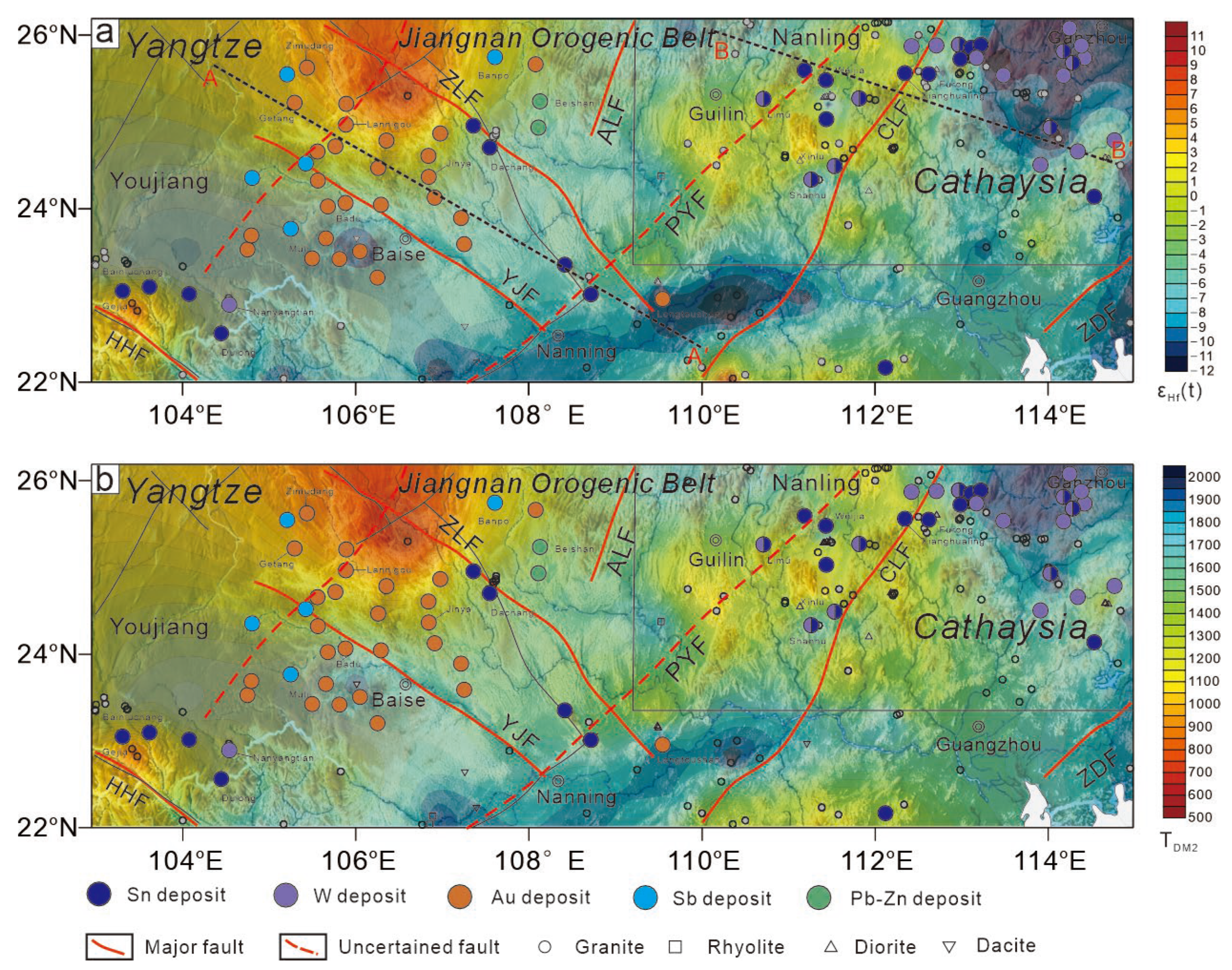
Hf isotopic mapping has been extensively utilized to delineate the architecture of continental lithosphere [80,108]. Our Hf isotopic mapping reveals highly negative εHf(t) values (<−5) within the southern part of southern Yangtze Block (Figure 6a) and TDM2 mapping shows ancient crustal residence ages (>1500 Ma) (Figure 6b). This indicates magmas were primarily formed by the remelting of the ancient lower crust following the Indosinian intracontinental collision. During the Early to Middle Triassic, the southern Yangtze Block experienced intracontinental orogeny in a subduction-related foreland basin setting, characterized by compressional deformation and fold-thrust belt development [104]. During the Early Cretaceous, lithospheric delamination likely occurred beneath the southern Yangtze Block at the southwestern margin of the Yangtze Craton [36]. This process involved the detachment and sinking of dense mafic lower crust and lithospheric mantle into the asthenosphere. Such delamination triggered asthenospheric upwelling, leading to crustal underplating and partial melting of crustal materials, which ultimately drove large-scale magmatic activity, forming numerous intrusive rock bodies associated with Au-polymetallic mineralization [109,110]. The peak metallogenic ages in the Youjiang region are primarily concentrated in the Cretaceous and Triassic periods (Figure 4; Table S3 in Supplementary Materials).
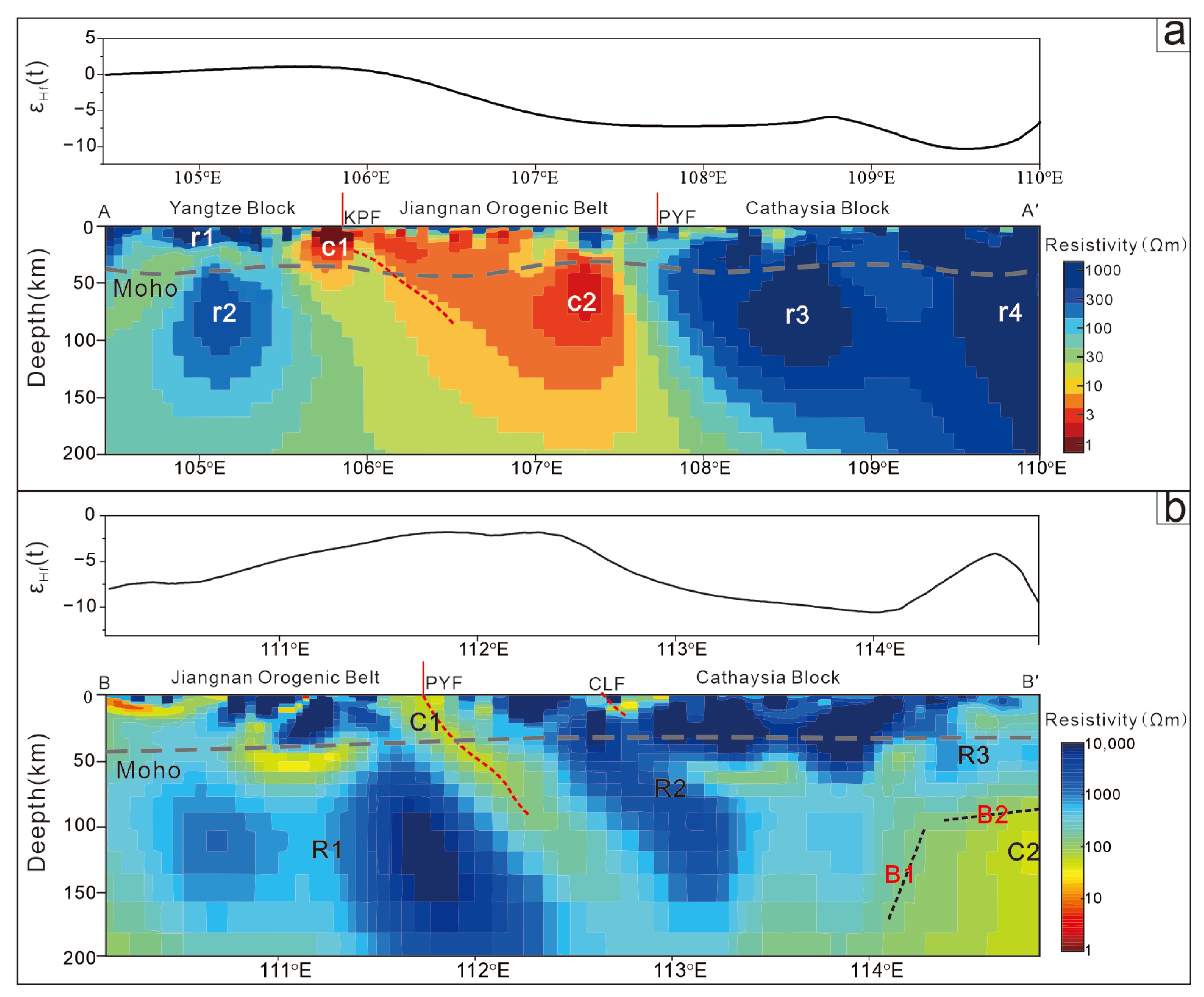
Geophysical studies also suggest that magmatic activity in the southern Yangtze Block was likely associated with mantle upwelling and crust-mantle interaction [36]. The fault structures are generally characterized by low resistivity or boundaries between high and low resistivity, typically resulting from water-bearing fracture zones or the upwelling of deep-seated materials [111,112]. For example, a southeast-dipping high-low resistivity boundary between the Jiangnan Orogen and the Yangtze Block corresponds to the Kaiyuan–Pingtang Fault (Figure 7a). In Figure 7b, location C1 exhibits low resistivity, correlating with the Pingxiang-Chaling Fault. These fault zones show good spatial correlation with relatively high εHf(t) values, suggesting upwelling of mantle-derived magmas. Mesozoic tectonic extension activated a series of deep-crustal fault zones (e.g., the Youjiang Fault), which served as favorable conduits for magma ascent from the lower crust. The northeastern segments of the Honghe and Ziyun–Luodian faults along the margin of the southern Yangtze Block are characterized by positive εHf(t) values (Figure 6a) and younger TDM2 model ages of 600–900 Ma (Figure 6b), indicating a dominantly juvenile component source.
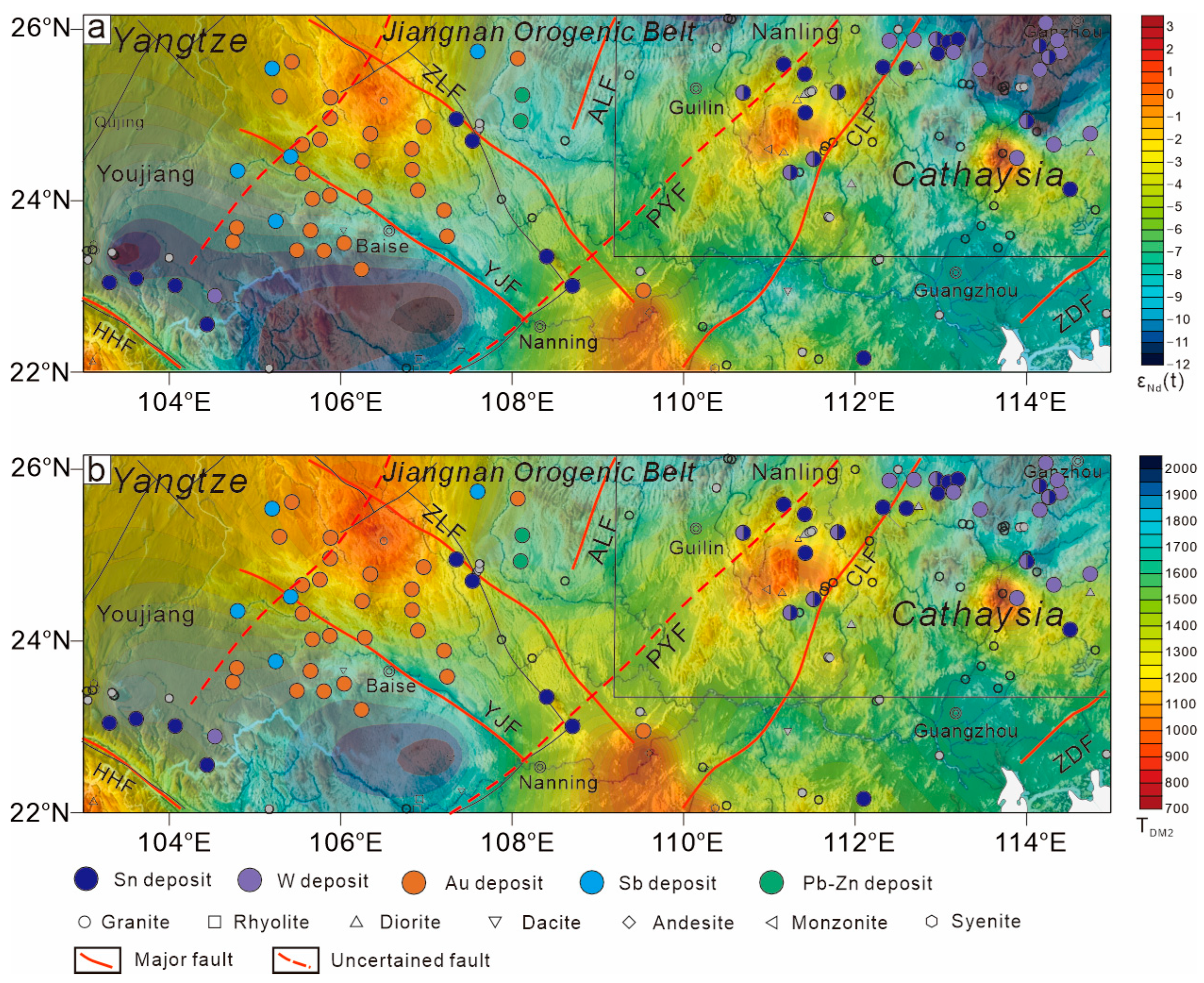
In the southern Cathaysia Block, the zone with highly negative εHf(t) area corresponds to the high-resistivity zone (R2-R3) in the magnetotelluric profile model (Figure 6a; Figure 7b). This high-resistivity zone is interpreted as stable Precambrian lithosphere of the Cathaysia Block [112], indicating contributions from ancient crust. Isotopic mapping of the westhern Nanling region is dominated by positive εNd(t) values (Figure 8a), reflecting input of depleted mantle-derived components to the magmatic system. A prevalence of relatively young crustal model ages (Figure 8b) further attest to intense juvenile crustal growth during the Mesozoic. Mantle-derived mafic magmas provided essential material and thermal inputs for granitic magma formation. Extensive W-Sn mineralization in the southern Cathaysia Block during the Indosinian (Triassic) is genetically linked to contemporaneous granitic intrusions [90].
The Mg# value, defined as 100 × Mg/(Mg + Fe) (molar ratio),Fe2+ estimated as 80% of total Fe [108], is a key igneous geochemical parameter reflecting magmatic evolution and source characteristics [113]. High Mg# values generally indicate mantle-derived magmas with limited differentiation, whereas low Mg# values suggest prolonged crystallization differentiation or crustal contamination [114]. Mafic rocks typically exhibit high Mg# values and Hf–Nd isotopic compositions similar to those of the mantle. However, a decrease in Mg# values coupled with Hf–Nd isotopes trending toward crustal endmembers may indicate crustal contamination or extensive magmatic differentiation [115]. The calculated average Mg# of the mafic xenoliths from the Huziyan locality on the western side of the southern Cathaysia Block is 79.11, indicating the addition of mantle materials that promoted melting of ancient crust [116]. During the Late Mesozoic (180 Ma), the South China Block experienced preferential lithospheric delamination and crustal reworking under extensional conditions in the southern Cathaysia Block [9,117]. This was followed by extensive crustal melting along the eastern Yangtze Block between 150 Ma and 120 Ma [118], coinciding with a prominent peak in the metallogenic age of southern Cathaysia Block (Figure 4).

5.3. Deep-Seated Processes-Derived Mesozoic Differential Metallogeny

The evolution of crustal properties in the South China Block during the Mesozoic was closely linked to deep dynamic processes, with numerous metal deposits forming in response to crust-mantle interactions [119,120,121]. Intracontinental deep magmatism and fluid circulation, induced by lithospheric delamination, thinning, and asthenospheric upwelling in the South China Block, generated the large-scale mineralization event. This event formed both high-temperature W-Sn and low-temperature Au-Sb deposits [4].
In the southern Yangtze Block, high εHf(t) value areas are mainly concentrated along the Honghe Fault (εHf(t) = −4 to +5.8) and the northeastern part of the Ziyun–Luodian Fault (εHf(t) = −4 to +10.6), with TDM2 ranging from 536 to 1430 Ma. Low εHf(t) value areas are mainly distributed within the southern part of Youjiang basin (corresponding to the Youjiang Fault), with εHf(t) = −10.6 to −4 and two-stage model ages of 1600–1933 Ma. The Carlin-type Au deposits in the basin are located in regions with relatively high εHf(t)-εNd(t) isotopic values (Figure 6a; Figure 8a), suggesting ore-forming materials derived from reworked crust with a significant contribution of mantle. Ore-related rocks yield εHf(t) values ranging from −4.5 to −6.1 [122,123], whereas barren rocks of similar ages show lower εHf(t) of −7.6 to −7.8 [124]. This suggests that a higher proportion of depleted mantle component in the reworked crust is favorable for Au mineralization. Isotopic studies of ore-forming fluids in the Au deposits of the southern Yangtze Block indicate a close genetic link between the fluids and deep magmatic sources [125]. Gold-transporting fluids were derived from hydrothermal solutions differentiated from deep concealed magmatic intrusions, which are significantly enriched in Au, S, As, Sb, Tl, and Hg but relatively depleted in Fe [126]. Structure exerts a prominent control over Carlin-type Au deposits in the Youjiang basin. Deep-crustal faults provide essential pathways for the upward migration of magmatic-hydrothermal fluids from depth. At the ore belt scale, major to giant gold deposits are predominantly distributed along principal fold belts [127,128,129]. The controlling role of faults on gold mineralization is particularly evident. Although the host rocks vary among different deposits, nearly all orebodies are strictly constrained by fault structures. At the Shuiyindong Au deposit, orebodies are primarily controlled by the unconformity between the Permian Maokou and Longtan Formations. The orebodies occurring within this interformational structure are nearly horizontal. Based on variations in the stratigraphic position and geological characteristics of the faults, it can be concluded that fault structures have provided effective channels for the migration of ore-forming fluids [122]. Simultaneously, during tectonic movement, a series of extensional faults were generated, serving as favorable ore-hosting spaces for the accumulation of ore-forming materials.
In the southern Cathaysia Block, the high-value area is distributed along the Chenzhou–Linwu Fault (εHf(t) = −4 to +4.7), with TDM2 ranging from 938 to 1409 Ma. Based on isotopic mapping results, Sn deposits in the Nanling region are relatively concentrated in zones characterized by transitional εHf(t) values, indicating that the parental magmas of the related intrusive rocks exhibit juvenile lower crustal affinity. In contrast, W deposits are predominantly distributed around ancient crustal blocks. Integrated analysis indicates that the W-Sn mineralized intrusions in the Nanling region are predominantly composed of highly fractionated granitic rocks (Table S4 in Supplementary Materials). However, the giant tungsten deposits at Dajishan, Xihuashan and Yaogangxian are hosted by F-rich, peraluminous A-type or highly fractionated S-type granites that are characterized by high SiO2 (>74 wt%), >1 wt% F and low MgO-CaO contents; mineralization occurs dominantly as quartz-vein and greisen types [130]. The Guposhan, Xianghualing and Qitianling Sn-polymetallic deposits are genetically linked to highly evolved cassiterite-sulfide-type fractionated granites that commonly carry Li-Nb-Ta mineralization [130]. Zircon Hf isotopic values (εHf(t)) from the eastern part of the Nanlin terrane are generally lower than those from the west, suggesting systematic spatial variations in source characteristics or magmatic evolution processes. The granitic rocks in the southern Cathaysia Block exhibit consistently negative εHf(t) values, high TDM2 ages, and relatively low εNd values, indicating that their magmas were derived primarily from partial melting of middle to lower crustal materials [131,132]. Ore-bearing rocks (W-Sn related) have εHf(t) values of −2.3 to +2.3 [133,134,135], while contemporaneous barren rocks display significantly more negative εHf(t) of −7.5 [136]. This implies that juvenile lower crust or mantle-derived inputs enhance W-Sn fertility. The 3He/4He ratios of fluid inclusions in pyrite and arsenopyrite from the Xihuashan quartz-vein W deposit, which reflect a mantle-derived signature, suggesting that the mineralizing fluids were not products of purely crustal melting [137]. The Xinlu and Shanhu W-Sn deposits are predominantly distributed in high εHf(t) value zones or along high-low value transition areas (Figure 6a), displaying characteristics of both juvenile crust and crustal reworking. This suggests that W-Sn enrichment may be related to Mesozoic lithospheric weakness and multi-stage crustal reworking, with mantle-derived magmas making contributions to W-Sn mineralization. Crustal recycling and partial melting were key processes for W-Sn mineralization in the southern Cathaysia Block.
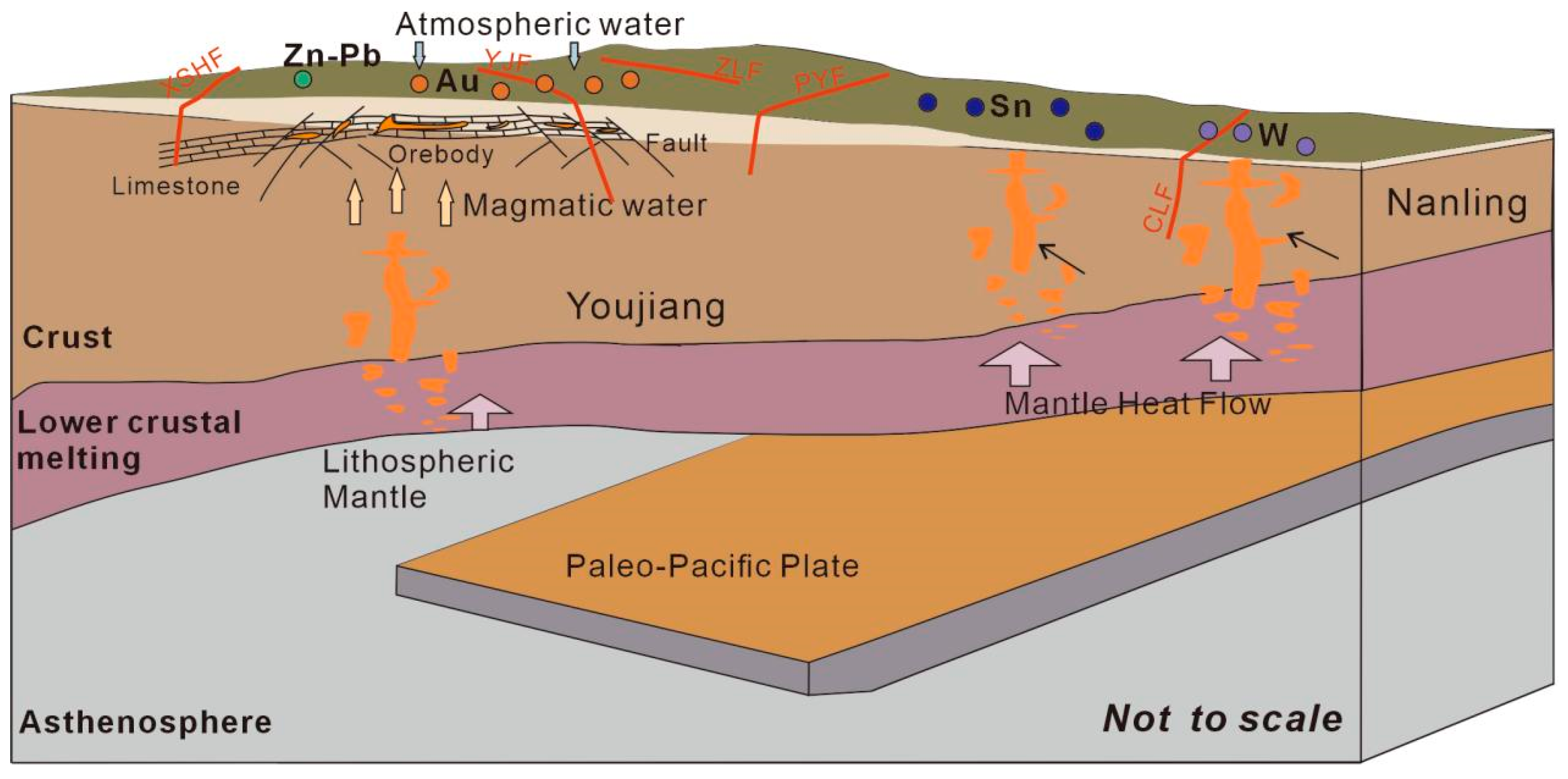
Figure 9 shows a cartoon model for deep-seated process controlling the Mesozoic differential metallogeny between the southern Cathaysia Block (W-Sn) and the southern Yangtze Block (Au-Sb). The Paleo-Pacific Plate underwent westward subduction during Triassic, which was subsequently followed by southward oblique subduction and coeval crustal extension during 150–123 Ma. Under such tectonic evolution, the Indosinian intracontinental orogeny and Yanshanian asthenospheric upwelling triggered the development of diverse metallic mineral deposits. The formation of these distinct deposit types was predominantly governed by variable tectonic regimes and heterogeneous partial melting sources. The lower crust modified by mantle-derived materials was the base of Carlin-type Au deposits, and the melting of old crust or upper crust contributed to W-Sn deposits and Pb-Zn deposits controlled (Figure 9).

6. Conclusions

(1)
Hf-Nd isotopic mapping of the southern region of the South China Block shows heterogeneous distribution patterns, with most areas displaying negative values. Relatively high εHf(t) and εNd(t) values, along with younger two-stage model ages, are observed in the northeastern parts of the Youjiang basin, as well as in the central Nanling region.
(2)
Reworked crustal domains exhibitS a spatial and genetic association with the formation of high-temperature hydrothermal deposits (e.g., W-Sn), where mineralization intensity statistically correlates with the degree of crustal reworking. Low-temperature Au-Sb deposits in the Youjiang basin are spatially distributed in areas characterized by elevated εHf(t)-εNd(t) isotopic signatures, suggesting a source dominated by reworked crust with significant mantle contributions
(3)
Metal deposits in the southern region of the South China Block are primarily distributed within the regenerated crust, likely linked to intense magmatic activity that enriched ore-forming elements. Most magmatic rock-associated deposit types tend to cluster at the boundaries of isotope anomalies. Mantle-crust deep-seated process controls the Mesozoic differential metallogeny between the southern Cathaysia Block (W-Sn) and the southern Yangtze Block (Au-Sb).

Supplementary Materials

The following supporting information can be downloaded at: https://www.mdpi.com/article/10.3390/geosciences16060230/s1, Table S1: Summary of Hf isotopic data of zircons in the Nanling region and Youjiang basin; Table S2: Summary of Whole-rock Nd data in the Nanling region and Youjiang basin; Table S3: Summary of Metallogenic Ages for the Mesozoic, Youjiang basin; Table S4: Summary of Mesozoic W-Sn Mineralization in the Nanling region.

Author Contributions

Conceptualization, B.X., M.Y. and Y.Y.; Methodology, B.X., M.Y., Z.M., J.W. and Z.W.; Investigation, Y.Y., T.J., P.C., W.S. and S.F.; Resources, B.X. and M.Y.; Data curation, Y.Y., T.J., P.C., W.S. and S.F.; Writing—original draft, Y.Y.; Writing—review&editing, Y.Y., M.Y. and M.A.; Supervision, M.Y.; Project administration, B.X.; Funding acquisition, B.X. and M.Y. All authors have read and agreed to the published version of the manuscript.

Funding

This research was funded by the National Science and Technology Major Project of the Ministry of Science and Technology of China (2024ZD1000100); National Science and Technology Major Project of the Ministry of Science and Technology of China (2025ZD1004706); National Key Research and Development Project of China (2023YFF0804200); National Science Foundation of China (NSFC) (42302035); Fundamental Research Funds for the Central Universities (2-9-2023-018).

Data Availability Statement

Data are contained within the Supplementary Materials.

Conflicts of Interest

The authors declare no conflicts of interest.

References

  1. Shu, L.S.; Yao, J.L.; Wang, B.; Faure, M.; Charvet, J.; Chen, Y. Neoproterozoic plate tectonic process and Phanerozoic geodynamic evolution of the South China Block. Earth-Sci. Rev. 2021, 216, 103596. [Google Scholar] [CrossRef] [Scilit]
  2. Wang, Y.J.; Fan, W.M.; Zhang, G.W.; Zhang, Y.H. Phanerozoic tectonics of the South China Block: Key observations and controversies. Gondwana Res. 2013, 23, 1273–1305. [Google Scholar] [CrossRef] [Scilit]
  3. Li, Z.X.; Li, X.H. Formation of the 1300-km-wide intracontinental orogen and postorogenic magmatic province in Mesozoic South China: A flat-slab subduction model. Geology 2007, 35, 179–182. [Google Scholar] [CrossRef] [Scilit]
  4. Hu, R.Z.; Gao, W.; Fu, S.L.; Su, W.C.; Peng, J.T.; Bi, X.W. Mesozoic intraplate metallogenesis in South China. Earth Sci. Front. 2024, 31, 226. [Google Scholar]
  5. Zhao, G.; Cawood, P.A. Precambrian geology of China. Precambrian Res. 2012, 222, 13–54. [Google Scholar] [CrossRef] [Scilit]
  6. Cheng, Y.S. Characteristics of granites and their relationship to mineralization, Dachang ore-field, Guangxi, China. Procedia Earth Planet. Sci. 2011, 2, 70–75. [Google Scholar] [CrossRef] [Scilit]
  7. Hu, R.Z.; Zhou, M.F. Multiple Mesozoic mineralization events in South China—An introduction to the thematic issue. Miner. Depos. 2012, 47, 579–588. [Google Scholar] [CrossRef] [Scilit]
  8. Hu, R.Z.; Fu, S.L.; Huang, Y.; Zhou, M.F.; Fu, S.H.; Zhao, C.H.; Xiao, Y.J. The giant South China Mesozoic low-temperature metallogenic domain: Reviews and a new geodynamic model. J. Asian Earth Sci. 2017, 137, 9–34. [Google Scholar] [CrossRef] [Scilit]
  9. Li, C.; Wang, Z.; Lü, Q.; Tan, Y.; Li, L.; Tao, T. Mesozoic tectonic evolution of the eastern South China Block: A review on the synthesis of the regional deformation and magmatism. Ore Geol. Rev. 2021, 131, 104028. [Google Scholar] [CrossRef] [Scilit]
  10. Feng, Z.T.; Chu, Y.; Wei, W.; Lin, W.; Xin, G.Y.; Wang, Y.; Qiu, H.B.; Ren, Z.H. Splitting a large pluton by Cretaceous crustal extension: Evolution of the Ziyuan detachment and crustal thinning of the South China Block. Tectonophysics 2022, 838, 229481. [Google Scholar] [CrossRef] [Scilit]
  11. Zhou, W.; Huang, D.; Yu, Z.; Santosh, M.; Cao, Y.; Zhang, J.; Liu, L.; Cui, J.; Li, J. Detrital zircon records of the Banxi Group in the western Jiangnan Orogen: Implications for crustal evolution of the South China Craton. Acta Geol. Sin.-Eng. Ed. 2023, 97, 35–54. [Google Scholar] [CrossRef] [Scilit]
  12. Dong, Y.P.; Hui, B.; Sun, S.S.; He, D.F.; Sun, J.P.; Zhang, F.F.; Cheng, C.; Yang, Z.; Zeng, R.T.; Long, X.P.; et al. Neoproterozoic tectonic evolution and proto-basin of the Yangtze Block, China. Earth-Sci. Rev. 2024, 249, 104669. [Google Scholar] [CrossRef] [Scilit]
  13. Charvet, J. The Neoproterozoic–early Paleozoic tectonic evolution of the South China Block: An overview. J. Asian Earth Sci. 2013, 74, 198–209. [Google Scholar] [CrossRef] [Scilit]
  14. Zhou, X.M.; Li, W.X. Origin of Late Mesozoic igneous rocks in Southeastern China: Implications for lithosphere subduction and underplating of mafic magmas. Tectonophysics 2000, 326, 269–287. [Google Scholar] [CrossRef] [Scilit]
  15. Zhou, X.M.; Sun, T.; Shen, W.Z.; Shu, L.S.; Niu, Y.L. Petrogenesis of Mesozoic granitoids and volcanic rocks in South China: A response to tectonic evolution. Episodes 2006, 29, 26–33. [Google Scholar] [CrossRef] [Scilit]
  16. Wang, F.Y.; Ling, M.X.; Ding, X.; Hu, Y.H.; Zhou, J.B.; Yang, X.Y.; Liang, H.Y.; Fan, W.M.; Sun, W.D. Mesozoic large magmatic events and mineralization in SE China: Oblique subduction of the Pacific plate. Int. Geol. Rev. 2011, 53, 704–726. [Google Scholar] [CrossRef] [Scilit]
  17. Zhou, J.; Jin, C.; Suo, Y.H.; Li, S.Z.; Zhang, L.; Liu, Y.M.; Wang, G.Z.; Wang, P.C.; Dai, L.M.; Santosh, M. The Yanshanian (Mesozoic) metallogenesis in China linked to crust-mantle interaction in the western Pacific margin: An overview from the Zhejiang Province. Gondwana Res. 2022, 102, 95–132. [Google Scholar] [CrossRef] [Scilit]
  18. Zeng, Y.S.; Wang, Q.F.; Groves, D.I.; Santosh, M.; Wang, Y.N.; Wang, T.Y.; Yang, L.; Chen, W.; Deng, J. Prolonged Mesozoic intracontinental gold mineralization in the South China Block controlled by lithosphere architecture and evolving Paleo-Pacific Plate subduction. Earth-Sci. Rev. 2023, 240, 104387. [Google Scholar] [CrossRef] [Scilit]
  19. Chen, Y.C.; Wang, D.H.; Xu, Z.G.; Huang, F. Outline of regional metallogeny of ore deposits associated with the Mesozoic magmatism in South China. Geotecton. Metallog. 2014, 38, 219–229. [Google Scholar]
  20. Mao, J.W.; Li, H.Y.; Wang, D.H.; Peng, C. Ore forming of Mesozoic polymetallic deposits in South China and its relationship with mantle plume. Bull. Mineral. Petrol. Geochem. 1998, 17, 130–132. [Google Scholar]
  21. Mao, J.W. Mesozoic large scale mineralization and multiple lithospheric extension in South China. Earth Sci. Front. 2004, 11, 45–55. [Google Scholar]
  22. Hua, R.M.; Chen, P.R.; Zhang, W.L.; Lu, J.J. Three major metallogenic events in Mesozoic in South China. Miner. Depos. 2005, 24, 99–107. [Google Scholar]
  23. Hu, R.Z.; Mao, J.W.; Fan, W.M.; Hua, R.M.; Bi, X.W.; Zhong, H.; Song, X.Y.; Tao, Y. Some scientific issues of intra-continental metallogeny in the South China continent. Earth Sci. Front. 2010, 17, 13–26. [Google Scholar]
  24. Zhang, K.J. A Mediterranean-style model for early Neoproterozoic amalgamation of South China. J. Geodyn. 2017, 105, 1–10. [Google Scholar] [CrossRef] [Scilit]
  25. Zhang, K.J. Grand South China: The keystone in the East Asia tectonics. Gondwana Res. 2026, 155, 240–262. [Google Scholar] [CrossRef] [Scilit]
  26. Feng, H.Y.; Ju, Y.W.; Zhu, H.J.; Yu, K.; Qiao, P.; Ju, L.T.; Xiao, L. Tectonic evolution and mineralization of Carlin-type gold deposits in Youjiang basin. J. Univ. Chin. Acad. Sci. 2023, 40, 614. [Google Scholar]
  27. He, X.H.; You, Y.Y.; Li, W.T.; Cao, Y.; Bi, L.J.; Liu, Z.; Tan, S.C. The enrichment mechanism of indium in Fe-enriched sphalerite from the Bainiuchang Zn-Sn polymetallic deposit, SW China. Ore Geol. Rev. 2024, 167, 105981. [Google Scholar] [CrossRef] [Scilit]
  28. Guo, J.; Zhang, R.Q.; Li, C.Y.; Sun, W.D.; Hu, Y.B.; Kang, D.M.; Wu, J.D. Genesis of the Gaosong Sn–Cu deposit, Gejiu district, SW China: Constraints from in situ LA-ICP-MS cassiterite U–Pb dating and trace element fingerprinting. Ore Geol. Rev. 2018, 92, 627–642. [Google Scholar] [CrossRef] [Scilit]
  29. Cheng, Y.B.; Spandler, C.; Kemp, A.; Mao, J.W.; Rusk, B.; Hu, Y.; Blake, K. Controls on cassiterite (SnO2) crystallization: Evidence from cathodoluminescence, trace-element chemistry, and geochronology at the Gejiu Tin District. Am. Mineral. 2019, 104, 118–129. [Google Scholar] [CrossRef] [Scilit]
  30. Du, Y.S.; Huang, H.W.; Huang, Z.Q.; Xu, Y.J.; Yang, J.H.; Huang, H. Basin translation from Late Palaeozoic to Triassic of Youjiang Basin and its tectonic significance. Geol. Sci. Technol. Inf. 2009, 28, 10–15. [Google Scholar]
  31. Wang, Y. Texture of the Upper Crust and pattern of the disseminated gold deposits distributed in Nanpanjiang Area. Guizhou Geol. 1995, 12, 91–183. [Google Scholar]
  32. Duan, L.; Meng, Q.R.; Wu, G.L.; Yang, Z.; Wang, J.; Zhan, R. Nanpanjiang basin: A window on the tectonic development of south China during Triassic assembly of the southeastern and eastern Asia. Gondwana Res. 2020, 78, 189–209. [Google Scholar] [CrossRef] [Scilit]
  33. Wang, Q.; Yang, L.; Xu, X.; Santosh, M.; Wang, Y.; Wang, T.; Chen, F.; Wang, R.; Gao, L.; Liu, X.; et al. Multi-stage tectonics and metallogeny associated with Phanerozoic evolution of the South China Block: A holistic perspective from the Youjiang Basin. Earth-Sci. Rev. 2020, 211, 103405. [Google Scholar] [CrossRef] [Scilit]
  34. Li, P.; Liu, X.J.; Liu, L. Petrogenesis of Late Cretaceous Muscovite-Bearing Peraluminous Granites in the Youjiang Basin, South China Block: Implications for Tin Mineralization. Minerals 2023, 13, 1206. [Google Scholar] [CrossRef] [Scilit]
  35. Wang, Y.; Lin, W.; Faure, M.; Van Nguyen, V.; Meng, L.T.; Chu, Y.; Wei, W.; Thu, H.L.T.; Lepvrier, C.; Vu, T.V.; et al. Correlation among the Ailaoshan–Song Ma–Song Chay orogenic belts and implications for the evolution of the eastern Paleo-Tethys Ocean. Tectonophysics 2022, 843, 229618. [Google Scholar] [CrossRef] [Scilit]
  36. Wang, Y.R.; Teng, J.W.; Tian, X.B. Crust and upper mantle structure beneath Southwest China and its implications for Mesozoic multistage gold deposits. Tectonophysics 2022, 838, 229474. [Google Scholar] [CrossRef] [Scilit]
  37. Gao, W. Geochronology and Dynamics of Carlin-Type Gold Deposits in the Youjiang Basin (NW Guangxi). Ph.D. Dissertation, Institute of Geochemistry, Chinese Academy of Sciences, Guiyang, China, 2018. [Google Scholar]
  38. Suo, Y.H.; Li, S.Z.; Cao, X.Z.; Wang, X.Y.; Somerville, I.; Wang, G.Z.; Wang, P.C.; Liu, B. Mesozoic-Cenozoic basin inversion and geodynamics in East China: A review. Earth-Sci. Rev. 2020, 210, 103357. [Google Scholar] [CrossRef] [Scilit]
  39. Mao, J.W.; Liu, P.; Goldfarb, R.J.; Goryachev, N.A.; Pirajno, F.; Zheng, W.; Zhou, M.F.; Zhao, C.; Xie, G.Q.; Yuan, S.D.; et al. Cretaceous large-scale metal accumulation triggered by post-subductional large-scale extension, East Asia. Ore Geol. Rev. 2021, 136, 104270. [Google Scholar] [CrossRef] [Scilit]
  40. Lin, S.R.; Hu, K.; Cao, J.; Bai, T.; Liu, Y.; Han, S.C. An in situ sulfur isotopic investigation of the origin of Carlin-type gold deposits in Youjiang Basin, southwest China. Ore Geol. Rev. 2021, 134, 104187. [Google Scholar] [CrossRef] [Scilit]
  41. Hua, R.M.; Zhu, J.C.; Zhao, Y.Y.; Zhou, J.P.; Wu, Y.Y.; Chen, X.D. Preliminary study on metallogenetic series of nonferrous metal deposits in Youjiang fold belt. Geol. J. China Univ. 1997, 3, 183–191. [Google Scholar]
  42. Liu, Y.; Hu, K.; Han, S.C.; Sun, Z.H. Structural evolution of the Youjiang Basin and its controlling effects on the formation of Carlin-type gold deposits. Geol. J. China Univ. 2015, 21, 1. [Google Scholar]
  43. Yang, C.F.; Liu, J.Z.; Gu, X.X.; Wang, Z.P.; Chen, F.E.; Wang, D.F.; Xu, Y.L.; Li, J. The relationship of tectonic evolution and Au-Sb mineralization in Nanpanjiang-Youjiang Basin. Acta Geosci. Sin. 2020, 41, 280–292. [Google Scholar]
  44. Su, W.C.; Zhang, H.T.; Hu, R.T.; Ge, X.; Xia, B.; Chen, Y.Y.; Zhu, C. Mineralogy and geochemistry of gold-bearing arsenian pyrite from the Shuiyindong Carlin-type gold deposit, Guizhou, China: Implications for gold depositional processes. Miner. Depos. 2012, 47, 653–662. [Google Scholar] [CrossRef] [Scilit]
  45. Dong, S.W.; Li, T.D.; Zhong, D.L.; Wang, C.S.; Sha, J.G.; Chen, X.H. Recent progress and perspective of the research on east Asian multi-direction convergent tectonics. Bull. Natl. Sci. Found. China 2009, 13, 281–286. [Google Scholar]
  46. Zhao, Y.X.; Yang, H.; Chen, J.Q.; Huang, Y.C. Temporal and Spatial Correlation Analysis of Mineralization during Magmatic Hydrothermal Activity Evolution. Chin. Earth Sci. Rev. 2024, 3, 169–176. [Google Scholar] [CrossRef] [Scilit]
  47. Hua, R.M.; Chen, P.R.; Zhang, W.L.; Liu, X.D.; Lu, J.J.; Lin, J.F.; Yao, J.M.; Qi, H.W.; Zhang, Z.S.; Gu, S.Y. Metallogenic systems related to new-generation and granite types in South China. Sci. China Ser. D 2003, 33, 335–343. [Google Scholar]
  48. Li, S.T.; Xu, L.Y.; Wang, Z.P.; Yang, C.F.; Tan, L.J.; Nie, R.; Meng, M.H.; Li, J.H.; Zhang, B.Q.; Liu, J. Application of tectono-geochemistry method for weak information extraction of Carlin-type gold deposits in Yunnan–Guizhou–Guangxi, SW China. Ore Geol. Rev. 2023, 163, 105813. [Google Scholar] [CrossRef] [Scilit]
  49. Xu, D.M.; Lin, Z.Y.; Long, W.G.; Zhang, K.; Wang, L.; Zhou, D.; Huang, H. Research history and current situation of Qinzhou-Hangzhou metallogenic belt, South China. Geol. Miner. Resour. South China 2012, 28, 277–289. [Google Scholar]
  50. Shu, L.S. Predevonian Tectonic Evolution of South China: From Cathaysian Block to Caledonian Period Folded Orogenic Belt. Geol. J. China Univ. 2006, 12, 418–431. [Google Scholar]
  51. Shu, L.S. An Analysis of Principal Features of Tectonic Evolution in South China Block. Geol. Bull. China 2012, 31, 1035–1053. [Google Scholar]
  52. Yuan, S.D.; Williams, J.; Mao, J.W.; Zhao, P.L.; Yan, C.; Zhang, D.L. The origin of the Zhangjialong tungsten deposit, south China: Implications for W-Sn mineralization in large granite batholiths. Econ. Geol. 2018, 113, 1193–1208. [Google Scholar] [CrossRef] [Scilit]
  53. Wang, D.H.; Chen, Y.C.; Jiang, B.; Huang, F.; Wang, Y.; Li, H.Q.; Hou, K.J. Preliminary study on the Triassic continental mineralization system in China. Earth Sci. Front. 2020, 27, 45. [Google Scholar]
  54. Mao, J.R.; Li, Z.L.; Ye, H.M. Mesozoic tectono-magmatic activities in South China: Retrospect and prospect. Sci. China Earth Sci. 2014, 57, 2853–2877. [Google Scholar] [CrossRef] [Scilit]
  55. Huang, Y.; Yu, P.P.; Chen, X.; Wu, Y.H.; Wang, Z.H.; Ding, W.; Zheng, Y. Magmatic controls on Pb-Zn and W-Sn metallogenic variations in the Nanling Metallogenic Belt, South China: Difference in sources, oxygen fugacity and differentiation degree. Ore Geol. Rev. 2023, 162, 105701. [Google Scholar] [CrossRef] [Scilit]
  56. Xu, X.B.; Zhang, Y.Q.; Jia, D.; Shu, L.S.; Wang, R.R. Early Mesozoic geotectonic processes in south China. Geol. China 2009, 36, 573–593. [Google Scholar]
  57. Liang, X.Q.; Li, X.H.; Qiu, Y.X.; Yang, D.S. Indosinian collisional orogeny: Evidence from structural and sedimentary geology in Shiwandashan Basin, South China. Geotecton. Metallog. 2005, 29, 99–112. [Google Scholar]
  58. Chu, Y.; Lin, W.; Faure, M.; Wang, Q.C. Early Mesozoic intracontinental orogeny: Example of the Xuefengshan-Jiuling Belt. Acta Petrol. Sin. 2015, 31, 2145–2155. [Google Scholar]
  59. Zhang, Y.Q.; Xu, X.B.; Jia, D.; Shu, L.S. Deformation record of the change from Indosinian collision-related tectonic system to Yanshanian subduction-related tectonic system in South China during the Early Mesozoic. Earth Sci. Front. 2009, 16, 234–247. [Google Scholar]
  60. Li, S.Z.; Wang, T.; Jin, C.; Dai, L.M.; Liu, X.; Zhou, X.J.; Wang, Y.J.; Zhang, G.W. Features and causes of Indosinian intracontinental structures in the Xuefengshan Precambrian basement and its neighboring regions. J. Jilin Univ. Earth Sci. Ed. 2011, 41, 93–105. [Google Scholar]
  61. Yang, W.C. Crustal density imaging of Yangtze craton and formation of the Yanshanian granitites in South China. Geol. Rev. 2018, 64, 1045–1056. [Google Scholar]
  62. Yuan, S.D. Several crucial scientific issues related to the W-Sn metallogenesis in the Nanling Range and their implications for regional exploration: A review. Bull. Mineral. Petrol. Geochem. 2017, 36, 736–749. [Google Scholar]
  63. Mao, J.W.; Xie, G.Q.; Guo, C.L.; Chen, Y.C. Large-scale tungsten-tin mineralization in the Nanling region, South China: Metallogenic ages and corresponding geodynamic processes. Acta Petrol. Sin. 2007, 23, 2329–2338. [Google Scholar]
  64. Li, X.H.; Li, Z.X.; Ge, W.; Zhou, H.; Li, W.; Liu, Y.; Wingate, M.T. Neoproterozoic granitoids in South China: Crustal melting above a mantle plume at ca. 825 Ma? Precambrian Res. 2003, 122, 45–83. [Google Scholar] [CrossRef] [Scilit]
  65. Wang, R.C.; Zhu, J.C.; Zhang, W.L.; Wen, L.; Xie, L.; Yu, A.P.; Che, X.D. Ore-Forming Mineralogy of W-Sn Granites in the Nanling Range: Concept and Case Study. Geol. J. China Univ. 2008, 14, 485–495. [Google Scholar]
  66. Wang, Y.J.; Fan, W.M.; Guo, F.; Peng, T.P.; Li, C.W. Geochemistry of Mesozoic mafic rocks adjacent to the Chenzhou-Linwu fault, South China: Implications for the lithospheric boundary between the Yangtze and Cathaysia blocks. Int. Geol. Rev. 2003, 45, 263–286. [Google Scholar] [CrossRef] [Scilit]
  67. He, Z.Y.; Xu, X.S.; Niu, Y. Petrogenesis and tectonic significance of a Mesozoic granite–syenite–gabbro association from inland South China. Lithos 2010, 119, 261–2641. [Google Scholar] [CrossRef] [Scilit]
  68. Gilder, S.A.; Gill, J.; Coe, R.S.; Zhao, X.X.; Liu, Z.W.; Wang, G.X.; Yuan, K.R.; Liu, W.L.; Kuang, G.D.; Wu, H.R. Isotopic and paleomagnetic constraints on the Mesozoic tectonic evolution of south China. J. Geophys. Res. Solid Earth 1996, 101, 16137–16154. [Google Scholar] [CrossRef] [Scilit]
  69. Dai, H.T.; Zhang, Y.; Pan, J.; Xia, F.; Ma, T.; Xu, Z.; Han, S.C.; Liu, G.Q.; Zhong, F.J.; Zhang, X.T.; et al. Li mineralization processes in the Gaoaobei W-Li deposit, Nanling, South China: Evidence from chemical compositions of mica and cassiterite U-Pb dating. Ore Geol. Rev. 2025, 183, 106647. [Google Scholar] [CrossRef] [Scilit]
  70. Hou, Z.D.; Zhao, Z.; Liu, Z.J.; Wang, J.P. Metallogenetic regularity and prospecting direction of granite related Li-Be-Nb-Ta deposits in the Nanling region, South China. Acta Petrol. Sin. 2023, 39, 1950–1972. [Google Scholar] [CrossRef] [Scilit]
  71. Che, X.D.; Wang, R.C.; Wu, F.Y.; Zhu, Z.Y.; Zhang, W.L.; Hu, H.; Xie, L.; Lu, J.J.; Zhang, D. Episodic Nb–Ta mineralisation in South China: Constraints from in situ LA–ICP–MS columbite-tantalite U–Pb dating. Ore Geol. Rev. 2019, 105, 71–85. [Google Scholar] [CrossRef] [Scilit]
  72. Wang, D.H.; Huang, F.; Wang, Y.; He, H.H.; Li, X.M.; Liu, X.X.; Sheng, J.F.; Liang, T. Regional metallogeny of Tungsten-tin-polymetallic deposits in Nanling region, South China. Ore Geol. Rev. 2020, 120, 103305. [Google Scholar] [CrossRef] [Scilit]
  73. Ni, P.; Wang, G.G.; Li, W.S.; Chi, Z.; Li, S.N.; Gao, Y. A review of the Yanshanian ore-related felsic magmatism and tectonic settings in the Nanling W-Sn and Wuyi Au-Cu metallogenic belts, Cathaysia Block, South China. Ore Geol. Rev. 2021, 133, 104088. [Google Scholar] [CrossRef] [Scilit]
  74. Patchett, P.J.; Tatsumoto, M. A routine high-precision method for Lu-Hf isotope geochemistry and chronology. Contrib. Mineral. Petrol. 1981, 75, 263–267. [Google Scholar] [CrossRef] [Scilit]
  75. Griffin, W.L.; Wang, X.; Jackson, S.E.; Pearson, N.J.; O’Reilly, S.Y.; Xu, X.S.; Zhou, X.M. Zircon chemistry and magma mixing, SE China: In-situ analysis of Hf isotopes, Tonglu and Pingtan igneous complexes. Lithos 2002, 61, 237–269. [Google Scholar] [CrossRef] [Scilit]
  76. Hawkesworth, C.J.; Kemp, A.I.S. Using hafnium and oxygen isotopes in zircons to unravel the record of crustal evolution. Chem. Geol. 2006, 226, 144–162. [Google Scholar] [CrossRef] [Scilit]
  77. Patchett, P.J. Importance of the Lu-Hf isotopic system in studies of planetary chronology and chemical evolution. Geochim. Cosmochim. Acta 1983, 47, 81–91. [Google Scholar] [CrossRef] [Scilit]
  78. Wu, F.Y.; Yang, Y.H.; Xie, L.W.; Yang, J.H.; Xu, P. Hf isotopic compositions of the standard zircons and baddeleyites used in U–Pb geochronology. Chem. Geol. 2006, 234, 105–126. [Google Scholar] [CrossRef] [Scilit]
  79. Wu, F.Y.; Li, X.H.; Zheng, Y.F.; Gao, S. Lu-Hf isotopic systematics and their applications in petrology. Acta Petrol. Sin. 2007, 23, 185–220. [Google Scholar]
  80. Hou, Z.Q.; Duan, L.F.; Lu, Y.J.; Zheng, Y.C.; Zhu, D.C.; Yang, Z.M.; Yang, Z.S.; Wang, B.D.; Pei, Y.R.; Zhao, Z.D.; et al. Lithospheric architecture of the Lhasa terrane and its control on ore deposits in the Himalayan-Tibetan orogen. Econ. Geol. 2015, 110, 1541–1575. [Google Scholar] [CrossRef] [Scilit]
  81. Söderlund, U.; Patchett, P.J.; Vervoort, J.D.; Isachsen, C.E. The 176Lu decay constant determined by Lu–Hf and U–Pb isotope systematics of Precambrian mafic intrusions. Earth Planet. Sci. Lett. 2004, 219, 311–324. [Google Scholar] [CrossRef] [Scilit]
  82. Blichert-Toft, J.; Albarède, F. The Lu-Hf isotope geochemistry of chondrites and the evolution of the mantle-crust system. Earth Planet. Sci. Lett. 1997, 148, 243–258. [Google Scholar] [CrossRef] [Scilit]
  83. Griffin, W.L.; Pearson, N.J.; Belousova, E.; Jackson, S.V.; Van Achterbergh, E.; O’Reilly, S.Y.; Shee, S.R. The Hf isotope composition of cratonic mantle: LAM-MC-ICPMS analysis of zircon megacrysts in kimberlites. Geochim. Cosmochim. Acta 2000, 64, 133–147. [Google Scholar] [CrossRef] [Scilit]
  84. Hou, Z.Q.; Wang, T. Isotopic mapping and deep material probing (II): Revealing the compositional evolution of the lithosphere and crustal growth processes. Earth Sci. Front. 2018, 25, 20–41. [Google Scholar]
  85. Liu, X.C.; Wu, Y.B.; Fisher, C.M.; Hanchar, J.M.; Beranek, L.; Gao, S.; Wang, H. Tracing crustal evolution by U-Th-Pb, Sm-Nd, and Lu-Hf isotopes in detrital monazite and zircon from modern rivers. Geology 2017, 45, 103–106. [Google Scholar] [CrossRef] [Scilit]
  86. Maboko, M.A.; Nakamura, E. Nd and Sr isotopic mapping of the Archaean-Proterozoic boundary in southeastern Tanzania using granites as probes for crustal growth. Precambrian Res. 1996, 77, 105–115. [Google Scholar] [CrossRef] [Scilit]
  87. Jacobsen, S.B.; Wasserburg, G.J. Sm-Nd isotopic evolution of chondrites. Earth Planet. Sci. Lett. 1980, 50, 139–155. [Google Scholar] [CrossRef] [Scilit]
  88. Wu, F.Y.; Sun, D.Y.; Li, H.; Jahn, B.M.; Wilde, S. A-type granites in northeastern China: Age and geochemical constraints on their petrogenesis. Chem. Geol. 2002, 187, 143–173. [Google Scholar] [CrossRef] [Scilit]
  89. Hammerli, J.; Kemp, A.I. Combined Hf and Nd isotope microanalysis of co-existing zircon and REE-rich accessory minerals: High resolution insights into crustal processes. Chem. Geol. 2021, 581, 120393. [Google Scholar] [CrossRef] [Scilit]
  90. Du, B.; Yang, Z.; Yang, L.F.; Chen, Q.; Zhu, J.X.; Shi, K.X.; Li, G.; Wang, L.; Lu, J. Zircon Hf-isotopic mapping applied to the metal exploration of the Sanjiang Tethyan orogenic belt, southwestern China. Appl. Sci. 2022, 12, 4081. [Google Scholar] [CrossRef] [Scilit]
  91. Champion, D.C.; Huston, D.L. Applications of Neodymium Isotopes to Ore Deposits and Metallogenic Terranes; Using Regional Isotopic Maps and the Mineral Systems Concept. In Isotopes in Economic Geology, Metallogenesis and Exploration; Springer International Publishing: Cham, Switzerland, 2023; pp. 123–154. [Google Scholar]
  92. Wang, C.; Bagas, L.; Lu, Y.; Santosh, M.; Du, B.; McCuaig, T.C. Terrane boundary and spatio-temporal distribution of ore deposits in the Sanjiang Tethyan Orogen: Insights from zircon Hf-isotopic mapping. Earth-Sci. Rev. 2016, 156, 39–65. [Google Scholar] [CrossRef] [Scilit]
  93. Jiang, W.; Yan, Q.R.; Deng, L.; Zhou, B.; Xiang, Z.J.; Xia, W.J. Early Jurassic mafic intrusions in the southern Youjiang Basin, SW China: Petrogenesis, tectonic and metallogenic implications. Minerals 2019, 9, 771. [Google Scholar] [CrossRef] [Scilit]
  94. Xie, X.D.; Yang, Y.P.; Xi, J.X. Nanoscale study of shock-induced polycrystalline xieite and granular chenmingite in Suizhou L6 chondrite by TEM. Genet. Mineral. 2026. [Google Scholar] [CrossRef] [Scilit]
  95. Gan, C.S.; Wang, Y.J.; Zhang, Y.Z.; Qian, X. Petrogenesis of Late Cretaceous granites and implications for W-Sn mineralization in the Youjiang Basin, South China. Ore Geol. Rev. 2022, 144, 104846. [Google Scholar] [CrossRef] [Scilit]
  96. Miao, Y.; Zhou, Y.; Li, W.C.; Zheng, Y.C.; Xu, B.; Zhang, Y.Q. Geochronological constraints and fluid source tracing for the Dixu pyroclastic-hosted gold deposit: An implication for Carlin-type gold metallogeny in the Youjiang Basin, SW China. Ore Geol. Rev. 2025, 187, 106987. [Google Scholar] [CrossRef] [Scilit]
  97. Gao, W.; Hu, R.; Wang, X.; Yin, R.; Bi, X.; Xie, Z.; Fu, S.; Yan, J. Large-scale basement mobilization endows the giant Carlin-type gold mineralization in the Youjiang Basin, South China: Insights from mercury isotopes. Geol. Soc. Am. Bull. 2023, 135, 3163–3172. [Google Scholar] [CrossRef] [Scilit]
  98. Jin, X.Y.; Zhao, J.X.; Feng, Y.X.; Hofstra, A.H.; Deng, X.D.; Zhao, X.F.; Li, J.W. Calcite U-Pb dating unravels the age and hydrothermal history of the giant Shuiyindong Carlin-type gold deposit in the golden triangle, South China. Econ. Geol. 2021, 116, 1253–1265. [Google Scholar] [CrossRef] [Scilit]
  99. Wang, D.Z.; Shu, L.S. Late Mesozoic basin and range tectonics and related magmatism in Southeast China. Geosci. Front. 2012, 3, 109–124. [Google Scholar] [CrossRef] [Scilit]
  100. Li, J.; Zhang, Y.; Dong, S.; Johnston, S.T. Cretaceous tectonic evolution of South China: A preliminary synthesis. Earth-Sci. Rev. 2014, 134, 98–136. [Google Scholar] [CrossRef] [Scilit]
  101. Peng, H.W.; Fan, H.R.; Jiang, P.; Hu, H.L.; Lan, T.G. Two-stage rollbacks of the paleo-Pacific plate beneath the Cathaysia block during Cretaceous: Insights from A-type granites and volcanic rocks. Gondwana Res. 2021, 97, 158–175. [Google Scholar] [CrossRef] [Scilit]
  102. Qin, J.H.; Wang, D.H.; Wang, Y.; Guo, Z.Q.; Liu, S.B.; Huang, F.; Zhao, R.Y. Metallogenic law and exploration prospect of the middle part of Nanling metallogeny belt. Geol. China 2024, 51, 1095–1122. [Google Scholar]
  103. Wu, S.Y.; Hou, L.; Jowitt, S.M.; Ding, J.; Zhang, J.R.; Zhu, S.B.; Zhao, Z.Y. Geochronology, geochemistry and petrogenesis of Late Triassic dolerites associated with the Nibao gold deposit, Youjiang Basin, southwestern China: Implications for post-collisional magmatism and its relationships with Carlin-like gold mineralization. Ore Geol. Rev. 2019, 111, 102971. [Google Scholar] [CrossRef] [Scilit]
  104. Hu, J.X.; Xiao, C.H.; Wei, C.S.; Shen, Y.K.; Chen, Z.L.; Zhang, Y.; Zhang, D. Polyphase deformation of the Youjiang fold-and-thrust belt during the Mesozoic: Implications for the tectonic transition of the South China block. Front. Earth Sci. 2023, 10, 1033541. [Google Scholar] [CrossRef] [Scilit]
  105. Qiu, L.; Li, X.; Li, X.W.; Yan, D.P.; Ren, M.H.; Zhang, L.L.; Cheng, G.S. Petrogenesis of early cretaceous intermediate to felsic rocks in Shanghai, South China: Magmatic response to Paleo-Pacific plate subduction. Tectonophysics 2022, 838, 229469. [Google Scholar] [CrossRef] [Scilit]
  106. Yang, L.; Deng, J.; Groves, D.I.; Wang, Q.; Zhang, L.; Wu, W.; Qin, K.; Zhang, Q. Recognition of two contrasting structural- and mineralogical-gold mineral systems in the Youjiang basin, China-Vietnam: Orogenic gold in the south and Carlin-type in the north. Geosci. Front. 2020, 11, 1477–1494. [Google Scholar] [CrossRef] [Scilit]
  107. Gao, W.; Mei, L.; Hu, R.; Fu, S.; Jiang, X.; Ma, J.; Zhao, Q. Age of Carlin-type gold mineralization in the Youjiang basin, South China: Constraint from hydrothermal zircon geochronology in the Badu dolerite-hosted gold deposit. Ore Geol. Rev. 2023, 163, 105771. [Google Scholar] [CrossRef] [Scilit]
  108. Xu, B.; Hou, Z.Q.; Griffin, W.L.; Zheng, Y.C.; Wang, T.; Guo, Z.; Hou, J.; Santosh, M.; O’Reilly, S.Y. Cenozoic lithospheric architecture and metallogenesis in Southeastern Tibet. Earth-Sci. Rev. 2021, 214, 103472. [Google Scholar] [CrossRef] [Scilit]
  109. Wang, Z.Y.; Fan, H.R.; She, H.D.; Yang, K.F. Petrogenesis and tectonic implication of the Triassic syenitic complexes in the eastern Qinling orogen, central China. J. Asian Earth Sci. 2024, 259, 105939. [Google Scholar] [CrossRef] [Scilit]
  110. Liu, C.G.; Jing, J.E.; Jin, S.; Yin, Y.T.; Xie, C.L.; Ye, G.F.; Sheng, Y.; Ji, L.Z. The structurally-controlled polyphase Au mineralization in the southern Youjiang Basin: Insights from magnetotelluric imaging. Ore Geol. Rev. 2024, 169, 106090. [Google Scholar] [CrossRef] [Scilit]
  111. Mao, X.; Ye, G.F.; Zhang, Y.X.; Jin, S.; Wei, W.B. Electric structure of the Southern section of the Jiangnan Orogenic belt and its Tectonic implications. Chin. J. Geophys. 2021, 64, 4043–4059. [Google Scholar]
  112. Yao, F.Y. Magnetotelluric Evidence of Lithospheric Thinning in the Southern Section of Wuyi-Yunkai Structural Belt. Master’s Thesis, China University of Geosciences, Beijing, China, 2023. [Google Scholar]
  113. Liu, W.H.; Jiang, M.R.; Xia, Y.; Zhang, X.J. Magma process of the ore-forming gabbrodiorite porphyry of the Meishan iron deposit, eastern China: Insights from the phenocrysts chemistry. J. Geochem. Explor. 2023, 252, 107269. [Google Scholar] [CrossRef] [Scilit]
  114. Wan, L.; Jin, W.; Tian, Y.; Kusky, T.; Ke, X.; Wang, J.; Yang, J.; Long, W.G. Petrogenesis of late Jurassic Mufushan high-Mg diorites and late Mesozoic tectonic evolution of the eastern South China Block. Gondwana Res. 2023, 121, 118–146. [Google Scholar] [CrossRef] [Scilit]
  115. Huang, H.; Wang, T.; Guo, L.; Tong, Y.; He, Z.Y.; Yin, J.; Wu, H.H. Crustal modification influenced by multiple convergent systems: Insights from Mesozoic magmatism in northeastern China. Earth-Sci. Rev. 2024, 252, 104737. [Google Scholar] [CrossRef] [Scilit]
  116. Dai, B.Z.; Jiang, S.Y.; Jiang, Y.H.; Zhao, K.D.; Liu, D.Y. Geochronology, geochemistry and Hf–Sr–Nd isotopic compositions of Huziyan mafic xenoliths, southern Hunan Province, South China: Petrogenesis and implications for lower crust evolution. Lithos 2008, 102, 65–87. [Google Scholar] [CrossRef] [Scilit]
  117. Zhang, Z.Y.; Hou, Z.Q.; Lü, Q.T.; Zhang, X.W.; Pan, X.F.; Fan, X.K.; Zhang, Y.Q.; Wang, C.G.; Lü, Y.J. Crustal architectural controls on critical metal ore systems in South China based on Hf isotopic mapping. Geology 2023, 51, 738–742. [Google Scholar] [CrossRef] [Scilit]
  118. Zhang, H.J.; Lü, Q.T.; Wang, X.L.; Han, S.C.; Liu, L.J.; Gao, L.; Wang, R.; Hou, Z.Q. Seismically imaged lithospheric delamination and its controls on the Mesozoic Magmatic Province in South China. Nat. Commun. 2023, 14, 2718. [Google Scholar] [CrossRef] [Scilit] [PubMed]
  119. Li, X.H.; Li, Z.X.; Li, W.X.; Wang, X.C.; Gao, Y. Revisiting the “C-type adakites” of the Lower Yangtze River Belt, central eastern China: In-situ zircon Hf–O isotope and geochemical constraints. Chem. Geol. 2013, 345, 1–15. [Google Scholar] [CrossRef] [Scilit]
  120. Liu, Y.N.; Fan, Y.; Zhou, T.F.; White, N.C.; Hong, H.L.; Zhang, W.; Zhang, L.J. In-situ LA-ICP-MS trace element analysis of magnetite from Mesozoic iron oxide apatite (IOA) deposits in the Luzong volcanic basin, eastern China. J. Asian Earth Sci. 2018, 166, 233–246. [Google Scholar] [CrossRef] [Scilit]
  121. Li, Y.; Li, Q.L.; Yang, J.H. Tracing water-rock interaction in carbonate replacement deposits: A SIMS pyrite S-Pb isotope perspective from the Chinese Xinqiao system. Ore Geol. Rev. 2019, 107, 248–257. [Google Scholar] [CrossRef] [Scilit]
  122. Chen, Y.B.; Mao, J.W. Age and geochemistry of granites in Gejiu area, Yunnan province, SW China: Constraints on their petrogenesis and tectonic setting. Lithos 2010, 120, 258–276. [Google Scholar] [CrossRef] [Scilit]
  123. Zhou, Y.; Zhou, J.X.; Wang, M.; Miao, Y.; Li, Y.; Li, M.X.; Xu, B. A genetic linkage between refertilized mantle and REE enrichment in an alkaline-silicate system: A case of nepheline syenite in the Gejiu district, SW China. Lithos 2024, 470, 107533. [Google Scholar] [CrossRef] [Scilit]
  124. Chen, X.C.; Hu, R.Z.; Bi, X.W.; Zhong, H.; Lan, J.B.; Zhao, C.H.; Zhu, J.J. Zircon U–Pb ages and Hf–O isotopes, and whole-rock Sr–Nd isotopes of the Bozhushan granite, Yunnan province, SW China: Constraints on petrogenesis and tectonic setting. J. Asian Earth Sci. 2015, 99, 57–71. [Google Scholar] [CrossRef] [Scilit]
  125. Wu, S.Y. The Study of Tectonic-Magmatic-Hydrothermal Metallogenic Model of Carlin-Type Gold Deposit in Southwestern Guizhou Province, China. Ph.D. Dissertation, China University of Geoscience Beijing, Beijing, China, 2019. [Google Scholar]
  126. Song, W.F. Geochemical Study on Multi-Level Tectonic Slippage Metallogenic System of Nanpanjiang-Youjiang Carlin Type Gold Deposit. Ph.D. Dissertation, Guizhou University, Guiyang, China, 2022. [Google Scholar]
  127. Tan, Q.P.; Xia, Y.; Wang, X.; Xie, Z.J.; Wei, D.T. Carbon-oxygen isotopes and rare earth elements as an exploration vector for Carlin-type gold deposits: A case study of the Shuiyindong gold deposit, Guizhou Province, SW China. J. Asian Earth Sci. 2017, 148, 1–12. [Google Scholar] [CrossRef] [Scilit]
  128. Zhang, X.H.; Su, Y.P.; Zheng, J.P.; Liu, P.L.; Wang, J.; Zhou, L. Considerable heating during clockwise decompression of a long-lived Paleoproterozoic hot orogen: Evidence from the Xuanhua Complex, North China Craton. Precambrian Res. 2024, 400, 107251. [Google Scholar] [CrossRef] [Scilit]
  129. Wang, T.; Hou, Z.Q.; Huang, H.; Yang, L.Q.; Zheng, Y.C.; Sun, J.; Bao, X.W.; Hou, T.; Fan, R.L.; Xu, B.; et al. Deep earth material exploration and mineralization prediction: Methods, applications, and future prospects. Earth Sci. Front. 2025, 32, 89–130. [Google Scholar]
  130. Ma, X.; Yan, J.; Wang, H.; Seltmann, R. Decoupling of tungsten and tin mineralization governed by magmatic fluorine. Sci. China Earth Sci. 2025, 68, 2474–2491. [Google Scholar] [CrossRef] [Scilit]
  131. Xia, Y.; Xu, X.; Zou, H.; Liu, L. Early Paleozoic crust–mantle interaction and lithosphere delamination in South China Block: Evidence from geochronology, geochemistry, and Sr–Nd–Hf isotopes of granites. Lithos 2014, 184, 416–435. [Google Scholar] [CrossRef] [Scilit]
  132. Zhong, Y.; Ma, C.; Zhang, C.; Wang, S.; She, Z.; Liu, L.; Xu, H. Zircon U–Pb age, Hf isotopic compositions and geochemistry of the Silurian Fengdingshan I-type granite pluton and Taoyuan mafic–felsic complex at the southeastern margin of the Yangtze Block. J. Asian Earth Sci. 2013, 74, 11–24. [Google Scholar] [CrossRef] [Scilit]
  133. Shu, X.J.; Wang, X.L.; Sun, T.; Xu, X.; Dai, M.N. Trace elements, U–Pb ages and Hf isotopes of zircons from Mesozoic granites in the western Nanling Range, South China: Implications for petrogenesis and W–Sn mineralization. Lithos 2011, 127, 468–482. [Google Scholar] [CrossRef] [Scilit]
  134. Zheng, W.; Mao, J.W.; Zhao, H.J.; Zhao, C.S.; Yu, X.H. Two Late Cretaceous A-type granites related to the Yingwuling W–Sn polymetallic mineralization in Guangdong province, South China: Implications for petrogenesis, geodynamic setting, and mineralization. Lithos 2017, 274, 106–122. [Google Scholar] [CrossRef] [Scilit]
  135. Wang, X.Y.; Yang, Z.; Chen, N.; Liu, R. Petrogenesis and Ore Genesis of the Late Yanshanian Granites and Associated Porphyry-Skarn W-Mo Deposits from the Yunkai Area of South China: Evidence from the Zircon U-Pb Ages, Hf Isotopes and Sulfide S-Fe Isotopes. J. Earth Sci. 2018, 29, 939–959. [Google Scholar] [CrossRef] [Scilit]
  136. Li, Y.X.; Kang, Z.Q.; Xu, J.F.; Yang, F.; Liu, D.M.; Liu, S.S.; Shan, C.X. Chronological, Geochemical Characteristics and Geological Significance of Volcanic Rocks in the Late Early Cretaceous in Southeast Guangxi. Earth Sci. 2023, 48, 2872–2887. [Google Scholar]
  137. Wei, W.F.; Hu, R.Z.; Bi, X.W.; Jiang, G.H.; Yan, B.; Yin, R.S.; Yang, J.H. Mantle-derived and crustal He and Ar in the ore-forming fluids of the Xihuashan granite-associated tungsten ore deposit, South China. Ore Geol. Rev. 2019, 105, 605–615. [Google Scholar] [CrossRef] [Scilit]
Figure 1. Geological units of China (a) (modified after [5]) and a tectonic–topographic map of South China (b) (modified after [2]). CLF: Chenzhou–Linwu Fault; CNF: Changle–Nanao Fault; HHF: Honghe Fault; SMF: Song Ma Fault; ZLF: Ziyun–Luodian Fault; ZDF: Zhenghe–Dapu Fault; ALF: Anhua–Luocheng Fault; YJF: Youjiang Fauls; XSHF: Xianshuihe Fault; PYF: Pingxiang–Yongzhou Fault.
Geosciences 16 00230 g001
Figure 2. Geology and tectonic map of Youjiang basin and the distribution of metallic deposits (modified after [48]).
Geosciences 16 00230 g002
Figure 3. Geological and tectonic map of the southern Cathaysia Block (modified after [73]).
Geosciences 16 00230 g003
Figure 4. Histogram of Mesozoic magmatic and mineralization ages in the Nanling region and Youjiang basin. The curve represents the fitted data of mineralization ages, with orange denoting the Youjiang basin (modified from [23,94,95,96,97,98]; Table S3 in Supplementary Materials) and green denoting the Nanling region (modified from [72]).
Geosciences 16 00230 g004
Figure 5. εHf(t) and εNd(t) value vs. age diagram.
Geosciences 16 00230 g005
Figure 6. (a) Zircon Hf-isotope contour maps showing the spatial variation in εHf values for Mesozoic igneous rocks in the south-western of South China. (b) Contour map of the zircon Hf Two-stage depleted mantle model age [TDM2(Hf)] for Mesozoic igneous rocks. The gray-filled areas represent rich ore data, and the hollow ones represent poor ore data. CLF: Chenzhou–Linwu Fault, HHF: Honghe Fault, ZLF: Ziyun–Luodian Fault, YJF: Youjiang Fault.
Geosciences 16 00230 g006
Figure 7. (a) Variations in zircon εHf values along A-A′ profile (see Figure 1 and Figure 6a for profile locations) and two-dimensional inversion resistivity model from magnetotelluric sounding profiles (modified from [111]). (b) Variations in zircon εHf values along B-B′ profile (see Figure 1 and Figure 6a for profile locations) and two-dimensional inversion resistivity model from magnetotelluric sounding profiles (modified from [112]). KPF: Kaiyuan–Pingtang Fault; PYF: Pingxiang–Yongzhou Fault; CLF: Chenzhou–Linwu Fault.
Geosciences 16 00230 g007
Figure 8. (a) Nd isotope contour map of whole rock from the southern south China block. (b) Two-stage depleted mantle model age [TDM2(Nd)] map. The gray-filled areas represent rich ore data, and the hollow ones represent poor ore data. CLF: Chenzhou–Linwu Fault, HHF: Honghe Fault, ZLF: Ziyun–Luodian Fault, YJF: Youjiang Fault.
Geosciences 16 00230 g008
Figure 9. Conceptual model of deep-seated metallogenesis in the southern region of the South China Block [54].
Geosciences 16 00230 g009
Disclaimer/Publisher’s Note: The statements, opinions and data contained in all publications are solely those of the individual author(s) and contributor(s) and not of MDPI and/or the editor(s). MDPI and/or the editor(s) disclaim responsibility for any injury to people or property resulting from any ideas, methods, instructions or products referred to in the content.