
The Trouble with Ichnofacies


New Mexico Museum of Natural History, 1801 Mountain Road NW, Albuquerque, NM 87104, USA
Geosciences 2026, 16(6), 229; https://doi.org/10.3390/geosciences16060229
Submission received: 13 April 2026
/
Revised: 22 May 2026
/
Accepted: 29 May 2026
/
Published: 6 June 2026
(This article belongs to the Special Issue Perspectives on Palaeogeography, Palaeoclimate, Palaeobiology and Sedimentary Records)
Abstract
For about 60 years, the ichnofacies model has been used to identify trace fossil assemblages associated with sedimentary environments. However, the ichnofacies model faces many problems, including: (1) how ichnofacies are defined; (2) non-environmental controls of trace fossil distribution; (3) trace fossil homeomorphy; (4) lack of autecology; (5) facies-crossing ichnotaxa; (6) non-uniformitarian aspects of trace fossil history; (7) monotaxial and other low-diversity ichnoassemblages; (8) ichnoassemblages that do not fit into established ichnofacies; and (9) taphonomic biases. Because of these problems, ichnofacies have become an over-generalized, assumption-ridden, exception-laden model that relies on diverse ad hocisms to explain away many of its shortfalls. Ichnofacies should be abandoned, and the relationship of trace fossils to sedimentary environments should be analyzed in a more granular and precise manner, focused on individual trace fossils or ichnoassemblages in conjunction with analysis of lithofacies and other biofacies data. Fossilized behavior is the conceptual paradigm of ichnology, not ichnofacies.
1. Introduction
Ichnology is the study of trace fossils (ichnofossils), which provide prima facie evidence of behavior—the interaction of an organism with a substrate. One of the prominent applications of invertebrate trace fossils is in the interpretation of sedimentary environments utilizing the ichnofacies model. First developed in the 1950s–1960s, the ichnofacies model consists of conceptual categories, the archetypal ichnofacies, that group together organismal responses to particular sets of environmental conditions. These responses are thus seen as environment-specific and thought to provide an important tool in paleoecology and in the identification and analysis of sedimentary environments.
However, diverse problems with ichnofacies have turned them into exception-laden models that provide only general understanding. Indeed, the interpretation of the relationship of trace fossils to sedimentary environments does not need the ichnofacies model. Such interpretations are readily made for individual trace fossils or trace-fossil assemblages in a holistic analysis that also analyzes lithologic and other non-trace fossil paleontological data.
Therefore, it is time to abandon the ichnofacies model and proceed with a more granular, precise and robust use of trace fossils in understanding paleoecology and sedimentary environments. Furthermore, claims that the ichnofacies model is the “unifying paradigm” of ichnology are erroneous; fossilized behavior is that paradigm, and more emphasis on the behavioral aspect of trace fossils, particularly by neoichnological analysis, is needed.
2. Terminology
The subject of ichnofacies involves some terminology that is not always consistently defined. Here, I present definitions of the important terms used here.
Facies—Walker [1] (Table 1) defined a facies as “a body of rock characterized by a combination of lithology, physical and biological structures that bestow an aspect (‘facies’) different from the bodies of rocks above, below and laterally adjacent.” Importantly, all geologists link facies to some aspect of sedimentary environments. This is common usage, and I distinguish biofacies (facies based on fossil content) from lithofacies (facies based on non-fossil lithologic content), another common usage. Many other kinds of facies are discussed in the literature (e.g., microfacies, petrofacies, etc.) but are not relevant to this discussion. In the terminology used here, an ichnofacies is a kind of biofacies distinguished by the trace-fossil content of sedimentary rocks.
Facies association and model—Collinson [2] (p. 128) defined facies associations as “groups of facies genetically related to one another and which have some environmental significance”, a definition Walker [1] endorsed. Walker [1] (Table 1) defined a facies model as “a general summary of a particular depositional system involving many individual examples from recent sediments.” Ichnofacies are generally considered to be equivalent in scope to facies models (e.g., [3,4]).
Trace fossil—A trace fossil (ichnofossil) is a fossil that records the interaction of a living organism and a substrate.
Ichnoassemblage—The basic collective term for trace fossils is ichnoassemblage (trace-fossil assemblage), which is conceptually equivalent to an assemblage of body fossils in a single rock unit. It is “all of the trace fossils occurring within a single unit of rock” [5] (p. 208). Ichnoassemblage is an empirical term, not an interpretive one.
Ichnoguild—Ichnoguilds are inferred from associations of trace fossils that record recurring behavior patterns, including a common activity within the substrate and a common feeding style.
Ichnocoenose(is)—An ichnocoenose(is) refers to the trace fossils of a biological community, so it is an interpretive term. Thus, an ichnocoenose can be defined as a trace fossil assemblage produced by a biological community that can be characterized by morphological criteria (independent of depositional environment or biological affinities) (e.g., [5,6,7]). The term “suite” is usually used as a synonym or near synonym of ichnocoenosis [8,9].
Ichnofacies—Seilacher [10] (p. 303) referred to the term ichnofacies as “general trace associations, or types of ichnocoenoses, representing certain facies with a long geologic range.” Thus, he drew attention to the trace-fossil content of the sediments (biofacies) and distinguished those with a long geologic time range as ichnofacies. These “high-level” ichnofacies with a large spatial and temporal range have been referred to as Seilacherian [5] or archetypal [11]; most use the latter term.
Bromley [5] (p. 241) stated that “ichnofacies are basically sedimentary facies defined on the basis of trace fossils.” MacEachern et al. [9] (p. 28) stated that “ichnofacies are part of the total aspect of the rock and consist of the primary biogenic structures created by organisms that inhabited the depositional environment.” They also noted that “ichnofacies are facies models that address animal-sediment response in the depositional environment” [9] (p. 29). I also regard ichnofacies as models in the conventional scientific usage of the term model as a simplified representation of a system that can be used to understand and predict phenomena.
3. Some History
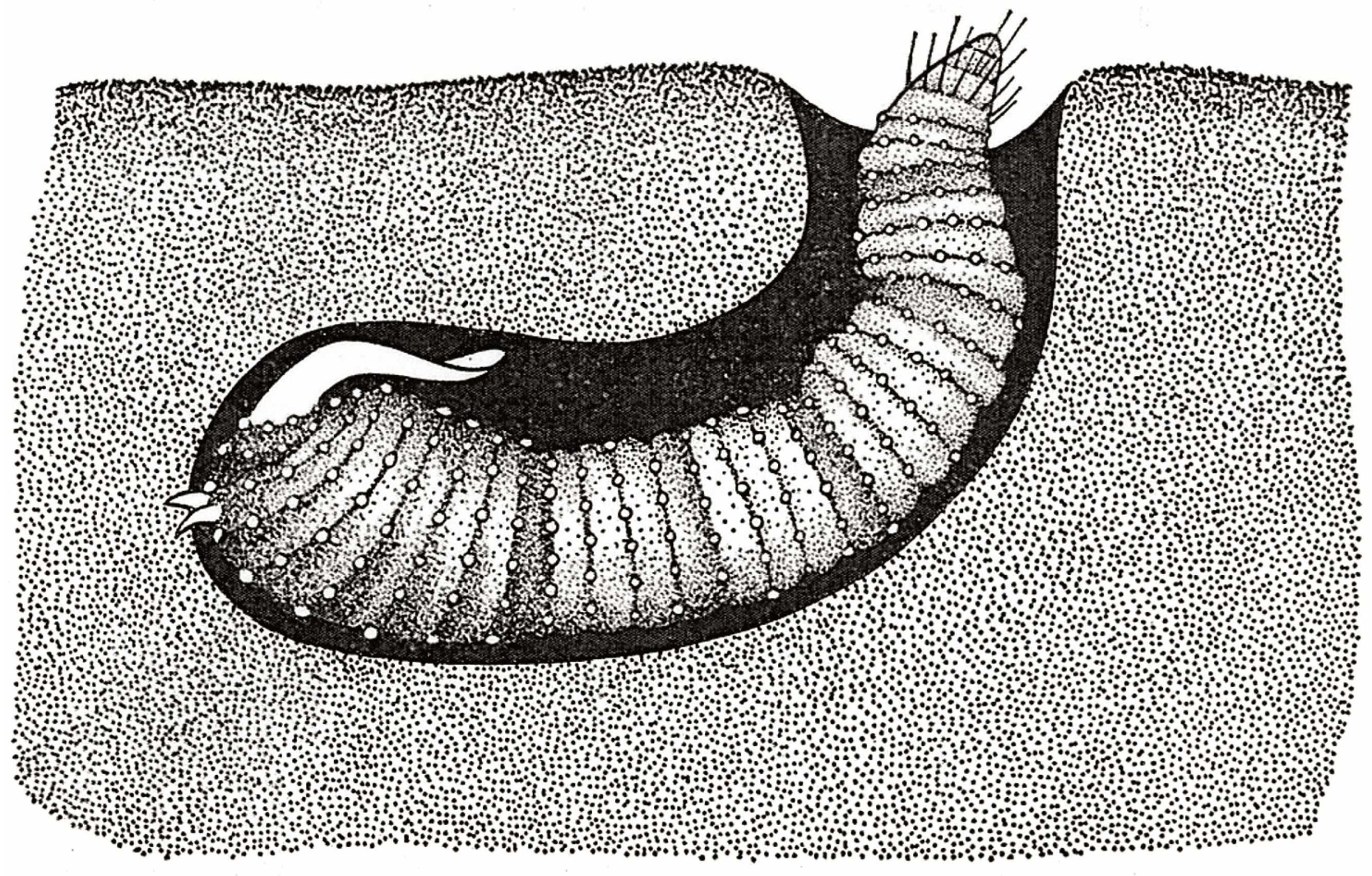
After a near century of stagnation, during which most invertebrate trace fossils were regarded as “fucoids,” invertebrate ichnology really began in the late 1800s with the recognition of traces as a fossil record of animal behavior (e.g., [12,13]). German scientists of the first half of the 20th century demonstrated the value of traces to environmental interpretations. This began with the work of Rudolf Richter (1881–1957), who founded the Senckenberg Marine Institute in 1928. Two important researchers at the institute and elsewhere were Walter Häntzschel (1902–1972) and Wilhelm Schäfer (1912–1981). Largely through actualistic research (“neoichnology”), these workers well demonstrated the relationship of organisms and their traces to environments (Figure 1). These workers and their research results (see [14] for a review) were well known to Adolf Seilacher (1925–2014), who is credited with introducing the concept of ichnofacies.
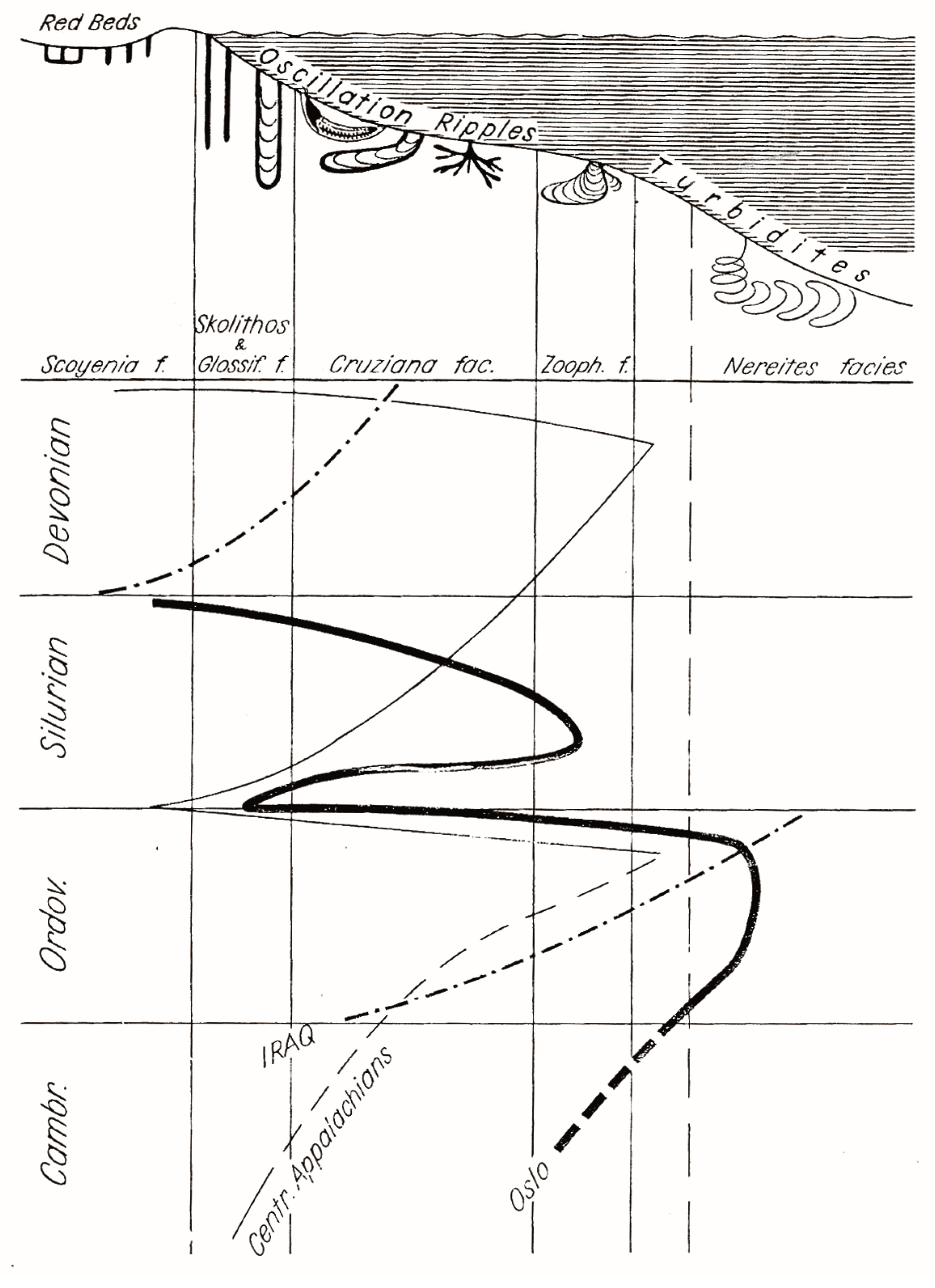
Seilacher [16,17] and Häntzschel [18] first used the term ichnofacies (German: “Ichnofazies”). However, the ichnofacies model is often traced to the work of Seilacher, particularly an article he published in 1967, usually cited by English-speaking paleontologists as the inception of ichnofacies (e.g., [19]). Nevertheless, in that article, Seilacher [20] did not use the term “ichnofacies” and instead referred to “facies,” using an ichnotaxon name as the modifier: Cruziana facies, Scoyenia facies, etc. (Figure 2).
Seilacher [20] identified what came to be called ichnofacies as a set of communities tied to different water depths, stating that “trace fossil communities are mainly bathymetry controlled” [20] (p. 413) and noting (p. 414) that “the communities are directly or indirectly related to depth no matter what factors primarily caused the differences between them.” Nevertheless, the broader ecological and behavioral significance of trace fossils was exemplified in many of Seilacher’s publications [10,21,22,23,24,25,26,27]. Indeed, Seilacher [20] (p. 414) stated that “trace fossils have good potentials [sic] to supplement other lines of environmental evidence.”
In my view, that should have been his “take home message,” as simple bathymetric control of the trace-fossil assemblages outlined by Seilacher was shown to be erroneous (e.g., [28,29,30,31,32,33]. Indeed, I find it puzzling that Seilacher tied the ichnofacies to differences in bathymetry because he surely knew that the work of Richter, Schäfer and Häntzschel (as well as Seilacher’s own work) demonstrated diverse ecological factors, both abiotic and biotic, that influence the distribution of traces. Thus, Seilacher’s [20] ichnofacies concept contained a substantial error, namely that bathymetry controlled trace fossil distribution.
The ichnofacies concept found ready acceptance (e.g., [34,35]) as well as criticism, particularly of its apparent tie to bathymetry. Very significant was that two of the great 20th-century students of ichnology, Robert Frey (1938–1992) and George Pemberton (1948–2018), who embraced the ichnofacies concept, moved away from tying the ichnofacies to bathymetry. They concluded that ichnofacies are “one of the more elegant but widely misunderstood concepts in ichnology” [19] (p. 155). But that “misunderstanding” was simply that traces reflected bathymetry, a misconception that Seilacher [20] introduced. Indeed, Frey et al. [19] claimed a “passive relationship” between bathymetry and trace-fossil distribution (and this claim has been repeated by others). But surely there is some active relationship between bathymetry and trace fossil distribution because water depth does affect phenomena such as temperature, oxygenation and substrate composition that are controls of the distribution of the tracemakers, as well as trace-fossil distribution.
Today, there are three main categories of archetypal ichnofacies recognized by leading proponents of the ichnofacies model: softground, substrate-controlled and continental, and recent reviews identify about 11 archetypal ichnofacies: (1) the softground marine ichnofacies—Cruziana, Psilonichnus, Skolithos, Nereites and Zoophycos; (2) the substrate-controlled marine ichnofacies—Glossifungites, Gnathichnus, Teredolites and Trypanites; and (3) the nonmarine ichnofacies—Celliforma, Coprinosphaera, Mermia, Octopodichnus-Entradichnus, Scoyenia and Termitichnus (e.g., [3,36,37]). Various other ichnofacies have been proposed (e.g., [33,38,39,40,41,42]) but are either regarded as ichnocoenoses and/or have not yet been demonstrated to have a distribution that merits their recognition as archetypal ichnofacies.
4. Some Previous Critiques of Ichnofacies
There have been various criticisms of particular ichnofacies, but my focus here is on criticism of the entire ichnofacies model. Not long after early criticisms drove an immediate retrenching of the controls on ichnofacies away from bathymetry to broader ecological factors, Bromley and Asgaard [33] critiqued ichnofacies, mainly focused on: (1) the lack of a clear definition of the Scoyenia ichnofacies, (2) problems distinguishing marine and nonmarine ichnofacies, and (3) lack of uniformity of ichnofacies definitions. Their central point, as the title of their article indicates, and in my mind their most cogent criticism, is that the characteristic features of some ichnofacies are determined more by taphonomic factors than by ecological factors. They thus argued that the “soft ground” ichnofacies—Zoophycos, Skolithos, Nereites and Cruziana ichnofacies—are taphofacies, but that the “hard-ground” (substrate-based) ichnofacies—Glossifungites, Trypanites, Teredolites and Psilonichnus—are biofacies that have been little (or at least less) affected by taphonomy. Yet, despite this assertion, Bromley and Asgaard [33] named a new Arenicolites ichnofacies, primarily for Skolithos records associated with Arenicolites and Polykladichnus, in storm deposits. And they ended their article by stating that “… although non-uniformitarian and although not bathymetrically controlled, and although not homogeneous, the ichnofacies remain the most important means of classifying trace fossil assemblages” [33] (p. 161).
Goldring [43,44] critiqued ichnofacies, and I regard his critique as the most cogent thus far published. In a short, editorial-style contribution, Goldring [43] (p. 403) stated that “the resolution of the archetypal ichnofacies (an extraction of the facies) is insufficient for the fine resolution required today.” He also noted that “the [ichnofacies] concept suggests that facies interpretation can be accomplished without first making autecological analysis” (p. 403). He thus concluded it is best to examine individual trace fossils/ichnotaxa from what they tell us about environments and to evaluate all factors, sedimentological and paleontological, in paleoecological analysis.
Goldring [44] (p. 159) later stated that “the ichnofacies concept is flawed in respect to facies interpretation” and listed what he perceived to be 12 flaws of ichnofacies. Some of these focus on particular ichnofacies, and most of those of general importance reiterate and elaborate on the two cardinal points of the 1993 critique—insufficient resolution (there are many [litho] facies, but few ichnofacies) and lack of autecological analysis. Goldring added that ichnofacies analysis relies only on distinct, elite trace fossils and thus ignores sediment mottling/nondescript bioturbation. He also noted that some sedimentary environments, particularly deltas, estuaries and lagoons, are not readily recognized by ichnofacies models.
Nevertheless, these critiques have had little to no impact on the recognition and use of ichnofacies. Indeed, criticism of individual ichnofacies, most notable in the case of the Zoophycos ichnofacies [45,46] (and see discussion below), has had little effect on the recognition and use of the archetypal ichnofacies. Instead, those who champion ichnofacies largely restate their utility, review their composition, draw attention to misunderstandings of what an ichnofacies is, and otherwise ignore the main points made by Goldring [43,44] and Bromley [5,33]. Here, I develop further the main points of older critiques and add additional points of criticism of the ichnofacies model.
5. Problems with the Ichnofacies Model
5.1. Definitions
There has been and continues to be some disagreement about what constitutes an archetypal ichnofacies and how such ichnofacies are identified. At one extreme, the term ichnofacies has been considered synonymous with ichnocoenose by some workers. And there is a middle tier of ichnofacies or ichnosubfacies that have usually been explicitly defined as subdivisions of the archetypal ichnofacies. For example, Lockley et al. [38] defined a Curvolithus ichnofacies as a subset of the Cruziana ichnofacies, and Seilacher [47] recognized the Nereites and Paleodictyon ichnosubfacies of the Nereites archetypal ichnofacies. Lockley et al. [48] and Hunt and Lucas [39] differed in what they considered to be an archetypal ichnofacies. Nevertheless, there is consensus in the invertebrate ichnological literature that ichnofacies should refer to recurrent ichnoassemblages (or ichnocoenoses) that represent a significant portion of Phanerozoic time. Trace fossils and ichnoassemblages are phenomena to be observed. But ichnocoenoses and ichnofacies are abstractions created by interpretation/analysis.
Ichnofacies are not recognized by the presence of a single ichnotaxon. In fact, as stated by Frey et al. [19] long ago, they are supposed to be recognizable even in the absence of the eponymous ichnotaxon (i.e., assemblages without Cruziana can still be considered part of the Cruziana ichnofacies). However, how many and exactly which ichnotaxa need to be present to identify an ichnofacies is somewhat fluid and imprecise. For example, Scoyenia need not be present to recognize the Scoyenia ichnofacies, but can that ichnofacies be identified in the absence of backfilled burrows?
An important distinction between pattern and process should be made in thinking about ichnofacies. The process is the organismal response to a set of environmental conditions. The pattern is the resulting distribution of trace fossils in sedimentary rocks. Many definitions of ichnofacies identify them as ichnological assemblages/associations characteristic of a particular sedimentary environment (e.g., [3,49,50]). Bromley [5] (p. 250) well reflected that when he defined an ichnofacies as “an association of trace fossils that is recurrent in time and space, and that directly reflects environmental conditions such as bathymetry, salinity and substrate character.” And Buatois and Mángano [3] (p. 58) well stated that “archetypal ichnofacies are conceptual constructs based on the identification of key features shared by different ichnocoenoses of a wide range of ages formed under a similar set of environmental conditions”.
The process aspect of an ichnofacies is the organismal responses to a set of environmental conditions (the process) that produce ichnoassemblages that characterize those conditions (the pattern) (e.g., [3,7,50]). McIlroy [7] (p. 33) well stated this by saying that the ichnofacies model “is built upon the recognition that organism will produce a similar range of burrows in response to a given set of environmental conditions.” And, according to MacEachern et al. [9] (p. 31), “the ichnofacies concept’s strength lies in the environmental validity of each of its ethological groupings.”
However, given some of the phenomena discussed below, such as trace-fossil homeomorphy and the general lack of autecology, understanding what the organism response is to a particular set of environmental conditions cannot be certain in many cases. In other words, what kind of animal response can be known if the animal that made the traces is not known, and the trace may reflect more than one behavior? If the behavior cannot be identified unambiguously, what environmental conditions might it reflect? Thus, the relationship between process and pattern in the ichnofacies model is often problematic, and this is a serious shortfall of the model.
5.2. What Controls Trace-Fossil Distribution?
The ichnofacies model relies heavily on the assumption that ichnoassemblage composition reflects organismal response to the environment, so it is fair to say it assumes that ichnoassemblage composition is controlled by the local paleoenvironment. While that is to some extent true, other factors, biotic and abiotic, are in control, including the presence/absence of particular organisms due to evolutionary and biogeographic history, the behaviors that those organisms employed and taphonomy/preservation. Put another way, evolution, biogeography, paleobiology, depositional environment and post-depositional history are controls of trace-fossil distribution. Furthermore, the presence of microbial mats is an important aspect of trace-fossil preservation.
The biology of tracemakers is, of course, a primary control on trace-fossil distribution. The energy, oxygen, food and other factors a tracemaker needs must be present in a particular environment for the tracemaker to live there. The tracemaker must also have evolved anatomy and behavior that make it possible to make the traces that will become its trace fossils. Ecological interaction between tracemakers within communities and evolutionary innovations are also important biological factors that can control trace-fossil distribution. Tracemakers can be eurytopic or stenotopic, which means that there is a range of ecological plasticity among tracemakers.
Ichnologists agree that ichnofacies in some way reflect sedimentary environments, so facets of those environments and their sedimentary record (lithofacies) are important controls of trace fossil distribution. Indeed, that control is the primary reason that the ichnofacies model works at all. Aspects of that control of significance include the composition of the substrate (e.g., [5,51,52]) and its stability, and the energy of the depositional system. Nevertheless, these controls are overprinted by taphonomic processes that provide an artifactual control of trace preservation and distribution (see later discussion).
The ichnofacies model claims that trace-fossil distribution corresponds to environment, usually understood to be the sedimentary environment. This correspondence, however, is general in nature (it identifies broadly construed sedimentary environments) and is influenced by the factors other than sedimentary environment that control trace fossil registration and preservation.
5.3. Homeomorphy
Invertebrate trace fossils are identified by their morphology, which reflects distinct behaviors. The identity of the tracemaker is not a factor in invertebrate trace fossil taxonomy because different taxa can make the same morphology of trace fossil (e.g., [5] p. 156). Indeed, Buatois and Mángano [3] (pp. 9–10) well explained that the same organism can produce more than one ichnotaxon, and that a single ichnotaxon can be produced by multiple organisms. Composite ichnotaxa and combination structures can also confound identification of the tracemaker [5,53].
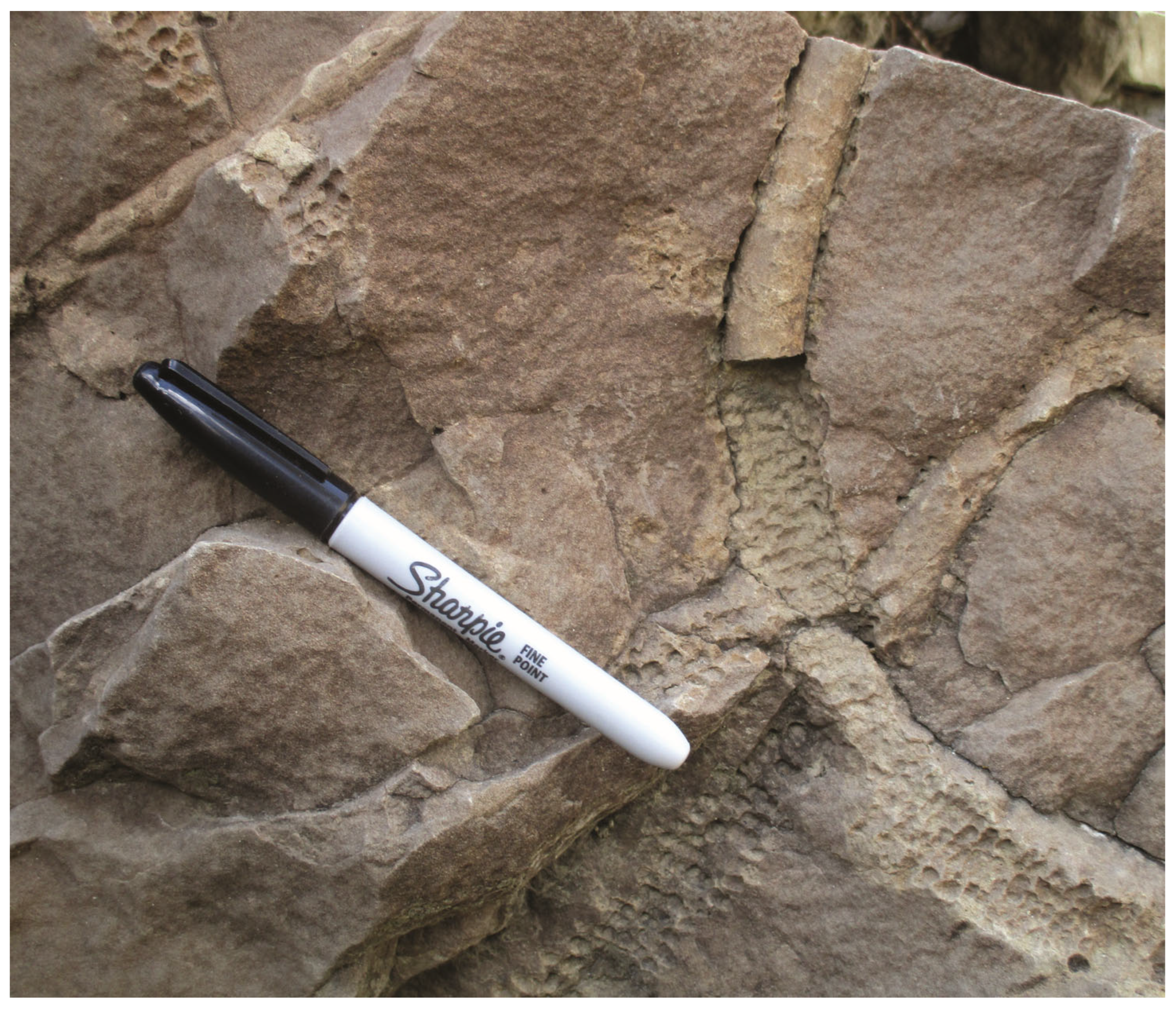
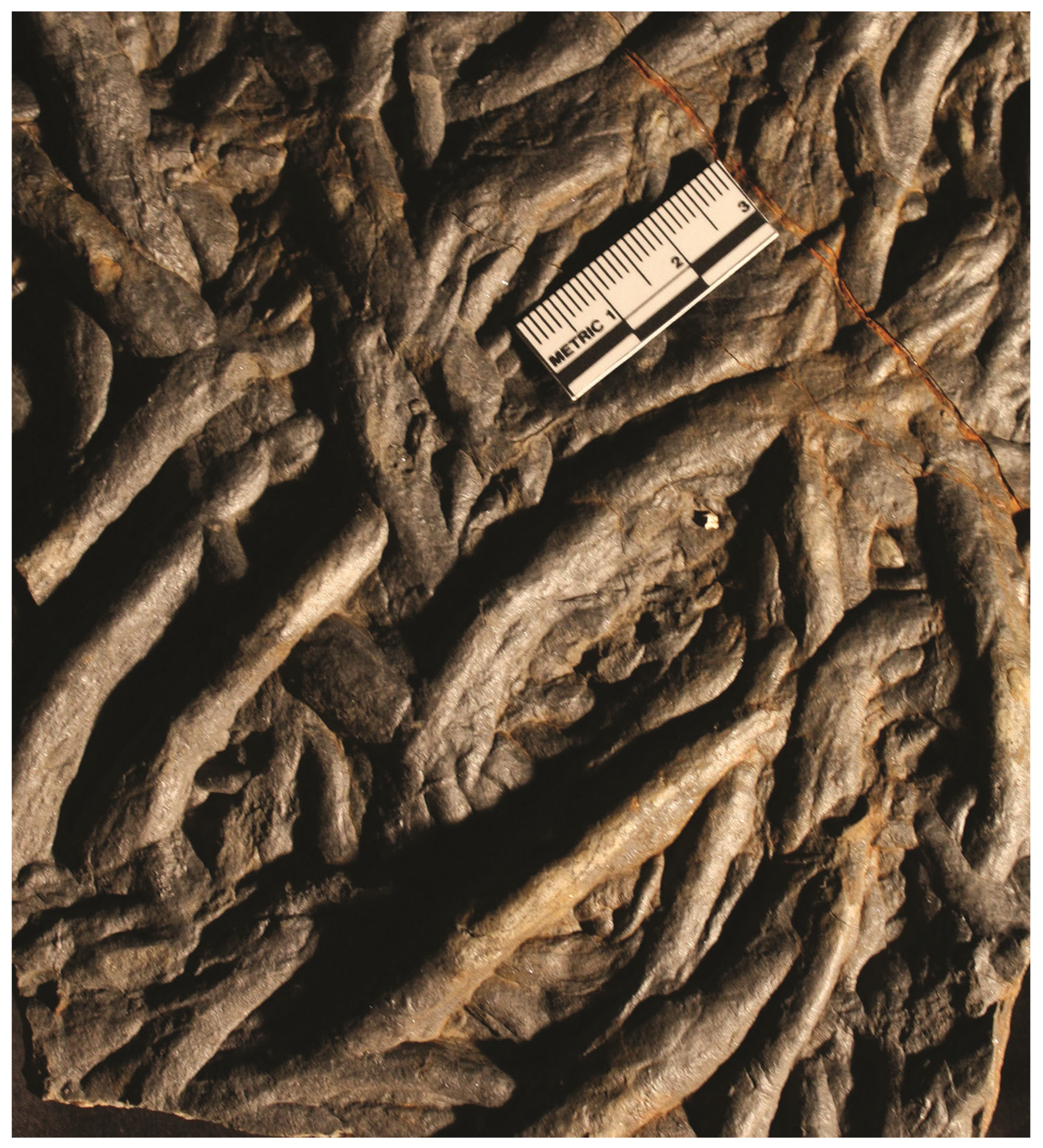
Thus, many invertebrate trace fossils are, as Seilacher [49] has put it, homeomorphic, so that identification of the tracemaker is simply not possible. There are some apparent exceptions, such as the well-known burrow Ophiomorpha (Figure 3) tied (at least in most cases, but see later discussion) by actualistic data to a calianassid shrimp as the tracemaker, but such exceptions are in a small minority. The general inability to identify the tracemaker is a huge limitation on using invertebrate trace fossils in the interpretation of paleoecology and sedimentary environments, as Goldring [43,44] noted.
Traces can also have multiple functions—feeding, dwelling and motility (e.g., [37] Table 3). Thus, for example, the very common and “well understood” trace fossil Arenicolites could have functioned as a domicile, a structure to enable filter feeding, carnivory or scavenging, and an interface or shallow tier for deposit feeding and/or stoping or mining [37]. If that is the case, how can the ichnofacies be recognized by “animal response,” as claimed by Buatois and Mángano [3] (see above) if the behavior the trace indicates (“response”) can be so varied or complex? In other words, how precisely can we define the behavior represented by some traces? Indeed, Gingras et al. [54] (p. 266) noted that because of trace homeomorphy, “in settings characterized by lower diversities of trace fossils (e.g., brackish-water settings) the application of accepted ichnofacies can be extremely misleading.” Indeed, the ichnofacies model, as noted above, faces serious problems because of the inability to associate many trace fossils with a specific organism and thereby identify its autecology and behavior.
5.4. Lack of Autecology
Autecology (also called “species ecology” or “population ecology”) is the ecology of an individual organism or a group of organisms of the same taxon. It is largely determined actualistically. Synecology (also called “community ecology” or “ecosystem ecology”) is the ecology of communities of organism. It is based on actualism, density, diversity, lateral and vertical changes in distributions and geographical distributions. Ager [55] (p. 297) stated that “the synecology of a fossil community is the sum of the autecologies of all its constituent elements.”
However, because their tracemakers are generally not known, or not known with taxonomic specificity, invertebrate trace fossils present little to no opportunity for autecological analysis [43]. This general lack of autecological analysis limits the application of most invertebrate trace fossils to paleoecology and, therefore, the interpretation of sedimentary environments. Ichnoguilds [5] are perhaps the only approximation of autecology available from the invertebrate trace-fossil record. Such guilds are trace fossils that record recurring behavior patterns, including a common activity within the substrate and a common feeding style. However, they are so generalized in what they tell us about tracemaker behavior and ecology that they do not precisely identify the autecology of tracemaking organisms. For example, what has been called the Diplichnites ichnoguild is simply an aggregation of arthropod walking structures mostly made by mobile predators and provides little insight into the ecology of specific tracemakers.
Bromley [5] devoted a section of his book on trace fossils to autecology, and all of it is neoichnological, simply because you cannot always identify the tracemaker of a trace fossil with specificity (almost always the case in ichnology, but not in neoichnology). I agree with Goldring [44] (p. 161) that “ichnological analysis must involve autecology.” The inability to provide much of any autecology for the majority of invertebrate trace fossils is a huge limitation on their use in the analysis of sedimentary environments and paleoecology. I do not think that can be overcome, so it hobbles the use of invertebrate trace fossils in ecological analysis both with and without using the ichnofacies model.
In his classic book, Principles of Paleoecology, Ager [55] devoted a chapter to trace fossils as “evidence of activity.” Significantly, his review of traces did not apply them to paleoecological interpretation. Instead, he regarded the traces as evidence of ancient behavior, and he summarized by saying that “they confirm the hypothesis that animals in the past had habits similar to those of living forms” (p. 21). Indeed, Ager began the next chapter of his book on “associated sediments” by stating that “the study of sediments in which fossils occur is perhaps the most obvious approach to paleoecology” (p. 123). It seems that Ager long ago saw that without autecology, trace fossils would be of limited use in paleoecology.
5.5. Lithofacies Abundance, Gradation, Overlap and Complexity
Lithofacies are mostly recognized based on grain size, grain composition and sedimentary structures. Goldring [43] noted that there are many more sedimentary facies (lithofacies) than ichnofacies and questioned how many ichnofacies would ultimately be needed. Bromley [5] (p. 253) stated that “we can recognize far more sedimentary facies than ichnofacies by combining all aspects of sedimentology, ichnology and paleontology into an integrated study.”
But, in answer to these issues, several workers (e.g., [3,4]) have stated that ichnofacies do not correspond to just facies; they correspond to facies models. Many lithofacies are relatively simple, but facies models can be quite complex. As an example, deltaic facies models are complex, especially where the processes of both wave and river input drive sedimentation. Therefore, only recently have there been attempts made to fit deltaic ichnoassemblages into ichnofacies models [4,56].
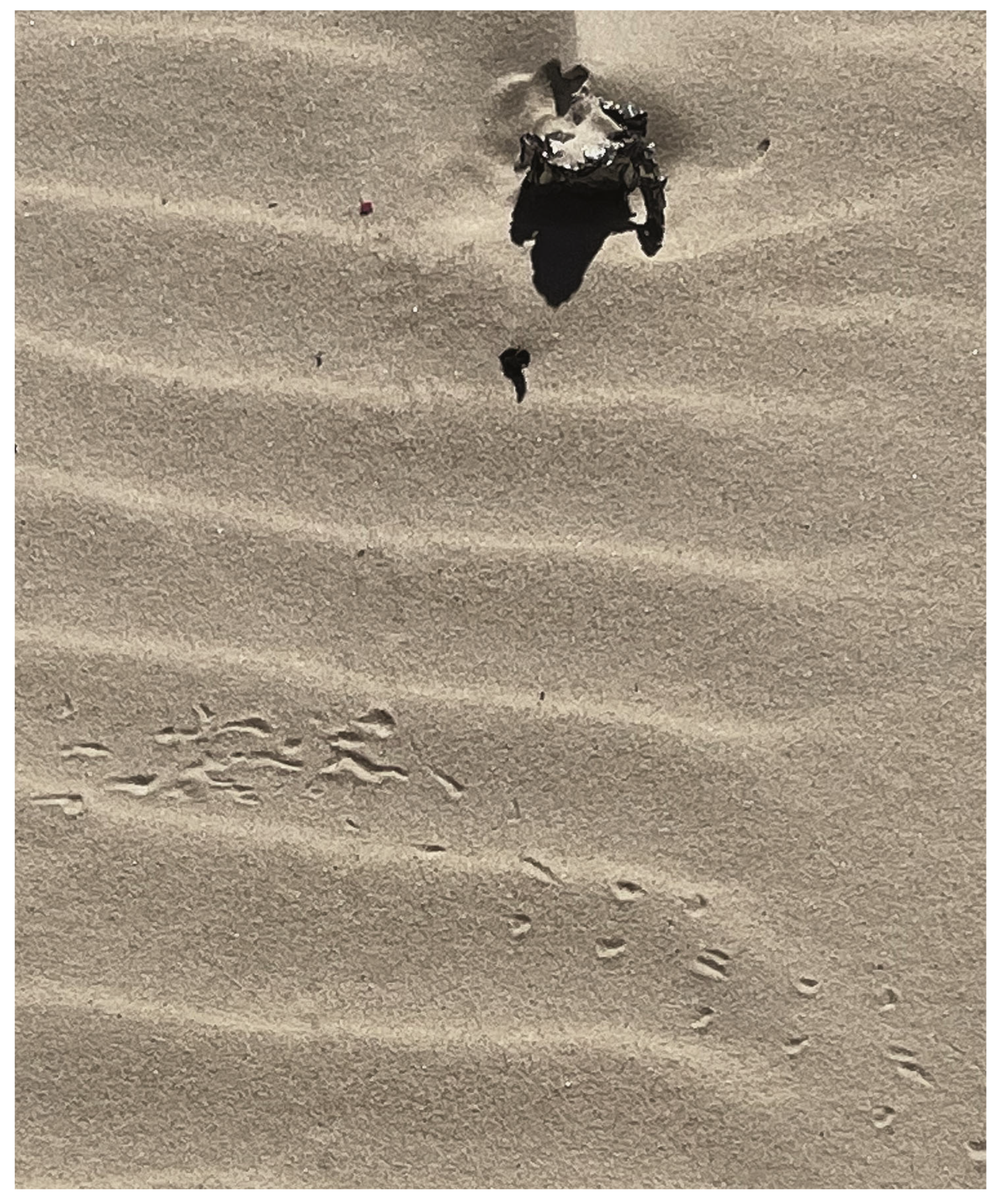
The reason for this complexity is simply environmental variability, which occurs not only spatially but through time as well. Because of this, many ichnofacies are associated with more than one facies model. A good example of this is the Psilonichnus ichnofacies, which characterizes transitional marine/terrestrial environments, particularly the backshore, coastal dunes, washover fans and supratidal flats, so it has been identified in shallow marine, shoreface, bay/backshore and coastal dune settings [57,58] (Figure 4). Furthermore, Curran and White [58] noted that in shallow subtidal to dunal facies in Quaternary carbonates, both Skolithos (subtidal) and Psilonichnus (supratidal) ichnofacies suites are present. And Seike [59] and Seike and Curran [60], among others, indicate that there are no clear ichnofacies boundaries in the wave-dominated sandy coastal zone.
This is not unusual—the Psilonichnus ichnofacies encompasses diverse facies/facies models so that the information it provides about paleoecology and sedimentary environments is broad and non-specific [61]. This overlap and gradation means that ichnoassemblages may not readily fit into archetypal ichnofacies, or that archetypal ichnofacies are co-occurring in the same facies models. In this case, it is essential to combine an analysis of the sediments with an analysis of the ichnoassemblage.
Given that the recognized ichnofacies do not cover all facies models ([32] pointed this out decades ago), there has been some effort to name new ichnofacies or ichnosubfacies to capture the complexity, and that is discussed below under ad hocisms.
5.6. Facies-Crossing Ichnotaxa
Ichnofacies are identified by the association of certain ichnotaxa that are thought to reflect behavioral responses indicative of specific environments. However, many ichnotaxa cross facies (“facies-breaking ichnogenera” of Seilacher [49]), and the number of facies crossers grows annually and is now legion. Perhaps the best example of this is Zoophycos, which gave its name to one of the archetypal ichnofacies.
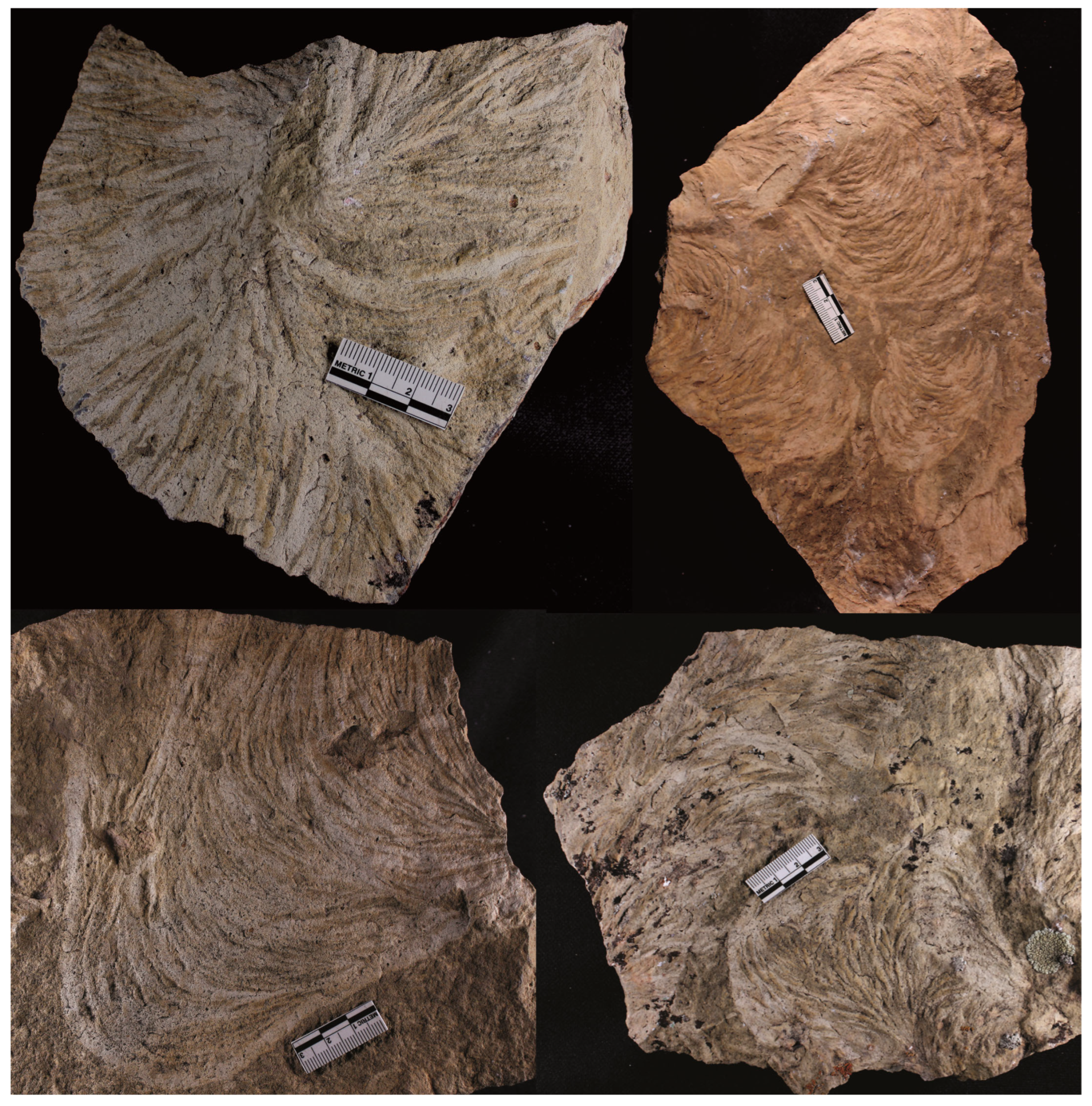
Seilacher [20] understood Zoophycos (Figure 5) to be associated with relatively deep, poorly oxygenated sea bottoms. McIlroy [50] more recently characterized the conditions prevalent at the time of trace formation within the low-ichnodiversity Zoophycos ichnofacies as dysaerobic, mud-rich environments where the poor quality of food resources often required intensive, Spreiten-producing feeding patterns leading to extensive and sometimes completely bioturbated sediments (also see [55]). Nevertheless, these characterizations only apply to part of the fossil record of Zoophycos because the paleoenvironments in which it is found changed through geologic time.
Bottjer et al. [62,63] examined the correlation between bathymetry and the distribution of two well-known trace fossils, Zoophycos and Ophiomorpha. They found that Zoophycos is present in a wide range of water depths during the Paleozoic and disappears from shallow water after the Jurassic—at present, its records are confined to deep water settings. However, recent discoveries document shallow water records of Zoophycos in Cretaceous and Miocene strata [64,65]. The use of the Zoophycos ichnofacies is therefore questionable (e.g., [5,45,46,64,65,66]). Paleoenvironments of Zoophycos shifted with geologic time, so it is a striking example of a facies-crossing ichnotaxon [46,62,63,66,67].
Let me briefly detail a few more (of many examples) facies-crossing ichnotaxa:
- Graphoglyptids are interpreted as complex agrichnial burrow systems (e.g., [71,72]) and have been regarded as “the most characteristic trace fossils of the Nereites ichnofacies, which is typical of deep-sea flysch environments” [72] (p. 123). Yet, Minter et al. [73] reported graphoglyptids from a lower Permian coastal plain facies in southern New Mexico, USA.
- Classically, Nereites was found in deep marine settings, especially in deposits of turbidites or of the oceanic basin floor (e.g., [74]), and this was Seilacher’s [20] understanding of what came to be called the Nereites ichnofacies. These have been thought of as environments of low energy that are anoxic to dysoxic. However, Nereites is also found in shallow marine settings, which are intertidal to subtidal environments that are well oxygenated. The trace has been attributed to worm-like organisms, arthropods and some crabs, and this homeomorphy likely, at least in part, underlies its facies crossing.
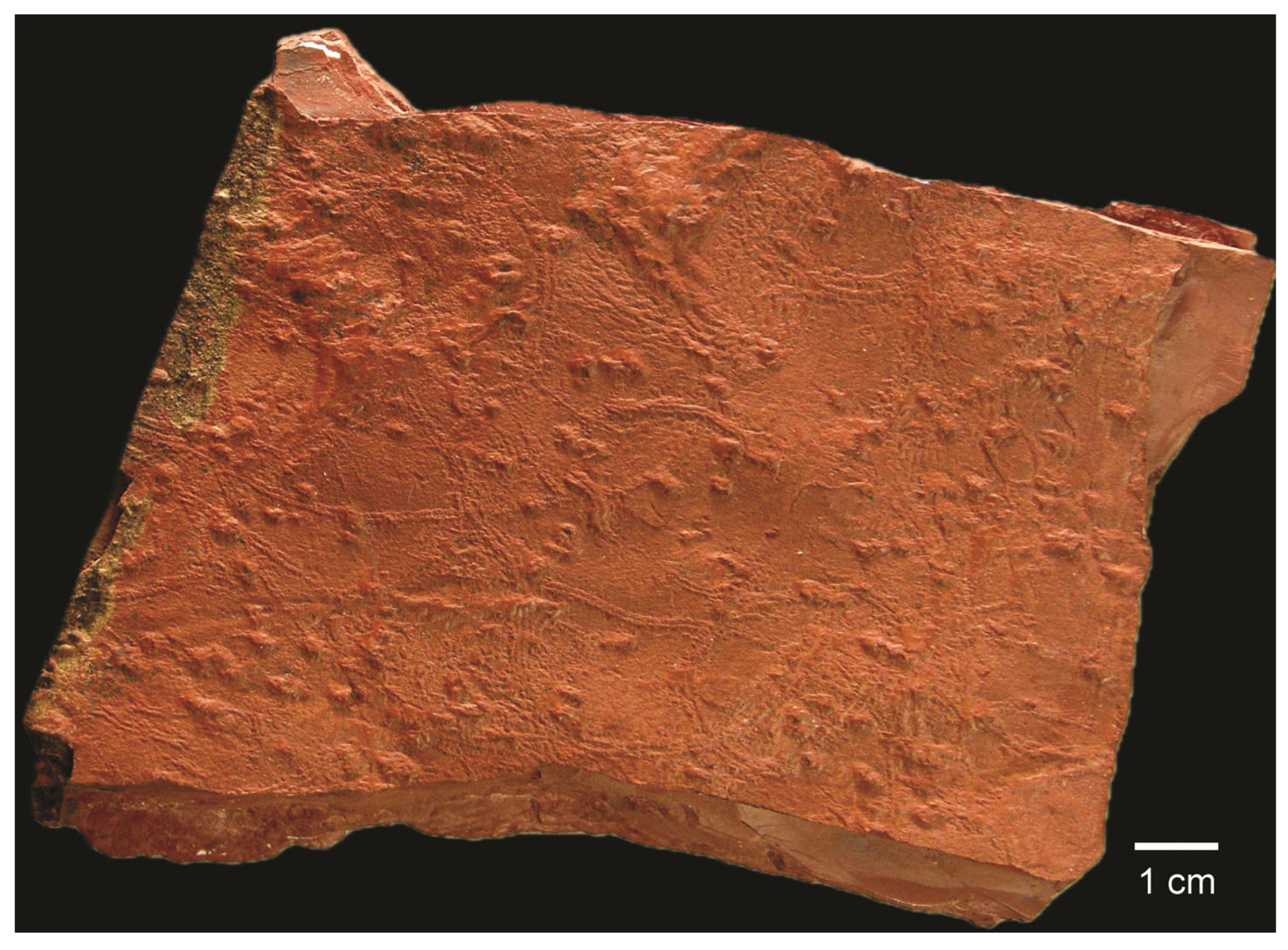
- Cruziana is classically found in shallow marine settings, from tidal and intertidal zones to offshore transition zones. However, it also occurs in freshwater deposits (Figure 6) and on some carbonate ramps. It was originally considered a trilobite trail but has nonmarine Paleozoic records and post-Permian (post-trilobite extinction) records that were surely made by other arthropods, such as notostracans.
- Scoyenia is a burrow found in diverse nonmarine facies, including lake and river margins, floodplains, coastal dunes and coastal zones. It was made by various terrestrial arthropods, especially millipedes, beetles and crayfish [75], and this homeomorphy is, in part, the basis of its facies crossing.
- Skolithos is found in a variety of facies, including high-energy, shallow marine sands, deltas and freshwater and terrestrial environments. It is generally attributed to worm-like animals but is also made by insect larvae, crustaceans and even plant roots [76]. The Skolithos ichnofacies is considered indicative of high-energy, shallow marine settings, but clearly, the Skolithos tracemakers were inhabiting both marine and nonmarine settings.
Indeed, there is not a one-to-one correspondence between many ichnotaxa and facies and between ichnofacies and facies models/associations. Many ichnotaxa occur in diverse facies and are not characteristic of a given lithofacies.
It is also worth considering here the concept of environmental convergence, in which similar environmental/ecological settings appear at widely separated localities and distantly separated points in geological time [80]. Thus, the reestablishment of a suite of environmental and synecological conditions (especially involving microbial mats for trace fossil preservation) can lead to a grouping of ichnofossils that might be expected to appear due to local taphonomic conditions. So, the ichnoassemblage composition can be driven by environmental convergence rather than reflecting an ichnofacies per se.
5.7. Monotaxial and Other Low-Diversity Ichnoassemblages
Many ichnofossil assemblages do not fit well into the established archetypal ichnofacies. This is particularly true of low-diversity (including monotaxial) ichnoassemblages (Figure 7). Nevertheless, a low-diversity (often monotaxial), recurring ichnoassemblage of bivalve borings in wood (Teredolites) was identified as its own, Teredolites ichnofacies [81].
Bromley et al. [81] named the Teredolites ichnofacies to encompass these borings in xylic (woody or coaly) substrates. They labeled the nature of the substrate of the Teredolites ichnofacies as a “woodground,” as opposed to a hardground, firmground or softground [81], so it seems the nature of the substrate drove the definition of the ichnofacies. However, Teredolites occurrences are typically of low ichnodiversity (usually monotaxial), so Hunt and Lucas [39] argued that the Teredolites ichnofacies lacks the breadth to be considered an ichnofacies, though it continues to be discussed as an ichnofacies in recent reviews [3,36,37,82,83].
What paleoecological/sedimentary environment information can be gleaned from the Teredolites ichnofacies that cannot be known from the wood itself? That clams bored the wood? Savrda [83] used the presence of Teredolites-bored wood to indicate sea-level dynamics—sea level rise producing an influx of wood into a marine setting where it is bored, its subsequent concentration during ravinement and condensation. However, this interpretation need not make any reference to a Teredolites ichnofacies. Thus, the Teredolites ichnofacies has very low information content and should be abandoned. No other ichnofacies has been based on a single ichnotaxon, and ichnoassemblages of one or a few (three or fewer) ichnotaxa generally cannot be fit into existing ichnofacies models.
5.8. Ichnoassemblages That Do Not Fit into Archetypal Ichnofacies
As just noted, many ichnoassemblages do not fit into the archetypal ichnofacies. MacEachern et al. [9] (pp. 44–45) discussed ichnoassemblages that depart from (do not fit in) the archetypal ichnofacies, stating that they are often assemblages in physico-chemically stressed environments that are “dominated by facies-crossing elements showing a high degree of infaunal opportunism” (p. 44).
Most (or all?) low-diversity ichnoassemblages also do not readily fit into ichnofacies other than the single ichnotaxon Teredolites, for which an ichnofacies was created (see above). This “bad fit” problem may partly be caused by a lack of ichnofacies to encompass all examples, so ad hoc definitions of new ichnofacies (e.g., the Arenicolites ichnofacies of [33] discussed earlier) have been used by some to obviate this problem. The failure of existing ichnofacies to encompass all ichnoassemblages indicates a lack of universal applicability of the ichnofacies model.
There are numerous examples of ichnoassemblages that cannot be readily fit into the known ichnofacies model. As one of many examples, Keighley and Pickerill [84] identified 13 ichnocoenoses in Carboniferous nonmarine strata on Cape Breton Island in eastern Canada. They presented sedimentology-based interpretations of the depositional environments of the sediments that contained the ichnocoenoses. However, most of these ichnocoenoses did not fit existing ichnofacies, so they redefined the relevant ichnofacies. Nevertheless, the sediment-based facies interpretations of Keighley and Pickerill [84] establish the sedimentary environments, so the traces reinforce but otherwise add little to the sedimentology-based interpretation.
Hasiotis [85], in a study of the ichnology of the nonmarine Upper Jurassic Morrison Formation in the western USA, stated that “the overwhelming majority of trace fossils in alluvial and margin lacustrine environments in the Upper Jurassic Morrison Formation could occur in any of the proposed Scoyenia, Termitichnus and Coprinosphaera ichnofacies based on their broad ambiguous definition.” He also stressed the complexity of nonmarine environments and traces to argue that such traces are better handled at the ichnoassemblage or ichnocoenosis level, not as part of ichnofacies [86,87].
In some cases, when ichnoassemblages do not fit into an ichnofacies, new “ichnosubfacies” have been established. For example, Uchman et al. [88] named a “European Sand Belt ichnosubfacies” of the “Entradichnus-Octopodichnus ichnofacies” for vertical to oblique meniscate burrows in sand layers transitional between laminated beds of sand. However, similar meniscate burrows from Cretaceous eolian deposits in Mongolia had already simply been assigned to the Entradichnus-Octopodichnus ichnofacies [89], or to the Scoyenia ichnofacies [90], which calls into question the need for an ichnosubfacies.
McIlroy [6,7] argued that there is little utility in creating additional archetypal ichnofacies. However, some workers do just that. For example, MacEachern and Bann [4] introduced two new archetypal ichnofacies for deltaic deposits—the Phycosiphon ichnofacies for mud-dominated prodelta deposits and the Rosselia ichnofacies for sandstone-dominated delta-front deposits. They noted that these ichnofacies may grade into each other and into other ichnofacies. They also noted (p. 856) that they were introducing the ichnofacies “to fill in gaps in the coverage of sedimentary environments by ichnofacies.” And, only three years after introducing two new ichnofacies for the deltaic system, MacEachern and Bann [56] noted complexities and departures of ichnoassemblages in deltaic deposits from those ichnofacies. Time to name even more ichnofacies, or time to admit that the complexity of deltaic systems is not well represented by the generalizations inherent to the ichnofacies model?
Finally, a very striking example of ichnoassemblages that do not fit into the ichnofacies model is provided by a recent article that claimed to be “expanding the ichnofacies model to tidal straits” [91] (p. 1). What was found, however, was that the ichnoassemblages studied did not fit into established ichnofacies models. The solution to this was to propose ad hoc a “Bichordites association that replaces the Skolithos ichnofacies in tide dominated very high-energy settings” [91] (p. 6). Thus, rather than expanding the ichnofacies model, the article documents yet another case of ichnoassemblages not fitting the model.
5.9. Non-Uniformitarian Outcomes
Like all of the global biota, the trace-fossil-making biota has evolved across geological time. Not all trace fossils have a range of Phanerozoic—Pleistocene, especially in the nonmarine realm (e.g., [3,92,93,94,95]). As Reading and Levell [96] (p. 16) stated, “since organisms have evolved through geologic time, the type, amount and the sites of biological activity have continually changed.” There have also been well-documented shifts in environments inhabited by tracemakers through time, well exemplified by the example of Zoophycos discussed earlier.
Thus, the trace-fossil record presents some non-uniformitarian outcomes, and there are large intervals of time to which many of the current ichnofacies models cannot be applied. For example, the Mermia ichnofacies of freshwater lacustrine settings apparently did not exist prior to the Carboniferous, when tracemaking organisms first invaded lakes and ponds [95]. Evolutionary history has had a substantial effect on the distribution of trace fossils, and there are tracemakers that changed their environmental preferences through time. Both of these phenomena reduce the general applicability of the ichnofacies model.
5.10. Taphonomy
Taphonomic processes influence both trace registration and trace-fossil preservation. These are such common phenomena of the trace-fossil record that ichnologists use terms such as taphoseries, taphofacies and taphotaxa [33,97,98,99]. Indeed, as noted above, Bromley and Asgaard [33] identified many “ichnofacies” as taphofacies. Bromley [5] (p. 241) thus noted that ichnofacies fall into two groups, “those that are characterized dominantly by the ecology of the tracemakers (biofacies) and those that are distinguished chiefly on the basis of taphonomic bias (taphofacies)”.
Taphonomic biases of the trace fossil record can be seen as biotic and abiotic. Biotic factors are related to the morphology and behavior of the tracemaker, and abiotic factors include aspects of substrate composition, depositional energy, compaction, dissolution and erosion. These factors all act as well-known filters that intervene between the preservation of “ideal” (elite) traces and the trace fossils that ichnologists can study/collect from the strata. Savrda [98] (p. 92) referred to “ichnological fidelity” as “completeness of the preserved record of biogenic activity that occurred in a substrate,” and assemblages with low ichnological fidelity are usually those that have been heavily influenced by taphonomic phenomena.
Bromley and Asgaard [33] (p. 153) stated that “trace fossil assemblages do not accurately reflect the work of the original community,” and this is likely true in the majority of such assemblages. They argued that colonization and ecological/compositional maturity also control ichnoassemblage distribution. One particular problem that characterizes most trace fossil assemblages is that of time averaging [100,101]. Ecological tiering can also result in deep burrows penetrating into beds containing trace fossils of an entirely different community [5]).
As McIlroy and Garton [100] (p. 420) well stated, “the ideal unit of study, the ecological community, is difficult to unequivocally determine” due to the fact that “the trace fossils in a single bed or related to a single colonization surface seldom represent the work of a single contemporaneous community.” This means that in addition to problems with determining the autecology of tracemaking organisms, there are also problems determining the synecology of ichnofossil assemblages. Taphonomic factors can thus confound the ichnofacies model by altering the composition of ichnoassemblages and reducing the ability to evaluate their synecology.
6. In Defense of Ichnofacies
The advocates of the utility of ichnofacies have devoted little effort to defending it against its critics. Part of their limited defense usually begins by claiming ichnofacies are misunderstood. That statement focuses largely on what constitutes an ichnocoenosis as opposed to an archetypal ichnofacies. However, it is not focused on a critique of the ichnofacies model per se but simply draws attention to disagreements over how to define an ichnofacies.
Beginning with Frey [101], proponents of ichnofacies have repeated over and over again the importance/value of ichnofacies and published many reviews of the archetypal ichnofacies [3,5,9,36,37,51,54,82,102]. Given how repetitive these reviews are, why are they being published over and over, instead of reference being made to one or another of the already published reviews? This repetition, intentionally or unintentionally, has created an illusory (or induced) truth effect, whereby statements are rated as more truthful after repeated exposure (e.g., [103]), thus reinforcing the conclusion that ichnofacies are a useful model.
MacEachern et al. [9] claimed that ichnofacies serve the same five functions as do facies models: (1) they provide norms for the purpose of comparison; (2) they are a framework to guide future observation; (3) they are a predictor in new situations; (4) they integrate a basis for interpretation of the system that it represents; and (5) they facilitate teaching and communication. I agree with the assertion that those five functions are served by the ichnofacies model but regard those as trivial functions of a general nature that apply to almost any scientific model. The fact is, the information content of an ichnofacies is relatively general and lacks the specificity that can be obtained from the analysis of the individual ichnofossils/ichnoassemblages done in conjunction with analysis of the lithofacies.
7. Ichnofabric
Ichnofabric, a term introduced by Ekdale and Bromley [104], has been defined as “those aspects of the texture and internal structure of a sediment that result from bioturbation and bioerosion at all scales” [102] (p. 308). Ichnofabric analysis is thus concerned with determining the style and intensity of bioturbation and bioerosion more than establishing the taxonomic composition of an ichnoassemblage (e.g., [100,105]).
Some workers argue that ichnofabric analysis provides better paleoecological insight than do ichnofacies [50,105]. I agree, simply because ichnofabric analysis focuses on some of the environmental parameters best inferred from traces, such as availability of organic matter and oxygen, and the consistency and stability of substrates.
McIlroy [50] (p. 332) proposed to unite ichnofacies and ichnofabric analysis as “applied ichnology,” noting that “the main objective of applied ichnology is the collection of detailed palaeoenvironmental data for use in sedimentological studies.” However, I see the ichnofacies model as unnecessary and advocate the analysis of individual ichnofossils and ichnoassemblages in paleoenvironmental analysis. Ichnofabric should be part of such analyses, which are not improved by ichnofacies analysis.
8. The Paradigm of Ichnology?
Ichnofacies have been called the “paradigm” of ichnology by some leading ichnologists. This found full expression in an article by MacEachern et al. [82] titled “The ichnofacies paradigm.” In that article, MacEachern et al. [82] (p. 52) stated that “the ichnofacies paradigm endures as the elegant, unifying framework within which accurate ichnological observation and reliable environmental interpretation can be derived from the rock record.” Later, MacEachern et al. [9] (pp. 27–28) stated “the ichnofacies paradigm is an elegant, unifying framework manifest by recurring, strongly facies-controlled (i.e., environmentally related) groupings of trace fossils that reflect specific combinations of organism behavior.” Thus, MacEachern et al. used the word paradigm as did historian of science Thomas Kuhn, who defined a “scientific paradigm” as a construct that frames and directs research by providing the questions, identifying the phenomena to be observed and explaining how the results should be interpreted [106]. Well-known paradigms in Earth science and paleontology include NeoDarwinism and plate tectonics. Should ichnofacies be included in a list with those paradigms?
I think not. Indeed, all three parts of MacEachern et al.’s [82] statement just quoted are open to contradiction. First, ichnofacies are not an “elegant, unifying framework.” In science, elegance refers to a theory or solution that is simple, clear and powerful in explaining complex phenomena with minimal assumptions (parsimony) (e.g., [107]). As argued here, ichnofacies are not that. Instead, they are an over-generalized, assumption-ridden, exception-laden model that relies on diverse ad hocisms to explain away its shortfalls.
Second, given that ichnofacies are actually an abstraction, or an interpretation, they cannot be identified as accurate ichnological observation. Ichnological observation is undertaken at the level of individual trace fossils or assemblages of trace fossils. All else—ichnocoenoses, suites and ichnofacies—are interpretations/analysis.
Third, ichnofacies do not well support “reliable environmental interpretation.” How can they if there are so many facies-crossing ichnotaxa and so many trace fossils cannot be reliably assigned to an ichnofacies? The kinds of facies or facies models that are the supposed correlatives of ichnofacies are generalizations that only impart an oversimplified understanding of the distribution of paleoenvironments. More detailed environmental interpretations can be derived from analyzing the actual lithofacies and adding the biofacies information available, including that of the trace fossils.
If ichnofacies are not the paradigm of ichnology, what is? The simple and obvious answer is embodied in the title of an article by Seilacher [25], “fossil behavior.” Traces record organismal behavior based on a record registered in a substrate. That is true of all trace fossils and is the concept that unifies all ichnological studies. Indeed, invertebrate ichnology is focused on the trace as evidence of behavior, and the morphology of the trace relevant to invertebrate ichnotaxonomy is judged to be indicative of behaviors specific to the ichnotaxon. Vertebrate ichnology usually treats the trace as a proxy for a biotaxon, yet there is substantial analysis of behavior based on vertebrate traces, ranging from the locomotion of an organism based on footprints to the feeding behavior of an organism based on its bromalites. Thus, behavior is what trace fossils indicate, and the inference of behavior is central to most ichnological studies. The trace fossil as “fossil behavior” is the unifying paradigm of all ichnology.
Osgood [12] (p. 87) long ago stated that “the greatest contribution by traces is their demonstration of behavior patterns among extinct organisms.” Pickerill [53] advocated calling traces “ethological structures” to emphasize their behavioral significance. Even though most of their book is organized by depositional environments, not behavioral categories, Buatois and Mángano [3] stated that “trace fossils represent evidence of behavior…. this is arguably the essence of trace fossils” (p. 8) and that “trace fossils are primarily evidence of animal behavior” (p. 17). May we all recognize that behavior is the paradigm that unifies ichnological analysis.
9. Discussion
Ichnofacies constitute a model for inferring paleoecology and deciphering sedimentary environments based on trace fossils. Ichnofacies models had utility in the 1960s to perhaps as late as the 1990s, particularly in the development of ichnology as a tool in paleoenvironmental interpretation. But, marked increases in our knowledge of the trace-fossil record, now awash in facies-crossers, and an augmented understanding of the distribution of traces in modern environments, have rendered the ichnofacies model over-generalized and thus of little utility. More precise interpretations of paleoenvironments can be made based on lithofacies. Indeed, that a 688-page-long, very detailed book on facies contains no discussion of ichnofacies [108] suggests how little value ichnofacies have been to the interpretation of sedimentary environments, even though individual trace fossils and ichnoassemblages are often part of such interpretations.
What is important is to evaluate organism presence and behavior based on the individual ichnofossils/ichnoassemblages and combine it with lithofacies (sedimentological) inferences. Ichnofacies models are of some value to paleoenvironmental interpretation, but most such interpretation can be undertaken based on the lithofacies present, with little help needed from ichnology. Where ichnology does help is with those parameters that can be difficult to judge from the sediments themselves, such as oxygenation, substrate stability, and the availability of organic matter. But those parameters can be inferred from individual trace fossils and ichnoassemblages without reference to a generalized ichnofacies model. Indeed, ichnofabric analysis well captures an understanding of those parameters. As British statistician George Box famously said, “all models are wrong, some are useful.” I would say that the ichnofacies model has outlived its usefulness. And, as the famous economist John Maynard Keynes said, “the difficulty lies, not in the new ideas, but in escaping from the old ones.” The ichnofacies model is now an old idea that many may find difficult to abandon.
Trace fossils do provide information important to the interpretation of ancient depositional environments and paleoecology, but this need not be done within the context of ichnofacies (for examples, see [28,44,84,109,110], among many others). But such interpretations need not be made in the context of ichnofacies. Instead, they can be made at the level of the trace fossil itself or of the ichnoassemblage within the context of biofacies—analyzing biological information provided by fossils that is not always provided by the lithofacies. These include availability of organic matter (food) and oxygen and substrate consistency and stability. Ichnofacies models contribute little to nothing to such analyses.
10. Conclusions
My recommendation is to simply abandon the concept and identification of ichnofacies (including those I have been involved in naming). The ichnofacies model has long outlived its usefulness. Ichnofacies are not a paradigm for ichnology or a useful model for detailed paleoenvironmental and paleoecological analysis.
We need to recognize that the paradigm of ichnology is that trace fossils are records of behavior. I thus fully endorse the suggestion of Plotnick [111] that ichnologists need to augment the understanding of traces within a behavioral paradigm. We should continue to use invertebrate trace fossils in the interpretation of ancient environments and paleoecology, and we must continue to develop our understanding of the behaviors for which trace fossils provide the best prima facie evidence.
Funding
This research received no external funding.
Data Availability Statement
No data were collected during the research and writing of this article.
Acknowledgments
I am grateful to Adrian Hunt, Eric Kappus, Allan Lerner, Hendrik Klein, Chris Mansky and Matt Stimson, who educated me on various topics and influenced my thinking about ichnofacies. Hendrik Klein and Andreas Wetzel generously helped me access some of the German literature cited here. The comments of the reviewers improved the content and the clarity of the manuscript.
Conflicts of Interest
The author declares no conflicts of interest.
References
- Walker, R.G. Facies, facies models and modern stratigraphic concepts. In Facies Models Response to Sea Level Change; Walker, R.G., James, N.P., Eds.; Geological Association of Canada: St. John’s Newfoundland, NL, Canada, 1992; pp. 1–14. [Google Scholar]
- Collinson, J.D. The sedimentology of the Grindslow Shales and the Kinderscout Grit: A deltaic complex in the Namurian of northern England. J. Sed. Pet. 1969, 439, 194–211. [Google Scholar] [CrossRef]
- Buatois, L.A.; Mángano, M.G. Ichnology: Organism-Substrate Interactions in Space and Time; Cambridge University Press: Cambridge, UK, 2011; 358p. [Google Scholar] [CrossRef]
- MacEachern, J.A.; Bann, K.L. The Phycosiphon ichnopfacies and the Rosselia ichnofacies: Two new ichnofacies for marine deltaic environments. J. Sed. Res. 2020, 90, 855–886. [Google Scholar] [CrossRef]
- Bromley, R.G. Trace Fossils: Biology and Taphonomy, 2nd ed.; Unwin Hyman: London, UK, 1996; 361p. [Google Scholar]
- McIlroy, D. (Ed.) The Application of Ichnology to Palaeoenvironmental and Stratigraphic Analysis; Geological Society London Special Publication: London, UK, 2004; Volume 228, 490p. [Google Scholar]
- McIlroy, D. Some ichnological concepts, methodologies, applications and frontiers. Geol. Soc. Lond. Spec. Publ. 2004, 228, 3–27. [Google Scholar] [CrossRef]
- Bromley, R.G. Trace fossils at omission surfaces. In The Study of Trace Fossils: A Synthesis of Principles, Problems, and Procedures in Ichnology; Frey, R.W., Ed.; Springer: Berlin/Heidelberg, Germany, 1975; pp. 399–428. [Google Scholar] [CrossRef]
- MacEachern, J.A.; Pemberton, S.G.; Gingras, M.K.; Bann, K.L. Ichnology and facies models. In Facies Models 4; James, N.P., Dalrymple, R.W., Eds.; Geological Association of Canada: St. John’s, NL, Canada, 2010; pp. 19–58. [Google Scholar]
- Seilacher, A. Biogenic sedimentary structures. In Approaches to Paleoecology; Imbrie, J., Newell, N., Eds.; Wiley: New York, NY, USA, 1964; pp. 296–316. [Google Scholar]
- Frey, R.W.; Pemberton, S.G. The Psilonichnus ichnofacies, and its relationship to adjacent marine and nonmarine ichnocoenoses along the Georgia coast. Bull. Canad. Petrol. Geol. 1987, 35, 333–357. [Google Scholar]
- Osgood, R.G., Jr. The paleontological significance of trace fossils. In The Study of Trace Fossils: A Synthesis of Principles, Problems, and Procedures in Ichnology; Frey, R.W., Ed.; Springer: Berlin/Heidelberg, Germany, 1975; pp. 87–108. [Google Scholar] [CrossRef]
- Baucon, A.; Bordy, E.; Brustur, T.; Buatois, L.A.; Cunningham, T.; De, C.; Duffin, C.; Felletti, F.; Gaillard, C.; Hu, B.; et al. A history of ideas in ichnology. In Trace Fossils as Indicators of Sedimentary Environments; Knaust, D., Bromley, R.G., Eds.; Developments in Sedimentology, 64; Elsevier: Amsterdam, The Netherlands, 2012; pp. 3–43. [Google Scholar] [CrossRef]
- Cadée, G.C.; Goldring, R. The Wadden Sea, cradle of invertebrate ichnology. In Trace Fossils: Concepts, Problems, Prospects; Miller, W., III, Ed.; Elsevier: Amsterdam, The Netherlands, 2007; pp. 3–13. [Google Scholar] [CrossRef]
- Schäfer, W. Aktuo-Paläontologie Nach Studien in der Nordsee; Verlag Waldemar Kramer: Frankfurt, Germany, 1962; 666p. [Google Scholar]
- Seilacher, A. Die geologische Bedeutung fossiler Lebensspuren. Zeitsch. Deut.Geol. Gesell. 1954, 105, 214–227. [Google Scholar]
- Seilacher, A. Spuren und Fazies im Unterkambrium. Akad. Wissensch. Liter. Mainz Abhand. Math-Naturwiss. Klasse 1955, 10, 373–399. [Google Scholar]
- Häntzschel, W. Lebensspuren als Kennzeichen des Sedimentationsraumes. Geol. Rund. 1955, 43, 551–562. [Google Scholar] [CrossRef]
- Frey, R.W.; Pemberton, S.G.; Saunders, T.D.A. Ichnofacies and bathymetry: A passive relationship. J. Paleont. 1990, 64, 155–158. [Google Scholar] [CrossRef]
- Seilacher, A. Bathymetry of trace fossils. Mar. Geol. 1967, 5, 413–428. [Google Scholar] [CrossRef]
- Seilacher, A. Studien zur Palichnologie I. Über die Methoden der Palichnologie. Neues J. Geol. Paläont. Abhand. 1953, 96, 421–452. [Google Scholar]
- Seilacher, A. Studien zur Palichnologie I. Die fossilen Ruhespuren (Cubichnia). Neues J. Geol. Paläont. Abhand. 1953, 98, 87–124. [Google Scholar]
- Seilacher, A. Zur ökologischen Charakteristik von Flysch und Molasse. Ecl. Geol. Helvet. 1959, 51, 1062–1078. [Google Scholar]
- Seilacher, A. Lebensspuren und Salinitätsfazies. Forsch. Geol. Rheinl.Westfal. 1963, 10, 81–94. [Google Scholar]
- Seilacher, A. Fossil behavior. Sci. Am. 1967, 217, 72–80. [Google Scholar] [CrossRef]
- Seilacher, A. Use of trace fossil assemblages for recognizing depositional environments. In Trace Fossil Concepts; Basan, P., Ed.; SEPM: Tulsa, OK, USA, 1978; pp. 185–201. [Google Scholar] [CrossRef]
- Seilacher, A.; Meischner, D. Fazies-Analyse im Palaozoikum des Oslo-Gebietes. Geol. Rund. 1964, 54, 596–619. [Google Scholar] [CrossRef]
- Fürsich, F.T. Trace fossils as environmental indicators in the Corallian of England and Normandy. Lethaia 1975, 8, 151–172. [Google Scholar] [CrossRef]
- Byers, C.W. Geological significance of marine biogenic sedimentary structures. In Animal Sediment Relations: The Biogenic Alteration of Sediments; McCall, P.L., Tevesz, J.A., Eds.; Plenum Press: New York, NY, USA, 1982; pp. 221–256. [Google Scholar] [CrossRef]
- Wetzel, A. Bioturbation in deep-sea fine-grained sediments. Geol. Soc. Lond. Spec. Publ. 1984, 15, 595–608. [Google Scholar] [CrossRef]
- Stow, D.A.V. Deep clastic seas. In Sedimentary Environments Processes, Facies and Stratigraphy, 3rd ed.; Reading, H.G., Ed.; Blackwell: Oxford, UK, 1996; pp. 399–444. [Google Scholar]
- Ekdale, A.A. Pitfalls of paleobathymetric interpretations based on trace fossil assemblages. Palaios 1988, 3, 464–472. [Google Scholar] [CrossRef]
- Bromley, R.G.; Asgaard, U. Ichnofacies: A mixture of taphofacies and biofacies. Lethaia 1991, 24, 153–163. [Google Scholar] [CrossRef]
- Rhoads, D.C. The paleoecological and environmental significance of trace fossils. In The Study of Trace Fossils: A Synthesis of Principles, Problems, and Procedures in Ichnology; Frey, R.W., Ed.; Springer: Berlin/Heidelberg, Germany, 1975; pp. 147–160. [Google Scholar] [CrossRef]
- Frey, R.W.; Seilacher, A. Uniformity in marine invertebrate ichnology. Lethaia 1980, 13, 183–207. [Google Scholar] [CrossRef]
- Buatois, L.A.; Mángano, M.G. Ichnofacies. In Encyclopedia of Geology, 2nd ed.; Alderton, D., Elias, S.A., Eds.; Academic Press: London, UK, 2021; Volume 3, pp. 511–519. [Google Scholar] [CrossRef]
- MacEachern, J.A.; Bann, K.L.; Gingras, M.K.; Zonneveld, J.; Dashtgard, S.E.; Pemberton, S.G. The ichnofacies paradigm. In Trace Fossils as Indicators of Sedimentary Environments; Knaust, D., Bromley, R.G., Eds.; Developments in Sedimentology, 64; Elsevier: Amsterdam, The Netherlands, 2012; pp. 103–138. [Google Scholar] [CrossRef]
- Lockley, M.G.; Rindsberg, A.K.; Zeiler, R.M. The paleoenvironmental significance of the nearshore Curvolithus ichnofacies. Palaios 1987, 2, 255–262. [Google Scholar] [CrossRef]
- Hunt, A.P.; Lucas, S.G. Tetrapod ichnofacies: A new paradigm. Ichnos 2007, 14, 59–68. [Google Scholar] [CrossRef]
- Hunt, A.P.; Lucas, S.G. The case for archetypal vertebrate ichnofacies. Ichnos 2016, 23, 237–247. [Google Scholar] [CrossRef]
- Jin, J.; Harper, D.A.T.; Rasmussen, J.A.; Sheehan, P.M. Late Ordovician massive-bedded Thalssinoiodes ichnofacies along the palaeoequator of Laurentia. Palaeogeogr. Palaeoclimatol. Palaeoecol. 2012, 367, 73–88. [Google Scholar] [CrossRef]
- Lucas, S.G. Two new, substrate-controlled nonmarine ichnofacies. Ichnos 2016, 28, 243–261. [Google Scholar] [CrossRef]
- Goldring, R. Ichnofacies and facies interpretation. Palaios 1993, 8, 403–405. [Google Scholar] [CrossRef]
- Goldring, R. Organism and substrate: Response and effect. Geol. Soc. Lond. Spec. Publ. 1995, 83, 151–180. [Google Scholar] [CrossRef]
- Bromley, R.G. Zoophycos: Strip mine, refuse dump, cache or sewage farm? Lethaia 1991, 24, 460–462. [Google Scholar] [CrossRef]
- Miller, M.F. Morphology and paleoenvironmental distribution of Paleozoic Spirophyton and Zoophycos: Implications for the Zoophycos ichnofacies. Palaios 1991, 6, 410–425. [Google Scholar] [CrossRef]
- Seilacher, A. Flysch trace fossils: Evolution of behavioural diversity in the deep-sea. Neues Jb. Geol. Paläontol. Monat. 1974, 1974, 233–245. [Google Scholar]
- Lockley, M.G.; Hunt, A.P.; Meyer, C. Vertebrate tracks and the ichnofacies concept: Implications for paleoecology and palichnostratigraphy. In The Paleobiology of Trace Fossils; Donovan, S., Ed.; John Wiley & Sons: Chichester, UK, 1994; pp. 241–268. [Google Scholar]
- Seilacher, A. Trace Fossil Analysis; Springer: Berlin/Heidelberg, Germany, 2007; 226p. [Google Scholar] [CrossRef]
- McIlroy, D. Ichnological analysis: The common ground between ichnofacies workers and ichnofabric analysts. Palaeogeogr. Palaeoclimatol. Palaeoecol. 2008, 270, 332–338. [Google Scholar] [CrossRef]
- Pemberton, S.G.; MacEachern, J.A.; Frey, R.W. Trace fossil facies models: Environmental and allostratigraphic significance. In Facies Models Response to Sea Level Change; Walker, R.G., James, N.P., Eds.; Geological Association of Canada: St. John’s Newfoundland, NL, Canada, 1992; pp. 47–72. [Google Scholar]
- Purdy, E.G. Sediments as substrates. In Approaches to Paleoecology; Imbrie, J., Newell, N., Eds.; Wiley: New York, NY, USA, 1964; pp. 238–271. [Google Scholar]
- Pickerill, R.K. Nomenclature and taxonomy of invertebrate trace fossils. In The Paleobiology of Trace Fossils; Donovan, S., Ed.; John Wiley & Sons: Chichester, UK, 1994; pp. 3–42. [Google Scholar]
- Gingras, M.K.; Dashtgard, S.E.; MacEachern, J.A.; Pemberton, S.G. Biology of shallow marine ichnology: A modern perspective. Aquat. Biol. 2008, 2, 255–268. [Google Scholar] [CrossRef]
- Ager, D.V. Principles of Paleoecology; McGraw-Hill Book Company Inc.: New York, NY, USA, 1963; 371p. [Google Scholar]
- MacEachern, J.A.; Bann, K.L. Departures from the archetypal deltaic ichnofacies. Geol. Soc. Lond. Spec. Publ. 2023, 522, 175–213. [Google Scholar] [CrossRef]
- Nesbitt, E.A.; Campbell, K.A. The paleoenvironmental significance of Psilonichnus. Palaios 2006, 21, 187–196. [Google Scholar] [CrossRef]
- Curran, H.A.; White, B. Trace fossils of shallow subtidal to dunal ichnofacies in Bahamian Quaternary carbonates. Palaios 1991, 6, 498–510. [Google Scholar] [CrossRef]
- Seike, K. Influence of beach morphodynamics on the distributions of the opheliid polychaete Euzonus sp. and its feeding burrows on a sandy beach: Paleoecological and paleoenvironmental implications for the trace fossil Macaronichnus segregatis. Palaios 2009, 24, 799–808. [Google Scholar] [CrossRef]
- Seike, K.; Curran, A. Burrow morphology of the land crab Gecarcinus lateralis and the ghost crab Ocypode quadrata on San Salvador Island, The Bahamas: Comparisons and palaeoenvironmental implications. Span. J. Palaeont. 2014, 29, 61–70. [Google Scholar] [CrossRef]
- Knaust, D.; Curran, H.A.; Dronov, A.V. Shallow marine carbonates. In Trace Fossils as Indicators of Sedimentary Environments; Knaust, D., Bromley, R.G., Eds.; Developments in Sedimentology, 64; Elsevier: Amsterdam, The Netherlands, 2012; pp. 705–750. [Google Scholar] [CrossRef]
- Bottjer, D.J.; Droser, M.L.; Jablonski, D. Bathymetric trends in the history of trace fossils. In New Concepts in the Use of Biogenic Sedimentary Structures for Paleoenvironmental Interpretation; SEPM Pacific Section: Los Angeles, CA, USA, 1987; pp. 57–65. [Google Scholar]
- Bottjer, D.J.; Droser, M.L.; Jablonski, D. Palaeoenvironmental trends in the history of trace fossils. Nature 1988, 333, 252–255. [Google Scholar] [CrossRef]
- Nemra, A.; Tellal, J.; Knaust, D.; Bendella, M.; Belkhedim, S.; Mehadji, A.O. Middle Miocene trace fossils from the Tenes area (NW Algeria) and their paleoenvironmental implications. Palaeobiodivers. Palaeoenviron. 2023, 104, 327–362. Available online: https://link.springer.com/article/10.1007/s12549-023-00594-y (accessed on 20 May 2026). [CrossRef]
- Lucas, S.G.; May, P.T. Unusual trace fossil assemblage from the Upper Cretaceous Paguate Member of the Dakota Formation in the Ojito Wilderness, Sandoval County, New Mexico. New Mex. Geol. Soc. Guideb. 2024, 74, 197–199. [Google Scholar] [CrossRef]
- Lucas, S.G.; Krainer, K.; Carey, P.J.; Green, D.P.; May, P.T. The trace fossil Zoophycos from Middle Pennsylvanian strata at Guadalupe Box, Jemez Mountains, New Mexico. N. M. Geol. Soc. Guideb. 2024, 74, 177–183. [Google Scholar] [CrossRef]
- Zhang, L.-J.; Fan, R.-Y.; Gong, Y.-M. Zoophycos macroevolution since 541 Ma. Sci. Rep. 2015, 5, 14954. [Google Scholar] [CrossRef]
- Bown, T.M. Trace fossils and rhizoliths of the nearshore fluvial Jebel Qatrani Formation (Oligocene), Fayum Province, Egypt. Palaeogeogr. Palaeoclimatol. Palaeoecol. 1982, 40, 255–309. [Google Scholar] [CrossRef]
- Merrill, R.D. Ophiomorpha and other nonmarine traces from the Eocene Ione Formation, California. J. Paleont. 1984, 58, 542–549. [Google Scholar]
- Loope, D.B.; Dingus, L. Mud-filled Ophiomorpha from Upper Cretaceous continental redbeds of southern Mongolia: An ichnologic clue to the origin of detrital, grain-coating clays. Palaios 1999, 14, 451–458. [Google Scholar] [CrossRef]
- Wetzel, A. Ecological interpretation of deep-sea trace fossil communities. Palaeogeogr. Palaeoclimatol. Palaeoecol. 1991, 185, 47–69. [Google Scholar] [CrossRef]
- Uchman, A. Trends in diversity, frequency and complexity of graphoglyptid trace fossils. evolutionary and palaeoenvironmental aspects. Palaeogeogr. Palaeoclimatol. Palaeoecol. 2003, 192, 123–142. [Google Scholar] [CrossRef]
- Minter, N.J.; Buatois, L.A.; Lucas, S.G.; Braddy, S.J.; Smith, J.A. Spiral-shaped graphogyptids from an early Permian intertidal flat. Geology 2006, 34, 1057–1060. [Google Scholar] [CrossRef]
- Crimes, T.P.; Droser, M.L. Trace fossils and bioturbation: The other fossil record. Ann. Rev. Ecol. Syst. 1992, 1992, 339–360. [Google Scholar] [CrossRef]
- Frey, R.W.; Pemberton, S.G.; Fagerstrom, J.A. Morphological, ethological, and environmental significance of the ichnogenera Scoyenia and Ancorichnus. J. Paleont. 1984, 58, 511–528. [Google Scholar]
- Gregory, M.R.; Campbell, K.A.; Zuraida, R.; Martin, A.J. Plant traces resembling Skolithos. Ichnos 2006, 13, 205–216. [Google Scholar] [CrossRef]
- Buatois, L.A.; Mángano, M.G. The paleoenvironmental and paleoecological significance of the lacustrine Mermia ichnofacies: An archetypal subaqueous nonmarine trace fossil assemblage. Ichnos 1995, 4, 151–161. [Google Scholar] [CrossRef]
- Walker, E.F. Arthropod ichnofauna of the Old Red Sandstone at Dunure and Montrose, Scotland. Trans. R. Soc. Edinb. 1985, 76, 287–297. [Google Scholar] [CrossRef]
- Pickerill, R.K.; Peel, J.S. Gordia nodosa isp. nov. and other trace fossils from the Cass Fjord Formation (Cambrian) of northern Greenland. Rapp. Gronl. Geol. Unders. 1991, 150, 15–28. [Google Scholar] [CrossRef]
- McMenamin, M.A. Dynamic Paleontology: Using Quantification and Other Tools to Decipher the History of Life; Springer: Cham, Switzerland, 2007. [Google Scholar] [CrossRef]
- Bromley, R.G.; Pemberton, S.G.; Rahmani, R.A. A Cretaceous woodground: The Teredolites ichnofacies. J. Paleont. 1984, 58, 488–498. [Google Scholar]
- MacEachern, J.A.; Pemberton, S.G.; Gingras, M.K.; Bann, K.L. The ichnofacies paradigm: A fifty-year perspective. In Trace Fossils: Concepts, Problems, Prospects; Miller, W., III, Ed.; Elsevier: Amsterdam, The Netherlands, 2007; pp. 52–77. [Google Scholar] [CrossRef]
- Savrda, C.E. Teredolites, wood substrates, and sea-level dynamics. Geology 1991, 19, 905–908. [Google Scholar] [CrossRef]
- Keighley, D.G.; Pickerill, R.K. Ichnocoenoses from the Carboniferous of eastern Canada and their implications for the recognition of ichnofacies in nonmarine strata. Atlant. Geol. 2003, 39, 1–22. [Google Scholar] [CrossRef]
- Hasiotis, S.T. Reconnaissance of Upper Jurassic Morrison Formation trace fossils, Rocky Mountain region, USA: Paleoenvironmental, stratigraphic, and paleoclimatic significance of terrestrial and freshwater ichnocoenoses. Sed. Geol. 2004, 167, 177–268. [Google Scholar] [CrossRef]
- Hasiotis, S.T. Continental ichnology: Fundamental processes and controls on trace fossil distribution. In Trace Fossils: Concepts, Problems, Prospects; Miller, W., III, Ed.; Elsevier: Amsterdam, The Netherlands, 2007; pp. 268–284. [Google Scholar] [CrossRef]
- Hasiotis, S.T.; Bown, T.M. Invertebrate trace fossils: The backbone of continental ichnology. Paleont. Soc. Short Course 1992, 5, 64–104. [Google Scholar] [CrossRef]
- Uchman, A.; Hsieh, S.; Ninard, H.; Lapcik, P.; Laska, W. Bioturbation in stabilized Quaternary inland dunes of the European Sand Belt in Poland. Palaeogeogr. Palaeoclimatol. Palaeoecol. 2024, 640, 112091. [Google Scholar] [CrossRef]
- Seike, K.; Hasegawa, H.; Ichinnorov, N. Preferred orientation of the trace fossil Entradichnus meniscus in eolian dune strata (Djadokhta Formation) at Tugrikiin Shiree, southern Mongolia, and its paleoecological implications. Isl. Arc 2010, 19, 622–627. [Google Scholar] [CrossRef]
- Lucas, S.G. A critical review of eolian ichnofacies. Geosciences 2024, 14, 246. [Google Scholar] [CrossRef]
- Buatois, L.; Mángano, M.G.; Rossi, V.M.; Longhitano, S.G.; Lopez, J.L.; Gugliotta, M.; Chiarella, D. Expanding the ichnofacies model to tidal straits: Testing predictions and assessing anomalies. Terra Nova 2025, 38, 19–26. [Google Scholar] [CrossRef]
- Buatois, L.A.; Mángano, M.G. The other biodiversity record Innovations in animal-substrate interactions through geologic time. GSA Today 2018, 28, 4–10. [Google Scholar] [CrossRef]
- Buatois, L.A.; Mángano, M.G.; Genise, J.F.; Taylor, T.N. The Ichnological record of the continental invertebrate invasion: Evolutionary trends in environmental expansion, ecospace utilization, and behavioral complexity. Palaios 1998, 13, 217–240. [Google Scholar] [CrossRef]
- Buatois, L.A.; Gingras, M.K.; MacEachern, J.; Mángano, M.G.; Zonneveld, J.-P.; Pemberton, S.G.; Netto, R.G.; Martin, A. Colonization of brackish-water systems through time: Evidence from the trace-fossil record. Palaios 2005, 20, 321–347. [Google Scholar] [CrossRef]
- Buatois, L.A.; Labandeira, C.C.; Mángano, M.G.; Cohen, A.; Voigt, S. The Mesozoic lacustrine revolution. In The Trace-Fossil Record of Major Evolutionary Events: Volume 2: Mesozoic and Cenozoic; Mángano, M.G., Buatois, L.A., Eds.; Springer: Dordrecht, The Netherlands, 2016; pp. 179–263. [Google Scholar] [CrossRef]
- Reading, H.G.; Levell, N.K. Controls on the sedimentary rock record. In Sedimentary Environments Processes, Facies and Stratigraphy, 3rd ed.; Reading, H.G., Ed.; Blackwell: Oxford, UK, 1996; pp. 5–36. [Google Scholar]
- Lucas, S.G. Taphotaxon. Lethaia 2001, 34, 30. [Google Scholar] [CrossRef]
- Savrda, C.E. Taphonomy of trace fossils. In The Application of Ichnology to Palaeoenvironmental and Stratigraphic Analysis; McIlroy, D., Ed.; Geological Society London Special Publication: London, UK, 2004; pp. 92–109. [Google Scholar] [CrossRef]
- Pickerill, R.K. Carboniferous nonmarine invertebrate ichnocoenoses from southern New Brunswick, eastern Canada. Ichnos 1992, 2, 21–35. [Google Scholar] [CrossRef]
- McIlroy, D.; Garton, M. Realistic interpretation of ichnofabrics and palaeoecology of the pipe-rock biotope. Lethaia 2010, 43, 420–426. [Google Scholar] [CrossRef]
- Frey, R.W. The realm of ichnology its strengths and limitations. In The Study of Trace Fossils: A Synthesis of Principles, Problems, and Procedures in Ichnology; Frey, R.W., Ed.; Springer: Berlin/Heidelberg, Germany, 1975; pp. 13–38. [Google Scholar] [CrossRef]
- Ekdale, A.A.; Bromley, R.G.; Pemberton, S.G. Ichnology: The Use of Trace Fossils in Sedimentology and Stratigraphy; SEPM: Tulsa, OK, USA, 1984; Volume 15, 315p. [Google Scholar] [CrossRef]
- Udry, J.; Barner, S.J. The illusory truth effect: A review of how repetition increases belief in misinformation. Curr. Opin. Psych. 2024, 56, 101736. [Google Scholar] [CrossRef]
- Ekdale, A.A.; Bromley, R.G. Trace fossils and ichnofabric in the Kjolby Gaard Marl, uppermost Cretaceous, Denmark. Bull. Geol. Soc. Den. 1983, 31, 107–119. [Google Scholar] [CrossRef]
- Ekdale, A.A.; Bromley, R.G.; Knaust, D. The ichnofabric concept. In Trace Fossils as Indicators of Sedimentary Environments; Knaust, D., Bromley, R.G., Eds.; Developments in Sedimentology, 64; Elsevier: Amsterdam, The Netherlands, 2012; pp. 139–155. [Google Scholar] [CrossRef]
- Kuhn, T.S. The Structure of Scientific Revolutions; University of Chicago Press: Chicago, IL, USA, 1962; 226p. [Google Scholar]
- Casadevall, A.; Fang, F.C. Elegant science. mBio 2018, 9, e00043-18. [Google Scholar] [CrossRef] [PubMed]
- Reading, H.G. (Ed.) Sedimentary Environments Processes, Facies and Stratigraphy, 3rd ed.; Blackwell: Oxford, UK, 1996; 688p. [Google Scholar]
- Fürsich, F.T.; Uchman, A.; Alberti, M.; Pandey, D.K. Trace fossils from an amalgamated storm-bed succession from the Jurassic of the Kachchh basin, India. J. Paleogeog. 2018, 7, 14–31. [Google Scholar] [CrossRef]
- Archer, A.W.; Maples, C.G. Trace-fossil distribution across a marine-to-nonmarine gradient in the Pennsylvanian of southwestern Indiana. J. Paleont. 1984, 58, 448–466. [Google Scholar]
- Plotnick, R.E. Behavioral biology of trace fossils. Paleobiology 2012, 38, 459–473. [Google Scholar] [CrossRef]
Figure 1.
The spoon worm Echiurus echiurus in its burrow as an example of the relationship between an organism (worm) and its trace (burrow). From [15].
Figure 1.
The spoon worm Echiurus echiurus in its burrow as an example of the relationship between an organism (worm) and its trace (burrow). From [15].

Figure 2.
Relationship of “trace fossil communities” to bathymetry, from [20], usually referred to as the inception of ichnofacies but in which the trace fossils are referred to as facies, not ichnofacies.
Figure 2.
Relationship of “trace fossil communities” to bathymetry, from [20], usually referred to as the inception of ichnofacies but in which the trace fossils are referred to as facies, not ichnofacies.

Figure 3.
Ophiomorpha burrows in an Upper Cretaceous marine shoreline sandstone in northeastern New Mexico, USA (marking pen is 13.5 cm long). Common in shallow marine/marine shoreface deposits and usually attributed to a marine crustacean tracemaker, Ophiomorpha also has some nonmarine records that identify it as a facies crosser.
Figure 3.
Ophiomorpha burrows in an Upper Cretaceous marine shoreline sandstone in northeastern New Mexico, USA (marking pen is 13.5 cm long). Common in shallow marine/marine shoreface deposits and usually attributed to a marine crustacean tracemaker, Ophiomorpha also has some nonmarine records that identify it as a facies crosser.

Figure 4.
In the coastal zone of eastern Brazil, a crab is working on a burrow that would be called Psilonichnus if it were a trace fossil. These burrows are found both on the beach and in a coastal dune field and thus represent part of the facies diversity of the Psilonichnus ichnofacies.
Figure 4.
In the coastal zone of eastern Brazil, a crab is working on a burrow that would be called Psilonichnus if it were a trace fossil. These burrows are found both on the beach and in a coastal dune field and thus represent part of the facies diversity of the Psilonichnus ichnofacies.

Figure 5.
Zoophycos is a complex burrow that is a facies crosser that changed its environmental preferences across Phanerozoic time. These specimens are from a shallow marine facies in the Pennsylvanian of northern New Mexico, USA.
Figure 5.
Zoophycos is a complex burrow that is a facies crosser that changed its environmental preferences across Phanerozoic time. These specimens are from a shallow marine facies in the Pennsylvanian of northern New Mexico, USA.

Figure 6.
Cruziana is generally considered to be a trilobite locomotion trace, and Rusophycus is the resting trace of a trilobite, both in shallow marine settings, and considered exemplary of the Cruziana ichnofacies. However, this specimen of multiple Cruziana and Rusophycus is from Mississippian nonmarine, fluvial red beds in eastern Pennsylvania, USA, and is part of the facies-crossing record of these two ichnotaxa.
Figure 6.
Cruziana is generally considered to be a trilobite locomotion trace, and Rusophycus is the resting trace of a trilobite, both in shallow marine settings, and considered exemplary of the Cruziana ichnofacies. However, this specimen of multiple Cruziana and Rusophycus is from Mississippian nonmarine, fluvial red beds in eastern Pennsylvania, USA, and is part of the facies-crossing record of these two ichnotaxa.

Figure 7.
In Nova Scotia, Canada, profuse, monotaxial ichnoassemblages of the burrow Palaeophycus are present in deposits of a Lower Mississippian coastal embayment. Assignment of such ichnoassemblages to an ichnofacies is not possible.
Figure 7.
In Nova Scotia, Canada, profuse, monotaxial ichnoassemblages of the burrow Palaeophycus are present in deposits of a Lower Mississippian coastal embayment. Assignment of such ichnoassemblages to an ichnofacies is not possible.

Disclaimer/Publisher’s Note: The statements, opinions and data contained in all publications are solely those of the individual author(s) and contributor(s) and not of MDPI and/or the editor(s). MDPI and/or the editor(s) disclaim responsibility for any injury to people or property resulting from any ideas, methods, instructions or products referred to in the content. |
© 2026 by the author. Licensee MDPI, Basel, Switzerland. This article is an open access article distributed under the terms and conditions of the Creative Commons Attribution (CC BY) license.
Share and Cite
MDPI and ACS Style
Lucas, S.G. The Trouble with Ichnofacies. Geosciences 2026, 16, 229. https://doi.org/10.3390/geosciences16060229
AMA Style
Lucas SG. The Trouble with Ichnofacies. Geosciences. 2026; 16(6):229. https://doi.org/10.3390/geosciences16060229
Chicago/Turabian StyleLucas, Spencer G. 2026. "The Trouble with Ichnofacies" Geosciences 16, no. 6: 229. https://doi.org/10.3390/geosciences16060229
APA StyleLucas, S. G. (2026). The Trouble with Ichnofacies. Geosciences, 16(6), 229. https://doi.org/10.3390/geosciences16060229
Note that from the first issue of 2016, this journal uses article numbers instead of page numbers. See further details here.