Article

Seismic Stratigraphy and Sedimentology of the Post-Rift Lower Paleogene Sedimentary Succession in the Northern Norwegian North Sea: Implications for New Potential Stratigraphic Petroleum Plays

1
Boon Pickens School of Geology, Oklahoma State University, Stillwater, OK 74078, USA
2
King Abdulaziz City for Science and Technology, King Abdulaziz City for Science and Technology (KACST), Riyadh 11442, Saudi Arabia
3
Geology Department, Faculty of Science, Al-Azhar University, Nasr City, Cairo 11884, Egypt
4
School of Mining and Geosciences, Nazarbayev University, Astana 010000, Kazakhstan
5
Department of Geology, Faculty of Science, Al-Azhar University, Assiut Branch, Assiut 11884, Egypt
*
Author to whom correspondence should be addressed.
Geosciences 2026, 16(5), 184; https://doi.org/10.3390/geosciences16050184

Submission received: 11 March 2026 / Revised: 22 April 2026 / Accepted: 27 April 2026 / Published: 4 May 2026
(This article belongs to the Section Sedimentology, Stratigraphy and Palaeontology)

Abstract

In the northern Norwegian North Sea, the Lower Paleogene post-rift succession constitutes an underexplored interval with considerable potential for stratigraphic petroleum plays. Nevertheless, predicting its subsurface prospectivity remains hindered by persistent uncertainties in facies architecture, depositional heterogeneity, and reservoir quality. To address these uncertainties, the present study integrates relative geologic time (RGT)-based seismic stratigraphic interpretation, spectral decomposition, sedimentary facies analysis, and litho-saturation assessment, primarily constrained by seismic and well-log datasets, to evaluate the Paleocene post-rift Lista Formation in the northern Norwegian North Sea. The results reveal the presence of Paleocene mass-transport deposit (MTD) complexes associated with axial lobe sandstones of submarine fan systems. These MTD complexes exhibit pronounced vertical and lateral facies transitions into low-density turbidites, debrites, and hemipelagic drapes, together forming an effective stratigraphic framework for hydrocarbon entrapment. Although the Lista submarine-fan sandstones are relatively thin, typically ranging from a few centimeters to decimeters in thickness, they display favorable reservoir characteristics. Litho-saturation analysis indicates preserved porosity and low water saturation (<20%), supporting their potential as effective hydrocarbon storage intervals. Distal fan-lobe sandstones, despite their limited thickness, show encouraging reservoir quality, whereas thicker low stand systems tract (LST) accumulations and time-equivalent carbonate mound complexes appear to have developed within more proximal structural domains. This proximal-to-distal facies organization reflects the dynamic interaction between tectonically inherited accommodation space and sediment-routing pathways during the early Paleocene. Overall, the findings highlight the significant petroleum prospectivity of the Paleocene post-rift succession in the northern Norwegian North Sea. The stratigraphic juxtaposition of sand-prone submarine-fan lobes against hemipelagic sealing intervals, combined with heterogeneity imposed by syn-rift structural inheritance, generates a highly favorable architecture for stratigraphic trapping. More broadly, the integrated workflow presented here enhances the predictive mapping of subtle stratigraphic traps within post-rift successions and provides a robust framework for reducing exploration uncertainty in analogous basins.

1. Introduction

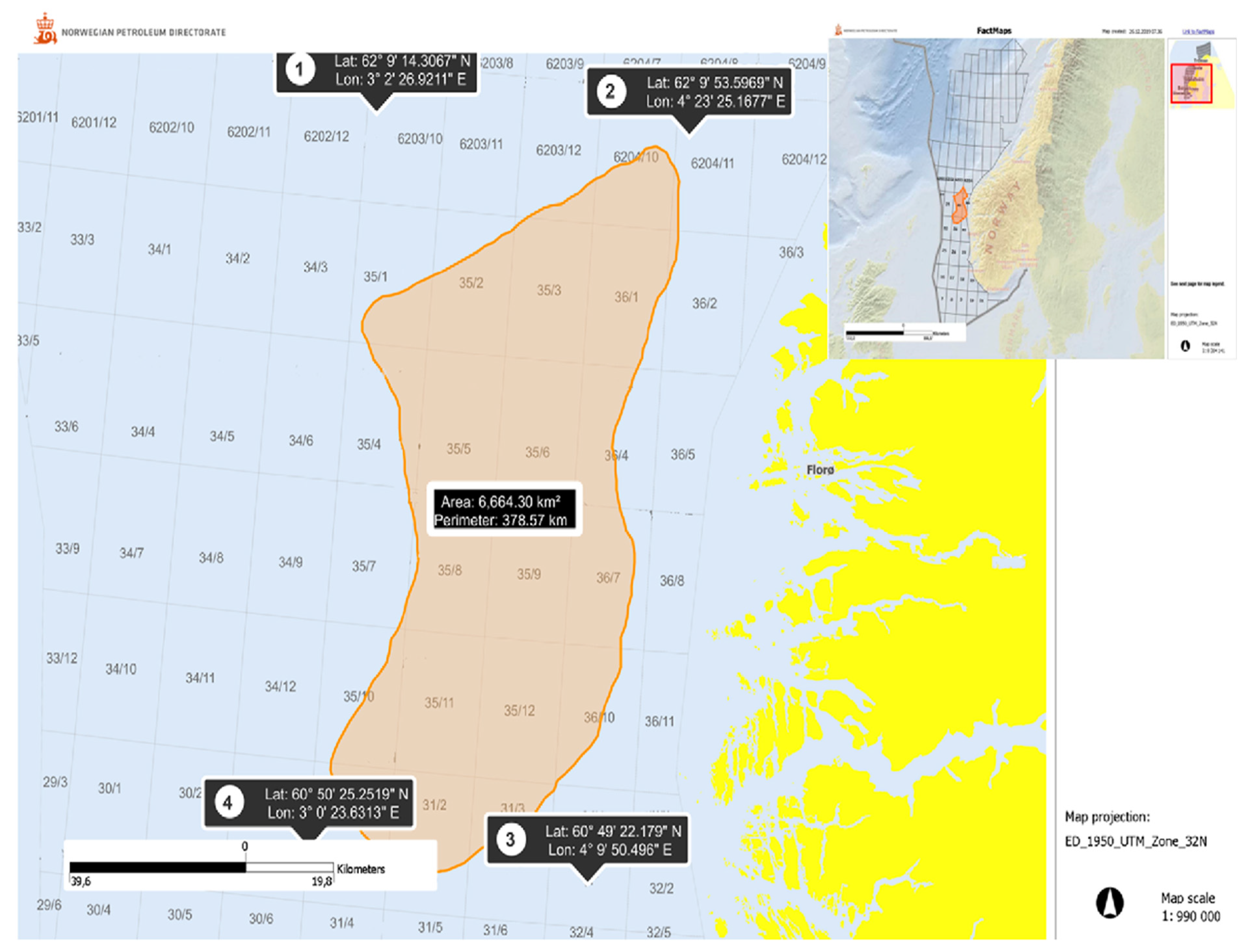
The northern Norwegian North Sea preserves a long-lived record of continental rifting, passive-margin subsidence, and Cenozoic post-rift tectonics that collectively contributed to the formation of a unique stratigraphic archive that hosts petroliferous reservoirs and source-rock organofacies e.g., [1,2,3,4]. While structural traps associated with Jurassic rift-block geometries have long dominated the petroleum exploration strategies, the post-rift sedimentary succession constituting the Cretaceous and Cenozoic strata hosts diverse stratigraphic architectures that remain comparatively underexplored. These include clinoformal shelf–slope–basin systems, mass-transport complexes, deep-marine channel–levee and lobe deposits, contourite drifts, and widespread transgressive–regressive shoreline packages that onlap regional unconformities [4,5,6,7]. Post-rift deposition in the northern Norwegian North Sea occurred after Late Jurassic rifting and subsequent thermal subsidence, which established broad accommodation across rift structures. The episodic uplift and margin tilting had modulated sediment supply and slope gradients, thereby developing a complex stratigraphic architecture of the post-rift succession. Moreover, Cenozoic basin reconfiguration—linked to the North Atlantic opening, dynamic topography, and high-latitude glaciation—further reworked the margin, generating stacked contourite drifts and glacigenic wedges that overprinted earlier deep-water systems. These complex tectono-sedimentary phases introduced uncertainties in the stratigraphic architecture of the seal and reservoir facies, thereby hindering predictive modeling and risk assessment in the region. Therefore, the ultimate objective of this contribution is to integrate seismic stratigraphy and sedimentologic analysis of the post-rift succession in the northern Norwegian North Sea (Figure 1) to (i) refine its sequence architecture and depositional evolution, and (ii) identify unrecognized, mappable stratigraphic elements with realistic charge access and seal capacity, thereby illuminating new hydrocarbon play concepts.
Although Jurassic structural traps have been widely explored in the North Sea, the Paleocene post-rift succession remains poorly constrained. This study integrates seismic stratigraphy and facies analysis to refine its depositional evolution and identify untapped stratigraphic plays. Integrating seismic stratigraphy with sedimentary facies analysis provides a scale-bridging framework for correlating depositional systems and mapping reservoir–seal relationships beyond well control [8,9,10,11,12,13]. This will allow identification of sand-body continuity at lobe fringes, the distribution of thin (<10–15 m) shoreface and mouth-bar units near unconformities, and the internal heterogeneity of mass-transport-prone slope prisms [13,14,15,16,17]. Moreover, establishing a seismic-sequence framework for the post-rift section in the northern Norwegian North Sea will allow recon-structing the sediment routing and depositional evolution of shelf–slope–basin systems through time, thereby providing new insights into a set of predictive play elements and fairway maps for stratigraphic trapping.

2. Geological Setting

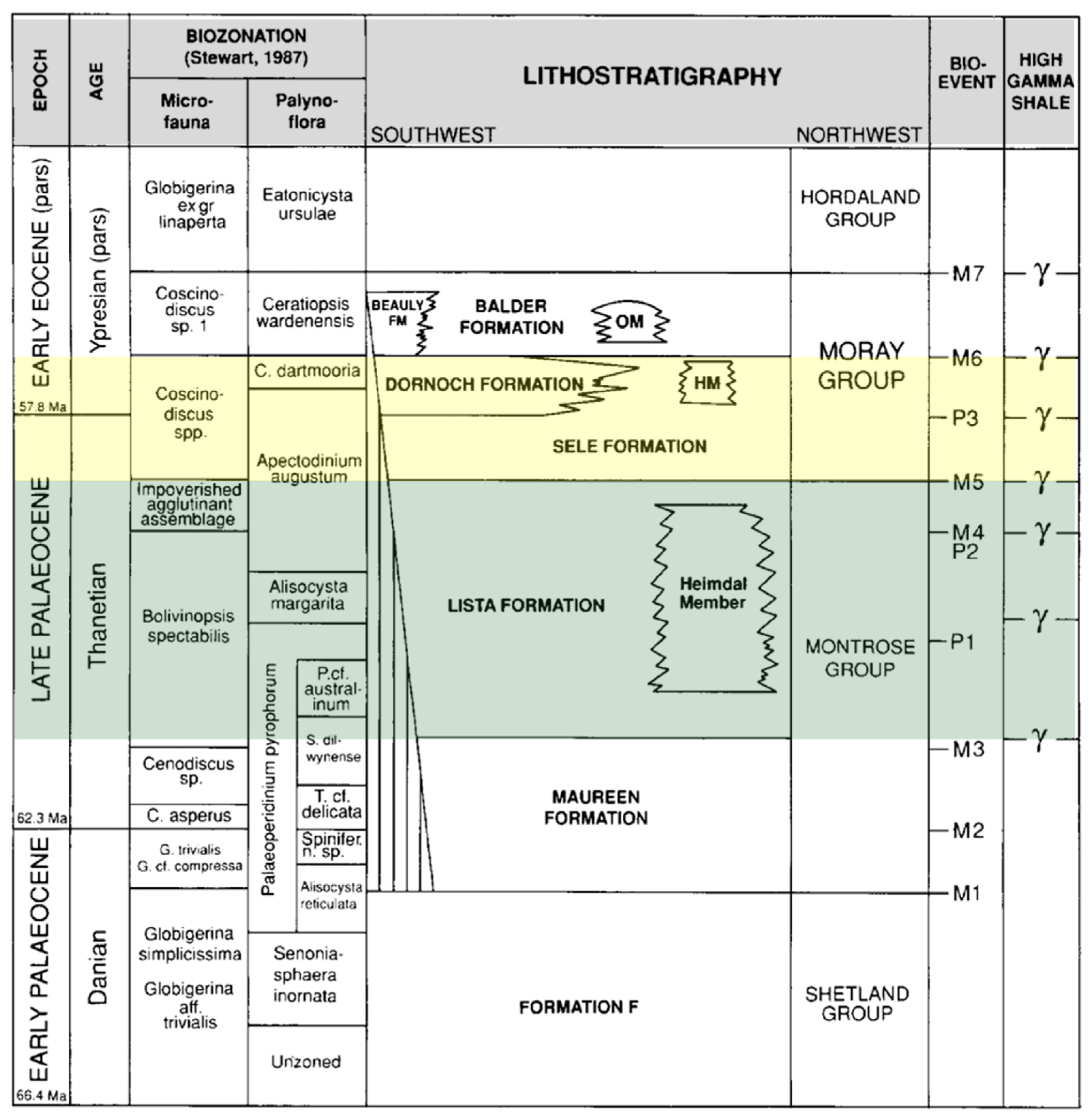
The study area is situated in the northern Norwegian North Sea, within key exploration blocks across the North Viking and Sogn grabens (Figure 1). It is part of the post-rift basin system that developed following Late Cretaceous tectonic events, during which substantial thicknesses of Paleocene–Eocene deep-marine sediments (>1000 m) accumulated [2]. These successions, which occur at burial depths of up to ~3000, record a major paleoenvironmental shift from carbonate-dominated to siliciclastic depositional systems. This transition was driven by regional tectonic reorganization and associated volcanic activity [2,6,18]. The Viking Graben is a predominantly Mesozoic structural province that was infilled with approximately 11,000 m-thick sediments that range in age from Triassic to the Quaternary (Figure 2). Structurally, the graben exhibits an asymmetric half-graben geometry, with major fault systems and the thickest syn-rift deposits concentrated along its western margin. The timing of rift initiation remains a subject of debate. While some interpretations suggest a pre-Permian onset [19,20], the prevailing consensus favors two principal rifting phases: the first during the Late Permian to earliest Triassic, and the second during the Late Jurassic. However, considerable debate surrounds the relative magnitude of crustal stretching associated with each rifting phase [21,22,23].
In the north Viking Graben, the syn-rift Upper Jurassic deposits, locally attaining thicknesses of up to ~1000 m [24], are preserved along the downthrown blocks adjacent to the rotational faults that delineate the western margin of the Graben. Cretaceous sediments accumulated across the structural highs, where a prominent angular disconformity separates the Humber Group (Bathonian–Ryazanian) from the overlying, predominantly argillaceous Cromer Knoll Group (late Ryazanian–late Albian). The Cromer Knoll Group typically exhibits progressive thinning towards major fault zones, with associated compactional normal-drag structures as common features. Ref. [25] attributed these patterns in the North Viking Graben to a significant, synchronous, basin-wide shift in tectonic regime. According to their interpretation, fault-block rotation associated with active rifting largely ceased towards the end of Ryazanian time, marking the termination of the main syn-rift phase. This was succeeded by a period of thermal subsidence, during which sedimentation was primarily governed by non-rotational basin subsidence and localized footwall uplift along basement-involved, planar normal faults [25].
Figure 2. A composite litho- and bio-stratigraphic chart of the Lower Paleogene sedimentary successions in the northern Norwegian North Sea. Modified after [26].
Geosciences 16 00184 g002
During the Paleocene, tectonic uplift linked to the Iceland hotspot generated significant topographic relief on the East Shetland Platform and the Scottish Highlands, substantially increasing sediment supply from western source areas. In contrast, the Norwegian mainland experienced comparatively subdued uplift, contributing only minor clastic influx to the basin [1]. This tectonic asymmetry terminated the carbonate deposition regime that prevailed during the Late Cretaceous and initiated extensive siliciclastic deposition [2]. Sediment delivery into the basin occurred via multiple gravity-flow processes, including turbidity currents, debris flows, and slumps, which operated in both confined and unconfined settings. These processes produced a range of deep-water depositional architectures, including channel-levee systems, lobe complexes, and mass-transport deposits [5]. Superimposed on these depositional patterns were second- and third-order eustatic fluctuations during the Paleocene–early Eocene [27,28], with regressive phases promoting the accumulation of sand-prone units and transgressive phases favoring fine-grained sedimentation along basin margins [2].

3. Data and Methods

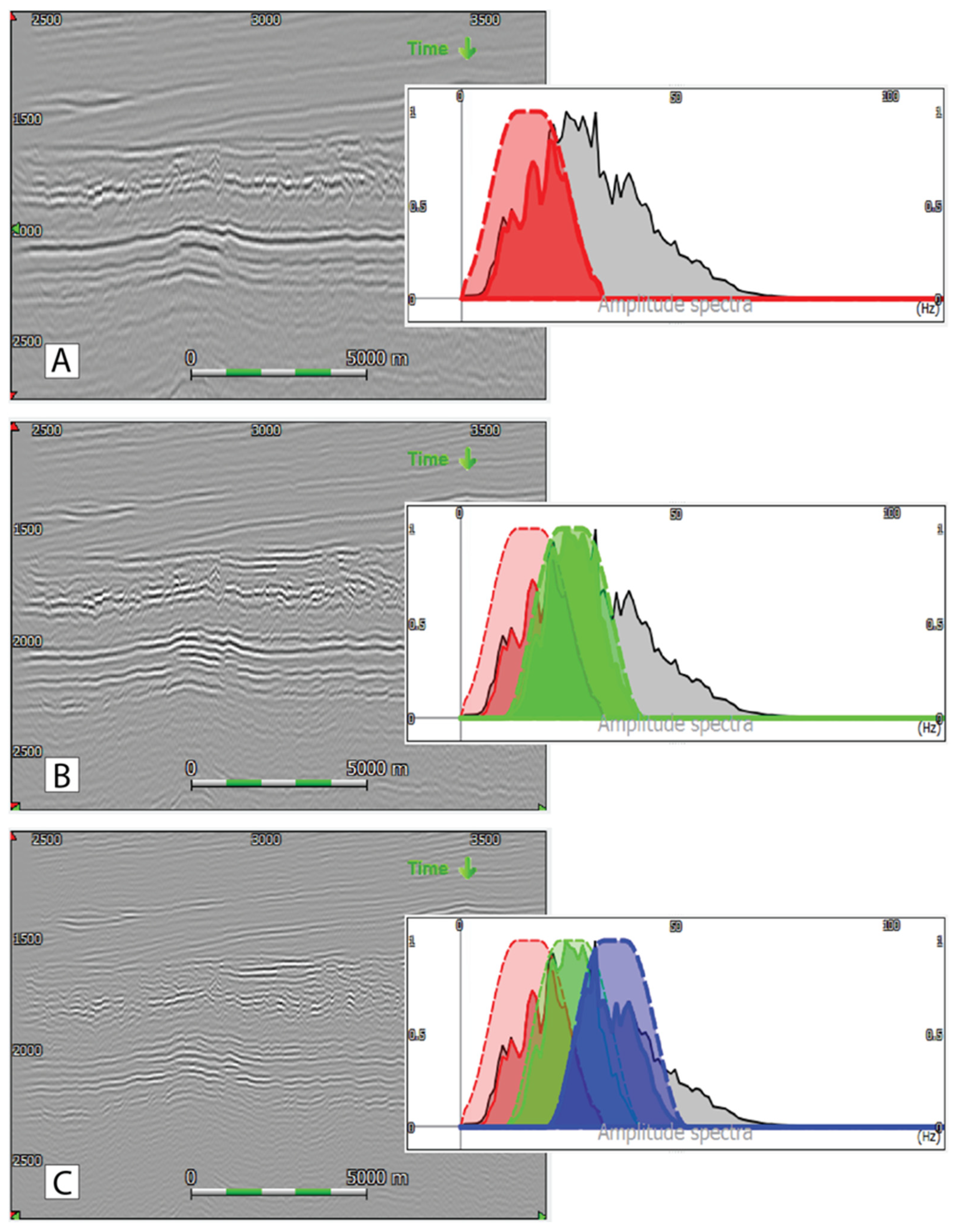
The study integrates 10 seismic profiles, 39 well logs, and two cores from the NPC-4 region (Figure 1). This region is classified by the Norwegian Offshore Directorate (NOD) as an unconfirmed petroleum play [7]. The seismic dataset comprises ten 2D seismic profiles and seismic volumes covering approximately 10,500 km2. The seismic data is post-stack, time-migrated seismic data, with a frequency range of 10–60 Hz. Frequency decomposition, with values of 15, 35, and 55 Hz, has been performed to define seismic geomorphological patterns. Well data includes logs (gamma ray, resistivity, sonic, neutron, and density) from 39 wells as well as conventional cores from two wells (35/12-2, 35/11-18). All the data mentioned above were obtained from the NOD.

3.1. Seismic Data Interpretation

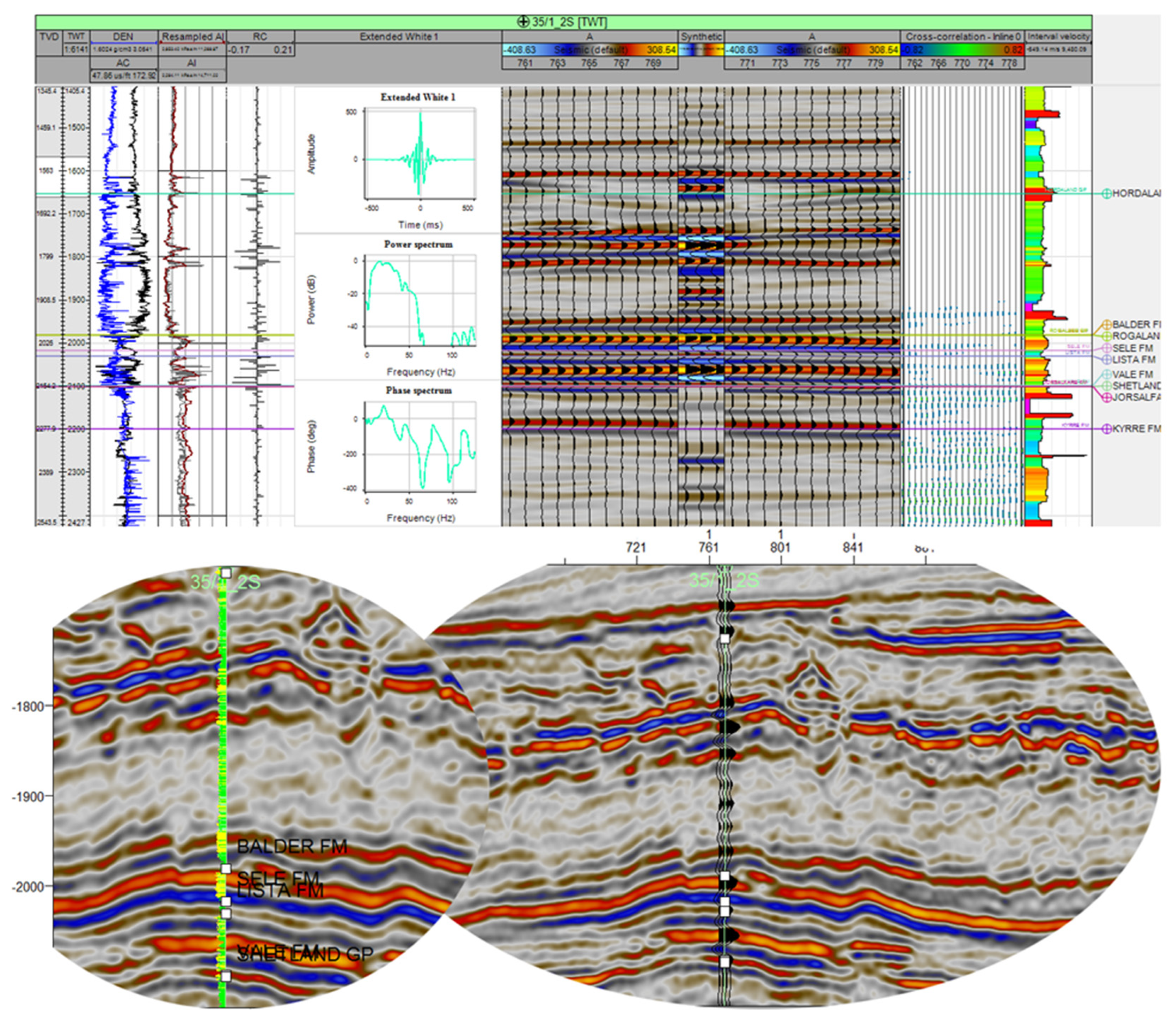
Seismic data analyses were conducted to support both structural and stratigraphic interpretation of the study area [29]. The workflow began with seismic-to-well tie, which correlates key stratigraphic markers with seismic reflections. This process utilized one-dimensional forward synthetic seismograms (Figure 3), generated by convolving sonic-density-derived reflectivity series with extracted seismic wavelets [30]. Seismic interpretation was conducted using Petrel (SLB), integrating synthetic seismograms for well ties and time–depth conversion. The integration of synthetic traces allowed for accurate time-depth conversion and the construction of a velocity model based on interval velocities derived from the 1D synthetics.
In addition, frequency decomposition was applied within carefully selected windows to highlight stratigraphic heterogeneities, such as channel systems, and to visualize their seismic geomorphological expressions (Figure 4). For spectral decomposition, discrete frequencies of 10, 30, and 50 Hz were combined in color-blended displays, enabling clear visualization of stratigraphic features across both time and stratal slices. Such frequencies were used for optimal detection of 5–10 m thick beds. For sequence-stratigraphic and seismic-facies analysis, a relative geological time (RGT) model was generated. This facilitated the construction of stratal and horizon slices, which were subsequently integrated with Wheeler transformations to discriminate, map, and trace depositional systems and facies distributions. The stratigraphic framework was interpreted in accordance with established seismic stratigraphic principles [9,31,32]. Key seismic stratigraphic elements—including stratal terminations, reflector configurations, seismic texture, reflector density, and geometric patterns—were systematically described. These criteria enabled the identification of package boundaries, external shapes/morphologies (e.g., sheet, mound, and fill shapes), and internal depositional textures/geometries (e.g., parallel, divergent, clinoforms, chaotics, and reflection-free), thereby providing robust insights into the evolution of sedimentary environments and the stratigraphic development of the basin. Depositional sequences and systems tracts subdivision and identification were done using the built relative geological time model (RGT), and Wheeler diagrams, following stratal stacking and configuration. Lowstand systems tracts were identified through progradational patterns and outbuilding seaward above an unconformity with an offlap break concaving upward. Transgressive systems tracts were marked by re-tergradational stacking and landward building up, with a coastal onlap. Highstand systems tracts were recognized upon progradation and downlapping the maximum flooding surface, with and offlap break convexing upward. Moreover, for seismic facies identification and paleoenvironment recognition, we followed standard depositional and sequence-stratigraphic models [31,32].

3.2. Wireline Logging Analysis

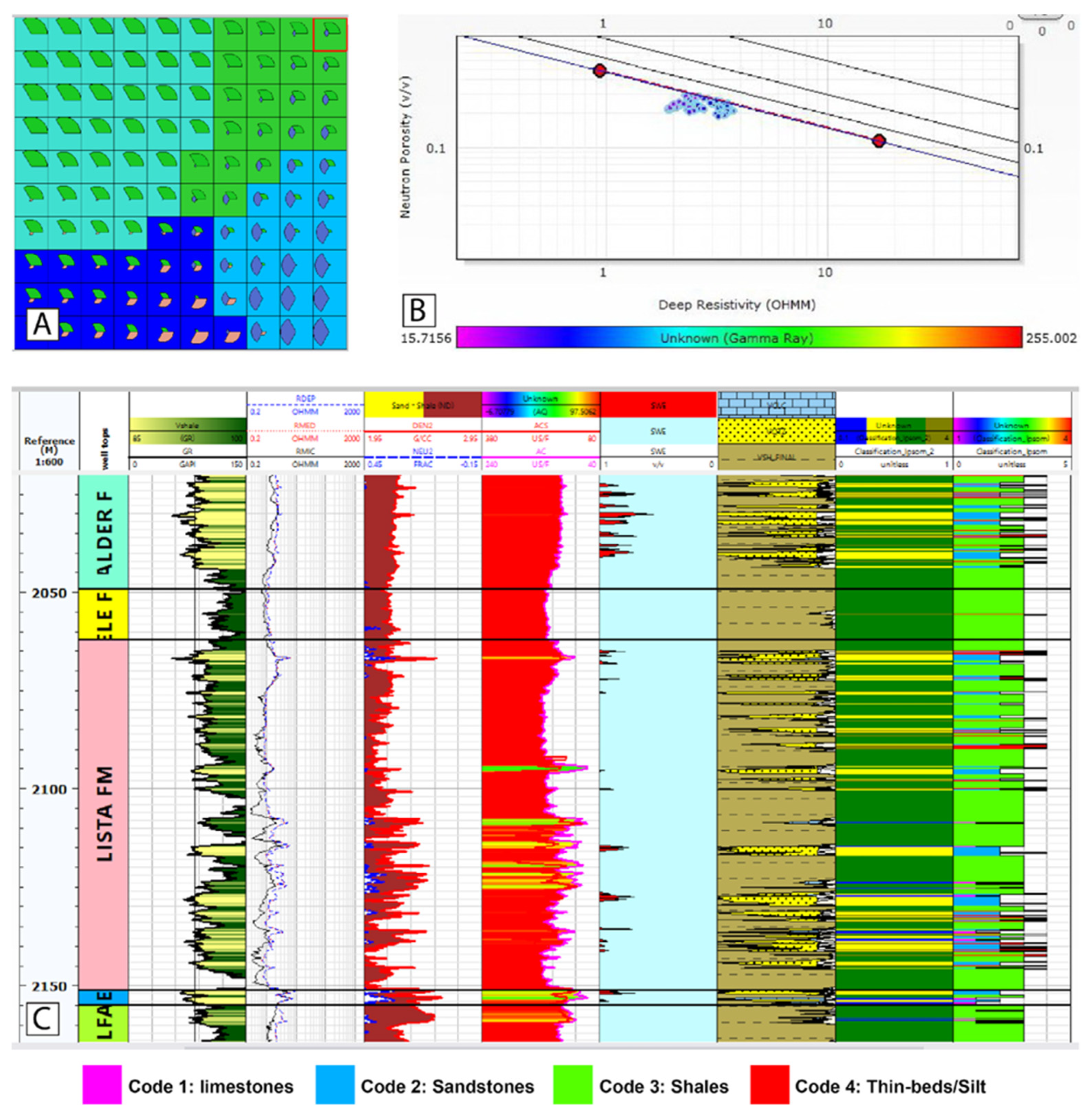
The wireline logging interpretation workflow involved identifying characteristic log motifs, delineating hydrocarbon-bearing play zones within the Lower Paleogene intervals studied, and quantitatively estimating key petrophysical parameters. These parameters include shale volume, total and effective porosity, and fluid saturations. Shale content was determined from a single-log indicator (GR), whereas porosity was derived using a crossplot technique that integrates density and neutron porosity logs. Water saturation (Sw) was calculated using the Indonesian equation, which is widely applied in shaly reservoir systems [33]. Formation water resistivity (Rw) and the cementation factor (m) specific to the AEB sediments were determined from Pickett’s plot methodology [34]. Machine learning-based electrofacies analysis using self-organized maps (SOM) was carried out in this study, precisely discriminating complex facies assemblages dominating the studied succession.

3.3. Sedimentary Facies Analysis

Conventional cores retrieved from several intervals in the Late Paleocene Lista Formation were systematically examined to characterize sedimentological attributes and infer depositional processes. Core logging documented lithologic properties (grain composition, grain-size distributions, sorting, and textural maturity), primary sedimentary structures, and ichnological features. These observations underpinned the identification and classification of discrete lithofacies within the cored interval. Lithofacies were then grouped into higher-order sedimentary facies associations to reconstruct depositional environments and stacking patterns. This facies-based workflow provides a process-oriented framework for interpreting stratigraphic architecture and predicting reservoir heterogeneity within the Late Paleocene sediments of the study region.

4. Results and Discussion

4.1. Seismic Stratigraphy

4.1.1. Syn-Rift Facies (Sequence 1)

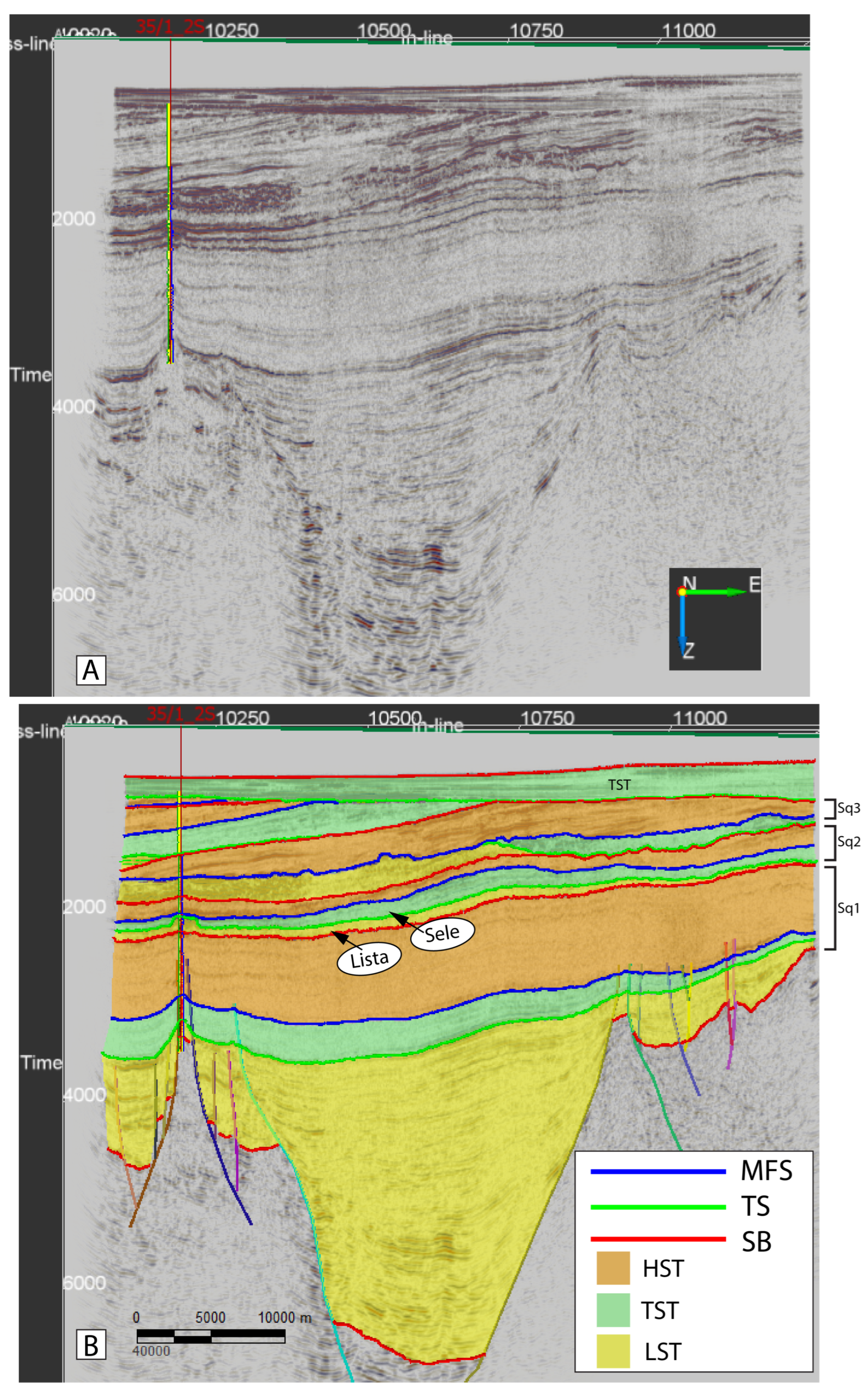
The Paleocene sedimentary succession forms part of the early post-rift fill in the central North Sea, draping deeply buried grabens and thinning onto adjacent horsts. It overlies a thick pre-Paleogene syn-rift megasequence dominated by lowstand systems tract (LST) clastic facies (Figure 5A,B). Pronounced thickness variations within the LST reflect strong structural partitioning, with packages exceeding 3000 m in rifted depocenters, whereas they thin markedly and locally pinch out over structural highs. Deposition of these LST facies coincided with rift-related structural reorganization and episodic marine incursions; inherited and syn-rift palaeotopography exerted first-order control on accommodation and sediment pathways, yielding a mosaic of shallow- to deep-marine systems, including fan deltas, fault-controlled submarine fans, and channelized complexes [35,36,37,38].
In seismic data, the LST typically exhibits vertically variable amplitudes that diminish upward, consistent with reflector continuity and indicative of upward fining or progressive condensation. Dominant frequency and amplitude tend to be higher over horsts—owing to shallower burial, reduced attenuation, and commonly coarser lithologies—and lower within basin depocenters. Localized high-amplitude, mounded to laterally continuous reflectors—interpreted here as submarine-fan sandstones—occur preferentially along structural culminations and relay zones, as shown in Figure 5A,B. Alternative explanations (e.g., mass-transport accumulations, diagenetically cemented sand bodies, or tuning effects) should be critically evaluated before assigning a final facies.
A regionally traceable, high-amplitude, and continuous reflector caps the syn-rift LST and marks the transgressive surface that initiates the overlying transgressive systems tract (TST). The TST comprises low-amplitude, semi-transparent reflections of near-uniform thickness, recording widespread marine flooding and the deposition of condensed deep-marine mudstones that constitute a prolific petroleum source across the northern Norwegian North Sea [38,39,40]. A second regionally persistent reflector corresponds to the maximum flooding surface (MFS). Although not a sequence boundary in the strict sense, the MFS marks the transition from retrogradation to progradation and separates the TST from the subsequent highstand systems tract (HST).
The HST displays transparent-to-semitransparent reflections, punctuated by local high-amplitude anomalies associated with small V-shaped incisions and mounded geometries. These features are consistent with shallow-marine channel–bar complexes, tidal inlets, storm scours, and shelf-ridge accumulations. While HST thickness is broadly uniform at the basin scale—consistent with thermal-subsidence-controlled accommodation during the post-rift phase—lateral variability in amplitude/frequency reflects facies heterogeneity and compactional or diagenetic overprint. Lithologically, HST facies encompass tide-dominated deltas and coastal spits, storm-influenced shorefaces, and shelf sand ridges, e.g., [41,42,43].
Collectively, the stacking from syn-rift LST to post-rift TST–HST documents a shift from structurally segmented, supply-dominated deposition to more regionally even, accommodation-driven shelfal sedimentation. Key predictive elements for stratigraphic trapping and reservoir distribution include: (i) sand-prone fairways localized along structural highs and relay ramps within the LST; (ii) regionally continuous, sealing and charge-generating TST mudstones at the base of the Paleocene; and (iii) heterogeneity within the HST related to ridge–inlet architecture and shoreface dynamics. Targeted seismic attribute analysis (e.g., spectral decomposition), AVO/impedance inversion, and rigorous well-to-seismic ties are recommended to discriminate true lithologic mounds from tuning or diagenetic artifacts and to refine sequence–stratigraphic correlations.

4.1.2. Post-Rift Facies (Sequences 2 & 3)

A regionally significant sequence boundary (SB) separates the syn-rift succession from the overlying post-rift strata, as shown in Figure 5A,B. On seismic profiles, the SB is expressed as an irregular, laterally persistent, high-amplitude reflector that erosionally truncates the upper syn-rift highstand systems tract (HST). This surface is overlayed by the low- to moderate-amplitude, discontinuous reflections of the Late Paleocene Lista Formation, which mark the onset of post-rift lowstand systems tract (LST) deposition. The amplitude–frequency character and external geometries of the Lista LST packages—ranging from sheet-like to mounded and locally channelized—indicate deposition in a confined to semi-confined deep-water setting. Pronounced lateral variations in amplitude and reflector continuity, together with shifts from tabular to mounded/chaotic internal configurations, record spatial changes in depositional processes and facies (e.g., channel–levee elements, lobe fringes, and mass-transport drapes). These observations are consistent with models in which sediment routing and sand dispersal were strongly modulated by inherited Mesozoic horst–graben topography, promoting focusing within structural lows and bypass across structural highs [44].
The Lista LST turbidites are overlain by the transgressive systems tract (TST) of the Sele Formation, where a prominent, high-amplitude transgressive flooding surface conformably caps the LST. Although the Sele TST exhibits a broadly similar seismic bandwidth and reflector continuity to the underlying Lista packages, reflecting persistent physiographic confinement and reactivation of the same feeder fairways, its more tabular, backstepping geometries and greater proportion of fine-grained drapes suggest reduced sand delivery during rising base level. Analysis of these post-rift deposits (sequence 2) refines our understanding of the interplay among relative sea-level change, inherited basin morphology, and sediment supply in shaping Paleogene stratigraphic architecture. Prior regional syntheses, which frequently generalize from the Sele Formation, e.g., [45,46], have tended to assume uniform depositional responses to base-level oscillations and simplified sediment-flux histories. In contrast, the Paleocene interpretations advanced here emphasize spatially variable accommodation and supply, leading to heterochronous stacking patterns across structural elements. This refinement bears directly on exploration strategy in the northern Norwegian North Sea, where the exhaustion of large structural closures elevates the importance of subtle stratigraphic traps and intra-field stratigraphic heterogeneity in producing assets.
A maximum flooding surface (MFS) separates the Sele TST from the overlying sequence-2 HST. Seismically, the HST comprises vertically and laterally variable amplitude–frequency packages with marked facies partitioning: proximal high-amplitude, gently mounded reflectors consistent with shoreface bars, storm-dominated shelves, or localized carbonate buildups; and more distal, discontinuous, patchy to disorganized high-amplitude intervals that pass basinward into thinner-bedded hemipelagic drapes, as shown in Figure 5A,B. The HST architecture records progressive progradation under relatively high accommodation, with downlap of clinoforms onto the MFS and local aggradation where sediment supply outpaced accommodation loss.
A sharp, erosional SB caps the sequence-2 HST and underlies the sequence-3 LST. Immediately above the boundary, proximal slope tracts display low-amplitude to seismic-transparent, chaotic facies, diagnostic of mass-transport complexes (MTCs), including slides, slumps, and debrites. Basinward, these transitions into higher-amplitude, mounded, and disorganized reflections are interpreted as ponded debrites and stacked MTD aprons within bathymetric lows—an arrangement typical of forced-regressive conditions and slope oversteepening. The overlying sequence-3 TST–HST exhibits complex seismic facies mosaics: (i) extensive hemipelagic flooding drapes across structural highs; (ii) localized carbonate mounds or hardgrounds in proximal areas; and (iii) the development of highstand, seaward-prograding clinoforms that signal the onset of deltaic to shallow-marine deposition. Clinoform foresets downlap onto flooding surfaces, while toplap/truncation along rollover crests indicates episodic stillstands and minor falls during late highstand progradation.

4.2. Relative Geologic Time Model

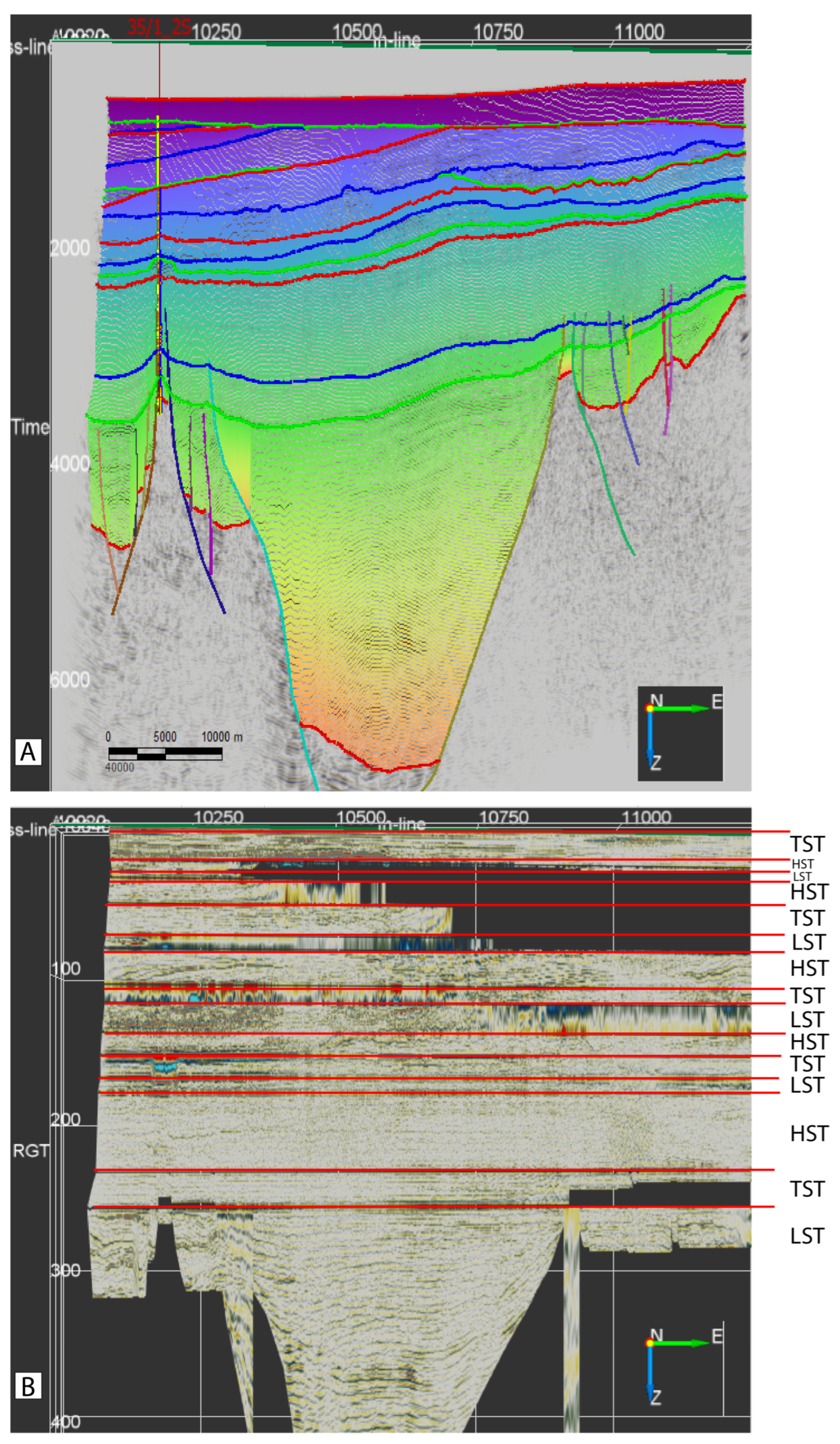
The relative geological time (RGT) model transforms the seismic cube into a chronostratigraphic domain in which reflections approximate time-equivalent surfaces, thereby minimizing structural dip, compactional effects, and fault throws. In this space, true stacking styles are clearly revealed: progradation by seaward-stepping clinoforms, retrogradation by systematic backstepping, and aggradation by subparallel, vertically accreting packages. The companion Wheeler diagram then flattens the section to time and makes explicit the alternation of lowstand, transgressive, and highstand systems tracts (LST, TST, and HST). Used together, these views enable us to read accommodation–sediment-supply changes through successive base-level cycles, locate sequence boundaries (SB) and maximum flooding surfaces (MFS), and distinguish sand-prone from seal-prone intervals with much higher confidence than in the untransformed seismic (Figure 6A,B).
A deep erosional canyon incises the section toward the left, cutting across older packages and being infilled by a thick, internally chaotic-to-weakly stratified body that onlaps its margins and truncates downward (Figure 6A). This geometry is diagnostic of a relative sea-level fall followed by canyon-confined delivery of gravity-flow deposits—an archetypal LST comprising channelized turbidites, slide/debris packages, and locally amalgamated sands. To the right, a set of downlapping clinoforms records shoreline and shelf-edge progradation typical of HST conditions; local toplap on the shelf edge suggests a late highstand stillstand or a subtle forced regression preceding the next fall. Overlying the canyon fill, smoother, high-continuity reflections onlap landward and drape pre-existing relief, marking a backstepping TST capped by condensed mud-rich flooding surfaces. Intervals of near-parallel, sheet-like reflectivity represent aggradational caps formed when accommodation and sediment supply were approximately balanced. Narrow normal faults locally offset reflections, but the RGT transform preserves time parallelism across throws, indicating that syndepositional subsidence modulated, rather than dominated, sequence architecture.
The Wheeler diagram corroborates these interpretations by showing the time–space distribution of deposition and hiatus (Figure 6B). LST packages appear as laterally restricted, wedge-shaped bands that pinch out upslope and thicken basinward, while shelf areas at the corresponding times exhibit gaps that reflect bypass or subaerial/shoreface erosion at SBs. TST intervals form thin, laterally continuous bands that drape across antecedent relief and are terminated upward by regionally mappable MFSs—prime chronostratigraphic tie points and typical seal levels. HST bands expand basinward through time, consistent with progradational parasequence sets; subtle thinning or terminations at the shelf edge in the Wheeler domain match the toplap seen in the RGT view. Taken together, the two panels document repeated third-order cycles of incision and bypass (SB → LST), backstepping and condensation (TST → MFS), and renewed progradation (HST), followed by the next fall.
Within this framework, SBs correspond to the canyon base and to surfaces of toplap/truncation across the shelf edge; updip, they are erosional unconformities, and downdip, they pass into correlative conformities. Maximum flooding surfaces cap each TST and appear as the most continuous, thin timelines in the Wheeler diagram; these surfaces are regionally correlative, excellent for well ties, and commonly bound pressure-baffle or seal intervals. Transgressive ravinement surfaces are recognized where backstepping TST reflections onlap and rework the tops of the preceding HST, producing sharp shifts from sandier progradational facies to mud-rich drapes.
The implied depositional processes are internally consistent. Lowstands focused sand delivery through canyon-confined turbidity systems with channel–levee complexes and lobe transitions; these are net-to-gross-rich but heterogeneous, with erosional bases, amalgamation, and interbedded mass-transport deposits. Transgressions favored widespread hemipelagic-to-pelagic muds and condensed lags that blanket relief and provide regionally persistent seals. Highstands re-established shoreface-to-delta-front progradation, building clinoforms that fed thin-slope aprons and minor gullies basinward while stacking parasequences updip. Shelf-edge trajectory analysis inferred from the RGT clinoforms indicates alternations between ascending or flat trajectories during aggradational to progradational highstands and descending trajectories during forced regression associated with canyon cutting. These shifts require changes in the balance of accommodation and sediment supply, plausibly linked to relative sea-level oscillations modulated by local subsidence and sediment influx. In synthesis, the combined RGT and Wheeler analyses reveal a repetitive triplet of LST incision and focused sand delivery, TST backstepping and regionally continuous sealing, and HST shoreline progradation. This cycle-based framework explains the observed geometries, provides robust chronostratigraphic surfaces for correlation, and offers predictive power for the spatial distribution of reservoirs, seals, and stratigraphic traps across the margin.

4.3. Seismic Facies and Geomorphology of the Paleocene Sequences

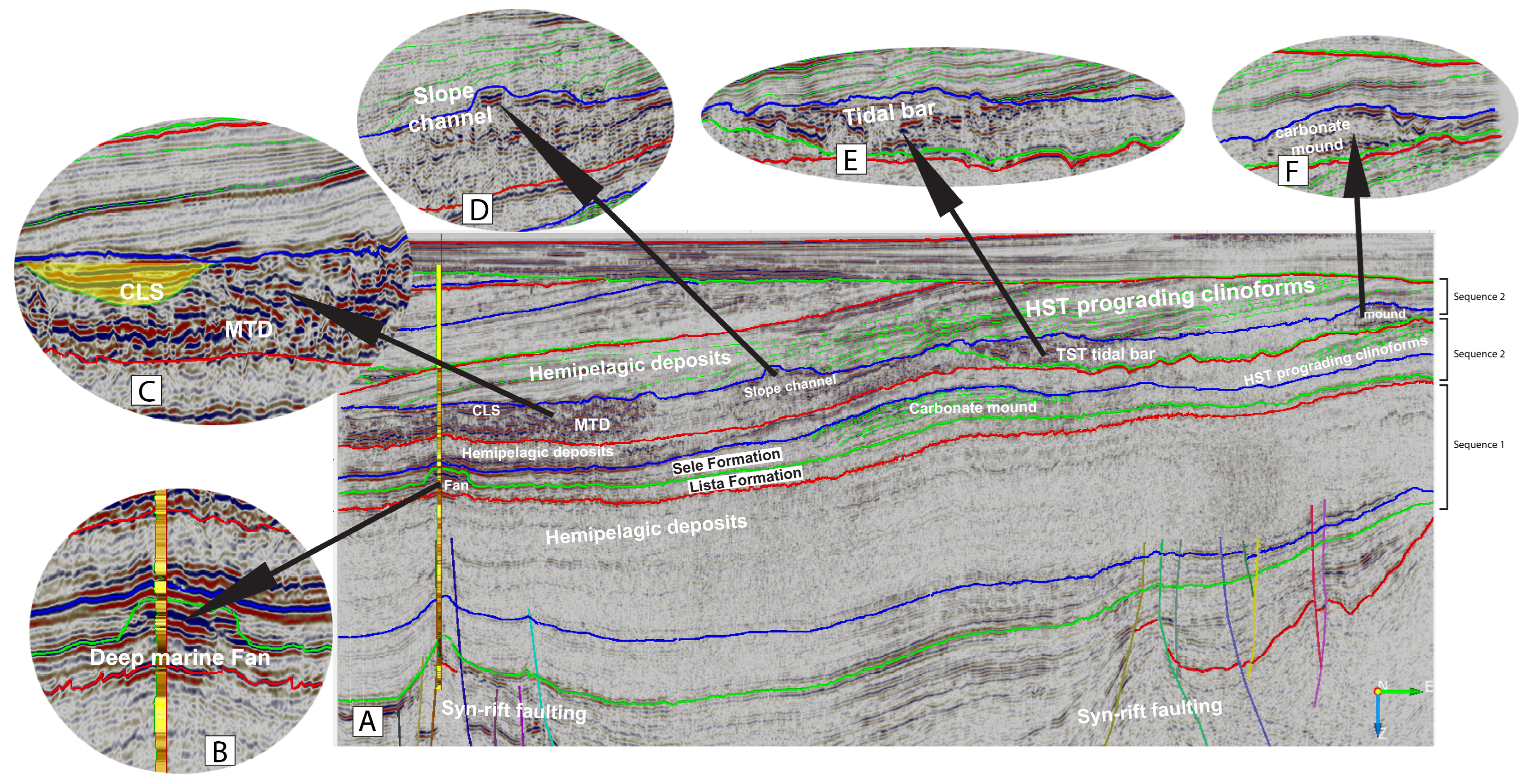
Seismic stratigraphic analysis illustrates a well-defined post-rift depositional architecture, organized into two successive depositional sequences that overlie a syn-rift structural framework. The Lista Formation shows three primary seismic facies: submarine fan lobes, mass-transport deposits (MTDs), and channel–levee systems. The lower sequence is initiated by a lowstand systems tract (Lista Formation), represented by deep-marine fans that accumulated within fault-controlled depocenters basinwards. These fans, highlighted by lens-shaped, high-amplitude packages, document the delivery of sand-prone turbidites to the basin floor. Associated with these fans are channel levee systems, identified as ribbon-like geometries with continuous, bright basal reflections encased by muddier levees. Their presence suggests focused sediment transport along confined conduits. Adjacent to these elements, mass-transport deposits characterized by chaotic to transparent seismic facies indicate slope instability and gravitational collapse, most likely triggered by oversteepening or tectonic reactivation along syn-rift faults (Figure 7A–C). These observations reveal paramount control of earlier syn-rift tectonics on sediment routing and the accumulation of sandstone lobes. A similar observation was reported by [47] in the Lista Formation of the UK central graben, where the sandstones are composed of distinct axial and lateral routing systems.
As the relative sea level rose, the basin experienced widespread transgression, recorded by hemipelagic drapes of low-amplitude, laterally persistent reflections that blanket the inherited relief. These mud-rich intervals represent condensed sections and maximum flooding surfaces, forming stratigraphically significant regional seals. Within this transgressive window, carbonate mounds nucleated locally, displaying positive relief and semi-chaotic internal seismic character. Their stratigraphic position and association with reduced siliciclastic input suggest that they developed during phases of limited terrigenous supply, potentially linked to biogenic or authigenic carbonate growth.
The overlying sequence captures the transition into renewed highstand progradation. Initially, tidal bars developed in more proximal settings, identified by internally stratified, moderate-amplitude bodies perched above the transgressive muds. These bar forms represent tidally influenced shoreface and inlet complexes formed during base-level rise. Subsequently, highstand conditions established a shelf-margin delta system that constructed basinward-prograding clinoforms 7D–F. The sigmoidal to oblique foresets, terminating in downlap against hemipelagic muds, record sustained sediment supply and margin progradation. Locally, slope channels incise these clinoforms, redistributing sediment downslope and linking the shallow-water delta system to the deeper basin floor.
The stratigraphic evolution of the Paleocene succession reflects a shift from sand-rich gravity-driven systems during lowstands, through starved hemipelagic drapes and carbonate-mound growth during transgression, to robust clastic progradation during highstands. Structurally, syn-rift normal faults exerted a strong control on sediment distribution by partitioning accommodation space, guiding slope conduits, and creating localized depocenters for mass transport and fan accumulation. Fault-related fluid migration may also have contributed to mound nucleation.
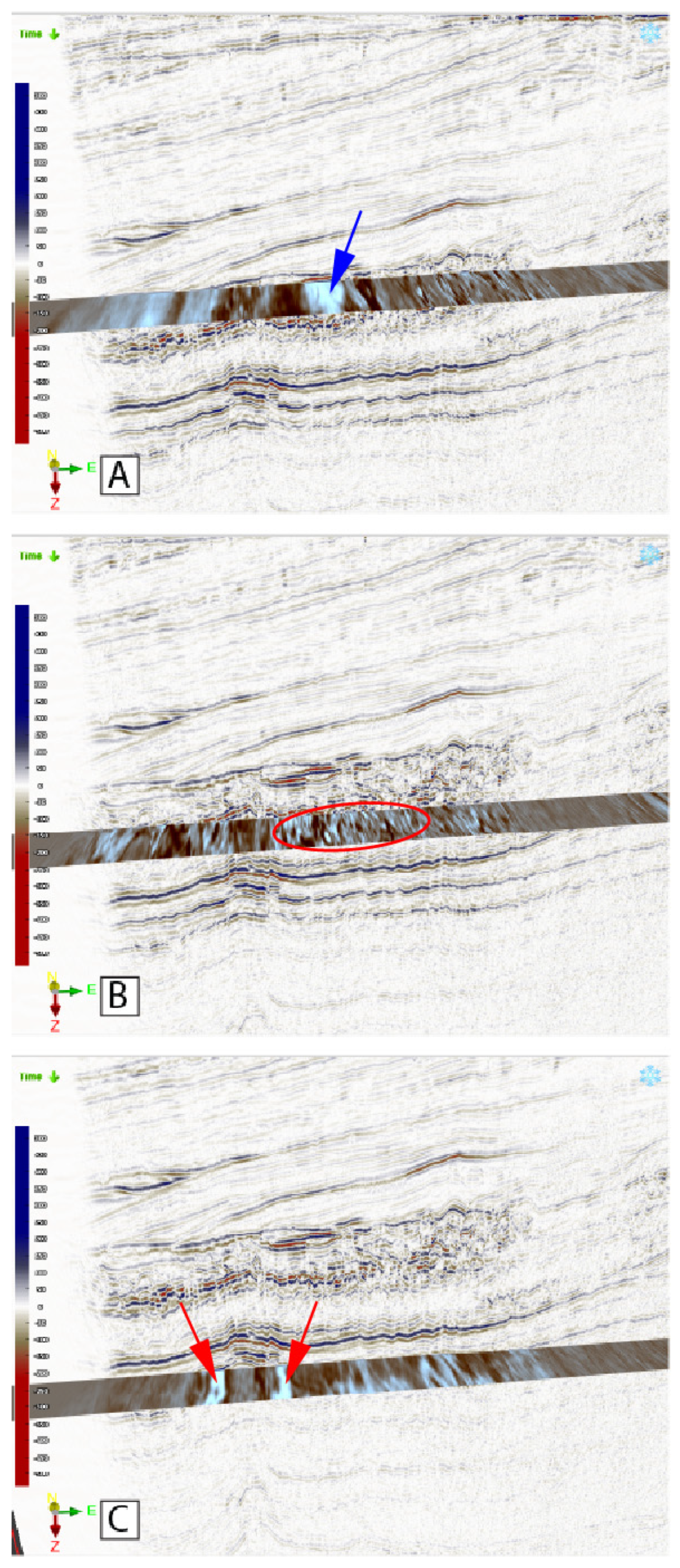
A slope-to-basin-floor seismic section of the Paleocene Lista Formation (Figure 8A–C) records a lowstand-dominated supply pulse that fed basin-floor channels and fans, as shown in Figure 8A,C, punctuated by slope failure and remobilization (Figure 8B). The inherited syn-rift topography organized accommodation and routing, while short-wavelength relative sea-level and supply fluctuations modulated the stacking of sand-rich and mud-rich elements. The channelized fan system (basin-floor lobe complex) exhibits a laterally expansive, lens-shaped, moderate- to high-amplitude package with internal semi-continuous reflections that thin and taper basinward and upsection. Internal architecture comprises weakly convergent foresets and discontinuous, sheet-like subunits bounded by low-amplitude drapes—diagnostic of compensational stacked turbidite lobes fed by ephemeral distributary channels. Amplitude attenuation towards the fringes and the smooth, downlap-style basal contact imply progressive lobe thinning into muddy basin-floor drape. The geometry, amplitude character, and compensational stacking support interpretation as a channelized fan system in a basin-floor setting during lowstand systems tract (LST) time, with sand delivery focused along a few conduits that repeatedly avulsed across the lobe surface. Expect vertical alternations of clean, structureless to faintly laminated sand (axial lobe beds) with thin mud caps, transitioning laterally and upsection into more heterolithic, ripple-laminated, current-reworked sand–silt at lobe fringes.
The channel–levee system (slope conduit) is represented by a ribbon-shaped, relatively continuous, bright basal reflector flanked by lower-amplitude. These parallel-to-divergent reflections gently rise away from the thalweg (Figure 8A). The asymmetric levee relief, local cut-and-fill, and preservation of overbank drape are characteristic of a confined channel–levee complex on the lower slope to proximal basin floor. The thalweg shows a chaotic-to-discontinuous internal character in places (sand-rich fill, scours), whereas levees show finer-grained, low-amplitude draping with occasional crevasse splays. This conduit plausibly fed the lobe complex. Typical reservoir partitioning includes high net-to-gross, better-sorted sands confined to channel axes and splay lobes; levees are muddier, which baffles flow and promotes compartmentalization. Mass-transport deposits (slope failure complex) shown in Figure 8B illustrate the internally chaotic-to-transparent seismic character bounded below by a sharp, erosional surface and above by a smoother, draping reflection set. Local blocks and striated fabrics, abrupt thickness variability along strike, and a rugose basal shear plane indicate a mass-transport deposit (MTD) composed of slumps to debris-flow packages. The MTD pinches out laterally into undeformed strata and locally incises underlying reflections, consistent with failure along an oversteepened slope margin. This failure episode likely post-dates an initial phase of channelization and preceded (or temporarily disrupted) fan lobe building, creating topographic roughness that buttressed subsequent flows.
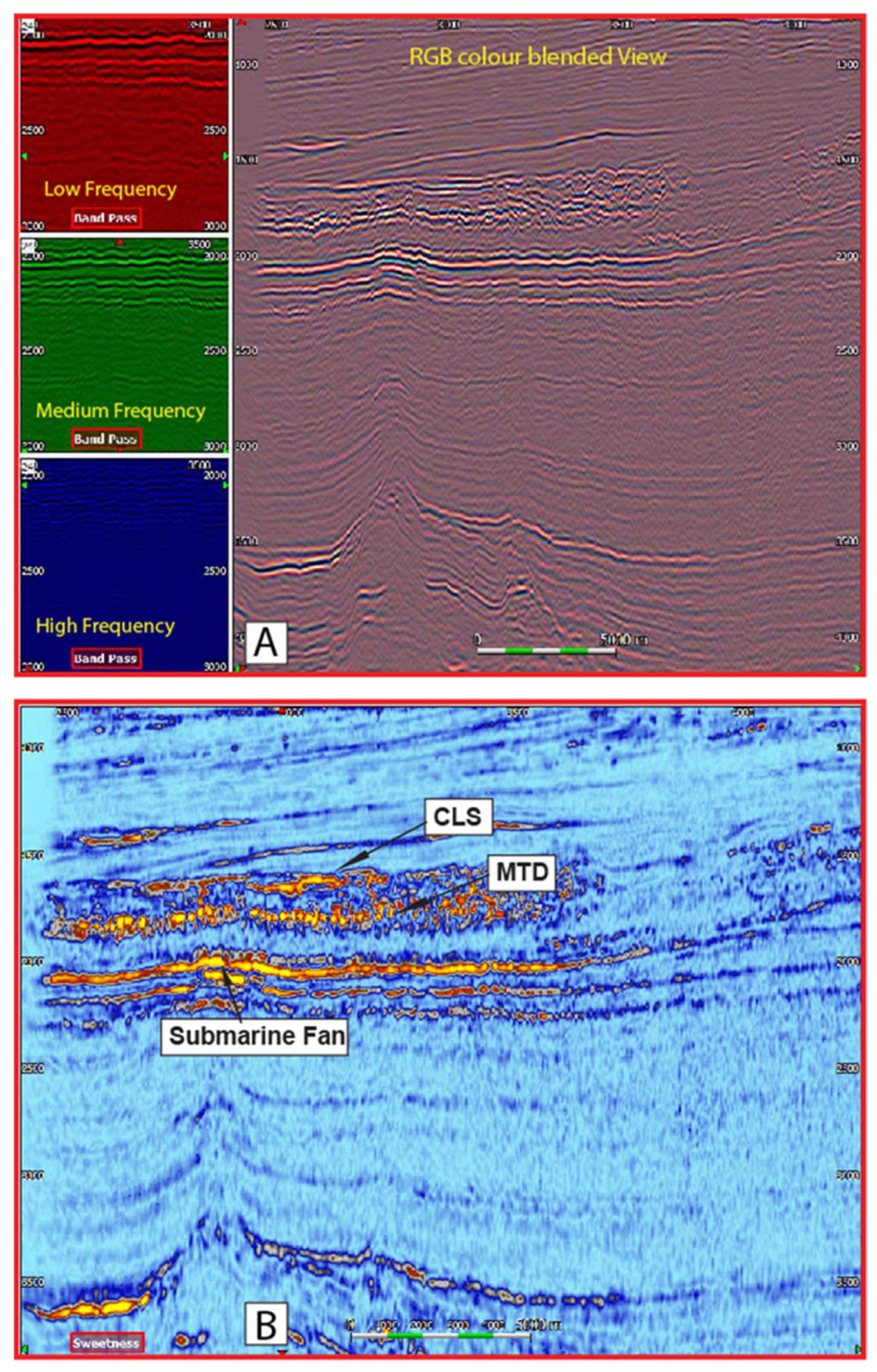
The RGB composite clearly highlights the seismic characteristics of the three key seismic facies within the Lista Formation, as shown in Figure 9A. The submarine fan (basin floor) is predominantly expressed in warm hues (orange–yellow), indicating the dominance of low to medium frequencies. This spectral character is consistent with thicker, compensatorily stacked lobe bodies whose internal reflections are laterally continuous but exhibit gradual amplitude attenuation toward the lobe fringes. The subdued blue component (high-frequency energy) along the fan axis suggests fewer sharp impedance breaks (e.g., fewer thin interbeds) than at the lobe margins, aligning with an axial, sand-rich core and finer, heterolithic fringes. The fan’s smooth downlap/mantel surfaces onto basin muds are visible as a muted, greyish halo in the blend, marking the lobe fringe and a potential stratigraphic seal.
MTD (slope failure complex) presents as a patchy, mottled color with abrupt hue changes over short distances—an expression of mixed spectral content from chaotic fabrics, rotated blocks, and shear bands. Local clusters of red–yellow patches mark thicker, internally more homogeneous rafts, while blue streaks highlight thin, strained intervals or shear-zone veneers. The spectral heterogeneity and irregular edges support an interpretation of slump–debris flow packages emplaced over an erosional basal glide plane, later draped by hemipelagic muds. Channel–levee system (CLS) appears as narrow, sinuous ribbons with relatively more green–blue content than the fan lobes. Their higher blue contribution reflects thinner levee strata and sharper internal boundaries (cut-and-fill, terrace surfaces, crevasse splays). The channel axis may show locally warmer tones (sandier, thicker fill), transitioning to cooler hues across the levee crest, capturing the grain-size and thickness gradients inherent to overbank deposition [48].
The sweetness volume, as shown in Figure 9B—highlighting zones of high instantaneous amplitude at relatively low instantaneous frequency—clarifies the sand–mud partitioning across the Lista slope-to-basin system. The basin-floor submarine fan appears as laterally continuous, high-sweetness bands that trace the axial lobe fairway; these ribbons attenuate and fragment toward the margins, consistent with a transition from thicker, cleaner turbidite beds in the lobe core to thinner, more heterolithic fringe deposits. Updip and along strike, the channel–levee belt is expressed as narrow, linear sweetness highs that delineate sand-prone channel fills and crevasse-splay aprons, flanked by systematically lower-sweetness levees that reflect muddier overbank drape and potential baffles. Interposed between these conduits and the fan, the mass-transport complex shows a mottled-sweetness fabric: discrete bright spots correspond to coherent slide blocks or coarse debris lenses that retain impedance contrast, whereas the surrounding low-sweetness matrix marks mud-rich, acoustically transparent debris and shear zones. This spatial pattern implies a linked lowstand routing system in which channelized flows fed sand into the fan, while slope failure periodically reconfigured pathways and imposed strong heterogeneity and compartmentalization; accordingly, the sweetest, most continuous responses in the fan axis and channel cores represent the highest reservoir potential, whereas the MTD matrix and levees provide local seals and baffles that may enable stratigraphic or combination traps along lobe pinchouts and MTD margins.
The RGB spectral blend and sweetness extraction together delineate the lowstand submarine-fan system of the Lista Formation, fed by channel–levee conduits and intermittently disrupted by mass-transport processes. Warm-hued RGB patches and continuous sweetness highs on the basin floor indicate sand-rich lobe axes with strong reservoir potential; CLS axes provide additional targets but with levee-induced baffles; MTDs introduce pronounced heterogeneity and local traps along their margins and within slide blocks. With careful tuning control, inversion tie, and stratal extraction, these attributes form a robust predictive framework for reservoir distribution, seal continuity, and trap geometry across the slope-to-basin transition.

4.4. Sedimentary Facies of the Paleocene Sequences

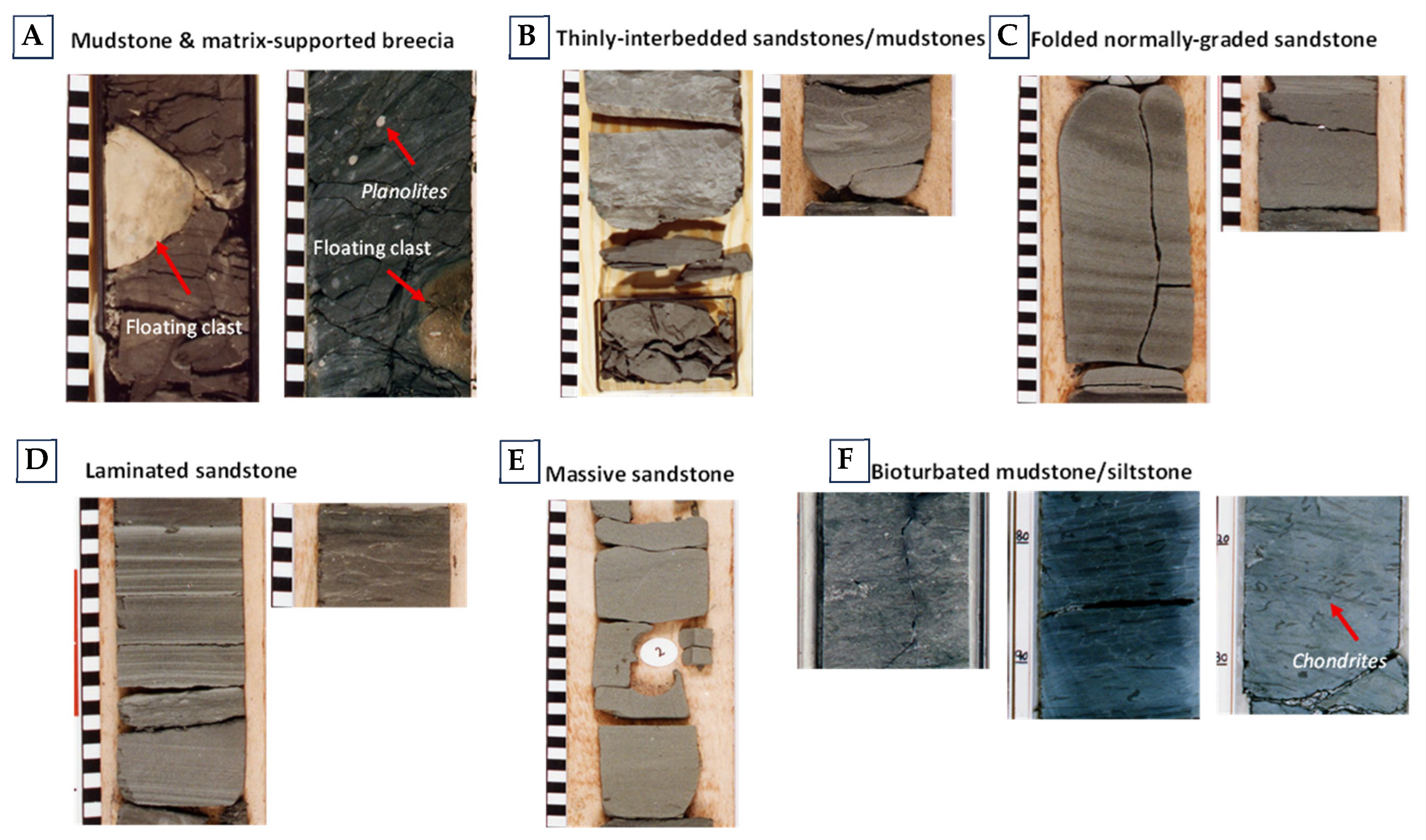
Core data confirm interbedded sandstone–mudstone lithofacies typical of turbiditic systems (Figure 10A–F). Analysis of the cored interval from the lowstand systems tract (LST) of Sequence 2 of the Lista Formation, as shown in Figure 10A,E, indicates a dominance of mixed sandstone–mudstone lithofacies. The mudstone association comprises homogeneous to massive units containing matrix-supported breccias with dispersed, angular “floating” clasts, as shown in Figure 10A. Syndepositional deformation structures—microfaults, slump folds, and minor shear bands—are common (Figure 10C). These attributes are diagnostic of deep-marine debris-flow and mass-transport deposition, wherein cohesive, high-viscosity gravity flows entrain and preserve large lithic fragments within a fine-grained matrix. The angularity and poor sorting of the breccia and intraclasts, together with their suspension within mud, imply short transport distances and rapid emplacement under high shear stresses, recording the dynamic conditions of mass-flow systems [49,50].
Overlying and intercalated with these units are thinly interbedded sandstone–mudstone couplets that display convolute bedding and sharp, erosive bases and tops. These couplets are interpreted as the product of episodic low-density turbidity currents alternating with quiescent hemipelagic settling (Figure 10) [5,51]. Their geometry and textural character are consistent with lobe-fringe to interlobe accumulation on a submarine fan, where waning flows deposit fine sand to silt in tabular beds, e.g., [52]. Upsection, these heterolithic beds grade into normally graded, fine- to medium-grained sandstones that retain evidence of syndepositional deformation (slump folds, microfaults), reflecting rapid loading and soft-sediment failure during early burial.
The graded sandstone facies exhibit vertical trends characteristic of deposition from high-density turbidity currents: coarse, denser fractions are rapidly stripped from suspension and settle first, followed by progressively finer grains as the current decelerates. This vertical suspension-fallout mechanism yields normal grading and sharp bounding surfaces that mark abrupt shifts in depositional regime—an expression of pulsed, short-lived but energetic sediment delivery [53]. Collectively, these attributes underscore the pulsatory behavior of gravity-flow systems within a deep-marine fan
Upwards, the graded beds pass into massive, parallel-laminated sandstones stacked into an overall fining-upward motif (Figure 10A–F). The massive intervals are coarse-grained, poorly sorted, sharply based, and gradationally topped, lacking internal structures—features consistent with the rapid, high-concentration phases of turbidity currents and indicative of lobe-axis deposition. The overlying parallel-laminated, fine-grained, argillaceous sandstones record deposition under comparatively steady, sustained traction with intermittent fluctuations in flow energy; these beds correspond to outer-fan turbidites approximating the Bouma Tb division [51]. Finally, laminated sands grade into dark, bioturbated mudstone–siltstone characterized by abundant Chondrites and Planolites, representing pelagic to hemipelagic drapes accumulated in a distal, low-energy setting with overall reduced sedimentation rates.

4.5. Implications for Untapped Petroleum Plays in Late Paleocene Sequences

Through the integrated application of seismic stratigraphic interpretation, seismic geomorphology, and sedimentary facies analysis, we reconstruct a process-based model of sediment routing and sand distribution within the Late Paleocene Lista Formation. The combined evidence reveals a hierarchy of sediment-transport pathways in which well-defined axial and lateral fairways steered turbidity currents and governed the partitioning, thickness, and geometry of sand bodies. Axial corridors funneled flows along the basin’s structural grain, whereas lateral fairways captured flow deflection, spill, and reworking at fairway margins and across topographic saddles. Average effective porosity values range from 12–18% in clean sand intervals, with localized low-Sw zones (~20%) that support viable hydrocarbon storage.
In the Norwegian North Sea, the inherited Mesozoic syn-rift physiography—expressed as horsts and half-grabens—exerted first-order control on accommodation, gradient, and confinement, thereby dictating where axial conduits formed and where lateral spill pathways developed. This structural template explains the observed facies asymmetry and sand-thickness variability across the Lista depocenter and is consistent with regional patterns documented elsewhere in the North Sea. Specifically, our results substantiate the dual west–east axial routing systems envisaged by [54] for the Central Graben and confirm the presence of lateral depositional pathways proposed by [55], refining both concepts by tying them to mapped geomorphic elements and their stratigraphic stacking.
A systematic proximal–to–distal facies transition is observed: carbonate-mound buildups in proximal settings give way basinward to slope-channel belts and distributive submarine-fan elements. In the distal and marginal reaches, Lista sandstones occur chiefly as intermediate- to thin-sheet- or lobe-like bodies interbedded with mud, forming sand- or mud-prone heterolithic successions (Figure 11). These packages reflect lobe-fringe deposition, levee/overbank aggradation, and localized mass-transport reworking, with limited amalgamation outside the most confined axial corridors.
Petrophysically, this architecture manifests as low net-to-gross with heterolithic log responses and thin-bed effects; the cleanest sand responses coincide with the mapped axial strands, while lateral fairways tend to show greater mud admixture, higher water saturations, and stronger vertical baffles. Consequently, reservoir quality and connectivity are expected to be highest where axial confinement promotes bed amalgamation, and lowest across distal sheets and lateral spill zones. Collectively, these findings validate and sharpen earlier conceptual models [54,55,56,57,58,59] by demonstrating that structural inheritance regulated both axial conveyance and lateral redistribution of turbidity currents, thereby controlling sand-body geometry and distribution within the Lista Formation. The resulting dispersal framework provides predictive guidance for targeting sand-prone nodes (e.g., axial–lateral intersections and confined axial segments) and for anticipating heterogeneity in more distal, thin-bedded domains.
Sedimentary facies analysis confirms the presence of axial submarine fan lobe sandstones, which are interbedded with debris flow and hemipelagic facies (Figure 10A–F). These facies provide a combination of excellent reservoirs interbedded with cap rocks, thereby forming potential stratigraphic traps that are poorly investigated in the northern Norwegian North Sea (Figure 11). The petrophysical well log analysis confirms the mud-rich character of the Lista Formation. Shale content (Vsh) is generally high, reducing net-to-gross ratios to around 0.15 when only clean sands are considered, but increasing to approximately 0.20–0.25 if thin-bedded sand–silt facies are included as effective net pay. Effective porosity (ϕe) values are typically low to moderate, with noticeable increases restricted to the sandstone intervals where cleaner grain compositions and reduced clay content prevail [56,57,58,59,60]. Water saturation is generally high across the formation, although localized zones within the sandier electrofacies exhibit reduced Sw, highlighting intervals of better reservoir potential. Nonetheless, the thinness and heterolithic nature of these sands limit their connectivity and capacity as continuous reservoir units. Reservoir potential within the Lista is therefore heterogeneous and compartmentalized, with effective flow capacity constrained by shale intercalations and thin-bed effects. While local sandstone layers exhibit improved porosity and lower Sw, their limited thickness and lateral extent make them more suitable as stratigraphic baffles or secondary targets rather than primary reservoirs.

5. Conclusions

  • The present study utilized an integrated seismic stratigraphic, petrophysical and sedimentary facies analysis approach to delineate the untapped stratigraphic traps within the Lower Paleogene sedimentary succession of the northern Norwegian North Sea.
  • The base of the Paleogene succession is typified by the lowstand systems tract (LST) of the Lista Formation, which constitutes the primary focus for reservoir development and stratigraphic trap definition.
  • Carbonate mound deposition prevailed proximal to structural highs, thereby reflecting localized shallow-water carbonate productivity during the early post-rift phase.
  • The carbonate facies change basinward into mass-transport deposits (MTD) consisting mainly of debris flows and high-density turbidites grading upward into hemipelagic drapes and low-density turbiditic mudstones.
  • Seismic attribute mapping reveals that the turbidite-prone units are characterized by high-amplitude, lenticular to lobate reflection geometries consistent with lobe sandstones of distal submarine fans.
  • The vertical stacking of reservoir-quality fan-lobe sandstones against hemipelagic mudstones provides an inherent mechanism for forming stratigraphic traps.
  • Laterally, the pinch-out of sand-prone lobes into mudstone-rich facies further enhances trap development, producing a favorable architecture for hydrocarbon entrapment.

Author Contributions

Conceptualization, A.A.J. and C.K.; methodology, A.A.J., M.A.A., M.L. and A.A.R.; software, A.A.J., M.A.A. and M.L.; validation, C.K., A.A.J. and Z.A.; formal analysis, A.A.J., M.A.A. and M.L.; investigation, A.A.J., Z.A. and A.A.R.; resources, C.K., A.A.J. and Z.A.; data curation, A.A.J., Z.A., A.A.R., M.A.A. and M.L.; writing—original draft preparation, A.A.J., M.A.A., M.L. and A.A.R.; writing—review and editing, C.K., A.A.J. and Z.A.; visualization, A.A.J., M.A.A., M.L. and A.A.R.; supervision, C.K. All authors have read and agreed to the published version of the manuscript.

Funding

This work would not have been possible without the generous support of the Geophysical Exploration Lab at the Boone Pickens School of Geology at Oklahoma State University. I am also thankful to Oklahoma State University for the financial assistance provided through graduate teaching and research assistantships and institutional grants. Additional support was generously offered by a scholarship from the West Texas Geological Society and a fellowship from the Oklahoma Geological Foundation.

Data Availability Statement

The original contributions presented in the study are included in the article material; further inquiries can be directed to the corresponding author.

Acknowledgments

The Norwegian Offshore Directorate (NOD) provided the necessary data for this study.

Conflicts of Interest

The authors declare no conflicts of interest.

Abbreviations

The following abbreviations are used in this manuscript:
MTDMass-Transport Deposits
NODNorwegian Offshore Directorate
RGTRelative Geological Time
GRGamma Ray
SWWater Saturation
mCementation Factor
AEBAlam El Bueib sediments
RWFormation water resistivity
LSTLowstand Systems Tract
TSTTransgressive Systems Tract
HSTHighstand Systems Tract
SBSequence Boundary
TSTransgressive Surface
MFSMaximum Flooding Surface
AVOAmplitude Versus Offset
MTCsMass-Transport Complexes
CLSChannel Levee System
RGBRed, Green, Blue

References

  1. Morton, A.C.; Hallsworth, C.R.; Chalton, J. Provenance of Paleocene Sandstones in the Central North Sea: Implications for Source Area Tectonics. J. Geol. Soc. 1993, 150, 489–502. [Google Scholar] [CrossRef]
  2. Ahmadi, H.; Johansen, S.E.; Nyberg, K. Depositional Processes and Reservoir Quality in Paleocene Deep Marine Sandstones, Norwegian North Sea. Nor. J. Geol. 2003, 83, 159–176. [Google Scholar]
  3. Stoker, S.J.; Gray, J.C.; Haile, P.; Andrews, I.J.; Cameron, T.D.J. The Importance of Stratigraphic Plays in the Undiscovered Resources of the UK Continental Shelf; Geological Society, London, Special Publications: Bath, UK, 2006; Volume 254, pp. 153–167. [Google Scholar] [CrossRef]
  4. Al Janabi, A.; Knapp, C.C.; Albesher, Z. Advanced Methods for Geological Interpretation of Depositional Environments and Lithofacies: Insights into Hydrocarbon Potential in the Northern Norwegian North Sea. Front. Earth Sci. 2025, 13, 1582071. [Google Scholar] [CrossRef]
  5. Mutti, E.; Tinterri, R.; Remacha, E.; Mavilla, N.; Angella, S.; Fava, L. Turbidite Facies Associations and Sequences: Examples from Tertiary Foredeep Turbidite Systems in the Apennines; APAT Special Publication: Rome, Italy, 1996; pp. 1–92. [Google Scholar]
  6. Kothe, M.; Hampson, G.J.; Storms, J.E.A. Stratigraphic Architecture and Sediment Distribution in Slope Systems. Mar. Pet. Geol. 2010, 27, 1200–1222. [Google Scholar]
  7. Norwegian Offshore Directorate (NOD). North Sea Stratigraphic and Structural Databases. 2021. Available online: https://www.npd.no (accessed on 1 April 2026).
  8. Vail, P.R.; Mitchum, R.M.; Thompson, S. Seismic Stratigraphy and Global Changes of Sea Level, Part 4: Global Cycles of Relative Changes of Sea Level. Mem. Am. Assoc. Pet. Geol. 1977, 26, 83–97. [Google Scholar]
  9. Mitchum, R.M., Jr.; Vail, P.R.; Sangree, J.B. Seismic Stratigraphy and Global Changes of Sea-Level, Part 6: Stratigraphic Interpretation of Seismic Reflection Patterns in Depositional Sequences. In Seismic Stratigraphy—Applications to Hydrocarbon Exploration; Memoir 26; Payton, C.E., Ed.; AAPG: Tulsa, OK, USA, 1977; pp. 117–133. [Google Scholar]
  10. Catuneanu, O. Principles of Sequence Stratigraphy; Elsevier: Amsterdam, The Netherlands, 2006. [Google Scholar]
  11. Kim, J.; Yong, L.; Hisada, K. Depositional and compositional controls on sandstone diagenesis, the Tetori Group (Middle Jurassic-Early Cretaceous), central Japan. Sediment. Geol. 2007, 195, 183–202. [Google Scholar] [CrossRef]
  12. Nabawy, B.S.; Mostafa, A.; Radwan, A.A.; Kotb, A.G.; Leila, M. Seismic Reservoir Characterization of the Syn-Rift Lower Miocene Rudeis Formation in the July Oilfield, Gulf of Suez Basin, Egypt: Implication for Reservoir Quality Assessment. Geoenergy Sci. Eng. 2023, 226, 211797. [Google Scholar] [CrossRef]
  13. Abdelwahhab, M.A.; Ali, E.H.; Abdelhafez, N.A. Petroleum System Analysis-Conjoined 3D-Static Reservoir Modeling in a 3-Way and 4-Way Dip Closure Setting: Insights into Petroleum Geology of Fluvio-Marine Deposits at BED-2 Field (Western Desert, Egypt). Petroleum 2023, 9, 8–32. [Google Scholar] [CrossRef]
  14. Leila, M.; Moscariello, A. Depositional and Petrophysical Controls on the Volumes of Hydrocarbons Trapped in the Messinian Reservoirs, Onshore Nile Delta, Egypt. Petroleum 2018, 4, 250–267. [Google Scholar] [CrossRef]
  15. Midtbø, R.E.A.; Rykkje, J.M.; Ramm, M. Deep burial diagenesis and reservoir quality along the eastern flank of the Viking Graben. Evidence for illitization and quartz cementation after hydrocarbon emplacement. Clay Min. 2000, 35, 227–237. [Google Scholar] [CrossRef]
  16. Hassan, A.; Radwan, A.; Mahfouz, K.; Leila, M. Sedimentary Facies Analysis, Seismic Interpretation, and Reservoir Rock Typing of the Syn-Rift Middle Jurassic Reservoirs in Meleiha Concession, North Western Desert, Egypt. J. Pet. Explor. Prod. Technol. 2023, 13, 2171–2195. [Google Scholar] [CrossRef]
  17. Salem, A.M.; Ketzer, J.M.; Morad, S.; Rizk, R.R.; Al-Aasm, I.S. Diagenesis and reservoir-quality evolution of incised valley sandstones, evidence from the Abu Madi gas reservoirs (Upper Miocene), the Nile Delta Basin, Egypt. J. Sediment. Res. 2005, 75, 572–584. [Google Scholar] [CrossRef]
  18. Liu, X.; Byrne, R.H. Comparative Carbonate Complexation of Yttrium and Gadolinium at 25 °C and 0.7 mol dm−3 Ionic Strength. Mar. Chem. 1995, 51, 213–221. [Google Scholar] [CrossRef]
  19. Haszeldine, R.S.; Russell, M.J. The Late Carboniferous Northern North Atlantic Ocean: Implications for Hydrocarbon Exploration from Britain to the Arctic. In Petroleum Geology of Northwest Europe; Brooks, J., Glennie, K.W., Eds.; Graham and Trotman: London, UK, 1987; pp. 1163–1176. [Google Scholar]
  20. Steel, R.; Ryseth, A. The Triassic-Early Jurassic Succession in the Northern North Sea: Megasequence Stratigraphy and Intra-Triassic Tectonics. In Tectonic Events Responsible for Britain’s Oil and Gas Reserves; Hardman, R.F.P., Brooks, J., Eds.; Geological Society Special Publication: Bath, UK, 1990; Volume 55, pp. 139–168. [Google Scholar]
  21. Giltner, J.P. Application of Extensional Models to the Northern Viking Graben. Nor. Geol. Tidsskr. 1987, 67, 339–352. [Google Scholar]
  22. Badley, M.E.; Price, J.D.; Rambech Dahl, C.; Agdestein, T. The Structural Evolution of Northern Viking Graben and Its Bearing upon Extensional Modes of Basin Formations. J. Geol. Soc. Lond. 1988, 145, 455–472. [Google Scholar] [CrossRef]
  23. White, N. Does the Uniform Stretching Model Work in the North Sea? In Tectonic Evolution of the North Sea Rifts; Blundell, D.J., Gibbs, A.D., Eds.; Oxford University Press: Oxford, UK, 1990; pp. 217–239. [Google Scholar]
  24. Pegrum, R.M.; Spencer, A.M. Hydrocarbon Plays in the North Sea. In Classic Petroleum Provinces; Brooks, J., Ed.; Geological Society London Special Publication: Bath, UK, 1990; Volume 50, pp. 441–470. [Google Scholar]
  25. Gabrielsen, R.H. Structural Elements in Graben Systems and Their Influence on Hydrocarbon Trap Types. In Habitat of Hydrocarbons on the Norwegian Continental Shelf; Spencer, A.M., Ed.; Graham and Trotman for the Norwegian Petroleum Society: London, UK, 1986; pp. 55–60. [Google Scholar]
  26. Mudge, D.C.; Copestake, P. Lower Palaeogene Stratigraphy of the Northern North Sea. Mar. Pet. Geol. 1992, 13, 287–301. [Google Scholar] [CrossRef]
  27. Haq, B.U.; Hardenbol, J.; Vail, P.R. Mesozoic and Cenozoic Chronostratigraphy and Cycles of Sea-Level Change; SEPM Special Publication: Claremore, OK, USA, 1988; Volume 42, pp. 71–108. [Google Scholar] [CrossRef]
  28. Neal, J.E. Sequence Stratigraphy and Sea-Level Change: A North Sea Perspective; Geological Society Special Publication: Bath, UK, 1996; Volume 103, pp. 245–267. [Google Scholar]
  29. Kuznetsov, O.L.; Gaynanovb, V.G.; Radwan, A.A.; Chirkin, I.A.; Rizanov, E.G.; Koligaev, S.O. Application of Scattered and Emitted Seismic Waves for Improving the Efficiency of Exploration and Development of Hydrocarbon Fields. Mosc. Univ. Geol. Bull. 2017, 72, 355–360. [Google Scholar] [CrossRef]
  30. White, R.; Simm, R. Tutorial: Good Practice in Well Ties. First Break 2003, 21, 3–6. [Google Scholar] [CrossRef]
  31. Mitchum, R.M., Jr.; Vail, P.R. Seismic Stratigraphy and Global Changes of Sea-Level. Part 7: Stratigraphic Interpretation of Seismic Reflection Patterns in Depositional Sequences. In Seismic Stratigraphy—Applications to Hydrocarbon Exploration; Memoir 26; Payton, C.E., Ed.; AAPG: Tulsa, OK, USA, 1977; pp. 135–144. [Google Scholar]
  32. Mitchum, R.M., Jr.; Vail, P.R.; Thompson, S. Seismic Stratigraphy and Global Changes of Sea-Level, Part 2: The Depositional Sequence as a Basic Unit for Stratigraphic Analysis. In Seismic Stratigraphy—Applications to Hydrocarbon Exploration; Memoir 26; Payton, C.E., Ed.; AAPG: Tulsa, OK, USA, 1977; pp. 53–62. [Google Scholar]
  33. Poupon, A.; Leveaux, J. Evaluation of Water Saturation in Shaly Formations. In Proceedings of the SPWLA 12th Annual Logging Symposium, Dallas, TX, USA, 2–5 May 1971. [Google Scholar]
  34. Pickett, G.R. Practical Formation Evaluation; GR Pickett Inc.: Golden, CO, USA, 1972. [Google Scholar]
  35. Partington, M.A.; Mitchener, B.C.; Milton, N.J.; Fraser, A.J. Genetic Sequence Stratigraphy for the North Sea Late Jurassic and Early Cretaceous: Distribution and Prediction of Kimmeridgian-Late Ryazanian Reservoirs in the North Sea and Adjacent Areas. In Petroleum Geology of Northwest Europe: Proceedings of the 4th Conference, Petroleum Geology Conference Series; Parker, J.R., Ed.; Geological Society: London, UK, 1993; Volume 4, pp. 347–370. [Google Scholar] [CrossRef]
  36. Nøttvedt, A.; Berge, A.M.; Dawers, N.H.; Færseth, R.B.; Häger, K.O.; Mangerud, G.; Puigdefabregas, C. Syn-Rift Evolution and Resulting Play Models in the Snorre-H Area, Northern North Sea. In Dynamics of the Norwegian Margin; Nøttvedt, A., Ed.; Geological Society Special Publications: Bath, UK, 2000; Volume 167, pp. 179–218. [Google Scholar] [CrossRef]
  37. Jackson, C.A.-L.; Kane, K.; Larsen, E.; Evrard, E.; Elliot, G.; Gawthorpe, R. Variability in Syn-Rift Structural Style Associated with a Mobile Substrate and Implications for Trap Definition and Reservoir Distribution in Extensional Basins: A Subsurface Case Study from the South Viking Graben, Offshore Norway. AAPG Search Discov. Artic. 2012, 10423, 1–7. [Google Scholar]
  38. Henstra, G.A.; Cullen, T.M.; Gawthorpe, R.L.; Munoz-Barrera, J.M.; Muravchik, M.; Rotevatn, A. The Evolution of Catchment-Depositional System Relationships on the Dip Slopes of Intra-Rift Basement Highs: An Example from the Frøya High, Mid-Norwegian Rifted Margin. Basin Res. 2023, 35, 1259–1287. [Google Scholar] [CrossRef]
  39. Jackson, C.A.-L.; Larsen, E. Temporal Constraints on Basin Inversion Provided by 3D Seismic and Well Data: A Case Study from the South Viking Graben, Offshore Norway. Basin Res. 2008, 20, 397–417. [Google Scholar] [CrossRef]
  40. Tillmans, F.; Gawthorpe, R.L.; Jackson, C.A.-L.; Rotevatn, A. Syn-Rift Sediment Gravity Flow Deposition on a Late Jurassic Fault-Terraced Slope, Northern North Sea. Basin Res. 2021, 33, 1844–1879. [Google Scholar] [CrossRef]
  41. Dreyer, T.; Whitaker, M.; Dexter, J.; Flesche, H.; Larsen, E. From Spit System to Tide-Dominated Delta: Integrated Reservoir Model of the Upper Jurassic Sognefjord Formation on the Troll West Field. In Petroleum Geology: North-West Europe and Global Perspectives—Proceedings of the 6th Petroleum Geology Conference; Doré, A.G., Vining, B.A., Eds.; Geological Society: London, UK, 2005; Volume 6, pp. 423–448. [Google Scholar] [CrossRef]
  42. Baniak, G.M.; Gingras, M.K.; Burns, B.A.; Pemberton, G. An Example of a Highly Bioturbated, Storm-Influenced Shoreface Deposit: Upper Jurassic Ula Formation, Norwegian North Sea. Sedimentology 2014, 61, 1261–1285. [Google Scholar] [CrossRef]
  43. Chiarella, D.; Longhitano, S.G.; Mosdell, W.; Tellesca, D. Sedimentology and Facies Analysis of Ancient Sand Ridges: Jurassic Rogn Formation, Trøndelag Platform, Offshore Norway. Mar. Pet. Geol. 2020, 112, 104082. [Google Scholar] [CrossRef]
  44. Hempton, M.; Marshall, J.; Sadler, S.; Hogg, N.; Charles, R.; Harvey, C. Turbidite Reservoirs of the Sele Formation, Central North Sea: Geological Challenges for Improving Production. In Petroleum Geology of Northwest Europe and Global Perspectives—Proceedings of the 6th Petroleum Geology Conference; Parker, J.R., Ed.; Geological Society: London, UK, 2005; pp. 449–459. [Google Scholar]
  45. Jager, D.; Den, H.; Giles, M.R.; Griffiths, G.R. Evolution of Paleogene Submarine Fans of the North Sea in Space and Time; Petroleum Geology Conference Series; Geological Society: London, UK, 1993; Volume 4, pp. 59–71. [Google Scholar] [CrossRef]
  46. Jennette, D.C.; Garfield, T.R.; Mohrig, D.C.; Cayley, G.T. The Interaction of Shelf Accommodation, Sediment Supply and Sea Level in Controlling the Facies, Architecture and Sequence Stacking Patterns of the Tay and Forties/Sele Basin-Floor Fans, Central North Sea. In Deep-Water Reservoirs of the World, Proceedings of the GCSSEPM Foundation 20th Annual Research Conference; Weimer, P., Slatt, R.M., Coleman, J., Rosen, N.C., Nelson, H., Bouma, A.H., Styzen, M.J., Lawrence, D.T., Eds.; The Write Enterprise: Houston, TX, USA, 2000; pp. 402–421. [Google Scholar]
  47. Kilhams, B.; Hartley, A.J.; Huuse, M.; Davis, C. Characterizing the Paleocene Turbidites of the North Sea: The Mey Sandstone Member, Lista Formation, UK Central Graben. Pet. Geosci. 2015, 18, 337–354. [Google Scholar] [CrossRef]
  48. Ismail, A.; Radwan, A.A.; Leila, M.; Eysa, E.A. Integrating 3D Subsurface Imaging, Seismic Attributes, and Wireline Logging Analyses: Implications for a High Resolution Detection of Deep-Rooted Gas Escape Features, Eastern Offshore Nile Delta, Egypt. J. Afr. Earth Sci. 2024, 213, 105230. [Google Scholar] [CrossRef]
  49. Prélat, A.; Hodgson, D.M.; Flint, S.S. Evolution, Architecture, and Hierarchy of Distributary Deep-Water Deposits: A High-Resolution Outcrop Investigation from the Permian Karoo Basin, South Africa. Sedimentology 2009, 56, 2132–2154. [Google Scholar] [CrossRef]
  50. Worden, R.H.; Armitage, P.J.; Butcher, A.R.; Churchill, J.; Csoma, A.; Hollis, C.; Lander, R.; Omma, J. Petroleum Reservoir Quality Prediction: Overview and Contrasting Approaches from Sandstone and Carbonate Communities; Geological Society London Special Publication: Bath, UK, 2018; Volume 435, pp. 1–31. [Google Scholar]
  51. Bouma, A.H. Sedimentology of Some Flysch Deposits: A Graphic Approach to Facies Interpretation; Elsevier: Amsterdam, The Netherlands, 1962. [Google Scholar]
  52. Reading, H.G.; Richards, M. Turbidite Systems in Deep-Water Basin Margins Classified by Grain Size and Feeder System. AAPG Bull. 1994, 78, 792–822. [Google Scholar] [CrossRef]
  53. Talling, P.J.; Masson, D.G.; Sumner, E.J.; Malgesini, G. Subaqueous Sediment Density Flows: Depositional Processes and Deposit Types. Sedimentology 2012, 59, 1937–2003. [Google Scholar] [CrossRef]
  54. Reynolds, T. Quantitative Analysis of Submarine Fans in the Tertiary of the North Sea Basin. Mar. Pet. Geol. 1994, 11, 202–207. [Google Scholar] [CrossRef]
  55. Morton, A.C.; Hallsworth, C.; Chalton, B. Garnet Compositions in Scottish and Norwegian Basement Terrains: A Framework for Interpretation of North Sea Sandstone Provenance. Mar. Pet. Geol. 2004, 21, 393–410. [Google Scholar] [CrossRef]
  56. Abdelwahhab, M.; Abdelhafez, N.; Embabi, A. Machine Learning-Supported Seismic Stratigraphy of the Paleozoic Nubia Formation (SW Gulf of Suez-Rift): Implications for Paleoenvironment−Petroleum Geology of a Lacustrine-Fan Delta. Petroleum 2022, 9, 301–315. [Google Scholar] [CrossRef]
  57. Xu, G.; Haq, B.U. Seismic facies analysis: Past, present and future. Earth-Sci. Rev. 2022, 224, 103876. [Google Scholar] [CrossRef]
  58. Nichols, G. Sedimentology and Stratigraphy, 2nd ed.; John Wiley & Sons Ltd.: Hoboken, NJ, USA, 2009. [Google Scholar]
  59. Bashir, Y.; Akdeniz, D.N.; Balci, D.; Soner, M.; Ozturk, D.U.; Tekin, M.; Doğan, D.; Karaman, A.; İmren, C. 3D geo-seismic data enhancement leveraging geophysical attributes for hydrocarbon prospect and geological illumination. Phys. Chem. Earth Parts A/B/C 2025, 138, 103854. [Google Scholar] [CrossRef]
  60. Bashir, Y.; Kemerli, B.D.; Yılmaz, T.; Saral, M.; Göknar, E.C.; Korkmaz, E.; Korkmaz, E.D. Reconstruction of subsurface potential hydrocarbon reservoirs through 3D seismic automatic interpretation and attribute analysis. Phys. Chem. Earth Parts A/B/C 2024, 136, 103751. [Google Scholar] [CrossRef]
Figure 1. Location of the study area (orange color) in the northern Norwegian North Sea (modified after Norwegian Offshore Directorate [7]).
Geosciences 16 00184 g001
Figure 3. The forward synthetic seismogram used for the seismic-well tie illustrates the input logs, the generated synthetic traces, and the wiggle-shaped traces that demonstrate good matching with the original seismic data.
Geosciences 16 00184 g003
Figure 4. Frequency decomposition showing a post-stack seismic data of a dominated frequency range of 10–60 Hz dissected into low frequency (A), medium frequency (B), and high frequency (C). This helps highlight stratigraphic heterogeneities, such as channel systems, and visualize their seismic geomorphological expressions.
Geosciences 16 00184 g004
Figure 5. (A) Uninterpreted seismic section, (B) sequence stratigraphic interpretation of seismic section A, with different depositional sequences and systems tracts (LST, TST, and HST), showing three third-order depositional sequences in which the Lower Paleogene Lista and Sele formations occupy sequence no. 2. LST, TST, HST, SB, TS, and MFS stand for lowstand systems tract, transgressive systems tract, highstand systems tract, sequence boundary, transgressive surface, and maximum flooding surface, respectively.
Geosciences 16 00184 g005
Figure 6. (A) The relative geological time (RGT) model used for discriminating different depositional sequences, follows progradational, reterogradational, and aggradational stacking patterns. (B) Wheeler diagram used alongside different systems tracts.
Geosciences 16 00184 g006
Figure 7. Seismic facies identification. (A) Interpreted seismic profile showing three depositional sequences with facies associations ranging from deep-water hemipelagic sediments up to shallow-water carbonate mounds, (B) Deep-water fan system of the Early Paleogene Lista Formation, marking the lowstand systems tract of sequence 2, overlain by the transgressive deposits of Sele Formation, then overlain by hemipelagic deposits, (C) Interplay of mass transport deposits (MTD) and channel levee system (CLS) marking the deep-water system of sequence 3, (D) Slope channels, (E) Transgressive tidal bars, and (F) Carbonate mounding overlain by the highstand prograding clinoforms of sequence 3.
Geosciences 16 00184 g007
Figure 8. Seismic geomorphology showing (C) channelized fan system (red arrow) of Lista Formation, (B) mass transport deposits (MTD) (red ellipse), and (A) channel levee system (blue arrow).
Geosciences 16 00184 g008
Figure 9. (A) RGB color-blended view of the decomposed frequencies highlighting the reservoir potential of the submarine fan of the Lista Formation, mass transport deposits (MTD), and channel levee system (CLs). (B) Sweetness attribute analysis delineates laterally continuous high-sand fairways (values > 0.8) within lobe axes, diminishing toward levee margins.
Geosciences 16 00184 g009
Figure 10. Selected core photographs demonstrate the different sedimentary lithofacies encountered in the distal turbidite deposits of the Lista Formation in the study region. (A) Slightly bioturbated mudstone with matrix-supported breccia; (B) thinly interbedded fine-grained sandstones. Mudstones; (C) deformed and folded normally-graded medium to coarse-grained sandstones; (D) parallel laminated fine-grained sandstones; (E) structureless, massive coarse-grained sandstones; (F) bioturbated mudstone/siltstone.
Geosciences 16 00184 g010
Figure 11. Well log analysis and electrofacies extraction. (A) hierarchical clustering with four classes chosen, (B) Pickett plot used for Formation water resistivity (Rw) determination, (C) petrophysical well log-based analysis of 35/1_2S well showing the petrophysical properties (shale content, effective porosity, and water saturation) and electrofacies identification (the last track) with assigned codes for every given lithology.
Geosciences 16 00184 g011
Disclaimer/Publisher’s Note: The statements, opinions and data contained in all publications are solely those of the individual author(s) and contributor(s) and not of MDPI and/or the editor(s). MDPI and/or the editor(s) disclaim responsibility for any injury to people or property resulting from any ideas, methods, instructions or products referred to in the content.