Article

Comparative Assessment of UAV and CoastSnap Data for Shoreline Change Monitoring Using DSAS Metrics: A Case Study from Southern Brazil


by
Jade Moreira
1,*,
João Luiz Nicolodi
1,
Miguel da Guia Albuquerque
2,*,
Breno Mello Pereira
3 and
Raíssa Magnan Scorsatto
4
1
Institute of Geosciences, Federal University of Rio Grande do Sul (UFRGS), Porto Alegre, RS 90650-001, Brazil
2
Department of Geoprocessing, Federal Institute of Rio Grande do Sul (IFRS), Rio Grande, RS 96260-210, Brazil
3
Engineering Center, Department of Geological Engineering, Federal University of Pelotas (UFPEL), Pelotas, RS 96010-440, Brazil
4
Institute of Mathematics and Statistics, Federal University of Rio Grande do Sul (UFRGS), Porto Alegre, RS 91509-900, Brazil
*
Authors to whom correspondence should be addressed.
Geosciences 2026, 16(5), 185; https://doi.org/10.3390/geosciences16050185
Submission received: 11 March 2026 / Revised: 28 April 2026 / Accepted: 1 May 2026 / Published: 5 May 2026
(This article belongs to the Section Climate and Environment)

Abstract

This study assesses the comparative performance of two geotechnologies for shoreline monitoring—Unmanned Aerial Vehicle (UAV) surveys and CoastSnap citizen-science imagery—at Guarita Beach, southern Brazil. The analysis was based on twelve paired monitoring dates distributed over a two-year interval. Shorelines were extracted from the wet–dry line, manually digitized from UAV orthomosaics, and automatically detected from CoastSnap images with subsequent quality control. Shoreline change was quantified in the Digital Shoreline Analysis System (DSAS) using the Shoreline Change Envelope (SCE) and the Linear Regression Rate (LRR). The SCE showed the highest equivalence between methods, with a mean difference close to zero (−0.14 m) and no evidence of systematic bias. For LRR, values derived from CoastSnap tended to be lower than those derived from UAVs (mean difference = −2.14 m year−1), although without statistically significant divergence at the adopted significance level. The results demonstrate that the agreement between CoastSnap and UAV data depends directly on the metric analyzed: SCE was more robust for inter-method comparison, whereas LRR was useful for medium-term trend interpretation but more sensitive to uncertainty propagation. Overall, CoastSnap did not replace UAV surveys, but it proved to be a valuable complementary tool for expanding temporal coverage in coastal monitoring programs.

1. Introduction

Coastal zones are environments of high ecological, economic, and social relevance and host a large share of the global population [1,2]. Rapid urbanization, extreme weather events, and sea-level rise have intensified shoreline adjustments and increased the need for repeated measurements capable of supporting coastal management, hazard assessment, and adaptation strategies [3,4,5]. Because shoreline position may vary substantially from seasonal to event scales, the interpretation of coastal change also depends on the monitoring method, the shoreline proxy adopted, and the temporal window analyzed [6,7]. Conventional shoreline monitoring approaches, including topographic surveys, GNSS campaigns, remote sensing, and LiDAR, are robust but often costly, labor-intensive, and limited in temporal frequency [8]. In this context, UAV-based photogrammetry has become an important alternative because it enables high-resolution and flexible acquisitions at lower operational cost, while retaining strong geometric control when supported by GCPs and RTK/GNSS data [9,10]. At broader scales, image-based tools such as CoastSat and CASSIE have expanded shoreline extraction from satellite archives [7,11]. More recently, low-cost camera systems and citizen-science initiatives have also widened the observational spectrum available for coastal monitoring [12,13,14]. Among these initiatives, CoastSnap stands out for combining public participation with standardized image acquisition from fixed stations, thereby increasing temporal sampling while reducing field costs [12,13]. However, shorelines derived from oblique smartphone images remain sensitive to illumination, water colour, runup, foam, and geometric rectification, which makes direct comparison with higher-accuracy surveys essential [13,14]. At Guarita Beach and adjacent sectors of southern Brazil, previous studies have already highlighted the strong influence of local morphology, wave exposure, and seasonal to event-scale forcing on beach behaviour [9,15,16,17,18]. In this context, the present study compares shoreline metrics derived from UAV and CoastSnap data acquired on coincident dates, with the objective of evaluating the applicability, limitations, and complementarity of both approaches for shoreline change monitoring.

2. Materials and Methods

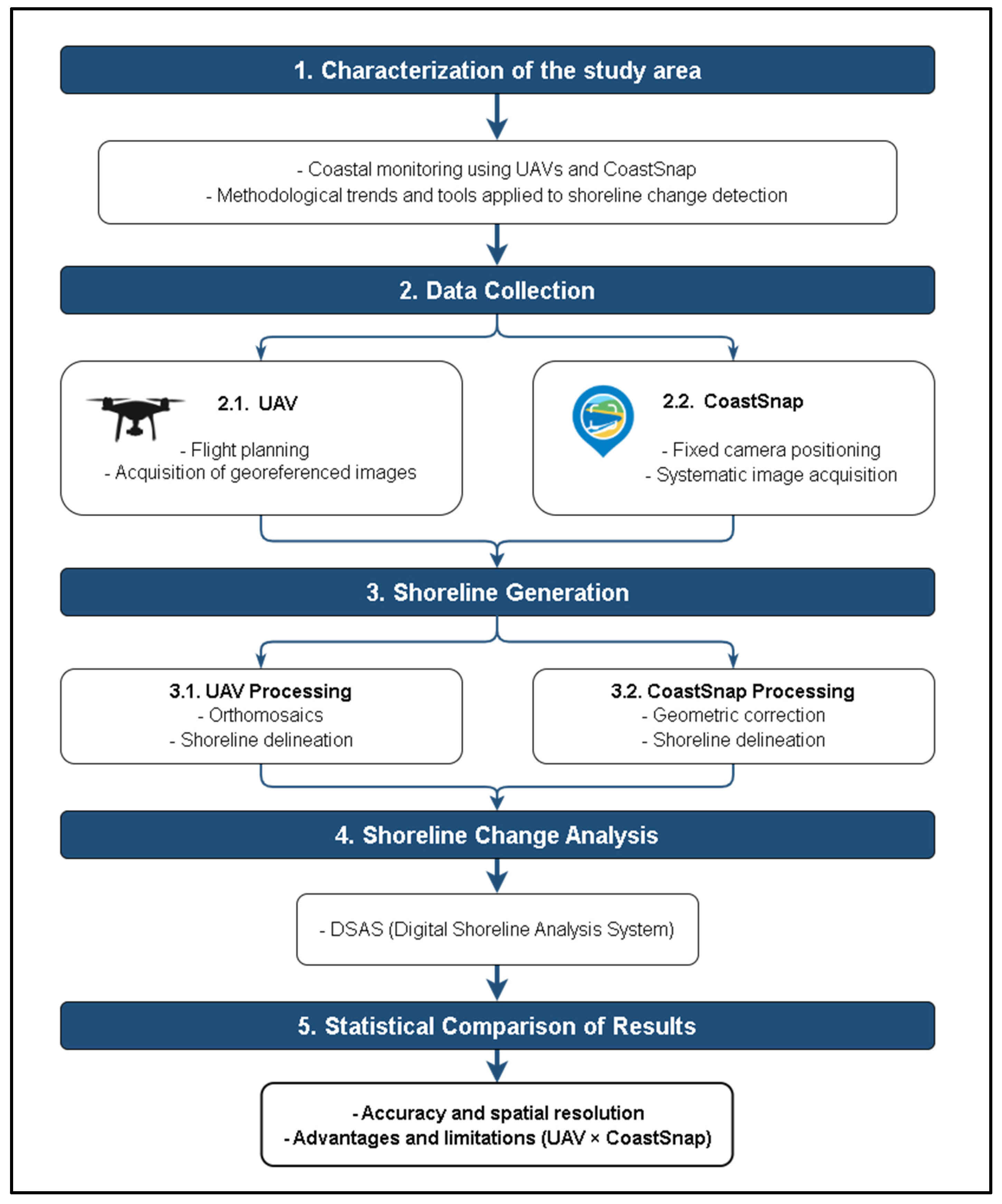
The methodology employs a quantitative approach, using comparative and statistical analysis to integrate data from UAV surveys with images collected via the CoastSnap RS network. The methodological workflow adopted in this study is summarized in Figure 1.

2.1. Study Area

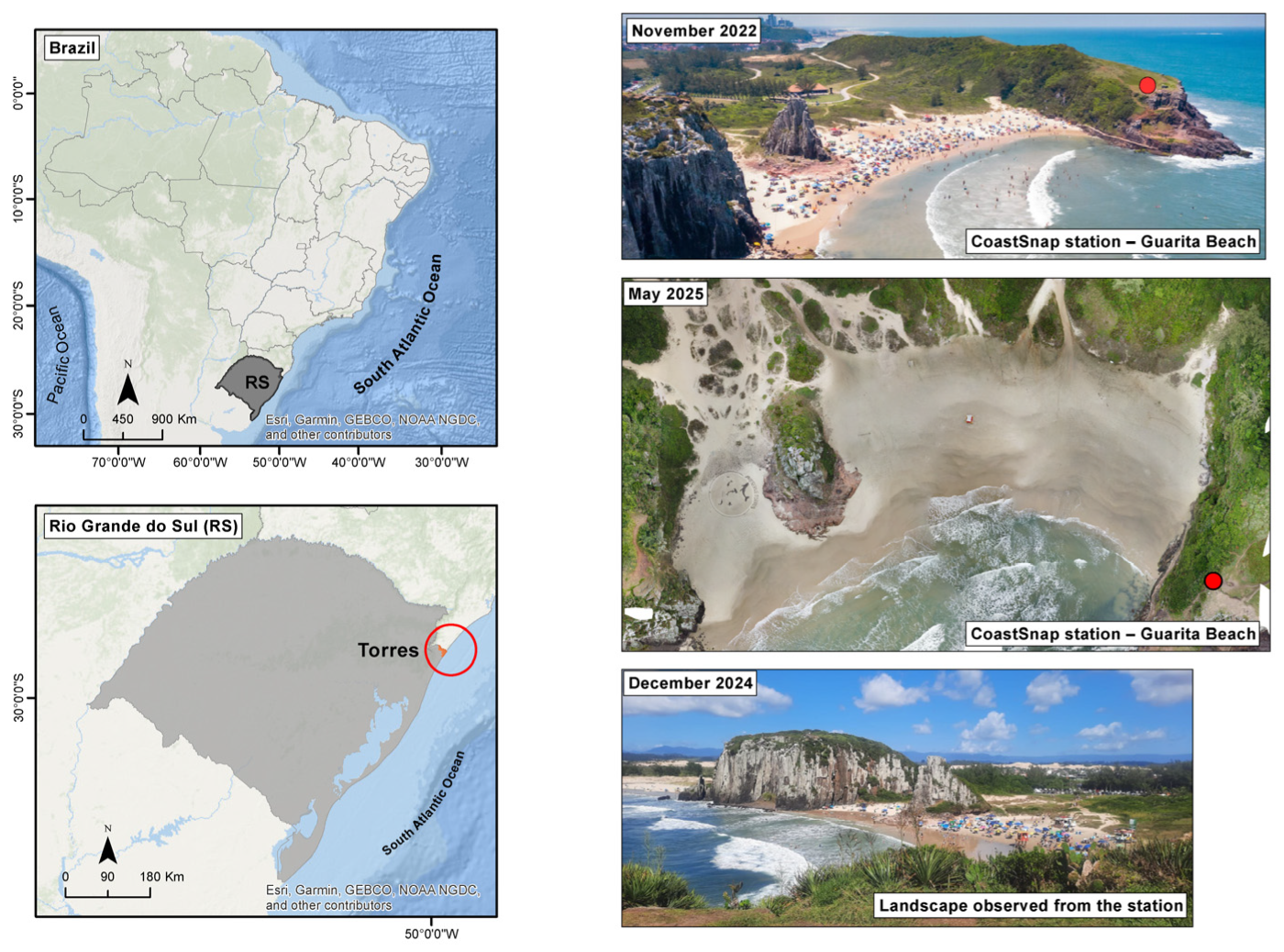
The study area is located at Guarita Beach, southern Brazil, as shown in Figure 2. This coastal stretch is characterized by a narrow coastal plain associated with basaltic rock outcrops. Its landward boundary is defined by the escarpments of the Serra Geral Formation (eastern Paraná Basin), which constitute one of the few rocky promontories along the southern Brazilian coastline [15,16,19]. A central outcrop, known as Middle Tower, influences the local hydrodynamics by sheltering the eastern sector from direct wave action [16].
Guarita Beach lacks foredunes and exhibits significant variability in backshore sediment thickness [9,17,18]. The winds are predominantly from the northeast (NE), following the region’s typical pattern [20]. In morphodynamic terms, according to the classification proposed by [21], the locality is classified as an intermediate beach.

2.2. Unmanned Aerial Vehicle (UAV) and GNSS Data Acquisition

Between September 2024 and September 2025, a set of twelve paired monitoring dates was selected to quantify the spatiotemporal variations in the Guarita Beach shoreline. UAV surveys were carried out using a DJI Mavic Mini, and only dates for which temporally compatible CoastSnap images were available were retained for the inter-method comparison. Flight plans were designed using Drone Harmony 2.3.0 software, and the main acquisition parameters adopted during the surveys are summarized in Table 1.
In the field, fourteen Ground Control Points (GCPs) were distributed homogeneously throughout the study area, and surveyed using a Leica GS15 GNSS receiver (L1, L2, and L2C signals) and a Pacific Crest T300 external radio. Data was acquired in RTK mode (PDOP < 4), with each GCP occupied for 5 min using a tripod-mounted rover for stabilization.
Both UAV imagery and GCPs were referenced to the WGS 84/UTM Zone 22S coordinate system. Ellipsoidal heights obtained from the GNSS surveys were converted to orthometric heights using geoid undulations provided by MAPGEO 2015, developed by the Brazilian Institute of Geography and Statistics (IBGE).

2.3. UAV Data Processing

For data processing, a high-performance workstation was employed. UAV imagery was processed using Agisoft Metashape 2.0.2 and the structure-from-motion (SfM) workflow. According to [10], SfM is used to reconstruct objects or scenes from a series of high-resolution, overlapping photographs obtained in different positions and orientations due to variation in the acquisition perspective.
Image alignment was first performed to generate a sparse point cloud, after which Ground Control Points (GCPs) measured in GNSS-RTK were inserted and used for camera optimization. A dense point cloud, a Digital Elevation Model (DEM), and the final orthomosaic were then generated. The orthomosaics presented an average GSD of 0.021 m (approximately 2.1 cm pixel−1), with small variations between 0.020 and 0.022 m.
Shoreline positions were then manually digitized from each UAV orthomosaic in ArcMap 10.8 by tracing the wet–dry boundary at a nominal working scale of 1:500. This procedure was adopted because the wet–dry line was visually well defined in the high resolution imagery and could be consistently reproduced along the beach face. Each shoreline was first digitized continuously and subsequently checked for local discontinuities, geometric inconsistencies, and ambiguous sectors related to moisture patches or swash remnants. [22] indicate that digitizing scales between 1:400 and 1:750 are appropriate for comparable coastal applications, whereas shoreline definition and mapping scale directly affect subsequent change analyses [6,23], as summarized in Table 2.
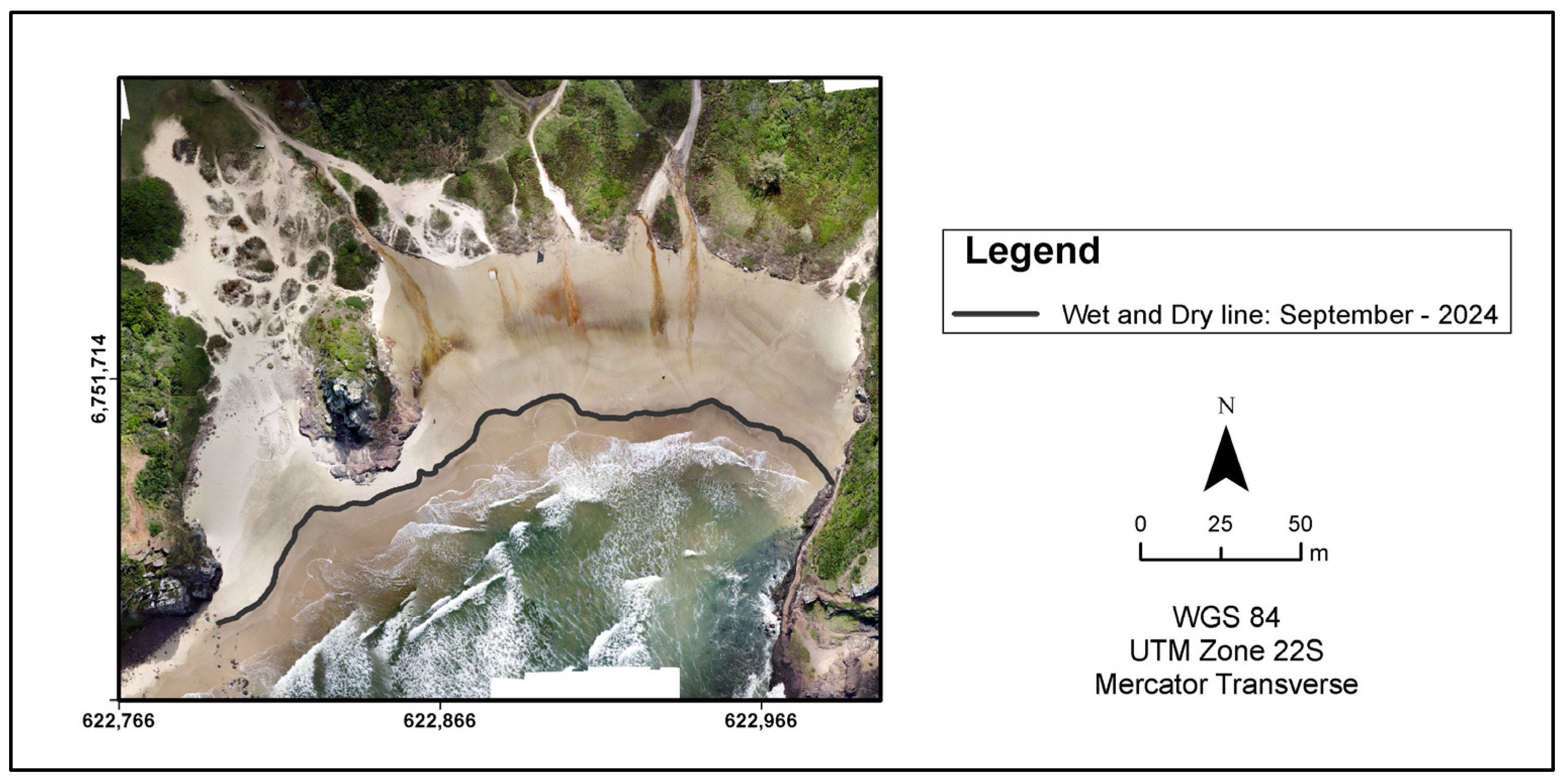
This standardization yielded an average RMSE between 0.03 and 0.05 m, which is consistent with both the image pixel size and the accuracy of the GNSS-RTK survey. Positional uncertainty therefore remained compatible with the adopted mapping scale. The wet–dry line (WDL), as shown in Figure 3, was considered the shoreline proxy due to its clear identification, consistency, and reproducibility in high-resolution imagery. As highlighted by [6,22], proxy selection must balance physical meaning and operator reproducibility.

2.4. CoastSnap Data Acquisition

In addition to UAV image collection, data were used from a CoastSnap RS network station located in the study area. Created in Australia in 2017, CoastSnap is an innovative approach that engages beach users, residents, and tourists in generating socio-environmental data for coastal monitoring [12].
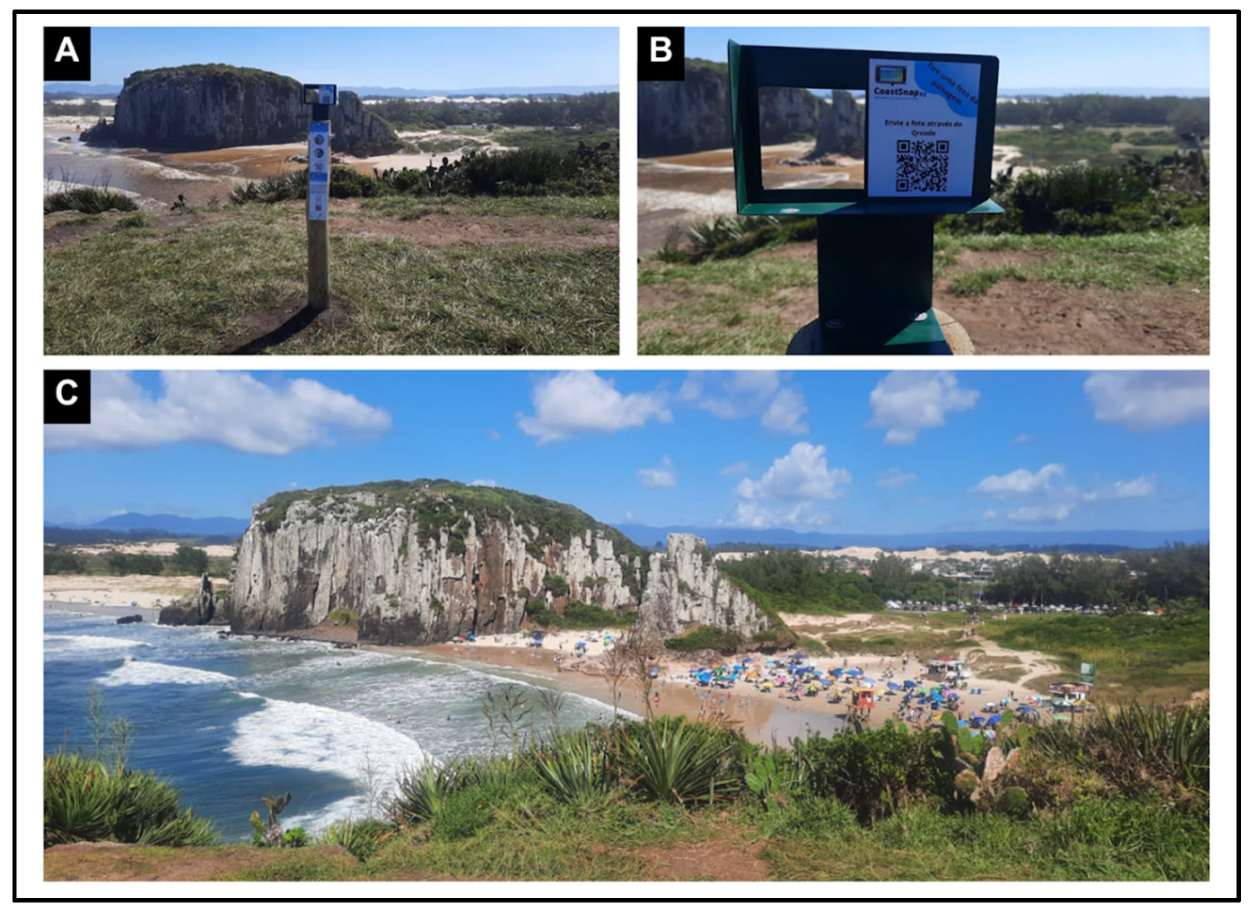
Using simple, low-cost stainless-steel structures, known as cradles or stations, citizen scientists capture photographs using smartphones positioned in the station cradle (Figure 4A,B). An example of the standardized framing obtained from the station is presented in Figure 4C. Additionally, information plaques on the structures provide instructions for capturing and submitting images via social media (Facebook, Instagram and WhatsApp) as shown in Figure 5. The photographs are stored in a database alongside metadata regarding the date, time, and environmental conditions, thereby broadening the temporal and climatic representativeness of the collected data.
The use of the acquired images and subsequent data processing enables the identification of the interrelationships between marine processes, coastal landforms, and anthropogenic activities. Furthermore, the data generated enables comparative analyses aimed at understanding the coastal environment.

2.5. CoastSnap Data Processing

Shoreline detection from CoastSnap imagery comprised image registration, rectification, and shoreline mapping/editing. Images were first aligned using Adobe Photoshop 23.5 and then georectified with the CoastSnap toolbox so that image pixels could be transformed into planimetric coordinates. This step required accurate camera positioning, station geometry, and Ground Control Points distributed across the field of view. After rectification, shoreline candidates were extracted using the dynamic threshold implemented in the CoastSnap toolbox, based on the contrast between the blue and red bands [13]. The automatically detected shoreline was then visually checked during the editing stage to remove obvious artefacts and ensure continuity along the swash boundary.
The detected shoreline corresponds to the upper limit of the swash zone and is therefore affected by tidal stage, runup, and instantaneous hydrodynamic conditions. In addition, the performance of the edge-detection routine may be reduced under strong shadows, variable illumination, foam, turbidity, atypical water colour, and in sectors located farther from the camera, where oblique geometry amplifies rectification uncertainty [13,14]. Tide data, sourced from Delft Dashboard [24], were generated at 15-min intervals to support the interpretation of acquisition conditions.

2.6. Shoreline Displacement Determination

This stage integrates shorelines digitized from UAV surveys with those automatically generated by the CoastSnap algorithm. Both platforms (UAV and CoastSnap) provided data from images captured on matching dates and within comparable time intervals to ensure temporal consistency. For each transect, the comparison therefore involved homologous DSAS outputs derived from the same shoreline dates and the same spatial position.
The Digital Shoreline Analysis System (DSAS, version 6.0), developed by the USGS, was used as the main spatial-analysis framework because it standardizes shoreline comparison through a baseline-transect approach [25]. Shoreline from UAV and CoastSnap datasets were processed separately, following three steps: (1) data import; (2) generation of equidistant transects perpendicular to the baseline; and (3) calculation of shoreline-change statistics for each transect. A 15 m spacing was adopted as a compromise between preserving alongshore variability and avoiding excessive oversampling relative to the study-sector length and the positional uncertainty of the mapped shorelines.
Although DSAS can compute several statistics, this study focused on SCE and LRR because they capture complementary dimensions of shoreline behaviour and are the most appropriate for the study objective. SCE summarizes the maximum envelope of positional variability and is therefore well suited to compare how both monitoring systems represent the spatial range of shoreline oscillation. LRR, in turn, provides a regression-based estimate of medium-term trend by integrating all available dates, which makes it less sensitive to individual endpoint choices than EPR or NSM. WLR was not adopted because a homogeneous set of method-specific uncertainty values was not available for all paired UAV and CoastSnap shorelines. Results from transect 14 were interpreted with caution because CoastSnap coverage at that location was more limited than in the central transects.

2.7. Statistical Analysis

The statistical analysis compared metrics derived from UAV and CoastSnap data as the difference between measurements performed over the same period and for the same transect (CoastSnap—UAV). This strategy allowed direct quantification of inter-method agreement, rather than separate interpretation of two independent shoreline datasets.
Data normality was assessed using the Shapiro–Wilk test, which guided the selection of inferential procedures [26]. When normality was not assumed, the non-parametric Wilcoxon test was applied [27]; conversely, when normality was satisfied, Student’s t-test was used for the mean and the Chi-square test for the variance [28]. These tests evaluated the hypothesis that the mean or median difference between CoastSnap and UAV measurements is statistically equal to zero, further allowing for the construction of confidence intervals for the population variance.
Finally, the influence of the recording date on the median values of the LRR and SCE differences was examined via the Kruskal–Wallis test [27]. Upon identification of statistical significance, multiple comparison tests with Bonferroni adjustment were applied to identify the specific differences indicated by the global test [29].

3. Results and Discussion

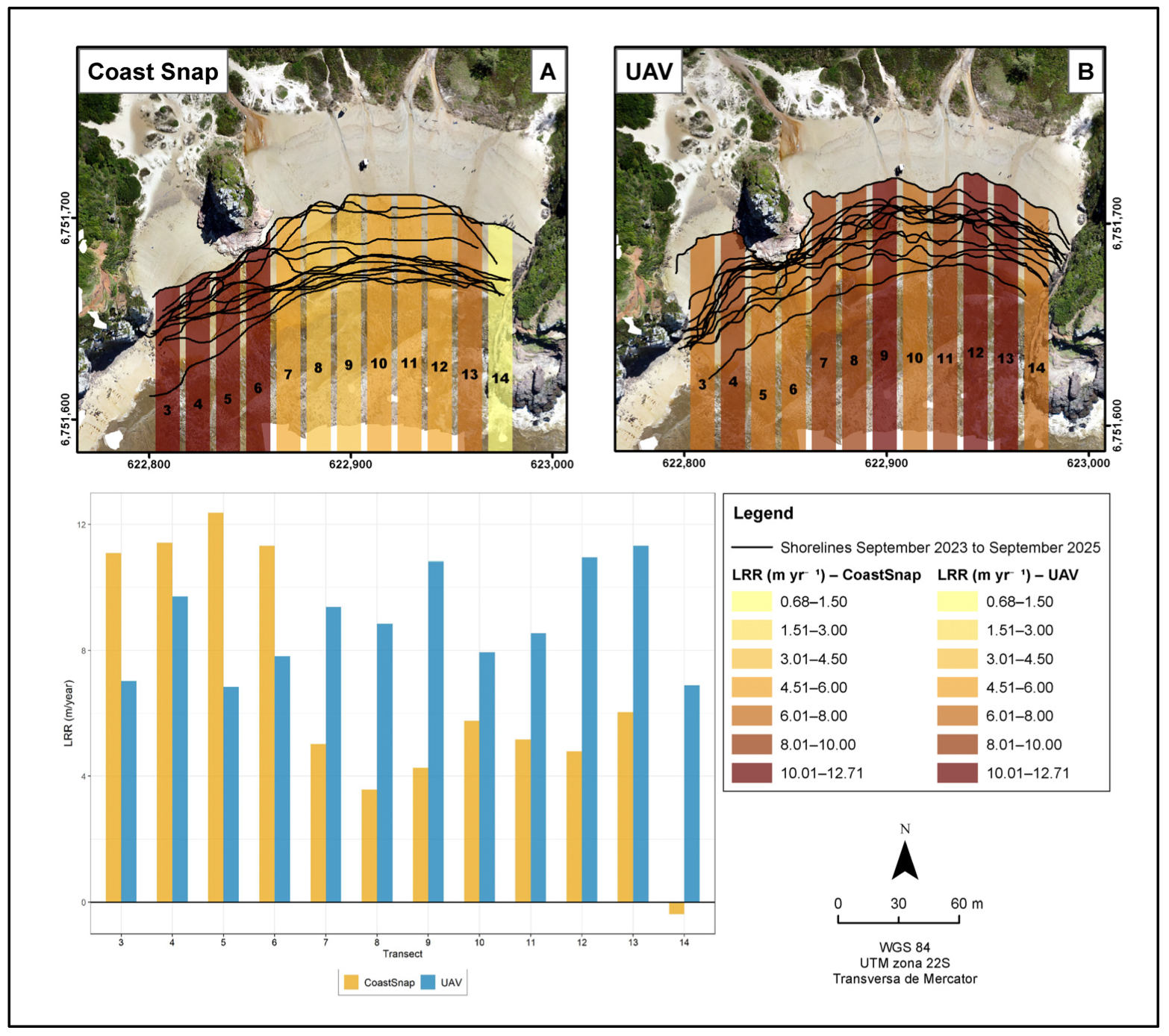
The spatial distribution of shoreline change rates (LRR) derived from CoastSnap and UAV datasets between September 2023 and September 2025 is presented in Figure 6. Both datasets indicate a predominant trend of shoreline progradation, with mean LRR values of 6.70 m year−1 for CoastSnap and 8.84 m year−1 for UAV-derived shorelines (Table 3). Values derived from CoastSnap show higher rates than those from UAVs for transects 3–6, while for transects 7–14, the values derived from UAVs are higher than those from CoastSnap.
In terms of spatial variability, both datasets exhibit a high degree of agreement. The highest rates of shoreline advance are concentrated in transects 3 to 6, while moderate progradation dominates transects 6 to 13, revealing a clear longitudinal gradient along the study area. This spatial consistency suggests that both methods are robust in identifying the distribution pattern of shoreline dynamics, capturing the same zones of higher and lower sedimentary activity.
However, a systematic discrepancy is observed in the magnitude of the estimated rates. UAV derived LRR values are consistently higher than those obtained from CoastSnap across nearly all transects, indicating differences in sensitivity between the methods. The most pronounced divergences occur between transects 7 to 9 and transect 12, where CoastSnap values range from 0.68 to 13 m year−1, whereas UAV estimates vary between 7.52 and 22.44 m year−1. This pattern suggests that CoastSnap tends to underestimate shoreline change rates, likely due to geometric uncertainties associated with camera positioning, image perspective, and tidal variability, while UAV data benefit from higher positional accuracy and orthorectified imagery.
A notable exception is observed in transect 14, where CoastSnap indicates a slight shoreline retreat (−0.38 m year−1), contrasting with a progradational rate of 6.89 m year−1 derived from UAV data. This divergence highlights a localized inconsistency between the methods and is likely influenced by the reduced number of CoastSnap observations available for this transect, which can directly affect the reliability of regression-based rate calculations such as LRR.
Despite these quantitative differences, the overall spatial agreement between the datasets reinforces that both methods capture the same dominant morphological behavior of the study area. Therefore, the results indicate that the primary distinction between CoastSnap and UAV-derived shorelines lies in the magnitude and sensitivity of LRR estimates, rather than in the identification of shoreline change patterns. This finding supports the complementary use of both approaches, emphasizing that CoastSnap is effective for detecting spatial variability, while UAV surveys provide more reliable quantification of absolute shoreline change rates, reinforcing the importance of integrated methodologies in coastal monitoring frameworks.
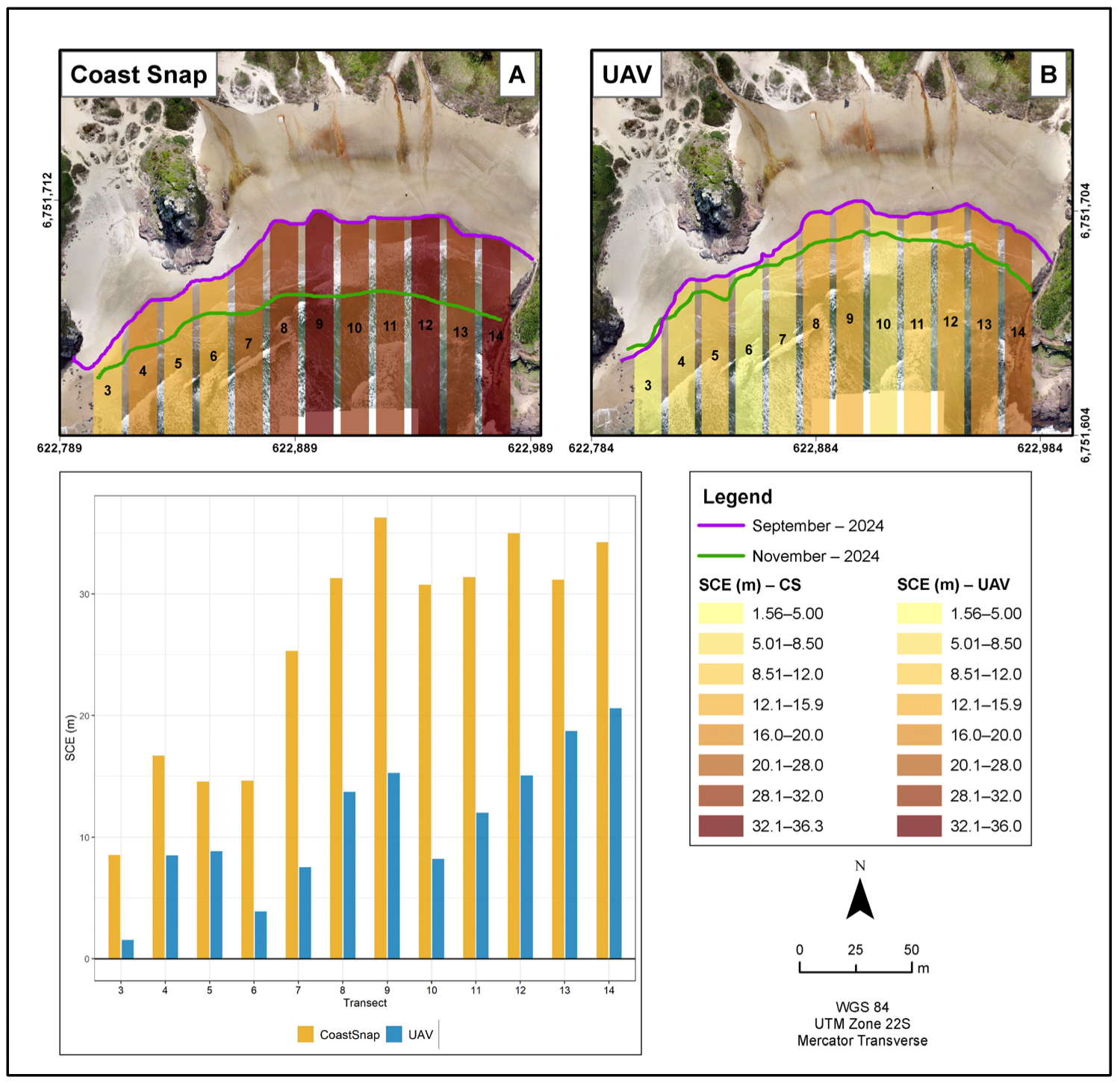
The spatial distribution of shoreline variability, expressed by the Shoreline Change Envelope (SCE), between September and November 2024 is presented in Figure 7. This interval was specifically selected as it represents the only period in which CoastSnap provided complete spatial coverage across all analyzed transects (3–14), ensuring methodological comparability.
The results reveal a clear and consistent spatial pattern, characterized by a progressive increase in shoreline variability from west to east along the inlet, regardless of the method applied. Lower SCE values are concentrated in transects 3–6, indicating relatively stable shoreline conditions, whereas higher values are observed in transects 9–14, highlighting increased sedimentary mobility in the central-eastern sector of the study area. This spatial gradient suggests a morphodynamic control associated with inlet orientation and differential exposure to wave energy, reflecting greater sensitivity of shoreline position in this compartment.
In quantitative terms, CoastSnap-derived SCE values range from approximately 8 m to 36 m, with pronounced peaks in transects 9, 12, and 14. In contrast, UAV-derived SCE values vary between approximately 1.5 m and 21 m, also exhibiting a gradual increase toward the eastern sector, particularly at transect 14. Despite the similarity in spatial trends, CoastSnap consistently produces wider shoreline envelopes across all transects.
This discrepancy reflects a structural difference between the methodologies rather than random variation. The broader SCE values observed in CoastSnap data indicate a greater amplitude of positional variability in shorelines derived from oblique imagery, compared to the more constrained variability obtained from high-resolution UAV orthomosaics. This effect is primarily related to the inherent geometric limitations of CoastSnap images, which rely on single-view oblique photographs requiring rectification. In contrast, UAV products are generated from nadir-oriented imagery and benefit from rigorous photogrammetric processing, including Ground Control Points, resulting in higher positional accuracy.
Additionally, the geometric distortion associated with oblique images may propagate positional uncertainties, particularly in areas located farther from the camera or under conditions of variable illumination and wave runup, further contributing to the expansion of the shoreline envelope in CoastSnap-derived results.
Despite these quantitative differences, both methods reproduce a remarkably consistent spatial pattern of intertemporal shoreline variability, reinforcing the morphological coherence of the system and confirming the ability of both approaches to identify the most dynamic sectors of the inlet. This finding highlights that SCE is a robust metric for detecting spatial variability, while also emphasizing the importance of considering methodological limitations when interpreting absolute magnitudes.
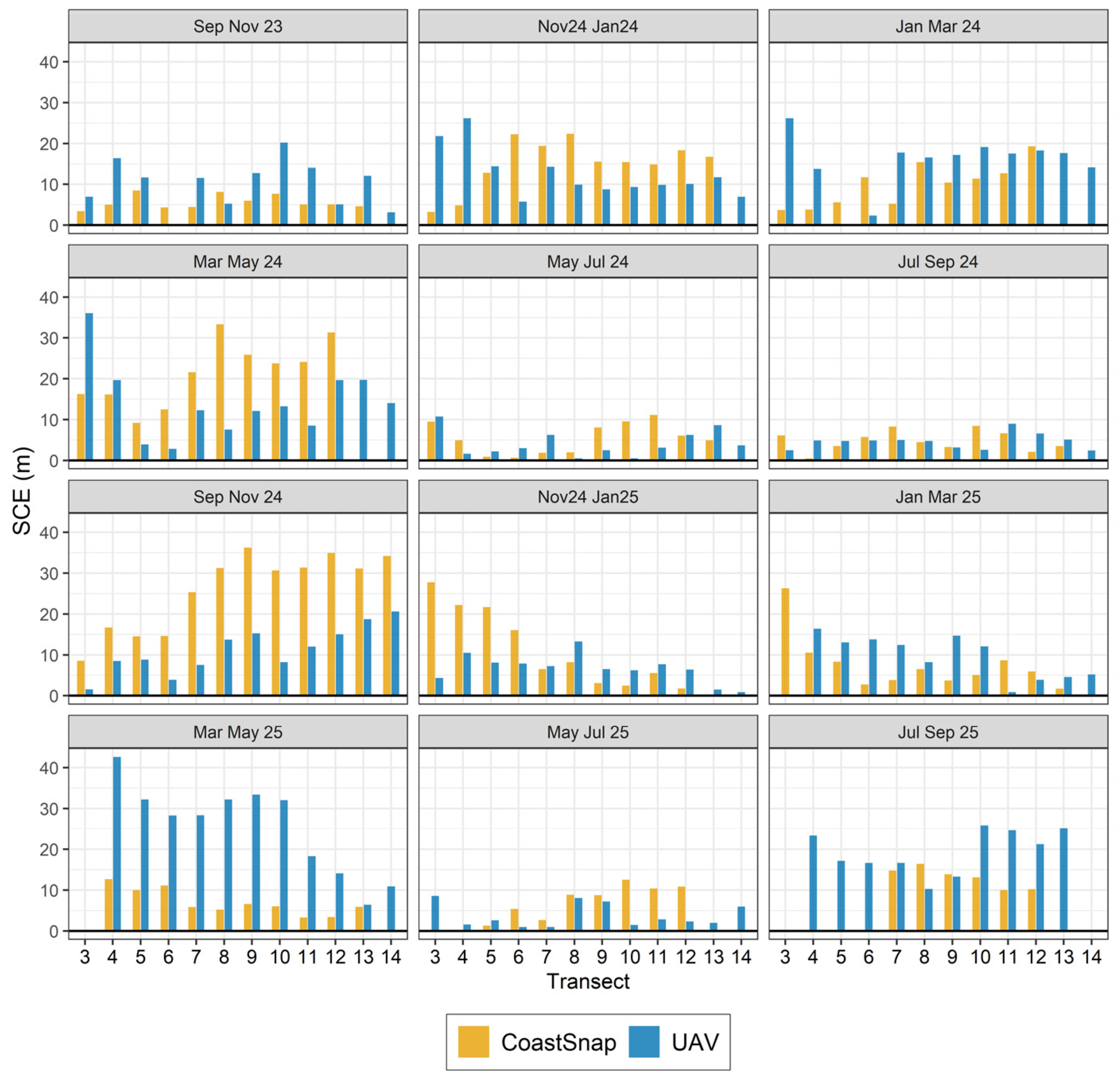
Figure 8 shows the temporal variation in SCE values along transects 3–14 between September 2023 and September 2025. The results indicate a marked increase in SCE values during the September–November 2024 interval across several transects, particularly in the CoastSnap dataset, which records amplitudes exceeding 30 m in multiple sectors. In comparison, UAV-derived values are also elevated but exhibit a more regular spatial distribution.
In contrast, during the March–May 2025 interval, the pattern is partially reversed: the UAV records pronounced peaks, in some cases exceeding 40 m in specific transects. This behavior increases the discrepancy between methods and explains the negative shift in the mean of the differences (CS—UAV). These results highlight that the discrepancies between methods are associated with the magnitude of shoreline variability rather than with the identification of the spatial pattern of coastal dynamics.
From an environmental perspective, the first interval (September–November 2024) coincided with the recurring influence of cold fronts and atmospheric instability, with moderate to intense rainfall and wind gusts recorded by INMET [30,31], especially in September and November. The second interval (March–May 2025) presented contrasting conditions: an initial period of heatwaves and low precipitation in March, followed by intense instabilities and storm alerts with heavy rainfall and wind gusts in May [32].
The alternation between phases of relative stability and extreme meteorological events tends to intensify the non-linearity of coastal morphodynamic responses, widening the shoreline spatial envelope. In this context, the differences observed between the methods primarily reflect the distinct sensitivity of each approach to the magnitude of spatial variations, rather than discrepancies in identifying the most dynamic sectors, reinforcing that the discrepancy is primarily associated with differences in the magnitude of the estimated SCE under varying environmental conditions. In contexts of intense events, the equivalence between methods decreases, requiring the consideration of the meteorological and hydrodynamic context when comparing shoreline change metrics.
It is also important to recognize that shoreline proxies based on the wet–dry interface are inherently influenced by hydrodynamic conditions at the moment of image acquisition, including tidal stage, wave runup, and swash dynamics. Although the use of the wet–dry Line (WDL) represents a widely adopted proxy in shoreline monitoring studies, these factors may introduce variability that is independent of actual sedimentary displacement.
The DSAS framework provides a robust basis for shoreline change analysis by standardizing spatial comparisons through multiple statistical approaches, such as SCE and LRR. In this study, the comparison between these metrics, based on a sample of 12 temporal positions (N = 12), revealed that CoastSnap yielded, on average, lower rate values than those estimated by UAV. Despite these variations, the sample size fulfills the methodological requirements established [33], which recommend a minimum of three observations for calculating reliable shoreline change rates. but the relatively short monitoring window still limits long term extrapolation. For that reason, this study emphasizes comparative performance between methods rather than future shoreline forecasting.
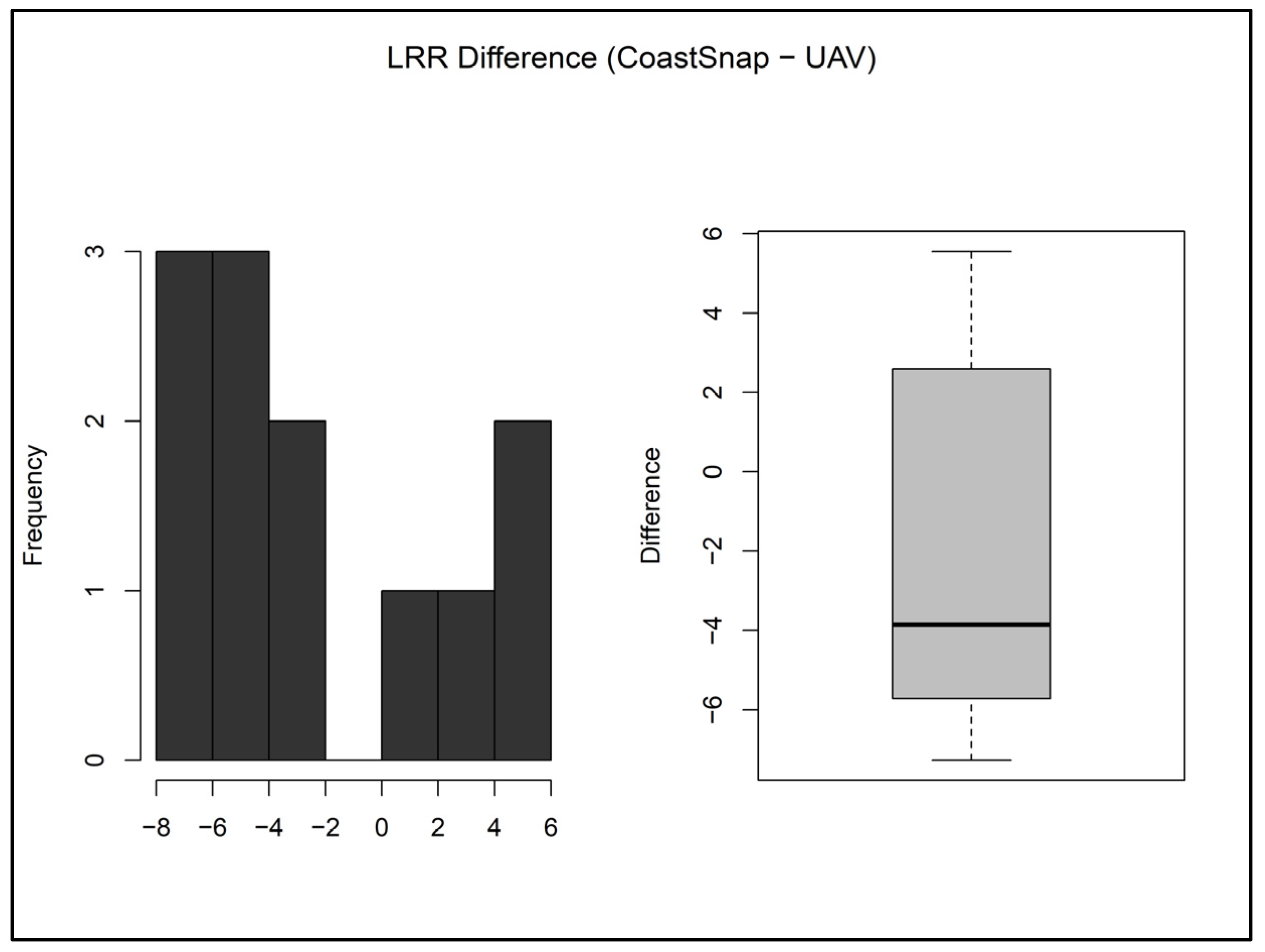
The descriptive statistics of the LRR values derived from CoastSnap and UAV data are presented in Table 3. The mean difference between the CoastSnap and UAV shorelines was −2.14 m year−1, with a median of −3.85 m year−1. Student’s T test did not indicate a significant difference between the change rates (p = 0.135). This means that, considering the observed variability in the data, there is insufficient evidence to claim that CoastSnap and UAV produce systematically distinct rates during the analyzed period.
From a geomorphological perspective, the negative mean and median of DIF_LRR indicate that CoastSnap tended to yield lower annualized rates than UAV data, but this tendency was not sufficiently stable to support a universal correction factor. The dispersion shown in Figure 9, together with the non-significant t-test result (p = 0.135), indicates that the offset varies from transect to transect according to local image geometry, shoreline curvature, and acquisition conditions.
In practical terms, CoastSnap is suitable for identifying the sign and spatial organization of shoreline change, but UAV surveys remain preferable when absolute rates are required for calibration, engineering design, or threshold-based management decisions.
The results obtained are consistent with the statistical foundation of the LRR, which, by integrating multiple temporal observations, tends to reduce the relative weight of isolated extreme variations. Thus, the LRR proved to be suitable for trend assessment within the studied data interval, considering the duration of the time series and the positional uncertainties associated with each method.
Table 4 summarizes the comparative performance of the shoreline change metrics (SCE and LRR) derived from CoastSnap and UAV datasets obtained at Guarita Beach. The results indicate that SCE presented the highest equivalence between methods, whereas LRR showed a tendency toward lower values derived from CoastSnap. On the other hand, the LRR, despite its tendency to underestimate the data, revealed behavioral stability, which reinforces its usefulness for trend analysis, in accordance with the literature.
According to [9], CoastSnap is effective for monitoring user density on the beach face and morphological variations over short time scales, particularly in environments with limited infrastructure. Recent studies have also reinforced the value of low-cost image based monitoring while highlighting the importance of acquisition strategy and uncertainty assessment in shoreline detection workflows [14,34].
Despite the variation in rate magnitude, spatial coherence is observed in identifying the predominant shoreline change trend. This indicates that both methods consistently capture the direction of morphodynamic behavior during the analyzed period, differing mainly in the estimated intensity of the rates.

4. Conclusions

The results demonstrate that the agreement between shoreline-change metrics derived from CoastSnap and UAV data depends strongly on the statistical indicator adopted, reflecting differences in geometric sensitivity, uncertainty propagation, and environmental conditions during image acquisition. Despite these differences, both datasets showed consistent spatial agreement in identifying the most dynamic sectors of Guarita Beach, indicating that the observed divergence does not compromise the interpretation of the dominant coastal morphodynamic pattern, but rather affects the magnitude of the estimated changes.
The Shoreline Change Envelope (SCE) presented the strongest inter-method equivalence, with a mean CoastSnap–UAV difference of −0.14 m and no evidence of systematic bias across the total sample. This indicates that both methods captured comparable envelopes of shoreline variability, even though temporal discrepancies were observed under periods of enhanced morphodynamic activity. These differences are better interpreted as a response to positional uncertainty, environmental forcing, and the geometric limitations inherent to oblique imagery, rather than as a consistent pattern of overestimation or underestimation.
The Linear Regression Rate (LRR) also reproduced the dominant trend of shoreline progradation and showed statistical stability consistent with its regression-based formulation. However, CoastSnap tended to underestimate annual rates relative to UAV data, with a mean difference of −2.14 m year−1. Because this negative offset was accompanied by broad dispersion and non-significant statistical divergence, it should not be interpreted as a fixed correction factor. Instead, it likely reflects the combined influence of oblique-image geometry, rectification uncertainty, variable shoreline proxy expression, and hydrodynamic variability at the time of acquisition. Although the spatial coherence of the LRR results reinforces its usefulness for trend analysis, its reliability remains dependent on the length and regularity of the time series.
Operationally, the findings support the use of CoastSnap as a complementary, rather than substitutive, monitoring strategy. CoastSnap significantly expands temporal coverage at low cost and is effective for identifying periods and sectors of enhanced shoreline variability, whereas UAV surveys remain preferable when greater geometric control and more reliable absolute rate estimates are required. The joint use of both approaches therefore represents a robust strategy for coastal monitoring programs under logistical and budget constraints. Ultimately, this study advances the methodological cross-validation of coastal monitoring techniques by showing that differences between CoastSnap and UAV data should be interpreted primarily as variations in the magnitude of the uncertainty envelope, not as inconsistencies in identifying the most dynamic sectors of the shoreline. Future work should test this integration over longer time series and under event-based stratification before predictive shoreline forecasting is attempted.

Author Contributions

Conceptualization, J.M., J.L.N. and M.d.G.A.; Methodology, J.M., M.d.G.A., B.M.P. and R.M.S.; Software, J.M., B.M.P. and R.M.S.; Validation, J.M., J.L.N., M.d.G.A. and R.M.S.; Formal Analysis, J.M. and R.M.S.; Investigation, J.M., J.L.N. and M.d.G.A.; Resources, J.M. and M.d.G.A.; Data Curation, J.M., M.d.G.A. and R.M.S.; Writing—Original Draft Preparation, J.M., J.L.N. and M.d.G.A.; Writing—Review & Editing, J.M., J.L.N. and M.d.G.A.; Visualization, M.d.G.A.; Supervision, J.L.N.; Project Administration, J.L.N.; Funding Acquisition, M.d.G.A. All authors have read and agreed to the published version of the manuscript.

Funding

This study was supported by the National Council for Scientific and Technological Development—CNPq (Project N°. 406334/2023-4, and 420516/2022-0).

Data Availability Statement

Dataset available on request from the authors.

Acknowledgments

The authors thank the Universidade Federal do Rio Grande do Sul (UFRGS), and Instituto Federal de Educação, Ciência e Tecnologia do Rio Grande do Sul (IFRS) for their support. This study was financed in part by the Coordenação de Aperfeiçoamento de Pessoal de Nível Superior—Brasil (CAPES)—Finance Code 001.

Conflicts of Interest

The authors declare no conflicts of interest.

Abbreviations

The following abbreviations are used in this manuscript:
CSCoastSnap
DSASDigital Shoreline Analysis System
GISGeographic Information System
GSDGround Sampling Distance
LRRLinear Regression Rate
RMSERoot Mean Square Error
RTKReal-Time Kinematic
SCEShoreline Change Envelope
UAVUnmanned Aerial Vehicle

References

  1. Barbier, E.B.; Hacker, S.D.; Kennedy, C.; Koch, E.W.; Stier, A.C.; Silliman, B.R. The value of estuarine and coastal ecosystem services. Ecol. Monogr. 2011, 81, 169–193. [Google Scholar] [CrossRef]
  2. Small, C.; Nicholls, R.J. A global analysis of human settlement in coastal zones. J. Coast. Res. 2003, 19, 584–599. [Google Scholar]
  3. Vallarino Castillo, R.; Negro Valdecantos, V.; del Campo, J.M. Understanding the impact of hydrodynamics on coastal erosion in Latin America: A systematic review. Front. Environ. Sci. 2023, 11, 1267402. [Google Scholar] [CrossRef]
  4. Mentaschi, L.; Vousdoukas, M.I.; García-Sánchez, G.; Fernández-Montblanc, T.; Roland, A.; Voukouvalas, E.; Federico, I.; Abdolali, A.; Zhang, Y.; Feyen, L. A global unstructured, coupled, high-resolution hindcast of waves and storm surge. Front. Mar. Sci. 2023, 10, 1233679. [Google Scholar] [CrossRef]
  5. Luijendijk, A.; Hagenaars, G.; Ranasinghe, R.; Baart, F.; Donchyts, G.; Aarninkhof, S. The state of the world’s beaches. Sci. Rep. 2018, 8, 6641. [Google Scholar] [CrossRef]
  6. Boak, E.H.; Turner, I.L. Shoreline Definition and Detection: A Review. J. Coast. Res. 2005, 21, 688–703. [Google Scholar] [CrossRef]
  7. Vos, K.; Splinter, K.D.; Harley, M.D.; Simmons, J.A.; Turner, I.L. CoastSat: A Google Earth Engine-enabled Python toolkit to extract shorelines from publicly available satellite imagery. Environ. Model. Softw. 2019, 122, 104528. [Google Scholar] [CrossRef]
  8. Elrick-Barr, C.E.; Clifton, J.; Cuttler, M.; Perry, C.; Rogers, A.A. Understanding coastal social values through citizen science: The example of CoastSnap in Western Australia. Ocean Coast. Manag. 2023, 238, 106563. [Google Scholar] [CrossRef]
  9. Albuquerque, M.G.; Pereira da Silva, C.; Paula, D.P.; Espinoza, J.M.A.; Moreira, J.; Façanha, M.C.; Leisner, M.M.; Gandra, L.C.; Bendo, A.R.R. Use of low-cost technologies for monitoring user density on beaches: A case study of Guarita Beach, Southern Brazil. J. Coast. Res. 2024, 113, 228–232. [Google Scholar] [CrossRef]
  10. Mancini, F.; Dubbini, M.; Gattelli, M.; Stecchi, F.; Fabbri, S.; Gabbianelli, G. Using Unmanned Aerial Vehicles (UAV) for High-Resolution Reconstruction of Topography: The Structure from Motion Approach on Coastal Environments. Remote Sens. 2013, 5, 6880–6898. [Google Scholar] [CrossRef]
  11. Almeida, L.; Oliveira, I.E.; Lyra, R.; Dazzi, R.L.S.; Martins, V.G.; Klein, A.H.F. Coastal analyst system from space imagery engine (CASSIE): Shoreline management module. Environ. Model. Softw. 2021, 140, 105003. [Google Scholar] [CrossRef]
  12. Harley, M.D.; Kinsela, M.A. CoastSnap: A global citizen science program to monitor changing coastlines. Cont. Shelf Res. 2022, 245, 104796. [Google Scholar] [CrossRef]
  13. Harley, M.D.; Kinsela, M.A.; Sánchez-García, E.; Vos, K. Shoreline Change Mapping Using Crowd-Sourced Smartphone Images. Coast. Eng. 2019, 150, 175–189. [Google Scholar] [CrossRef]
  14. Nuyts, S.; Farrell, E.J.; Fennell, S.; Nash, S. An Assessment of the Role of the Timex Sampling Strategy on the Precision of Shoreline Detection Analysis. Coasts 2024, 4, 347–365. [Google Scholar] [CrossRef]
  15. Pereira, P.S.; Calliari, L.J.; Barletta, R.C. Heterogeneity and homogeneity of southern Brazilian beaches: A morphodynamic and statistical approach. Cont. Shelf Res. 2010, 30, 270–280. [Google Scholar] [CrossRef]
  16. Cristiano, S.C.; Rockett, G.C.; Portz, L.C.; Anfuso, G.; Gruber, N.L.S.; Williams, A. Evaluation of coastal scenery in urban beaches: Torres, Rio Grande do Sul, Brazil. J. Integr. Coast. Zone Manag. 2016, 16, 71–78. [Google Scholar] [CrossRef]
  17. IBGE. Atlas Geográfico das Zonas Costeiras e Oceânicas do Brasil; IBGE: Rio de Janeiro, Brazil, 2011; ISBN 978-85-240-4219-5. Available online: https://biblioteca.ibge.gov.br/visualizacao/livros/liv55263.pdf (accessed on 3 February 2026).
  18. Esteves, L.S.; Toldo, E., Jr.; Dillenburg, S.; Tomazelli, L.J. Long- and short-term coastal erosion in southern Brazil. J. Coast. Res. 2002, 36, 273–282. [Google Scholar] [CrossRef]
  19. Villwock, J.A. Geology of the coastal province of Rio Grande do Sul, southern Brazil. A synthesis. Pesqui. Geociências 1984, 16, 5–49. [Google Scholar] [CrossRef]
  20. Souza, V.G.; Albuquerque, M.G.; Paula, D.P.; Leisner, M.M.; Façanha, M.C.; Bendô, A.R.R.; Freitas, S.C. Low-cost coastal monitoring using citizen scientist data: An overview of the coastsnap program in Brazil. Finisterra 2026, 61, e42824. [Google Scholar] [CrossRef]
  21. Wright, L.D.; Short, A.D. Morphodynamic variability of surf zones and beaches: A synthesis. Mar. Geol. 1984, 56, 93–118. [Google Scholar] [CrossRef]
  22. Gonçalves, J.A.; Henriques, R. UAV photogrammetry for topographic monitoring of coastal areas. ISPR Photogramm. Remote Sens. 2015, 104, 101–111. [Google Scholar] [CrossRef]
  23. Vos, K.; Spliter, K.D.; Palomar-Vasquez, J.; Pardo-Pascual, J.E.; Almonacid-Caballer, J.; Cabezas-Rabadán, C.; Kras, E.C.; Luijendijk, A.P.; Calkoen, F.; Almeida, L.P.; et al. Benchmarking satellite-derived shoreline mapping algorithms. Commun. Earth Environ. 2023, 4, 345. [Google Scholar] [CrossRef]
  24. Van Ormondt, M.; Nederhoff, K.; Van Dongeren, A. Delft Dashboard: A Quick Set-Up Tool for Hydrodynamic Models. J. Hydroinformatics 2020, 22, 510–527. [Google Scholar] [CrossRef]
  25. U.S. Geological Survey (USGS). Digital Shoreline Analysis System (DSAS) Version 6.0 User Guide; USGS: Reston, VA, USA, 2023.
  26. Shapiro, S.S.; Wilk, M.B. An analysis of variance test for normality (complete samples). Biometrika 1965, 52, 591–611. [Google Scholar] [CrossRef]
  27. Conover, W.J. Practical Nonparametric Statistics, 3rd ed.; John Wiley & Sons, Inc.: Hoboken, NJ, USA, 1999; ISBN 978-0471160687. [Google Scholar]
  28. Montgomery, D.C.; Runger, G.C. Applied Statistics and Probability for Engineers, 7th ed.; John Wiley & Sons, Inc.: Hoboken, NJ, USA, 2018; ISBN 978-1119400301. [Google Scholar]
  29. Bland, J.M.; Altman, D.G. Multiple significance tests: The Bonferroni method. BMJ 1995, 310, 170. [Google Scholar] [CrossRef]
  30. INMET. Informativo Meteorológico n.º 26/2024: Previsão do Tempo Entre 23 e 30 de Setembro de 2024; Instituto Nacional de Meteorologia: Brasília, Brazil, 2024.
  31. INMET. Informativo Meteorológico n.º 33/2024: Previsão do Tempo Entre 11 e 18 de Novembro de 2024; Instituto Nacional de Meteorologia: Brasília, Brazil, 2024.
  32. INMET. Boletim Meteorológico—Maio de 2025; Instituto Nacional de Meteorologia: Brasília, Brazil, 2025.
  33. Thieler, E.R.; Himmelstoss, E.A.; Zichichi, J.L.; Ergul, A. Digital Shoreline Analysis System (DSAS) Version 4.0: An ArcGIS Extension for Calculating Shoreline Change; USGS Open-File Report 2008-1278; USGS: Reston, VA, USA, 2009.
  34. Araújo, R.J.V.; Araújo, T.C.M.; Pereira, P.S.; Queiroz, H.A.d.A.; Gonçalves, R.M. Managing Coastal Erosion and Exposure in Sandy Beaches of a Tropical Estuarine System. Sustainability 2025, 17, 11046. [Google Scholar] [CrossRef]
Figure 1. Methodological workflow adopted for shoreline extraction and comparative analysis using UAV-derived orthomosaics and CoastSnap images, including shoreline digitization, DSAS processing, and statistical evaluation.
Geosciences 16 00185 g001
Figure 2. Study area at Guarita Beach, Torres, Rio Grande do Sul, southern Brazil, highlighting the coastal sector analyzed in this study and the CoastSnap station position (indicated by a red point).
Geosciences 16 00185 g002
Figure 3. Wet–dry line (WDL) mapped from UAV-derived orthomosaic (September 2024) used as a shoreline proxy. The WDL corresponds to the interface between wet and dry sand and was selected due to its clear detectability, methodological consistency, and reproducibility in high-resolution datasets.
Geosciences 16 00185 g003
Figure 4. CoastSnap monitoring station at Morro da Guarita, Torres (southern Brazil). (A) General view of the installed structure; (B) cradle used for positioning smartphones in landscape orientation; (C) example of the standardized framing obtained by citizen scientists.
Geosciences 16 00185 g004
Figure 5. Informational panel from the CoastSnap system illustrating guidelines for image acquisition and submission through social media platforms (Facebook, Instagram and WhatsApp).
Geosciences 16 00185 g005
Figure 6. Spatial distribution of shoreline change rates (LRR, m year−1) derived from CoastSnap images (A) and UAV orthomosaics (B) between September 2023 and September 2025.
Geosciences 16 00185 g006
Figure 7. Spatial comparison of shoreline change envelope (SCE) values obtained from CoastSnap and UAV data between September and November 2024 for transects 3–14, derived from CoastSnap images (A) and UAV orthomosaics (B).
Geosciences 16 00185 g007
Figure 8. Temporal variation in SCE values along transects 3–14 derived from CoastSnap and UAV shorelines at bimonthly intervals between September 2023 and September 2025. Bars represent SCE magnitude (m) for each transect and method.
Geosciences 16 00185 g008
Figure 9. Distribution of differences between LRR values derived from CoastSnap and UAV data (CS—UAV), illustrating the dispersion of shoreline change rate discrepancies between the methods.
Geosciences 16 00185 g009
Table 1. Flight plan parameters adopted for UAV surveys conducted at Guarita Beach during the monitoring campaigns.
ParametersValues
Flight altitude60 m
Flight speed8 m s−1
Image overlay70% × 70%
Flight routes7.0 routes
GSD medium (cell size)0.021 m
Estimated horizontal RMSE0.03–0.05 m
Table 2. Parameters adopted for shoreline vectorization from UAV-derived orthomosaics, including mapping scale, ground sample distance (GSD), positional accuracy, and shoreline proxy definition.
ParameterValueRecommended RangeCriteria/Observation
Vectorization scale1:5001:400–1:7503–5 pixels per feature; adjust according to complexity (closer in rocky areas, further apart in straight areas).
GSD (Cell size)0.021 m0.020–0.022 mAverage orthomosaics size (0.0203–0.0218 m). Baseline for all other parameters.
RMSE0.050 m0.030–0.050 mValue for RTK and GCP series
Proxy adoptedWet–Dry Line (WDL)------Between dry and wet sand, characterizing the high tide line during image capture.
Table 3. Descriptive statistics of shoreline change rates (LRR) derived from UAV and CoastSnap datasets, including the calculated differences between methods (CS—UAV).
VariableMean
(m yr−1)
SD
(m yr−1)
MedianQ1Q3RangeMin.Max.
UAV_LRR8.841.618.687.629.992.3656.8211.31
CS_LRR6.703.945.464.6611.146.4775−0.3812.37
DIF_LRR−2.144.59−3.85−5.502.157.645−7.275.55
Table 4. Summary of the comparative performance of shoreline change metrics (SCE and LRR) derived from CoastSnap and UAV datasets.
MetricMean
Behavior
(CoastSnap—UAV)
Key
Values
Temporal SensitivityMethod
Robustness
Recommended Use
SCENear-zero mean difference; no systematic biasMean = −0.14 m;
Median = −0.40 m;
SD = 11.23 m;
p = 0.886
High sensitivity (p < 0.001) during energetic periods, especially Mar–May 2025
(−19.77 ± 2.87 m)
HighMost stable and equivalent metric between methods; Best metric for inter method validation and spatial variability mapping
[33]
LRRTrend towards underestimation without conclusive differenceMean = −2.14 m year−1
SD = 4.59 m year−1
p = 0.135 (N = 12)
Moderate; influenced by record length and local image geometryModerate to highSuitable for medium and long-term trends interpretation; use cautiously for absolute rates; requires sample expansion [33]
Disclaimer/Publisher’s Note: The statements, opinions and data contained in all publications are solely those of the individual author(s) and contributor(s) and not of MDPI and/or the editor(s). MDPI and/or the editor(s) disclaim responsibility for any injury to people or property resulting from any ideas, methods, instructions or products referred to in the content.