
Article

Permian Crustal Reworking and Rare-Metal Mineralization in the Halajun Area, the Southwest Tianshan, NW China


1
Xi’an Mineral Resources Survey, China Geological Survey, Xi’an 710100, China
2
Technology Innovation Center for Gold Ore Exploration, China Geological Survey, Xi’an 710100, China
3
State Key Laboratory of Deep Earth and Mineral Exploration, Chinese Academy of Geological Sciences, Beijing 100037, China
*
Author to whom correspondence should be addressed.
Geosciences 2026, 16(5), 181; https://doi.org/10.3390/geosciences16050181
Submission received: 2 April 2026 / Revised: 24 April 2026 / Accepted: 27 April 2026 / Published: 1 May 2026

Abstract

Permian A-type granites and associated rare-metal mineralization are widespread in the Halajun area, southwestern Tianshan; however, petrogenetic controls on rare-metal enrichment and mineralization remain under-constrained. Here, we integrate zircon and monazite geochronology, whole-rock geochemistry, and zircon Hf-O isotopes from Halajun I and II plutons to constrain the origin of these granites and their metallogenic significance. Zircon U–Pb and monazite ages indicate emplacement at 274–273 Ma, coeval with regional magmatism associated with the Tarim large igneous province. Geochemical signatures—high SiO2, alkali, and rare-earth element (REE) contents, enrichment of HFSE (e.g., Nb, Zr, and Hf), coupled with LILE (e.g., Ba and Sr) depletion—classify these granites as highly differentiated alkaline A-type rocks. Positive εHf(t) values and intermediate δ18O compositions of zircons suggest derivation from partial melting of Neoproterozoic lower crust with input from mantle-derived melts, reflecting significant crust–mantle mixing. Magmatic differentiation, in concert with regional crustal reworking driven by mantle plume activity, produced granites enriched in Nb, Ta, Zr, and REEs, which host the rare-metal mineralization in the region. These results indicate that Permian crustal reworking in the southwestern Tianshan was a driver of high-differentiation magmatism and rare-metal enrichment, highlighting the potential of similar A-type granitic systems in Central Asia for rare-metal exploration.

1. Introduction

Rare metals, including niobium (Nb), tantalum (Ta), and rare-earth elements (REEs), are essential for modern technologies such as electronics, energy storage, and aerospace applications [1]. Global demand for these elements exceeds supply; their distribution is highly concentrated in specific tectono-magmatic environments [2]. Alkaline granites, pegmatites, and related magmatic systems commonly host Nb, Ta, and REE mineralization [3,4,5,6] and are often spatially associated with regional tectonic activity in orogenic belts or suture zones [7]. Understanding the regional tectonic and petrogenetic processes that produce rare metal-enriched granites is, therefore, critical for resource assessment and exploration [8,9,10,11].
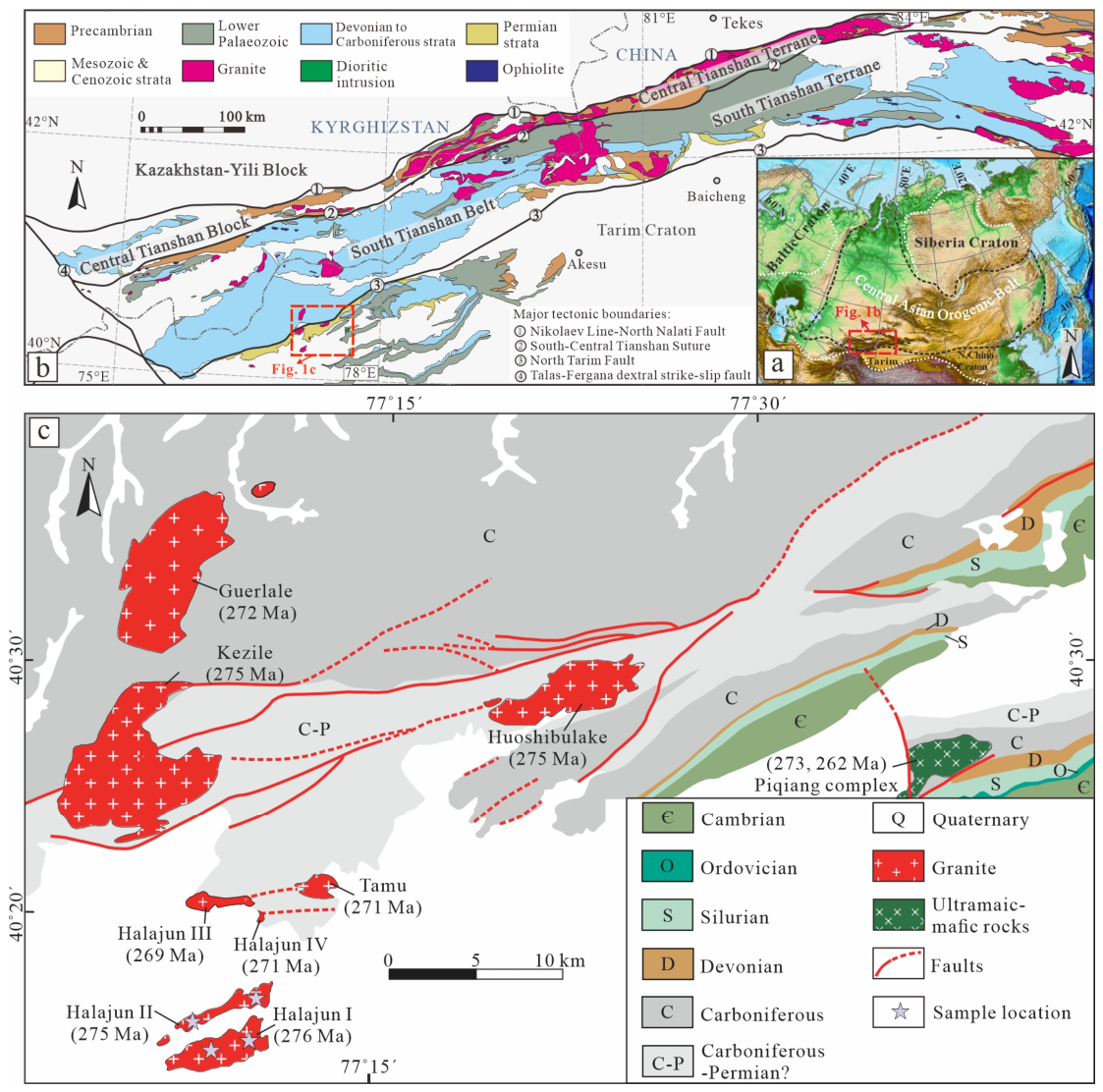
The southwestern Tianshan Orogenic Belt (SW-TOB) is a key rare-metal metallogenic belt in northwestern China, with significant exploration potential highlighted by a series of recently discovered deposits (summarized by Wu [12]). The Halajun area represents a typical rare-metal district within the SW-TOB, located along the northwestern margin of the Tarim Craton (Figure 1a,b), preserves a suite of Nb-, Ta-, and REE-bearing occurrences, such as the Tamu and Huoshibulake [12,13,14], as well as Permian granitic plutons, including Halajun I–IV, Kezile, and Guerlale (Figure 1c; [12,15]). Permian ultramafic–mafic intrusions have also been identified in the region [16]. These observations, together with previous studies, indicate that the SW-TOB experienced significant Early Permian magmatism [17], potentially linked to the Tarim Large Igneous Province (LIP). Regional tectono–magmatic activity likely controlled mantle input, triggered partial melting of the lower crust, and facilitated the transfer of melts to the upper crust, forming juvenile rocks [18]. This process records the crustal reworking [19] in the SW-TOB. Moreover, prolonged magma transport and evolution are commonly associated with magmatic differentiation, which promotes rare-metal enrichment and mineralization. However, the detailed relationships between magma evolution and rare-metal mineralization in the Halajun area remain under-constrained.
Previous investigations in the Halajun area normally have focused on the petrogenesis and tectonic backgrounds [12,13,14]; however, systematic integration of isotopic, geochronological, and geochemical datasets across tectonic–magmatism–mineralization is lacking. In particular, the role of mantle-derived melts versus crustal contributions in controlling A-type granite petrogenesis, as well as the role in rare-metal enrichment, are under-constrained. Addressing these questions is essential for understanding the geodynamic evolution of the SW-TOB, and for identifying new targets for rare-metal exploration in Central Asia Orogenic Belt (CAOB).
In this study, we present a comprehensive dataset from Halajun I and II plutons, including whole-rock major and trace element compositions, zircon and monazite U–Pb ages, and in-situ zircon Hf-O isotopes. By integrating these data with regional information on coeval Permian intrusions and deposits, we aim to: (1) elucidate the petrogenesis of Halajun A-type granites; (2) assess the extent of crust–mantle mixing and regional crustal reworking; and (3) identify the major factors that contribute to the rare-metal mineralization and explore the potential ore-bearing rocks at the Halajun area. Our results provide insights into the processes driving high-differentiation magmatism and rare-metal enrichment during the Permian, offering a framework for exploration of similar A-type granitic systems in the CAOB.

2. Geological Setting and Petrography

2.1. Geological Setting

The Halajun area is situated within the west part of the South Tianshan orogenic belt, along the southwestern margin of the CAOB (Figure 1a,b; [20,21]). This region records a complex tectonic history associated with Paleozoic accretionary processes, ocean closure, and subsequent intracontinental reworking [22]. Stratigraphic units exposed in the study area are dominated by Lower and Upper Paleozoic sequences, with subordinate Cenozoic cover, and are broadly aligned with regional structural trends (Figure 1c). The country rocks of the intrusive complexes comprise Carboniferous Bashisuogong and Kangkelin formations, together with Permian Barikeli and Kalendal formations [12]. These successions are interpreted as part of the Keping Paleozoic foreland basin system and are mainly composed of clastic and carbonate lithologies, including siltstone and limestone [23]. Metamorphism in the area is generally weak and localized, occurring predominantly as contact metasomatism adjacent to intrusive rocks [12].
Magmatism in the Halajun area is extensive and dominated by Permian intrusive suites emplaced along NEE-trending fault systems (Figure 1c). These intrusions include the Halajun I–IV, Kezile, and Guerlale granitic plutons, as well as the Tamu and Huoshibulake plutons, which host Nb–Ta–REE mineralization [12,15,16,17,18,24,25]. Coeval ultramafic–mafic intrusions, such as those at Piqiang [16], indicate a compositionally diverse magmatic system. Collectively, these features reflect a period of intensive Early Permian magmatism, likely linked to regional lithospheric extension and mantle upwelling. No obvious metasomatic textures or mineral assemblages were identified in the granites or adjacent wall rocks near the contact zone, suggesting that wall–rock interaction had only a minor effect on petrogenesis and rare-metal enrichment.

2.2. Petrography

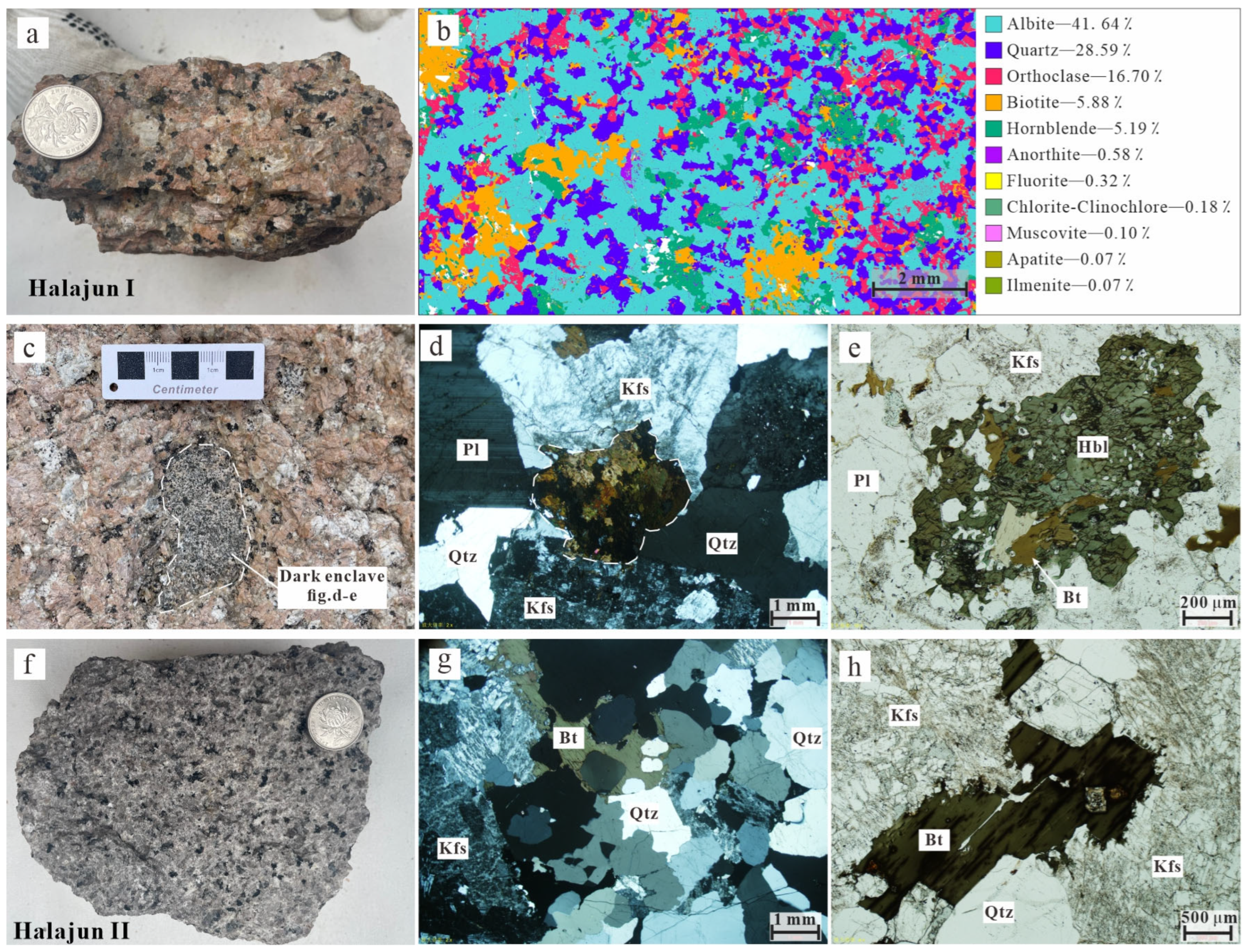
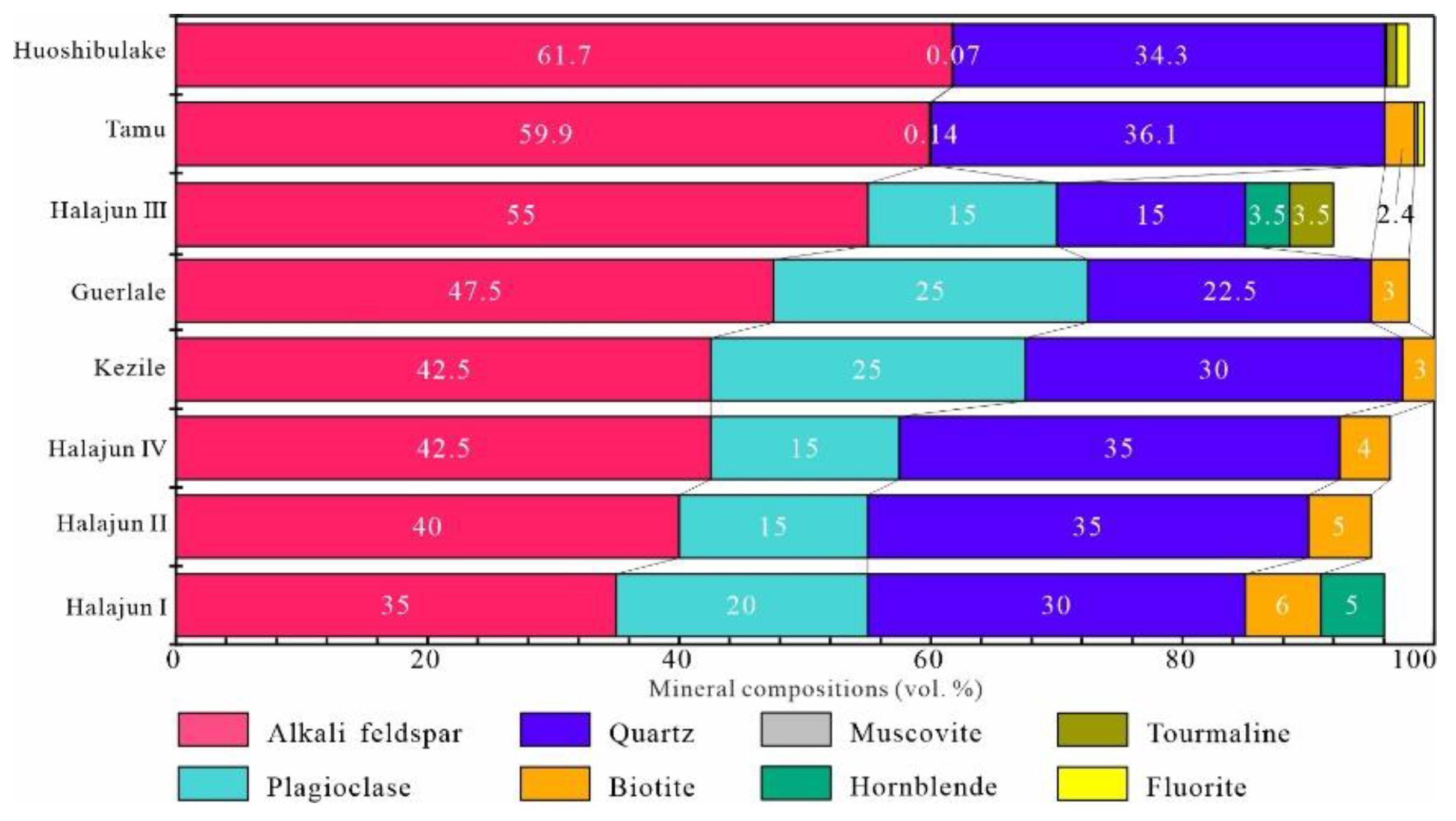
The Halajun I (HLJ1) pluton is composed predominantly of light red, medium- to coarse-grained monzogranite, exhibiting a typical granular texture and massive structure (Figure 2a,b). It consists mainly of plagioclase, alkali feldspar, quartz, and minor hornblende and biotite, with accessory zircon and monazite (Figure 2a,b). Plagioclase (~20 vol.%) occurs as euhedral to subhedral tabular crystals (4–12 mm), whereas alkali feldspar (~35 vol.%) forms subhedral grains with grain size of 4–10 mm. Quartz (~30 vol.%) is present as anhedral interstitial grains (1–6 mm). Mafic minerals are dominated by hornblende and biotite, commonly intergrown, with hornblende locally replaced by biotite (Figure 2c,d), indicating late-stage magmatic to subsolidus alteration. Dark, fine-grained enclaves are common within HLJ1 and display a mineral assemblage similar to the host granite, comprising quartz (~28 vol.%), plagioclase (~41 vol.%), alkali feldspar (~16 vol.%), biotite (~5 vol.%), and hornblende (~5 vol.%) (Figure 2e). These enclaves likely represent mafic microgranular enclaves or autoliths, suggesting magma mixing or mingling processes during emplacement. The Halajun II (HLJ2) pluton consists mainly of light grey, medium- to fine-grained biotite monzogranite with a massive structure and equi-granular texture (Figure 2f). The main mineral assemblage includes alkali feldspar (~40 vol.%), plagioclase (~15 vol.%), quartz (~35 vol.%), and minor biotite (~5 vol.%), along with accessory zircon (Figure 2g,h). Alkali feldspar occurs as subhedral tabular to prismatic crystals (2–6 mm), with some strongly altered, whereas plagioclase forms euhedral to subhedral grains (2–5 mm) with typical polysynthetic twinning. Quartz is present as anhedral interstitial grains (1–6 mm). Biotite is sparsely distributed and typically fine-grained. Overall, the HLJ1 and HLJ2 granites exhibit similar mineral assemblages, characterized by high abundances of feldspar and quartz (Figure 3), indicating crystallization from highly evolved felsic magmas. The presence of dark enclaves suggests that magma mixing occurred.

3. Materials and Methods

3.1. TESCAN Integrated Mineral Analyzer (TIMA)

TIMA analyses were conducted using a Tescan field-emission scanning electron microscope (TESCAN ORSAY HOLDING, Brno, Czech Republic) at the TIMA Laboratory, Institute of Geology, Chinese Academy of Geological Sciences. The detailed operating conditions of the instrument and system, as well as the data analysis procedures, are consistent with those described by Chen [26]. Imaging was performed at an accelerating voltage of 25 kV and a beam current of 9.71 nA. The analytical grid was defined with a step size of 91.67 nm and a spacing of 15 μm, enabling high-resolution automated mineral mapping. Mineral phases and textural relationships were identified using combined backscattered electron (BSE) imaging and energy-dispersive X-ray spectroscopy (EDS). Manganese was used as a standard to calibrate the EDS signal. Phase classification was achieved through automated spectral matching against an internal mineral library, allowing for rapid discrimination of mineralogical assemblages. Ambiguous or compositionally complex phases were verified and manually corrected based on spectral characteristics and textural context. First, BSE images were compared with those of well-characterized minerals; the measured spectral peaks were cross-checked against standard mineral databases. Mineral labels were then revised accordingly or merged into existing phase classifications. Using TESCAN TIMA software version 2.7.0 (TESCAN ORSAY HOLDING, Brno, Czech Republic), quantitative modal mineralogy was calculated from the classified pixel data; bulk mineral proportions were derived using density-corrected conversions from volume to mass. Overall, the identified minerals and their compositions account for more than 99.5% of the area analyzed.

3.2. Whole-Rock Geochemistry

Whole-rock major and trace element analyses were performed at ALS Minerals–ALS Chemex (Guangzhou, China). Major element concentrations were determined by lithium borate fusion followed by X-ray fluorescence spectrometry (method ME-XRF26d), with analytical uncertainties better than 5%. Trace elements, including REEs, were measured following mixed-acid digestion using inductively coupled plasma–mass spectrometry (ICP–MS; method M61-MS81). Analytical precision for trace elements is typically within 10%. Data analysis and plotting were conducted after excluding values below the detection limit. The mantle-normalized multi-element spider diagrams, chondrite-normalized REE patterns, and other geochemical diagrams were plotted using Excel software (Microsoft, Houston, TX, USA).

3.3. Zircon and Monazite U–Pb Geochronology

Zircon U–Pb dating and trace element analyses were conducted by laser ablation–inductively coupled plasma–mass spectrometry (LA–ICP–MS) at Nanjing Hongchuang Geological Survey Technical Service Co., Ltd., Nanjing, China. Laser ablation was performed using a GeolasPro system equipped with a 193 nm COMPexPro 102 ArF excimer laser coupled to a MicroLas optical system (Coherent Inc., Santa Clara, CA, USA). An Agilent 7700e ICP–MS (Agilent Technologies, Santa Clara, CA, USA) was used for signal acquisition. Helium was employed as the carrier gas and argon as the make-up gas, mixed prior to introduction into the plasma. A signal-smoothing device was used to enhance analytical stability [27]. Analyses were carried out with a spot size of 30 μm and a repetition rate of 5 Hz. Each analysis consisted of 20–30 s of background acquisition followed by ~50 s of signal collection. Zircon 91500 was used as the external standard for U–Pb age calibration; NIST SRM 610 glass was used for trace element calibration (The Zircon 91500 and NIST SRM 610 glass provided by the laboratory).
Monazite U–Pb dating and trace element analyses were performed at the State Key Laboratory of Ore Deposit Geochemistry, Institute of Geochemistry, Chinese Academy of Sciences, Guiyang, China, using a similar LA–ICP–MS configuration. Analytical conditions were comparable to those used for zircon, except for a smaller spot size of 16 μm at a repetition rate of 5 Hz. The Trebilcock 117531 monazite standard (272 Ma, [28]) was used for U–Pb isotopic calibration. Coqueiro (511.8 Ma) and Bananeira (507.7 Ma) monazites were analyzed as secondary reference materials to monitor analytical accuracy for both U–Pb ages and trace element concentrations [29]. Each analysis included 20–30 s of background measurement followed by ~50 s of ablation.
Data reduction was performed using the ICPMSDataCal software version 10.7 (Yongsheng Liu, the state kay laboratory of GPMR, China University of Geosciences, Wuhan, China) package, including background subtraction, signal integration, time-drift correction and quantitative calibration [30,31]. Concordia diagrams and weighted mean age calculations were generated using Isoplot/Ex version 3 [32].

3.4. Zircon Lu–Hf Isotopes

In situ zircon Lu–Hf isotopic analyses were performed using a Neptune Plus multi-collector ICP–MS (Thermo Fisher Scientific, Waltham, MA, USA) coupled to a Geolas HD 193 nm ArF excimer laser ablation system at Nanjing Hongchuang Geological Survey Technical Service Co., Ltd., Nanjing, China. The ablation system was equipped with a signal-smoothing device to enhance stability at low repetition rates. Helium was used as the carrier gas, with argon as the make-up gas; a small amount of nitrogen was added to improve analytical sensitivity [33]. The combined use of nitrogen addition and optimized cone geometry (Jet sample cone and X skimmer cone) significantly enhanced signal intensities for Hf, Yb and Lu.
Analyses were conducted in single-spot mode with a beam diameter of 40 μm, an energy density of ~3 J cm−2, and a repetition rate of 1 Hz. Each analysis comprised ~20 s of background acquisition followed by ~50 s of ablation. Data reduction, including signal integration and mass bias correction, was carried out using the ICPMSDataCal software package.

3.5. Zircon Oxygen Isotopes

In situ oxygen isotope analyses of zircon were carried out using a Cameca SHRIMP IIe–MC (Australian Scientific Instruments, Fyshwick, Australia) at the Beijing SHRIMP Center, China. Prior to analysis, sample surfaces were cleaned twice, before and after gold coating, to minimize surface contamination. A primary Cs+ beam accelerated at 10 kV was used, producing a spot size of ~25 μm in diameter. The TEMORA 2 zircon standard (δ18O = 8.20‰, [34]) was employed as the external reference for calibration and to monitor instrumental stability, while zircon 91500 was analyzed as a secondary standard. Analyses were conducted in sequences bracketed by standard measurements to ensure data quality. Analytical precision for δ18O values is better than ±0.2–0.3‰ (2σ). Detailed operating conditions and data reduction are the same as description by Ickert and Hiess [35].

4. Results

4.1. Whole-Rock Geochemistry

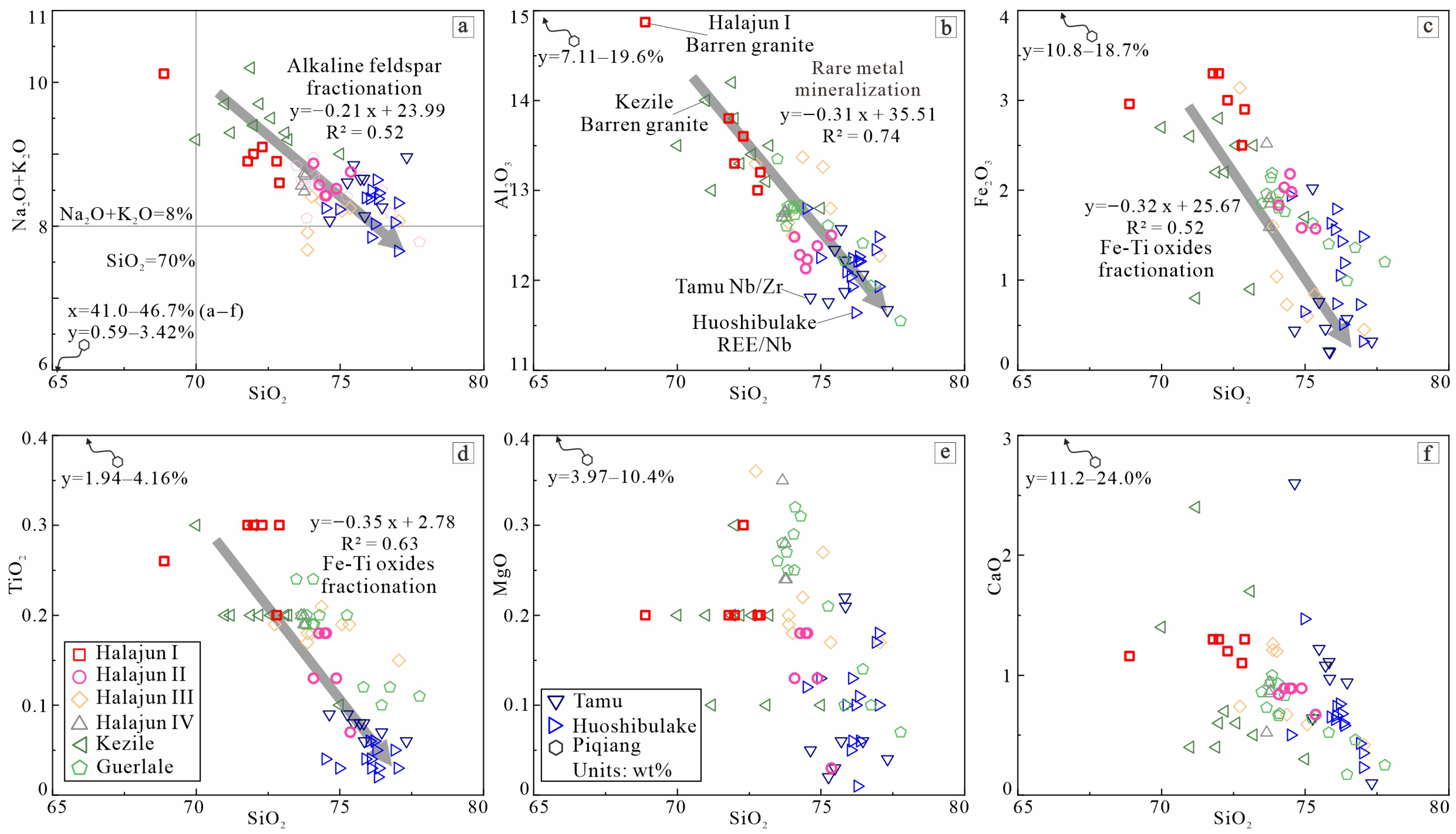
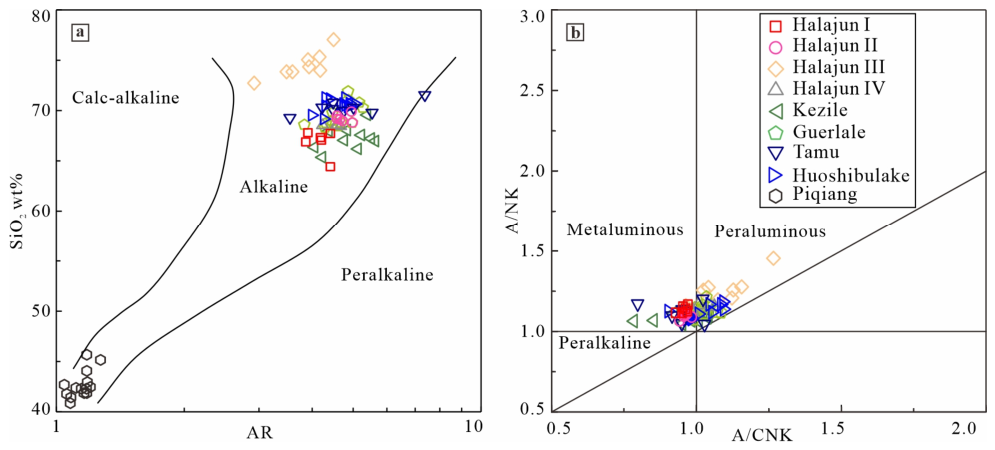
Whole-rock major and trace element data for the HLJ1 and HLJ2 granites are listed in Table S1. All these show low loss-on-ignition (0.20–1.10 wt.%), indicating negligible post-magmatic alteration. Major element compositions of HLJ1 are characterized by high SiO2, ranging from 68.9 to 72.9 wt.% (mean = 71.8 wt.%), and high alkaline (K2O + Na2O = 8.60–10.1 wt.%, mean = 9.10 wt.%) but exhibit low Al2O3, MgO, TFe2O3, CaO, MnO, and TiO2 contents (Figure 4). Similarly, HLJ2 exhibits higher SiO2 contents (74.1–75.4 wt.%, mean = 74.6 wt.%) and high alkaline (K2O + Na2O = 8.42–8.87 wt.%, mean = 8.59 wt.%), along with low contents of Al2O3, MgO, TFe2O3, CaO, MnO, and TiO2 (Figure 4). Their A/NK (1.07–1.17) and A/CNK (0.93–0.97) ratios indicate metaluminous and alkaline affinity (Figure 5). Compared with other granitic rocks in the Halajun area, HLJ1 and HLJ2 show comparable major-element characteristics and define a coherent compositional trend towards the more evolved Tamu and Huoshibulake granites (Figure 4).
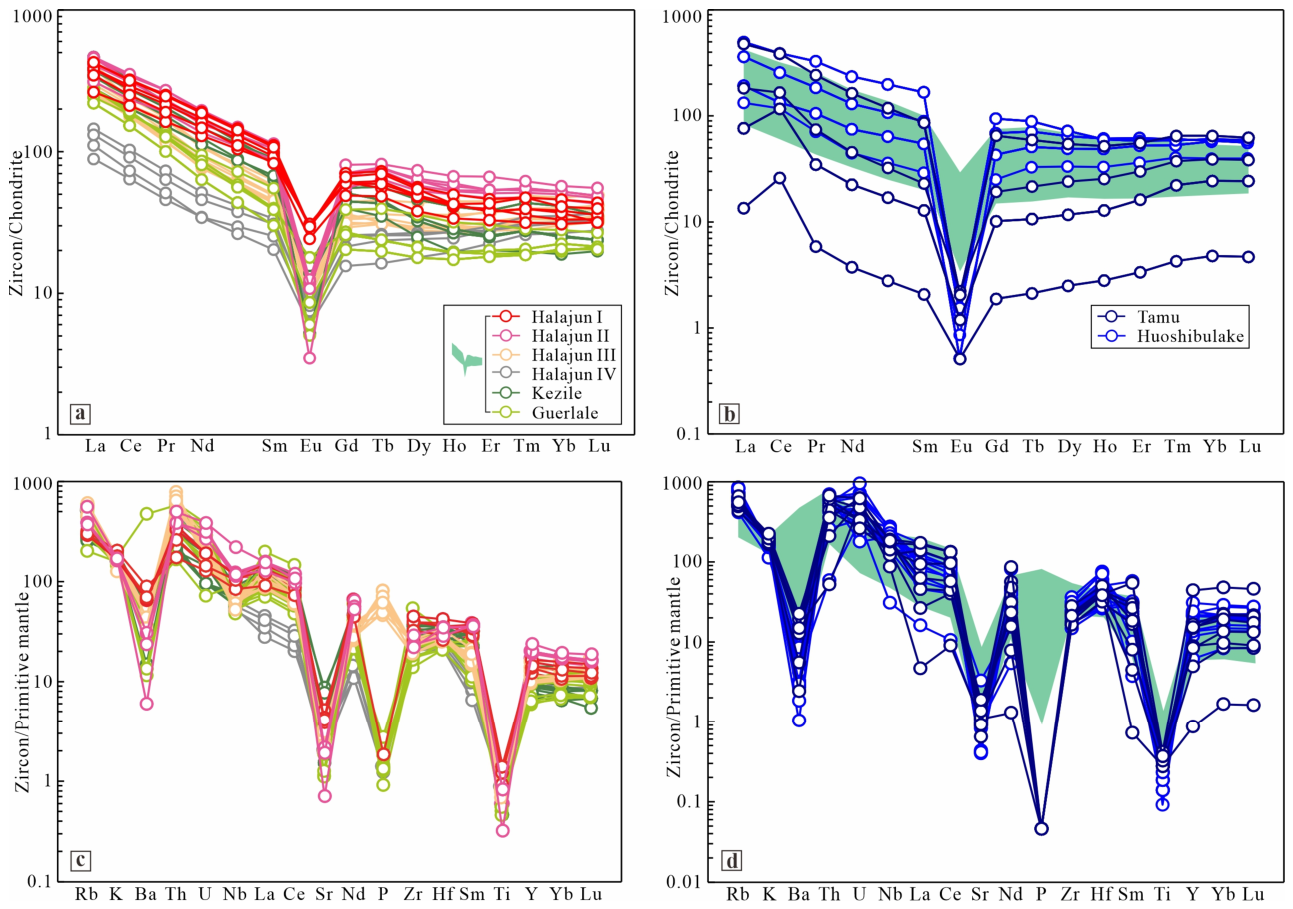
Both units are strongly enriched in rare earth elements (ΣREEHLJ1 = 324–480 ppm, mean = 415 ppm; ΣREEHLJ2 = 359–511 ppm, mean = 460 ppm) and display pronounced light REE enrichment relative to heavy REEs ((La/Yb)N HLJ1 = 7.98–11.3, mean = 9.93; (La/Yb)N HLJ1= 6.82–9.36, mean = 8.02). Chondrite-normalized patterns show steep fractionation and negative Eu anomalies (Figure 6), which are moderate in HLJ1 (δEu = 0.33–0.43) but markedly stronger in HLJ2 (δEu = 0.04–0.15). Primitive mantle-normalized trace element patterns reveal systematic depletion in the large-ion lithophile elements (LILEs, e.g., Ba and Sr) and enrichment in high field-strength elements (HFSEs, e.g., Nb, Zr, and Hf). Despite broadly similar trace element signatures across the Halajun granites, the Tamu and Huoshibulake granites exhibit more extreme depletion in Eu, K, Sr, P, and Ti, consistent with their advanced magmatic differentiation.

4.2. Zircon U–Pb Geochronology

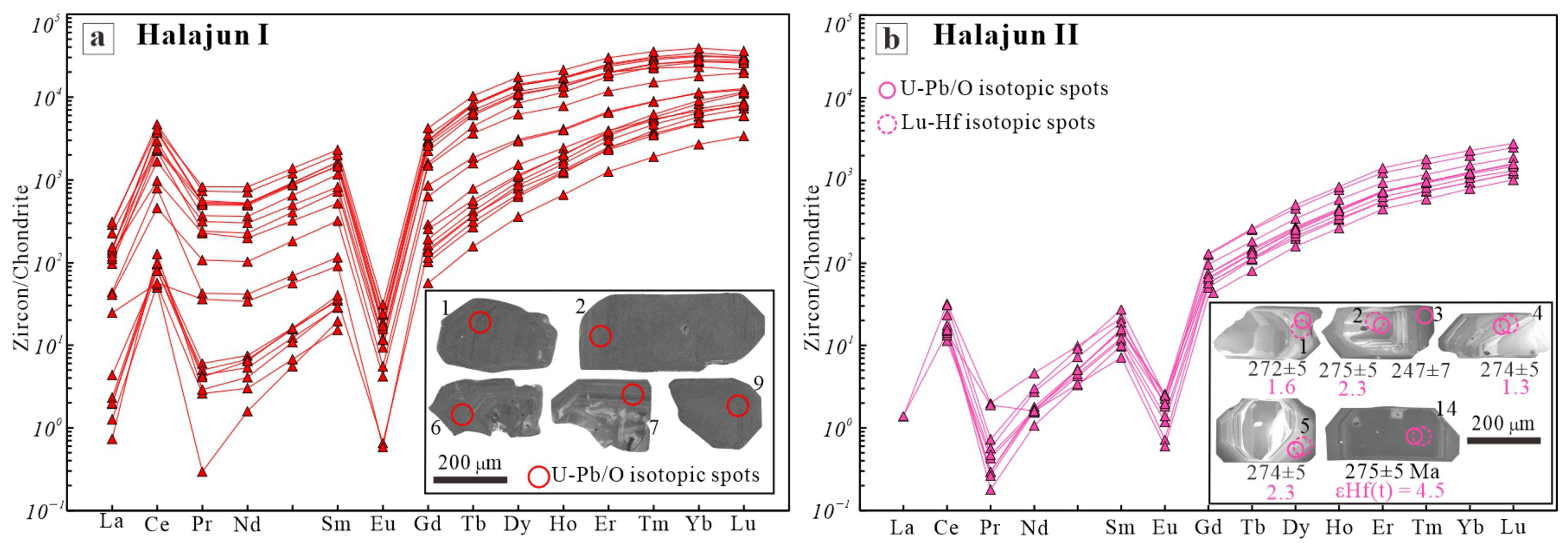
Zircons from both HLJ1 and HLJ2 occur as euhedral prismatic grains (100–500 μm), with length–width ratios of 1–4. HLJ2 zircons display clear oscillatory zoning, consistent with a magmatic origin, whereas HLJ1 zircons commonly exhibit turbid surfaces and weak or faint zoning (Figure 7). Twenty selected zircons were analyzed from each unit. The REE compositions and associated U–Pb data are listed in Tables S2 and S3.
Zircons from HLJ1 show highly variable and elevated REE contents (ΣREE = 10,517–201,522 ppm), with wide ranges in LREE/HREE (0.05–0.51) and Eu anomalies (δEu = 0.01–1.00), indicating that they are disturbed or recrystallized grains (Figure 7a). In contrast, HLJ2 zircons yield lower and more coherent REE contents (ΣREE = 2963–48,826 ppm), with low LREE/HREE ratios (0.005–0.32) and uniformly negative Eu anomalies (δEu = 0.06–0.37), supporting a magmatic origin (Figure 7b). Accordingly, only HLJ2 zircons are considered for age interpretation.
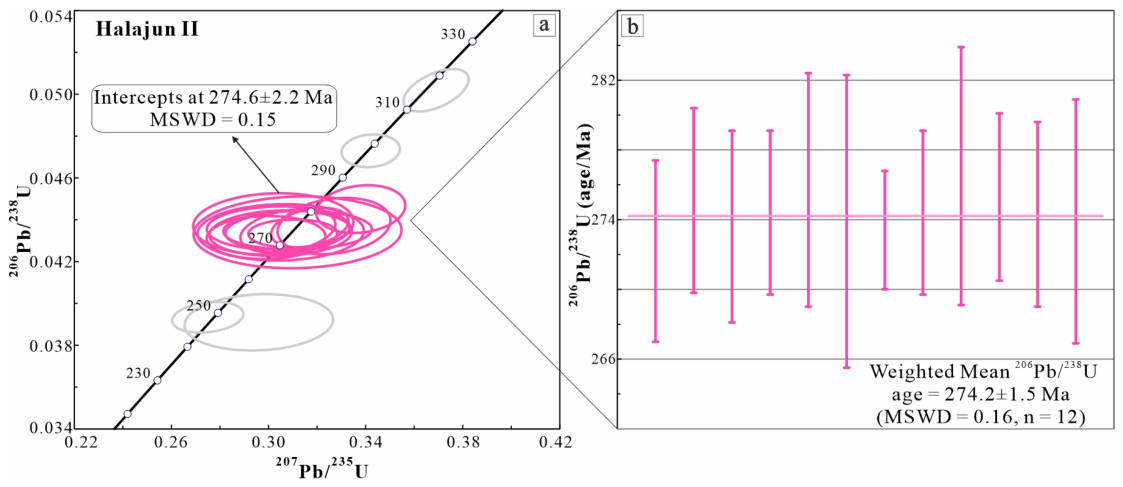
After excluding three outliers with low concordance between 207Pb/235U and 206Pb/238U (<95%), HLJ2 zircons yield Th and U concentrations of 37.3–998 ppm and 93.8–1832 ppm, respectively, with Th/U ratios of 0.36–0.58, further confirming their magmatic character. Most analyses are concordant (>95%) and cluster along the Concordia curve. The data yield a lower intercept age of 274.6 ± 2.2 Ma (MSWD = 0.15; Figure 8a). Individual 206Pb/238U ages range from 272.2 to 280.7 Ma, with a weighted mean age of 274.2 ± 1.5 Ma (MSWD = 0.16; Figure 8b), revealing the crystallization age of the HLJ2 granite.

4.3. Monazite U–Pb Geochronology

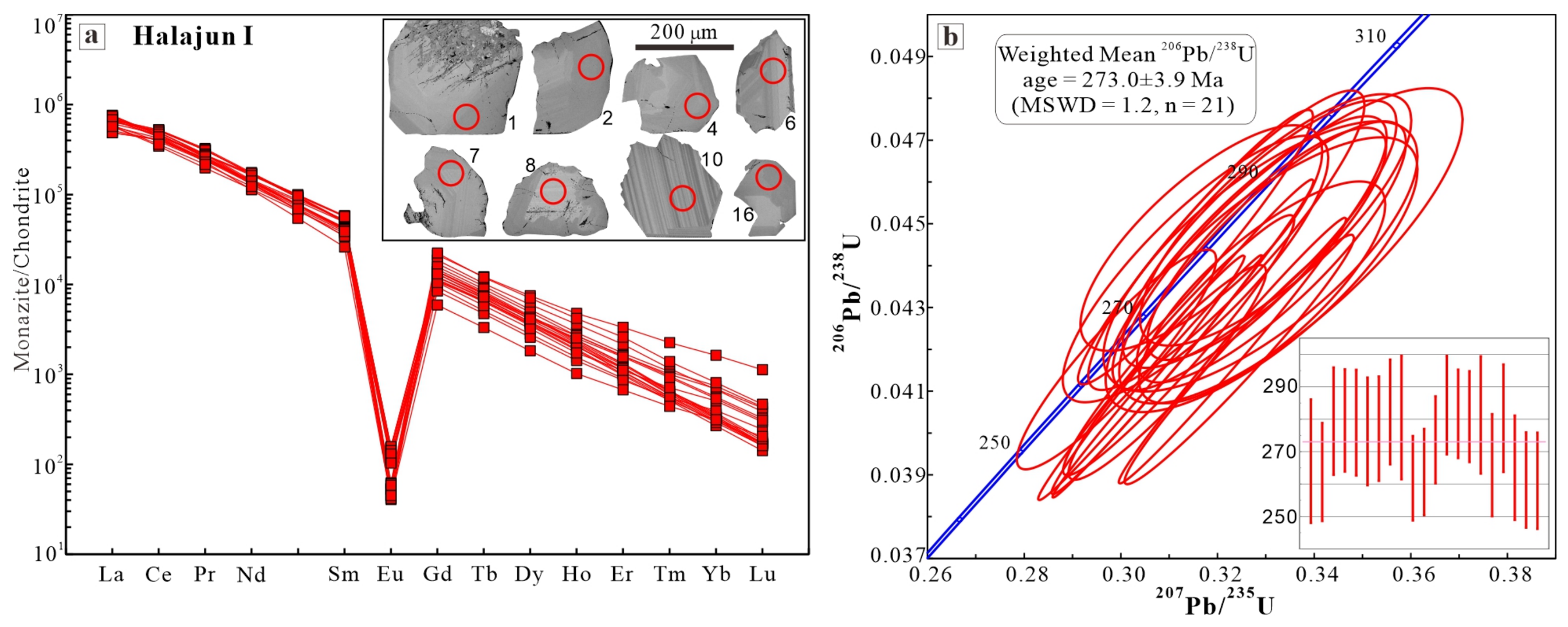
Monazite in HLJ1 occurs as euhedral prismatic grains (100–300 μm) with length-width ratios of 1–2. Most grains display well-developed oscillatory zoning, consistent with primary magmatic growth, although a few exhibit weak or faint zoning (Figure 9a). Thirty selected monazites were analyzed by LA–ICP–MS. The REE compositions and associated U–Pb data are listed in Tables S4 and S5.
Monazite shows high total REE contents (ΣREE = 418,557–842,577 ppm), with strong enrichment in light REEs (LREE/HREE = 59.5–249) and pronounced negative Eu anomalies (δEu < 0.01), suggesting a magmatic origin (Figure 9a). High Th (342,170–1,631,783 ppm) and moderate U (4364–29,282 ppm) concentrations yield elevated Th/U ratios (33.6–111), further supporting their crystallization from melts. Most analyses are concordant (>95%) and plot close to the Concordia curve (Figure 9b). Individual 206Pb/238U ages range from 261.0 to 284.3 Ma, yielding a weighted mean age of 273.2 ± 3.9 Ma (MSWD = 1.2; n = 21), interpreted as the crystallization age of HLJ1. These results indicate broadly coeval emplacement of granitic magmatism across the Halajun area during the Early Permian.

4.4. Zircon Hf-O Isotopes

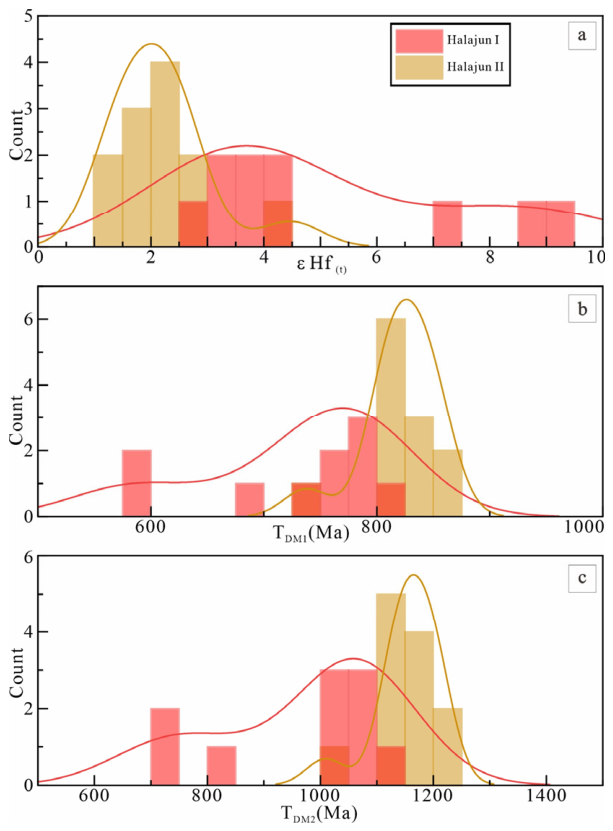
Zircon Lu–Hf isotopic compositions from HLJ1 (n = 10) and HLJ2 (n = 12) are characterized by uniformly positive εHf(t) values (Figure 10a; Table S6), indicating contributions from mantle or juvenile crustal sources. In comparison, HLJ2 zircons yield systematically lower εHf(t) values and older model ages than those from HLJ1.
The 176Hf/177Hf ratios for the HLJ1 range from 0.282688–0.282883. They have 176Lu/177Hf ratios from 0.001171 to 0.007318, with εHf(t) values of 2.9–9.2. The TDM1 vary from 576–803 Ma (mean ~729 Ma), while TDM2 ranges from 710 to 1111 Ma (mean ~971 Ma) (Figure 10). HLJ2 zircons show lower 176Hf/177Hf ratios (0.282641–0.282734) and 176Lu/177Hf ratios (0.000384–0.001190), yielding εHf(t) values of +1.4 to +4.5 (Figure 10). Corresponding TDM1 and TDM2 ages are 738–856 Ma (mean ~821 Ma) and 1007–1207 Ma (mean ~1153 Ma), respectively, indicating a greater contribution from evolved crustal components.
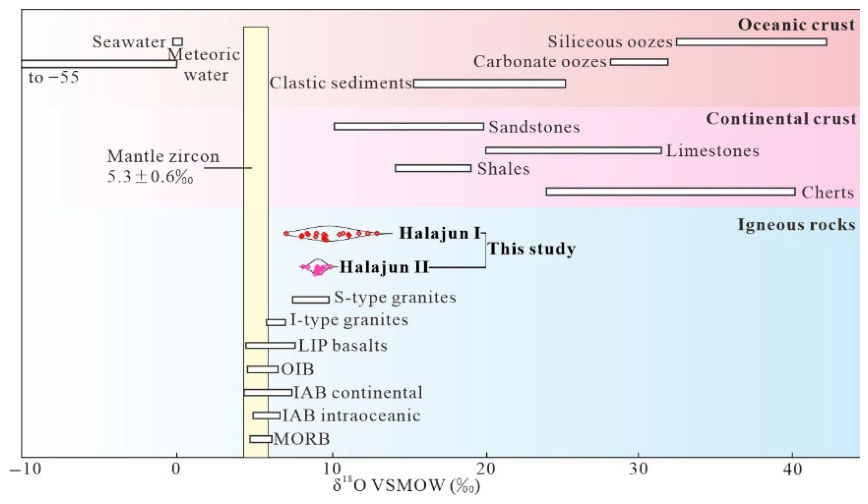
Zircon δ18O values range from 7.16‰ to 13.0‰ for HLJ1 and 8.24‰ to 10.0‰ for HLJ2 (Table S7). These values are consistently higher than those of mantle zircon but overlap with the lower range of crustal materials (Figure 11), suggesting variable but significant incorporation of supracrustal components.

5. Discussion

5.1. Petrogenesis of Halajun Granitic Plutons

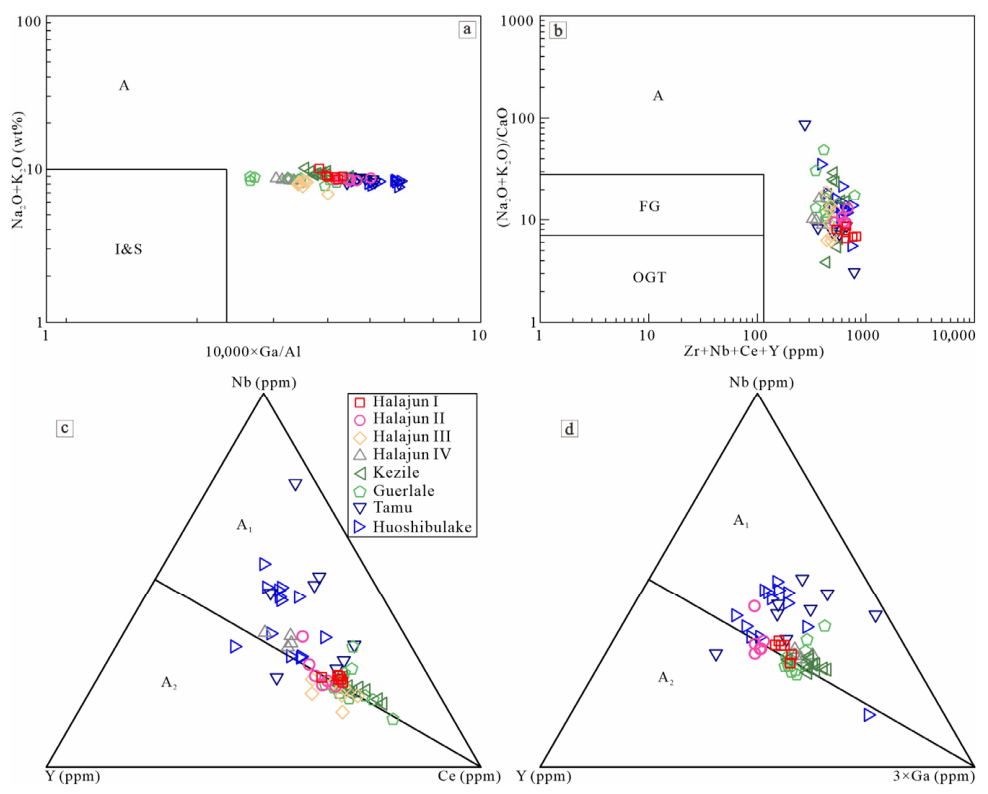
A-type granites are typically characterized by alkaline, relatively anhydrous compositions and emplacement in anorogenic settings [40,41], commonly reflecting high-temperature magmatism sourced from deep crust–mantle levels [42]. The HLJ1 and HLJ2 granitoids exhibit elevated total alkali contents coupled with comparatively low Al2O3 concentrations (Figure 4 and Figure 5). Their geochemical signatures—illustrated by discrimination diagrams such as (K2O + Na2O – 10,000 Ga/Al, (K2O + Na2O/CaO) – 10,000 Ga/Al, Nb–Y–Ce, and Nb–Y–3Ga (Figure 12)—consistently plot them within the A-type granite field. Wu [12] further proposed a deep magma chamber origin based on the high zircon saturation temperatures of the Halajun plutons, while the regional tectonic framework [12,15,43] indicates an anorogenic setting. These lines of evidence are consistent with our classification, indicating that HLJ1 and HLJ2 belong to A-type granites.
Several genetic models have been proposed for A-type granites, including: (1) direct differentiation of mantle-derived alkaline basaltic magma [44,45]; (2) mixing between mantle- and crust-derived melts [46]; and (3) partial melting of the lower continental crust induced by underplating of mantle-derived magmas [42,47]. In highly evolved granitic systems, zircon Lu–Hf isotopes provide robust constraints on magma sources and evolution [12,48,49]. Here, we integrate whole-rock geochemistry with zircon Hf-O isotope data to constrain the petrogenesis of HLJ1 and HLJ2.
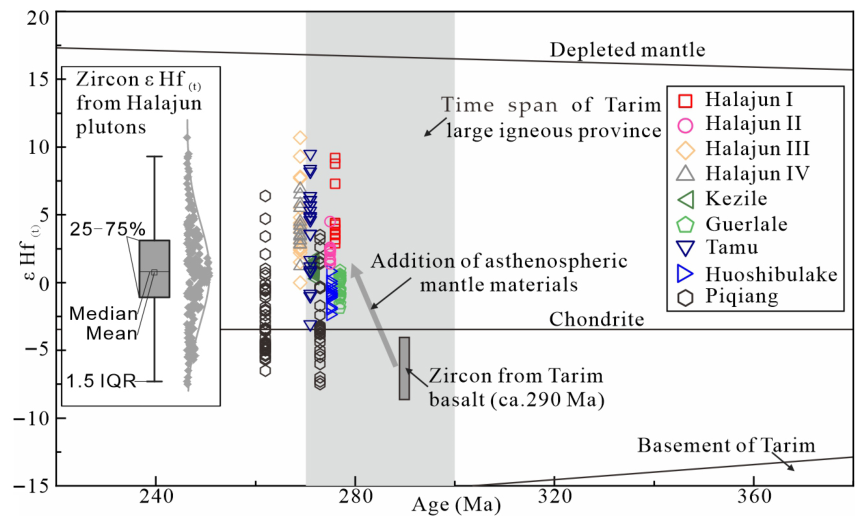
Whole-rock geochemical and geochronological datasets from the Halajun area define coherent compositional trends across the coeval plutons (Figure 4, Figure 5, Figure 6 and Figure 13), suggesting a genetically related magmatic system [48,50,51]. Abundant dark enclaves in the Halajun I pluton, characterized by mafic compositions, indicate input from a deep, potentially mantle-derived source. Zircon Hf isotopic compositions from both HLJ1 and HLJ2 yield uniformly positive εHf(t) values (Figure 14), overlapping with those of coeval granitic and mafic rocks in the region [16,17,18,24,25]. In contrast, zircon δ18O values fall between mantle and crustal ranges (Figure 11). The combined isotopic evidence points to a hybrid source involving both mantle-derived and crustal components, consistent with those proposed regional petrogenetic models [18,25]. In summary, all lines of evidence indicate a crust–mantle mixing origin, rather than independent crustal- or mantle-derived sources.
Figure 12. K2O + Na2O − 10,000 Ga/Al (a); (K2O + Na2O/CaO) – 10,000 Ga/Al (b); Nb–Y–Ce (c); and Nb–Y–3Ga (d) discrimination diagrams (modified after Whalen and Currie [42] and Eby [52]). I = I-type granites; S = S-type granites; A = A-type granites; A1 = A1-type; A2 = A2-type; FG = felsic granite; OGT = unfractionated M-, I- and S-type granite.
Geosciences 16 00181 g012
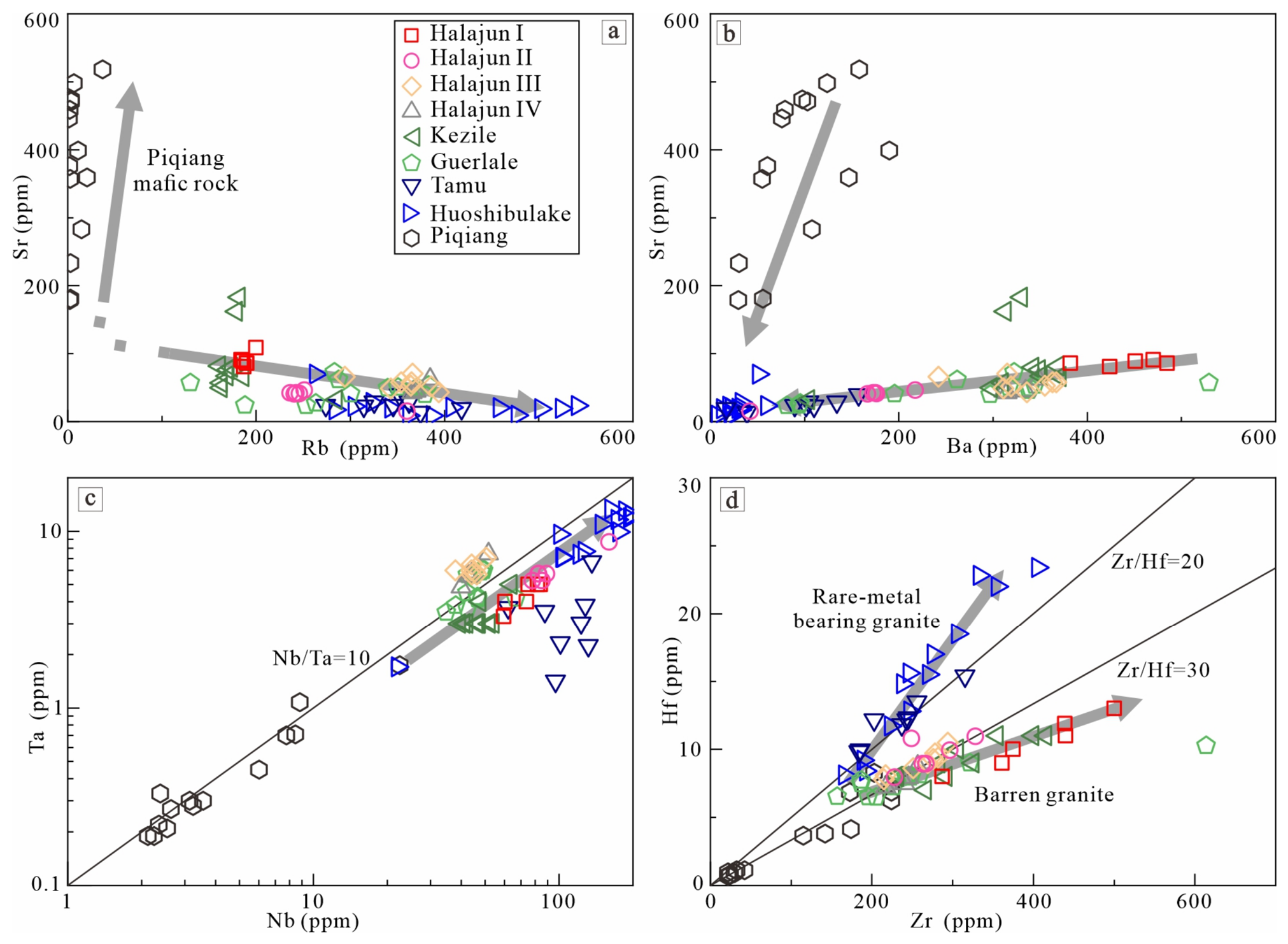
Figure 13. Magmatic evolution trends illustrated by representative elemental variations: (a) Sr-Rb; (b) Sr-Ba; (c) Ta-Nb; and (d) Hf-Zr. The gray arrows display the evolutional trends of the element contents.
Geosciences 16 00181 g013
Systematic variations in major and trace elements—including SiO2, total alkalis, Al2O3, and trace element ratios, such as Sr/Rb, Sr/Ba, Ta/Nb, and Hf/Zr (Figure 13), define coherent evolutionary trends among the Halajun granites and Piqiang complex [53,54]. These trends are consistent with progressive magmatic differentiation playing a key role in their evolution. Notably, the Tamu and Huoshibulake plutons display elevated Ta/Nb and Hf/Zr ratios relative to other intrusions, indicating derivation from more highly fractionated magmas [54].
Figure 14. Zircon Hf-isotopic evolution diagram. The age of Tarim large igneous province reference from Xu and Wei [55].
Geosciences 16 00181 g014

5.2. Crustal Reworking in the Southwest Tianshan

The Early Permian Tarim magmatic event is widely recognized as a large igneous province (LIP) [25,55,56,57], with a protracted magmatic history spanning ~30 Myr [17,18,56,58,59,60,61,62,63,64,65,66,67,68]. Available geochronological data indicate that magmatism initiated at ca. 300 Ma with the emplacement of kimberlites [55,61], followed by widespread intrusive and extrusive activity. The emplacement ages of the Halajun plutons overlap with this interval (Figure 14), suggesting that their formation was temporally and genetically linked to the Tarim LIP [55].
Among the proposed genetic models, a mantle plume origin provides the most coherent explanation for the scale, duration, and geochemical characteristics of the Tarim LIP [55], and is consistent with other Permian LIPs, globally [55,69,70,71]. In this framework, upwelling of the Tarim mantle plume would have supplied substantial thermal energy and mafic magma to the base of the lithosphere. The zircon Hf isotopic data define a coherent positive εHf(t) array for both granitic and mafic rocks from the Halajun area (Figure 14), while zircon δ18O values indicate contributions from supracrustal materials (Figure 11). As a whole, these isotopic signatures point to pervasive crust–mantle interaction, consistent with plume-induced magmatism [25].
The Tarim LIP covers an area of approximately 250,000 km2 [55] and is characterized by widespread evidence of hybrid magmatism involving both mantle- and crust-derived components (Figure 14, [25]). The generation of such voluminous magmas requires significant heat input, most plausibly supplied by a mantle plume, which in turn would have triggered extensive partial melting of the ancient lower crust [18,55] and generated large volumes of felsic rocks at the upper crust [17,18,25,72]. This process indicates regional-scale crustal reworking in the SW-TOB. In summary, the coupling of mantle-derived magmatism and lower-crustal melting led to a regionally extensive phase of crustal reworking. The Halajun granitoids record this process through their hybrid isotopic signatures and systematic geochemical trends, reflecting both mantle input and progressive magmatic differentiation. Such crustal reworking represents a fundamental mechanism for modifying continental crust during LIP events, linking deep mantle dynamics to upper-crustal magmatism and metallogenesis.

5.3. Potential for Rare-Metal Mineralization in the Halajun Area

As a direct manifestation of regional crustal reworking, A-type granites are widely distributed across the SW-TOB and the northwestern margin of the Tarim Craton (Figure 1c). A-type granites commonly exhibit enrichment in HFSE and REE and have been found to be closely linked to NYF-type (Nb–Y–F) rare-metal mineralization [73,74]. Recent exploration has identified several rare-metal deposits genetically associated with A-type alkaline intrusions along the northwestern margin of the Tarim Craton [3,12,13,14,73], highlighting their metallogenic significance.
Although some deposits, such as the Shanghu pegmatite-type REE system (~1.81 Ga, [75]) and the Qieganbulake carbonatite-related REE–P deposit (~812–811 Ma, [13,76,77]), were formed during earlier tectonomagmatic events, most rare-metal mineralization in the region clusters within the Early Permian (ca. 290–269 Ma). This temporal distribution coincides with the Tarim LIP [13,14,67,68,78,79], suggesting that plume-related magmatism contributed to a regional rare-metal metallogenic event. Representative deposits—including the Boziguoer (Nb–Ta–Zr, 290-280 Ma, [80]), Tamu (Nb–Zr–REE, 275 Ma, [12]), Huoshibulake (Nb–REE, 273 Ma, [12,13,14]), and Bashisuogong (Nb–REE, 274-269 Ma, [68])—display geochemical and mineralogical features consistent with globally recognized NYF-type systems [81,82,83].
In granitic systems, rare metals, such as Nb, Ta, REE, and U behave as incompatible components during partial melting and fractional crystallization [84,85]. Their enrichment is, therefore, governed by a combination of low-degree partial melting and advanced magmatic differentiation [3,12,74,82,86,87]. Petrogenetic models [88] suggest that the primary magma of the Halajun plutons was derived from low-degree (10–15%) partial melting of an amphibole-bearing spinel lherzolite source, followed by substantial fractional crystallization during emplacement [17,18,24,25]. This evolutionary history is consistent with regional geochemical trends and isotopic features.
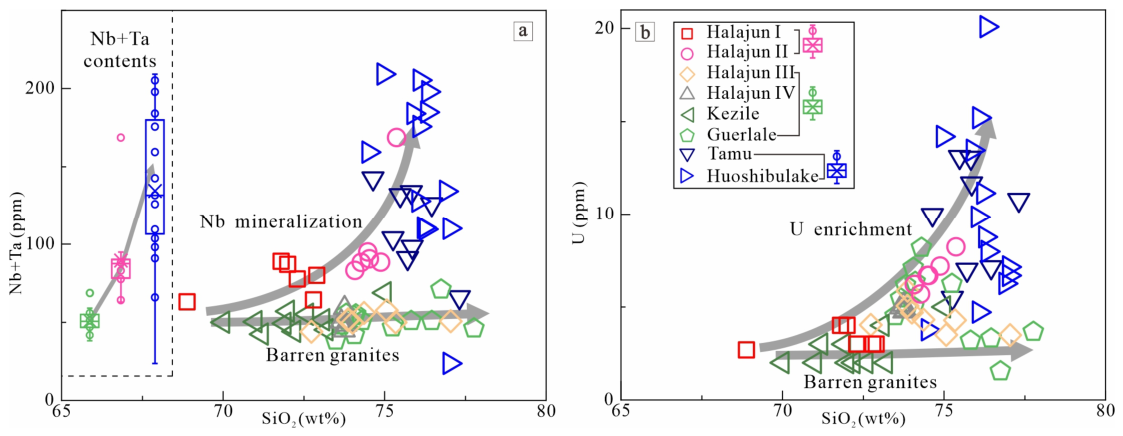
Systematic comparisons between ore-bearing and barren granites reveal distinct geochemical signatures (Figure 4, Figure 6 and Figure 13). Ore-bearing intrusions are characterized by higher SiO2 contents and Nb/Ta ratios, coupled with lower Al2O3 and Zr/Hf ratios (Figure 4 and Figure 13). Moreover, they exhibit pronounced enrichment in Nb, Ta and U relative to barren counterparts (Figure 15). These features collectively indicate that progressive magmatic differentiation plays a critical role in concentrating rare metals to economically significant levels [12,13,14]. Notably, some Halajun intrusions—particularly the HLJ2 pluton—exhibit geochemical characteristics indicative of highly evolved magmatic systems, suggesting a potential for rare-metal mineralization (Figure 15). The integration of plume-related magmatism, crust–mantle interaction, and prolonged fractional crystallization establishes a favorable metallogenic framework. Consequently, the Halajun granitoids, along with analogous A-type granite systems in southwestern Tianshan, represent promising targets for future rare-metal exploration.

6. Conclusions

The Halajun I and II plutons in the Halajun area represent highly evolved alkaline A-type granites emplaced at ~274–273 Ma, coeval with regional magmatism of the Tarim large igneous province. Their geochemical characteristics—including enrichment in SiO2, alkalis and REEs, and depletion in LILEs and HFSEs—reflect advanced magmatic differentiation. Zircon Hf-O isotopic compositions indicate that these granites were derived from partial melting of Neoproterozoic lower crust, with additional input from mantle-derived melts. This hybrid signature records significant crust–mantle interaction driven by plume-related thermal input. The Permian mantle plume activity beneath the Tarim region triggered large-scale crustal reworking in the southwestern Tianshan, generating voluminous felsic magmas and promoting prolonged fractional crystallization. This process led to progressive enrichment of incompatible elements, including Nb, Ta and REEs, in highly evolved melts. The spatial and geochemical association between these evolved granites and rare-metal occurrences indicates that extreme magmatic differentiation, coupled with crust–mantle mixing, is critical for producing metal-fertile systems.

Supplementary Materials

The following supporting information can be downloaded at: https://www.mdpi.com/article/10.3390/geosciences16050181/s1, Table S1: Whole-rock major and trace element data for the Halajun granites and Piqiang ultramafic–mafic rocks; Table S2: Rare-earth element (REE) compositions of zircons from the HLJ1 and HLJ2; Table S3: U–Pb data of zircons from the HLJ1 and HLJ2; Table S4: Rare earth element compositions of Monazite from the HLJ1 and HLJ2; Table S5: U–Pb data of Monazite from the HLJ1 and HLJ2; Table S6: Zircon Lu–Hf isotopic compositions from the HLJ1 and HLJ2; Table S7: Zircon oxygen isotopic compositions from the HLJ1 and HLJ2.

Author Contributions

Conceptualization, H.W., H.L. and H.H.; methodology, M.L. and Z.G.; software, G.W.; validation, H.W. and D.H.; formal analysis, H.L.; investigation, H.W. and H.H.; resources, M.L. and D.H.; data curation, G.W.; writing—original draft preparation, H.L.; writing—review and editing, H.W. and H.H.; visualization, G.W. and D.H.; supervision, H.W.; project administration, H.W.; funding acquisition, H.W. and H.H. All authors have read and agreed to the published version of the manuscript.

Funding

This research was funded by the Natural Science Foundation of China (NSFC Grant nos. 42502062 and 42173052), the Science and Technology Innovation Foundation of Survey Center of Comprehensive Natural Resources (KC20240007), the China Geological Survey Project (DD202601103403), and the Youth Talent Program of the Special Support Plan for Talents in Shaanxi Province to Huanhuan Wu. The APC was funded by KC20240007 and DD202601103403.

Data Availability Statement

All data are listed in the Supplementary Materials.

Acknowledgments

We thank the editors and reviewers for constructive comments, which significantly improved the quality of the manuscript.

Conflicts of Interest

The authors declare no conflicts of interest.

References

  1. Li, J.K.; Li, P.; Wang, D.H.; Li, X.J. A review of niobium and tantalum metallogenic regularity in China. Chin. Sci. Bull. 2019, 64, 1545–1566, (In Chinese with English Abstract). [Google Scholar] [CrossRef]
  2. Oliveira, J.M.d.; Anes, I.A.; Coleti, J.L.; Espinosa, D.C.R.; Carvalho, M.S.d.; Tenório, J.A.S. Niobium and tantalum recovery from the primary source and from tin slag, an industrial challenge: A review. Can. J. Chem. Eng. 2022, 100, 1743–1761. [Google Scholar] [CrossRef]
  3. Wu, H.H.; Huang, H.; Zhang, Z.C.; Wang, T.; Guo, L.; Gao, Y.B.; Zhang, Z. Highly differentiated trachytic magma linked with rare metal mineralization: A case study from the Shuanghekou Nb deposit, South Qinling. Lithos 2023, 438–439, 106990. [Google Scholar] [CrossRef]
  4. Wu, H.H.; Huang, H.; Zhang, Z.C.; Yang, S.Y.; Gao, Y.B.; Finch, A.A. Tourmaline chemical and boron isotopic constraints on the magmatic-hydrothermal transition and rare-metal mineralization in alkali granitic systems. Am. Mineral. 2024, 109, 1461–1477. [Google Scholar] [CrossRef]
  5. Cao, L.; Chen, X.; Jiang, J.S.; Garba, A.A.; Li, H.Q.; Chao, N.; Hu, P.; Lv, X.B. Geochronology of cassiterite in the Nassarawa-Keffi rare metal pegmatite belt, Nigeria: Tectonic linkages to the Gondwana-forming orogeny. Ore Geol. Rev. 2024, 175, 106339. [Google Scholar] [CrossRef]
  6. Tang, Z.M.; Che, X.D.; Wang, R.C.; Yang, Y.H.; Wu, F.Y.; Linnen, R.L.; Deng, F.; Hu, H.; Lu, J.J. Nb-Ta mineralization in a metaluminous-weakly peraluminous magmatic system: Constraints from the chemical compositions and Hf isotopes of columbite-group minerals in China. Am. Mineral. 2025, 110, 1787–1802. [Google Scholar] [CrossRef]
  7. Zhang, H.F.; Harris, N.; Parrish, R.; Zhang, L.; Zhao, Z.D. Geochemistry of North Himalayan Leucogranites: Regional Comparison, Petrogenesis and Tectonic Implications. Earth Sci. 2005, 30, 275–288, (In Chinese with English Abstract). [Google Scholar]
  8. Li, G.M.; Fu, J.G.; Guo, W.K.; Zhang, H.; Zhang, L.K.; Dong, S.L.; Li, Y.X.; Wu, J.Y.; Jiao, Y.J.; Jin, C.H.; et al. Discovery of the Gabo granitic pegmatite-type lithium deposit in the Kulagangri Dome, eastern Himalayan metallogenic belt, and its propecting implication. Acta Petrol. Et Mineral. 2022, 41, 1109–1119, (In Chinese with English Abstract). [Google Scholar]
  9. Li, G.M.; Zhang, L.K.; Jiao, Y.J.; Xia, X.B.; Dong, S.L.; Fu, J.G.; Liang, W.; Zhang, Z.; Wu, J.Y.; Dong, L.; et al. First discovery and implications of Cuonadong superlarge Be-W-Sn polymetallic deposit in Himalayan metallogenic belt, southern Tibet. Miner. Depos. 2017, 36, 1003–1008, (In Chinese with English Abstract). [Google Scholar]
  10. Qin, K.Z.; Zhao, J.X.; He, C.T.; Shi, R.Z. Discovery of the Qongjiagang giant lithium pegmatite deposit in Himalaya, Tibet, China. Acta Petrol. Sin. 2021, 37, 3277–3286, (In Chinese with English Abstract). [Google Scholar]
  11. Zheng, Y.Y.; Chen, X.; Gao, S.B.; Li, H.Q.; Jiang, X.J.; Zheng, S.L. Discovery and Prospecting Significance of Zhaguopu Li-Nb-Ta Deposit in the Western Himalayan Metallogenic Belt. Earth Sci. 2024, 49, 1555–1564, (In Chinese with English Abstract). [Google Scholar]
  12. Wu, H.H. Magmatic-Hydrothermal Evolution and Rare Metal Enrichment in the Alkali Granites in the Halajun Area, Northern Margin of the Tarim Craton. Ph.D. Thesis, China University of Geosciences (Beijing), Beijing, China, 2024. [Google Scholar]
  13. Xie, M.C.; Xiao, W.J.; Su, B.X.; Sakyi, P.A.; Ao, S.J.; Zhang, J.; Song, D.F.; Zhang, Z.Y.; Li, Z.Y.; Han, C.M. REE mineralization related to carbonatites and alkaline magmatism in the northern Tarim basin, NW China: Implications for a possible Permian large igneous province. Int. J. Earth Sci. 2022, 111, 2759–2776. [Google Scholar] [CrossRef]
  14. Zou, T.R.; Xu, J.; Chen, W.S.; Xia, F.R. Rare and Rare Earth Mineral Deposits Related to Alkaline Rocks on Northern Margin of Tarim Basin, Xinjing, China. Miner. Depos. 2002, 21, 845–848, (In Chinese with English Abstract). [Google Scholar]
  15. Huang, H. Paleozoic Granitoids in the Chinese South Tianshan and Its Implications for Geological Evolution of the Region. Ph.D. Thesis, China University of Geosciences (Beijing), Beijing, China, 2013. [Google Scholar]
  16. Cao, J.; Wang, X.; Tao, J.H. Petrogenesis of the Piqiang mafic-ultramafic layered intrusion and associated Fe-Ti-V oxide deposit in Tarim Large Igneous Province, NW China. Int. Geol. Rev. 2019, 61, 2249–2275. [Google Scholar] [CrossRef]
  17. Huang, H.; Zhang, Z.C.; Kusky, T.; Santosh, M.; Zhang, S.; Zhang, D.Y.; Liu, J.L.; Zhao, Z.D. Continental vertical growth in the transitional zone between South Tianshan and Tarim, western Xinjiang, NW China: Insight from the Permian Halajun A1-type granitic magmatism. Lithos 2012, 155, 49–66. [Google Scholar] [CrossRef]
  18. Zhang, C.L.; Zou, H.B. Permian A-type granites in Tarim and western part of Central Asian Orogenic Belt (CAOB): Genetically related to a common Permian mantle plume? Lithos 2013, 172–173, 47–60. [Google Scholar] [CrossRef]
  19. Sawyer, E.W. Formation and Evolution of Granite Magmas During Crustal Reworking: The Significance of Diatexites. J. Petrol. 1998, 39, 1147–1167. [Google Scholar] [CrossRef]
  20. Xiao, W.J.; Windley, B.F.; Sun, S.; Li, J.L.; Huang, B.C.; Han, C.M.; Yuan, C.; Sun, M.; Chen, H.L. A Tale of Amalgamation of Three Permo-Triassic Collage Systems in Central Asia: Oroclines, Sutures, and Terminal Accretion. Annu. Rev. Earth Planet. Sci. 2015, 43, 477–507. [Google Scholar] [CrossRef]
  21. Şengör, A.M.C.; Natal’in, B.A.; Burtman, V.S. Evolution of the Altaid tectonic collage and Palaeozoic crustal growth in Eurasia. Nature 1993, 364, 299–307. [Google Scholar] [CrossRef]
  22. Windley, B.F.; Alexeiev, D.; Xiao, W.J.; Kröner, A.; Badarch, G. Tectonic models for accretion of the Central Asian Orogenic Belt. J. Geol. Soc. 2007, 164, 31–47. [Google Scholar] [CrossRef]
  23. Hu, A.Q.; Jahn, B.-M.; Zhang, G.X.; Chen, Y.B.; Zhang, Q.F. Crustal evolution and Phanerozoic crustal growth in northern Xinjiang: Nd isotopic evidence. Part I. Isotopic characterization of basement rocks. Tectonophys. 2000, 328, 15–51. [Google Scholar] [CrossRef]
  24. Chen, T.C.; Ling, M.X.; Liu, Y.L.; Jiang, X.Y.; Wei, Y.; Chen, J.J. Origin of the Permian high silica A-type granites in Halajun, South Tienshan, NW China: Implications for crystal-liquid segregation and rare metal fertilization. Lithos 2024, 468–469, 107490. [Google Scholar] [CrossRef]
  25. Zong, Z.J.; Du, Y.S.; Li, S.T.; Cao, Y.; Du, J.G.; Deng, X.H.; Xue, L.W. Petrogenesis of the early Permian A-type granites in the Halajun region, southwest Tianshan, western Xinjiang, NW China: Implications for geodynamics of Tarim large igneous province. Int. Geol. Rev. 2020, 63, 1110–1131. [Google Scholar] [CrossRef]
  26. Chen, Q.; Song, W.L.; Yang, J.K.; Hu, Y.; Huang, J.; Zhang, T.; Zheng, G.S. Principle of automated mineral quantitative analysis system and its application in petrology and mineralogy: An example from TESCAN TIMA. Miner. Depos. 2021, 40, 345–368, (In Chinese with English Abstract). [Google Scholar]
  27. Hu, Z.C.; Zhang, W.; Liu, Y.S.; Gao, S.; Li, M.; Zong, K.Q.; Chen, H.H.; Hu, S.H. “Wave” Signal-Smoothing and Mercury-Removing Device for Laser Ablation Quadrupole and Multiple Collector ICPMS Analysis: Application to Lead Isotope Analysis. Anal. Chem. 2015, 87, 1152–1157. [Google Scholar] [CrossRef] [PubMed]
  28. Tomascak, P.B.; Krogstad, E.J.; Walker, R.J. U-Pb Monazite Geochronology of Granitic Rocks from Maine: Implications for Late Paleozoic Tectonics in the Northern Appalachians. J. Geol. 1996, 104, 185–195. [Google Scholar] [CrossRef]
  29. Gonçalves, G.O.; Lana, C.; Scholz, R.; Buick, I.S.; Gerdes, A.; Kamo, S.L.; Corfu, F.; Marinho, M.M.; Chaves, A.O.; Valeriano, C.; et al. An assessment of monazite from the Itambé pegmatite district for use as U–Pb isotope reference material for microanalysis and implications for the origin of the “Moacyr” monazite. Chem. Geol. 2016, 424, 30–50. [Google Scholar] [CrossRef]
  30. Liu, Y.S.; Gao, S.; Hu, Z.C.; Gao, C.G.; Zong, K.Q.; Wang, D.B. Continental and Oceanic Crust Recycling-induced Melt–Peridotite Interactions in the Trans-North China Orogen: U–Pb Dating, Hf Isotopes and Trace Elements in Zircons from Mantle Xenoliths. J. Petrol. 2010, 51, 537–571. [Google Scholar] [CrossRef]
  31. Liu, Y.S.; Hu, Z.C.; Gao, S.; Günther, D.; Xu, J.; Gao, C.G.; Chen, H.H. In situ analysis of major and trace elements of anhydrous minerals by LA-ICP-MS without applying an internal standard. Chem. Geol. 2008, 257, 34–43. [Google Scholar] [CrossRef]
  32. Ludwig, K.R. ISOPLOT 3.00: A Geochronological Toolkit for Microsoft Excel; Berkeley Geochronology Center: Berkeley, CA, USA, 2003; p. 39. [Google Scholar]
  33. Hu, Z.C.; Liu, Y.S.; Gao, S.; Xiao, S.Q.; Zhao, L.S.; Günther, D.; Li, M.; Zhang, W.; Zong, K.Q. A “wire” signal smoothing device for laser ablation inductively coupled plasma mass spectrometry analysis. Spectrochim. Acta Part B At. Spectrosc. 2012, 78, 50–57. [Google Scholar] [CrossRef]
  34. Black, L.P.; Kamo, S.L.; Allen, C.M.; Davis, D.W.; Aleinikoff, J.N.; Valley, J.W.; Mundil, R.; Campbell, I.H.; Korsch, R.J.; Williams, I.S.; et al. Improved 206Pb/238U microprobe geochronology by the monitoring of a trace-element-related matrix effect; SHRIMP, ID–TIMS, ELA–ICP–MS and oxygen isotope documentation for a series of zircon standards. Chem. Geol. 2004, 205, 115–140. [Google Scholar] [CrossRef]
  35. Ickert, R.B.; Hiess, J.; Williams, I.S.; Holden, P.; Ireland, T.R.; Lanc, P.; Schram, N.; Foster, J.J.; Clement, S.W. Determining high precision, in situ, oxygen isotope ratios with a SHRIMP II: Analyses of MPI-DING silicate-glass reference materials and zircon from contrasting granites. Chem. Geol. 2008, 257, 114–128. [Google Scholar] [CrossRef]
  36. Wright, J.B. A simple alkalinity ratio and its application to questions of non-orogenic granite genesis. Geol. Mag. 1969, 106, 370–384. [Google Scholar] [CrossRef]
  37. Maniar, P.D.; Piccoli, P.M. Tectonic discrimination of granitoids. GSA Bull. 1989, 101, 635–643. [Google Scholar] [CrossRef]
  38. Sun, S.S.; McDonough, W.F. Chemical and isotopic systematics of oceanic basalts: Implications for mantle composition and processes. Geol. Soc. Lond. Spec. Publ. 1989, 42, 313–345. [Google Scholar] [CrossRef]
  39. Ireland, T.R.; Avila, J.; Greenwood, R.C.; Hicks, L.J.; Bridges, J.C. Oxygen Isotopes and Sampling of the Solar System. Space Sci. Rev. 2020, 216, 25. [Google Scholar] [CrossRef]
  40. Clemens, J.D.; Holloway, J.R.; White, A.J.R. Origin of an A-type granite; experimental constraints. Am. Mineral. 1986, 71, 317–324. [Google Scholar]
  41. Bonin, B. A-type granites and related rocks: Evolution of a concept, problems and prospects. Lithos 2007, 97, 1–29. [Google Scholar] [CrossRef]
  42. Whalen, J.B.; Currie, K.L.; Chappell, B.W. A-type granites: Geochemical characteristics, discrimination and petrogenesis. Contrib. Mineral. Petrol. 1987, 95, 407–419. [Google Scholar] [CrossRef]
  43. Alexeiev, D.V.; Biske, Y.S.; Wang, B.; Djenchuraeva, A.V.; Getman, O.F.; Aristov, V.A.; Kröner, A.; Liu, H.; Zhong, L. Tectono-Stratigraphic framework and Palaeozoic evolution of the Chinese South Tianshan. Geotectonics 2015, 49, 93–122. [Google Scholar] [CrossRef]
  44. Eby, G.N. The A-type granitoids: A review of their occurrence and chemical characteristics and speculations on their petrogenesis. Lithos 1990, 26, 115–134. [Google Scholar] [CrossRef]
  45. Turner, S.P.; Foden, J.D.; Morrison, R.S. Derivation of some A-type magmas by fractionation of basaltic magma: An example from the Padthaway Ridge, South Australia. Lithos 1992, 28, 151–179. [Google Scholar] [CrossRef]
  46. Kerr, A.; Fryer, B.J. Nd isotope evidence for crust-mantle interaction in the generation of A-type granitoid suites in Labrador, Canada. Chem. Geol. 1993, 104, 39–60. [Google Scholar] [CrossRef]
  47. Collins, W.J.; Beams, S.D.; White, A.J.R.; Chappell, B.W. Nature and origin of A-type granites with particular reference to southeastern Australia. Contrib. Mineral. Petrol. 1982, 80, 189–200. [Google Scholar] [CrossRef]
  48. Cao, H.W.; Pei, Q.M.; Santosh, M.; Li, G.M.; Zhang, L.K.; Zhang, X.F.; Zhang, Y.H.; Zou, H.; Dai, Z.W.; Lin, B.; et al. Himalayan leucogranites: A review of geochemical and isotopic characteristics, timing of formation, genesis, and rare metal mineralization. Earth-Sci. Rev. 2022, 234, 104229. [Google Scholar] [CrossRef]
  49. Liu, Z.C.; Wu, F.Y.; Ji, W.Q.; Wang, J.G.; Liu, C.Z. Petrogenesis of the Ramba leucogranite in the Tethyan Himalaya and constraints on the channel flow model. Lithos 2014, 208–209, 118–136. [Google Scholar] [CrossRef]
  50. Chen, G.; Li, H.Q.; Chen, H.; Huang, X.K. Timing and Tectonic Setting of the Zhaguopu Pegmatite-Type Li-Be-Nb-Ta Deposit, Western Himalaya: Implications for Post-Collisional Rare-Metal Metallogeny. Minerals 2026, 16, 208. [Google Scholar] [CrossRef]
  51. Li, H.Q.; Wei, Y.X.; Zhou, W.X.; Fru, E.C.; Drüppel, K.; Xu, D.L.; Deng, X.; Liu, H.; Tan, M.T. A Neoproterozoic appinite rock suite records the early tectonic evolution of the northern margin of the Yangtze Block during convergence with Rodinia. Precambrian Res. 2024, 409, 107448. [Google Scholar] [CrossRef]
  52. Eby, G.N. Chemical subdivision of the A-type granitoids:Petrogenetic and tectonic implications. Geology 1992, 20, 641–644. [Google Scholar] [CrossRef]
  53. Bachmann, O.; Dungan, M.A.; Bussy, F. Insights into shallow magmatic processes in large silicic magma bodies: The trace element record in the Fish Canyon magma body, Colorado. Contrib. Mineral. Petrol. 2005, 149, 338–349. [Google Scholar] [CrossRef]
  54. Dostal, J.; Chatterjee, A.K. Contrasting behaviour of Nb/Ta and Zr/Hf ratios in a peraluminous granitic pluton (Nova Scotia, Canada). Chem. Geol. 2000, 163, 207–218. [Google Scholar] [CrossRef]
  55. Xu, Y.G.; Wei, X.; Luo, Z.Y.; Liu, H.Q.; Cao, J. The Early Permian Tarim Large Igneous Province: Main characteristics and a plume incubation model. Lithos 2014, 204, 20–35. [Google Scholar] [CrossRef]
  56. Wei, X.; Xu, Y.G.; Feng, Y.X.; Zhao, J.X. Plume-lithosphere interaction in the generation of the Tarim large igneous province, NW China: Geochronological and geochemical constraints. Am. J. Sci. 2014, 314, 314–356. [Google Scholar] [CrossRef]
  57. Feng, W.Y.; Zhu, Y.F. Decoding magma storage and pre-eruptive processes in the plumbing system beneath early Carboniferous arc volcanoes of southwestern Tianshan, Northwest China. Lithos 2018, 322, 362–375. [Google Scholar] [CrossRef]
  58. Li, Y.; Su, W.; Kong, P.; Qian, Y.X.; Zhang, K.Y.; Zhang, M.L.; Chen, Y.; Cai, X.Y.; You, D.H. Zircon U-Pb ages of the Early Permian magmatic rocks in the Tazhong-Bachu region, Tarim basin by LAICPMS. Acta Petrol. Sin. 2007, 23, 1097–1107, (In Chinese with English Abstract). [Google Scholar]
  59. Zhang, C.L.; Li, X.H.; Li, Z.X.; Ye, H.M.; Li, C.N. A Permian Layered Intrusive Complex in the Western Tarim Block, Northwestern China: Product of a Ca. 275-Ma Mantle Plume? J. Geol. 2008, 116, 269–287. [Google Scholar] [CrossRef]
  60. Zhang, C.L.; Xu, Y.G.; Li, Z.X.; Wang, H.Y.; Ye, H.M. Diverse Permian magmatism in the Tarim Block, NW China: Genetically linked to the Permian Tarim mantle plume? Lithos 2010, 119, 537–552. [Google Scholar] [CrossRef]
  61. Zhang, D.Y.; Zhang, Z.C.; Santosh, M.; Cheng, Z.G.; Huang, H.; Kang, J.L. Perovskite and baddeleyite from kimberlitic intrusions in the Tarim large igneous province signal the onset of an end-Carboniferous mantle plume. Earth Planet. Sci. Lett. 2013, 361, 238–248. [Google Scholar] [CrossRef]
  62. Zhang, D.Y.; Zhang, Z.C.; Xue, C.J.; Zhao, Z.D.; Liu, J.L. Geochronology and Geochemistry of the Ore-Forming Porphyries in the Lailisigao’er-Lamasu Region of the Western Tianshan Mountains, Xinjiang, NW China: Implications for Petrogenesis, Metallogenesis, and Tectonic Setting. J. Geol. 2010, 118, 543–563. [Google Scholar] [CrossRef]
  63. Zhang, Y.T.; Liu, J.Q.; Guo, Z.F. Permian basaltic rocks in the Tarim basin, NW China: Implications for plume–lithosphere interaction. Gondwana Res. 2010, 18, 596–610. [Google Scholar] [CrossRef]
  64. Chen, M.M.; Tian, W.; Zhang, Z.L.; Pan, W.Q.; Song, Y. Geochronology of the Permian basic-intermediate-acidic magma suite from Tarim, Northwest China and its geological implications. Acta Petrol. Sin. 2010, 26, 559–572, (In Chinese with English Abstract). [Google Scholar]
  65. Tian, W.; Campbell, I.H.; Allen, C.M.; Guan, P.; Pan, W.Q.; Chen, M.M.; Yu, H.J.; Zhu, W.P. The Tarim picrite–basalt–rhyolite suite, a Permian flood basalt from northwest China with contrasting rhyolites produced by fractional crystallization and anatexis. Contrib. Mineral. Petrol. 2010, 160, 407–425. [Google Scholar] [CrossRef]
  66. Yu, X.; Yang, S.F.; Chen, H.L.; Chen, Z.Q.; Li, Z.L.; Batt, G.E.; Li, Y.Q. Permian flood basalts from the Tarim Basin, Northwest China: SHRIMP zircon U–Pb dating and geochemical characteristics. Gondwana Res. 2011, 20, 485–497. [Google Scholar] [CrossRef]
  67. Zou, S.Y.; Li, Z.L.; Song, B.; Ernst, R.E.; Li, Y.Q.; Ren, Z.Y.; Yang, S.F.; Chen, H.L.; Xu, Y.G.; Song, X.Y. Zircon U–Pb dating, geochemistry and Sr–Nd–Pb–Hf isotopes of the Wajilitag alkali mafic dikes, and associated diorite and syenitic rocks: Implications for magmatic evolution of the Tarim large igneous province. Lithos 2015, 212–215, 428–442. [Google Scholar] [CrossRef]
  68. Ma, Y.; Zhang, Z.C.; Huang, H.; Santosh, M.; Cheng, Z.G. Petrogenesis of the Bashisuogong bimodal igneous complex in southwest Tianshan Mountains, China: Implications for the Tarim Large Igneous Province. Lithos 2016, 264, 509–523. [Google Scholar] [CrossRef]
  69. Xu, Y.G.; He, B.; Chung, S.L.; Menzies, M.A.; Frey, F.A. Geologic, geochemical, and geophysical consequences of plume involvement in the Emeishan flood-basalt province. Geology 2004, 32, 917–920. [Google Scholar] [CrossRef]
  70. Xu, Y.G.; Luo, Z.Y.; Huang, X.L.; He, B.; Xiao, L.; Xie, L.W.; Shi, Y.R. Zircon U–Pb and Hf isotope constraints on crustal melting associated with the Emeishan mantle plume. Geochim. Et Cosmochim. Acta 2008, 72, 3084–3104. [Google Scholar] [CrossRef]
  71. Zhou, M.F.; Zhao, J.H.; Jiang, C.Y.; Gao, J.F.; Wang, W.; Yang, S.H. OIB-like, heterogeneous mantle sources of Permian basaltic magmatism in the western Tarim Basin, NW China: Implications for a possible Permian large igneous province. Lithos 2009, 113, 583–594. [Google Scholar] [CrossRef]
  72. Lin, W.; Faure, M.; Shi, Y.H.; Wang, Q.C.; Li, Z. Palaeozoic tectonics of the south-western Chinese Tianshan: New insights from a structural study of the high-pressure/low-temperature metamorphic belt. Int. J. Earth Sci. 2009, 98, 1259–1274. [Google Scholar] [CrossRef]
  73. Rakovan, J. NYF-Type Pegmatite. Rocks Miner. 2008, 83, 351–353. [Google Scholar] [CrossRef]
  74. Siegel, K.; Vasyukova, O.V.; Williams-Jones, A.E. Magmatic evolution and controls on rare metal-enrichment of the Strange Lake A-type peralkaline granitic pluton, Québec-Labrador. Lithos 2018, 308–309, 34–52. [Google Scholar] [CrossRef]
  75. Zhang, H.J. Geological Characteristics and Mineralization of the Shanghu REE Deposit in Korla, Xinjiang. Ph.D. Thesis, Guangzhou Institute of Geochemistry, Chinese Academy of Sciences, Guangzhou, China, 2019. [Google Scholar]
  76. Sun, L.H.; Wang, Y.J.; Fan, W.M.; Peng, T.P. Petrogenesis and tectonic significances of the diabase dikes in the Bachu area, Xinjiang. Acta Petrol. Sin. 2007, 23, 1369–1380, (In Chinese with English Abstract). [Google Scholar]
  77. Huang, J.H.; Wu, C.Z.; Lei, R.X.; Chen, G.; Xsiong, L.M.; Qin, Q.; Gu, L.X. Genesis and ore-forming model of Qieganbulak superlarge vermiculite deposit in Xinjiang. Miner. Depos. 2012, 31, 359–368, (In Chinese with English Abstract). [Google Scholar]
  78. Li, Z.; Qiu, N.S.; Chang, J.; Yang, X.M. Precambrian evolution of the Tarim Block and its tectonic affinity to other major continental blocks in China: New clues from U–Pb geochronology and Lu–Hf isotopes of detrital zircons. Precambrian Res. 2015, 270, 1–21. [Google Scholar] [CrossRef]
  79. Huang, H.; Zhang, Z.C.; Santosh, M.; Zhang, D.Y. Geochronology, geochemistry and metallogenic implications of the Boziguo’er rare metal-bearing peralkaline granitic intrusion in South Tianshan, NW China. Ore Geol. Rev. 2014, 61, 157–174. [Google Scholar] [CrossRef]
  80. Xie, M.C.; Han, C.M.; Fan, H.R.; Yang, K.F.; Li, X.H.; She, H.D.; Liang, G.Z. Etallogenic age and metallogenic dynamic setting of the Boziguoer super-large rare-rare earth metal deposit in Xinjiang: Insights from monazite U-Th-Pb dating and graphite Laser Raman spectroscopy. Acta Petrol. Sin. 2023, 39, 2927–2950, (In Chinese with English Abstract). [Google Scholar] [CrossRef]
  81. Maphumulo, M.S.; Ballouard, C.; Elburg, M.A. Age and origin of NYF pegmatites from the Mesoproterozoic Orange River pegmatite belt (Namaqualand, South Africa): Insights from monazite and titanite U-Pb geochronology and Nd isotope systematics. Lithos 2025, 510–511, 108110. [Google Scholar] [CrossRef]
  82. Huang, H.; Wang, T.; Zhang, Z.C.; Li, C.; Qin, Q. Highly differentiated fluorine-rich, alkaline granitic magma linked to rare metal mineralization: A case study from the Boziguo’er rare metal granitic pluton in South Tianshan Terrane, Xinjiang, NW China. Ore Geol. Rev. 2018, 96, 146–163. [Google Scholar] [CrossRef]
  83. Berni, G.V.; Wagner, T.; Fusswinkel, T. From a F-rich granite to a NYF pegmatite: Magmatic-hydrothermal fluid evolution of the Kymi topaz granite stock, SE Finland. Lithos 2020, 364–365, 105538. [Google Scholar] [CrossRef]
  84. Xu, Y.G.; Wang, R.C.; Wang, C.Y.; Linnen, R.; Wu, F.Y. Highly fractionated granites and rare-metal mineralization. Lithos 2021, 398–399, 106262. [Google Scholar] [CrossRef]
  85. Linnen, R.L.; Cuney, M. Granite-Related Rare-Element Deposits and Experimental Constraints on Ta-Nb-W-Sn-Zr-Hf Mineralization; Short Course Notes; Geological Association of Canada: St. John’s, NL, Canada, 2005; pp. 45–68. [Google Scholar]
  86. Ballouard, C.; Massuyeau, M.; Elburg, M.A.; Tappe, S.; Viljoen, F.; Brandenburg, J.-T. The magmatic and magmatic-hydrothermal evolution of felsic igneous rocks as seen through Nb-Ta geochemical fractionation, with implications for the origins of rare-metal mineralizations. Earth-Sci. Rev. 2020, 203, 103115. [Google Scholar] [CrossRef]
  87. Pollard, P.J. The Yichun Ta-Sn-Li Deposit, South China: Evidence for Extreme Chemical Fractionation in F-Li-P-Rich Magma. Econ. Geol. 2021, 116, 453–469. [Google Scholar] [CrossRef]
  88. Xue, Y.X.; Zhu, Y.F. Zircon SHRIMP chronology and geochemistry of the Haladala gabbro in south- western Tianshan Mountains. Acta Petrol. Sin. 2009, 25, 1353–1363, (In Chinese with English Abstract). [Google Scholar]
Figure 1. (a) Topographic and tectonic map of the Central Asian Orogenic Belt and adjacent regions; (b) simplified geological map of the Tianshan Orogenic Belt; and (c) geological map of the Halajun area, showing the distribution and emplacement ages of granitic intrusions and the Piqiang ultramafic–mafic complex (modified from Huang and Zhang [17]).
Geosciences 16 00181 g001
Figure 2. Hand-specimen image and microphotographs of Halajun I and Halajun II plutons: (a) hand-specimen image of Halajun I pluton; (b) TIMA image of Halajun I sample; (ce) hand-specimen image and microphotographs of dark enclaves in the Halajun I pluton; (f) hand-specimen image of Halajun II pluton; and (g,h) microphotographs of Halajun II pluton. Pl, Plagioclase; Kfs, K-feldspar; Qtz, Quartz; Bt, Biotite; Hbl, hornblende.
Geosciences 16 00181 g002
Figure 3. Modal abundances of major minerals in granites from the Halajun area. Data for the Halajun III, Halajun IV, Kezile, and Guerlale plutons are from Zhang and Zou [24], whereas data for the Tamu and Huoshibulake plutons are from Wu [12]. Mineral proportions represent average modal values.
Geosciences 16 00181 g003
Figure 4. Harker diagrams of Halajun I and II: (a) K2O + Na2O-SiO2; (b) Al2O3-SiO2; (c) Fe2O3-SiO2; (d) MgO-SiO2; (e) CaO-SiO2; and (f) TiO2-SiO2. The compositional ranges of the Piqiang complex are indicated separately in the diagrams for comparison. Other data are from Wu [12], Cao, Wang [16], Huang and Zhang [17], Zhang and Zou [18], Chen, Ling [24], and Zong and Du [25].
Geosciences 16 00181 g004
Figure 5. Geochemical discriminations for Halajun I and II: (a) SiO2-AR; (b) K2O-SiO2 (after Wright [36]); and (b) A/NK-A/CNK (after Maniar and Piccoli [37]). AR = (Al2O3 + CaO + Na2O + K2O)/(Al2O3 + CaO − Na2O − K2O) (wt.%), A/NK = Al2O3/(Na2O + K2O) (mol), A/CNK = Al2O3/(CaO + Na2O + K2O) (mol). Data sources are the same as in Figure 4.
Geosciences 16 00181 g005
Figure 6. Chondrite-normalized rare-earth element patterns (a,c) and primitive mantle normalized trace element diagrams (b,d) for the Halajun I, II plutons, and other granites from Halajun area. The chondrite and primitive mantle data are from Sun and Mcdonough [38]. Data sources are the same as in Figure 4.
Geosciences 16 00181 g006
Figure 7. Representative CL images and chondrite-normalized REE diagrams for the zircons from the Halajun I (a) and II (b) plutons (after Sun and McDonough [38]).
Geosciences 16 00181 g007
Figure 8. Concordant (a) and weighted average (b) ages of zircon from the Halajun II pluton.
Geosciences 16 00181 g008
Figure 9. (a) Representative CL images, chondrite-normalized REE pattern (after Sun and McDonough [38]). (b) Age diagrams for the Monazites from the Halajun I pluton.
Geosciences 16 00181 g009
Figure 10. Zircon Hf isotopic data plotted on the histogram for the Halajun I and II pluton: (a) εHf(t); (b) TDM1; and (c) TDM2.
Geosciences 16 00181 g010
Figure 11. Zircon O-isotopic data from the Halajun I and II (modified after Ireland and Avila [39]). The bars represent the oceanic crust, continental crust, and igneous rocks from top to bottom.
Geosciences 16 00181 g011
Figure 15. Nb + Ta vs. SiO2 (a); and U vs. SiO2 (b) of different granites from the Halajun area, illustrating the relationship between magmatic differentiation and Nb–Ta enrichment. The gray arrows display two different trends of rare metal element contents.
Geosciences 16 00181 g015
Disclaimer/Publisher’s Note: The statements, opinions and data contained in all publications are solely those of the individual author(s) and contributor(s) and not of MDPI and/or the editor(s). MDPI and/or the editor(s) disclaim responsibility for any injury to people or property resulting from any ideas, methods, instructions or products referred to in the content.