1. Introduction
Trace fossils, including tracks, can provide unique insights into the behavior, locomotion, and paleoecology of extinct animals that body fossils alone cannot offer [
1,
2]. Given their
in situ preservation, tracks record where animals actually lived, making them powerful tools for reconstructing paleoecosystems [
3]. Among Mesozoic trace fossils, dinosaur tracks are particularly significant, as they document the presence of specific faunal groups across time and space, even in the absence of skeletal remains [
4,
5].
The Late Cretaceous ichnological record of China is dominated by three main tracksites: The Shaxian Formation in Fujian Province, with an assemblage comprising 247 tracks of ornithopod, sauropod, and small to medium-sized theropod tracks [
6]. The Nanxiong Basin of Guangdong, the Zhutian Formation has recorded hadrosaurid trackways (
Hadrosauropodus nanxiongensis), alongside pterosaur tracks [
7]. Finally, the Zonggei Formation on the Tibetan Plateau preserves sauropod, ornithischian, and theropod tracks [
8]. In Central China, including Hubei Province, no dinosaur tracks have been documented from this age. Here, we briefly report the first occurrences of dinosaur tracks preserved in Upper Cretaceous continental deposits from Hubei Province, central China. We describe their morphology and discuss their possible ichnotaxonomy.
2. Geological Setting
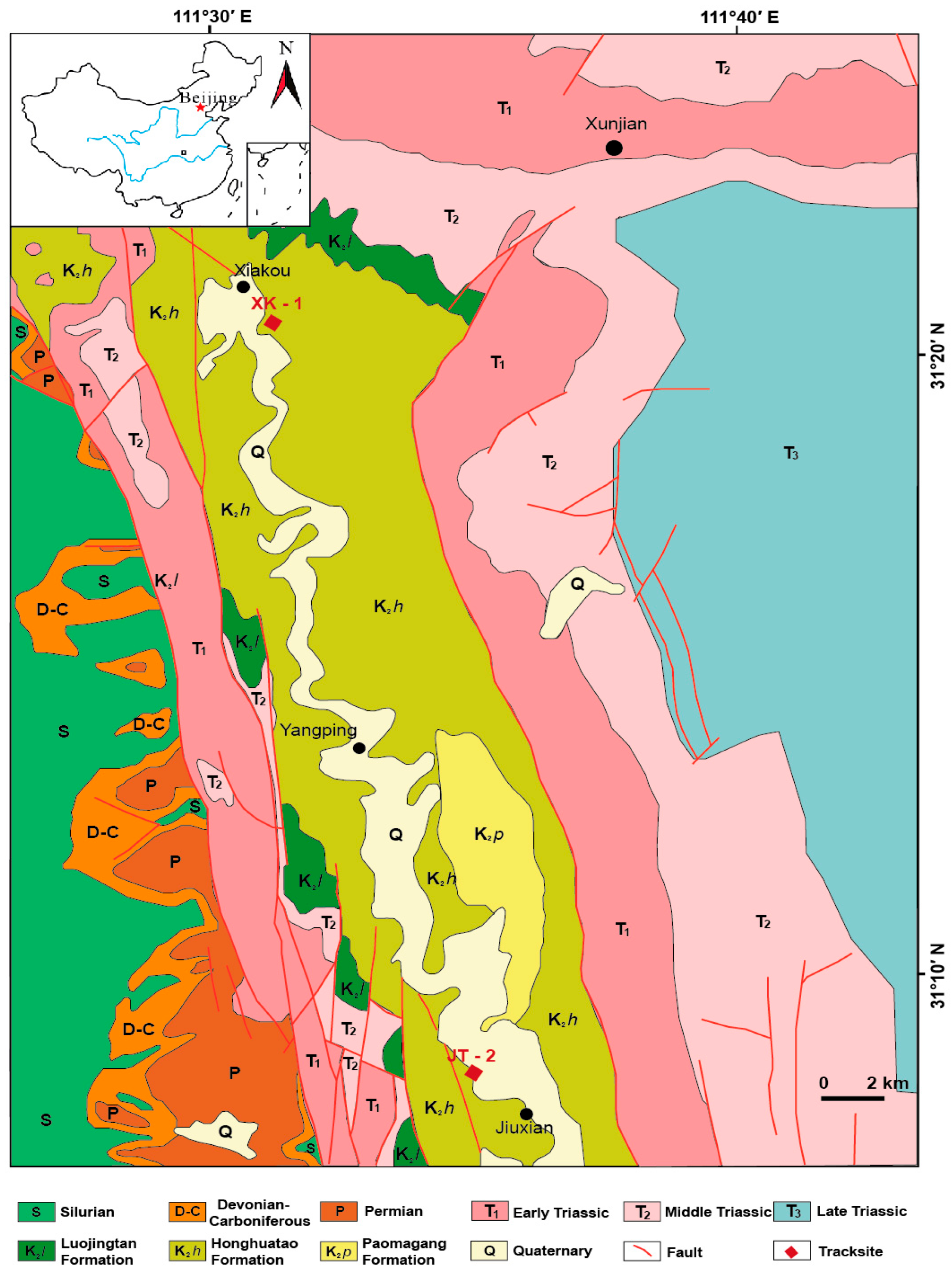
The tracks described were discovered at two distinct localities: Xiakou village (Nanzhang County) and Jiuxian town (Yuan’an County), both situated within the Yuan’an Basin and stratigraphically assigned to the Upper Cretaceous Honghuatao Formation (
Figure 1). The Nanzhang Yuan’an area is known for yielding important Triassic marine reptiles [
9], yet other geological and paleontological research work in this region remains relatively scarce.
The Yuan’an Basin is a secondary graben structure developed along the northwestern margin of the Jianghan Basin, filled predominantly with Upper Cretaceous continental clastic deposits [
11]. Its stratigraphic succession is subdivided into three conformable units, from bottom to top: the Luojingtan Formation (K2l), the Honghuatao Formation (K2h), and the Paomagang Formation (K2p) [
12]. The lowermost unit, the Luojingtan Formation, is characterized by thick-bedded to massive grayish-red, purplish-red, and gray conglomerates, reflecting high-energy depositional conditions. Overlying this, the Honghuatao Formation (the stratigraphic interval preserving the tracks) consists of bright brownish-red and brick-red thick-bedded sandstones, intercalated with argillaceous fine sandstones, siltstones, and mudstones, suggesting a fluvial plain environment with an episodic low-energy phase. The uppermost unit, the Paomagang Formation, is composed of heterogeneous sandstones, siltstones, silty mudstones, and mudstones, indicative of progressively finer-grained and lower-energy depositional conditions.
3. Materials and Methods
Fieldwork was carried out in August 2025. Track-bearing surfaces were carefully assessed for accessibility and track preservation quality, as exposure conditions varied laterally, with several surfaces restricted to thin, fragile bedding planes. A total of eleven isolated tracks were identified and are all documented in this communication.
Before measurement and photography, all surfaces were dry-brushed to remove loose sediment and debris, ensuring that natural track outlines were clearly visible. To facilitate documentation, the internal contour of each track was highlighted with chalk, following standard ichnological practice. Each track was assigned a unique alphanumeric code (prefixed with XK for specimens from Xiakou village and JT for those from Jiuxian town), followed by a lowercase letter to distinguish individual tracks within each locality.
Morphometric data were collected directly in the field using a digital caliper with a precision of 0.1 cm, following established ichnological measurement protocols [
13,
14,
15]. Where preservation permitted, the following parameters were recorded for tridactyl tracks: track length (L), track width (W), toe extension of digit III (te), interdigital angles (II–III, III–IV, and II–IV), and individual digit lengths (LII, LIII, LIV). For the rounded tracks, only length (L) and width (W) were measured. Moreover, the length-to-width ratio (L/W), the narrowness index ([L–W]/W), and the Anterior triangle (AT) were calculated [
14,
16]. All measurements and calculations are reported in a single table in the
Supplementary Materials related to this communication. The tridactyl tracks found are considered small (L < 30 cm), following the repartition proposed by [
17,
18].
4. Preliminary Results
The tracks described in this study represent seven tracks from Xiakou village (XK) and four from Jiuxian town (JT). All Tracks are preserved as concave hyporeliefs on exposed bedding plane surfaces. Based on morphological characteristics, the assemblage is divided into two morphogroups: tridactyl tracks and rounded-oval (sauropod morphology) tracks.
4.1. Tracks from Xiakou Village (XK)
4.1.1. Tridactyl Tracks
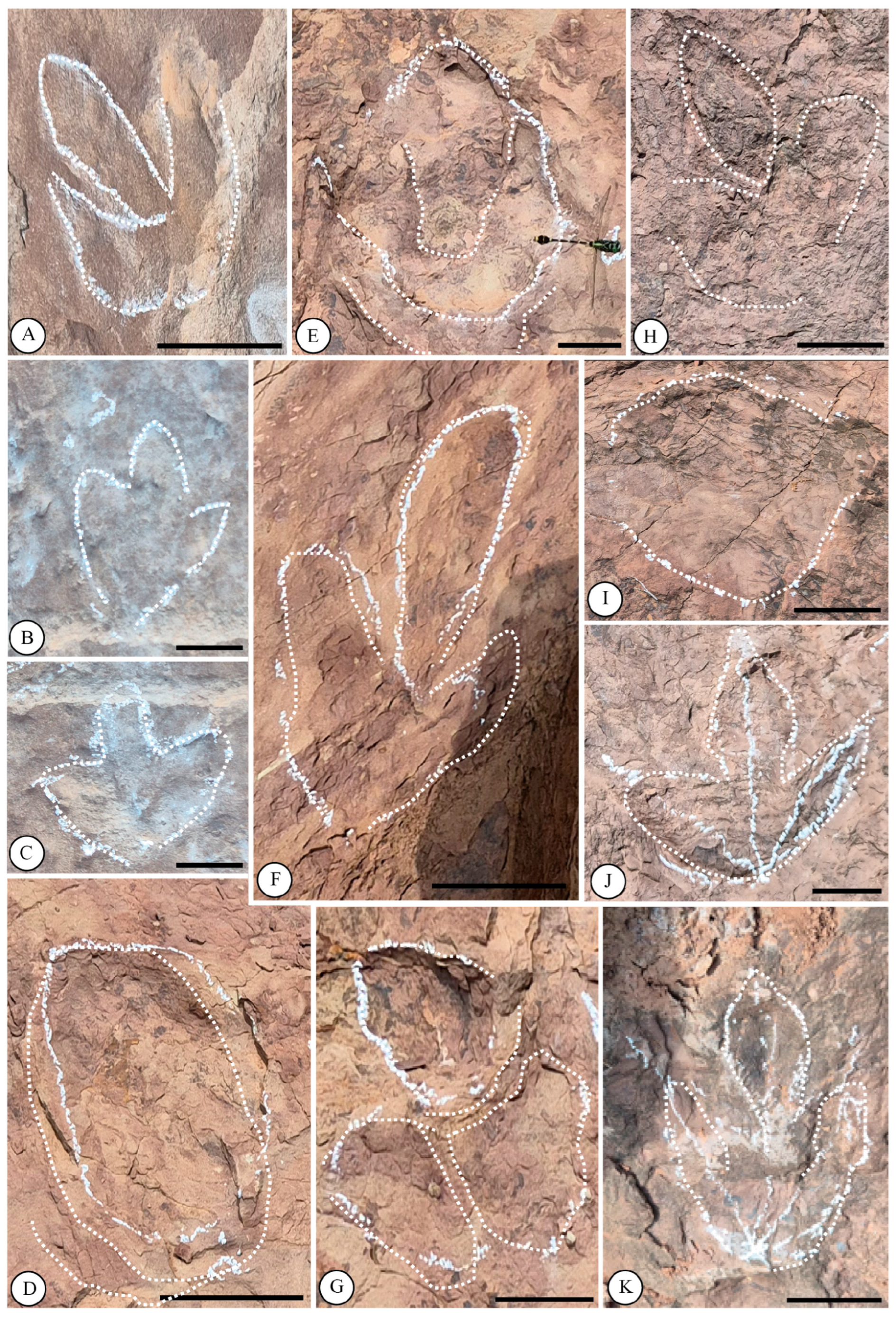
Six of the seven tracks from Xiakou village (XK-1a, XK-1b, XK-1c, XK-1e, XK-1f, XK-1g) display a tridactyl morphology. The track lengths range from 12.0 cm (XK-1c;
Figure 2C) to 25.0 cm (XK-1e;
Figure 2E), and widths from 8.5 cm (XK-1c) to 19.0 cm (XK-1e). All tridactyl tracks are narrow in outline, with length-to-width ratios falling between 0 and 1, consistent with the narrow morphotype defined by Pérez-Lorente [
16,
17]. In these tracks, digit III is consistently the longest, ranging from 6.5 (XK-1b;
Figure 2B) to 18.5 cm (XK-1f;
Figure 2F), flanked by shorter digit II (LII: 3.0–6.0 cm) and digit LIV (LIV: 5.0–12.5 cm). The total divarication angle (II–IV) ranges from 44° to 106°. No claw marks or metatarsal pad impressions were observed. The tracks are coincident with or subparallel to primary sedimentary structures, including ripple marks, and show no evidence of sediment collapse along track walls, suggesting a substrate of appropriate consistency at the time of emplacement. Partial weathering has affected the surface, obscuring some morphological details in some tracks (e.g., XK-1a (
Figure 2A) and XK-1b (
Figure 2B)).
4.1.2. Rounded/Oval Tracks
A single track from Xiakou village (XK-1d;
Figure 2D) shows no clear toe impressions and has a rounded-to-oval outline. Morphometric data were limited to overall length and width, as digital parameters could not be reliably measured. Their close special proximity to well-defined tridactyl tracks, particularly XK-1e (
Figure 2E) and XK-1g (
Figure 2G), is noteworthy and will be discussed in the context of substrate influence below.
4.2. Jiuxian Town Locality (JT)
4.2.1. Tridactyl Tracks
Track lengths range from 11.0 cm (JT-2a) to 18.5 cm (JT-2d), with widths between 14.0 cm (JT-2d) and 16.0 cm (JT-2c). As observed at the XK locality, digit III is consistently the longest in all tracks. Still, the length-to-width ratio is less than 1, and the narrowness index is negative for JT-2a and JT-2c and positive for JT-2d, with a total divarication angle (II-IV) between 99° (JT-2c) and 106° (JT-2a). This can suggest a different morphological characteristic than JT-2d and the rest of the tridactyl tracks reported in Xiakou village.
4.2.2. Rounded/Oval Tracks
One track from Jiuxian town (JT-2b;
Figure 2I) is oval in outline, measuring 19.5 cm by 21 cm. As with XK-1d, its morphology is ambiguous and does not permit confident ichnotaxonomy assignment.
4.3. Ichnotaxonomy Assessment
The tridactyl tracks described here share a consistent set of morphological features: small size (L < 30 cm), narrow outline with positive narrowness index, asymmetric digit configuration with a dominant central digit III, and absence of metatarsal impressions. These characteristics are collectively consistent with small theropod dinosaur ichnofauna [
18,
19,
20]. The exception is observed for the two tracks: JT-2a and JT-2c. These tracks certainly have a tridactyl shape with no claw marks, but their L/W ratio value is lower than 1, and a negative narrowness index, which can indicate that these tracks are relatively broad (W is slightly larger than L). The broad-footed characteristic aligns with ornithischian tracks, which are wider relative to length compared to the slender, narrow tracks of theropods [
14].
The oval/rounded shape is a debatable subject, while in ichnology, the oval/rounded shape is referred to as sauropods [
14,
15]. No trackways or a possible succession of tracks is observed. These traces could be related to sauropods or as extramorphological expressions of theropod or ornithopod tracks without considering or ruling out the possibility of sauropod affinity. Regarding the isolated nature of the track assemblage, its shape remains ichnotaxonomically indeterminate.
5. Discussion
The dinosaur tracks from Xiakou village and Jiuxian town are the first recorded from the Upper Cretaceous Honghuatao Formation from Hubei Province, contributing significantly to the poorly known ichnological record from central China. Among the identified morphotypes, small tridactyl tracks with a pronounced digit III confirm theropod presence, and small, wide tracks showing similarities to theropod tracks and ornithischian from eastern Laurasia and other Cretaceous Chinese sites [
21,
22], suggesting a widespread distribution of small theropods and ornithopods in central Asia [
21]. The rounded/oval impressions lack distinct features and are possibly from substrate consistency and post-depositional alteration, similar to patterns seen at other sites like Paluxy River (USA) and Fumanya (Spain) [
23,
24]. While sauropod involvement cannot be ruled out, the absence of supporting evidence, such as trackways or manus impressions, suggests their influence is minimal. The potential for ornithischian tracks is speculative, though high proportions of ornithischian at other Upper Cretaceous sites [
21] highlight the possibility of mixed assemblages.
Due to the limited track numbers, variable preservation, and lack of continuous trackways, a theropod-dominated fauna cannot be conclusively confirmed. The tridactyl tracks, however, provide clear evidence of theropod activity, while other track types require further study. These results suggest that the scarcity of Late Cretaceous ichnology in central China is likely due to insufficient field exploration, maybe not due to faunal scarcity. This underscores the potential for future surveys, sedimentological analysis, and possible new tracks or vertebrate remains.
6. Conclusions
This study documents the first dinosaur track record from the Upper Cretaceous Honghuatao Formation from Hubei Province, central China. Tridactyl track morphotypes are consistent with small theropod dinosaurs and ornithopods, while rounded tracks remain questionable, most likely resulting from substrate-related modification rather than distinct trackmakers. The small sample size, poor preservation, and absence of continuous trackways limit ichnotaxonomic precision and prevent confident assertions of a theropod-dominated assemblage or any other taxonomical attribution. These findings indicate that the scarcity of ichnological records in this region largely reflects insufficient fieldwork rather than genuine faunal absence. This project is ongoing, and future research will focus on detailed sedimentological and stratigraphic analyses, expanded regional prospecting, and enhanced documentation to reduce morphological ambiguity and improve our understanding of Late Cretaceous dinosaur diversity and distribution in central China.
Author Contributions
N.L.: Conceptualization, Data acquisition, Methodology, Interpretation, Writing, and Editing; X.Z.: Conceptualization, Data acquisition, Methodology, Interpretation, Writing, and Editing; L.C.: Investigation, Funding acquisition, Project administration, Editing; Z.N.: Supervision, Project administration, Editing. All authors have read and agreed to the published version of the manuscript.
Funding
This research was funded by the Natural Science Foundation of China, grant numbers U2544205, U2444201, and 42172038. The China Geological Survey, grant numbers DD20230006, DD20230218, and DD20230100507.
Data Availability Statement
The original contributions presented in this study are included in the
Supplementary Materials. Further inquiries can be directed to the corresponding authors.
Conflicts of Interest
The authors declare no conflicts of interest. The funders had no role in the design of the study; in the collection, analyses, or interpretation of data; in the writing of the manuscript; or in the decision to publish the results.
References
- Plotnick, R.E. Behavioral Biology of Trace Fossils. Paleobiology 2012, 38, 459–473. [Google Scholar] [CrossRef]
- Lockley, M.G. Tracking Dinosaurs: A New Look at an Ancient World; Cambridge University Press: Cambridge, UK, 1991; 264p. [Google Scholar]
- Falkingham, P.L.; Gatesy, S.M. Formation, Preservation, and Interpretation of Dinosaur Tracks. Palaeontology 2026, 69, e70040. [Google Scholar] [CrossRef]
- Martin, A.J. Dinosaurs Without Bones: Dinosaur Lives Revealed by Their Trace Fossils; Simon and Schuster: New York, NY, USA, 2021. [Google Scholar]
- Bernardi, M.; Petti, F.M.; Piñuela, L.; García-Ramos, J.C.; Avanzini, M.; Lockley, M.G. The Mesozoic Vertebrate Radiation in Terrestrial Settings. In The Trace-Fossil Record of Major Evolutionary Events; Mángano, M.G., Buatois, L.A., Eds.; Topics in Geobiology, Volume 40; Springer: Dordrecht, The Netherlands, 2016; pp. 135–177. [Google Scholar] [CrossRef]
- Xing, L.; Niu, K. The First Dinosaur Track Assemblages from the Upper Cretaceous Shaxian Formation, Fujian Province, Southeastern China. Cretac. Res. 2023, 163, 105486. [Google Scholar] [CrossRef]
- Xing, L.; Lockley, M.G.; Wang, Y.D.; Pole, M.S.; Klein, H.; Peng, G.Z.; Xie, X.P.; Zhang, G.Q.; Deng, C.T.; Burns, M.E. New Middle Jurassic Dinosaur Track Record from Northeastern Sichuan Province, China. Swiss J. Palaeontol 2017, 136, 359–364. [Google Scholar] [CrossRef]
- Li, Y.; Yao, H.; Yu, Y.; Foster, W.J.; Wang, C.; Zhao, L.; Xing, L. First Report of Sauropod and Ornithopod Tracks from the Upper Cretaceous of Tibet, China. Cretac. Res. 2023, 149, 105569. [Google Scholar] [CrossRef]
- Fang, Z.; Cheng, L.; Yan, C. A Review on the Early Triassic Nanzhang-Yuanan Fauna of Hubei Province, South China. South China Geolog. 2020, 1, 80–86. (In Chinese) [Google Scholar] [CrossRef]
- Yan, C.; Li, J.; Cheng, L.; Zhao, B.; Zou, Y.; Niu, D.; Chen, G.; Fang, Z. Strata characteristics of the Early Triassic Nanzhang-Yuan’an Fauna in Western Hubei Province. Earth Sci. 2021, 46, 122–135, (In Chinese with English Abstract). [Google Scholar] [CrossRef]
- Peng, L.; Shen, C.; Yang, Z.; Ge, X. Apatite Fission-Track Data from Upper Cretaceous Formations in the Yuan’an Graben (China): Constraints on the Timing of Synsedimentary Fault Activity. Radiat. Meas. 2013, 50, 187–191. (In Chinese) [Google Scholar] [CrossRef]
- Wang, C.; Shan, Y. Conditions of Deformation Bands in the Cretaceous Yuan’an Basin, Western Hubei, Central China. Geotecton. Et Metallog. 2018, 42, 1001–1009, (In Chinese with English Abstract). [Google Scholar]
- Manning, P.L. A New Approach to the Analysis and Interpretation of Tracks: Examples from the Dinosauria. Geol. Soc. Lond. Spec. Publ. 2004, 228, 93–123. [Google Scholar] [CrossRef]
- Thulborn, T. Dinosaur Tracks; Springer: London, UK, 1990; 424p. [Google Scholar]
- Leonardi, G. (Ed.) Glossary and Manual of Tetrapod Footprint Palaeoichnology; Departamento Nacional da Produçao Mineral: Distrito Federal, Brasil, 1987; p. 117.
- Pérez-Lorente, F.; Romero-Molina, M.M. Nuevas Icnitas de Dinosaurios Terópodos y Saurópodos en Galve y Miravete de la Sierra (Teruel, España). Geogaceta 2001, 30, 115–118. [Google Scholar]
- Pérez-Lorente, F. Dinosaur Footprints and Trackways of La Rioja; Indiana University Press: Bloomington, IN, USA, 2015. [Google Scholar]
- Ceniceros, J.M.; Masrour, M.; Boutakiout, M.; Extremiana, J.I.; Pérez-Lorente, F. Analysis of Very Small-Small Theropod Footprints Data from Imilchil Tracksite (High Central Atlas, Morocco): A Concordance Model for a Global Scale. J. Afr. Earth Sci. 2024, 219, 105389. [Google Scholar] [CrossRef]
- Lallensack, J.N. Automatic Generation of Objective Footprint Outlines. PeerJ 2019, 7, e7203. [Google Scholar] [CrossRef] [PubMed]
- Falkingham, P.L.; Bates, K.T.; Avanzini, M.; Bennett, M.; Bordy, E.M.; Breithaupt, B.H.; Castanera, D.; Citton, P.; Díaz-Martínez, I.; Farlow, J.O.; et al. A standard protocol for documenting modern and fossil ichnological data. Palaeontology 2018, 61, 469–480. [Google Scholar] [CrossRef]
- Xing, L.; Lockley, M.G.; Li, D.; Klein, H.; Ye, Y.; Persons, W.S., IV; Ran, H. Late Cretaceous ornithopod-dominated, theropod, and pterosaur track assemblages from the Nanxiong Basin, China: New discoveries, ichnotaxonomy, and paleoecology. Palaeogeogr. Palaeoclimatol. Palaeoecol. 2017, 466, 303–313. [Google Scholar] [CrossRef]
- Xing, L.; Yang, G.; Cao, J.; Lockley, M.G.; Klein, H.; Zhang, J.; Qin, Y. Cretaceous saurischian tracksites from southwest Sichuan Province and overview of Late Cretaceous dinosaur track assemblages of China. Cretac. Res. 2015, 56, 458–469. [Google Scholar] [CrossRef]
- Farlow, J.O.; Bates, K.T.; Bonem, R.M.; Dattilo, B.F.; Falkingham, P.L.; Gildner, R.; Whitcraft, J. Dinosaur Footprints from the Glen Rose Formation (Paluxy River, Dinosaur Valley State Park, Somervell County, Texas). In Early-and Mid-Cretaceous Archosaur Localities of North-Central Texas, Field Trip Guidebook; Academics: Cambridge, MA, USA, 2015; pp. 14–37. [Google Scholar]
- Schulp, A.S.; Brokx, W.A. Maastrichtian sauropod footprints from the Fumanya site, Bergueda, Spain. Ichnos 1999, 6, 239–250. [Google Scholar] [CrossRef]
| Disclaimer/Publisher’s Note: The statements, opinions and data contained in all publications are solely those of the individual author(s) and contributor(s) and not of MDPI and/or the editor(s). MDPI and/or the editor(s) disclaim responsibility for any injury to people or property resulting from any ideas, methods, instructions or products referred to in the content. |